Trump Supporters Score Higher on Verbal Ability Tests

The fracas over Don Lemon of CNN laughing at his panel’s insults about the intelligence of Trump supporters raises a larger issue: the ignorant belief that Trump supporters are much dumber than the general public and much dumber than those who supported Clinton in 2016.  Don Lemon and his guests specifically ridiculed Trump supporters for supposed problems with “readin'” and “geography” (e.g., picking out Ukraine on a map).

Even without looking at the data, it would be surprising if there were any VERY LARGE differences in intelligence between the average Trump supporter and the rest of the general public.

INTELLIGENCE OF TRUMP SUPPORTERS

We don’t have great data on the intelligence of Trump supporters, but the best available is in the 2018 General Social Survey. For those unfamiliar with the GSS, it is generally regarded as the leading omnibus academic survey in the US; it usually achieves response rates about 10 to 20 times higher than the typical public opinion poll.

In 1974, the GSS adopted a 10-question vocabulary test (WORDSUM) that was extracted from a standard, widely used IQ test. The National Science Foundation (NSF), in its 2018 report on science knowledge, refers to this battery of GSS items as a “verbal ability” test.

In the 2018 GSS, respondents were asked for whom they voted in 2016 (PRES16) or for whom they would have voted if they had voted (IF16WHO): Clinton, Trump, someone else, or no one.

On the verbal ability test (WORDSUM), not surprisingly the median number of vocabulary questions correct was the same for both Clinton and Trump supporters: 6 out of 10 words correct.  The mean verbal ability score for Trump supporters was 6.15 words correct, while the mean verbal ability score for Clinton supporters was 5.69 correct, a difference of nearly a half a question on a 10-question test.  This moderate difference is statistically significant at p<.0005.

Further, Trump supporters score significantly higher on verbal ability (6.15 correct) than the rest of the public combined (5.70 correct), whereas Clinton supporters score significantly lower on verbal ability (5.69 correct) than the rest of the public combined (5.98 correct).

This should not be too surprising. On the 22 General Social Surveys using the verbal ability scale since 1974, for every single one, conservative Republicans score significantly higher than the rest of the public combined. As for Republicans overall, they score significantly higher in verbal ability than Democrats in all five decades, including for the 2010s combined.

But the Trump era is helping Democrats to catch up: the Republican advantage dropped to insignificance in 2016, and in 2018 Democrats (6.03 correct) actually scored slightly (but insignificantly) higher than Republicans (5.98 correct).

In 1996, the GSS employed another module lifted from a standard IQ test, one testing analogical reasoning.  Again, Republicans and conservative Republicans in 1996 performed significantly better on analogical reasoning than the rest of the public and significantly better than Democrats.

TRUMP SUPPORTERS’ KNOWLEDGE OF SCIENCE

These results on verbal ability are also consistent with the results of most (but not all) of the National Science Foundation’s science knowledge questions on the GSS.

Testing the hypothesis that Trump supporters have greater science knowledge than those who supported Clinton in 2016, on six questions Trump supporters offer the correct answer significantly more often than Clinton supporters: those about lasers, radioactivity, viruses, the father’s contribution to the biological sex of the child (BOYORGRL), whether “according to astronomers” the universe began with a huge explosion (BIGBANG1), and that the earth goes around the sun and that it takes a year to do so (combined EARTHSUN and SOLARREV).

On one science knowledge question—whether the center of the earth is hot (HOTCORE)—the superior performance of Trump supporters over Clinton supporters is borderline significant (1-sided Fisher’s Exact Test p=.05-.10).

On two questions, the structure of atoms (ELECTRON) and continental drift (CONDRIFT), Trump supporters score slightly, but insignificantly, better than Clinton supporters. On none of these nine science questions do Trump supporters score worse than Clinton supporters.

When one compares Clinton supporters to the rest of the public combined, Clinton supporters perform significantly worse than the rest of the public on the same six science questions on which Trump supporters perform better than Clinton supporters.

Indeed, less than half of 2016 Clinton supporters (49.6%) are able to answer correctly both of two related questions: whether the earth goes around the sun or the sun goes around the earth (EARTHSUN) and whether that takes a day, a month, or a year (SOLARREV).  Remember these two questions are multiple choice! You would have a 50-50 chance of guessing correctly on the first part: whether the earth goes around the sun or vice versa. Sadly, the general public that didn’t do hugely better than Clinton supporters, with only 57.1% (compared to 49.6%) knowing that the earth goes around the sun and that it takes a year to do so.

When one compares Trump supporters to all the rest of the public combined (rather than just to Clinton supporters), the pattern for these nine science questions is roughly similar (though weaker).

Overall, on most science knowledge questions Trump supporters score significantly higher than Clinton supporters and significantly higher than the combined non-Trump supporting public. Usually, you have to ask about beliefs, rather than knowledge, about evolution and the origins of the universe to get any substantially better answers on individual science questions from Clinton supporters than Trump supporters.

MAP-READING

As for reading maps and picking out countries, which the CNN segment raised, I searched quickly and found two Pew surveys from 2013 that asked respondents to pick out Egypt or Syria on a map of the Middle East. Testing the hypothesis that Republicans were significantly better at finding an unlabeled country on a map than Democrats, one 2013 Pew study supported that hypothesis (Republicans were indeed significantly more likely to pick out Syria on a map), while the other 2013 Pew study reported that Democrats were insignificantly better at picking out Egypt on a map.

Thus, neither of these two studies supports the CNN’s panel’s ridicule of right-wing map reading, and there is some weak evidence pointing in the other direction. Of course, this was a test of Republicans, not Trump supporters, but Trump supporters did better on the 2018 GSS verbal ability test and on 2018 science knowledge questions, so there is no strong reason to suppose that the results would be radically different if one were to test Trump supporters today rather than Republicans in 2013.  In 2013 the differences were not large either way, and it’s unwarranted to suppose that (in a study of the quality of the GSS) any differences in map-reading would be large today.

IGNORANCE LEADS TO BIGOTRY

Don Lemon laughed uncontrollably at his guests insulting the intelligence and knowledge of Trump supporters. The best evidence we have suggests that, compared to the general public, Trump supporters score significantly better than the rest of the public—and Clinton supporters score significantly worse—on a standard verbal ability test. Likewise,  Trump supporters score significantly better on most science knowledge questions than Clinton supporters or the general public.

In this essay, I analyzed the results of over 30 questions from 22 different representative national surveys, involving over 20,000 respondents. Not one of the questions I examined here supports the idea that Trump supporters are significantly less knowledgeable than Clinton supporters, and some of them point to small or moderate differences in the opposite direction. The idea that there are very large differences in intelligence or knowledge here is implausible without strong evidence.

In short, Don Lemon is a bigot—and like most bigots, he’s an ignorant one as well.


[Disclosure: The author made a small donation to the Hillary Clinton campaign in the fall of 2016.]

[Research Note: General Social Survey data were downloaded from NORC. GSS data are weighted by WTSALL. On science questions, I coded the correct answers v. those who gave wrong answers, said they don’t know, or failed to answer.  The Pew data were downloaded from the IPOLL database at the Roper Center, and the WEIGHT variable was used. For 2×2 tables, significance was determined by 1-tailed Fisher Exact tests. For differences of means, 1-sided independent T-Tests were used without assuming equal variances.]


from Latest – Reason.com https://ift.tt/2vrEygH
via IFTTT

Trump Supporters Score Higher on Verbal Ability Tests

The fracas over Don Lemon of CNN laughing at his panel’s insults about the intelligence of Trump supporters raises a larger issue: the ignorant belief that Trump supporters are much dumber than the general public and much dumber than those who supported Clinton in 2016.  Don Lemon and his guests specifically ridiculed Trump supporters for supposed problems with “readin'” and “geography” (e.g., picking out Ukraine on a map).

Even without looking at the data, it would be surprising if there were any VERY LARGE differences in intelligence between the average Trump supporter and the rest of the general public.

INTELLIGENCE OF TRUMP SUPPORTERS

We don’t have great data on the intelligence of Trump supporters, but the best available is in the 2018 General Social Survey. For those unfamiliar with the GSS, it is generally regarded as the leading omnibus academic survey in the US; it usually achieves response rates about 10 to 20 times higher than the typical public opinion poll.

In 1974, the GSS adopted a 10-question vocabulary test (WORDSUM) that was extracted from a standard, widely used IQ test. The National Science Foundation (NSF), in its 2018 report on science knowledge, refers to this battery of GSS items as a “verbal ability” test.

In the 2018 GSS, respondents were asked for whom they voted in 2016 (PRES16) or for whom they would have voted if they had voted (IF16WHO): Clinton, Trump, someone else, or no one.

On the verbal ability test (WORDSUM), not surprisingly the median number of vocabulary questions correct was the same for both Clinton and Trump supporters: 6 out of 10 words correct.  The mean verbal ability score for Trump supporters was 6.15 words correct, while the mean verbal ability score for Clinton supporters was 5.69 correct, a difference of nearly a half a question on a 10-question test.  This moderate difference is statistically significant at p<.0005.

Further, Trump supporters score significantly higher on verbal ability (6.15 correct) than the rest of the public combined (5.70 correct), whereas Clinton supporters score significantly lower on verbal ability (5.69 correct) than the rest of the public combined (5.98 correct).

This should not be too surprising. On the 22 General Social Surveys using the verbal ability scale since 1974, for every single one, conservative Republicans score significantly higher than the rest of the public combined. As for Republicans overall, they score significantly higher in verbal ability than Democrats in all five decades, including for the 2010s combined.

But the Trump era is helping Democrats to catch up: the Republican advantage dropped to insignificance in 2016, and in 2018 Democrats (6.03 correct) actually scored slightly (but insignificantly) higher than Republicans (5.98 correct).

In 1996, the GSS employed another module lifted from a standard IQ test, one testing analogical reasoning.  Again, Republicans and conservative Republicans in 1996 performed significantly better on analogical reasoning than the rest of the public and significantly better than Democrats.

TRUMP SUPPORTERS’ KNOWLEDGE OF SCIENCE

These results on verbal ability are also consistent with the results of most (but not all) of the National Science Foundation’s science knowledge questions on the GSS.

Testing the hypothesis that Trump supporters have greater science knowledge than those who supported Clinton in 2016, on six questions Trump supporters offer the correct answer significantly more often than Clinton supporters: those about lasers, radioactivity, viruses, the father’s contribution to the biological sex of the child (BOYORGRL), whether “according to astronomers” the universe began with a huge explosion (BIGBANG1), and that the earth goes around the sun and that it takes a year to do so (combined EARTHSUN and SOLARREV).

On one science knowledge question—whether the center of the earth is hot (HOTCORE)—the superior performance of Trump supporters over Clinton supporters is borderline significant (1-sided Fisher’s Exact Test p=.05-.10).

On two questions, the structure of atoms (ELECTRON) and continental drift (CONDRIFT), Trump supporters score slightly, but insignificantly, better than Clinton supporters. On none of these nine science questions do Trump supporters score worse than Clinton supporters.

When one compares Clinton supporters to the rest of the public combined, Clinton supporters perform significantly worse than the rest of the public on the same six science questions on which Trump supporters perform better than Clinton supporters.

Indeed, less than half of 2016 Clinton supporters (49.6%) are able to answer correctly both of two related questions: whether the earth goes around the sun or the sun goes around the earth (EARTHSUN) and whether that takes a day, a month, or a year (SOLARREV).  Remember these two questions are multiple choice! You would have a 50-50 chance of guessing correctly on the first part: whether the earth goes around the sun or vice versa. Sadly, the general public that didn’t do hugely better than Clinton supporters, with only 57.1% (compared to 49.6%) knowing that the earth goes around the sun and that it takes a year to do so.

When one compares Trump supporters to all the rest of the public combined (rather than just to Clinton supporters), the pattern for these nine science questions is roughly similar (though weaker).

Overall, on most science knowledge questions Trump supporters score significantly higher than Clinton supporters and significantly higher than the combined non-Trump supporting public. Usually, you have to ask about beliefs, rather than knowledge, about evolution and the origins of the universe to get any substantially better answers on individual science questions from Clinton supporters than Trump supporters.

MAP-READING

As for reading maps and picking out countries, which the CNN segment raised, I searched quickly and found two Pew surveys from 2013 that asked respondents to pick out Egypt or Syria on a map of the Middle East. Testing the hypothesis that Republicans were significantly better at finding an unlabeled country on a map than Democrats, one 2013 Pew study supported that hypothesis (Republicans were indeed significantly more likely to pick out Syria on a map), while the other 2013 Pew study reported that Democrats were insignificantly better at picking out Egypt on a map.

Thus, neither of these two studies supports the CNN’s panel’s ridicule of right-wing map reading, and there is some weak evidence pointing in the other direction. Of course, this was a test of Republicans, not Trump supporters, but Trump supporters did better on the 2018 GSS verbal ability test and on 2018 science knowledge questions, so there is no strong reason to suppose that the results would be radically different if one were to test Trump supporters today rather than Republicans in 2013.  In 2013 the differences were not large either way, and it’s unwarranted to suppose that (in a study of the quality of the GSS) any differences in map-reading would be large today.

IGNORANCE LEADS TO BIGOTRY

Don Lemon laughed uncontrollably at his guests insulting the intelligence and knowledge of Trump supporters. The best evidence we have suggests that, compared to the general public, Trump supporters score significantly better than the rest of the public—and Clinton supporters score significantly worse—on a standard verbal ability test. Likewise,  Trump supporters score significantly better on most science knowledge questions than Clinton supporters or the general public.

In this essay, I analyzed the results of over 30 questions from 22 different representative national surveys, involving over 20,000 respondents. Not one of the questions I examined here supports the idea that Trump supporters are significantly less knowledgeable than Clinton supporters, and some of them point to small or moderate differences in the opposite direction. The idea that there are very large differences in intelligence or knowledge here is implausible without strong evidence.

In short, Don Lemon is a bigot—and like most bigots, he’s an ignorant one as well.


[Disclosure: The author made a small donation to the Hillary Clinton campaign in the fall of 2016.]

[Research Note: General Social Survey data were downloaded from NORC. GSS data are weighted by WTSALL. On science questions, I coded the correct answers v. those who gave wrong answers, said they don’t know, or failed to answer.  The Pew data were downloaded from the IPOLL database at the Roper Center, and the WEIGHT variable was used. For 2×2 tables, significance was determined by 1-tailed Fisher Exact tests. For differences of means, 1-sided independent T-Tests were used without assuming equal variances.]


from Latest – Reason.com https://ift.tt/2vrEygH
via IFTTT

House Moves To Give Homeland Security More Power To Snoop

Some unsettling new legislation has been quietly advancing in Congress. Called the Cybersecurity and Vulnerability Identification and Notification Act of 2020, the bill passed out of the House Committee on Homeland Security yesterday and will now go to the full House for a vote.

The legislation—like its companion in the Senate—gives the Department of Homeland Security (DHS) more power to subpoena information from internet and telecommunications companies, including subscriber names, addresses, and telephone numbers.

Rep. James Langevin (D–R.I.), one of the bill’s sponsors, describes it as giving the new Cybersecurity and Infrastructure Security Agency (CISA)—created by President Donald Trump in 2018—”the ability to say something when they see something.”

That’s the first sign that something might be off, since “see something, say something” is more or less the motto for DHS-enabled snooping and security theater.

A press release from Langevin’s office insists that subpoenaed data will “only to be used for notification about a risk, not for surveillance or investigation purposes.” Why do I not feel reassured?

The legislation grants that “the director of Homeland Security may issue a subpoena for the production of information necessary to identify” suspected security vulnerabilities in an “information system connected to the internet,” so long as DHS says the potential risk is connected “to critical infrastructure.”

Compelling private information when it involves risks to “critical infrastructure” might sound smart. But it’s important to keep in mind that it doesn’t take much for CISA to deem something critical infrastructure. The agency’s 16 sectors of critical infrastructure extend to such places as casinos, hotels, motels, campgrounds, zoos, shopping malls, self-storage facilities, condominiums, banks, insurance companies, and motion picture studios.

Also relevant: just how loose Homeland Security’s definition of “risk” is. This month, for instance, the agency has been warning about the purportedly high risk of sex traffickers at the Super Bowl—an urban legend that has been thoroughly, repeatedly debunked.

Langevin claims that in the past, potential risks have been identified but “CISA has not been able to identify the owner of a vulnerable system and warn them of their exposure.” The new policy would force “telecommunications companies that may have relevant subscriber information that could make it easier to identify the subscriber assigned an IP address” to share that information with Homeland Security.

That sounds like a good way for DHS to demand identifying information on any systems, services, or subscribers it wants.

The bill was sponsored by Reps. Langevin, Sheila Jackson Lee (D–Texas), Cedric Richmond (D–La.), Bennie Thompson (D–Miss.), John Katko (R–N.Y.), and John Ratcliffe (R–Texas). Its companion bill in the Senate was introduced in December by Homeland Security Committee Chair Ron Johnson (R–Wisc.) and Sen. Maggie Hassan (D–N.H.).

Thompson has said the bill will likely be part of a bigger package of “DHS authorization legislation.”


FREE MARKETS

Another California city is effectively decriminalizing hallucinogenic mushrooms. A new ordinance adopted this week in Santa Cruz says “the investigation and arrest of individuals involved with the adult possession, use, or cultivation of psychoactive plants and fungi listed on the Federal Schedule 1 list for personal adult use and clinical research be among the lowest priorities for the city of Santa Cruz.”

Meanwhile, the feds are still going after marijuana sellers in states where the drug is legal. Michigan resident Danny Trevino was just sentenced to more than 15 years in federal prison for running medical marijuana dispensaries in a state that allows medical marijuana. “He was not allowed to use the state’s medical-marijuana law as a defense to the federal charges,” MLive.com reports.


FREE MINDS

David French on “the growing threat to free speech online”: attempts to overhaul or abolish Section 230. “Hostility against Big Tech may cause our nation to blunder into changing the nature of the internet to enhance the power of the elite at the expense of ordinary Americans,” French writes at Time.

One frightening development on this front has been Attorney General Bill Barr jumping on the anti–Section 230 bandwagon. Section 230 doesn’t apply to federal criminal investigations of the sort Barr is supposed to be worrying over.

For a 101 on Section 230 and its foes, see this ReasonTV video:


QUICK HITS

  • Good news: U.S. life expectancy is on the upswing again, according to the latest report from the Centers for Disease Control and Prevention.
  • Clearview has been marketing its facial recognition technology to law enforcement, promising to find matches in 75 percent of all searches. “That doesn’t actually mean it finds the right person 75% of the time,” notes Tim Cushing. “It only means the software finds someone that matches submitted photos three-quarters of the time.” Meanwhile, BuzzFeed finds that Clearview has been lying about the police agencies it has worked with.
  • Elizabeth Warren wants “criminal penalties for spreading disinformation online,” CNBC tweeted yesterday. Read Scott Shackford here for what Warren actually proposed.

from Latest – Reason.com https://ift.tt/2GxJYcm
via IFTTT

UK’s Guardian Bans Ads From Oil, Gas Firms In World’s Media First

UK’s Guardian Bans Ads From Oil, Gas Firms In World’s Media First

Authored Tsvetana Paraskova via OilPrice.com,

UK newspaper Guardian will not accept advertising money from the fossil fuel industry, even if this means a financial hit for the media, making it the world’s first large news organization to ban oil and gas adds.

The Guardian has been active in recent years in covering climate change and reporting on the climate crisis. Last year, the Guardian changed its style guide to use stronger language to describe the climate emergency, using words such as ‘climate crisis’ and ‘climate emergency’ instead of ‘climate change.’

Now the Guardian is outright banning advertising money from oil and gas companies, with immediate effect, the newspaper said on Wednesday.

“Our decision is based on the decades-long efforts by many in that industry to prevent meaningful climate action by governments around the world,” the company’s acting chief executive, Anna Bateson, and the chief revenue officer, Hamish Nicklin, said in a joint statement.

The Guardian has also recently pledged to become a carbon neutral organization at a corporate level by 2030, and to almost entirely divest its Scott Trust endowment fund from fossil fuels.  

Guardian Media Group (GMG) generates 40 percent of its revenue from advertising, so rejecting ads from oil and gas companies would be a financial hit to the organization, the managers said.

The funding model for the Guardian – like most high-quality media companies – is going to remain precarious over the next few years. It’s true that rejecting some adverts might make our lives a tiny bit tougher in the very short term. Nonetheless, we believe building a more purposeful organisation and remaining financially sustainable have to go hand in hand,” Bateson and Nicklin said.  

Greenpeace UK welcomed Guardian’s move, saying that “This is a huge moment in the battle against oil and gas for all of us! Guardian have just announced they won’t let dirty oil and gas companies advertise with them anymore because we’re in a climate emergency.” 

The environmental organization called on other media to follow suit because “Dirty oil and gas companies are making the climate emergency worse. They belong in the history books. Not in our news outlets.”  


Tyler Durden

Thu, 01/30/2020 – 10:25

via ZeroHedge News https://ift.tt/2tRnFMd Tyler Durden

“I’m In An Apocalypse” – New Accounts From Wuhan Detail Coronavirus Outbreak

“I’m In An Apocalypse” – New Accounts From Wuhan Detail Coronavirus Outbreak

Global equity markets are taking a beating on Thursday as the death toll climbs to 170 from 132, with 7,711 cases of coronavirus confirmed in China and 7,814 worldwide. 

The developments over the last several weeks could force the World Health Organization (WHO) to issue a global alert over the alarming infection rate of the deadly virus. 

Evidence shows the virus can be transmitted from person to person before any signs or symptoms, which is one of the reasons why the WHO could soon declare a Public Health Emergency of International Concern (PHEIC), as the virus spreads across the world. 

Dozens of cities are shut down across China, more than 50 million folks are quarantined to their homes, and experts have warned there’s no vaccine for at least one year, suggests the deadly virus will continue to spread across China and the world. 

Airline carriers started to cut flights to and from China on Wednesday. Western companies have announced factory and retail store closings across the country, and this will likely result in a massive loss of business that could produce an economic shock felt around the world

Late last week, a Wuhan nurse made an emotional video on social media, claiming more than 90,000 have already been infected. 

On Wednesday, the Epoch Times tweeted an interview with a Wuhan citizen, who says people in the outbreak areas “can’t get any medical treatments” nor “a diagnosis” because hospitals are overloaded with patients. He said people “sit and wait to die.” 

“Imagine being a Wuhan citizen…they can’t get any medical treatments, they can’t even get a diagnosis. They can only sit and wait to die.”

He warned that transmission of the deadly virus isn’t just “oral” but also “through the eyes.”  

He said the government isn’t telling the truth about symptoms, because in many cases, there are no symptoms as people spread the disease during the incubation period, which could be 7 to 10 days before signs are seen. 

Another perspective of life in Wuhan is nothing short of an “apocalypse,” said 21-year-old US-born college student Nicholas Schneider, who was interviewed by Reuters on Wednesday. 

RTRS Schneider interview 

“It’s like a ghost town, barely any people and cars. It’s a weird feeling. I feel like I’m in an apocalypse somehow,” Schneider said via a phone interview.

It’s only a matter of time before cities outside of China are locked down on coronavirus fears as there’s no vaccine for 12 months.  


Tyler Durden

Thu, 01/30/2020 – 10:05

via ZeroHedge News https://ift.tt/2GzNlzo Tyler Durden

House Moves To Give Homeland Security More Power To Snoop

Some unsettling new legislation has been quietly advancing in Congress. Called the Cybersecurity and Vulnerability Identification and Notification Act of 2020, the bill passed out of the House Committee on Homeland Security yesterday and will now go to the full House for a vote.

The legislation—like its companion in the Senate—gives the Department of Homeland Security (DHS) more power to subpoena information from internet and telecommunications companies, including subscriber names, addresses, and telephone numbers.

Rep. James Langevin (D–R.I.), one of the bill’s sponsors, describes it as giving the new Cybersecurity and Infrastructure Security Agency (CISA)—created by President Donald Trump in 2018—”the ability to say something when they see something.”

That’s the first sign that something might be off, since “see something, say something” is more or less the motto for DHS-enabled snooping and security theater.

A press release from Langevin’s office insists that subpoenaed data will “only to be used for notification about a risk, not for surveillance or investigation purposes.” Why do I not feel reassured?

The legislation grants that “the director of Homeland Security may issue a subpoena for the production of information necessary to identify” suspected security vulnerabilities in an “information system connected to the internet,” so long as DHS says the potential risk is connected “to critical infrastructure.”

Compelling private information when it involves risks to “critical infrastructure” might sound smart. But it’s important to keep in mind that it doesn’t take much for CISA to deem something critical infrastructure. The agency’s 16 sectors of critical infrastructure extend to such places as casinos, hotels, motels, campgrounds, zoos, shopping malls, self-storage facilities, condominiums, banks, insurance companies, and motion picture studios.

Also relevant: just how loose Homeland Security’s definition of “risk” is. This month, for instance, the agency has been warning about the purportedly high risk of sex traffickers at the Super Bowl—an urban legend that has been thoroughly, repeatedly debunked.

Langevin claims that in the past, potential risks have been identified but “CISA has not been able to identify the owner of a vulnerable system and warn them of their exposure.” The new policy would force “telecommunications companies that may have relevant subscriber information that could make it easier to identify the subscriber assigned an IP address” to share that information with Homeland Security.

That sounds like a good way for DHS to demand identifying information on any systems, services, or subscribers it wants.

The bill was sponsored by Reps. Langevin, Sheila Jackson Lee (D–Texas), Cedric Richmond (D–La.), Bennie Thompson (D–Miss.), John Katko (R–N.Y.), and John Ratcliffe (R–Texas). Its companion bill in the Senate was introduced in December by Homeland Security Committee Chair Ron Johnson (R–Wisc.) and Sen. Maggie Hassan (D–N.H.).

Thompson has said the bill will likely be part of a bigger package of “DHS authorization legislation.”


FREE MARKETS

Another California city is effectively decriminalizing hallucinogenic mushrooms. A new ordinance adopted this week in Santa Cruz says “the investigation and arrest of individuals involved with the adult possession, use, or cultivation of psychoactive plants and fungi listed on the Federal Schedule 1 list for personal adult use and clinical research be among the lowest priorities for the city of Santa Cruz.”

Meanwhile, the feds are still going after marijuana sellers in states where the drug is legal. Michigan resident Danny Trevino was just sentenced to more than 15 years in federal prison for running medical marijuana dispensaries in a state that allows medical marijuana. “He was not allowed to use the state’s medical-marijuana law as a defense to the federal charges,” MLive.com reports.


FREE MINDS

David French on “the growing threat to free speech online”: attempts to overhaul or abolish Section 230. “Hostility against Big Tech may cause our nation to blunder into changing the nature of the internet to enhance the power of the elite at the expense of ordinary Americans,” French writes at Time.

One frightening development on this front has been Attorney General Bill Barr jumping on the anti–Section 230 bandwagon. Section 230 doesn’t apply to federal criminal investigations of the sort Barr is supposed to be worrying over.

For a 101 on Section 230 and its foes, see this ReasonTV video:


QUICK HITS

  • Good news: U.S. life expectancy is on the upswing again, according to the latest report from the Centers for Disease Control and Prevention.
  • Clearview has been marketing its facial recognition technology to law enforcement, promising to find matches in 75 percent of all searches. “That doesn’t actually mean it finds the right person 75% of the time,” notes Tim Cushing. “It only means the software finds someone that matches submitted photos three-quarters of the time.” Meanwhile, BuzzFeed finds that Clearview has been lying about the police agencies it has worked with.
  • Elizabeth Warren wants “criminal penalties for spreading disinformation online,” CNBC tweeted yesterday. Read Scott Shackford here for what Warren actually proposed.

from Latest – Reason.com https://ift.tt/2GxJYcm
via IFTTT

This Won’t End Well…

This Won’t End Well…

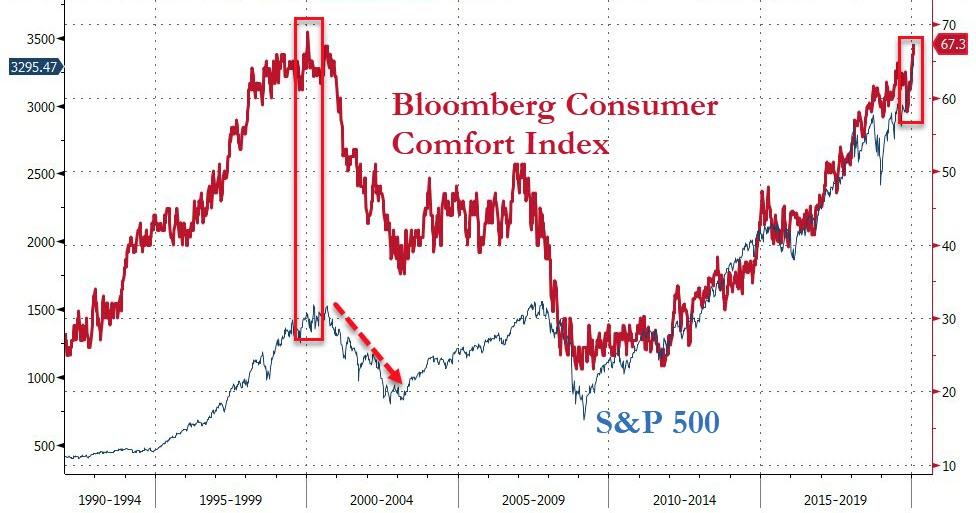
According to Bloomberg’s latest survey, confidence among Americans climbed to a 20-year high amid record optimism about personal finances and the buying climate.

Bloomberg’s index of consumer comfort rose 1.3 points to 67.3 – the highest since the peak of the DotCom bubble in 2000…

Source: Bloomberg

Additionally, Bloomberg’s measures of finances and buying were the strongest in more than 34 years of weekly surveys.

And everyone’s in… The composition of the comfort survey showed broad-based gains as several sub-indexes advanced to records, including measures for those ages 45-54, home owners, married individuals and full-time workers. The category for high-school graduates jumped 3.1 points to match a previous peak.

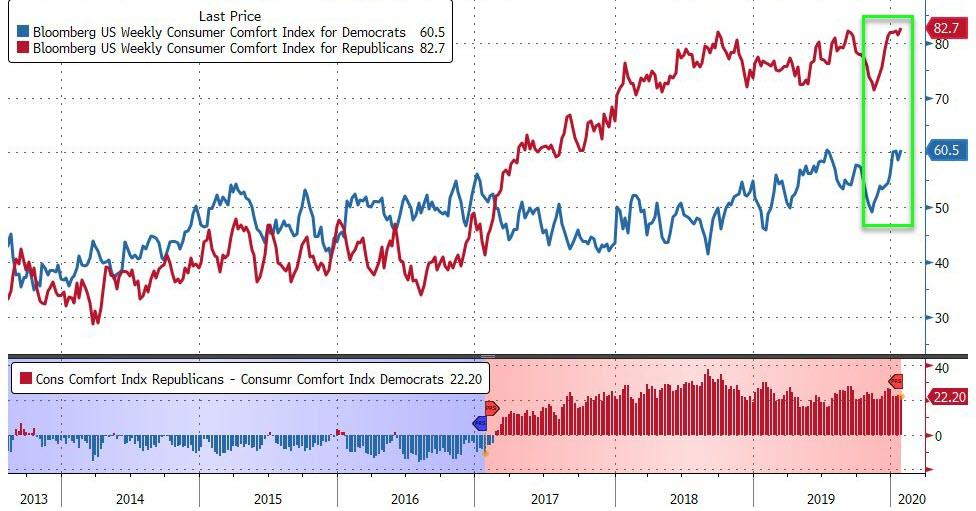
Even Democrats are coming around… The comfort reading for Republicans rose 1.2 points to a record 82.7, a sign they’re looking past President Donald Trump’s impeachment proceedings, though measures for Democrats and independents advanced even more on the week, notching gains of about 2 points.

Source: Bloomberg

That is the highest level of comfort among Democrats since 2001!

We suspect, with things as good as they have ever been… ever… that this will not end well.


Tyler Durden

Thu, 01/30/2020 – 09:53

Tags

via ZeroHedge News https://ift.tt/3aXsgNi Tyler Durden

Just A Matter Of Time…

Just A Matter Of Time…

Authored by Michael Every via Rabobank,

A slightly more dovish Fed (see below), and the corresponding perceived increase in the odds of further stimulus by the US central bank, failed to excite investors much as the coronavirus continues to dampen the mood on global markets. Asian equities are down sharply again, with the Hang Seng index losing 2.9%, and both the Nikkei 225 and the KOSPI currently down 1.7% on the day. While it appeared like the initial virus scare had faded, this risk-off sentiment was reinvigorated by news that the virus may spread unnoticed, and news that the WHO may reconsider declaring a global emergency as “progress of the virus in some countries, and especially human-to-human transmission” are worrying them.

US Treasury yields fell on the back of the risk-off sentiment and reassessment of the FOMC’s likely next policy move. The 10y Treasury has dipped below 1.6%, dragging German Bund yields down alongside.

As we note in a report published just prior to this Daily, experience with virus outbreaks in the past shows that markets often bounce back quickly, but even if the virus outbreak turns out be comparable to SARS, its global economic effects are likely to be larger, as China has a much bigger share in the global economy nowadays. At this point, we don’t expect any permanent damage of the epidemic to the Chinese economy or other regions across the globe, but in case of a further spread of the virus globally or in case of defaults among China’s highly indebted non-financial corporates due to the containment measures, the risk of permanent damage increases significantly.

Barring such a scenario, the effects of the risk-off sentiment are probably temporary.

Yet, to the extent that the fall in yields wasn’t driven by the coronavirus, but by a re-evaluation of the FOMC’s future policy stance, this decline may be a bit more permanent.

The FOMC kept the target range for the federal funds rate unchanged at 1.50%-1.75%, but the Board of Governors, as expected, did make an upward technical adjustment of 5bp to the IOER and the ON RRP rate to force the effective federal funds rate closer to the midpoint of the current target range.

Powell repeated that it would take a ‘material reassessment’ of the economic outlook to change the current stance of monetary policy. But, overall, the FOMC statement and Powell sounded dovish with a slight downgrade in their assessment of household spending; a more explicit commitment to get inflation back to target; an acknowledgement of the serious nature of the coronavirus; and the acknowledgement of remaining trade policy uncertainty. Finally, Powell said that the phase one trade deal and the USMCA were potentially positive developments, but he stressed also that trade policy uncertainty remains elevated with businesses having a wait and see attitude whether this is going to be sustained.

As our US strategist, Philip Marey, concluded: on balance, it sounded as if any ‘material reassessment’ of the outlook is more likely to lead to a rate cut than a hike. Of course, he has long warned that the US economy is actually already late in the cycle, rather than the Fed’s assessment that their ‘mid-cycle adjustment’ will be sufficient to keep the economy humming along nicely. And, Philip argues, it is just a matter of time before the FOMC realises this as well. Therefore, we expect the Fed will be forced to cut rates all the way back to zero before the end of the year.

Furthermore, the FOMC decided to keep supporting the repo market, directing the Open Market Desk to continue its purchases of Treasury bills at least into Q2, and to continue its term and overnight repo operations at least through April (instead of January). Given the recent expansion of the balance sheet, Philip estimated that a 5 to 10bp technical hike to the IOER should be sufficient to push the effective federal funds rate back up towards the midpoint of the target range. The Fed opted for the lower of these two options yesterday. So, with the Fed continuing to expand its balance sheet, we may see the Board make another 5bp hike in the IOER and ON RRP rates (at least relative to the target for the federal funds rate) somewhere down the road.


Tyler Durden

Thu, 01/30/2020 – 09:40

via ZeroHedge News https://ift.tt/2GNqlxj Tyler Durden

Wilbur Ross Says China’s Coronavirus Outbreak Will “Help Bring Jobs Back To America”

Wilbur Ross Says China’s Coronavirus Outbreak Will “Help Bring Jobs Back To America”

Anxieties about the knock-on impact to the global economy from the coronavirus outbreak, which appears on track to shave whole percentage points off China’s GDP, have pushed stock futures back into the red Thursday morning.

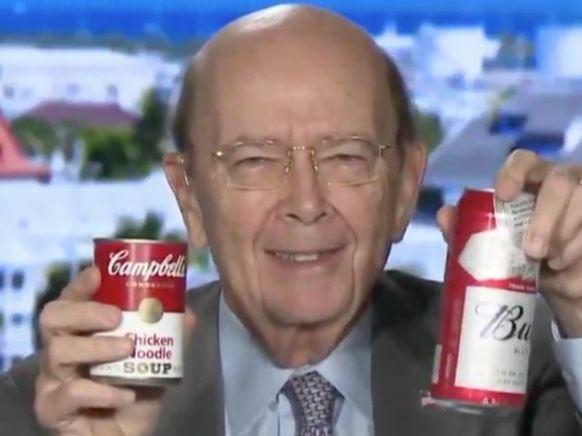
But during an interview with Maria Bartiromo that aired on Thursday, Commerce Secretary Wilbur Ross argued that the North American economy might benefit from the outbreak as companies “reevaluate their supply chains” to factor in emergent outbreak risk.

While Ross insisted that he didn’t want to appear insensitive, it’s pretty clear to him that the outbreak could help “accelerate the return of jobs to North America.”

“First of all, every American’s heart has to go out to the victims of the coronavirus. I don’t want to talk about a victory lap over a very unfortunate very malignant disease. But the fact is, it does give business another thing to consider when they go through their review of their supply chain. On top of all the other things – you had SARS, you had the African swine virus there, now you have this – it’s another risk factor that people need to take into account.”

“I think it will help to accelerate the return of jobs to North America, some to the US and some to Mexico as well,” Ross said.

Watch the clip below:

Bartiromo conceded that Ross had made an interesting point.

“Ah, that’s a good point,” Bartiromo responds.

While it might sound callous, we’ve heard this argument before: Remember when all the sell-side research departments advised that Hurricane Harvey would help boost GDP in the ensuing quarters?

Life, which you so nobly serve, comes from destruction, disorder, chaos…”

“Look at all these little things, so busy now”…just some food for thought.


Tyler Durden

Thu, 01/30/2020 – 09:20

via ZeroHedge News https://ift.tt/36J361z Tyler Durden

Has The Global Economy Finally Exhausted Its Good Luck?

Has The Global Economy Finally Exhausted Its Good Luck?

Authored by Charles Hugh Smith via OfTwoMinds blog,

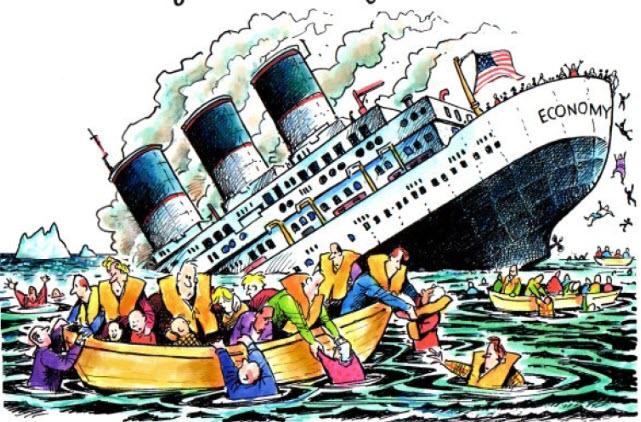
All of these guarantees and redundancies are as illusory as the “unsinkable” technologies of the Titanic.

The past three decades of global growth are rarely attributed to luck: it’s all the result of our brilliant fiscal, monetary and trade policies. Those in positions of wealth and power are delighted to take credit for this tremendous success, but as a general rule, the more knowledgeable you are and the higher up the food chain you are, the greater your awareness of the role of luck in any unbroken chain of success.

There are various moving parts in what we call luck. One is what we don’t know but think we know, or put another way, we know enough to be confident everything will work as intended and expected.

I described how this worked in the Titanic disaster in Why Our Financial System Is Like the Titanic (March 15, 2016).

The technologies of the early 1900s enabled shipbuilders to construct enormous steel-hulled ships almost 900 feet in length capable of steaming at 24 knots, transporting passengers across the Atlantic in comfort. The technologies that made such ships and transits low risk were largely already present but in forms that were deeply flawed in ways that were not readily visible or understood.

Unbeknownst to the era’s designers and shipbuilders, the Titanic’s hull plates were brittle due to high sulfur content in the steel, especially at cold temperatures (the water was near freezing at the time of the collision with the iceberg).

Rather than deform as the iceberg scraped against the hull, the plates and rivets fractured, opening the irregular gash that sank the ship.

The watertight bulkheads appeared to make the ship “unsinkable,” but this was only true if the hull was compromised across no more than four watertight compartments. The bulkheads may have actually accelerated the sinking, as later studies found the ship would have stayed afloat an additional six hours without any watertight bulkheads, as the ship would have settled evenly rather than sinking bow-first as the forward compartments filled.

The presence of lifeboats seemed to offer a guarantee of safety, yet outdated regulations only required enough lifeboats for half the crew and passengers.

The new technology of radio (“wireless”) seemed to provide a reliable way to call for help, yet regulations did not require all ships to staff wireless stations 24 hours a day, so nearby ships never received Titanic’s distress calls.

Assuming that human lookouts could detect icebergs soon enough to change course seemed realistic, and favoring the first class passengers in lifeboat access was unquestioned until after the sinking.

After the disaster, all these inadequacies (except the high sulfur steel deficiencies) became obvious, but this “obviousness” only manifested because of the disaster: if the Titanic had narrowly missed the iceberg, everyone would have continued to be resolutely confident that the ship and all the life-safety systems were not just adequate but beyond adequate.

The fact that large ships and powerful engines could be built created the illusion of low risk, because the risk factors were invisible until after the fact. The high confidence in the technologies of the day now seem quaint: the flaws in the steel plates and rivets would remain invisible until the technologies of steel production finally caught up with the other shipbuilding technologies, and better detection and tracking of icebergs would have to wait for radar and better navigational technologies.

But how different is our current extreme confidence in our healthcare technologies?

Much of what we take for granted as essentially guaranteed by our fabulous technologies and systems is more akin to the Titanic than we care to admit. That the world has avoided seriously disruptive global pandemics for a hundred years is more luck than most people understand. RNA viruses mutate at a very high rate (i.e. they replicate with imprecision, generating a high rate of mutations). Whether these mutations end up being “good” or “bad” for the human hosts is a function of randomness, i.e. luck.

The global economy has been astonishingly lucky for 30 years–or even 75 years. Like the passengers on the Titanic, we have unquestioned confidence in our technologies and systems because they appear so “guaranteed”, so resilient and so redundant.

All of these guarantees and redundancies are as illusory as the “unsinkable” technologies of the Titanic. The irony is that the more knowledgeable the individual, the more they understand the role of luck in avoiding failure or catastrophe. The less we know, the more trusting we are in compelling illusions of safety and security.

*  *  *

My recent books:

Audiobook edition now available:
Will You Be Richer or Poorer?: Profit, Power, and AI in a Traumatized World ($13)
(Kindle $6.95, print $11.95) Read the first section for free (PDF).

Pathfinding our Destiny: Preventing the Final Fall of Our Democratic Republic ($6.95 (Kindle), $12 (print), $13.08 ( audiobook): Read the first section for free (PDF).

The Adventures of the Consulting Philosopher: The Disappearance of Drake $1.29 (Kindle), $8.95 (print); read the first chapters for free (PDF)

Money and Work Unchained $6.95 (Kindle), $15 (print) Read the first section for free (PDF).

*  *  *

If you found value in this content, please join me in seeking solutions by becoming a $1/month patron of my work via patreon.com.


Tyler Durden

Thu, 01/30/2020 – 09:00

via ZeroHedge News https://ift.tt/3b4Aun8 Tyler Durden