Q4 GDP Rises 2.1%, Beating Expectations As Plunging Imports Offset Consumption Slump
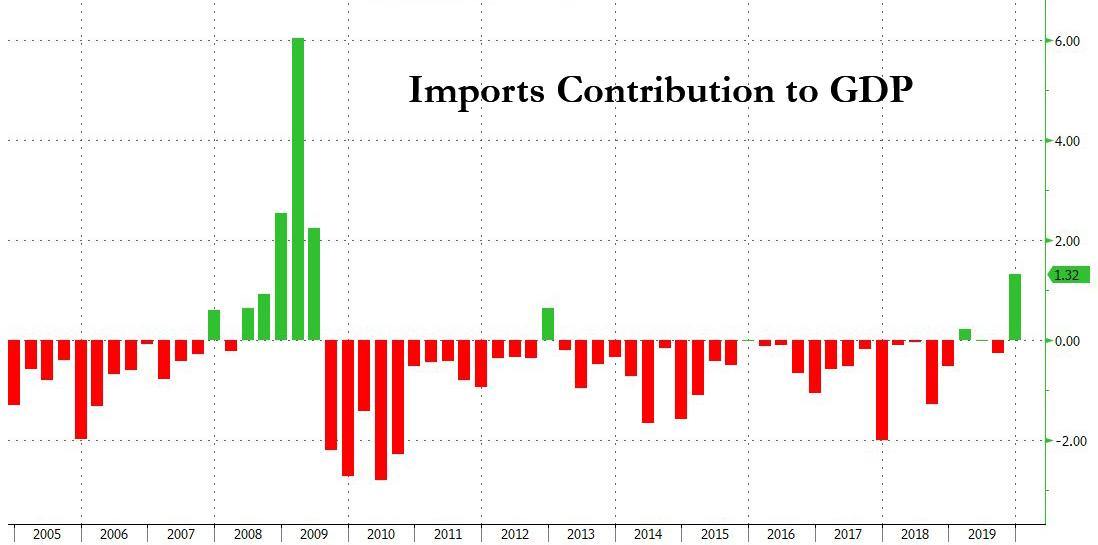
After rising 2.1% in the third quarter, moments ago the BEA reported its first estimate of Q4 GDP, which was unchanged from the last quarter, rising at an annual rate of 2.1%, beating expectations of a 2.0% print despite a miss in personal consumption, with the GDP number benefiting from a surge in net trade as a result of a 1.32% boost from imports.
Ironically, the trade war-related slide in imports gave an outsize boost to the GDP calculation, as consumer spending cooled and nonresidential business investment registered a third straight drop, for the longest slump since 2009.
The fourth-quarter increase in real GDP reflected increases in consumer spending, government spending, housing investment, and exports which were partially offset by decreases in inventory investment and business investment. Imports, a subtraction in the calculation of GDP, decreased.
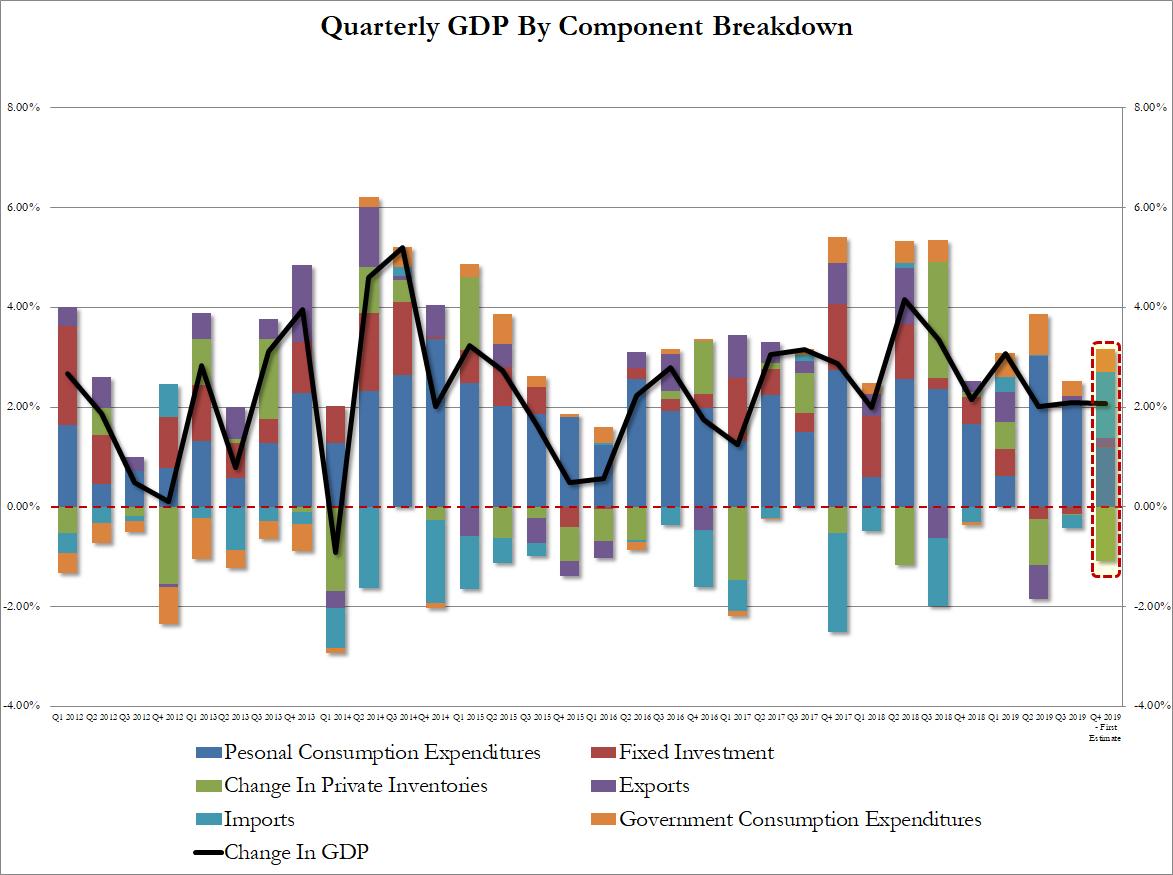
What is notable is that after surging in Q2 and Q3, personal consumption moderated sharply to 1.8% SAAR from 3.2% in Q3, missing expectations of 2.0% print, and contributing 1.20% to the GDP number from 2.12% last quarter, growing at the slowest pace in three quarters.
The Q4 breakdown was as follows:
Personal consumption: 1.20%, down from 2.12%
Fixed Investment: 0.01% up from -0.14%
Private Inventories: -1.09%, down from -0.03%
Exports: 0.17% up from 0.11%
Imports: 1.32% up from -0.26%
Government: 0.47%, up from 0.30%
The increase in consumer spending reflected increases in goods (led by clothing and footwear) and services (led by health care). The increase in government spending reflected increases in both federal and state and local government. The decrease in inventory investment reflected a decrease in retail trade inventories (led by motor vehicle dealers). The decrease in business investment reflected a decrease in structures (led by mining exploration, shafts and wells) and equipment (led by industrial equipment).
Government spending also gave GDP a boost, with gains in both federal and state and local outlays.
As noted above, the hail mary in this report was net trade which accounted for 1.49% of the 2.08% GDP number (of which imports were 1.32%), the most since 2009. The irony is that this was actually negative as trade collapsed mostly in the form of plunging imports. Such a “boost” via net exports is the flipside to trade war and/or weaker consumption-investment-inventory figures, because unless the plunge in imports (a boost to GDP) is a function of rising domestic production (hardly), they actually reflect weaker domestic demand.
One bright spot was residential investment, which advanced at the fastest rate in two years, as builders picked up the pace of construction and prospective homebuyers benefited from low mortgage rates and a solid job market. Business investment in software was also solid.
Excluding trade, inventories and government, real sales to private domestic purchasers rose just 1.4%, the slowest pace since 2015, indicating weaker underlying growth.
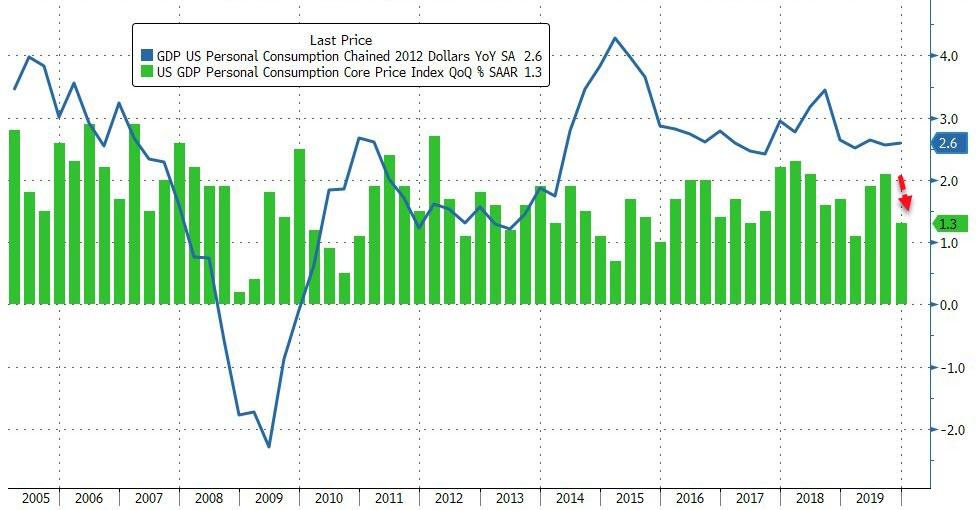
Meanwhile, in good news for the market, the Fed’s preferred inflation metric, PCE rose 1.3% Q/Q, dropping from 1.6% last quarter as prices of goods and services purchased by U.S. residents increased 1.5% in the fourth quarter after increasing 1.4% in the third quarter. Core PCE rose only 1.3% after increasing 1.8% in the third quarter, and missing expectations of a 1.6% increase.
Tesla Conference Call Warns Of Increased Expenses In 2020, Seasonal And Coronavirus Headwinds
After “beating” expectations handily but still finishing 2019 off with GAAP net income losses exceeding $800 million, Tesla took a relatively lengthy victory lap on their conference call yesterday, which started around 6:30pm EST and lasted about an hour.
And why wouldn’t it? Tesla stock shot up nearly 15% after hours Wednesday and pre-market Thursday, at one point printing new all time highs of $659, assigning a market value of the company of nearly $120 billion.
On the call, the company reiterated that it would exceed 500,000 vehicles delivered this year, inclusive of the Model Y. CEO Elon Musk also talked about the Cybertruck, saying it was the most “bad-ass futuristic vehicle” and claiming they will make as many as they can sell.
“The product is better than people realize,” Musk said on the call.
Yes, the one with the broken windows. That one.
CFO Zach Kirkhorn noted that the company’s Model 3 backlog had finally dried up and that Tesla was no longer filling orders from reservations, but rather just to “fresh demand”.
The Model 3 ASP has “stabilized,” he said. Kirkhorn also noted that the company is expecting higher gross margins on the Model Y than on the Model 3. He also said that Tesla was taking the lessons it learned from trying to ramp up the Model 3 for use producing the Model Y in Fremont and for production in Shanghai.
Kirkhorn called 2019 “truly transformational”.
Which seems like a great spot for us to point out that much of Tesla’s operating cash flow and free cash flow “success” over 2019 came mostly after the company parted ways with two Chief Accounting Officers, a Corporate Treasurer, a CFO and two general counsels. Probably just a coincidence, as @SheepleAnalytics noted on social media last night.
Musk also spoke about the Buffalo factory, saying it was “doing great”, which flies in the face of media reports this year claiming the factory is a hotbed for racism and questionable productivity.
“Do you want a roof that is alive with power or dead without?” Musk asked about the solar roof.
How about a product that was pitched to the world in 2016 to justify the bailout of a bankrupt company and, 4 years later, still doesn’t seem to exist?
The company also said it would boost energy product deployments by at least 50% and said limited numbers of the Tesla Semi would start to trickle out.
Musk said on the call that the company doesn’t have plans of raising money because it’s still able to meet its capex obligations while remaining cash flow positive.
Not everybody was beaming with optimism after the call. Liam Denning’s follow up at Bloomberg was quick to point out, however that “the dissonance between mouse-sized results and elephantine market reactions is deafening.”
Specifically, he noted that: “the $105 million of earnings was more than accounted for by the $133 million of regulatory credits sold in the quarter.”
He also commented: “As for the $1 billion of free cash flow Tesla reported, more than half is accounted for by those credits, a big working capital swing and $204 million of “other” cash from operations that await some 10K-filing details.”
Tesla also mentioned on the call that they expected operational expenses to increase during the year due to the production ramp of the Model Y and operations in Shanghai. The company said it could “slightly” impact profit, but that it was too early to tell by how much.
There were also caveats mentioned on the call that weren’t in the company’s official press release, like seasonal effects and potential headwinds from the coronavirus outbreak.
Elon Musk also seemed to continue his aversion to selling equity. When asked by Dan Levy of Credit Suisse why he wouldn’t just pay down his debt with a small capital raise at the company’s nosebleed valuation, Musk responded by saying they would pay the debt down, “steadily”, as time goes by.
All told, it was another “win” for Musk as the company’s valuation gives Musk significant breathing room to operate and moves the company even closer to Musk’s incentive awards listed on his pay plan. But while the company may have been able to game one more quarter of positive looking headline results and a strong top line, there’s always another quarter waiting in the wings.
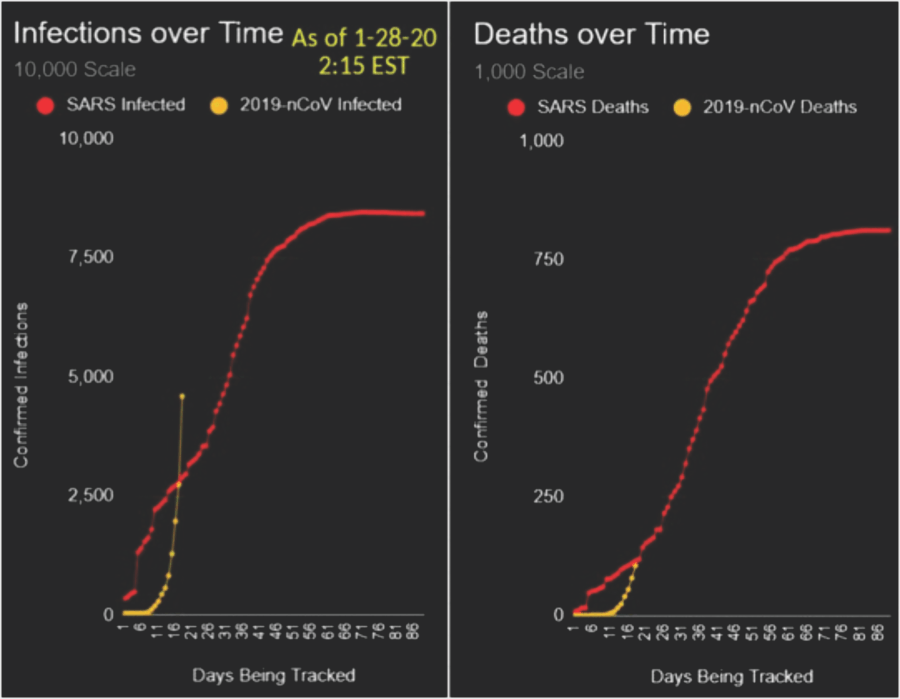
A week dominated by headlines of a spreading respiratory virus has had investors recalling pandemics past, from SARS in 2003 to the Ebola scare six years ago. While the “Wuhan” virus, or known scientifically as “nCoV,” is still in its infancy, it is closely tracking both the infection and, unfortunately, death rates of the SARS virus.
However, the question everyone wants an answer to is: “what does the virus mean for the markets?”
Will it derail the longest bull market in U.S. history? Or, is it nothing to worry about?
If you read the mainstream media, the answer seems to be the latter. To wit:
“However, gauged by the market’s performance during the onset of other infectious diseases, including SARS, or severe acute respiratory syndrome, Ebola and avian flu, Wall Street investors may have little to fear that this disease will sicken a U.S. stock market that finished 2019 with the best annual return in years and has kicked off 2020 at or near all-time highs.” – MarketWatch
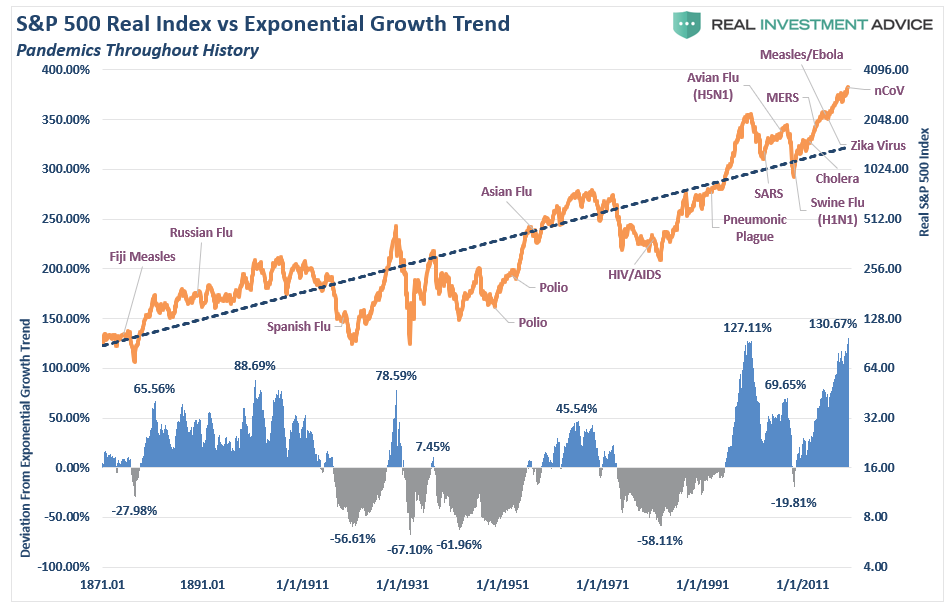
With the stock market perched near all-time highs, it is understandable investors are quick to dismiss the potential ramifications of the virus very quickly. There is also plenty of anecdotal evidence to support the bullish claims as well. The chart below is the S&P 500 index versus its exponential growth trend with a history of the more important viral outbreaks notated.
Throughout history, markets have always seemed to bounce back from deadly viral outbreaks. However, long-term charts tend to obfuscate the damage done to investors who have a much shorter investment time horizon.
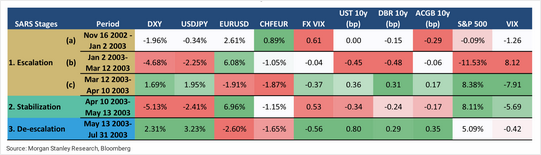
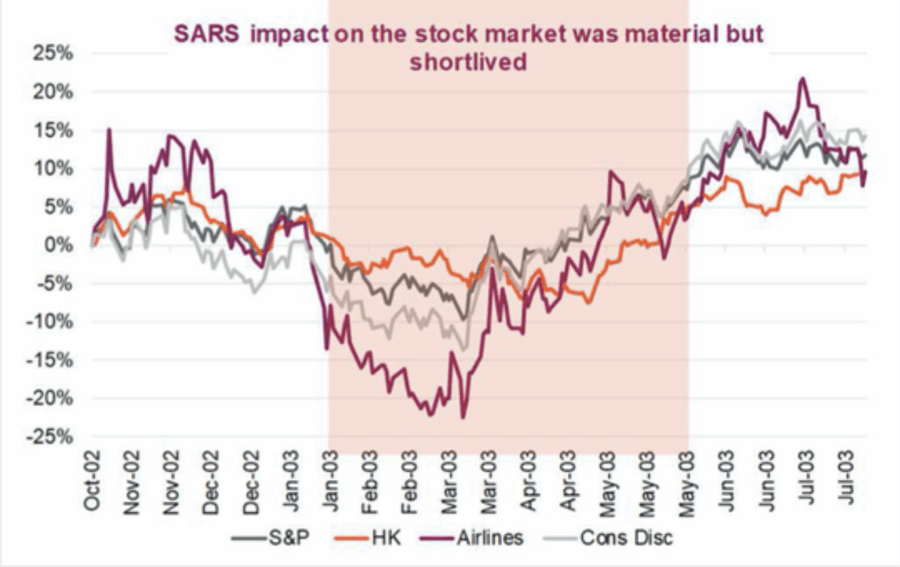
Currently, the more prominent comparison is how the market performed following the “SARS” outbreak in 2003, as it also was a member of the “corona virus” family.
Clearly, if you just remained invested, there was a quick recovery from the market impact, and the bull market resumed.
At least it seems that way.
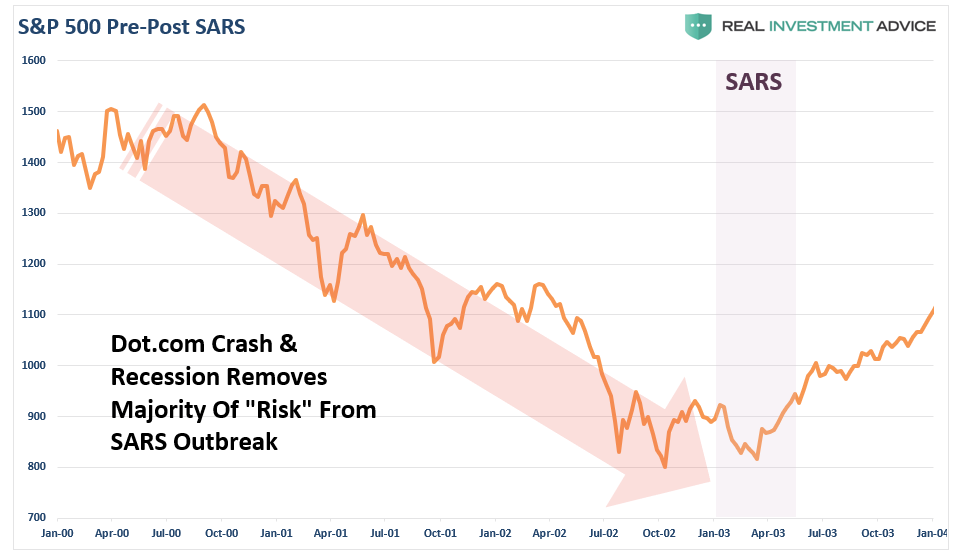
While the chart is not intentionally deceiving, it hides a very important fact about the market decline and the potential impact of the SARS virus. Let’s expand the time frame of the chart to get a better understanding.
Following a nearly 50% decline in asset prices, a mean-reversion in valuations, and an economic recession ending, the impact of the SARS virus was negligible given the bulk of the “risk” was already removed from asset prices and economic growth.
Today’s economic environment could not be more opposed.
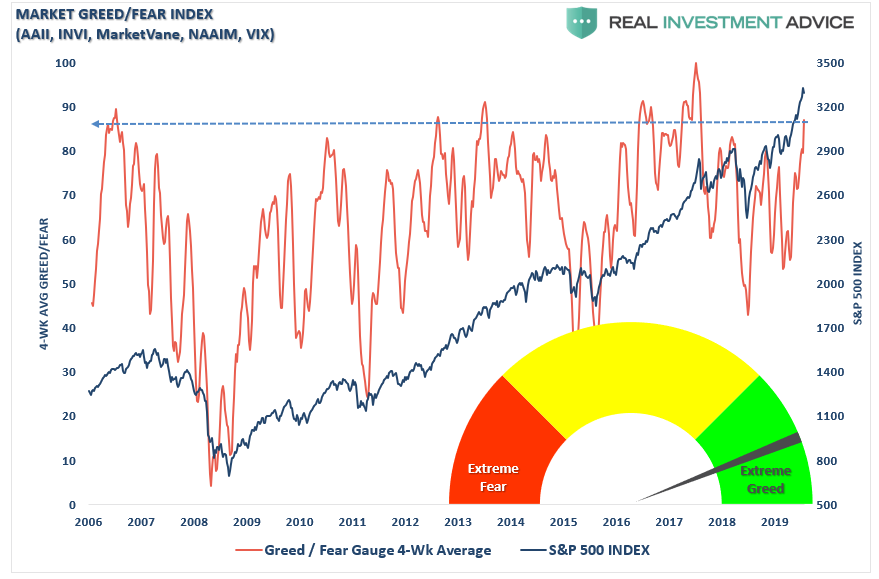
Currently, asset prices are near historic highs along with investor sentiment and overall market optimism. The chart below is our composite “fear/greed” gauge, which is comprised of professional and retail asset allocations to equities. (Importantly, this is NOT a measure of how investors “feel” about the market, it is how they are allocated to it.)
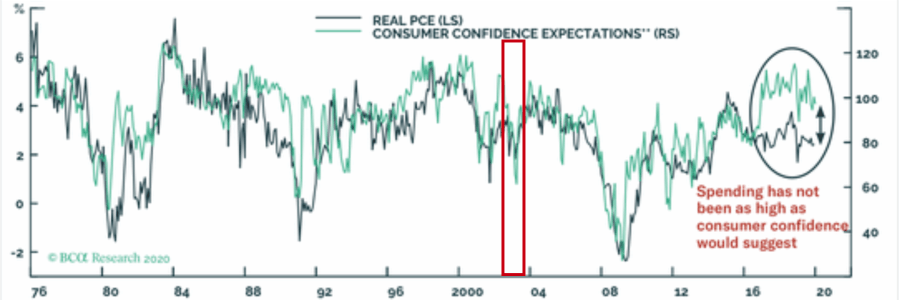
Real personal consumption expenditures and consumer confidence had also reverted during the recession in 2001-2002, so there was sufficient “pent-up” demand to offset the economic and market impact from the SARS outbreak. Currently, consumer confidence remains near highs as consumption has remained strong enough to sustain 2% economic growth.
There is also the issue that China, which is ground zero for the “Wuhan virus,” is a substantially larger portion, and economically more important, than it was in 2003.
“China itself is a much more crucial player in the global economy than it was at the time of SARS, or severe acute respiratory syndrome, in 2003. It occupies a central place in many supply chains used by other manufacturing countries—including pharmaceuticals, with China home to 13 percent of facilities that make ingredients for U.S. drugs—and is a voracious buyer of raw materials and other commodities, including oil, natural gas, and soybeans. That means that any economic hiccups for China this year—coming on the heels of its worst economic performance in 30 years—will have a bigger impact on the rest of the world than during past crises.
That is particularly true given the epicenter of the outbreak: Wuhan, which is now under effective quarantine, is a riverine and rail transportation hub that is a key node in shipping bulky commodities between China’s coast and its interior.
Given that U.S. exporters have already been under pressure from the impact of the “trade war,” the current outbreak could lead to further deterioration of exports to China. This is not inconsequential as exports make up about 40% of corporate profits in the U.S. With economic growth already struggling to maintain 2% growth currently, the virus could shave another 1% off that number.
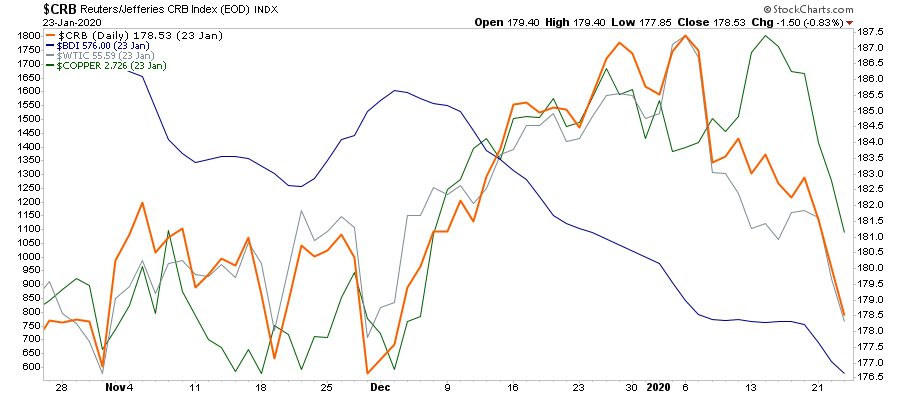
As I noted this past weekend, the commodity complex is suggesting something went awry with the economy in January.
“There are a few indicators which, by their very nature, should be signaling a surge in economic activity if there was indeed going to be one. Copper, energy prices, commodities in general, and the Baltic Dry index, should all be rising if economic activity is indeed beginning to recover.
Not surprisingly, as the “trade deal” was agreed to, we DID see a pickup in commodity prices, which was reflected in the stronger economic reports as of late. However, while the media is crowing that “reflation is on the horizon,” the commodity complex is suggesting that whatever bump there was from the “trade deal,” is now over.”
Importantly, this decline happened BEFORE the “Wuhan virus” which suggests the virus will only worsen the potential impact.
Furthermore, given the “ink is barely dry” on the newly signed trade deal, any economic slowdown would likely make it very difficult for China to meet its overly ambitious purchase targets. However, the collapse of soybean prices in January already suggests they aren’t purchasing any great amounts.
Though stock markets recovered their stride following Monday’s rout, the risks of a deeper market correction remains. For investors, markets both domestically and globally are trading at historically high valuations. However, valuations aren’t a problem, until they are. As Michael Lebowitz recently penned:
“Consider that in 1929 valuations were similar to where levels stand today across a wide variety of metrics. Many valuation-based forecasts predict returns of plus or minus a few percent annualized over the next ten years. The following table contrasts current valuations versus prior periods.”
While investors try rationalize high valuations using a number of faulty comparisons, such as forward-operating earnings, low-interest rates, or low-inflation, there is little historical evidence to support that high-valuations are justified by such measures.
However, as David Lafferty recently noted in a Bloomberg interview:
“The thing that worries me is that there’s so much optimism priced in, and people are worried about valuation. But valuation, in and of itself, isn’t a catalyst. So in that vacuum, people tend to look for catalysts and maybe some type of epidemic or pandemic becomes the excuse they’ve been looking for to either profit-take or sell down assets that they think are expensive. ”
The problem with a more significant market correction, spawned by a repricing of valuations due to slower economic growth, is that it creates a downward spiral.
“A big market correction would severely impact global growth this year, the International Monetary Fund and ratings agencies have warned. The hit to U.S. consumers alone would likely dampen spending and could halve GDP growth, bringing U.S. growth to levels last seen during the financial crisis a decade ago. And companies already burdened with a record level of high-yield debt would be even more exposed after a market downturn, creating the possibility of a wave of defaults that could further undermine confidence.” – Johnson & Palmer via Foreign Policy
While it certainly is not clear how much worse the outbreak will become, or how long it will last, the epidemic could last well into the summer. While a short-term disruption during the Lunar New Year holiday is one thing; half a year of interrupted trade and canceled travel in at least swathes of the world’s second-biggest economy is potentially much more damaging.
With the economic expansion peaking, the market overly extended and excessively bullish, and fundamentals strained, there is a vast difference between “now” and “then.” It also just might be the message that plunging commodity prices and falling bond yields are already sending.
World Stocks Tumble As Viral Pandemic Fears Return, Curve Re-Inverts
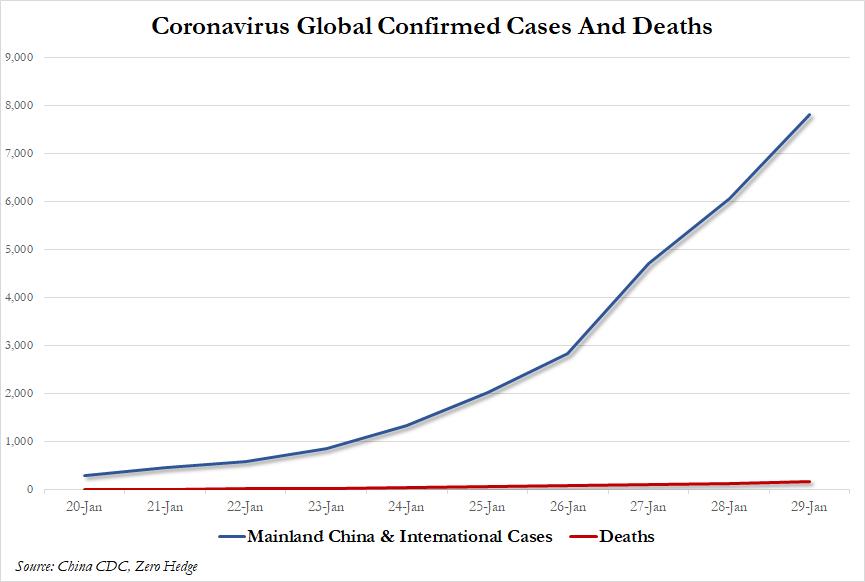
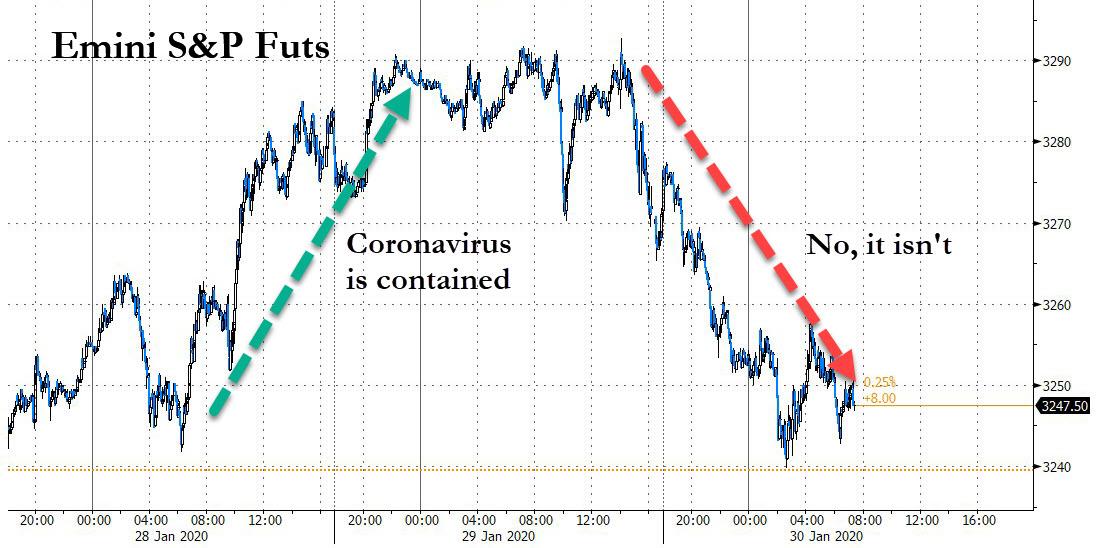
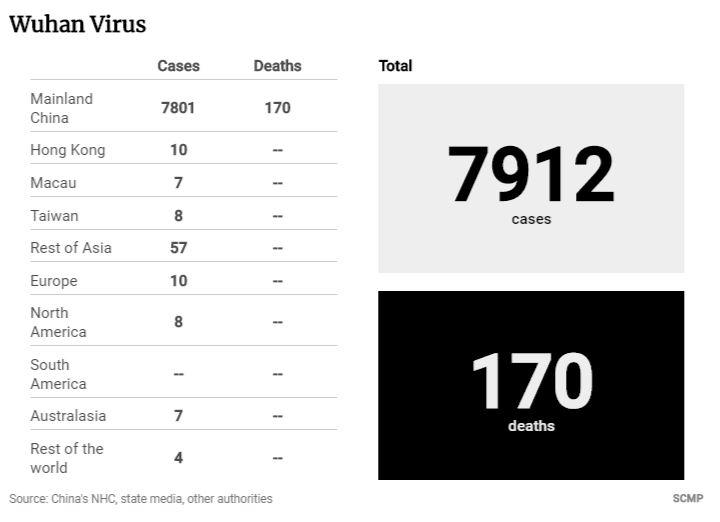
If yesterday, algos, millennial traders and generally markets acted as if the coronavirus epidemic was contained, all of that reversed overnight when global stocks and US equity futures across the world tumbled on Thursday as the death toll from the coronavirus epidemic reached 170 with nearly 8000 people now sick…
… forcing airlines to cut flights and stores to close as the potential economic hit from the outbreak came into focus.
And after dismissing the latest escalation on Wednesday, markets perhaps finally read up on what a geometric progression means and decided to freak out on Thursday, just because, with S&P futures tumbling, and undoing all of Wednesday’s gains, as tech giant giants presenting a mixed picture after the bell on Wednesday, with Facebook’s results underwhelming even as Microsoft and Tesla beat expectations.
Or perhaps someone in the market finally learned to do math, and it is ugly: Chinese factories have announced extended holidays, global airlines cut flights and Sweden’s Ikea said it would shut all stores in China. One Chinese government economist said the crisis could cut first quarter growth in the world’s second largest economy to 5% or lower, with the crisis hitting sectors from mining to luxury goods. Investment banks also started to put figures on what the damage could be. Citi has said it expects China’s 2020 growth to slow to 5.5%, after previously predicting it to be 5.8%, with the sharpest slowdown this quarter.
“The economic impact will be determined by the extent to which it spreads,” said Michael Bell, global market strategist at J.P. Morgan Asset Management, adding that hard evidence of a hit to economic data was needed before the impact of the virus could be judged.
Right or not, stocks wasted no time to selloff as pessimism returned, with the MSCI world equity index dropping 0.5% as European shares followed Asian indexes into the red, stoking demand for the perceived security of safe-haven assets from bonds to gold. Europe’s broad STOXX 600 tumbled over 1% in early trade, as all but two sectors traded in the red, with European markets a sea of red, as indexes in Frankfurt, Paris and London all lost between 0.7%-1.3%. Adding to the gloom, disappointing earnings and trading updates weighed further on blue-chip stocks. Royal Dutch Shell plunged 4.8% after fourth-quarter profit halved to its lowest in more than three years.
Earlier in the session, the MSCI index of Asia-Pacific shares ex-Japan fell 2.1% to a seven-week low and has now dropped for six straight sessions as the World Health Organization considered issuing a global alarm on China’s spreading coronavirus. The MSCI Asia Pacific Index extended losses to as much as 1.9%, with all major regional markets trading in the red. Taiwan’s shares slumped after market reopened from holidays, catching up with the slide elsewhere during Lunar New Year. Hong Kong’s Hang Seng Index had its worst two-day performance in almost a year. With China’s economy now expected to deteriorate the longer the outbreak persists, the government is expected to unveil efforts to cushion the economic blow, with the central bank set to keep liquidity ample, according to economists.
Earnings presented a mixed picture, and in addition to the Facebook plunge offset in part by the surge in Microsoft and Tesla, the following reports were notable, courtesy of Bloomberg:
Coca-Cola climbed after fourth quarter organic revenue topped analyst estimates.
United Parcel Service slipped in early trading after profit outlook fell short of analyst estimates.
Royal Dutch Shell fell to the lowest in more than two years after missing profit expectations and scaling back buybacks.
Deutsche Bank fluctuated after reporting a larger-than-expected loss in the fourth quarter.
Unilever rose despite the company’s slowest quarterly growth in a decade.
“If things go wrong, whether earnings disappoint or the coronavirus causes a short or a long-term problem for the economy, there is not a lot of buffer in asset prices to absorb that,” said Simon Doyle, head of fixed income andmulti-asset at Schroders in Sydney. “Clearly there will be a growth shock as people stop traveling, but we don’t know exactly how that will play out. From a market perspective, the lack of a risk premium does make markets vulnerable if it’s worse than people hope it is.”
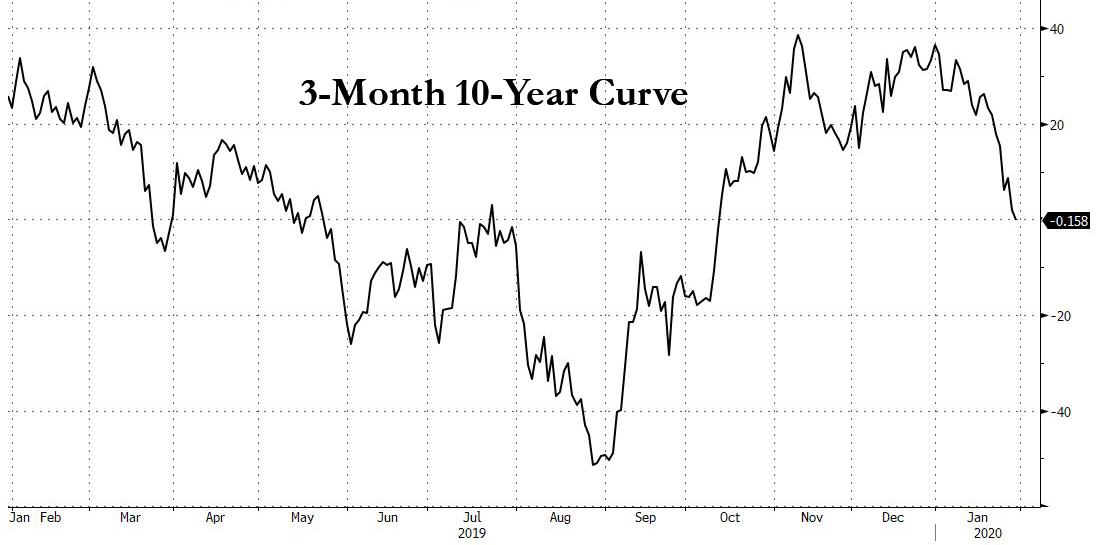
Meanwhile, the rush to safety continued with U.S. and German government bond yields falling sharply, with 10-year German bund yields dropping to a three-month low. 10-year Treasuries also fell 3 basis points to 1.5600%, their lowest since October. The yield curve – as measured by the 3M10Y spread, a closely watched indicator of looming recession – again sliding into negative territory.
The pain will likely get worse: the World Health Organisation’s Emergency Committee is due to reconvene later in the day to decide whether the rapid spread of the virus now constitutes a global emergency. “There is some concern about tonight’s presser by the WHO. The fear is that they might raise the alarm bells … so people are taking money off the table,” said Chris Weston, head of research at Melbourne brokerage Pepperstone.
Besides pandemics, there were also central banks: Fed chair Powell acknowledged on Wednesday the risks from any slowdown in the Chinese economy but said it was too early to judge the impact on the United States. The Fed held interest rates steady on Wednesday at its first policy meeting of the year, with Powell pointing to continued moderate economic growth and a “strong” job market.
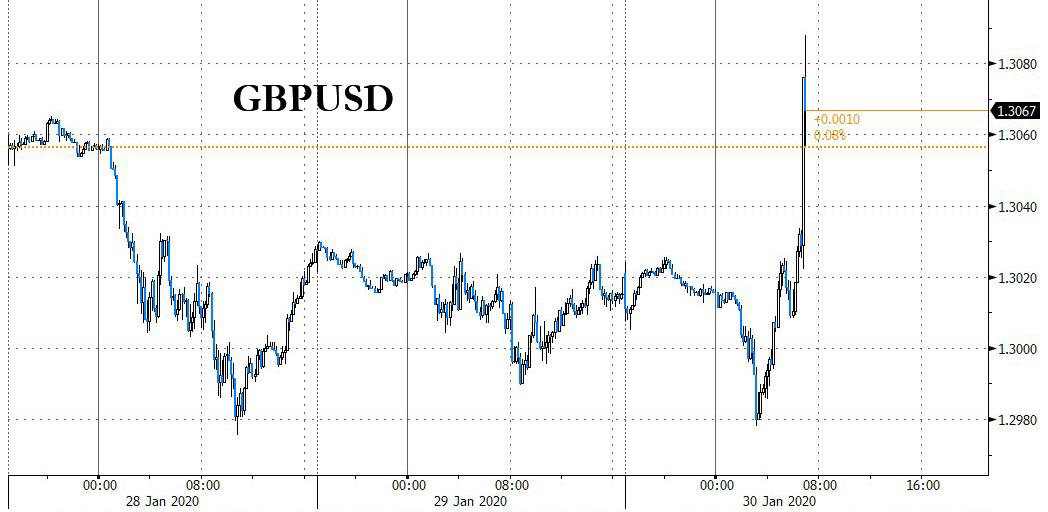
In Europe, the pound jumped after the Bank of England Governor Mark Carney’s final policy vote, in which the central bank decided to keep rates unchanged despite rising speculation of a rate cut.
Elsewhere in currencies, a risk-averse mood ruled, with exposed Asian currencies and commodities sensitive to Chinese demand extending losses as economists made deep cuts to their China growth forecasts. The Chinese yuan reversed Wednesday’s gains to fall 0.4% to its lowest level since Dec. 30., breaking below the key level of 7 against the dollar. The Australian dollar and the kiwi dollar NZD=D3 both lost 0.3%. The Japanese yen rose 0.2% against the dollar, while the Swiss franc, also seen as a safe haven, also gained. The dollar against a basket of six major currencies was flat.
Oil prices, a barometer of the expected impact of the virus on the world’s economy, resumed their slide. Brent was down 95 cents, or 1.8%, at $58.71 a barrel and has dropped 10% since Jan 20.
Expected data include GDP and jobless claims. Altria, Blackstone, Coca-Cola, UPS, Verizon, Amazon, and Visa are among companies reporting earnings.
Market Snapshot
S&P 500 futures down 0.5% to 3,255.25
STOXX Europe 600 down 0.6% to 416.87
MXAP down 1.8% to 165.99
MXAPJ down 2.1% to 536.60
Nikkei down 1.7% to 22,977.75
Topix down 1.5% to 1,674.77
Hang Seng Index down 2.6% to 26,449.13
Shanghai Composite closed
Sensex down 0.6% to 40,959.55
Australia S&P/ASX 200 down 0.3% to 7,008.43
Kospi down 1.7% to 2,148.00
German 10Y yield fell 1.9 bps to -0.396%
Euro up 0.05% to $1.1016
Brent Futures down 1.3% to $59.01/bbl
Italian 10Y yield fell 7.8 bps to 0.787%
Spanish 10Y yield fell 1.9 bps to 0.281%
Brent futures down 1.9% to $58.67/bbl
Gold spot up 0.2% to $1,579.67
U.S. Dollar Index little changed at 98.03
Top Overnight News from Bloomberg
Federal Reserve Chairman Jerome Powell signaled that the central bank would pull out the stops to combat a global disinflationary downdraft, foreshadowing a potential shift toward an easier monetary policy over time
Oil resumed declines as the biggest jump in U.S. crude stockpiles in almost three months added to concern over weak demand in a market already grappling with the spreading coronavirus
The European Union stopped short of an outright ban on Huawei Technologies Co. and other Chinese 5G suppliers, seeking to navigate a path between warnings from U.S. President Donald Trump and provoking Beijing
Argentina’s government late Wednesday announced its time line for debt negotiations with private creditors, according to a chronology published on the Economy Ministry’s website
German unemployment unexpectedly declined at the start of 2020 as businesses ramped up operations after a yearlong industry slump.
Europe’s manufacturers started the new year on an upbeat note, the latest sign that the uncertainty that’s shrouded the sector and the region’s economy more broadly has lifted somewhat in recent weeks.
The pound held steady Thursday ahead of a delicately-poised Bank of England decision, but the chances are it could stay under pressure in the medium term.
China is expected to unveil efforts to cushion the economic blow from coronavirus, with the central bank set to keep liquidity ample and the government likely to step up spending
Asian sentiment was downbeat as the overhang from the coronavirus outbreak continued to take its toll across the region and following an indecisive lead from the US, where markets reacted to the FOMC policy announcement. ASX 200 (-0.3%) and Nikkei 225 (-1.7%) were subdued with underperformance across Australian mining names as demand concerns overshadowed the higher quarterly production updates by Fortescue Metals and Newcrest Mining, but with downside for the broader market stemmed by resilience in financials, while losses in Tokyo were exacerbated by flows into the JPY. KOSPI (-1.7%) was pressured after index heavyweight Samsung Electronics posted a 38% drop in Q4 net and Hang Seng (-2.6%) slipped deeper into correction territory after the number of confirmed coronavirus cases in the mainland increased to 7711 and the death toll now at 170, while the TAIEX (-5.8%) slumped as Taiwan participants returned to the market for the 1st time in 10 days and took their turn to play catch up to the epidemic fears. Finally, 10yr JGBs were higher due to the broad weakness in risk appetite and following upside in T-notes which were supported post-FOMC and saw the US 10yr yield decline to a 3-month low, while the mostly improved results from the 2yr JGB auction added fuel to the upside momentum.
Top Asian News
China Seen Boosting Stimulus as Virus Hammers the Economy
Taiwan Prepares Measures to Stabilize Stock, Forex Markets
Hong Kong Exports Grow 3.3% in December, Beating Estimates
Turkey Sticks With Inflation Outlook, Tees Up More Rate Cuts
An overall bleak session in the European equity-space [Eurostoxx 50 -0.9%] following on from a similar APAC handover which saw the Hang Seng post losses in excess of 2.5% – as risk aversion continues to materialise with the virus outbreak. Sectors are mostly in the red with the exception of utilities amid and outperformance/less pronounced downside in defensives to reflect the risk aversion. The energy sector stands as the underperformer amid the price action in the oil complex coupled with downbeat earnings from oil-titan Shell (-3.4%) which account for ~1.2% of the Stoxx600 and ~10% of the FTSE 100 (Shell A and B shares combined). In terms of earning-driven movers: Roche (+0.7%) remain supported by an above-forecast EPS and a dividend increase despite missing on profit and sales forecasts. Swatch (-3.6%) missed on earnings estimates and noted that it sees no quick rebound in its key Hong Kong market. As such, luxury peers are pressured in sympathy with the likes of LVMH (-1.7%), Richemont (-1.7%) posting firm losses. H&M (+9.8%) rose to the top of pan-European index amid stellar numbers and the appointment of a new CEO. Meanwhile, Deutsche Bank (+2.1%) erased opening losses which came amid a deeper than forecast net loss. Losses diminished amidst the conference call which provided investors with reassurance regarding early signs of progress in its overhaul. Other earnings-related movers include Diageo (-1.9%), Volvo (+7.7%), BT (-5.9%) and Unilever (+1.4%).
Top European News
Saint-Gobain Sees Closing of Continental Purchase on Feb. 3
Siemens Gamesa Plunges on Loss Caused by Unforeseen Charges
Carney’s Final BOE Rate Call Is a Knife Edge: Decision Day Guide
Nordea Is Said to Name Virgin Money’s Ian Smith as New CFO
In FX, not much bang for the Buck from the Fed as downgrades to the state of US consumption and level of inflation relative to target halted the DXY’s steady rise above 98.000 and sapped broad demand for the Dollar amidst the progressive spread of China’s coronavirus. However, as the death toll and number of cases (confirmed or suspected) continue to mount, Usd/CNH has rebounded further to temporarily test and breach the psychological 7.0000 mark alongside more pronounced depreciation in EM currencies overall, and especially those closely connected or correlated to commodities that are prone to steep price declines on the probability of depressed demand. Hence, the Greenback may well retain a relatively firm underlying bid ahead of data in the form of advance Q4 GDP and initial claims even though a French bank is flagging mild month end selling for portfolio rebalancing purposes.
CHF/EUR/JPY/XAU – The renowned, but not always reliable or consistent safe and pseudo safe havens are all outperforming, and particularly the Franc that has been flagging of late. Usd/Chf has retreated towards 0.9700 and Eur/Chf is back below 1.0700 as the single currency remains heavy on the 1.1000 handle within a spread of hefty Eur/Usd option expiries stretching from 1.0985 (1.3 bn) through 1.1000-05 (1.7 bn) to 1.1045-50 (1.1 bn). Note, firmer German state CPIs, solid jobs data and rather mixed Eurozone sentiment indicators have all hardly impacted, but the Euro did get a boost from more month end cross buying vs the Pound at one stage (into 9 am fix as usual). Meanwhile, the Yen has bounced over 109.00 ahead of a raft of Japanese macro releases and Gold remains bid between Usd1575-82/oz parameters.
NOK/NZD/AUD/CAD/GBP – A triple blow for the Norwegian Krona as a steeper retracement in crude prices against the backdrop of heightened risk aversion combines with a big retail sales miss to propel Eur/Nok beyond resistance around 10.1200 and close to 10.1500. Similarly, the Kiwi, Aussie and Loonie have all declined through deeper chart support and/or significant levels vs their US counterpart, at 0.6500, 0.6737-25 and 1.3200 respectively, with the latter now eyeing Canadian average earnings for some independent impetus. Conversely, Sterling has staged a stoic recovery to reclaim 1.3000+ status in Cable terms and pare some lost ground vs the Euro within a 0.8454-87 band on short covering and position/hedge tweaking ahead of the BoE at high noon as expectations for a 25 bp rate cut or no move flit either side of evens – check out our full preview of super Thursday via the Research Suite.
EM – More pain for regional currencies, but added angst for the Lira as the CBRT Governor echoes Turkey’s Finance Minister with regard to deeming the Try competitive at current levels (circa 5.9800), while maintaining projections for CPI to decelerate further and hit target over the forecast horizon.
CBRT Governor says 2020 year-end inflation forecast mid-point 8.2% (Prev. 8.2%), 2021 mid-point at 5.4%, inflation is expected to stabilise around 5% target in the mid-term, downward trend in inflation expected to continue throughout 2021; Current dollarisation at 51% vs. 56% in May 2019, downward trend seen continuing. CBRT maintains their prudential stance.
In commodities, another downbeat session or the energy complex thus far, with prices weighed on by on the ongoing demand implication of the coronavirus, rise in US crude stocks as per yesterday’s DoEs and with the current sentiment also providing further pressure on the contracts. WTI Mar’20 futures found an overnight base at around 52.30/bbl ahead of the Monday’s (and January) low at 52.20/bbl, whilst its Brent counterpart hovers around the 59/bbl at time of writing, with support seen at 58.50/bbl – which marks the January low and has been tested twice this week. On the OPEC -front, the Algerian Energy Minister alluded to the possibility that the March confab will be brought forward to February amid the effect of the Wuhan flu on outbreak on prices, and added that an extension to the output cut pact is possible – no dates have been flagged for a February meeting yet. Moreover, OPEC members are said to be preparing a report on the virus’ impact on energy prices for members to review. Elsewhere, spot gold prices retain an underlying bid, part-aided by the FOMC’s decision yesterday ahead of today’s BOE and WHO presser. Copper prices sees continued downside pressure amid the ongoing coronavirus woes – on a sentiment and demand front with the latter a function of border closures to China.
US Event Calendar
8:30am: GDP Annualized QoQ, est. 2.0%, prior 2.1%
8:30am: Personal Consumption, est. 2.0%, prior 3.2%
8:30am: Initial Jobless Claims, est. 215,000, prior 211,000; Continuing Claims, est. 1.73m, prior 1.73m
9:45am: Bloomberg Consumer Comfort, prior 66
DB’s Jim Reid concludes the overnight wrap
As expected there wasn’t a great deal of new information to take away from the Fed last night although at the margin it did lean a touch dovish. That was certainly how bond markets felt with treasury yields ending the day a fair bit lower with 10yr yields trading at 1.563% this morning – including a move yesterday of -7.2bps – and to their lowest since early October. That leg lower also means yields are down an impressive -36.5bps from the December highs now.
The 2s10s curve also flattened -2.5bps to 16.5bps while Gold nudged up +0.62% – it’s sixth rise in the last seven sessions. Meanwhile, US equities were slightly firmer going into the meeting as they caught a tailwind from the various earnings reports – which seemed to offset the coronavirus headlines – however by the end of Powell’s press conference they had given up pretty much all of those gains. The S&P 500 actually closed slightly lower, down -0.09%, while the NASDAQ and DOW ended up a very modest +0.06% and +0.04% respectively.
As for the specifics of the Fed meeting, rates were left unchanged and there were a couple of small dovish tweaks to the FOMC’s statement. The first was that household spending was described as rising “at a moderate pace”, in contrast to the “strong pace” referred to in December. And the second change was that they said the current stance of policy was appropriate in supporting inflation “returning to the Committee’s symmetric 2 percent objective”. This is a change from last time, where the statement said “near the Committee’s … objective” instead. Chair Powell said in the press conference that the adjustment would underscore the commitment that the 2% target wasn’t a ceiling for the inflation rate.
In terms of policy changes, though they were secondary to the main decision, the interest rate paid on required and excess reserve balances was raised by 5bps to 1.60%, while the rate on the reverse repurchase-agreement facility was also raised by 5bps as well, up to 1.50%. In addition, the FOMC voted for the continuation of term and overnight repo operations at least through April, which had previously been through January. All-in-all our economists expect the Fed to remain on hold this year before cutting 50bps in 2021 in response to persistently below-target inflation, albeit with the risk of a rate cut sooner than they anticipate. See their full summary here.
At the press conference, Powell was asked about the coronavirus and its possible economic effects, saying in response that there was “likely to be some disruption to activity in China and possibly globally”, and that the Fed was “very carefully monitoring” the situation. That said, with a great deal of uncertainty over its eventual course, Powell said he was “not going to speculate”.
Speaking of which, yesterday we got wind that the World Health Organization’s International Health Regulations Emergency Committee would be gathering today over the question of whether to declare a public health emergency of international concern (PHEIC). The WHO emergencies chief said the few cases of human to human spread of the virus outside china in japan, Germany, Canada and Vietnam were of great concern and were part of the reason for calling today’s meeting. Prior to that a number of airlines confirmed that flights to China would be suspended including British Airways, Finnair and Lufthansa as well as some by American Airlines and Air Canada. Overnight, IKEA became the latest company to close all its stores in China beginning today. The governor of Hubei also confirmed that the virus outbreak in Huanggang is “especially severe” – the population for which is only slightly less than London. This morning the latest update is that the number of confirmed deaths is now at 170 (up from 132 yesterday) and confirmed cases at 7,783 (up from 4,515). Chinese universities, primary and middle schools and kindergartens across the country have now postponed the opening of the spring semester until further notice.
Markets in Asia have weakened in tow with the latest virus updates. The Nikkei (-2.00%), Hang Seng (-2.14%) and Kospi (-1.80%) have all seen sharp declines. Taiwan’s TAIEX index is down -5.69% having reopened post the NY holidays. As for FX, the offshore Chinese yuan is down -0.51% to 6.9873 while, the Japanese yen is up +0.12%. Meanwhile, crude oil prices are down around 1% this morning. It’s worth noting also that Samsung Electronics is down -2.88% overnight as the company reported a 39% drop in fourth-quarter net profit, albeit with forecasted improved market conditions in 2020.
After the close we’ve also had a number of high profile US earnings, with tech and industrials again the main focus. Facebook was down around 7% despite beating estimates on revenues and profits for the quarter, with concerns about growing expenses and low growth numbers. Conversely, Microsoft shares were up 4% post-announcement after rallying +1.56% intraday on a larger than expected beat driven by their cloud computing division. Tesla surged as much as 14% after beating expectations with a 2.14 EPS ($1.72 exp.), with the company expecting positive quarterly cash flow going forward “with possible temporary exceptions.” NASDAQ and S&P 500 futures are lower nevertheless, down -0.56% and -0.65% respectively as we go to print.
This followed broadly better than expected earnings reports yesterday. GE rallied +10.32% as the company continues their turnaround,reporting strong cash flows and revising next quarter’s guidance higher. McDonalds was another strong earnings performer, up +1.89% as price hikes helped offset declining store visits. Even a company that missed on earnings like Boeing was higher yesterday, up +1.66%, on a relief rally after 737 Max-related charges came in lower than analysts expected. However, stocks were not completely exempt from virus worries. Similar to Apple the night before, Starbucks management expressed some concerns over next quarter’s numbers after the coffee-maker decided to close more than half of their stores in China. SBUX was down -2.12% on the news even after beating analyst estimates with EPS of $0.79 ($0.76 expected).
Moving on, and next up in the central bank queue today is the BoE, in what should hopefully be a more interesting decision and is also Governor Carney’s last MPC meeting at the helm. The market is pricing in a 46% chance of a cut, though at one stage earlier this month we were pricing in just over a 70% chance before last week’s better than expected PMIs. Our economists expect a dovish meeting today with a 25bp cut, and believe that the case for a cut is strong. For one, there are clear signs of excess capacity in the economy. UK growth has been below potential for nearly two years and recent survey data continue to point to weaker growth. Importantly, inflation remains below the Bank’s 2% mandate (CPI came in at a 3-year low of 1.3% in December), with core CPI and services inflation relatively weak in spite of elevated unit labour costs. In addition Brexit uncertainty is here to stay.
Speaking of Brexit, the European Parliament voted in favour of the Withdrawal Agreement yesterday by a 621-49 margin ahead of the UK’s departure from the EU tomorrow. And in other European news, following the UK decision on Huawei the EU recommended limiting high-risk 5G vendors, including Huawei. EU governments will ultimately have the final word however. US Secretary of State Pompeo responded to the UK’s decision from the day prior by saying that “there is still a chance for the UK to relook at this as implementation moves forward” and also that “we should have western systems with western rules and American information should only pass across a trusted network”. Clearly tensions have been raised between the UK and the US in light of the decision however we have yet to have heard of any link to a trade deal.
Before we wrap up, prior to the Fed yesterday the data in the US included a December advance goods trade deficit of $68.3bn that was wider than expected, weaker than expected wholesale inventories in December (-0.1% mom vs. +0.1% expected) and very soft pending home sales (-4.9% mom vs. +0.5% expected) albeit data that tends to be fairly volatile. In Europe there wasn’t much to report datawise. The ECB’s monthly bank lending data was on the softer and while the bank credit impulse recovered, it still remains at a weak level.
Looking at the day ahead, the focus of the data in the US this afternoon is the advance Q4 GDP print (2.0% annualised qoq expected) while initial jobless claims will also be out. In Europe we’re expecting preliminary January CPI in Germany and January confidence indicators for the Euro Area. The aforementioned BoE meeting is the other big focus. Away from that the ECB’s Weidmann is due to speak while earnings highlights include Amazon, Visa, Roche, Verizon, Coca-Cola, Shell and Unilever.
Passenger Threatens To Blow Herself Up At Moscow Airport
As if the world wasn’t already uneasy enough, hours after Russia’s new prime minister signed a decree to close the country’s border with China, Japan and North Korea, a woman onboard a plane that is grounded at Moscow’s Domodedovo Airport is reportedly threatening to blow herself up.
Pound Jumps As BOE Keeps Rates Unchanged But Drops “Limited And Gradual” In Leaked Decision
In the end, all of the recent poor economic data out of the UK proved not to be enough for BOE outgoing governor Mark Carney to cut rates in his final meeting. That said, a rate cut is just a matter of when not if.
As largely expected, BOE policymakers voted 7-2 (Haskel and Saunders voting to cut) to keep the benchmark at 0.75%, an unchanged split which made a mockery of investor expectations the decision was on a knife-edge. Still, BOE officials dropped reference to “limited and gradual” tightening, a long-standing piece of BoE guidance that dated back to a time when a more rapid pace of interest rate increases might have looked likely, and signaling the tightening era is over and easing is coming, with the bank’s new forecasts showing inflation only returning to target by the end of 2021 with a quarter-point reduction in the coming year.
Markets had seen a 50% chance of a cut but the Monetary Policy Committee split once again 7-2 in favor of keeping Bank Rate at 0.75% with external members Michael Saunders and Jonathan Haskel again voting to lower rates. The expectation was for at least one more policymaker to vote for a cut.
That said, the BOE kept the door open for a move after Governor Mark Carney hands over to his successor, Andrew Bailey, in March.
“Policy may need to reinforce the expected recovery in UK GDP growth should the more positive signals from recent indicators of global and domestic activity not be sustained or should indicators of domestic prices remain relatively weak,” the BoE said in its quarterly Monetary Policy Report. But if growth picked up as suggested by upbeat business surveys since Prime Minister Boris Johnson’s unexpectedly emphatic Dec. 12 election win, “some modest tightening” of policy might be needed further ahead, the BoE said.
Here are the highlights from the decision, as recapped by Ransquawk:
The BOE said “some modest” tightening of monetary policy may be needed further out if econ recovers as forecast
If the economy develops as it expects, upward pressure on prices should build gradually over the next few years, and in that case, BOE thinks a modest increase in interest rates may be needed to keep inflation at our 2% target
Policy may need to reinforce expected growth recovery, if recent signs of stronger global and domestic activity are not sustained
The BOE said UK potential growth has weakened due to reduced investment, Brexit
Too early to judge impact of Coronavirus
BOE assumes an immediate but orderly move, at the beginning of next year, to a deep free trade agreement between the UK and the EU
Risks to GDP are ‘broadly balanced’, sees support from government budget
Domestic inflation lower than strong unit labour cost growth would suggest, BOE to research further
To be sure, the dovish tone prevailed with the BOE’s new GDP forecasts – 0.8% for 2020 and 1.4% for 2021 – well below November’s 1.2% and 1.8%. Those are also below consensus: Economists in Bloomberg’s January survey forecast 1.1% growth in 2020, and a pickup to 1.5% in 2021.
In summary, “limited and gradual” is gone – that was a line the BOE used to describe the likely path for rate hikes, and as Bloomberg notes, it marks the “end of an era.” Andrew Bailey, who takes over from Carney in March, will have to get working on his own catchy phrase.
The pound jumped 0.5% higher at $1.3084 at 12:01 p.m. London time. Investors are now pricing a rate cut by August.
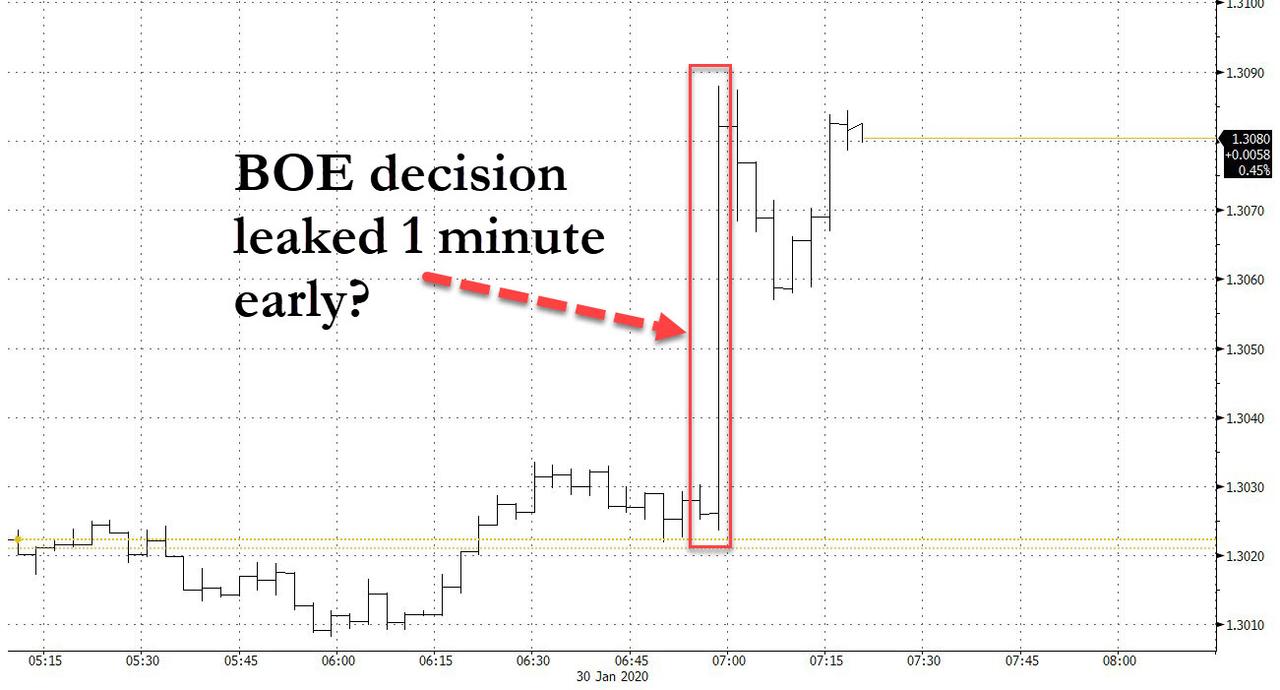
In the end perhaps the most controversial aspect of today’s unchanged decision is that it once again appears to have leaked just moments before the 7am announcement, with GBPUSD spiking a minute before the official release.
Assume you are a 17-year-old licensed driver and your father’s driver’s license has been suspended. He hands you the keys to his car and asks you to run an errand. While completing that errand you are stopped by the police. You have not broken a single law. You were stopped only because the officer guessed that your father might be driving. Was the traffic stop lawful?
The above scenario is hypothetical, but the questions it raises are genuine. In November, the U.S. Supreme Court heard oral arguments in a case that asks whether the Fourth Amendment “always permits a police officer to seize a motorist when the only thing the police officer knows is that the motorist is driving a vehicle registered to someone whose license has been revoked.”
The case is Kansas v. Glover. In 2016, a patrolling sheriff’s deputy ran the plates on a Chevrolet pickup truck and learned that the truck’s owner, Charles Glover, had a revoked driver’s license. The deputy had no idea if Glover was actually behind the wheel. But the deputy still pulled the truck over on the assumption that Glover was driving. He was. Now Glover wants the Supreme Court to rule the stop unconstitutional.
“When a driver loses his license, he and his family must rely on other drivers (a spouse, a driving-age child, a child-care provider, a neighbor) to meet the family’s needs,” Glover and his lawyers point out in their brief to the Supreme Court. “Under Kansas’s proposed rule…any of those other drivers can be pulled to the side of the road at any moment merely for driving a lawfully registered and insured car in a completely lawful manner.” That rule, they argue, is an “unjustified intrusion on personal privacy” that violates the Fourth Amendment.
According to Kansas, it does not matter if innocent drivers happen to get stopped based on the false assumption that someone else is behind the wheel. “While it is certainly possible that the registered owner of a vehicle is not the driver, ‘it is reasonable for an officer to suspect that the owner is driving the vehicle, absent other circumstances that demonstrate the owner is not driving,'” the state maintains. “That is the very point of investigative stops—to confirm or dispel an officer’s suspicion.”
The Supreme Court has an unfortunate record of sometimes whittling away the Fourth Amendment in traffic stop cases. A victory for the state here would lower the constitutional safeguard even further.
from Latest – Reason.com https://ift.tt/2S1doVD
via IFTTT
Virus Scare Leaves 6,000 Quarantined On Italian Cruise Ship; Russia Closes Border With China
National health officials in Beijing announced a slew of new cases and virus-related deaths early Thursday morning (nearly 8,000 have been sickened, another 12,000 cases are suspected, and roughly 170 have died), but since then, things have been quiet.
If the recent past is any guide, this would suggest another dump of new cases and deaths is in the offing.
Three new cases were confirmed in Vietnam overnight. But in terms of news flow, most of the drama during the early hours of Thursday centered around Italy and Russia.
A map of cases hasn’t yet reflected the suspected cases in Italy.
With the WHO set to reconvene its emergency committee in Geneva on Thursday for the third time in a week, experts are calling on the supra-national organization to label the outbreak a “public health emergency of international concern,” or PHEIC – the official designation of a global pandemic.
The 16 independent experts on the WHO’s emergency committee will advise Director-General Tedros Adhanom Ghebreyesus on the decision and give recommendations for managing the outbreak. Earlier this week, Tedros met Chinese President Xi Jinping in Beijing earlier in the week to discuss the situation. Twice last week, the WHO decided to hold off on declaring a public health emergency, saying it was “too soon,” according to the SCMP.
Hitoshi Oshitani, a former regional adviser on communicable disease surveillance and response at the WHO’s Western Pacific office, told the SCMP that there is an “imminent risk” of a dangerous global outbreak.
“I think the WHO should have declared a public health emergency of international concern earlier. They are supposed to declare PHEIC based on a risk of international spread. There was already significant risk of international spread one week ago,” Oshitani said.
“For Sars, patients were infectious only when they developed very severe illness. But for this virus, patients are likely to be infectious even during the incubation period. If so, rapid isolation is not enough to contain the virus,” he said.
SARS infected 8,000 people and killed 813 worldwide. The coronavirus outbreak has already surpassed SARS in terms of the number of cases in China. Globally, the virus has already effectively tied SARS for the number of confirmed cases, though if skeptical epidemiologists are correct, the true number of cases has already far surpassed the total for SARs.
A number of evacuation missions have been completed, as the US and Japan have flown citizens trapped in Wuhan to safety. However, Japanese officials discovered that several citizens on the flight were infected with the virus, leading to a mass quarantine. UK officials said that citizens evacuated from Wuhan must agree to spend two weeks in quarantine after returning to the UK.
An Italian cruise ship with some 6,000 on board is being held at Civitavecchia, roughly 35 miles north of Rome, after a Chinese couple on board came down with the virus, according to the Daily Mail.
The couple arrived in Italy on Jan. 25 and borded the ship in the port town of Savona. None of the passengers and crew are being allowed off the ship until everybody has been examined for signs of the virus.
Italy isn’t the only country worried about Chinese tourists who entered the country weeks ago, and might potentially be carrying the virus. Thailand fears that more than 20,000 vacationers from Wuhan have already passed through its borders.
Russia’s newly appointed Prime Minister Mikhail Mishustin on Thursday signed an order to close the country’s border with the Far East to prevent the spread of coronavirus. Russia joins North Korea, becoming the second country to completely shutter its border with the world’s second-largest economy. Although Russia hasn’t provided details about the plan, Russia also border China, Japan and North Korea along the Far East.
Mishustin has also asked Deputy Prime Minister Tatyana Golikova to inform the population on a daily basis about the current situation and preventive measures, according to the Russian press.
Both Russia and the Czech Republic have decided to suspend the granting of visas to Chinese.
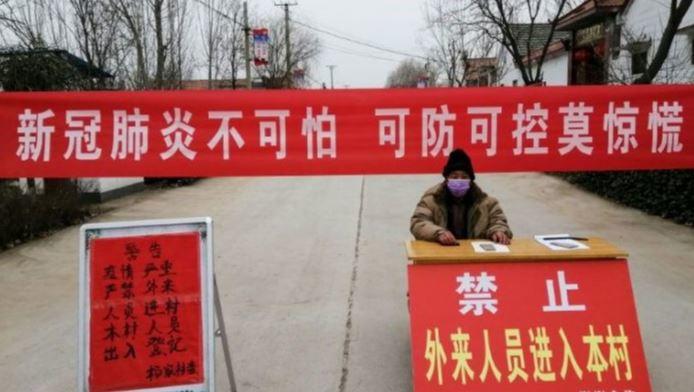
Meanwhile, villages and apartment complexes across China are “taking the fight against a deadly viral epidemic into their own hands,” according to AFP.
Some areas are starting to look like something out of a sectarian conflict, complete with check points and makeshift barricades. Groups of locals have constructed makeshift barricades across access roads to keep potentially-infected strangers out.
In one residential compound in Beijing, “a motley stack of shared bicycles have been haphazardly woven together and wired to a wooden ladder, blocking a side gate and forcing visitors to register with guards at the main entrance.”
With more than 50 million people still on lockdown, resentment against the ruling party has intensified, and more Chinese are speaking out on social media, according to the NYT: “We gave up our rights in exchange for protection,” the user wrote. “But what kind of protection is it? Where will our long-lasting political apathy lead us?” That post was shared more than 7,000 times.