After Gold & Oil Contract Chaos, CME Group Secures $7 Billion Credit Line “In Case Of Clearing Member Default”

After Gold & Oil Contract Chaos, CME Group Secures $7 Billion Credit Line “In Case Of Clearing Member Default”

Something unusual is coming…

First we had unprecedented dysfunction in the gold futures markets with dramatic paper and physical price divergences amid virus-inspired geographical shortages for deliverables.

“I’ve never seen that before,” said one gold trader who has been in the market for 30-plus years.

Saxo Bank’s head of commodity strategy, Ole Hansen, observed that a lockdown is occurring in two biggest gold hubs in the world, New York and London,  so many traders are working from home. “This has caused a breakdown in the marketplace”, he said.

“There is no price discovery in the market right now,” he said Tuesday morning. “If you need to borrow gold in the OTC [over-the-counter] markets right now, you are going to pay a king’s ransom.”

Then we had the even more stunning negative prices for front-month WTI crude futures as prices converged to negative spot prices at expiration/delivery, thanks to a lack of storage and ETF-driven illiquidity issues. This sparked major losses for some very large market brokerages and clearing houses, among them, Interactive Brokers:

CNBC: “Across the industry, do you think there is going to be some really serious pain?”

Peterffy: “There is about another half a billion dollars of losses that somebody is sitting on… and I do not know who those folks are.”

So, it is with great interest that we note that CME Group said its Chicago Mercantile Exchange subsidiary entered into an amended credit facility for a $7 billion revolving secured credit facility.

As Bloomberg reports, in a U.S. Securities and Exchange Commission filing, CME it entered into an amendment to its 364-day multi-currency credit facility with Bank of America N.A., as administrative agent, Citibank N.A., as collateral agent and collateral monitoring agent and some of the banks under its existing facility.

The amended facility is for a multi-currency revolving secured credit facility of $7 billion, which is eligible to be increased to $10 billion.

Specifically, the filing says, the new credit facility is “intended to provide temporary liquidity to CME in the event of a clearing member default, a liquidity constraint or depositary default, or in the event of a delay in the payment systems utilized by CME.”

Of course, this is nothing to worry about as we are sure The Fed has their back… right?


Tyler Durden

Fri, 05/01/2020 – 08:55

via ZeroHedge News https://ift.tt/2yZ0fXq Tyler Durden

Potential Winners From Easing Lockdowns Emerge

Potential Winners From Easing Lockdowns Emerge

Authored by Bloomberg macro strategists Michael Msika and Joe Easton

Equity investors tend to act in anticipation of the next big event, a fact that’s especially apparent in the current rebound. Even amid bleak economic data and earnings reports, European shares posted their best monthly gain since October 2015 and the U.K.’s benchmark FTSE 100 Index finally entered a bull market. The prospect of easing lockdown norms is starting to spur strong gains in some battered sectors.

Since the market bottomed on March 18, the Stoxx Europe 600 is up 22%, but those hammered in the preceding rout have risen a lot more: notably, the travel and leisure sector (46%), energy stocks (41%) and autos (35%).

Strategists including those at Sanford Bernstein & Co. and Barclays Plc had noted earlier that the rebound was not “risk on,” as value and cyclical stocks were getting left behind. Such shares had started to show tentative signs of a comeback as the rally broadened, before stalling.

Amundi SA head of equities Kasper Elmgreen remains cautious after the rally, but says he’s looking for high quality cyclical stocks with exposure to the demand recovery in consumer discretionary and industrials.

Competitive positioning and strong balance sheets are essential in stock picking, he says, adding that quality banks and insurers trading at attractive valuations and supported by central-bank measures fit the bill. He’s also constructive on the luxury sector in China and on leading sports-goods makers trading cheaply, but expects automotive stocks to report sharp declines in 2020 earnings.

Still, it might be a little late to play the bounce. Societe Generale strategist Andrew Lapthorne warns the economic fallout of the pandemic is mounting daily, with rising unemployment, a complete collapse of aggregate demand and the skyrocketing public cost of recovery.

“Given the overall negative undertone from the economic challenges ahead, the dramatic reversal of global markets after the pandemic lows is more puzzling, as it also implies an all clear victory against the silent enemy and a return back to the pre-pandemic normality,” he says.

Looking more specifically at the U.K., locally-exposed shares are once again benefiting from renewed sterling strength, with the FTSE 250 Index and the pound highly correlated. Despite the lockdown, the FTSE 250 has strongly outperformed the FTSE 100 since March 18.

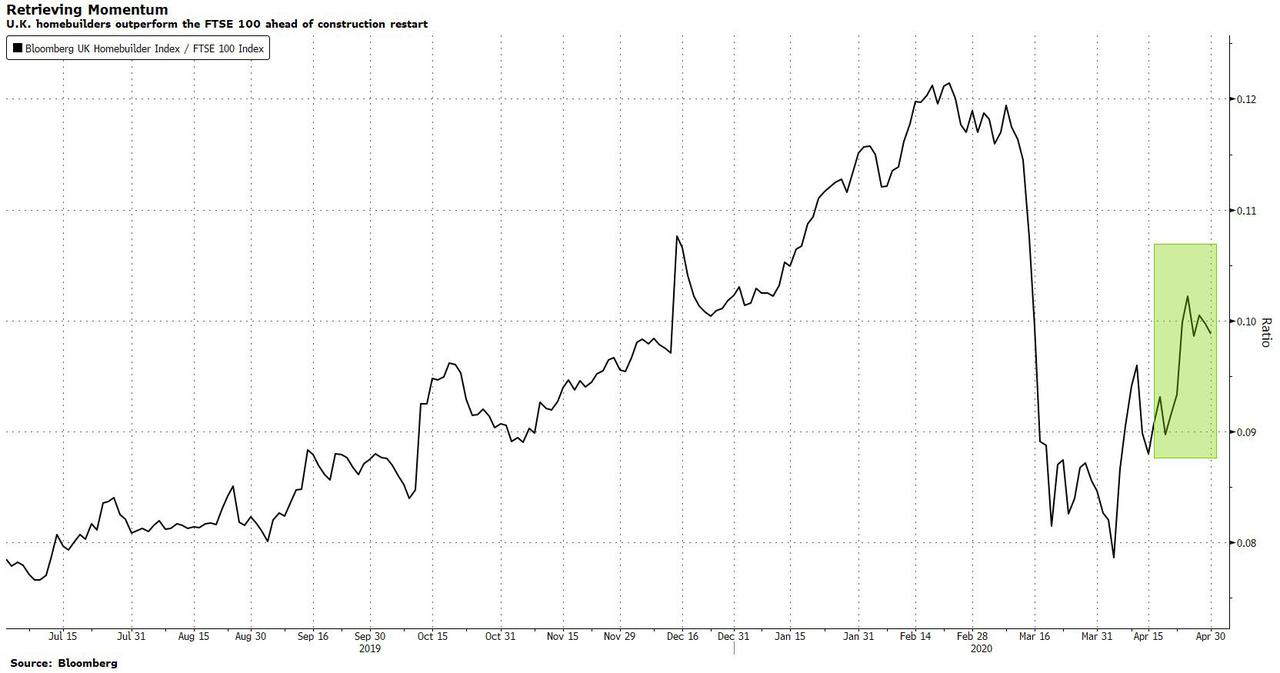
The U.K.’s biggest homebuilders, like Persimmon Plc, Vistry Group Plc and Taylor Wimpey Plc are set to return to building sites in the coming weeks, which is “encouraging news” and implies the firms should start converting their order books into cash, hence further reducing the risks of liquidity crunch scenarios, UBS analysts say.

They see the sector as having sufficient liquidity to withstand at least three months of lockdown or zero-revenue. That said, the country is set to build 35% fewer houses than forecast this year, according to real-estate broker Knight Frank LLP.

As for the British retail sector, it’s up about 28% since March 19, even as questions linger about how such businesses might operate as restrictions ease, with Next Plc warning it expects sales to be disrupted even after the full lockdown has been lifted. Berenberg analysts say there is an opportunity for companies like Next to garner more market share as rivals such as Debenhams, New Look and River Island struggle in the current environment.

Some clothing and other non-food retailers have already succumbed to balance sheet and cash flow constraints, such as Debenhams and Cath Kidston, and it’s not over yet, according to Shore Capital analyst Clive Black. He expects many more independent and chain-based outlets to fail due to cash shortages and weak ongoing demand.

“Short-to-medium term U.K. consumer demand feels worrying to us,” Black says. “It remains to be seen how many businesses re-emerge from the current coronavirus crisis,” he added.


Tyler Durden

Fri, 05/01/2020 – 08:30

via ZeroHedge News https://ift.tt/2VT7YPL Tyler Durden

Freedom Is a Pandemic Casualty in Authoritarian Regimes and Liberal Democracies

It will be months, at least, before we have a full accounting of pandemic casualties. For now, though, you can confidently add to that list a healthy measure of human freedom. Around the world, governments are taking advantage of the public health emergency to tighten the screws on their subjects. That’s true of the usual-suspect authoritarian regimes, but citizens of liberal democracies have also seen their liberty curtailed. And not only is it unclear how much they’ll get back once the crisis passes, it’s not obvious that everybody will even want to reclaim the freedom they’ve surrendered.

It’s not surprising that regimes traditionally contemptuous of the give and take of an open society see in the spread of COVID-19 a new opportunity for punishing dissidents and extending their power.

“The Thai authorities are prosecuting social media users who criticize the government and monarchy in a systematic campaign to crush dissent which is being exacerbated by new COVID-19 restrictions,” Amnesty International reports. “Authorities have wasted no time using existing repressive laws in order to censor ‘false’ communications related to COVID-19,” the organization adds.

Thailand isn’t alone.

“Cambodian authorities are using the Covid-19 pandemic to carry out arbitrary arrests of opposition supporters and government critics,” according to Human Rights Watch. “The authorities have arrested at least 30 people, including 12 linked to the dissolved Cambodian National Rescue Party (CNRP), on charges of spreading ‘fake news’ and other offenses since the global outbreak of the pandemic.”

You could say that arresting political opponents for criticizing public health efforts has gone viral.

“Across the globe, illiberal leaders—facing questions about their preparedness to deal with a pandemic that has killed nearly 45,000 people, at a time when too few states appear to be equipped for the challenge—see fake news bans as convenient tools to suppress criticism and accurate information just as readily as misinformation,” Foreign Policy acknowledged a month ago, before the death toll climbed to its current level.

Despite controversial social media efforts to tag and sometimes yank (allegedly) misleading information, the pandemic hasn’t been widely used in democratic countries to stifle political speech—yet.

Then again, as governments around the globe use the force of law to close businesses, restrict travel, and confine people to their homes—by the beginning of April, half of all humans were under lockdown orders of varying severity—aiming barbs at political leaders may be one of the few liberties that remain intact in many traditionally free-ish countries.

“If somebody wants to stay in the house that’s great,” Tesla chief Elon Musk complained in an April 29 conference call. “But to say that they cannot leave their house and they will be arrested if they do… this is fascist.”

Musk is one of the more high-profile figures to push back against lockdown orders. But protests have erupted against restrictions across the United States, Canada, Germany, and elsewhere. In France they turned violent in reaction to harsh police enforcement tactics.

Some leaders are doubling down. California’s Governor Gavin Newsom indicated that he would close all beaches and state parks to deter people from congregating under the open sky. Almost simultaneously, a Michigan judge refused to uphold a constitutional challenge to Michigan’s bizarre and draconian (if recently softened) pandemic restrictions. That last bit of news should be little surprise since U.S. courts generally abandon anything resembling a protective role toward constitutionally protected rights during health crises.

“Historically, the courts have been very deferential to the executive branch in times of pandemics,” constitutional expert Josh Blackman of the South Texas College of Law told The Foundation for Individual Rights in Education. “People always go to the courts. They tell the courts, ‘We’re not having our rights respected. We’re having our rights violated. Do something!’ And in almost every case, the courts say, ‘Ehhh… Not for us … We’re going to sit on the outside and look in.’ And that’s really been the story of the law in the time of epidemics.”

Why do they fold so easily? Judges are people like anybody else, and they’re as prone to panic and to abandon principles at the mention of “disease” as the rest of us. With a majority of Americans supportive of lockdown orders, and even of requiring people to postpone “non-essential” medical care, judges protecting individual liberty would be swimming against the current of public opinion.

Enough Americans are sufficiently frightened of becoming sick that many have taken to snitching on neighbors who they suspect of stepping beyond the bounds of pandemic rules.

“Covid-19-induced terror has hijacked the nation,” worries Dr. Joseph A. Ladapo, an associate professor at UCLA’s David Geffen School of Medicine. “The battle against Covid-19 is gradually morphing into a battle over civil liberties,” he wrote in an April 29 Wall Street Journal op-ed.

Ladapo is concerned not just by restrictive stay-at-home orders but also about what’s to come, as efforts to control the spread of the novel coronavirus become a regular part of our lives.

“Testing may be mandatory,” Ladapo warns. “Contact tracing may mean government tracking of cellphone data. How much privacy are individuals willing to forfeit for a virus that increasingly appears to pose little danger to a large percentage of the U.S. population?” He worries that, as in Thailand, Cambodia, and elsewhere, new intrusions into people’s lives will be “more about the exercise of power than about public health.”

The American Civil Liberties Union also worries about “plans to use location data from our cellphones to address the pandemic in ways that would not be effective and would impinge on rights.” Likewise, Human Rights Watch warns that “for authoritarian-minded leaders, the coronavirus crisis is offering a convenient pretext to silence critics and consolidate power.”

That power, once consolidated, will be hard to take away. And the freedom that power is used to crush—of speech, movement, business, privacy, and day-to-day activity—will be extremely difficult to reclaim.

Freedom will be that much harder to reclaim if many people don’t want it back. The subjects of already-authoritarian governments won’t be asked their opinions on the subject, but the citizens of countries that were relatively free have themselves to blame if they meekly surrender what they once enjoyed.

from Latest – Reason.com https://ift.tt/2xoIm3I
via IFTTT

Freedom Is a Pandemic Casualty in Authoritarian Regimes and Liberal Democracies

It will be months, at least, before we have a full accounting of pandemic casualties. For now, though, you can confidently add to that list a healthy measure of human freedom. Around the world, governments are taking advantage of the public health emergency to tighten the screws on their subjects. That’s true of the usual-suspect authoritarian regimes, but citizens of liberal democracies have also seen their liberty curtailed. And not only is it unclear how much they’ll get back once the crisis passes, it’s not obvious that everybody will even want to reclaim the freedom they’ve surrendered.

It’s not surprising that regimes traditionally contemptuous of the give and take of an open society see in the spread of COVID-19 a new opportunity for punishing dissidents and extending their power.

“The Thai authorities are prosecuting social media users who criticize the government and monarchy in a systematic campaign to crush dissent which is being exacerbated by new COVID-19 restrictions,” Amnesty International reports. “Authorities have wasted no time using existing repressive laws in order to censor ‘false’ communications related to COVID-19,” the organization adds.

Thailand isn’t alone.

“Cambodian authorities are using the Covid-19 pandemic to carry out arbitrary arrests of opposition supporters and government critics,” according to Human Rights Watch. “The authorities have arrested at least 30 people, including 12 linked to the dissolved Cambodian National Rescue Party (CNRP), on charges of spreading ‘fake news’ and other offenses since the global outbreak of the pandemic.”

You could say that arresting political opponents for criticizing public health efforts has gone viral.

“Across the globe, illiberal leaders—facing questions about their preparedness to deal with a pandemic that has killed nearly 45,000 people, at a time when too few states appear to be equipped for the challenge—see fake news bans as convenient tools to suppress criticism and accurate information just as readily as misinformation,” Foreign Policy acknowledged a month ago, before the death toll climbed to its current level.

Despite controversial social media efforts to tag and sometimes yank (allegedly) misleading information, the pandemic hasn’t been widely used in democratic countries to stifle political speech—yet.

Then again, as governments around the globe use the force of law to close businesses, restrict travel, and confine people to their homes—by the beginning of April, half of all humans were under lockdown orders of varying severity—aiming barbs at political leaders may be one of the few liberties that remain intact in many traditionally free-ish countries.

“If somebody wants to stay in the house that’s great,” Tesla chief Elon Musk complained in an April 29 conference call. “But to say that they cannot leave their house and they will be arrested if they do… this is fascist.”

Musk is one of the more high-profile figures to push back against lockdown orders. But protests have erupted against restrictions across the United States, Canada, Germany, and elsewhere. In France they turned violent in reaction to harsh police enforcement tactics.

Some leaders are doubling down. California’s Governor Gavin Newsom indicated that he would close all beaches and state parks to deter people from congregating under the open sky. Almost simultaneously, a Michigan judge refused to uphold a constitutional challenge to Michigan’s bizarre and draconian (if recently softened) pandemic restrictions. That last bit of news should be little surprise since U.S. courts generally abandon anything resembling a protective role toward constitutionally protected rights during health crises.

“Historically, the courts have been very deferential to the executive branch in times of pandemics,” constitutional expert Josh Blackman of the South Texas College of Law told The Foundation for Individual Rights in Education. “People always go to the courts. They tell the courts, ‘We’re not having our rights respected. We’re having our rights violated. Do something!’ And in almost every case, the courts say, ‘Ehhh… Not for us … We’re going to sit on the outside and look in.’ And that’s really been the story of the law in the time of epidemics.”

Why do they fold so easily? Judges are people like anybody else, and they’re as prone to panic and to abandon principles at the mention of “disease” as the rest of us. With a majority of Americans supportive of lockdown orders, and even of requiring people to postpone “non-essential” medical care, judges protecting individual liberty would be swimming against the current of public opinion.

Enough Americans are sufficiently frightened of becoming sick that many have taken to snitching on neighbors who they suspect of stepping beyond the bounds of pandemic rules.

“Covid-19-induced terror has hijacked the nation,” worries Dr. Joseph A. Ladapo, an associate professor at UCLA’s David Geffen School of Medicine. “The battle against Covid-19 is gradually morphing into a battle over civil liberties,” he wrote in an April 29 Wall Street Journal op-ed.

Ladapo is concerned not just by restrictive stay-at-home orders but also about what’s to come, as efforts to control the spread of the novel coronavirus become a regular part of our lives.

“Testing may be mandatory,” Ladapo warns. “Contact tracing may mean government tracking of cellphone data. How much privacy are individuals willing to forfeit for a virus that increasingly appears to pose little danger to a large percentage of the U.S. population?” He worries that, as in Thailand, Cambodia, and elsewhere, new intrusions into people’s lives will be “more about the exercise of power than about public health.”

The American Civil Liberties Union also worries about “plans to use location data from our cellphones to address the pandemic in ways that would not be effective and would impinge on rights.” Likewise, Human Rights Watch warns that “for authoritarian-minded leaders, the coronavirus crisis is offering a convenient pretext to silence critics and consolidate power.”

That power, once consolidated, will be hard to take away. And the freedom that power is used to crush—of speech, movement, business, privacy, and day-to-day activity—will be extremely difficult to reclaim.

Freedom will be that much harder to reclaim if many people don’t want it back. The subjects of already-authoritarian governments won’t be asked their opinions on the subject, but the citizens of countries that were relatively free have themselves to blame if they meekly surrender what they once enjoyed.

from Latest – Reason.com https://ift.tt/2xoIm3I
via IFTTT

“It’s A Crock Of S**t!” – Here’s Why Bill Blain Is Furious This Morning

“It’s A Crock Of S**t!” – Here’s Why Bill Blain Is Furious This Morning

Authored by Bill Blain via MorningPorridge.com,

I am deeply uneasy about what’s happening in financial markets.

The Coronavirus has completely turned the global economy on its head. It will create the most profound changes to the way we live and our future prospects – we are all beginning to realise that. There is not going to be a V-Shaped recovery. Many lives will be shattered and ruined in its wake.

Yes, what I saw yesterday confirms two terrible truths we’ve long denied: 

1) The system was already rotten to its very core before Coronavirus triggered the coming depression. This was coming and is overdue. 

2) Those responsible for that rotten core will likely walk away richer, while the poor working men and women that struggle, scrimp and suffer spending their lives working for them will inevitably get poorer. 

What has made me so angry?

Boeing. 

Boeing has launched an extremely successful multi-tranche $25 billion bond deal. The issue solves all its immediate funding needs. It enables the company to walk away from difficult bailout discussions. It claims its access to market capital demonstrates it’s soundness – which is utter bollchocks – and that it doesn’t need a government rescue. The issue of moral hazard for government is avoided. Boeing will survive – for time being – as is. 

It’s a crock of s**t. 

The bond deal was snapped up by investors. It does offer a small increase in yield if its downgraded to junk, and an 5.15% yield on the 10-year tranche. Buyers are unconcerned the company is haemorrhaging money, has been downgraded to the cusp of junk, faces massive lawsuits over the B-737 Max, has comprised on quality and safety, is laying staff off in droves, and is seeing orders cancelled around the globe. 

Nope… Investors love it. 

They wanted to buy – even though it looks to be priced very aggressively for a company with such obvious crisis emblazoned across it. The brutal reality is investors know Boeing is such a central part of the US Military-Industrial-Aerospace complex, with so many other contractors and jobs dependent upon it, that the US government has no choice but to backstop it. It’s the industrial equivalent of Too-Big-To-Fail.

The get-out-of-jail-card is there in plain sight – The Fed’s QE Infinity programme can buy as much toxic Boeing bonds as the market cares to lob at them. As we know from the Taper-Tantrum a few years back, bond holders have an infinite put back to the Fed. As long as it was investment grade back in March it qualifies for the Fed… No one cares about the economic reality facing the company. 

It fills me with great sadness. 

What happened to the concept of the free hand of markets ensuring the efficient allocation of capital to good companies? This deal screams MORAL HAZARD – yet the whole street has bought it.

So much for ESG and the importance of socially aware investment and good governance. The Street should hang our heads in shame…

Boeing illustrates everything that was once great but is now rotten about our Western economy: 

It was once a good solid plane maker. It built the aircraft that allowed global airlines to develop, grow and innovate new routes and services. Regional travel, tourism and business travel all exploded in the wake of the Boeing aircraft that enabled it. The B-737 regional jet and the B-747 Jumbo really did make the world smaller and brought it to everyone’s door. 

Then it bought MacDonald-Douglas. The rival smaller planemaker pulled off the coup of the century, buying Boeing with Boeing’s money as the joke went. Its executives took over. The brilliant Boeing engineers were ousted by McD cost accountants. Cost cutting trumped engineering every time. The company moved to Chicago – away from its Seattle roots. 

The last decent plane Boeing made was the innovative, fuel-efficient, composite Dreamliner. It cost $25 bln plus to develop – and it will take decades to recoup the money through clever accounting. (It may never make a real profit.) The plan had then been to develop a successor for the venerable B-737 which airlines and the environmental lobby would have loved: a fuel efficient lightweight city-to-city hopper. It never happened.

Instead the C-Suite cut costs and saved money. Their market was secure, a duopoly with Airbus and 3-4 year order books, happy that airlines had little choice but keep buying whatever crud they offered. 

As interest rates fell Boeing borrowed more and more from market, using it to buyback stock. The stock soared. Executives received enormous bonuses and stock option packages. Workers saw salary and conditions cut. Quality fell. The C-Suite decided not to invest in new aircraft development – they simply further extended the B-737, making the once slim thoroughbred of the skies into a fat, bloated unstable and unsafe lump of flying metal. 346 people paid the ultimate price for Boeing compromising safety. 

Today Boeing has no aircraft on its books any airline really wants. Its new B-777x is years late and utterly pointless in this new environment. There have been very few new Dreamliner orders – the whole programme may have lost money. Across the globe airlines are retrenching. It could be years before air travel recovers. 

Boeing is textbook corporate failure. 

Yet because of the perception Governments will now intervene freely in “free markets”, it’s been able to snub a “strings-attached” government rescue, take market money, and is still backstopped. 

This really is the end of Capitalism… The rolling raucus sound you hear from the hills in North London is the sound of Karl Marx laughing his head off in Highgate Cemetery. 


Tyler Durden

Fri, 05/01/2020 – 08:34

via ZeroHedge News https://ift.tt/2WdIVpq Tyler Durden

Exxon Reports First Quarterly Loss In 32 Years

Exxon Reports First Quarterly Loss In 32 Years

The energy industry is truly reeling.

One day after Shell unexpectedly cut its dividend for the first time since WWII, supermajor Exxon Mobil reported its first quarterly loss in 32 years amid a glut of oil, a global recession, and a pandemic that has forced billions of people to stay indoors instead of driving, destroying petroleum demand. 

The company reported a $610 million loss for the quarter ending March 31, equivalent to a 14c loss per share in 1Q versus earnings per share estimates of around 55c Y/Y.  First-quarter results are a reminder that the worst has yet to come, as lockdowns only began around mid-month, so the quarter only captured about 15 days or so of demand destruction. 

Here are some of the highlights from the 1Q earnings report:

  • 1Q production 4,046 mboe/d, +1.6% y/y, estimate 3,943 (Bloomberg Consensus)
  • 1Q capital expenditure $7.14 billion, +3.7% y/y
  • 1Q production 9,396 mmcfe/d, -5.3% y/y, estimate 8,633
  • 1Q chemical prime product sales 6,237 kt, -7.9% y/y
  • 1Q downstream petroleum product sales 5,287 kbd, -2.4% y/y
  • 1Q cash flow from operations and asset sales $6.36 billion, -25% y/y
  • 1Q refinery throughput 4,060 mb/d, +4.5% y/y 

Exxon also announced it is “reducing 2020 capital spending by 30 percent and cash operating expenses by 15 percent. Capex is now expected to be approximately $23 billion for the year, down from the previously announced guidance of $33 billion.” 

“COVID-19 has significantly impacted near-term demand, resulting in oversupplied markets and unprecedented pressure on commodity prices and margins,” said Darren W. Woods, chairman and chief executive officer.

“While we manage through these challenging times, we are not losing sight of the long-term fundamentals that drive our business. Economic activity will return, and populations and standards of living will increase, which will in turn drive demand for our products and a recovery of the industry.”

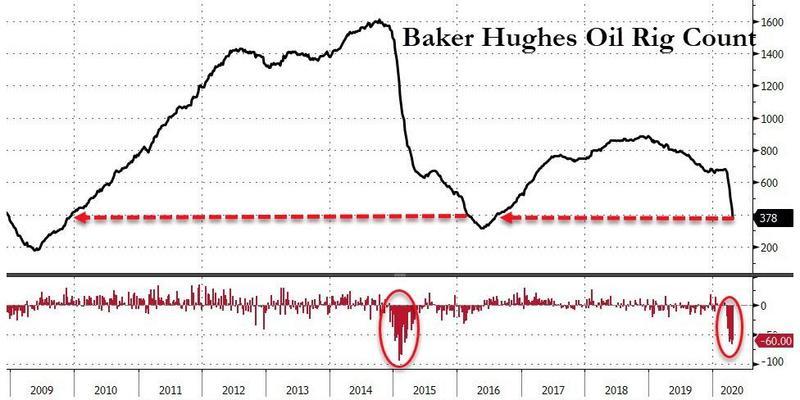
We have noted in the last several weeks that a bankruptcy wave in the oil and gas complex has begun. Producers have slashed spending amid collapsing energy demand. The economic downturn has destroyed tens of billions of dollars in value for shale companies, rigs are being taken offline, and thousands of jobs eliminated. 

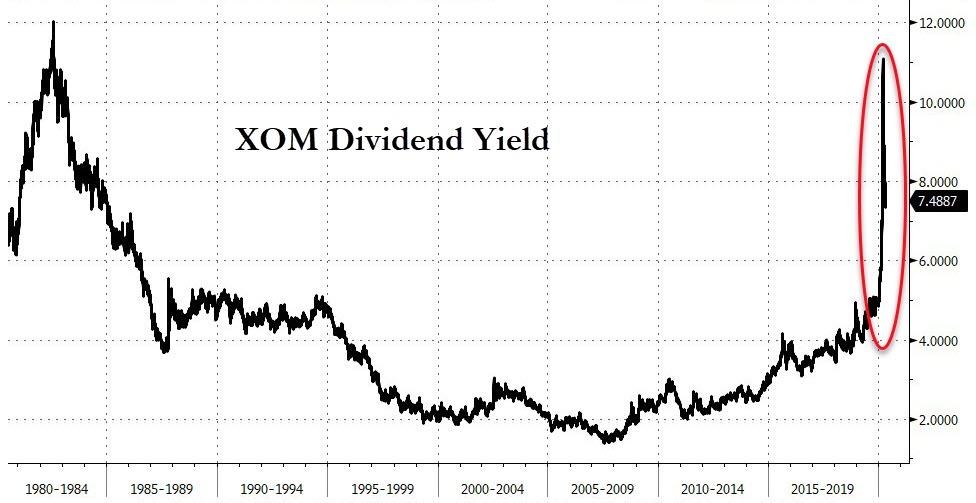
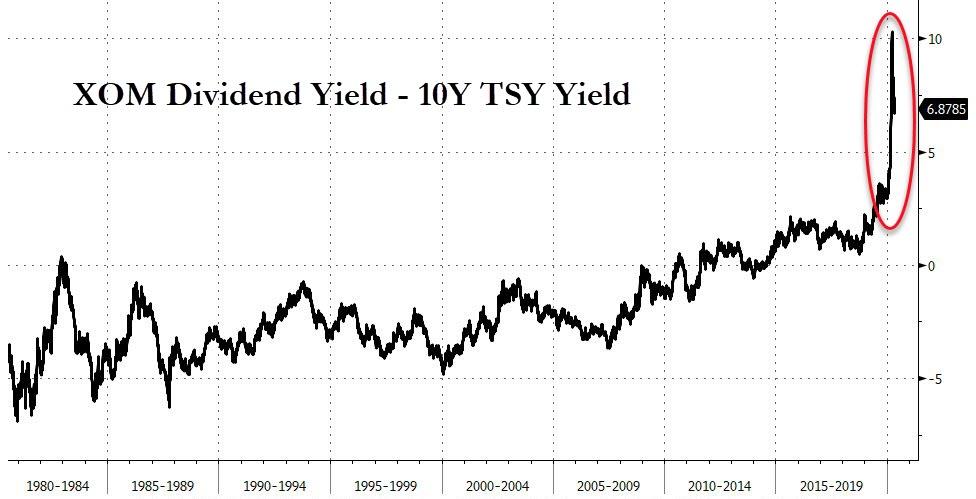
While it did not follow in Shell’s footsteps and cut its dividend, Exxon kept its dividend unchanged for the first time in 13 years earlier this week. The current dividend yield is near its absolute record highs.

But on a relative basis the yield is an extreme outlier…

Exxon shares are widely unchanged after the earnings announcement. Shares doubled over the last 27 sessions from mid-March despite deteriorating fundamentals, mostly the result of a technical bounce after a halving in share price was seen from early January to mid-March.


Tyler Durden

Fri, 05/01/2020 – 08:18

via ZeroHedge News https://ift.tt/35mCTXA Tyler Durden

Justin Amash Wants To Be the First Libertarian President

Five-term Michigan Congressman Justin Amash has announced that he’s running for the Libertarian Party’s presidential nomination, which will be decided in late May. The 40-year-old son of Middle Eastern immigrants took office in 2011 as a Republican but left the party last July, saying he didn’t want to be part of a partisan death spiral. He has consistently voted against corporate bailouts, increases in debt-financed government spending, overseas military interventions, and the prosecution of the federal drug war.

During the coronavirus pandemic, Amash has castigated federal agencies such as the Centers for Disease Control and the Food and Drug Administration, first for botching containment efforts and then for asserting monopoly control over testing. He was one of a mere handful of no votes on the $2.2 trillion CARES Act, arguing that all relief payments should go directly to individuals and households rather than corporations, nonprofits, or government agencies.

Republican and Democratic loyalists are lashing out at Amash as a quixotic potential spoiler with no chance of being elected and calling for him to step aside. 

Nick Gillespie talked with Amash about why he thinks Donald Trump is too erratic to be given a second term, why Joe Biden is too old for a first term, and why he believes his vision of a freer country will take him to victory in November.

Audio production by Ian Keyser.

This is a rush transcript. Please check all quotes against the audio for accuracy.

Nick Gillespie: Okay, so let’s get right to it. Why are you running for president as a Libertarian?

Justin Amash: Well, I’m running for president because I think we need an alternative to these two candidates and we need someone in Washington who’s going to be honest and practical and respect the rights of the people and fight for a system that will benefit the people.

Gillespie: So what’s your vision of the country then? And I’m sorry to chop you off there because you’re talking about fairness and competency, but then in broader terms, what is the country you want to live in?

Justin Amash: I want to live in a country where people feel they have freedom to make decisions for their own lives and where people live respectfully with one another. So if someone has a difference of opinion, someone has a different perspective on how things might work, we can all live together, and we don’t all have to have the same exact rules from community to community. That’s why we have a system of federalism: different people can live in different places and make different choices about their lives. And I think that’s the system the Founders really intended. And we’ve perfected that over the years—we’ve perfected the system so we actually have, at least under our Constitution, more freedoms, more protections today for the people to make decisions for themselves.

Yet at the same time we have a government that has been moving in the other direction in recent decades because of how they run the system, where they’ve been consolidating power in just a few people and taking away representation, and moving more and more to the federal government and away from state governments, local governments, and individuals.

Gillespie: Let’s talk about that more broadly in a second. But right now the reason we’re doing this the way we are is because of the coronavirus pandemic and the state and federal responses to it. And I think in talking about this it will illuminate your larger ideas about government. But what is the single biggest mistake that Donald Trump has made and the federal government has made in combating or confronting the novel coronavirus pandemic?

Justin Amash: They were very slow right from the get-go, in terms of getting testing, finding the individuals who had the initial cases. And we don’t know exactly when that happened either. There is some evidence that maybe it started earlier in the states than we realized, but there wasn’t enough of an effort when we first heard about it coming out of China to find those cases and also get the testing ramped up really quickly so that people could be tested and we could contain it. And part of that is a regulatory issue. Just the FDA and the CDC getting in the way of the ability of private labs to actually get the tests out there.

Gillespie: Right. And that’s what they exist for, and they were not prepared and then getting in the way. What about and that’s kind of the long-term government. These are lifers, it’s not political appointees. What has Trump done that you think is either right or wrong in the way that he’s kind of responded to things?

Justin Amash: I think his instincts about the way the power should be split up is probably right. He has some instincts about the federal government not managing everything at the top. He conveys it in totally the wrong way and he vacillates from day-to-day. So one day he’ll say he has ultimate authority and he controls the whole thing. I don’t know if he’s trying to appeal to some group, or own someone with that kind of statement, or what he’s trying to do, but then the next day he’ll go back to the states should handle things.

He’s vacillated, but in some sense I think he probably has some instincts that are right about this, that one person or one small group of people sitting at a table can’t make all of these determinations that you have to divide the process, and you have to use the knowledge that’s at home. But he’s been both good and bad in the sense that, like I said, he vacillates. One day he’ll say he has ultimate power and controls everything; the next day he’ll say, which I think is probably closer to his instincts, to say that we need to divide this up a little bit.

Gillespie: You have been critical of your governor in Michigan, Governor Whitmer. What would you do differently if you were president, or if you were governor of your specific state?

Justin Amash: So setting aside for now the relief package—because I think the relief packages is a whole nother issue—I would be very clear about the division of powers in our system and very clear that the White House is there to coordinate things. It’s there to provide guidance, it’s there to provide assistance. It’s there to help when there aren’t sufficient resources. So some states might have a massive surge like New York, and the state might need resources that it can’t obtain quickly. The federal government might step up in that circumstance, whereas for some other states maybe there’s not the same need because you know it might be some state out in the Mountain West, or something, where they don’t have the same immediate need for the federal government to step in. So the federal government would be there to assist and provide guidance.

As for how state government should operate: state governments obviously have more authority to shut things down if you will, like tell businesses they’re not going to operate, etc., than the federal government does. But you have to be mindful of the way people react to it. So if I were a state governor—which I’m not running for to be clear—but if I were a state governor, I would give communities, particularly counties for example in the state of Michigan, more authority to make decisions along with the cities in those counties.

Like I live near the city of Grand Rapids and you might give those counties and cities more authority to make decisions about how to allocate resources and handle the virus in the particular community. Because there’s a big difference between, say, what’s happening on the east side of the state and what’s happening on the west side of the state. And some of the rules you put in place on the east side of the state might not make a lot of sense on the west side of the state and might actually lead to more deaths and more economic devastation than would otherwise happen if you just allowed people to make decisions at home.

Gillespie: From a public health perspective, do you think we have overreacted to the problem so far?

Justin Amash: It’s hard to say whether we’ve overreacted in the sense that it is a big issue. We don’t know what will happen with the virus, so at first you have to take some pretty extraordinary measures. But a lot of these measures can be taken by society. I’m not sure that they all have to be compelled by government, and that’s a big difference between my approach and maybe some of these governor’s approaches, where I would say you can make more decisions at home and there’s a lot of reasons to think that people would make voluntarily the right decisions. There’s actually data on this showing that many people would just make the right decisions in these circumstances. I’m sure governors nudging it along does also help, but you want to give people the most room possible. We’ve overreacted in some ways and maybe underacted in other ways.

Gillespie: Let’s talk about The Cares Act, the $2.2 trillion spending bill passed a few weeks ago by Congress. You were one of the few people who were public in Congress who was publicly on the record as saying “no,” you actually entered a no vote even though it had been done by voice vote. What is the essential mistake that is being made by the way that the federal government economically is dealing with the economic collapse caused by the shutdown of the economy?

Justin Amash: It’s pretty simple: When you have a crisis like this, the key is to get assistance to people who need it the most as fast as possible. It’s that simple. You don’t spend time, weeks and weeks like they did, coming up with a convoluted scheme and negotiating it back and forth about, well we want this enhancement, and we want this change, and we want this provision and we want these restrictions, and we want these other guidelines and other. You’ve made it too complicated for people.

And you slow the process down so that by the time they get the assistance they need, it’s already too late. They’re already in trouble. And what happened with this coronavirus relief package is the massive pot of corporate welfare, the $500 billion for the Federal Reserve, that went out pretty quickly because the federal reserve and minutia and they can get that stuff out quickly to the big corporations. And then this convoluted scheme at the bottom with PPP and enhanced unemployment benefits, etc. It’s very slow. I have constituents right now who can not get the unemployment benefits they need. I have small businesses in my community that can not get the loans they need, so they’re struggling right now. They have to go to food banks and other things, and they could have had assistance very quickly and it could have been done at a lower cost than what we spent, which is up to now about $3 trillion, I would guess.

Gillespie: Yeah. So what would you say is Donald Trump’s biggest failure as president? And what do you fear most from a second term of Donald Trump?

Justin Amash: Well, there are lots of policy failures. For example, he talked about getting us out of the wars. He didn’t get us out of the wars. I mean it’s always like next week we’re going to do something or we’re coming up with some deal with someone and it’ll happen sometime in the future. So there’s a lot of talk of that kind of stuff. You see him talk about FISA of course, because of what happened with respect to his campaign and with respect to the Russia investigation. But then when it comes to the legislation that comes through where we try to reform FISA, he hasn’t been helpful in any way really with respect to FISA reform. And you’re getting the same stuff brought over and over again and he’s putting a stamp on it and signing the legislation to continue the same kind of surveillance laws that have violated our privacy.

Look at civil asset forfeiture to. Another example where he’s continued the civil asset forfeiture process and actually enhanced it where you have federal adoptive forfeitures happening, so there are—I could go policy after policy and Donald Trump in most respects is an establishment Republican. He essentially merged with Mitch McConnell at some point. He took his rhetoric and his style and merged it with Mitch McConnell’s policies and that’s what you have now. That’s basically the Republican party.

Gillespie: That’s a terrifying apparition to be quite honest with you.

Justin Amash: Yeah, it’s basically Mitch McConnell’s policy with Donald Trump’s style and that’s today’s Republican party, which is a frightening combination.

Gillespie: Yeah, what do you fear most in a second term? Does he take us finally over the fiscal cliff that seems to be in the immediate future, but we haven’t yet reached?

Justin Amash: I didn’t even mention the spending and all that. Even when the economy was good, he kept signing these spending bills and saying the debt doesn’t matter, the deficit doesn’t matter. So I do see us going off a cliff. I don’t think that the president cares at all about the deficit or debt. I think he’ll just keep running it up. What he cares about is reelection, his ego, people loving him, that kind of thing. And anything to get him to that point where he has adoration and he gets enough of the percentage of the vote to win, that’s what he cares about.

Gillespie: So you’ve said that we were talking about Donald Trump, switching to Joe Biden. You said that Joe Biden is not up to it, meaning the job of being president. What do you mean by that? And what is your assessment—Biden was in the senate basically longer than you’ve been alive. He was the vice president for eight years. What is your knock on Joe Biden?

Justin Amash: Well, there are lots of things to criticize here, but I do think that he’s had his opportunity. He’s run twice for president. He’s had a long career in politics. I don’t think the time to become president is when we’ve got Donald Trump in office and then you’re running and you’re 77, 78 years old, or whatever he is at this point, and you’re going to turn 80 during your term. I think he is not at the prime of his career to be able to handle a job of that kind of pressure. And my dad’s 80 years old, we all have older parents and grandparents and others. We know that it becomes difficult as they get older to manage something like being the head of the executive branch. So you want to have someone who’s more in their prime. And I think that matters.

Justin Amash: And when you look at Biden’s policies, he’s been all over the board throughout his career, but he’s pushed for some of the most anti-liberty policies that we know about.

Gillespie: Name a couple of those? What are those?

Justin Amash: Whether it’s an expansion of federal criminalization—he was at the forefront of that for many years. With respect to privacy laws, he was pushing for programs and other surveillance laws that eventually evolved into things like the Patriot Act and FISA. He’s been terrible on corporate welfare and a variety of corporate issues over the years, giving more power to corporations at the expense of people. So there’s a long list of things you could go through with Joe Biden where he has been essentially an establishment Democrat-Republican. They’re not that far off in many respects on some of these major policies.

And that’s not really what we need right now. If you go back to the status quo, you’re going to end up with another Donald Trump. If you revert to pre-Donald Trump, Republican versus Democratic battles, you’re just going to get another Donald Trump because the people are not happy with this system. It doesn’t represent them. And they’re going to rise up again, and it might be a Democratic Donald Trump or it might be a Republican Donald Trump, but you’ll get another one.

Gillespie: Biden was obviously part of the Obama administration, which gave us health care reform. Health care is more important now than ever because of Coronavirus. What is your assessment of Obamacare at the time—you were a staunch opponent? Where are we now in terms of health care and how would you reform health care spending or the insurance system?

Justin Amash: Well, I think you can have some sort of government backstop, but it should be handled at the state level, not at the federal level. So you mostly want to have a private market and then you want to have some kind of backstop for people who don’t have proper coverage. And that might be some kind of expansion of a Medicaid-style system or something like that, that’s handled at the state level and gives people the assurance that when things aren’t going well for them and they need some healthcare and they don’t have the insurance to cover it, there will be someone to cover it.

But when you do things like that it needs to be understood that the government will have to make decisions about what’s covered and what’s not. Because if you set it up so that it covers every single thing under the sun, no matter what, the cost will go through the roof because there’s no limit on that if you don’t have private actors.

Nick Gillespie: Trump and Biden have both been credibly accused of sexual assault. Can you state definitively that you have never assaulted anyone or acted improperly toward them? And how do you balance concern for victims with concerns for due process of the accused?

Justin Amash: Yes, I can say that definitively. And I think it’s important that everyone have due process. In other words, if an accusation is made, you can’t just say the person is guilty without a trial and a proper venue and all that. You can’t just rush the judgment on it. Because accusations can be made that are false and we should be willing to acknowledge that.

At the same time when someone makes an accusation, I think we should not rush the judgment about the accuser because it very well could be a real situation where the person was harmed, and we should respect people who are making the accusation and give them the full opportunity to make their case and to present evidence and have that evidence corroborated.

Gillespie: Do you think if Joe Biden is guilty of digitally penetrating Tara Reade that disqualifies him from running for president or holding public office?

Justin Amash: I think anyone is disqualified if they’ve engaged in some kind of assault, like especially a sexual assault. So I think that’s disqualifying him. But for my part, on this campaign, I’m focused on other issues, and I think that needs to be sorted out, but it will be sorted out through the media and through the parties involved.

Gillespie: Foreign policy—you’ve raised it a couple of times already. Donald Trump had talked a good game about getting us out of dumb wars, overseas wars. Foreign policy and military intervention has faded a bit over the past few months, at least as the topic of discussion, where, obviously, we still have troops all over the place, we’re still working with countries that are bombing and droning people. What is your vision for the US as a world power especially in a world where China and other regional actors or world powers are starting to flex? What does an Amash foreign policy look like?

Justin Amash: We need to be engaged with the world, but that doesn’t mean we have to be at war throughout the world. So I’m not opposed to bodies where countries from around the world come and meet like the UN and can engage and discuss things, that doesn’t mean that we should give those bodies authority over U.S. citizens to decide laws for our people, but it does mean that these can be positive venues where countries can come together and hash things out and work through differences. I think that kind of dialogue is always important, and it would be a mistake for the US to retreat from the world in the sense of not talking or engaging with other countries. We have to have that engagement. And if we don’t have that engagement, if we don’t have that interaction, if we don’t have trade with other countries as well, you will have countries like China come in and take advantage of the situation and potentially present a threat to us down the road. So we want to have that engagement.

As for wars and having our troops everywhere, those things have to be authorized and I think the American people have to be firmly behind it with a congressional authorization. And so often we’ve heard presidents say, “We’re going to end this war or that war,” but nothing ever happens.

What I would say if I were president in the first few days of my presidency, I would look at these wars that are going on overseas and I would tell Congress, if I don’t think the war has an authorization, I would say to Congress, “Give me an authorization for this conflict within 90 days. If you don’t do that, we’re bringing the troops home.” And force their hand on it. And then if the American people support engagement in that war, then they can authorize their representatives and senators to vote for that engagement. That’s how that should be handled.

Gillespie: Can you talk about why? What are your qualifications to run the country? You’re a five-term congressman, but is that enough? How are you qualified to actually assume the office of the presidency?

Justin Amash: Yeah, and I’m sure you didn’t mean to say run the country because as we know the president is not running the country. But I think it’s important that I do have a background in Congress. I’ve served nine years in Congress and I understand the problems. And I think I’ve uniquely defined and identified the problems over the past few years when I’ve talked about the way Congress operates, the way it is a top-down system. And I wrote about the partisan death spiral that’s going on.

There hasn’t been a member of Congress who’s emphasized those points more and I think has gotten to the bottom of what’s really hindering our system and causing people to not feel represented at home. When you have a few people at the top who control everything, of course, people at home are going to feel like they don’t have real representation in Washington and it also enhances the partisanship. Because when people can’t fight on policy, what they start doing is fighting on personalities, and you get more partisan sniping, you get more sticking with your team, because there’s nothing else to do. You’re not actually working on crafting legislation. So when Pelosi says, “We’re doing this,” you stick with her because that’s your team. Or when McConnell says, “We’re doing this,” you stick with him.

And that’s a really dangerous environment and I recognize that. And I think I’m uniquely suited to challenging that system because I’ve shown in Congress my determination on these things, my willingness to go it alone if I have to, to stand up for what’s right. I’ve been willing to break from my party when I was Republican many times on many difficult issues because we understood what was going on and we did, in my office, we did what we thought was right. I think those are important considerations.

I’ve also pushed for rules changes in the House. For example, I was able to change the House rules to make the bills we read look more like track changes in a word document so that people could more easily read legislation. Because for a long time, you had people having to just do cross-references on the bills where you have to go back and forth. And at least for the committee report portion of the bills now, you are getting them in more of a track changes form.

It doesn’t go all the way through the process, it doesn’t go as far as I would like, but I was at least able to get that change through. And those are the kind of ideas. There are a lot of process ideas that I think needs to come into play if we want to fix the system. And most people are focused on substance and I’ve been very focused on process over the past nine years.

Gillespie: Let’s go back to generational politics for a moment. You have essentially said Joe Biden is too old to be an effective president. Donald Trump is much younger and show scattered thoughts and whatnot. Millennials and Gen Z voters are less partisan. The older you get, the more likely you are to just keep voting for one party or the other. They’re also the ones who are going to be paying for the 23, $24 trillion debt. Can you talk specifically to younger Americans, how does having that much debt screw them over and kind of beggar their future?

Justin Amash: Well, if they have that kind of debt, they have a very uncertain future because there’s no guarantee that our economic system can sustain that kind of debt in the future. Right now, of course, we’ve been able to handle it, we’ve remained the strongest economy in the world, but that’s all not guaranteed. Things can change in the future. You could have a situation where another country starts to rise and it starts to gain prominence, and its currency starts to become a dominant currency, and you could have then a massive debt problem in this country where things spiral out of control, there’s massive inflation or very high interest rates and the people left holding the bag will be the next generation who have to pay back all of this debt and can’t spend the money then on the things that they want to spend on in the present.

Gillespie: Younger voters also care a lot about immigration, ending the drug war, emptying prisons, and reducing economic inequality. Can we go through these real quick? What is your basic position on immigration?

Justin Amash: I support immigration and I think we need to fix our immigration system so that people can come here lawfully. Right now what we have is a system where millions of people come here unlawfully. And you’ll probably have the same number of people arriving in the United States, it’s just that they would be lawful and that would be a benefit to our country. Because then instead of hiding, many of these people would go and integrate into society in a way that is beneficial to all of us. It would be more likely for those who are concerned about people learning English or people assimilating into communities, they’d be much more likely to do so if they come here lawfully and are welcomed as lawful residents of the United States and potentially lawful citizens of the United States. So we should do that.

And I come from a family of immigrants. My parents are both immigrants and they were welcomed here to the United States. My dad was welcomed as a refugee, and that I’m sure made a big difference in his life and a big difference in my mom’s life, in how they integrated and how they felt about America as a country. And that was instilled in me as a child where I understood what a blessing it was to be born in this country and how much better off we have it than so many other countries in the world. This is the best country on earth. And I really sought to preserve it and uphold our constitutional system. That’s why I ran for office so that we could preserve this for the next generation.

Gillespie: Would you be in favor of an immigration policy that is essentially, if you want to come here and work and live legally, you can, as long as you don’t have communicable diseases or a violent criminal past?

Justin Amash: I think for the most part, yes. Anytime you have a policy, it’s never laid out that simply, so you want to work through all the details and make sure you’ve covered all the bases. But for the most part, yeah. If someone wants to come to the United States and work here and be a resident of the United States, we should make that as open and possible as we can.

Gillespie: What about the drug war at the federal level? Obviously, a lot of drug war stuff happens at the state level, but what should the federal government’s role be in telling people what substances they can or cannot use?

Justin Amash: I don’t think the federal government should have a role in that. I believe that should be left to the states. States can make those decisions and states are perfectly equipped to make those decisions. There’s no reason you should have one government, the federal government, telling everyone what to do. And when you do that, you’ve also have state laws now that conflict with the federal law and you might even have local laws that conflict with the state laws.

In some places like Michigan for a while, we had a huge conflict where the City of Grand Rapids had a different law than the State of Michigan, which had a different law than the federal government. And that’s a total mess. So depending on which officer approaches you, you’re in trouble in different ways.

Gillespie: What’s your vision in terms of economic mobility and economic inequality? It seems that the spread between the richest Americans and poorest Americans is growing. In your mind, is economic opportunity twiddling in America? And if so, how? What are the types of policies as president you can support or push that would make that better?

Justin Amash: I think there is a gap between the rich and the poor that is widening, and you can see it in businesses. You can see that people who have professional skills are often advancing well, people with blue-collar skills are being left behind. And some of that is due to automation, some of that is due to productivity gains through technology and other things and perhaps trade in some instances too. So we have to find ways to make sure that people are educated. I think this starts with the education system. And these are mostly state level issues, not federal issues, but finding ways for adults who are in difficult circumstances to get education and training in new fields, I think is really important.

But, again, it’s not something that has to happen at the federal level, it makes more sense at the state level. The needs of the State of Michigan are going to be very different from the needs of New Mexico or Idaho or some other state, or the State of New York. So we have to allow states to make more of those decisions.

So, we have to allow states to make more of those decisions, and base it on the needs of the people there.

Gillespie: What about environmental issues? And again, keeping it kind of focused on younger voters, who I suspect may be the ones that give you the longest look. Most polls show that millennials, Gen Z people really care about things like climate change. Is climate change a priority, would it be a priority in an Amash presidency? And how do you conceptualize government action when it comes to environmental issues?

Justin Amash: It is really important. And I believe climate change is happening. I want to be clear about that, because you sometimes hear from elected officials, and it’s not clear where they stand on that. I believe there is climate change. I believe it’s very important. I believe that humans do affect it, and that we should take action with respect to climate change. But we have to be smart about the actions we take. And some of the things we can do, for example, would be to look into further nuclear power, and finding ways to get nuclear power in this country because it is a relatively safe form of production and very low emissions compared to other forms of energy.

There’s a lot of pushback about that, whenever you talk about nuclear power, but I think it’s important to consider it. I also think we need to make sure we’re not subsidizing any particular energy sources. So to the extent there are oil subsidies or any other subsidies, we should get those subsidies out of the way and allow people in the market to make decisions about how they get their energy.

And then, we need to continue to make sure that we’re innovating as a country. And that really happens at the private sector level. So, for individuals who are buying product, if they want to have an energy-efficient product, go buy that product. I do my best to try to buy energy-efficient products. I love the idea of electric cars as much as I love a V8 and manual transmission.

Gillespie: You are from Michigan, right?

Justin Amash: Yeah. SI love the idea though of having electric vehicles. I love the idea of wind power and solar power and other things. I think that private actors need to get more involved and companies need to make it more of a priority. Companies themselves can get together and present their own metrics and present that to the public. There’s no reason companies for example, couldn’t show off all the time, about how environmentally friendly they are with their products. And then the people who like that can go buy that product and it would be a very high proportion of the United States.

What I always warn people is, we need to have that balance. If you put too many regulations in place, you may stifle innovation in a way that actually hurts the economy and hurts the climate, because if the economy goes bad, people stop caring about innovation as much. When you’re really struggling, you’re not as worried about the energy-efficient refrigerator or vehicle. You’re more worried about, can you put your food in something, and can you get to work? You’re not thinking can I pay a few hundred dollars more or a thousand dollars more for this energy-efficient model? So we want to keep the economy strong.

Gillespie: Your colleague, congressional colleague, Alexandra Cortez a while back made a huge splash with the Green New Deal. Joe Binus, he has signed on to at least some version of that. You are not a supporter of the Green New Deal, are you? And if not, what’s wrong with it?

Justin Amash: Well, I haven’t read the Green New Deal, but from what I’ve heard about, and it’s a lot of guidance and other things. There may be some parts of it that are okay in terms of just providing guidance and suggestions, but I haven’t really spent time with it and I couldn’t really answer the question effectively.

Gillespie: Okay. Well, let’s talk about your chances of actually winning and reception of your announcement, which has been pretty extreme in many ways, at least in libertarian circles, I think there’s a lot of enthusiasm, everywhere else, not so much, and we’ll talk about that in a second. But you told my colleague Matt Welch just the other day that you wouldn’t be running unless you thought you could win. Realistically, what’s the possible path for you to get 270 electoral votes?

Justin Amash: Well, it depends on what voters do. My job is to get out there and get the message to the people. I’m doing lots of interviews, I’m talking to journalists, I’m talking to delegates, I’m talking to people around the country doing video conferencing. I’m trying to get the message out there and I believe that if you hear this message for many months and then you compare and contrast me to the other candidates, you will see a big difference. You will see that the more capable candidate is the one running for the Libertarian Party nomination and is serving as Libertarian Party candidate if I earn that nomination.

So I think that’s really important. Just getting my face out there, getting media hits and trying to get that message out there because I think that it will be an appealing message. At the end of the day, I think people just want someone who’s normal, honest, practical and capable. That’s what they want. And when you look at that criteria, Donald Trump doesn’t fit the bill and Joe Biden in most respects, doesn’t fit the bill.

So I think there’s a real opportunity here and maybe this a situation where we’re all working from home and we can do all these video conferencing outreaches, maybe that will actually help get the message out there.

Nick Gillespie: Well, talk a bit about that because not only as a Libertarian or as a third party candidate, you’re already starting with kind of support deficit and all of that. But now we’re in age where it may not even be that you can have rallies of more than five people or something. How does that challenge you or how do you think that gives you an opportunity, these bizarre kind of… How do you campaign for president in an era of social distancing?

Justin Amash: Well, in the short run, I think it’s an opportunity for me because I don’t have high name ID. So if Donald Trump goes anywhere in the country, people know who he is. He can hold a big rally. Joe Biden, for the most part too. I don’t know that he’s been holding big rallies like that, but he could do it.

I have pretty low name ID, so I’m starting from scratch. For me, it’s an advantage to start an outreach in this format where we’re doing video conferencing, where we are able to reach out to people digitally. I think that’s an advantage as I grow my name identification over time. And then once I’ve built up enough name ID and gotten my message out there enough, we can go from city to city and hold some rallies. So hopefully, that will happen later in the cycle. But I think right now this presents an opportunity.

Gillespie: Let me give you a couple of quotes and I’d like you to respond to them. These are people responding to your announcement. George Conway, a prominent, never Trump Republican. He’s married to Kellyanne Conway who’s in the white house administration. He said, “The only real effect Amash could have in this campaign is to enhance Trump’s chances. This is a terrible idea.” What do you think about that?

Justin Amash: It’s not based on any evidence or math. Nobody has any real evidence of this and the math is impossible. People keep pretending that it’s actually possible to figure this out and it’s mathematically not possible because there are so many variables.

Gillespie: Is your support more likely to come from disaffected Trump voters or disaffected Biden voters?

Justin Amash: This is the way I look at it and like I said, it’s mathematically impossible to figure this out because there are too many variables. There are a couple hundred million voters in the United States, potential voters, and there are infinite preferences. So each voter has a different set of preferences. You’d never figure out what the number of possibilities are. You can’t figure out all the permutations on this kind of thing. And so to analyze it and figure out who’s going to vote for who, I don’t know.

What I would say anecdotally, my instincts, especially interacting with people and talking to people over the past year or so, are that if people are worried about potential Trump voters who might go to Joe Biden or might go to me, what I would say is this, if you look at Trump voters who are… Let me put it this way, Republicans who don’t like Trump but are still voting for Trump versus Republicans who don’t like Trump but are voting for Biden, which group do you think is bigger? I would say that the bigger group is Republicans who don’t like Trump but are voting for Trump. That’s probably the pool that I will pull more people from anecdotally. But again, we can’t figure that out. Nobody knows the answer.

Gillespie: Will you actualize or kind of activate people who are not interested in politics to do something? And this was Ron Paul who is a mentor figure in many ways. He, in 2008 and 2012, he seemed to bring people into politics who otherwise didn’t care. He wasn’t necessarily making people switch. Is that your goal or do you think is that the thing that you need to do in order to be a real force in this election?

Justin Amash: I think there are some Republicans who will vote for me. There are some Democrats who will vote for me. And then there’s a large swath of voters, which is probably the plurality of the United States, who aren’t closely affiliated with either of the parties. And I think many of them often don’t vote and it gives them an opportunity to vote for someone they actually want to be in the white house. So it’s possible it changes that dynamic in a very big way, but we can’t know until we try it.

I think everyone spends so much time trying to figure out what’s going to happen instead of just trying it and seeing what happens. And I wouldn’t try it if I didn’t believe it was winnable. When you look at the groups of voters out there and the opportunities, it is a winnable thing and we should try that and we should give people more options on the ballot. At the end of the day, if you don’t want to vote for someone, don’t vote for that person. Nobody is required to vote for me. Nobody’s required to vote for the other two candidates either, so just vote for the one you want and that’s the person who will win if they get the most votes.

Gillespie: To talk about polarization, you left the Republican party partly because obviously you disagree with the way the Republican party is going on things like spending immigration, military interventions. But also you said you left because you didn’t want to be party to a partisan death spiral and kind of tribalist loyalties that were destroying the country. And obviously I agree with you, Matt Welch and I co wrote a book called the Declaration of Independence about how independent voters are the single largest group. It’s about 40 percent of voters identify at least when polled as independent. But to talk about this tribalism, in your district in Michigan, you went from winning re-election by 60percent to when you started criticizing Donald Trump, suddenly you’re getting all kinds of flack. When you became an independent, you’re facing a challenge where you probably according to many polls wouldn’t win. It’s not a sign that tribalism is actually alive and well, it might be ugly and stupid, but it seems to be a major, major force in the way politics operates.

Justin Amash: Well, just to correct you on that point, in my district, when you talk about this race, the polling did not actually show that I would be in trouble. There was no polling on a general election, no public polling on a general election that had me as an independent. There was no such polling done and all of our polling had me in the lead or very competitive at the top of a three-way race. So we felt very confident in this race and I was able to outrace everyone in the race until I decided to pause my fundraising.

I think that when you look at what happened in this district, my favorability went up when I became an independent because people are sick of the two parties and they’re sick of all the fighting and they wants someone who’s going to go to Washington and represent them and stop worrying about the partisan nonsense.

So I think people are ready to abandon these parties and move toward a system that is more independent. But in the meantime, I do think we need a competitor to these two parties. I don’t think it’s going to happen overnight. I can win this district as an independent, but many other people would not dare to try it because it is a complicated thing to run without that kind of support behind you and apparatus like a party. So most people aren’t that comfortable doing that. So in the meantime, in the short run, I’d say in the next decade or so, you have to have a strong competitor and that competitor can be the Libertarian Party.

Gillespie: Yeah. Two quick questions. One is, are you not running for re-election for your congressional seat now?

Justin Amash: That’s right, yeah. I’m running for one seat at a time, so I’m running for the white house.

Gillespie: So here’s a question to a reason obviously has a lot of fans who are registered with the Libertarian Party, you have not yet won the nomination there. That will be held in May at their nominating convention. What is your specific message to Libertarian Party members and particularly those delegates, there’s about a thousand of them who will decide the Libertarian Party candidate. Why should it be you as opposed to people who have been laboring in the fields of the LP for four years now?

Justin Amash: Well, I’ve been a Libertarian in my whole life, a small L libertarian. And I brought that to Congress and served in Congress as a small L libertarian for more than nine years and was able to bring those principles to the table and to fight for libertarian principles.

Justin Amash: I became an independent because I realized that these two parties weren’t cutting it, and I thought genuinely that I could make the Republican party a more libertarian party, because when I first joined the Republican party, they espoused some principles, at least on paper, that were closer to libertarianism than what we see today. nThat were closer to Libertarianism then what we see today. So I thought I could change the party. I became an independent and wanted to change the system that way. I’m coming to the Libertarian party at a later stage than I’d like. But, at the same time I’ve been a libertarian, a small L libertarian my whole life. I’m going to work to earn their support over the next few weeks. I’m going to spend time reaching out to delegates and reaching out to the party to make sure that they feel comfortable with me. And I’m committed to the party. So, yes. I’m just starting in the party, but I’m going to serve in Congress as a Libertarian. I’m going to change my ID to Libertarian. I’m committed to working with the party and making the party a major competitor and, not just in this cycle, but in future cycles as well.

Gillespie: You came to Congress as part of a Tea Party wave back in the 2010 elections. Do you think the combination of both the lockdown, the coronavirus pandemic, and the spending that is coming out of that, do you think that’s capable of creating a new set of political movements like the financial crisis did? Both the Tea Party and the Occupy movement came out of that? Do you think something like that is going to happen or might happen coming out of this particular situation we’re in right now?

Justin Amash: I think it’s possible. I hope it’s channeled in the right direction. Some of it seems to be protesters who are rallying for Trump. And, if they’re rallying for Trump, I think they’re missing the point a little bit. A lot of the things the states are doing, for example, that restrict rights are at the behest of the administration through its own guidance. It might not be firmly pushed by the administration, but it’s the administration’s guidance that is leading to it.

So, I think we have to be careful and channel it in the right direction. We need to channel our frustration toward making sure that our rights are protected generally and not into some kind of partisan message about one party is good and the other party is bad. And you can see that also in the economic relief package. You can’t just blame one party for it. So, we can’t have it be a partisan message again.

Gillespie: I mean, it was truly, like the Patriot Act and, actually the TARP bailouts, this was almost passed unanimously, right?

Justin Amash: That’s right, with very few exceptions. There were maybe a few of us who submitted a no vote on the record. I don’t know how many, but you can count them on your fingers.

And it was Republicans and Democrats working together to bail out the big companies, help those who are well connected very quickly, and then leave millions of other people behind who really needed the help. So, if we can channel it in the right direction, I think we can have a movement that is actually a Libertarian movement, that can upset the status quo and push back against these two parties.

Gillespie: Presidents often, or presidential candidates typically talk about their biography as a form of political expression. You mentioned your parents are immigrants. Your father was a refugee from Palestine. Is that correct?

Justin Amash: Yeah, that’s right. Mm-hmm.

Gillespie: Okay. And you have kids. So, I mean, you’re first generation born in America. How do you see your personal history as somehow illustrating something that is meaningful about America? And what are the hopes and dreams for the country that your kids will live in, other than paying off all of the bills because of the legislation that your colleagues decided they should be paying for?

Justin Amash: Well, the one thing that gives me hope is that America has always risen to the task. So, we’ve had a lot of challenges in the past. There are times where things looked grim or where we took steps that looked like there were steps backward. And we’ve come through it and found ways to expand liberty. And sometimes it can take decades. It might not happen overnight. But we’ve found ways to move forward and improve the country.

Justin Amash: I think, in most respects, when it comes to our laws, the major laws affecting our rights, you have more liberty in a great sense today than you did before. Now, you have a government that has consolidated a lot of power in other ways, but there are also a lot of advancements. For example, you didn’t even have gay marriage. It wasn’t that long ago that you didn’t have gay marriage in this country. It wasn’t that long ago, frankly, that black Americans were treated as truly second class citizens with different rights, the way they were treated. And there’s still discrimination in this country. And there are still problems that we need to move forward for a whole bunch of communities, including black Americans. But there have been gains made in the past decades. And we’ll keep moving forward. So, I have hope for the next generation.

My parents coming here as immigrants, they instilled in me a love for this country and a love for the opportunity it provides. That every person can come here or be born here and have a chance to make it and to set their own course for their life. They don’t have to have the government set the course for them, or have the right last name, or the right religion, or right background. Anyone can do it here. And that doesn’t mean that there aren’t disparities and disadvantages. There are all of those things. And, in fact, my parents face disadvantages as well coming here as immigrants and faced discrimination in some ways as well, even though they don’t talk about it that much, frankly. But they certainly did face some discrimination when they first came here.

And so, there are opportunities here. And they taught me to love this country and love what it stands for. And I’ll keep fighting for what this country is about, which is the ability to interact with others freely and make the decisions for your own life.

Gillespie: Two final quick questions. First is, you mentioned discrimination. What is the role of the government in remedying discrimination? Do you have a general theory about that?

Justin Amash: Yeah. The federal government has an important role in remedying discrimination. And, in fact, the Fourteenth Amendment is really structured around that, particularly with respect to how the states might apply their laws. And the Fourteenth Amendment is my favorite amendment to the constitution because I think, at its core, is the libertarian-

Gillespie: Would you summarize? Would you summarize the Fourteenth Amendment for those of us who are English majors and/or bad at math?

Justin Amash: Well, importantly, the Fourteenth Amendment talks about due process and equal protection. And, at the core of liberty and Libertarianism, is this idea of the rule of law and the rule of law really entails these ideas of due process and equal protection, particularly the idea of equality before the law. That every person should be treated equally under the law. And so, I think that there is a major role for the federal government to play in protecting individual rights. And, in fact, that’s why the Fourteenth Amendment exists. And it is my favorite Amendment to the Constitution because I think it really embodies the idea of liberty the best of any of the Amendments. Even though there’s a great case to be made for the First Amendment, and the Second Amendment, and several other amendments about the idea of liberty, I think the Fourteenth Amendment really embodies it best.

Gillespie: So, the Fourteenth Amendment essentially applies the Bill of Rights or the Constitution, the Federal Constitution to the states, the rights that are guaranteed under that. And I keep saying two more questions. I actually do only have two more questions.

Justin Amash: It’s okay.

Gillespie: And I guess the one is, you are antiabortion if I’m correct. Can you explain how that would play out? What would your priorities be in an Amash administration in terms of abortion policy throughout the country?

Justin Amash: I’m pro-life, 100% pro-life. And I know that there’s a split, even within the Libertarian party, for example, on that issue.

Gillespie: Sure.

Justin Amash: And I recognize that. And I don’t know which side is bigger right now than the other, but it’s definitely a divide within the Libertarian party. And it’s a divide within the country. There’s no doubt about that. I mean, it’s a major divide between the Republican party and the Democratic party. What that means though is that very little legislation is going to get through that changes it in the near term. I’ve always said that the life movement, if you’re a pro-life, the best way to advance it is through society, through methods of engagement, and discussion, conversation, and activism. So, I’ve been involved in pro-life organizations that try to change it from the outside, not through the legislative process, but try to change hearts and minds and explain the issue to people. For me, as a-

Gillespie: So, you wouldn’t be calling for a repeal of Roe vs. Wade? Or you would not be calling for a federal law that would ban abortion across the country?

Justin Amash: Well, to be clear, I think most progressive scholars also think Roe v. Wade is bad law.

Gillespie: Right.

Justin Amash: They might agree with the outcome, but they would likely disagree with the way it was drafted as an opinion. So, my job as a president is to execute the laws. It’s not to write the laws. Congress is going to write the laws. And I think it’s very important, as part of being a president, that you be humble in your role, that you have some humility about the process and your role in the process. And I want to leave it to Congress to make those decisions. But I’m very clear about my position on it. I’m pro-life and I support pro-life legislation or have supported pro-life legislation. But, as for what comes to my desk, probably the most you’re going to get is something to defund abortion providers, not provide federal funding for abortion providers, or abortions.

And I think most people, in the Libertarian party for sure, but a lot of Americans can understand that concern. That, in an issue that that controversial, you should keep the federal government out of the funding. Whether it’s local government or private effort to fund those things or what have you, that’s a different story. And communities can decide that and individuals can decide that. But, at the federal level, it seems wrong and it is wrong to have the federal government involved in such a controversial practice.

Gillespie: Okay. Okay. I have finally reached my absolute last question, which is what are you going to pick as a campaign song? And I want to kind of make it even harder on you because you are from Michigan. You’re proud of Michigan. You went to University of Michigan twice. I look forward to you getting a PhD from that mediocre institution. But pick a campaign song. And does it have to be a Michigan band? And, if so, I’m going to suggest you go with Iggy and The Stooges, I Wanna be Your Dog. But, Representative Amash, what is your campaign song?

Justin Amash: I knew you were going to ask me this. I had heard that this was going to come up.

Gillespie: Yes.

Justin Amash: And I don’t have a song for you. I don’t know. I’ve thought through some of the people and music, but it’s just hard to come up with something.

Gillespie: I think.

Justin Amash: Sometimes I’m at home and I’ll hear something and I’ll say to my kids, that’s a good campaign song. But I can’t think of one on the spot.

Gillespie: Well this, I have to admit that Trump, I don’t know if it was his official song, but he would play “You Can’t Always Get What You Want” by the Rolling Stones.

Justin Amash: Yeah.

Gillespie: Well, that’s kind of inspired. And I’m assuming Biden is something like when I’m 64, because it would be aspirational for him to merely be 64. But, Congressmen, thank you for taking the time to talk to us. We will be checking in with you as you progress, looking to get the Libertarian nomination. And we’ll see how all of that goes. Thanks very much for your time.

Justin Amash: Thanks so much, Nick. Yeah. Take care.


from Latest – Reason.com https://ift.tt/3aSNvih
via IFTTT

Accusing Someone of Inadvertent Patent Infringement Is Not Libelous

From Sarkisian v. Rooke, decided in 2007 by Judge Thomas M. Golden (E.D. Pa.) but just posted on Westlaw:

The parties to this matter are also involved in a patent litigation before the Court (REAL v. Sarkisian, 05-cv-03573). In the patent action, plaintiff Real Estate Alliance, Limited (REAL) alleges that defendant Diane Sarkisian, a local realtor, violated two of its patents-in-suit by conducting web-based property searches…. [Sarkisian countersued on various grounds, including defamation, based] on a press release about the patent suit issued by REAL in July 2005, and a published interview given by defendant Scott Tatro, an officer of one of REAL’s licensees, the company Equias Technology Development.

Sarkisian claims that Equias works in concert with REAL to extort money from realtors. Specifically, once REAL has threatened agents with a patent infringement lawsuit unless they purchase a $10,000 license, Equias moves in to offer them a sublicense at a deep discount. The alleged collusion between Equias, Tatro and REAL plays a central role in the federal counts of Sarkisian’s complaint; to resolve the [defamation] counts, however, the Court primarily addresses REAL’s press release, Tatro’s interview, and the unspecified activities by the defendants to publicize their suit….

Sarkisian’s defamation claim fails because the Court concludes that the communication contained in the REAL press release and the Tatro interview could not have a defamatory meaning…. A defamatory statement “tends to blacken a person’s reputation or expose him to public hatred, contempt, or ridicule or injure him in his business or profession.” Statements that are merely annoying or embarrassing are not defamatory.

Sarkisian argues that “[l]anguage which imputes fraud or want of integrity to one’s business, profession, or other occupation is actionable per se” in a defamation claim. She is correct insofar as there are a number of cases in which direct or implied insults to a business have been held to be defamatory. [Such defamatory meaning had been found in] … [an] advertisement implying that a camera shop used inferior materials, inflated costs, and ruined snapshots[,] … [a] letter implying that a travel agency trafficked in stolen tickets and was under criminal investigation[,] … [and a] broadcaster’s assertion that plaintiff misrepresented the quality and price of its products …. In a recent case that bears some resemblance to this one, an Eastern District court concluded that when one manufacturer of biomedical devices accused another of patent infringement, the statement might be defamatory because it could mar the plaintiff’s reputation and “deter third persons from associating with [plaintiff].”

The Court concludes that REAL’s press release and the related publicity could not have defamatory meaning for two reasons: first, because an average reader would not feel hatred or contempt for Sarkisian upon reading the release or related material; and second, because the release and related material does not meaningfully criticize either Sarkisian’s work or her character. As to the first reason, even the most dedicated patent lawyer would have difficulty mustering “hatred” for a computer user who inadvertently violated a patent. The Court’s analysis thus focuses on the second reason, and why the press release and related material does not impugn Sarkisian’s professional reputation to a defamatory degree.

First, the press release does not indicate that Sarkisian is unique in her behavior. Just the opposite is true—the release equates Sarkisian’s conduct with that of “real estate agents throughout the United States.” Moreover, the press release claims that the “average” real estate agent might owe as much as $50,000 in fees to REAL because of consistent infringement. Although perhaps embarrassing to Sarkisian, this language is not defamatory because it suggests that the patent infringement is typical, and thus cannot reflect a special want of integrity on Sarkisian’s part.

Nothing in the release suggests that Sarkisian, or any of her colleagues, would have intentionally violated REAL’s patent, which makes Sarkisian’s claims of an assault on her integrity weak. In addition, it is difficult to imagine that … REAL’s statements could deter third parties from associating with Sarkisian. The press release notes that Sarkisian is similar to the “average” real estate agent; a customer truly deterred by REAL’s claims would have to swear off not just Sarkisian, but real estate agents altogether.

Moreover, nothing in the press release and related material reflects on Sarkisian’s moral fiber or on the quality of her work. Unlike the defendants in [the precedents cited above], REAL has made no statements that imply Sarkisian is unskilled, dishonest, or involved in a crime. Similarly, nothing in the release implies that Sarkisian is not a good realtor—if anything, REAL hints that she is an industry leader. Because the average reader would not come away from REAL’s press release or related materials with a negative impression about Sarkisian’s work or character, her defamation claim is dismissed….

from Latest – Reason.com https://ift.tt/3dhj8DV
via IFTTT

Justin Amash Wants To Be the First Libertarian President

Five-term Michigan Congressman Justin Amash has announced that he’s running for the Libertarian Party’s presidential nomination, which will be decided in late May. The 40-year-old son of Middle Eastern immigrants took office in 2011 as a Republican but left the party last July, saying he didn’t want to be part of a partisan death spiral. He has consistently voted against corporate bailouts, increases in debt-financed government spending, overseas military interventions, and the prosecution of the federal drug war.

During the coronavirus pandemic, Amash has castigated federal agencies such as the Centers for Disease Control and the Food and Drug Administration, first for botching containment efforts and then for asserting monopoly control over testing. He was one of a mere handful of no votes on the $2.2 trillion CARES Act, arguing that all relief payments should go directly to individuals and households rather than corporations, nonprofits, or government agencies.

Republican and Democratic loyalists are lashing out at Amash as a quixotic potential spoiler with no chance of being elected and calling for him to step aside. 

Nick Gillespie talked with Amash about why he thinks Donald Trump is too erratic to be given a second term, why Joe Biden is too old for a first term, and why he believes his vision of a freer country will take him to victory in November.

Audio production by Ian Keyser.

This is a rush transcript. Please check all quotes against the audio for accuracy.

Nick Gillespie: Okay, so let’s get right to it. Why are you running for president as a Libertarian?

Justin Amash: Well, I’m running for president because I think we need an alternative to these two candidates and we need someone in Washington who’s going to be honest and practical and respect the rights of the people and fight for a system that will benefit the people.

Gillespie: So what’s your vision of the country then? And I’m sorry to chop you off there because you’re talking about fairness and competency, but then in broader terms, what is the country you want to live in?

Justin Amash: I want to live in a country where people feel they have freedom to make decisions for their own lives and where people live respectfully with one another. So if someone has a difference of opinion, someone has a different perspective on how things might work, we can all live together, and we don’t all have to have the same exact rules from community to community. That’s why we have a system of federalism: different people can live in different places and make different choices about their lives. And I think that’s the system the Founders really intended. And we’ve perfected that over the years—we’ve perfected the system so we actually have, at least under our Constitution, more freedoms, more protections today for the people to make decisions for themselves.

Yet at the same time we have a government that has been moving in the other direction in recent decades because of how they run the system, where they’ve been consolidating power in just a few people and taking away representation, and moving more and more to the federal government and away from state governments, local governments, and individuals.

Gillespie: Let’s talk about that more broadly in a second. But right now the reason we’re doing this the way we are is because of the coronavirus pandemic and the state and federal responses to it. And I think in talking about this it will illuminate your larger ideas about government. But what is the single biggest mistake that Donald Trump has made and the federal government has made in combating or confronting the novel coronavirus pandemic?

Justin Amash: They were very slow right from the get-go, in terms of getting testing, finding the individuals who had the initial cases. And we don’t know exactly when that happened either. There is some evidence that maybe it started earlier in the states than we realized, but there wasn’t enough of an effort when we first heard about it coming out of China to find those cases and also get the testing ramped up really quickly so that people could be tested and we could contain it. And part of that is a regulatory issue. Just the FDA and the CDC getting in the way of the ability of private labs to actually get the tests out there.

Gillespie: Right. And that’s what they exist for, and they were not prepared and then getting in the way. What about and that’s kind of the long-term government. These are lifers, it’s not political appointees. What has Trump done that you think is either right or wrong in the way that he’s kind of responded to things?

Justin Amash: I think his instincts about the way the power should be split up is probably right. He has some instincts about the federal government not managing everything at the top. He conveys it in totally the wrong way and he vacillates from day-to-day. So one day he’ll say he has ultimate authority and he controls the whole thing. I don’t know if he’s trying to appeal to some group, or own someone with that kind of statement, or what he’s trying to do, but then the next day he’ll go back to the states should handle things.

He’s vacillated, but in some sense I think he probably has some instincts that are right about this, that one person or one small group of people sitting at a table can’t make all of these determinations that you have to divide the process, and you have to use the knowledge that’s at home. But he’s been both good and bad in the sense that, like I said, he vacillates. One day he’ll say he has ultimate power and controls everything; the next day he’ll say, which I think is probably closer to his instincts, to say that we need to divide this up a little bit.

Gillespie: You have been critical of your governor in Michigan, Governor Whitmer. What would you do differently if you were president, or if you were governor of your specific state?

Justin Amash: So setting aside for now the relief package—because I think the relief packages is a whole nother issue—I would be very clear about the division of powers in our system and very clear that the White House is there to coordinate things. It’s there to provide guidance, it’s there to provide assistance. It’s there to help when there aren’t sufficient resources. So some states might have a massive surge like New York, and the state might need resources that it can’t obtain quickly. The federal government might step up in that circumstance, whereas for some other states maybe there’s not the same need because you know it might be some state out in the Mountain West, or something, where they don’t have the same immediate need for the federal government to step in. So the federal government would be there to assist and provide guidance.

As for how state government should operate: state governments obviously have more authority to shut things down if you will, like tell businesses they’re not going to operate, etc., than the federal government does. But you have to be mindful of the way people react to it. So if I were a state governor—which I’m not running for to be clear—but if I were a state governor, I would give communities, particularly counties for example in the state of Michigan, more authority to make decisions along with the cities in those counties.

Like I live near the city of Grand Rapids and you might give those counties and cities more authority to make decisions about how to allocate resources and handle the virus in the particular community. Because there’s a big difference between, say, what’s happening on the east side of the state and what’s happening on the west side of the state. And some of the rules you put in place on the east side of the state might not make a lot of sense on the west side of the state and might actually lead to more deaths and more economic devastation than would otherwise happen if you just allowed people to make decisions at home.

Gillespie: From a public health perspective, do you think we have overreacted to the problem so far?

Justin Amash: It’s hard to say whether we’ve overreacted in the sense that it is a big issue. We don’t know what will happen with the virus, so at first you have to take some pretty extraordinary measures. But a lot of these measures can be taken by society. I’m not sure that they all have to be compelled by government, and that’s a big difference between my approach and maybe some of these governor’s approaches, where I would say you can make more decisions at home and there’s a lot of reasons to think that people would make voluntarily the right decisions. There’s actually data on this showing that many people would just make the right decisions in these circumstances. I’m sure governors nudging it along does also help, but you want to give people the most room possible. We’ve overreacted in some ways and maybe underacted in other ways.

Gillespie: Let’s talk about The Cares Act, the $2.2 trillion spending bill passed a few weeks ago by Congress. You were one of the few people who were public in Congress who was publicly on the record as saying “no,” you actually entered a no vote even though it had been done by voice vote. What is the essential mistake that is being made by the way that the federal government economically is dealing with the economic collapse caused by the shutdown of the economy?

Justin Amash: It’s pretty simple: When you have a crisis like this, the key is to get assistance to people who need it the most as fast as possible. It’s that simple. You don’t spend time, weeks and weeks like they did, coming up with a convoluted scheme and negotiating it back and forth about, well we want this enhancement, and we want this change, and we want this provision and we want these restrictions, and we want these other guidelines and other. You’ve made it too complicated for people.

And you slow the process down so that by the time they get the assistance they need, it’s already too late. They’re already in trouble. And what happened with this coronavirus relief package is the massive pot of corporate welfare, the $500 billion for the Federal Reserve, that went out pretty quickly because the federal reserve and minutia and they can get that stuff out quickly to the big corporations. And then this convoluted scheme at the bottom with PPP and enhanced unemployment benefits, etc. It’s very slow. I have constituents right now who can not get the unemployment benefits they need. I have small businesses in my community that can not get the loans they need, so they’re struggling right now. They have to go to food banks and other things, and they could have had assistance very quickly and it could have been done at a lower cost than what we spent, which is up to now about $3 trillion, I would guess.

Gillespie: Yeah. So what would you say is Donald Trump’s biggest failure as president? And what do you fear most from a second term of Donald Trump?

Justin Amash: Well, there are lots of policy failures. For example, he talked about getting us out of the wars. He didn’t get us out of the wars. I mean it’s always like next week we’re going to do something or we’re coming up with some deal with someone and it’ll happen sometime in the future. So there’s a lot of talk of that kind of stuff. You see him talk about FISA of course, because of what happened with respect to his campaign and with respect to the Russia investigation. But then when it comes to the legislation that comes through where we try to reform FISA, he hasn’t been helpful in any way really with respect to FISA reform. And you’re getting the same stuff brought over and over again and he’s putting a stamp on it and signing the legislation to continue the same kind of surveillance laws that have violated our privacy.

Look at civil asset forfeiture to. Another example where he’s continued the civil asset forfeiture process and actually enhanced it where you have federal adoptive forfeitures happening, so there are—I could go policy after policy and Donald Trump in most respects is an establishment Republican. He essentially merged with Mitch McConnell at some point. He took his rhetoric and his style and merged it with Mitch McConnell’s policies and that’s what you have now. That’s basically the Republican party.

Gillespie: That’s a terrifying apparition to be quite honest with you.

Justin Amash: Yeah, it’s basically Mitch McConnell’s policy with Donald Trump’s style and that’s today’s Republican party, which is a frightening combination.

Gillespie: Yeah, what do you fear most in a second term? Does he take us finally over the fiscal cliff that seems to be in the immediate future, but we haven’t yet reached?

Justin Amash: I didn’t even mention the spending and all that. Even when the economy was good, he kept signing these spending bills and saying the debt doesn’t matter, the deficit doesn’t matter. So I do see us going off a cliff. I don’t think that the president cares at all about the deficit or debt. I think he’ll just keep running it up. What he cares about is reelection, his ego, people loving him, that kind of thing. And anything to get him to that point where he has adoration and he gets enough of the percentage of the vote to win, that’s what he cares about.

Gillespie: So you’ve said that we were talking about Donald Trump, switching to Joe Biden. You said that Joe Biden is not up to it, meaning the job of being president. What do you mean by that? And what is your assessment—Biden was in the senate basically longer than you’ve been alive. He was the vice president for eight years. What is your knock on Joe Biden?

Justin Amash: Well, there are lots of things to criticize here, but I do think that he’s had his opportunity. He’s run twice for president. He’s had a long career in politics. I don’t think the time to become president is when we’ve got Donald Trump in office and then you’re running and you’re 77, 78 years old, or whatever he is at this point, and you’re going to turn 80 during your term. I think he is not at the prime of his career to be able to handle a job of that kind of pressure. And my dad’s 80 years old, we all have older parents and grandparents and others. We know that it becomes difficult as they get older to manage something like being the head of the executive branch. So you want to have someone who’s more in their prime. And I think that matters.

Justin Amash: And when you look at Biden’s policies, he’s been all over the board throughout his career, but he’s pushed for some of the most anti-liberty policies that we know about.

Gillespie: Name a couple of those? What are those?

Justin Amash: Whether it’s an expansion of federal criminalization—he was at the forefront of that for many years. With respect to privacy laws, he was pushing for programs and other surveillance laws that eventually evolved into things like the Patriot Act and FISA. He’s been terrible on corporate welfare and a variety of corporate issues over the years, giving more power to corporations at the expense of people. So there’s a long list of things you could go through with Joe Biden where he has been essentially an establishment Democrat-Republican. They’re not that far off in many respects on some of these major policies.

And that’s not really what we need right now. If you go back to the status quo, you’re going to end up with another Donald Trump. If you revert to pre-Donald Trump, Republican versus Democratic battles, you’re just going to get another Donald Trump because the people are not happy with this system. It doesn’t represent them. And they’re going to rise up again, and it might be a Democratic Donald Trump or it might be a Republican Donald Trump, but you’ll get another one.

Gillespie: Biden was obviously part of the Obama administration, which gave us health care reform. Health care is more important now than ever because of Coronavirus. What is your assessment of Obamacare at the time—you were a staunch opponent? Where are we now in terms of health care and how would you reform health care spending or the insurance system?

Justin Amash: Well, I think you can have some sort of government backstop, but it should be handled at the state level, not at the federal level. So you mostly want to have a private market and then you want to have some kind of backstop for people who don’t have proper coverage. And that might be some kind of expansion of a Medicaid-style system or something like that, that’s handled at the state level and gives people the assurance that when things aren’t going well for them and they need some healthcare and they don’t have the insurance to cover it, there will be someone to cover it.

But when you do things like that it needs to be understood that the government will have to make decisions about what’s covered and what’s not. Because if you set it up so that it covers every single thing under the sun, no matter what, the cost will go through the roof because there’s no limit on that if you don’t have private actors.

Nick Gillespie: Trump and Biden have both been credibly accused of sexual assault. Can you state definitively that you have never assaulted anyone or acted improperly toward them? And how do you balance concern for victims with concerns for due process of the accused?

Justin Amash: Yes, I can say that definitively. And I think it’s important that everyone have due process. In other words, if an accusation is made, you can’t just say the person is guilty without a trial and a proper venue and all that. You can’t just rush the judgment on it. Because accusations can be made that are false and we should be willing to acknowledge that.

At the same time when someone makes an accusation, I think we should not rush the judgment about the accuser because it very well could be a real situation where the person was harmed, and we should respect people who are making the accusation and give them the full opportunity to make their case and to present evidence and have that evidence corroborated.

Gillespie: Do you think if Joe Biden is guilty of digitally penetrating Tara Reade that disqualifies him from running for president or holding public office?

Justin Amash: I think anyone is disqualified if they’ve engaged in some kind of assault, like especially a sexual assault. So I think that’s disqualifying him. But for my part, on this campaign, I’m focused on other issues, and I think that needs to be sorted out, but it will be sorted out through the media and through the parties involved.

Gillespie: Foreign policy—you’ve raised it a couple of times already. Donald Trump had talked a good game about getting us out of dumb wars, overseas wars. Foreign policy and military intervention has faded a bit over the past few months, at least as the topic of discussion, where, obviously, we still have troops all over the place, we’re still working with countries that are bombing and droning people. What is your vision for the US as a world power especially in a world where China and other regional actors or world powers are starting to flex? What does an Amash foreign policy look like?

Justin Amash: We need to be engaged with the world, but that doesn’t mean we have to be at war throughout the world. So I’m not opposed to bodies where countries from around the world come and meet like the UN and can engage and discuss things, that doesn’t mean that we should give those bodies authority over U.S. citizens to decide laws for our people, but it does mean that these can be positive venues where countries can come together and hash things out and work through differences. I think that kind of dialogue is always important, and it would be a mistake for the US to retreat from the world in the sense of not talking or engaging with other countries. We have to have that engagement. And if we don’t have that engagement, if we don’t have that interaction, if we don’t have trade with other countries as well, you will have countries like China come in and take advantage of the situation and potentially present a threat to us down the road. So we want to have that engagement.

As for wars and having our troops everywhere, those things have to be authorized and I think the American people have to be firmly behind it with a congressional authorization. And so often we’ve heard presidents say, “We’re going to end this war or that war,” but nothing ever happens.

What I would say if I were president in the first few days of my presidency, I would look at these wars that are going on overseas and I would tell Congress, if I don’t think the war has an authorization, I would say to Congress, “Give me an authorization for this conflict within 90 days. If you don’t do that, we’re bringing the troops home.” And force their hand on it. And then if the American people support engagement in that war, then they can authorize their representatives and senators to vote for that engagement. That’s how that should be handled.

Gillespie: Can you talk about why? What are your qualifications to run the country? You’re a five-term congressman, but is that enough? How are you qualified to actually assume the office of the presidency?

Justin Amash: Yeah, and I’m sure you didn’t mean to say run the country because as we know the president is not running the country. But I think it’s important that I do have a background in Congress. I’ve served nine years in Congress and I understand the problems. And I think I’ve uniquely defined and identified the problems over the past few years when I’ve talked about the way Congress operates, the way it is a top-down system. And I wrote about the partisan death spiral that’s going on.

There hasn’t been a member of Congress who’s emphasized those points more and I think has gotten to the bottom of what’s really hindering our system and causing people to not feel represented at home. When you have a few people at the top who control everything, of course, people at home are going to feel like they don’t have real representation in Washington and it also enhances the partisanship. Because when people can’t fight on policy, what they start doing is fighting on personalities, and you get more partisan sniping, you get more sticking with your team, because there’s nothing else to do. You’re not actually working on crafting legislation. So when Pelosi says, “We’re doing this,” you stick with her because that’s your team. Or when McConnell says, “We’re doing this,” you stick with him.

And that’s a really dangerous environment and I recognize that. And I think I’m uniquely suited to challenging that system because I’ve shown in Congress my determination on these things, my willingness to go it alone if I have to, to stand up for what’s right. I’ve been willing to break from my party when I was Republican many times on many difficult issues because we understood what was going on and we did, in my office, we did what we thought was right. I think those are important considerations.

I’ve also pushed for rules changes in the House. For example, I was able to change the House rules to make the bills we read look more like track changes in a word document so that people could more easily read legislation. Because for a long time, you had people having to just do cross-references on the bills where you have to go back and forth. And at least for the committee report portion of the bills now, you are getting them in more of a track changes form.

It doesn’t go all the way through the process, it doesn’t go as far as I would like, but I was at least able to get that change through. And those are the kind of ideas. There are a lot of process ideas that I think needs to come into play if we want to fix the system. And most people are focused on substance and I’ve been very focused on process over the past nine years.

Gillespie: Let’s go back to generational politics for a moment. You have essentially said Joe Biden is too old to be an effective president. Donald Trump is much younger and show scattered thoughts and whatnot. Millennials and Gen Z voters are less partisan. The older you get, the more likely you are to just keep voting for one party or the other. They’re also the ones who are going to be paying for the 23, $24 trillion debt. Can you talk specifically to younger Americans, how does having that much debt screw them over and kind of beggar their future?

Justin Amash: Well, if they have that kind of debt, they have a very uncertain future because there’s no guarantee that our economic system can sustain that kind of debt in the future. Right now, of course, we’ve been able to handle it, we’ve remained the strongest economy in the world, but that’s all not guaranteed. Things can change in the future. You could have a situation where another country starts to rise and it starts to gain prominence, and its currency starts to become a dominant currency, and you could have then a massive debt problem in this country where things spiral out of control, there’s massive inflation or very high interest rates and the people left holding the bag will be the next generation who have to pay back all of this debt and can’t spend the money then on the things that they want to spend on in the present.

Gillespie: Younger voters also care a lot about immigration, ending the drug war, emptying prisons, and reducing economic inequality. Can we go through these real quick? What is your basic position on immigration?

Justin Amash: I support immigration and I think we need to fix our immigration system so that people can come here lawfully. Right now what we have is a system where millions of people come here unlawfully. And you’ll probably have the same number of people arriving in the United States, it’s just that they would be lawful and that would be a benefit to our country. Because then instead of hiding, many of these people would go and integrate into society in a way that is beneficial to all of us. It would be more likely for those who are concerned about people learning English or people assimilating into communities, they’d be much more likely to do so if they come here lawfully and are welcomed as lawful residents of the United States and potentially lawful citizens of the United States. So we should do that.

And I come from a family of immigrants. My parents are both immigrants and they were welcomed here to the United States. My dad was welcomed as a refugee, and that I’m sure made a big difference in his life and a big difference in my mom’s life, in how they integrated and how they felt about America as a country. And that was instilled in me as a child where I understood what a blessing it was to be born in this country and how much better off we have it than so many other countries in the world. This is the best country on earth. And I really sought to preserve it and uphold our constitutional system. That’s why I ran for office so that we could preserve this for the next generation.

Gillespie: Would you be in favor of an immigration policy that is essentially, if you want to come here and work and live legally, you can, as long as you don’t have communicable diseases or a violent criminal past?

Justin Amash: I think for the most part, yes. Anytime you have a policy, it’s never laid out that simply, so you want to work through all the details and make sure you’ve covered all the bases. But for the most part, yeah. If someone wants to come to the United States and work here and be a resident of the United States, we should make that as open and possible as we can.

Gillespie: What about the drug war at the federal level? Obviously, a lot of drug war stuff happens at the state level, but what should the federal government’s role be in telling people what substances they can or cannot use?

Justin Amash: I don’t think the federal government should have a role in that. I believe that should be left to the states. States can make those decisions and states are perfectly equipped to make those decisions. There’s no reason you should have one government, the federal government, telling everyone what to do. And when you do that, you’ve also have state laws now that conflict with the federal law and you might even have local laws that conflict with the state laws.

In some places like Michigan for a while, we had a huge conflict where the City of Grand Rapids had a different law than the State of Michigan, which had a different law than the federal government. And that’s a total mess. So depending on which officer approaches you, you’re in trouble in different ways.

Gillespie: What’s your vision in terms of economic mobility and economic inequality? It seems that the spread between the richest Americans and poorest Americans is growing. In your mind, is economic opportunity twiddling in America? And if so, how? What are the types of policies as president you can support or push that would make that better?

Justin Amash: I think there is a gap between the rich and the poor that is widening, and you can see it in businesses. You can see that people who have professional skills are often advancing well, people with blue-collar skills are being left behind. And some of that is due to automation, some of that is due to productivity gains through technology and other things and perhaps trade in some instances too. So we have to find ways to make sure that people are educated. I think this starts with the education system. And these are mostly state level issues, not federal issues, but finding ways for adults who are in difficult circumstances to get education and training in new fields, I think is really important.

But, again, it’s not something that has to happen at the federal level, it makes more sense at the state level. The needs of the State of Michigan are going to be very different from the needs of New Mexico or Idaho or some other state, or the State of New York. So we have to allow states to make more of those decisions.

So, we have to allow states to make more of those decisions, and base it on the needs of the people there.

Gillespie: What about environmental issues? And again, keeping it kind of focused on younger voters, who I suspect may be the ones that give you the longest look. Most polls show that millennials, Gen Z people really care about things like climate change. Is climate change a priority, would it be a priority in an Amash presidency? And how do you conceptualize government action when it comes to environmental issues?

Justin Amash: It is really important. And I believe climate change is happening. I want to be clear about that, because you sometimes hear from elected officials, and it’s not clear where they stand on that. I believe there is climate change. I believe it’s very important. I believe that humans do affect it, and that we should take action with respect to climate change. But we have to be smart about the actions we take. And some of the things we can do, for example, would be to look into further nuclear power, and finding ways to get nuclear power in this country because it is a relatively safe form of production and very low emissions compared to other forms of energy.

There’s a lot of pushback about that, whenever you talk about nuclear power, but I think it’s important to consider it. I also think we need to make sure we’re not subsidizing any particular energy sources. So to the extent there are oil subsidies or any other subsidies, we should get those subsidies out of the way and allow people in the market to make decisions about how they get their energy.

And then, we need to continue to make sure that we’re innovating as a country. And that really happens at the private sector level. So, for individuals who are buying product, if they want to have an energy-efficient product, go buy that product. I do my best to try to buy energy-efficient products. I love the idea of electric cars as much as I love a V8 and manual transmission.

Gillespie: You are from Michigan, right?

Justin Amash: Yeah. SI love the idea though of having electric vehicles. I love the idea of wind power and solar power and other things. I think that private actors need to get more involved and companies need to make it more of a priority. Companies themselves can get together and present their own metrics and present that to the public. There’s no reason companies for example, couldn’t show off all the time, about how environmentally friendly they are with their products. And then the people who like that can go buy that product and it would be a very high proportion of the United States.

What I always warn people is, we need to have that balance. If you put too many regulations in place, you may stifle innovation in a way that actually hurts the economy and hurts the climate, because if the economy goes bad, people stop caring about innovation as much. When you’re really struggling, you’re not as worried about the energy-efficient refrigerator or vehicle. You’re more worried about, can you put your food in something, and can you get to work? You’re not thinking can I pay a few hundred dollars more or a thousand dollars more for this energy-efficient model? So we want to keep the economy strong.

Gillespie: Your colleague, congressional colleague, Alexandra Cortez a while back made a huge splash with the Green New Deal. Joe Binus, he has signed on to at least some version of that. You are not a supporter of the Green New Deal, are you? And if not, what’s wrong with it?

Justin Amash: Well, I haven’t read the Green New Deal, but from what I’ve heard about, and it’s a lot of guidance and other things. There may be some parts of it that are okay in terms of just providing guidance and suggestions, but I haven’t really spent time with it and I couldn’t really answer the question effectively.

Gillespie: Okay. Well, let’s talk about your chances of actually winning and reception of your announcement, which has been pretty extreme in many ways, at least in libertarian circles, I think there’s a lot of enthusiasm, everywhere else, not so much, and we’ll talk about that in a second. But you told my colleague Matt Welch just the other day that you wouldn’t be running unless you thought you could win. Realistically, what’s the possible path for you to get 270 electoral votes?

Justin Amash: Well, it depends on what voters do. My job is to get out there and get the message to the people. I’m doing lots of interviews, I’m talking to journalists, I’m talking to delegates, I’m talking to people around the country doing video conferencing. I’m trying to get the message out there and I believe that if you hear this message for many months and then you compare and contrast me to the other candidates, you will see a big difference. You will see that the more capable candidate is the one running for the Libertarian Party nomination and is serving as Libertarian Party candidate if I earn that nomination.

So I think that’s really important. Just getting my face out there, getting media hits and trying to get that message out there because I think that it will be an appealing message. At the end of the day, I think people just want someone who’s normal, honest, practical and capable. That’s what they want. And when you look at that criteria, Donald Trump doesn’t fit the bill and Joe Biden in most respects, doesn’t fit the bill.

So I think there’s a real opportunity here and maybe this a situation where we’re all working from home and we can do all these video conferencing outreaches, maybe that will actually help get the message out there.

Nick Gillespie: Well, talk a bit about that because not only as a Libertarian or as a third party candidate, you’re already starting with kind of support deficit and all of that. But now we’re in age where it may not even be that you can have rallies of more than five people or something. How does that challenge you or how do you think that gives you an opportunity, these bizarre kind of… How do you campaign for president in an era of social distancing?

Justin Amash: Well, in the short run, I think it’s an opportunity for me because I don’t have high name ID. So if Donald Trump goes anywhere in the country, people know who he is. He can hold a big rally. Joe Biden, for the most part too. I don’t know that he’s been holding big rallies like that, but he could do it.

I have pretty low name ID, so I’m starting from scratch. For me, it’s an advantage to start an outreach in this format where we’re doing video conferencing, where we are able to reach out to people digitally. I think that’s an advantage as I grow my name identification over time. And then once I’ve built up enough name ID and gotten my message out there enough, we can go from city to city and hold some rallies. So hopefully, that will happen later in the cycle. But I think right now this presents an opportunity.

Gillespie: Let me give you a couple of quotes and I’d like you to respond to them. These are people responding to your announcement. George Conway, a prominent, never Trump Republican. He’s married to Kellyanne Conway who’s in the white house administration. He said, “The only real effect Amash could have in this campaign is to enhance Trump’s chances. This is a terrible idea.” What do you think about that?

Justin Amash: It’s not based on any evidence or math. Nobody has any real evidence of this and the math is impossible. People keep pretending that it’s actually possible to figure this out and it’s mathematically not possible because there are so many variables.

Gillespie: Is your support more likely to come from disaffected Trump voters or disaffected Biden voters?

Justin Amash: This is the way I look at it and like I said, it’s mathematically impossible to figure this out because there are too many variables. There are a couple hundred million voters in the United States, potential voters, and there are infinite preferences. So each voter has a different set of preferences. You’d never figure out what the number of possibilities are. You can’t figure out all the permutations on this kind of thing. And so to analyze it and figure out who’s going to vote for who, I don’t know.

What I would say anecdotally, my instincts, especially interacting with people and talking to people over the past year or so, are that if people are worried about potential Trump voters who might go to Joe Biden or might go to me, what I would say is this, if you look at Trump voters who are… Let me put it this way, Republicans who don’t like Trump but are still voting for Trump versus Republicans who don’t like Trump but are voting for Biden, which group do you think is bigger? I would say that the bigger group is Republicans who don’t like Trump but are voting for Trump. That’s probably the pool that I will pull more people from anecdotally. But again, we can’t figure that out. Nobody knows the answer.

Gillespie: Will you actualize or kind of activate people who are not interested in politics to do something? And this was Ron Paul who is a mentor figure in many ways. He, in 2008 and 2012, he seemed to bring people into politics who otherwise didn’t care. He wasn’t necessarily making people switch. Is that your goal or do you think is that the thing that you need to do in order to be a real force in this election?

Justin Amash: I think there are some Republicans who will vote for me. There are some Democrats who will vote for me. And then there’s a large swath of voters, which is probably the plurality of the United States, who aren’t closely affiliated with either of the parties. And I think many of them often don’t vote and it gives them an opportunity to vote for someone they actually want to be in the white house. So it’s possible it changes that dynamic in a very big way, but we can’t know until we try it.

I think everyone spends so much time trying to figure out what’s going to happen instead of just trying it and seeing what happens. And I wouldn’t try it if I didn’t believe it was winnable. When you look at the groups of voters out there and the opportunities, it is a winnable thing and we should try that and we should give people more options on the ballot. At the end of the day, if you don’t want to vote for someone, don’t vote for that person. Nobody is required to vote for me. Nobody’s required to vote for the other two candidates either, so just vote for the one you want and that’s the person who will win if they get the most votes.

Gillespie: To talk about polarization, you left the Republican party partly because obviously you disagree with the way the Republican party is going on things like spending immigration, military interventions. But also you said you left because you didn’t want to be party to a partisan death spiral and kind of tribalist loyalties that were destroying the country. And obviously I agree with you, Matt Welch and I co wrote a book called the Declaration of Independence about how independent voters are the single largest group. It’s about 40 percent of voters identify at least when polled as independent. But to talk about this tribalism, in your district in Michigan, you went from winning re-election by 60percent to when you started criticizing Donald Trump, suddenly you’re getting all kinds of flack. When you became an independent, you’re facing a challenge where you probably according to many polls wouldn’t win. It’s not a sign that tribalism is actually alive and well, it might be ugly and stupid, but it seems to be a major, major force in the way politics operates.

Justin Amash: Well, just to correct you on that point, in my district, when you talk about this race, the polling did not actually show that I would be in trouble. There was no polling on a general election, no public polling on a general election that had me as an independent. There was no such polling done and all of our polling had me in the lead or very competitive at the top of a three-way race. So we felt very confident in this race and I was able to outrace everyone in the race until I decided to pause my fundraising.

I think that when you look at what happened in this district, my favorability went up when I became an independent because people are sick of the two parties and they’re sick of all the fighting and they wants someone who’s going to go to Washington and represent them and stop worrying about the partisan nonsense.

So I think people are ready to abandon these parties and move toward a system that is more independent. But in the meantime, I do think we need a competitor to these two parties. I don’t think it’s going to happen overnight. I can win this district as an independent, but many other people would not dare to try it because it is a complicated thing to run without that kind of support behind you and apparatus like a party. So most people aren’t that comfortable doing that. So in the meantime, in the short run, I’d say in the next decade or so, you have to have a strong competitor and that competitor can be the Libertarian Party.

Gillespie: Yeah. Two quick questions. One is, are you not running for re-election for your congressional seat now?

Justin Amash: That’s right, yeah. I’m running for one seat at a time, so I’m running for the white house.

Gillespie: So here’s a question to a reason obviously has a lot of fans who are registered with the Libertarian Party, you have not yet won the nomination there. That will be held in May at their nominating convention. What is your specific message to Libertarian Party members and particularly those delegates, there’s about a thousand of them who will decide the Libertarian Party candidate. Why should it be you as opposed to people who have been laboring in the fields of the LP for four years now?

Justin Amash: Well, I’ve been a Libertarian in my whole life, a small L libertarian. And I brought that to Congress and served in Congress as a small L libertarian for more than nine years and was able to bring those principles to the table and to fight for libertarian principles.

Justin Amash: I became an independent because I realized that these two parties weren’t cutting it, and I thought genuinely that I could make the Republican party a more libertarian party, because when I first joined the Republican party, they espoused some principles, at least on paper, that were closer to libertarianism than what we see today. nThat were closer to Libertarianism then what we see today. So I thought I could change the party. I became an independent and wanted to change the system that way. I’m coming to the Libertarian party at a later stage than I’d like. But, at the same time I’ve been a libertarian, a small L libertarian my whole life. I’m going to work to earn their support over the next few weeks. I’m going to spend time reaching out to delegates and reaching out to the party to make sure that they feel comfortable with me. And I’m committed to the party. So, yes. I’m just starting in the party, but I’m going to serve in Congress as a Libertarian. I’m going to change my ID to Libertarian. I’m committed to working with the party and making the party a major competitor and, not just in this cycle, but in future cycles as well.

Gillespie: You came to Congress as part of a Tea Party wave back in the 2010 elections. Do you think the combination of both the lockdown, the coronavirus pandemic, and the spending that is coming out of that, do you think that’s capable of creating a new set of political movements like the financial crisis did? Both the Tea Party and the Occupy movement came out of that? Do you think something like that is going to happen or might happen coming out of this particular situation we’re in right now?

Justin Amash: I think it’s possible. I hope it’s channeled in the right direction. Some of it seems to be protesters who are rallying for Trump. And, if they’re rallying for Trump, I think they’re missing the point a little bit. A lot of the things the states are doing, for example, that restrict rights are at the behest of the administration through its own guidance. It might not be firmly pushed by the administration, but it’s the administration’s guidance that is leading to it.

So, I think we have to be careful and channel it in the right direction. We need to channel our frustration toward making sure that our rights are protected generally and not into some kind of partisan message about one party is good and the other party is bad. And you can see that also in the economic relief package. You can’t just blame one party for it. So, we can’t have it be a partisan message again.

Gillespie: I mean, it was truly, like the Patriot Act and, actually the TARP bailouts, this was almost passed unanimously, right?

Justin Amash: That’s right, with very few exceptions. There were maybe a few of us who submitted a no vote on the record. I don’t know how many, but you can count them on your fingers.

And it was Republicans and Democrats working together to bail out the big companies, help those who are well connected very quickly, and then leave millions of other people behind who really needed the help. So, if we can channel it in the right direction, I think we can have a movement that is actually a Libertarian movement, that can upset the status quo and push back against these two parties.

Gillespie: Presidents often, or presidential candidates typically talk about their biography as a form of political expression. You mentioned your parents are immigrants. Your father was a refugee from Palestine. Is that correct?

Justin Amash: Yeah, that’s right. Mm-hmm.

Gillespie: Okay. And you have kids. So, I mean, you’re first generation born in America. How do you see your personal history as somehow illustrating something that is meaningful about America? And what are the hopes and dreams for the country that your kids will live in, other than paying off all of the bills because of the legislation that your colleagues decided they should be paying for?

Justin Amash: Well, the one thing that gives me hope is that America has always risen to the task. So, we’ve had a lot of challenges in the past. There are times where things looked grim or where we took steps that looked like there were steps backward. And we’ve come through it and found ways to expand liberty. And sometimes it can take decades. It might not happen overnight. But we’ve found ways to move forward and improve the country.

Justin Amash: I think, in most respects, when it comes to our laws, the major laws affecting our rights, you have more liberty in a great sense today than you did before. Now, you have a government that has consolidated a lot of power in other ways, but there are also a lot of advancements. For example, you didn’t even have gay marriage. It wasn’t that long ago that you didn’t have gay marriage in this country. It wasn’t that long ago, frankly, that black Americans were treated as truly second class citizens with different rights, the way they were treated. And there’s still discrimination in this country. And there are still problems that we need to move forward for a whole bunch of communities, including black Americans. But there have been gains made in the past decades. And we’ll keep moving forward. So, I have hope for the next generation.

My parents coming here as immigrants, they instilled in me a love for this country and a love for the opportunity it provides. That every person can come here or be born here and have a chance to make it and to set their own course for their life. They don’t have to have the government set the course for them, or have the right last name, or the right religion, or right background. Anyone can do it here. And that doesn’t mean that there aren’t disparities and disadvantages. There are all of those things. And, in fact, my parents face disadvantages as well coming here as immigrants and faced discrimination in some ways as well, even though they don’t talk about it that much, frankly. But they certainly did face some discrimination when they first came here.

And so, there are opportunities here. And they taught me to love this country and love what it stands for. And I’ll keep fighting for what this country is about, which is the ability to interact with others freely and make the decisions for your own life.

Gillespie: Two final quick questions. First is, you mentioned discrimination. What is the role of the government in remedying discrimination? Do you have a general theory about that?

Justin Amash: Yeah. The federal government has an important role in remedying discrimination. And, in fact, the Fourteenth Amendment is really structured around that, particularly with respect to how the states might apply their laws. And the Fourteenth Amendment is my favorite amendment to the constitution because I think, at its core, is the libertarian-

Gillespie: Would you summarize? Would you summarize the Fourteenth Amendment for those of us who are English majors and/or bad at math?

Justin Amash: Well, importantly, the Fourteenth Amendment talks about due process and equal protection. And, at the core of liberty and Libertarianism, is this idea of the rule of law and the rule of law really entails these ideas of due process and equal protection, particularly the idea of equality before the law. That every person should be treated equally under the law. And so, I think that there is a major role for the federal government to play in protecting individual rights. And, in fact, that’s why the Fourteenth Amendment exists. And it is my favorite Amendment to the Constitution because I think it really embodies the idea of liberty the best of any of the Amendments. Even though there’s a great case to be made for the First Amendment, and the Second Amendment, and several other amendments about the idea of liberty, I think the Fourteenth Amendment really embodies it best.

Gillespie: So, the Fourteenth Amendment essentially applies the Bill of Rights or the Constitution, the Federal Constitution to the states, the rights that are guaranteed under that. And I keep saying two more questions. I actually do only have two more questions.

Justin Amash: It’s okay.

Gillespie: And I guess the one is, you are antiabortion if I’m correct. Can you explain how that would play out? What would your priorities be in an Amash administration in terms of abortion policy throughout the country?

Justin Amash: I’m pro-life, 100% pro-life. And I know that there’s a split, even within the Libertarian party, for example, on that issue.

Gillespie: Sure.

Justin Amash: And I recognize that. And I don’t know which side is bigger right now than the other, but it’s definitely a divide within the Libertarian party. And it’s a divide within the country. There’s no doubt about that. I mean, it’s a major divide between the Republican party and the Democratic party. What that means though is that very little legislation is going to get through that changes it in the near term. I’ve always said that the life movement, if you’re a pro-life, the best way to advance it is through society, through methods of engagement, and discussion, conversation, and activism. So, I’ve been involved in pro-life organizations that try to change it from the outside, not through the legislative process, but try to change hearts and minds and explain the issue to people. For me, as a-

Gillespie: So, you wouldn’t be calling for a repeal of Roe vs. Wade? Or you would not be calling for a federal law that would ban abortion across the country?

Justin Amash: Well, to be clear, I think most progressive scholars also think Roe v. Wade is bad law.

Gillespie: Right.

Justin Amash: They might agree with the outcome, but they would likely disagree with the way it was drafted as an opinion. So, my job as a president is to execute the laws. It’s not to write the laws. Congress is going to write the laws. And I think it’s very important, as part of being a president, that you be humble in your role, that you have some humility about the process and your role in the process. And I want to leave it to Congress to make those decisions. But I’m very clear about my position on it. I’m pro-life and I support pro-life legislation or have supported pro-life legislation. But, as for what comes to my desk, probably the most you’re going to get is something to defund abortion providers, not provide federal funding for abortion providers, or abortions.

And I think most people, in the Libertarian party for sure, but a lot of Americans can understand that concern. That, in an issue that that controversial, you should keep the federal government out of the funding. Whether it’s local government or private effort to fund those things or what have you, that’s a different story. And communities can decide that and individuals can decide that. But, at the federal level, it seems wrong and it is wrong to have the federal government involved in such a controversial practice.

Gillespie: Okay. Okay. I have finally reached my absolute last question, which is what are you going to pick as a campaign song? And I want to kind of make it even harder on you because you are from Michigan. You’re proud of Michigan. You went to University of Michigan twice. I look forward to you getting a PhD from that mediocre institution. But pick a campaign song. And does it have to be a Michigan band? And, if so, I’m going to suggest you go with Iggy and The Stooges, I Wanna be Your Dog. But, Representative Amash, what is your campaign song?

Justin Amash: I knew you were going to ask me this. I had heard that this was going to come up.

Gillespie: Yes.

Justin Amash: And I don’t have a song for you. I don’t know. I’ve thought through some of the people and music, but it’s just hard to come up with something.

Gillespie: I think.

Justin Amash: Sometimes I’m at home and I’ll hear something and I’ll say to my kids, that’s a good campaign song. But I can’t think of one on the spot.

Gillespie: Well this, I have to admit that Trump, I don’t know if it was his official song, but he would play “You Can’t Always Get What You Want” by the Rolling Stones.

Justin Amash: Yeah.

Gillespie: Well, that’s kind of inspired. And I’m assuming Biden is something like when I’m 64, because it would be aspirational for him to merely be 64. But, Congressmen, thank you for taking the time to talk to us. We will be checking in with you as you progress, looking to get the Libertarian nomination. And we’ll see how all of that goes. Thanks very much for your time.

Justin Amash: Thanks so much, Nick. Yeah. Take care.


from Latest – Reason.com https://ift.tt/3aSNvih
via IFTTT

Accusing Someone of Inadvertent Patent Infringement Is Not Libelous

From Sarkisian v. Rooke, decided in 2007 by Judge Thomas M. Golden (E.D. Pa.) but just posted on Westlaw:

The parties to this matter are also involved in a patent litigation before the Court (REAL v. Sarkisian, 05-cv-03573). In the patent action, plaintiff Real Estate Alliance, Limited (REAL) alleges that defendant Diane Sarkisian, a local realtor, violated two of its patents-in-suit by conducting web-based property searches…. [Sarkisian countersued on various grounds, including defamation, based] on a press release about the patent suit issued by REAL in July 2005, and a published interview given by defendant Scott Tatro, an officer of one of REAL’s licensees, the company Equias Technology Development.

Sarkisian claims that Equias works in concert with REAL to extort money from realtors. Specifically, once REAL has threatened agents with a patent infringement lawsuit unless they purchase a $10,000 license, Equias moves in to offer them a sublicense at a deep discount. The alleged collusion between Equias, Tatro and REAL plays a central role in the federal counts of Sarkisian’s complaint; to resolve the [defamation] counts, however, the Court primarily addresses REAL’s press release, Tatro’s interview, and the unspecified activities by the defendants to publicize their suit….

Sarkisian’s defamation claim fails because the Court concludes that the communication contained in the REAL press release and the Tatro interview could not have a defamatory meaning…. A defamatory statement “tends to blacken a person’s reputation or expose him to public hatred, contempt, or ridicule or injure him in his business or profession.” Statements that are merely annoying or embarrassing are not defamatory.

Sarkisian argues that “[l]anguage which imputes fraud or want of integrity to one’s business, profession, or other occupation is actionable per se” in a defamation claim. She is correct insofar as there are a number of cases in which direct or implied insults to a business have been held to be defamatory. [Such defamatory meaning had been found in] … [an] advertisement implying that a camera shop used inferior materials, inflated costs, and ruined snapshots[,] … [a] letter implying that a travel agency trafficked in stolen tickets and was under criminal investigation[,] … [and a] broadcaster’s assertion that plaintiff misrepresented the quality and price of its products …. In a recent case that bears some resemblance to this one, an Eastern District court concluded that when one manufacturer of biomedical devices accused another of patent infringement, the statement might be defamatory because it could mar the plaintiff’s reputation and “deter third persons from associating with [plaintiff].”

The Court concludes that REAL’s press release and the related publicity could not have defamatory meaning for two reasons: first, because an average reader would not feel hatred or contempt for Sarkisian upon reading the release or related material; and second, because the release and related material does not meaningfully criticize either Sarkisian’s work or her character. As to the first reason, even the most dedicated patent lawyer would have difficulty mustering “hatred” for a computer user who inadvertently violated a patent. The Court’s analysis thus focuses on the second reason, and why the press release and related material does not impugn Sarkisian’s professional reputation to a defamatory degree.

First, the press release does not indicate that Sarkisian is unique in her behavior. Just the opposite is true—the release equates Sarkisian’s conduct with that of “real estate agents throughout the United States.” Moreover, the press release claims that the “average” real estate agent might owe as much as $50,000 in fees to REAL because of consistent infringement. Although perhaps embarrassing to Sarkisian, this language is not defamatory because it suggests that the patent infringement is typical, and thus cannot reflect a special want of integrity on Sarkisian’s part.

Nothing in the release suggests that Sarkisian, or any of her colleagues, would have intentionally violated REAL’s patent, which makes Sarkisian’s claims of an assault on her integrity weak. In addition, it is difficult to imagine that … REAL’s statements could deter third parties from associating with Sarkisian. The press release notes that Sarkisian is similar to the “average” real estate agent; a customer truly deterred by REAL’s claims would have to swear off not just Sarkisian, but real estate agents altogether.

Moreover, nothing in the press release and related material reflects on Sarkisian’s moral fiber or on the quality of her work. Unlike the defendants in [the precedents cited above], REAL has made no statements that imply Sarkisian is unskilled, dishonest, or involved in a crime. Similarly, nothing in the release implies that Sarkisian is not a good realtor—if anything, REAL hints that she is an industry leader. Because the average reader would not come away from REAL’s press release or related materials with a negative impression about Sarkisian’s work or character, her defamation claim is dismissed….

from Latest – Reason.com https://ift.tt/3dhj8DV
via IFTTT