Trump Gains In Post-Convention Poll As Biden Support Slips

Trump Gains In Post-Convention Poll As Biden Support Slips

Tyler Durden

Sat, 08/29/2020 – 18:30

President Trump received a healthy boost in support following the Republican National Convention, while enthusiasm former VP Joe Biden has slipped, according to a new poll by Morning Consult.

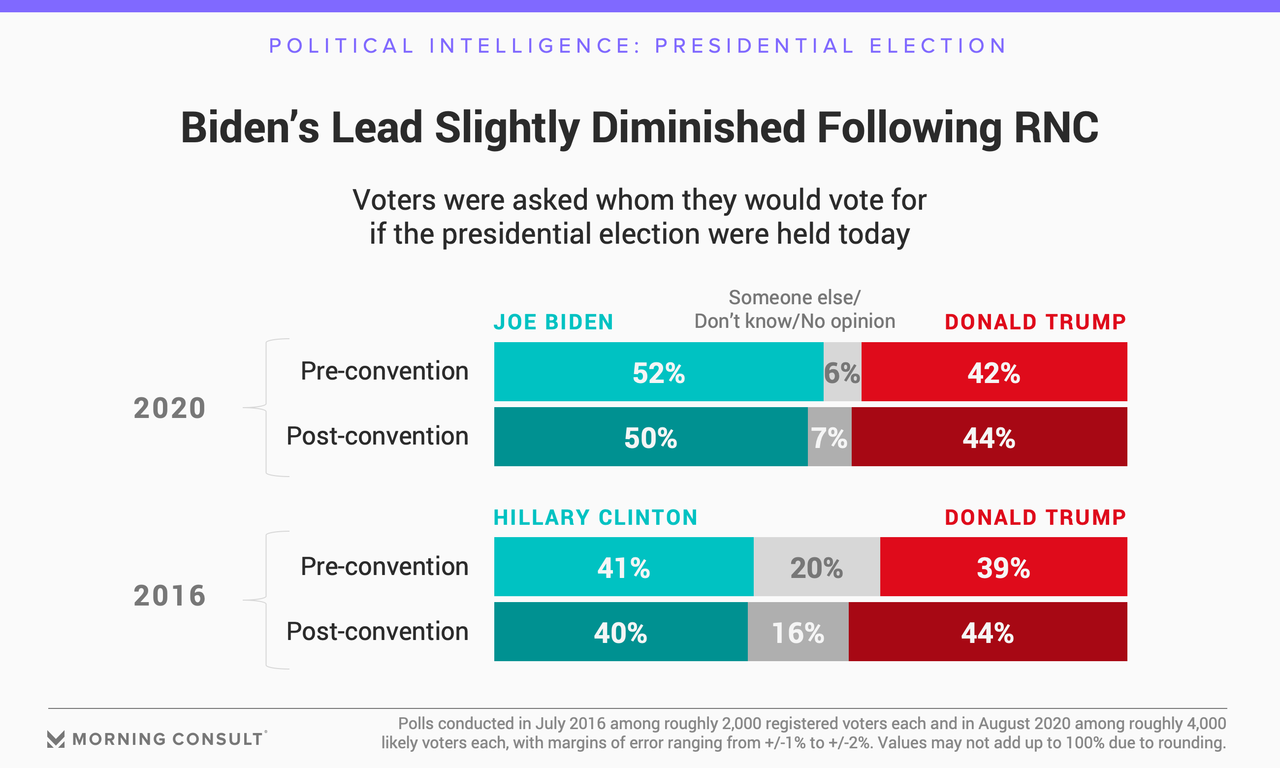
President Donald Trump needed a convention bounce — and he got one, emerging from the Republican National Convention with an improved standing against Democratic presidential nominee Joe Biden, fueled by gains among white voters and those in the suburbs, though he still trails the former vice president nationwide.

A new Morning Consult poll conducted Friday that asked 4,035 likely voters which candidate they would pick found Biden leading Trump by 6 percentage points, 50 percent to 44 percent. It marked a 4-point improvement from his standing heading into the convention on Aug. 23, when Biden led 52 percent to 42 percent. Friday’s poll had a 2-point margin of error, compared with a 1-point margin of error for responses gathered among 4,810 likely voters on Aug. 23. –Morning Consult

Keep in mind, nearly 12% of Trump supporters won’t admit to supporting the president (though many argue that figure is much higher), while just 5.4% of Democrats won’t reveal their preferences.

What’s interesting is that Biden received virtually no boost after the Democratic National Convention, while Trump’s numbers improved after the RNC. What’s more, fewer people tuned in to watch the Republican event.

The poll results come after a convention that was less watched than the Democratic National Convention a week before. According to The New York Times, an average of 19.4 million people watched the Republican gathering each night on live TV, compared to 21.6 million who watched the DNC; Trump’s acceptance speech was viewed live by 23.8 million, less than Biden’s 24.6 million the week before.

What’s more, Biden’s lead among suburban voters was nearly cut in half after the RNC – from 14 points (54 percent to 40 percent) to 8 points (50 percent to 42 percent).

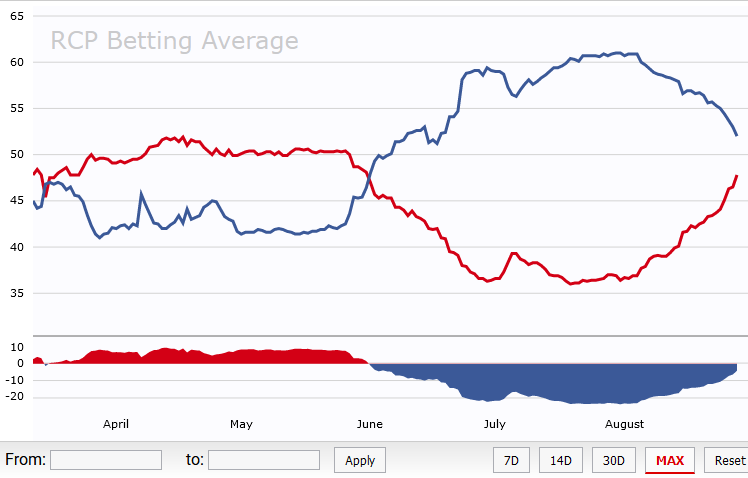
Meanwhile, a far more dramatic race is reflected in Real Clear Politics‘ betting average between Trump and Biden, using data from oddsmakers Betfair, Bovada, Bwin, Matchbook, Smarkets and SpreadEx.

Perhaps pollsters will stop oversampling Democrats this time around to give the false impression Biden is hugely popular, as they did with Hillary Clinton in 2016. Then again, it might be a catch-22 if they dare to reflect actual support for Trump, or lack of faith in Biden.

via ZeroHedge News https://ift.tt/34H6T2l Tyler Durden

Schiff, Pelosi Livid After Intel Community Ditches ‘Manipulated’ Election Briefings For Written Updates

Schiff, Pelosi Livid After Intel Community Ditches ‘Manipulated’ Election Briefings For Written Updates

Tyler Durden

Sat, 08/29/2020 – 18:00

House Democrats are livid after the Director of National Intelligence, John Ratcliffe, announced that US intel agencies would be pulling the plug on in-person congressional briefings on election security, and will instead be providing written updates ahead of November.

In a verbal notification to the House Intelligence Committee, chaired by Rep. Adam Schiff (D-CA), Ratcliffe argued that the process will prevent the unauthorized disclosure of sensitive information, according to The Hill.

Ratcliffe followed up with Friday letters addressed to top House and Senate lawmakers in which he emphasized that the Office of the Director of National Intelligence (ODNI) plans to continue Congressional oversight efforts.

“The ODNI will primarily meet its obligation to keep Congress fully and currently informed leading into the Presidential election through written finished intelligence products,” read the letters, which were obtained by The Hill.

I believe this approach helps ensure, to the maximum extent possible, that the information ODNI provides the Congress in support of your oversight responsibilities on elections security, foreign malign influence, and election interference is not misunderstood nor politicized. It will also better protect our sources and methods and most sensitive intelligence from additional unauthorized disclosures or misuse.”

Democrats are not happy

House Speaker Nancy Pelosi (D-CA) and Adam Schiff railed against the move, suggesting that it would help conceal public knowledge of foreign interference in US politics.

This is a shocking abdication of its lawful responsibility to keep the Congress currently informed, and a betrayal of the public’s right to know how foreign powers are trying to subvert our democracy. This intelligence belongs to the American people, not the agencies which are its custodian,” reads a joint statement.

Pelosi and Schiff threatened that they will “consider the full range of tools available to the House to compel compliance” if the ODNI does not resume briefings, claiming it is a “shameful” attempt by the Trump administration to “withhold election-related information from Congress and the American people at the precise moment that greater transparency and accountability is required.”

CNN first reported the shift from in-person briefings to written updates.

The announcement comes after William Evanina, the director of the National Counterintelligence and Security Center, released a statement detailing election security threats. –The Hill

Former acting Director of National Intelligence, Richard Grenell, welcomed the move – tweeting on Saturday: “Career intelligence officials came to me to say they didn’t want to brief the Hill because the partial information leaks and manipulation of their words were detrimental to their careers,” adding “This is a very good reform.

via ZeroHedge News https://ift.tt/3bkIHEl Tyler Durden

84% Of CFOs Say Stocks Are Overvalued

84% Of CFOs Say Stocks Are Overvalued

Tyler Durden

Sat, 08/29/2020 – 17:30

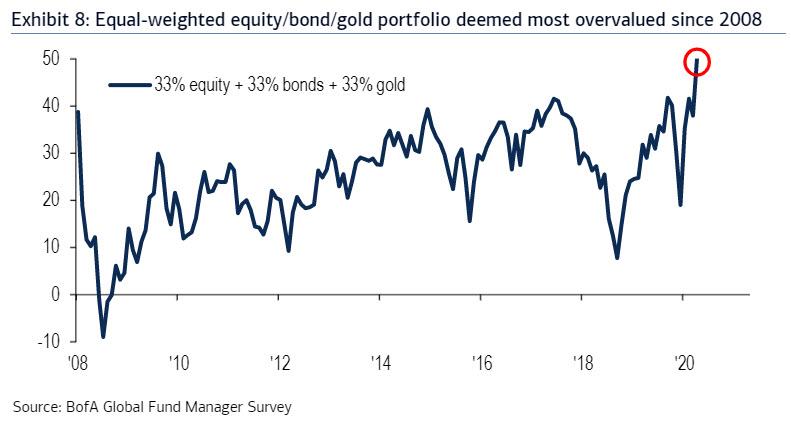
It’s not just Wall Street fund managers who, as the latest BofA fund manager survey  revealed, view stocks (along with bonds and gold) to be the most overvalued on record.

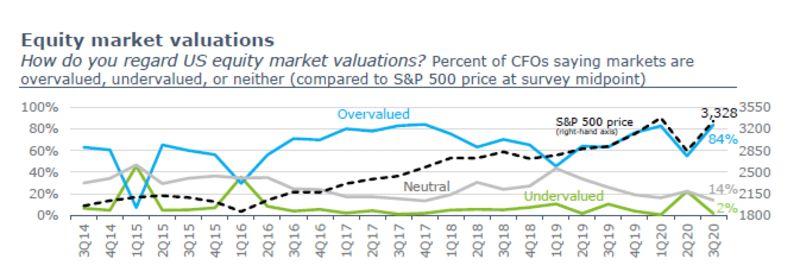
Corporate finance chiefs – those whose actions ultimately set the price of their public equity – agree, and in the latest quarterly survey conducted by Deloitte LLP, about 84% of CFOs said equities are too expensive, the second-highest level in the decade since the accounting and consulting firm began collecting the data. Only 2% of respondents said U.S. stocks look cheap (probably the CFOs of the gigacaps who continue to repurchase their stock hand over fist).

Some 155 CFOs across North America, most of whom work at companies with more than $1 billion in annual revenue, participated in the survey which spanned Aug. 3 to Aug. 7. Since then, the S&P 500 is up another 3.8%.

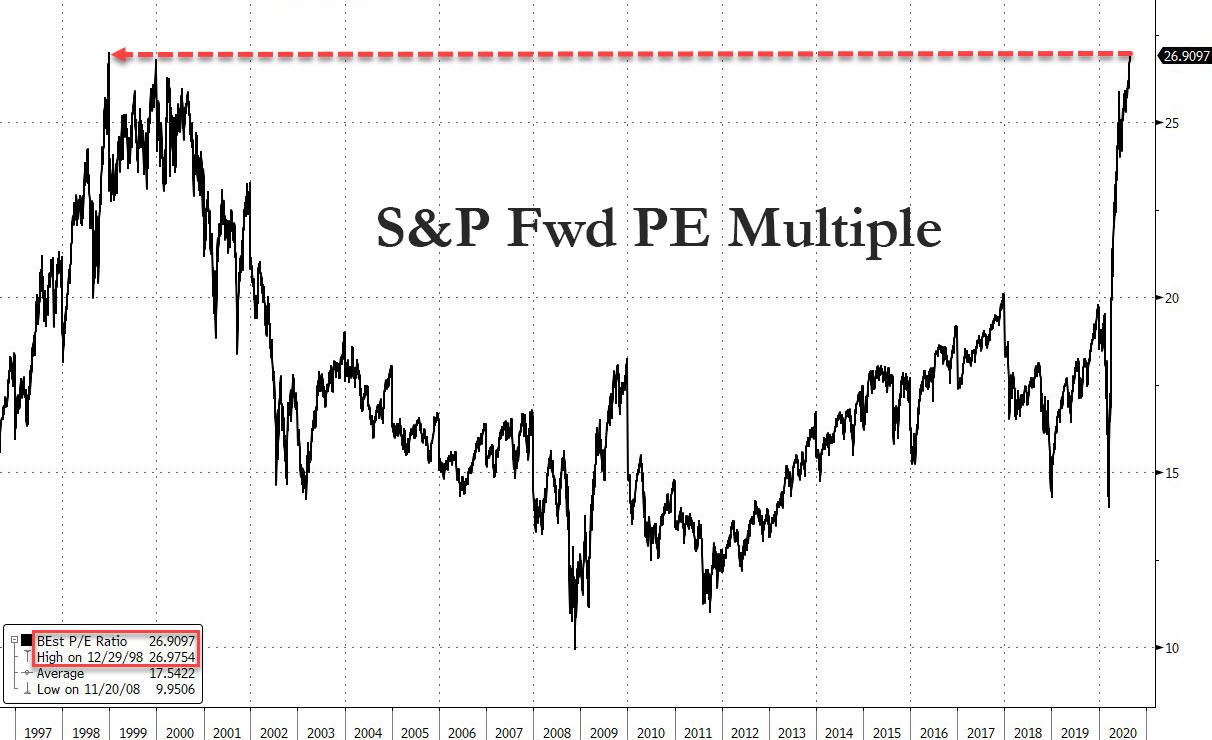
Of course, the CFOs are spot on, because at 27 times forward earnings, the S&P 500’s price-earnings ratio is just fractions below its all time high.

As Bloomberg notes, “the data provide further insight into the views of corporate management, particularly the finance departments responsible for capital expenditures.” 

While skeptical on stocks, the CFOs did grow slightly more optimistic on the economy, albeit from record lows as the U.S. began recovering from the depths of the Covid-caused recession. In the most recent report, 7% of respondents rated current economic conditions in North America as good, up from just 1% in the prior survey period. However, only 43% said they expect better economic conditions in a year – down 15 percentage points.

“Economic expectations were improved from really historic lows in the 2Q survey, but more cautious,” Steve Gallucci, Deloitte’s U.S. leader of the CFO Program, said by phone. “Most CFOs felt like it was going to take a lot longer to get their operating capacity back up to pre-pandemic levels.”

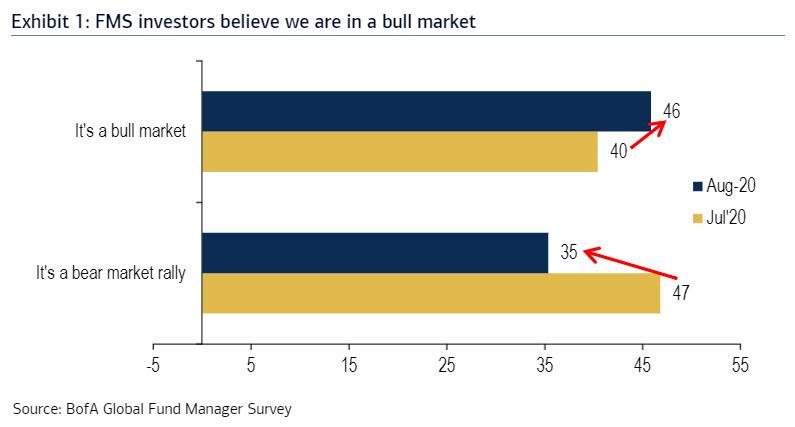
Yet just as the BofA Fund Manager survey reveals the sheer force of FOMO across Wall Street, where despite accepting a market that has never been more overvalued, most are rushing back into the stock market and the majority have recently changed their mind from “it’s a bear market rally” to “it’s a bull market”…

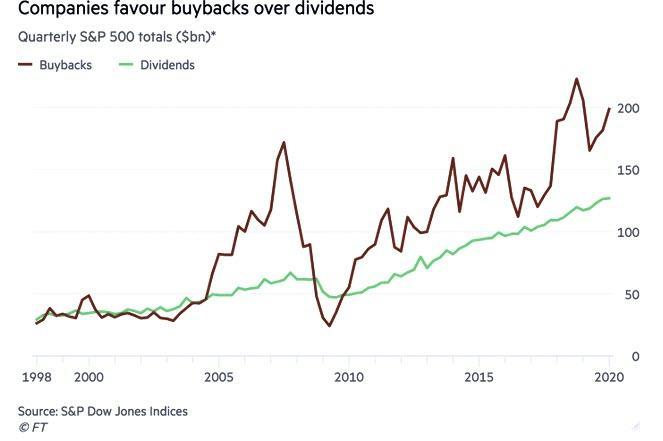
… we wonder just what the point of the CFO survey is: after all, as we laid out recently there has been a tidal wave of companies who in recent weeks have announced plans to resume stock buybacks, and certainly favor buybacks over dividends due to the immediate upside impact they have on the stock price and the resulting favorable impact on equity-linked comp plans.

One thing is clear: if the vast majority of CFOs thought stocks were overvalued, they would be selling equity not buying stock back. Then again, with their own compensation on the line, and with relentless demand for bonds from both investors and the Fed, why not sell some bonds and use the proceeds to buy back some more stock, assuring even more equity levitation and also assuring that next month even more CFOs will find stocks to be overvalued.

via ZeroHedge News https://ift.tt/32H6Roi Tyler Durden

NPR Claims That Calling A Riot A “Riot” Is Racist

NPR Claims That Calling A Riot A “Riot” Is Racist

Tyler Durden

Sat, 08/29/2020 – 17:05

Authored by Paul Joseph Watson via Summit News,

NPR published an article claiming that calling a riot a “riot” is offensive because it’s “rooted in racism.”

Yes, really.

The article was written by Jonathan Levinson for Oregon Public Broadcasting, the Portland NPR affiliate.

Portland has experienced 93 days of continuous rioting – last night was the first time in that entire period that the city has not seen unrest – but according to Levinson, merely calling a spade a spade is a racist dog whistle.

Levinson’s argument for this position is vague to the point of being non-existent. He appears upset that police are able to declare a riot and use crowd control measures to disperse violent BLM mobs.

His only point appears to be that because crowd control measures were also used in the 60s during the civil rights era, this means that using them today is racist, despite the fact that the clear majority of BLM protesters in Portland are white.

The media now seems to be taking three different approaches to the riots.

Claim that they are largely “peaceful,” as both CNN and CBS News did this week.

Claim that the riots aren’t even happening at all or are minimal, as CNN political analyst Kirsten Powers did.

Or as NPR has done, simply declare that anyone who dares use the words “riot” to describe the mayhem that has plagued American cities for the past 3 months is a despicable racist.

Unfortunately for Democrats, the polls suggest that all three of these methods aren’t working because the unrest is turning voters away from Joe Biden in droves.

*  *  *

In the age of mass Silicon Valley censorship It is crucial that we stay in touch. I need you to sign up for my free newsletter here. Also, I urgently need your financial support here.

via ZeroHedge News https://ift.tt/3hGKjKR Tyler Durden

NYC Landlords Wage War Against Remote Working

NYC Landlords Wage War Against Remote Working

Tyler Durden

Sat, 08/29/2020 – 16:40

New York City’s biggest landlords have a major dilemma; that is, companies like Citigroup, JP Morgan, Google, Twitter, and Facebook all encouraged their employees to work remotely from home, which will result in a slower economic recovery. 

Jeff Blau, chief executive officer of Related Cos., was on Bloomberg Television Thursday talking about the dire situation, and the campaign he is waging, along with other top landlords to convince companies that their employees should return to offices to avoid damaging the local economy. 

“If you go to the business districts, Midtown, it’s deserted,” Blau said “If employers tell their employees that they don’t need to come back, they’re going decide to hang out at their parents’ or in the Hamptons and phone it in. Ultimately, businesses are not going to be able to survive that.”

Blau said big banks are bringing a new wave of recruits into the city this fall that will require them to work in offices. He said he’s spoken with top firms in the town, asking them to return their workforce to offices. 

“You can’t run a business on Zoom,” he said. 

Earlier this month, former hedge fund manager James Altucher told Fox Business that New York City is dead:

“We have something like 30 to 50 percent of the restaurants in New York City are probably already out of business, and they’re not coming back,” Altucher said.  

He said many offices in Midtown Manhattan are open but mostly empty as remote working has allowed employees to abandon the city for suburbia. 

“This completely damages not only the economic eco-system of New York City…but what happens to your tax base when all of your workers can now live anywhere they want to in the country?” asked the fund manager. 

Altucher warned the situation is “only going to get worse” – as Wall Street firms are now considering a mass exodus.

When firms break their lease, or let ones expire, and or shrink their corporate footprint, rental income for landlords like Blau will see declines, and if their portfolio of buildings is highly leveraged, it could result in, as we explain in Stunning Surge In New CMBS Delinquencies Heralds Commercial Real Estate Disaster,” the coming commercial real estate bust. 

Blau and other landlords are waging war against remote working. The big question: Will they succeed? 

via ZeroHedge News https://ift.tt/3jjmXeG Tyler Durden

Should Universities Recommend (or Demand) Epithet Filtering on Students’ and Professors’ Internet Devices?

Some students, faculty, and administrators have argued that even hearing racial epithets quoted is traumatic or at least highly offensive to students, and that decent people therefore should not quote them. Most of these complaints have arisen with regard to quotes of the word “nigger,” whether from court opinions, court case files, historical documents, literature, or otherwise. My view is that these words shouldn’t be rendered taboo for serious academic discussion, and that there’s a sharp difference between improper use of the words (especially to insult someone) and proper mention of how the words were used in a case or book or speech.

But let me try to approach the problem in a slightly different way; tell me if you think it’s helpful.

I take it that if it’s so damaging and unjustifiable for students to have to hear the word, it’s also damaging and unjustifiable for them to have to see the word. Indeed, one of the recent complaints has been about a Stanford professor writing the word on the board; a commenter on this blog seems to be objecting to my even quoting the word in blog posts; others have mentioned similar objections.

And it’s not surprising: We are all literate folk, and we all know the power of the written word; no-one would doubt, for instance, that e-mailing someone to call them by an epithet would be extremely insulting. If the use-mention distinction doesn’t matter for oral statements, why should it matter for written ones? Yet whatever a professor may or may not say in class, students will likely see the word written in many places: It appears in over 10,000 court opinions on Westlaw, in thousands of law review articles, and in many other places, including history books, novels, and more.

Enter Advanced Profanity Filter, a Chrome app that expurgates whatever words it is set to expurgate. (That’s its logo above.) The default list includes vulgarities and slurs, but it can be reconfigured as necessary. Anyone using the Filter can be shielded from seeing various words in Westlaw, on Google Scholar, or wherever else. Whether you’re reading an online court opinion or a newspaper article or an e-mail, you’ll see the word written as “n*****” or some such. (And if you want to distinguish situations the Filter changes from ones where the word is “n*****” in the original, you can use an unusual expurgation, such as “n@@@@@.”)

Of course, this only works for normal text; I don’t know of any such filter for PDF viewers. But it should be a fairly straightforward coding project (at least as to PDFs that have searchable text)—presumably a university that really thinks its students need such shielding could have its tech people create such a filter, and indeed then make it available to the whole world. Likewise, it could create such a filter for other browsers, and perhaps even have a voice recognition bleeper for videos, songs, and the like (though I realize that this is a harder task).

Then the university might have several options:

  1. It could encourage black students—and perhaps even professors—to run this filter, to prevent them from being traumatized by seeing “nigger.” (It might perhaps encourage gay students to do the same, especially if it adds “faggot” to the list.)
  2. It could encourage all students and professors to run this filter, since many students object (or perhaps, in the university’s view, should object) to such words even if they don’t refer to the identity groups to which they belong. It could add other phrases that some students find offensive, such as “illegal alien.” And the university could of course make it as easy as possible to use the filter, for instance turning it on by default on computers that it sells in the student store.
  3. It could require students and professors to run the filter, since this will remind them of the university’s view that they shouldn’t be quoting those words out loud: If students or professors is are an expurgated version of a case, this will make it more likely that they will say an expurgated version of the word as well. And this will also signal that the university refuses to allow its network used for spreading such awful words.

Do you think that universities should do this? A few possible answers, though there are many others:

[1.] Great idea! (Please indicate whether you’d go for option A, B, C, or something else.)

[2.] Not a good idea, because the filter can’t tell whether a particular word was written by someone who is black (or, for other epithets, a member of the relevant group). The theory: There’s nothing wrong with blacks quoting the word—it’s only people of other races who shouldn’t quote it, and a filter that filters out the writings of black authors that use the word is unacceptably overinclusive. But maybe there could be a filter focused on Westlaw, Lexis, and Google Scholar, which first identifies the opinion author’s name and looks it up in a table that indicates each judge’s race ….

[3.] Not a good idea, because reading the word is just fine and untraumatic, but hearing it (again, in a quote from a case or some such) is something that “[h]uman decency and respect for the feelings of others” forbids “without qualification.”

[4.] This proposal is missing the point: The goal shouldn’t be to prevent trauma to black students caused by seeing or hearing the word—it should be to stop white people (or, more generally, non-black people) from saying or writing the word, regardless of who sees or hears it. Even if black students are automatically shielded from it, so long as white people keep quoting it in material that they write (or keep including unexpurgated passages containing it in their course assignments or some such), that’s still bad.

[5.] Not a good idea, because (A) university students should be encouraged to read actual sources as they actually exist (offensive words and all)—and (B) law students, who are joining a profession in which such words routinely appear (in opinions, briefs, case documents, trials, oral arguments, and witness interviews), should likewise be taught to get the raw information, offensive as it may be, and then to decide as a tactical matter how best to quote it. Encouraging students to filter out words like this, including when they read precedents, articles, books, and the like, is teaching them the opposite of the norms and practices that they need to learn.

As you might gather, I take the last of these views (for the reasons that Randall Kennedy and I lay out in Quoting Epithets in the Classroom and Beyond), but I’d love to hear what others think, both as to this question and as to the thought experiment more broadly.

from Latest – Reason.com https://ift.tt/2YKXYsR
via IFTTT
Should Universities Recommend (or Demand) Epithet Filtering on Students’ and Professors’ Internet Devices?

Some students, faculty, and administrators have argued that even hearing racial epithets quoted is traumatic or at least highly offensive to students, and that decent people therefore should not quote them. Most of these complaints have arisen with regard to quotes of the word “nigger,” whether from court opinions, court case files, historical documents, literature, or otherwise. My view is that these words shouldn’t be rendered taboo for serious academic discussion, and that there’s a sharp difference between improper use of the words (especially to insult someone) and proper mention of how the words were used in a case or book or speech.

But let me try to approach the problem in a slightly different way; tell me if you think it’s helpful.

I take it that if it’s so damaging and unjustifiable for students to have to hear the word, it’s also damaging and unjustifiable for them to have to see the word. Indeed, one of the recent complaints has been about a Stanford professor writing the word on the board; a commenter on this blog seems to be objecting to my even quoting the word in blog posts; others have mentioned similar objections.

And it’s not surprising: We are all literate folk, and we all know the power of the written word; no-one would doubt, for instance, that e-mailing someone to call them by an epithet would be extremely insulting. If the use-mention distinction doesn’t matter for oral statements, why should it matter for written ones? Yet whatever a professor may or may not say in class, students will likely see the word written in many places: It appears in over 10,000 court opinions on Westlaw, in thousands of law review articles, and in many other places, including history books, novels, and more.

Enter Advanced Profanity Filter, a Chrome app that expurgates whatever words it is set to expurgate. (That’s its logo above.) The default list includes vulgarities and slurs, but it can be reconfigured as necessary. Anyone using the Filter can be shielded from seeing various words in Westlaw, on Google Scholar, or wherever else. Whether you’re reading an online court opinion or a newspaper article or an e-mail, you’ll see the word written as “n*****” or some such. (And if you want to distinguish situations the Filter changes from ones where the word is “n*****” in the original, you can use an unusual expurgation, such as “n@@@@@.”)

Of course, this only works for normal text; I don’t know of any such filter for PDF viewers. But it should be a fairly straightforward coding project (at least as to PDFs that have searchable text)—presumably a university that really thinks its students need such shielding could have its tech people create such a filter, and indeed then make it available to the whole world. Likewise, it could create such a filter for other browsers, and perhaps even have a voice recognition bleeper for videos, songs, and the like (though I realize that this is a harder task).

Then the university might have several options:

  1. It could encourage black students—and perhaps even professors—to run this filter, to prevent them from being traumatized by seeing “nigger.” (It might perhaps encourage gay students to do the same, especially if it adds “faggot” to the list.)
  2. It could encourage all students and professors to run this filter, since many students object (or perhaps, in the university’s view, should object) to such words even if they don’t refer to the identity groups to which they belong. It could add other phrases that some students find offensive, such as “illegal alien.” And the university could of course make it as easy as possible to use the filter, for instance turning it on by default on computers that it sells in the student store.
  3. It could require students and professors to run the filter, since this will remind them of the university’s view that they shouldn’t be quoting those words out loud: If students or professors is are an expurgated version of a case, this will make it more likely that they will say an expurgated version of the word as well. And this will also signal that the university refuses to allow its network used for spreading such awful words.

Do you think that universities should do this? A few possible answers, though there are many others:

[1.] Great idea! (Please indicate whether you’d go for option A, B, C, or something else.)

[2.] Not a good idea, because the filter can’t tell whether a particular word was written by someone who is black (or, for other epithets, a member of the relevant group). The theory: There’s nothing wrong with blacks quoting the word—it’s only people of other races who shouldn’t quote it, and a filter that filters out the writings of black authors that use the word is unacceptably overinclusive. But maybe there could be a filter focused on Westlaw, Lexis, and Google Scholar, which first identifies the opinion author’s name and looks it up in a table that indicates each judge’s race ….

[3.] Not a good idea, because reading the word is just fine and untraumatic, but hearing it (again, in a quote from a case or some such) is something that “[h]uman decency and respect for the feelings of others” forbids “without qualification.”

[4.] This proposal is missing the point: The goal shouldn’t be to prevent trauma to black students caused by seeing or hearing the word—it should be to stop white people (or, more generally, non-black people) from saying or writing the word, regardless of who sees or hears it. Even if black students are automatically shielded from it, so long as white people keep quoting it in material that they write (or keep including unexpurgated passages containing it in their course assignments or some such), that’s still bad.

[5.] Not a good idea, because (A) university students should be encouraged to read actual sources as they actually exist (offensive words and all)—and (B) law students, who are joining a profession in which such words routinely appear (in opinions, briefs, case documents, trials, oral arguments, and witness interviews), should likewise be taught to get the raw information, offensive as it may be, and then to decide as a tactical matter how best to quote it. Encouraging students to filter out words like this, including when they read precedents, articles, books, and the like, is teaching them the opposite of the norms and practices that they need to learn.

As you might gather, I take the last of these views (for the reasons that Randall Kennedy and I lay out in Quoting Epithets in the Classroom and Beyond), but I’d love to hear what others think, both as to this question and as to the thought experiment more broadly.

from Latest – Reason.com https://ift.tt/2YKXYsR
via IFTTT
Trump Administration To Invest $1 Billion In Quantum Computing, AI

Trump Administration To Invest $1 Billion In Quantum Computing, AI

Tyler Durden

Sat, 08/29/2020 – 16:15

Authored by Alan McDonnell via The Epoch Times,

The Trump Administration announced awards of more than $1 billion Wednesday for the establishment of 12 new artificial intelligence (AI) and quantum information science (QIS) research & development institutes across the United States. The administration says it is taking the action to ensure American leadership in what it termed “industries of the future,” which include 5G and other critical technologies.

With the support of the White House, the National Science Foundation‘s (NSF’s) AI Research Institutes and the Department of Energy’s (DOE’s) QIS Research Centers will serve as hubs for innovation and research & development.

“Today, the Trump Administration is making an unprecedented investment to strengthen American leadership in AI and quantum, and to ensure the Nation benefits from these emerging technologies. Built upon the uniquely American free market approach to technological advancement, these institutes will be world-class hubs for accelerating American innovation and building the 21st century American workforce,” said U.S. Chief Technology Officer, Michael Kratsios in a statement.

The technology chief said that such technologies were currently being used to fight the Chinese Communist Party (CCP) virus.

“The U.S. is using every tool at its disposal to defeat the novel coronavirus, including artificial intelligence,” Kratsios wrote in an Op-Ed published in the Wall Street Journal on May 27.

However, AI technology is not only being used to combat disease, he cautioned.

“At the same time, AI is being twisted by authoritarian regimes to violate rights. The Chinese Communist Party is reportedly using AI to uncover and punish those who criticize the regime’s pandemic response and to institute a type of coronavirus social-credit score – assigning people color codes to determine who is free to go out and who will be forced into quarantine.”

United States Continues to Lead

According to a National Strategic Overview for Quantum Information Science report from 2018 (pdf), the United States can harness quantum information science to “improve its industrial base, create jobs, and provide economic and national security benefits.” The report mentioned previous examples of American scientific ingenuity that laid the foundation for a host of critical modern technologies.

“Prior examples of QIS-related technologies include semiconductor microelectronics, photonics, the global positioning system (GPS), and magnetic resonance imaging (MRI),” the report said. “These underpin significant parts of the national economic and defense infrastructure. Future scientific and technological discoveries from QIS may be even more impactful.”

“The Department of Energy is a staunch supporter of cutting edge research to advance quantum information science,” said Secretary of Energy, Dan Brouillette, in a statement. “I am proud to lead an Agency committed to developing industries of the future by making investments today to accelerate American innovation.”

In a joint statement from The White House, Kratsios and the Deputy Chief of Staff for Policy Coordination, Chris Liddell, said that

“The establishment of these new national AI and QIS institutes will not only accelerate discovery and innovation, but will also promote job creation and workforce development. NSF’s AI Research Institutes and DOE’S QIS Research Centers will include a strong emphasis on training, education, and outreach to help Americans of all backgrounds, ages, and skill levels participate in our 21st-century economy.”

The White House statement says the administration also views the research facilities as a manifestation of the United States’ free-market approach to the advancement of technology, as they leverage the efforts of the Federal government, American industry, and academia for the betterment of the Nation.

“As history has shown, America is a country of thinkers, doers, and innovators,” Kratsios and Liddel said. “The United States is the proud home of the greatest technological breakthroughs the world has ever known, from creating the modern Internet to putting humans on the moon. Emerging technologies like AI and QIS will lead to transformative benefits for the American people in healthcare, communications, manufacturing, agriculture, transportation, security, and beyond.

Funding Appropriation

A total of 7 AI research institutes will receive funding to the tune of $140 million over 5 years from the NSF and other federal partners, and will focus on the fields of synthetic manufacturing, machine-learning, precision agriculture, and forecasting prediction. The research efforts will be carried out at universities including the Universities of Oklahoma, Texas, Colorado, Illinois, and California, and at Massachusetts Institute of Technology.

As the largest non-defense funding body for research & development in the field of AI, the NSF plans to make over $300 million in awards over the coming years.

In order to set up the QIS research centers, the Department of Energy will award $625 million over the next five years to the Oak RidgeArgonneBrookhavenFermi, and Lawrence Berkeley National Laboratories. In addition, the private sector will provide a further $300 million in funding.

via ZeroHedge News https://ift.tt/2EunP1q Tyler Durden

Michael Moore & Bill Maher Beg Dems To Wake Up: “Enthusiasm For Trump OFF THE CHARTS! Are You Ready For Trump Victory?”

Michael Moore & Bill Maher Beg Dems To Wake Up: “Enthusiasm For Trump OFF THE CHARTS! Are You Ready For Trump Victory?”

Tyler Durden

Sat, 08/29/2020 – 15:50

As even The New York Times was reluctant to admit this week, the return of mass unrest and urban rioting in places like Kenosha, Portland, Seattle and D.C. is only serving to energize Trump’s base, and further to make his law-and-order message more appealing to fence-sitters. RealClearPolitics has Biden’s lead shrinking to 3 points in key battleground states after Biden led in June by a considerable nearly 7 points, according to its index of polls.

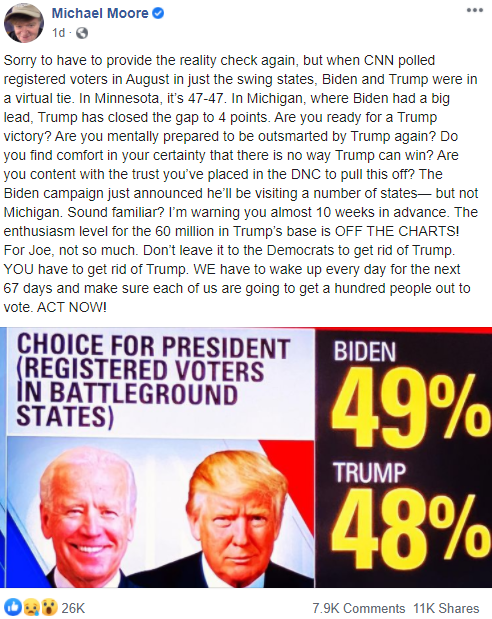
And more significantly, some of same Liberal and Progressive voices that tried to warn Democrats ahead of Trump’s “shock” 2016 victory are at it again, starting with filmmaker Michael Moore, who warned in a Facebook post on Friday using all caps that enthusiasm among Trump’s base is “OFF THE CHARTS!” 

Moore begged Biden-supporters and never-Trumpers to “ACT NOW!” Crucially, Moore had in the lead-up to the 2016 election been an almost lone voice on the left predicting a Trump victory, but was dismissed, laughed at and ignored at the time.

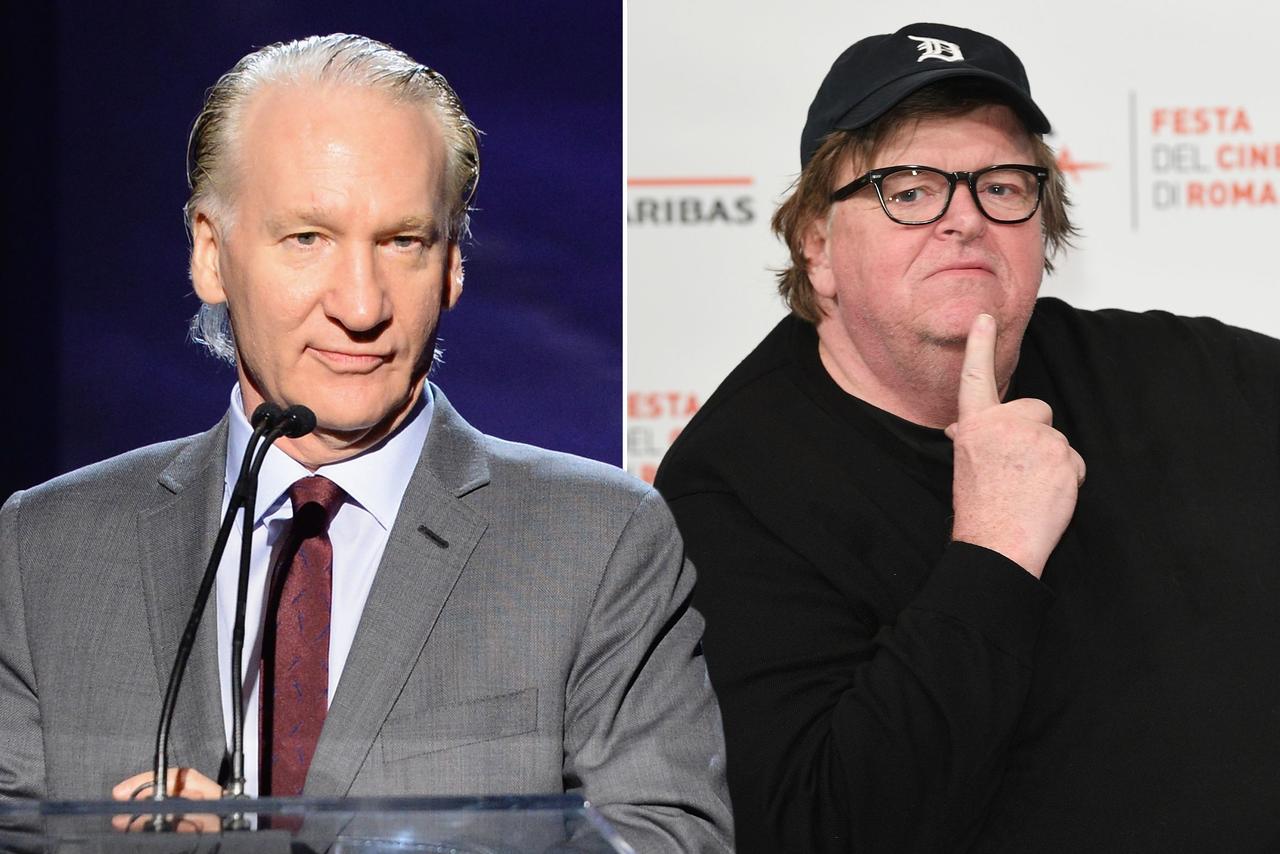
Bill Maher and Michael Moore, Page Six/Getty Images

Likely his listeners are not laughing now as he issues what he’s calling “a reality check again”. Pointing out that Trump is likely at least close to Biden if not pulling ahead in key states like Michigan and Minnesota — also states lately witnessing George Floyd protest-related riots, looting, and unrest — Moore said the following

Are you ready for a Trump victory? Are you mentally prepared to be outsmarted by Trump again? Do you find comfort in your certainty that there is no way Trump can win? Are you content with the trust you’ve placed in the DNC to pull this off?” 

“I’m warning you almost 10 weeks in advance. The enthusiasm level for the 60 million in Trump’s base is OFF THE CHARTS! For Joe, not so much,” he added, underscoring that this time his warning is coming even earlier than the similar statements that irked his audience in 2016.

“Don’t leave it to the Democrats to get rid of Trump. YOU have to get rid of Trump. WE have to wake up every day for the next 67 days and make sure each of us are going to get a hundred people out to vote. ACT NOW!”

Moore referenced recent CNN polling showing “Biden and Trump were in a virtual tie.”

HBO’s “Real Time” host Bill Maher had a similar warning, telling MSNBC’s Joy Reid on Friday that he’s nervous and “less confident” about a Biden victory  “the same way I was feeling four years ago,” he said.

“I don’t know if this stuff works, but it might,” Maher said.

“I am feeling less confident about this maybe it’s just their convention bump got to me, but I’m feeling less confident than I was a month ago.”

And the president himself highlighted the Maher statements on Twitter: “Leading in Michigan, leading in Minnesota, leading all over. Sorry!” Trump corrected.

And crucially the Libertarian-Left leaning Maher said something more important on his show Friday night. Let’s call this another inconvenient truth that Democrats simply don’t want to hear:

On Friday’s broadcast of HBO’s “Real Time,” host Bill Maher stated that Democrats “seem to be hesitant, in some ways…to condemn the looting.”

Maher said President Donald Trump seems to be running for re-election as “the law and order candidate. And are the Democrats facing that right? They seem to be hesitant, in some ways, for example, to condemn the looting. Because they understand what causes people to have the rage that would make them loot. Although, I don’t know why looting is always associated with the rage. I mean, sometimes they’re just taking shit, and it’s not people you would even think would need the shit.”

But like in 2016 we’re again dealing with a situation where never-Trumpers “don’t want to hear it”. 

“Sometime’s they’re just taking shit,” Maher emphasized of the looting in a number of major cities which appear to be giving the Trump campaign a big boost.

However, this is precisely the type of thinking that Moore and Maher appear to be warning their Liberal colleagues against, given this was by and large the mentality they observed leading into 2016 election day.

* * *

As a reminder, below is precisely the I’m entitled to the presidency (like Hillary before) mentality Moore and Maher are highlighting:

via ZeroHedge News https://ift.tt/3joLX4b Tyler Durden

The Controversy Over Quoting Racial Epithets, Now at UC Irvine School of Law

You can read the details of the UCI controversy in this Reddit post and this Above The Law post, but here’s the heart of the matter. Prof. Carrie Menkel-Meadow—a distinguished scholar for more than 35 years, and very much a woman of the Left—was teaching a class on lawyer problem solving; her main field is dispute resolution (focusing on outside-the-courtroom resolution), a field that she basically helped found. (Note that she was a colleague of mine at UCLA, but I never got to her know well then.)

In the class Prof. Menkel-Meadow had a unit that discussed “hate speech” filtering on Facebook, and one of the passages in the readings, from this article, was:

In a different way, the [Facebook] policy was also too broad. In 2017, a lot of L.G.B.T.Q. people were posting the word “dyke” on Facebook. That was deemed a slur, and was duly removed. A blind spot was exposed. Facebook, it has been observed, is able to judge content—but not intent. Matt Katsaros, a Facebook researcher who worked extensively on hate speech, cites an unexpected problem with flagging slurs. “The policy had drawn a distinction between ‘nigger’ and ‘nigga,'” he explains. The first was banned, the second was allowed. Makes sense. “But then we found that in Africa many use ‘nigger’ the same way people in America use ‘nigga.'” Back to the drawing board.

Talking about this, she quoted the word “nigger,” which later led to an outcry. The Dean has now publicly condemned Prof. Menkel-Meadow’s actions, and barred her from teaching first-year classes. (She isn’t teaching any first-year classes this year in any event, but she sometimes teaches a mandatory 1L International Legal Analsysis class.)

Several administrators also released a public letter of condemnation, which said “We condemn without qualification the classroom utterance of terms, such as the N-word, that are loaded with histories of pain and oppression.” No exact list of condemned terms was given, but the “such as” makes clear that there would be others as well.

The condemnations didn’t mention the professor’s name, but to her credit, Prof. Menkel-Meadow e-mailed the faculty a letter that began, “I have no need to hide behind any anonymity of the Dean’s letter to you all,” and then defended her position. She remains unrepentant.

Dean Richardson also gave a statement to Above The Law saying, “It is time to eliminate the use of the ‘N’ word in legal pedagogy.” This would mean that words that respected, thoughtful, judges and lawyers of all ideological stripes routinely mention in opinions, briefs, and oral arguments, and which lawyers routinely see in case documents and hear in witness and client interviews, would be forbidden in the law school classroom. And this would of course have to be on pain of discipline or firing, or how else would the word be “eliminated”?

This is entirely the wrong approach, it seems to me. It is not just contrary to academic freedom, but more importantly contrary to basic pedagogical principles. The judiciary and the legal profession has long relied on (1) the distinction between improper use of a word as an insult and proper mention of the word (for instance, as a fact in a case), and (2) a strong preference for quoting the facts accurately rather than in an expurgated way. If we are to prepare our students properly for that profession, we should be conveying the profession’s broadly shared norms, rather than punishing professors who adhere to those norms.

In any event, Harvard Law School Prof. Randall Kennedy—one of the nation’s leading scholars of race and the law—and I have written an article on these very points, Quoting Epithets in the Classroom and Beyond, which lays out our position in much more detail. We’re circulating it now to law reviews, but you can read a draft here; in this post, let me just close with a small sample from the article (anecdotal, but we have much more data than that there):

The late Prof. Terry Smith (a scholar of voting rights, a field where the statements containing the word are routinely quoted by voting rights supporters as evidence of legislator racism) put it bluntly but well in 2018, in defending a colleague at the DePaul College of Law who was being criticized for quoting the word in a class discussion:

“Increasingly, we are dumbing down legal education for students. And increasingly they are ill-prepared to go out and represent clients. They will encounter this terminology and worse in practice. What will they do then?” Smith said….

“[The professor] and I pulled up more than 5,500 federal cases that use the word n– [expurgation presumably by the newspaper—ed.] and did not substitute the word with the ‘N-word,'” Smith said. “If these students are preparing to become lawyers, how can it be objectionable for a professor, in the proper teaching context, to use the word?”

from Latest – Reason.com https://ift.tt/2ELy6WI
via IFTTT