The Republican Convention’s Defense of Trump’s Trade War Fell Flat

sipaphotosten992084

It’s telling that one of the few speakers at this week’s Republican National Convention who directly addressed President Donald Trump’s trade policies ended up inadvertently undermining the White House’s case for protectionism.

The speaker was Debbie Flood, owner of the Melron Corporation, an architectural foundry and machine shop in Schofield, Wisconsin. “We really make things, and we love it,” Flood explained in pre-recorded remarks aired Thursday.

Flood’s speech followed a predictable line of argument. In the early part of the 21st century, as China became a global manufacturing force, she watched as orders dwindled away. “When we lost nearly 50 percent of our business to China,” she said, “we wonder how a small company like ours could continue to compete.” She accused Joe Biden of being indirectly responsible for the damage to her business, because he’d supported efforts to normalize trade with China and to bring China into the World Trade Organization in the 1990s, even though those actions “were hurting American companies like ours.”

This argument has been, essentially, the root of Trump’s economic nationalist agenda for the past four years. Trump believes that increased trade with China has been a losing prospect for the United States and that the political establishment has been complicit in letting China “continue stealing our jobs, ripping us off, and robbing our country blind,” as the president said in his acceptance speech later that night. He has erected new barriers to trade with China—though they’ve mostly been ineffective—and has promised to take even more aggressive action if re-elected.

Given all that, you’d expect Flood to tell us how Trump’s intervention in the global marketplace has saved her business, or at least allowed her to regain some of what she’d lost.

Instead, her story took an unexpected turn.

“We are tenacious and we’re creative,” she said. “We took a risk and purchased a 3D printer. 3D printing technology allows us to do things that China can’t. Now, we can take a customer’s idea from sketch to sample to production in just a few weeks. This opened up new opportunities for us.”

In short, Flood argued that increased competition from China forced her company to innovate, to invest in new technology, and to seek out new customers. Instead of making the case for protecting American businesses from overseas competition, she ended up essentially offering the opposite.

Flood’s brief remarks highlighted the economic and intellectual contradiction at the center of Trump’s “America First” economic strategy. The president and his supporters claim that our businesses are the most successful in the world and that our workers are the best to be found anywhere; then they immediately suggest that the only way American companies can survive is with expensive and expansive government protection.

In reality, outsourcing low-level manufacturing to other parts of the world has allowed American manufacturing to reach new heights. You wouldn’t know it from watching the Republican convention this week—or the Democratic convention last week, for that matter—but the United States is a global manufacturing powerhouse. The narrative about declining manufacturing jobs has been outdated for years.

American manufacturing has never been more valuable than it is now. America’s industrial production last year was 48 percent higher than in 1995, according to the Federal Reserve. The number of American manufacturing jobs bottomed out at 11.4 million in 2010, at the depths of the Great Recession in 2010. Jobs in that sector had grown by 12 percent since then, before sharply declining this year as the COVID-19 pandemic shuttered factories and disrupted supply chains.

Outsourcing low-end manufacturing has allowed America to focus on manufacturing more expensive goods while maintaining access to cheap consumer goods that are now mostly made elsewhere. That shift has had negative consequences for some individuals, but those human costs can be addressed without the large-scale reorientation of global supply chains envision by Trump and others on the right, such as Sen. Josh Hawley (R–Mo.).

Meanwhile, businesses can adapt to changing economic circumstances—as Flood’s did—better than governments can. Trump’s trade policies have had huge unintended (but not unexpected) consequences for the very American manufacturers that Trump believes he is helping. More than two years after his trade war with China began, the most obvious consequence has been increased costs for American businesses that make them less competitive in the global market.

Unfortunately, the president doesn’t seem to have learned his lesson. In his acceptance speech, Trump promised to wage his trade war even harder in his second term. If reelected, Trump said, he would seek to “provide tax credits to bring jobs out of China back to America.” He also threatened to “impose tariffs on any company that leaves America to produce jobs overseas.”

That, too, is telling. Tariffs are not imposed on specific companies or their products, but on whole categories of imported goods. If a company that builds widgets moves their widget factory to Denmark, for example, the president can’t put tariffs on that company’s widgets without also imposing tariffs on all other widgets imported into the United States from Denmark.

Trump sees tariffs as a magic wand that can accomplish anything he wants. In fact they are a dull sword—a relic that’s difficult to wield effectively and that cuts both ways. Unfortunately, the president doesn’t appear to be ready to put the sword down.

from Latest – Reason.com https://ift.tt/2YLDZdv
via IFTTT
A Quarter Of All Personal Income In The US Comes From The Government

A Quarter Of All Personal Income In The US Comes From The Government

Tyler Durden

Fri, 08/28/2020 – 15:25

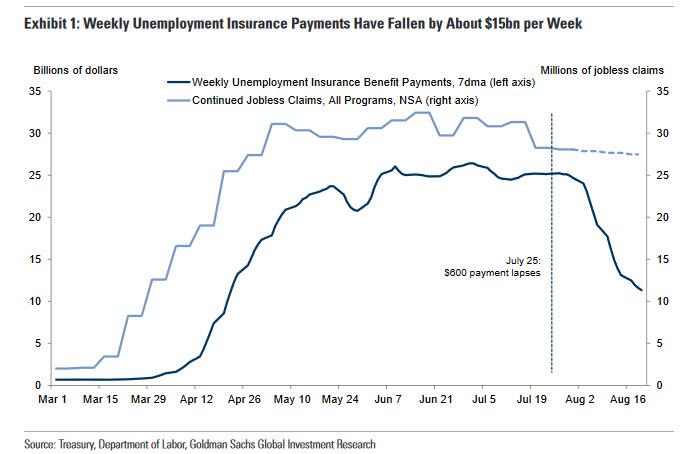
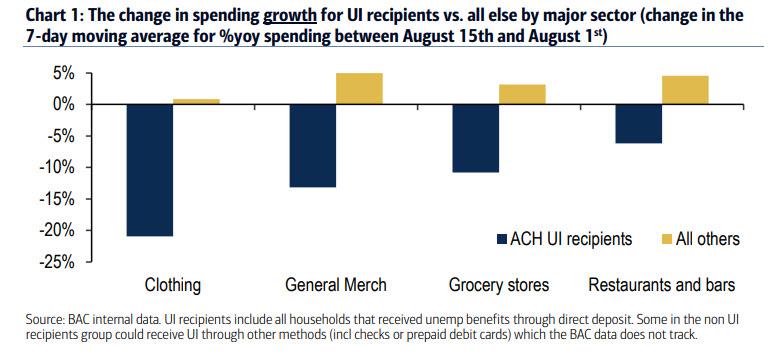
Today’s release of the latest Personal Income and Spending data showed that income and spending both rose more than expected in July, just ahead of the fiscal cliff at the end of that month, which as we showed last week has resulted in a sharp drop in spending among recipients of Unemployment Benefits.

In other words, it is safe to say that with much of the unemployment insurance benefits on their way out, as the following chart from Goldman shows…

… spending will slide in August and onward unless a new fiscal stimulus program is agreed upon by Congress (for now, consensus among strategists is that for that to happen, the market will need to suffer a correction first).

It is even safer to say that if all government stimulus were withdrawn, the US would stumble right into a double dip recession (if not depression), because as we have shown previously what was most remarkable about today’s personal income and spending data is just how reliant on the US government the population has become.

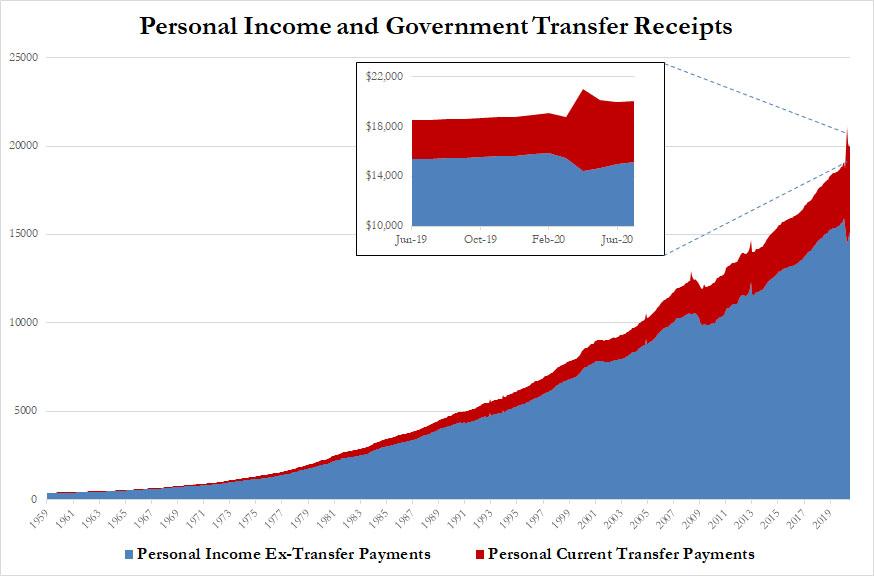
We are referring, of course, to Personal Current Transfer payments which are essentially government sourced income such as unemployment and emergency benefits, welfare checks, and so on. In July, this number was $4.9 trillion annualized, just a small drop from the $5 trillion in July.

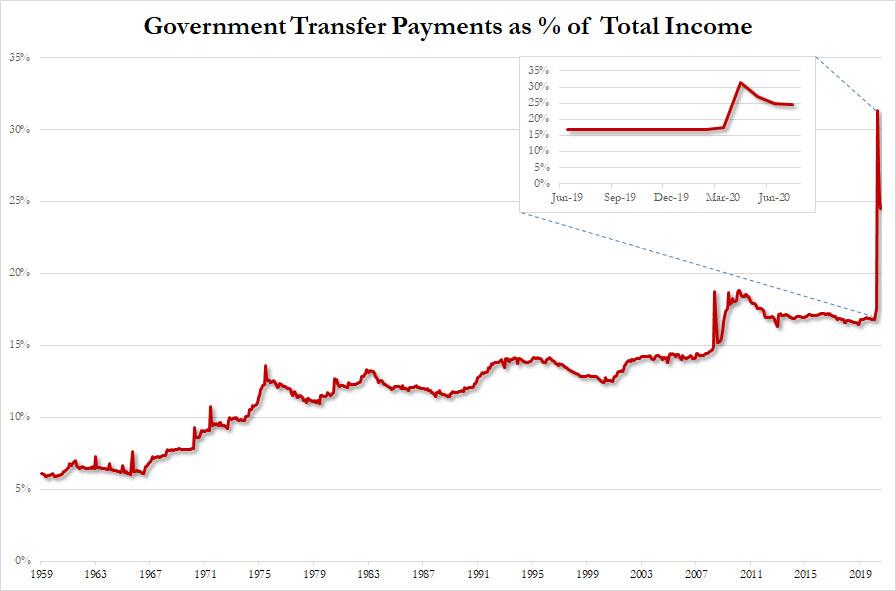
Just as striking, is that as of July when total Personal Income was just over $20 trillion annualized for the first time ever, the government is now responsible for just under a quarter of all income.

Putting that number in perspective, in the 1950s and 1960s, transfer payment were around 7%. This number rose in the low teens starting in the mid-1970s (or right after the Nixon Shock ended Bretton-Woods and closed the gold window). The number then jumped again after the financial crisis, spiking to the high teens.

And now, the coronavirus has officially sent this number into the mid-20% range, after hitting a record high 31% in April.

And that’s how creeping banana republic socialism comes at you: first slowly, then fast.

So for all those who claim that the Fed is now (and has been for the past decade) subsidizing the 1%, that’s true, but with every passing month, the government is also funding the daily life of an ever greater portion of America’s poorest social segments.

Who ends up paying for both?

Why the middle class of course, where the dollar debasement on one side, and the insane debt accumulation on the other, mean that millions of Americans content to work 9-5, pay their taxes, and generally keep their mouth shut as others are burning everything down and tearing down statues, are now doomed.

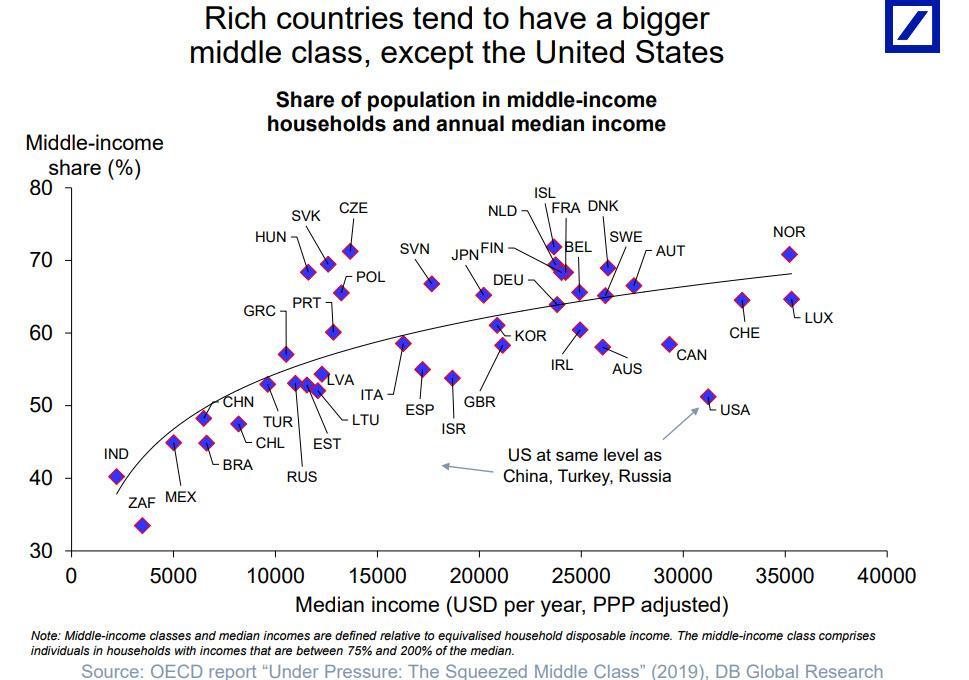
The “good” news? As we reported last November, the US middle class won’t have to suffer this pain for much longer, because while the US has one one of the highest median incomes in the entire world, with only three countries boasting a higher income, it is who gets to collect this money that is the major problem, because as the chart also shows, with just a 50% share of the population in middle-income households, the US is now in the same category as such “banana republics” as Turkey, China and, drumroll, Russia.

What is just as stunning: according to the OECD, more than half of the countries in question have a more vibrant middle class than the US.

So the next time someone abuses the popular phrase  “they hate us for our [fill in the blank]”, perhaps it’s time to counter that “they” may not “hate” us at all, but rather are making fun of what has slowly but surely become the world’s biggest banana republic?

And as we concluded last year, and as even established banks now agree, “it has not Russia, nor China, nor any other enemy, foreign or domestic, to blame… except for one: the Federal Reserve Bank of the United States.”

via ZeroHedge News https://ift.tt/2QFaUvH Tyler Durden

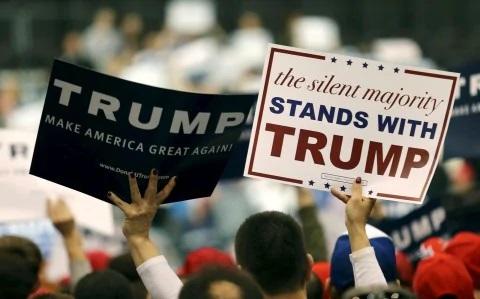
Silent Majority: Over 10% Of Trump Voters Won’t Admit Preferences To Pollsters

Silent Majority: Over 10% Of Trump Voters Won’t Admit Preferences To Pollsters

Tyler Durden

Fri, 08/28/2020 – 15:05

A new study from CloudResearch reveals that 11.7% of Republicans won’t admit their political preferences to pollsters – which is more than twice the number of Democrats at just 5.4%.

CloudResearch also found that “10.5% of Independents fell into the “shy voter” category, just a percentage point lower than how Republicans react to phone polls.”

When asked why they wouldn’t be truthful in their responses, “shy” respondents cited six concerns: 

1. A lack of trust in phone polls as truly being anonymous

2. An apprehension to associate their phone numbers with recorded responses.

3. Fear that their responses will become public in some manner.

4. Fear of reprisal and related detrimental impact to their financial, social, and family lives should their political opinions become publicly known. 

5. A general dislike of phone polls. 

6. Malicious intent to mislead polls due to general distrust of media and political pundits (though a sentiment expressed only by a few “shy voters”). 

Specifically, the following explanations were given:

“I don’t believe the information would be confidential and I think it’s dangerous to express an opinion outside of the current liberal viewpoint.”

“Well I probably wouldn’t give my opinion period, but if pushed, I would not give my real opinion for fear of reprisal if someone found out.”

“Because most polls released to the public are slanted and aren’t scientifically based. So, they are messing with the results of the survey from the beginning by knocking down one party or the other. I’m just trying to right the ship.”

My answers could be recorded so I don’t really trust such phone conversations.”

I do not discuss politics — let alone with a total stranger on the telephone.

“I don’t always trust phone call surveys. I wouldn’t want to be bombarded with phone calls and political mail.”

“I don’t want my opinion associated with my phone number.”

I am less anonymous, and somewhat ashamed of my opinion as it is frowned upon.”

CloudResearch also found that the reluctance to give honest answers should not be interpreted as outright lying – rather, they are an indication of a lack of trust in the anonymity of polls, as well as a fear of reprisal if their opinions were to become public.

The results could have implications in terms of the true accuracy of phone polls; if Republicans, Independents and supporters of Donald Trump (regardless of party affiliation) are less likely to participate in polls or accurately disclose the candidate they support, that inherently generates biased poll outcomes.

Given razor thin-margins in the swing states, such bias may have important consequences, although more research is required to fully understand the potential magnitude of this effect. We intend to examine the magnitude of “shy-voter bias” in specific states like Arizona, Florida, Michigan, North Carolina, Pennsylvania, and Wisconsin over the coming weeks. –CloudResearch

And who can blame the silent majority – with Trump supporters having been actively targeted with violence and harassment in restaurants, at their homes, and walking in public.

So – between egregious oversampling of Democrats by polling companies, and Republicans won won’t admit to supporting Trump, it’s no wonder the polls have been dead wrong since 2016.

via ZeroHedge News https://ift.tt/34GbzVZ Tyler Durden

“Expectations Are Too High” – Morgan Stanley Downgrades Penn And DraftKings

“Expectations Are Too High” – Morgan Stanley Downgrades Penn And DraftKings

Tyler Durden

Fri, 08/28/2020 – 15:00

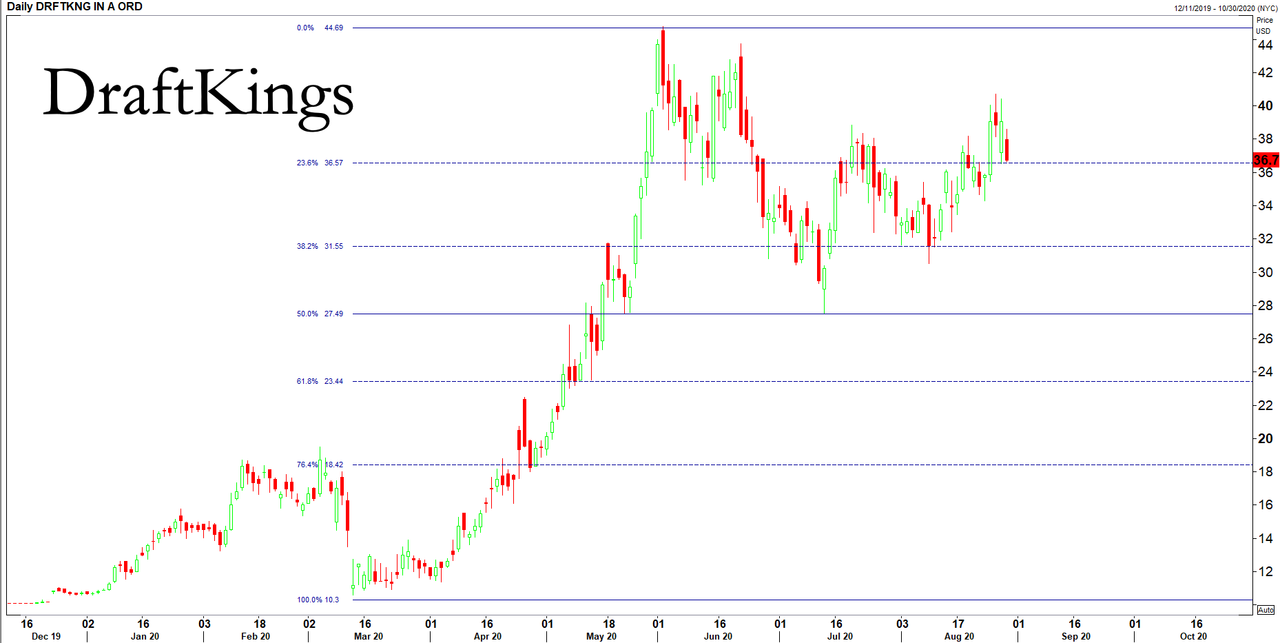
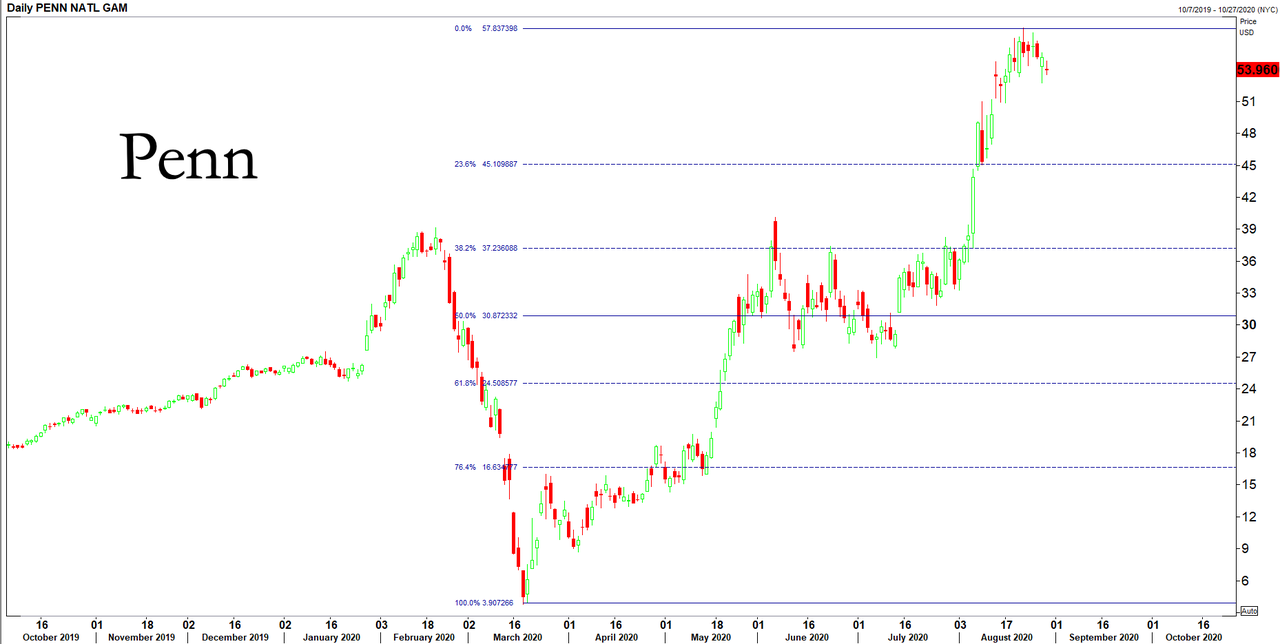
Shares of sports betting companies, DraftKings and Penn National Gaming, slumped Friday after Morgan Stanley published a new note downgrading both to equal weight from overweight amid extreme valuation concerns. 

“DKNG and PENN have both more than doubled since the start of the year. While we think a lot of the increased value is valid, we are concerned investors’ expectations are too high and see six potential negative catalysts through” the end of the year, Morgan Stanley analyst Thomas Allen wrote. 

Allen outlined six potential, near-term risks for DraftKings and Penn that suggest it’s time for Robinhood traders to cash in those chips before the recent loss of momentum in both stocks turns into a correction. 

  • A reversal of “stay-at-home tailwinds;” 

  • Lower consumer gambling trends thanks to the fiscal cliff, or lack of stimulus round two;

  • Increased competition in the sports betting industry;

  • Lack of progress in additional legalization of sports gambling;

  • Increasing prospectus of NFL season being canceled; 

  • Insiders selling stock (read: “DraftKings Insiders Dump $596 Million Of Stock On Unsuspecting Robinhood Daytraders”

Despite the downgrades, Allen increased DraftKings’ price target to $37 from $26, along with Penn’s target to $55 from $49 per share.

The downgrade is mainly due to valuation concerns; DraftKings is up 267% and Penn +1,339% since lockdowns began in early March. Readers may recall we’ve noted the insane moves in both stocks, even pointed out the moves happened in a period when all sporting events were canceled. As some major league games return, such as MLB, NBA, and NHL ones, both companies remain price for perfection. 

Allen believes sports betting and online gaming could be a $12 business by 2025, as both DraftKings and Penn are “arguably the purest plays” on legal sports and online betting.

Draftkings

Penn

The recent loss of momentum in both stocks suggests a correction nears. 

via ZeroHedge News https://ift.tt/31E5tUh Tyler Durden

“They Would Have Killed Us” – Rand Paul Describes Attack By “Unhinged” Mob

“They Would Have Killed Us” – Rand Paul Describes Attack By “Unhinged” Mob

Tyler Durden

Fri, 08/28/2020 – 14:46

During his first live interview since being confronted and assaulted outside the White House last night, Rand Paul, the senator who back in June introduced a bill that would end the kind of “no-knock” warrants that contributed to the murder of Breonna Taylor, described the “horrific” experience of being attacked alongside his wife.

Paul is no stranger to confrontation (remember the incident with his neighbor?) but he said he regretted his decision to try to walk back to his hotel. As Paul and his wife and friends walked, the crowd around them started getting bigger and bigger. They were shouting threats, but they were also shouting “say her name” in reference to Breonna Taylor.

“You couldn’t reason with this mob, but I’m actually the author of a law to try and get rid of no knock raids. These people were unhinged. I’m not sure we would have made it.”

At one point, the mob knocked down one of the officers guarding Paul and his wife. Asked about the types of threats, Paul said he heard members of the crowd bray about trying to kill him and his wife. If the police hadn’t been there “we would not be here today, or we would be in a hospital today.”

“I truly believe this with every fiber of my being, had they gotten at us they would have gotten us to the ground, we might not have been killed, might just have been injured by being kicked in the head, or kicked in the stomach until we were senseless,” he explained.

Later in the interview, he said he feared the mob would have “killed us” if the police hadn’t been there to stop them.

“They were inciting a riot and they would have killed us had the police not been there,” he said, before profusely thanking the police who stepped up to protect him.

Toward the end of the interview, Paul said he believes the mob that attacked him was partly comprised of paid protesters who arrived in Washington DC from out of state, and were given money for their accommodations so they could come and protest.

“I believe there are going to be people who are involved with the attack on us that actually were paid to come here, are not from Washington, DC, and are sort of paid to be anarchists.”

While Americans have a right to peaceably assemble, inciting a riot is a crime, and paid agitators deserve to be arrested, along with whoever is financing them.

“This is disturbing because really, if you’re inciting a riot that’s a crime, but if you’re paying someone to incite a riot that person needs to go to jail as well.”

“If you’re paying someone to incite a riot, that person needs to go to jail as well. I like being free to be able to take a walk in the park…I don’t hear Joe Biden saying anything about it…these are their voters.”

Mobs like this are why politicians who are playing footsie with the crypto-communists calling for “de-funding” the police shouldn’t be given the opportunity to lead.

“It’s become so dangerous for us and I don’t hear Joe Biden or Kamala Harris saying one thing about the violence. This mob is their voters. This is the new Democrat party, and if we don’t resist this, the United States is going to become Portland. We’re going to become Chicago. All of these failed cities Democrats have run, the president said in his speech,” he said. “If we allow them to take over the White House, we are going to become Portland, the country will be on fire, we have to have law and order and we have to support the police. I can’t say that strong enough.”

While Paul acknowledged that he and his wife got out unscathed, he noted that the mob was still out on the street on Friday morning.

“We can’t live this way. It’s getting worse and worse.”

Watch the entire interview below:

via ZeroHedge News https://ift.tt/34URTOz Tyler Durden

The U.S. Prison System Has Reached 1,000 COVID-19 Deaths

sanquentinii_1161x653

America crossed a grim threshold this week. The Marshall Project and the Associated Press calculate that there have now been 1,000 COVID-19 deaths across the state and federal prison systems. Of the people who died, 928 were inmates and 72 were prison staff.

There have been at least 108,000 reported COVID-19 infections among inmates, and the rates can vary wildly from state to state: Less than 10 percent of California’s prison population has reported infections, while 30 percent of Arkansas’ population has. You probably shouldn’t use those numbers alone to determine how effectively prisons have responded to the outbreak: There are other variables, like how long it took for prisons to start widespread testing and how they’ve managed the infections. There has been a big spike in newly reported infections in prisons in July and August, but reported deaths are stable and about half what they were in April and May.

Research published in early July found that COVID-19 infection rates among prisoners were 5.5 times that of the general population. The death rate (39 per 10,000) among inmates was also higher than the death rate (29 per 10,000) among the general population. Again, this can vary wildly from state to state. Some states, such as Pennsylvania, report lower infection and death rates among its inmates than in the general population.

In California, the consequences of poor prison COVID policies are still playing out in San Quentin State Prison. California’s oldest prison had been doing very well at keeping the coronavirus at bay, reporting no infections at all until May. But that month, several prisoners were transferred to San Quentin from the Correctional Institute for Men in Chino. The Chino prison had seen a massive outbreak and several deaths, and this was supposed to relieve overcrowding. But the transferred prisoners were not properly tested and quarantined, and so San Quentin had an outbreak too.

When Reason first noted this new infection cluster at the end of June, there had not yet been any COVID-19 deaths at San Quentin. Now, less than 90 days later, there have been 26 deaths, and San Quention has bypassed Chino to have most deaths among inmates in the state. This month a San Quentin prison guard also died of COVID-19.

When we critique politicians who try to shower themselves with undeserved glory for their COVID-19 responses, like New York Gov. Andrew Cuomo, we tend to focus on their poor grasp of risks at both ends of the spectrum—in Cuomo’s case, pushing the infected elderly into nursing homes while shutting down parks and other outdoor spaces. The problems in the prisons deserve more attention, but it often takes a back seat because of people’s attitudes toward prisoners.

But prisoners are in a position where they depend almost completely on government competence in a pandemic for their survival. And this should matter to you even if you don’t particularly care about criminal justice reform (though it’s certainly worth thinking about the facts that almost all of our biggest infection clusters are in prisons and that America has the world’s highest incarceration rate). The people who are most dependent on government competence are getting infected at a higher rate and dying at a higher rate than those who are not. What does that tell you?

from Latest – Reason.com https://ift.tt/3lqXPEA
via IFTTT

Can the Republican Party Survive Trump?

Thumb

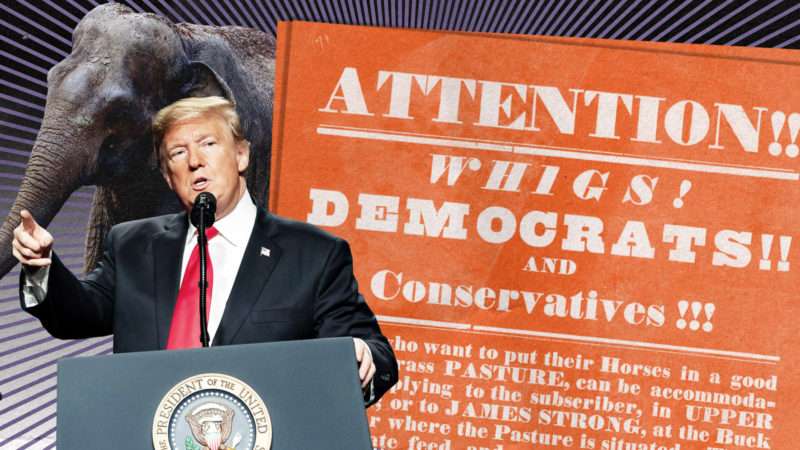
Donald Trump, who four short years ago was viewed by many GOP operatives as an erratic outsider, has just been re-nominated as the Republican Party’s standard-bearer. But whether he wins or loses, can a party without any guiding principles survive?

How do old political parties die, and how are new ones born?

Imagine a political party that has lost its ideological coherence and is torn apart by various warring factions. Then an outsider and celebrity candidate emerges with no fealty to the party’s policy agenda and with no previous political experience. He goes on to connect with voters and retake the White House.

That’s exactly what happened in 1848, when the Whigs backed Zachary Taylor.

Political scientist Philip Wallach, a resident senior fellow at the R Street Institute, published a 2017 paper on the parallels between Taylor and Trump.

“Taylor was a very disruptive force for the Whig Party,” says Wallach. “His victory was, of course, something they were very excited about, but he didn’t govern in exactly the ways they would have preferred.”

While Trump raised his profile by projecting a bellicose demeanor on primetime television, Taylor was a celebrated general who won a key battle in the Mexican-American War. And like Trump, he tried to redefine his party in his own image and refused to pledge fealty to party principles.

Taylor “even thought about rebranding [Whiggism] as ‘Taylor Republicanism,'” says Wallach.

But Taylor’s efforts at redefining Whig principles were doomed by a preexisting divide over whether slavery would be allowed in new territories. Both the Whigs and their primary competitors, the Democrats, waffled, which created an opening for single-issue third-parties such as the anti-slavery Liberty Party and Free Soil Party, as well as the nativist Know-Nothing Party.

After Taylor’s untimely death in office, the fractured Whig Party “bled to death,” as historian Michael Holt put it, losing too many voters to the Free Soil and Know-Nothing parties. And out of that carnage rose the Republican Party, united by the conviction that slavery should have no part in America’s future.

What does the death of the Whigs tell us about the prospect of breaking up our modern two-party duopoly?

“In 2020, we have two parties that have delivered us candidates, both of which are more destructive than they are constructive,” says evolutionary biologist and podcast host Bret Weinstein, who is trying to engineer the candidacy of an independent to go up against Biden and Trump.

Weinstein sees a parallel with the mid-19th century in that voters are again open to alternatives.

“This is, in some sense, the natural outgrowth of the fact that the parties long ago stopped serving the interests of the American public,” says Weinstein.

Weinstein, who’s best known for his viral confrontation with student protesters at The Evergreen State College after he objected to a call for all white people to leave campus for a day, believes that the two major parties are in thrall to far-left and far-right fringes and elite donors, causing them to neglect a majority of Americans.

“For many reasons, the natural thing is for Americans to unify under some banner in order to regain power over the policymaking structure,” says Weinstein.

Weinstein launched an initiative called Unity 2020, which intends to use online crowdsourcing to nominate a center-left and center-right candidate to run and govern as a team. He says by circumventing the usual political process, candidates will avoid being so easily corrupted.

“We have all been told that power tends to corrupt and absolute power corrupts absolutely,” says Weinstein. “I have long thought this is nonsense. What we do have is a system in which power tends to be awarded to people on the basis that they are corruptible.”

But in the 19th century, there were fewer obstacles to challenging the major parties.

“For a third party to be able to get some votes was much easier,” says Wallach. “It just had to be able to print ballots and distribute them to a network of supporters….Nineteenth-century politics were just much more open and fluid than our politics today.”

With the election less than two and a half months away, whoever’s nominated by the Unity 2020 ticket is unlikely to make it on many ballots, and Weinstein declined to articulate a plausible path to victory.

“We are certainly too late with respect to the standard process of collecting signatures to get on the ballots of all 50 states, but that’s not the only way this can be accomplished,” says Weinstein.

The Libertarian Party’s presidential nominee, Jo Jorgensen, is on track to getting on the ballot in all 50 states, and she says she offers a better path forward than either Trump or Biden.

“People are realizing that they don’t have the choices that they used to have. And I think they’re getting fed up with government telling them at every turn what they can do,” says Jorgensen.

But Wallach is skeptical that a third party can disrupt our modern duopoly.

In the 19th century, minor parties like the Free Soilers won local and state elections and congressional seats, which the Libertarian Party has mostly failed to achieve. In 2016, after getting more attention than any Libertarian candidate in history, former New Mexico Governor Gary Johnson won just over 3 percent of the popular vote when going up against Trump and Clinton, two historically unpopular candidates.

A third party or independent candidate has never triumphed in a modern presidential election, with the strongest contender being former President Teddy Roosevelt’s 1912 campaign under the Progressive Party banner. The self-funded billionaire Ross Perot’s run in 1992 eventually spun off the Reform Party, which never won a national election but did become the site of Donald Trump’s first foray into presidential politics.

“That leaves us wondering, where would [a successful] a third party come from?” says Wallach.

He believes that, based on the death of the Whigs, to be successful the Libertarian Party would need to win in statewide races and then merge with defectors from a collapsed Democratic or Republican Party.

But Weinstein is betting that digital media have opened new channels for a Unity ticket to bypass traditional gatekeepers, as outsider candidate Andrew Yang did in the Democratic primary.

“Andrew Yang would potentially not have gained our attention had it not been for this alternative media network,” says Weinstein. “He certainly rose spectacularly in the public imagination at the point he showed up on Joe Rogan’s ….There is something of similar or greater magnitude to the major networks that are operating under a different set of rules.”

And while there’s no single issue dividing the nation that’s on par with slavery in the time of the Whigs, Weinstein does see historical parallels.

“We are dealing with the very same issue in a different form in 2020. The thing that caused the civil war is simply not fully resolved,” says Weinstein.

While Weinstein is supportive of some aims of the Black Lives Matter movement, he believes its emphasis on racial identity foments dangerous divisions—for different reasons, but in similar ways, as racist movements on the far right.

“We are now seeing a movement that wishes to place race back at the forefront of our political thinking and, frighteningly, that viewpoint seems to be shared by those on the far left and the far right,” says Weinstein. “We cannot remain cohesive as a nation if we are attacking each other on the basis. That the only thing we need to understand to know what team we are on is the color of our skin or our gender.”

Jorgensen believes it’s government intervention that exacerbates many of our divisions, including racial ones, pointing to the Rosa Parks story as a historical example.

“A rural black woman stood up and refused to sit in the back of the bus,” says Jorgensen. “That was a government-run, government-owned bus. And so it was the government who was putting us in this ‘us versus them’ situation.”

While their strategies and analyses differ, Weinstein and Jorgensen both agree that the status quo cannot hold.

“I’d say everything is at stake in this particular election. And what we’ve been delivered is two different failure modes,” says Weinstein. “I think the problem is either case is unacceptable. And when one finds that situation, we have to look for a third way. And in this case, if it’s considered radical, so be it. It’s simply time.”

Jorgensen says that Americans feel fundamentally disempowered by the infringements on their liberties that a poor federal response to the COVID-19 pandemic has caused.

“Americans are frustrated because they don’t have any control over their own lives,” says Jorgensen. “And all they know is that it’s the two old parties that are making them feel this way.”

Produced by Zach Weissmueller. Opening graphic by Lex Villena.

Music by Stanley Gurvich licensed by Artlist.

Photo credits: CNP/AdMedia/Newscom; DNC via Sipa USA/Newscom; Tetra Images Tetra Images/Newscom; Tom Williams/CQ Roll Call/Newscom ; Bill Clark/CQ Roll Call/Newscom; Leah Millis/Reuters/Newscom; Leslie Spurlock/ZUMA Press/Newscom; Jeremy Hogan/ZUMA Press/Newscom; Antonio Perez/TNS/Newscom; Nuri Vallbona/Reuters/Newscom; Leah Millis/Reuters/Newscom; Stanton Sharpe/SOPA Images/Sip/Newscom; Gary I. Rothstein/UPI/Newscom;  David R. Frazier/DanitaDelimont.com “Danita Delimont Photography”/Newscom

from Latest – Reason.com https://ift.tt/2Er2Cp5
via IFTTT

Maximum Security Comes Up Short

Horse races should be decided on the track, not in court. That’s one way to read the opinion of the U.S. Court of Appeals for the Sixth Circuit in West v. Kentucky Horse Racing Commission, a challenge to the decision to effectively disqualify Maximum Security from the Kentucky Derby, despite the fact that that horse was the first to cross the finish line.

Judge Bush’s opinion for the court begins:

“Whether true or perceived to be true, a referee’s calls can ‘change the outcome of [a] game.'” Higgins v. Ky. Sports Radio, LLC, 951 F.3d 728, 735 (6th Cir. 2020) (citation omitted). As is true for Kentucky basketball, the same is true for Kentucky horse racing. At issue here is a call made by racing stewards that changed the outcome in the most storied race of them all—the Kentucky Derby.

In 144 uninterrupted years of Runs for the Roses, only one horse to cross the finish line first had been disqualified, and no winning horse had ever been disqualified for misconduct during the race itself. But, on the first Saturday in May 2019, fans were told to hold onto their tickets at the conclusion of the 145th Derby. “Maximum Security,” the horse that had finished first, would not be declared the winner. Instead, he would come in last, thanks to the stewards’ call that Maximum Security committed fouls by impeding the progress of other horses in the race.

As a result of this ruling, Maximum Security’s owners, Gary and Mary West, were not awarded the Derby Trophy, an approximate $1.5 million purse, and potentially even far greater financial benefits from owning a stallion that won the Derby. So, the Wests filed this civil rights lawsuit under 42 U.S.C. § 1983 against the individual stewards who made the controversial call, the individual members of the Kentucky Horse Racing Commission, and the Commission itself. The complaint alleged that the stewards’ decision was arbitrary and capricious, was not supported by substantial evidence, and violated the Wests’ right to procedural due process. The Wests also claimed that the regulation that gave the stewards authority to disqualify Maximum Security is unconstitutionally vague. They sought, among other things, a declaration from the district court that Maximum Security was the official winner of the 145th Kentucky Derby.

The district court dismissed the suit for failure to state a claim. It determined that the stewards’ decision was not reviewable under Kentucky law, that the Wests had no property interest in the prize winnings, and that the challenged regulation is not unconstitutionally vague. For the reasons discussed below, we agree and AFFIRM the judgment of the district court.

Judges Batchelder and Larsen joined Judge Bush’s opinion.

from Latest – Reason.com https://ift.tt/3jB6XoD
via IFTTT

The U.S. Prison System Has Reached 1,000 COVID-19 Deaths

sanquentinii_1161x653

America crossed a grim threshold this week. The Marshall Project and the Associated Press calculate that there have now been 1,000 COVID-19 deaths across the state and federal prison systems. Of the people who died, 928 were inmates and 72 were prison staff.

There have been at least 108,000 reported COVID-19 infections among inmates, and the rates can vary wildly from state to state: Less than 10 percent of California’s prison population has reported infections, while 30 percent of Arkansas’ population has. You probably shouldn’t use those numbers alone to determine how effectively prisons have responded to the outbreak: There are other variables, like how long it took for prisons to start widespread testing and how they’ve managed the infections. There has been a big spike in newly reported infections in prisons in July and August, but reported deaths are stable and about half what they were in April and May.

Research published in early July found that COVID-19 infection rates among prisoners were 5.5 times that of the general population. The death rate (39 per 10,000) among inmates was also higher than the death rate (29 per 10,000) among the general population. Again, this can vary wildly from state to state. Some states, such as Pennsylvania, report lower infection and death rates among its inmates than in the general population.

In California, the consequences of poor prison COVID policies are still playing out in San Quentin State Prison. California’s oldest prison had been doing very well at keeping the coronavirus at bay, reporting no infections at all until May. But that month, several prisoners were transferred to San Quentin from the Correctional Institute for Men in Chino. The Chino prison had seen a massive outbreak and several deaths, and this was supposed to relieve overcrowding. But the transferred prisoners were not properly tested and quarantined, and so San Quentin had an outbreak too.

When Reason first noted this new infection cluster at the end of June, there had not yet been any COVID-19 deaths at San Quentin. Now, less than 90 days later, there have been 26 deaths, and San Quention has bypassed Chino to have most deaths among inmates in the state. This month a San Quentin prison guard also died of COVID-19.

When we critique politicians who try to shower themselves with undeserved glory for their COVID-19 responses, like New York Gov. Andrew Cuomo, we tend to focus on their poor grasp of risks at both ends of the spectrum—in Cuomo’s case, pushing the infected elderly into nursing homes while shutting down parks and other outdoor spaces. The problems in the prisons deserve more attention, but it often takes a back seat because of people’s attitudes toward prisoners.

But prisoners are in a position where they depend almost completely on government competence in a pandemic for their survival. And this should matter to you even if you don’t particularly care about criminal justice reform (though it’s certainly worth thinking about the facts that almost all of our biggest infection clusters are in prisons and that America has the world’s highest incarceration rate). The people who are most dependent on government competence are getting infected at a higher rate and dying at a higher rate than those who are not. What does that tell you?

from Latest – Reason.com https://ift.tt/3lqXPEA
via IFTTT

Can the Republican Party Survive Trump?

Thumb

Donald Trump, who four short years ago was viewed by many GOP operatives as an erratic outsider, has just been re-nominated as the Republican Party’s standard-bearer. But whether he wins or loses, can a party without any guiding principles survive?

How do old political parties die, and how are new ones born?

Imagine a political party that has lost its ideological coherence and is torn apart by various warring factions. Then an outsider and celebrity candidate emerges with no fealty to the party’s policy agenda and with no previous political experience. He goes on to connect with voters and retake the White House.

That’s exactly what happened in 1848, when the Whigs backed Zachary Taylor.

Political scientist Philip Wallach, a resident senior fellow at the R Street Institute, published a 2017 paper on the parallels between Taylor and Trump.

“Taylor was a very disruptive force for the Whig Party,” says Wallach. “His victory was, of course, something they were very excited about, but he didn’t govern in exactly the ways they would have preferred.”

While Trump raised his profile by projecting a bellicose demeanor on primetime television, Taylor was a celebrated general who won a key battle in the Mexican-American War. And like Trump, he tried to redefine his party in his own image and refused to pledge fealty to party principles.

Taylor “even thought about rebranding [Whiggism] as ‘Taylor Republicanism,'” says Wallach.

But Taylor’s efforts at redefining Whig principles were doomed by a preexisting divide over whether slavery would be allowed in new territories. Both the Whigs and their primary competitors, the Democrats, waffled, which created an opening for single-issue third-parties such as the anti-slavery Liberty Party and Free Soil Party, as well as the nativist Know-Nothing Party.

After Taylor’s untimely death in office, the fractured Whig Party “bled to death,” as historian Michael Holt put it, losing too many voters to the Free Soil and Know-Nothing parties. And out of that carnage rose the Republican Party, united by the conviction that slavery should have no part in America’s future.

What does the death of the Whigs tell us about the prospect of breaking up our modern two-party duopoly?

“In 2020, we have two parties that have delivered us candidates, both of which are more destructive than they are constructive,” says evolutionary biologist and podcast host Bret Weinstein, who is trying to engineer the candidacy of an independent to go up against Biden and Trump.

Weinstein sees a parallel with the mid-19th century in that voters are again open to alternatives.

“This is, in some sense, the natural outgrowth of the fact that the parties long ago stopped serving the interests of the American public,” says Weinstein.

Weinstein, who’s best known for his viral confrontation with student protesters at The Evergreen State College after he objected to a call for all white people to leave campus for a day, believes that the two major parties are in thrall to far-left and far-right fringes and elite donors, causing them to neglect a majority of Americans.

“For many reasons, the natural thing is for Americans to unify under some banner in order to regain power over the policymaking structure,” says Weinstein.

Weinstein launched an initiative called Unity 2020, which intends to use online crowdsourcing to nominate a center-left and center-right candidate to run and govern as a team. He says by circumventing the usual political process, candidates will avoid being so easily corrupted.

“We have all been told that power tends to corrupt and absolute power corrupts absolutely,” says Weinstein. “I have long thought this is nonsense. What we do have is a system in which power tends to be awarded to people on the basis that they are corruptible.”

But in the 19th century, there were fewer obstacles to challenging the major parties.

“For a third party to be able to get some votes was much easier,” says Wallach. “It just had to be able to print ballots and distribute them to a network of supporters….Nineteenth-century politics were just much more open and fluid than our politics today.”

With the election less than two and a half months away, whoever’s nominated by the Unity 2020 ticket is unlikely to make it on many ballots, and Weinstein declined to articulate a plausible path to victory.

“We are certainly too late with respect to the standard process of collecting signatures to get on the ballots of all 50 states, but that’s not the only way this can be accomplished,” says Weinstein.

The Libertarian Party’s presidential nominee, Jo Jorgensen, is on track to getting on the ballot in all 50 states, and she says she offers a better path forward than either Trump or Biden.

“People are realizing that they don’t have the choices that they used to have. And I think they’re getting fed up with government telling them at every turn what they can do,” says Jorgensen.

But Wallach is skeptical that a third party can disrupt our modern duopoly.

In the 19th century, minor parties like the Free Soilers won local and state elections and congressional seats, which the Libertarian Party has mostly failed to achieve. In 2016, after getting more attention than any Libertarian candidate in history, former New Mexico Governor Gary Johnson won just over 3 percent of the popular vote when going up against Trump and Clinton, two historically unpopular candidates.

A third party or independent candidate has never triumphed in a modern presidential election, with the strongest contender being former President Teddy Roosevelt’s 1912 campaign under the Progressive Party banner. The self-funded billionaire Ross Perot’s run in 1992 eventually spun off the Reform Party, which never won a national election but did become the site of Donald Trump’s first foray into presidential politics.

“That leaves us wondering, where would [a successful] a third party come from?” says Wallach.

He believes that, based on the death of the Whigs, to be successful the Libertarian Party would need to win in statewide races and then merge with defectors from a collapsed Democratic or Republican Party.

But Weinstein is betting that digital media have opened new channels for a Unity ticket to bypass traditional gatekeepers, as outsider candidate Andrew Yang did in the Democratic primary.

“Andrew Yang would potentially not have gained our attention had it not been for this alternative media network,” says Weinstein. “He certainly rose spectacularly in the public imagination at the point he showed up on Joe Rogan’s ….There is something of similar or greater magnitude to the major networks that are operating under a different set of rules.”

And while there’s no single issue dividing the nation that’s on par with slavery in the time of the Whigs, Weinstein does see historical parallels.

“We are dealing with the very same issue in a different form in 2020. The thing that caused the civil war is simply not fully resolved,” says Weinstein.

While Weinstein is supportive of some aims of the Black Lives Matter movement, he believes its emphasis on racial identity foments dangerous divisions—for different reasons, but in similar ways, as racist movements on the far right.

“We are now seeing a movement that wishes to place race back at the forefront of our political thinking and, frighteningly, that viewpoint seems to be shared by those on the far left and the far right,” says Weinstein. “We cannot remain cohesive as a nation if we are attacking each other on the basis. That the only thing we need to understand to know what team we are on is the color of our skin or our gender.”

Jorgensen believes it’s government intervention that exacerbates many of our divisions, including racial ones, pointing to the Rosa Parks story as a historical example.

“A rural black woman stood up and refused to sit in the back of the bus,” says Jorgensen. “That was a government-run, government-owned bus. And so it was the government who was putting us in this ‘us versus them’ situation.”

While their strategies and analyses differ, Weinstein and Jorgensen both agree that the status quo cannot hold.

“I’d say everything is at stake in this particular election. And what we’ve been delivered is two different failure modes,” says Weinstein. “I think the problem is either case is unacceptable. And when one finds that situation, we have to look for a third way. And in this case, if it’s considered radical, so be it. It’s simply time.”

Jorgensen says that Americans feel fundamentally disempowered by the infringements on their liberties that a poor federal response to the COVID-19 pandemic has caused.

“Americans are frustrated because they don’t have any control over their own lives,” says Jorgensen. “And all they know is that it’s the two old parties that are making them feel this way.”

Produced by Zach Weissmueller. Opening graphic by Lex Villena.

Music by Stanley Gurvich licensed by Artlist.

Photo credits: CNP/AdMedia/Newscom; DNC via Sipa USA/Newscom; Tetra Images Tetra Images/Newscom; Tom Williams/CQ Roll Call/Newscom ; Bill Clark/CQ Roll Call/Newscom; Leah Millis/Reuters/Newscom; Leslie Spurlock/ZUMA Press/Newscom; Jeremy Hogan/ZUMA Press/Newscom; Antonio Perez/TNS/Newscom; Nuri Vallbona/Reuters/Newscom; Leah Millis/Reuters/Newscom; Stanton Sharpe/SOPA Images/Sip/Newscom; Gary I. Rothstein/UPI/Newscom;  David R. Frazier/DanitaDelimont.com “Danita Delimont Photography”/Newscom

from Latest – Reason.com https://ift.tt/2Er2Cp5
via IFTTT