“The Most Dangerous Period For Your Savings & Individual Freedom We’ve Ever Seen…”

“The Most Dangerous Period For Your Savings & Individual Freedom We’ve Ever Seen…”

Tyler Durden

Tue, 08/25/2020 – 17:25

Via InternationalMan.com,

International Man: I’d like to introduce Chris MacIntosh.

After working for many top-tier investment banks, Chris left the corporate world. He has since built and sold multiple million-dollar businesses, built a VC firm allocating $35m into early-stage ventures, and become a full-time trader.

He now manages money for clients of Glenorchy Capital; a macro focused hedge fund. Chris is the founder of Capitalist Exploits, with its flagship investment subscription letter called Insider.

Alright, let’s get into our discussion.

As countries destroy their national currencies, middle- and lower-class individuals will be disproportionately affected.

Are we seeing global destruction of private savings? What are the implications?

Chris MacIntosh: There’s a lot to unpack there.

What we’re seeing is the wholesale destruction of the middle class, certainly in Western democracies.

I think it’s by design.

We’re also seeing a wave of neo-Marxism taking place across the Western world, and they see it as an opportunity.

For anybody who wants an in-depth look at it, I suggest going to the World Economic Forum and looking at what they call The Great Reset.

They see this as an opportunity to rebuild the world in a Communist form.

The destruction of the middle class allows governments to enact all sorts of dangerous policies because the middle class is really what rises up.

When you have a middle class, people fight for that—if they have capital and resources to present some resistance.

If you take that capital away from them, they have less resistance. Certainly, if you take it away from them and then replace it with something like a Universal Basic Income (UBI), people essentially just become serfs of the government. And that’s what they’re doing.

Now, when you look around the world, that’s not what is currently happening in many emerging markets. I wouldn’t call much of Asia an emerging market anymore.

You have non-socialist structures or countries, and the way they deal with this crisis will tell what happens there over the next 10–20 years.

Western countries are dealing with this crisis by increasing debts, increasing social spending—and hence, ensuring the destruction of their currencies and their bond markets—and impoverishing the citizenry along the way.

However, in other countries, and I could pinpoint many—mainly in Asia, Eastern Europe, and even Russia—they’re not handling this in the same fashion.

Many of these countries don’t have social spending programs to the extent that the West does. Hence, there isn’t a belief by the citizenry that the government can or should look after them.

They’re not destroying their balance sheets or creating serfs.

What I think will happen, as the crisis fades with respect to the coronavirus, is many countries will be in poor shape in emerging markets. However, they are laying the groundwork to build and rise up from it because they’re not crushing themselves with social spending plans.

They’re also not crushing people by dis-incentivizing to get up and work. That’s exactly what the UBI does.

On a relative basis, these places are freer—they’re freer in terms of market economics—they’re freer in terms of human capital.

We’re going to see a shift of human capital, as well as capital, from the West to the East.

That’s how I see the national currencies and how middle- and lower-class individuals are affected in this process. I think, quite frankly, that everybody suffers.

The question is, who comes out of it in a stronger fashion?

And what is more conducive to capital formation on a go-forward basis? It’s absolutely clear to me that it’s not the West. It is largely in the East. That’s the longer-term trend.

For the chaos in-between, I think it’s pretty simple—you want to own tangible stuff.

International Man: Aside from the economic trends unfolding—and accelerating—as a response to Covid-19, a cultural, political, and social shift is also underway.

How are these trends connected, and what does it mean in the months and years ahead?

Chris MacIntosh: It’s all accelerating now.

Five years ago, I couldn’t have written a book to explain what’s happening today. And had any logical person read it, they would have said, “Oh, sure. That’s going to happen.”

They would have said, “Well, that’s a bloody great piece of fiction, Chris. Good job.”

And yet, here we are. Again, these trends are in an exponential blow-off top phase.

What does it mean for the months and years ahead?

I think it’s the most dangerous period of time that we’ve ever seen, not just for your capital but also for individual freedom.

That is troubling.

In terms of what it means for capital, we’re going to have extraordinary shortages.

Right now, people are very focused on a deflationary impact because they’re saying, “Well, nobody’s working. Businesses are going bust. There’s this credit contraction.”

That’s being met with a lot of fiscal and monetary stimulus. I don’t discount the fact that people losing their jobs has a disinflationary impact. What is being missed is the extraordinary shutting down of supply.

If you look at Maslow’s hierarchy of needs—it’s food, shelter, energy.

If you look at those components over the last two decades—on a relative basis—against all other sectors, they are the cheapest that they’ve ever been.

Take agriculture, for example.

Agriculture is the cheapest it’s been in about 70 years. Yet we have absolute destruction in supply.

We have governments literally deciding who is essential and who is not essential within the food supply chain. This is not any different from what the Bolsheviks tried. We all know what that resulted in. People can look up the genocide in Ukraine, which was a massive famine caused by the government.

We’re at the cusp of seeing the same sort of thing. Already, the US just had the highest rise in food prices in 50 years. And people are still not paying attention to it. This is going to become a massive problem.

*  *  *

Tens of millions of people have lost their jobs in the US alone, and small to medium-sized businesses have been destroyed. It’s clear that we’re seeing the destruction of the middle class. We’re also seeing a wave of neo-Marxism, which is sure to transform the Western world’s political and cultural nature. The risks that lie ahead are too big and dangerous to ignore. That’s why Chris just released the most critical report on these trends, What Happens Next. This free special report explains precisely what’s coming down the pike and what it means for your wealth and well-being. Click here to access it now.

via ZeroHedge News https://ift.tt/32mUNIV Tyler Durden
Palantir Gives Investors First Look At Financials, Reveals It Lost $580 Million Last Year

Palantir Gives Investors First Look At Financials, Reveals It Lost $580 Million Last Year

Tyler Durden

Tue, 08/25/2020 – 17:19

Palantir, the mysterious data analytics companies that has become one of the most valuable Silicon Valley unicorns despite being for all intents and purposes, a black box, has just given investors the first look inside the kimono.

Pardon our mixing of metaphors – but it really is difficult to understate how eager some investors have been to see these financials. As it turns out, the company, which is also known for receiving some of its early funding from a CIA-backed VC firm, lost $580 million last year.

Looks like they’re going to need to spy on more people.

Palantir was expected to go public this year, one of a handful of Silicon Valley stalwarts, including Airbnb, that missed out on last year’s string of hot IPOs (some of which – Zoom, Peloton – have done quite well in recent months).

The financials leaked over the weekend, but this is the first confirmed look from the company to investors.

For those of our readers who aren’t irredeemable fantasy nerds, Palantir was named after a magical orb from one of “The Lord of the Rings” books. It was co-founded by Peter Thiel in 2004, after he had already succeeded with PayPal and just after he made his career-cementing investment in Facebook.

Here’s what we know so far about the financials so far:

  • The company lost $588 million ($580 million on a pro-forma basis) in 2019, according to its S-1 filing. Revenue grew almost 25% from the year earlier while its losses stayed roughly even – no  doubt a good sign that the business is “scalable” (however horrifying that might sound to some). In the first half of 2020, Palantir lost $165 million, or $175 million on a pro-forma basis.
  • Palantir has two classes of stock, Class A and Class B, and while each share of Class A stock receives the rights to one vote, each Class A share gets 10 votes. In this way, the structure is similar to Facebook’s, and is really a classic Silicon Valley strategy for retaining founder control. Palantir says it plans to introduce Class F shares as well, which will carry a variable number of votes.


via ZeroHedge News https://ift.tt/3jcRZEN Tyler Durden

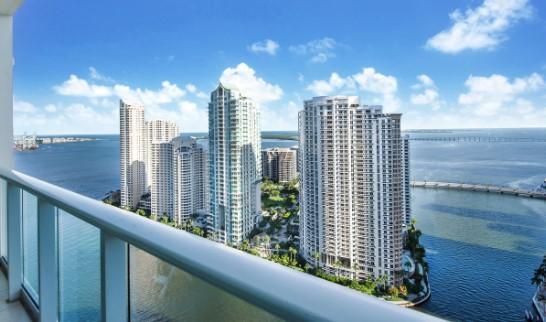
“There’s Too Much Product”: Miami Has 30 Months’ Of Unsold Condos After Covid Ravages Its Economy

“There’s Too Much Product”: Miami Has 30 Months’ Of Unsold Condos After Covid Ravages Its Economy

Tyler Durden

Tue, 08/25/2020 – 17:05

Miami is seeing a massive surge in supply in its condo market as Covid continues to have profound economic effects in South Florida, according to a new report from The Real Deal

The market now has a glut of 30 months worth of unsold condos and 100 months worth of luxury units (units over $1 million), according to an analysis of Multiple Listing Service data by Condo Vultures Realty. The data is ex-pre-construction sales and consists of “the area between Edgewater and Brickell, east of I-95”.

The condo data is based on 711 sales that closed in the first 6 months of this year, which averages out to about 119 sales per month. As of this week, there are still 3,579 condo listings awaiting suitors in Miami. The average asking price is about $758,000 – which contrasts sharply with the average closing price of $511,000 this year. 

The luxury market is in even worse shape than the condo market: only 36 units sold in the first 6 months of the year. There are about 600 luxury condos on the market asking an average of $2.05 million. 26 sales are pending. 

Peter Zalewski, principal at Condo Vultures Realty, told The Real Deal: “This is giving me flashbacks to 12 years ago in 2007, when the Miami condo market started to go bad. Early indications are that this pandemic combined with the oversupply that already existed is going to turn this into a serious buyer’s market.”

Shadow inventory, consisting of units that individual landlords put on the market, which are typically condos, and those that institutional owners will lease out, oftentimes without using the MLS, is also on the rise, according to Zalewski. He says that individual condo landlords and institutional owners are “dropping their prices and offering deals on units”. 

There is about 6 months of supply of shadow rental units listed on the MLS, the report says. An average of 541 leases per month were signed in the first six months of the year. 3,167 remain on the market for rent. 

Zalewski says that more price cuts and deep discounts are on their way: “The day of the all cash buyer is coming, and coming quickly. Those all cash buyers are not looking to pay market value. They’re not even looking for a discount. They’re looking for a haircut.”

“There’s too much product, and people do not want to live in a 500-unit building with 700 people,” Zalewski concluded.

via ZeroHedge News https://ift.tt/3lk2Z55 Tyler Durden

New Jersey Gym-Owners Outmaneuver Governor’s Vendetta With “Political” Workaround

New Jersey Gym-Owners Outmaneuver Governor’s Vendetta With “Political” Workaround

Tyler Durden

Tue, 08/25/2020 – 16:45

Authored by Andrea Widburg via AmericanThinker.com,

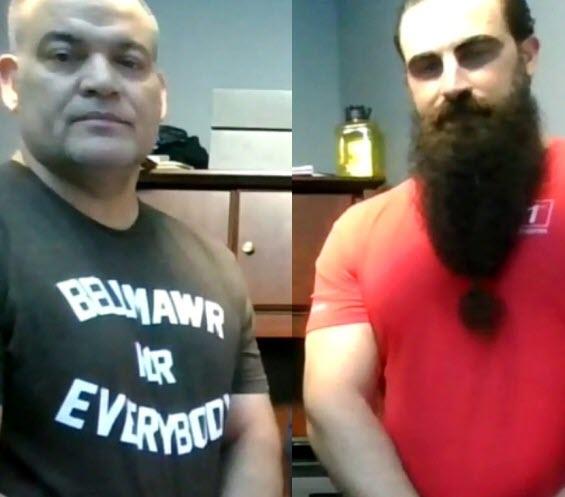
One of the lockdown stories that’s earned a lot of coverage concerns Ian Smith and Frank Trumbetti, who own Atilis Gym in Bellmawr, New Jersey.  

Because the Wuhan virus is now the status quo, rather than an emerging threat, they have pushed back against Governor Phil Murphy’s insistence that his continuing “emergency” executive powers can force them into bankruptcy.  They re-opened, and, despite observing social distancing, masks, and disinfection rules (and no cases of Wuhan viruses can be traced to their gym), Murphy has engaged in a full-on vendetta against the gym, including yanking their business license.

Help may be on the way, though.  

The gym’s owners have allied with Rik Mehta, a pharmacist who is running for the U.S. Senate. 

 If Mehta wins, he’ll bump Cory “I am Spartawuss” Booker, one of the smarmiest leftists in the Senate.  The gym’s owners and Mehta had a great idea — they’ve turned the gym into Mehta’s campaign headquarters:

The gym will serve as a campaign headquarters and rally spot for Republican US Senate candidate Rik Mehta, a pharmacist who is challenging Sen. Cory Booker (D-NJ), the owners said.

Gym co-owner Frank Trumbetti, asked whether the pair thought the state might try to mess with them this time around, responded, “We believe they can’t. It doesn’t mean that they’re not going to.”

“We hope it gives us a reprieve until Nov. 3,” he said of potential government interference at the gym. “Everyone who comes in here will be a volunteer for the Mehta campaign, and we’ll be here to exercise our rights.”

“And we’re not requiring masks, either,” Trumbetti added defiantly.

Bravo, guys, for standing up to the petty tyranny of yet another Democrat governor who turned his elder care facilities into slaughterhouses.  (At a certain point, you have to wonder if the Democrat governors who did this were merely stupid or if they were deliberately trying to ease the financial burden that the needs of elderly people can impose on state budgets.)

“We took a stand for our constitutional rights and for the rights of all small business owners throughout the country,” Smith told “Fox & Friends Weekend” Sunday.

“And it wasn’t intended to become political. We were trying to offer a solution to a problem where the government was failing, and it turned political. And that was because of Gov. Murphy’s actions. So now we made it political just as much as he has.

Without knowing any of the inevitable details about in-kind donations, insurance, etc., it sounds like an excellent idea for GOP candidates to join together with those locally owned businesses that Democrat governors seem determined to destroy.  While the governors are making sure that the big stores (Walmart, Lowes, etc.) see sales soar, they’re systematically destroying restaurants, gyms, hair care establishments, mom-and-pop stores, and all sorts of other places that can’t afford big donations to Democrat politicians.

via ZeroHedge News https://ift.tt/3gv72YX Tyler Durden

WTI Holds Near 6-Month Highs Amid Gulf Shut-Ins, Inventory Draws

WTI Holds Near 6-Month Highs Amid Gulf Shut-Ins, Inventory Draws

Tyler Durden

Tue, 08/25/2020 – 16:35

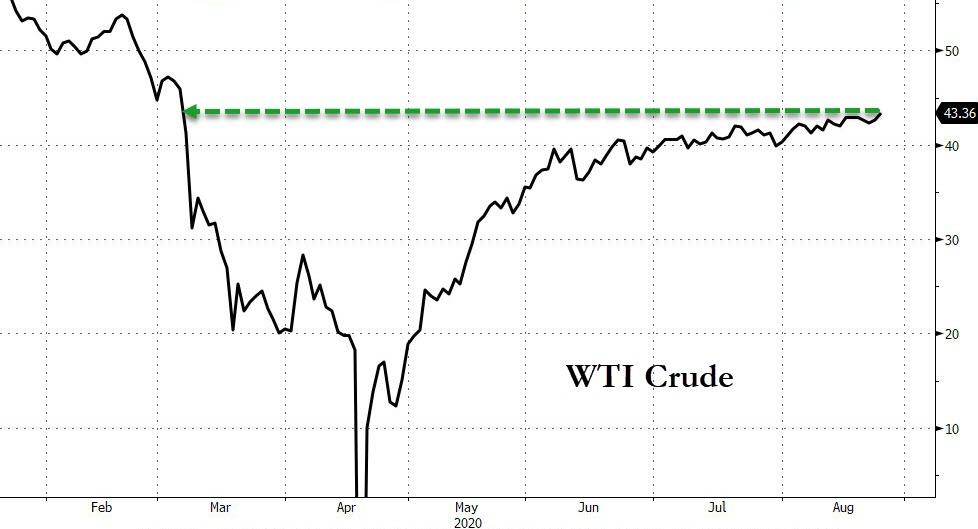
Oil prices were higher today, driven in large part by significant shut-ins across the Gulf of Mexico. WTI traded back above $43.

As Bloomberg’s Kriti Gupta details, the Gulf of Mexico is responsible for 17% of U.S. offshore oil production, 82% of which has been shut in preparation for the storm (up from 58% yesterday). So the simple explanation for rising crude is less production means less supply and higher prices.

It gets even thornier when you consider that 45% of total U.S. petroleum refining capacity also is located along the Gulf Coast.

This is unlikely to be reflected in any inventory/production data released this week.

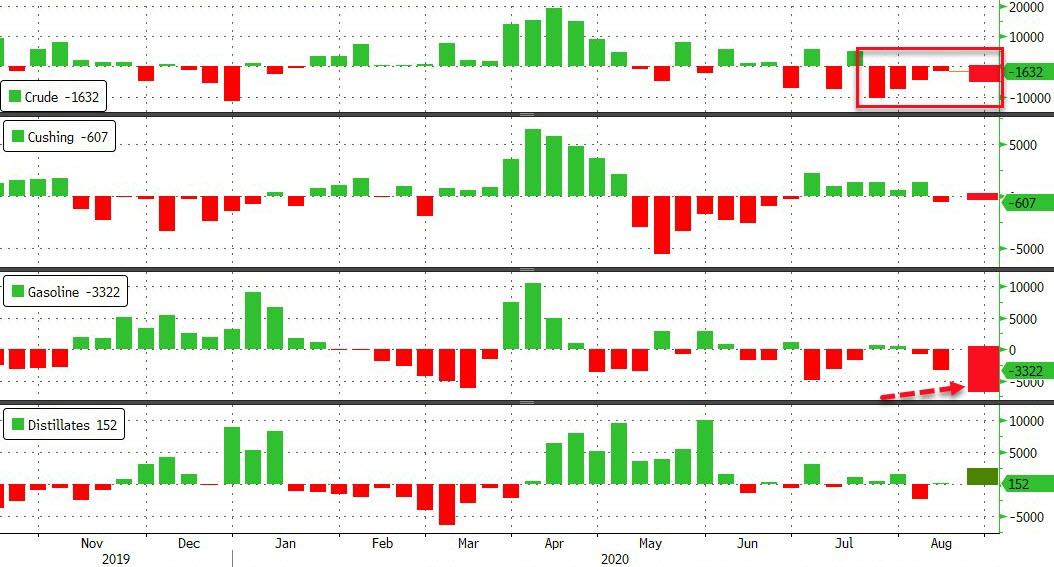
API

  • Crude -4.524mm (-4.3mm exp)

  • Cushing -646k

  • Gasoline -6.392mm (-2.7mm exp) – biggest draw since April 2019

  • Distillates +2.259mm (-700k exp)

Analysts expected a fifth weekly crude draw in a row and a continuing trend of draws in Gasoline stocks also… API reported bigger than expected draws for Crude and Gasoline (with the latter’s biggest drop in stocks since April 2019)…

Source: Bloomberg

WTI closed at its highest for the front-month contract since early March…

Source: Bloomberg

Oil was trading around $43.35 ahead of the print, and was little changed after the data.

“Markets know that the hurricane shut-ins are usually transient, and it’s a bit too early to know whether the current ones will have a prolonged bearish effect on prices or not,” said Bjornar Tonhaugen, head of oil markets at Rystad Energy, in a daily note. “Refineries might need to shut-in more runs due to flooding than upstream operators shut in crude supply,” so weaker demand for crude at the refineries may help to offset price-bullish supply constraints.

via ZeroHedge News https://ift.tt/31sxaiM Tyler Durden

Justifying a Moral Duty to Vote is a Lot Harder than You Might Think

Votingbooth

In the midst of the 2020 election, Americans are bitterly divided over a wide range of political issues. But there is broad agreement that we have a duty to vote, if at all possible—at least barring some kind of dire exigent circumstances. The idea that we have a moral duty to vote is so taken for granted that many think that it’s just obviously right, and don’t bother to provide an argument for it. But, as it turns out, the existence of a moral duty to vote is far from obvious, and justifying it turns out to be much harder than many people think. Georgetown political philosopher Jason Brennan, a leading academic critic of the idea, has a good summary of the reasons why it is difficult to defend well:

1. Overcome the particularity problem: It’s not enough to point to some general duty, G, which you argue people possess, and then to point out that voting is a way of satisfying G. It’s not even enough to show that voting is the best way to satisfy G. You need to show voting is the obligatory way of satisfying G.

For instance, suppose someone says, “You should exercise civic virtue, therefore vote!” The problem–which should be obvious but for some reason isn’t–is that there are lots of ways of exhibiting civic virtue other than by voting. Indeed, voting isn’t even especially good.

Even if voting were the best, that wouldn’t obviously make it obligatory. Suppose you have a duty to do productive work…. Maybe the best job you could take, given your talents, is medical doctor. But that doesn’t mean you are obligated to be a medical doctor…..

2. You need to deal with bad voters and bad voting: Most defenders of the duty to vote think there is merely a general duty to vote some way, not a specific duty to vote well, for the better side. But then your argument for a duty to vote nevertheless needs to explain, carefully, why the voters for the worse parties or worse candidates aren’t doing something morally bad and wrong…..

Many of the supposed arguments for a general duty to vote seem to imply that you must vote well, not merely that you must vote.

3. You need to follow the consequences of your argument. For instance, as [Geoffrey] Brennan and Lomasky have pointed out, one popular argument for a duty to vote leads to absurd conclusions. “If no one voted, it’d be a disaster, therefore you should vote.” First, it wouldn’t be a disaster, but secondly, notice the argument works even better for farming: “If no one farmed, we would all starve to death, therefore you should be a farmer….”

4. Don’t magically assume that voters know the right way to vote and that voting well is easy. It isn’t. Read up on voter psychology, which says most people just follow what others do and for most people, politics is not about policy…. Consider how hard it is to be informed, not merely of the particulars, but of the social science needed to understand causation. Consider how difficult it is to predict what politicians will do if elected….

All of the above points are well taken. I would add a few more.

First, if you want to argue not only that you have a duty to vote, but that voting should be made mandatory, you have to meet an even higher burden of proof. In addition to showing that there is a moral duty to vote, you must prove that it is an important enough duty to justify coercive enforcement, with all the attendant risks that go along with the use of force by the state.

For example, if the authorities are going to track down and arrest violators (or even just impose fines on them), you will increase the number of encounters between citizens and police where they latter might use excessive force, engage in racial profiling, or commit other abuses. The benefits of mandatory voting, whatever they might be, have to be great enough to outweigh these very real costs.

Second, let’s say that your goal in promoting increased turnout is to make sure that the “right” party or candidate wins. For example, perhaps you believe that the Democrats have far better policies than the Republicans, and they are more likely to win if there is higher turnout. That’s a perfectly reasonable view! But if that is your reason for urging more people to vote, you are not actually making an argument for a general duty to vote. You’re just saying it would be good if more people voted conditional on their voting the right way. If conditions changed such that higher turnout benefits the “wrong” party rather than the right one, you should (if you are consistent) prefer lower turnout in that world. Consider the following two hypothetical scenarios:

A. Turnout is very high (say 90%) but your preferred party and policies almost always lose. The quality of government policy is considerably worse than it would be if election outcomes were different.

B. Turnout is much lower (say 40%), but your preferred party and policies almost always win. The quality of policy is much better than it would be if turnout were higher.

If you prefer B to A, there’s nothing wrong with that. But it means you either don’t really believe there is a general obligation to vote, or that any such obligation is weak enough to be readily outweighed by the goal of improving public policy. It also means that most people actually do not have an obligation to vote if the real world is more like scenario B than A.

Finally, it’s worth emphasizing, as Jason recognizes, that bad voting can often be worse than no voting at all. I summarized the reasons why here:

[M]ost advocates of compulsory voting [and also of a duty to vote that is not mandatory]… contend that going to the polls is a duty we owe society, in order to make the political system work better. But this overlooks crucial ways in which it might actually make the system worse. On average, those who choose not to vote are even less well-informed about politics and public policy than current voters are. If they are forced to go to the polls, they will exacerbate the already severe problem of political ignorance. When relatively ignorant voters go to the polls, they aren’t doing the rest of society a favor. They are instead inflicting harm on us by making poor choices and incentivizing politicians to cater to their ignorance.

Admittedly, there are some situations where political ignorance can actually be beneficial, and ignorant voters might make better decisions than more knowledgeable ones. I discuss a few such scenarios in my book on political ignorance. But such cases are unusual exceptions. Most of the time, the most ignorant potential voters can better serve society by staying home on election day than by voting….

What is true of voters who are simply ignorant also applies to the many who may be relatively knowledgeable, but are highly biased in their evaluation of the facts they learn about, acting like “political fans” cheering on their side rather than as truth- seekers.

The problem with ignorant and biased voting is not just that it might enable the “wrong” candidate or party to win out of the choices before the electorate, but that it also reduces the quality of those choices to begin with. Politicians and parties that know they are facing a largely ignorant electorate, with lots of “political fans,” are likely to run on platforms that seek to cater to that ignorance and bias. Donald Trump did so in a particularly dramatic and extreme way in 2016. But more conventional politicians also routinely use similar tactics, even if in less extreme ways. The result is a general degradation in the quality of government policy and political discourse. Whichever party ends up winning, we all end up losing compared to what might be achieved in a world where political ignorance and bias were  not so seere.

There are steps people can take to become more knowledgeable and less biased voters. But those who haven’t made the effort to do so may, at least in many situations, benefit society more by not voting, and instead carrying out their civic duty in some other way.

Many argue that we can overcome political ignorance and voter bias through effective use of “information shortcuts” and increased civic education. This turns out to be a much tougher task than advocates assume. I discuss some of the reasons why in greater detail in Chapters 4 and 7 of my book Democracy and Political Ignorance. But if you take this view, you at least have to concede that no one has a duty to vote unless and until they have gotten the necessary education, learned how to use information shortcuts well, or some combination of both.

One of the strengths of Julia Maskivker’s important recent book defending a duty to vote is that she recognizes the force of many of the above criticisms. Among other things, she agrees that there is no duty to vote unless the person has become reasonably well-informed about the relevant issues.  She in fact argues that most citizens have a duty to both vote and become well-informed. In my view, she substantially underestimates the difficulty of the latter, and the extent to which it can be overcome by a combination of shortcuts, education, and reform of the media. But even if  Maskivker, it follows that most people do not  have any duty to vote until such time as we have actually achieved the necessary increases in political knowledge (though they may, on this view, be morally culpable for failing to increase their knowledge).

It might still be possible to justify a moral duty to vote. But it’s a much tougher task than most people tend to assume.


from Latest – Reason.com https://ift.tt/32sgxTs
via IFTTT

Tennessee Cops Raid Wrong Home, Point Guns at Naked Woman While Looking for Teen Suspect

Wrong raid Nashville

Three Tennessee officers have been decommissioned after raiding the wrong home with guns drawn and forcing a naked woman outside.

Officers with the Metro Nashville Police Department (MNPD) raided the home of Azaria Hines last Tuesday, WSMV reports. The unclothed Hines was asleep on her sofa after a late shift when she heard a banging outside. When she realized the commotion was coming from officers, Hines later said, she asked them to hold on. Her calls were ignored.

Body camera footage from the raid shows Hines attempting to ask the officers to wait while they break her door down with a battery ram, which occurred fewer than 30 seconds after they shouted warnings.

After smashing the door frame, officers burst through the door with guns drawn at a naked Hines. Hines attempted to reach for a shirt, but was prevented from clothing herself. Armed police rushed through the home and forced Hines’ 3-year-old nephew and 15-year-old cousin outside the home.

Several minutes later, the officers told Hines they had the wrong home.

The police were looking for a 16-year-old in connection with some vehicle burglaries. Interim Chief John Drake confirmed in a Wednesday press conference that the address MNPD used to serve the search warrant was outdated. The department obtained the information through the Metropolitan Development and Housing Agency, which has not provided updates on residents since 2018, due to privacy concerns. Hines had only lived in the apartment for six months, and she had no connection to the teen.

Lt. Harrison Dooley, Sgt. Jeff Brown, and Officer Michael Richardson are currently decommissioned pending an investigation. The department will also review its search warrant procedures.

The department attempted to smooth things over with Hines by dropping off groceries. Hines wasn’t impressed by the gesture, saying: “Groceries isn’t what I need. I need a peace of mind. I haven’t had any sleep since this happened. I haven’t had a whole night of sleep since this happened. I don’t feel comfortable in my own home. My door is still not fixed all the way.”

from Latest – Reason.com https://ift.tt/3aVFKcO
via IFTTT

Texas Files Motion in the En Banc Court to Stay Injunction Pending Appeal in Whole Woman’s Health v. Paxton

Does the Fifth Circuit permit en banc review of interim rulings? Last year, Judge Willett said the answer was no, citing “nonpublic ‘internal court policies.” But those rules have changed. In January 2020, the Fifth Circuit revised those “internal court policies” through the new internal operating procedures. The IOP now states, “The [Federal Rules] covering rehearings en banc do apply to interlocutory orders of this Court issued pursuant to [Rule] 8.”

The Texas Attorney General has become–as far as I know–the first litigant to rely on this new IOP. The document is styled, a Motion in the En Banc Court to Stay Injunction Pending Appeal. And Texas chose a huge case to file in: Whole Woman’s Health v. Paxton, No. 17-51060 (5th Cir.). This case considered Texas’s prohibition of “dismemberment abortions.”

This case has a long procedural posture. In November 2017, the district court enjoined the enforcement of the law. I described the appellate procedural posture in March:

The panel (Stewart, Dennis, and Willett) heard oral arguments on November 5, 2018. Six months later, on March 13, 2019, the panel issued an order placing the case in abeyance [pending June Medical]:

Let’s consider the chronology.

  • The Fifth Circuit decided June Medical v. Gee on September 26, 2018, before the dismemberment case was argued.
  • The Supreme Court granted a stay on February 7, 2019.
  • And on March 13, 2019, the panel held the dismemberment case in abeyance for June Medical.
  • A petition for certiorari was filed in June Medical in April 2019.
  • Cert was granted on October 4, 2019.

June Medical was decided on June 29, 2020. At that point, more than eighteen months had elapsed from oral arguments. Shortly after June Medical was decided, Texas sought a stay of the injunction pending appeal.

On August 22, the panel denied the stay of the injunction pending appeal. Judge Willett dissented, and would have granted the injunction. He agreed with the Eighth Circuit, and Justice Kavanaugh, that the Chief’s opinion in June Medical was now the controlling precedent:

I would grant the State of Texas’s motion to stay the injunction.

The Supreme Court recently divided 4-1-4 in June Medical Services LLC v. Russo, 140 S. Ct. 2103 (2020). The opinions are splintered, but the takeaway seems clear: The three-year-old injunction issued by the district court in this case rests upon a now-invalid legal standard. See Hopkins v. Jegley, No. 17-2879, 2020 WL 4557687, at *1-2 (8th Cir. Aug. 7, 2020) (explaining that June Medical upended the previous cost-benefit balancing test for reviewing the constitutionality of abortion restrictions); June Med. Servs., 140 S. Ct. at 2182 (Kavanaugh, J., dissenting) (“Today, five Members of the Court reject the Whole Woman’s Health cost-benefit standard.”).

I blogged about Willett’s dissent here.

Judge Dennis wrote a separate opinion. He contended that Whole Woman’s Health remains the controlling standard. Dennis’s opinion concludes with the line, “Carl E. Stewart, Circuit Judge, concurs.” Usually, joins are noted at the beginning of an opinion, not at the end. It isn’t clear if Stewart concurred with Dennis’s opinion, or if he concurred in the justification for the denial of the stay. If Stewart joined Dennis’s opinion, then the panel has set a new circuit precedent about the scope of June Medical. And the panel would have created a clean circuit split with the Eighth Circuit. I this reading of Dennis’s opinion makes en banc review far more likely.

Here is an excerpt from Texas’s motion:

In November 2017, the district court below enjoined the enforcement of an important Texas abortion regulation. Texas filed a notice of appeal the same day. This appeal has been pending ever since. Though the Panel assigned to this case heard oral argument almost two years ago, it has not yet issued its decision, and it has denied Texas’s motion to stay the injunction below pending resolution of this appeal. Whether a State may enforce a duly enacted law is a question of exceptional importance, see Fed. R. App. P. 35(b)(1)(B), and the Panel’s published order denying a stay conflicts with June Medical Services v. Russo, 140 S. Ct. 2103 (2020), see Fed. R. App. P. 35(b)(1)(A). Furthermore, the Panel’s order creates an acknowledged circuit split with the Eighth Circuit’s decision in Hopkins v. Jegley, No. 17-2879, 2020 WL 4557687, at *1-2 (8th Cir. Aug. 7, 2020) (per curiam). Therefore, pursuant to Rules 8 and 35(a), Texas now asks the en banc Court to stay the district court’s injunction and allow Texas to enforce its law immediately.

Texas now asks the en banc Court to stay the district court’s injunction immediately. As Judge Willett explained, a stay is plainly warranted. First, Texas is very likely to prevail in this appeal, because June Medical confirms that the district court’s injunction is unlawful. Second, the injunction below irreparably harms Texas, by preventing it from enforcing its law and requiring it to tolerate the “brutal and inhumane procedure,” Gonzales, 550 U.S. at 157, of live-dismemberment abortion. Third, the equities strongly favor Texas, as plaintiffs face no harm of their own, and the public interest supports the immediate enforcement of Texas law.

If the en banc Fifth Circuit grants a stay of the injunction pending appeal, Whole Woman’s Health would likely seek a stay from the Supreme Court. That is, Whole Woman’s Health will seek to reimpose the injunction. In general, the Roberts Court does not like granting an injunction. We will see, perhaps before the election, what the Chief thinks about June Medical. Will Whole Woman’s Health II formally overrule Whole Woman’s Health I? Stay tuned.

from Latest – Reason.com https://ift.tt/2Ez1vDg
via IFTTT

Justifying a Moral Duty to Vote is a Lot Harder than You Might Think

Votingbooth

In the midst of the 2020 election, Americans are bitterly divided over a wide range of political issues. But there is broad agreement that we have a duty to vote, if at all possible—at least barring some kind of dire exigent circumstances. The idea that we have a moral duty to vote is so taken for granted that many think that it’s just obviously right, and don’t bother to provide an argument for it. But, as it turns out, the existence of a moral duty to vote is far from obvious, and justifying it turns out to be much harder than many people think. Georgetown political philosopher Jason Brennan, a leading academic critic of the idea, has a good summary of the reasons why it is difficult to defend well:

1. Overcome the particularity problem: It’s not enough to point to some general duty, G, which you argue people possess, and then to point out that voting is a way of satisfying G. It’s not even enough to show that voting is the best way to satisfy G. You need to show voting is the obligatory way of satisfying G.

For instance, suppose someone says, “You should exercise civic virtue, therefore vote!” The problem–which should be obvious but for some reason isn’t–is that there are lots of ways of exhibiting civic virtue other than by voting. Indeed, voting isn’t even especially good.

Even if voting were the best, that wouldn’t obviously make it obligatory. Suppose you have a duty to do productive work…. Maybe the best job you could take, given your talents, is medical doctor. But that doesn’t mean you are obligated to be a medical doctor…..

2. You need to deal with bad voters and bad voting: Most defenders of the duty to vote think there is merely a general duty to vote some way, not a specific duty to vote well, for the better side. But then your argument for a duty to vote nevertheless needs to explain, carefully, why the voters for the worse parties or worse candidates aren’t doing something morally bad and wrong…..

Many of the supposed arguments for a general duty to vote seem to imply that you must vote well, not merely that you must vote.

3. You need to follow the consequences of your argument. For instance, as [Geoffrey] Brennan and Lomasky have pointed out, one popular argument for a duty to vote leads to absurd conclusions. “If no one voted, it’d be a disaster, therefore you should vote.” First, it wouldn’t be a disaster, but secondly, notice the argument works even better for farming: “If no one farmed, we would all starve to death, therefore you should be a farmer….”

4. Don’t magically assume that voters know the right way to vote and that voting well is easy. It isn’t. Read up on voter psychology, which says most people just follow what others do and for most people, politics is not about policy…. Consider how hard it is to be informed, not merely of the particulars, but of the social science needed to understand causation. Consider how difficult it is to predict what politicians will do if elected….

All of the above points are well taken. I would add a few more.

First, if you want to argue not only that you have a duty to vote, but that voting should be made mandatory, you have to meet an even higher burden of proof. In addition to showing that there is a moral duty to vote, you must prove that it is an important enough duty to justify coercive enforcement, with all the attendant risks that go along with the use of force by the state.

For example, if the authorities are going to track down and arrest violators (or even just impose fines on them), you will increase the number of encounters between citizens and police where they latter might use excessive force, engage in racial profiling, or commit other abuses. The benefits of mandatory voting, whatever they might be, have to be great enough to outweigh these very real costs.

Second, let’s say that your goal in promoting increased turnout is to make sure that the “right” party or candidate wins. For example, perhaps you believe that the Democrats have far better policies than the Republicans, and they are more likely to win if there is higher turnout. That’s a perfectly reasonable view! But if that is your reason for urging more people to vote, you are not actually making an argument for a general duty to vote. You’re just saying it would be good if more people voted conditional on their voting the right way. If conditions changed such that higher turnout benefits the “wrong” party rather than the right one, you should (if you are consistent) prefer lower turnout in that world. Consider the following two hypothetical scenarios:

A. Turnout is very high (say 90%) but your preferred party and policies almost always lose. The quality of government policy is considerably worse than it would be if election outcomes were different.

B. Turnout is much lower (say 40%), but your preferred party and policies almost always win. The quality of policy is much better than it would be if turnout were higher.

If you prefer B to A, there’s nothing wrong with that. But it means you either don’t really believe there is a general obligation to vote, or that any such obligation is weak enough to be readily outweighed by the goal of improving public policy. It also means that most people actually do not have an obligation to vote if the real world is more like scenario B than A.

Finally, it’s worth emphasizing, as Jason recognizes, that bad voting can often be worse than no voting at all. I summarized the reasons why here:

[M]ost advocates of compulsory voting [and also of a duty to vote that is not mandatory]… contend that going to the polls is a duty we owe society, in order to make the political system work better. But this overlooks crucial ways in which it might actually make the system worse. On average, those who choose not to vote are even less well-informed about politics and public policy than current voters are. If they are forced to go to the polls, they will exacerbate the already severe problem of political ignorance. When relatively ignorant voters go to the polls, they aren’t doing the rest of society a favor. They are instead inflicting harm on us by making poor choices and incentivizing politicians to cater to their ignorance.

Admittedly, there are some situations where political ignorance can actually be beneficial, and ignorant voters might make better decisions than more knowledgeable ones. I discuss a few such scenarios in my book on political ignorance. But such cases are unusual exceptions. Most of the time, the most ignorant potential voters can better serve society by staying home on election day than by voting….

What is true of voters who are simply ignorant also applies to the many who may be relatively knowledgeable, but are highly biased in their evaluation of the facts they learn about, acting like “political fans” cheering on their side rather than as truth- seekers.

The problem with ignorant and biased voting is not just that it might enable the “wrong” candidate or party to win out of the choices before the electorate, but that it also reduces the quality of those choices to begin with. Politicians and parties that know they are facing a largely ignorant electorate, with lots of “political fans,” are likely to run on platforms that seek to cater to that ignorance and bias. Donald Trump did so in a particularly dramatic and extreme way in 2016. But more conventional politicians also routinely use similar tactics, even if in less extreme ways. The result is a general degradation in the quality of government policy and political discourse. Whichever party ends up winning, we all end up losing compared to what might be achieved in a world where political ignorance and bias were  not so seere.

There are steps people can take to become more knowledgeable and less biased voters. But those who haven’t made the effort to do so may, at least in many situations, benefit society more by not voting, and instead carrying out their civic duty in some other way.

Many argue that we can overcome political ignorance and voter bias through effective use of “information shortcuts” and increased civic education. This turns out to be a much tougher task than advocates assume. I discuss some of the reasons why in greater detail in Chapters 4 and 7 of my book Democracy and Political Ignorance. But if you take this view, you at least have to concede that no one has a duty to vote unless and until they have gotten the necessary education, learned how to use information shortcuts well, or some combination of both.

One of the strengths of Julia Maskivker’s important recent book defending a duty to vote is that she recognizes the force of many of the above criticisms. Among other things, she agrees that there is no duty to vote unless the person has become reasonably well-informed about the relevant issues.  She in fact argues that most citizens have a duty to both vote and become well-informed. In my view, she substantially underestimates the difficulty of the latter, and the extent to which it can be overcome by a combination of shortcuts, education, and reform of the media. But even if  Maskivker, it follows that most people do not  have any duty to vote until such time as we have actually achieved the necessary increases in political knowledge (though they may, on this view, be morally culpable for failing to increase their knowledge).

It might still be possible to justify a moral duty to vote. But it’s a much tougher task than most people tend to assume.


from Latest – Reason.com https://ift.tt/32sgxTs
via IFTTT

Democrats To Investigate Pompeo Over GOP Convention Speech

Democrats To Investigate Pompeo Over GOP Convention Speech

Tyler Durden

Tue, 08/25/2020 – 16:20

House Democrats are launching an investigation into Secretary of State Mike Pompeo’s upcoming speech at tonight’s Republican National Convention – not over the content of the speech, but whether it’s in violation of the Hatch Act and a breach of State Department regulations, according to The Hill.

Rep. Joaquin Castro (D-Texas), chairman of the House Foreign Affairs panel’s subcommittee of oversights and investigations, raised his concerns in a letter to Deputy Secretary of State Stephen Biegun and requested information on the secretary’s planned remarks.

Pompeo is coming under scrutiny for taking time during official diplomatic travel in the Middle East to record remarks to be played at the GOP convention on Tuesday night. –The Hill

Pompeo is believed to have recorded several remarks from Jerusalem, possibly violating his own instructions that appointed State Department officials are barred from engaging in partisan political activities related to US elections. The State Department, however, says Pompeo is acting in his personal capacity and that taxpayer resources were not used for preparing or delivering the remarks.

The State Department prohibition was laid out in two memos, one of which was issued in December, 2019 from the Office of the Legal Adviser, which states in bold and italics that “Senate confirmed Presidential appointees may not even attend a political party convention or convention-related event.”

The second memo, signed by Pompeo in July, reiterates the points.

It’s absolutely unacceptable that a sitting U.S. Secretary of State, America’s top diplomat, would use official taxpayer-funded business to participate in a political party convention, particularly after the State Department published guidance that explicitly prohibits such activity,” Castro wrote to Deputy Secretary of State Stephen Biegun.

“This action is part of a pattern of politicization of U.S foreign policy, for which President Trump was impeached by the House of Representatives, that undermines America’s standing in the world. The American people deserve a full investigation,” the letter continues.

via ZeroHedge News https://ift.tt/3aUrocI Tyler Durden