Goldman Warns If The Short Squeeze Continues, The Entire Market Could Crash

Goldman Warns If The Short Squeeze Continues, The Entire Market Could Crash

Last Friday (Jan 22) we advised readers who thought they had missed the move in Gamestop (they hadn’t), to position appropriately in the most shorted Russell 3000 names which included such tickers as FIZZ, DDS, BBBY, AMCX, GOGO and a handful of other names, as it was likely that the short-squeeze was only just starting.
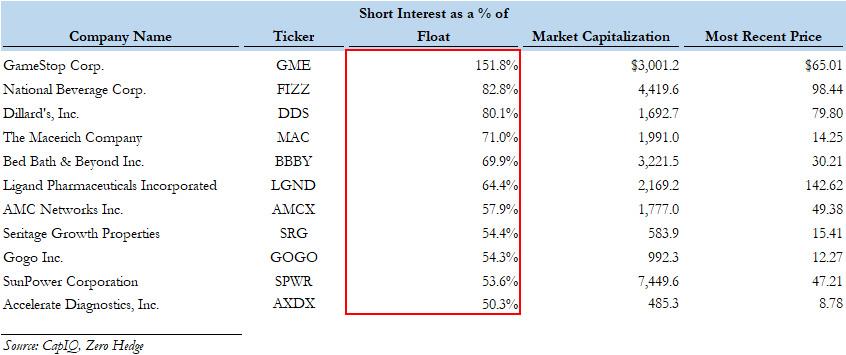
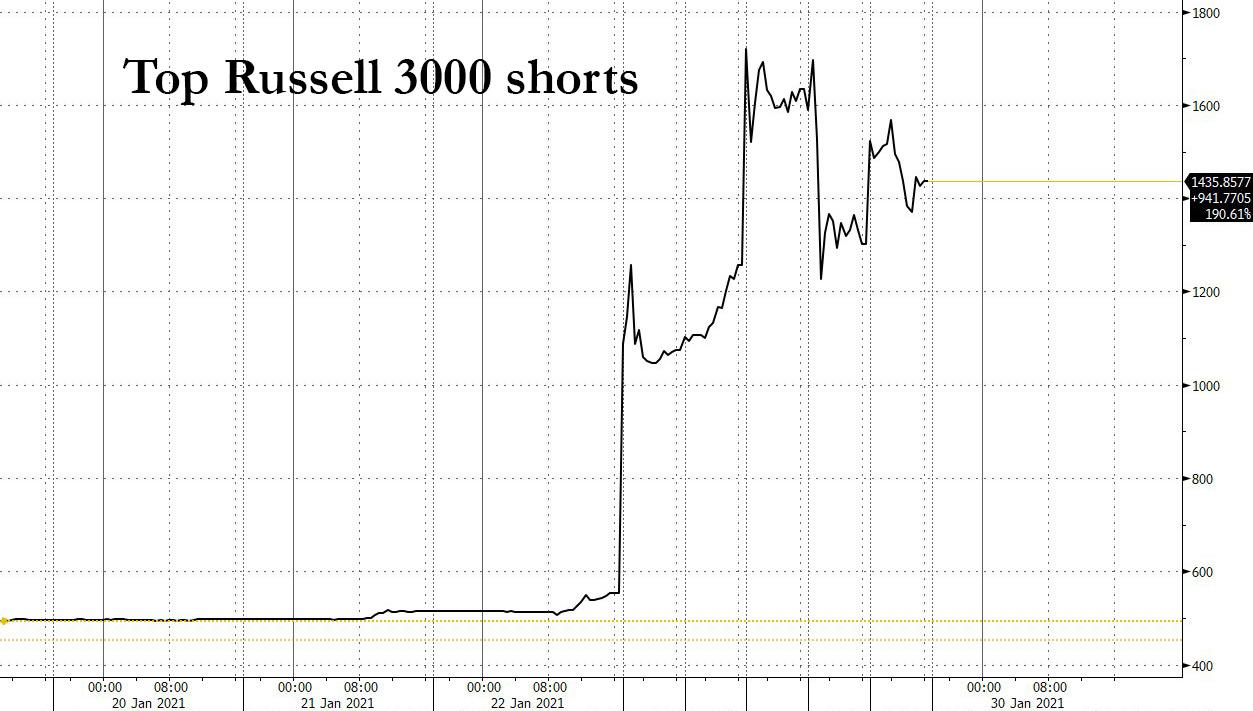
We were right and all of the stocks listed above – and others – exploded higher the coming Monday, and all other days of the week, with results – encapsulated by the WallStreetTips vs Wall Street feud – that has become the top conversation piece across America, while on WSB the only topic is the phenomenal gains generated by going long said most shorted stocks. To wit, the basket of top shorts we compiled on Jan 22 has tripled in the past week.
And while some are quick to blame last week’s fireworks on the “dopamine rush” of traders at r/wallstreetbets who seek an outlet to being “copped up with little else to do during the pandemic” (as Bloomberg has done, while also blaming widespread lockdowns and forgetting that it has been Bloomberg that was among the most vocal defenders of the very lockdowns that have given us the short squeeze of the century), the reality is that at the end of the day the strategy unleashed by the subreddit is merely an extension of the bubble dynamics that were made possible by the Federal Reserve (of which Bloomberg is also a very staunch fan) pumping trillions and trillions of shotgunned liquidity into a financial system where there are now bubble visible anywhere one looks. In short, main street finally learned that it too can profit from the lunacy of the money printers at the Marriner Eccles building, and some are very unhappy about that (yes, it will end in tears, but – newsflash – $300 trillion in debt and $120BN in liquidity injections monthly will also end in tears).

That aside, one week later, Goldman has finally caught up with what Zero Hedge readers knew one week ago, and all the way down to a chart showing a basket of the most-shorted Russell 3000 stocks…
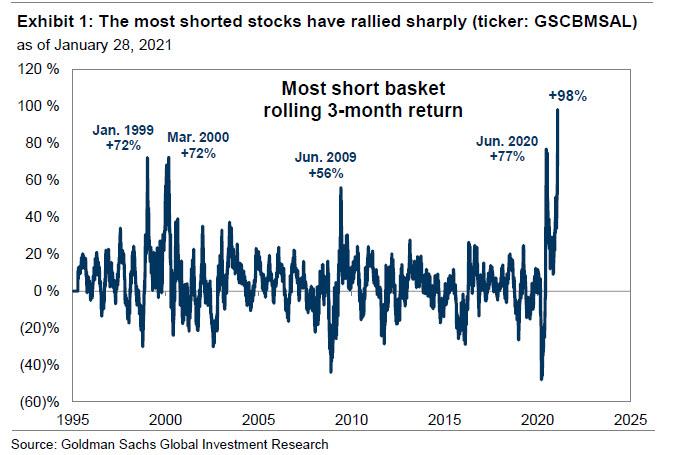
… Goldman’s David Kostin has published a post-mortem of what happened last week, writing that “the most heavily-shorted stocks have risen by 98% in the past three months, outstripping major short squeezes in 2000 and 2009.”

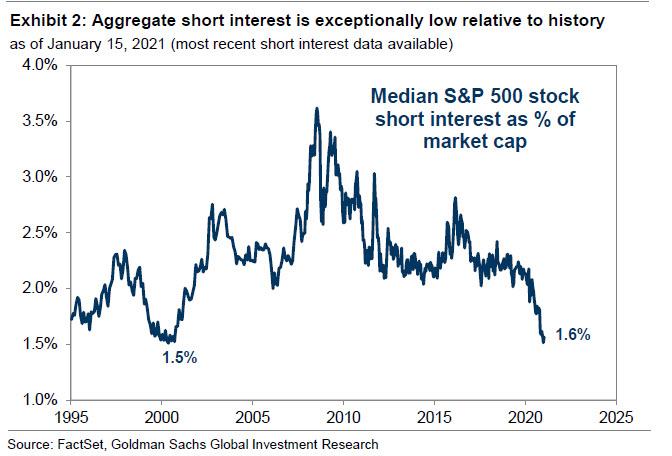
He then points out something we discussed in “Hedge Funds Are Puking Longs To Cover Short-Squeeze Losses“, noting that while aggregate short interest levels are remarkably low (imagine what would have happened has shorting been far more aggressive marketwide)…
“the -4% weekly return of our Hedge Fund VIP list of the most popular hedge fund long positions (GSTHHVIP) showed how excess in one small part of the market can create contagion.”

As an aside, and as we showed previously, as the most shorted stocks soared…
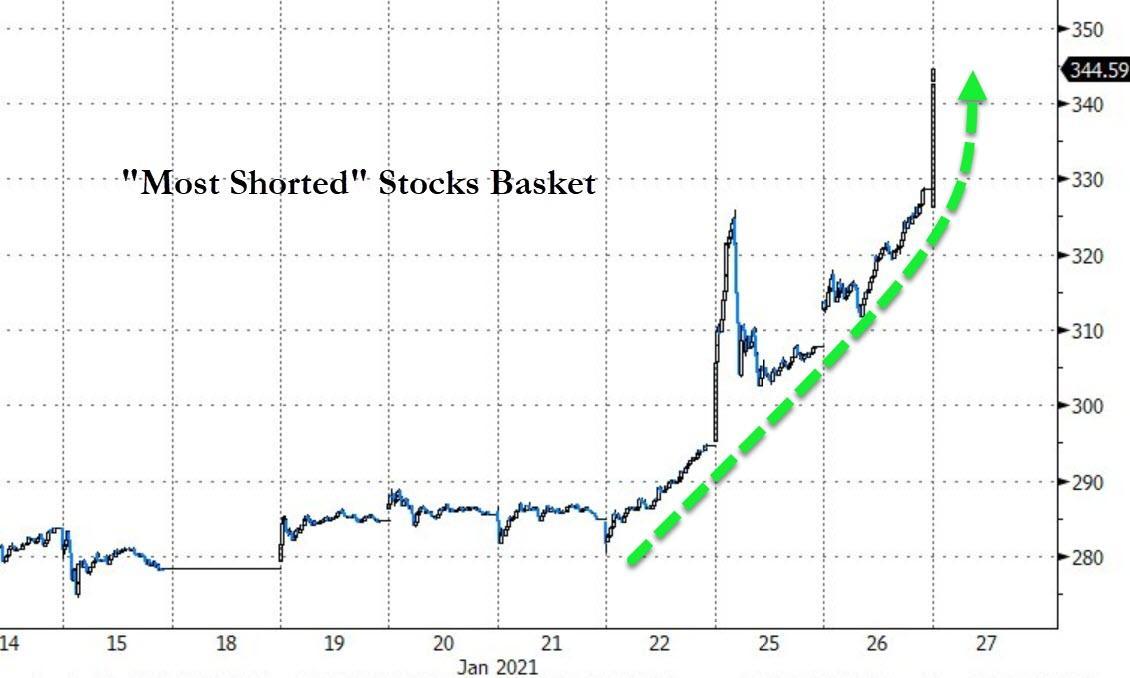
… hedge funds were forced to cover (as well as paying for margin calls), and as part of the broader degrossing they also had to sell some of the favorite hedge fund names across the industry, in this case represented by the Goldman Hedge Fund VIP basket.

Yet what may come as a surprise to some, even as hedge funds deleveraged aggressively and actively cut risk this week, gross and net exposures “remain close to the highest levels on record” (something which may come as a huge surprise to Marko Kolanovic who has been erroneously claiming the opposite), suggesting that if the squeeze continues, hedge funds are set for much more pain.
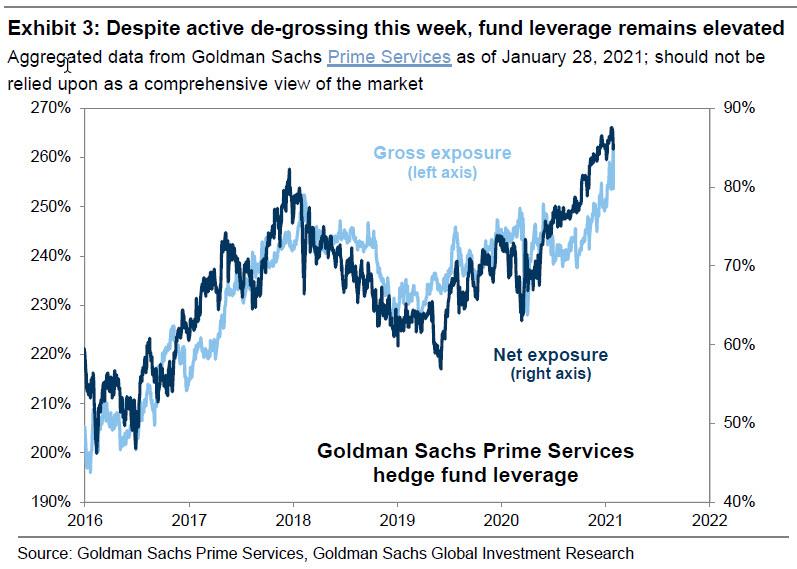
According to Goldman Sachs Prime Services, this week “represented the largest active hedge fund de-grossing since February 2009. Funds in their coverage sold long positions and covered shorts in every sector” and yet “despite this active deleveraging, hedge fund net and gross exposures on a mark-to-market basis both remain close to the highest levels on record, indicating ongoing risk of positioning-driven sell-offs.”

With that in mind, here are Kostin’s big picture thoughts:

It was a placid week in the US stock market – provided one was a long-only mutual fund manager. US equity mutual funds and ETFs had $2 billion of net inflows last week (+$10 billion YTD). Although the typical large-cap core mutual fund fell by 2% this week, it has generated a return of +1.3% YTD vs. S&P 500 down -1.1%. However, life was very different last week if one managed a hedge fund. The typical US equity long/short fund returned -7% this week and has returned -6% YTD.

With the average WSB portfolio up double digits this past week, one can see why hedge funds are upset. Anyway, moving on:

The past 25 years have witnessed a number of sharp short squeezes in the US equity market, but none as extreme as has occurred recently.In the last three months, a basket containing the 50 Russell 3000 stocks with market caps above $1 billion and the largest short interest as a share of float (GSCBMSAL) has rallied by 98%.  This exceeded the 77% return of highly-shorted stocks during 2Q 2020, a 56% rally in mid-2009, and two distinct 72% rallies during the Tech Bubble in 1999 and 2000. This week the basket’s trailing 5-, 10-, and 21-day returns registered as the largest on record.

Thanks Goldman, and yes, your “brisk assessment” would have been more useful to your clients if it had come before the event (like, for example, this) instead of after.

Kostin then goes on to point out that the “mooning” in the most shorted stocks took place even though aggregate short interest was near record low (imagine what would have happened had short interest been higher), which is odd because historically, “major short squeezes have typically taken place as aggregate short interest declined from elevated levels. In contrast, the recent short squeeze has been driven by concentrated short positions in smaller companies, many of which had lagged dramatically and were perceived by most investors to be in secular decline” to wit:

Unusually, the rally of the most heavily-shorted stocks has taken place against a backdrop of very low levels of aggregate short interest. At the start of this year, the median S&P 500 stock had short interest equating to just 1.5% of market cap, matching mid-2000 as the lowest share in at least the last 25 years. In the past, major short squeezes have typically taken place as aggregate short interest declined from elevated levels. In contrast, the recent short squeeze has been driven by concentrated short positions in smaller companies, many of which had lagged dramatically and were perceived by most investors to be in secular decline.

Of course, there is nothing “historical” about what happened last week, because – as we all know – the biggest difference between the typical short squeeze of the past and the recent rally in heavily-shorted stocks “was the degree of involvement of retail traders, who also appear to have catalyzed sharp moves in other parts of the market.” Why thank you WSB, but that’s ok – you will be handsomely rewarded.

Last week we discussed the surging trading activity and share prices of penny stocks, firms with negative earnings, and extremely high-growth, high-multiple stocks. These trends have all accompanied a large increase in online broker trading activity. A basket of retail favorites (ticker: GSXURFAV) has returned +17% YTD and +179% since the March 2020 low, outperforming both the S&P 500 (+72%) and our Hedge Fund VIP list of the most popular hedge fund long positions (GSTHHVIP, +106%).
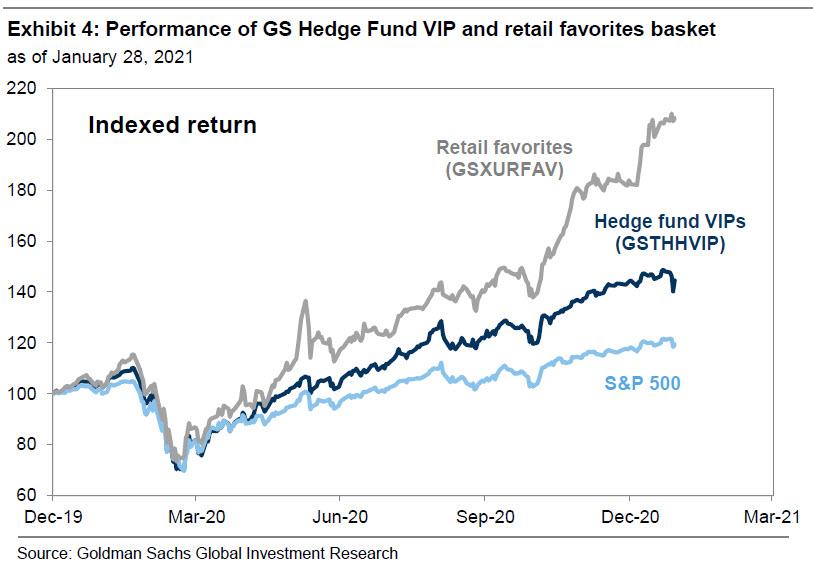
So why does this matter? One simple reason: contrary to the bizarrely nonchalant optimism spouted earlier this week by JPMorgan’s Marko Kolanovic who said “any market pullback, such as one driven by repositioning by a segment of the long-short community (and related to stocks of insignificant size), is a buying opportunity, in our view,” Goldman has a far more dismal take on recent events, and writes that “this week demonstrated that unsustainable excess in one small part of the market has the potential to tip a row of dominoes and create broader turmoil.”

He then picks up on what he said last weekend when responding to Goldman client concerns about a stock bubble, which we summarized in “Goldman’s Clients Are Freaking Out About A Stock Bubble: Here Is The Bank’s Response“, and which turned out to be 100% warranted, and writes that “most of the bubble-like dynamics we highlighted last week have taken place in stocks constituting very small portions of total US equity market cap. Indeed, many of the shorts dominating headlines this week were (prior to this week) small-cap stocks. But large short squeezes led investors short these stocks to cover their positions and also reduce long positions, leading other holders of common positions to cut exposures in turn.”

As a result, Goldman’s Hedge Fund VIP list declined by 4%. Which is a problem because as Kostin concludes, “in recent years elevated crowding, low turnover, and high concentration have been consistent patterns, boosting the risk that one fund’s unwind could snowball through the market.

Translation: if WSB continues to push the most shorted stocks higher, the entire market could crash.

And since Kostin admits that “the retail trading boom can continue” as “an abundance of US household cash should continue to fuel the trading boom” with more than 50% of the $5 trillion in money market mutual funds owned by households and is $1 trillion greater than before the pandemic, what happens in the coming week – i.e., if the short squeeze persists – could have profound implications for the future of capital markets.

Tyler Durden
Sat, 01/30/2021 – 18:30

via ZeroHedge News https://ift.tt/3tbIL1y Tyler Durden
Maryland High Court Upholds 8½-Year Sentence for Perjurious Claim of Unwanted Sexual Touching

Maryland Rule 8-131(c)

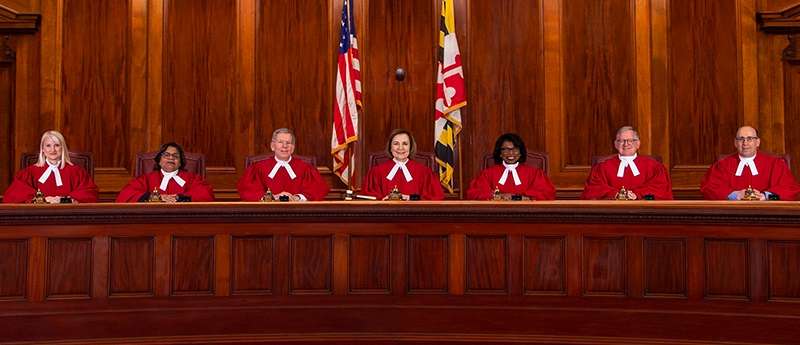
From State v. McGagh, decided Friday by the Maryland high court (always a good excuse for showing The Court Of The Red Robe, see above):

… Karen McGagh was tried … for falsely accusing Glenn Trebay [a Verizon store employee] of sexually assaulting her while patronizing a Verizon store. McGagh stated to a police officer and in a sworn criminal complaint that Trebay cupped her breast and touched her inner thigh. During a bench trial, the State admitted a surveillance video from the Verizon store that did not show Trebay touching McGagh as she claimed {though it showed Trebay briefly touching McGagh at various points throughout the encounter}.

The trial court convicted McGagh of perjury and making a false statement to police officer. McGagh received a sentence of ten years’ incarceration for the perjury conviction, all but eight years suspended, with five years’ supervised probation. McGagh also received a consecutive sentence of six months for the false report conviction….

The trial court found no evidence to support McGagh’s accusations. The trial court convicted McGagh of perjury and giving a false statement to police:

“I find beyond a reasonable doubt that Ms. McGagh perjured herself and that she gave a false statement to Officer Heims. I find that she intentionally lied. And not about everything, that is a many page statement of charges. Many of the things in the statement are true, but the essential, critical facts are untrue. It is completely and totally untrue that Mr. Trebay cupped Ms. McGagh’s breast. It, it’s not even a close call. He didn’t cup her breast, he didn’t brush her breast, he did not touch her breast or her chest in any way. He never got close to her upper inner thigh. I can’t say, having looked at two plus hours of video, that I know where his hands were all the time, but my, I feel like they were, he’s a, as he said, a garrulous guy, he talks with his hands and I saw his hands in the air a lot but,

“I’ll tell you this, he wasn’t in a position to reach across from where he was and rub her or touch her upper inner thigh on the left hand side, which is what Ms. McGagh told Officer Heims happened. I saw it as she showed him on the video, the body camera, I guess is what I mean to say. And I don’t believe that she was confused about what happened. It’s far more likely that she wanted Mr. Trebay fired and the story started and was sort of like that proverbial snowball going down the hill, it just got more ingrained and more elaborate, but it was false. And so, that’s my decision.” …

The trial court based the sentence on an examination of the evidence, McGagh’s behavior before and during proceedings, and a pattern of disregarding the law:

“I don’t think any one of us has ever seen a case like this before and I’m sure [defense counsel] will agree, we’ve never, as [the prosecutor] mentioned, never seen a pre-sentence investigation like this or a psyche evaluation like this. I obviously need to consider, in my decision making, rehabilitation, punishment and public safety….

“[T]his would include her history of deceitfulness, consistent irresponsibility to honor financial obligations and lack of remorse. … During this investigation, she continued to make statements minimizing her own actions and instead, blaming the victim, the Judge and her own attorney. … [T]he pre-sentence investigation, again, … indicates that it’s been suspected that Ms. McGagh continues to drive on a suspended license. I was shocked by the number of just traffic violations, just a, just a consistent unrelenting inability or disregard [ ] for the law. As though it just does not apply to her … Ms. McGagh has been involved in criminal and traffic proceedings in which she has benefited from lenient dispositions.8 Regardless of these privileges, she has continued to avoid hearings by numerous failing to appears and not fulfilling her financial obligations in paying fines and costs, as well as financial liens against her.

{In October 2015, McGagh was convicted for theft after the court found her “to be not telling the truth.” Before this proceeding, McGagh was on probation and had an outstanding restitution balance of $13,000.}

The trial court found that falsehoods reflected in McGagh’s background followed “a lifelong pattern of deceitfulness, manipulative behavior and a narration of depicting herself as the victim.” The trial court highlighted a revealing moment of intentional deceit when McGagh told Dr. Kohn, the doctor assigned to her pre-sentence psychiatric evaluation, that “she knows how to play the game and what to say.” The court explained that Mr. Trebay was not the only victim in this case:

“I believe that the police officer who was pulled away from his work and summonsed to the home and lied to, he was very sympathetic to what Ms. McGagh was telling him. And offered her options. … [w]ouldn’t he think the next time he’s called to someone’s house and there’s the complaint of a sexual assault, won’t he remember Ms. McGagh. … The next person who actually makes a complaint to the police, they’re victims and I will tell you the justice system is a victim. We only, this delicate, fragile system only works because we depend on people to have their word mean something. … I have no doubt that had there not been video, Mr. Trebay would be in jail because a jury would say why would she lie about this? … So, I think, not only Mr. Trebay, not only the Commissioner, not only the police officer … but the entire system brought to its knees because we, as a system, may have failed Mr. Trebay if there wasn’t that video.

The trial court justified why its eight years and six months sentence exceeded the sentencing guidelines:

“Those [sentencing] guidelines do not take into account these facts and all of these victims and all of these lies and this history of dishonest and manipulative [ ] actions that show a complete and total disregard for the other humans that are walking this path…. I think this is one of the most serious and truly despicable crimes that I have witnessed, when you consider the ripples of the damage that [has] been caused.”

{In the sentencing hearing, the State informed the court that Trebay would have faced up to eleven years’ imprisonment for a second degree and fourth degree sexual assault.}

[Sufficiency of the evidence:] The two-witness rule [recognized under Maryland law] describes the minimum evidence needed to establish the falsity of a statement…. “The rule that testimony of a single witness is not sufficient to negative the alleged false oath is not merely technical, but is founded on substantial justice. There must either be two witnesses to prove such falsity, or one witness with material and independently established corroborative facts.” … The two-witness rule applies only to the falsity element.

{The rule no longer requires two, actual witnesses…. “… It is enough that there is testimony of one witness and other independent corroborative evidence[.]” Independent corroborative evidence comes in the form of documents, video footage, or other circumstantial evidence.}

Here, and similar to Hourie, we “clearly” have sufficient evidence from Trebay’s testimony, the Verizon surveillance video, and McGagh’s admission in court for “any rational trier of fact” to find the falsity of McGagh’s statements beyond a reasonable doubt. Trebay testified that he did not “recall” putting his hand on McGagh’s breast or inner thigh. The Verizon surveillance video corroborated his testimony by also showing that the contact alleged by McGagh did not occur. McGagh also conceded during her colloquy with the trial court that the alleged touching did not occur [though she did not concede that she had deliberately lied about it]….

The Verizon surveillance video in this case also satisfies the purpose of the two-witness rule articulated in Brown. The two-witness rule prevents “oath against oath” by allowing the fact finder to observe and judge the credibility of witnesses offering competing recollections of events, while comparing the witness statements against independent, circumstantial evidence. The trial court here had the opportunity to judge and observe McGagh’s and Trebay’s testimony. The Verizon surveillance video provided independent corroboration of the pertinent factual dispute: whether Trebay cupped McGagh’s breast and touched her inner thigh.

The Court of Special Appeals found that the surveillance video’s lack of sound created too much ambiguity to prove the falsity of McGagh’s claims, thereby adopting a too stringent reading of the two-witness rule. Evidence always contains some ambiguity, but the two-witness rule does not require circumstantial evidence to be perfect. “The test” for whether evidence satisfies the two-witness rule is “whether the evidence is of a quality to assure that a guilty verdict is solidly founded.” If other evidence is of “equal weight” to testimony by a witness, it can satisfy the two-witness rule….

The State [also] provided sufficient evidence to satisfy the mens rea elements of McGagh’s perjury and false statement convictions…. “[T]he false [statement] must be deliberate and not the result of surprise, confusion or bona fide mistake[.]”

Here, the trial court found that McGagh exhibited … deliberate behavior …: “I don’t believe that [McGagh] was confused about what happened. It’s far more likely that she wanted Mr. Trebay fired and the story started and was sort of like that proverbial snowball going down the hill, it just got more ingrained and more elaborate, but it was false.” The trial court rejected the possibility that McGagh alleged sexual assault by mistake: “[I]t’s not even a close call. He didn’t cup her breast, he didn’t brush her breast, he did not touch her breast or her chest in any way…. Which is, frankly, not an easy thing to do when one is wearing, a very downy fleece or down vest, which just, you know, it’s thick and straight across your chest.” The trial court further observed that “[Trebay] never got close to her upper inner thigh.”

The trial court reasonably found that McGagh willfully and knowingly made a false statement when she alleged that Trebay sexually assaulted her by touching her breast and inner thigh.

The court also held that perjury convictions need not be reviewed de novo:

Maryland Rule 8-131(c) provides the standard for appellate review of bench trials: “When an action has been tried without a jury, the appellate court will review the case on both the law and the evidence. It will not set aside the judgment of the trial court on the evidence unless clearly erroneous, and will give due regard to the opportunity of the trial court to judge the credibility of the witnesses.” …

Maryland appellate courts accordingly adopt a deferential standard when reviewing sufficiency of evidence that asks whether “any rational trier of fact could have found the elements of the crime beyond a reasonable doubt.” … Maryland courts have always used the sufficiency of evidence standard to review perjury convictions. Perjury and false report convictions heavily depend on the fact finder’s determination of credibility. The fact finder must intimately evaluate each party’s story to assess who is telling the truth. The deferential standard of review recognizes trial courts’ better position in making this determination. … “Having lived with the case, the trial judge views the situation in three dimension, up close and personal, not from a cold record; thus, having closely observed the entire trial, he or she is able to appreciate nuances, inflections and impressions never to be gained from a cold record.” …

In some cases, this Court has supplemented the Jackson standard with a de novo review when a constitutional right is at issue. The independent examination ensures this Court’s protection of fundamental rights. Our case law demonstrates the proper application of de novo review when the State, through action or statute, seeks to regulate or control protected speech [for instance, in disorderly conduct or obscenity cases]….

In Polk, the State charged the defendant with disobeying a lawful order after the defendant responded with a series of profanities to an officer’s instruction to be quiet and leave the hospital. The case turned on whether the order attempted to control the content of her speech or her aggressive behavior at a hospital…. This Court conducted a de novo review to determine to what extent, if any, the officer’s order violated the defendant’s First Amendment right to free speech….

[But p]erjurious speech does not receive First Amendment protection. The Supreme Court explained in United States v. Alvarez:

“It is not simply because perjured statements are false that they lack First Amendment protection. Perjured testimony ‘is at war with justice’ because it can cause a court to render a ‘judgment not resting on truth.’ Perjury undermines the function and province of the law and threatens the integrity of judgments that are the basis of the legal system.”

Unprotected speech renders unnecessary an independent review of the record for First Amendment violations.

Here, McGagh’s First Amendment rights were not implicated in this case, let alone violated. McGagh did not challenge the constitutionality of the perjury statute on its face or as applied to her. The Court of Special Appeals only suggested that the facts of the case “arguably” triggered a de novo review to evaluate First Amendment interests. The court reads too much of a First Amendment interest into the case. The case turns on whether the State presented sufficient evidence to prove the elements of perjury and false report; it does not turn on whether the State infringed upon her protected speech.

Unlike in Polk v. State (Md. 2003), where this Court needed to determine whether an officer’s order infringed on the defendant’s right to speak (albeit vulgarly), McGagh does not claim the perjury and false report statutes infringed upon her right to petition the government for redress. It would similarly be unnecessary for us to conduct a constitutional analysis here as this Court did in Polk. Respondent never voiced any deterred ability to make a criminal complaint by threat of perjury.

Even if McGagh had raised such concerns, the perjurious content of McGagh’s speech also means it lacks First Amendment protection…. Our holding in no way departs from this Court’s previously acknowledged important public policy objective of encouraging women, and all victims of sexual assault, to bring their truthful sexual assault allegations to light. It also does not abridge an individual’s First Amendment right to truthfully and in good faith report a sexual assault without punishment or intimidation, even if the allegation is later shown to be mistaken, confused, or erroneous.

I don’t think this appellate review analysis is quite spot on: It’s true that perjury is unprotected speech, obscenity, libel, fighting words, and the like are unprotected speech, too. But decisions whether certain speech qualifies as obscenity, libel, or fighting words are generally reviewed independently by appellate courts (see PDF pp. 5-9 of this article), precisely to make sure that only unprotected speech gets punished.

Nonetheless, I think that the court may have gotten the result right as to the proper standard of appellate review. First Amendment independent appellate review generally applies to judgments whether certain facts satisfy the constitutional standard (e.g., whether a particular film lacks serious artistic value, what sort of subjective knowledge qualifies as reckless disregard of the truth, or whether certain words qualify as the sort of face-to-face insults that are likely to start a fight). It generally doesn’t apply to witness credibility determinations, where the question is what actually happened, what was actually said, or whether the speaker knew it was false:

In determining whether the constitutional standard has been satisfied, the reviewing court must consider the factual record in full. Although credibility determinations are reviewed under the clearly-erroneous standard because the trier of fact has had the “opportunity to observe the demeanor of the witnesses,” the reviewing court must “‘examine for [itself] the statements in issue and the circumstances under which they were made to see … whether they are of a character which the principles of the First Amendment … protect.'”

So deferring to the trial judge’s judgment about the defendant’s credibility might have been correct after all, though I’m open to being persuaded otherwise.

from Latest – Reason.com https://ift.tt/3raCukH
via IFTTT

Maryland High Court Upholds 8½-Year Sentence for Perjurious Claim of Unwanted Sexual Touching

Maryland Rule 8-131(c)

From State v. McGagh, decided Friday by the Maryland high court (always a good excuse for showing The Court Of The Red Robe, see above):

… Karen McGagh was tried … for falsely accusing Glenn Trebay [a Verizon store employee] of sexually assaulting her while patronizing a Verizon store. McGagh stated to a police officer and in a sworn criminal complaint that Trebay cupped her breast and touched her inner thigh. During a bench trial, the State admitted a surveillance video from the Verizon store that did not show Trebay touching McGagh as she claimed {though it showed Trebay briefly touching McGagh at various points throughout the encounter}.

The trial court convicted McGagh of perjury and making a false statement to police officer. McGagh received a sentence of ten years’ incarceration for the perjury conviction, all but eight years suspended, with five years’ supervised probation. McGagh also received a consecutive sentence of six months for the false report conviction….

The trial court found no evidence to support McGagh’s accusations. The trial court convicted McGagh of perjury and giving a false statement to police:

“I find beyond a reasonable doubt that Ms. McGagh perjured herself and that she gave a false statement to Officer Heims. I find that she intentionally lied. And not about everything, that is a many page statement of charges. Many of the things in the statement are true, but the essential, critical facts are untrue. It is completely and totally untrue that Mr. Trebay cupped Ms. McGagh’s breast. It, it’s not even a close call. He didn’t cup her breast, he didn’t brush her breast, he did not touch her breast or her chest in any way. He never got close to her upper inner thigh. I can’t say, having looked at two plus hours of video, that I know where his hands were all the time, but my, I feel like they were, he’s a, as he said, a garrulous guy, he talks with his hands and I saw his hands in the air a lot but,

“I’ll tell you this, he wasn’t in a position to reach across from where he was and rub her or touch her upper inner thigh on the left hand side, which is what Ms. McGagh told Officer Heims happened. I saw it as she showed him on the video, the body camera, I guess is what I mean to say. And I don’t believe that she was confused about what happened. It’s far more likely that she wanted Mr. Trebay fired and the story started and was sort of like that proverbial snowball going down the hill, it just got more ingrained and more elaborate, but it was false. And so, that’s my decision.” …

The trial court based the sentence on an examination of the evidence, McGagh’s behavior before and during proceedings, and a pattern of disregarding the law:

“I don’t think any one of us has ever seen a case like this before and I’m sure [defense counsel] will agree, we’ve never, as [the prosecutor] mentioned, never seen a pre-sentence investigation like this or a psyche evaluation like this. I obviously need to consider, in my decision making, rehabilitation, punishment and public safety….

“[T]his would include her history of deceitfulness, consistent irresponsibility to honor financial obligations and lack of remorse. … During this investigation, she continued to make statements minimizing her own actions and instead, blaming the victim, the Judge and her own attorney. … [T]he pre-sentence investigation, again, … indicates that it’s been suspected that Ms. McGagh continues to drive on a suspended license. I was shocked by the number of just traffic violations, just a, just a consistent unrelenting inability or disregard [ ] for the law. As though it just does not apply to her … Ms. McGagh has been involved in criminal and traffic proceedings in which she has benefited from lenient dispositions.8 Regardless of these privileges, she has continued to avoid hearings by numerous failing to appears and not fulfilling her financial obligations in paying fines and costs, as well as financial liens against her.

{In October 2015, McGagh was convicted for theft after the court found her “to be not telling the truth.” Before this proceeding, McGagh was on probation and had an outstanding restitution balance of $13,000.}

The trial court found that falsehoods reflected in McGagh’s background followed “a lifelong pattern of deceitfulness, manipulative behavior and a narration of depicting herself as the victim.” The trial court highlighted a revealing moment of intentional deceit when McGagh told Dr. Kohn, the doctor assigned to her pre-sentence psychiatric evaluation, that “she knows how to play the game and what to say.” The court explained that Mr. Trebay was not the only victim in this case:

“I believe that the police officer who was pulled away from his work and summonsed to the home and lied to, he was very sympathetic to what Ms. McGagh was telling him. And offered her options. … [w]ouldn’t he think the next time he’s called to someone’s house and there’s the complaint of a sexual assault, won’t he remember Ms. McGagh. … The next person who actually makes a complaint to the police, they’re victims and I will tell you the justice system is a victim. We only, this delicate, fragile system only works because we depend on people to have their word mean something. … I have no doubt that had there not been video, Mr. Trebay would be in jail because a jury would say why would she lie about this? … So, I think, not only Mr. Trebay, not only the Commissioner, not only the police officer … but the entire system brought to its knees because we, as a system, may have failed Mr. Trebay if there wasn’t that video.

The trial court justified why its eight years and six months sentence exceeded the sentencing guidelines:

“Those [sentencing] guidelines do not take into account these facts and all of these victims and all of these lies and this history of dishonest and manipulative [ ] actions that show a complete and total disregard for the other humans that are walking this path…. I think this is one of the most serious and truly despicable crimes that I have witnessed, when you consider the ripples of the damage that [has] been caused.”

{In the sentencing hearing, the State informed the court that Trebay would have faced up to eleven years’ imprisonment for a second degree and fourth degree sexual assault.}

[Sufficiency of the evidence:] The two-witness rule [recognized under Maryland law] describes the minimum evidence needed to establish the falsity of a statement…. “The rule that testimony of a single witness is not sufficient to negative the alleged false oath is not merely technical, but is founded on substantial justice. There must either be two witnesses to prove such falsity, or one witness with material and independently established corroborative facts.” … The two-witness rule applies only to the falsity element.

{The rule no longer requires two, actual witnesses…. “… It is enough that there is testimony of one witness and other independent corroborative evidence[.]” Independent corroborative evidence comes in the form of documents, video footage, or other circumstantial evidence.}

Here, and similar to Hourie, we “clearly” have sufficient evidence from Trebay’s testimony, the Verizon surveillance video, and McGagh’s admission in court for “any rational trier of fact” to find the falsity of McGagh’s statements beyond a reasonable doubt. Trebay testified that he did not “recall” putting his hand on McGagh’s breast or inner thigh. The Verizon surveillance video corroborated his testimony by also showing that the contact alleged by McGagh did not occur. McGagh also conceded during her colloquy with the trial court that the alleged touching did not occur [though she did not concede that she had deliberately lied about it]….

The Verizon surveillance video in this case also satisfies the purpose of the two-witness rule articulated in Brown. The two-witness rule prevents “oath against oath” by allowing the fact finder to observe and judge the credibility of witnesses offering competing recollections of events, while comparing the witness statements against independent, circumstantial evidence. The trial court here had the opportunity to judge and observe McGagh’s and Trebay’s testimony. The Verizon surveillance video provided independent corroboration of the pertinent factual dispute: whether Trebay cupped McGagh’s breast and touched her inner thigh.

The Court of Special Appeals found that the surveillance video’s lack of sound created too much ambiguity to prove the falsity of McGagh’s claims, thereby adopting a too stringent reading of the two-witness rule. Evidence always contains some ambiguity, but the two-witness rule does not require circumstantial evidence to be perfect. “The test” for whether evidence satisfies the two-witness rule is “whether the evidence is of a quality to assure that a guilty verdict is solidly founded.” If other evidence is of “equal weight” to testimony by a witness, it can satisfy the two-witness rule….

The State [also] provided sufficient evidence to satisfy the mens rea elements of McGagh’s perjury and false statement convictions…. “[T]he false [statement] must be deliberate and not the result of surprise, confusion or bona fide mistake[.]”

Here, the trial court found that McGagh exhibited … deliberate behavior …: “I don’t believe that [McGagh] was confused about what happened. It’s far more likely that she wanted Mr. Trebay fired and the story started and was sort of like that proverbial snowball going down the hill, it just got more ingrained and more elaborate, but it was false.” The trial court rejected the possibility that McGagh alleged sexual assault by mistake: “[I]t’s not even a close call. He didn’t cup her breast, he didn’t brush her breast, he did not touch her breast or her chest in any way…. Which is, frankly, not an easy thing to do when one is wearing, a very downy fleece or down vest, which just, you know, it’s thick and straight across your chest.” The trial court further observed that “[Trebay] never got close to her upper inner thigh.”

The trial court reasonably found that McGagh willfully and knowingly made a false statement when she alleged that Trebay sexually assaulted her by touching her breast and inner thigh.

The court also held that perjury convictions need not be reviewed de novo:

Maryland Rule 8-131(c) provides the standard for appellate review of bench trials: “When an action has been tried without a jury, the appellate court will review the case on both the law and the evidence. It will not set aside the judgment of the trial court on the evidence unless clearly erroneous, and will give due regard to the opportunity of the trial court to judge the credibility of the witnesses.” …

Maryland appellate courts accordingly adopt a deferential standard when reviewing sufficiency of evidence that asks whether “any rational trier of fact could have found the elements of the crime beyond a reasonable doubt.” … Maryland courts have always used the sufficiency of evidence standard to review perjury convictions. Perjury and false report convictions heavily depend on the fact finder’s determination of credibility. The fact finder must intimately evaluate each party’s story to assess who is telling the truth. The deferential standard of review recognizes trial courts’ better position in making this determination. … “Having lived with the case, the trial judge views the situation in three dimension, up close and personal, not from a cold record; thus, having closely observed the entire trial, he or she is able to appreciate nuances, inflections and impressions never to be gained from a cold record.” …

In some cases, this Court has supplemented the Jackson standard with a de novo review when a constitutional right is at issue. The independent examination ensures this Court’s protection of fundamental rights. Our case law demonstrates the proper application of de novo review when the State, through action or statute, seeks to regulate or control protected speech [for instance, in disorderly conduct or obscenity cases]….

In Polk, the State charged the defendant with disobeying a lawful order after the defendant responded with a series of profanities to an officer’s instruction to be quiet and leave the hospital. The case turned on whether the order attempted to control the content of her speech or her aggressive behavior at a hospital…. This Court conducted a de novo review to determine to what extent, if any, the officer’s order violated the defendant’s First Amendment right to free speech….

[But p]erjurious speech does not receive First Amendment protection. The Supreme Court explained in United States v. Alvarez:

“It is not simply because perjured statements are false that they lack First Amendment protection. Perjured testimony ‘is at war with justice’ because it can cause a court to render a ‘judgment not resting on truth.’ Perjury undermines the function and province of the law and threatens the integrity of judgments that are the basis of the legal system.”

Unprotected speech renders unnecessary an independent review of the record for First Amendment violations.

Here, McGagh’s First Amendment rights were not implicated in this case, let alone violated. McGagh did not challenge the constitutionality of the perjury statute on its face or as applied to her. The Court of Special Appeals only suggested that the facts of the case “arguably” triggered a de novo review to evaluate First Amendment interests. The court reads too much of a First Amendment interest into the case. The case turns on whether the State presented sufficient evidence to prove the elements of perjury and false report; it does not turn on whether the State infringed upon her protected speech.

Unlike in Polk v. State (Md. 2003), where this Court needed to determine whether an officer’s order infringed on the defendant’s right to speak (albeit vulgarly), McGagh does not claim the perjury and false report statutes infringed upon her right to petition the government for redress. It would similarly be unnecessary for us to conduct a constitutional analysis here as this Court did in Polk. Respondent never voiced any deterred ability to make a criminal complaint by threat of perjury.

Even if McGagh had raised such concerns, the perjurious content of McGagh’s speech also means it lacks First Amendment protection…. Our holding in no way departs from this Court’s previously acknowledged important public policy objective of encouraging women, and all victims of sexual assault, to bring their truthful sexual assault allegations to light. It also does not abridge an individual’s First Amendment right to truthfully and in good faith report a sexual assault without punishment or intimidation, even if the allegation is later shown to be mistaken, confused, or erroneous.

I don’t think this appellate review analysis is quite spot on: It’s true that perjury is unprotected speech, obscenity, libel, fighting words, and the like are unprotected speech, too. But decisions whether certain speech qualifies as obscenity, libel, or fighting words are generally reviewed independently by appellate courts (see PDF pp. 5-9 of this article), precisely to make sure that only unprotected speech gets punished.

Nonetheless, I think that the court may have gotten the result right as to the proper standard of appellate review. First Amendment independent appellate review generally applies to judgments whether certain facts satisfy the constitutional standard (e.g., whether a particular film lacks serious artistic value, what sort of subjective knowledge qualifies as reckless disregard of the truth, or whether certain words qualify as the sort of face-to-face insults that are likely to start a fight). It generally doesn’t apply to witness credibility determinations, where the question is what actually happened, what was actually said, or whether the speaker knew it was false:

In determining whether the constitutional standard has been satisfied, the reviewing court must consider the factual record in full. Although credibility determinations are reviewed under the clearly-erroneous standard because the trier of fact has had the “opportunity to observe the demeanor of the witnesses,” the reviewing court must “‘examine for [itself] the statements in issue and the circumstances under which they were made to see … whether they are of a character which the principles of the First Amendment … protect.'”

So deferring to the trial judge’s judgment about the defendant’s credibility might have been correct after all, though I’m open to being persuaded otherwise.

from Latest – Reason.com https://ift.tt/3raCukH
via IFTTT

Biden Plagiarizes Again After Bloomberg Points Out Virus Plan Is Basically Trump’s

Biden Plagiarizes Again After Bloomberg Points Out Virus Plan Is Basically Trump’s

While President Biden has done nothing but disparage President Trump’s COVID-19 vaccination plan – while promising on the campaign trail to ‘introduce his own,‘ it now appears there was no ‘new’ plan whatsoever – and his team is essentially using Trump’s playbook with “modest changes,” according to Bloomberg.

Biden has said vaccine distribution was in “worse shape than we anticipated.” White House Chief of Staff Ron Klain said a Trump administration plan “did not really exist.” Adviser Cedric Richmond said they “didn’t leave a plan.” Xavier Becerra, Biden’s choice for health secretary, said it was like taking over a plane in a nosedive.

But while Biden’s approach to the virus — frank warnings about the pandemic, mask mandates on federal property — is a reversal from Trump’s policies, his administration’s distribution of vaccines so far looks little different from that of its predecessor. Before Biden was sworn in, vaccines already were being delivered at a pace to meet his goal of 100 million doses in his first 100 days as president.

The Biden administration has said they’ll order new doses, but will do so by exercising options in contracts negotiated by the previous administration, which thought it premature to do so. They say they’ll use the Defense Production Act, which Trump used repeatedly. Rather than a total overhaul, they have otherwise made course corrections and modest shifts. Data released Friday by Johnson & Johnson will fuel hopes that a third vaccine soon could hit the U.S. market. –Bloomberg

Biden – who has a history of plagiarism – was essentially lying, especially when one considers the mammoth effort involved in distribution efforts which would make major changes costly and risk setbacks to the program. Bloomberg adds that “some aspects of the program don’t offer much wiggle room to begin with, while the trickiest part are yet to come.”

Bloomberg does toss Biden a bone, however, reporting that Trump ‘undercut’ Biden’s efforts to shape the program by delaying the transition while disputing the results of the election. Trump’s team, however, says they had over 300 transition briefings with health officials – which Biden officials claim contained little useful information until just days before the inauguration.

Meanwhile, officials from the Operation Warp Speed – the joint effort between the Trump administration’s Departments of Health and Human Services and DoD, say the partisan sniping from Biden’s team is hurting morale among career staff who are handling the vaccine rollout.

The transition is happening less well than I, and my team, had been hoping,” said Moncef Slaoui, chief scientific adviser to Operation Warp Speed. “The team doesn’t understand why the Operation is being criticized as it is. It is so unfair and unjustified.”

“If it wasn’t for this Operation, we may not have as many vaccines as we will now.”

Also pushing back against the Biden team’s besmirchments is Anthony Fauci, the highest-paid employee in the federal government and ongoing COVID-19 advisor to the Office of the President.

We certainly are not starting from scratch,” Fauci said earlier this month. “It’s taking what’s gone on, but amplifying it in a big way,” he added. Even Biden said that “credit is absolutely due” to the Trump administration for launching the vaccine program.

The differences

According to Bloomberg, “Biden is endorsing federally run community vaccination centers and mobile clinics,” and will attempt to provide states with a three-week supply, along with an increase in the number of people who can administer it. Trump officials, however, say the limitation is the number of vaccines, not healthcare professionals.

Biden is also focusing on communities of color instead of devoting all resources to first vaccinating essential workers and those at most risk of dying from the virus. According to Biden, communities of color have been disproportionately affected by the virus.

Yet, most of the plan remains unchanged.

Via Bloomberg:

[T]he biggest pieces of the distribution effort remain unchanged, undercutting claims from some Biden advisers that they inherited no plan. Many of the most stubborn bottlenecks don’t stem from the federal government’s decisions: Companies simply can’t produce vaccines fast enough and supplies are scarce; even if distribution goes smoothly, the administration of doses gets backed up at the local level.

What we’re seeing here is them marching through the playbook of Operation Warp Speed,” added Michael Pratt, a former Health and Human Services official under Trump. “Something cannot simultaneously be a dismal failure and have already accomplished the ‘ambitious goal’ you set.”

Nearly every industrialized nation has been beset by vaccine delays. The European Union has moved to restrict vaccine exports. The U.S. has administered 8.3 doses per 100 people, trailing the U.K. and Israel yet outpacing Germany, Canada, France and the EU overall, according to Bloomberg’s Vaccine Tracker. –Bloomberg

The Biden team has also retained many key Trump personnel, including the co-leader of Operation Warp Speed, General Gustave Perna.

Furthermore, one of Biden’s key tools to move quickly on the virus response is the use of the Defense Production Act to prioritize the availability of certain materials and supplies – which the Trump administration used extensively.

It is really incorrect to say there was no plan — because we’re already achieving 1.3 million doses in arms per day, which exceeds the first goal President Biden had,” said Brett Giroir, who led the Trump administration’s program to ramp up widespread virus testing.

One wild card is whether another vaccine will hit the market anytime soon. Late Friday, Johnson & Johnson announced that its single-dose vaccine generated strong protection against COVID-19 in a large, late-stage trial. The company expects it to be ‘quickly brought to market without the missed delivery timelines of the Pfizer shots.’ If authorized for use, the J&J vaccine could allow the Biden team to reach 2 million total doses per day according to a former Trump official.

And that’s, the rest of the story…

Tyler Durden
Sat, 01/30/2021 – 17:31

via ZeroHedge News https://ift.tt/3oukT5P Tyler Durden

CDC Issues Mask Mandate For Persons “While on Conveyances and at Transportation Hubs”

Yesterday, the CDC issued an eleven-page order that required people to wear masks “while on conveyances and at transportation hubs.” The order does not apply in jurisdictions that have requirements that are equivalent to, or more stringent than, the federal mandate.

Here is a brief summary:

(1) Persons must wear masks over the mouth and nose when traveling on conveyances into and within the United States. Persons must also wear masks at transportation hubs as defined in this Order.

(2) A conveyance operator transporting persons into and within the United States? must require all persons onboard to wear masks for the duration of travel.

(3) A conveyance operators operating a conveyance arriving at or departing from a U.S. port of entry must require all persons on board to wear masks for the duration of travel as a condition of controlled free pratique.

The CDC will require “conveyance operators” to use “best efforts” to ensure compliance. In short, no mask, no service.

(4) Conveyance operators must use best efforts to ensure that any person on the conveyance wears a mask when boarding, disembarking, and for the duration of travel. Best efforts include:

  • boarding only those persons who wear masks;
  • instructing persons that Federal law requires wearing a mask on the conveyance and failure to comply constitutes a violation of Federal law;
  • monitoring persons onboard the conveyance for anyone who is not wearing a mask and
  • seeking compliance from such persons;
  • at the earliest opportunity, disembarking any person who refuses to comply; and
  • providing persons with prominent and adequate notice to facilitate awareness and compliance of the requirement of this Order to wear a mask; best practices may include, if feasible, advance notifications on digital platforms, such as on apps, websites, or email; posted signage in multiple languages with illustrations; printing the requirement on transit tickets; or other methods as appropriate.

The order adopts the regulatory definition of “conveyance,” with one addition. Rideshare–a relatively new mode of transportation–is embraced within “conveyance.”

Conveyance shall have the same definition as under 42 CFR 70.1, meaning “an aircraft, train, road vehicle, [FN5] vessel . . . or other means of transport, including military.” Included in the definition of “conveyance” is the term “carrier” which under 42 CFR 71.1 has the same definition as conveyance under 42 CFR 70.1.

FN5: This includes rideshares meaning arrangements where passengers travel in a privately owned road vehicle driven by its owner in connection with a fee or service.

It is less clear that the federal government has authority over privately owned cars that are used for local, intrastate transportation.

Indeed, the definition of “interstate travel” includes intrastate travel:

Interstate traffic shall have the same definition as under 42 CFR 70.1, meaning

“(1): (i) The movement of any conveyance or the transportation of persons or property, including any portion of such movement or transportation that is entirely within a state or possession

(ii) From a point of origin in any state or possession to a point of destination in any other state or possession; or

(iii) Between a point of origin and a point of destination in the same state or possession but through any other state, possession, or contiguous foreign country.

(2) Interstate traffic does not include the following:

(i) The movement of any conveyance which is solely for the purpose of unloading persons or property transported from a foreign country or loading persons or property for transportation to a foreign country.

(ii) The movement of any conveyance which is solely for the purpose of effecting its repair, reconstruction, rehabilitation, or storage.”

And “intrastate traffic” includes:

Intrastate traffic means the movement of any conveyance or the transportation or movement of persons occurring solely within the boundaries of a state or territory, or on tribal land.

Transportation hubs includes a wide range of places, including those limited to intrastate travel, such as outdoor local bus stops:

Transportation hub means any airport, bus terminal, marina, seaport or other port, subway station, terminal (including any fixed facility at which passengers are picked-up or discharged), train station, U.S. port of entry, or any other location that provides transportation subject to the jurisdiction of the United States.

The mandate includes five exemptions:

  • While eating, drinking, or taking medication, for brief periods;
  • While communicating with a person who is hearing impaired when the ability to see the mouth is essential for communication;
  • If, on an aircraft, wearing of oxygen masks is needed because of loss of cabin pressure or other event affecting aircraft ventilation;
  • If unconscious (for reasons other than sleeping), incapacitated, unable to be awakened, or otherwise unable to remove the mask without assistance;’ or
  • When necessary to temporarily remove the mask to verify one’s identity such as during Transportation Security Administration screening or when asked to do so by the ticket or gate agent or any law enforcement official.

Three categories of people are exempted from the mandate:

  •  child under the age of 2 years;
  • A person with a disability who cannot wear a mask, or cannot safely wear a mask, because of the disability as defined by the Americans with Disabilities Act. FN9 [This is a narrow exception that includes a person with a disability who cannot wear a mask for reasons related to the disability.]
  • A person for whom wearing a mask would create a risk to workplace health, safety, or job duty as determined by the relevant workplace safety guidelines or federal regulations.

I follow travel blogs closely. There are many, many stories about two-year-old toddlers who cannot wear masks. In most cases, the flight attendants look the other way. But in some cases, the flight attendants forcibly remove the families from the flight. Invariably, these removals create a lot of chaos, where people are stuck on the tarmac for extended periods of time. In the past, airlines had discretion. Now, with a federal mandate, there will be a zero tolerance policy. Airlines would be on the hook for potential liability if a two year old fails to weak a mask. Delta airlines, for example, had permitted some young toddlers to skip mask wearing. Now, that leniency goes away. Good luck to parents who need to keep a mask on a two-year-old’s face for a three hour flight.

from Latest – Reason.com https://ift.tt/3oA4XyI
via IFTTT

Our Tech Minders & The Future Of Public Discourse

Our Tech Minders & The Future Of Public Discourse

Authored by Edward Morse, op-ed via The Epoch Times,

Both Apple and Google have deplatformed Parler, a social media app widely used as an alternative channel for group communication.

Amazon soon joined this effort by denying access to cloud services hosting Parler content. Other service providers apparently followed suit, constricting and perhaps exterminating Parler from among the options available to consumers.

Parler was offline for over a week, until it eventually found a new platform, albeit one deprived of the convenient access allowed by apps. Parler users have also effectively been cancelled, regardless of their actual posting conduct, based on a professed concern about violent discourse on the site.

Anyone who doubts that the large tech platforms have market power should take notice.

Although competition provides alternatives in the long run, concentration within channels for app distribution and cloud hosting allowed Parler’s operations to be disrupted. In addition, competition in the marketplace of ideas became a little less robust—all based on discretionary judgments from minders in Big Tech. They profess a desire to protect us, but we have reason to question the evenhandedness of this putative protection and its contribution to our wellbeing.

Bans and Suppression

Twitter’s recent decision to ban President Donald Trump from its platform embraces a prophylactic approach to censorship. Twitter explained that it suspended Trump’s account “due to the risk of further incitement of violence.” (Of course, this presumes that he has incited violence in the first place.) In a blog the company describes as “your official source to what is happening,” Twitter officials explained that this decision depended on their contextual interpretation of two statements sent out by Trump:

First, On Jan. 8 the president tweeted: “The 75,000,000 great American Patriots who voted for me, AMERICA First, and MAKE AMERICA GREAT AGAIN, will have a GIANT VOICE long into the future. They will not be disrespected or treated unfairly in any way, shape or form!!!!”

Second, according to Twitter, “shortly thereafter” the president tweeted: “To all of those who have asked, I will not be going to the Inauguration on January 20th.”

Twitter explains:

“Due to the ongoing tensions in the United States, and an uptick in the global conversation in regards to the people who violently stormed the Capitol on January 6, 2021, these two Tweets must be read in the context of broader events in the country and the ways in which the President’s statements can be mobilized by different audiences, including to incite violence, as well as in the context of the pattern of behavior from this account in recent weeks. After assessing the language in these Tweets against our Glorification of Violence policy, we have determined these Tweets are in violation …”

On their face, neither of the statements by the president incite violence. (Trump supporters do, indeed, face adverse consequences, making the first statement incorrect. But that’s another matter.) Neither asks for violent action nor expresses support for past violence. And if context is important, Twitter fails to note that the president clearly asked for peaceful demonstration in his speech to supporters, as well as in a subsequent Tweet, which Twitter suppressed. He also swiftly condemned the violence and promised prosecution for the perpetrators.

Twitter bases its assessment solely on predictions about how different audiences might respond to these statements. Likewise, Facebook (including its Instagram service) issued its ban based solely on the perceived risk of what the speaker might say in the future, which is even more speculative than Twitter’s approach. Democrat political leaders cheered them on, even claiming that these efforts were too little, too, late. Apparently, they would have preferred that Trump had been banned instead of censored during the campaign.

Keeping Dissent in the Open

Political campaigns are indeed much easier and, on the surface, more harmonious if you can suppress competing voices. But this is not the way of a free society. If messages can be cancelled based on predictions about how audiences will read them, then there’s a lot more inciting going on than we’ve previously realized. Twitter allowed repeated posts that approved of violence. Did those posts incite more violence, too?

And predictions about likely effects on the audience is all we need to suppress speech: Consider the repeated tag of “false” or “baseless” added to claims of election wrongdoing in news reports going back to the days immediately after the election—before there was time to investigate. Based on the likely impact of those words on Trump supporters, is that a form of incitement, too?

Big Tech minders are also intervening in this arena. On Dec. 10, while considerable litigation and investigation of alleged voter fraud and official misconduct remained under investigation, YouTube announced that it would ban videos addressing possible election fraud or claiming that errors changed the outcome of the election, attaching the presumption that all such allegations are “false.” YouTube thus became the judge of election outcomes, at least for its own platform.

Suppression has a superficial appeal by clearing dissent from a channel. This gives the appearance of harmony and squelches the expression of similar views by sending a judgment of inferiority to others. However, the source of that dissent likely remains, and the channel for expression simply moves elsewhere.

Trump’s opponents expressed dissent after the 2016 election, but instead of suppression, our nation undertook a lengthy public investigation of claims about Russian meddling in the election. The media dutifully reported every conspiratorial claim, including those debunked as false after the facts emerged. In some cases, the mainstream media arguably proved too gullible. But at least dialogue and debate were not suppressed based on contestable predictions about how people might react. Other protests likewise raised alternative theories about racial and economic justice. Some of these theories are based on flawed factual predicates, but those faults were left to be exposed by debate.

Allowing these processes of investigation and dialogue did not eliminate the left’s animosity toward the president or their desire to remove him from office. But choosing the path of suppression eliminates even the possibility for dialogue and reason to prevail over alternatives that might include violence.

Maintaining Competition

Suppression is an exercise of power, not reason. Even when exercised by private actors instead of the government, it erodes the public trust by treating people as wards and not citizens. Our system is designed to restrict government suppression, but we haven’t yet wrestled with conditions that involve private suppression to the extent we’re now experiencing. Ordinarily, market forces provide options—and that’s likely to occur in the long run if collusion doesn’t restrict new entrants. But in an environment of concentrated market power, we face new challenges.

Cancelling and suppressing may not be limited to speech or speakers but could also extend to other channels. Consider Signal, which is one of the top-rated communication apps on both the Google and Apple platforms. It permits encrypted messaging to escape the prying habits of the Big Tech giants who profit from collecting and selling your information. However, it also avoids the surveillance efforts of law enforcement. If the effects of a channel involve carrying speech that might involve crime or violence, will Signal be deplatformed, too? Ironically, Jack Dorsey, CEO of Twitter, is prominently featured on Signal’s website as endorsing the service.

Our Big Tech minders must stop this suppression. Other legal means to address violent conspiracies exist without the overbroad decision to cancel speakers or channels, particularly based on speculative concerns about what might be said rather than what was actually said. We must also recognize that other encrypted channels exist, such as Signal, which allow communications to be undetected—creating a privacy cloak that benefits both lawful and unlawful activity.

Suppressing future speech because of a desire to suppress violence is not a persuasive reason—wouldn’t it be better to have that speech out in the open for all (including law enforcement) to witness? We are capable of minding ourselves and making our own judgments about the truth. Cancellation and suppression threatens all of us. It’s not just Trump supporters saying this; even the ACLU shares this concern.

We must somehow come to terms with our history and tradition of robust debate in this country. Competition is good for us in the economic realm, and it’s good for us in the quest for truth. Competition provides a much-needed dose of humility, cautioning us that we might not have it all right and that we might have to cooperate with our fellow citizens, despite our disagreements.

Tyler Durden
Sat, 01/30/2021 – 17:00

via ZeroHedge News https://ift.tt/3oCKwRQ Tyler Durden

CDC Issues Mask Mandate For Persons “While on Conveyances and at Transportation Hubs”

Yesterday, the CDC issued an eleven-page order that required people to wear masks “while on conveyances and at transportation hubs.” The order does not apply in jurisdictions that have requirements that are equivalent to, or more stringent than, the federal mandate.

Here is a brief summary:

(1) Persons must wear masks over the mouth and nose when traveling on conveyances into and within the United States. Persons must also wear masks at transportation hubs as defined in this Order.

(2) A conveyance operator transporting persons into and within the United States? must require all persons onboard to wear masks for the duration of travel.

(3) A conveyance operators operating a conveyance arriving at or departing from a U.S. port of entry must require all persons on board to wear masks for the duration of travel as a condition of controlled free pratique.

The CDC will require “conveyance operators” to use “best efforts” to ensure compliance. In short, no mask, no service.

(4) Conveyance operators must use best efforts to ensure that any person on the conveyance wears a mask when boarding, disembarking, and for the duration of travel. Best efforts include:

  • boarding only those persons who wear masks;
  • instructing persons that Federal law requires wearing a mask on the conveyance and failure to comply constitutes a violation of Federal law;
  • monitoring persons onboard the conveyance for anyone who is not wearing a mask and
  • seeking compliance from such persons;
  • at the earliest opportunity, disembarking any person who refuses to comply; and
  • providing persons with prominent and adequate notice to facilitate awareness and compliance of the requirement of this Order to wear a mask; best practices may include, if feasible, advance notifications on digital platforms, such as on apps, websites, or email; posted signage in multiple languages with illustrations; printing the requirement on transit tickets; or other methods as appropriate.

The order adopts the regulatory definition of “conveyance,” with one addition. Rideshare–a relatively new mode of transportation–is embraced within “conveyance.”

Conveyance shall have the same definition as under 42 CFR 70.1, meaning “an aircraft, train, road vehicle, [FN5] vessel . . . or other means of transport, including military.” Included in the definition of “conveyance” is the term “carrier” which under 42 CFR 71.1 has the same definition as conveyance under 42 CFR 70.1.

FN5: This includes rideshares meaning arrangements where passengers travel in a privately owned road vehicle driven by its owner in connection with a fee or service.

It is less clear that the federal government has authority over privately owned cars that are used for local, intrastate transportation.

Indeed, the definition of “interstate travel” includes intrastate travel:

Interstate traffic shall have the same definition as under 42 CFR 70.1, meaning

“(1): (i) The movement of any conveyance or the transportation of persons or property, including any portion of such movement or transportation that is entirely within a state or possession

(ii) From a point of origin in any state or possession to a point of destination in any other state or possession; or

(iii) Between a point of origin and a point of destination in the same state or possession but through any other state, possession, or contiguous foreign country.

(2) Interstate traffic does not include the following:

(i) The movement of any conveyance which is solely for the purpose of unloading persons or property transported from a foreign country or loading persons or property for transportation to a foreign country.

(ii) The movement of any conveyance which is solely for the purpose of effecting its repair, reconstruction, rehabilitation, or storage.”

And “intrastate traffic” includes:

Intrastate traffic means the movement of any conveyance or the transportation or movement of persons occurring solely within the boundaries of a state or territory, or on tribal land.

Transportation hubs includes a wide range of places, including those limited to intrastate travel, such as outdoor local bus stops:

Transportation hub means any airport, bus terminal, marina, seaport or other port, subway station, terminal (including any fixed facility at which passengers are picked-up or discharged), train station, U.S. port of entry, or any other location that provides transportation subject to the jurisdiction of the United States.

The mandate includes five exemptions:

  • While eating, drinking, or taking medication, for brief periods;
  • While communicating with a person who is hearing impaired when the ability to see the mouth is essential for communication;
  • If, on an aircraft, wearing of oxygen masks is needed because of loss of cabin pressure or other event affecting aircraft ventilation;
  • If unconscious (for reasons other than sleeping), incapacitated, unable to be awakened, or otherwise unable to remove the mask without assistance;’ or
  • When necessary to temporarily remove the mask to verify one’s identity such as during Transportation Security Administration screening or when asked to do so by the ticket or gate agent or any law enforcement official.

Three categories of people are exempted from the mandate:

  •  child under the age of 2 years;
  • A person with a disability who cannot wear a mask, or cannot safely wear a mask, because of the disability as defined by the Americans with Disabilities Act. FN9 [This is a narrow exception that includes a person with a disability who cannot wear a mask for reasons related to the disability.]
  • A person for whom wearing a mask would create a risk to workplace health, safety, or job duty as determined by the relevant workplace safety guidelines or federal regulations.

I follow travel blogs closely. There are many, many stories about two-year-old toddlers who cannot wear masks. In most cases, the flight attendants look the other way. But in some cases, the flight attendants forcibly remove the families from the flight. Invariably, these removals create a lot of chaos, where people are stuck on the tarmac for extended periods of time. In the past, airlines had discretion. Now, with a federal mandate, there will be a zero tolerance policy. Airlines would be on the hook for potential liability if a two year old fails to weak a mask. Delta airlines, for example, had permitted some young toddlers to skip mask wearing. Now, that leniency goes away. Good luck to parents who need to keep a mask on a two-year-old’s face for a three hour flight.

from Latest – Reason.com https://ift.tt/3oA4XyI
via IFTTT

Has The Robinhood Exodus Begun? 

Has The Robinhood Exodus Begun? 

There’s no telling how many Robinhood users are infuriated with the discount brokerage after last week’s GameStop snafu following trading restrictions and forced liquidations. Still, the evidence is mounting of a possible mass exodus. 

First, Google spent late last week removing nearly 100,000 negative reviews from the Robinhood app in the Google Play Store. Disgruntled Robinhood users, many of whom were restricted in buying GameStop shares or options or were forced to liquidate after the “mother of all short squeezes.” 

Here’s a screenshot from the Google Play store when Robinhood had a one-star rating and nearly 275,000 reviews:

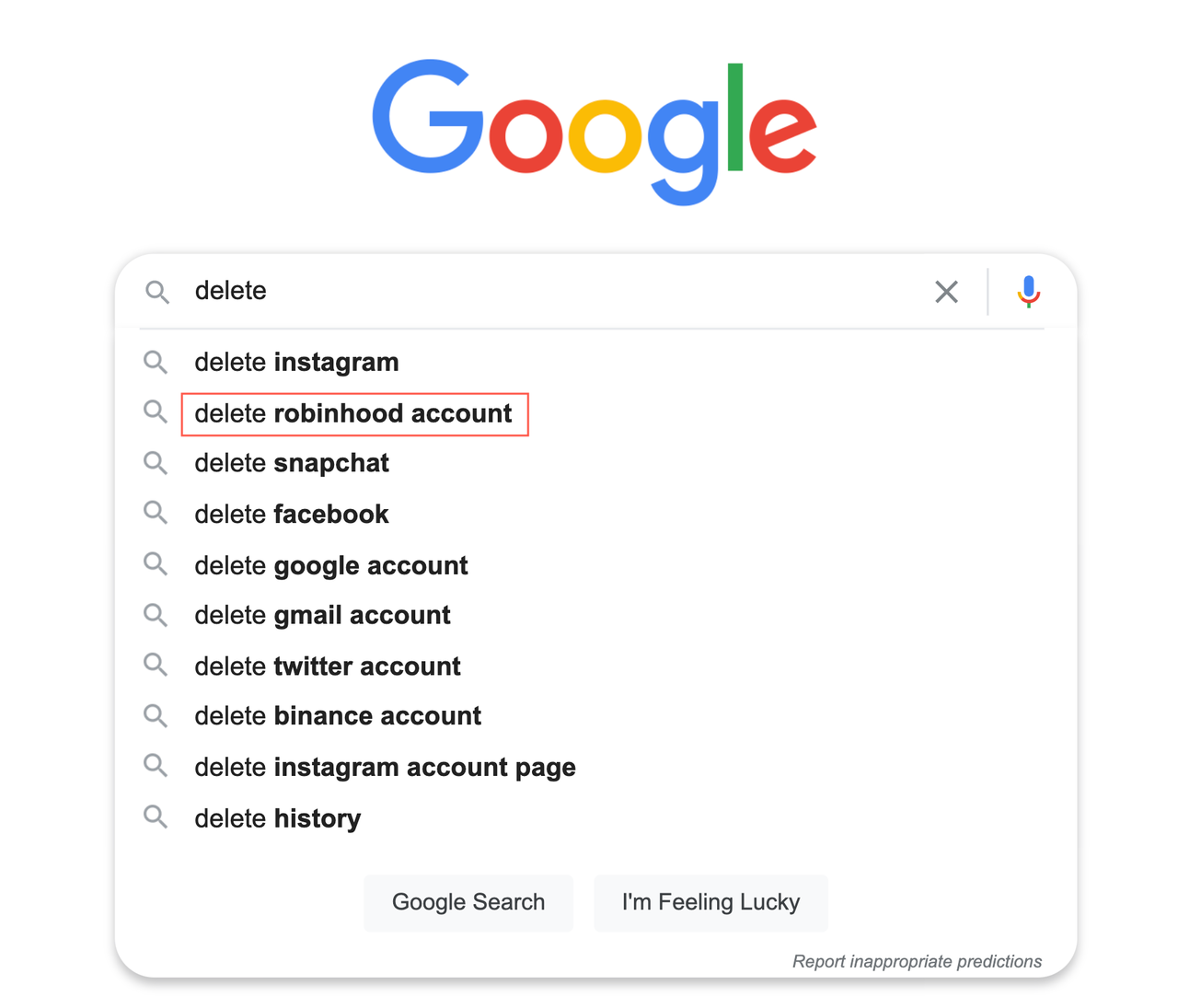
Meanwhile, internet searches for “delete Robinhood” have gone parabolic in recent days, with other search queries including “how to delete Robinhood,” “delete my Robinhood account,” and, “how to delete a Robinhood account” surging across the country. 

On Friday evening, in Google’s search engine, typing the word “delete” followed with “delete Rboinhood account” in the number two search spot.

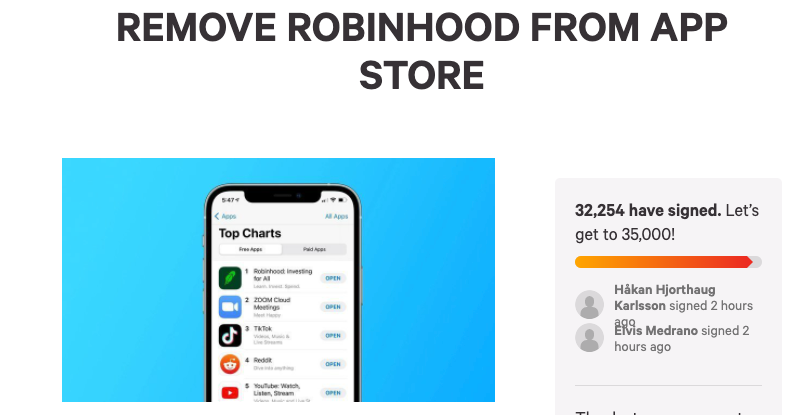
Someone created a petition on Change.org titled “Remove Robinhood From App Store,” which already has 32k signatures, with the needed goal of 35k. 

The petition reads: 

It’s clear that Robinhood doesn’t want individuals to make their own decisions, but large institutions like hedge funds can do as they please.

Robinhood is in CLEAR violation of Apple’s Terms of Service to “plan or engage in any illegal, fraudulent, or manipulative activity.” You can find Apple’s full terms of service here: https://www.apple.com/legal/internet-services/itunes/us/terms.html

Robinhood MANIPULATED the market today, and this is completely unacceptable. We need to remove Robinhood from the App Store. Move all your funds out of Robinhood today, do not give them your business. 

… and an interesting few tweets from Tesla Uber-Bull Ross Gerber on the subject: 

“Robinhood is basically not letting people trade anymore. This is the precursor to a potential BK filing on Monday morning. They’ll be calling their VC backers for billions more this weekend. And when they say No… this is like LTCM,” Gerber tweeted. 

He said, “So if Robinhood goes under the SEC will freeze all the accounts. The SIPC protects up to $500k in accounts. It takes months to unwind and get your money back. Move the money now. This could become a nightmare.” 

“Robinhood is dealing with the classic run on the bank scenario. Everyone wants out but they can’t process it fast enough depleting needed capital as fast as they can get new VC Capital in. So they need to put up more margin and they are losing Capital out the door,” Gerber warned. 

There’s good news for Robinhooders fleeing the platform, brokerage WeBull announced late last week that GME, AMC, and KOSS were no longer restricted.

Something bad is about to go down at Robinhood… 

Tyler Durden
Sat, 01/30/2021 – 16:30

via ZeroHedge News https://ift.tt/2YvKpwM Tyler Durden

“Republicans Need To Suffer”: Drake Prof Triggers Free Speech Debate With Hateful Tweets Against Men, Conservatives

“Republicans Need To Suffer”: Drake Prof Triggers Free Speech Debate With Hateful Tweets Against Men, Conservatives

Authored by Jonathan Turley,

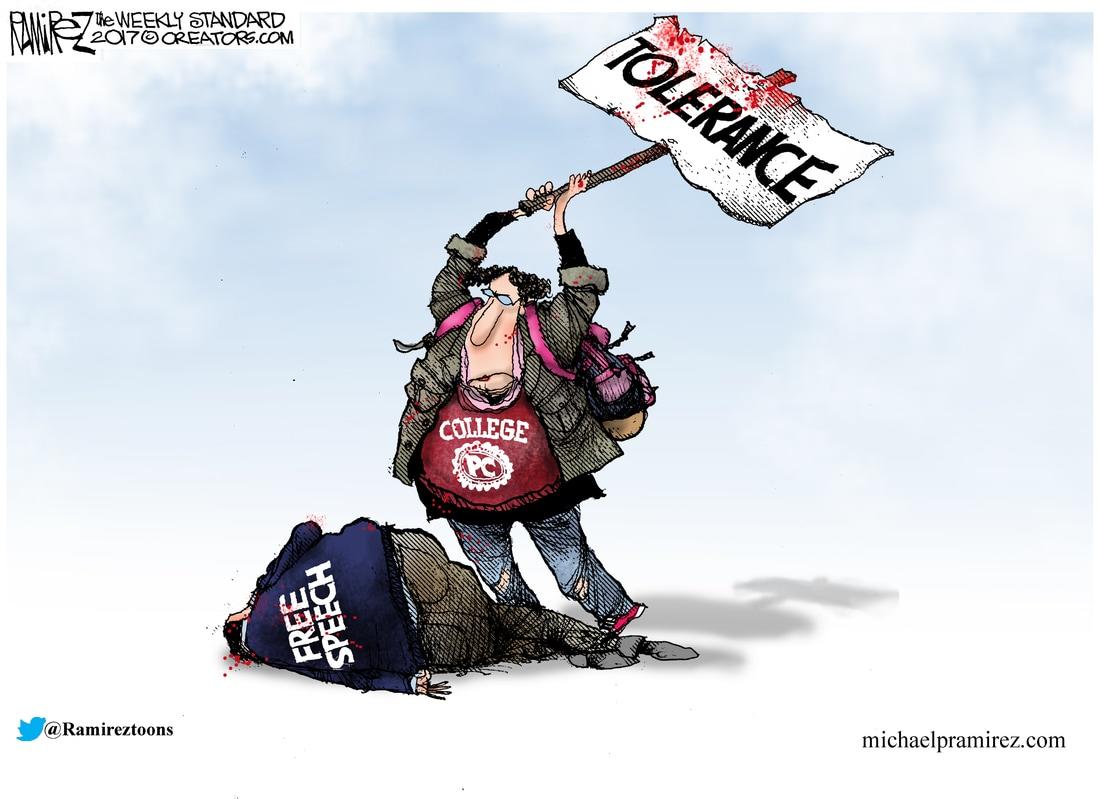
There is a free speech debate at Drake University over hateful and vulgar tweets from Associate English Professor Beth Younger, who called for Republicans “to suffer.” We have seen increasing vulgar attacks from academics, including such high-profile figures as Laurence Tribe in the last few years. Notably, Twitter did not suspend Younger’s account for calling for harm to all Republicans. I do not believe that she should be barred from social media or fired from Drake as a matter of free speech. Even with professors who have justified the murder of conservatives or killing police are protected in such hateful expressions. 

The solution to such hate speech is more (and better) speech.  I would rather we denounce such speech than censor it.

Beth Younger tweeted on October 26th that  “I was just pondering how much hatred I feel towards all the Republican a**holes. They need to suffer.”

Younger also declared that all “men are trash.” and sent a message to U.S. Senator Josh Hawley on Jan. 7 that stated “f**k of you piece of shit.” She also attacked Melania Trump and called Secretary Mike Pompeo a “f**king moron and a traitor.”

Such sentiments are obviously concerning given many Republican students and presumably faculty on campus. It also have an impact on male students taking her class with her stated hatred for their gender.  In a compelling and well-considered email, President Marty Martin  correctly condemned Younger’s comments as “unacceptable.” Martin however stressed freedom of speech in her email this week:

The Drake University Statement of Principles declares that freedom of thought and freedom of expression are central to our educational mission. We therefore carefully refrain from restricting the exchange of ideas or regulating the content of speech. We recognize that the frank and open discussion of social, cultural, artistic, religious, moral, scientific, and political issues may be disturbing and even hurtful for some individuals, but the principle of free exchange and inquiry takes precedence because of its fundamental role in our educational enterprise. We seek to create through this robust exchange of ideas a community in which shared purpose transcends difference and respect for human dignity transcends conflict.

Younger’s tweets raise serious questions over sexist and political intolerance.  However, there is no allegation that she has engaged in discriminatory or hateful conduct in classes.  The question is whether universities would maintain such a position in favor of free speech if the statements targeted other groups like a male professor saying the same thing about women. It is not clear if there is a coherent line or policy on such cases. Free speech demands bright lines but the record among universities has been conflicted. I often hear from conservative and libertarian faculty about what they view as a double standard.  They do not believe that the universities would show equal tolerance for criticism, let alone hateful attacks, of other groups. Certainly many liberal faculty and students have not shown the same tolerance.

As many on this blog are aware, I tend to be predictable on free speech issues.  My natural default is to protect speech, particularly when exercised off campus or on social media. These are difficult cases when statements reflect prejudice and sexism as in the case of Professor Younger.  However, there is a fear of a slippery slope once universities begin to punish those with unacceptable views expressed in their private capacity.  We have been discussing efforts to fire professors who voice dissenting views of the basis or demands of recent protests including an effort to oust a leading economist from the University of Chicago as well as a leading linguistics professor at Harvard and a literature professor at Penn. The silence of many faculty in the face of crackdowns on free speech has been chilling in the last few years.

There is a palpable sense of fear among many conservative and libertarian faculty and students that they cannot express themselves on campus or in classes without be ostracized or even subjected to retaliatory measures, including attacks by the student government. While faculty member like Professor Younger might not show the same tolerance for opposing views, we have a greater responsibility to regain the trust of our communities in the tolerance for opposing views and expression on our campuses. She is the cost of free speech.

Tyler Durden
Sat, 01/30/2021 – 16:00

via ZeroHedge News https://ift.tt/39ucACB Tyler Durden

Reddit Preparing To Unleash “World’s Biggest Short Squeeze” In Silver

Reddit Preparing To Unleash “World’s Biggest Short Squeeze” In Silver

While all eyes have been focused on GameStop and a handful of other heavily-shorted stocks as they exploded higher under continuous fire from WallStreetBets traders igniting a short-squeeze coinciding with a gamma-squeeze, the last few days saw another asset suddenly get in the crosshairs of the ‘Reddit-Raiders’ – Silver!

On Thursday, we asked “Is The Reddit Rebellion About To Descend On The Precious Metals Market?”One WallStreetBets user (jjalj30) posted the following last night:

Silver Bullion Market is one of the most manipulated on earth. Any short squeeze in silver paper shorts would be EPIC. We know billion banks are manipulating gold and silver to cover real inflation.

Both the industrial case and monetary case, debt printing has never been more favorable for the No. 1 inflation hedge Silver.

Inflation adjusted Silver should be at 1000$ instead of 25$. Link to post removed by mods.

Why not squeeze $SLV to real physical price.

Think about the Gainz. If you don’t care about the gains, think about the banks like JP MORGAN you’d be destroying along the way.

Tldr- Corner the market. GV thinks its possible to squeeze $SLV, FUCK AFTER SEEING $AG AND $GME EVEN I THINK WE CAN DO IT. BUY $SLV GO ALL IN TH GAINZ WILL BE UNLIMITED. DEMAND PHYSICAL IF YOU CAN. FUCK THE BANKS.

Disclaimer: This is not Financial advice. I am not a financial services professional. This is my personal opinion and speculation as an uneducated and uninformed person.

…and judging by the unprecedented flows into the Silver ETF (SLV) they just got started…

SLV saw inflows of almost one billion dollars on Friday, almost double the previous record inflow for this 15 year-old ETF.

Source: Bloomberg

Which helped prompt a spike in SLV off Wednesday’s lows of over 11% (and note that every surge in price was mimicked by gold, but gold was instantly monkey-hammered lower after the spike).

Source: Bloomberg

And judging by the asset flow, SLV has room to run here…

Source: Bloomberg

Just as short-interest in the ETF has been building…

Source: Bloomberg

This surge came after Reddit user ‘TheHappyHawaiian’ posted the following thesis on buying silver noting that “the worlds biggest short squeeze is possible and we can make history.”

‘TheHappyHawaiian’ cites two reasons to buy – The Short Squeeze and Fundamentals.

The short squeeze:

Buy SLV shares (or PSLV shares) and SLV call options to force physical delivery of silver to the SLV vaults.

The silver futures market has oscillated between having roughly 100-1 and 500-1 ratio of paper traded silver to physical silver, but lets call it 250-1 for now. This means that for every 250 ounces in open interest in the futures market, only 1 actually gets delivered. Most traders would rather settle with cash rather than take delivery of thousands of ounces of silver and have to figure out to store and transport it in the future.

The people naked shorting silver via the futures markets are a couple of large banks and making them pay dearly for their over leveraged naked shorts would be incredible. It’s not Melvin capital on the other side of this trade, its JP Morgan. Time to get some payback for the bailouts and manipulation they’ve done for decades (look up silver manipulation fines that JPM has paid over the years).

The way the squeeze could occur is by forcing a much higher percentage of the futures contracts to actually deliver physical silver. There is very little silver in the COMEX vaults or available to actually be use to deliver, and if they have to start buying en masse on the open market they will drive the price massively higher. There is no way to magically create more physical silver in the world that is ready to be delivered. With a stock you can eventually just issue more shares if the price rises too much, but this simply isn’t the case here. The futures market is kind of the wild west of the financial world. Real commodities are being traded, and if you are short, you literally have to deliver thousands of ounces of silver per contract if the holder on the other side demands it. If you remember oil going negative back in May, that was possible because futures are allowed to trade to their true value. They aren’t halted and that’s what will make this so fun when the true squeeze happens.

Edit for more detail: let’s say there’s one futures seller who gets unlucky and gets the buyer who actually wants to take delivery. He doesn’t have the silver and realizes it’s all of a sudden damn difficult to find some physical silver. He throws up his hands and just goes long a matching number of futures contracts and will demand actual delivery on those. Problem solved because he has now matched the demanding buyer with a new seller. The issue is that the new seller has the same issue and does the exact same thing. This is how the cascade effect of a meltup occurs. All the naked shorts trying to offload their position to someone who actually has some silver. My goal is to ensure that I have the silver and won’t sell to them until silver is at a far higher price due to the desperation.

The silver market is much larger than GME in terms of notional value, but there is very little physical silver actually readily available (think about the difference between total shares and the shares in the active float for a stock), and the paper silver trading hands in the futures market is hundreds of times larger than what is available. Thus when they are forced to actually deliver physical silver it will create a massive short squeeze where an absurd amount of silver will be sought after (to fulfill their contractually obligated delivery) with very little available to actually buy. They are naked shorting silver and will have to cover all at once and the float as a percentage of the total silver stock globally is truly miniscule.

The fundamentals:

The current gold to silver ratio is 73-1. Meaning the price of gold per ounce is 73 times the price of silver. Naturally occurring silver is only 18.75 times as common as gold, so this ratio of 73-1 is quite high. Until the early 20th century, silver prices were pegged at a 15-1 ratio to gold in the US because this ratio was relatively known even then. In terms of current production, the ratio is even lower at 8-1. Meaning the world is only producing 8 ounces of silver for each newly produced ounce of gold.

Global industry has been able to get away with producing so little new silver for so long because governments have dumped silver on the market for 80 years, but now their silver vaults are empty. At the end of WW2 government vaults globally contained 10 billion ounces of silver, but as we moved to fiat currency and away from precious metal backed currencies, the amount held by governments has decreased to only 0.24 billion ounces as they dumped their supply into the market. But this dumping is done now as their remaining supply is basically nil.

This 0.24 billion ounces represents only 8% of the total supply of only 3 billion ounces stored as investment globally. This means that 92% of that gold is held privately by institutions and by millions of boomer gold and silver bugs who have been sitting on meager gains for decades. These boomers aren’t going to sell no matter what because they see their silver cache as part of their doomsday prepper supplies. It’s locked away in bunkers they built 500 miles from their house. Also, with silver at $23 an ounce currently, this means all of the worlds investment grade silver only has a total market cap of $70 billion. For comparison the investment grade gold in the world is worth roughly $6 trillion. This is because most of the silver produced each year actually gets used, as I have mentioned. $70 billion sounds like a lot, but we don’t have to buy all that much for the price to go up a lot.

**If the squeeze happens, it would be like 40 years worth of their gains in 4 months **

The reason that only 8 ounces of silver are produced for every 1 ounce of gold in today’s world is because there aren’t really any good naturally occurring silver deposits left in the world. Silver is more common than gold in the earth’s crust, but it is spread very thin. Thus nearly every ounce of silver produces is actually a byproduct of mining for other metals such as gold or copper. This means that even as the silver price skyrockets, it wont be easy to increase the supply of silver being produced. Even if new mines were to be constructed, it could take years to come online.

Finally, most of this newly created silver supply each year is used for productive purposes rather than kept for investment. It is used in electronics, solar panels, and jewelry for the most part. This demand wont go away if the silver price rises, so the short sellers will be trying to get their hands on a very small slice of newly minted silver. The solar market is also growing quickly and political pressure to increase solar and electric vehicles could provide more industrial demand.

The other part of the story is the faster moving piece and that is the inflation and currency debasement fear portion. The government and the fed are printing money like crazy debasing the value of the dollar, so investors look for real assets like precious metals to hide out in, driving demand for silver. The $1.9 trillion stimulus passing in a month or two could be a good catalyst. All this money combined with the reopening of the economy could cause some solid inflation to occur, and once inflation starts it often feeds on itself.

What to buy:

I will be putting 50% directly into SLV shares, and 50% into the $35 strike SLV calls expiring 4/16.

This way the SLV purchase creates a groundswell into silver immediately that then rockets through a gamma squeeze as SLV approaches $35.

Price target of $75 for SLV by end of April if the short squeeze happens.

Edit: for the part of your purchases going into shares, some people recommend PSLV because they think SLV might start lying about having the silver in their vault. Or that the custodian will be double counting, ie claiming that the same silver belongs to multiple people (banking on the fact that people wont all try to get their silver at once). So if you buy SLV shares and calls, that’s great. But I think it could be prudent for us to buy options in SLV (no options on PSLV) and shares in PSLV. It all depends on how paranoid you want to be. There is a lot of paranoia in the precious metals world.

Alternate options:

  • buying physical silver; this also works but you pay a premium to buy and sell so its less efficient and you take fewer silver ounces off of the market because of the premium you pay

  • going long futures for February or March; if you are a rich bastard and can actually take physical delivery of 1000s of ounces of silver by all means do so. But if you simply settle for cash you are actually part of the problem. We need actual physical delivery, which is what SLV demands and is why SLV is the way to go unless you are going to take delivery

  • miners; I don’t recommend buying miners as part of this trade. Miners will absolutely go up if SLV goes up, but buying them doesn’t create the squeeze in the actual silver market. Furthermore, most silver miners only derive 30-50% of their revenue from silver anyways, so eventually SLV will outperform them as it gets high enough (and each marginal SLV dollar only increases miner profits by a smaller and smaller percentage)

Details on SLV physical settlement:

When SLV issues shares, the custodian is forced to true up their vaults with the proportional amount of silver daily. From the SLV prospectus:

“An investment in Shares is: Backed by silver held by the Custodian on behalf of the Trust. The Shares are backed by the assets of the Trust. The Trustee’s arrangements with the Custodian contemplate that at the end of each business day there can be in the Trust account maintained by the Custodian no more than 1,100 ounces of silver in an unallocated form. The bulk of the Trust’s silver holdings is represented by physical silver, identified on the Custodian’s or, if applicable, sub-custodian’s, books in allocated and unallocated accounts on behalf of the Trust and is held by the Custodian in London, New York and other locations that may be authorized in the future.”

‘TheHappyHawaiian” ends with a call to (financial) arms:

Join me brothers. Lets take silver to the moon and take on the biggest and baddest manipulators in the world.

Please post rocket emojis in the comments as desired.

Disclaimer: do your own research, make your own decisions, everything here is a guess and hypothetical and nothing is guaranteed, not a financial advisor, I have ADHD and maybe other things too.

Bear case: silver does tend to sell off if the broader market plunges so it’s not immune to broad market sell off. It’s also the most manipulated market in the world so we are facing some tough competition on the short side

Interestingly, ‘TheHappyHawaiian’ dropped this update on 1/29:

Due to the manipulation and collusion of citadel, hedge funds, and brokers to change the rules and rig the game in their favor. Who likely knew ahead of time and bought puts right before and calls at the bottom, GME is too important to abandon still. SLV is still my next play but GME needs to go to $1000 and these people need to go to jail.

However, judging by the massive physical premiums for silver (APMEX) we are seeing this weekend…

…there are more than a few who are already rotating to SLV from GME.

Tyler Durden
Sat, 01/30/2021 – 15:30

via ZeroHedge News https://ift.tt/36s2Yqa Tyler Durden