Revolution, Revenge Of The Nerds, Or The Matrix Reloaded?

Revolution, Revenge Of The Nerds, Or The Matrix Reloaded?

Authored by Tom Luongo via Gold, Goats, ‘n Guns blog,

I have to say as revolutions go, this one is hilarious.

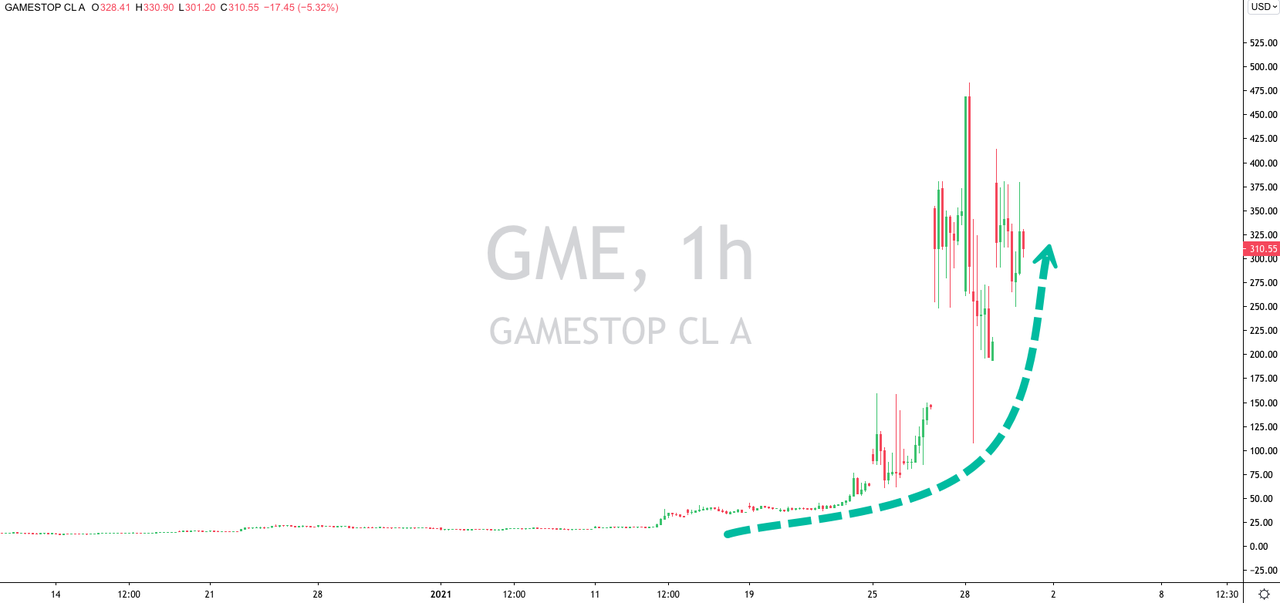
GameStop opened Friday morning above $330 per share, a sentence I never thought in a million years I’d ever write.

This open nearly ensures that all the attempts Thursday to push the price back down to bail out the hedge funds desperately short have failed spectacularly.

There’s options expiration today which will fundamentally change the way we look at markets if Game Spot closes in this range.

Because it shows that when people act in the aggregate they can overwhelm the attempts by a few central planners to control you.

Your best proof that this is at least a part of what’s going on is the way Wall St. and the regulators in D.C. are reacting. Because they are screaming that this is outrageous, that we need stronger enforcement tools to ‘ensure the integrity of our markets.’

That’s just code for ‘only we’re allowed to game the markets not the little people.’

And with options expiring on GameStop nearly every week in February and March this game isn’t over by any stretch of the imagination.

Populist is a Four-Letter Work

In fact, It’s the beginning of a new form of populist revolt.

We’ve seen what they think of populist revolts. They have utter disdain for them. They squash them and hope to ignore the consequences.

Vote for Trump? Can’t have that happen again.

Speak out against any facet of the Great Reset? Get censored.

Try to build a new platform not controlled by them? Get deplatformed.

Show up at the Capitol to peacefully assemble? Get caught up in a false flag to justify arresting you and shaming you into submission.

Today’s price action in Game Spot and other stocks heavily-shorted by hedge funds is simply the next iteration of the people finding ways to make their voices heard.

If you remove someone’s ability to speak in one arena they will find a way in another.

And don’t for a second think the irony of this evolution of Occupy Wall St. occurring during the World Economic Forum’s virtual Davos is lost on me.

It isn’t.

In an age where we are forced to wear masks in ritual submission to oligarchic control they hide behind ever bigger barriers to our hatred of them.

As we saw on Capitol Hill three weeks ago, public assembly in the age of COVID is a recipe for even more ‘wound collecting‘ by the oligarchy, who have their media quislings turn into it bad PR for how unruly the little people are to scare the ‘normies.’

Black-Scholes Event Horizon

But what happens when the little people don’t care about making money or any of those other ‘rational’ investor/actor assumptions which undergird the value-at-risk equations used by most hedge funds and Wall St. quants?

What happens when someone finally blows the lid off the assumption that the risk-free rate of return, R* in the Black Scholes Equation, is anything less than 1000% for $100 call option on Game Spot?

Well, today it means a few rich people will be made poor and a lot of poor people richer.

The bigger question however, about all of this is what happens when, finally, the markets admit that R* for U.S. Treasuries is not zero?

Because that’s what this whole Game Spot Revolution is really about, opening up major cracks in the confidence and validity of the institutions that are supposed to be so unassailably powerful that markets rely on to justify insane valuation models.

They made a mistake staging their failed Tiananmen Square moment at the Capitol. No one other than them was really upset about it other than people getting shot (Her name was Ashli Babbitt).

It means that for a moment, and possibly a few more moments, given how screwed up our financial system is, the little guy’s anger just got capitalized.

They Hate US for Our Freedoms

And the irony is the seed capital for this came from their own disdain for us.

When the last round of stimulus checks showed up, I don’t know about you but I was angry. My wife and I stared at it for a few days and doing so made us viscerally mad.

It represented just how little they thought of all the people whose lives they’d ruined. Paying out the bare minimum to hold us over until they’d fully consolidated power behind barricades and 25,000 troops in D.C.

When asked about what I would do with my stimmy check I replied the same way every time, “Pay my taxes with it.”

But even if 2020 was good for you financially as it was, admittedly for me, all of this COVID-destruction destroyed something far more important: quality of life.

It wasn’t about the money, it was about what was truly lost. The personal bonds broken, the psychological damage to my daughter trying to school via Zoom while going slowly insane.

The destruction of my weekly ‘guys night out’ board gaming group and, now, my martial arts school, a staple in our lives for over 25 years. We shared one last pitcher of beer last night holding back tears.

The haunted looks of my friends and favorite local vendors trying to keep it together.

We all have those stories. They take their toll. The scar tissue builds.

So, when that check showed up after six months of Nancy Pelosi burning down people’s lives even more to burn down her nemesis Donald Trump, we all knew what the score was.

They care about you like a virus cares about its host.

And finally, after a year of this, instead of sitting around wondering what DLC to buy for Fortnight with their stimulus check a bunch of really angry smart guys said, “You know what? Fuck these assholes.”

And they got a whole lot of people with nothing left to lose (except their payola to not disturb Queen Nancy) to go along with them.

Revenge of the Nerds?

That anger, as I said, is now pretty well capitalized, the same way that 2017’s cryptocurrency rally capitalized a whole lot of committed anarcho-assholes of all political stripes to build on top of bitcoin’s reserve status.

The early fruits of that labor are also on display today. Not because these guys are pushing their GameStop profits into Dogecoin but because after a massive coordinated attack to break Bitcoin after the peak near $42,000 two weeks ago, it couldn’t be beaten back below $20,000, the previous all-time high.

All of a sudden there were places to park crypto-profits which weren’t U.S. dollars, the asset where all the off-ramps could be shut off and the little people trapped inside Coinbase getting slaughtered while it’s ‘down for maintenance.’

That’s why today is so fascinating. Wall St. thought all they had to do was double down on their GameStop shorts and use their hammer to beat the nails back into the board.

It didn’t work. By then this thing had gone global.

Now, you have to wonder who was helping the rabble push GameStop back above the $210 Maginot Line? Once something like this starts Wall St.’s enemies start coming out of the woodwork to piggy back on the chaos and change the board state of global markets.

Think China, Russia and everyone else sanctioned to hell and gone by Neocons in our government in the service of Israel.

And yesterday’s close forced a lot of people to scramble and find the money they need to cover their losses or these meme-lords will own enough shares to not only own Game Spot’s board but also have money left over to go after someone else.

Maybe American Airlines? Maybe Blackberry? Maybe Nokia?

This is the first real battle in an asymmetric war.

And those stocks would be very interesting to see successful populist raids on. Can we say hostile takeover and a recapitalization of Blackberry or Nokia outside of the Apple/Google mobile web duopoly?

I’d sell my iPhone if that happened.

Hey, I’m just vamping here, but if these guys are serious about doing damage and re-leveling the playing field that financial advice I’m not allowed to give you can have for free.

Reality is that which, when you stop….

At the same time there’s also the reality that when the masses storm the financial Bastille like this there’s a lot of bystanders run over in the process.

The guys at r/WallStreetBets understood the structure of the markets. They understand that Robinhood had to shut down trading on Game Spot and others simply because Robinhood wouldn’t have enough cash to post the required collateral thanks to Dodd-Frank.

Moreover, it’s going to cause real problems with clearinghouses and primary banks. Robinhood had to tap more than a billion dollars to cover the collateral.

And today’s close will make that number bigger. Which makes me wonder if this chaos unleashed by the Game Spot Revolution doesn’t have a more sinister angle.

One where an upstart retail brokerage was stealing too much market share for trading fees and, like the proles on Reddit, was making too much money threatening the someone else’s business.

… Believing in it Doesn’t Go Away.

So, is this an elaborate hit job inside of this populist uprising like what we saw at the Capitol on January 6th?

Like I said at the outset the usual suspects are all out their today saying we need wealth taxes and trading fees on stock trades. There will be punishment for upsetting the sanctity of our capital markets.

Are we all just, as always, having our chain jerked by a bunch of psychopaths looking to advance a new regulatory environment where the validity of capital markets themselves are undermined?

Because, you don’t think the Commies who just performed a coup in D.C. through blatant election fraud and whose Masters are bloviating about ‘rebooting capitalism’ as I type this would concoct such a thing would you?

Surely things couldn’t be that corrupt? No. Power to the Short Squeeze and all hail Elon Musk!

If you don’t think that’s possible then I’ve got some GameStop January 2023 Leaps at $250 strike price to sell you. As many as you like… 140% of the float even.

I sincerely hope I’m wrong but something tells me I’m not being cynical enough.

*  *  *

Join My Patreon if you want a real revolution

Donate
BTC: 3GSkAe8PhENyMWQb7orjtnJK9VX8mMf7Zf
BCH: qq9pvwq26d8fjfk0f6k5mmnn09vzkmeh3sffxd6ryt
ETH: 0x1dd2e6cddb02e3839700b33e9dd45859344c9edc
DCR: DsV2x4kJ4gWCPSpHmS4czbLz2fJNqms78oE
DASH: XjWQKXJuxYzaNV6WMC4zhuQ43uBw8mN4Va
XMR: 48Whbhyg8TNXiNV2LNkjeuJJU55CNt5m1XDtP3jWZK2xf5GNsbU2ZwHLDJTQ5oTU3uaJPN8oQooRpSQ2CPMJvX8pVTqthmu

Tyler Durden
Sat, 01/30/2021 – 15:00

via ZeroHedge News https://ift.tt/3akBW54 Tyler Durden

COVID Lockdowns Spark Biggest Cigarette Sales Spike In Years

COVID Lockdowns Spark Biggest Cigarette Sales Spike In Years

During the first months of quarantine, when nobody really had any idea whether they’d be seeing their colleagues again next week, next month, or next year, reporters churned out stories about people walking, jogging or otherwise exercising to try and squeeze out a little endorphin boost while also helping to prepare one’s body for the worst-case scenario (after all the stories we have published about COVID “long haulers”, those risks, however slight, should be widely understood).

But as the months dragged on, it appears Americans turned instead to a quick buzz as rates of drinking alcohol, using drugs and, now, smoking cigarettes climbed. As WSJ reports, 2020 was the first year in decades that cigarette use among Americans increased, instead of declining.

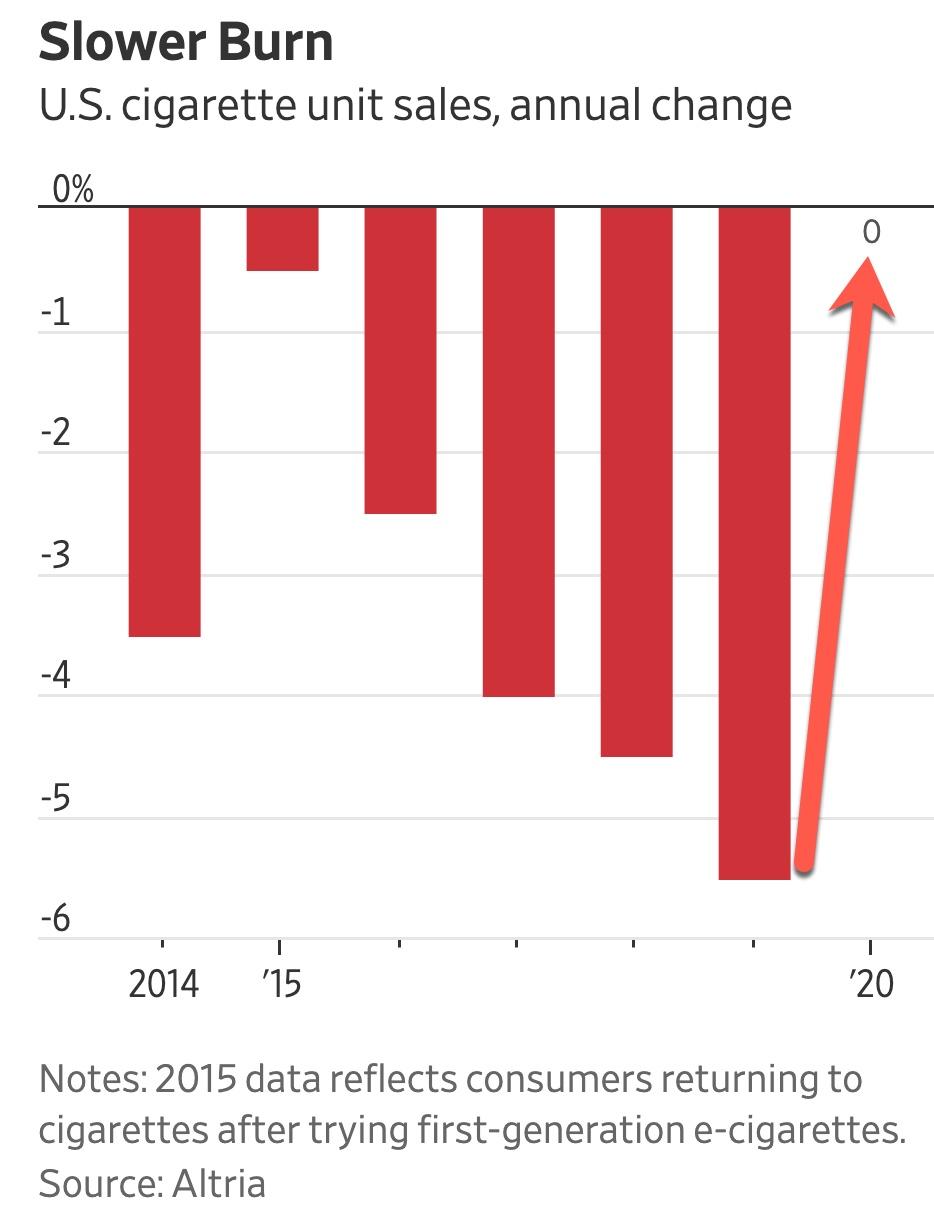
Even though the “vaping illness” has been largely attributed to an additive in illegal marijuana vaping products, sales of nicotine vaping products never rebounded from the paranoia it caused. A sense of pervasive skepticism lingers, as several of the WSJ’s sources pointed out. In the US, cigarette sales topped sales from five years’ ago when many consumers switched back to cigarettes after trying first-generation vaping devices.

Before the pandemic, cigarette sales had been falling at an accelerating rate. Sales declined by 5.5% in 2019. But in 2020, the trend suddenly reversed, and sales were flat.

The reasons for the spike in cigarette sales aren’t too difficult to deduce: Being stuck at home all the time gave people more opportunities to smoke, while the inability to go out and see and meet people essentially forced them to save money on gas, travel and entertainment, which they could then spend on cigarettes). The Virginia-based company posted EPS of $1.03 (or 99 cents per share on an adjusted basis). That’s a couple cents shy of what Wall Street had expected. Still, cigarettes outperformed many other consumer products, and sales in 2020 were even stronger than in 2015, when a drop in gas prices gave consumers more discretionary money to play around with.

Despite the success in cigarette sales during the prior 12 months, Altria didn’t offer a projection for cigarette sales in 2021, saying Thursday that it would depend in part on the rollout of the COVID-19 vaccine, an excuse that has been offered by pretty much every publicly-traded US company.

E-cigarette sales were booming by the fall of 2019 as the popularity of the Juul vaporizer, which caught on among teens and got a whole new generation of Americans addicted to nicotine and tobacco, were blamed for reviving the practice, especially in the US. But many of those same users have apparently now made the switch to cigarettes.

Recognizing this, ederal regulators under Dr. Scott Gottlieb, who ran the FDA before Dr. Stephen Hahn, moved to crush cigarette sales when they raised the federal age for legal tobacco purchases to 21, while pushing President Trump to bar flavored vapes and menthol cigarettes, though the president ultimately demurred.

And if the COVID-19 vaccination process takes even longer than Dr. Anthony Fauci & Co. are saying, we imagine next year might be another big year for tobacco sales as well, especially as the Biden Administration roles out the stimulus checks and unemployment benefits.

Tyler Durden
Sat, 01/30/2021 – 14:30

via ZeroHedge News https://ift.tt/36pdr5u Tyler Durden

Saturday Sarcasm: 9 Great New Jobs For Laid-Off Oil And Gas Workers

Saturday Sarcasm: 9 Great New Jobs For Laid-Off Oil And Gas Workers

Via Babylon Bee,

President Biden is doing a great job getting rid of evil sources of energy like coal and gas, and replacing them with good energy– like wind, solar, and baby unicorn whispers. Unfortunately, it seems that some of you may have lost your jobs as a result.

Never fear! Biden has promised to replace your jobs with much better jobs that don’t make Mother Gaia cry. 

Here are 9 exciting new opportunities for laid-off oil and gas workers:

#1 Installing urinals in girls’ bathrooms – There are over 120 million buildings in the US. That’s 120 million girls’ bathrooms that will need a new urinal installed for the sake of equality. Not bad!  

#2 Trumpet boy for Biden’s royal decrees – Biden’s executive orders just seem a little more special with a trumpet boy out front heralding the coming of a new decree! Whitehouse.gov recently posted an opening for this position. Get on it!

#3 Elementary school teacher in Chicago – There’s nothing nobler than working for the education of a child. Well– we don’t mean work, we mean get paid by the government just for existing. Not a bad gig. 

#4 Carry buckets of oil up and down the Continental United States on foot – The Keystone XL pipeline may be gone, but that oil has to get to its destination somehow, Jack! There are thousands of new positions opening up for people to carry oil across the country, balanced on their heads, like tribal natives after fetching water at the village well. Start practicing now!

#5 Take that job at McDonald’s –  Might as well. At this rate, the minimum wage will be $45 an hour by the years’ end.

#6 Open a GameStop – It’s the wave of the future!

#7 Go back in time and buy bitcoin – Just do it. Get off your butt, build a time machine, and buy some Bitcoin in 2009. Accomplish something for once! 

#8 Replace all your body parts with cyborg implants and become an Amazon drone – Helicopter arms!!! Literally no downside to this. 

#9 Become a youth pastor – Hardly any work required.

Hang in there, bucko! There’s plenty of opportunity out there!

Tyler Durden
Sat, 01/30/2021 – 14:00

via ZeroHedge News https://ift.tt/3qZU230 Tyler Durden

It’s Not Just Robinhood, Reddit Rebellion Has Clogged Entire Financial System’s Plumbing

It’s Not Just Robinhood, Reddit Rebellion Has Clogged Entire Financial System’s Plumbing

While mainstream media is juggling with just who to be angry at, and who to virtue-signal for in the WallStreetBets Reddit Rebellion and Robinhood Rout episiode, the reality under the surface is that the US financial markets have just been punctured by the thin blades of truth. As CHS recently noted, “it is fatally wounded but nobody dares notice.”

So, what’s really happening with Robinhood et al…?

As @Compound248 details in this excellent thread, “this is a ‘plumbing’ issue. It is esoteric, even for those on Wall Street.”

Here is the explanation of how the toilet is clogged.

First: RH was not the only brokerage to restrict buying in $GME et al. Much of the below applies to many brokerages. I’m going to use “RH” in my writing for simplicity and because it’s the most prominent, but it’s not fair to call this a RobinHood issue, per se.

The restrictions impacted retail AND institutional players – many institutional prime brokers (“PBs”) did the same thing to their hedge fund clients.

Why?

Surely PBs can’t be trying to punish their own clients just to benefit Citadel. There must be something else happening…

Let’s talk plumbing.

Most RH clients (& all HFs) use “margin” accounts, not “cash” accounts. RH’s sign up process nudges new customers into margin accounts by default.

Whether RH should do that is worthy of discussion another day.

This is a story of lending and capital.

Margin accounts are Wall Street’s way of denoting lending accounts.

Practically speaking, in margin accounts, the client does NOT own *any* securities. Rather, margin account holders “own” a promise from their broker.

Yay.

When an RH’er buys $GME, a whole bunch of things happen behind the scenes, all of which are the ugly plumbing of Wall Street. 

I’m simplifying, but because the buyer does not know who the seller is, the brokers for both buyer & seller use a 3rd company called DTCC to actually match & “clear” stock transactions, moving title from selling broker to buying broker while ensuring proceeds are moved on time.

Side Note for Later:

For equity options contracts (puts and calls), the primary clearing entity is OCC (Options Clearing Corp). I’m going to refer to “DTCC” below, but know that the same story can be told for options with OTC.

Clearing for US equities is generally a “T+2” process: settlement takes no more than 2 days from the trade. But the Buyer’s & Seller’s brokerage accounts generally reflect the transaction immediately – behind the scenes, there is lending. Lending means “counterparty credit risk.”

DTCC provides its balance sheet to guarantee settlement. But its balance sheet isn’t that big, so it has to tightly manage counterparty risk to guarantee accurate settlement.

In this way, DTCC is both a central repository for Title, and also the guarantor of Title.

This guarantee is typically an extremely low risk proposition.

However, “low risk” does not equal “no risk” 

Generally, DTCC holds the “physical” title to your stock. This speeds up settlement: DTCC simply assigns title from one DTCC client to another, to clear the transaction.

DTCC clients are the brokers, and so the title is held in “Street name” (the broker’s name), not your name.

So, you bought $GME in your RH margin account: what’s happens behind the scenes?

1) You buy

2) At day’s end, RH nets all the money it needs to send to DTCC

3) If RH is a net sender, it generally borrows that money cheaply via interbank lending, & sends it to DTCC

4) DTCC sends net proceeds to brokers due to receive

5) Formal settlement happens within 2 days

If you look at that, there are different windows of credit risk.

1) RH vs. DTCC: Between transaction time (e.g., you buy @ 9:45am) and close of business (when net proceeds go to DTCC);

2) DTCC vs. DTCC: Between the time DTCC sends net proceeds & formally settles the transaction

3) Selling Broker vs. Selling Client: Selling Broker fronts its client credit for the proceeds immediately upon transaction;

4) DTCC vs. Selling Broker: DTCC owes the selling broker proceeds at day’s end;

5) RH vs. RH Client: You deposit $10,000 in your RH account to open it. It’s a margin account. You start buying stocks for zero commission. You’re not paying anything, so RH doesn’t make any money on that…or do they? It’s actually not particularly important to the story, but we all know RH’s real customer is not you – you are the product.

RH’s *real* customers are buyers of “order flow”, the largest of whom is Citadel (the same Citadel that bailed out Melvin Capital with Point72 on Monday)

Just because you aren’t RH’s real customer doesn’t mean they don’t care about you – they need you to be happy and active in order to continuously sell you to Citadel.

Citadel et al get a sneak peak at RH’s order flow (ie, pending trade activity) & use that to “provide you liquidity” (ie, front-run your trade).

Citadel makes tiny amounts on each transaction (on average), slightly reducing the quality of your execution (on average), but allowing you to pay no explicit commission. 

So now you own $GME stock in the margin account.

Actually, you don’t – RH owns the stock and simply passes through many of the rights of ownership to you, crediting you with quasi-ownership.

This is important because if RH failed, you would not “own” your stocks, per se. You would be a creditor with a claim against RH. This is a key risk of margin accounts.

See Lehman Brothers.

When you signed your customer agreement and terms of service, you gave RH the ability to take the stock you bought and lend it out to others to short. Depending on how “hard to borrow” that stock is, RH gets paid a variable rate for this stock loan.

While many brokers share the proceeds of stock lending w/ clients, RobinHood does not. RobinHood keeps it all.

This is a critical way RH gets paid. This payment can be VERY large on hard to borrow names.

  • Lending $MSFT, which is easy to borrow, pays very little.

  • Lending $GME, which is very hard-to-borrow may pay 50-100% (or more) per year. The “borrow rate” is set by the market and is frustratingly opaque. The rate gets reset daily as the difficulty of borrow goes fluctuates.

Shorting In practice:

Somebody wants to short $GME. Most HFs that short-sell first ping their PB to “locate borrow”.

In order to meet legal requirements, the broker has to find un-lent shares (so the same shares aren’t lent twice). The PB will “tag” those shares, indicate to the client the prevailing cost to borrow, and provide the client a “locate ID” that guarantees that client those shares.

Information in hand, the HF manager decides whether to go forward. If she wants the short, she instructs her trader to sell, and provides the trader the Locate ID (tagged to the shares that were shorted) to match with that transaction, so that everything works on the back-end.

Let’s look at the HF’s transaction:

  • The PB lent the HF specific $GME shares, which the HF immediately sold, receiving cash.

  • The HF balance sheet is: owes shares and has cash… 

  • The HF receives money market interest on the cash in its account (called “short rebate” – this is nominal in today’s ZIRP world, but can be meaningful in a high interest rate environment)

  • The HF pays borrow cost on the owed shares 

As you know, because the HF owes shares, and not money, its performance moves precisely inverse to the share price movement (profit on decline, lose on increase). 

Behind the scenes, the PB deals with plumbing.

The PB needed to find someone who owned the $GME shares with clean title. Ideally, the PB found those “in house” (from another client of the same brokerage), but often they locate them from a 3rd party (like RH or another PB)… 

The PB pays RH daily for the borrow, and charges its HF client daily.

Now zoom out:

RH’s margin client (a retail investor) *thinks* he own shares. He never did, because it’s a margin account.

RH itself actually owned the shares (in Street name).

RH lent those shares to a HF PB (aka “hypothecation”), in exchange for daily borrow fees.

That loan creates a debit/credit relationship between RH and PB. The PB took those borrowed shares and re-lent them to its client, who sold them to a 4th party. The RH client and the 4th party simultaneously “own” the same shares.

Summary from various perspectives:

  • The RH Client has a stock *credited* to its margin acct. This is actually a promise from RH 

  • The HF owes GME stock + borrow interest. It owns “cash” from the short sale, which is credited to its margin account. It receives interest on that cash (even that cash is actually just a promise from its PB) 

  • RH has a security loan to PB, and collects variable borrow interest in the meantime 

  • PB owes RH stock and daily borrow interest. PB holds HF client margin account assets as collateral. HF pays PB a daily borrow rate. PB scrapes a vig off the borrow rate and pays the balance to RH 

  • A 4th party owns the actual shares that the RH client thinks *they* own, and

  • DTCC is recording the ownership chain and ensuring cash from purchase and to sale flows through. 

DTCC’s main worry is that someone mid-chain hits a problem.

If that happens, the problems flow all the way up the chain to RH’s client and down the chain to DTCC.

In this way, RH is at risk to downstream problems.

The plumbing metaphor is apt: when you flush, a downstream clog causes a mess that backs up into your toilet. Don’t handle that clog well & you end up with a mess on your floor. Handle it *really* poorly & you burst a pipe – wastewater seeps into your walls.

To avoid this, DTCC has risk-weightings based on the counterparty and the securities. When $GME became the most volatile asset in the world, it created massive risks to the system. Likewise, DTCC views transactions from margin accounts as riskier than from cash accounts.

From the broker’s perspective, its risk w/r/t margin accounts is mitigated by the broker’s ability to close clients out of positions, liquidating them when risk thresholds are breached.

Stocks that are extremely volatile increase the odds of breaches.

To mitigate the risk of a failure to get paid, DTCC requires brokers (like RH and PB) to keep collateral on deposit at DTCC (cash and Treasuries) in proportion to the risk that broker poses.

As more and more of a broker’s DTCC assets increase in risk (e.g., $GME becomes disproportionately part of RH’s assets), DTCC says to RH “you need to send us more collateral.”

Collateral means liquidity.

Liquidity is the oxygen of financial markets.

Accessing liquidity is easy when you don’t need it and hard when you need it.

So maintaining big buffers is important. 

So far, I have skipped a MAJOR – perhaps THE MAJOR – part of the $GME story: Options.

If you’ve seen my Tweets from the past few days, I said the GME situation is no longer Retail vs. Hedge Fund – it is Hedge Fund vs. Hedge Fund.

The dollars at play are unbelievably massive in relation to the companies we are all talking about.

Everyone – both the longs and the shorts – knows that $GME, $AMC, et al are ALL shorts, in the long-run. In the meantime, they are trading footballs. The players are all punters and hunters.

The punters are gambling. Many gamblers are skilled, but most are patsies. The median punter loses money.

The hunters are trying to figure out how to capitalize on the inevitable long-run outcome, “I know GameStop will be lower in the long-run, how do I profit from that?” They tend to be choosy.

In the case of a short squeeze, the “long-run” is just the other side of the squeeze. It could be days; it’s not likely to be many months. If you look at historical analogs, the collapses are as breathtaking as the squeeze.

This is where options come into play.

Buying options is a way of borrowing money, but capping your risk of loss: you cannot lose more than you put in but you receive nearly uncapped upside.

In exchange for capping your max loss and getting exposure to huge upside, options have fairly high odds of expiring worthless.

If buying options provides nearly uncapped upside, then – tautologically – selling options has nearly uncapped downside. Sellers collect premium up front, and most of the time you keep it. But, when you lose, it can be bad.

Selling options resembles an insurance contract from the insurer’s perspective. Receive small up-front payments, and occasionally pay out big in disasters.

Selling options is the classic “picking up pennies in front of a bulldozer.”

Some people joke that when you buy options, you join a group of people throwing pennies toward a guy in front of a bulldozer. If the bulldozer runs over the guy while he’s picking up *your* penny, you get to keep all the pennies in his pocket. 

As the $GME “short squeeze” took flight, anyone who had sold calls was in deep shit.

Their toilet was flooding (and flooding and flooding).

If in December, when $GME was at $15, I sold $20 strike calls on GME with a Feb expiration for $1.75, I’d have received $175/contract (each contract represents 100 shares).

Above $21.75, I start losing money.

With $GME at $300/share, that contract now sells for $280 ($28,000).

I’d have lost $27,825 per contract ($280 x 100 – $175).

That means I lost ~280x the premium I received.

No bueno. Even a TINY position could bankrupt you. 

I’m not going to go into this, but many market participants finance their option purchases (i.e., borrow on margin to buy the option).

Your head might explode if you think about that too long…

Back to plumbing: Guess what type of account nearly all options sit in?

Hint: Margin accounts.

If I sold that call, I obviously could not wait until $300 to start managing my losses: my solvency and the market’s rationality would be at loggerheads well before that, and my solvency would lose.

I’d be desperate to get long. If I didn’t do it myself, my broker would do it for me. The broker would liquidate me as soon as I become a real credit risk to them. If they are nice, they might give me some warnings first, and let me try to cure.

I (or my broker) could mitigate this risk by

  • Adding additional collateral (infuse cash: see Point72 and Citadel with Melvin)

  • Closing out the sold call (buy it back at a loss);

  • Buying enough stock to offset the call (but I have a margin account… 

… and that would increase my use of balance sheet); or

  • Buy a call with a higher strike that has the effect of capping your loss (also a use of balance sheet, but arguably more efficient) 

However, for you to buy that higher call, somebody else has to sell the call. In the midst of the squeeze, option sellers can see the shadow of the bulldozer, and are no longer sanguine.

Very few people want to sell calls on something they’ve watched go up 15x in two weeks, but gamblers might. This culls the supplier of option selling down. 

Conversely, everyone wants to buy options. Hunters and punters alike scour the universe to buy cheap puts (puts win if the stock declines enough). Today, because demand is so high, put pricing has skyrocketed.

Importantly, buying puts creates implied short exposure, which means the implied notional short exposure for GME can be much, MUCH bigger than it looks like.

Recall, everybody believes the collapse is coming: hunters and punters alike. The question is when.

Nobody wants uncapped exposure to losses. This means that people who are selling options at one strike are likely buying options at another strike to limit their exposure. The total amount of option notional outstanding is growing and growing and growing.

Despite the high cost, options are the preferred method for sophisticated hunters to play. Everybody wants to own options on GameStop but nobody wants to sell them. Price goes up until they entice the marginal seller.

Sellers don’t want to pick up pennies, but they might be willing to pick up hundos.

This week, the strangest thing began happening in $GME options (actually earlier, but it became very obvious on Tuesday). Even as GameStop hit moonshot phase, the price of its puts barely budged.

If you owned a Feb 19 $70 strike put on Monday, it traded for $20-$25. $GME stock closed at $77. At $20, the put price implied that the breakeven price for a new buyer of that put requires $GME stock falling by 1/3 and going to $50 by Feb 19th. A big move. Expensive options.

You will recall that on Tuesday, GameStop nearly doubled, closing at $148 and on Wednesday it more than doubled, closing +$200 at $348.

That same $70 strike put closed Wednesday at $19. The stock was up $270!!! and the put only declined one dollar!!!

The perceived risk of loss to an option seller for that $70 strike option was basically unchanged even as GME went from $77 to $370.

Crazy.  

A put that is 72% out of the money and expires in 3 weeks normally trades for pennies, not $19. Arguably it was trading for 100x a more standard price for a put that far out of the money and with that little time left before expiring. 

Options use lots of “Greeks”: delta, theta, gamma.

It is not practical to get into implied vol and gamma in a Tweet, but suffice it to say, “something broke.”

On Thursday, as $GME’s stock price fell >$150, that put increased in value, which makes sense. But only by $2, to $21. Hardly a budge. Insane.

With the stock price not behaving like anything normal, the options market basically told the stock market “I don’t believe you.”

It was as if the out of the money puts market simply ignored multi-hundred dollar stock price swings.

Go back to the broker or client: they’re using options to hedge equity positions (or vice versa), but all of the sudden there is no meaningful correlation between the two.

All the “normal” relationships shattered.

This is quantitative risk management death. You die and go to balance sheet hell. At the River Styx awaits Citadel, saying “oh, you need a ride?”

So now, what?

You either have to unwind or… do more.

More exposure is the answer and the problem. You can’t do it but you feel like you can’t not do it. Instead, you de-gross. Sell anything you have that is liquid. Sell your Microsoft. Sell your Facebook. Sell it all. Get exposure down.

The amount of capital at play in $GME et al, through options, is astounding. Because the expected relationship between the equity and options markets is failing, we have what I have been calling a “Gamma War.”

Thomas Petterfy, the founder of Interactive Brokers (a better alternative to RH, IMO), said the following to CNBC

Quoting from the article:

We are concerned about the ability of the market and the clearing systems, through the onslaught of orders, to continue to provide liquidity. And we are concerned about the financial viability of intermediaries and the clearing houses,” he added.

“The broker stands between these customers and the clearing house,” said Peterffy. “So when some option holders make money, the clearing house has to give us the money to give it to our customers…

“…while other option holders, sellers or buyers on their own side lose money we have to collect money from them and give it to the clearing house. If our customers are unable to pay for their losses we have to put up our own money.” 

Interactive Brokers has $10 billion in equity to cover these payments if need be, but Peterffy said he can’t say the same about other brokers with full confidence.

If you made it this far, you will realize it is those last few sentences that say it all.

Worse yet, if you are a brokerage where your clients are:

a) zooming in on the same small set of securities that, all of which are correlated (e.g., GME, AMC, BB); and

b) all taking the same side of the trade, 

then with each new trade, your brokerage is onboarding more of the same risk. The capital required for the broker to fulfill more and more of the same, without risking the business, is large. 

Your clients are all taking the same side – collateral is flowing one way. You aren’t receiving enough of the expected netting benefits from some of your clients taking the opposite side of the same trade.

It’s almost like a casino’s sports book where all the customers are betting the same team. Even as the line moves gets worse and worse, theoretically incentivizing bets on the other side, your clients just keep taking more of the same.

The House’s risk is building & building. 

At a *systemic* level, this all basically nets out. But, at any given counterparty, it may not. That counterparty might be the client (a HF or individual) or the broker (RH or PB). Depending on where you are in the chain, you have different worries.

This is what Risk Management processes and systems are designed to mitigate. However, if your system did not consider this type of event, and you did not override with commonsense early on, you can be caught offsides.

Badly. Lethally.

There have been huge winners already. But if you are only a winner on paper, your story is not yet finished. The game is not over until the whistle blows. You need to ultimately be a winner in *realized* gains held in a safe brokerage.

Sophisticated players know this. They care about the quality of their counterparties and risk-manage their own portfolios…

…and that all brings us back to RobinHood.

Questions abound. Answers will be revealed in the fullness of time.

[End – phew]

Tyler Durden
Sat, 01/30/2021 – 13:30

via ZeroHedge News https://ift.tt/36qWmbk Tyler Durden

Biden Appoints Veteran Nuclear Deal Negotiator As Envoy To Iran

Biden Appoints Veteran Nuclear Deal Negotiator As Envoy To Iran

Authored by Dave DeCamp via AntiWar.com,

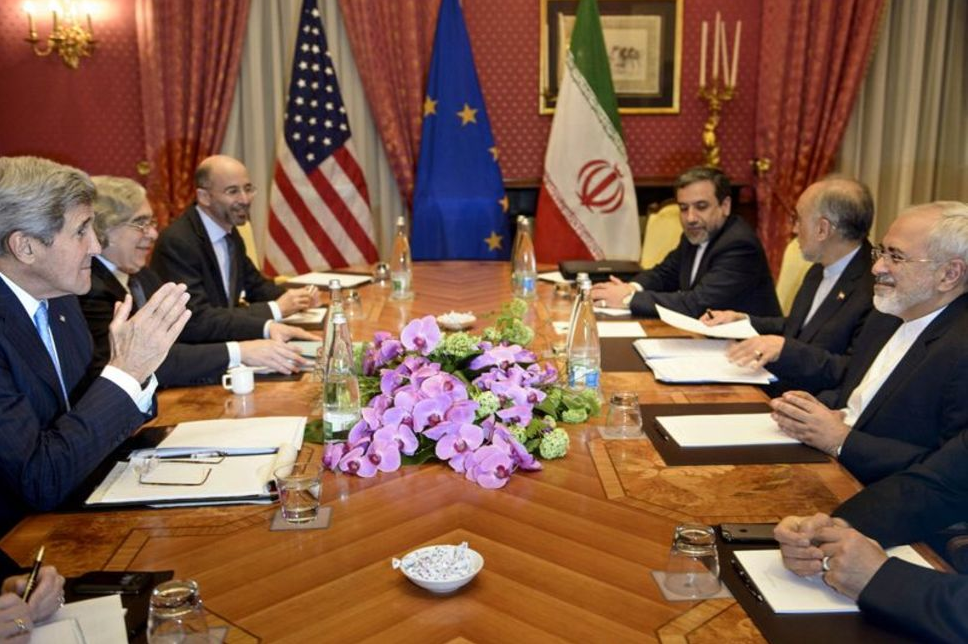
White House Press Secretary Jen Psaki confirmed on Friday that President Biden appointed Rob Malley to be the US envoy to Iran. Malley was the lead negotiator for the 2015 Iran nuclear deal, known as the JCPOA.

Malley’s appointment has been rumored for over a week, and many Iran hawks came out in opposition against it since he has a history of successful diplomacy with Tehran. Senator Tom Cotton (R-AR) wrote on Twitter last week that Malley “has a long track record of sympathy for the Iranian regime & animus towards Israel.”

Robert Malley, Getty Images

While Malley’s appointment is a good sign for the JCPOA, the Biden administration doesn’t seem to be in a hurry to lift sanctions on Iran. Secretary of State Antony Blinken said this week that Iran must return to compliance first, and then the US would, something he said was a “long ways” away.

And separately, White House national security adviser Jake Sullivan said Friday, “From our perspective, a critical early priority has to be to deal with what is an escalating nuclear crisis as they (Iran) move closer and closer to having enough fissile material for a weapon.”

With the US and Iran so far apart, a dialogue is needed to move forward. The US has yet to reach out to Iran, but reports say Malley has been in touch with European allies on how to approach Iran and the JCPOA.

Malley during 2015 nuclear deal negotiations with Iran, via Reuters.

Sources told Reuters that Malley spoke with French, German, and British officials on Thursday. “It was to take stock of the dossier and to assess what our state of mind is,” a European diplomatic source said.

Tyler Durden
Sat, 01/30/2021 – 13:05

via ZeroHedge News https://ift.tt/2Mz9wMx Tyler Durden

US COVID Hospitalizations Fall; World Bank Donates $12BN To African Vaccine Effort: Live Updates

US COVID Hospitalizations Fall; World Bank Donates $12BN To African Vaccine Effort: Live Updates

Summary:

  • US cases continue to slow
  • Deaths move off their post-holiday peak
  • Europe vaccine battle continues
  • WHO touts $12BN World Bank contribution to Covax

* * *

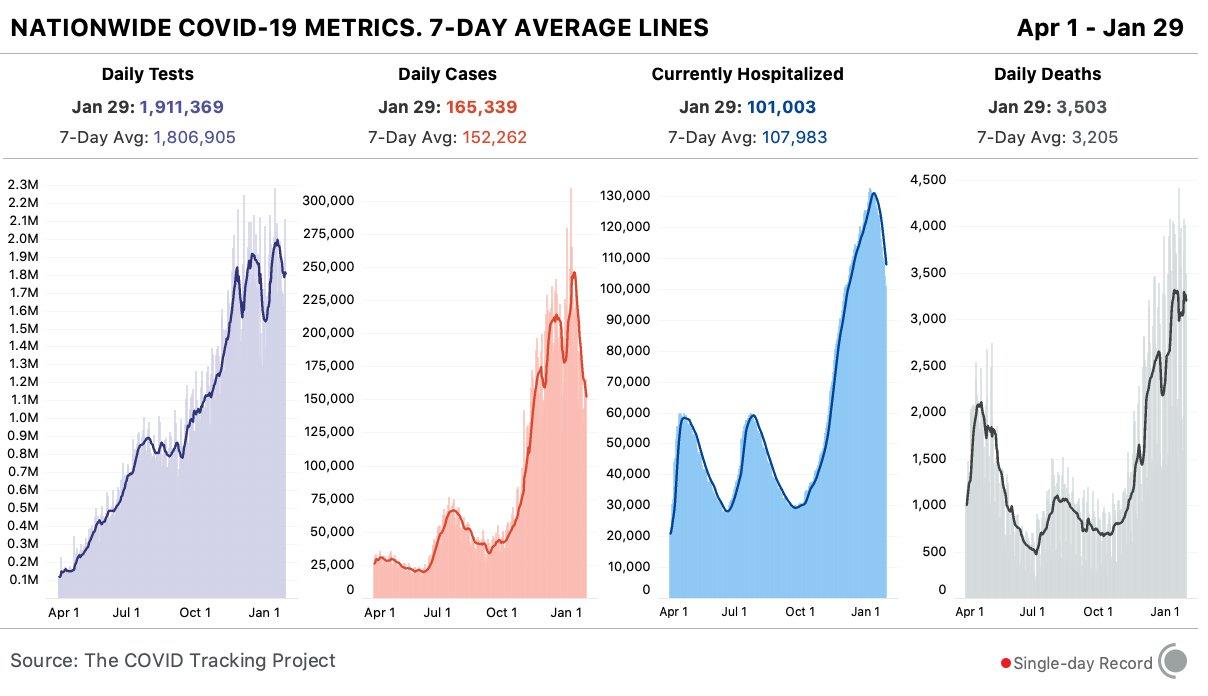
New confirmed coronavirus cases and hospitalizations in the US continued to fall on Friday, despite all the fearmongering about the “mutant” COVID strains, and the CDC’s warning about a post-holiday surge. The US added 165.3K new cases, bringing the total to

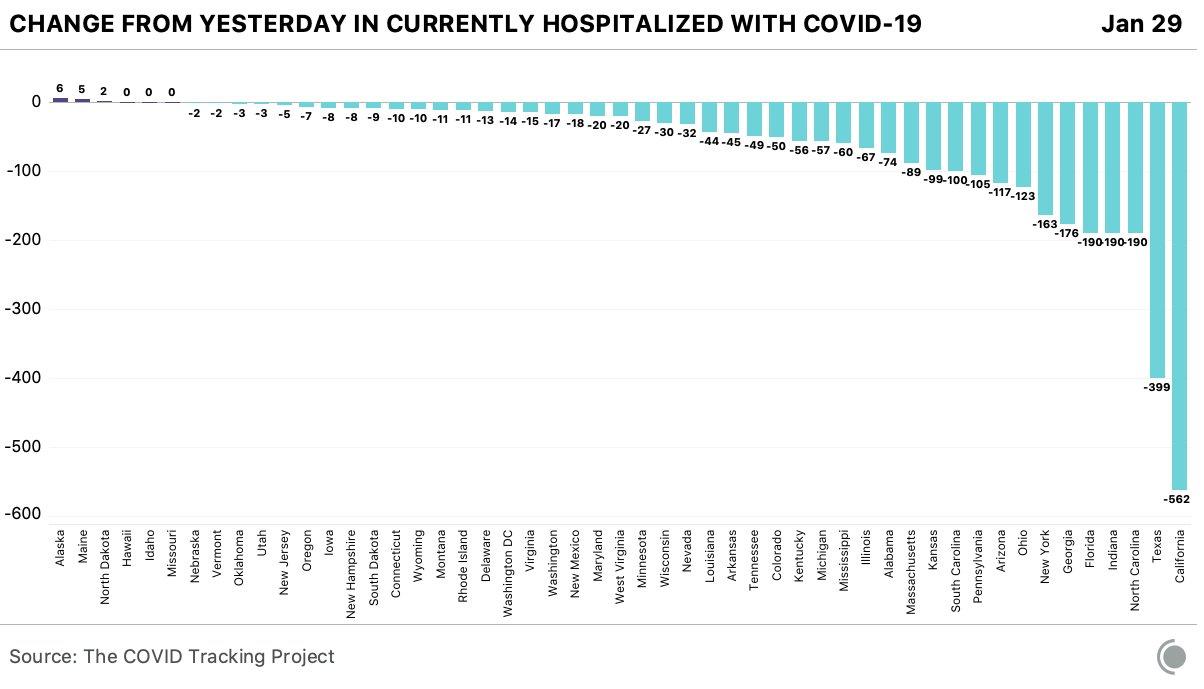
Hospitalizations continued to fall across the US.

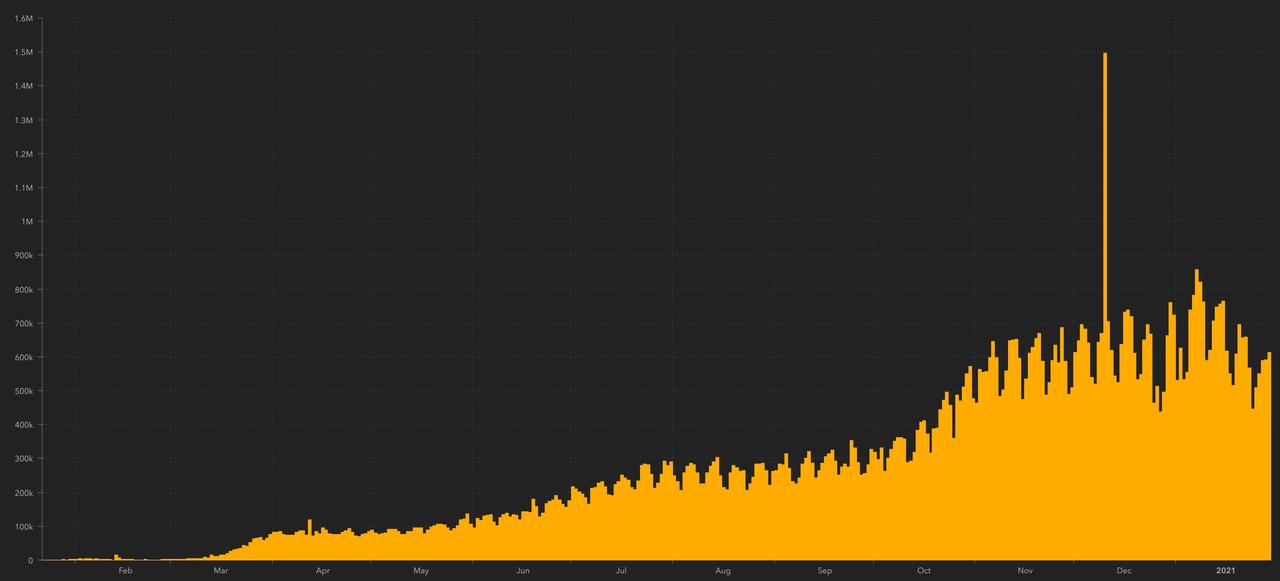
Globally, new cases are declining as well…

…while daily deaths internationally have only just started to move off their peaks from earlier this month.

Most of the big news on Saturday morning concerned the ongoing battle in Europe over the supply of vaccines, which is threatening to unleash a wider political and economic maelstrom that could destroy global collaboration on vaccines – or at least that’s what Bloomberg reported. Virus mutations that likely offer some resistance to vaccine and antibody treatments are now prevalent in South Africa and Brazil, as global scientists frame the threat of mutations as a problem for the developing world.

This is why, the WHO and Bill Gates argue, the US must rejoin Covax, the WHO program to deliver vaccines to the developing world, which has reached a new milestone on Saturday as the World Bank committed $12BN to supporting the program for Afircan countries, while Novartis will be able to deliver “substantial amounts” of Pfizer Inc. and BioNTech SE’s vaccine, according to its CEOs.

On the US front, so far, about 49MMn doses have distributed and about 23.5MM people have received their first of two shots and 5MM have received both, according to Bloomberg. Last month, Trump administration officials had projected that 30MM people could be fully vaccinated by the end of January.

Tyler Durden
Sat, 01/30/2021 – 12:40

via ZeroHedge News https://ift.tt/3adAhOK Tyler Durden

Gold Price Framework Update: The New Cycle Accelerates

Gold Price Framework Update: The New Cycle Accelerates

Via Goldmoney Insights,

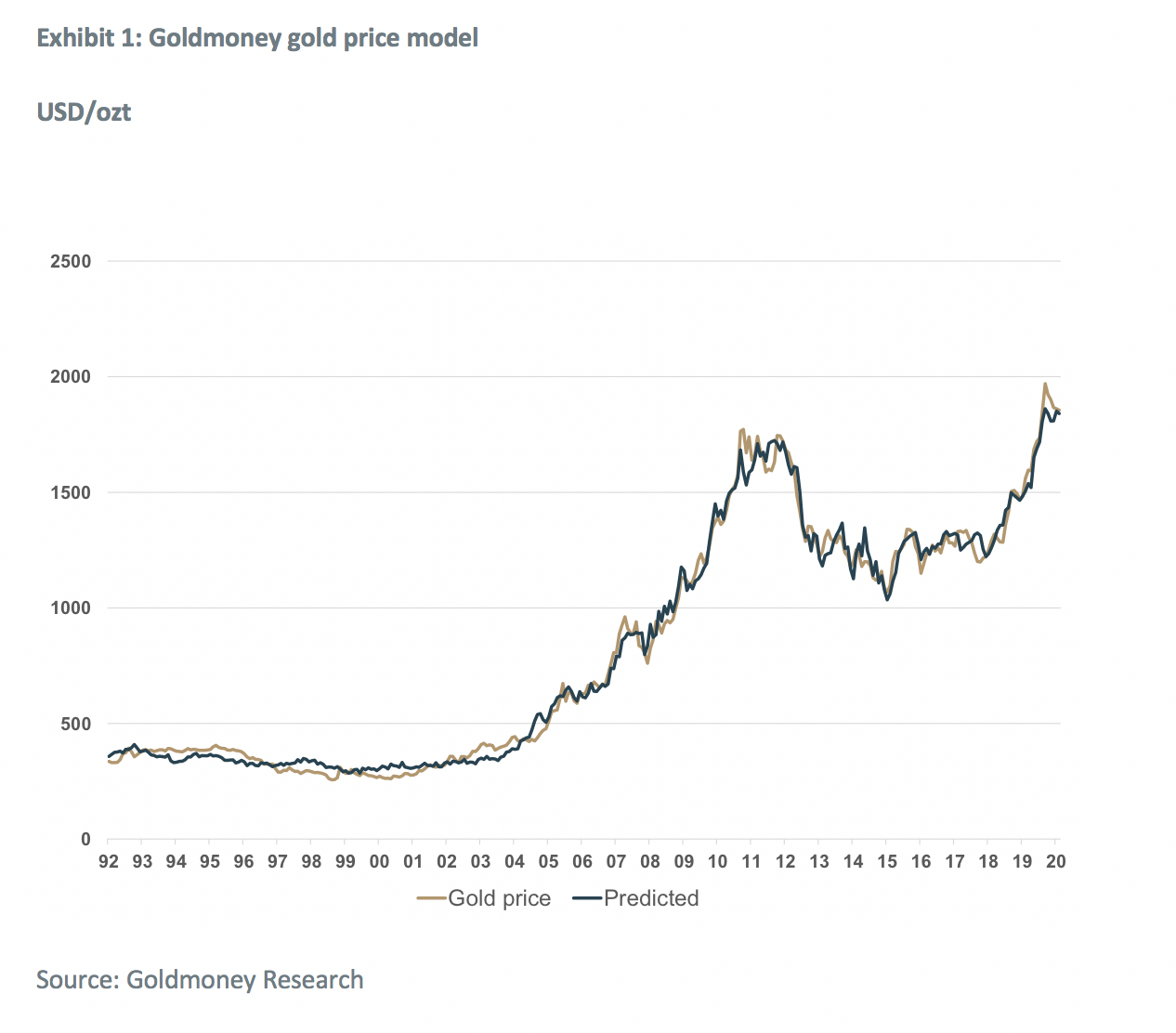
Gold prices rallied 25% in 2020 after having gained 19% the year before. We believe this marks still only the beginning of the current golds price cycle, as all main drivers for gold prices are strongly skewed to the upside.

In our gold price framework (Gold Price Framework Vol. 2 – The Energy Side of the Equation, May 28, 2018), we identified three main price drivers for gold prices over the long run:

  1. Central bank policy (real-interest rate expectations and quantitative easing),

  2. net central bank gold sales and

  3. longer-dated energy prices.

When we presented the first iteration of this model in late 2015, we came to the conclusion that these three drivers were all aligned for gold to be at the bottom of its prices cycle and enter a new cycle.

At the time, gold was trading at around $1100. Over the subsequent years, gold prices have gradually risen in all currencies. It made new record highs in every currency one by one, until it also finally broke its previous all-time high in USD of $1900 in July last year. Gold prices subsequently rallied briefly to $2070 in August before consolidating over the past months.

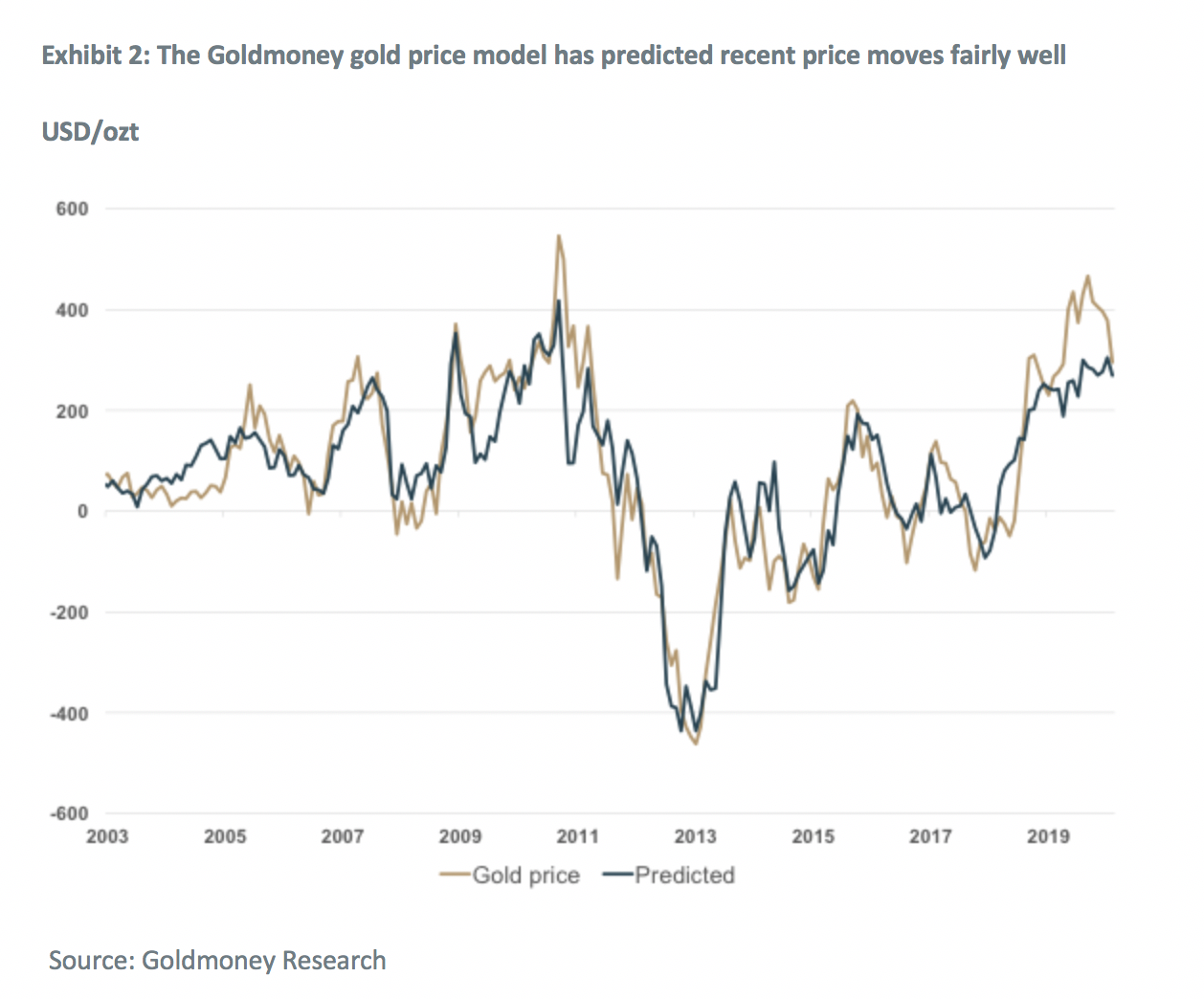
We think this is still the early stage of a new gold cycle that started in 2016 rather than the end of it. Our gold price framework has predicted the recent moves very well (see Exhibit 2). In our view, gold prices overshot in summer and prices were no longer supported by the underlying fundamental drivers. This has now corrected. Given our views on where the main drivers in our model are heading, we think the risk to gold prices remains strongly skewed to the upside. While we think some downside risk remains, any large retracement will be short lived in our view.

Gold price drivers in 2020

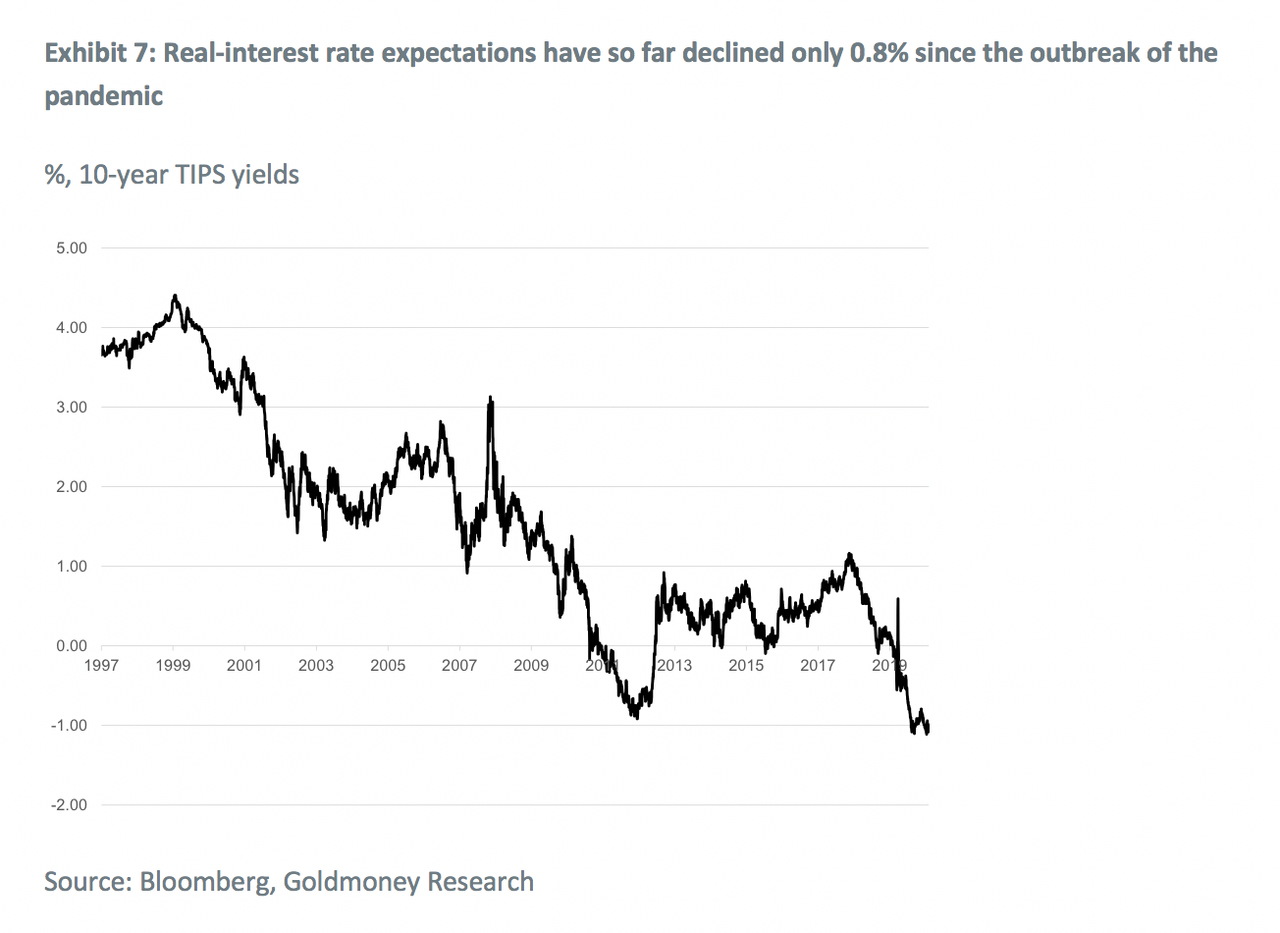
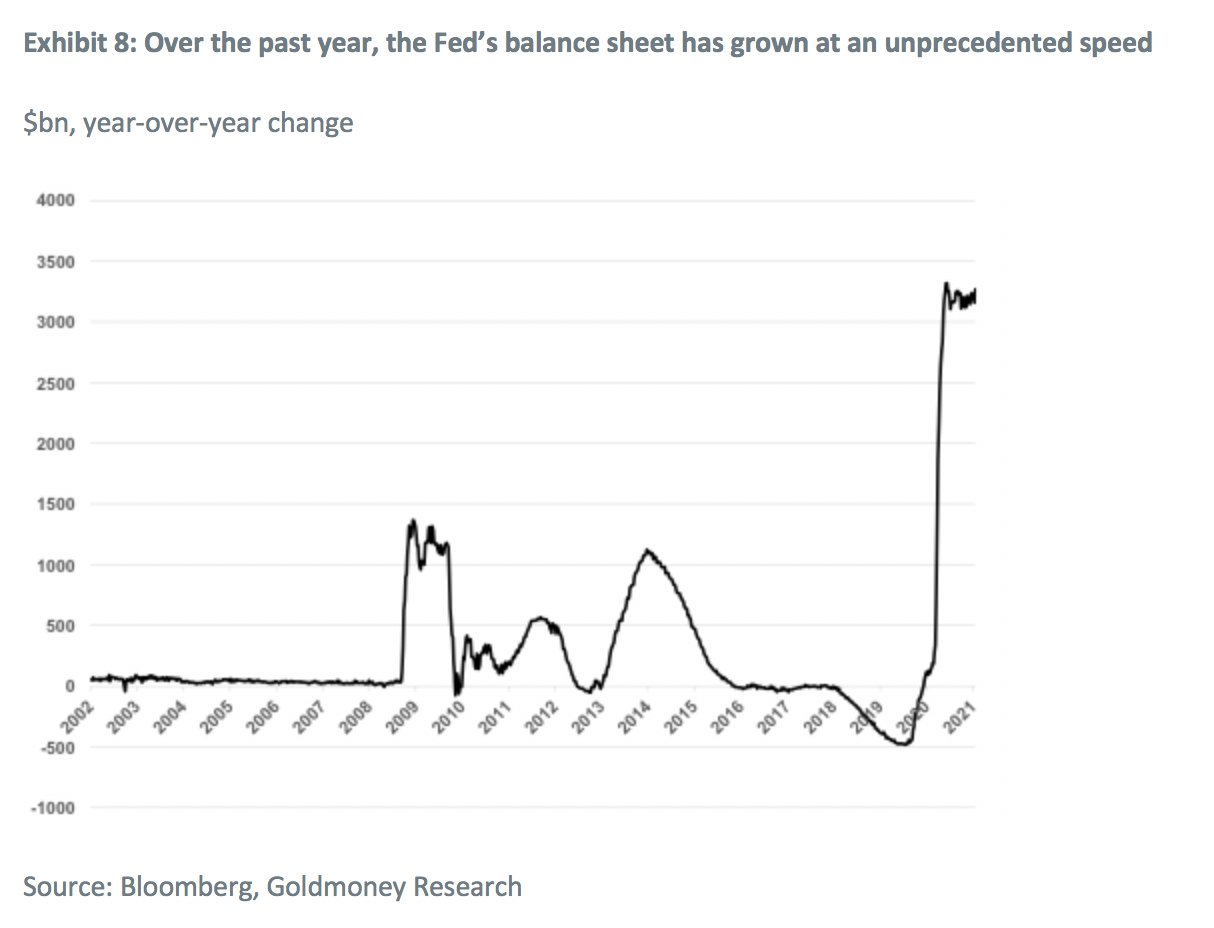
The 25% rally in 2020 was entirely driven by the move in real-interest rate expectations. The Fed has sharply lowered interested rates and accelerated its asset purchase programs. As a result, 10-year TIPS yields went from +13bp at the end of 2019 to -111bp in early January 2021 and are currently at around 96bp. Simultaneously, the Fed’s balance sheet went from $4.1tn by the end of 2019 to currently $7.3tn. Other central banks have also rapidly increased their balance sheets. The ECB for example went from EUR 4.7tn by the end of 2019 to currently EUR 7.0tn.

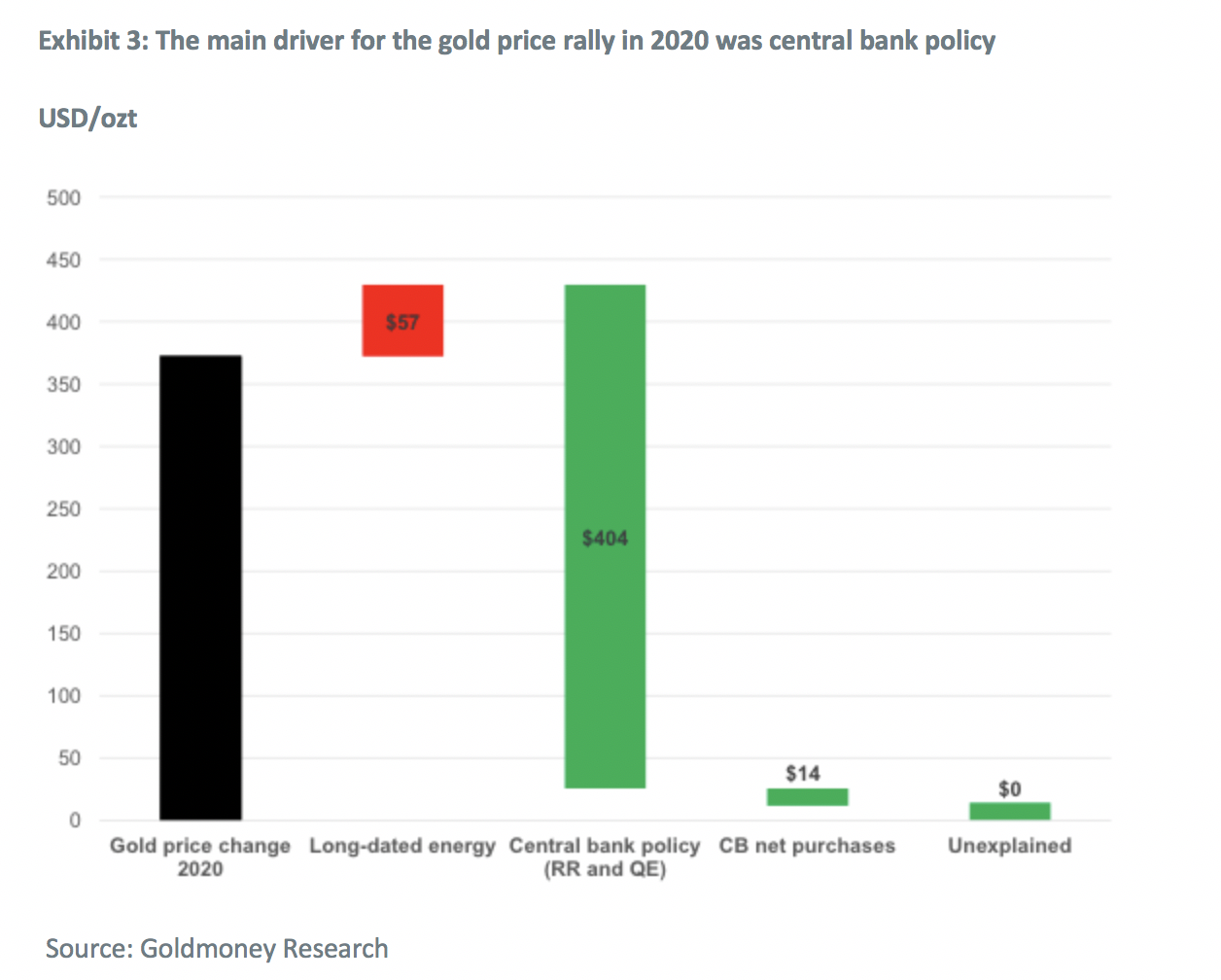
According to our model, this accounted for around $400/ozt of the gold price move in 2020. In contrast, falling longer-dated energy prices had a negative impact on gold prices of about $80/ozt. And while central banks continued to increase their gold holdings in 2020, they did so at a relatively moderate pace, which impacted the gold price only by around $10/ozt (see exhibit 3).

The current cycle will unfold over the coming years

We expect the risk for all drivers for the gold price to remain firmly skewed in favor of gold. Real-interest rate expectations are currently at their lowest point in history, but historical central bank action after a recession suggests that there is a lot of room to the downside. Longer-dated energy prices crashed as the global Covid pandemic unfolded, which will accelerate the energy supply crunch we have been expecting for the coming years. And there is no evidence that the long-term trend of growing central bank gold reserves is reversing anytime soon.

Real-interest rate expectations

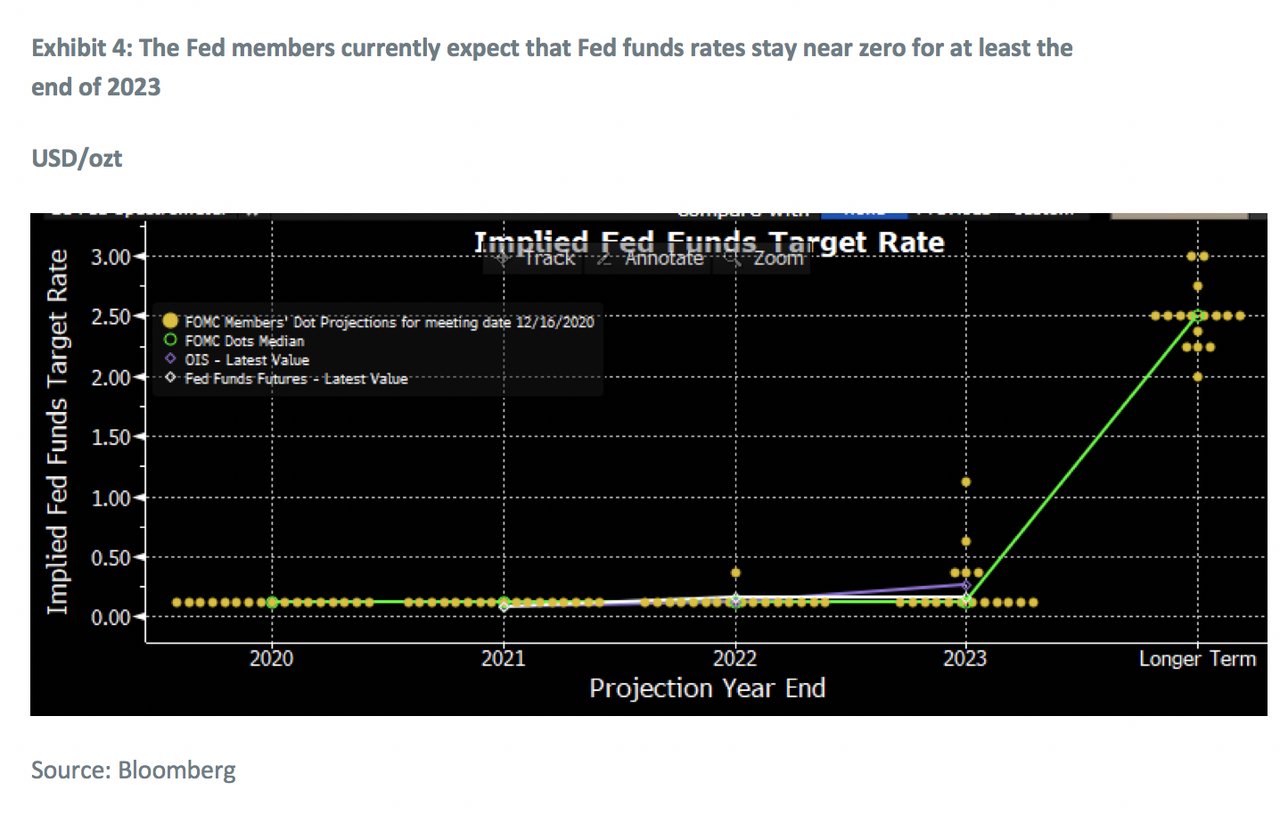
Real-interest rate expectations are a combination of long-term rates (10 year yields) and the markets long-term inflation expectations. Nominal interest rates are current at extremely low levels. The Fed funds rate has been slashed to zero and is likely to stay there for an extended period. The Fed itself is predicting that interest rates will remain at 0% for the foreseeable future (at least until the end of 2023). In the aftermath of the credit crisis, the Fed members have continuously revised their outlook for rate hikes further back as time progressed, and the terminal rate (long-term rate) expectations moved lower over time. We expect a similar situation to unfold this time.

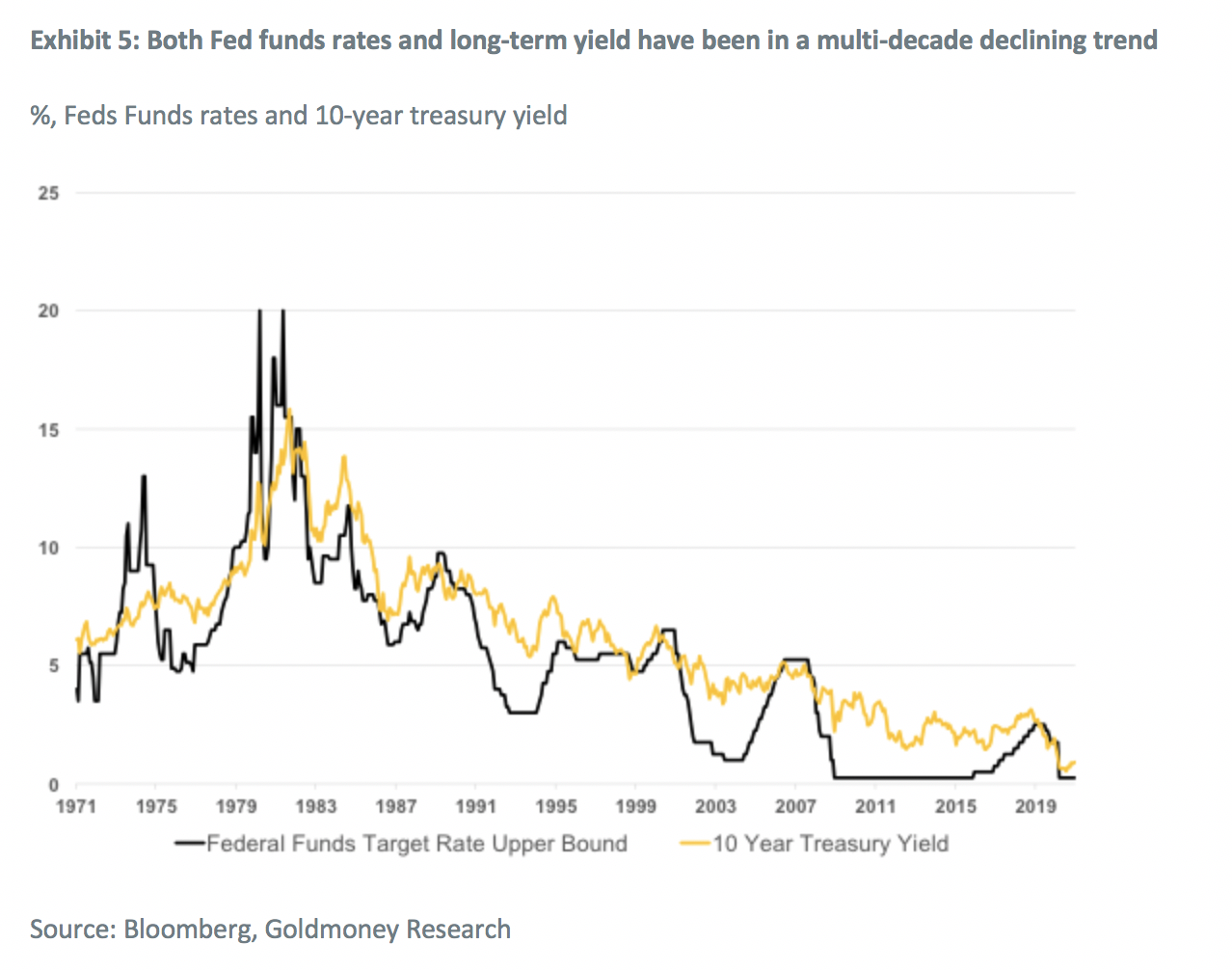
For gold prices, the nominal rates that matter are the longer-term yields. While the Fed directly sets the near-term rates, Fed policy has a strong influence on longer-dated rates (See Exhibit 5). 10-year treasury rates peaked in the early 1980 together with the Fed funds rate and have been gradually declining since.

The Fed has historically reacted to a recession by slashing near-term nominal interest rates (Fed funds rate) by about 5.5% on average. Once the economy recovered, the Fed raised the Fed funds rates, but never back to the levels prior to the rate cuts. Longer-dated rates have not been as volatile, but the overall trend was in line with shorter-dated rates.

In the aftermath of the credit crisis, the Fed began to directly target longer-dated rates by purchasing treasury bonds in an attempt to keep the long-term yield low.

10-year treasury rates have thus moved from around 5% in 2007 to as low as 0.5% last summer. 10-year treasury yields have since recovered to 1.1%, which is still extremely low in historical terms.  Given the Fed’s own forecast for Fed funds rate and the continuing increase in the Fed balance sheet, we see little risk for a sharp spike in long-dated rates in the medium term. While there is a risk in the short term of rates’ spiking in a broader market correction, our expectation is that the Fed would intervene if rates rose to quickly. Any spike in nominal rates is therefore likely to be short lived.

Inflation expectations

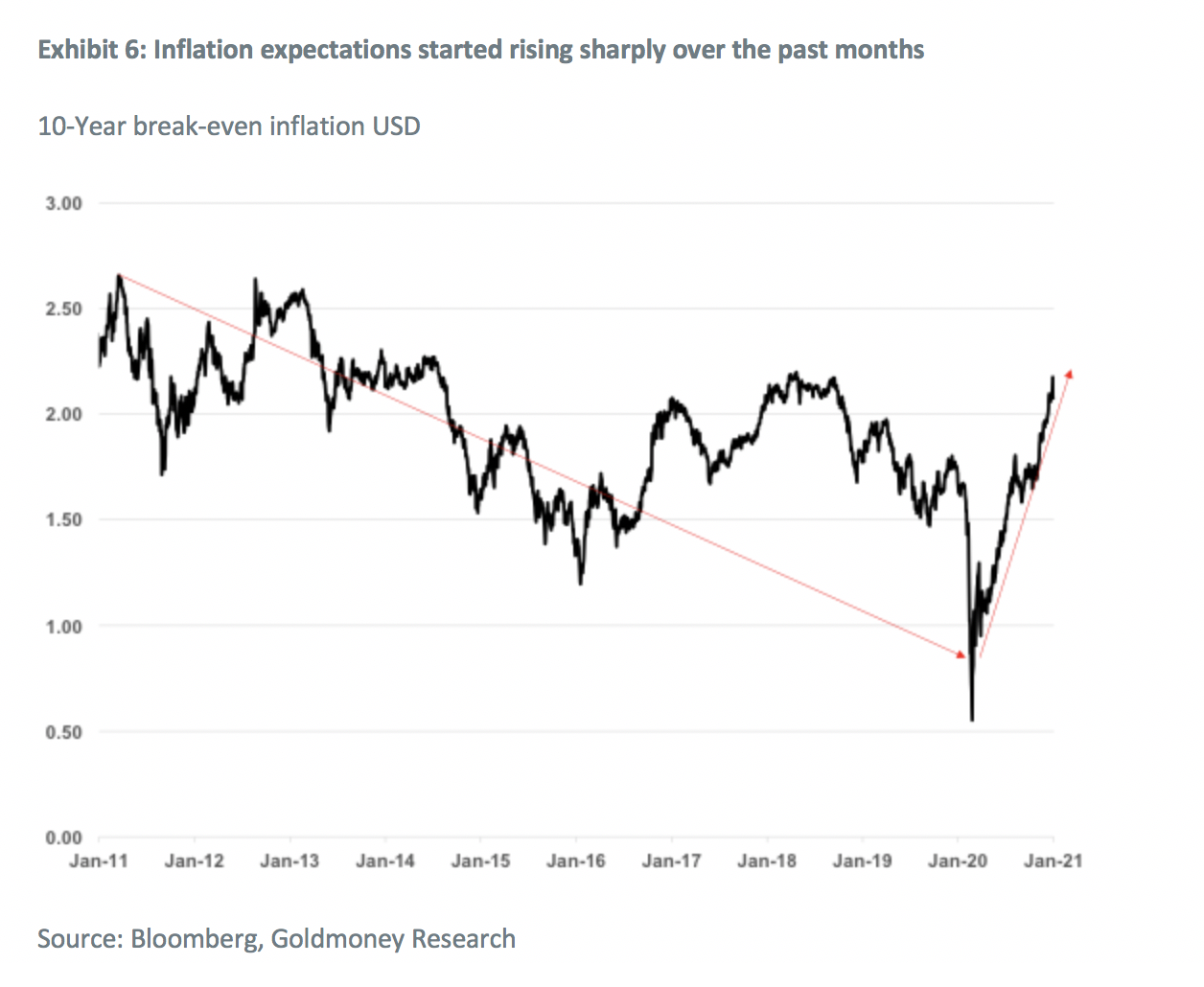
As we have highlighted above, real-interest rate expectations are a combination of nominal long-term rates and long-term inflation expectations. Break-even inflation expectations had collapsed in early 2020 as the Covid19 Pandemic unfolded and dropped as low as 0.55% in March 2020.  However, since then, inflation expectations have been rising sharply, reaching multi-year highs and seemly reversing the long-term trend that started around 2011 (See Exhibit 6).

Real-interest rate expectations

Given our current expectations for central bank policy, we do see limited risk for inflation expectations to reverse this trend anytime soon. Thus, as we expect downward pressure on nominal yields to persist in the medium term – in line with historical patterns in the aftermath of a recession – and inflation expectations are unlikely to reverse and likely to continue to rise, in our view, real-interest rate expectations have significantly more downside risk than upside risk. Real-interest rate expectations declined by more than 3.5% from their top in 2007 to the bottom in 2012. Since the pandemic started, real-interest rates have only declined by 0.8% so far (see Exhibit 7).

Quantitative easing

In addition, as we have shown in our gold price framework, quantities easing (QE) alters the relationship between real-interest rate expectations and gold. QE is a central bank policy tool to push real-interest rates down even as nominal rates approach zero. However, QE has a positive impact on gold prices beyond their impact on real-interest rate expectations. In other words, QE leads to lower real-interest rate expectations, which pushed gold higher. However, the actual price impact is larger than what can be explained by the move in real-interest rate expectations alone.

As nominal interest rates where already very low in early 2020, there was very little leeway for central banks to react by slashing rates. Instead, they accelerated their QE programs at an unprecedented speed. For example, it took the Fed seven years of QE to increase its balance sheet by $3.6tn, from $900bn in 2008 to $4.5tn by 2015. It took just three months to get from $4.3tn in March 2020 to $7.2tn in June 2020 (see Exhibit 8). While asset purchases have slowed down, the Fed has still been adding around $20bn per week to its balance sheets.

Our model tells us that gold prices so far have been trading in line with the level of real-interest rate expectations and QE. This may be surprising to some, as they have expected gold to have underperformed given the extreme environment we are currently in.

We expect gold prices to remain well supported in the medium term. The risks from both real-interest rate expectations and QE are squarely skewed to the upside. However, this upside skew is much stronger now than it was when we concluded that gold had entered a new cycle in 2015. In fact, in our view, gold has explosive upside risk as real-interest rate expectations can move sharply lower if inflation expectations remain on the current upside trend.

Longer-dated energy prices have also reached a trough and the medium-term trend is up

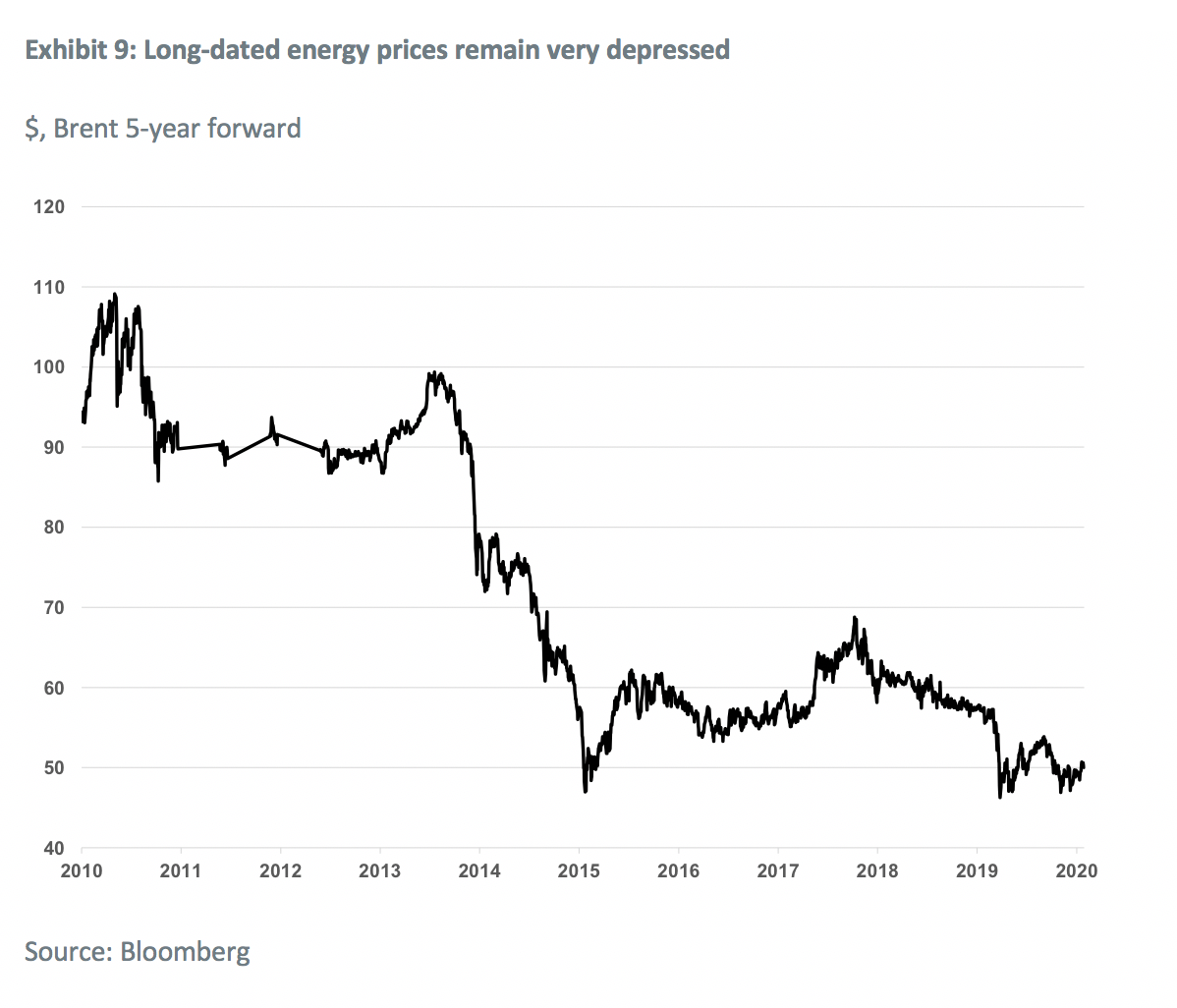
In addition to this, longer-dated energy prices have collapsed earlier last year as demand for oil and other energy commodities suffered an unprecedented decline. While longer-dated oil prices (and other energy commodities) have since recovered, they are still far below pre-pandemic levels (see Exhibit 9). Importantly, energy supply has also seen the largest contraction on record. While the demand impact is expected to be transitory in nature, the supply impact is likely to be longer lasting. This is a fertile ground for energy price inflation over the medium term. We explore this more in an upcoming report.

The unfolding of the current gold price cycle over the medium term

On net, we think we are still in the beginning of the current gold price cycle. While there remain some near-term risk from a spike in nominal rates (potentially triggered by a sharp correction in equity markets), we think central banks are ready to step in and act quickly, limiting the upside to nominal rates. The medium-term outlook for real-interest rate expectations and QE is very positive for gold in our view, and long-dated energy prices present some further upside risk.

Should real-interest rates fall to a similar extent as they have historically in the aftermath of a recession, that alone would push gold prices to around $2600-3100. Such a move over the entire gold price cycle would be in line with the 2008-2011 move of around 270% from bottom to top. Importantly, this scenario would still not assume a sharp pick up of inflation.

Tyler Durden
Sat, 01/30/2021 – 12:15

via ZeroHedge News https://ift.tt/3oyV2ts Tyler Durden

Steve Cohen Nukes Twitter Account After Getting “Personal Threats” Over GameStop Debacle

Steve Cohen Nukes Twitter Account After Getting “Personal Threats” Over GameStop Debacle

Hedge-fund billionaire Steven Cohen deleted his Twitter account Friday following an uproar of thousands of Robinhood users.

“I’ve really enjoyed the back and forth with Mets fans on Twitter, which was unfortunately overtaken this week by misinformation unrelated to the Mets that led to our family getting personal threats. So I’m going to take a break for now. 

“We have other ways to listen to your suggestions and remain committed to doing that. I love our team, this community, and our fans, who are the best in baseball. The bottom line is that this week’s events in no way affect our resources and drive to put a championship team,” a statement read from Cohen. 

Cohen’s Point72 Asset Management and hedge fund Citadel managed by Ken Griffin, infused Melvin Capital Management with $2.75 billion after its GameStop short spectacularly blew up in the “mother of short squeezes.” 

Retail traders, including Barstool’s Dave Portnoy, accused Cohen of pressuring Robinhood in restricting GameStop (GME) shares from trading to protect Melvin and other hedge fund buddies who were short. 

In a Twitter spat late last week, Portnoy went after Cohen. Here are some of the back and forth conversations the two had on Thursday afternoon: 

Portnoy tweeted, “PRISON TIME. Dems and Republicans haven’t agreed on 1 issue till this. That’s how blatant, illegal, unfathomable today’s events are. It also shows how untouchable @RobinhoodApp @StevenACohen2C Citadel Point72 all think they are. Fines aren’t enough. Prison or bust.” 

… and believe it or not, Steven Cohen, founder of hedge fund Point72 Asset Management, who with Citadel bailed out Melvin Capital for their Gamestop short, responded to Portnoy and said, “Hey Dave, What’s your beef with me. I’m just trying to make a living just like you. Happy to take this offline.” 

Barstool’s founder responded by saying, “I don’t do offline. That’s where shady shit happens. You bailed out Melvin cause he’s you’re boy along with Citadel. I think you had a strong hand in today’s criminal events to save hedge funds at the cost of ordinary people. Do you unequivocally deny that?” 

Cohen responded: 

“What are you talking about? I unequivocally deny that accusation. I had zero to do with what happened today Btw, If I want to make an additional investment with somebody, that is my right if it’s in the best interest of my investors, Chill out.” 

Considering Portnoy and r/WallStreetBets have millions of followers, the Twitter spat went viral in a matter of minutes. Thousands of people bashed Cohen and hedge funds for their alleged acts to pressure Robinhood to restrict trading on GameStop. 

After a couple of days of angry traders bashing Cohen, it appears sometime late on Friday, the hedge fund billionaire decided to delete his Twitter account. Perhaps he couldn’t take the heat. 

​One of Portnoy’s writers on Barstools had this to say: 

“But as a person, Steve Cohen is a garbage raccoon. His proudest achievement is paying a $1.8 billion fine to the SEC. When criticized for bailing out Robinhood (and he is more than likely the reason they stopped allowing people to trade GME, AMC, NOK, etc.) he joked “trading is a tough game” when he had the rules literally changed to stop him from losing money at the expense of the common man, and he followed it up with how he was just “trying to make a living”. So basically, he stole money from every common man trader on Robinhood and laughed about it while we were left holding the bag. The empty bag. That’s who this guy is.” 

While there’s no concrete evidence and just hearsay of Cohen and hedge funds pressuring Robinhood to restrict trading – one thing we do know is that there’s not just a list of hedge funds that have been severely battered by the squeeze (we noted shorts lost tens of billions of dollars in the GME) but also Robinhood itself could be in trouble

On Thursday, Robinhood drew on its bank lines and obtained a $1 billion rescue capital investment and has since restricted users from trading stocks and options in dozens of securities. As we noted Friday evening, we believe there are issues “between DTC, clearinghouses and other regulatory entities, Robinhood was found to be in another capital deficiency position – even with the billions raised overnight – and it is being forced to deliver.”

This likely means that Robinhood is, even though the weekend, scrambling to obtain even more capital, although we somehow doubt it will be easy. 

It also means that we may have to have another “Lehman Weekend” situation on our hands, only this time it will be a “Robinhood Weekend”, and an urgent acquisition from a strategic buyer may be required to prevent the worst-case outcome. We only hope that the billions in funds held in custody for clients have segregated should the company collapse. 

A new class of decentralized activist investors, otherwise called r/WallStreetBets, spectacularly outsmarted a bunch of PhD hedge fund managers and capitalized on a market imbalance, and along the way, blew up a few hedge funds, sent Robinhood into a tailspin, and created market stress.

With that in mind, trending this morning on Twitter is “Steve Cohen” – here’s what Twitter users had to say about Cohen deleting his account:

Tyler Durden
Sat, 01/30/2021 – 11:50

via ZeroHedge News https://ift.tt/3ckbjQu Tyler Durden

Vegan Butter Can Be Called “Butter”—But Not “Hormone Free” or “Revolutionizing Dairy with Plants”

From Miyoko’s Kitchen v. Ross, decided Aug. 21 by Judge Richard Seeborg (N.D. Cal.), but just recently posted on Westlaw:

Miyoko’s produces and sells a variety of plant-based, vegan products which are designed to resemble dairy products in appearance and taste. The company markets its foods using names that reference the products’ more common dairy analogues, such as a “vegan butter” and “vegan cheese.” These dairy references are always preceded by conspicuous terms such as “vegan” or “plant-based.” …

California law directs the Department to review food labelling for compliance with federal law. See Cal. Food & Agric. Code § 32912.5 (specifically directing as much “in connection with advertising and retail sales of milk, … dairy products, cheese, and products resembling milk products”). As pertains here, federal law forbids a retailer from selling “misbranded” food items (that is, items with “labelling [that] is false or misleading”), food items “offered for sale under the name of another food,” and food items that, though “purport[ing] to be or … represented as a food for which a definition and standard of identity” exists, do not “conform to such definition and standard ….” 21 U.S.C. § 343. For nearly a century, the standard of identity for butter has required a product “made exclusively from milk or cream, or both … and containing not less than 80 per centum by weight of milk fat.” 21 U.S.C. § 321a.

On December 9, 2019, Miyoko’s received written notice from the Department’s Milk and Dairy Foods Safety Branch indicating the label for its “Cultured Vegan Plant Butter” failed to comply with this regulatory framework. Noting that “the product is not butter” and may not imply it is “a dairy food without [traditional dairy] characteristics,” the Letter instructed Miyoko’s to remove five terms from the product’s label: “butter,” “lactose free,” “hormone free,” “cruelty free,” and “revolutionizing dairy with plants.” The Letter also objected to the display of the animal sanctuary imagery and the phrase “100% dairy and cruelty free” on Miyoko’s website, stating “[d]airy images or associating the product with [agricultural] activity cannot be used on the advertising of products which resemble milk products.” …

The court held that Miyoko’s use of “butter” (prefixed with “vegan” or “plant-based”), “lactose free,” and “cruelty free” were likely truthful and nonmisleading and therefore likely protected by the First Amendment. (The question had to do with likelihood, because the court was deciding whether to grant a preliminary injunction; the court’s analysis, though, seemed pretty confident on these points.)

But the court held that “hormone free” is literally false:

The parties do not seriously disagree about the truthfulness of Miyoko’s “hormone free” claim: because plants contain naturally-occurring hormones, and because Miyoko’s vegan butter is made of plants, it necessarily contains hormones as well….

Miyoko’s struggles to escape this result by reference to its prototypical consumer, who allegedly “understands that the phrase … in context with other phrases [on the label] … mean[s] that the company’s vegan butter does not contain the artificial hormones that are sometimes added to animal-based dairy products.” While there is something to be said for the connection a brand forges with its customers, this reasoning takes that concept a step too far.

[The Court’s First Amendment caselaw] insists, at the threshold, that commercial speech be true, and provides no exception for falsities made true by the target consumer’s supposed contextual awareness. Indeed, as the State persuasively points out, no court has ever repudiated a regulator’s authority to demand that products claiming to lack hormones actually lack hormones. Against this backdrop, Miyoko’s insistence that it would be “illogical for any consumer to believe” that a product labelled “hormone free” does not contain hormones falls decidedly flat…. Because its plant-based butter is not “hormone free,” there is no merit to Miyoko’s request for license to label it with that term.

And the court held likewise as to “revolutionizing dairy with plants”

[T]o “revolutionize” an industry requires “chang[ing] it fundamentally or completely” [citing a dictionary]. “Revolutionizing dairy” thus denotes direct interaction with animal-based milk products in a way that leaves them “fundamentally” different than they were before. Put simply, this is not at the core of what Miyoko’s—a maker of dairy replacements—does or seeks to do. Just like the statement that a vegan clothier’s motorcycle jackets “revolutionize leather with cotton,” or that a maker of non-alcoholic beverages “revolutionizes whiskey with seltzer,” this claim of Miyoko’s is plainly misleading. The State should not be enjoined from responding to its presence in the marketplace with appropriate regulatory action.

from Latest – Reason.com https://ift.tt/3ovMEL1
via IFTTT

Elizabeth Warren Mocks Reporter’s Concerns Over A Wealth Tax As A “Bluff”

Elizabeth Warren Mocks Reporter’s Concerns Over A Wealth Tax As A “Bluff”

Authored by Jonathan Turley,

Sen. Elizabeth Warren (D., Mass.) was back on the airwaves this week touting her signature “wealth tax” in a sharp exchange with CNBC’s “Closing Bell” host Sarah Eisen. I have previously written about the constitutional concerns over a true wealth (as opposed to an income) tax, the exchange concerned the impact of a tax on the most wealthy. Warren ridiculed the notion of the wealthy leaving the country as a mere “bluff” meant to deter her and others from forcing the wealthy to pay their fair share.

A wealth tax has long been a rallying cry for Democrats. During the Democratic primary, I wrote about New York Mayor Bill de Blasio and his “eat the rich” pitch for votes. He pledged to “tax the hell out of the rich.”   Recently, de Blasio added that he viewed the public schools as a tool for wealth redistribution and not just education:  “I’d like to say very bluntly our mission is to redistribute wealth. A lot of people bristle at that phrase. That is, in fact, the phrase we need to use.”

The wealth tax however has been the focus of Warren’s campaigns. She has the support of academics like Yale Professor Bruce Ackerman who assured Warren that such a tax would be constitutional. In a Slate column entitled “Constitutional Critiques of Elizabeth Warren’s Wealth Tax Proposal Are Absurd,” Ackerman dismisses any possible constitutional challenge and made reference to my earlier Washington Post column. As I have previously said, there are good-faith arguments on both sides of this issue and the outcome is likely to be a close vote. However, Ackerman reduction of countervailing arguments to absurdity not only omits key arguments but creates an incomplete account of the case against such a wealth tax. The “absurdity” of such a view is shared by a range of experts and law professors. Erik M. Jensen, the Coleman P. Burke Professor Emeritus of Law at Case Western Reserve University, analyzed the constitutionality of the proposal as concluded “at best, the wealth tax would be constitutional problematic.” Harvard Professor Noah Feldman concluded that it would be close question and would likely come down to Roberts’ vote. Chicago Law Professor Daniel Hemel also thought it would be close with a swing vote likely by Roberts. Michael Graetz, a professor of tax law at Columbia University, concluded “I think a constitutional challenge to an actual tax on wealth is inevitable.That it would fail does not seem to me to be obvious.” Brian Galle, a Georgetown professor at Georgetown Law, noted, as I did, that the absence of a transaction to tax would present a problem in a constitutional challenge. He added that, while he disagreed with earlier rulings of the Court like Pollock, “the Supreme Court doesn’t think that Pollock was wrong.”  He added that Warren’s academic supporters did not reveal the full strength of arguments against such a tax under the Constitution.

The problem is the text of Article I, Section 8 which permits Congress to “lay and collect taxes, duties, imposts and excises.” However, it requires that these “be uniform throughout the United States.” The next section says that “no capitation, or other direct, tax shall be laid, unless in proportion to the census or enumeration herein before directed to be taken.” A wealth tax by any measure is a “direct tax.” As I noted in my column, there are various contributing factors for this language from the infamous “Three-Fourths compromise” to early forms of taxation to a desire to limit federal tax authority.

Putting aside that interesting and unresolved constitutional question, Warren lashed out at the suggestion that such a tax would influence migration from the United States.

Eisen reasonably noted that the tax “might also chase wealthy people out of this country as we’ve seen has happened with, with other wealth taxes. You just said how much we need the economy to be revitalized right now for companies to start adding jobs and not subtracting them anymore.”

Warren responded that “All I’m saying is can we have just, just a little fairness here? A two-cent wealth tax so that we can have universal childcare…”

Eisen interjected that she was “just presenting the counter argument.”  Warren shot back

Well, how about a counter argument though, based on fact? The wealthiest in this country are paying less in taxes than everyone else. Asking them to step up and pay a little more and you’re telling me that they would forfeit their American citizenship, or they had to do that and I’m just calling her bluff on that. I’m sorry that’s not going to happen.” 

Warren may be right that this is not enough to cause a wealth flight, particularly given the constitutional challenges that could be raised.  However, such flight from high taxes have occurred in countries like France.

I am still unclear on how Warren intends to do this constitutionally or logistically, as discussed in my Washington Post column. However, the fastest migration is likely to be into the courts rather than out of the country.

Tyler Durden
Sat, 01/30/2021 – 11:33

via ZeroHedge News https://ift.tt/3oxEX7o Tyler Durden