Vegan Butter Can Be Called “Butter”—But Not “Hormone Free” or “Revolutionizing Dairy with Plants”

From Miyoko’s Kitchen v. Ross, decided Aug. 21 by Judge Richard Seeborg (N.D. Cal.), but just recently posted on Westlaw:

Miyoko’s produces and sells a variety of plant-based, vegan products which are designed to resemble dairy products in appearance and taste. The company markets its foods using names that reference the products’ more common dairy analogues, such as a “vegan butter” and “vegan cheese.” These dairy references are always preceded by conspicuous terms such as “vegan” or “plant-based.” …

California law directs the Department to review food labelling for compliance with federal law. See Cal. Food & Agric. Code § 32912.5 (specifically directing as much “in connection with advertising and retail sales of milk, … dairy products, cheese, and products resembling milk products”). As pertains here, federal law forbids a retailer from selling “misbranded” food items (that is, items with “labelling [that] is false or misleading”), food items “offered for sale under the name of another food,” and food items that, though “purport[ing] to be or … represented as a food for which a definition and standard of identity” exists, do not “conform to such definition and standard ….” 21 U.S.C. § 343. For nearly a century, the standard of identity for butter has required a product “made exclusively from milk or cream, or both … and containing not less than 80 per centum by weight of milk fat.” 21 U.S.C. § 321a.

On December 9, 2019, Miyoko’s received written notice from the Department’s Milk and Dairy Foods Safety Branch indicating the label for its “Cultured Vegan Plant Butter” failed to comply with this regulatory framework. Noting that “the product is not butter” and may not imply it is “a dairy food without [traditional dairy] characteristics,” the Letter instructed Miyoko’s to remove five terms from the product’s label: “butter,” “lactose free,” “hormone free,” “cruelty free,” and “revolutionizing dairy with plants.” The Letter also objected to the display of the animal sanctuary imagery and the phrase “100% dairy and cruelty free” on Miyoko’s website, stating “[d]airy images or associating the product with [agricultural] activity cannot be used on the advertising of products which resemble milk products.” …

The court held that Miyoko’s use of “butter” (prefixed with “vegan” or “plant-based”), “lactose free,” and “cruelty free” were likely truthful and nonmisleading and therefore likely protected by the First Amendment. (The question had to do with likelihood, because the court was deciding whether to grant a preliminary injunction; the court’s analysis, though, seemed pretty confident on these points.)

But the court held that “hormone free” is literally false:

The parties do not seriously disagree about the truthfulness of Miyoko’s “hormone free” claim: because plants contain naturally-occurring hormones, and because Miyoko’s vegan butter is made of plants, it necessarily contains hormones as well….

Miyoko’s struggles to escape this result by reference to its prototypical consumer, who allegedly “understands that the phrase … in context with other phrases [on the label] … mean[s] that the company’s vegan butter does not contain the artificial hormones that are sometimes added to animal-based dairy products.” While there is something to be said for the connection a brand forges with its customers, this reasoning takes that concept a step too far.

[The Court’s First Amendment caselaw] insists, at the threshold, that commercial speech be true, and provides no exception for falsities made true by the target consumer’s supposed contextual awareness. Indeed, as the State persuasively points out, no court has ever repudiated a regulator’s authority to demand that products claiming to lack hormones actually lack hormones. Against this backdrop, Miyoko’s insistence that it would be “illogical for any consumer to believe” that a product labelled “hormone free” does not contain hormones falls decidedly flat…. Because its plant-based butter is not “hormone free,” there is no merit to Miyoko’s request for license to label it with that term.

And the court held likewise as to “revolutionizing dairy with plants”

[T]o “revolutionize” an industry requires “chang[ing] it fundamentally or completely” [citing a dictionary]. “Revolutionizing dairy” thus denotes direct interaction with animal-based milk products in a way that leaves them “fundamentally” different than they were before. Put simply, this is not at the core of what Miyoko’s—a maker of dairy replacements—does or seeks to do. Just like the statement that a vegan clothier’s motorcycle jackets “revolutionize leather with cotton,” or that a maker of non-alcoholic beverages “revolutionizes whiskey with seltzer,” this claim of Miyoko’s is plainly misleading. The State should not be enjoined from responding to its presence in the marketplace with appropriate regulatory action.

from Latest – Reason.com https://ift.tt/3ovMEL1
via IFTTT

Mark Cuban Presents A “Little Trick” For Creating The Mother Of All Short Squeezes

Mark Cuban Presents A “Little Trick” For Creating The Mother Of All Short Squeezes

A few days ago when Wall Street was panicking over the unprecedented short squeeze that had sent the most short names soaring and streamrolling hedge funds such as Melvin Capital, Maplelane and countless others, we said that instead of engaging in damage control perhaps Wall Street should consider how much worse it could still get. To wit, late on Jan 26 we said that a “little trick” that is available (for those with cash accounts) was for holders of GME stock to call back shares they owned of the heavily shorted names.

Just a few hours later, early in the Thursday premarket session, things started to really move: that’s when GME hit an all time high of $513.12 which has yet to be topped.

So did people call back their shares? Perhaps, we don’t know, or maybe that about to happen. According to S3 Partners, the total short interest is still a whopping 113% of the float, which means the squeeze could easily go on for a long time if the buyers kept applying pressure. None other than Mark Cuban may have assured of just that.

In a series of tweets on Friday, the iconic investor and “shark” compared the lending and rebate payment mechanism in stocks vs DeFi crypto tokens (where the bearer gets the benefit of the borrow fee and not the broker) and said – in an almost verbatim paraphrase of our “tricky” tweet from two days earlier – the following:

one trick that I have been on both sides of is to lend out stock to shorts at a high APY and then call back my shares, which forces the short to cover. Now if #WSB did this en masse, it would be the mother of all short squeezes “.

Cuban made another point which we also addressed previously, namely that with millions of new users signing up to r/WallStreetBets where each trader has an average brokerage account of $5,000 (soon to get another $1,400 “stimmy check” infusion), the subreddit has become the world’s biggest distributed, decentralized hedge fund with a “hive mind”, where all the individual traders coordinate and work as one, and one which can steamroll over virtually any Wall Street veteran. In fact, at this rate, Once WSB has 15 million or so members  – which should happen by the end of the week, as it now has a whopping 7 million up from 2 million at the start of the week – it will have more monetary firepower than the world’s biggest hedge fund (central banks not included) Bridgewater:

And here’s Cuban on this topic too:

The beauty of what has happened with #WSB is that Wall street is learning an expensive lesson that The Way Things Have Always Been Done is not How Things Should Be Done. There is power in numbers working together. Buy and Trade Together can be a whole lot more powerful than old-school buy and hold. Im not saying HODLing stocks is bad. It can be great and have the same impact as HODLing crypto. And the same principals even apply. The number of shares outstanding and their growth is comparable to coins mined (without the algorithmic control).

His full thread is below (source):

Lets talk $GME shorts vs De-Fi. When someone shorts a stock that is already heavily shorted, they have to pay a fee to borrow that stock. In the case of $GME that fee has been hovering around 30% this week. Shorts have to pay (Price x .30)/360 per day. In DeFi thats a 30% APY.

For RH Traders that own $GME that money, as best I can tell, is held in street name. Which means that 30% APR goes 100pct to @RobinhoodApp 😬😬😬. Imagine if you pooled your crypto and the platform was getting 30% APY and didnt pay all but fees to you ? What would happen ?

This is one more way that Wall St takes advantage of the little guy. If you are moving from RH, look to see if you can find some place that allows you to hold the shares and lend them in YOUR name, so you get the Yield (Yield Farming in stocks !). Not all will allow it.

But if they do, one trick that I have been on both sides of is to lend out stock to shorts at a high APY and then call back my shares, which forces the short to cover. Now if #WSB did this en masse, it would be the mother of all short squeezes .

The beauty of what has happened with #WSB is that Wall street is learning an expensive lesson that The Way Things Have Always Been Done is not How Things Should Be Done. There is power in numbers working together. Buy and Trade Together can be a whole lot more powerful than old-school buy and hold. Im not saying HODLing stocks is bad. It can be great and have the same impact as HODLing crypto. And the same principals even apply. The number of shares outstanding and their growth is comparable to coins mined (without the algorithmic control).

If small trades can work together and share information together the power to move stock pricing moves quickly from the analyst on Wall Street to the people working together. There is one VERY IMPORTANT caveat. No amount of trading together can keep a bad company in business.

But if individual traders educate each other and use their combined strength to focus on good companies , with strong prospects, the power shifts from wall street to main street, particularly now that Direct Listings are changing the IPO game. Thoughts ? Comments ?

So for all those wondering how and when GameStop will Stop, and if the squeeze is finally over, as long as iconic figures with a chip on their shoulder and a desire to inflict more pain on Wall Street continue to chime in with perspectives on how to keep the pain up, it is likely that the unprecedented short squeeze mania is not over by a long shot. And furthermore, with borrow costs now at 50%, even in the absence of further painful gains in the stock price the cost of carry alone will force the shorts to cover in the coming days should the price of GME fail to drop.

Tyler Durden
Sat, 01/30/2021 – 11:02

via ZeroHedge News https://ift.tt/2MiVlLN Tyler Durden

Germany Fires Top Financial Watchdog 7 Months After Being Blamed For Wirecard Collapse

Germany Fires Top Financial Watchdog 7 Months After Being Blamed For Wirecard Collapse

Earlier this week, it appeared that the German government would be taking a page out of the American playbook by letting top regulators walk while scapegoating a mid-level employee for responsibility in the Wirecard scandal, the biggest accounting fraud in German history.

One day after BaFin (in English: the Federal Financial Supervisory Authority) suspended an employee and filed a criminal complaint against him. On Friday evening (Frankfurt Time), BaFin is taking things one step further on orders from Olaf Scholz, Angela Merkel’s finance minister.

Scholz has sacked BaFin chief Felix Hufeld, the head of the financial watchdog, amid a torrent of criticism that Hufeld deliberately ignored warnings about fraud at Wirecard from myriad sources, choosing instead to angrily pursue both journalists and short-sellers (the agency sued two FT reporters while briefly prohibiting short-selling in the company’s shares). The investigation into the FT reporters wasn’t brought to a close until two months after two months after Wirecard’s bankruptcy filing.

Hufeld

Recent evidence has also emerged putting a spotlight on shady insider trades executed at another German regulator responsible for overseeing audit firms that operate within the country.

Gerhard Schick, head of consumer lobby group Finance Watch Germany, on Thursday called for the dismissal of both Hufeld and Roegele, adding that the watchdog waited until immense public pressure had built up before it cracked down.

Wirecard shares collapsed seven months ago after KPMG published a special audit confirming that a $2BN hole had been blown by its balance sheet, as executives for the company – one of whom is believed to be an FSB spy – reportedly made up 2/3rds of Wirecard’s business. It has also been shown that much of the missing money had been looted by executives in the week or so before the KPMG report was published.

Media reports claimed that Hufeld had discussed with Scholz the possibility that Wirecard may have been the victim of an elaborate plot organized by nefarious short sellers. But in the end, Hufeld couldn’t substantiate any of this, and after a brief “conversation” with Scholz on Friday, the former BaFin had agreed to go quietly.

Hufeld is finally leaving seven month after Wirecard collapsed amid what has been branded as the worst accounting fraud in post-war German history. In a statement, Scholz acknowledged that Wirecard had taught Germany a bitter lesson: the fact that its financial regulation “needs to be reorganized”. And this is only something that can be handled with change at the top.

Tyler Durden
Sat, 01/30/2021 – 10:45

via ZeroHedge News https://ift.tt/39BQXk5 Tyler Durden

2021 – A Disappointment Of Growth And Disinflation

2021 – A Disappointment Of Growth And Disinflation

Authored by Lance Roberts via RealInvestmentAdvice.com,

As we head into 2021, there is a large consensus that the massive monetary interventions in 2020 will lead to an explosion of economic growth, inflation, and higher interest rates. We suspect that the outcome of more debt-driven spending will lead to a disappointment in growth and disinflation instead.

Milton Friedman once said:

“Inflation is always and everywhere a monetary phenomenon, in the sense that it cannot occur without a more rapid increase in the quantity of money than in output.” 

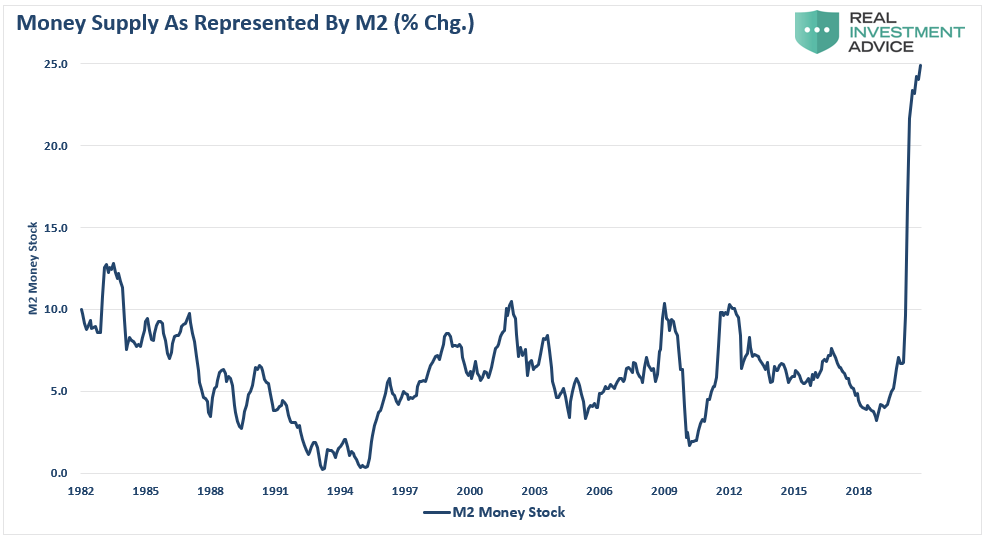
There is little argument currently that the Federal Reserve is “printing money” without any reservation. The chart below is the “supply of money” as represented by M2.
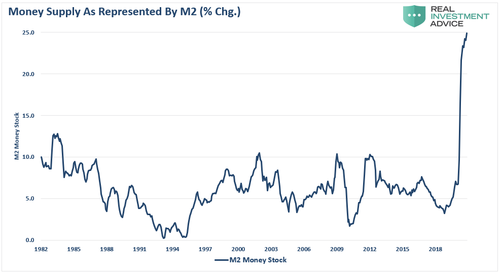
That massive spike in M2 is from the Government’s gigantic monetary rescue to combat the pandemic-related economic shutdown.

“In our analysis, the ‘end game’ for the Fed’s twin asset bubbles in stocks and bonds is inflation.” – Crescat Capital

Of course, if the massive monetary infusions create an economic boom, then a surge in inflation and interest rates should follow. As noted recently by GaveKal:

“In summary, my indicators tell me that US growth will be strong and we are on the right side of the four quadrants framework. As prices seem set to accelerate, we are moving into the upper half, which means that 2021 should see an inflationary boom in the US.”

There are several reasons why expectations may fall short of reality.

Why Printing Money Won’t Create Inflation

For the last 12-years, the annual refrain from economists has been “this year is the year of economic growth and inflation.” Each year has been a disappointment of those expectations.

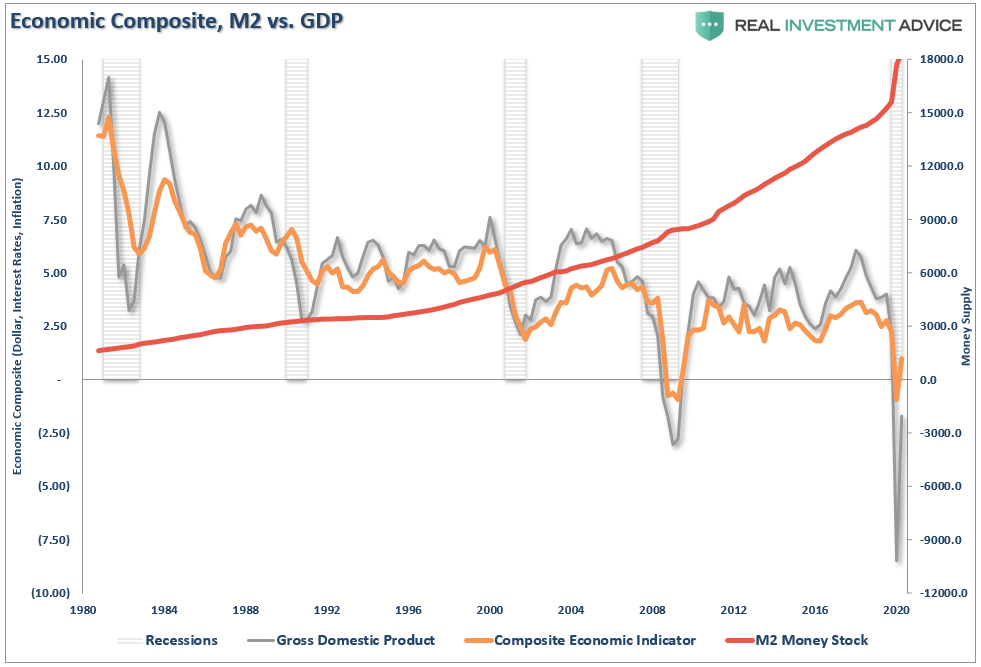
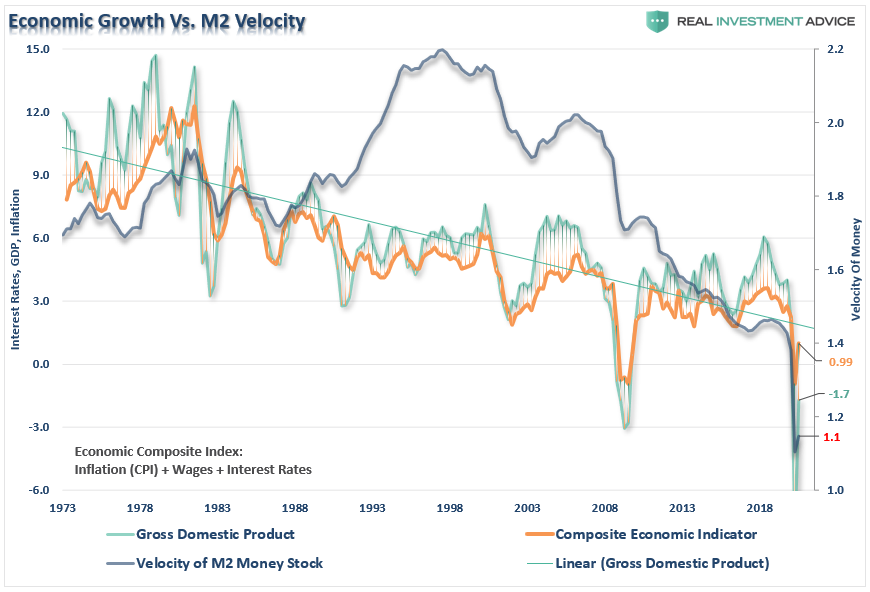
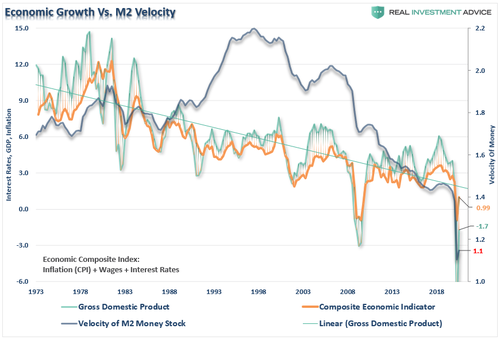
The chart below compares the money supply to GDP growth and our composite economic indicator. The composite includes inflation, wages, and interest rates, which directly correlate to economic activity.
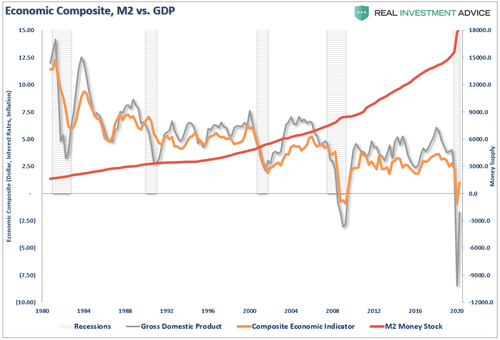
While in theory, “printing money” should lead to an increase in economic activity and inflation, such has not been the case.

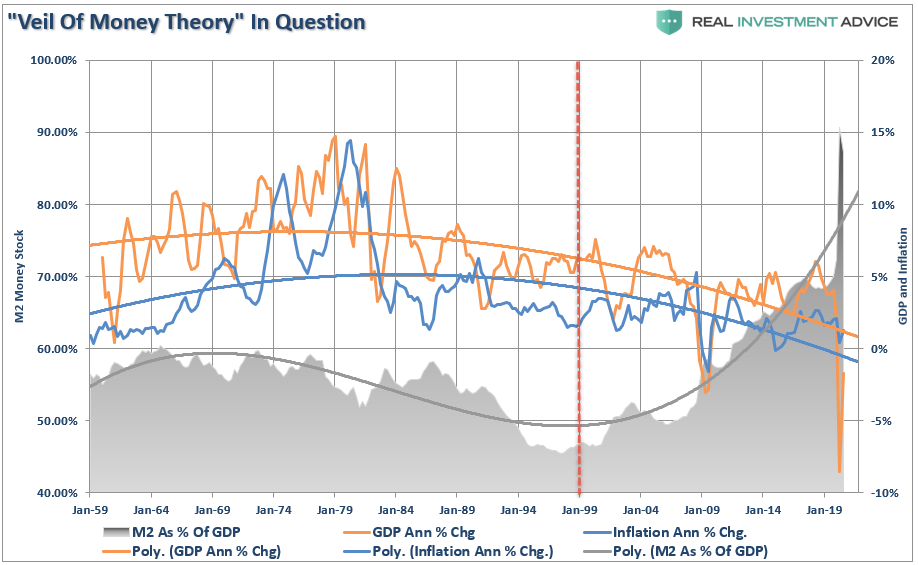
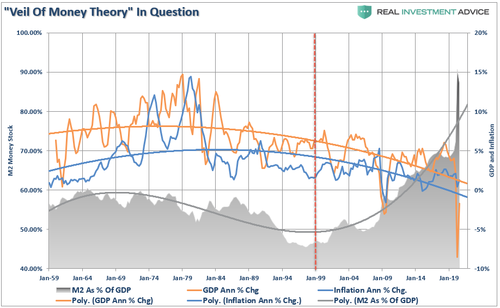
A better way to look at this is through the “veil of money” theory. If money is a commodity, more of it should lead to less purchasing power, resulting in inflation. However, this theory began to fail as Governments attempted to adjust interest rates rather than maintain a gold standard.

As shown, beginning in 2000, the “money supply” as a percentage of GDP has exploded higher without a resulting rise in inflation or economic growth. As shown by the attendant trendlines, it has been quite the opposite.
However, this is where monetary velocity becomes essential.

Monetary Velocity

The Federal Reserve has failed to grasp that monetary policy is “deflationary” when “debt” is required to fund it.

How do we know this? Monetary velocity tells the story.

What is “monetary velocity?” 

“The velocity of money is important for measuring the rate at which money in circulation is used for purchasing goods and services. Velocity is useful in gauging the health and vitality of the economy. High money velocity is usually associated with a healthy, expanding economy. Low money velocity is usually associated with recessions and contractions.” – Investopedia

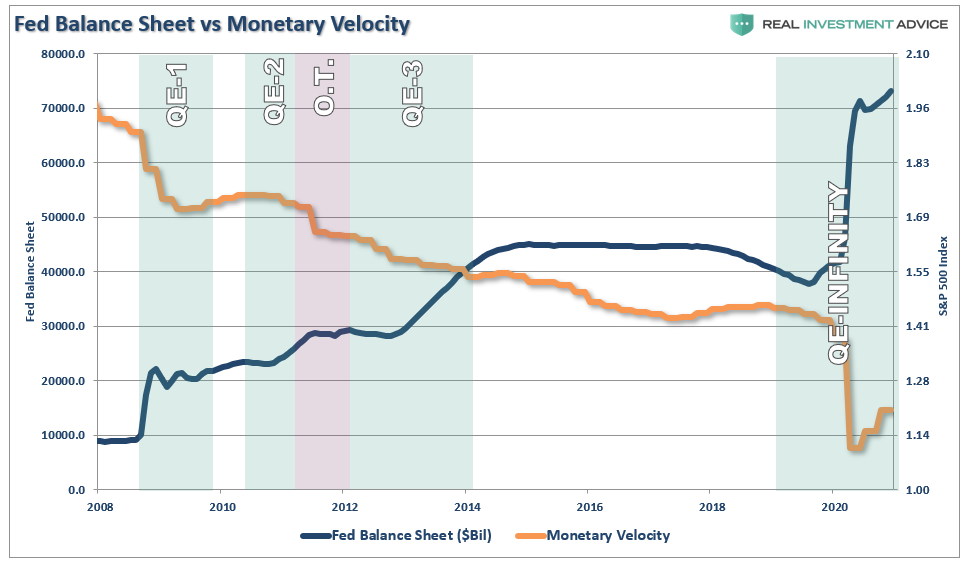
With each monetary policy intervention, the velocity of money has slowed along with the breadth and strength of economic activity.
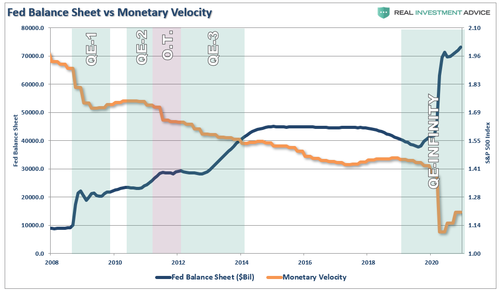
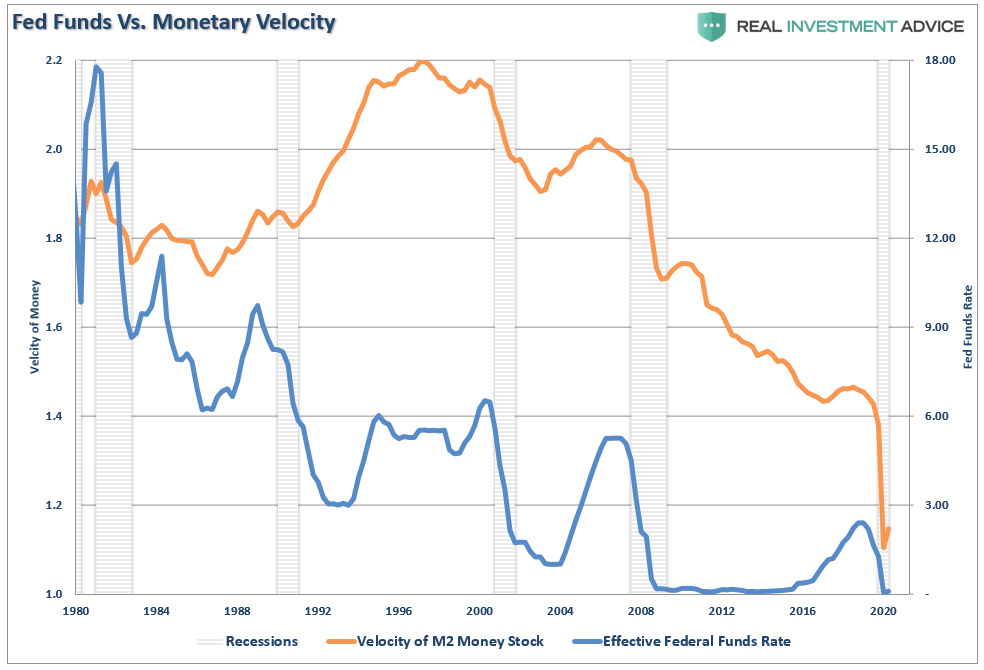
However, it isn’t just the expansion of the Fed’s balance sheet, which undermines the strength of the economy. It is also the ongoing suppression of interest rates to try and stimulate economic activity.

In 2000, the Fed “crossed the Rubicon,” whereby lowering interest rates did not stimulate economic activity. Instead, the “debt burden” detracted from it. (More on this in a moment)
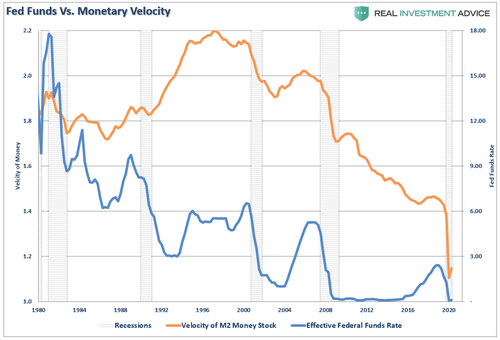
As monetary interventions increased, the “transmission system” became more fractured as the “wealth gap” expanded. Despite perennial hopes that economic growth and inflation would arise from lower rates, more government spending, and increased “accommodative policies,” each iteration led to weaker outcomes.
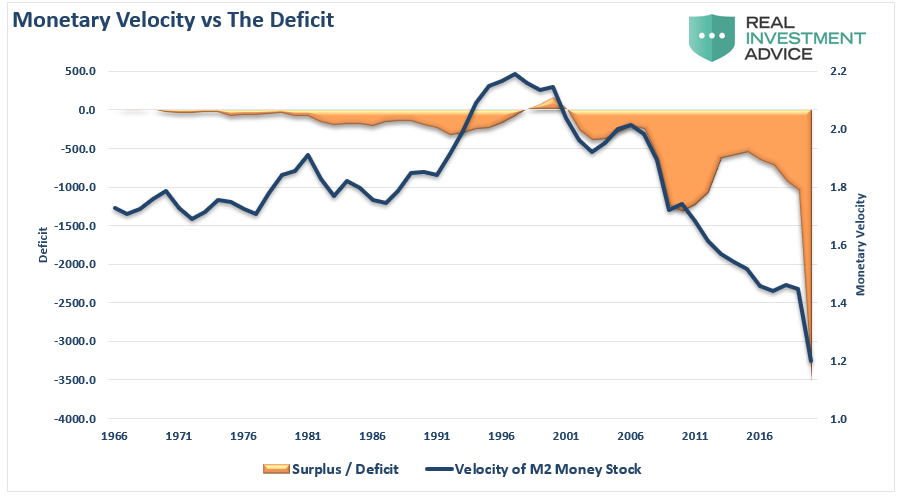
To illustrate the last point, we can compare monetary velocity to the deficit.
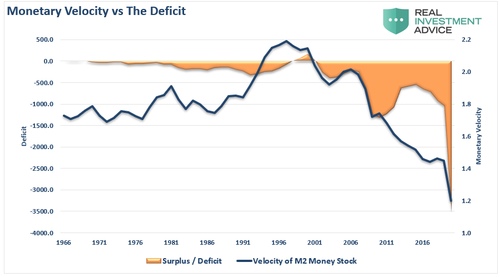
To no surprise, monetary velocity increases when the deficit reverses to a surplus. Financial surpluses allow revenues to move into productive investments rather than debt service.

The problem for the Fed is the misunderstanding of the derivation of organic economic inflation.

Productive Vs. Non-Productive Spending

Since 1980, there has been a shift in the economy’s fiscal makeup from productive to non-productive investment. To explain this concept, we can take a page from Dr. Woody Brock’s “American Gridlock” to explain the difference.

Country A spends $4 Trillion with receipts of $3 Trillion. This leaves Country A with a $1 Trillion deficit. In order to make up the difference between the spending and the income, the Treasury must issue $1 Trillion in new debt. That new debt is used to cover the excess expenditures, but generates no income leaving a future hole that must be filled.

Country B spends $4 Trillion and receives $3 Trillion income. However, the $1 Trillion of excess, which was financed by debt, was invested into projects, infrastructure, that produced a positive rate of return. There is no deficit as the rate of return on the investment funds the “deficit” over time.

Doing It Wrong

As discussed in “The Failing Theory Of MMT:”

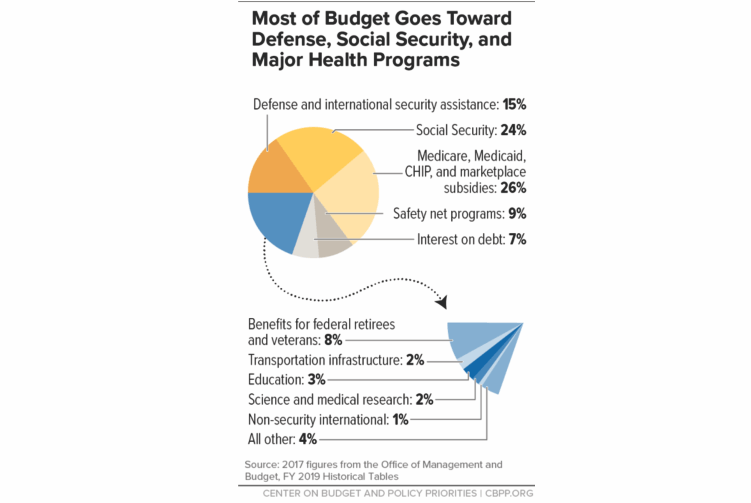
“The problem is government spending has shifted away from productive investments. Instead of things like the Hoover Dam, which creates jobs (infrastructure and development), spending shifted to social welfare, defense, and debt service, which have a negative rate of return.

According to the Center On Budget & Policy Prioritiesnearly 75% of every tax dollar goes to non-productive spending.” 
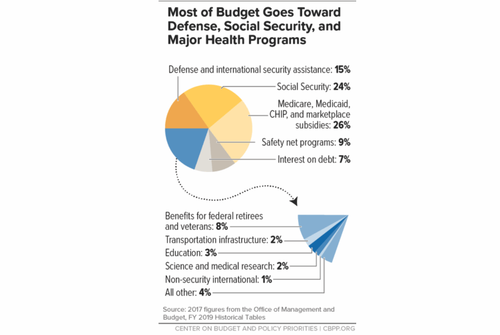
In other words, the U.S. is “Country A.” 

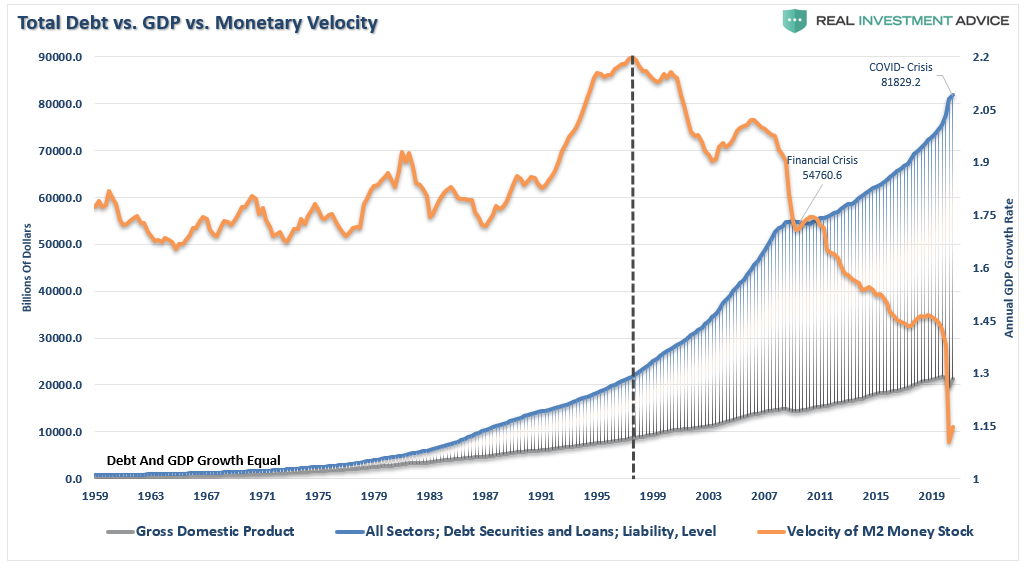
However, since that article was published, the debt swelled by $6.2 trillion in 2020. In an economy saddled by $82 Trillion in debt, the debt is no longer productive as more debt is issued to cover ongoing spending needs. This is why “monetary velocity” began to decline as total debt passed the point of being “productive” to becoming “destructive.”
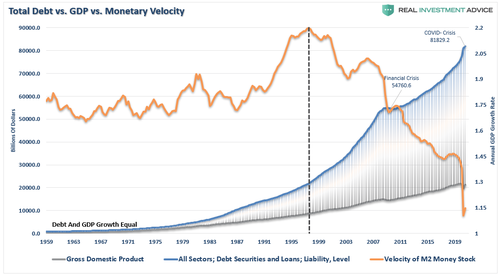
The Federal Reserve problem is that due to the massive levels of debt, interest rates MUST remain low. Any uptick in rates quickly slows economic activity, forcing the Fed to lower rates and support it.

With the economy set to push a $4.2 Trillion deficit in 2020, the deficit’s deflationary pressure will continue to erode economic activity. As noted, even if the Fed does manage to get a spark of inflation, which would push interest rates higher, the debt burden will lead to an economic recession and deflationary pressures.

Why Sending Money To Households Won’t Create Inflation

This time is different because we are sending money directly to households. 

Such is the underlying sentiment behind a universal basic income and its impact on economic growth. Unfortunately, it merely isn’t true.

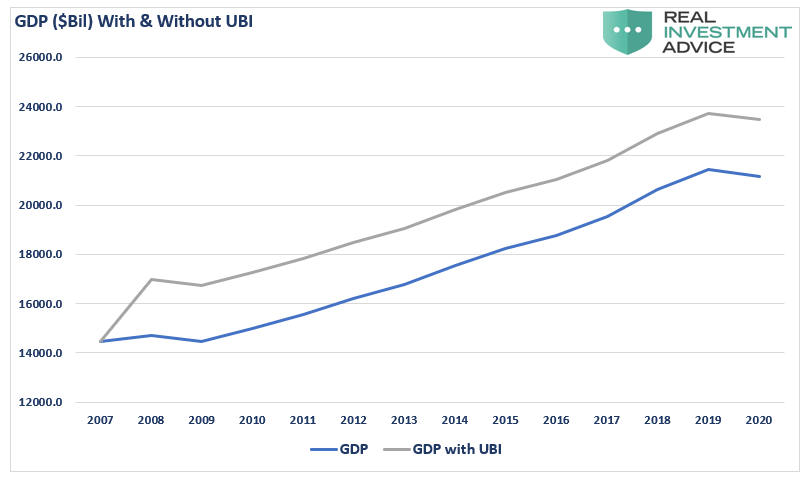
We can run a hypothetical example using GDP from 2007 to the present. (I am using estimates of -1.1% for 2020 GDP growth) In 2008, in response to the “Financial Crisis,” Congress passes a bill providing $1000/month ($12,000 annually) to 190 million families in the U.S. 

The chart below shows the economy’s annual GDP growth trend assuming the entire UBI program shows up in economic growth. For those supporting programs like UBI, it certainly appears as if GDP rises to a higher level. 
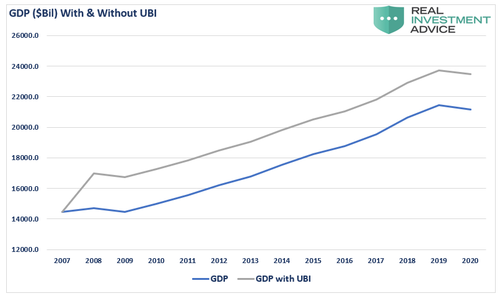
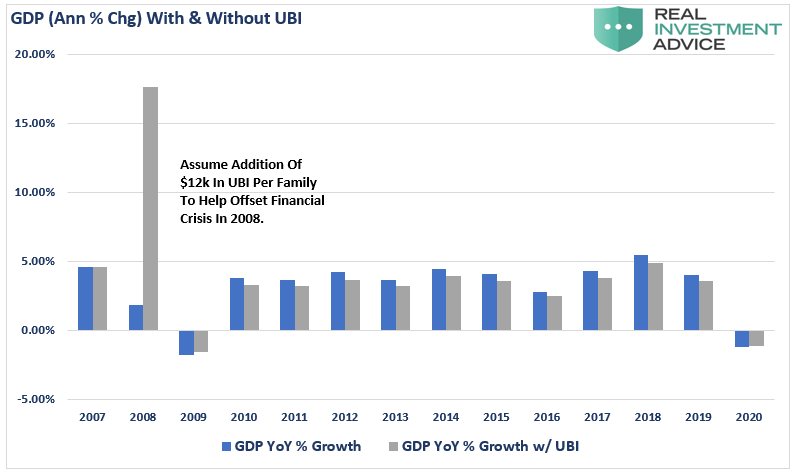
However, such is an illusion. When you look at the annual rate of change in economic growth, which is how we measure GDP for economic purposes, a different picture emerges. In 2008, when the $12,000 arrives at households, GDP spikes, printing a 17% growth rate versus the actual 1.81% rate. Such was also be coincident with a short-term spike in inflationary pressures.
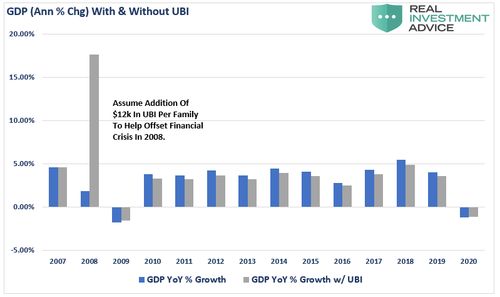
However, in the next year, the growth, along with inflation, disappears.

The reason is that after UBI flows into the system, the economy normalizes to a new level after the first year. Also, notice that GDP grows at a slightly slower rate as the dollar changes to GDP at higher levels print a lower growth rate.

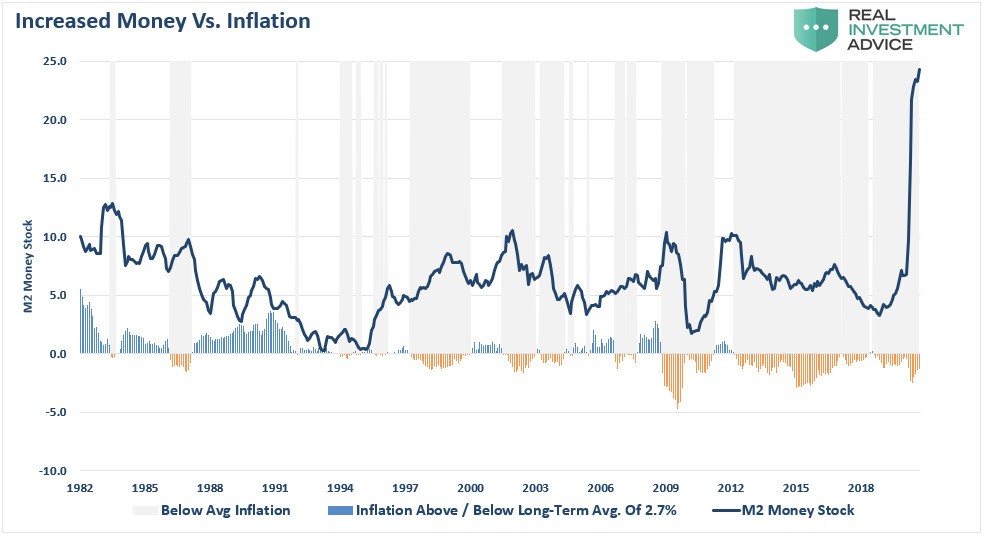
Using the money supply as a proxy, we can see that increased money supply does not increase measured inflation.
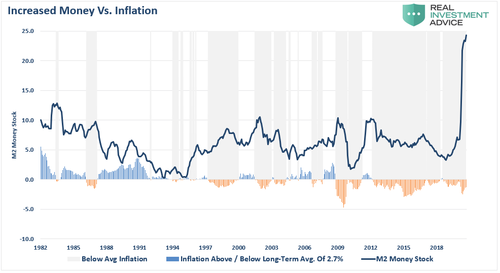
What we find is since 1980, increases in the money supply tend to precede periods of below-average inflation. As noted, this is due to the “debt burden” and non-productive investment of increased money supply.

Deflation Remains The Risk

The debt problem remains a massive risk of monetary to fiscal policy. If rates rise, the negative impact on an indebted economy quickly depresses activity. More importantly, the decline in monetary velocity clearly shows that deflation is a persistent threat.

Treasury&Risk clearly explained the reasoning:

“It is hard to overstate the degree to which psychology drives an economy’s shift to deflation. When the prevailing economic mood in a nation changes from optimism to pessimism, participants change. Creditors, debtors, investors, producers, and consumers all change their primary orientation from expansion to conservation.

  • Creditors become more conservative, and slow their lending.

  • Potential debtors become more conservative, and borrow less or not at all.

  • Investors become more conservative, they commit less money to debt investments.

  • Producers become more conservative and reduce expansion plans.

  • Consumers become more conservative, and save more and spend less.

These behaviors reduce the velocity of money, which puts downward pressure on prices. Money velocity has already been slowing for years, a classic warning sign that deflation is impending. Now, thanks to the virus-related lockdowns, money velocity has begun to collapse. As widespread pessimism takes hold, expect it to fall even further.”

No Real Options

There are no real options for the Federal Reserve unless they are willing to allow the system to reset painfully.

Unfortunately, given we now have a decade of experience of watching monetary experiments only succeed in creating a massive “wealth gap,” maybe we should consider the alternative.

Ultimately, the Federal Reserve, and the Administration, will have to face hard choices to extricate the economy from the current “liquidity trap.”  However, history shows that political leadership never makes hard choices until those choices get forced upon them.

Most telling is the current economists’ inability, who maintain our monetary and fiscal policies, to realize the problem of trying to “cure a debt problem with more debt.”

The Keynesian view that “more money in people’s pockets” will drive up consumer spending, with a boost to GDP being the result, has been wrong. It hasn’t happened in 40 years.

We fear the ongoing policies will continue to lead to further social instability and populism. Such has been the result in every other country which has run such programs of unbridled debts and deficits.

As Dr. Woody Brock aptly argues:

“It is truly ‘American Gridlock’ as the real crisis lies between the choices of ‘austerity’ and continued government ‘largesse.’ One choice leads to long-term economic prosperity for all; the other doesn’t.”

Take your pick.

But 2021 will likely be a disappointment to those expecting more robust economic growth and inflation.

Tyler Durden
Sat, 01/30/2021 – 10:20

via ZeroHedge News https://ift.tt/3r5mPTN Tyler Durden

Russia Deploys Crimea Missile System As Three US Warships Enter Black Sea

Russia Deploys Crimea Missile System As Three US Warships Enter Black Sea

On Thursday a guided-missile destroyer, the USS Porter, was the third American naval vessel to have entered the Black Sea over the past week, with the other two – the USS Donald Cook and USNS Laramie – having been there since Sunday. It’s a significant build-up coming a mere week after Joe Biden entered the White House.

“The US Navy has three warships operating in the Black Sea, stepping up its presence in the region after a drop in overall NATO maritime activity there last year,” Stars and Stripes reports late this week. “The destroyer USS Porter began its transit into the sea Thursday in support of NATO efforts, joining two other Navy vessels conducting operations in the strategic waterway, the Naples, Italy-based 6th Fleet said.”

Prior file image of USS Porter (DDG-78), via USNI

While a beefed up US warship presence in the Black Sea is nothing new, given that as Stars and Stripes has noted the US Navy spent over 80 days in the Black Sea last year, Russia has certainly taken notice.

As Russia’s state-backed TASS news describes, the defense ministry on the same day deployed a mobile coastal defense anti-ship system in Crimea.

A mobile coastal defense anti-ship system Bastion has carried out a march to a deployment site in Crimea within the framework of an exercise being held against the backdrop of the US destroyer Donald Cook’s visit to the Black Sea, the Black Sea Fleet’s information support office said on Thursday.

Crucially the Russian military press release noted that the mobile systems are armed with anti-ship missiles, and are currently prepping for joint drills with Russia Black Sea frigates. “Combat crews arrived in the designated area, readied the systems for combat and carried out preparations for virtual fire,” the TASS report continued.

Despite a bright spot in US-Russian relations coming this week with each side’s negotiators firming up an agreed upon 5-year extension of the landmark New Start strategic nuclear weapons reduction treaty, the White House has still made clear this week it intends to keep up significant pressure on Russia.

Here’s the former commanding general of US Army Europe hailing Biden’s actions to get tough with Russia over Ukrainian sovereignty:

And further on Friday national security adviser Jake Sullivan said that things are going to be “difficult” with Russia. “On Russia, you know, President Biden takes a clear eyed hard edit practical approach to this relationship. It is going to be challenging and difficult because Russia poses threats across multiple dimensions and part of our inheritance,” Sullivan said.

“We will have to be able to impose costs and consequences for Russia’s aggressive behavior and threats to the United States and our allies and at the same time be able to have credible serious clear-eyed negations with them on hard strategic stability issues,” he added.

…So get ready for four years of Democrat-led “Russia, Russia, Russia!” foreign policy talking points and escalation, if this week is any sign of things to come.

Tyler Durden
Sat, 01/30/2021 – 09:55

via ZeroHedge News https://ift.tt/2MI57qs Tyler Durden

Watch: UK Police Harass And Arrest People For Going To Work, Shops

Watch: UK Police Harass And Arrest People For Going To Work, Shops

Authored by Steve Watson via Summit News,

Two viral videos encapsulate the state of the UK at the moment with police abusing powers given to them to enforce lockdown laws. In one case a man was arrested on his way to work for not identifying himself, while another who went to a shop was hauled away for not wearing a mask properly.

West Midlands police were forced to apologise after a man in Solihull was followed, called an idiot, and finally arrested by overly officious police.

The police can be seen harassing the man, asking him where he is going, where he lives and demanding his name.

The guy was just trying to go to work.

When the man refused to give his name, saying “don’t worry about it”, and asked the officer to turn on his body cam, the harassment was ratcheted up.

“What do you mean don’t worry about it?” the officer replied, adding “We’re here to enforce legislation, mate, so I need to know who you are.”

“You don’t need to know who I am – I haven’t committed an offence,” the man replied.

The officer then threatened “under coronavirus legislation you have to provide me with some details, otherwise you’re going to be arrested.”

When the man asked what he was going to be arrested for, the officer said he was “arguing” and that was providing “reasonable suspicion”.

“You’re obviously just harassing me, because I’ve got a hoodie on, I’ve got a coat on, I’m on my way to work, I’m a normal citizen,” the guy replied, adding “Why would I allow someone to just pull me over?”

The officer then replied “We’re the police, we’re not just someone, you idiot.”

“What, so just because you’re the police, that gives you the right to stop anyone you want and get their details?” the man replied, urging “You need to be reinformed about the law.”

The officer then hauled the man away.

The police force later issued a statement noting that “It’s clear that the officer’s conduct fell far below what we would expect.”

“The man explained he was heading to work – that’s clearly a justifiable reason to be out and about and there was no suspicion he had committed any offences,” the statement continued, concluding “As such, he should not have been challenged in the way he was.”

This is far from an isolated incident, with another video emerging showing officers in Merseyside pinning a man to the floor of a supermarket after he refused to give them his name.

Police claim the man was wearing a mask around his neck, not covering the face, which is why officers approached him.

However, the man insisted that he only lowered the mask to clean his glasses, which had steamed up.

“I didn’t want to give my details because I hadn’t done anything wrong and when he grabbed me I tried to pull away,” the man told reporters.

“I was startled and I didn’t know what to do so I tried to get him away from me. He then put my hands behind my back and pushed me onto the floor,” the man added.

Police ejected him from the store and fined him £100, stopping short of arrest.

Supermarkets are being patrolled by police and inspected amid claims that they are not enforcing social distancing rules effectively enough. Some may face fines for ‘bending the rules’, according to reports.

People have been encouraged not to socialise or even talk to friends in the street or supermarket.

In a separate incident, a couple with a baby and a pushchair were grilled by COVID police in Birmingham city centre merely for walking on the street. The report noted that the Police Community Support Officers then began quizzing people who had arrived at a pharmacy to pick up prescription drugs.

Police are also harassing old ladies feeding pigeons, and others walking and sitting on benches in parks or along waterfronts.

Two women were interrogated and fined by police for going on a walk in a remote area 5 miles from where they lived despite this not being illegal under coronavirus laws. Police told the women that hot drinks they were carrying constituted a “picnic”.

The women, Jessica Allen and Eliza Moore, told reporters that the police appeared ‘desperate to fine them’.

As we have previously reported, police recently announced the adoption of a new ‘hardline’ lockdown policy to stop and question people if they are out in the street, and to issue on the spot fines if they cannot provide a reasonable excuse for being out of their houses.

Police also said they would specifically target ‘anti-lockdown, anti-vaccine protesters’, saying that “we now have a hardcore element who are against the rules.”

Police are also demanding new powers to force entry into the homes of suspected lockdown violators.

Videos have already emerged of cops entering people’s homes after receiving reports from snitching neighbours reporting visitors.

As we also highlighted, police are threatening people with fines if they enjoy winter weather.

One local police force even angrily tweeted about “2 reports of snowballs being thrown” in violation of coronavirus lockdown rules.

Another police force threatened people with fines for planning to go sledging in a remote area of North Yorkshire.

Avon and Somerset Police even boasted about fining a person for sitting in their car alone, eating a kebab.

When it comes to following the rules themselves, some police don’t seem to care about complying.

Video emerged of police officers themselves sitting down in a cafe drinking coffee, with the person filming them questioning why they were not following the rules.

Tyler Durden
Sat, 01/30/2021 – 09:20

via ZeroHedge News https://ift.tt/3j3sOWI Tyler Durden

“It Just Doesn’t Work As Expected” – Macron Questions Vaccine Credibility As EU Approves AstraZeneca Jab

“It Just Doesn’t Work As Expected” – Macron Questions Vaccine Credibility As EU Approves AstraZeneca Jab

A battle is raging in Europe over the safety of vaccines on Friday. As the EMA insists that the AstraZeneca’s COVID vaccine was safe, before approving it for everyone over 18, French President Emmanuel Macron has just expressed serious doubts about the jab’s efficacy, just as Europe’s second-largest economy is supposedly struggling to convince citizens to take the vaccine.

Just before the EMA’s expert committee unanimously recommended the vaccine to be used on all adults over 18, concerns were raised this week that not enough data exist to prove that the vaccine works in older people, and those concerns were amplified by Macron, much to the chagrin of some fellow EU leaders.

“The real problem with AstraZeneca is just that it doesn’t work as expected, because there we have very little information,” Macron told a group of foreign reporters at the Elysée Palace on Friday.

The comments come after days of Brussels pushing back against AstraZeneca and other vaccine makers’ delays in delivering the vaccines, even as skepticism of their efficacy remains widespread, especially in France and Germany.

The AstraZeneca jab is only the third given the greenlight by the EMA, after the Pfizer and Moderna jabs.

Europe still approved the jab on Friday, despite widespread doubts and criticisms about whether it’s efficacy. Too many bureaucrats were apparently anxious of the delay in the bloc’s decision to approve and roll out the vaccines. Even the mainstream press acknowledged that “concerns” had been raised about the vaccine’s use in elderly patients.

The trials upon which the EMA based its decision found that the AZ vaccine was roughly 60% effective.

Macron added that the US hadn’t approved the AZ jab yet, and added that France was waiting on the EUA’s decision. Still, the president didn’t sound particularly enthusiastic, and his remarks follow an independent commission advising the German government’s findings that the AZ-Oxford vaccine shouldn’t be used on people over 65.

The French president added that “everything suggests that it is almost ineffective for those over 65, and some say over 60.”

Given that the virus is much more virulent in the elderly and those with comorbidities, four-fifths of those hospitalized with the virus in France are older than 65. Europe has been engaged in a heated confrontation with AZ over whether the vaccine maker was breaking its delivery commitments. When asked about rumors Europe would simply halt vaccines from leaving local factories, the French President insisted that such an infringement on private property wouldn’t be tolerated.

The shortfall of AZ vaccines is expected to be about 60% of the quantity that was hoped for. European Commission head Ursula von der Leyen demanded an explanation for why the company wouldn’t be able to meet its commitments after unspecified problems at one of its factories.

Then again, that’s not exactly reassuring.

Tyler Durden
Sat, 01/30/2021 – 08:45

via ZeroHedge News https://ift.tt/3cq2vIP Tyler Durden

Europe Considers Orwellian Proposal To Protect Its Dairy Industry From Vegan Competitors

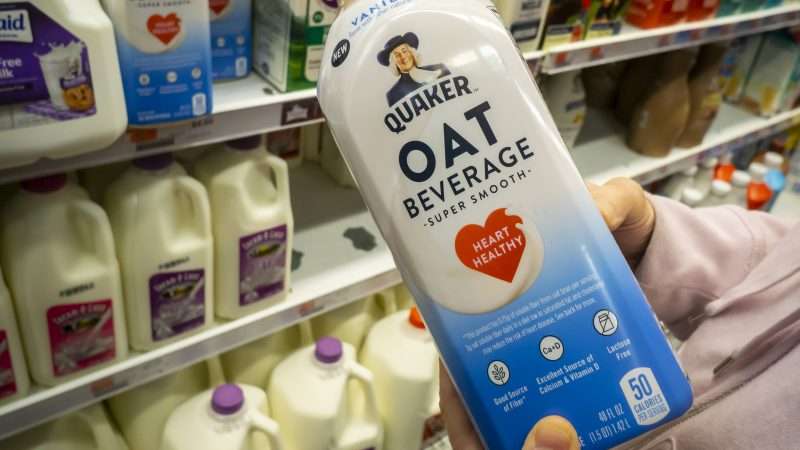
oatmilk

As early as this week, the European Union (E.U.) could deal a nonsensical and significant blow to makers of plant-based dairy substitutes such as almond milk and soy-based yogurt. And though several U.S. states have taken some steps to protect animal-based dairy interests, some of the E.U.’s more obnoxious efforts make those wrongheaded efforts in U.S. states look reasonable by comparison.

In 2017, a European court banned makers of plant-based milks from labeling their milk as “milk.” Since then, as The Conversation explained in an excellent piece this week, the E.U. has moved to place further restrictions on plant-based dairy substitutes.

Opponents of the current E.U. proposal, Amendment 171, have dubbed it the “Dairy Ban.” The law would prohibit plant-based milk producers from using words or images on their food labels that may also be used to describe or refer to animal-based dairy products.

Worse still, the rules could expand beyond simply censoring words and pictures on food packaging. It could even prohibit the use of some common food packaging itself.

“They would also be unable to use packaging designs that call to mind dairy products, such as yoghurt [containers] or milk cartons,” The Conversation explains. “Even simply showing climate impact by comparing the carbon footprint of their products with dairy equivalents could become illegal.

Some of the potential consequences of the proposed E.U. ban, critics contend, could be downright Orwellian.

Amendment 171 has spurred headlines such as “Dairy Lobby Wants to Stop Vegan Brands From Using Images of Their Own Products.” Oatly, the Sweden-based oat milk maker that’s helping lead the charge against Amendment 171, notes the law would prohibit it and other plant-based food companies from using the phrase “does not contain milk” to describe “products that don’t um…contain milk.”

That would be exactly as preposterous as it sounds.

Why are E.U. lawmakers leading the charge against the powerful animal-based dairy industry’s upstart plant-based competitors? Simple. Lawmakers are doing so at the behest of those same powerful animal-based dairy interests.

The dairy lobby (both in the U.S. and E.U.) claims the honest and accurate labeling, imagery, and packaging used by most plant-based competitors misleads consumers. It does not.

“No reasonable consumer would confuse soymilk or almond milk with cow’s milk,” an advocate for plant-based foods told me in a 2017 column I wrote on wrongheaded efforts to protect the U.S. dairy industry from plant-based competitors. “In fact, demand for plant-based milks is on the rise precisely because consumers are seeking out dairy-free options.”

While plant-based meat and dairy substitutes are indeed a small-but-growing segment of the global food market, that growth has been slowed by the lawmakers who have pushed burdensome rules.

Here in the U.S., lawmakers in several states have mimicked some of the worst inclinations of lawmakers in Brussels. In 2018, Missouri became “the first state to take steps to prevent misrepresentation of products as meat that are not derived from livestock or poultry,” banning vegan and vegetarian imitators from using the term “meat” to refer to their products. Since then, the National Conference of State Legislatures reports at least 10 U.S. states have adopted similar laws.

Plant-based food makers have sued to overturn some of these laws, including Missouri’s. And these lawsuits often reveal the inanity of the laws they’re challenging. For example, as I explained in a column last year, a federal judge in California—a state that has targeted vegan dairy companies—ruled that the “maker of a vegan butter, may use the word ‘butter’ to describe its, well, vegan butter.”

In the United States, at least, these various state laws barring plant-based food makers from honestly describing the products they sell violate their First Amendment rights. And they violate the First Amendment rights of consumers to see, read, and be informed by those honest descriptions.

As I urged in a 2012 column, food companies should be free to use “any and all statements that aren’t demonstrably false” on their product labels. Plant-based food companies are no exception.

While the rights of food companies and consumers may differ to some extent in the E.U., the same general principles apply equally there and in the U.S.: consumers are served best when the law allows companies to tell the truth about their food products. That’s why the growing European crackdown on plant-based foods, which violates that principle, is so harmful and should be reversed.

from Latest – Reason.com https://ift.tt/36qFgux
via IFTTT

Europe Considers Orwellian Proposal To Protect Its Dairy Industry From Vegan Competitors

oatmilk

As early as this week, the European Union (E.U.) could deal a nonsensical and significant blow to makers of plant-based dairy substitutes such as almond milk and soy-based yogurt. And though several U.S. states have taken some steps to protect animal-based dairy interests, some of the E.U.’s more obnoxious efforts make those wrongheaded efforts in U.S. states look reasonable by comparison.

In 2017, a European court banned makers of plant-based milks from labeling their milk as “milk.” Since then, as The Conversation explained in an excellent piece this week, the E.U. has moved to place further restrictions on plant-based dairy substitutes.

Opponents of the current E.U. proposal, Amendment 171, have dubbed it the “Dairy Ban.” The law would prohibit plant-based milk producers from using words or images on their food labels that may also be used to describe or refer to animal-based dairy products.

Worse still, the rules could expand beyond simply censoring words and pictures on food packaging. It could even prohibit the use of some common food packaging itself.

“They would also be unable to use packaging designs that call to mind dairy products, such as yoghurt [containers] or milk cartons,” The Conversation explains. “Even simply showing climate impact by comparing the carbon footprint of their products with dairy equivalents could become illegal.

Some of the potential consequences of the proposed E.U. ban, critics contend, could be downright Orwellian.

Amendment 171 has spurred headlines such as “Dairy Lobby Wants to Stop Vegan Brands From Using Images of Their Own Products.” Oatly, the Sweden-based oat milk maker that’s helping lead the charge against Amendment 171, notes the law would prohibit it and other plant-based food companies from using the phrase “does not contain milk” to describe “products that don’t um…contain milk.”

That would be exactly as preposterous as it sounds.

Why are E.U. lawmakers leading the charge against the powerful animal-based dairy industry’s upstart plant-based competitors? Simple. Lawmakers are doing so at the behest of those same powerful animal-based dairy interests.

The dairy lobby (both in the U.S. and E.U.) claims the honest and accurate labeling, imagery, and packaging used by most plant-based competitors misleads consumers. It does not.

“No reasonable consumer would confuse soymilk or almond milk with cow’s milk,” an advocate for plant-based foods told me in a 2017 column I wrote on wrongheaded efforts to protect the U.S. dairy industry from plant-based competitors. “In fact, demand for plant-based milks is on the rise precisely because consumers are seeking out dairy-free options.”

While plant-based meat and dairy substitutes are indeed a small-but-growing segment of the global food market, that growth has been slowed by the lawmakers who have pushed burdensome rules.

Here in the U.S., lawmakers in several states have mimicked some of the worst inclinations of lawmakers in Brussels. In 2018, Missouri became “the first state to take steps to prevent misrepresentation of products as meat that are not derived from livestock or poultry,” banning vegan and vegetarian imitators from using the term “meat” to refer to their products. Since then, the National Conference of State Legislatures reports at least 10 U.S. states have adopted similar laws.

Plant-based food makers have sued to overturn some of these laws, including Missouri’s. And these lawsuits often reveal the inanity of the laws they’re challenging. For example, as I explained in a column last year, a federal judge in California—a state that has targeted vegan dairy companies—ruled that the “maker of a vegan butter, may use the word ‘butter’ to describe its, well, vegan butter.”

In the United States, at least, these various state laws barring plant-based food makers from honestly describing the products they sell violate their First Amendment rights. And they violate the First Amendment rights of consumers to see, read, and be informed by those honest descriptions.

As I urged in a 2012 column, food companies should be free to use “any and all statements that aren’t demonstrably false” on their product labels. Plant-based food companies are no exception.

While the rights of food companies and consumers may differ to some extent in the E.U., the same general principles apply equally there and in the U.S.: consumers are served best when the law allows companies to tell the truth about their food products. That’s why the growing European crackdown on plant-based foods, which violates that principle, is so harmful and should be reversed.

from Latest – Reason.com https://ift.tt/36qFgux
via IFTTT

Risk Of A Lost Decade?!

Risk Of A Lost Decade?!

Authored by Daniel Lacalle,

The World Bank alerts of the risk of a lost decade in its latest Global Outlook report.

What would constitute a “lost decade” and why would it happen? Unlike what many think, a lost decade is not ten years of zero growth, but a very weak improvement in GDP, productivity, and with it, jobs and salaries.

Such a risk comes after the massive stimulus plans and massive debt increases of 2020.

We know from the past seventy years that economies show a weaker recovery with poor job improvements after massive debt increases. This will likely be the same.

The debt overhang will likely cripple productivity growth because many sectors have been zombified, investment is probably going to suffer due to the maintenance of overcapacity coming from massive liquidity injections and, as such, real salaries show a weaker improvement as productivity growth stalls.

This is particularly risky because it was already a concern in 2015-2019. The rise in zombie companies, governments entering into large deficits in growth times and weak productivity improvements were already challenges in advanced economies in the so-called growth period after the 2008 crisis.

History shows us that adding massive debt in the years of crisis leads later to weaker recoveries. This will not be an exception.

The question may be “what should be done”?

Probably what no government wants to do. Abandon demand-side policies and using government and central banks as the lender of first resort and embrace supply side measures that allow a productive clean-up of the exces slack in the economy.

In the eurozone the lost decade was already a risk before Covid-19. Now it is even a larger risk as central banks and governments ignore the imbalances and excess spending and embark on copying Japan without its technology or foreign exchange saving.

Tyler Durden
Sat, 01/30/2021 – 08:10

via ZeroHedge News https://ift.tt/3pxQsNl Tyler Durden