The Senate’s Problem Isn’t the Filibuster, It’s a Lack of Open Debate

schumer

While Democrats have not yet abolished the filibuster, they have rejected Republican demands that they commit to maintaining the Senate’s current rules over the next two years. Some Democrats are even threatening to blow up those rules if Republicans try to filibuster President Joe Biden’s agenda. However, doing so will make the Senate even more dysfunctional than it is now.

Ending the filibuster will make it harder for senators to adjudicate their constituents’ concerns, to negotiate with one another as equals, and to compromise. The Senate is one of only two places in the federal government where elected officials can gather to reconcile their disagreements and make collective decisions. And the Senate’s rules are vital to making that debate process work.

The Senate’s rules are designed to facilitate lawmaking by pushing senators to agree with one another. They do so by making the legislative process more predictable and reliable than it would be otherwise. That makes it possible for senators to form expectations about what will happen in the future and, by extension, make it easier to compromise in the present. And it gives senators leverage in negotiations. Those rules also lead to stable policy by reconciling losers in a debate to its outcome. For example, Sen. Richard Russell (D–Ga.) led the filibuster against the Civil Rights Act of 1964. After he failed to stop the bill, Russell accepted the outcome as legitimate and urged his fellow southern senators to do so as well.

Breaking those rules to abolish the filibuster would make it harder, not easier, for the Senate to function.

Unlike in the House of Representatives, where a simple majority can vote to end debate at any point, the Senate’s rules require a three-fifths majority to end debate over senators’ objections. The rules require an even larger two-thirds majority to end debate when the underlying legislation is a proposal to change the Senate rules. It thus takes more votes to end a filibuster (typically 60 senators) than it does to pass a bill (typically 51 senators).

In the past, senators rightly understood that their ability to filibuster was not absolute; it merely gave individual senators leverage to force their colleagues, the House, or the administration to negotiate with them in a debate. That is why legislation approved by the Senate almost always included minority-favored provisions in addition to those supported by the majority. In that way, the filibuster facilitated negotiation and compromise.

That changed as the gap between Democrats and Republicans widened in the late 20th century. Once a source of leverage that specific senators could use in negotiations, the filibuster morphed into a veto that Senate minorities could use to block legislation favored by the majority. Even the prospect of a filibuster is a powerful force—in recent years, gun-related legislation has stalled in the Senate, not because a committed minority is filibustering it but because senators on both sides are threatening to filibuster it.

Yet despite how it may operate, the filibuster is not really a veto. It does not level the playing field between the majority and minority sides in debates. It merely grants a senator, or senators, the opportunity to speak on the Senate floor for as long as possible. Using the filibuster to obstruct the majority regularly requires minority-party senators to be willing to expend considerable effort to succeed. And the filibuster cannot cause gridlock in a debate of reasonable length because no two sides in any debate are evenly matched in terms of their members’ effort. One group of senators must always prevail after a debate. Gridlock only occurs when senators do not debate.

The filibuster operates like a veto today because Senate majorities are unwilling to use the rules to pass legislation. Senators may temporarily delay particular aspects of that agenda by speaking on the floor. But they cannot prevent the Senate from voting in perpetuity, because filibustering imposes physical and opportunity costs and because of the procedural limitations contained in the Senate’s existing rules and practices.

For example, Rule XIX limits how many times a senator may speak on the floor in a debate and it stipulates that when a senator is no longer able to talk, he or she has no choice but to yield the floor. At that point, the Senate votes on the underlying question unless another senator seeks recognition and then speaks for as long as he or she desires and is able. While the length of the Senate’s business delay is proportional to the number of senators who participate in a filibuster, there is no point at which business gets delayed indefinitely, since individual senators can speak for only a finite period. When no senator seeks recognition in a debate, the Senate must vote.

The Senate will rarely need to go to such lengths to overcome filibusters because simply debating a bill before trying to pass it creates buy-in among senators and builds bipartisan support for it. Legislation on issues like COVID-19 relief, criminal justice reform, privacy, and trade can pass on large bipartisan votes if leaders let the process play out instead of trying to control it. A freewheeling debate in which all senators can participate makes it easier for cross-partisan coalitions to emerge. And it also helps constituents assign responsibility for policy outcomes and hold their elected officials accountable in the next election.

Abolishing the filibuster will therefore not make it easier for senators to negotiate and compromise. Instead, it will give majorities an incentive to craft major bills behind closed doors and pass them through the chamber as quickly as possible by limiting senators’ ability to participate in the legislative process. The result will be to make the Senate even more dysfunctional than it is now.

from Latest – Reason.com https://ift.tt/3j3hPMA
via IFTTT

The Senate’s Problem Isn’t the Filibuster, It’s a Lack of Open Debate

schumer

While Democrats have not yet abolished the filibuster, they have rejected Republican demands that they commit to maintaining the Senate’s current rules over the next two years. Some Democrats are even threatening to blow up those rules if Republicans try to filibuster President Joe Biden’s agenda. However, doing so will make the Senate even more dysfunctional than it is now.

Ending the filibuster will make it harder for senators to adjudicate their constituents’ concerns, to negotiate with one another as equals, and to compromise. The Senate is one of only two places in the federal government where elected officials can gather to reconcile their disagreements and make collective decisions. And the Senate’s rules are vital to making that debate process work.

The Senate’s rules are designed to facilitate lawmaking by pushing senators to agree with one another. They do so by making the legislative process more predictable and reliable than it would be otherwise. That makes it possible for senators to form expectations about what will happen in the future and, by extension, make it easier to compromise in the present. And it gives senators leverage in negotiations. Those rules also lead to stable policy by reconciling losers in a debate to its outcome. For example, Sen. Richard Russell (D–Ga.) led the filibuster against the Civil Rights Act of 1964. After he failed to stop the bill, Russell accepted the outcome as legitimate and urged his fellow southern senators to do so as well.

Breaking those rules to abolish the filibuster would make it harder, not easier, for the Senate to function.

Unlike in the House of Representatives, where a simple majority can vote to end debate at any point, the Senate’s rules require a three-fifths majority to end debate over senators’ objections. The rules require an even larger two-thirds majority to end debate when the underlying legislation is a proposal to change the Senate rules. It thus takes more votes to end a filibuster (typically 60 senators) than it does to pass a bill (typically 51 senators).

In the past, senators rightly understood that their ability to filibuster was not absolute; it merely gave individual senators leverage to force their colleagues, the House, or the administration to negotiate with them in a debate. That is why legislation approved by the Senate almost always included minority-favored provisions in addition to those supported by the majority. In that way, the filibuster facilitated negotiation and compromise.

That changed as the gap between Democrats and Republicans widened in the late 20th century. Once a source of leverage that specific senators could use in negotiations, the filibuster morphed into a veto that Senate minorities could use to block legislation favored by the majority. Even the prospect of a filibuster is a powerful force—in recent years, gun-related legislation has stalled in the Senate, not because a committed minority is filibustering it but because senators on both sides are threatening to filibuster it.

Yet despite how it may operate, the filibuster is not really a veto. It does not level the playing field between the majority and minority sides in debates. It merely grants a senator, or senators, the opportunity to speak on the Senate floor for as long as possible. Using the filibuster to obstruct the majority regularly requires minority-party senators to be willing to expend considerable effort to succeed. And the filibuster cannot cause gridlock in a debate of reasonable length because no two sides in any debate are evenly matched in terms of their members’ effort. One group of senators must always prevail after a debate. Gridlock only occurs when senators do not debate.

The filibuster operates like a veto today because Senate majorities are unwilling to use the rules to pass legislation. Senators may temporarily delay particular aspects of that agenda by speaking on the floor. But they cannot prevent the Senate from voting in perpetuity, because filibustering imposes physical and opportunity costs and because of the procedural limitations contained in the Senate’s existing rules and practices.

For example, Rule XIX limits how many times a senator may speak on the floor in a debate and it stipulates that when a senator is no longer able to talk, he or she has no choice but to yield the floor. At that point, the Senate votes on the underlying question unless another senator seeks recognition and then speaks for as long as he or she desires and is able. While the length of the Senate’s business delay is proportional to the number of senators who participate in a filibuster, there is no point at which business gets delayed indefinitely, since individual senators can speak for only a finite period. When no senator seeks recognition in a debate, the Senate must vote.

The Senate will rarely need to go to such lengths to overcome filibusters because simply debating a bill before trying to pass it creates buy-in among senators and builds bipartisan support for it. Legislation on issues like COVID-19 relief, criminal justice reform, privacy, and trade can pass on large bipartisan votes if leaders let the process play out instead of trying to control it. A freewheeling debate in which all senators can participate makes it easier for cross-partisan coalitions to emerge. And it also helps constituents assign responsibility for policy outcomes and hold their elected officials accountable in the next election.

Abolishing the filibuster will therefore not make it easier for senators to negotiate and compromise. Instead, it will give majorities an incentive to craft major bills behind closed doors and pass them through the chamber as quickly as possible by limiting senators’ ability to participate in the legislative process. The result will be to make the Senate even more dysfunctional than it is now.

from Latest – Reason.com https://ift.tt/3j3hPMA
via IFTTT

Hungary Approves China Vaccine As Rift With Brussels Grows 

Hungary Approves China Vaccine As Rift With Brussels Grows 

Discontent with the AstraZeneca vaccine has caused Hungary’s drug regulator to approve a COVID-19 vaccine from China’s Sinopharm for emergency use, according to Reuters.

On Friday, Hungarian Prime Minister Viktor Orban told state radio the purchase of Sinopharm’s vaccine could be completed imminently. 

Orban has been frustrated by Brussels’ leadership surrounding the vaccine rollout. He said last week, he signed a deal with Sinopharm. 

“We have several million Chinese vaccines we could get tomorrow morning or in a few days,” Orban said last week. 

More details are emerging of just how large the purchase will be. Hungarian Foreign Minister Peter Szijjarto said upwards of five million COVID-19 vaccines from Sinopharm are ready to be purchased. 

Orban was quoted by Reuters this week as saying he only trusts the Chinese vaccine. 

The National Institute of Pharmacy and Nutrition (OGYÉI), otherwise known as the Hungarian drug regulator, granted Sinopharm’s vaccine permission for emergency use late this week. 

“Today the OGYEI (Hungarian drug regulator) has issued the permission to use the Sinopharm vaccine as well, so after Pfizer, Moderna, Astra Zeneca and the Russian Sputnik vaccine, we can also count on the Sinopharm shot,” surgeon general Cecilia Muller told a briefing.

Muller said the Sinopharm vaccine would help the country combat the virus pandemic among an arsenal of vaccines from other companies. 

Hungary’s move comes as difficulties in shipping and storing the AstraZeneca-Oxford jab have caused a much slower roll out across Europe than previously anticipated. Europe expected 100MM doses of the vaccine to be ready during the first quarter of the year, but the big-pharma is only expected to deliver half of that. 

The move also reflects the Hungarian government’s mistrust of Brussels, as they could move closer to China and perhaps even Russia. The geopolitics of vaccine distribution could push Hungary further away from the EU.  

This is not the first time the Hungarian government has grown skeptical of Brussels. Over the years, Hungarian politicians have been displeased with the EU’s migration and economic policies.

Although the Russian Sputnik V vaccine had been approved, Muller said Sputnik V would undergo more testing and that may concluded as early as next week. 

Tyler Durden
Sat, 01/30/2021 – 07:35

via ZeroHedge News https://ift.tt/3pzt1mT Tyler Durden

The Sordid History of the Fairness Doctrine

radio_right

After Twitter permanently suspended Donald Trump’s account, conservative interest in mandating online platform neutrality spiked. Meanwhile, progressives alarmed by the Capitol riot called for reviving the Fairness Doctrine to combat the misinformation circulating about the election. The national mood has never been more favorable for some kind of government regulation of the internet.

The Fairness Doctrine hasn’t been active policy at the Federal Communications Commission (FCC) since the 1980s, so public knowledge of the doctrine is hazy at best. But the more you learn about the actual history of the Fairness Doctrine and its antecedents, the clearer it becomes that applying similar regulations to the internet would be a mistake.

When many people hear the phrase “Fairness Doctrine,” they picture a time at some indeterminate point in the past when broadcast media were reasonable and balanced. Back then, they imagine, radio and television station owners couldn’t air only their own opinions and spread unchecked misinformation; they had to let the other side on any given hot-button issue have a say, allowing the “good guys” to act as a check on the “bad guys” and their lies.

That narrative is almost entirely a myth. Despite its evocative name, the Fairness Doctrine was primarily a tool wielded by established political interests to suppress unwelcome speech.

The true story of the Fairness Doctrine begins long before the first major implementation of the doctrine in 1963, back before the rule was enacted in 1949, back all the way to the Radio Act of 1927. That law created the FCC’s precursor, the Federal Radio Commission (FRC), and gave it the power to license and limit radio stations. Among other things, the law required licensees to promote “the public interest, convenience, and necessity” and not simply to serve their own interests.

Does that sound vague to you? It certainly did to station owners in the 1920s and ’30s. Whose convenience are we talking about? What content is necessary and what is not? Is there even such a thing as a singular public interest? The inherent ambiguity also meant incredible opportunities for graft and political privilege. In practice, the more political connections and capital you possessed, the more “public interest” your license application had. The commission maintained a revolving door with the major radio networks, and the networks quickly consolidated what had been a relatively diverse and independent radio landscape.

Non-WASPs and political radicals in particular faced an uphill battle when applying for station licenses. In 1928, for example, the FRC attempted to reassign the license for the leftist Queens station WEVD, named after the socialist leader Eugene Victor Debs. It took a major public pressure campaign to convince the agency that the station showed “due regard for the opinions of others,” which was necessary given that they were “the mouthpiece of a substantial political or religious minority” and thus not naturally deserving of a broadcast voice. Of course, non-socialist stations never had to show a similar “due regard”; it was taken for granted that they represented the public interest.

Similarly, in 1933 the FRC decided that two stations in Chicago—WIBO and WPCC, which served a predominantly immigrant audience—should lose their licenses to a new station, WJKS, because the latter’s programming was better “designed to meet the needs of the foreign population.” By what standard? Well, WJKS promised to air programming that “stress[ed] loyalty to the community and the Nation” and taught “American ideals and responsibilities.” The FRC had decided that the public interest was synonymous with ethno-nationalist self-interest, the 1930s regulatory version of an “English only” sign.

Federal regulation ensured that radio broadcasting in the 1930s became less diverse, less weird, less independent, more corporate, more anodyne, and more centralized. Even actress and comedian Mae West was barred from the airwaves for 13 years after she dared to utter this shocking obscenity in a 1937 radio sketch: “Come on home with me, honey. I’ll let you play in my wood pile.” Thank goodness the government was there to protect the public interest against mild innuendo!

The commission’s crackdown did not go unchallenged. Take “Fightin’ Bob” Shuler, a muckraking fundamentalist pastor from Los Angeles who used his platform to expose local politicians and businessmen for their involvement in one of the largest financial frauds to that point in U.S. history, the Julian Petroleum scandal. His enemies retaliated by asking the FRC not to renew his license, and the commission proceeded to revoke his right to broadcast. Shuler sued, claiming a violation of his free speech rights.

The case, Trinity Methodist Church South v. Federal Radio Commission (1932), made its way to a federal circuit court, which denied Shuler’s claim and, more importantly, upheld the FRC’s power to license or deny stations on the basis of the content of their speech. All subsequent jurisprudence on broadcast speech regulation hinged on this and a handful of other cases from the time.

There’s a vital contrast between what was happening with First Amendment claims in broadcasting versus developments in print media. Just a year prior to Shuler’s case, the U.S. Supreme Court had ruled in Near v. Minnesota (1931) that prior restraint on newspapers by state governments was censorship. As a result, two radically different media regimes emerged: Print speech got ever firmer and clearer protections, while radio speech received distinctly second-class status. The FCC could freely grant or pull licenses based on whether it believed a station’s speech fit within “the public interest,” which in turn meant whatever a small group of industry lobbyists, political flunkies, and communications lawyers managed to form a consensus about.

How did the government get away with denying broadcasters full free speech rights? When challenged in cases like Trinity, they appealed to something called the “scarcity rationale.” Since the electromagnetic spectrum is physically finite, they argued, the First Amendment shouldn’t apply to radio. The government needed to choose winners and losers, because someone had to decide who got a license and who did not.

This was always a convenient legal fiction, if for no other reason than because the FCC has never hit the technical limit on the number of possible broadcast stations, either then or now. To the extent that there was scarcity on the airwaves, it was artificially imposed by the FCC itself. By limiting the number of stations, the agency protected powerful media companies from competition, as when it delayed regulatory approval for FM radio because of lobbying by businesses heavily invested in AM broadcasting. Nevertheless, the courts bought the scarcity rationale excuse until the 1990s.

Thus, a readily corruptible government agency with a sweeping but ambiguous mandate had authority over the airwaves. Politicians quickly discerned an opportunity to manipulate the regulators for political advantage. President Franklin Delano Roosevelt, for example, had little tolerance for those who questioned the New Deal. Some of his most vociferous opponents were conservative newspaper owners, who were increasingly critical after Roosevelt’s Supreme Court–packing scheme in 1937. Now, Roosevelt couldn’t go after them directly, thanks to that pesky First Amendment, but many of these newspapermen had begun to buy radio stations, and in that arena FDR could target them for special regulatory attention.

As one former commissioner put it, Roosevelt “put the blow torch” on his FCC chairman, Larry Fly, to use various regulations to shut down the president’s enemies. Among other measures, Fly proposed a cross-media ownership ban; it ultimately failed but it still tied up newspaper acquisition of FM licenses for several years. (President Richard Nixon’s FCC would ultimately enact a cross-media ownership ban in an attempt to intimidate the owner of The Washington Post into easing up on the paper’s Watergate reporting.)

Fly’s most lasting legacy was the Mayflower Doctrine, a direct precursor of the Fairness Doctrine. In the 1941 Mayflower decision, the FCC ruled that a station that had “editorialized” by criticizing FDR would lose its license to a disgruntled former employee. “A truly free radio,” Fly wrote, “cannot be used to advocate the causes of the licensee. It cannot be used to the support of principles he happens to regard most favorably. In brief, the broadcaster cannot be an advocate.” Well, then. 

The radio industry pushed back, and in 1949 the FCC backed away from the ban on editorializing. But it kept a crucial component, which was that licensees operated “under an obligation to insure that opposing points of view will also be presented.” This 1949 statement was the basis of the Fairness Doctrine. But the Fairness Doctrine remained notional from 1949 to 1963, with relatively little attempt to exercise the vast powers the FCC had claimed for itself—certainly nothing as extensive as its efforts during the 1930s. Yet something big was changing in the broadcasting industry, something with enormous consequences for regulatory policy.

After World War II, the major networks, which had controlled 95 percent of all radio stations in America in 1945, shifted their attention and capital investment to television. By 1952, fewer than half of radio stations were network affiliates, a ratio that continued to fall through the rest of the decade. Most new radio licenses during this period were going to small-timers—say, a local car dealer who wanted a station to advertise his business. Finances were tight for these independent stations, so the owners were open to selling timeslots to groups the networks wouldn’t have given the time of day to. 

That included a new generation of right-wing broadcasters, who (mostly unfairly) attacked liberals and Democrats as unpatriotic Communist sympathizers. After President John F. Kennedy’s election in 1960, he became a particular target of these broadcasters, who went after everything from his mishandling of the Bay of Pigs invasion to his proposed Nuclear Test Ban Treaty.

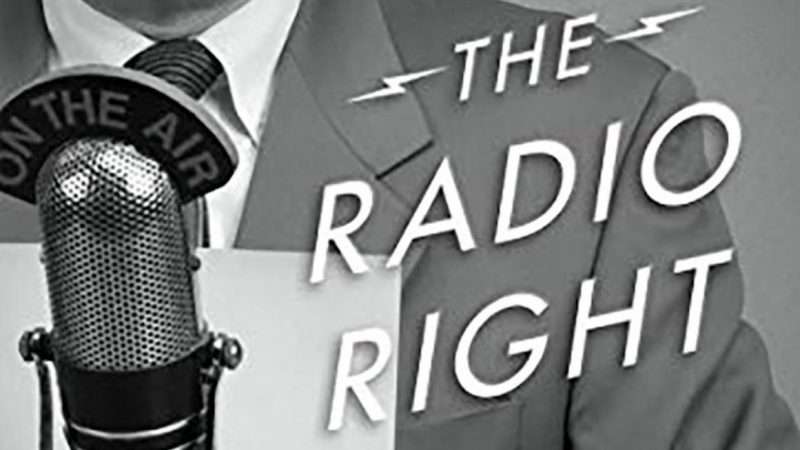
This Radio Right emerged rapidly. The biggest of them, a fundamentalist minister from New Jersey named Carl McIntire, could be heard on just two radio stations in 1956; by 1963, he was on more than 460 outlets. His estimated weekly audience was 20 million people—about as many as Rush Limbaugh reached 40 years later.

JFK, who had narrowly won in 1960, wanted these irritants quashed. His brother, Attorney General Robert F. Kennedy, concocted a detailed plan for doing so with the help of Walter and Victor Reuther, executives with the United Automobile Workers. Their plan, later nicknamed the “Reuther Memorandum,” had many moving parts, but the two most significant involved the Internal Revenue Service and the Federal Communications Commission. The tax agency, though a program called the “Ideological Organizations Project,” would target right-wing broadcasters for audits in order to dry up the flow of small-dollar listener donations they used to buy airtime. Meanwhile, the FCC would use the Fairness Doctrine to pressure stations not to sell airtime to the offending broadcasters.

In 1963, JFK told his newly appointed FCC chief, Bill Henry, “It is important that stations be kept fair.” Henry listened. One of his first official acts as chairman was to issue a clarification of the Fairness Doctrine that promised a new push for enforcement. The statement singled out only examples of conservative speech that needed balancing by liberal voices, and not vice versa.

Enforcement hinged on members of the public filing Fairness Doctrine complaints with the commission. At license renewal time, the FCC would consider the quantity and quality of Fairness Doctrine complaints. Losing a license—which was rare in this period—was the death penalty for a radio station. But even if a station didn’t lose its license, it would have to bear the expense of hiring legal counsel to fight the complaints and extra staff to prove compliance.

Henry’s most useful tool in enhancing the Fairness Doctrine was a complementary rule known as the Cullman Doctrine, which stipulated that response time claimed under the Fairness Doctrine should be provided for free if the respondents said they couldn’t afford to pay. (Unsurprisingly, nobody ever said they could pay.) This made direct criticism of public figures and administration policies an expensive proposition for the station owners, who responded by ditching conservative broadcasters known for making attacks.

Here is one example of how the Kennedy administration weaponized the Fairness Doctrine. In 1963, JFK negotiated the Nuclear Test Ban Treaty with the Soviet Union. He planned to make it the centerpiece of his re-election bid. The Radio Right attacked it ceaselessly during the summer of ’63. This mattered, because Kennedy needed two-thirds of the Senate for treaty ratification.

So the White House secretly organized a front organization—the Citizens Committee for a Nuclear Test Ban—to threaten stations that aired conservative criticisms of the treaty with Fairness Doctrine complaints unless they were given free response time. The plan was a success, hundreds of hours of free pro-treaty airtime was secured, and the treaty passed by a comfortable margin.

Kennedy was killed shortly thereafter, but the Democratic National Committee picked up the Fairness Doctrine baton. It secretly organized a pressure campaign—complete with its own front organization—to extract free airtime for Lyndon Johnson’s 1964 presidential campaign. Thousands of hours of free airtime were secured, but as the party’s operatives reported after the election, even “more important than the free radio time…was the effectiveness of this operation in inhibiting the political activity of these Right Wing broadcasts.” Stations dropped conservative programming en masse.

When the U.S. Supreme Court validated the Fairness Doctrine in Red Lion Broadcasting Co. v. FCC (1969), it did so unaware that the Democratic National Committee had secretly sponsored the original complainant, feeding him opposition research and even paying for his health insurance. By this time, President Nixon was wielding the Fairness Doctrine against the left.

Conservative radio didn’t make a comeback until relatively laissez-faire commissioners appointed by President Jimmy Carter (the true Great Deregulator) stopped rigorously enforcing the Fairness Doctrine. Ronald Reagan’s FCC ended the rule in 1987, and Reagan vetoed a bi-partisan bill to reinstate it.

We are fortunate that Congress and the courts decided in the 1990s to regulate the internet under a print regulatory regime rather than a broadcast regime. As a result, the internet was “born free,” to borrow a phrase from Adam Thierer. For example, when Congress codified Section 230 of the Communications Decency Act, it extended to the internet a set of legal precedents that had protected bookstores from publisher liability.

And thank goodness they did! Imagine how disastrous a Fairness Doctrine for the internet would be, if outlets and platforms had an affirmative obligation to ensure that either articles published or user posts permitted were carefully balanced according to some ambiguous public interest standard. Think of the mischief that, say, President Donald Trump could have done under a Fairness Doctrine-style regime. The Trump reelection campaign—or some ostensibly independent PAC—could have forced outlets to run a response to any criticism of the administration.

The Fairness Doctrine as originally conceived would not pass legal muster for cable broadcasting or the internet. But there have been proposals for Fairness Doctrine–style regulations that would make an end-run around First Amendment protections by targeting Section 230’s liability waiver. For instance, in 2019 Sen. Josh Hawley (R-Mo.) introduced a bill that would have given the Federal Trade Commission the power to certify that social media platforms are politically neutral with their content moderation policies; decertification would have exposed companies to significant legal liability. Hawley’s legislation was laughed off at the time, but just last October several Senate Republicans, including Lindsey Graham, introduced a bill that would make platforms liable for their moderation of political speech.

These approaches might not pass First Amendment muster. But even if they ultimately failed in court, that would still mean years of messy legal challenges with significant chilling effects on online speech and innovation. 

Despite its name, the Fairness Doctrine was deeply unfair. It made broadcasting less diverse, more beholden to powerful corporate interests, and more susceptible to political abuse. And it was a key weapon in one of the most successful censorship campaigns in American history. It would be a mistake of historic proportions to mimic it while writing regulations for the internet.

from Latest – Reason.com https://ift.tt/2Mbpxsm
via IFTTT

The Sordid History of the Fairness Doctrine

radio_right

After Twitter permanently suspended Donald Trump’s account, conservative interest in mandating online platform neutrality spiked. Meanwhile, progressives alarmed by the Capitol riot called for reviving the Fairness Doctrine to combat the misinformation circulating about the election. The national mood has never been more favorable for some kind of government regulation of the internet.

The Fairness Doctrine hasn’t been active policy at the Federal Communications Commission (FCC) since the 1980s, so public knowledge of the doctrine is hazy at best. But the more you learn about the actual history of the Fairness Doctrine and its antecedents, the clearer it becomes that applying similar regulations to the internet would be a mistake.

When many people hear the phrase “Fairness Doctrine,” they picture a time at some indeterminate point in the past when broadcast media were reasonable and balanced. Back then, they imagine, radio and television station owners couldn’t air only their own opinions and spread unchecked misinformation; they had to let the other side on any given hot-button issue have a say, allowing the “good guys” to act as a check on the “bad guys” and their lies.

That narrative is almost entirely a myth. Despite its evocative name, the Fairness Doctrine was primarily a tool wielded by established political interests to suppress unwelcome speech.

The true story of the Fairness Doctrine begins long before the first major implementation of the doctrine in 1963, back before the rule was enacted in 1949, back all the way to the Radio Act of 1927. That law created the FCC’s precursor, the Federal Radio Commission (FRC), and gave it the power to license and limit radio stations. Among other things, the law required licensees to promote “the public interest, convenience, and necessity” and not simply to serve their own interests.

Does that sound vague to you? It certainly did to station owners in the 1920s and ’30s. Whose convenience are we talking about? What content is necessary and what is not? Is there even such a thing as a singular public interest? The inherent ambiguity also meant incredible opportunities for graft and political privilege. In practice, the more political connections and capital you possessed, the more “public interest” your license application had. The commission maintained a revolving door with the major radio networks, and the networks quickly consolidated what had been a relatively diverse and independent radio landscape.

Non-WASPs and political radicals in particular faced an uphill battle when applying for station licenses. In 1928, for example, the FRC attempted to reassign the license for the leftist Queens station WEVD, named after the socialist leader Eugene Victor Debs. It took a major public pressure campaign to convince the agency that the station showed “due regard for the opinions of others,” which was necessary given that they were “the mouthpiece of a substantial political or religious minority” and thus not naturally deserving of a broadcast voice. Of course, non-socialist stations never had to show a similar “due regard”; it was taken for granted that they represented the public interest.

Similarly, in 1933 the FRC decided that two stations in Chicago—WIBO and WPCC, which served a predominantly immigrant audience—should lose their licenses to a new station, WJKS, because the latter’s programming was better “designed to meet the needs of the foreign population.” By what standard? Well, WJKS promised to air programming that “stress[ed] loyalty to the community and the Nation” and taught “American ideals and responsibilities.” The FRC had decided that the public interest was synonymous with ethno-nationalist self-interest, the 1930s regulatory version of an “English only” sign.

Federal regulation ensured that radio broadcasting in the 1930s became less diverse, less weird, less independent, more corporate, more anodyne, and more centralized. Even actress and comedian Mae West was barred from the airwaves for 13 years after she dared to utter this shocking obscenity in a 1937 radio sketch: “Come on home with me, honey. I’ll let you play in my wood pile.” Thank goodness the government was there to protect the public interest against mild innuendo!

The commission’s crackdown did not go unchallenged. Take “Fightin’ Bob” Shuler, a muckraking fundamentalist pastor from Los Angeles who used his platform to expose local politicians and businessmen for their involvement in one of the largest financial frauds to that point in U.S. history, the Julian Petroleum scandal. His enemies retaliated by asking the FRC not to renew his license, and the commission proceeded to revoke his right to broadcast. Shuler sued, claiming a violation of his free speech rights.

The case, Trinity Methodist Church South v. Federal Radio Commission (1932), made its way to a federal circuit court, which denied Shuler’s claim and, more importantly, upheld the FRC’s power to license or deny stations on the basis of the content of their speech. All subsequent jurisprudence on broadcast speech regulation hinged on this and a handful of other cases from the time.

There’s a vital contrast between what was happening with First Amendment claims in broadcasting versus developments in print media. Just a year prior to Shuler’s case, the U.S. Supreme Court had ruled in Near v. Minnesota (1931) that prior restraint on newspapers by state governments was censorship. As a result, two radically different media regimes emerged: Print speech got ever firmer and clearer protections, while radio speech received distinctly second-class status. The FCC could freely grant or pull licenses based on whether it believed a station’s speech fit within “the public interest,” which in turn meant whatever a small group of industry lobbyists, political flunkies, and communications lawyers managed to form a consensus about.

How did the government get away with denying broadcasters full free speech rights? When challenged in cases like Trinity, they appealed to something called the “scarcity rationale.” Since the electromagnetic spectrum is physically finite, they argued, the First Amendment shouldn’t apply to radio. The government needed to choose winners and losers, because someone had to decide who got a license and who did not.

This was always a convenient legal fiction, if for no other reason than because the FCC has never hit the technical limit on the number of possible broadcast stations, either then or now. To the extent that there was scarcity on the airwaves, it was artificially imposed by the FCC itself. By limiting the number of stations, the agency protected powerful media companies from competition, as when it delayed regulatory approval for FM radio because of lobbying by businesses heavily invested in AM broadcasting. Nevertheless, the courts bought the scarcity rationale excuse until the 1990s.

Thus, a readily corruptible government agency with a sweeping but ambiguous mandate had authority over the airwaves. Politicians quickly discerned an opportunity to manipulate the regulators for political advantage. President Franklin Delano Roosevelt, for example, had little tolerance for those who questioned the New Deal. Some of his most vociferous opponents were conservative newspaper owners, who were increasingly critical after Roosevelt’s Supreme Court–packing scheme in 1937. Now, Roosevelt couldn’t go after them directly, thanks to that pesky First Amendment, but many of these newspapermen had begun to buy radio stations, and in that arena FDR could target them for special regulatory attention.

As one former commissioner put it, Roosevelt “put the blow torch” on his FCC chairman, Larry Fly, to use various regulations to shut down the president’s enemies. Among other measures, Fly proposed a cross-media ownership ban; it ultimately failed but it still tied up newspaper acquisition of FM licenses for several years. (President Richard Nixon’s FCC would ultimately enact a cross-media ownership ban in an attempt to intimidate the owner of The Washington Post into easing up on the paper’s Watergate reporting.)

Fly’s most lasting legacy was the Mayflower Doctrine, a direct precursor of the Fairness Doctrine. In the 1941 Mayflower decision, the FCC ruled that a station that had “editorialized” by criticizing FDR would lose its license to a disgruntled former employee. “A truly free radio,” Fly wrote, “cannot be used to advocate the causes of the licensee. It cannot be used to the support of principles he happens to regard most favorably. In brief, the broadcaster cannot be an advocate.” Well, then. 

The radio industry pushed back, and in 1949 the FCC backed away from the ban on editorializing. But it kept a crucial component, which was that licensees operated “under an obligation to insure that opposing points of view will also be presented.” This 1949 statement was the basis of the Fairness Doctrine. But the Fairness Doctrine remained notional from 1949 to 1963, with relatively little attempt to exercise the vast powers the FCC had claimed for itself—certainly nothing as extensive as its efforts during the 1930s. Yet something big was changing in the broadcasting industry, something with enormous consequences for regulatory policy.

After World War II, the major networks, which had controlled 95 percent of all radio stations in America in 1945, shifted their attention and capital investment to television. By 1952, fewer than half of radio stations were network affiliates, a ratio that continued to fall through the rest of the decade. Most new radio licenses during this period were going to small-timers—say, a local car dealer who wanted a station to advertise his business. Finances were tight for these independent stations, so the owners were open to selling timeslots to groups the networks wouldn’t have given the time of day to. 

That included a new generation of right-wing broadcasters, who (mostly unfairly) attacked liberals and Democrats as unpatriotic Communist sympathizers. After President John F. Kennedy’s election in 1960, he became a particular target of these broadcasters, who went after everything from his mishandling of the Bay of Pigs invasion to his proposed Nuclear Test Ban Treaty.

This Radio Right emerged rapidly. The biggest of them, a fundamentalist minister from New Jersey named Carl McIntire, could be heard on just two radio stations in 1956; by 1963, he was on more than 460 outlets. His estimated weekly audience was 20 million people—about as many as Rush Limbaugh reached 40 years later.

JFK, who had narrowly won in 1960, wanted these irritants quashed. His brother, Attorney General Robert F. Kennedy, concocted a detailed plan for doing so with the help of Walter and Victor Reuther, executives with the United Automobile Workers. Their plan, later nicknamed the “Reuther Memorandum,” had many moving parts, but the two most significant involved the Internal Revenue Service and the Federal Communications Commission. The tax agency, though a program called the “Ideological Organizations Project,” would target right-wing broadcasters for audits in order to dry up the flow of small-dollar listener donations they used to buy airtime. Meanwhile, the FCC would use the Fairness Doctrine to pressure stations not to sell airtime to the offending broadcasters.

In 1963, JFK told his newly appointed FCC chief, Bill Henry, “It is important that stations be kept fair.” Henry listened. One of his first official acts as chairman was to issue a clarification of the Fairness Doctrine that promised a new push for enforcement. The statement singled out only examples of conservative speech that needed balancing by liberal voices, and not vice versa.

Enforcement hinged on members of the public filing Fairness Doctrine complaints with the commission. At license renewal time, the FCC would consider the quantity and quality of Fairness Doctrine complaints. Losing a license—which was rare in this period—was the death penalty for a radio station. But even if a station didn’t lose its license, it would have to bear the expense of hiring legal counsel to fight the complaints and extra staff to prove compliance.

Henry’s most useful tool in enhancing the Fairness Doctrine was a complementary rule known as the Cullman Doctrine, which stipulated that response time claimed under the Fairness Doctrine should be provided for free if the respondents said they couldn’t afford to pay. (Unsurprisingly, nobody ever said they could pay.) This made direct criticism of public figures and administration policies an expensive proposition for the station owners, who responded by ditching conservative broadcasters known for making attacks.

Here is one example of how the Kennedy administration weaponized the Fairness Doctrine. In 1963, JFK negotiated the Nuclear Test Ban Treaty with the Soviet Union. He planned to make it the centerpiece of his re-election bid. The Radio Right attacked it ceaselessly during the summer of ’63. This mattered, because Kennedy needed two-thirds of the Senate for treaty ratification.

So the White House secretly organized a front organization—the Citizens Committee for a Nuclear Test Ban—to threaten stations that aired conservative criticisms of the treaty with Fairness Doctrine complaints unless they were given free response time. The plan was a success, hundreds of hours of free pro-treaty airtime was secured, and the treaty passed by a comfortable margin.

Kennedy was killed shortly thereafter, but the Democratic National Committee picked up the Fairness Doctrine baton. It secretly organized a pressure campaign—complete with its own front organization—to extract free airtime for Lyndon Johnson’s 1964 presidential campaign. Thousands of hours of free airtime were secured, but as the party’s operatives reported after the election, even “more important than the free radio time…was the effectiveness of this operation in inhibiting the political activity of these Right Wing broadcasts.” Stations dropped conservative programming en masse.

When the U.S. Supreme Court validated the Fairness Doctrine in Red Lion Broadcasting Co. v. FCC (1969), it did so unaware that the Democratic National Committee had secretly sponsored the original complainant, feeding him opposition research and even paying for his health insurance. By this time, President Nixon was wielding the Fairness Doctrine against the left.

Conservative radio didn’t make a comeback until relatively laissez-faire commissioners appointed by President Jimmy Carter (the true Great Deregulator) stopped rigorously enforcing the Fairness Doctrine. Ronald Reagan’s FCC ended the rule in 1987, and Reagan vetoed a bi-partisan bill to reinstate it.

We are fortunate that Congress and the courts decided in the 1990s to regulate the internet under a print regulatory regime rather than a broadcast regime. As a result, the internet was “born free,” to borrow a phrase from Adam Thierer. For example, when Congress codified Section 230 of the Communications Decency Act, it extended to the internet a set of legal precedents that had protected bookstores from publisher liability.

And thank goodness they did! Imagine how disastrous a Fairness Doctrine for the internet would be, if outlets and platforms had an affirmative obligation to ensure that either articles published or user posts permitted were carefully balanced according to some ambiguous public interest standard. Think of the mischief that, say, President Donald Trump could have done under a Fairness Doctrine-style regime. The Trump reelection campaign—or some ostensibly independent PAC—could have forced outlets to run a response to any criticism of the administration.

The Fairness Doctrine as originally conceived would not pass legal muster for cable broadcasting or the internet. But there have been proposals for Fairness Doctrine–style regulations that would make an end-run around First Amendment protections by targeting Section 230’s liability waiver. For instance, in 2019 Sen. Josh Hawley (R-Mo.) introduced a bill that would have given the Federal Trade Commission the power to certify that social media platforms are politically neutral with their content moderation policies; decertification would have exposed companies to significant legal liability. Hawley’s legislation was laughed off at the time, but just last October several Senate Republicans, including Lindsey Graham, introduced a bill that would make platforms liable for their moderation of political speech.

These approaches might not pass First Amendment muster. But even if they ultimately failed in court, that would still mean years of messy legal challenges with significant chilling effects on online speech and innovation. 

Despite its name, the Fairness Doctrine was deeply unfair. It made broadcasting less diverse, more beholden to powerful corporate interests, and more susceptible to political abuse. And it was a key weapon in one of the most successful censorship campaigns in American history. It would be a mistake of historic proportions to mimic it while writing regulations for the internet.

from Latest – Reason.com https://ift.tt/2Mbpxsm
via IFTTT

Two Years To Stop The Spread? Some Countries Will Close Borders Until At Least 2022

Two Years To Stop The Spread? Some Countries Will Close Borders Until At Least 2022

Authored by Jordan Schachtel via The American Institute For Economic Research,

Australians and Kiwis are looking at the very real possibility of being shut off from the rest of the world for at least another year.

The two countries, often touted by the media and the “public health expert” class as a COVID-19 response success story (and described by the likes of Dr. Anthony Fauci as countries that the United States should model their response after), may remain closed off from the rest of the world until 2022.

In a conversation with the Australian Broadcasting Corporation on Monday, Aussie Department of Health Secretary Brendan Murphy, the country’s top health official, revealed: “I think that we’ll go most of this year with still substantial border restrictions.”

Murphy explained that this is because they don’t know enough about the vaccine, so they’re going to play it safe and continue the self-destructive self-siege indefinitely. 

“Even if we have a lot of the population vaccinated, we don’t know whether that will prevent transmission of the virus,” he added. 

As for the mandatory 14 day quarantine facilities for Australian returnees (who pay for the lockdown “quarantine hotels” at their own expense), Murphy explained that this policy would continue “for some time.”

Australia closed its borders to non-residents on March 20, 2020. Aussies might be able to visit only New Zealand at some point in 2021, but they may still be subject to 14 day stays in mandatory quarantine facilities on either or both sides of their outbound and return trips. Qantas, Australia’s biggest airline, remains hopeful of the possibility that it will be allowed to return to partial operations in late summer or fall.

Australia and New Zealand have had arguably the most brutal lockdowns in the world.

When Australia faces a new round of inevitable COVID-19 outbreaks, states often quickly transform into full-fledged police states, and immediately strip all citizens of their fundamental rights, rationalizing the decision because it’s necessary to “slow the spread” or “stamp out” COVID-19. In Melbourne, for instance, citizens were not allowed more than a few miles from their homes, and could only leave their house to exercise, and only for a maximum of one hour a day.

New Zealand also appears to be headed in the indefinite self-siege direction, with politicians now openly conceding that the nation will probably not open up for business or outbound or inbound travel until at least 2022.

New Zealand has even worse draconian policies than Australia. Citizens who test positive for COVID-19 are forcibly removed, if necessary, into military-guarded quarantine camps, to deal with COVID-19 outbreaks. The country also locks down entirely in the event of a single new outbreak of the disease, which has a 99.8% recovery rate. The country’s leaders are “optimistic” that they will begin their vaccination program at some point in the middle of 2021. New Zealand’s self-siege has caused entire sectors of its economy to indefinitely collapse.

Still, many American “public health experts” have urged legislators to adopt the Australia and New Zealand rights-restricting model for “stopping the spread. Dr. Anthony Fauci, the long time government health bureaucrat, has applauded Australia and New Zealand, claiming they have “done quite well” in their draconian policy response to COVID-19.

Tyler Durden
Sat, 01/30/2021 – 07:00

via ZeroHedge News https://ift.tt/3ozqF5U Tyler Durden

The Dangerous Paradise of 1980 Miami

book1

Dave Barry has described Miami as a tropical paradise full of people from many different lands, cultures, backgrounds, and walks of life, all of whom want to kill each other. The city’s proximity to the piratical Caribbean, which has always been happy to help Americans evade their country’s prohibitions, has inspired breathtakingly flamboyant displays of open criminality since the beginning of recorded Miami history.

Sometimes this is merely amusing, as when Calvin Coolidge’s entourage pulled into Key West in 1928 on the first leg of a state visit to Cuba and discovered that, even with the president of the United States and his vast law-enforcement traveling party in town, nobody made even a pretense of observing Prohibition. The one-night stopover turned into a drunken bacchanal, with reporters dizzily toppling off gangplanks into the ocean the next day as they tried to board Coolidge’s Havana-bound flotilla.

Other times it has been deadly. On the day after Christmas in 1969, a pair of Cuban-exile cocaine trafficking groups, occupying five cars, raced through Miami’s crowded downtown streets for half an hour, engaged in a running gun battle that left two men badly injured and one dead. The low body count was surprising, especially given that several participants were CIA-trained veterans of the Bay of Pigs. But what is truly astonishing is that the bang-bang was so ordinary that it didn’t rate even the merest mention in The Miami Herald.

Why should it? Miami was full of untethered rage and a plenitude of weapons. The foes of Fidel Castro carried out at least 30 bombings in 1975. Miami Herald crime writer Edna Buchanan once opened her trunk to load some groceries only to find that her husband (also a Herald reporter) had stashed a load of machine guns there to smuggle to his pals in Havana.

The Year of Dangerous Days: Riots, Refugees, and Cocaine in Miami 1980 is a crisp and fascinating account of arguably the worst single year for a city that’s had a lot of bad ones. If it has a flaw, it’s that the author, the journalist and novelist Nicholas Griffin, seems to think Miami was normal before it was flooded with cocaine cowboys from Colombia and refugees from Cuba. From the real-estate scammers and bootleggers of the 1920s to the transplanted New York mobsters of the ’40s and ’50s to the anti-Castro bombers of the ’60s and ’70s, Miami has been perpetually at war with itself.

And then the city was blindsided by an unprecedented tidal wave of refugees from Cuba and a mind-bogglingly violent cohort of cocaine traffickers from Colombia.

The events were not connected, even tangentially. They didn’t even really take place simultaneously. The narcotraffickers began arriving in the mid-1970s, as dance clubs and cocaine underwent a mutually reinforcing surge in popularity. They announced themselves in spectacular fashion in summer 1979. Three men walked into a liquor store in what was then South Florida’s biggest shopping mall and machine-gunned two people, then kept spraying bullets around the parking lot as they fled. The two corpses were so shot up that the medical examiner couldn’t count all the bullet holes, though Griffin—a connoisseur of Miami madness—notes that one of the men, despite being blown to bits, “managed to keep his bottle of Chivas intact.”

Left behind was a van with reinforced steel plates, gun ports, black one-way glass, and a hefty supply of bulletproof vests and automatic weapons inside. Buchanan called it a “war wagon.” (Full disclosure: She’s a friend of mine. I worked at the Herald in 1979, the year before the events of Griffin’s book, and returned in 1992 for 27 more years. A lot of the characters in The Year of Dangerous Days are my friends or acquaintances, and a few—mostly editors—are sworn enemies.)

By 1980, the cocaine cowboys had turned Miami into an endless-loop replay of Gunfight at the O.K. Corral. They were audacious, murdering victims everywhere from freeways to airport luggage carousels. Once, a couple checking into a motel near the airport complained their room had a peculiar odor; management promptly dispatched a maid to remove a body from under the bed. They were prolific, racking up as many as four corpses in four hours in separate killings. They came close to recycling their victims: One man was shot five times in the head as he pushed his wife’s wheelchair—she was still recovering from 30 bullet wounds in an earlier attack.

So many coke-laden airplanes filled Miami’s airspace after dark that two collided in midair, scattering half a dozen bodies around the beach. Police started finding dead drug mules, putrefying in cheap hotel rooms after bags of cocaine burst open in their intestines. (The cops always knew the cause of death instantly, thanks to the laxatives and enemas at the side of the bed.) Some 60 percent of the city’s first-degree murder cases were settled on lesser charges because Miami’s courts were so wildly overcrowded.

The crime would have overwhelmed even a competent police department. But in Miami, the homicide squad was continuously short-staffed because its members kept getting indicted. (An FBI investigation of the homicide cops had so much electronic surveillance running that it took 22 stenographers working full-time just to keep up with the tapes.) The source of the corruption, of course, was the narcotraffickers the cops were supposed to be investigating.

The traffickers had an awesome stash of cash with which to hand out bribes. When federal agents arrested South Florida’s top Colombian money launderer, it took a day and a half to total just the $40 million he had stacked on the floors of his safe houses. And as the government began freezing bank accounts, the Federal Reserve had to fly an emergency load of funds to Miami to prevent a run on the bank.

Against this backdrop, the Mariel refugees started flooding in. “Flooding” is an overworked word in describing immigration, but it applies here: About 125,000 Cubans—roughly equal to a third of the city’s population—came to Miami in just six weeks.

The Mariel boatlift represented the detonation of a fuse inadvertently lit in 1978. Seeking foreign exchange to fund his fraying revolution, Castro for the first time had allowed Cuban exiles in Miami to visit friends and family who had stayed behind. In a single year, the visitors pumped $100 million into Cuba, filling it with TVs and tape recorders, medicine and mascara. It was graphic evidence that Castro’s description of a hardscrabble exile life in Miami was a lie. Castro, worried by the discontent he had unleashed, shut the visits down. But the discontent remained.

On April 1, 1980, an unemployed bus driver and a few of his friends rammed his vehicle through the gate at the Peruvian embassy in Havana. The ambassador, to Castro’s surprise, declared them asylum seekers and wouldn’t give them back. Castrologists to this day debate whether what followed was pure pique or a canny plan; either way, the dictator pulled Cuban guards off the premises. By Sunday, some 10,000 would-be refugees had crowded inside, far more than the Peruvians could feed; the crowd began strangling and eating neighborhood cats. Having either proved his point or committed a humiliating error, Castro blocked the embassy door again.

President Jimmy Carter, who had been championing human rights around the world, suddenly had second thoughts about accepting the fruits of his humanitarian labors. Maybe Costa Rica could take some of them? But Miami Mayor Maurice Ferre, hoping to calm crowds of angry demonstrators who wanted their families freed to come to the United States, told reporters there was no need to stall. “Miami’s absorbed 600,000 Cubans,” he said. “They’re a net benefit to our community. Cubans haven’t taken from the coffers but rendered taxes to us.”

Eventually, Castro simply ignored Carter. He declared that the exiles could come pick up their families in Cuba—in a little fishing village called Mariel, about 40 minutes from Havana—and ferry them back to Miami in boats. And not just the 10,000 huddled inside the Peruvian embassy. Anybody. The first flotilla of eight boats made the round trip in a single day, returning with family members the crews had been trying to extract for 20 years.

The race was on. News helicopters showed a hellish traffic jam along the single-lane 160-mile highway that was Miami’s only link to Key West. From there, rippling lines of boats stretched out the 120 miles to Mariel: fishing skiffs, cabin cruisers, anything that would float. The process was by no means as efficient or easygoing as that first day had promised. The refugees, soon known as Marielitos, left with nothing but the clothes on their backs. Government-assembled mobs usually beat them on their way to the water. Storms battered the boats waiting to be loaded with refugees, crashing them into rocks, walls, and other boats. The harbor filled with sewage and gasoline, through which some crewmen had to swim, collecting donations for the ransoms some officials demanded.

In the single most ghastly story in a book that’s full of them, Griffin describes the fate of a 36-foot cruiser named the Olo Yumi, which departed Mariel overloaded with more than 50 refugees at the order of the Cuban military. Running into rough weather, it capsized, spilling passengers—less than half of them in life jackets—in all directions.

Among them was a 14-year-old girl named Ibis Guerrero, who over the next few minutes watched as her father, mother, and sisters slipped beneath the roiling waves. “She had gone from the youngest in an exiled family of six to an orphan in under an hour,” writes Griffin. And still the dying continued. Another mother handed Ibis her 4-year-old son, then vanished. The next morning in Key West, the girl watched stoically as workers at a funeral home pulled five caskets out of a stack of 10 so she could say goodbye to her family.

On May 10, another disaster befell the Marielitos: the New York Times headline “Retarded People and Criminals Are Included in Cuban Exodus.” The story itself, describing how Cuban officials had forced two boats to accept passengers from mental wards and prison cells, was accurate and nuanced, describing how little it took to be labeled criminal or crazy in Castro’s totalitarian state and what a tiny percentage of the boatlift the two vessels represented. But the headline was repeated—and exaggerated—endlessly. The Times itself editorialized that Castro “mocks the generosity of the United States by dumping criminals, even leprosy patients, into the boats” and demanded tighter enforcement of American immigration laws. Castro joined in from the other direction, calling the Marielitos gusanos (worms) and escoria (scum).

Griffin resists the most lurid smears, but he casually accepts the contention that the boatlift brought 5,000 criminals to the United States. Perhaps—but in Cuba you could get a rap sheet for slaughtering a cow without permission, refusing to join the Communist Party, being jobless, being gay, or playing Beatles records. And some of the so-called criminals were fakers: Signing a carta de escoria (literally a “scum letter”) confessing to a criminal record or sexual deviance was one of the quickest ways to the head of the boatlift line.

The U.S. government identified about 1,650 people who came ashore during the boatlift with a record that would be considered seriously criminal in the U.S., and it promptly jailed them all. Though many reporters over the years have used the staggering increases in Dade County crime in 1980 (robbery up 124 percent, assault up 109 percent) as evidence that Marielitos ran amok, those numbers were hugely inflated by three days of rioting in the city’s black neighborhoods. It’s true that Dade set a record for homicides in 1980, but it did the same thing in 1979, before the refugees arrived. The principal culprits in both years were the cocaine cowboys.

That rioting, the third of Griffin’s narratives, is both as old as America and as fresh as this morning’s newspaper. By 1980, black people were no longer under a curfew that forced them off Miami Beach by sundown. But most were cooped up in three almost-contiguous neighborhoods—Liberty City, Overtown, and the Black Grove—clustered along Interstate 95, all ruined by the highway’s construction in the early 1960s.

Those areas, collectively known to cops as the Central District, had 23 percent of the county’s robberies and 40 percent of its stabbings—and the police only made things worse. Commanders put their most brutal blockheads in the black districts and then further concentrated them on the midnight shift. The black communities were where “they sent the screwups that the brass didn’t want to have to see in the daytime,” said Buchanan, who as a crime reporter knew as much about the cops as anyone, including their own commanders. The fallout included one (white) cop who shot a (black) guy in the head for peeing against a wall.

The Central District was a powder keg in search of a spark, and that spark was Arthur McDuffie, a black 33-year-old ex-Marine who sold insurance for a living. He could also be something of a scofflaw, and that side of him was on display in the wee hours of December 17, 1979. His motorcycle speed hit 80 mph. He popped a wheelie and extended an upraised middle finger to a cop. As he zig-zagged across the north side of Miami, at least 15 officers took pursuit.

At 1:59 a.m., McDuffie apparently decided enough was enough and stopped at a street corner. At 2:03, an ambulance arrived. What happened in the intervening four minutes would be hotly disputed, but whatever it was, McDuffie’s health took an abrupt and inauspicious decline. He required 11 pints in blood transfusions. His sister said his head looked like a basketball: His brain was so swollen that doctors could do nothing but watch him die.

Some of the cops claimed that McDuffie attacked them. If so, scofflaw seems far too inadequate a term to characterize him. He was one scrawny 147-pound guy against 15 cops, none of them exactly gentlemen. Michael Watts, one of the officers who would be arrested for McDuffie’s death, had already been in trouble for fracturing the skull of a black motorist who ran a red light and then dragging another black driver out of her car by her feet, bouncing her head along the pavement.

Three cops eventually took immunity to testify against five others on charges ranging from second-degree murder to fabricating evidence. They weren’t necessarily the best spokesmen for the prosecution—one, nicknamed Mad Dog for his disciplinary record, admitted to advising another cop where to hit the unconscious McDuffie with a flashlight to break his legs—and a change-of-venue jury in Tampa, after deliberating for 90 minutes, acquitted everybody of everything.

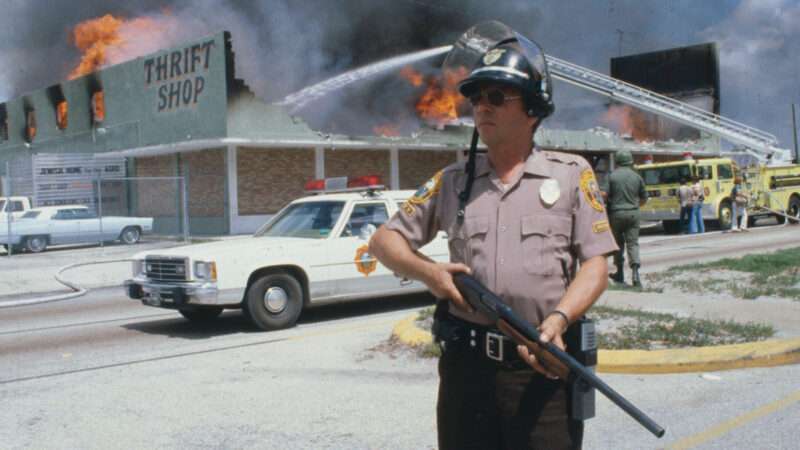
Within minutes, raging Miami crowds were shooting and burning and beating anything that moved. Two young white men who happened to be driving through Liberty City when the news was announced were dragged from their car, shot, pounded with cement blocks, and then repeatedly run over. (Incredibly, one of them survived.)

“Two, three, five, 12 at a time,” Griffin writes, describing the arrivals at Miami’s major trauma hospital. “Housewives blinded by rocks through car windscreens, a cameraman knocked unconscious  by a baseball bat to the back of the head; reporters beaten to the ground.” On the first day, all eight dead were white; on the second day, all eight were black. After three days, the rioting ended—no thanks to the cops, who didn’t dare venture into the Central District. There were 18 fatalities and around $100 million in damage, all of it in the black part of town.

Are there lessons from Miami’s year of dangerous days? A few. The drug war leads to sickening violence and garish corruption, but it does little or nothing to actually stop drugs. (When the U.S. government finally got the cocaine cowboys under control, it almost immediately went to war—this time, literally—against Panamanian strongman Manuel Noriega over cocaine.) Cuba was, and is, an awful place. Most of the sound and fury over immigration is counterproductive. And when cops behave like an occupying army, pretty soon the place starts looking like Berlin in 1945. Watch the news tonight to see how well we learned that one.

The Year of Dangerous Days: Riots, Refugees, and Cocaine in Miami 1980, by Nicholas Griffin, Simon & Schuster, 319 pages, $26.99

from Latest – Reason.com https://ift.tt/3j0BL2J
via IFTTT

The Dangerous Paradise of 1980 Miami

book1

Dave Barry has described Miami as a tropical paradise full of people from many different lands, cultures, backgrounds, and walks of life, all of whom want to kill each other. The city’s proximity to the piratical Caribbean, which has always been happy to help Americans evade their country’s prohibitions, has inspired breathtakingly flamboyant displays of open criminality since the beginning of recorded Miami history.

Sometimes this is merely amusing, as when Calvin Coolidge’s entourage pulled into Key West in 1928 on the first leg of a state visit to Cuba and discovered that, even with the president of the United States and his vast law-enforcement traveling party in town, nobody made even a pretense of observing Prohibition. The one-night stopover turned into a drunken bacchanal, with reporters dizzily toppling off gangplanks into the ocean the next day as they tried to board Coolidge’s Havana-bound flotilla.

Other times it has been deadly. On the day after Christmas in 1969, a pair of Cuban-exile cocaine trafficking groups, occupying five cars, raced through Miami’s crowded downtown streets for half an hour, engaged in a running gun battle that left two men badly injured and one dead. The low body count was surprising, especially given that several participants were CIA-trained veterans of the Bay of Pigs. But what is truly astonishing is that the bang-bang was so ordinary that it didn’t rate even the merest mention in The Miami Herald.

Why should it? Miami was full of untethered rage and a plenitude of weapons. The foes of Fidel Castro carried out at least 30 bombings in 1975. Miami Herald crime writer Edna Buchanan once opened her trunk to load some groceries only to find that her husband (also a Herald reporter) had stashed a load of machine guns there to smuggle to his pals in Havana.

The Year of Dangerous Days: Riots, Refugees, and Cocaine in Miami 1980 is a crisp and fascinating account of arguably the worst single year for a city that’s had a lot of bad ones. If it has a flaw, it’s that the author, the journalist and novelist Nicholas Griffin, seems to think Miami was normal before it was flooded with cocaine cowboys from Colombia and refugees from Cuba. From the real-estate scammers and bootleggers of the 1920s to the transplanted New York mobsters of the ’40s and ’50s to the anti-Castro bombers of the ’60s and ’70s, Miami has been perpetually at war with itself.

And then the city was blindsided by an unprecedented tidal wave of refugees from Cuba and a mind-bogglingly violent cohort of cocaine traffickers from Colombia.

The events were not connected, even tangentially. They didn’t even really take place simultaneously. The narcotraffickers began arriving in the mid-1970s, as dance clubs and cocaine underwent a mutually reinforcing surge in popularity. They announced themselves in spectacular fashion in summer 1979. Three men walked into a liquor store in what was then South Florida’s biggest shopping mall and machine-gunned two people, then kept spraying bullets around the parking lot as they fled. The two corpses were so shot up that the medical examiner couldn’t count all the bullet holes, though Griffin—a connoisseur of Miami madness—notes that one of the men, despite being blown to bits, “managed to keep his bottle of Chivas intact.”

Left behind was a van with reinforced steel plates, gun ports, black one-way glass, and a hefty supply of bulletproof vests and automatic weapons inside. Buchanan called it a “war wagon.” (Full disclosure: She’s a friend of mine. I worked at the Herald in 1979, the year before the events of Griffin’s book, and returned in 1992 for 27 more years. A lot of the characters in The Year of Dangerous Days are my friends or acquaintances, and a few—mostly editors—are sworn enemies.)

By 1980, the cocaine cowboys had turned Miami into an endless-loop replay of Gunfight at the O.K. Corral. They were audacious, murdering victims everywhere from freeways to airport luggage carousels. Once, a couple checking into a motel near the airport complained their room had a peculiar odor; management promptly dispatched a maid to remove a body from under the bed. They were prolific, racking up as many as four corpses in four hours in separate killings. They came close to recycling their victims: One man was shot five times in the head as he pushed his wife’s wheelchair—she was still recovering from 30 bullet wounds in an earlier attack.

So many coke-laden airplanes filled Miami’s airspace after dark that two collided in midair, scattering half a dozen bodies around the beach. Police started finding dead drug mules, putrefying in cheap hotel rooms after bags of cocaine burst open in their intestines. (The cops always knew the cause of death instantly, thanks to the laxatives and enemas at the side of the bed.) Some 60 percent of the city’s first-degree murder cases were settled on lesser charges because Miami’s courts were so wildly overcrowded.

The crime would have overwhelmed even a competent police department. But in Miami, the homicide squad was continuously short-staffed because its members kept getting indicted. (An FBI investigation of the homicide cops had so much electronic surveillance running that it took 22 stenographers working full-time just to keep up with the tapes.) The source of the corruption, of course, was the narcotraffickers the cops were supposed to be investigating.

The traffickers had an awesome stash of cash with which to hand out bribes. When federal agents arrested South Florida’s top Colombian money launderer, it took a day and a half to total just the $40 million he had stacked on the floors of his safe houses. And as the government began freezing bank accounts, the Federal Reserve had to fly an emergency load of funds to Miami to prevent a run on the bank.

Against this backdrop, the Mariel refugees started flooding in. “Flooding” is an overworked word in describing immigration, but it applies here: About 125,000 Cubans—roughly equal to a third of the city’s population—came to Miami in just six weeks.

The Mariel boatlift represented the detonation of a fuse inadvertently lit in 1978. Seeking foreign exchange to fund his fraying revolution, Castro for the first time had allowed Cuban exiles in Miami to visit friends and family who had stayed behind. In a single year, the visitors pumped $100 million into Cuba, filling it with TVs and tape recorders, medicine and mascara. It was graphic evidence that Castro’s description of a hardscrabble exile life in Miami was a lie. Castro, worried by the discontent he had unleashed, shut the visits down. But the discontent remained.

On April 1, 1980, an unemployed bus driver and a few of his friends rammed his vehicle through the gate at the Peruvian embassy in Havana. The ambassador, to Castro’s surprise, declared them asylum seekers and wouldn’t give them back. Castrologists to this day debate whether what followed was pure pique or a canny plan; either way, the dictator pulled Cuban guards off the premises. By Sunday, some 10,000 would-be refugees had crowded inside, far more than the Peruvians could feed; the crowd began strangling and eating neighborhood cats. Having either proved his point or committed a humiliating error, Castro blocked the embassy door again.

President Jimmy Carter, who had been championing human rights around the world, suddenly had second thoughts about accepting the fruits of his humanitarian labors. Maybe Costa Rica could take some of them? But Miami Mayor Maurice Ferre, hoping to calm crowds of angry demonstrators who wanted their families freed to come to the United States, told reporters there was no need to stall. “Miami’s absorbed 600,000 Cubans,” he said. “They’re a net benefit to our community. Cubans haven’t taken from the coffers but rendered taxes to us.”

Eventually, Castro simply ignored Carter. He declared that the exiles could come pick up their families in Cuba—in a little fishing village called Mariel, about 40 minutes from Havana—and ferry them back to Miami in boats. And not just the 10,000 huddled inside the Peruvian embassy. Anybody. The first flotilla of eight boats made the round trip in a single day, returning with family members the crews had been trying to extract for 20 years.

The race was on. News helicopters showed a hellish traffic jam along the single-lane 160-mile highway that was Miami’s only link to Key West. From there, rippling lines of boats stretched out the 120 miles to Mariel: fishing skiffs, cabin cruisers, anything that would float. The process was by no means as efficient or easygoing as that first day had promised. The refugees, soon known as Marielitos, left with nothing but the clothes on their backs. Government-assembled mobs usually beat them on their way to the water. Storms battered the boats waiting to be loaded with refugees, crashing them into rocks, walls, and other boats. The harbor filled with sewage and gasoline, through which some crewmen had to swim, collecting donations for the ransoms some officials demanded.

In the single most ghastly story in a book that’s full of them, Griffin describes the fate of a 36-foot cruiser named the Olo Yumi, which departed Mariel overloaded with more than 50 refugees at the order of the Cuban military. Running into rough weather, it capsized, spilling passengers—less than half of them in life jackets—in all directions.

Among them was a 14-year-old girl named Ibis Guerrero, who over the next few minutes watched as her father, mother, and sisters slipped beneath the roiling waves. “She had gone from the youngest in an exiled family of six to an orphan in under an hour,” writes Griffin. And still the dying continued. Another mother handed Ibis her 4-year-old son, then vanished. The next morning in Key West, the girl watched stoically as workers at a funeral home pulled five caskets out of a stack of 10 so she could say goodbye to her family.

On May 10, another disaster befell the Marielitos: the New York Times headline “Retarded People and Criminals Are Included in Cuban Exodus.” The story itself, describing how Cuban officials had forced two boats to accept passengers from mental wards and prison cells, was accurate and nuanced, describing how little it took to be labeled criminal or crazy in Castro’s totalitarian state and what a tiny percentage of the boatlift the two vessels represented. But the headline was repeated—and exaggerated—endlessly. The Times itself editorialized that Castro “mocks the generosity of the United States by dumping criminals, even leprosy patients, into the boats” and demanded tighter enforcement of American immigration laws. Castro joined in from the other direction, calling the Marielitos gusanos (worms) and escoria (scum).

Griffin resists the most lurid smears, but he casually accepts the contention that the boatlift brought 5,000 criminals to the United States. Perhaps—but in Cuba you could get a rap sheet for slaughtering a cow without permission, refusing to join the Communist Party, being jobless, being gay, or playing Beatles records. And some of the so-called criminals were fakers: Signing a carta de escoria (literally a “scum letter”) confessing to a criminal record or sexual deviance was one of the quickest ways to the head of the boatlift line.

The U.S. government identified about 1,650 people who came ashore during the boatlift with a record that would be considered seriously criminal in the U.S., and it promptly jailed them all. Though many reporters over the years have used the staggering increases in Dade County crime in 1980 (robbery up 124 percent, assault up 109 percent) as evidence that Marielitos ran amok, those numbers were hugely inflated by three days of rioting in the city’s black neighborhoods. It’s true that Dade set a record for homicides in 1980, but it did the same thing in 1979, before the refugees arrived. The principal culprits in both years were the cocaine cowboys.

That rioting, the third of Griffin’s narratives, is both as old as America and as fresh as this morning’s newspaper. By 1980, black people were no longer under a curfew that forced them off Miami Beach by sundown. But most were cooped up in three almost-contiguous neighborhoods—Liberty City, Overtown, and the Black Grove—clustered along Interstate 95, all ruined by the highway’s construction in the early 1960s.

Those areas, collectively known to cops as the Central District, had 23 percent of the county’s robberies and 40 percent of its stabbings—and the police only made things worse. Commanders put their most brutal blockheads in the black districts and then further concentrated them on the midnight shift. The black communities were where “they sent the screwups that the brass didn’t want to have to see in the daytime,” said Buchanan, who as a crime reporter knew as much about the cops as anyone, including their own commanders. The fallout included one (white) cop who shot a (black) guy in the head for peeing against a wall.

The Central District was a powder keg in search of a spark, and that spark was Arthur McDuffie, a black 33-year-old ex-Marine who sold insurance for a living. He could also be something of a scofflaw, and that side of him was on display in the wee hours of December 17, 1979. His motorcycle speed hit 80 mph. He popped a wheelie and extended an upraised middle finger to a cop. As he zig-zagged across the north side of Miami, at least 15 officers took pursuit.

At 1:59 a.m., McDuffie apparently decided enough was enough and stopped at a street corner. At 2:03, an ambulance arrived. What happened in the intervening four minutes would be hotly disputed, but whatever it was, McDuffie’s health took an abrupt and inauspicious decline. He required 11 pints in blood transfusions. His sister said his head looked like a basketball: His brain was so swollen that doctors could do nothing but watch him die.

Some of the cops claimed that McDuffie attacked them. If so, scofflaw seems far too inadequate a term to characterize him. He was one scrawny 147-pound guy against 15 cops, none of them exactly gentlemen. Michael Watts, one of the officers who would be arrested for McDuffie’s death, had already been in trouble for fracturing the skull of a black motorist who ran a red light and then dragging another black driver out of her car by her feet, bouncing her head along the pavement.

Three cops eventually took immunity to testify against five others on charges ranging from second-degree murder to fabricating evidence. They weren’t necessarily the best spokesmen for the prosecution—one, nicknamed Mad Dog for his disciplinary record, admitted to advising another cop where to hit the unconscious McDuffie with a flashlight to break his legs—and a change-of-venue jury in Tampa, after deliberating for 90 minutes, acquitted everybody of everything.

Within minutes, raging Miami crowds were shooting and burning and beating anything that moved. Two young white men who happened to be driving through Liberty City when the news was announced were dragged from their car, shot, pounded with cement blocks, and then repeatedly run over. (Incredibly, one of them survived.)

“Two, three, five, 12 at a time,” Griffin writes, describing the arrivals at Miami’s major trauma hospital. “Housewives blinded by rocks through car windscreens, a cameraman knocked unconscious  by a baseball bat to the back of the head; reporters beaten to the ground.” On the first day, all eight dead were white; on the second day, all eight were black. After three days, the rioting ended—no thanks to the cops, who didn’t dare venture into the Central District. There were 18 fatalities and around $100 million in damage, all of it in the black part of town.

Are there lessons from Miami’s year of dangerous days? A few. The drug war leads to sickening violence and garish corruption, but it does little or nothing to actually stop drugs. (When the U.S. government finally got the cocaine cowboys under control, it almost immediately went to war—this time, literally—against Panamanian strongman Manuel Noriega over cocaine.) Cuba was, and is, an awful place. Most of the sound and fury over immigration is counterproductive. And when cops behave like an occupying army, pretty soon the place starts looking like Berlin in 1945. Watch the news tonight to see how well we learned that one.

The Year of Dangerous Days: Riots, Refugees, and Cocaine in Miami 1980, by Nicholas Griffin, Simon & Schuster, 319 pages, $26.99

from Latest – Reason.com https://ift.tt/3j0BL2J
via IFTTT