The Reverse Spider-Man Principle: With Great Responsibility Comes Great Power

[I blogged an early draft of this essay three months ago, but I’ve revised it extensively since then. I’d love to hear any suggestions people might have; I still have a few weeks to edit it before it’s put to bed. You can also read the whole thing in a 16-page PDF.]

An entity—a landlord, a manufacturer, a phone company, a credit card company, an Internet platform, a self-driving car manufacturer—is making money off its customers’ activities. Some of those customers are using the entity’s services in ways that are criminal or tortious. Should the entity be held responsible, legally or morally, for its role (however unintentional) in facilitating its customers’ activities? This question has famously been at the center of the debates about platform content moderation,[1] but it can come up in other contexts as well.[2]

This is a broad question, and there might be no general answer. (Perhaps it is two broad questions—one about legal responsibility and one about moral responsibility—but I think the two are connected enough to be worth discussing together.) In this essay, though, I’d like to focus on one downside of answering it “yes”: What I call the Reverse Spider-Man Principle—with great responsibility comes great power.[3] Whenever we are contemplating holding entities responsible for their customers’ behavior, we should think whether we want to empower such entities to surveil, investigate, and police their customers, both as to that behavior and as to other behavior.[4]

Of course, some of the entities with whom we have relationships do have power over us. Employers are a classic example: In part precisely because they are responsible for our actions (through principles such as respondeat superior or negligent hiring/supervision liability), they have great power to control what we do, both on the job and in some measure off the job.[5] Doctors have the power to decide what prescription drugs we can buy, and psychiatrists have the responsibility (and the power) to report when their patients make credible threats against third parties.[6] And of course we are all within the power of police officers, who have the professional though not the legal responsibility to prevent and investigate crime.

On the other hand, we generally don’t expect to be in such subordinate relationships to phone companies, or to manufacturers selling us products. We generally don’t expect them to monitor how we use their products or services (except in rare situations where our use of a service interferes with the operation of the service itself), or to monitor our politics to see if we are the sorts of people who might use the products or services badly. At most, we expect some establishments to perform some narrow checks at the time of a sale, often defined specifically and clearly by statute, for instance by laws that require bars not to serve people who are drunk or that require gun dealers to perform background checks on buyers.[7]

Many of us value the fact that, in service-oriented economies, companies try hard to do what it takes to keep customers (consider the mentality that “the customer is always right”), rather than expecting customers to comply with the companies’ demands. But as we demand more “responsibility” from such providers, we push them to exercise more power over us, and thus fundamentally change the nature of their relationships with us. If companies are required to police the use or users of their products and services—what scholars have called “third-party policing”[8]—then people’s relationship with them may become more and more like people’s relationship with the police.

[I.] The Virtues of Irresponsibility

Let me begin by offering three examples of where some courts have balked at imposing legal liability, precisely because they didn’t want to require or encourage businesses to exercise power over their customers.

[A.] Telephone and Telegraph Companies

The first came in the early 1900s, where some government officials demanded that telephone and telegraph companies block access to their services by people suspected of running illegal gambling operations. Prosecutors could have gone after the bookies, of course, and they did. But they also argued that the companies should have done the same—and indeed sometimes prosecuted the companies for allowing their lines to be used for such criminal purposes.

No, held some courts (though not all[9]); to quote one:

A railroad company has a right to refuse to carry a passenger who is disorderly, or whose conduct imperils the lives of his fellow passengers or the officers or the property of the company. It would have no right to refuse to carry a person who tendered or paid his fare simply because those in charge of the train believed that his purpose in going to a certain point was to commit an offense. A railroad company would have no right to refuse to carry persons because its officers were aware of the fact that they were going to visit the house of [the bookmaker], and thus make it possible for him and his associates to conduct a gambling house.

Common carriers are not the censors of public or private morals. They cannot regulate the public and private conduct of those who ask service at their hands.[10]

If the telegraph or telephone company (or the railroad) were held responsible for the actions of its customers, the court reasoned, then it would acquire power—as “censor[] of public or private morals”—that it ought not possess.

[B.] E-Mail Systems

Now those companies were common carriers, denied such power (and therefore, those courts said, responsibility) by law. But consider a second example, Lunney v. Prodigy Services Co., a 1999 case in which the New York high court held that e-mail systems were immune from liability for allegedly defamatory material sent by their users.[11]

E-mail systems aren’t common carriers, but the court nonetheless reasoned that they shouldn’t be held responsible for failing to block messages, even if they had the legal authority to block them: An e-mail system’s “role in transmitting e-mail is akin to that of a telephone company,” the court held, “which one neither wants nor expects to superintend the content of its subscribers’ conversations.”[12] Even though e-mail systems aren’t forbidden from being the censors of their users’ communications, the court concluded that the law shouldn’t pressure them into becoming such censors.

[C.] Landlords

Courts have likewise balked at imposing obligations on residential landlords that would encourage the landlords to surveil and police their tenants. Consider Castaneda v. Olsher, where a mobile home park tenant injured in a gang-related shootout involving another tenant sued the landlord, claiming it “had breached a duty not to rent to known gang members.” No, said the California Supreme Court:

[W]e are not persuaded that imposing a duty on landlords to withhold rental units from those they believe to be gang members is a fair or workable solution to [the] problem [of gang violence], or one consistent with our state’s public policy as a whole. . . .

If landlords regularly face liability for injuries gang members cause on the premises, they will tend to deny rental to anyone who might be a gang member or, even more broadly, to any family one of whose members might be in a gang.[13]

This would in turn tend to lead to “arbitrary discrimination on the basis of race, ethnicity, family composition, dress and appearance, or reputation,” which may itself be illegal (so the duty would put the landlord in a damned-if-you-do-damned-if-you-don’t position).

But even apart from such likely reactions by landlords being illegal, making landlords liable would jeopardize people’s housing options and undermine their freedom even if they aren’t gang members, putting them further in the power of their landlords: “families whose ethnicity, teenage children, or mode of dress or personal appearance could, to some, suggest a gang association would face an additional obstacle to finding housing.” Likewise, even if landlords respond only by legally and evenhandedly checking all tenants’ criminal histories, “refusing to rent to anyone with arrests or convictions for any crime that could have involved a gang” would “unfairly deprive many Californians of housing.” This “likely social cost” helped turn the court against recognizing such a responsibility on the part of landlords.[14]

Other courts have taken similar views. In Francis v. Kings Park Manor, Inc., for instance, the Second Circuit sitting en banc refused to hold a landlord liable for its tenants’ racial harassment of fellow tenants, partly because of concern that such responsibility would pressure landlords to exercise undue power over tenants:

[Under the alternative proposed by Francis,] prospective and current renters would confront more restrictive leases rife with in terrorem clauses, intensified tenant screening procedures, and intrusions into their dealings with neighbors, all of which could result in greater hostility and danger, even culminating in (or beginning with) unwarranted evictions.

Our holding should also be of special interest to those concerned with the evolution of surveillance by state actors or by those purporting to act at their direction. See Note 44, ante (warning against broad liability schemes that would encourage landlords to act as law enforcement).[15]

The New York intermediate appellate court took a similar view in Gill v. New York City Housing Authority, rejecting liability for tenant-on-tenant crime that plaintiff claimed might have been avoided had the landlord dealt better with a tenant’s mental illness:

The practical consequences of an affirmance in this case would be devastating. The Housing Authority would be forced to conduct legally offensive and completely unwarranted “follow-up” of all those tenants within its projects known to have a psychiatric condition possibly, but it must be noted, not foreseeably, injurious to another tenant. Once the “follow-up” had been conducted, the Housing Authority would then be obligated to look into its crystal ball to access the likelihood of harm and then, where indicated, to take protective measures for which it had no expertise or authority. These would include dispensing medication, monitoring treatment, posting warnings (i.e., “Beware of your neighbor”), or evicting tenants. Given the options, eviction, which is described in the Housing Authority Management Manual as a “last resort,” would become almost commonplace. Those with psychiatric disorders would be dispossessed from their low-income accommodations to live in the streets.[16]

And a New Jersey intermediate appellate court took the same view in Estate of Campagna v. Pleasant Point Properties, LLC, in rejecting a claim that landlords should be responsible for doing background checks on tenants:

Even assuming that defendants had performed a criminal background check of Strong and learned of his robbery conviction, there are significant public policy ramifications about what a rooming house would be expected to do with that information, if a legal duty to conduct a criminal background check of prospective residents were imposed.

“In deciding whether to recognize the existence of a duty of care . . . [courts] must bear in mind the broader implications that will flow from the imposition of a duty.”  . . . The practical effects of creating a duty for rooming house owners to conduct criminal background checks of prospective residents might be either: (1) a need to disclose a new resident’s criminal history to the other residents for their protection; or (2) a need to reject a prospective resident’s application based upon the apparent criminal history. Both of these possible outcomes have debatable ramifications.

The first outcome raises policy concerns because sharing a new resident’s criminal background with other residents would potentially violate his or her statutory right to privacy and potentially foster unnecessary fear and conflict.

As for the second likely consequence—outright rejection of an applicant based upon any criminal conviction—that outcome would surely inhibit the ability of persons with criminal histories to obtain affordable housing. . . .

Notably, although certain federal and state housing guidelines do allow property owners to conduct criminal background checks of prospective residents so long as they are not used in a discriminatory manner, such checks are not mandated.[17]

To be sure, the pattern here is not uniform. Sometimes landlords are held responsible, by statutes, ordinances, or tort law rules, for monitoring their tenants for potentially illegal behavior (such as distribution of drugs), for failing to evict tenants who are violating the law[18] (or even ones who are being victimized by criminals, and thus calling 911 too often[19]), for failing to warn co-tenants of tenants’ past criminal records,[20] or even for renting to tenants who have criminal records.[21] But the result has indeed been what the courts quoted above warned about: Greater surveillance of tenants by landlords, and greater landlord power being exercised over tenants.[22]

[D.] The Limits of Complicity

One way of seeing these cases is as putting limits on concepts of complicity. The law does sometimes hold people liable for enabling or otherwise facilitating others’ wrongful conduct, even in the absence of a specific wrongful purpose to aid such conduct;[23] consider tort law principles such as negligent hiring and negligent entrustment. But there are often good public policy reasons to limit this.

Sometimes those reasons stem from our sense of professional roles. We don’t fault a doctor for curing a career criminal, even if as a result the criminal goes on to commit more crimes. It’s not a doctor’s job to choose who merits healing, or to bear responsibility for the consequences of successfully healing bad people.

Likewise, the legal system expects defense lawyers to do their best to get clients acquitted, and doesn’t hold the lawyers responsible for the clients’ future crimes. (Indeed, historically the legal system had allowed courts to order unwilling lawyers to represent indigent defendants.[24]) When there is public pressure on lawyers to refuse to represent certain clients, the legal establishment often speaks out against such pressure.[25]

And sometimes those reasons stem from our sense of who should and who shouldn’t be “censors of public or private morals.” The police may enforce gambling laws, or arrest gang members for gang-related crimes. The courts may enforce libel law. But various private companies, such as phone companies, e-mail services, and landlords shouldn’t be pressured into doing so.[26]

[II.] Practical Limits on Private Companies’ Power, in the Absence of Responsibility

Now of course many such companies (setting aside the common carriers or similarly regulated monopolies) have great power over whom to deal with and what to allow on their property, even when they aren’t held responsible—by law or by public attitudes—for what happens on their property. In theory, for instance, Prodigy’s owners could have decided that they wanted to kick off users who were using Prodigy e-mail for evil purposes: libel, racist speech, anti-capitalist advocacy, or whatever else. Likewise, some companies may decide not to deal with people who they view as belonging to hate groups, just because their owners think that’s the right thing to do, entirely apart from any social or legal norms of responsibility.

But in practice, in the absence of responsibility (whether imposed by law or social norms), many companies will eschew such power, for several related reasons—even setting aside the presumably minor loss of business from the particular customers who are ejected:

  1. Policing customers takes time, effort, and money.
  2. Policing customers risks error and bad publicity associated with such error, which could alienate many more customers than the few who are actually denied service.
  3. Policing customers in particular risks allegation of discriminatory policing, which may itself be illegal and at least is especially likely to yield bad publicity.
  4. Policing some customers will often lead to public demands for broader policing: “You kicked group X, which we sort of like, off your platform; why aren’t you also kicking off group Y, whom we loathe and whom we view as similar to X?”[27]
  5. Conversely, a policy of “we don’t police our customers”—buttressed by social norms that don’t require (or even affirmatively condemn) such policing—offers the company a simple response to all such demands.
  6. Policing customers creates tension even with customers who aren’t violating the company’s rules—people often don’t like even the prospect that some business is judging what they say, how they dress, or whom they associate with.
  7. Policing customers gives an edge to competitors who publicly refuse to engage in such policing, and sell their services as “our only job is to serve you, not to judge you or eject you.”

Imposing legal responsibility on such companies can thus pressure them to exercise power even when they otherwise wouldn’t have. And that is in some measure so even if responsibility is accepted as a broad moral norm, enforced by public pressure, not just a legal norm. That norm would increase the countervailing costs of non-policing. It would decrease the costs of policing: For instance, the norm and the corresponding pressure will likely act on all major competitors, so the normal competitive pressures encouraging a “the customer is always right” attitude will be sharply reduced. And at some point, might become standard against which the reasonableness of behavior is measured, either as a legal matter or as a matter of public reaction.

Likewise, when people fault a company for errors or perceived discrimination, the company can use the norm as cover, for instance arguing that “regrettably, errors will happen, especially when one has to do policing at scale.” “After all, you’ve told us you want us to police, don’t you?”

Accepting such norms of responsibility can also change the culture and organization of the companies. It would habituate the companies to exercising such power. It would create bureaucracies within the companies staffed with people whose jobs rely on exercising the power—and who might be looking for more reasons to exercise that power.

And by making policing part of the companies’ official mission, it would subtly encourage employees to make sure that the policing is done effectively and comprehensively, and not just at the minimum that laws or existing social norms command. Modest initial policing missions, based on claims of responsibility for a narrow range of misuse, can thus creep into much more comprehensive use of such powers.[28]

[III.] The Future of Responsibility, When Products Involve Constant
Customer/Seller Interaction

So far, there has been something of a constraint on calls for business “responsibility” for the actions of their customers: Such calls have generally involved ongoing business-customer relationships, for instance when Facebook can monitor what its users are posting (or at least respond to other users’ complaints).

Occasionally, there have been calls for businesses to simply not deal with certain people at the outset—consider Castaneda v. Olsher, where plaintiffs argued that defendants just shouldn’t have rented the mobile homes to likely gang members. But those have been rare.

Few people, for instance, would think of arguing that car dealers should refuse to sell cars to suspected gang members who might use the cars for drive-by shootings or for crime getaways.[29] Presumably most people would agree that even gang members are entitled to buy and use cars in the many lawful ways that cars can be used, and that car dealers shouldn’t try to deny gang members access to cars.[30] If the legislature wants to impose such responsibilities, for instance by banning sales of guns to felons or of spray paint to minors, then presumably the legislature should create such narrow and clearly defined rules, which rely on objective criteria that don’t require seller judgment about which customers merely seem likely to be dangerous.

But now more and more products involve constant interaction between the customer and the seller.[31] Say, for instance, that I’m driving a partly self-driving Tesla that is in constant contact with the company. Recall how Airbnb refused to rent to people who it suspected were going to a “Unite the Right” rally.[32] If that is seen as proper—and indeed as mandated by corporate social responsibility principles—then one can imagine similar pressure on Tesla to stop Teslas from driving to the rally (or at least to stop such trips by Teslas of those people suspected of planning to participate in the rally).[33]

To be sure, this might arouse some hostility, because it’s my car, not Tesla’s. But of course Airbnb was refusing to arrange bookings for other people’s properties, not its own. Airbnb’s rationale was that it had a responsibility to stop its service from being used to promote a racist, violent event.[34] But why wouldn’t Tesla then have a responsibility to stop its intellectual property and its computers (assuming they are in constant touch with my car) from being used the same way?

To be sure, Tesla’s sale contract might be seen as implicitly assuring that its software will always try to get me to my destination. But that is just a matter of the contract. If companies are seen as responsible for the misuse of their services, why wouldn’t they have an obligation to draft contracts that let them fulfill that responsibility?

Now maybe some line might be drawn here: Perhaps, for instance, we might have a special rule for services that are ancillary to the sale of goods (Tesla, yes, Airbnb, no), under which the transfer of the goods carries with it the legal or moral obligation to keep providing the services even when one thinks the goods are likely to be used in illegal or immoral ways. (Though what if I lease my Tesla rather than buying it outright?) Or at least we might say there’s nothing irresponsible about a product seller refusing to police customers’ continuing use of the services that make those products work.

But that would just be a special case of the broader approach that I’m suggesting here: For at least some kinds of commercial relationships, a business should not be held responsible for what its customers do—because we don’t want it exercising power over its customers’ actions.

[IV.] The Future of Responsibility and Big Data Analysis

There had historically also been another constraint on such calls for business “responsibility”: It’s often very hard for a business to determine what a customer’s plans are. Even if there is social pressure to get businesses to boycott people who associate with supposed “hate groups”[35]—or even if the owners of a business (say, Airbnb) just want to engage in such a boycott—how is a business to know what groups a person associates with, at least unless the person is famous, or unless someone expressly complains about the person to the business?[36]

But of course these days we can get a lot more data about people, just by searching on the Internet and through some other databases (some of which may cost money, but well within the means of most big businesses). To be sure, this might yield too much data about each prospective customer for a typical business to process at scale. But AI technology may well reduce the cost of such processing, by enabling computers to quickly and cheaply sift through all that data, and produce some fairly reliable estimate: Joe Schmoe is 93% likely to be closely associated with one of the groups that a business is being pressured to boycott. At that point, the rhetoric of responsibility may suggest that what now can be done (identify supposedly bad potential clients) should be done.

Consider one area in which technological change has sharply increased the scope of employer responsibility—and constrained the freedom of many prospective employees. American tort law has long held employers for negligent hiring, negligent supervision, or negligent retention when they unreasonably hire employees who are incompetent at their jobs (in a way that injures third parties)[37] or who have a tendency to commit crimes that are facilitated by the job.[38] But until at least the late 1960s, this hasn’t required employers to do nationwide background checks, because they were seen as too expensive, and thus “would place an unfair burden on the business community.”[39] Even someone who had been convicted of a crime could thus often start over and get a job, at least in a different locale, without being dogged by his criminal record.

Now, though, as nationwide employee background checks have gotten cheap, they have in effect become mandatory for many employers: “Lower costs and easier access provide [an] incentive to perform [background] checks, potentially leaving employers who choose not to conduct such checks in a difficult position when trying to prove they were not negligent in hiring.”[40] As a result, people with criminal records often find it especially hard to get jobs. Perhaps that’s good, given the need to protect customers from criminal attack, or perhaps it’s bad, given the social value of giving people a way to get back to productive, law-abiding life, or perhaps it’s a mix of both. But my key point here is that, while the employer’s responsibility for screening his employees has formally remained the same—the test is reasonable care—technological change has required employers to exercise that responsibility in a way that limits the choices of prospective employees much more than it did before.

Similarly, commercial property owners have long been held responsible for taking reasonable—which is to say, cost-effective—measures to protect their business visitors from criminal attack. Thus, as video surveillance cameras became cheap enough to be cost effective, courts began to hold that defendants may be negligent for failing to install surveillance cameras,[41] even though such surveillance would not have been required when cameras were much more expensive.

We can expect to see something similar as technological change makes other forms of investigation and surveillance—not just of employees or of outside intruders, but of customers—more cost-effective. If it is a company’s responsibility to make sure that bad people don’t use the company’s products or services for bad purposes, then as technology allows companies to investigate their clients’ affiliations and beliefs more cost-effectively, companies will feel pressure to engage in such investigation.

Conclusion

“Responsibility” is often viewed as an unalloyed good. (Who, after all, wants to be known as “irresponsible”?) Sometimes we should indeed hold people and organizations legally or morally responsible for providing tools that others misuse. And of course people and organizations are entitled to choose to accept such responsibility, even if they are not pressured to do so.[42]

My point here is simply that such responsibility has an important cost, and refusal to take responsibility has a corresponding benefit. Those who are held responsible for what we do will need to assert their power over us, surveilling, second-guessing, and blocking our decisions. A phone company or an e-mail provider or a landlord that is responsible for what we do with its property will need to control whether we are allowed to use its property, and control what we do with that property; likewise for a social media platform or a driverless car manufacturer. If we want freedom from such control, we should try to keep those companies from being held responsible for their users’ behavior.

There is value in businesses being encouraged to “stay in their lane,” with their lane being defined as providing a particular product or service. They should be free to say that they “are not the censors of public or private morals,” and that they should not “regulate the public and private conduct of those who ask service at their hands”;[43] even if, unlike with telephone and telegraph cases, they have the legal right to reject some customers, they should be free to decline to exercise that right. Sometimes the responsibility for stopping misuse of the product should be placed solely on the users, and on law enforcement—not on businesses that are enlisted as legally largely unsupervised private police forces, doing what the police are unable to do, or (as with speech restrictions) are constitutionally forbidden from doing.


[1] See, e.g., U. Mich., Hate Speech in Social Media: How Platforms Can Do Better (Feb. 17, 2022), Mich. News, https://‌news.umich.edu/‌hate-speech-in-social-media-how-platforms-can-do-better/‌ (“‘[T]he companies behind [social media platforms] have civic responsibilities to combat abuse and prevent hateful users and groups from harming others'”) (quoting Prof. Libby Hemphill, author of an Anti-Defamation League report urging platforms to ban “white supremacist speech”); Karis Stephen, The Social Responsibility of Social Media Platforms, Reg. Rev. (Dec. 21, 2021), https://‌www.theregreview.org/‌2021/‌12/‌21/‌stephen-social-responsibility-social-media-platforms/‌.

[2] See, e.g., Henry Fernandez, Curbing Hate Online: What Companies Should Do Now, Center for American Progress (Oct. 25, 2018) (arguing that payment processors have a responsibility to refuse to process payments to “hate groups”).

[3] “With great power comes great responsibility” of course predates Spider-Man’s Uncle Ben, though it is most associated with him. The phrase is often credited to Voltaire, Montpelier US Ins. Co. v. Collins, No. CIV. 11-141-ART, 2012 WL 588799, *1 (E.D. Ky. Feb. 22, 2012), among others.

For reasons that elude me, the official name is apparently “Spider-Man” rather than “Spiderman.” Bui not “Bat-Man” or “Super-Man.”

[4] I assume in all such situations that the entities aren’t acting with the specific purpose of promoting illegal behavior. If such a purpose is present, their actions may well be criminal aiding and abetting or even criminal conspiracy. See, e.g., 18 Pa. Cons. Stat. Ann. § 306 (aiding and abetting); Tex. Penal Code. Ann. § 7.02 (2004) (likewise); United States v. Pino-Perez, 870 F.2d 1230, 125 (7th Cir. 1989) (likewise); Ocasio v. United States, 578 U.S. 282, 288 (2016) (conspiracy).

[5] Some statutes do limit employers’ power to act on their employees’ religious practices, speech, and certain off-the-job activities. See, e.g., Title VII of the Civil Rights Act of 1964, 42 U.S.C. § 2000e; Eugene Volokh, Private Employees’ Speech and Political Activity: Statutory Protection Against Employer Retaliation, 16 Tex. Rev. L. & Pol. 295 (2012); Colo. Rev. Stat. Ann. § 24-34-402.5(1) (lawful off-the-job activities generally); N.D. Cent. Code Ann. § 14-02.4-03, -08 (same); 820 Ill. Comp. Stat. Ann. 55/‌5 (off-the-job consumption of lawful products); Mont. Code Ann. §§ 39-2-313(2), -313(3) (2011) (same); Nev. Rev. Stat. Ann. § 613.333(1)(B) (same); N.C. Gen. Stat. Ann. § 95-28.2(B) (same); Wis. Stat. Ann. §§ 111.321, 111.35(2) (same).

[6] See, e.g., Tarasoff v. Regents, 551 P.2d 334 (Cal. 1976).

[7] See, e.g., Cal. Bus. & Prof. Code § 25602(a); 18 U.S.C. § 922(t).

[8] See, e.g., Lorraine Mazerolle & Janet Ransley, Third Party Policing (2005); Tracey L. Meares & Emily Owens, Third-Party Policing: A Critical View, in Police Innovation 273–87 (2019).

[9] For the contrary view, see, e.g., Howard Sports Daily v Weller, 18 A.2d 210 (Md. 1941).

[10] Commonwealth v. Western Union Tel. Co., 67 S.W. 59, 60 (Ky. 1901) (paragraph break added); see also Pa. Publications v. Pa. Pub. Util. Comm’n, 36 A.2d 777, 781 (Pa. 1944) (cleaned up); People v. Brophy, 120 P.2d 946, 956 (Cal. App. 1942).

[11] The case turned on conduct that happened before the enactment of 47 U.S.C. § 230, which provided such immunity by statute. The court therefore addressed whether a libel claim was available in the first place, thus avoiding the need to determine whether § 230 was retroactive.

[12] Lunney v. Prodigy Servs. Co., 723 N.E.2d 539, 542 (N.Y. 1999).

[13] 162 P.3d 610 (Cal. 2007). On this point, the Justices were unanimous.

[14] Id. at 619.

[15] 992 F.3d 67, 79 n.47 (2d Cir. 2021).

[16] 130 A.D. 2d 256, 266 (1987).

[17] 234 A.3d 348, 369 (N.J. App. Div. 2020); see also Anderson v. 124 Green St. LLC, No. CIV.A. 09-2626-H, 2011 WL 341709, *5 (Mass. Super. Jan. 18, 2011), aff’d, 82 Mass. App. Ct. 1113 (2012).

[18] See, e.g., Giggers v. Memphis Hous. Auth., 277 S.W.3d 359, 371 (Tenn. 2009).

[19] See, e.g., Bd. of Trustees of Vill. of Groton v. Pirro, 152 A.D.3d 149, 157–58 (N.Y. App. Div. 2017); Erik Eckholm, Victims’ Dilemma: 911 Calls Can Bring Eviction, N.Y. Times, Aug. 17, 2013; Matthew Desmond & Nicol Valdez, Unpolicing the Urban Poor: Consequences of Third-Party Policing for Inner-City Women, 78 Am. Soc. Rev. 117 (2012).

[20] See generally Eugene Volokh, Tort Law vs. Privacy, 114 Colum. L. Rev. 879, 895–97 (2014).

[21] See David Thacher, The Rise of Criminal Background Screening in Rental Housing, 33 L. & Soc. Inq. 5, 26 (2008) (“government efforts that encouraged landlords to adopt criminal history screening were partly motivated by a growing belief that private institutions should take more responsibility for their social impacts”).

[22] See generally, e.g., B.A. Glesner, Landlords as Cops: Tort, Nuisance & Forfeiture Standards Imposing Liability on Landlords for Crime on the Premises, 42 Case W. Res. L. Rev. 679, 780 (1992); Deborah J. La Fetra, A Moving Target: Property Owners’ Duty to Prevent Criminal Acts on the Premises, 28 Whittier L. Rev. 409, 439–59 (2006); Robert J. Aalberts, Drug Testing Tenants: Does It Violate Rights of Privacy?, 38 Real Prop. Prob. & Tr. J. 479, 481–82 (2003); Desmond & Valdez, supra note 11.

[23] See supra note 4.

[24] See, e.g., Sacandy v. Walther, 262 Ga. 11 (1992); David L. Shapiro, The Enigma of the Lawyer’s Duty to Serve, 55 N.Y.U. L. Rev. 735 (1980).

[25] See, e.g., Guantanamo Remarks Cost Policy Chief His Job, CNN (Feb. 2, 2007); Michel Paradis & Wells Dixon, In Defense of Unpopular Clients—and Liberty, Wall St. J., Nov. 18, 2020; cf. Eugene Volokh, Defending Guantanamo Detainees, Volokh Conspiracy (Jan. 12, 2007), https://‌volokh.com/‌posts/‌1168632463.shtml.

[26] I set aside here still other reasons, for instance stemming from the sense that excessive complicity liability may improperly chill proper behavior as well as improper, or may unduly deter the exercise of constitutional rights. See, e.g., New York Times Co. v. Sullivan, 376 U.S. 254 (1964) (limiting newspaper publisher’s liability for publishing allegedly libelous ads); Protection for Lawful Commerce in Arms Act, 15 U.S.C. §§ 7901­­-7903 (limiting firearms manufacturers’ and sellers’ liability for criminal misuse of firearms by third parties).

[27] Judge Alex Kozinski and I have labeled this “censorship envy,” at least when it applies to speech-restrictive decisions. Alex Kozinski & Eugene Volokh, A Penumbra Too Far, 106 Harv. L. Rev. 1639, 1655 n.88 (1993)

[28] See Eugene Volokh, The Mechanisms of the Slippery Slope, 116 Harv. L. Rev. 1026, 1051–56 (2003) (discussing such “enforcement need” slippery slopes).

[29] But see Andrew Jay McClurg, The Tortious Marketing of Handguns: Strict Liability Is Dead, Long Live Negligence, 19 Seton Hall Legis. J. 777, 816 n.178 (1995) (quoting a proposal that gun sellers must, on pain of liability for negligence, “be especially alert to, and wary of, gun buyers who display certain behavioral characteristics such as . . . appear[ing] in unkempt clothing and hav[ing] a slovenly appearance”).

[30] A few companies have said that they will refuse to do business with anyone “associated with known hate groups.” See Airbnb, An Update on Our Work to Uphold Our Community Standards, Mar. 18, 2021; Michelle Malkin, Why Airbnb Banned Me (And My Hubby, Too!), Prescott eNews, Feb. 6, 2022, https://‌prescottenews.com/‌index.php/‌2022/‌02/‌06/‌opinion-why-airbnb-banned-me-and-my-hubby-too-michelle-malkin/‌; Twitch, Off Service Conduct, https://‌safety.twitch.tv/‌s/‌article/‌Off-Service-Conduct?language=en_US. Twitch also says it will ban users who are “[h]armful misinformation actors, or persistent misinformation spreaders,” even when none of the alleged misinformation was spread on Twitch. But this seems to be a fairly rare sort of rule.

[31] Rebecca Crootof, The Internet of Torts: Expanding Civil Liability Standards to Address Corporate Remote Interference, 69 Duke L.J. 583 (2019), discusses this interaction in detail; but that article focuses on corporations monitoring and controlling the products they sell in order to promote their own financial interests (for instance, enforcing otherwise hard-to-enforce license terms, or electronically “repossessing” them in the event of failure to pay), rather than in order to fulfill some legally or socially mandated responsibilities to prevent supposed misuse by customers.

In addition to the question discussed in the text—whether the companies should have a responsibility for monitoring customer use of such connected products, and preventing misuse—there are of course other questions as well, such as (1) whether companies should have a responsibility to report possible misuse, see Volokh, Tort Law vs. Privacy, note 19, (2) whether companies’ records of user behavior should in some measure be shielded from law enforcement subpoenas and warrants, and from civil discovery, and (3) whether companies should be required to design their products in a way that facilitates law enforcement, cf. 47 U.S.C. §§ 1002, 1003, 1005 (requiring that telephone systems be designed to facilitate legally authorized surveillance).

[32] Will Sommer, Airbnb, Uber Plan to Ban ‘Unite the Right’ White-Supremacist Rally Participants, Daily Beast, Aug. 10, 2018, https://‌www.thedailybeast.com/‌airbnb-uber-plan-to-ban-unite-the-right-white-supremacist-rally-participants. Uber and Lyft apparently only stressed that their drivers could “refuse service to passengers connected to the . . . rally,” id., rather than themselves forbidding their drivers from doing so.

[33] Maybe Tesla’s current owner, Elon Musk, would be reluctant to do impose such rules, but then imagine some other car company that sells such cars.

[34] See, e.g., Should Airbnb Ban Customers It Disagrees With?, BBC (Aug. 8, 2017), https://‌www.bbc.com/‌news/‌world-us-canada-40867272.

[35] See supra note 19.

[36] See, e.g., the Michelle Malkin incident cited in note 19; Malkin is a prominent conservative commentator.

[37] See, e.g., Carman v. City of New York, 1862 WL 4285 (N.Y. Sup. Ct. 1862) (noting liability for “want of sufficient care in employing suitable persons”).

[38] See, e.g., F. & L. Mfg. Co. v. Jomark, Inc., 134 Misc. 349 (N.Y. App. Term. 1929) (noting liability when a messenger hired by defendant stole property, when “[t]he most casual investigation would have disclosed that this messenger was not a proper person to whom defendant’s goods might be intrusted,” presumably because the investigation would have shown that the messenger was dishonest); Hall v. Smathers, 240 N.Y. 486, 490 (1925) (noting liability for an “assault upon a tenant of an apartment house by a superintendent kept in his position in spite of the complaints of the tenants, and with full knowledge of the defendants’ agents of his habits and disposition”).

[39] See Stevens v. Lankard, 297 N.Y.S.2d 686, 688 (App. Div. 1968), aff’d, 254 N.E.2d 339 (N.Y. 1969).

[40] Ryan D. Watstein, Note, Out of Jail and Out of Luck: The Effect of Negligent Hiring Liability and the Criminal Record Revolution on an Ex-Offender’s Employment Prospects, 61 Fla. L. Rev. 581, 592–93 (2009); cf., e.g., Malorney v. B & L Motor Freight, Inc., 496 N.E.2d 1086, 1089 (Ill. App. Ct. 1986) (“[T]here is no evidence . . . that the cost of checking on the criminal history of all truck driver applicants is too expensive and burdensome when measured against the potential utility [(preventing sexual assault of hitchhikers)] of doing so.”); Carlsen v. Wackenhut Corp., 868 P.2d 882, 887–88 (Wash. Ct. App. 1994) (concluding employer may have duty to conduct background check for certain employees, including unarmed concert security guards).

[41] See supra Volokh, Tort Law vs. Privacy, note 13, at 918 n.176 (collecting cases).

[42] Occasionally people’s felt moral or religious obligation to avoid what they see as complicity with evil behavior will clash with public accommodations laws, and will raise interesting questions under various religious freedom statutes and constitutional regimes; but is a separate matter. See, e.g., Eugene Volokh, A Common-Law Model for Religious Exemptions, 46 UCLA L. Rev. 1465, 1525-26 (1999); Eugene Volokh, Religious Exemption Regimes and Complicity in Sin, Volokh Conspiracy (Dec. 6, 2021), https://ift.tt/wZ9hxOC.

[43] See supra note 9.

The post The Reverse Spider-Man Principle: With Great Responsibility Comes Great Power appeared first on Reason.com.

from Latest https://ift.tt/GxlLK9P
via IFTTT

The Jurisdiction Problem in the Church Autonomy Cases

I’ve been blogging this week about church autonomy. So far my posts have been based on my new paper on “The Limits of Church Autonomy.” In this post I’m going to leave the subject of the paper to talk about another issue in the church autonomy caselaw, one that’s a bit in the weeds of civil procedure but really matters. (This post is based on a recent symposium presentation I gave at Loyola Chicago; I’m currently writing up a longer version of this for the symposium issue of the Loyola Chicago Law Journal.)

Courts are divided about whether church autonomy is jurisdictional in a more technical and procedural sense. For a while, the federal courts were split as to whether church autonomy should be raised as a jurisdictional challenge under Rule 12(b)(1) or as an affirmative defense under Rule 12(b)(6). Alongside the courts that agreed that church autonomy was jurisdictional were others that denied church autonomy fit the description of jurisdictional.

Why it matters

In many cases it doesn’t really matter whether church autonomy is jurisdictional or an affirmative defense. But it does matter in answering the following questions:

  1. Must church autonomy be resolved at the earliest possible opportunity?
  2. Can a denial of church autonomy be subject to an interlocutory appeal?
  3. Can church autonomy be raised at any time in the proceedings?

If it’s jurisdictional, then all of these questions must be answered “yes.”

Resolving the problem (or not)

The Supreme Court thought it could solve the problem with a footnote in its 2012 decision, Hosanna-Tabor, where it explained that church autonomy is an affirmative defense. In the immediate aftermath of the decision, Howard Wasserman argued that the Court’s position was the best approach in light of the Court’s efforts to tighten the definition of jurisdiction in recent years.

But the Supreme Court didn’t solve the question of whether church autonomy is jurisdictional. The question lives on.

The courts are still divided

A number of state courts continue to treat the matter as jurisdictional. Texas courts, for instance, continue to say that a church autonomy defense should be raised as an objection to jurisdiction: “A party may raise lack of subject matter jurisdiction via a plea to the jurisdiction ‘when religious-liberty grounds form the basis for the jurisdictional challenge.'”

Sometimes, the decision to treat the church autonomy issue as jurisdictional in the face of the Supreme Court’s disagreement has been controversial. One judge on the Texas Court of Appeals dissented in a recent case on precisely this issue. The court majority issued a writ of mandamus to stop a district court from deciding a dispute about a priest’s pay, when the matter involved examining the decision making of a religious authority over a minister. In dissent, Chief Justice Yvonne Rodriguez argued that church autonomy is not jurisdictional and thus cannot be the basis for mandamus. She noted that the Texas Supreme Court held that church autonomy issues were jurisdictional in its 2007 case, Westbrook v. Penley. But since then, she argued, the U.S. Supreme Court had clarified in Hosanna-Tabor that the First Amendment is not a “substantive restraint on jurisdiction in religious liberty cases,” at least when it comes to “employment discrimination.” The U.S. Supreme Court trumps state law on issues of federal constitutional law, so, she argued, the Texas courts are in error.

One might think that the federal courts at least would be paying more attention to the Supreme Court’s instructions on civil procedure and church autonomy. But when one looks around a bit, it turns out that there’s disagreement there too. The Eleventh Circuit said as recently as last year: “Civil courts lack jurisdiction to entertain disputes involving church doctrine and polity.”

A decision from the Southern District of New York explained: “It is somewhat unclear whether the First Amendment serves as jurisdictional bar or an affirmative defense to claims that require courts to review ecclesiastical decisions.” Citing pre-Hosanna-Tabor decisions, it noted that “[m]ost district courts to consider the question have treated it as jurisdictional.” It suggested whether—perhaps—these decisions survived after Hosanna Tabor on the theory that matters implicating “ecclesiastical decisions” outside of the employment context could be treated differently from the “ministerial exception” in the employment context of Hosanna-Tabor.

It’s not the only court to make this suggestion. For example, from a District of D.C. decision: “[W]ithout definitive guidance otherwise from the Supreme Court or the D.C. Circuit, the Court will analyze defendants’ arguments under the ecclesiastical abstention doctrine—which is ‘related’ to but ‘distinct’ from the ministerial exception—under a Rule 12(b)(1) lens, as that approach is consistent with the long-standing practice of treating questions of ecclesiastical entanglement as jurisdictional.”

A possible solution

I think that the distinction between “ecclesiastical abstention” and “ministerial exception” is pretty flimsy. But I don’t think that the issues that really matter should necessarily turn on whether the issue is labeled jurisdictional. Sovereign immunity is a helpful analogue. Like church autonomy, it’s best thought of as an affirmative defense under the tighter definition of ‘jurisdiction’ employed by the Supreme Court in recent years. But like church autonomy, it has characteristics that appear jurisdictional. In church autonomy as in sovereign immunity, it’s best to unbundle the issues, and consider one at a time whether church autonomy can be raised in an interlocutory posture, whether it can be waived, and so on.

There’s not space here to tackle all of the issues—but I’ll just briefly address one, which is pending in both the Second and Tenth Circuits: can a denial of a church autonomy defense be raised in an interlocutory posture?

I think the answer should yes. And I don’t think that it’s necessary to characterize church autonomy as “jurisdictional” under Rule 12 for the answer to be yes. Instead, I think the answer is yes based on the reasons for the church autonomy doctrine itself. Protecting against interference with the internal processes of church is the objective of church autonomy. If it’s erroneously denied at the outset, and no interlocutory review is available, the protection is entirely lost. It’s too late for an appellate court to remedy the matter on appeal later. This is where some courts and commentators have rightly noted an analogy to qualified immunity: the whole point of the doctrine is to protect against having to defend the case.

There’s more to say about how this plays out with issues of waiver and forfeiture. I’m working on that paper now (the link will be coming soon to my SSRN or Twitter). In the meantime, thanks to the Volokh Conspiracy for letting me share some of my thoughts on the matter here on the blog, and thank you for reading!

The post The Jurisdiction Problem in the Church Autonomy Cases appeared first on Reason.com.

from Latest https://ift.tt/D6pV30S
via IFTTT

The Penny Drops: April Exposes Markets To Some Brutal Truths

The Penny Drops: April Exposes Markets To Some Brutal Truths

Authored by Bill Blain via MorningPorridge.com,

Trouble is, just because things are obvious doesn’t mean they’re true…” 

April 2022 will go down in market history as the month it all became obvious.. But what? That the global economy is in need of repair, markets are overly euphoric and consumers can’t consume when they are broke.

Sometimes the penny takes an awful long time to drop.

April 2022 has been one of the most interesting months I’ve seen in nearly 40 years messing around in markets. 30 days have confirmed a massive and diametric shift in thinking is underway. Take a look at the number of overturned market narratives, the undeliverable promises exposed, and the rising number of Doh! moments of shocked realisation stuff simply isn’t what markets thought it was.

Not only has the US economy actually shrank (by 1.4% Q1) for the first time since the pandemic, raising higher recession/stagflation fears, but for all the Netflix moments, the ructions in gas and oil, the political threats, the realisation moments, the discovery the Russian army as less than the Goliath we feared it was… April looks like it was just the start of our sense of “everything we think might be wrong” being set into hyperdrive.

There are two very different worlds at play here. There is the real world of consumers, retail and work. And then there is the world of markets and investment. I sometimes wonder if the market forgets who pays for it all..  The bottom line is that if prices are rising and incomes are falling, then.. something has to give….

There is much more to come in terms of this particular penny dropping.

Let’s start in the real world.. where it’s getting pretty damn miserable.

She-Who-Is-Mrs-Blain tells me the March Energy Bill was £360. That’s up from £140 this time last year. I daresay we can just about cope – but many families will struggle with £2600 plus a year extra when UK average family disposable income is $31.4k. (For the record – not a large house, and very well insulated.)

The ideal job is probably NHS hospital trust executive. You will get paid a couple of hundred thousand plus a 10% pay rise this year for a couple of days working from home, with a guaranteed index-linked 6 digit pension, and no-one in government will really care much if your trust fails or not, because it will give them excuse of pouring more money into it to look good, while raising national insurance again to pay for it..

We all care about the NHS. (Beware.. it is going to eat us all.) Nurses get paid negative the square-root of f***-all – where does the money go?

Meanwhile, Young Ms Blain has seen her take-home pay-packet slashed by higher taxes and NI contributions, having to pay back her student loan faster, and has been hit with a rent increase. She ain’t getting a long-delayed pay-rise as her company is struggling as consumers cut spending. The BOMD (The Bank of Mum and Dad) has tripled its provisions.

As someone pointed out, the relative impact on my daughter’s disposable income of buying a London Underground Ticket to work is about the same as Mrs Sunak’s legally unpaid taxes buying a brace of top of the range Ferraris every day plus an executive jet (with gold-blingy taps). Silly girl. Why doesn’t young Ms Blain save up and buy her own flat to cut her rent bill? asks Mrs Sunak.. That would put her on the path to wealth. Sure. You try living in London as a 25-year old and see how much you save.

The only thing giving hope and meaning to our miserable middle-class, middle-aged lives is the value of our homes – which can only ever go up and up and up! Er. No. Mortgage rates have risen faster than ever before, visits to home-buying sites have crashed. No one wants to pay stamp-duty and everyone’s savings are being hoovered out by tax demands. A house price crash is coming, and even though it will quickly reverse, (because that is the received wisdom about housing crashes here in the UK), it will make the miserable mood even worse..

So.. when it comes to buying more cheap crappy stuff off the internet, or replacing the car, or going on holiday (not that we could get new passports anyway)… its all just a bit of a solids-hitting-the-fan-show…

If consumers ain’t consuming.. remind me how corporates make money?

Back in the La La Land of markets.. There are also increasing signs everything in the garden is no longer rosy… If there is one aspect to the flipping of the market’s current polarity, it’s the abrupt turnaround in confidence in the once all-powerful FAANGs. (That’s Facebook, Apple, Amazon, Netflix and Google to we mere mortals.)

Once they were Gods. Now they stare sightless into the vast seas of sand…

Take a look at the headlines from yesterday’s market – these are all FAANG linked. See if you can spot a trend. (US Readers – mild use of sarcasm for dramatic effect warning…)

  • Apple warning it’s likely to take a $ 8bln hit from supply chains and shutdowns in China. That’s the tip of the tip of the iceberg – anecdotally, firms across manufacturing from autos to defence say parts are increasingly unavailable. We thought supply chains would swiftly reopen post-Covid. In fact, supply has become even more sclerotic, and are unravelling the whole just-in-time parts dependent economy. Broken chains could take years to fix. The economy needs a defibrillator.

  • Amazon takes a spanking from lower post-pandemic sales, supply-chains, staff-costs and inflation. Oh, and a $7.6 bln punch in the face from the crashing value of EV maker Rivian! Doh! Consumers have spotted most of its products are cheap nasty Chinese knock-offs. Now we know why Jeff got out. The retail world had its flirtation with big – now it is going back to small.

  • Rumours are beginning to circulate of a bid for Netflix – hardly a surprise. When its bubble burst on flatlining subscriber models, it’s triggered a wake-up moment. Subscribers are good, but monetising them and profits are better. Take a look across the market – every subscription based service is now under massive pressure; from Disney to Spotify. That opens opportunities for consolidation.

  • And from Wednesday; “Hope is not strategy” should be tattooed on the foreheads of Meta (Facebook) investors. Revenue continues to slow, and ad revenue continues to fall – and Zuck is actually cutting spending on his Metaverse vision “given the current business growth levels.” So just how exactly, does he intend to put the firm back on its feet?

  • But things are never as bad as you think they are. Apple’s lost production and sales will be compensated by its services division – the FT put it nicely: “services gross margin north of 72.6%… its $14 bln profit last quarter was alone almost double the $7.5 bln net income at Facebook parent Meta.” Amazon might do better to give up the delivery business – Amazon Web Services made $6.5 bln compared to a $2.8 bln retail loss (its first loss in 7 yrs!)

FAANGs aren’t actually important. The market importance ascribed to them through the fantabulous 20-Teens was just a symptom of the market belief system. Apple will remain a great firm – but the rest? (Oh.. the power of a question mark.)

The market is not just FAANGs:

I can’t resist the tale of Teledoc Health –one of ARK founder Cathie Wood’s big picks. It crashed 40% y’day on the back of higher than expected costs, lower than expected sales growth, and a more competitive market. Wow.. who could have foreseen that? It’s down 91% since its high last year. Gonna change the World? Cathie said: “we truly believe our portfolio is full of the next Tesla, the next bitcoin”. Oh dear.. time to sell then..

I try not to write about Bitcoin anymore. All I ever get is tinfoil hat wearers complaining I haven’t read as much as them about it as they have, and if I only had the intellectual curiosity to really understand Bitcoin and why central banks are so evil, then I would be a buyer. Blah Blah Blah. I will not be sucked into an asset that’s only intrinsic value is what other desperate folk hope it might be. Excellent piece in the FT y’day from Jemima Kelly: Why I’m still not taking crypto seriously.

And if you are a Tesla owner.. your call. Take the Red Pill and believe whatever you want to believe. Me? Sorry…

Or how about retail brokerage Robinhood is slashing 9% of its workforce because it says it expanded too fast. Oh, and its meme-stock-trading retail marks have had their pockets emptied. It hasn’t turned a profit since its IPO. An overexpanded firm that is losing clients and is making losses. Apparently some analysts still think it’s got potential – I just checked on the WSJ and its ranked a hold with 5 buy ratings and 2 Sells. Really?

The world.. is not what we think it should be.. it is what it is.. and that is getting less pretty.

Tyler Durden
Fri, 04/29/2022 – 08:16

via ZeroHedge News https://ift.tt/X2GFBDQ Tyler Durden

Stop Using Legislation To Virtue Signal


og1

Officials in overwhelmingly Democratic California have long used state power to torment businesses they don’t like for a variety of ideological reasons. The Newsom administration is, by its own admission, trying to put the entire fossil-fuels industry out of business because of the governor’s stated concerns about climate change.

A succession of Democratic attorney generals—Rob Bonta, Xavier Becerra and Kamala Harris—used the state Department of Justice to go after gun manufacturers, insurance companies, and carmakers for transparently political reasons. Sure, they concoct legalistic justifications—such as claiming that pension funds’ coal investments endanger the state’s long-term fiscal health.

But they’re really just misusing their police authority to achieve progressive policy goals. Republicans have been right in arguing that state Democrats should knock off the politics of virtue signaling, stick to the basics of governance and treat all citizens and businesses equitably. Having failed to rein in the Left, however, the Right now is mimicking its tactics.

In states where conservatives have power they are more aggressive than progressives in punishing companies they dislike—not just for the nature of their business, but for the operational decisions those companies make and the political views corporate leaders express. Like Democrats, they’re doing real harm even if their efforts are all about posturing.

Florida is the prime example. Gov. Ron DeSantis (R), who is positioning himself as the Trumpiest candidate for the 2024 presidential race, wants to punish Twitter because its board thwarted Elon Musk’s buyout attempt. I argued that his takeover would advance freer speech, but it’s an appalling abuse of government power to intervene in that private dispute.

“We’re going to be looking at ways that the state of Florida potentially can be holding these Twitter board of directors accountable for breaching their fiduciary duty,” DeSantis declared at a recent press conference. He previously signed a First-Amendment-shredding tech bill that also is about posturing given that courts almost certainly will invalidate it.

Whenever a politician says “we,” that politician really is saying “the machinery of government.” Yet to the hosannas of conservatives who claim to be the upholders of limited government and the Constitution, DeSantis took things further by vowing to strip special state zoning rules that give Disney magical self-governing powers around its theme-park kingdom in Orlando.

It’s fair to criticize the special privileges enjoyed by influential corporate players. This columnist and The Orange County Register editorial board have regularly slammed Disney’s outsized political influence and subsidies in Anaheim. Cities ought to treat all businesses equally, although there’s a serious case for exempting private enterprises from burdensome land-use and planning regulations.

But that serious debate is not the impetus in Florida. As Allahpundit explained in the conservative Hot Air website, DeSantis had no problem carving out a Disney exemption from his tech bill nor has he or Florida Republicans expressed principled opposition to Disney’s fiefdom. Instead, DeSantis is punishing Disney because its corporate leaders vocally opposed his “Don’t Say Gay” legislation.

“No one believes that Disney would be facing this reckoning if it had cheer-led the ‘don’t say gay’ bill,” the column opined. “Which means the action Florida is taking, although facially neutral, is textbook viewpoint discrimination by government. Likewise, if a governor conditioned welfare payments on the recipient signing a statement pledging that he won’t criticize the governor’s climate-change agenda, that would be—or should be—a problem.”

I wish he hadn’t given California officials ideas. Seriously, DeSantis’ efforts aren’t fundamentally different in principle from what California’s woke progressives are doing—misusing state power to go after their corporate enemies. DeSantis’ action is creepily reminiscent of when AG Harris tried to force some conservative nonprofits to reveal their donors, although probably worse.

Colorado’s libertarian-ish governor Jared Polis’s rebuttal was delightful. His Tweet: “Florida’s authoritarian socialist attacks on the private sector are driving businesses away. In CO, we don’t meddle in affairs of companies like @Disney or @Twitter. Hey @Disney we’re ready for Mountain Disneyland and @twitter we’re ready for Twitter HQ2, whoever your owners are.” Touché.

Sadly, we now have two parties that are unabashedly authoritarian and socialistic – and use whatever authority they have to advance virtue-signaling agendas. While blue California impedes immigration enforcement, red Texas imposes enhanced border truck inspections—something Reason rightly called a “performative stunt” that led to massive border backups and “screwed over truck drivers.”

California filed more than 110 mostly performative lawsuits against the Trump administration, which echoed Texas’ 48 mostly performative lawsuits against the Obama administration. Despite both sides’ inconsistent claims of 10th Amendment (states’ rights) principle, we all know the reality. Ambitious partisan politicians simply are using government muscle to signal to their base that they are fighting back against (fill in the blank).

Owning the other side can indeed be great fun as long as your side is in power. It’s safer for everyone’s liberties, however, if both parties stayed within some guardrails.

This column was first published in The Orange County Register.

The post Stop Using Legislation To Virtue Signal appeared first on Reason.com.

from Latest https://ift.tt/6NgPBDW
via IFTTT

Review: Dual and Hatching


HATCHING - Still 1

Dual

Somewhere in the future a woman named Sarah is informed that she has a terminal disease. “What are my chances?” she asks a doctor, poking around for an ember of hope. “Zero,” the doctor says. “Life has thrown you a curve ball.”

But there turns out to be an upside to Sarah’s predicament. In this world, those condemned by fate to die can have a clone made, a head-to-toe replica designed to stick around as a consolation for any loved ones being left behind. (In some cases, bereaved families have been known to prefer the replacement to the soon-to-be-barely remembered original.) This is kind of sad, but the departed never know about it, of course. And best of all, while clones are expensive, there’s no need for the original humans to pay full price for one—the clone itself will be billed for any still-pending debt. Welcome to the world!

Writer-director Riley Stearns (The Art of Self-Defense) has taken this not-entirely-novel premise and spiffed it up with unexpected humor. The picture also benefits from a quietly uncanny performance by its star, Karen Gillan (Guardians of the Galaxy), who plays Sarah and her eventual clone as two identical women who are nevertheless very slightly different.

Sarah’s life isn’t especially vibrant. Her hobbies are drinking whiskey from the bottle and masturbating on a sofa to laptop porn. Her amiable boyfriend, Peter (TV’s Hawaii Five-O), travels for business, and while her whiny mother (Maija Paunio) is ever-present, Sarah is skilled at ignoring her.

After receiving her diagnosis of doom and ordering a clone (it takes about an hour to create one), Sarah quickly realizes that this new facsimile is going to be a pain in the neck. The first thing Sarah 2 wants to do upon arrival is go clothes shopping. (“I may be a size smaller than you,” she observes.) She’d also like to know more about this boyfriend. (“What’s his favorite sex position?”)

Sarah’s biggest problem crops up after she is suddenly informed that her disease is in remission: She’s not going to die after all. Good—she’s ready to terminate the catty interloper. But there’s a complication: Clones can legally be “decommissioned,” but if they’ve been kept around long enough to establish an independent presence they must be allowed to stay—and to fight a duel to the death with their creator for existential preeminence. This forces Sarah to seek out a combat trainer, Trent (Aaron Paul), to instruct her in the uses of hatchets, crossbows, guns, and other weapons provided for these contests (which have naturally been turned into a popular TV series).

Sarah and her clone have one year to prepare for their big battle. As the date draws near, Sarah, in a forgiving mood one day, gets in touch with her synthetic nemesis, who has a few complaints. There’s Sarah’s mother, for instance: She calls S2 all the time and just wants to hang on the phone and talk. “She acts like I owe her my life,” the frustrated clone says. “They already have a day for mothers. Isn’t that enough?” Sarah sympathizes—something of which her Doppelgänger is incapable. Sarah thinks she’s been inconvenienced by this situation? Really? “It’s my life, too,” says Sarah 2.

Hatching

Puberty, as a new movie from Finland emphatically reminds us, is a bitch. Especially for those averse to giant wet-feathered birds popping up out of their unconscious and ripping their faces off.

You say you don’t remember it that way? Well, it happened to a 12-year-old girl named Tinja (Siiri Solalinna), and it’s her story that first-time feature director Hanna Bergholm tells in Hatching.

Tinja lives in a tidy little suburban house with a picture-perfect family: gregarious Mom (Sophia Heikkilä), gamma-male Dad (Jani Volanen), and proto-bratty little brother Matias (Oiva Ollila). One day a blackbird flies into their home through a living-room window. Tinja gently apprehends it and takes it to Mom, who smiles and snaps its neck. The bird survives, though. Tinja comes across it again out in the woods, and after beating its head to a bloody pulp with a rock, she lifts up its now definitely lifeless body to reveal a speckled egg. She unwisely takes it home.

We’re in a feverish dreamtime here, of course. Half the things we see actually are happening—like catching Mom with her hand on the leg of a hunky handyman (“What about we keep this between us?” she suggests)—and half aren’t, like the scene in which we see a huge mutant creature drooling all over someone’s face. The egg, which Tinja keeps in her bedroom, swells up to the size of a really big beach ball, and ultimately disgorges a most unattractive inhabitant. (The effects crew that worked on this movie has credits that reach back to Aliens, Star Wars, and Game of Thrones.) The story may be short on surprises, but the drool will stay with you.

The post Review: <em>Dual</em> and <em>Hatching</em> appeared first on Reason.com.

from Latest https://ift.tt/SbZteUD
via IFTTT

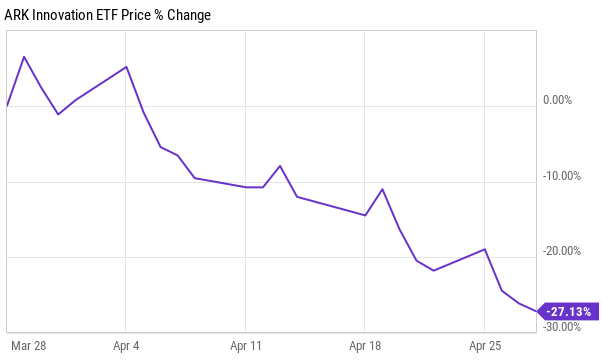
“A Dramatic Change In Fortunes” For Cathie Wood: ARKK Is Set For Its Worth Ever Month After Plunging 27% In April

“A Dramatic Change In Fortunes” For Cathie Wood: ARKK Is Set For Its Worth Ever Month After Plunging 27% In April

The hits just keep on coming for Cathie Wood. The manager of the ARK Innovation Fund (ARKK) was probably hoping for some type – any type – of help from tech earnings after hours yesterday to buoy the NASDAQ heading into the end of the week.

But, alas, that does not look to be the case. Amazon, and yes even Apple, posted reported that have failed to excite the street heading into the second half of 2022, and the NASDAQ looks slated to have another volatile day on Friday.

Wood’s flagship fund has suffered its worth month on record, plunging nearly 27% in April.

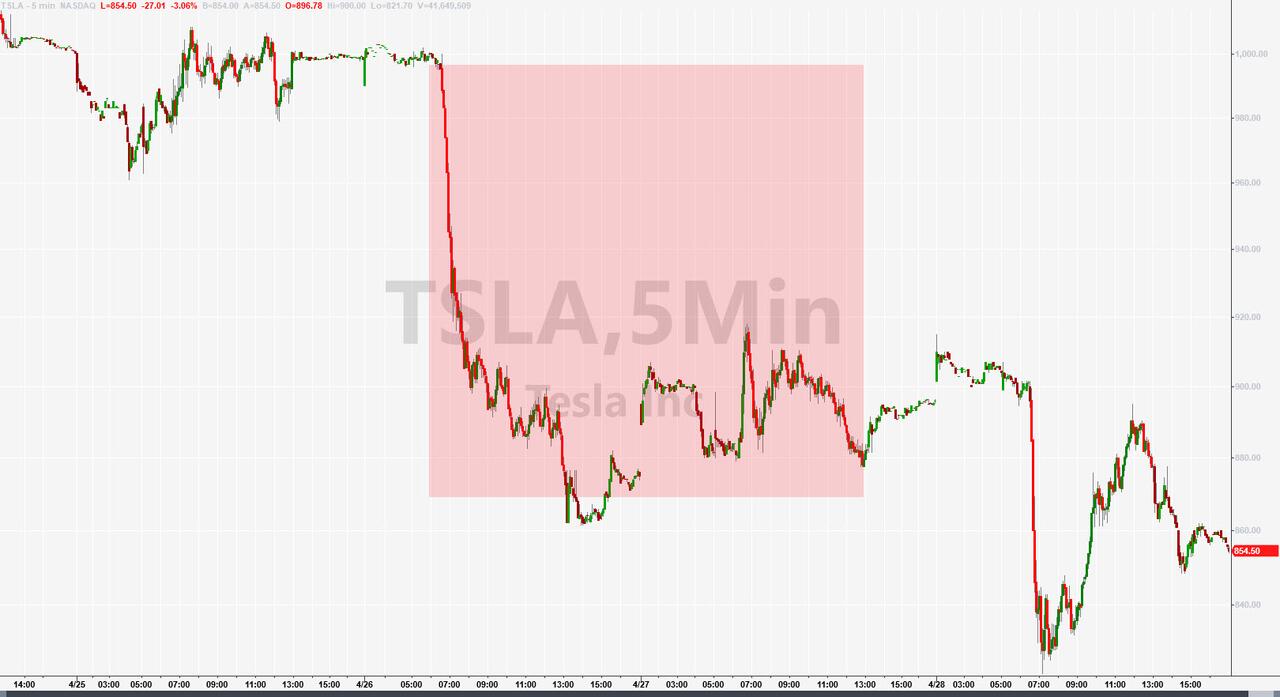
Adding insult to injury this past week were several of Wood’s major holdings. First, Teladoc set the tone, crashing more than 40% after an earnings and guidance meltdown. Then, Tesla shares were under pressure all week (from what we now know to have been Elon Musk selling billions of dollars in stock). 

The shares were sold over the past few days, at prices ranging from $872.02 to $999.13, and were the first by the Tesla chief since a burst of selling late last year that raised more than $16bn (which were offsetting tax payments on vesting options).

And on Thursday after hours, Robinhood, another popular ARK name, was also down 10% on earnings. 

ARKK has now fallen almost 70% from its all time highs, Bloomberg noted in a wrap up Friday morning. They called it a “dramatic change in fortunes for Wood”.

The report noted that out of the fund’s 37 holdings, only one – Signify Health – is green for the year. 

Russ Mould, investment director at AJ Bell, told Bloomberg: “The debate about whether Cathie Wood just rides beta up and beta down, or is genuinely capable of providing alpha, will continue to rage.”

But is there really a debate? Rather, it seems to us to be an amazing case study in what happens when the Fed suddenly decides it no longer wants to artificially prop up the stock market. 

Tyler Durden
Fri, 04/29/2022 – 08:01

via ZeroHedge News https://ift.tt/pdCQvfS Tyler Durden

The Reverse Spider-Man Principle: With Great Responsibility Comes Great Power

[I blogged an early draft of this essay three months ago, but I’ve revised it extensively since then. I’d love to hear any suggestions people might have; I still have a few weeks to edit it before it’s put to bed. You can also read the whole thing in a 16-page PDF.]

An entity—a landlord, a manufacturer, a phone company, a credit card company, an Internet platform, a self-driving car manufacturer—is making money off its customers’ activities. Some of those customers are using the entity’s services in ways that are criminal or tortious. Should the entity be held responsible, legally or morally, for its role (however unintentional) in facilitating its customers’ activities? This question has famously been at the center of the debates about platform content moderation,[1] but it can come up in other contexts as well.[2]

This is a broad question, and there might be no general answer. (Perhaps it is two broad questions—one about legal responsibility and one about moral responsibility—but I think the two are connected enough to be worth discussing together.) In this essay, though, I’d like to focus on one downside of answering it “yes”: What I call the Reverse Spider-Man Principle—with great responsibility comes great power.[3] Whenever we are contemplating holding entities responsible for their customers’ behavior, we should think whether we want to empower such entities to surveil, investigate, and police their customers, both as to that behavior and as to other behavior.[4]

Of course, some of the entities with whom we have relationships do have power over us. Employers are a classic example: In part precisely because they are responsible for our actions (through principles such as respondeat superior or negligent hiring/supervision liability), they have great power to control what we do, both on the job and in some measure off the job.[5] Doctors have the power to decide what prescription drugs we can buy, and psychiatrists have the responsibility (and the power) to report when their patients make credible threats against third parties.[6] And of course we are all within the power of police officers, who have the professional though not the legal responsibility to prevent and investigate crime.

On the other hand, we generally don’t expect to be in such subordinate relationships to phone companies, or to manufacturers selling us products. We generally don’t expect them to monitor how we use their products or services (except in rare situations where our use of a service interferes with the operation of the service itself), or to monitor our politics to see if we are the sorts of people who might use the products or services badly. At most, we expect some establishments to perform some narrow checks at the time of a sale, often defined specifically and clearly by statute, for instance by laws that require bars not to serve people who are drunk or that require gun dealers to perform background checks on buyers.[7]

Many of us value the fact that, in service-oriented economies, companies try hard to do what it takes to keep customers (consider the mentality that “the customer is always right”), rather than expecting customers to comply with the companies’ demands. But as we demand more “responsibility” from such providers, we push them to exercise more power over us, and thus fundamentally change the nature of their relationships with us. If companies are required to police the use or users of their products and services—what scholars have called “third-party policing”[8]—then people’s relationship with them may become more and more like people’s relationship with the police.

[I.] The Virtues of Irresponsibility

Let me begin by offering three examples of where some courts have balked at imposing legal liability, precisely because they didn’t want to require or encourage businesses to exercise power over their customers.

[A.] Telephone and Telegraph Companies

The first came in the early 1900s, where some government officials demanded that telephone and telegraph companies block access to their services by people suspected of running illegal gambling operations. Prosecutors could have gone after the bookies, of course, and they did. But they also argued that the companies should have done the same—and indeed sometimes prosecuted the companies for allowing their lines to be used for such criminal purposes.

No, held some courts (though not all[9]); to quote one:

A railroad company has a right to refuse to carry a passenger who is disorderly, or whose conduct imperils the lives of his fellow passengers or the officers or the property of the company. It would have no right to refuse to carry a person who tendered or paid his fare simply because those in charge of the train believed that his purpose in going to a certain point was to commit an offense. A railroad company would have no right to refuse to carry persons because its officers were aware of the fact that they were going to visit the house of [the bookmaker], and thus make it possible for him and his associates to conduct a gambling house.

Common carriers are not the censors of public or private morals. They cannot regulate the public and private conduct of those who ask service at their hands.[10]

If the telegraph or telephone company (or the railroad) were held responsible for the actions of its customers, the court reasoned, then it would acquire power—as “censor[] of public or private morals”—that it ought not possess.

[B.] E-Mail Systems

Now those companies were common carriers, denied such power (and therefore, those courts said, responsibility) by law. But consider a second example, Lunney v. Prodigy Services Co., a 1999 case in which the New York high court held that e-mail systems were immune from liability for allegedly defamatory material sent by their users.[11]

E-mail systems aren’t common carriers, but the court nonetheless reasoned that they shouldn’t be held responsible for failing to block messages, even if they had the legal authority to block them: An e-mail system’s “role in transmitting e-mail is akin to that of a telephone company,” the court held, “which one neither wants nor expects to superintend the content of its subscribers’ conversations.”[12] Even though e-mail systems aren’t forbidden from being the censors of their users’ communications, the court concluded that the law shouldn’t pressure them into becoming such censors.

[C.] Landlords

Courts have likewise balked at imposing obligations on residential landlords that would encourage the landlords to surveil and police their tenants. Consider Castaneda v. Olsher, where a mobile home park tenant injured in a gang-related shootout involving another tenant sued the landlord, claiming it “had breached a duty not to rent to known gang members.” No, said the California Supreme Court:

[W]e are not persuaded that imposing a duty on landlords to withhold rental units from those they believe to be gang members is a fair or workable solution to [the] problem [of gang violence], or one consistent with our state’s public policy as a whole. . . .

If landlords regularly face liability for injuries gang members cause on the premises, they will tend to deny rental to anyone who might be a gang member or, even more broadly, to any family one of whose members might be in a gang.[13]

This would in turn tend to lead to “arbitrary discrimination on the basis of race, ethnicity, family composition, dress and appearance, or reputation,” which may itself be illegal (so the duty would put the landlord in a damned-if-you-do-damned-if-you-don’t position).

But even apart from such likely reactions by landlords being illegal, making landlords liable would jeopardize people’s housing options and undermine their freedom even if they aren’t gang members, putting them further in the power of their landlords: “families whose ethnicity, teenage children, or mode of dress or personal appearance could, to some, suggest a gang association would face an additional obstacle to finding housing.” Likewise, even if landlords respond only by legally and evenhandedly checking all tenants’ criminal histories, “refusing to rent to anyone with arrests or convictions for any crime that could have involved a gang” would “unfairly deprive many Californians of housing.” This “likely social cost” helped turn the court against recognizing such a responsibility on the part of landlords.[14]

Other courts have taken similar views. In Francis v. Kings Park Manor, Inc., for instance, the Second Circuit sitting en banc refused to hold a landlord liable for its tenants’ racial harassment of fellow tenants, partly because of concern that such responsibility would pressure landlords to exercise undue power over tenants:

[Under the alternative proposed by Francis,] prospective and current renters would confront more restrictive leases rife with in terrorem clauses, intensified tenant screening procedures, and intrusions into their dealings with neighbors, all of which could result in greater hostility and danger, even culminating in (or beginning with) unwarranted evictions.

Our holding should also be of special interest to those concerned with the evolution of surveillance by state actors or by those purporting to act at their direction. See Note 44, ante (warning against broad liability schemes that would encourage landlords to act as law enforcement).[15]

The New York intermediate appellate court took a similar view in Gill v. New York City Housing Authority, rejecting liability for tenant-on-tenant crime that plaintiff claimed might have been avoided had the landlord dealt better with a tenant’s mental illness:

The practical consequences of an affirmance in this case would be devastating. The Housing Authority would be forced to conduct legally offensive and completely unwarranted “follow-up” of all those tenants within its projects known to have a psychiatric condition possibly, but it must be noted, not foreseeably, injurious to another tenant. Once the “follow-up” had been conducted, the Housing Authority would then be obligated to look into its crystal ball to access the likelihood of harm and then, where indicated, to take protective measures for which it had no expertise or authority. These would include dispensing medication, monitoring treatment, posting warnings (i.e., “Beware of your neighbor”), or evicting tenants. Given the options, eviction, which is described in the Housing Authority Management Manual as a “last resort,” would become almost commonplace. Those with psychiatric disorders would be dispossessed from their low-income accommodations to live in the streets.[16]

And a New Jersey intermediate appellate court took the same view in Estate of Campagna v. Pleasant Point Properties, LLC, in rejecting a claim that landlords should be responsible for doing background checks on tenants:

Even assuming that defendants had performed a criminal background check of Strong and learned of his robbery conviction, there are significant public policy ramifications about what a rooming house would be expected to do with that information, if a legal duty to conduct a criminal background check of prospective residents were imposed.

“In deciding whether to recognize the existence of a duty of care . . . [courts] must bear in mind the broader implications that will flow from the imposition of a duty.”  . . . The practical effects of creating a duty for rooming house owners to conduct criminal background checks of prospective residents might be either: (1) a need to disclose a new resident’s criminal history to the other residents for their protection; or (2) a need to reject a prospective resident’s application based upon the apparent criminal history. Both of these possible outcomes have debatable ramifications.

The first outcome raises policy concerns because sharing a new resident’s criminal background with other residents would potentially violate his or her statutory right to privacy and potentially foster unnecessary fear and conflict.

As for the second likely consequence—outright rejection of an applicant based upon any criminal conviction—that outcome would surely inhibit the ability of persons with criminal histories to obtain affordable housing. . . .

Notably, although certain federal and state housing guidelines do allow property owners to conduct criminal background checks of prospective residents so long as they are not used in a discriminatory manner, such checks are not mandated.[17]

To be sure, the pattern here is not uniform. Sometimes landlords are held responsible, by statutes, ordinances, or tort law rules, for monitoring their tenants for potentially illegal behavior (such as distribution of drugs), for failing to evict tenants who are violating the law[18] (or even ones who are being victimized by criminals, and thus calling 911 too often[19]), for failing to warn co-tenants of tenants’ past criminal records,[20] or even for renting to tenants who have criminal records.[21] But the result has indeed been what the courts quoted above warned about: Greater surveillance of tenants by landlords, and greater landlord power being exercised over tenants.[22]

[D.] The Limits of Complicity

One way of seeing these cases is as putting limits on concepts of complicity. The law does sometimes hold people liable for enabling or otherwise facilitating others’ wrongful conduct, even in the absence of a specific wrongful purpose to aid such conduct;[23] consider tort law principles such as negligent hiring and negligent entrustment. But there are often good public policy reasons to limit this.

Sometimes those reasons stem from our sense of professional roles. We don’t fault a doctor for curing a career criminal, even if as a result the criminal goes on to commit more crimes. It’s not a doctor’s job to choose who merits healing, or to bear responsibility for the consequences of successfully healing bad people.

Likewise, the legal system expects defense lawyers to do their best to get clients acquitted, and doesn’t hold the lawyers responsible for the clients’ future crimes. (Indeed, historically the legal system had allowed courts to order unwilling lawyers to represent indigent defendants.[24]) When there is public pressure on lawyers to refuse to represent certain clients, the legal establishment often speaks out against such pressure.[25]

And sometimes those reasons stem from our sense of who should and who shouldn’t be “censors of public or private morals.” The police may enforce gambling laws, or arrest gang members for gang-related crimes. The courts may enforce libel law. But various private companies, such as phone companies, e-mail services, and landlords shouldn’t be pressured into doing so.[26]

[II.] Practical Limits on Private Companies’ Power, in the Absence of Responsibility

Now of course many such companies (setting aside the common carriers or similarly regulated monopolies) have great power over whom to deal with and what to allow on their property, even when they aren’t held responsible—by law or by public attitudes—for what happens on their property. In theory, for instance, Prodigy’s owners could have decided that they wanted to kick off users who were using Prodigy e-mail for evil purposes: libel, racist speech, anti-capitalist advocacy, or whatever else. Likewise, some companies may decide not to deal with people who they view as belonging to hate groups, just because their owners think that’s the right thing to do, entirely apart from any social or legal norms of responsibility.

But in practice, in the absence of responsibility (whether imposed by law or social norms), many companies will eschew such power, for several related reasons—even setting aside the presumably minor loss of business from the particular customers who are ejected:

  1. Policing customers takes time, effort, and money.
  2. Policing customers risks error and bad publicity associated with such error, which could alienate many more customers than the few who are actually denied service.
  3. Policing customers in particular risks allegation of discriminatory policing, which may itself be illegal and at least is especially likely to yield bad publicity.
  4. Policing some customers will often lead to public demands for broader policing: “You kicked group X, which we sort of like, off your platform; why aren’t you also kicking off group Y, whom we loathe and whom we view as similar to X?”[27]
  5. Conversely, a policy of “we don’t police our customers”—buttressed by social norms that don’t require (or even affirmatively condemn) such policing—offers the company a simple response to all such demands.
  6. Policing customers creates tension even with customers who aren’t violating the company’s rules—people often don’t like even the prospect that some business is judging what they say, how they dress, or whom they associate with.
  7. Policing customers gives an edge to competitors who publicly refuse to engage in such policing, and sell their services as “our only job is to serve you, not to judge you or eject you.”

Imposing legal responsibility on such companies can thus pressure them to exercise power even when they otherwise wouldn’t have. And that is in some measure so even if responsibility is accepted as a broad moral norm, enforced by public pressure, not just a legal norm. That norm would increase the countervailing costs of non-policing. It would decrease the costs of policing: For instance, the norm and the corresponding pressure will likely act on all major competitors, so the normal competitive pressures encouraging a “the customer is always right” attitude will be sharply reduced. And at some point, might become standard against which the reasonableness of behavior is measured, either as a legal matter or as a matter of public reaction.

Likewise, when people fault a company for errors or perceived discrimination, the company can use the norm as cover, for instance arguing that “regrettably, errors will happen, especially when one has to do policing at scale.” “After all, you’ve told us you want us to police, don’t you?”

Accepting such norms of responsibility can also change the culture and organization of the companies. It would habituate the companies to exercising such power. It would create bureaucracies within the companies staffed with people whose jobs rely on exercising the power—and who might be looking for more reasons to exercise that power.

And by making policing part of the companies’ official mission, it would subtly encourage employees to make sure that the policing is done effectively and comprehensively, and not just at the minimum that laws or existing social norms command. Modest initial policing missions, based on claims of responsibility for a narrow range of misuse, can thus creep into much more comprehensive use of such powers.[28]

[III.] The Future of Responsibility, When Products Involve Constant
Customer/Seller Interaction

So far, there has been something of a constraint on calls for business “responsibility” for the actions of their customers: Such calls have generally involved ongoing business-customer relationships, for instance when Facebook can monitor what its users are posting (or at least respond to other users’ complaints).

Occasionally, there have been calls for businesses to simply not deal with certain people at the outset—consider Castaneda v. Olsher, where plaintiffs argued that defendants just shouldn’t have rented the mobile homes to likely gang members. But those have been rare.

Few people, for instance, would think of arguing that car dealers should refuse to sell cars to suspected gang members who might use the cars for drive-by shootings or for crime getaways.[29] Presumably most people would agree that even gang members are entitled to buy and use cars in the many lawful ways that cars can be used, and that car dealers shouldn’t try to deny gang members access to cars.[30] If the legislature wants to impose such responsibilities, for instance by banning sales of guns to felons or of spray paint to minors, then presumably the legislature should create such narrow and clearly defined rules, which rely on objective criteria that don’t require seller judgment about which customers merely seem likely to be dangerous.

But now more and more products involve constant interaction between the customer and the seller.[31] Say, for instance, that I’m driving a partly self-driving Tesla that is in constant contact with the company. Recall how Airbnb refused to rent to people who it suspected were going to a “Unite the Right” rally.[32] If that is seen as proper—and indeed as mandated by corporate social responsibility principles—then one can imagine similar pressure on Tesla to stop Teslas from driving to the rally (or at least to stop such trips by Teslas of those people suspected of planning to participate in the rally).[33]

To be sure, this might arouse some hostility, because it’s my car, not Tesla’s. But of course Airbnb was refusing to arrange bookings for other people’s properties, not its own. Airbnb’s rationale was that it had a responsibility to stop its service from being used to promote a racist, violent event.[34] But why wouldn’t Tesla then have a responsibility to stop its intellectual property and its computers (assuming they are in constant touch with my car) from being used the same way?

To be sure, Tesla’s sale contract might be seen as implicitly assuring that its software will always try to get me to my destination. But that is just a matter of the contract. If companies are seen as responsible for the misuse of their services, why wouldn’t they have an obligation to draft contracts that let them fulfill that responsibility?

Now maybe some line might be drawn here: Perhaps, for instance, we might have a special rule for services that are ancillary to the sale of goods (Tesla, yes, Airbnb, no), under which the transfer of the goods carries with it the legal or moral obligation to keep providing the services even when one thinks the goods are likely to be used in illegal or immoral ways. (Though what if I lease my Tesla rather than buying it outright?) Or at least we might say there’s nothing irresponsible about a product seller refusing to police customers’ continuing use of the services that make those products work.

But that would just be a special case of the broader approach that I’m suggesting here: For at least some kinds of commercial relationships, a business should not be held responsible for what its customers do—because we don’t want it exercising power over its customers’ actions.

[IV.] The Future of Responsibility and Big Data Analysis

There had historically also been another constraint on such calls for business “responsibility”: It’s often very hard for a business to determine what a customer’s plans are. Even if there is social pressure to get businesses to boycott people who associate with supposed “hate groups”[35]—or even if the owners of a business (say, Airbnb) just want to engage in such a boycott—how is a business to know what groups a person associates with, at least unless the person is famous, or unless someone expressly complains about the person to the business?[36]

But of course these days we can get a lot more data about people, just by searching on the Internet and through some other databases (some of which may cost money, but well within the means of most big businesses). To be sure, this might yield too much data about each prospective customer for a typical business to process at scale. But AI technology may well reduce the cost of such processing, by enabling computers to quickly and cheaply sift through all that data, and produce some fairly reliable estimate: Joe Schmoe is 93% likely to be closely associated with one of the groups that a business is being pressured to boycott. At that point, the rhetoric of responsibility may suggest that what now can be done (identify supposedly bad potential clients) should be done.

Consider one area in which technological change has sharply increased the scope of employer responsibility—and constrained the freedom of many prospective employees. American tort law has long held employers for negligent hiring, negligent supervision, or negligent retention when they unreasonably hire employees who are incompetent at their jobs (in a way that injures third parties)[37] or who have a tendency to commit crimes that are facilitated by the job.[38] But until at least the late 1960s, this hasn’t required employers to do nationwide background checks, because they were seen as too expensive, and thus “would place an unfair burden on the business community.”[39] Even someone who had been convicted of a crime could thus often start over and get a job, at least in a different locale, without being dogged by his criminal record.

Now, though, as nationwide employee background checks have gotten cheap, they have in effect become mandatory for many employers: “Lower costs and easier access provide [an] incentive to perform [background] checks, potentially leaving employers who choose not to conduct such checks in a difficult position when trying to prove they were not negligent in hiring.”[40] As a result, people with criminal records often find it especially hard to get jobs. Perhaps that’s good, given the need to protect customers from criminal attack, or perhaps it’s bad, given the social value of giving people a way to get back to productive, law-abiding life, or perhaps it’s a mix of both. But my key point here is that, while the employer’s responsibility for screening his employees has formally remained the same—the test is reasonable care—technological change has required employers to exercise that responsibility in a way that limits the choices of prospective employees much more than it did before.

Similarly, commercial property owners have long been held responsible for taking reasonable—which is to say, cost-effective—measures to protect their business visitors from criminal attack. Thus, as video surveillance cameras became cheap enough to be cost effective, courts began to hold that defendants may be negligent for failing to install surveillance cameras,[41] even though such surveillance would not have been required when cameras were much more expensive.

We can expect to see something similar as technological change makes other forms of investigation and surveillance—not just of employees or of outside intruders, but of customers—more cost-effective. If it is a company’s responsibility to make sure that bad people don’t use the company’s products or services for bad purposes, then as technology allows companies to investigate their clients’ affiliations and beliefs more cost-effectively, companies will feel pressure to engage in such investigation.

Conclusion

“Responsibility” is often viewed as an unalloyed good. (Who, after all, wants to be known as “irresponsible”?) Sometimes we should indeed hold people and organizations legally or morally responsible for providing tools that others misuse. And of course people and organizations are entitled to choose to accept such responsibility, even if they are not pressured to do so.[42]

My point here is simply that such responsibility has an important cost, and refusal to take responsibility has a corresponding benefit. Those who are held responsible for what we do will need to assert their power over us, surveilling, second-guessing, and blocking our decisions. A phone company or an e-mail provider or a landlord that is responsible for what we do with its property will need to control whether we are allowed to use its property, and control what we do with that property; likewise for a social media platform or a driverless car manufacturer. If we want freedom from such control, we should try to keep those companies from being held responsible for their users’ behavior.

There is value in businesses being encouraged to “stay in their lane,” with their lane being defined as providing a particular product or service. They should be free to say that they “are not the censors of public or private morals,” and that they should not “regulate the public and private conduct of those who ask service at their hands”;[43] even if, unlike with telephone and telegraph cases, they have the legal right to reject some customers, they should be free to decline to exercise that right. Sometimes the responsibility for stopping misuse of the product should be placed solely on the users, and on law enforcement—not on businesses that are enlisted as legally largely unsupervised private police forces, doing what the police are unable to do, or (as with speech restrictions) are constitutionally forbidden from doing.


[1] See, e.g., U. Mich., Hate Speech in Social Media: How Platforms Can Do Better (Feb. 17, 2022), Mich. News, https://‌news.umich.edu/‌hate-speech-in-social-media-how-platforms-can-do-better/‌ (“‘[T]he companies behind [social media platforms] have civic responsibilities to combat abuse and prevent hateful users and groups from harming others'”) (quoting Prof. Libby Hemphill, author of an Anti-Defamation League report urging platforms to ban “white supremacist speech”); Karis Stephen, The Social Responsibility of Social Media Platforms, Reg. Rev. (Dec. 21, 2021), https://‌www.theregreview.org/‌2021/‌12/‌21/‌stephen-social-responsibility-social-media-platforms/‌.

[2] See, e.g., Henry Fernandez, Curbing Hate Online: What Companies Should Do Now, Center for American Progress (Oct. 25, 2018) (arguing that payment processors have a responsibility to refuse to process payments to “hate groups”).

[3] “With great power comes great responsibility” of course predates Spider-Man’s Uncle Ben, though it is most associated with him. The phrase is often credited to Voltaire, Montpelier US Ins. Co. v. Collins, No. CIV. 11-141-ART, 2012 WL 588799, *1 (E.D. Ky. Feb. 22, 2012), among others.

For reasons that elude me, the official name is apparently “Spider-Man” rather than “Spiderman.” Bui not “Bat-Man” or “Super-Man.”

[4] I assume in all such situations that the entities aren’t acting with the specific purpose of promoting illegal behavior. If such a purpose is present, their actions may well be criminal aiding and abetting or even criminal conspiracy. See, e.g., 18 Pa. Cons. Stat. Ann. § 306 (aiding and abetting); Tex. Penal Code. Ann. § 7.02 (2004) (likewise); United States v. Pino-Perez, 870 F.2d 1230, 125 (7th Cir. 1989) (likewise); Ocasio v. United States, 578 U.S. 282, 288 (2016) (conspiracy).

[5] Some statutes do limit employers’ power to act on their employees’ religious practices, speech, and certain off-the-job activities. See, e.g., Title VII of the Civil Rights Act of 1964, 42 U.S.C. § 2000e; Eugene Volokh, Private Employees’ Speech and Political Activity: Statutory Protection Against Employer Retaliation, 16 Tex. Rev. L. & Pol. 295 (2012); Colo. Rev. Stat. Ann. § 24-34-402.5(1) (lawful off-the-job activities generally); N.D. Cent. Code Ann. § 14-02.4-03, -08 (same); 820 Ill. Comp. Stat. Ann. 55/‌5 (off-the-job consumption of lawful products); Mont. Code Ann. §§ 39-2-313(2), -313(3) (2011) (same); Nev. Rev. Stat. Ann. § 613.333(1)(B) (same); N.C. Gen. Stat. Ann. § 95-28.2(B) (same); Wis. Stat. Ann. §§ 111.321, 111.35(2) (same).

[6] See, e.g., Tarasoff v. Regents, 551 P.2d 334 (Cal. 1976).

[7] See, e.g., Cal. Bus. & Prof. Code § 25602(a); 18 U.S.C. § 922(t).

[8] See, e.g., Lorraine Mazerolle & Janet Ransley, Third Party Policing (2005); Tracey L. Meares & Emily Owens, Third-Party Policing: A Critical View, in Police Innovation 273–87 (2019).

[9] For the contrary view, see, e.g., Howard Sports Daily v Weller, 18 A.2d 210 (Md. 1941).

[10] Commonwealth v. Western Union Tel. Co., 67 S.W. 59, 60 (Ky. 1901) (paragraph break added); see also Pa. Publications v. Pa. Pub. Util. Comm’n, 36 A.2d 777, 781 (Pa. 1944) (cleaned up); People v. Brophy, 120 P.2d 946, 956 (Cal. App. 1942).

[11] The case turned on conduct that happened before the enactment of 47 U.S.C. § 230, which provided such immunity by statute. The court therefore addressed whether a libel claim was available in the first place, thus avoiding the need to determine whether § 230 was retroactive.

[12] Lunney v. Prodigy Servs. Co., 723 N.E.2d 539, 542 (N.Y. 1999).

[13] 162 P.3d 610 (Cal. 2007). On this point, the Justices were unanimous.

[14] Id. at 619.

[15] 992 F.3d 67, 79 n.47 (2d Cir. 2021).

[16] 130 A.D. 2d 256, 266 (1987).

[17] 234 A.3d 348, 369 (N.J. App. Div. 2020); see also Anderson v. 124 Green St. LLC, No. CIV.A. 09-2626-H, 2011 WL 341709, *5 (Mass. Super. Jan. 18, 2011), aff’d, 82 Mass. App. Ct. 1113 (2012).

[18] See, e.g., Giggers v. Memphis Hous. Auth., 277 S.W.3d 359, 371 (Tenn. 2009).

[19] See, e.g., Bd. of Trustees of Vill. of Groton v. Pirro, 152 A.D.3d 149, 157–58 (N.Y. App. Div. 2017); Erik Eckholm, Victims’ Dilemma: 911 Calls Can Bring Eviction, N.Y. Times, Aug. 17, 2013; Matthew Desmond & Nicol Valdez, Unpolicing the Urban Poor: Consequences of Third-Party Policing for Inner-City Women, 78 Am. Soc. Rev. 117 (2012).

[20] See generally Eugene Volokh, Tort Law vs. Privacy, 114 Colum. L. Rev. 879, 895–97 (2014).

[21] See David Thacher, The Rise of Criminal Background Screening in Rental Housing, 33 L. & Soc. Inq. 5, 26 (2008) (“government efforts that encouraged landlords to adopt criminal history screening were partly motivated by a growing belief that private institutions should take more responsibility for their social impacts”).

[22] See generally, e.g., B.A. Glesner, Landlords as Cops: Tort, Nuisance & Forfeiture Standards Imposing Liability on Landlords for Crime on the Premises, 42 Case W. Res. L. Rev. 679, 780 (1992); Deborah J. La Fetra, A Moving Target: Property Owners’ Duty to Prevent Criminal Acts on the Premises, 28 Whittier L. Rev. 409, 439–59 (2006); Robert J. Aalberts, Drug Testing Tenants: Does It Violate Rights of Privacy?, 38 Real Prop. Prob. & Tr. J. 479, 481–82 (2003); Desmond & Valdez, supra note 11.

[23] See supra note 4.

[24] See, e.g., Sacandy v. Walther, 262 Ga. 11 (1992); David L. Shapiro, The Enigma of the Lawyer’s Duty to Serve, 55 N.Y.U. L. Rev. 735 (1980).

[25] See, e.g., Guantanamo Remarks Cost Policy Chief His Job, CNN (Feb. 2, 2007); Michel Paradis & Wells Dixon, In Defense of Unpopular Clients—and Liberty, Wall St. J., Nov. 18, 2020; cf. Eugene Volokh, Defending Guantanamo Detainees, Volokh Conspiracy (Jan. 12, 2007), https://‌volokh.com/‌posts/‌1168632463.shtml.

[26] I set aside here still other reasons, for instance stemming from the sense that excessive complicity liability may improperly chill proper behavior as well as improper, or may unduly deter the exercise of constitutional rights. See, e.g., New York Times Co. v. Sullivan, 376 U.S. 254 (1964) (limiting newspaper publisher’s liability for publishing allegedly libelous ads); Protection for Lawful Commerce in Arms Act, 15 U.S.C. §§ 7901­­-7903 (limiting firearms manufacturers’ and sellers’ liability for criminal misuse of firearms by third parties).

[27] Judge Alex Kozinski and I have labeled this “censorship envy,” at least when it applies to speech-restrictive decisions. Alex Kozinski & Eugene Volokh, A Penumbra Too Far, 106 Harv. L. Rev. 1639, 1655 n.88 (1993)

[28] See Eugene Volokh, The Mechanisms of the Slippery Slope, 116 Harv. L. Rev. 1026, 1051–56 (2003) (discussing such “enforcement need” slippery slopes).

[29] But see Andrew Jay McClurg, The Tortious Marketing of Handguns: Strict Liability Is Dead, Long Live Negligence, 19 Seton Hall Legis. J. 777, 816 n.178 (1995) (quoting a proposal that gun sellers must, on pain of liability for negligence, “be especially alert to, and wary of, gun buyers who display certain behavioral characteristics such as . . . appear[ing] in unkempt clothing and hav[ing] a slovenly appearance”).

[30] A few companies have said that they will refuse to do business with anyone “associated with known hate groups.” See Airbnb, An Update on Our Work to Uphold Our Community Standards, Mar. 18, 2021; Michelle Malkin, Why Airbnb Banned Me (And My Hubby, Too!), Prescott eNews, Feb. 6, 2022, https://‌prescottenews.com/‌index.php/‌2022/‌02/‌06/‌opinion-why-airbnb-banned-me-and-my-hubby-too-michelle-malkin/‌; Twitch, Off Service Conduct, https://‌safety.twitch.tv/‌s/‌article/‌Off-Service-Conduct?language=en_US. Twitch also says it will ban users who are “[h]armful misinformation actors, or persistent misinformation spreaders,” even when none of the alleged misinformation was spread on Twitch. But this seems to be a fairly rare sort of rule.

[31] Rebecca Crootof, The Internet of Torts: Expanding Civil Liability Standards to Address Corporate Remote Interference, 69 Duke L.J. 583 (2019), discusses this interaction in detail; but that article focuses on corporations monitoring and controlling the products they sell in order to promote their own financial interests (for instance, enforcing otherwise hard-to-enforce license terms, or electronically “repossessing” them in the event of failure to pay), rather than in order to fulfill some legally or socially mandated responsibilities to prevent supposed misuse by customers.

In addition to the question discussed in the text—whether the companies should have a responsibility for monitoring customer use of such connected products, and preventing misuse—there are of course other questions as well, such as (1) whether companies should have a responsibility to report possible misuse, see Volokh, Tort Law vs. Privacy, note 19, (2) whether companies’ records of user behavior should in some measure be shielded from law enforcement subpoenas and warrants, and from civil discovery, and (3) whether companies should be required to design their products in a way that facilitates law enforcement, cf. 47 U.S.C. §§ 1002, 1003, 1005 (requiring that telephone systems be designed to facilitate legally authorized surveillance).

[32] Will Sommer, Airbnb, Uber Plan to Ban ‘Unite the Right’ White-Supremacist Rally Participants, Daily Beast, Aug. 10, 2018, https://‌www.thedailybeast.com/‌airbnb-uber-plan-to-ban-unite-the-right-white-supremacist-rally-participants. Uber and Lyft apparently only stressed that their drivers could “refuse service to passengers connected to the . . . rally,” id., rather than themselves forbidding their drivers from doing so.

[33] Maybe Tesla’s current owner, Elon Musk, would be reluctant to do impose such rules, but then imagine some other car company that sells such cars.

[34] See, e.g., Should Airbnb Ban Customers It Disagrees With?, BBC (Aug. 8, 2017), https://‌www.bbc.com/‌news/‌world-us-canada-40867272.

[35] See supra note 19.

[36] See, e.g., the Michelle Malkin incident cited in note 19; Malkin is a prominent conservative commentator.

[37] See, e.g., Carman v. City of New York, 1862 WL 4285 (N.Y. Sup. Ct. 1862) (noting liability for “want of sufficient care in employing suitable persons”).

[38] See, e.g., F. & L. Mfg. Co. v. Jomark, Inc., 134 Misc. 349 (N.Y. App. Term. 1929) (noting liability when a messenger hired by defendant stole property, when “[t]he most casual investigation would have disclosed that this messenger was not a proper person to whom defendant’s goods might be intrusted,” presumably because the investigation would have shown that the messenger was dishonest); Hall v. Smathers, 240 N.Y. 486, 490 (1925) (noting liability for an “assault upon a tenant of an apartment house by a superintendent kept in his position in spite of the complaints of the tenants, and with full knowledge of the defendants’ agents of his habits and disposition”).

[39] See Stevens v. Lankard, 297 N.Y.S.2d 686, 688 (App. Div. 1968), aff’d, 254 N.E.2d 339 (N.Y. 1969).

[40] Ryan D. Watstein, Note, Out of Jail and Out of Luck: The Effect of Negligent Hiring Liability and the Criminal Record Revolution on an Ex-Offender’s Employment Prospects, 61 Fla. L. Rev. 581, 592–93 (2009); cf., e.g., Malorney v. B & L Motor Freight, Inc., 496 N.E.2d 1086, 1089 (Ill. App. Ct. 1986) (“[T]here is no evidence . . . that the cost of checking on the criminal history of all truck driver applicants is too expensive and burdensome when measured against the potential utility [(preventing sexual assault of hitchhikers)] of doing so.”); Carlsen v. Wackenhut Corp., 868 P.2d 882, 887–88 (Wash. Ct. App. 1994) (concluding employer may have duty to conduct background check for certain employees, including unarmed concert security guards).

[41] See supra Volokh, Tort Law vs. Privacy, note 13, at 918 n.176 (collecting cases).

[42] Occasionally people’s felt moral or religious obligation to avoid what they see as complicity with evil behavior will clash with public accommodations laws, and will raise interesting questions under various religious freedom statutes and constitutional regimes; but is a separate matter. See, e.g., Eugene Volokh, A Common-Law Model for Religious Exemptions, 46 UCLA L. Rev. 1465, 1525-26 (1999); Eugene Volokh, Religious Exemption Regimes and Complicity in Sin, Volokh Conspiracy (Dec. 6, 2021), https://ift.tt/wZ9hxOC.

[43] See supra note 9.

The post The Reverse Spider-Man Principle: With Great Responsibility Comes Great Power appeared first on Reason.com.

from Latest https://ift.tt/GxlLK9P
via IFTTT
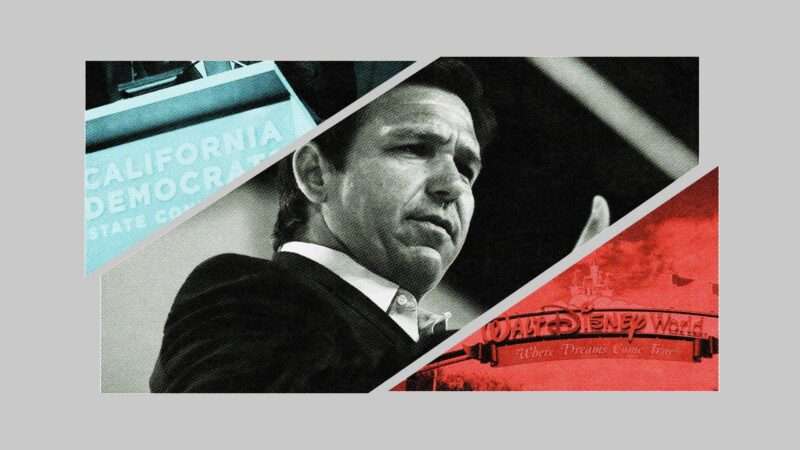
The Jurisdiction Problem in the Church Autonomy Cases

I’ve been blogging this week about church autonomy. So far my posts have been based on my new paper on “The Limits of Church Autonomy.” In this post I’m going to leave the subject of the paper to talk about another issue in the church autonomy caselaw, one that’s a bit in the weeds of civil procedure but really matters. (This post is based on a recent symposium presentation I gave at Loyola Chicago; I’m currently writing up a longer version of this for the symposium issue of the Loyola Chicago Law Journal.)

Courts are divided about whether church autonomy is jurisdictional in a more technical and procedural sense. For a while, the federal courts were split as to whether church autonomy should be raised as a jurisdictional challenge under Rule 12(b)(1) or as an affirmative defense under Rule 12(b)(6). Alongside the courts that agreed that church autonomy was jurisdictional were others that denied church autonomy fit the description of jurisdictional.

Why it matters

In many cases it doesn’t really matter whether church autonomy is jurisdictional or an affirmative defense. But it does matter in answering the following questions:

  1. Must church autonomy be resolved at the earliest possible opportunity?
  2. Can a denial of church autonomy be subject to an interlocutory appeal?
  3. Can church autonomy be raised at any time in the proceedings?

If it’s jurisdictional, then all of these questions must be answered “yes.”

Resolving the problem (or not)

The Supreme Court thought it could solve the problem with a footnote in its 2012 decision, Hosanna-Tabor, where it explained that church autonomy is an affirmative defense. In the immediate aftermath of the decision, Howard Wasserman argued that the Court’s position was the best approach in light of the Court’s efforts to tighten the definition of jurisdiction in recent years.

But the Supreme Court didn’t solve the question of whether church autonomy is jurisdictional. The question lives on.

The courts are still divided

A number of state courts continue to treat the matter as jurisdictional. Texas courts, for instance, continue to say that a church autonomy defense should be raised as an objection to jurisdiction: “A party may raise lack of subject matter jurisdiction via a plea to the jurisdiction ‘when religious-liberty grounds form the basis for the jurisdictional challenge.'”

Sometimes, the decision to treat the church autonomy issue as jurisdictional in the face of the Supreme Court’s disagreement has been controversial. One judge on the Texas Court of Appeals dissented in a recent case on precisely this issue. The court majority issued a writ of mandamus to stop a district court from deciding a dispute about a priest’s pay, when the matter involved examining the decision making of a religious authority over a minister. In dissent, Chief Justice Yvonne Rodriguez argued that church autonomy is not jurisdictional and thus cannot be the basis for mandamus. She noted that the Texas Supreme Court held that church autonomy issues were jurisdictional in its 2007 case, Westbrook v. Penley. But since then, she argued, the U.S. Supreme Court had clarified in Hosanna-Tabor that the First Amendment is not a “substantive restraint on jurisdiction in religious liberty cases,” at least when it comes to “employment discrimination.” The U.S. Supreme Court trumps state law on issues of federal constitutional law, so, she argued, the Texas courts are in error.

One might think that the federal courts at least would be paying more attention to the Supreme Court’s instructions on civil procedure and church autonomy. But when one looks around a bit, it turns out that there’s disagreement there too. The Eleventh Circuit said as recently as last year: “Civil courts lack jurisdiction to entertain disputes involving church doctrine and polity.”

A decision from the Southern District of New York explained: “It is somewhat unclear whether the First Amendment serves as jurisdictional bar or an affirmative defense to claims that require courts to review ecclesiastical decisions.” Citing pre-Hosanna-Tabor decisions, it noted that “[m]ost district courts to consider the question have treated it as jurisdictional.” It suggested whether—perhaps—these decisions survived after Hosanna Tabor on the theory that matters implicating “ecclesiastical decisions” outside of the employment context could be treated differently from the “ministerial exception” in the employment context of Hosanna-Tabor.

It’s not the only court to make this suggestion. For example, from a District of D.C. decision: “[W]ithout definitive guidance otherwise from the Supreme Court or the D.C. Circuit, the Court will analyze defendants’ arguments under the ecclesiastical abstention doctrine—which is ‘related’ to but ‘distinct’ from the ministerial exception—under a Rule 12(b)(1) lens, as that approach is consistent with the long-standing practice of treating questions of ecclesiastical entanglement as jurisdictional.”

A possible solution

I think that the distinction between “ecclesiastical abstention” and “ministerial exception” is pretty flimsy. But I don’t think that the issues that really matter should necessarily turn on whether the issue is labeled jurisdictional. Sovereign immunity is a helpful analogue. Like church autonomy, it’s best thought of as an affirmative defense under the tighter definition of ‘jurisdiction’ employed by the Supreme Court in recent years. But like church autonomy, it has characteristics that appear jurisdictional. In church autonomy as in sovereign immunity, it’s best to unbundle the issues, and consider one at a time whether church autonomy can be raised in an interlocutory posture, whether it can be waived, and so on.

There’s not space here to tackle all of the issues—but I’ll just briefly address one, which is pending in both the Second and Tenth Circuits: can a denial of a church autonomy defense be raised in an interlocutory posture?

I think the answer should yes. And I don’t think that it’s necessary to characterize church autonomy as “jurisdictional” under Rule 12 for the answer to be yes. Instead, I think the answer is yes based on the reasons for the church autonomy doctrine itself. Protecting against interference with the internal processes of church is the objective of church autonomy. If it’s erroneously denied at the outset, and no interlocutory review is available, the protection is entirely lost. It’s too late for an appellate court to remedy the matter on appeal later. This is where some courts and commentators have rightly noted an analogy to qualified immunity: the whole point of the doctrine is to protect against having to defend the case.

There’s more to say about how this plays out with issues of waiver and forfeiture. I’m working on that paper now (the link will be coming soon to my SSRN or Twitter). In the meantime, thanks to the Volokh Conspiracy for letting me share some of my thoughts on the matter here on the blog, and thank you for reading!

The post The Jurisdiction Problem in the Church Autonomy Cases appeared first on Reason.com.

from Latest https://ift.tt/D6pV30S
via IFTTT

Stop Using Legislation To Virtue Signal


og1

Officials in overwhelmingly Democratic California have long used state power to torment businesses they don’t like for a variety of ideological reasons. The Newsom administration is, by its own admission, trying to put the entire fossil-fuels industry out of business because of the governor’s stated concerns about climate change.

A succession of Democratic attorney generals—Rob Bonta, Xavier Becerra and Kamala Harris—used the state Department of Justice to go after gun manufacturers, insurance companies, and carmakers for transparently political reasons. Sure, they concoct legalistic justifications—such as claiming that pension funds’ coal investments endanger the state’s long-term fiscal health.

But they’re really just misusing their police authority to achieve progressive policy goals. Republicans have been right in arguing that state Democrats should knock off the politics of virtue signaling, stick to the basics of governance and treat all citizens and businesses equitably. Having failed to rein in the Left, however, the Right now is mimicking its tactics.

In states where conservatives have power they are more aggressive than progressives in punishing companies they dislike—not just for the nature of their business, but for the operational decisions those companies make and the political views corporate leaders express. Like Democrats, they’re doing real harm even if their efforts are all about posturing.

Florida is the prime example. Gov. Ron DeSantis (R), who is positioning himself as the Trumpiest candidate for the 2024 presidential race, wants to punish Twitter because its board thwarted Elon Musk’s buyout attempt. I argued that his takeover would advance freer speech, but it’s an appalling abuse of government power to intervene in that private dispute.

“We’re going to be looking at ways that the state of Florida potentially can be holding these Twitter board of directors accountable for breaching their fiduciary duty,” DeSantis declared at a recent press conference. He previously signed a First-Amendment-shredding tech bill that also is about posturing given that courts almost certainly will invalidate it.

Whenever a politician says “we,” that politician really is saying “the machinery of government.” Yet to the hosannas of conservatives who claim to be the upholders of limited government and the Constitution, DeSantis took things further by vowing to strip special state zoning rules that give Disney magical self-governing powers around its theme-park kingdom in Orlando.

It’s fair to criticize the special privileges enjoyed by influential corporate players. This columnist and The Orange County Register editorial board have regularly slammed Disney’s outsized political influence and subsidies in Anaheim. Cities ought to treat all businesses equally, although there’s a serious case for exempting private enterprises from burdensome land-use and planning regulations.

But that serious debate is not the impetus in Florida. As Allahpundit explained in the conservative Hot Air website, DeSantis had no problem carving out a Disney exemption from his tech bill nor has he or Florida Republicans expressed principled opposition to Disney’s fiefdom. Instead, DeSantis is punishing Disney because its corporate leaders vocally opposed his “Don’t Say Gay” legislation.

“No one believes that Disney would be facing this reckoning if it had cheer-led the ‘don’t say gay’ bill,” the column opined. “Which means the action Florida is taking, although facially neutral, is textbook viewpoint discrimination by government. Likewise, if a governor conditioned welfare payments on the recipient signing a statement pledging that he won’t criticize the governor’s climate-change agenda, that would be—or should be—a problem.”

I wish he hadn’t given California officials ideas. Seriously, DeSantis’ efforts aren’t fundamentally different in principle from what California’s woke progressives are doing—misusing state power to go after their corporate enemies. DeSantis’ action is creepily reminiscent of when AG Harris tried to force some conservative nonprofits to reveal their donors, although probably worse.

Colorado’s libertarian-ish governor Jared Polis’s rebuttal was delightful. His Tweet: “Florida’s authoritarian socialist attacks on the private sector are driving businesses away. In CO, we don’t meddle in affairs of companies like @Disney or @Twitter. Hey @Disney we’re ready for Mountain Disneyland and @twitter we’re ready for Twitter HQ2, whoever your owners are.” Touché.

Sadly, we now have two parties that are unabashedly authoritarian and socialistic – and use whatever authority they have to advance virtue-signaling agendas. While blue California impedes immigration enforcement, red Texas imposes enhanced border truck inspections—something Reason rightly called a “performative stunt” that led to massive border backups and “screwed over truck drivers.”

California filed more than 110 mostly performative lawsuits against the Trump administration, which echoed Texas’ 48 mostly performative lawsuits against the Obama administration. Despite both sides’ inconsistent claims of 10th Amendment (states’ rights) principle, we all know the reality. Ambitious partisan politicians simply are using government muscle to signal to their base that they are fighting back against (fill in the blank).

Owning the other side can indeed be great fun as long as your side is in power. It’s safer for everyone’s liberties, however, if both parties stayed within some guardrails.

This column was first published in The Orange County Register.

The post Stop Using Legislation To Virtue Signal appeared first on Reason.com.

from Latest https://ift.tt/6NgPBDW
via IFTTT

Futures Slide As Amazon, Apple Slump; Nasdaq Set For Worst Month Since Nov 2008

Futures Slide As Amazon, Apple Slump; Nasdaq Set For Worst Month Since Nov 2008

It has been an illiquid, rollercoaster session on the last day of the week and month, which first saw US index futures modestly rise alongside European stocks propped up by surging Chinese and Asian markets following Beijing’s latest vow to use new tools and policies to spur growth, however the initial move higher quickly faded as markets remembered that not only did Amazon report dismal earnings (with Apple also sliding on weak guidance) but the Fed is set to hike 50bps (or maybe 75bps) next week, and put a lit on any upside follow through. As a result, S&P500 futures dropped 0.9%, while Nasdaq futures retreated 1.1% on the last trading day of April, adding to their 9.3% decline so far this month and on pace for the worst monthly performance since November 2008 as fears of rising rates hurt bubbly growth shares and fuel risks for future profits. The yen snapped a slide while staying near 20-year lows. The yuan, euro, pound and commodity-linked currencies made gains while the dollar dipped. 10Y TSY yields rose, rising by about 4bps to 2.87% while gold moved back above $1900. Bitcoin tumbled as usual, and last traded back under $39,000.

In premarket trading, Amazon.com plunged 9%, after projecting dismal second-quarter sales growth, while the world’s largest company Apple dropped 2.8% after warning on supply constraints. Meanwhile, Tesla shares gained 3.1% premarket after CEO Elon Musk said he doesn’t plan on selling any more stock after a $4 billion stake sale. Here are some other notable premarket movers:

  • Intel (INTC US) shares slide 3.1% premarket as analysts flag “light” guidance for the chipmaker’s second quarter, stoking worries over the impact of waning demand for PCs. Intel’s second-quarter forecast missed the average estimate.
  • Robinhood (HOOD US) shares are set to open at a record low Friday as a lockdown-driven boom in retail trading continues to fade and a stock market selloff squeezes out some clients.
  • Tesla (TSLA US) shares rise as much as 4.2% premarket, after CEO Elon Musk said he doesn’t plan on offloading any more Tesla stock after selling ~$4b of shares in the electric vehicle maker following his deal to buy Twitter.
  • Accolade (ACCD US) plummets 36% premarket after the company’s 2023 revenue forecast fell short of estimates, with Morgan Stanley downgrading the healthcare software provider to equal-weight after the loss of a key customer.
  • Finch Therapeutics (FNCH US) shares soar as much as 54% premarket after the biotech announced that the FDA removed the clinical hold on Finch’s investigational new drug application for CP101.
  • Piper Sandler cut its recommendation on Mastercard (MA US) to underweight, becoming the first broker to downgrade the company with a sell-equivalent rating since August. Shares down 1.1% premarket.
  • U.S.-listed Chinese stocks rally across the board in premarket trading after China’s top leaders pledged more support to spur economic growth and vowed to contain Covid outbreaks. Alibaba (BABA US) +13%, JD.com (JD US) +16%.
  • Zymeworks (ZYME US) climbs 30% premarket; All Blue Capital made a non-binding offer at $10.50 per share in cash for the biotech company, Reuters reports, citing people familiar with the matter.

Outside of the flagship tech giant earnings misses, the results season has been reassuring so far. S&P 500 earnings growth is tracking 4.3% year-on-year, with 86% of companies beating estimates, according to Barclays strategists. “With continued solid U.S. growth prospects, robust earnings, and relatively strong household balance sheets, a recession in the next 12 months is not in our base case,” said UBS Wealth Management CIO Mark Haefele. 

Meanwhile, as reported earlier, China’s top leaders promised to boost economic stimulus to spur growth.  While China’s announcement brought some relief for markets, many risks remain. They span China’s ongoing Covid challenges, the impact of the Fed on the U.S. economy and Russia’s war in Ukraine.

“The Fed’s record on soft landings is not that strong,” Carol Schleif, deputy chief investment officer at BMO Family Office LLC, said on Bloomberg Television. “Markets are watching very, very carefully to see if we can thread that needle.”

The latest U.S. data showed that the world’s largest economy unexpectedly shrank for the first time since 2020. That reflected an import surge tied to solid consumer demand, suggesting growth will return imminently.  The figures underscore the debate about how much scope the U.S. central bank has to tighten policy before the economy cracks. Markets continue to project a half-point Fed rate hike next week.

“A year from now, 10-year yields are most likely going to be lower than where we are today,” Jimmy Chang, chief investment officer at Rockefeller Financial LLC, said on Bloomberg Television, referring to Treasuries. “I do believe at some point the economy starts to weaken, the Fed will be less hawkish, perhaps even go into a pause mode by, say, early next year.”

Meanwhile, China’s latest vow to prop up markets helped support European stocks (in addition to Asian and Chinese stocks of course), also spurred by a robust earnings season. The Stoxx Europe 600 Index climbed 0.8%, trimming a monthly decline. The Euro Stoxx 50 gains as much as 1.5% with most cash equity indexes gaining over 1% before stalling. Tech, consumer products and financial services are the strongest performing sectors. Here are some of the biggest European movers today:

  • Novo Nordisk shares gain as much as 7.3% after the Danish pharmaceutical giant reported its latest earnings, which included a large beat on its blockbuster obesity drug Wegovy. The company also hiked its outlook.
  • BBVA rises as much as 5.6% after better-than-expected first-quarter earnings, as the Spanish lender’s performance in Turkey showed signs of vindicating Chief Executive Officer Onur Genc’s bet on the country.
  • Johnson Matthey jumps as much as 36%, the steepest gain since at least 1989 when Bloomberg’s records started, after Standard Industries Inc. bought a stake in the company.
  • Remy Cointreau climbs as much as 3.8% after the French distiller reported 4Q sales that were in line with consensus. Analysts noted the strong start to the current fiscal year and a limited impact so far from a Covid-19 resurgence in the key Chinese market.
  • Spie shares climb as much as 5.1% after the French company reported 1Q figures that Bryan Garnier said were “substantially” above expectations, with planned European investments for energy independence also viewed as a potential headwind.
  • AstraZeneca shares decline as much as 1.3% after the company’s first-quarter earnings included a beat on core EPS and overall revenue, but also a slight miss on Alexion rare disease medication and key growth drugs such as Imfinzi.
  • Neste falls as much as 8.7% even as the Finnish maker of renewable diesel reported first-quarter results that beat estimates. Jefferies (hold) said the lack of longer-term (full-year 2022) margin guidance could disappoint.
  • Henkel tumbles as much as 10% after what RBC says was a “substantial profit warning” for 2022.
  • NatWest falls as much as 6% after its 1Q results got a mixed response from analysts. Some were impressed with the performance of the bank’s Go-Forward business, while others highlighted the very low mortgage spread and miss in the CET1 capital ratio.
  • Orsted drop as much as 3.2% despite reporting a 1Q profit beat, with analysts focusing on the project delays due to supply chain shortages as well as the impact of high input costs.

Earlier in the session, Asian stocks climbed for a second day led by a jump in Chinese technology shares, amid a series of new policy promises from the country’s top leaders to bolster the economy and markets.  The MSCI Asia Pacific Index advanced as much as 1.7%, with Tencent and Alibaba among the biggest gainers. The Hang Seng Tech Index soared more than 10%, rebounding from earlier losses, as the country vowed to support healthy growth of platform companies. As reported earlier, China’s Politburo, led by President Xi Jinping, vowed to meet economic targets in a sign that it may step up stimulus to support growth. Shortly before the measures were unveiled, Chinese tech stocks reversed earlier losses as traders speculated about a possible relaxation of the yearlong regulatory clampdown. Chipmakers in Taiwan and South Korea also climbed, helping the region’s tech sector. A Bloomberg index of Asian semiconductor stocks rallied as much as 2.4%, its biggest gain in more than two weeks. A key technical indicator suggested that the sector is still oversold after Intel’s disappointing profit forecast.

“After recent selloffs in the semiconductor sector, the price levels have become attractive for dip buyers,” said Seo Jung-Hun, a strategist at Samsung Securities, adding that the rebound may be limited ahead of the U.S. Federal Reserve meeting next week.   Stocks in South Korea, Taiwan and Australia advanced while those in Japan were closed for a holiday. Asia’s equity benchmark was still poised for its steepest monthly drop since March 2020 and its fourth monthly decline.

Australian stocks also advanced, paring the week’s decline. The S&P/ASX 200 index rose 1.1% to 7,435.00, paring the week’s loss. Technology and communications sectors gained the most Friday. Pointsbet gained the most in almost a month, snapping a five day losing streak after reporting turnover for the third quarter. Domino’s Pizza fell for a fourth day, dropping the most in a month. New Zealand, the S&P/NZX 50 index was little changed at 11,884.30.

India’s benchmark equities index completed a third monthly slide this year as higher oil prices weighed on sentiment.  The S&P BSE Sensex fell 0.8% to 57,060.87 in Mumbai on Friday, taking its loss in April to 2.6%. Axis Bank Ltd. dropped 6.6% after reporting earnings and was the biggest drag on the Sensex, which saw 23 of 30 member-stocks fall. The NSE Nifty 50 Index also slipped 0.8% to 17,102.55. All 19 sectoral sub-indexes compiled by BSE Ltd. slipped, led by a gauge of oil and gas companies.  “We’ve been seeing the index oscillating in a broader range for the last two weeks and there’s no clarity over the next directional move yet,” Ajit Mishra, vice president for research at Religare Broking Ltd., wrote in a note.  The brokerage maintains a cautious view, with focus on earnings, auto sales data and the initial share sale of Life Insurance Corporation next week.  Of the 15 Nifty 50 firms that have announced earnings results so far, 10 either met or exceeded analysts’ expectations, while five missed. 

In FX, the Bloomberg Dollar Spot Index fell after touching an almost two-year high yesterday as the greenback weakened against all of its Group-of-10 peers. Treasuries underperformed European bonds, with 3-year yields rising by 7bps. Scandinavian currencies were the top performers as they were supported by month-end flows. The Australian dollar extended intra-day gains after China’s top leaders promised to boost economic stimulus to spur growth and vowed to contain the country’s worst Covid outbreak since 2020, which is threatening official targets for this year. The euro snapped six days of losses against the dollar but was still set for its worst monthly performance in almost four years. Bunds extended losses and yields rose by up to 5 bps after data showed euro-area consumer prices rose by 7.5% from a year earlier in April, in line with the median estimate in a Bloomberg survey. A gauge excluding volatile items such as food and energy jumped to 3.5%. The pound advanced against the dollar, trimming a weekly decline of 2.2%. The cost of hedging against swings in the pound over a one-week period rose to the highest since December 2020. Gilts outperformed bunds and Treasuries, as money markets pared BOE tightening wagers. The yen rose on demand over the currency fix in Tokyo but it remains on track for its worst monthly performance since 2016

In rates, Treasuries hold losses into the U.S. session leaving yields down by as much as 6bps across front-end as the curve flattens. 10-year TSY yields were around 2.86%, cheaper by 4bp vs. Thursday close while 2s10s, 5s30s spreads flatten 2bp and 2.5bp amid front-end and belly-led weakness. German short-end cheapens roughly 5 bps to 0.24% as euro-area core inflation accelerated higher than expected. In Europe, peripherals underperform and lead bond losses while Estoxx50 climbs following better sentiment across Asia stocks after China’s pledge to ramp up stimulus.  Dollar issuance slate empty so far; two names priced $4.5b Thursday, taking weekly volumes through $8b vs. $20b forecast. Expectations are for $20b to $25b next week and a total of $125b to $150b for the month of May

In commodities, WTI rose 1.2% higher to trade near $107. Saudi Aramco is expected to lower its official selling prices for June-loading crudes, market sources told S&P Global Commodity Insights; following tepid Asian demand fundamentals, with the OSP differentials retreating from the record highs. North Sea Crude oil grades underpinning dated Brent Benchmark to average 540k BPD in June (prev. 755k BPD), according to programmes. Indian firms are reportedly seeking oil import deals with Russia, according to sources cited by Reuters; three refiners looking to buy up to 16mln bbl per month of oil from Russia. Spot gold rises roughly $20 to trade around $1,915/oz. Most base metals trade in the green.

Bitcoin prices are softer as usual and briefly retreated beneath the 39,000 level.

Looking at the day ahead now, and data releases include the flash CPI estimate for the Euro Area in April, as well as the first look at Q1 GDP for the Euro Area, Germany, France and Italy. Otherwise from the US, we’ll get March’s data on personal spending and personal income, the Q1 employment cost index, the NI Chicago PMI for April, and the University of Michigan’s final consumer sentiment index for April. From central banks, we’ll hear from the ECB’s de Cos, and the Central Bank of Russia will be making its latest policy decision. Finally, earnings releases include ExxonMobil, Chevron, AbbVie, Bristol-Myers Squibb, Honeywell International, Charter Communications, Aon and NatWest.

Market Snapshot

  • S&P 500 futures down 0.9% to 4,242.00
  • STOXX Europe 600 up 1.0% to 451.55
  • MXAP up 2.0% to 169.00
  • MXAPJ up 2.6% to 561.33
  • Nikkei up 1.7% to 26,847.90
  • Topix up 2.1% to 1,899.62
  • Hang Seng Index up 4.0% to 21,089.39
  • Shanghai Composite up 2.4% to 3,047.06
  • Sensex up 0.5% to 57,796.94
  • Australia S&P/ASX 200 up 1.1% to 7,435.01
  • Kospi up 1.0% to 2,695.05
  • German 10Y yield little changed at 0.88%
  • Euro up 0.7% to $1.0574
  • Brent Futures up 0.9% to $108.51/bbl
  • Brent Futures up 0.9% to $108.51/bbl
  • Gold spot up 1.1% to $1,915.10
  • U.S. Dollar Index down 0.66% to 102.94

Top Overnight News from Bloomberg

  • More than six years after China’s shock 2015 devaluation roiled global markets and spurred an estimated $1 trillion in capital flight, the yuan is weakening at a similar pace. Onshore it’s lost nearly 4% in eight days, while the offshore rate is heading for its worst month relative to the greenback in history. Selling momentum is the strongest since the height of Donald Trump’s trade war in 2018
  • Geopolitical turmoil is reviving the dollar’s status as a haven, extending gains seen earlier this year as traders shifted to the U.S. to seize on rising interest rates from the Federal Reserve. On Thursday, one gauge of the greenback pushed through to the strongest level since 2002, swept up by a wave of demand for the world’s reserve currency
  • Russia’s war with Ukraine may persuade the Swiss National Bank to adjust its monetary policy if inflation accelerates, SNB President Thomas Jordan said
  • Economic expansion in the euro zone began 2022 on a weak footing — underscoring the damage from soaring energy costs and worsening supply snarls following Russia’s invasion of Ukraine. Output increased 0.2% from the previous quarter in the three months through March — matching the median estimate in a Bloomberg survey
  • U.K. house prices rose for a ninth consecutive month in April as the housing market continued to defy an escalating cost of living crisis. The 0.3% gain marked the longest winning streak since 2016
  • Oil is poised for a fifth monthly gain after another tumultuous period of trading that saw prices whipsawed by the fallout from Russia’s war in Ukraine and the resurgence of Covid-19 in China

A More detailed look at global markets courtesy of Newsquawk

APAC stocks gained after the firm lead from the US where stocks looked past the surprise contraction in US GDP, but with advances in the region capped heading into month-end and next week’s mass closures. ASX 200 was firmer as tech mirrored the outperformance of the Nasdaq stateside and with gold miners following closely behind after the precious metal reclaimed the psychological USD 1900/oz level. Hang Seng and Shanghai Comp were initially indecisive ahead of next week’s holiday closures including in the mainland where markets will remain closed through to Wednesday, while participants also digested the surprise contraction in Hong Kong’s exports and imports data. However, a surge in Hong Kong tech stocks and policy pledges by China’s Politburo helped shake off the indecision.

Top Asian News

  • Bets of Easing Crackdown Spur Dizzying Jump in China Tech Stocks
  • Grab Gets Malaysia Digital Bank License as Five Bids Win
  • CATL Posts Sharp Drop in Earnings in Abrupt Reversal of Fortune
  • China Plans Symposium With Big Tech Firms After Labor Day: SCMP

European equities remained on the front foot on the last trading day of the month.   In terms of sectors, tech currently stands as the clear outperformer amid the sectoral gains on Wall Street yesterday alongside the surge in Chinese Tech. Overall, sectors have a slight anti-defensive bias. State-side futures were dented overnight amid after-hours losses in Amazon (-9% pre-market) and Apple (-2.4% pre-market) following disappointing guidance and inflationary headwinds. Thus, the NQ (-0.8%) currently lags.

Top European News

  • Russia Offers Dual-Payment Plan for Oil, Other Trade With India
  • Germany Says Won’t Block Embargo on Russian Oil to Punish Putin
  • UBS Wealth Says Too Early to Bet on Recession, Fed’s Failure
  • U.K. House Prices Deliver Longest Winning Streak Since 2016

FX

  • Dollar bulls book profits into month end and DXY pulls back further from near 104.000 peak in the process.
  • High betas, cyclical and activity currencies grab the chance to recoup losses vs Buck.
  • Euro rebounds amidst more hot Eurozone inflation data, but could be hampered by big option expiries.
  • Yuan regroups as Chinese Government promises stimulus measures and aid for sectors of the economy suffering worst covid contagion
  • Central Bank of Russia (CBR) cuts key rate by 300bps to 14.00% (exp. 15.00%); sees key rate in 12.5-14.00% range this year (prev. 9.0-11.0%).
  • Russia’s Kremlin, when asked about the idea of pegging the RUB to gold prices, says it is under discussion, according to Reuters.

Fixed Income

  • Bonds suffer another inflation setback after early EU rebound.
  • Bunds some 100 ticks down from 154.69 peak, Gilts flattish between 119.34-118.73 parameters and 10 year T-note nearer 119-04+ low than 19-24 high.
  • BTPs weak after so-so reception at end of month Italian auctions – US PCE data also adds to caution as Fed’s preferred measure of inflation.

Commodities

  • WTI and Brent front-month futures have been gaining during the European morning.
  • Saudi Aramco is expected to lower its official selling prices for June-loading crudes, market sources told S&P Global Commodity Insights; following tepid Asian demand fundamentals, with the OSP differentials retreating from the record highs. (S&PGlobal)
  • North Sea Crude oil grades underpinning dated Brent Benchmark to average 540k BPD in June (prev. 755k BPD), according to programmes.
  • Indian firms are reportedly seeking oil import deals with Russia, according to sources cited by Reuters; three refiners looking to buy up to 16mln bbl per month of oil from Russia.
  • Spot gold has been rising in tandem with a pullback in the Buck but ahead of the US March PCE metric.
  • Overnight, base metals saw gains in Shanghai, with some also citing a demand front-load ahead of the Chinese Labour Day.

US Event Calendar

  • 08:30: 1Q Employment Cost Index, est. 1.1%, prior 1.0%
  • 08:30: March Personal Income, est. 0.4%, prior 0.5%
    • March Personal Spending, est. 0.6%, prior 0.2%
    • March Real Personal Spending, est. -0.1%, prior -0.4%
    • March PCE Deflator MoM, est. 0.9%, prior 0.6%
    • March PCE Deflator YoY, est. 6.7%, prior 6.4%
    • March PCE Core Deflator MoM, est. 0.3%, prior 0.4%
    • March PCE Core Deflator YoY, est. 5.3%, prior 5.4%
  • 09:45: April MNI Chicago PMI, est. 62.0, prior 62.9
  • 10:00: April U. of Mich. Sentiment, est. 65.7, prior 65.7
    • U. of Mich. Expectations, est. 64.1, prior 64.1
    • U. of Mich. Current Conditions, est. 68.0, prior 68.1
    • U. of Mich. 1 Yr Inflation, est. 5.5%, prior 5.4%; 5-10 Yr Inflation, prior 3.0%

DB’s Jim Reid concludes the overnight wrap

By the time you’re reading this I’ll be lying down with straps around my ankles and wrists and making strange noises while I get manipulated by someone very strict. No I’m not remaking “50 Shades” but instead starting “Reformer Pilates” for the first time at a very early physio appointment. The miracle worker of a back consultant that has for now cured my debilitating sciatica with one simple injection has recommended it as a way of preventing a relapse. At this point, I will do absolutely anything he says so I’m prepared to humiliate myself on a regular basis going forward. So feel free to picture this as you read this.

Some of the bearish chains have been loosened in risk markets over the last 24 hours but volatility remains elevated. We’ve seen another major European bond selloff, the highest German inflation since 1950, a further surge in the dollar, an unexpected US economic contraction in Q1, poor Amazon earnings, as well as growing geopolitical tensions as speculation continues about a Russian oil embargo in Europe. In spite of all that however, major equity indices have continued to advance from their Tuesday lows, with the S&P 500 (+2.47%) staging a huge comeback as investors focused on the more positive stories from recent corporate earnings releases.

This was before Amazon missed sales expectations after the bell and revised down sales expectations for the second-quarter, fueling fears that consumer spending may slow despite evidence of robust activity in yesterday’s GDP data. Amazon shares were -9.15% lower after hours. However, Apple reported earnings that beat estimates on strong iPhone sales, despite supply chain issues coinciding with China’s lockdowns. Shares were -2.19% lower after hours. Overall sentiment still remains fragile with NASDAQ 100 futures (-1.04%) and S&P 500 futures (-0.43%) moving lower in the overnight trade.

This followed the best day for the S&P 500 (+2.47%) since the bounceback after the initial invasion in early March, with every sector more than +1.00% higher. Megacap tech stocks led the way as the FANG+ index rose +4.78%, its best day since mid-March. Europe also saw decent gains, although missing most of the rally that took place in the New York afternoon, with the STOXX 600 (+0.62%), the DAX (+1.35%) and the FTSE 100 (+1.13%) all higher. Given the big run-up in the New York afternoon, the S&P 500 was ‘only’ around +0.8% higher as Europe closed.

Bond markets were again lively with most of the action in Europe, with a significant selloff after the German CPI print for April surprised on the upside yet again. Looking at the details, the year-on-year measure rose to +7.8% using the EU-harmonised method (vs. +7.6% expected), which is certainly the fastest pace of inflation since German reunification, and at the same level briefly seen in West Germany after the first oil shock in 1973. Indeed if you’re looking for German inflation faster than that, you’ve got to go all the way back to the 1950s, since West Germany had much more success than the US or UK for example in keeping inflation in the single-digits even during the 1970s. We’ll have to see what the flash CPI reading for the entire Euro Area brings today, but as I mentioned in my Chart of the Day yesterday (link here), this brings home just how far the ECB is behind the curve, since the last time inflation was around these levels in the 70s, the Bundesbank certainly didn’t have a negative deposit rate.

With the inflation reading coming in above expectations, that catalysed a fresh bond selloff that took the 10yr bund yield up by +9.8bps to 0.89%. This echoes some of the other big moves higher in yields we’ve seen over the last couple of months, but it still leaves them beneath the peak of 0.97% at the end of last week. What was also noticeable was the fresh widening in spreads that speaks to the building minor stresses in European markets right now, with the gap between Italian and German 10yr yields up a further +4.2bps to 181bps, a level not seen since June 2020. As in the previous session, those moves were seen in the credit space too, with the iTraxx Crossover widening +3.7bps to 418bps, leaving it just shy of its recent peak at 421bps in early March.

Another cause for concern in European markets have been the ongoing tensions between Russia and the West over Ukraine, with the Euro falling by a further -0.55% yesterday to $1.0499, the first close below $1.05 since early 2017, although this morning it has moved back up to $1.0514. Conversely the dollar index (+0.65%) continued its upward march, strengthening for the 19th time in the last 21 sessions, and closing at its strongest level since 2002. That comes as the latest reports indicate that a Russian oil embargo is moving closer, with Brent crude ending the day up +2.16% at $107.59/bbl after Dow Jones reported that Germany had dropped its opposition to an embargo, and this morning, Brent has risen further to $108.00/bbl. We also heard from President Biden, who requested $33bn from Congress for further assistance to Ukraine, including $20.4bn on security and military assistance, $8.5bn on economic assistance, and $3bn on humanitarian assistance.

Overnight in Asia, equity markets are mostly trading higher following the strong performance on Wall Street, with tech stocks leading the way. The Hang Seng (+2.04%) has seen one of the strongest performances, far outpacing mainland Chinese indices including the Shanghai Composite (+0.37%) and the CSI 300 (-0.06%). That comes amidst persistent concerns over the country’s lockdowns, with Shanghai seeing an increase in Covid-19 cases for the first time in 6 days, and overnight we also heard from China’s Politburo, with CCTV reporting that they’re urging efforts to meet the economic growth targets. Elsewhere, the Kospi (+0.78%) is trading up while markets in Japan are closed for a holiday today.

Back on the data front, another notable release yesterday came from the US GDP reading for Q1. On one level it’s a fairly backward-looking reading, but the print saw an unexpected contraction, with the economy shrinking at an annualised rate of -1.4%, marking the first quarterly contraction since the lockdowns of Q2 2020. That said, there are no indications this is going to derail the Fed from their path of rate hikes, with a 50bps move next week still fully priced in. In fact, there was a massive drag coming from the surprisingly large trade deficit, while underlying consumption was actually very robust, suggesting rates need to get even higher to slow demand, as we’ve been arguing. In turn, the amount of Fed hikes priced for the rest of the year moved up +2.2bps to 239bps, and this morning they’re up to 242bps, just shy of their closing high last Friday at 244bps. That led to a renewed flattening in the yield curve, and 2yr yields gained +2.6bps while 10yr yields fell -0.9bps. Despite the tepid headline nominal move, there was a big divergence in 10yr inflation breakevens and real yields. Breakevens gained +7.3bps to 2.98%, a few bps shy of their highest levels on record from last week. By contrast, real yields fell -8.2bps to -0.16%, taking them a further from positive territory ahead of next week’s FOMC where its also widely-anticipated they will announce the beginning of their QT program.

To the day ahead now, and data releases include the flash CPI estimate for the Euro Area in April, as well as the first look at Q1 GDP for the Euro Area, Germany, France and Italy. Otherwise from the US, we’ll get March’s data on personal spending and personal income, the Q1 employment cost index, the MNI Chicago PMI for April, and the University of Michigan’s final consumer sentiment index for April. From central banks, we’ll hear from the ECB’s de Cos, and the Central Bank of Russia will be making its latest policy decision. Finally, earnings releases include ExxonMobil, Chevron, AbbVie, Bristol-Myers Squibb, Honeywell International, Charter Communications, Aon and NatWest.

Tyler Durden
Fri, 04/29/2022 – 07:33

via ZeroHedge News https://ift.tt/ZcD32oH Tyler Durden