After Backlash, Google Turns Off ‘Newspeak’ Correction Tool (For Now)

After Backlash, Google Turns Off ‘Newspeak’ Correction Tool (For Now)

Authored by Steve Watson via Summit News,

Google claims that it has disabled a feature within its document editor that was correcting language to make it ‘more inclusive’, but only while it refines the tool to make it work more effectively.

As we reported Monday, Google Docs was trialling ‘inclusive warnings’, which act like a language checker, suggesting that users refrain from using terms such as ‘policeman’ or ‘landlord’, because they are gendered, and words like ‘fierce’ and ‘annoyed’ for being threatening.

Critics (even ones with rainbow flags in the bio) compared the move to the Ministry of Truth from Orwell’s 1984, policing language and making sure that its Newspeak is implemented whenever necessary.

Now, following the backlash, The Daily Wire notes that Google is pausing the tool.

Google spokeswoman Jenny Thomson told the outlet that “inclusive language suggestions—an assisted writing feature—can over or undercorrect certain phrases. We’re looking more carefully at the inclusive language suggestions and have paused those for further review while we continue to improve this feature.”

In a creepy admission, Thomson noted that the feature is “a form of AI that uses language understanding models, based on millions of common phrases and sentences, to automatically learn how people communicate and suggest changes.”

In comments to the Telegraph, Big Brother Watch’s Silkie Carlo urged that “Google’s new word warnings aren’t assistive, they’re deeply intrusive,” adding that “This speech-policing is profoundly clumsy, creepy and wrong, often reinforcing bias.”

The purpose of Newspeak was not only to provide a medium of expression for the world-view and mental habits proper to the devotees of Ingsoc, but to make all other modes of thought impossible.

There was no vocabulary expressing the function of Science as a habit of mind, or a method of thought irrespective of its particular branches. There was, indeed, no word for ‘Science,’ any meaning that it could possibly bear being already sufficiently covered by the word Ingsoc. 

*  *  *

Brand new merch now available! Get it at https://www.pjwshop.com/

In the age of mass Silicon Valley censorship It is crucial that we stay in touch. We need you to sign up for our free newsletter here. Support our sponsor – Turbo Force – a supercharged boost of clean energy without the comedown. Also, we urgently need your financial support here.

Tyler Durden
Thu, 04/28/2022 – 17:20

via ZeroHedge News https://ift.tt/Vc9T8zW Tyler Durden

New textbook: Firearms Law and the Second Amendment


guninholster_1161x653

If you are interested in arms law, you might enjoy the new textbook Firearms Law and the Second Amendment: Regulation, Rights, and Policy. The third edition, from Aspen Publishing, came out several months ago. It is coauthored by Nicholas J. Johnson (Fordham), George A. Mocsary (Wyoming), E. Gregory Wallace (Campbell), Donald Kilmer (Lincoln), and me (Denver).

Our inspiration for the textbook, whose first edition appeared in 2012, was Rutgers law professor Ruth Bader Ginsburg and her textbook Constitutional Aspects of Sex Discrimination. What law students learn depends on what professors can teach. Teaching depends on what textbooks exist. Although some professors do collect or write their own materials for class, most of what gets taught in law school is from textbooks. Only if a textbook on women’s rights existed could women’s rights be broadly studied in law school.

By 1971 there were professors who were interested in women’s rights but were far from expert on the subject. They could teach it only if someone else wrote a textbook. They had neither the time nor inclination to determine which cases and materials were most important, collect and edit them, and then organize them into an orderly narrative. So Ginsburg did it all for them. She also provided her own analysis.

Now, the same process is happening for the Second Amendment. Since 2012, Firearms Law has been spurring the creation of Second Amendment classes at law schools; every year more law students learn how to incorporate the right to keep and bear arms into their legal practice. Some of those students will become criminal defense lawyers and others prosecutors. Some will become business and regulation lawyers who represent retailers or manufacturers, and others will work for regulatory agencies. More than a few will eventually become lawmakers, judges, or other leading government officers. Unlike in past generations, the new generation of lawyers includes members who are already well-educated about the right to keep and bear arms and gun control laws.

The success of Firearm Regulation and the Second Amendment has spurred two other publishers of law school textbooks to produce their own entries into what has become the growing field of Second Amendment education. One good book is Guns and the Law: Cases, Problems, and Explanation, by Andrew J. McClurg (Memphis) and Brannon P. Denning (Samford) (Carolina Academic Press 2016). The 592 page book contains ten chapters with pro/con materials on various topics. Back in 2002, McClurg, Denning, and I teamed up to write Gun Control and Gun Rights: A Reader and Guide (NYU Press), which at the time was the first book on firearms policy written for use in higher education.

The other textbook, forthcoming in 2023 from West, is The Second Amendment: Gun Rights and Regulation, by Joseph Blocher (Duke), Darrell A.H. Miller (Duke), and Jacob Charles (Pepperdine). Unlike the Firearms Law textbook, this one will not delve deep into legal history, but will instead (like six chapters in Firearms Law) examine the post-Heller legal landscape. I’m sure that a book from these three excellent scholars will be good; in our own textbook, we cite them 14 times.

Things have come a long way since Sanford Levinson observed in 1989 that the legal academy considered it “embarrassing” to think seriously about the Second Amendment. Sanford Levinson, The Embarrassing Second Amendment, 99 Yale Law Journal 637 (1989).

The Johnson et al. Firearms Law book is for readers like the Buddhist monk who walked into a sandwich shop and said, “Make me one with everything.”

Firearms Law runs 2,243 pages and costs $298. However, in terms of how many words you get per dollar, it’s a bargain!

Firearms Law was written for more than just the law school audience. The style is accessible to the general intelligent reader, and the textbook is also a treatise of arms law and history, from ancient times to the present. As such, it has been useful to the courts. Judge Brett Kavanaugh, when he served on the D.C. Circuit Court of Appeals, cited the textbook, as did Judge Thomas Hardiman of the Third Circuit. The Illinois Supreme Court has cited the textbook twice. Much of the book is on the cutting edge of modern legal analysis and of legal history.

To prepare students for practice, Firearms Law extensively covers the federal gun control statutes, such as the Gun Control Act and the National Firearms Act, as well as state laws.

Some of Firearms Law is available for free. The printed book is 16 chapters, and those are supplemented by 7 online chapters, which are available on the public Internet, at the book’s website. http://firearmregulation.org/. These free online chapters cover issues of identity and status (e.g., race, gender, disability, sexual orientation, marijuana use, and veteran status); other nations and international issues (ancient, modern, and in-between), and an “In-Depth Explanation of Firearms and Ammunition.” The printed book has a coupon for access for all 23 chapters as an integrated e-book, usable by readers who have academic email accounts.

And that’s not all! Also free online for everyone is chapter 3 from the printed textbook, on colonial America. Did you know that in the English-speaking world, the first written guarantees of the right to arms were the colonial charters of Virginia in 1606 and New England in 1620? Neither did anyone else until we found out, and put the history into Firearms Law.

While the printed book is almost entirely about the United States, except for a chapter on United Kingdom history, the online chapters allow readers to explore arms law and policy the rest of the world, from ancient times to the present. The international chapters cover global and regional treaties, the United Nations, national constitutions, the classical founders of international law such as Pufendorf and Grotius, and comparative social science. (Social science about arms in the U.S. is even-handedly summarized in chapter 1 of the printed book.) The online chapters include case studies on Armenia, Australia, Canada, the Czech Republic, Ghana, the Holocaust, Japan, Kenya, Mexico, South Africa, Switzerland, Thailand, the United Kingdom, and Venezuela.

China is examined in great detail. Online chapter 21, Antecedents of the Second Amendment, starts with Confucius, Lao Tzu, Mencius, and their successors. The Comparative Law chapter includes 10 pages on modern Chinese arms law, and a hundred-page study of the effects of various arms policies in China and Tibet during the reign of Mao Zedong.

Firearms Law pays close attention to material culture, and how changes in arms technology have influenced arms law and policy. The technological evolution is integrated into the historical and modern chapters of the printed book, and described in depth in concluding Chapter 23, “The Evolution of Firearms Technology from the Sixteenth Century to the Twenty-First Century.”

In words of Faber College founder Emil Faber (from the movie Animal House), “Knowledge is good.” We hope Firearms Law and the Second Amendment will increase knowledge, and thereby help legal education and the general public progress to ever-more thoughtful and informed examination of law and policy involving the right to keep and bear arms.

The post New textbook: Firearms Law and the Second Amendment appeared first on Reason.com.

from Latest https://ift.tt/jaULYg9
via IFTTT

Apple Jumps After Smashing Expectations In Record Non-holiday Quarter, Boosts Buyback By $90BN

Apple Jumps After Smashing Expectations In Record Non-holiday Quarter, Boosts Buyback By $90BN

Just when traders were getting a deja vu sense of “oh shit, here we go again”, and were bracing for another collapse in the Nasdaq tomorrow after Amazon’s plunge driven by dismal guidance, moments ago the last remaining GAMMA stock, and the world’s most valuable company, Apple may have saved the Nasdaq – and the market – at least until next week’s FOMC, when it reported fiscal Q2 earnings that blew away expectations, and in fact, reported its best non-holiday quarter ever!

Here is what AAPL just reported for its fiscal Q2 quarter.

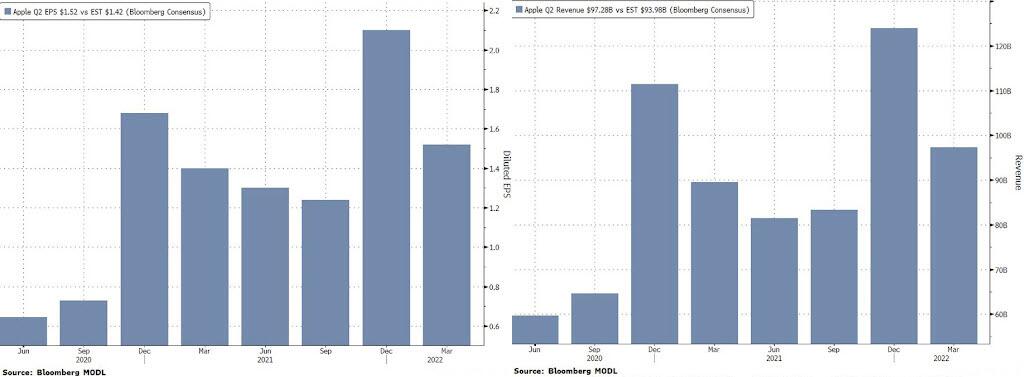
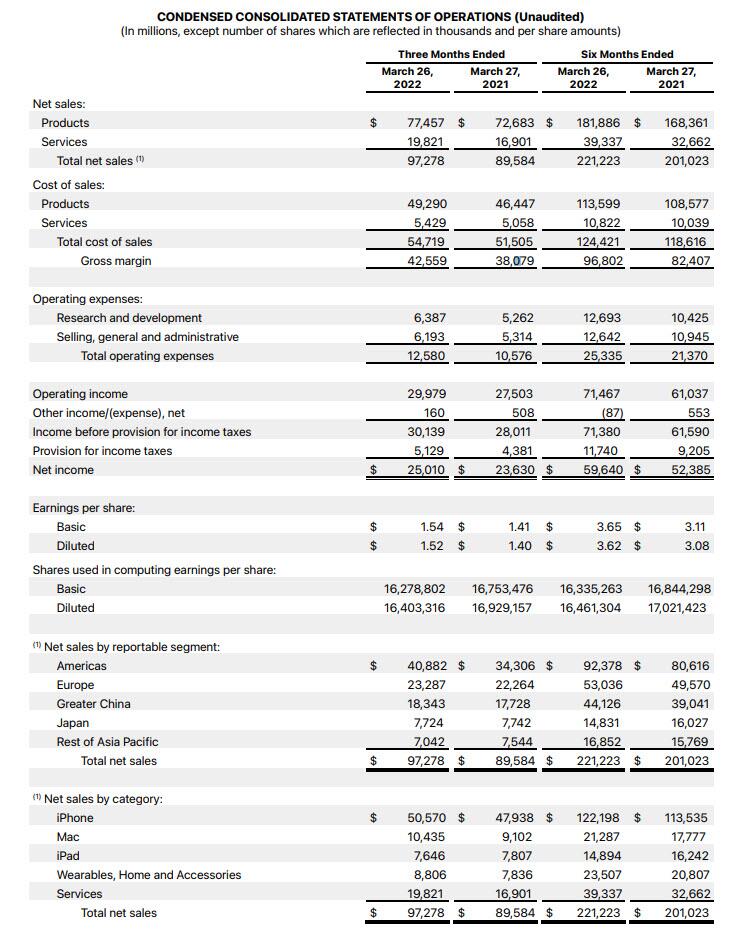
  • Apple 2Q EPS $1.52,  beating consensus estimates of $1.42
  • Apple 2Q Rev. $97.3B, +8.6% Y/Y, smashing consensus estimates of $93.98B

A breakdown by product category

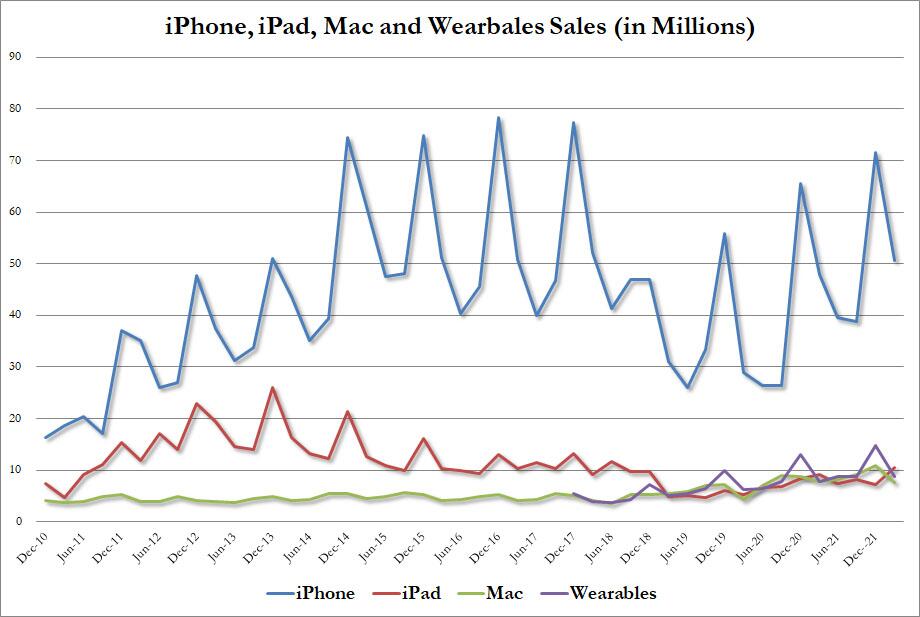
  • IPhone revenue $50.57 billion, +5.5% y/y, beating estimate $49.16 billion
  • Mac revenue $10.44 billion, +15% y/y, beating estimate $9.23 billion
  • IPad revenue $7.65 billion, -2.1% y/y, beating estimate $7.19 billion
  • Wearables, home and accessories $8.81 billion, +12% y/y, missing estimates $8.98 billion

What is remarkable, is that this was the best non-holiday quarter for AAPL in history. Some more details:

  • Service revenue $19.82 billion, +17% y/y, beating estimates $19.78 billion
  • Greater China rev. $18.34 billion, +3.5% y/y
  • Gross margin $42.56 billion, +12% y/y
  • Cash and cash equivalents $28.10 billion, -27% y/y, estimate $35.81 billion

Earnings snapshot

Commenting on the quarter, CFO Luca Maestri said that Apple “set an all-time revenue record for Services and March quarter revenue records for iPhone, Mac, and Wearables, Home and Accessories. Continued strong customer demand for our products helped us achieve an all-time high for our installed base of active devices. Our strong operating performance generated over $28 billion in operating cash flow, and allowed us to return nearly $27 billion to our shareholders during the quarter.”

And just in case the blowout earnings were not enough, AAPL also announced that its board had authorized an increase of $90 billion to the existing share repurchase program.

As noted above, AAPL beat on all sales categories, except wearables, with IPhone sales hitting $50.6 billion, +5.5% y/y, and above estimates $49.2 billion. iPad sales came in at $7.65BN, down 2.1% Y/Y but also beating estimates of $7.19BN, while Mac sales also beat estimates of $9.23BN, rising 15% to $10.44BN. The only product miss was in wearables, which came in at $8.81BN, up 12% Y/Y, but below the $8.98BN estimate.

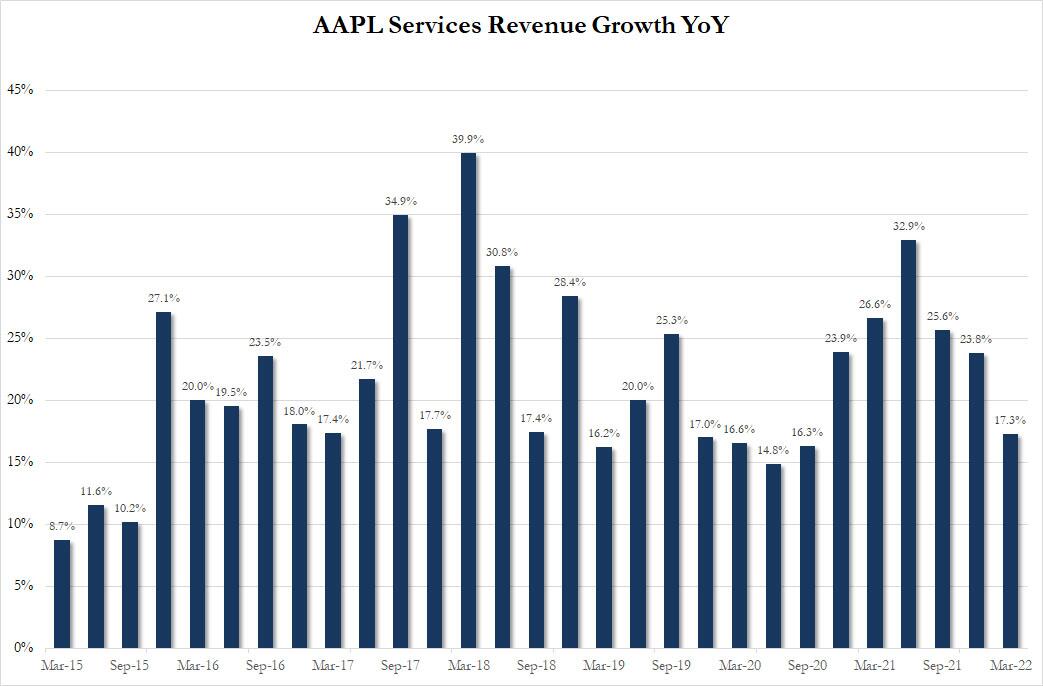
Apple also reported another blowout record quarter for Service Revenues, which rose to $19.82BN, beating expectations of $19.78BN.

… although the annual increase of 17.3% was a slight drop sequentially from the 25.6% increase last quarter

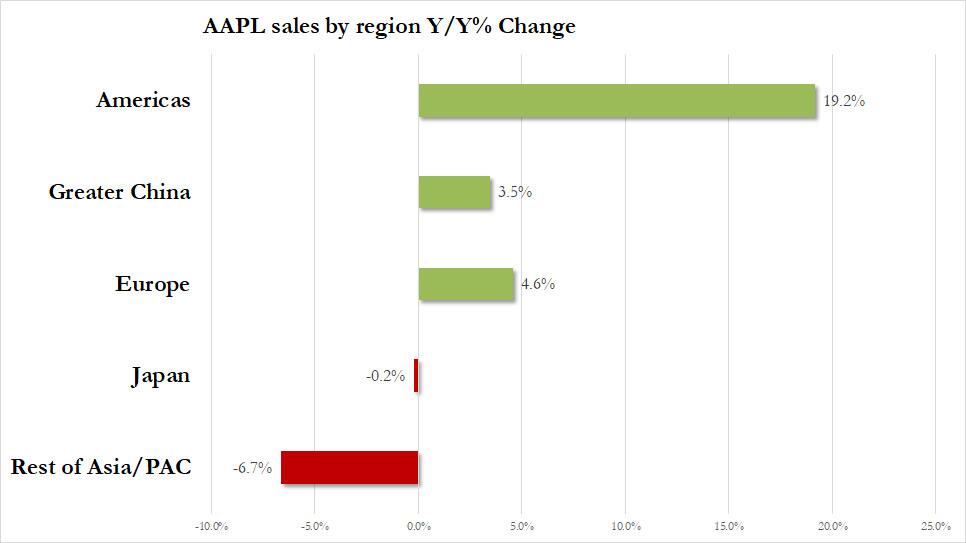
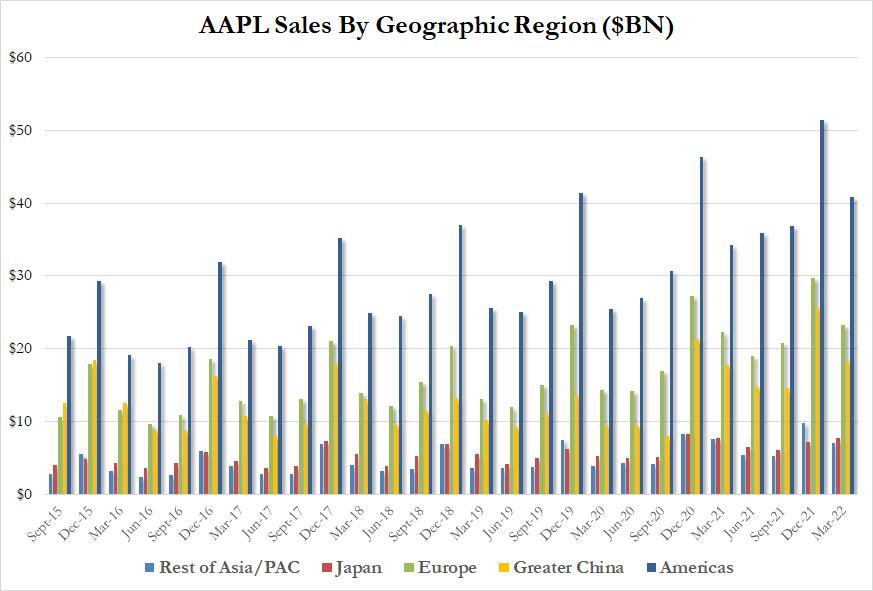
The geographic breakdown was also solid: most areas showed a boost in sales, apart from a minor drop in Japan and a notable decline in Rest of Asia/PAC. The Americas remains its largest sales area with $40.882 billion of revenue in the quarter. China was up to $18.343 billion, growing 3.5%, which however was well below the corporate average.

And in dollar terms:

In any case, the results were strong enough – at least initially – to push the stock higher, even if the initial surge is quickly fading after hours.

Tyler Durden
Thu, 04/28/2022 – 17:05

via ZeroHedge News https://ift.tt/F8l2Yie Tyler Durden

New textbook: Firearms Law and the Second Amendment


guninholster_1161x653

If you are interested in arms law, you might enjoy the new textbook Firearms Law and the Second Amendment: Regulation, Rights, and Policy. The third edition, from Aspen Publishing, came out several months ago. It is coauthored by Nicholas J. Johnson (Fordham), George A. Mocsary (Wyoming), E. Gregory Wallace (Campbell), Donald Kilmer (Lincoln), and me (Denver).

Our inspiration for the textbook, whose first edition appeared in 2012, was Rutgers law professor Ruth Bader Ginsburg and her textbook Constitutional Aspects of Sex Discrimination. What law students learn depends on what professors can teach. Teaching depends on what textbooks exist. Although some professors do collect or write their own materials for class, most of what gets taught in law school is from textbooks. Only if a textbook on women’s rights existed could women’s rights be broadly studied in law school.

By 1971 there were professors who were interested in women’s rights but were far from expert on the subject. They could teach it only if someone else wrote a textbook. They had neither the time nor inclination to determine which cases and materials were most important, collect and edit them, and then organize them into an orderly narrative. So Ginsburg did it all for them. She also provided her own analysis.

Now, the same process is happening for the Second Amendment. Since 2012, Firearms Law has been spurring the creation of Second Amendment classes at law schools; every year more law students learn how to incorporate the right to keep and bear arms into their legal practice. Some of those students will become criminal defense lawyers and others prosecutors. Some will become business and regulation lawyers who represent retailers or manufacturers, and others will work for regulatory agencies. More than a few will eventually become lawmakers, judges, or other leading government officers. Unlike in past generations, the new generation of lawyers includes members who are already well-educated about the right to keep and bear arms and gun control laws.

The success of Firearm Regulation and the Second Amendment has spurred two other publishers of law school textbooks to produce their own entries into what has become the growing field of Second Amendment education. One good book is Guns and the Law: Cases, Problems, and Explanation, by Andrew J. McClurg (Memphis) and Brannon P. Denning (Samford) (Carolina Academic Press 2016). The 592 page book contains ten chapters with pro/con materials on various topics. Back in 2002, McClurg, Denning, and I teamed up to write Gun Control and Gun Rights: A Reader and Guide (NYU Press), which at the time was the first book on firearms policy written for use in higher education.

The other textbook, forthcoming in 2023 from West, is The Second Amendment: Gun Rights and Regulation, by Joseph Blocher (Duke), Darrell A.H. Miller (Duke), and Jacob Charles (Pepperdine). Unlike the Firearms Law textbook, this one will not delve deep into legal history, but will instead (like six chapters in Firearms Law) examine the post-Heller legal landscape. I’m sure that a book from these three excellent scholars will be good; in our own textbook, we cite them 14 times.

Things have come a long way since Sanford Levinson observed in 1989 that the legal academy considered it “embarrassing” to think seriously about the Second Amendment. Sanford Levinson, The Embarrassing Second Amendment, 99 Yale Law Journal 637 (1989).

The Johnson et al. Firearms Law book is for readers like the Buddhist monk who walked into a sandwich shop and said, “Make me one with everything.”

Firearms Law runs 2,243 pages and costs $298. However, in terms of how many words you get per dollar, it’s a bargain!

Firearms Law was written for more than just the law school audience. The style is accessible to the general intelligent reader, and the textbook is also a treatise of arms law and history, from ancient times to the present. As such, it has been useful to the courts. Judge Brett Kavanaugh, when he served on the D.C. Circuit Court of Appeals, cited the textbook, as did Judge Thomas Hardiman of the Third Circuit. The Illinois Supreme Court has cited the textbook twice. Much of the book is on the cutting edge of modern legal analysis and of legal history.

To prepare students for practice, Firearms Law extensively covers the federal gun control statutes, such as the Gun Control Act and the National Firearms Act, as well as state laws.

Some of Firearms Law is available for free. The printed book is 16 chapters, and those are supplemented by 7 online chapters, which are available on the public Internet, at the book’s website. http://firearmregulation.org/. These free online chapters cover issues of identity and status (e.g., race, gender, disability, sexual orientation, marijuana use, and veteran status); other nations and international issues (ancient, modern, and in-between), and an “In-Depth Explanation of Firearms and Ammunition.” The printed book has a coupon for access for all 23 chapters as an integrated e-book, usable by readers who have academic email accounts.

And that’s not all! Also free online for everyone is chapter 3 from the printed textbook, on colonial America. Did you know that in the English-speaking world, the first written guarantees of the right to arms were the colonial charters of Virginia in 1606 and New England in 1620? Neither did anyone else until we found out, and put the history into Firearms Law.

While the printed book is almost entirely about the United States, except for a chapter on United Kingdom history, the online chapters allow readers to explore arms law and policy the rest of the world, from ancient times to the present. The international chapters cover global and regional treaties, the United Nations, national constitutions, the classical founders of international law such as Pufendorf and Grotius, and comparative social science. (Social science about arms in the U.S. is even-handedly summarized in chapter 1 of the printed book.) The online chapters include case studies on Armenia, Australia, Canada, the Czech Republic, Ghana, the Holocaust, Japan, Kenya, Mexico, South Africa, Switzerland, Thailand, the United Kingdom, and Venezuela.

China is examined in great detail. Online chapter 21, Antecedents of the Second Amendment, starts with Confucius, Lao Tzu, Mencius, and their successors. The Comparative Law chapter includes 10 pages on modern Chinese arms law, and a hundred-page study of the effects of various arms policies in China and Tibet during the reign of Mao Zedong.

Firearms Law pays close attention to material culture, and how changes in arms technology have influenced arms law and policy. The technological evolution is integrated into the historical and modern chapters of the printed book, and described in depth in concluding Chapter 23, “The Evolution of Firearms Technology from the Sixteenth Century to the Twenty-First Century.”

In words of Faber College founder Emil Faber (from the movie Animal House), “Knowledge is good.” We hope Firearms Law and the Second Amendment will increase knowledge, and thereby help legal education and the general public progress to ever-more thoughtful and informed examination of law and policy involving the right to keep and bear arms.

The post New textbook: Firearms Law and the Second Amendment appeared first on Reason.com.

from Latest https://ift.tt/jaULYg9
via IFTTT

The First Amendment Option: An Easy Way For Musk To Restore Free Speech On Twitter

The First Amendment Option: An Easy Way For Musk To Restore Free Speech On Twitter

Authored by Jonathan Turley,

Below is my column in the Hill on one way for Elon Musk to re-introduce free speech values on his newly acquired social media platform. Pro-censorship advocates like former President Barack Obama may have given Musk a roadmap for restoring free speech on Twitter.

Here is the column:

For free speech advocates, Elon Musk’s purchase of Twitter could prove the most impactful event since Twitter’s founding in 2006. The question, however, is how Musk can accomplish his lofty goal of restoring free speech values to social media. He first would have to untie the Gordian knot of censorship in a company now synonymous with speech control. The answer may be simpler than most people think. Indeed, anti-free-speech figures in the country may have given Musk the very roadmap he’s looking for: the First Amendment.

The purchase of Twitter alone will have immediate and transformative changes for free speech. The control over speech on social media required a unified front. Free speech is like water, it tends to find a way out. With social media, there was no way out because of the unified front of companies like Google, Apple and Facebook. Facebook is actually running commercials trying to convince people to embrace their own censorship. This message was reinforced by Democratic leaders like President Biden, who demanded that these companies expand censorship and curtail access to harmful viewpoints.

Now this market has one major competitor selling a free speech product.

The fear is that Musk might be proven right and that Twitter could become larger and more profitable by allowing more free speech. Facebook has not had much success in convincing customers to embrace censorship, but it may find shareholders wondering why the Facebook board (like the Twitter board) is undermining its own product as a communications company committed to limited speech.

Another immediate change could be the forced exodus of a line of ardent censors from the company, with Twitter CEO Parag Agrawal (hopefully) at the head of line. Agrawal is one of the most anti-free-speech figures in Big Tech. After taking over as CEO, Agrawal quickly made clear that he wanted to steer the company beyond free speech and that the issue is not who can speak but “who can be heard.”

However, once such figures are removed from Twitter, the question is how to re-establish a culture of free speech.

The answer may be in the very distinction used by Democratic politicians and pundits to justify corporate censorship.

For years, anti-free-speech figures have dismissed free speech objections to social media censorship by stressing that the First Amendment applies only to the government, not private companies.

The distinction was always a dishonest effort to evade the implications of speech controls, whether implemented by the government or corporations. The First Amendment was never the exclusive definition of free speech. Free speech is viewed by many of us as a human right; the First Amendment only deals with one source for limiting it. Free speech can be undermined by private corporations as well as government agencies. This threat is even greater when politicians openly use corporations to achieve indirectly what they cannot achieve directly.

Corporations clearly have free speech rights. Ironically, Democrats have long opposed such rights for companies, but they embrace such rights when it comes to censorship. The Democratic Party embraced corporate governance of free speech once these companies aligned themselves with their political agenda. Starbucks and every other company have every right to pursue a woke agenda. Social media companies, however, sell communications, not coffee. They should be in the business of free speech.

Democrats have continued to treat the First Amendment as synonymous with free speech, as a way to justify greater censorship.

Just last week, former President Barack Obama spoke at Stanford to flog this false line. Obama started by declaring himself, against every indication to the contrary, to be “pretty close to a First Amendment absolutist.” He then called for the censorship of anything that he considered “disinformation,” including “lies, conspiracy theories, junk science, quackery, racist tracts and misogynist screeds.”

He was able to do that by emphasizing that “The First Amendment is a check on the power of the state. It doesn’t apply to private companies like Facebook or Twitter.”

Well, what if it did?

The Constitution does not impose the same standard on Twitter — but Musk could. He could order a new Twitter team to err on the side of free speech while utilizing First Amendment standards to maximize protections on the platform. In other words, if the government could not censor a tweet, Twitter would not do so.

The key to such an approach is not to treat Twitter as akin to “government speech,” a category where the government has allowed major speech controls. Rather, tweets are very much as Musk has described them: akin to speech in “the digital town square.” If the government could not stop someone from speaking in a public forum like a town square, Twitter should not do so through private means.

The value to tying private speech to First Amendment jurisprudence is that there is a steady array of cases illuminating this standard and its applications.

Such a rule would admittedly allow a large array of offensive and objectionable speech — just as the First Amendment does in a public square. That is the price of free speech.

This is, admittedly, not a perfect fit. Twitter needs to protect itself from civil liability in the form of trademark, copyright and other violations in the use of its platforms. Moreover, most sites (including my own blog) delete racist and offensive terms. That can be done through standard moderation systems or, preferably, optional filters for users to adopt on Twitter. There are also standard rules against doxxing as well as personal threats or privacy violations.

Social media companies long had these limitations before plunging headlong into the type of content-based speech regulations made infamous by Twitter. Musk can use the baseline of the First Amendment with these limited augmentations to re-create the type of relatively open forums that once characterized the internet.

I have long admitted to being a type of “internet originalist” who prefers precisely the digital town square concept embraced by Musk. Adopting the First Amendment standards would create a foundation for free speech that can be tweaked to accommodate narrow, well-defined limitations.

The greatest challenge is not the restoration of free speech but the retention of such a site.

Notably, figures like Hillary Clinton have suddenly turned from advocating corporate censorship to calling for good old-fashioned state censorship. Last week, Clinton called on the European Union to pass the Digital Services Act (DSA), a massive censorship measure that has received preliminary approval. Coming after Musk’s bid for Twitter, Clinton and others now want to use European countries to offer the same circumvention of the First Amendment. Rather than use a corporate surrogate, they would use an alternative state surrogate to force Twitter to censor content or face stiff penalties in Europe.

Musk will have to fight that battle when it comes. In the interim, he can rally the public, as he did Twitter shareholders, to the cause of free speech.

[ZH: Always willing to help, Elon Musk himself explained where he stands…]

Tyler Durden
Thu, 04/28/2022 – 16:35

via ZeroHedge News https://ift.tt/X1Nl3HE Tyler Durden

Amazon Crashes After Reporting Catastrophic Guidance, Worst Revenue Growth In Decade

Amazon Crashes After Reporting Catastrophic Guidance, Worst Revenue Growth In Decade

With the bulk of the FAAMG stocks – which is now GAMMA following Facebook’s rebranding to Meta – having reported Q1 results (some great, like Facebook and MSFT, some terrible, like Facebook), investors were keenly looking to Amazon and Apple earnings after the close today, to round out the picture for the market generals and set the tone until next week’s FOMC meeting, and also to find whether today’s massive nasdaq short squeeze surge of 3% was justified.

Focuing on Amazon, Investors want to see if growth from Amazon’s profitable cloud-computing and advertising businesses outshine slower growth from its e-commerce business, which is lapping the blockbuster gains it had during the pandemic. Investors are already expecting sales growth of about 7% in the first quarter to be Amazon’s slowest in 20 years. They mainly want to see if Amazon is managing higher labor and fuel costs in a manner that protects profits. The company hiked yearly Prime membership subscriptions by $20 and announced a new fuel and inflation surcharge on sellers to help shore up revenue.

Amazon impressed investors in January with a Prime price hike and a big earnings boost tied to its investment in electric vehicle maker Rivian Automotive. Unless it has some more surprises, investors will have to focus more on Amazon’s fundamentals.

And unfortunately, it is not looking good because moments ago Amazon report both historical data and projections which badly missed expectations.

  • Amazon 1Q Oper Income $3.7B, missing est. $5.42B
  • Amazon Sees 2Q Net Sales $116.0B to $121.0B, missing Est. $125.01B

Here are the Q1 details:

  • Net Sales $116.44B,+7.3% Y/Y,  barely beating Est. $116.43B
  • Loss per share $7.56, beating the estimate EPS $8.40
  • Physical Stores Net Sales $4.59B, +17% Y/Y, beating Est. $4.3B
  • Online Stores Net Sales $51.13B, -3.3% Y/Y, missing Est. $51.5B
  • North America Net Sales $69.24B, +7.6% Y/Y, beating Est. $67.8B
  • International net sales $28.76 billion, -6.2% y/y, missing Est $29.78 billion
  • AWS Net Sales $18.44B, +37% Y/Y,  beating Est. $18.25B
  • Subscription Services Net Sales $8.41B, +11% Y/Y,  missing Est. $8.55B
  • Operating income $3.67 billion, -59% y/y, missing the estimate $5.42 billion
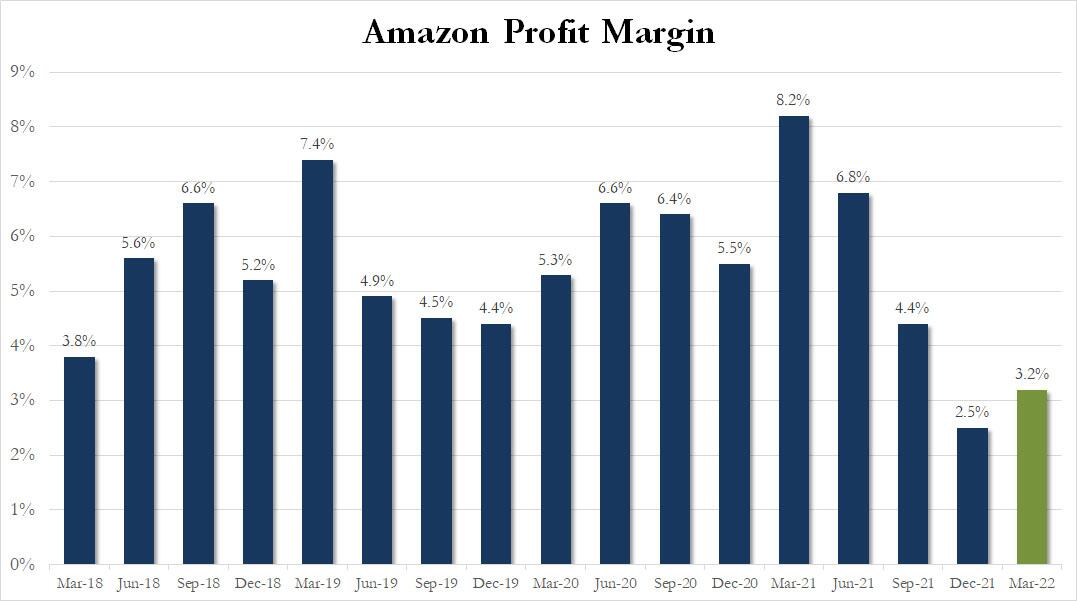
  • Oper Margin 3.2% vs 8.2% Y/Y, missing Est. 4.7%
  • Fulfillment expense $20.27 billion, +23% y/y, estimate $19.3 billion
  • Seller unit mix 55% vs. 55% y/y, estimate 56.1%

While operating margins rebounded modestly, from 2.5% in Q4, to 3.2%, it was well below the 4.7% expected.

And while historical data was mixed at best, just barely beating on sales if showing some weakness in online store and international sales, as well as missing on operating margin, what the market is focused on is the company’s dismal guidance, whose upper end of $121BN missed the Wall Street median estimates of $125BN, while also projecting an operating loss as bad as $1 billion (up to a $3 billion gain).

  • Sees net sales $116.0 billion to $121.0 billion, estimate $125.01 billion (Bloomberg Consensus)
  • Sees operating loss $1.0 billion to profit $3.0 billion, estimate profit $6.8 billion

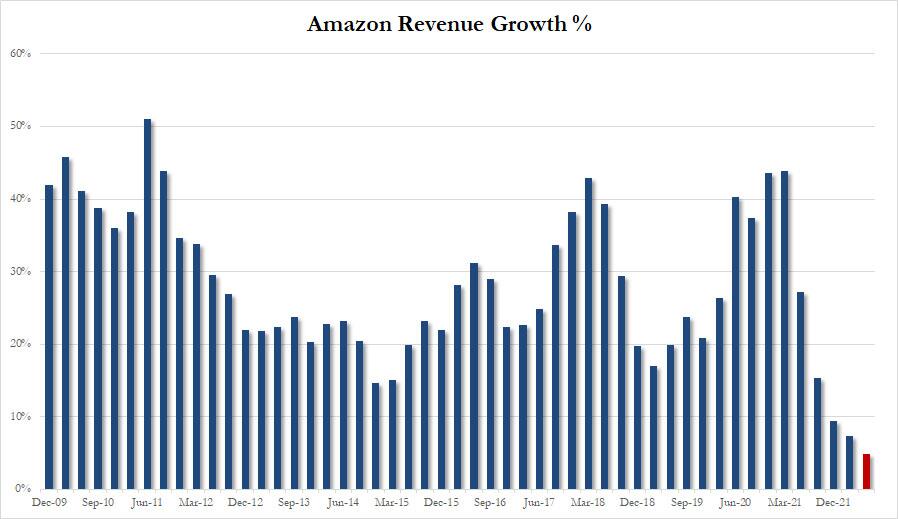
One unpleasant highlight here: reported revenue growth of 7.3% in the first quarter, its slowest growth in about two decades. Worse, the company’s guidance to a median $118.5BN in the next quarter would be growth of just 4.8%, even lower!

Some more guidance details:

  • Amazon Guidance Assumes Prime Day Occurs in 3Q 2022
  • Amazon: Working Through Inflationary, Supply Chain Pressures
  • Amazon Delivery Speeds Approaching Pre-Pandemic Levels
  • Amazon ‘No Longer Chasing Physical or Staffing Capacity’

It wasn’t just revenues that were concerning: as Bloomberg notes, one red flag about Amazon’s financial condition: Worldwide shipping costs jumped 14% to $19.6 billion. Meanwhile, revenue from online store sales dropped 3% and revenue from third-party sellers services increased 9%.

Indeed, inflation is exposing the dangers of Amazon’s low-margin e-commerce model that has conditioned customers to expect low prices and quick delivery

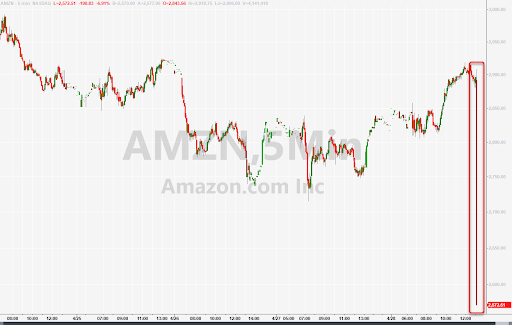
So it Amazon going to spoil the tech party again? Well, we have to wait for AAPL for the final verdict, but as of this moment, AMZN is down some 10%, trading around $2,600 after closing at $2,900 the regular session after surging some 4.6%.

developing

Tyler Durden
Thu, 04/28/2022 – 16:19

via ZeroHedge News https://ift.tt/FWresHv Tyler Durden

Joe Biden Takes Another Stab at Zoning Reform


reason-bidenmoney

Two years into his administration, President Joe Biden has thus far failed to eliminate “the suburban lifestyle dream”—something former President Donald Trump often said he was plotting to do. But a new proposed grant program from the White House aims to make that dream a little more affordable by encouraging localities to eliminate regulatory barriers to new home construction.

The language of the latest proposal has excited some zoning reformers who want to see the federal government take a more active role in reducing local restrictions on housing supply. But previous ideas from the administration have been watered down and stalled in Congress.

Tucked away in the congressional justification of Biden’s budget request for the U.S. Department of Housing and Urban Development (HUD) is a proposed 10-year, $35 billion Housing Supply Fund, with $10 billion of that dedicated to grants to “reduce affordable housing barriers.”

America is short some 3.8 million homes, reads the HUD budget document first reported on by Route Fifty, resulting “in rental units and homeownership being unaffordable, and often unattainable for millions of Americans.” The department pins some of the blame for this housing deficit, and attendant higher housing costs, on “local regulations, zoning policies, and insufficient infrastructure.”

As a solution, HUD is proposing to give some of that $10 billion to states and localities that adopt “housing-forward policies and practices to remove barriers to the development of affordable housing.” That money could then be spent on “street improvements, traffic control measures, and water and sewer lines.” That money could also be available to jurisdictions to cover the planning costs that go into adopting “housing-forward” policies.

“We know local and state leaders are critical to enabling housing development,” a HUD spokesperson tells Reason. “The proposed fund will provide incentives to leaders taking the steps necessary to streamline production in order to reduce the time and cost to build.”

The department spokesperson specifically named California and Massachusetts as two states that “have made significant strides in lowering barriers to production through their regulatory infrastructure.”

Last year, the California Legislature passed laws legalizing duplexes on formerly single-family-zoned land statewide and streamlining the ability of local governments to zone for smaller apartment buildings in urban areas. Massachusetts implemented a new law this year that requires localities to allow apartment buildings near transit stops.

The idea behind HUD’s latest proposal, says Mike Kingsella of Up For Growth Action, is to provide money on the front and back ends of the zoning reform process.

Providing grants to localities that initiate zoning reform, he says, would be helpful for fast-growing cities like Austin, Texas. There, almost any new development bumps up against the limits of the city’s current, decades-old zoning codes.

“It’s really resource-intensive to take an old zoning code like that and modernize it with a lens toward eliminating barriers,” he tells Reason. Federal money can incentivize cities like that to undertake a wholesale rewrite.

Even when jurisdictions do adopt planning reforms aimed at deregulating housing production, individual projects can still face opposition from local activists worried about clogged streets and overcrowded parks and schools.

With federal money available for the “production of infrastructure that supports community growth,” Kingsella says Biden’s proposal is about “taking arguments off the table” when it comes to localities adopting zoning reforms.

The proposal is a combination of two previous federal zoning grant programs that were previously floated in Congress.

The first is the technical assistance grant program included in the Housing Supply and Affordability Act, first introduced by Sens. Amy Klobuchar (D–Minn.), Rob Portman (R–Ohio), and Tim Kaine (D–Va.) in March 2021. Their bill would provide $1.5 billion over five years to jurisdictions to develop and implement housing plans that reduce barriers to affordable housing.

The second is a program included in Sen. Elizabeth Warren’s (D–Mass.) Housing and Economic Mobility Act, first introduced in 2018. That bill would have made $10 billion in incentives available to jurisdictions that adopted local land use reforms (not all of which would have to be deregulatory). Grantees could then use that money on a whole host of activities, whether that’s fixing up schools or building new parks.

A HUD spokesperson says that it’s too early in the process to estimate how much of that $10 billion would fund technical assistance grants and how much would go toward jurisdictions that had already adopted reforms.

“We have left room in the proposal to reward those who have taken significant steps as well as encourage those who have just begun to assess the impact of their policy and practices on the availability of quality, affordable housing for their residents,” they tell Reason.

A third tactic of conditioning existing federal transportation and housing spending on localities adopting zoning reforms was endorsed by Biden on the campaign trail. It thus far hasn’t worked its way into any of the president’s proposals since he took office.

Neither Warren nor Klobuchar’s bills have gone far in Congress on their own. The Biden administration has also been trying to attach some sort of zoning grant program to its big spending initiatives without much success.

In March 2021, the White House proposed a competitive grant program to reward localities that take “concrete steps” to reduce barriers to new housing—specifically naming apartment bans, large minimum lot sizes, and parking minimums—as part of Biden’s American Jobs Plan. A June 2021 White House document put a name and a number on the idea: a $5 billion Unlocking Possibilities Program.

Eventually, a scaled-down $1.6 billion Unlocking Possibilities program was included in the Build Back Better Act. But housing policy experts criticized the legislative language creating that program as much too broad. Instead of rewarding localities for eliminating harmful regulations, it dolled out money to do run-of-the-mill urban planning.

“There is almost no planning exercise undertaken by any planning consultant or city that would not qualify under this text,” wrote Salim Furth, a senior research fellow at George Mason University’s Mercatus Center, in The Bridge. “A planning consultant could hardly ask for a more perfectly targeted subsidy.”

The Build Back Better Act has officially stalled in Congress—and with it the Unlocking Possibilities Program. Now, the Biden administration is trying again with its request for a Housing Supply Fund.

Furth tells Reason that the latest language in the White House’s budget proposal is much more encouraging.

“I think this is really well-conceived,” he says. “Instead of targeting [just] planning, which can never guarantee an outcome, it is targeting things that potentially really can ease the growing pains of removing barriers to housing.”

There are ways to make these programs more targeted still.

Emily Hamilton, another Mercatus researcher, has suggested that federal zoning grants only be made available to jurisdictions that issue building permits and that funding only go toward places that are actually issuing lots of permits for new housing.

Biden’s proposal does condition grants on market outcomes. It also makes money available to states, which typically don’t issue building permits.

Furth says targeting outcomes like that is ideal, but not necessary for the $10 billion program that Biden is proposing. The relatively small amount of proposed funding and the growing number of localities getting serious about eliminating housing barriers make it more likely that money will flow to jurisdictions adopting the best reforms, he says.

Still, Furth cautions that everything hinges on what Congress does.

“We know that there’s a huge gap between budget proposals and what becomes law,” he says.

Kingsella says the inclusion of this grant program in the budget proposal makes it more likely that zoning reform might pass.

“We’re talking about must-pass legislation. Congress is going to have to pass a budget,” he says. “The exciting element around this proposal is the president and HUD has made it clear that housing production and the elimination of exclusionary housing and land use policies remain a very important and high priority.”

Obviously, the administration’s proposal is not perfectly, or even particularly, libertarian. It still involves new federal spending. Additionally, only $10 billion of the $35 billion Housing Supply Fund would be aimed at incentivizing local deregulation. The other $25 billion would go toward subsidizing the construction of housing that, per HUD, “is not currently incentivized by the market.”

Given the damage that local restrictions on housing supply have caused to housing affordability, however, this is one area where the federal government could potentially play a constructive, deregulatory role.

The post Joe Biden Takes Another Stab at Zoning Reform appeared first on Reason.com.

from Latest https://ift.tt/1fSodCq
via IFTTT

“WTF Was That!” – Stocks Explode Higher As US Economy Heads Into Recession

“WTF Was That!” – Stocks Explode Higher As US Economy Heads Into Recession

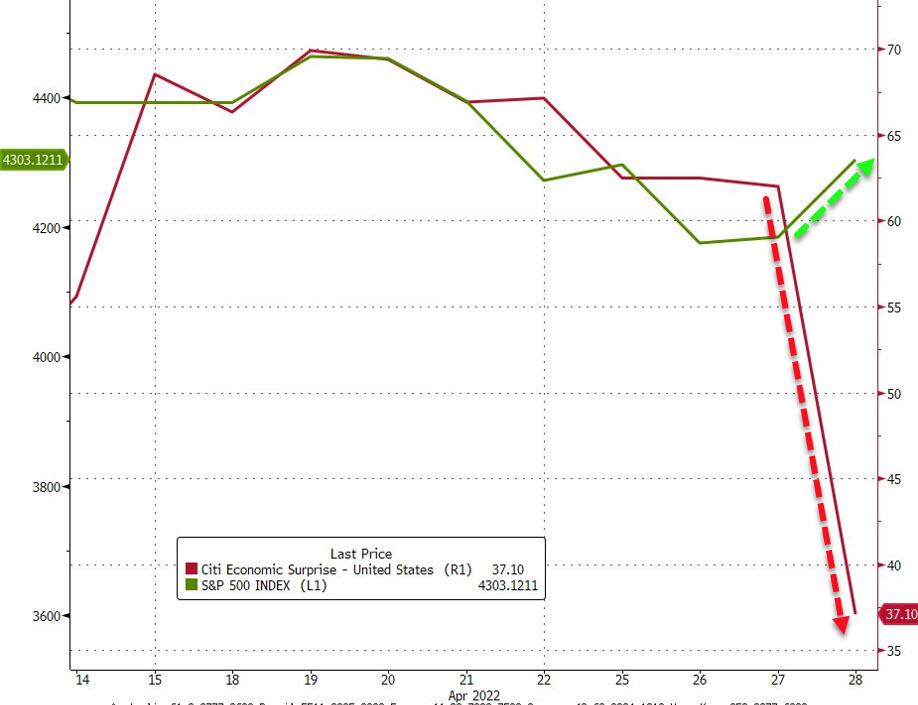
Following the first real signs of a US recession (with a shocking negative print for Q1 GDP)…

Source: Bloomberg

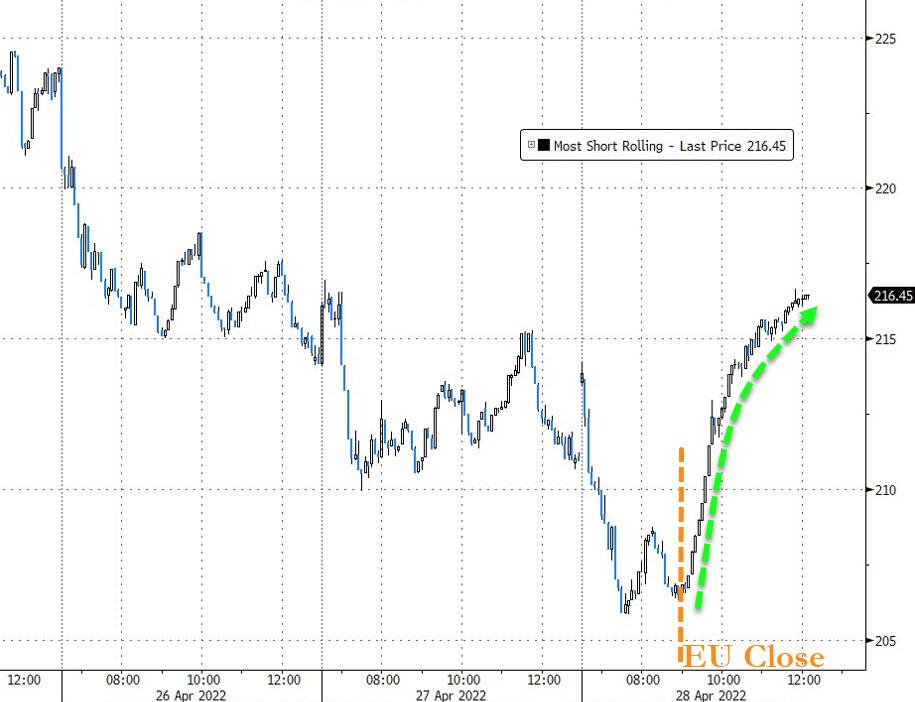
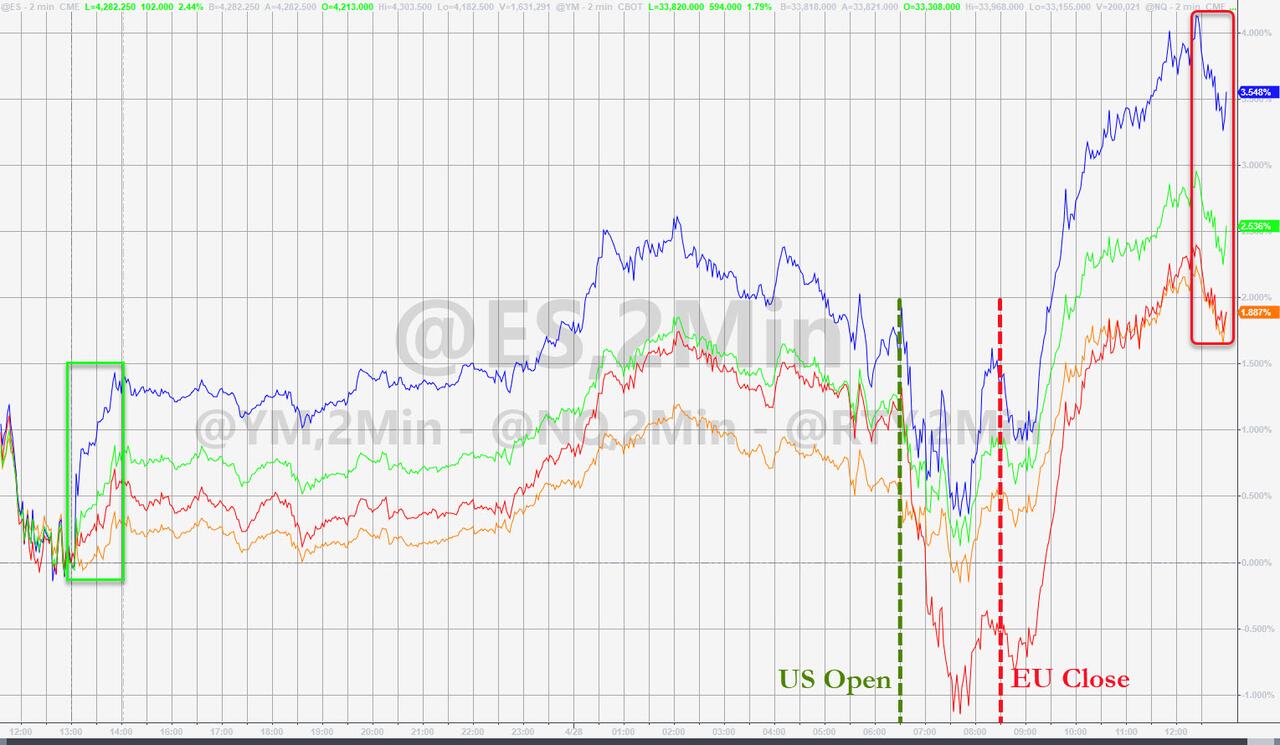
…dip-buyers got the all-clear as soon as Europe closed, the short-squeeze began with “Most Shorted” stocks soaring almost 6% off the lows

Source: Bloomberg

The ammo for a massive squeeze is all there…(unless AAPL misses tonight)

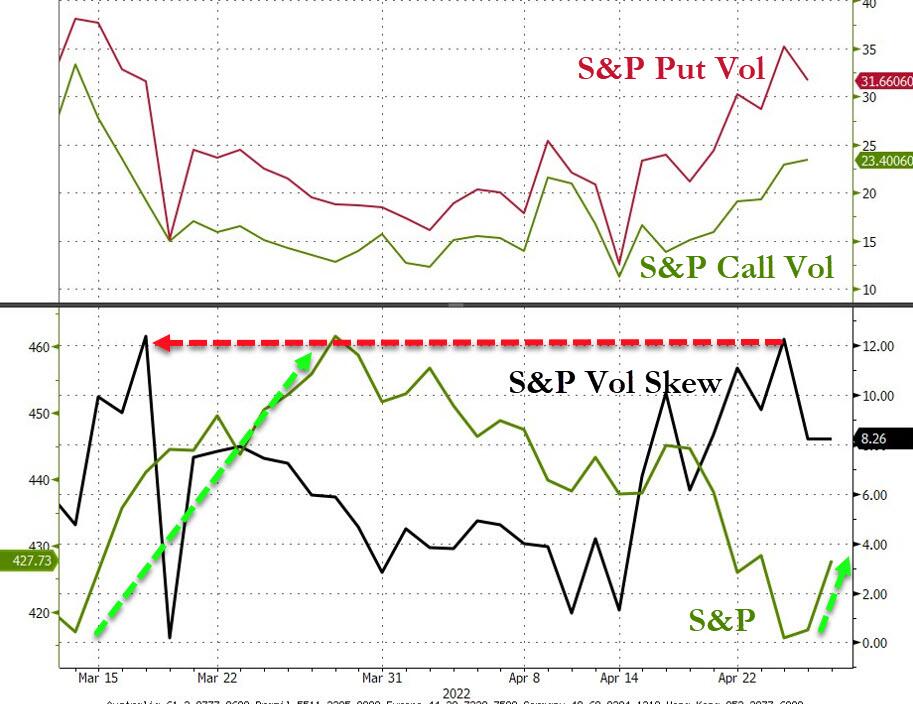
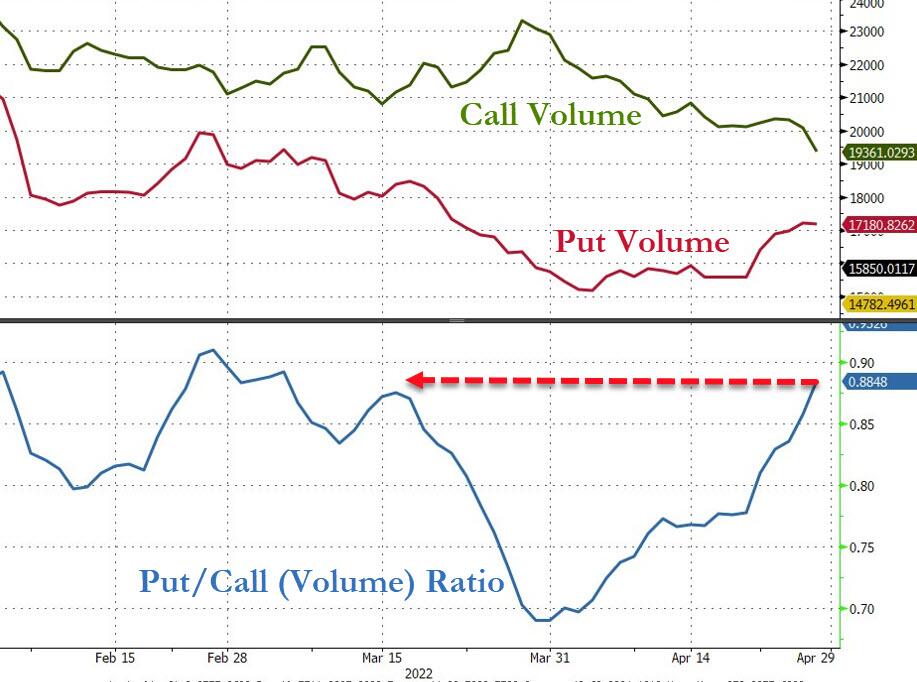
S&P Skew shows Put vols heavily favored – the last time the put demand was this high relative to call demand, all hell broke loose in the second half of March…

Source: Bloomberg

Put volumes are even more extreme relative to call volumes than at the start of the last surge in late March…

Additionally, Delta positioning in options land is at record negative levels

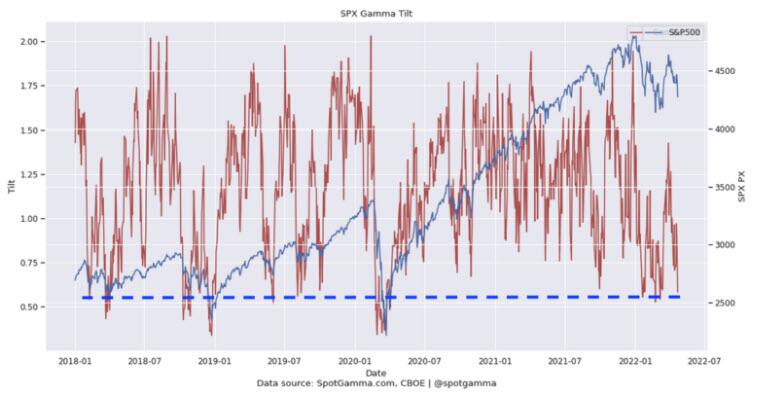
And Gamma tilt is at a key extreme (puts over calls)…

All of which adds up to – hold on to your hats boys and girls (and others) – as Nasdaq exploded 4% higher (helped by the Meta-Meltup)!!!

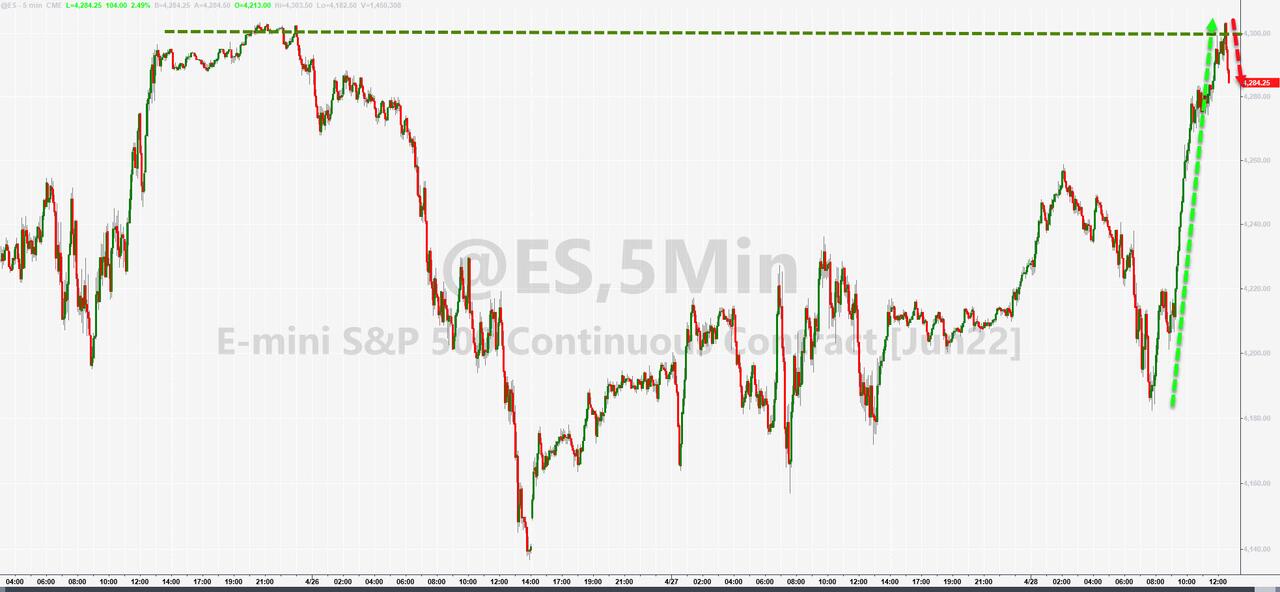
The S&P stalled at 4300…

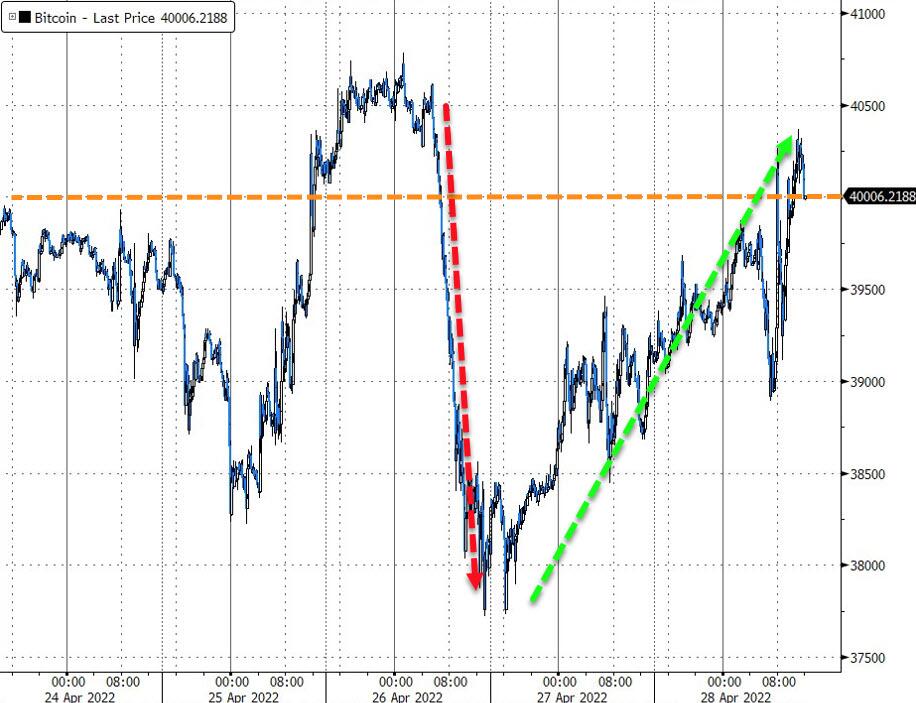
And as Nasdaq goes, so goes Bitcoin… for now…

Source: Bloomberg

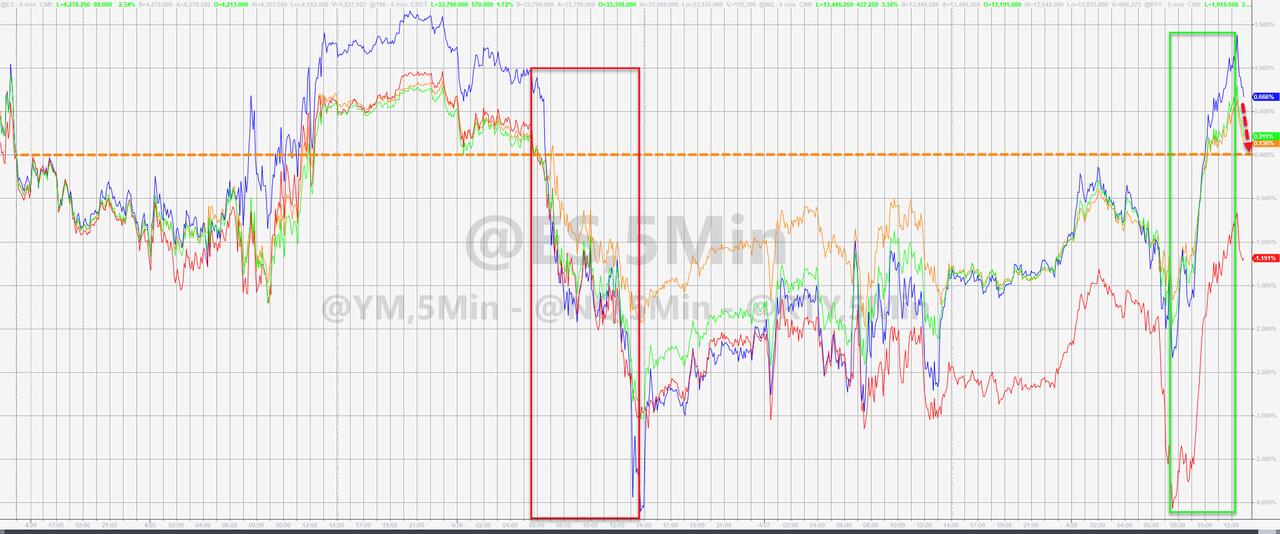
Today’s MegaLiftaton took all the majors back into the green for the week (only Small Caps remained red), but the late-day selling erased most of those gains…

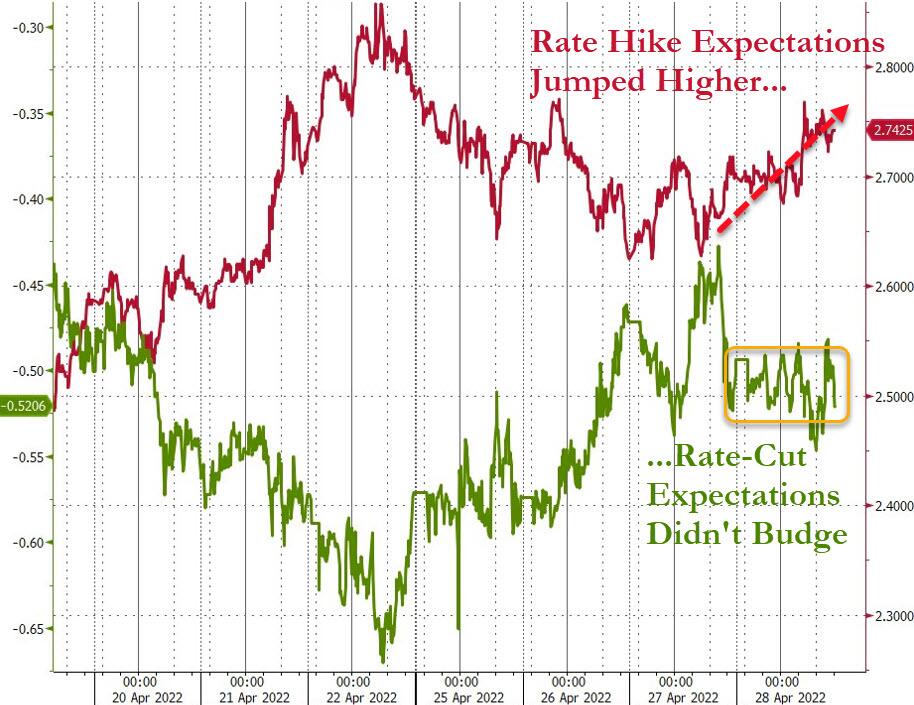
And if anyone suggests that “well, a recessionary print for GDP is likely to mean The Fed will pull back a little from its hawkishly monstrous outlook” – they are wrong! The market actually shifted more hawkishly today!!!

Source: Bloomberg

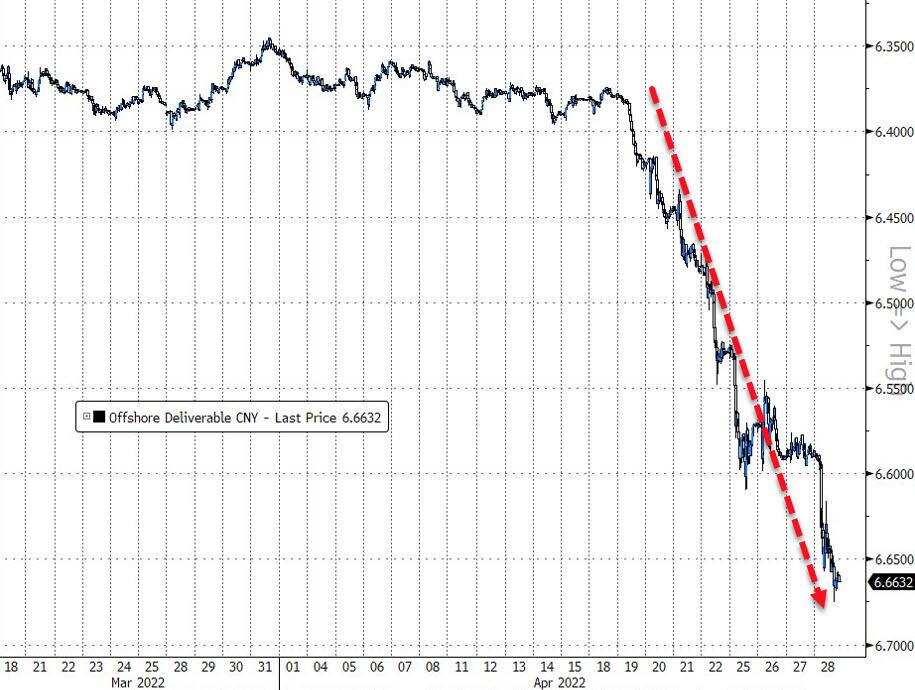
The yuan continues to collapse…

Source: Bloomberg

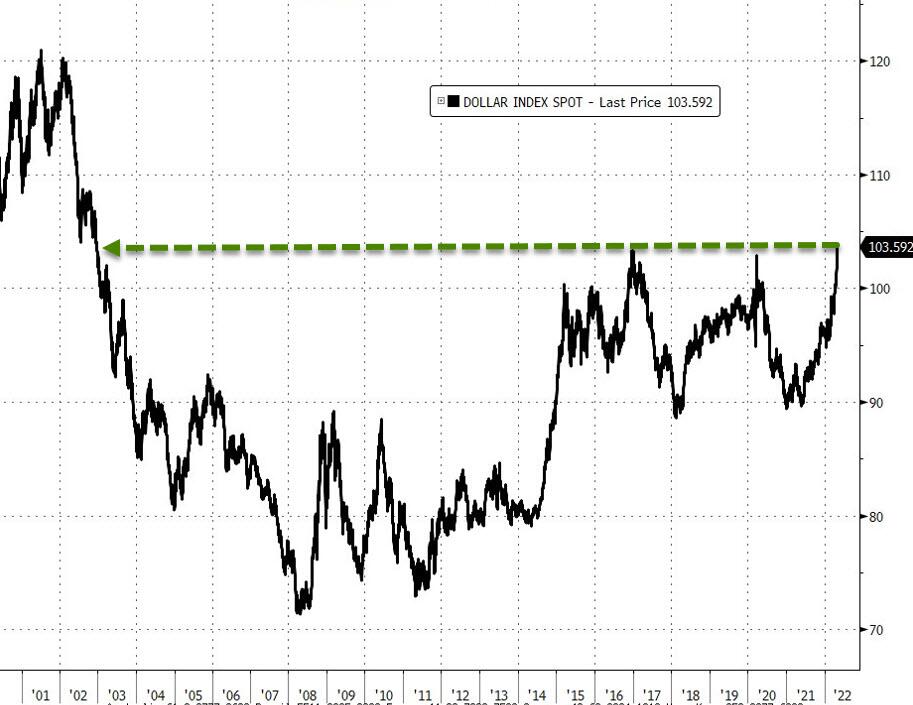
As the dollar breaks out to 20-year-highs…

Source: Bloomberg

Treasuries were mixed amid a terrible macro economic print and hope that Meta has turned a corner! 30Y yields were down 1bps as the short end (2Y) rose 5bps. NOTE that yields are all still lower on the week (despite stocks all being higher on the week now)…

Source: Bloomberg

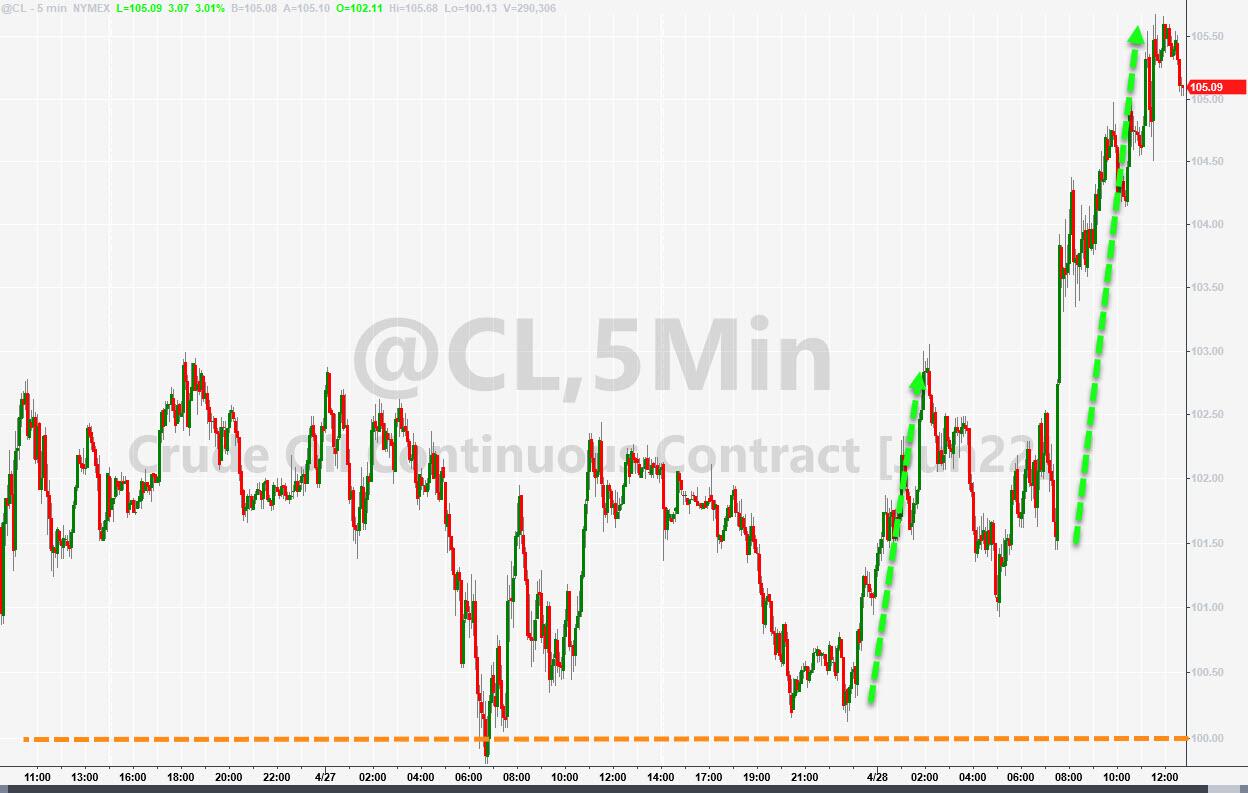
Oil prices surged as Europe claimed a Russian oil embargo was imminent…

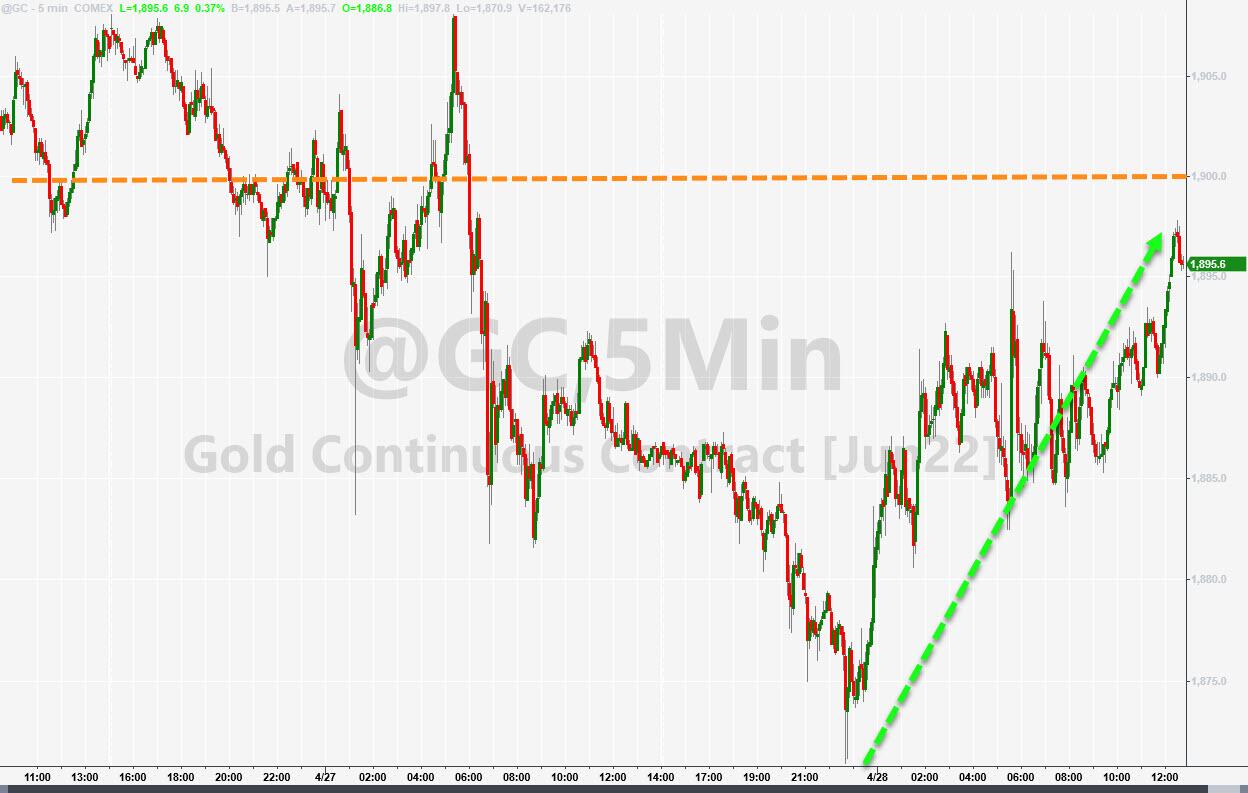
Gold rebounded on the day but was unable to get back above $1900…

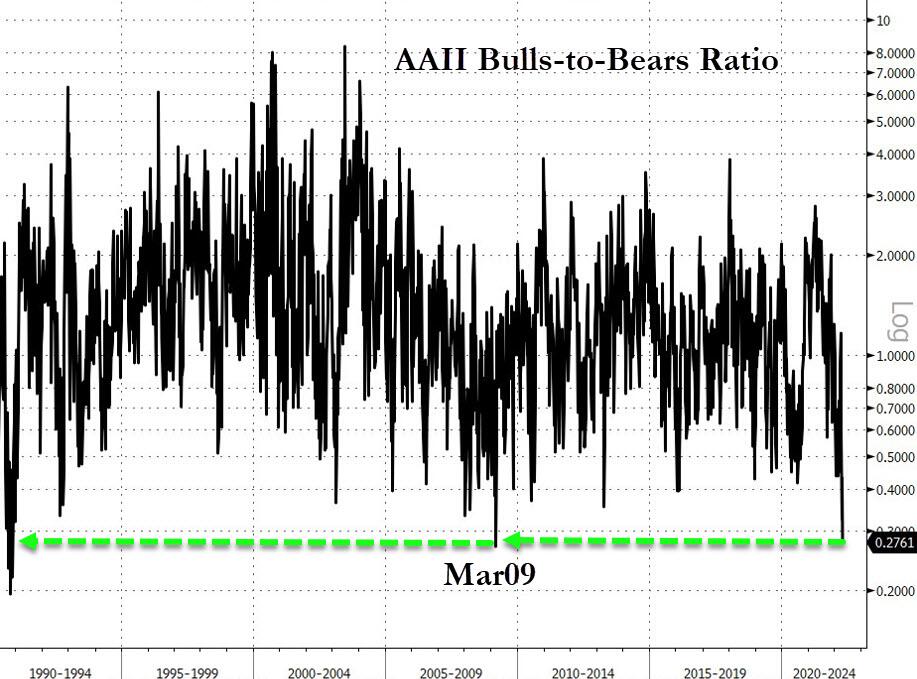
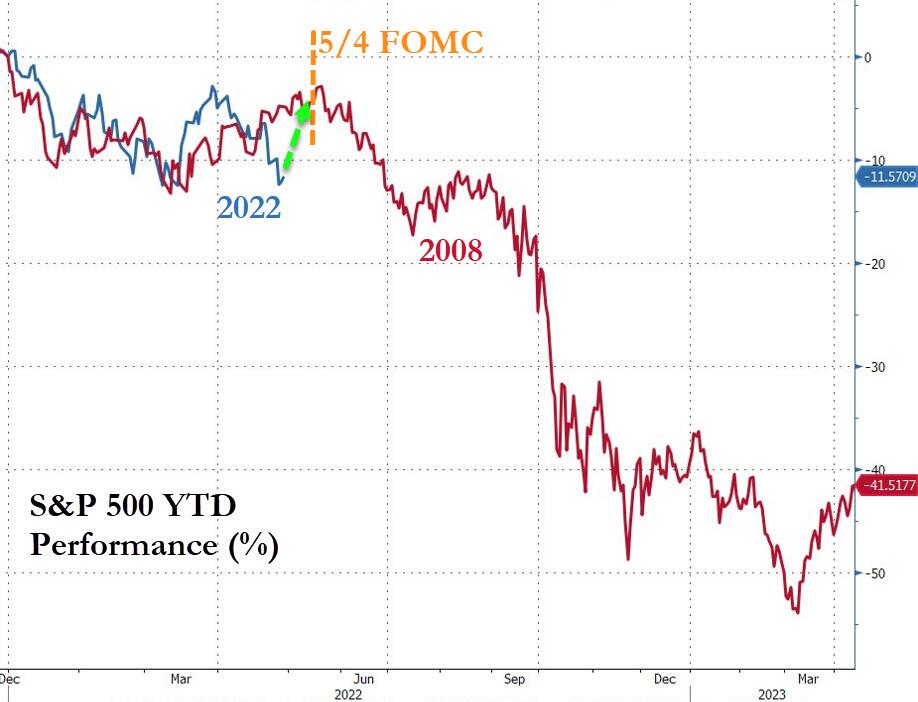
Finally, the AAII Bull-to-Bear ratio has almost never been this low… adding to yet more conviction for the contrarians that a rip higher is coming…

Source: Bloomberg

But will it last beyond 5/4?

Source: Bloomberg

Tyler Durden
Thu, 04/28/2022 – 16:01

via ZeroHedge News https://ift.tt/ikTHKwj Tyler Durden

Joe Biden Takes Another Stab at Zoning Reform


reason-bidenmoney

Two years into his administration, President Joe Biden has thus far failed to eliminate “the suburban lifestyle dream”—something former President Donald Trump often said he was plotting to do. But a new proposed grant program from the White House aims to make that dream a little more affordable by encouraging localities to eliminate regulatory barriers to new home construction.

The language of the latest proposal has excited some zoning reformers who want to see the federal government take a more active role in reducing local restrictions on housing supply. But previous ideas from the administration have been watered down and stalled in Congress.

Tucked away in the congressional justification of Biden’s budget request for the U.S. Department of Housing and Urban Development (HUD) is a proposed 10-year, $35 billion Housing Supply Fund, with $10 billion of that dedicated to grants to “reduce affordable housing barriers.”

America is short some 3.8 million homes, reads the HUD budget document first reported on by Route Fifty, resulting “in rental units and homeownership being unaffordable, and often unattainable for millions of Americans.” The department pins some of the blame for this housing deficit, and attendant higher housing costs, on “local regulations, zoning policies, and insufficient infrastructure.”

As a solution, HUD is proposing to give some of that $10 billion to states and localities that adopt “housing-forward policies and practices to remove barriers to the development of affordable housing.” That money could then be spent on “street improvements, traffic control measures, and water and sewer lines.” That money could also be available to jurisdictions to cover the planning costs that go into adopting “housing-forward” policies.

“We know local and state leaders are critical to enabling housing development,” a HUD spokesperson tells Reason. “The proposed fund will provide incentives to leaders taking the steps necessary to streamline production in order to reduce the time and cost to build.”

The department spokesperson specifically named California and Massachusetts as two states that “have made significant strides in lowering barriers to production through their regulatory infrastructure.”

Last year, the California Legislature passed laws legalizing duplexes on formerly single-family-zoned land statewide and streamlining the ability of local governments to zone for smaller apartment buildings in urban areas. Massachusetts implemented a new law this year that requires localities to allow apartment buildings near transit stops.

The idea behind HUD’s latest proposal, says Mike Kingsella of Up For Growth Action, is to provide money on the front and back ends of the zoning reform process.

Providing grants to localities that initiate zoning reform, he says, would be helpful for fast-growing cities like Austin, Texas. There, almost any new development bumps up against the limits of the city’s current, decades-old zoning codes.

“It’s really resource-intensive to take an old zoning code like that and modernize it with a lens toward eliminating barriers,” he tells Reason. Federal money can incentivize cities like that to undertake a wholesale rewrite.

Even when jurisdictions do adopt planning reforms aimed at deregulating housing production, individual projects can still face opposition from local activists worried about clogged streets and overcrowded parks and schools.

With federal money available for the “production of infrastructure that supports community growth,” Kingsella says Biden’s proposal is about “taking arguments off the table” when it comes to localities adopting zoning reforms.

The proposal is a combination of two previous federal zoning grant programs that were previously floated in Congress.

The first is the technical assistance grant program included in the Housing Supply and Affordability Act, first introduced by Sens. Amy Klobuchar (D–Minn.), Rob Portman (R–Ohio), and Tim Kaine (D–Va.) in March 2021. Their bill would provide $1.5 billion over five years to jurisdictions to develop and implement housing plans that reduce barriers to affordable housing.

The second is a program included in Sen. Elizabeth Warren’s (D–Mass.) Housing and Economic Mobility Act, first introduced in 2018. That bill would have made $10 billion in incentives available to jurisdictions that adopted local land use reforms (not all of which would have to be deregulatory). Grantees could then use that money on a whole host of activities, whether that’s fixing up schools or building new parks.

A HUD spokesperson says that it’s too early in the process to estimate how much of that $10 billion would fund technical assistance grants and how much would go toward jurisdictions that had already adopted reforms.

“We have left room in the proposal to reward those who have taken significant steps as well as encourage those who have just begun to assess the impact of their policy and practices on the availability of quality, affordable housing for their residents,” they tell Reason.

A third tactic of conditioning existing federal transportation and housing spending on localities adopting zoning reforms was endorsed by Biden on the campaign trail. It thus far hasn’t worked its way into any of the president’s proposals since he took office.

Neither Warren nor Klobuchar’s bills have gone far in Congress on their own. The Biden administration has also been trying to attach some sort of zoning grant program to its big spending initiatives without much success.

In March 2021, the White House proposed a competitive grant program to reward localities that take “concrete steps” to reduce barriers to new housing—specifically naming apartment bans, large minimum lot sizes, and parking minimums—as part of Biden’s American Jobs Plan. A June 2021 White House document put a name and a number on the idea: a $5 billion Unlocking Possibilities Program.

Eventually, a scaled-down $1.6 billion Unlocking Possibilities program was included in the Build Back Better Act. But housing policy experts criticized the legislative language creating that program as much too broad. Instead of rewarding localities for eliminating harmful regulations, it dolled out money to do run-of-the-mill urban planning.

“There is almost no planning exercise undertaken by any planning consultant or city that would not qualify under this text,” wrote Salim Furth, a senior research fellow at George Mason University’s Mercatus Center, in The Bridge. “A planning consultant could hardly ask for a more perfectly targeted subsidy.”

The Build Back Better Act has officially stalled in Congress—and with it the Unlocking Possibilities Program. Now, the Biden administration is trying again with its request for a Housing Supply Fund.

Furth tells Reason that the latest language in the White House’s budget proposal is much more encouraging.

“I think this is really well-conceived,” he says. “Instead of targeting [just] planning, which can never guarantee an outcome, it is targeting things that potentially really can ease the growing pains of removing barriers to housing.”

There are ways to make these programs more targeted still.

Emily Hamilton, another Mercatus researcher, has suggested that federal zoning grants only be made available to jurisdictions that issue building permits and that funding only go toward places that are actually issuing lots of permits for new housing.

Biden’s proposal does condition grants on market outcomes. It also makes money available to states, which typically don’t issue building permits.

Furth says targeting outcomes like that is ideal, but not necessary for the $10 billion program that Biden is proposing. The relatively small amount of proposed funding and the growing number of localities getting serious about eliminating housing barriers make it more likely that money will flow to jurisdictions adopting the best reforms, he says.

Still, Furth cautions that everything hinges on what Congress does.

“We know that there’s a huge gap between budget proposals and what becomes law,” he says.

Kingsella says the inclusion of this grant program in the budget proposal makes it more likely that zoning reform might pass.

“We’re talking about must-pass legislation. Congress is going to have to pass a budget,” he says. “The exciting element around this proposal is the president and HUD has made it clear that housing production and the elimination of exclusionary housing and land use policies remain a very important and high priority.”

Obviously, the administration’s proposal is not perfectly, or even particularly, libertarian. It still involves new federal spending. Additionally, only $10 billion of the $35 billion Housing Supply Fund would be aimed at incentivizing local deregulation. The other $25 billion would go toward subsidizing the construction of housing that, per HUD, “is not currently incentivized by the market.”

Given the damage that local restrictions on housing supply have caused to housing affordability, however, this is one area where the federal government could potentially play a constructive, deregulatory role.

The post Joe Biden Takes Another Stab at Zoning Reform appeared first on Reason.com.

from Latest https://ift.tt/Zoum8zx
via IFTTT