German Lawmakers Vote Overwhelmingly To Send ‘Heavy & Complex Weapons’ To Ukraine

German Lawmakers Vote Overwhelmingly To Send ‘Heavy & Complex Weapons’ To Ukraine

Merely a week ago German Foreign Minister Annalena Baerbock claimed that the country’s armed forces have said it “can no longer supply weapons from its own reserves” to Ukraine. But with Berlin coming under immense pressure from NATO allies, particularly the United States, after Chancellor Olaf Scholz voiced fears of sparking a WW3 nuclear showdown scenario with Russia, Germany’s tune quickly changed.

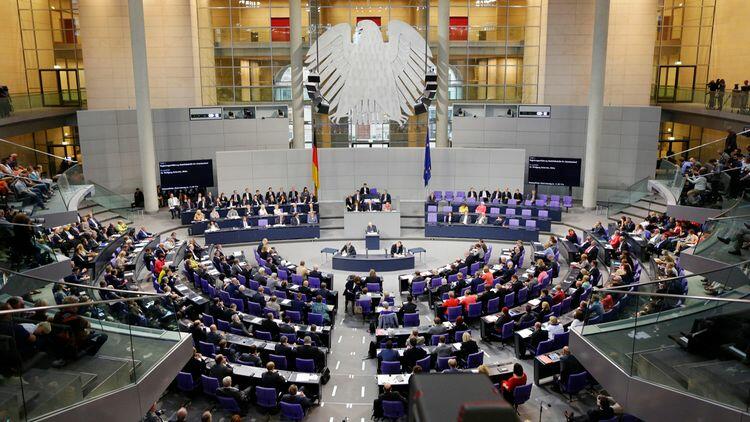
On Thursday lawmakers in the Bundestag, Germany’s lower house of parliament, voted overwhelmingly to approve sending “heavy weapons and complex machinery” to Ukraine. According to national media it passed with 586 votes in favor, 100 against, and seven abstentions.

Bundestag, via government of Germany

The bulk of those voting “no” included the right-wing Alternative for Germany (AfD) party, citing that the move feels close to a “declaration of war”. Senior AfD lawmaker Tino Chrupalla spelled out that it “could make us party to a nuclear war.”

Though this view is now being dismissed as merely excuse-making by the “far-right”, Chancellor Scholz himself said the same thing in a Spiegel interview published last Friday…

“We need to do everything to avoid a direct military confrontation between NATO and a heavily armed superpower such as Russia, a nuclear power,” the chancellor said at the time. “I will do everything to avoid an escalation that could lead to World War III – there can be no nuclear war.”

It was only days after this interview that Berlin signaled a complete reversal, with the German Ministry of Defense announcing Tuesday that delivery of Gepard anti-aircraft tanks to Ukraine had been approved. However, it could take up to a year or more for Ukrainian forces to be properly trained in the effective deployment and use of the Gepard systems.

Thursday’s vote represents what appears to be Berlin’s new commitment to a policy of ‘open-ended’ arming of Ukraine – much like the United States of late. Deutsche Welle details the types of weaponry and assistance that Ukraine can expect to receive based on Thursday’s Bundestag vote:

In addition to heavy weapons, such as anti-aircraft systems and armored vehicles, the measure passed by German MPs included provisions for sending heavier equipment to eastern NATO allies as well.

Military aid should continue and accelerate wherever possible, according to the proposal backed by the ruling coalition and the biggest opposition party, the conservative Christian Democrats (CDU).

Germany will also deploy more soldiers to boost NATO presence in eastern Europe, and encourage Russian soldiers to lay down their arms and seek asylum in Germany and the EU.

Additionally, the measure foresees an appeal to China for it to “abandon its acceptance of war” and actively support a truce. 

But as for calling on China to “actively support a truce” – we wonder the degree to which this is also the active stance of NATO countries at this point, who seem to be rushing headlong toward escalation given the now constant ramping up of weapons shipments to Kiev.

The Kremlin quickly voiced its anger and condemned the vote…

In light of this, it’s worth revisiting some of Scholz’s own words from last week: “To avoid an escalation towards NATO is a top priority for me,” and “That’s why I don’t focus on polls or let myself be irritated by shrill calls. The consequences of an error would be dramatic.” Despite Germany’s complete reversal, this is still truer than ever.

Tyler Durden
Thu, 04/28/2022 – 12:28

via ZeroHedge News https://ift.tt/lWtyRfp Tyler Durden

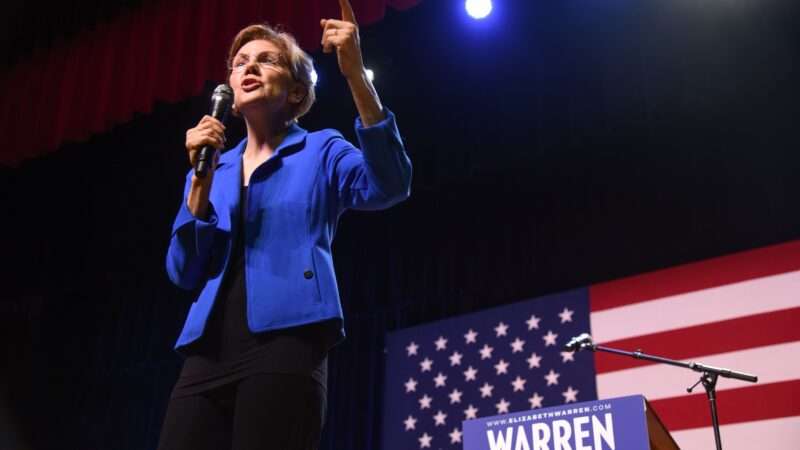
Elizabeth Warren Wants Joe Biden To Deliver a Massive, Illegal Handout to the Well-Off


sfphotosfour519071

Sen. Elizabeth Warren likes to describe herself as someone who sides with working people. For example, in a recent New York Times op-ed, the Massachusetts Democrat warns, correctly, that her party is headed for disaster in this year’s midterm elections. She then urges President Joe Biden “to use every tool of the presidency to deliver for”—you guessed it—”working people.” This is the sort of thing that is designed to appeal to Biden’s abiding sense that he’s just a regular guy whose mission in life is to make life easier for other regular people. He’s just an average Joe trying to help all the other average joes.

But Warren’s first suggestion is a policy that would disproportionately benefit a group of people who are, economically speaking, already doing comparatively well. And Biden increasingly appears poised to act on that policy. I’m referring, of course, to canceling large amounts of student loan debt.

At a private meeting with the Congressional Hispanic Caucus yesterday, Biden was reportedly quite receptive to the idea of canceling some student debt, according to NBC News. Some reports suggest the administration is readying a plan to cancel $10,000 of student debt per borrower. But Senate Majority Leader Chuck Schumer (D–N.Y.) claims the figure could be higher. “We’re getting closer and closer and closer on student loans. I’ve been working relentlessly on the president and his staff, and they seem more open to it now than ever before,” he said this week. “There’s nothing done yet, but I am really hopeful that the goal that we have had, $50,000 of student loans canceled, is getting more and more likely.”

There may be other, smaller actions in the meantime, like this morning’s announcement that the Biden administration will cancel $238 million worth of cosmetology school debt, but Schumer was laying out the end goal: canceling $50,000 of student loan debt per borrower.

First, it’s worth noting that people with college degrees are more likely to both be employed and, on average, are better paid than those who never attended college. People who attend college are also more likely to come from comparatively affluent households in the first place.

Second, it’s worth asking: Who has $50,000 worth of school loans? Not, for the most part, struggling dropouts from state schools. No, large student loan values are heavily associated with professional schools that produce graduates who, on average, go on to be fairly well-compensated.

The single largest source of student loan debt is MBA programs, as Brookings Institution Senior Fellow Adam Looney has noted, and MBA grads average more than $73,000 in earnings their first year out of school. “The five degrees responsible for the most student debt are: MBA, JD, BA in business, BS in nursing, and MD,” Looney wrote in 2020. “That’s one reason why the top 20 percent of earners owe 35 percent of the debt, and why most debt is owed by well-educated individuals.”

Technically, it’s true that well-paid professional school graduates fall into the category of “working people.” But they are not the sort of working people Warren wants you to think of when she uses those words.

What Warren wants, and what Biden appears to be considering, is a massive program of government aid that would disproportionately benefit doctors, lawyers, well-paid medical specialists, and comfortably salaried individuals with advanced business degrees.

But for some reason, you don’t hear Warren and Biden talking about their plan to give huge amounts of money to corporate lawyers and junior associates at hedge funds.

How much money would a program like this cost? Cost, of course, is slightly tricky to define here, since a student loan forgiveness program would not spend money so much as fail to collect it. But a program to forgive $50,000 per borrower would come in at around $950 billion, according to the Committee for a Responsible Federal Budget. This would be in addition to the cost of the current pause on student loan repayment, which has already cost more than $100 billion.

Warren’s pitch for a presidential program to help “working people” is a trillion-dollar bailout for the upper-middle class. They’re just looking out for the little guy.

Here’s another question worth asking that no one involved seems to want answered: Would a unilateral program of debt forgiveness like the one that is apparently under discussion be legal?

Actually, someone did answer that question. Specifically, that question was answered in 2021 by the Office of the General Counsel at the U.S. Department of Education. Lawyers for sprawling government agencies often like to defend the broad powers of their departments, declaring what they legally can do rather than what they legally can’t. So it is noteworthy that the lawyers for the Education Department found that the secretary of education “does not have statutory authority to provide blanket or mass cancellation, compromise, discharge, or forgiveness of student loan principal balances, and/or to materially modify the repayment amounts or terms thereof, whether due to the COVID-19 pandemic or for any other reason.” That sounds like a pretty firm no.

So it’s not just a plan to give huge amounts of money to corporate lawyers and junior associates at hedge funds. It’s an illegal plan to give huge amounts of money to corporate lawyers and junior associates at hedge funds.

In an interview with Politico this week, Warren recycled some of the “delivery” language of her Times op-ed. “If we do deliver,” she said, “if we can get some tangible results that touch people’s lives, then we can go to the polls in November with our heads held high.”

Illegally funneling money to a well-paid, well-off cohort that just happens to vote increasingly for Democrats? Now that’s something a champion of working people can really feel good about.

The post Elizabeth Warren Wants Joe Biden To Deliver a Massive, Illegal Handout to the Well-Off appeared first on Reason.com.

from Latest https://ift.tt/Qob4GNK
via IFTTT

Elizabeth Warren Wants Joe Biden To Deliver a Massive, Illegal Handout to the Well-Off


sfphotosfour519071

Sen. Elizabeth Warren likes to describe herself as someone who sides with working people. For example, in a recent New York Times op-ed, the Massachusetts Democrat warns, correctly, that her party is headed for disaster in this year’s midterm elections. She then urges President Joe Biden “to use every tool of the presidency to deliver for”—you guessed it—”working people.” This is the sort of thing that is designed to appeal to Biden’s abiding sense that he’s just a regular guy whose mission in life is to make life easier for other regular people. He’s just an average Joe trying to help all the other average joes.

But Warren’s first suggestion is a policy that would disproportionately benefit a group of people who are, economically speaking, already doing comparatively well. And Biden increasingly appears poised to act on that policy. I’m referring, of course, to canceling large amounts of student loan debt.

At a private meeting with the Congressional Hispanic Caucus yesterday, Biden was reportedly quite receptive to the idea of canceling some student debt, according to NBC News. Some reports suggest the administration is readying a plan to cancel $10,000 of student debt per borrower. But Senate Majority Leader Chuck Schumer (D–N.Y.) claims the figure could be higher. “We’re getting closer and closer and closer on student loans. I’ve been working relentlessly on the president and his staff, and they seem more open to it now than ever before,” he said this week. “There’s nothing done yet, but I am really hopeful that the goal that we have had, $50,000 of student loans canceled, is getting more and more likely.”

There may be other, smaller actions in the meantime, like this morning’s announcement that the Biden administration will cancel $238 million worth of cosmetology school debt, but Schumer was laying out the end goal: canceling $50,000 of student loan debt per borrower.

First, it’s worth noting that people with college degrees are more likely to both be employed and, on average, are better paid than those who never attended college. People who attend college are also more likely to come from comparatively affluent households in the first place.

Second, it’s worth asking: Who has $50,000 worth of school loans? Not, for the most part, struggling dropouts from state schools. No, large student loan values are heavily associated with professional schools that produce graduates who, on average, go on to be fairly well-compensated.

The single largest source of student loan debt is MBA programs, as Brookings Institution Senior Fellow Adam Looney has noted, and MBA grads average more than $73,000 in earnings their first year out of school. “The five degrees responsible for the most student debt are: MBA, JD, BA in business, BS in nursing, and MD,” Looney wrote in 2020. “That’s one reason why the top 20 percent of earners owe 35 percent of the debt, and why most debt is owed by well-educated individuals.”

Technically, it’s true that well-paid professional school graduates fall into the category of “working people.” But they are not the sort of working people Warren wants you to think of when she uses those words.

What Warren wants, and what Biden appears to be considering, is a massive program of government aid that would disproportionately benefit doctors, lawyers, well-paid medical specialists, and comfortably salaried individuals with advanced business degrees.

But for some reason, you don’t hear Warren and Biden talking about their plan to give huge amounts of money to corporate lawyers and junior associates at hedge funds.

How much money would a program like this cost? Cost, of course, is slightly tricky to define here, since a student loan forgiveness program would not spend money so much as fail to collect it. But a program to forgive $50,000 per borrower would come in at around $950 billion, according to the Committee for a Responsible Federal Budget. This would be in addition to the cost of the current pause on student loan repayment, which has already cost more than $100 billion.

Warren’s pitch for a presidential program to help “working people” is a trillion-dollar bailout for the upper-middle class. They’re just looking out for the little guy.

Here’s another question worth asking that no one involved seems to want answered: Would a unilateral program of debt forgiveness like the one that is apparently under discussion be legal?

Actually, someone did answer that question. Specifically, that question was answered in 2021 by the Office of the General Counsel at the U.S. Department of Education. Lawyers for sprawling government agencies often like to defend the broad powers of their departments, declaring what they legally can do rather than what they legally can’t. So it is noteworthy that the lawyers for the Education Department found that the secretary of education “does not have statutory authority to provide blanket or mass cancellation, compromise, discharge, or forgiveness of student loan principal balances, and/or to materially modify the repayment amounts or terms thereof, whether due to the COVID-19 pandemic or for any other reason.” That sounds like a pretty firm no.

So it’s not just a plan to give huge amounts of money to corporate lawyers and junior associates at hedge funds. It’s an illegal plan to give huge amounts of money to corporate lawyers and junior associates at hedge funds.

In an interview with Politico this week, Warren recycled some of the “delivery” language of her Times op-ed. “If we do deliver,” she said, “if we can get some tangible results that touch people’s lives, then we can go to the polls in November with our heads held high.”

Illegally funneling money to a well-paid, well-off cohort that just happens to vote increasingly for Democrats? Now that’s something a champion of working people can really feel good about.

The post Elizabeth Warren Wants Joe Biden To Deliver a Massive, Illegal Handout to the Well-Off appeared first on Reason.com.

from Latest https://ift.tt/Qob4GNK
via IFTTT

Justice Breyer Cites His Boss’s Concurrence in Heart of Atlanta Motel

Today the Supreme Court decided Cummings v. Premier Rehab Keller. The case concerned whether damages for emotional distress are available in suits brought under the Rehabilitation Act. The Court split 6-3. The majority, per Chief Justice Roberts, says no. The dissent, per Justice Breyer, says yes. I don’t have much to say about the specific nuances of contract law. But I did chuckle when Justice Breyer included a very personal citation:

As a Member of this Court noted in respect to the CivilRights Act of 1964, Congress’ antidiscrimination laws seek “the vindication of human dignity and not mere economics.” Heart of Atlanta Motel, Inc. v. United States, 379 U. S. 241, 291 (1964) (Goldberg, J., concurring). Quoting the Senate Commerce Committee, Justice Goldberg observed:

“‘Discrimination is not simply dollars and cents, hamburgers and movies; it is the humiliation, frustration, and embarrassment that a person must surely feel when he is told that he is unacceptable as a member of the public because of his race or color. It is equally the inability to explain to a child that regardless of education, civility, courtesy, and morality he will be denied the right to enjoy equal treatment, even though he be a citizen of the United States and may well be called upon to lay down his life to assure this Nation continues.'” Id., at 292 (quoting S. Rep. No. 872, 88th Cong., 2d Sess., 16 (1964)).

It is difficult to believe that prospective funding recipients would be unaware that intentional discrimination based on race, sex, age, or disability is particularly likely to cause emotional suffering.

Heart of Atlanta Motel was decided during the October 1964 Term. And, during that time, a young Stephen Breyer clerked for Justice Arthur Goldberg. I think it safe to say that Breyer worked on that landmark decision. There were only two law clerks for each Justice at the time, and the case was decided two months after it was argued. It is remarkable how much the Court has changed in the six decades since Breyer clerked. I doubt Heart of Atlanta would be unanimous today. And we should never lose sight of the fact that Breyer later took Goldberg’s seat. And Breyer’s clerk, KBJ, will take his seat.

Speaking of which, yesterday Chief Justice Roberts gave an emotional farewell to Justice Breyer. (C-SPAN has the recording.) Roberts began:

As many of you may know, Justice Breyer has announced his retirement from the Court effective when we rise for the summer recess. That means that the oral argument we concluded will bet he last we hear with Justice Breyer on the bench.

Ehh… Not only is John Roberts content to rewrite the acts of Congress. Now he is taking it upon himself to rewrite the handiwork by members of the Judiciary! Justice Breyer did not announce his retirement when the Court rises for the recess. His statement was premised on several nested conditionals:

“I intend this decision to take effect when the Court rises for the summer recess this year (typically late June or early July) assuming that by then my successor has been nominated and confirmed.

Perhaps Roberts is taking the OLC view that since Judge Jackson was confirmed to fill a vacancy that does not yet exist, and was commissioned, Breyer is now deemed to have retired. Or something to that effect. In any event, I think now Breyer is more or less stuck with stepping down, given the Chief’s poignant farewell. Unless Breyer pulls a Tom Brady!

The post Justice Breyer Cites His Boss's Concurrence in <i>Heart of Atlanta Motel</i> appeared first on Reason.com.

from Latest https://ift.tt/JBc2hPZ
via IFTTT

Wikipedia’s Jimmy Wales Has Already Solved the Internet’s Problems


8181334

Wikipedia, “the free encyclopedia that anyone can edit,” went from being a weird online experiment 21 years ago to one of the mainstays of the modern internet with astonishing speed. Even more astonishing, it has maintained its reputation and functionality since its founding, even as the rest of the social internet seems hellbent on tearing itself apart.

As Twitter, Facebook, and others are consumed with controversy over moderation, governance, and the definition of free speech, Wikipedia continues to quietly grow in utility, trustworthiness, and comprehensiveness; there are now nearly 6.5 million articles on the English version alone and it has held its place in the top 15 most visited sites on the internet for well over a decade.

Reason spoke with Wikipedia’s founder, Jimmy Wales, who was predictably modest about what he got right. A key ingredient to Wikipedia’s success is its high degree of decentralization. After this interview was conducted, Elon Musk made a bid to buy Twitter, bringing new salience to the battle over who controls the flow of information (and disinformation) online.

Reason last spoke with Wales 15 years ago, and the resulting profile ended up becoming a source for Wales’ own Wikipedia entry. At that time, we talked about the future of online speech, improving the algorithms that shape our lives, and the role that Friedrich Hayek played in Wales’ thinking. This conversation picked up where we left off.

Interview by Katherine Mangu-Ward; edited by Adam Czarnecki; intro by John Osterhoudt

Photo: Lino Mirgeler/dpa/picture-alliance/Newscom

The post Wikipedia's Jimmy Wales Has Already Solved the Internet's Problems appeared first on Reason.com.

from Latest https://ift.tt/ruEVtYn
via IFTTT

Russian Fossil Fuel Revenues Double Despite Western Sanctions 

Russian Fossil Fuel Revenues Double Despite Western Sanctions 

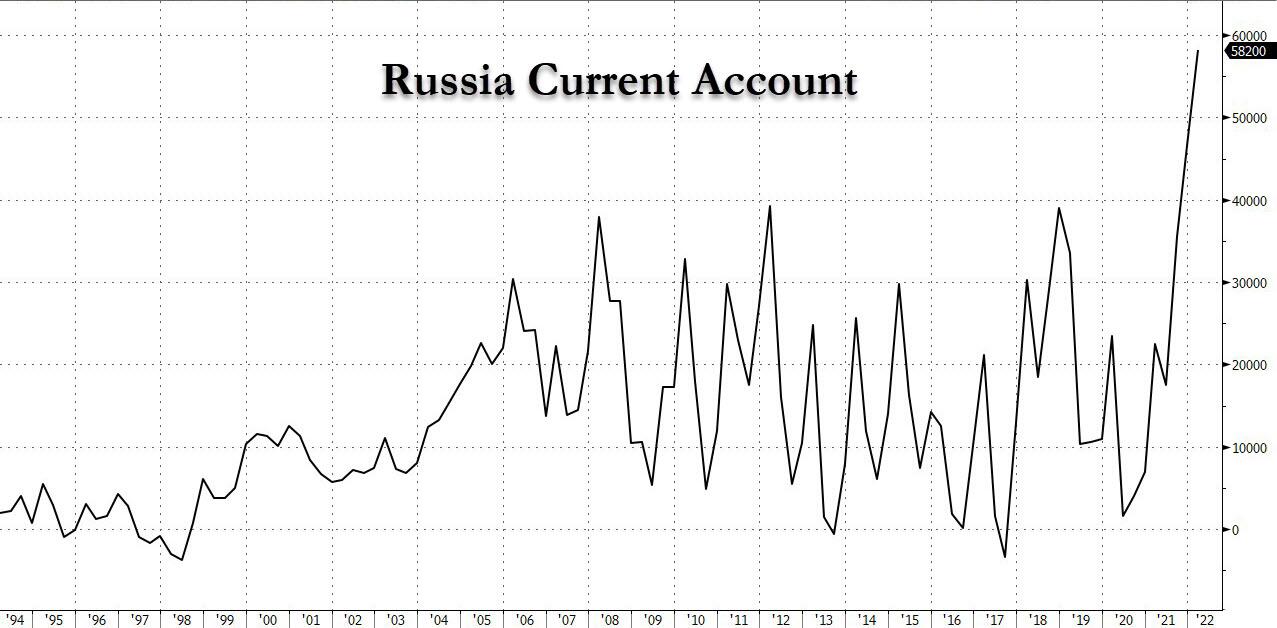
The longer Western sanctions isolate Russia and reduce energy supplies to European refiners. The higher energy prices will go. Even though Russian energy exports are declining, higher prices have enabled the country’s state-owned oil and gas companies to double revenue, thus stabilizing the ruble and allowing financing for President Putin’s military machine. 

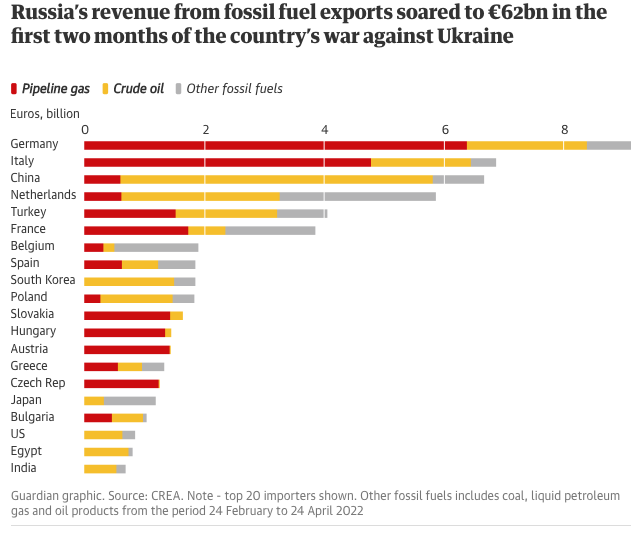
According to The Guardian, citing a new report of shipping movements by the Centre for Research on Energy and Clean Air (CREA), Russia has reaped a whopping €62 billion from oil, gas, and coal exports since the invasion of Ukraine began.  

Russian exports to energy-stricken Europe totaled €44 billion in the last two months, compared with €140 billion for FY’21. The revenue surge comes as “Russia has continued to benefit from its stranglehold over Europe’s energy supply, even while governments have frantically sought to prevent Vladimir Putin from using oil and gas as an economic weapon,” CREA said. 

CREA data showed Russian crude oil exports tumbled 30% in the first three weeks of April, compared with rates in January and February, before the invasion. However, soaring prices because of tight global supplies have helped cushion the blow of Western sanctions and ultimately allowed Putin to continue his funding war efforts.

“Russia has effectively caught the EU in a trap where further restrictions will raise prices further, cushioning its revenues despite the best efforts of EU governments,” CREA explained. 

“Fossil fuel exports are a key enabler of Putin’s regime and many other rogue states,” Lauri Myllyvirta, lead analyst for CREA, said. 

“Continued energy imports are the major gaps in the sanctions imposed on Russia. Everyone who buys these fossil fuels is complicit in the horrendous violations of international law carried out by the Russian military,” Myllyvirta said, 

The EU receives around 40% of its gas, 46% of its coal, and 30% of its oil from Russia — and there are no quick and easy substitutes if supplies are disrupted. Germany has been the biggest importer of Russian energy products in the last two months. German businesses and unions have warned a ban on energy products from Russia could severely impact industry and jobs. 

In recent days, Moscow has doubled down on its demands that its European “partners” pay for its oil and gas in rubles instead of euros. Russia’s Gazprom said it is halting natural gas supplies to Poland and Bulgaria over their refusal to pay in Russian rubles.

So far, Western sanctions have backfired as Russia doubled fossil fuel revenues. What’s important to understand next is that Russian oil production is likely to drop further in the coming months and will tighten global supplies and boost energy prices which could mean higher revenues for Putin. 

Tyler Durden
Thu, 04/28/2022 – 11:45

via ZeroHedge News https://ift.tt/cV5MBnX Tyler Durden

Justice Breyer Cites His Boss’s Concurrence in Heart of Atlanta Motel

Today the Supreme Court decided Cummings v. Premier Rehab Keller. The case concerned whether damages for emotional distress are available in suits brought under the Rehabilitation Act. The Court split 6-3. The majority, per Chief Justice Roberts, says no. The dissent, per Justice Breyer, says yes. I don’t have much to say about the specific nuances of contract law. But I did chuckle when Justice Breyer included a very personal citation:

As a Member of this Court noted in respect to the CivilRights Act of 1964, Congress’ antidiscrimination laws seek “the vindication of human dignity and not mere economics.” Heart of Atlanta Motel, Inc. v. United States, 379 U. S. 241, 291 (1964) (Goldberg, J., concurring). Quoting the Senate Commerce Committee, Justice Goldberg observed:

“‘Discrimination is not simply dollars and cents, hamburgers and movies; it is the humiliation, frustration, and embarrassment that a person must surely feel when he is told that he is unacceptable as a member of the public because of his race or color. It is equally the inability to explain to a child that regardless of education, civility, courtesy, and morality he will be denied the right to enjoy equal treatment, even though he be a citizen of the United States and may well be called upon to lay down his life to assure this Nation continues.'” Id., at 292 (quoting S. Rep. No. 872, 88th Cong., 2d Sess., 16 (1964)).

It is difficult to believe that prospective funding recipients would be unaware that intentional discrimination based on race, sex, age, or disability is particularly likely to cause emotional suffering.

Heart of Atlanta Motel was decided during the October 1964 Term. And, during that time, a young Stephen Breyer clerked for Justice Arthur Goldberg. I think it safe to say that Breyer worked on that landmark decision. There were only two law clerks for each Justice at the time, and the case was decided two months after it was argued. It is remarkable how much the Court has changed in the six decades since Breyer clerked. I doubt Heart of Atlanta would be unanimous today. And we should never lose sight of the fact that Breyer later took Goldberg’s seat. And Breyer’s clerk, KBJ, will take his seat.

Speaking of which, yesterday Chief Justice Roberts gave an emotional farewell to Justice Breyer. (C-SPAN has the recording.) Roberts began:

As many of you may know, Justice Breyer has announced his retirement from the Court effective when we rise for the summer recess. That means that the oral argument we concluded will bet he last we hear with Justice Breyer on the bench.

Ehh… Not only is John Roberts content to rewrite the acts of Congress. Now he is taking it upon himself to rewrite the handiwork by members of the Judiciary! Justice Breyer did not announce his retirement when the Court rises for the recess. His statement was premised on several nested conditionals:

“I intend this decision to take effect when the Court rises for the summer recess this year (typically late June or early July) assuming that by then my successor has been nominated and confirmed.

Perhaps Roberts is taking the OLC view that since Judge Jackson was confirmed to fill a vacancy that does not yet exist, and was commissioned, Breyer is now deemed to have retired. Or something to that effect. In any event, I think now Breyer is more or less stuck with stepping down, given the Chief’s poignant farewell. Unless Breyer pulls a Tom Brady!

The post Justice Breyer Cites His Boss's Concurrence in <i>Heart of Atlanta Motel</i> appeared first on Reason.com.

from Latest https://ift.tt/JBc2hPZ
via IFTTT

Wikipedia’s Jimmy Wales Has Already Solved the Internet’s Problems


8181334

Wikipedia, “the free encyclopedia that anyone can edit,” went from being a weird online experiment 21 years ago to one of the mainstays of the modern internet with astonishing speed. Even more astonishing, it has maintained its reputation and functionality since its founding, even as the rest of the social internet seems hellbent on tearing itself apart.

As Twitter, Facebook, and others are consumed with controversy over moderation, governance, and the definition of free speech, Wikipedia continues to quietly grow in utility, trustworthiness, and comprehensiveness; there are now nearly 6.5 million articles on the English version alone and it has held its place in the top 15 most visited sites on the internet for well over a decade.

Reason spoke with Wikipedia’s founder, Jimmy Wales, who was predictably modest about what he got right. A key ingredient to Wikipedia’s success is its high degree of decentralization. After this interview was conducted, Elon Musk made a bid to buy Twitter, bringing new salience to the battle over who controls the flow of information (and disinformation) online.

Reason last spoke with Wales 15 years ago, and the resulting profile ended up becoming a source for Wales’ own Wikipedia entry. At that time, we talked about the future of online speech, improving the algorithms that shape our lives, and the role that Friedrich Hayek played in Wales’ thinking. This conversation picked up where we left off.

Interview by Katherine Mangu-Ward; edited by Adam Czarnecki; intro by John Osterhoudt

Photo: Lino Mirgeler/dpa/picture-alliance/Newscom

The post Wikipedia's Jimmy Wales Has Already Solved the Internet's Problems appeared first on Reason.com.

from Latest https://ift.tt/ruEVtYn
via IFTTT

Rabobank: “Life Is About More Than Social Networks And Virtual Moustaches”

Rabobank: “Life Is About More Than Social Networks And Virtual Moustaches”

By Michael Every of Rabobank

The Social Network of Liberty

Bloomberg exceeds itself today with its truly myopic focus. It is thrilled enough about a social media giant which thinks we all want to wear headsets all day (hypothetical note to self: go long optometrists/opticians and skin cream?), “because virtual reality moustaches”, and which just decided to open a corner-shop as a visionary idea, narrowly exceeding slim expected growth in user numbers to run THAT as its main Asia morning headline rather than anything else.

For example, the further pivot in Indonesia on palm oil exports, saying locals come first, that has seen global prices for that food staple up 10%: obviously people with virtual moustaches eat virtual food. Or the will-they-won’t-they of EU gas payments in/not in roubles, where it is still unclear who is going to keep getting Russian gas, and who is going to comply with EU sanctions: obviously people with virtual moustaches need virtual heat and energy.

Or Russia’s Putin warning countries who interfere in Ukraine will be met with a “lightning-fast” response, adding, “If someone intends to intervene into the ongoing events from the outside and creates unacceptable strategic threats for us, then they should know that our response to those strikes will be swift, lightning fast… We have all the tools for this – ones that no one can brag about. And we won’t brag. We will use them if needed. And I want everyone to know this.” Obviously people with virtual moustaches get full protection from these kinds of threats.

Or China’s Xi Jinping stating he wants to Chinese GDP growth to be faster than that of the US in 2022,… in order to show that his one-party system is superior to Western democracy, and the US is in decline, according to a Wall Street Journal report. To be fair, that leads even Bloomberg’s Shuli Ren to write an op-ed stating ‘China’s Xi May Soon Learn You Can’t Eat Statistics.’ Indeed, aren’t these guys supposed to get that with their (superior) New World Order, non-fiat, based, old school schtick?

Or, that just a day after I wrote “‘Why Bretton Woods 3 Won’t Work’ is working”, as the ‘doomed’ US dollar continues to soar, which said that if the West shifts to a more geopolitical economic stance, that it would stay that way, we get a Mansion House speech from UK Defence Secretary Truss which says “geopolitics is back”, argues for a “reboot” in the free world to a new global economic and security ‘Network of Liberty’.

Truss states, “Three years ago Vladimir Putin said Western liberalism was dead. Last year President Xi argued that the west is declining. In April 2022 things look very different…Those who think they can win through oppression, coercion, or invasion are being proved wrong by this new stand on global security – one that not only seeks to deter, but also ensures that aggressors fail… We must be prepared for the long haul. We’ve got to double down on our support for Ukraine… Heavy weapons, tanks, aeroplanes – digging deep into our inventories…. We will keep going further and faster to push Russia out of the whole of Ukraine…. Inaction would be the greatest provocation. This is a time for courage not for caution.” Putin just gave specific warnings on this.  

Truss says the post-WW2 global architecture no longer functions and signed treaties have little meaning (**cough** Northern Ireland **cough**) and makes a deserved dig at ‘ze Germans’ that “Wandel durch handel… didn’t work”. Instead, “We now need a new approach, one that melds hard security and economic security, one that builds stronger global alliances and where free nations are more assertive and self-confident, one that recognises geopolitics is back.”

The new policy approach is based on three areas: military strength, economic security and deeper global alliances.

  • On the military:In the words of President Zelenskiy: “Freedom must be better armed than tyranny.”… Spending 2% on defence must be a floor, not a ceiling.” That’s a *lot* of state spending for a *long* time. Moreover, “We need a global NATO. [It] must have a global outlook… We need to pre-empt threats in the Indo-Pacific, working with our allies like Japan and Australia to ensure the Pacific is protected. And we must ensure that democracies like Taiwan are able to defend themselves.” That brings China and its new ‘Global Security Initiative’ of ‘Yankee, NATO, AUKUS, Quad Go Home’ slap bang into the equation along with Russia.

  • On economic security:We recognise that growth from cheap gas and money syphoned from kleptocracies is growth built on sand. It’s not the same as real, sustained growth from higher productivity and greater innovation… We will always champion economic freedom. But free trade must be fair – and that means playing by the rules. For too long many have been naïve about the geopolitical power of economics. Aggressors treat it as a tool of foreign policy – using patronage, investment, and debt as a means to exert control and coerce. They are ruthless in their approach… It’s time to wise up. Access to the global economy must depend on playing by the rules. There can be no more free passes…We are showing that economic access is no longer a given. It has to be earned. Countries must play by the rules. And that includes China… China is not impervious. By talking about the rise of China as inevitable we are doing China’s work for it. In fact, their rise isn’t inevitable. They will not continue to rise if they don’t play by the rules. China needs trade with the G7. We represent half of the global economy. And we have choices.”

  • On deeper global alliances: “Our prosperity and security must be built on a network of strong partnerships. This is what I have described as the Network of Liberty…In a world where malign actors are trying to undermine multilateral institutions, we know that bilateral and plurilateral groups will play a greater role. Partnerships like NATO, the G7 and the Commonwealth are vital… we want to keep growing our ties with countries like Japan, India and Indonesia. We also should build on the strong core that we have in the G7 [which] should act as an economic NATO, collectively defending our prosperity. If the economy of a partner is being targeted by an aggressive regime we should act to support them. All for one and one for all.

True, the UK is a relatively small global economy at loggerheads with the EU. True, this is a government whose many critics point out couldn’t organise a heavy-drinking session in a brewery, but can and did under lockdown in Downing Street, whose backbench MPs make ‘Basic Instinct’ smears against opposition front-benchers, and whose front-benchers are accused of watching porn in the House of Commons. Regardless, the UK has been a thought-leader in the past, and this *is* thought leadership. It must surely be a better option than doing nothing, accepting the ‘realism’ of imperialism, or Germany turning down the temperature of their public swimming pools to support Ukraine(!)

The implications of this happening are, as I have argued since 2017, that the world fractures but the West gets to keep the lion’s share of what matters most – and the US dollar soars.

This is not to say that this *will* happen, or immediately, even if both Truss and Yellen are now saying it. Words, like Chinese imports (when you can get them due to lockdowns) are cheaper than local action. We all said Build Back Better a lot while not meaning it for a second, or even knowing WHAT it meant.

The difference here is that the Network of Liberty (with some de facto illiberal members, as during the first Cold War) is something people CAN understand and IS focused. It’s just very, very disruptive to the status quo.

Then again, so is Elon Musk, who just tweeted he wants to buy Coca-Cola to put the cocaine back in it. (And as some ask how someone so exposed to China can be a true free-speech libertarian – including those who are not free-speech libertarians, and are also deeply exposed to China. We shall see, I suppose.)

Markets need to be paying close attention to all of this, and not the usual quarterly frippery. They didn’t follow those warning of the GFC before 2008 (**cough**), or the sea-change in politics that saw first Brexit, then Trump, then trade war, then China’s ‘common prosperity’ shift, and now Russia’s invasion of Ukraine: can one call that a pattern, if one is a Wall Street analyst, or is one constantly being surprised? Nor did they predict the political swing in the West towards social justice that has spread to said Wall Street analysts, the US Treasury, and even the Fed (although let’s see what that means for monetary policy now push has come to shove).

One needs to build a wider network of reading than quarterly earnings reports or GDP data to predict these kinds of things.

In pure market terms, but reflecting these underlying shifts, look to the travails of the BOJ, meeting today, and JPY. If you want another example, consider the outlook for CNY. If you want a third, read the Bloomberg op-ed arguing ‘The Hong Kong Dollar’s Peg Has Become Untenable’ because of changes in Hong Kong, geopolitics, and relative US and Chinese monetary policy stances. Can you imagine the market volatility if, as the op-ed author suggests, “The only question, really, is whether the Chinese government wants the hassle and expense of defending the Hong Kong dollar’s peg or whether it just bows to the inevitable?”

He goes on to add that, “Much of Hong Kong’s status as an Asian financial hub was derived from the fact that its legal system was robust, speech was free, and it was a nice place to live. Now, if anything, capital is fleeing Hong Kong. Bank deposits are falling, the benchmark Hang Seng Index is down 40% since early 2018, and the H-share index of mainland Chinese equities is lower than it was at the nadir of the global financial crisis. None of this bodes well for the Hong Kong dollar. The Hong Kong Monetary Authority likes to say that it runs a currency board, making the dollar peg virtually unbreakable. Actually, it doesn’t and it isn’t… over the years Hong Kong has watered down its currency board… The dollar peg is now really only a target.” Somewhere, Kyle Bass is hyperventilating.

Another similar question from the other geopolitical side, as one thinks of this topic, and links back to Truss, is if Hong Kong is still considered an integral part of a ‘Network of Liberty’ or not: that is as this week saw the Hong Kong Foreign Correspondents’ Club cancel its annual human rights press awards days before it was due to announce the winners, out of fear it would violate the city’s wide-ranging national security law.

So, enjoy the wild market swings of extrapolating mild earnings and user numbers vs. massaged expectations. Just recall life is about more than social networks and virtual moustaches: it is perhaps increasingly about historical fears of men with moustaches, and emerging networks of liberty (and, by Manichean definition, autocracy).
Tyler Durden
Thu, 04/28/2022 – 11:25

via ZeroHedge News https://ift.tt/b739N0o Tyler Durden

Oil Spikes After EU Says Russian Embargo ‘Imminent’ As Germany Drops Opposition

Oil Spikes After EU Says Russian Embargo ‘Imminent’ As Germany Drops Opposition

After throughout the whole month consistently rejecting a proposed European Union ban on Russian oil, but while also walking a delicate tightrope of opposing Putin’s demand of payments in rubles for Russian energy, Germany is now ready to pull the trigger on an embargo.

It’s another major Berlin U-turn happening in tandem with the decision to send heavy weapons to Ukraine. The Wall Street Journal is citing Berlin government officials who say “Germany is now ready to stop buying Russian oil.”

The WSJ underscores that this “clears the way” for a wider EU ban on Russian oil imports, given that Germany’s resistance was the chief holdout to imposing an embargo before this point.

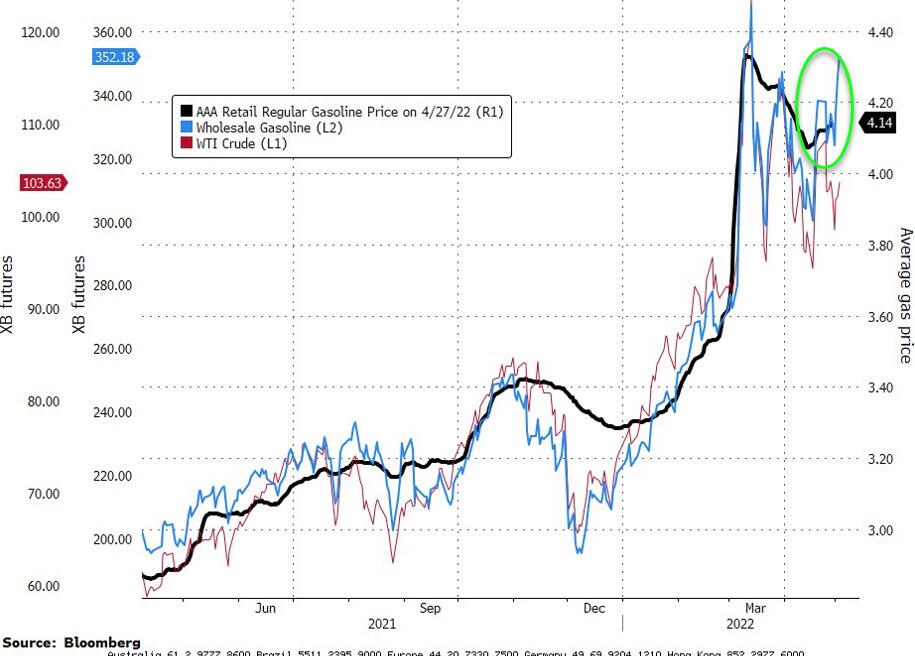
Further the report indicates that an embargo now seen as “imminent” but it remains that no target date has been set yet, or at least hasn’t been disclosed publicly. While events earlier in the week made clear that this was coming, preparing markets, oil began surging on the news…

Which is not good news for President Biden as gas prices at the pump are already on the rise…

Germany appears to have lifted its objection based on prior negotiations to implement a phased-in Russian oil embargo, similar to the phased approach regarding the coal ban. 

Additionally, other countries particularly in eastern Europe have lately appeared willing to step up in taking the pressure off Germany supply – for example Poland says it’s ready to supply a German refinery via Gdansk which is owned by Rosneft.

“Should Rosneft refuse to process non-Russian oil imports, Germany could put the refinery under state management under laws protecting strategic assets,” the report says. But the elephant in the room is that some eastern European countries are actually close to 100% reliant on Russian oil, or with many approaching total dependency. 

According to recent figures in The Hill “European nations, which in November 2021 imported about seven times as much Russian oil as the United States, are far more reliant on Russian oil imports and some Eastern European countries are almost entirely dependent on Russian oil.” This is broken down as follows according to European regions…

  • Lithuania, for example, gets 83 percent of its oil imports from Russia, followed by Finland (80 percent), Slovakia (74 percent), Poland (58 percent), Hungary (43 percent) and Estonia (34 percent).

  • Germany follows at 30 percent, joined by Norway (25 percent), Belgium (23 percent), Turkey (21 percent), Denmark (15 percent) and Spain (11 percent).

Developing…

Tyler Durden
Thu, 04/28/2022 – 11:10

via ZeroHedge News https://ift.tt/3Jou1WE Tyler Durden