Gold Demand Surges In First Quarter

Gold Demand Surges In First Quarter

Via SchiffGold.com,

Gold demand surged to kick off the year, up 34% year-on-year in the first quarter of 2022.

Total demand came in at 1,234 tons in Q1. That was the highest quarterly demand since Q4 2018, according to the World Gold Council’s Gold Demand Trends report. Demand in the first quarter of this year was 19% above the 5-year average.

According to the WGC, surging inflation and the Russian invasion of Ukraine were key factors driving demand.

The price of gold was up 8% in Q1.

Gold inflows into ETFs charted their strongest quarterly number since the third quarter of 2020. Safe-haven demand fueled the 269-ton increase in ETF gold holdings. This more than reversed the 174-ton outflow from gold-backed funds in 2021.

Demand for gold coins and gold bars came in at 282 tons. That was 20% down from a very strong first quarter last year, but it was still 11% higher than the five-year quarterly average.

While physical investment gold demand in the US and Europe were both strong, China was key to explaining the y-o-y decline. A drop in Chinese demand for gold bars and coins due to new government COVID-19 lockdowns put a drag on physical gold investment in that country. Record gold prices in some currencies also resulted in profit-taking. This was particularly true in Japan and Turkey.

Softer demand in China and India also stalled the recovery in the gold jewelry market. Q1 demand was down 7% year-on-year, coming in at 474 tons.

Central banks added a modest amount of gold to their holdings in Q1. On net, central banks globally increased their gold reserves by 84 tons. This doubled the increase from Q4 but was 29% down from the first quarter of 2020. Several central banks made large sales in Q1, pulling the net increase lower.

Demand for gold by industry rose by 1% year on year. It was the best Q1 for industrial gold demand since 2018.

While the technology sector has recovered somewhat from the impact of the pandemic, COVID-related headwinds remain thanks to China’s draconian policies. Dozens of cities in China are under total or partial lockdown, with major industrial and financial hubs such as Shanghai impacted. China’s zero-COVID policy also coincided with the Chinese New Year holiday. According to the WGC, this will potentially impact the electronics supply chain throughout 2022. The war in Ukraine could also impact the global electronics market moving into the second quarter.

Looking ahead, the WGC says that with so many factors in play, it’s difficult to determine gold demand trends moving forward.

Jewelry and industrial demand could see deteriorating market conditions if the war in Ukraine continues.  But we could also see quickly improving conditions with a resolution of that conflict. It’s also hard to predict how governments will respond to any resurgence in COVID-19. More lockdowns would put additional drag on these sectors.

On the other hand, the World Gold Council says it expects investment demand to be higher this year than last year due to high inflation and geopolitical instability.

You can read the entire World Gold Council report HERE.

Tyler Durden
Thu, 04/28/2022 – 14:00

via ZeroHedge News https://ift.tt/fGsvZKj Tyler Durden

Biden’s Mammoth $33BN Ukraine Package Includes Help With Wartime Propaganda

Biden’s Mammoth $33BN Ukraine Package Includes Help With Wartime Propaganda

Politico’s Christopher Miller noted earlier that the record-smashing $33 billion spending package that the White House is proposing for Ukraine actually “dwarfs the annual defense budgets of most nations.” To which we naturally asked: how many billions of dollars does it take to turn a ‘proxy’ war into a ‘direct conflict’?

For starters it’s clear that such a massive amount of taxpayer money means that Washington clearly doesn’t expect that the war will end anytime soon, as multiple US defense and intelligence officials have recently testified. In fact General Mark Milley, the chair of the Joint Chiefs of Staff, told the House Armed Services Committee during the first week of this month that he sees this as“very protracted conflict” to come that will be “at least measured in years.”

Biden in his Thursday rollout remarks described that the new aid package “begins the transition to longer-term security assistance.” But interestingly as part of this assistance, a key area that the US will fund is what’s essentially information warfare

Independent journalist and media commentator Michael Tracey has pointed out…

White House fact-sheet says part of the mammoth $33 billion spending package it’s requesting for Ukraine will be to “support independent media.” Because nothing screams “independent” like being directly funded by the US Government as part of its “information warfare” initiative.

Of course, going back to at least 2014 the US government has funded such Ukraine initiatives as “citizen journalism” to push back against ‘Russian influence’ in the country.

As WikiLeaks has documented long ago, there was similarly heavy State Department and US intelligence funding of “independent” and “opposition” media in Syria in the lead-up to and during the decade-long war to try and overthrow Assad.

But this marks a huge expansion of the United States much more directly assisting Ukraine in its media and wartime propaganda efforts. The White House fact sheet detailing the scope of the security aid package spells out in a bullet point:

  • Counter Russian disinformation and propaganda narratives, promote accountability for Russian human rights violation, and support activists, journalists, and independent media to defend freedom of expression.

This as “freedom of expression” is often suppressed at home, ironically enough especially targeting independent media outlets.

Among recent examples of Ukraine’s current info war efforts is this nugget:

Also of little comfort to the US taxpayer in terms of a potential eventual path to WW3 between two nuclear armed powers is this section under a header titled Help Ukraine Defend Itself Over the Long-Term…

  • A stronger NATO security posture through support for U.S. troop deployments on NATO territory, including transportation of U.S. personnel and equipment, temporary duty, special pay, airlift, weapons system sustainment, and medical support.

Ultimately this means hundreds of millions will go toward propping up “independent media” which will actually in truth be US-state funded pro-NATO information efforts.

Tyler Durden
Thu, 04/28/2022 – 13:40

via ZeroHedge News https://ift.tt/AuKQzTl Tyler Durden

Here’s The Biggest Geopolitical Factor The Markets Haven’t Priced-In… Yet

Here’s The Biggest Geopolitical Factor The Markets Haven’t Priced-In… Yet

Via InternationalMan.com,

International Man: What’s your take on the situation with Russia, and what comes next?

Nick Giambruno: Let me first say as an American citizen, I don’t think the US should be a global empire. If it were up to me, I’d make the US more like how Switzerland used to be—neutral and staying out of the conflicts of other nations. Sadly, Switzerland has shed most of its independence over the years, but that’s a story for another day.

Anyways, be that as it may, if you are inclined to want the US government to rule the world, you have to look at the other big powers in the world—Russia and China. So, logically you wouldn’t want Russia and China to team up. You’d want to split them apart. It’s just basic strategy.

Nonetheless, the folks in charge of the US government are bungling this basic geopolitical strategy. Instead, they are causing Russia and China to get together in an alliance against the United States.

If Russia and China come together, you have a credible challenger to the US empire. That’s a historical development that changes the whole geopolitical game, and I think that’s what we’re seeing right before our eyes.

That, of course, has enormous implications, including for your portfolio.

International Man: What do these sanctions against Russia mean for the US dollar’s role as the world’s reserve currency?

Nick Giambruno: Before I get into that, allow me to make one point clear.

The notion that a group of politicians can tell you with whom you can and cannot transact is absurd. Free men should be able to conduct business with whomever they like without busybodies interfering.

If you want to purchase a Cuban cigar, Cuban rum, or Russian vodka, who is anyone to tell you that’s forbidden?

So I reject the concept of sanctions. But, of course, I understand they are a practical reality and wouldn’t advise anyone to openly break them unless they prefer to become an outlaw or a martyr.

The US government has gone overboard with the sanctions. They can wield this financial weapon because the US dollar is the world’s reserve currency. That means they can cut them off from the US financial system and a large portion of international trade at the push of a button.

Sanctions are like an “easy button” to cause economic pain to coerce another country into behaving a certain way. It’s an expedient option but not one that has been thought out well.

Remember, Russia is not a tiny, feeble country that can’t punch back.

Russia is the world’s largest exporter of natural gas, lumber, wheat, fertilizer, and palladium (a crucial component in cars).

It is the second-largest exporter of oil and aluminum and the third-largest exporter of nickel and coal.

Russia is a major producer and processor of uranium for nuclear power plants. Enriched uranium from Russia and its allies provides electricity to 20% of the homes in the US.

Aside from China, Russia produces more gold than any other country, accounting for more than 10% of global production.

These are just a handful of examples. There are many strategic commodities that Russia dominates.

In short, Russia is not just an oil and gas powerhouse but a commodity powerhouse.

Europe cannot survive without Russian commodities.

Taking Russian commodities off of global markets would cause an across-the-board price shock that would decimate financial markets, banks, and practically every industry.

That’s one reason why the US government’s Russia sanctions are shortsighted.

Another reason is that it only makes sense to use sanctions to the extent it doesn’t incentivize the other big powers in the world to create alternative financial institutions. But that is precisely what is happening, and it’s undermining the US dollar’s role as the world’s reserve currency.

Although they are often the most opportunistic and unprincipled people, those in charge of the US government are not necessarily the smartest. If they were competent geopolitical strategists that wanted to maintain American hegemony, they would not be doing such counterproductive things.

In short, they have the big picture strategy backward.

China will be the bigger challenger to the US soon. So it would make much more geopolitical sense to ally with Russia to knock China down a peg or two.

I am, of course, not advocating this but simply pointing out the basic strategy and power dynamics at play and how the US government is fumbling it.

In any case, splitting Russia off from China is improbable to happen now. That means we will see Russia and China team up to form a credible geopolitical, economic, and financial partnership to the detriment of the US.

I don’t like the game of global empire. I don’t like other countries dominating others and all the wars it causes. However, you have to understand how the power structures of the world work so you can make the right investment decisions.

International Man: Given that big picture backdrop, How can our readers position themselves to profit?

Nick Giambruno: Here’s the bottom line.

The US government is bungling the geopolitical strategy on several levels. It will foster the partnership of Russia and China, which can act as a counterweight to the US. They are creating an alternative monetary and economic system outside of the dollar that billions of people worldwide could use.

It’s a nightmare scenario for US strategists unfolding right now.

With Russia and China teamed up economically and militarily, what you have is not just a credible challenge to the US. You have something that could be more powerful than the West.

That will have enormous implications for the stock market, the US dollar, the euro, and monetary alternatives such as gold, silver, and Bitcoin.

I don’t think financial markets have priced in the implications of the US screwing up the big picture geopolitical strategy. In other words, there is an enormous information asymmetry in the market.

But that’s actually a good thing. If the market had priced this in, there wouldn’t be an opportunity for astute investors who can see the true big picture and know how to position themselves for big profits as this all plays out.

*  *  *

The economic trajectory is troubling. Unfortunately, there’s little any individual can practically do to change the course of these trends in motion. The best you can and should do is to stay informed so that you can protect yourself in the best way possible, and even profit from the situation. That’s precisely why bestselling author Doug Casey and his colleagues just released an urgent new PDF report that explains what could come next and what you can do about it. Click here to download it now.

Tyler Durden
Thu, 04/28/2022 – 13:25

via ZeroHedge News https://ift.tt/jUCI5WQ Tyler Durden

Solid 7Y Auction Tails Despite Spike In Foreign Demand

Solid 7Y Auction Tails Despite Spike In Foreign Demand

After a strong 2Y, and a subpar 7Y auction earlier this week, we end the week’s coupon issuance with an auction of $44BN in 7Y paper which came in just right.

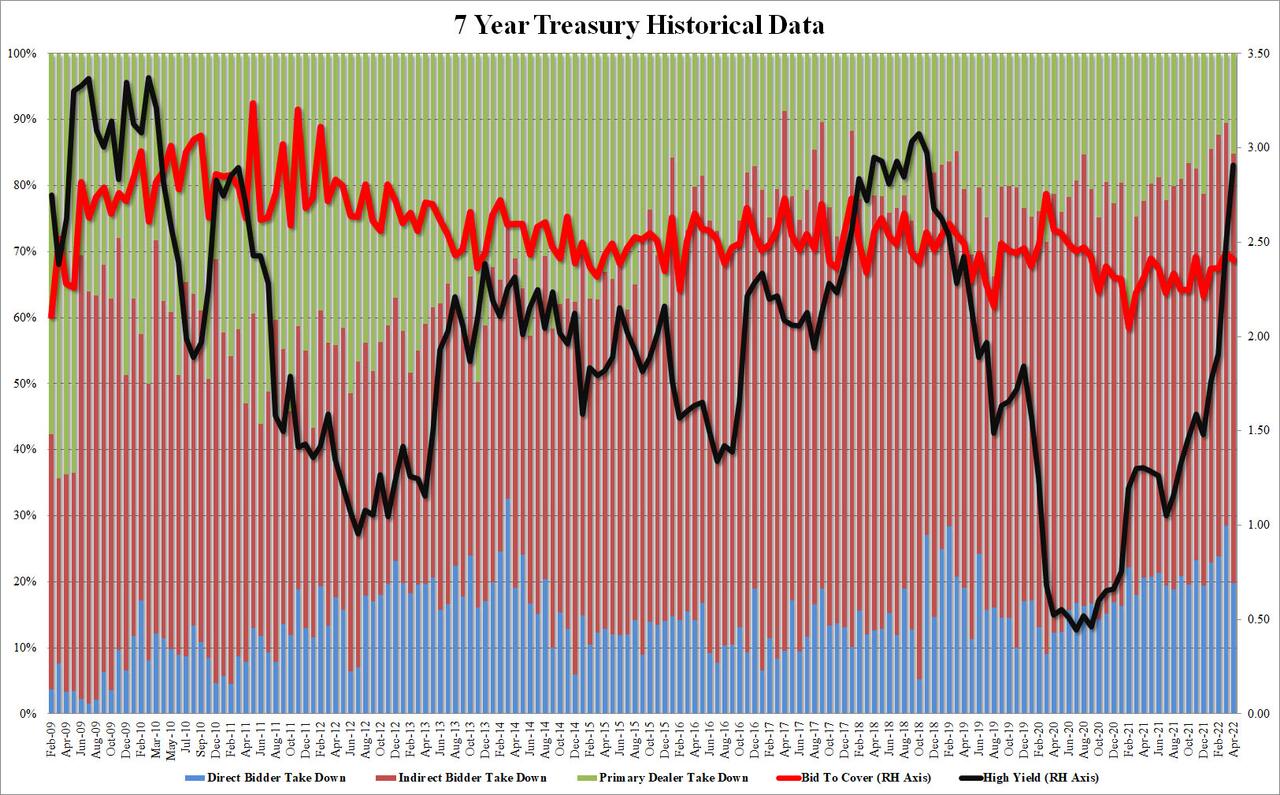
The high yield of 2.908% was  a whopping 41bps higher than the March auction and was the highest since Nov 2018, just before the Fed panicked and ended its tightening (of course, inflation back then was well lower). And even though yields have been grinding higher all day, the auction tailed the 2.891% When Issued with a “decent” 1.7bps tail, the biggest since December.

The 2.41 bid to cover was in line with recent prints, and while it dipped from last month’s 2.44, it was above the 2.34 six-auction average.

Finally, the internals were more impressive with Indirects taking down a solid 64.95%, a big jump from 60.9% last month and the most since Nov 2020 and one of the highest on record. And with Dfirects taking down a decent 19.8% (below last month’s near record 28.55%), Dealers were left holding 15.2% of the allotment, right on top of the recent average of 15.4%.

Overall, a solid if not spectacular auction, and one which priced pretty much on top of expectations, which is why it had absolutely no impact on the rest of the curve.


Tyler Durden
Thu, 04/28/2022 – 13:20

via ZeroHedge News https://ift.tt/NjelPCM Tyler Durden

Time Is Running Out for South Carolina’s Over-the-Counter Birth Control Bill


dreamstime_xl_124360200

A South Carolina bill that would allow women to access birth control pills without a doctor’s prescription is running out of time before the state’s legislative session ends. While the bill passed unanimously through the South Carolina Senate, there are only seven legislative days left to pass the bill in the House.

The Pharmacy Access Act would allow women over the age of 18 to receive birth control pills or other hormonal contraception from a pharmacist without a doctor’s prescription. The bill also allows pharmacists to dispense the medication to women under 18, provided they can show evidence of a past birth control prescription. The bill does not require pharmacists to dispense the medication.

The Pharmacy Access Act is a reasonable step forward in allowing women more autonomy over their medical choices. Birth control pills have been proven safe and effective. In fact, 19 U.S. states and the District of Columbia already allow pharmacists to dispense hormonal contraceptives without a doctor’s prescription. Further, for the few women for whom hormonal contraceptives pose a health risk, the bill mandates that women fill out a risk assessment form, ensuring that those with conditions such as blood clots or uncontrolled high blood pressure will not be incorrectly given possibly dangerous medication.

While birth control pills are both safe and easy to use, in 31 states, women seeking to take them—for everything from contraception, to painful menstrual symptoms, to acne problems—are required to use a physician as a pricey and time-intensive middleman. Uninsured women may not be able to afford that expense, while women living in rural areas often face the obstacle of finding a reasonably nearby doctor with available appointments. Pharmacies, meanwhile, are plentiful and don’t require appointments.

One of the bill’s most fierce advocates, Rep. Russell Ott (D–St. Matthews) has taken a different approach to advocating for the bill. Ott argues that the bill will reduce abortions in South Carolina: “If we want to get serious about cutting down on abortions, if we’re going to decrease the number of unwanted or unplanned pregnancies, we need to get real.” As he continued during a subcommittee meeting on the bill, “This is about trying to make sure that women have more of an opportunity to have access to contraceptives than they currently do.”

This bill therefore serves as an interesting response to a world in which women are increasingly unable to access abortions. Especially with Roe v. Wade possibly on the Supreme Court’s chopping block, increasing women’s ability to prevent pregnancy is a surprisingly useful solution from a state whose legislature introduced a bill outright banning abortion earlier this year. In a future where abortion is illegal across red-state America, increased access to contraceptives could become increasingly important.

The measure has broad support in South Carolina. Dawn Bingham, a Columbia-area OB-GYN physician, addressed concerns that the bill would make women less likely to go to the doctor for important screenings, stating in a discussion of the bill that “cervical cancer screenings are not actually recommended annually for most women. It’s actually 3 to 5 years for most women.”

While the bill passed unanimously in the Senate, and passed out of a House subcommittee with only one opposition vote, the bill’s chances of being passed into law are waning as the legislative session draws to a close.

However, the bill’s supporters remain optimistic. As Sen. Tom Davis (R–Beaufort) said: “Even social conservatives in the Upstate realize what we are talking about here is avoiding unintended pregnancies, which is going to reduce the number of abortions in South Carolina.”

The post Time Is Running Out for South Carolina's Over-the-Counter Birth Control Bill appeared first on Reason.com.

from Latest https://ift.tt/lTYvWeK
via IFTTT

Nomura Warns Of “Huge Fodder For Mechanical Short Squeeze” As ‘Event Risks’ Clear

Nomura Warns Of “Huge Fodder For Mechanical Short Squeeze” As ‘Event Risks’ Clear

With numerous ‘high-profile earnings event risks’ now in the process of “clearing”, Nomura’s Charlie McElligott notes that we are (at least locally) seeing some stocks now trade-UP on what are actually pretty weak qtrs and guides, a.k.a. nascent pockets of Equities which have now stopped going LOWER on bad news, as a general “bullish” signal for markets.

The Nomura strategist adds that amid all of the seeming macro calamity (central-bank-induced volatility and policy divergence and the DXY raging to 20-year-highs), US Equities keep seeing somehow stabilizing to the consternation of many with grossed-up short books and who are hedged for “FCI tightening / Inflation / Ukraine / Earnings disaster”.

There are two factors supporting stocks here: the tendency for volatility to mean-revert, and the extreme (short) positioning that has once again appeared across the major markets.

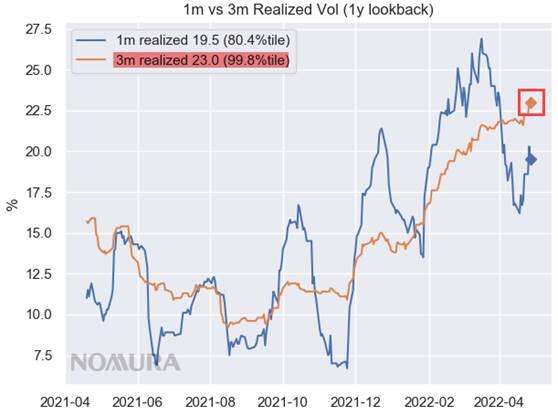
1) as the market will gradually lose its ability to sustain currently implied daily ~1.9% swings with UX1 @ 29.5 and “compress” without another Earnings or Fed “shocker” coming next wk), this then has capacity to kick-off second-order blasts of “mechanical flows” which impact the market virtuously:

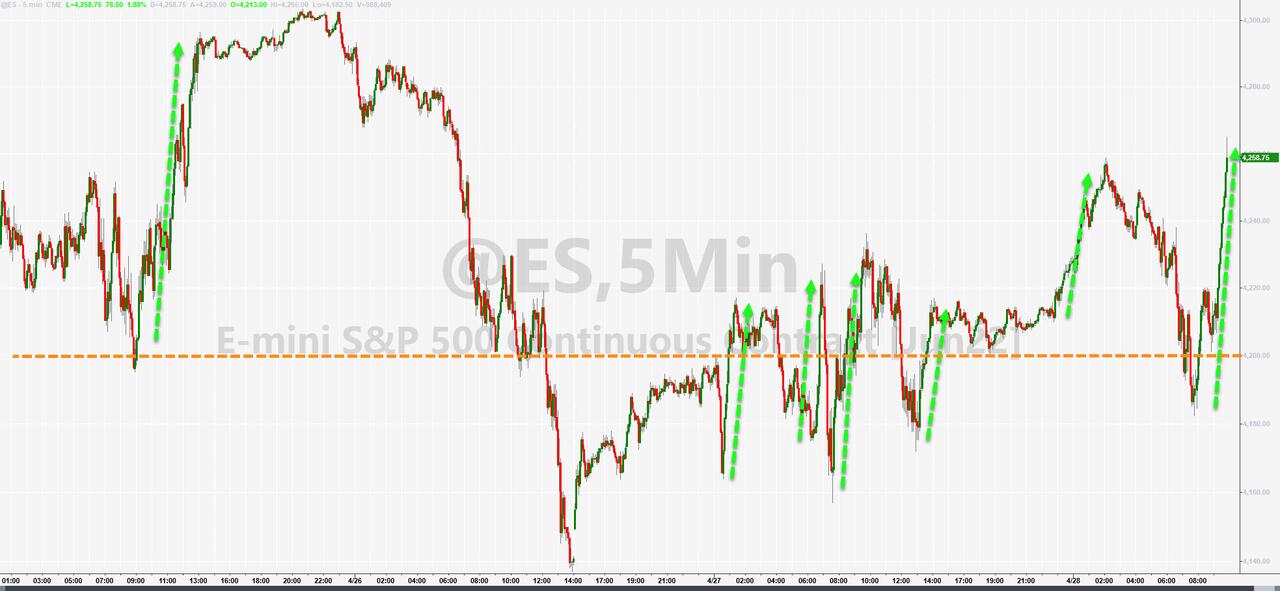
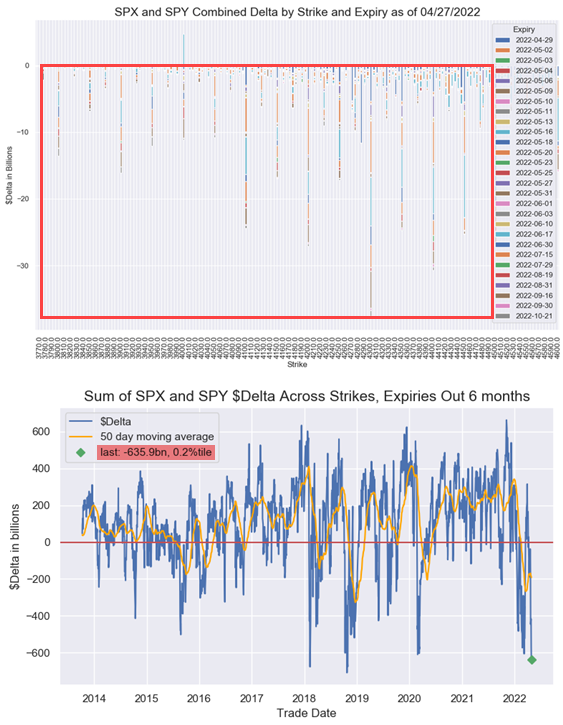
2) the currently EXTREME “Short Gamma / Short Delta” profile due the client recent grab into short-dated Puts and downside structures then sees those highly-convex Puts “bleed” and unwound on Spot rallies like this, with Dealers buying-back (covering) “short hedges” which acts to propel futures higher.As McElligott highlights, this is “huge fodder for mechanical short-squeezes on these spot-rallies and vol-meltdowns due to dealer-covering.”

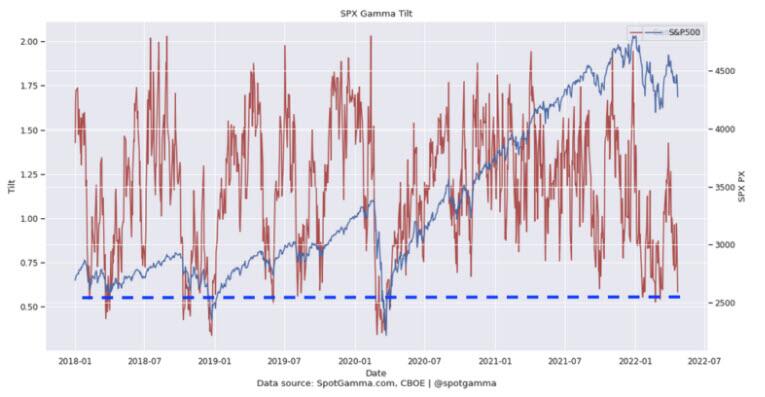
Additionally, SpotGamma notes that Gamma Tilt is now flashing near its lower bound, as shown here…

…which suggests that put gamma is very high relative to call gamma, and downside is likely exhausted as markets break <4200.

And in a world where “Volatility is the Exposure Toggle,” a trending-lower Vol input will mean “Systematic” reallocation flows for Target Vol and Risk Parity (with still “historically light” exposures), which too will go hand-in-hand with a Spot / Price rally that will dictate bouts of covering in current and largely “Short” Equities position signals – hence, “unemotional” buying that creates this “chop” and creates passive “buy” flows off the lows… with CTA positioning at just 3.9%ile and “buy triggers” close…

Are we about to see a second-half-of-March-meltup redux?

The question is – will this rebound occur now and stall on the 5/4 FOMC/Russian-Default-Deadline?

However, if the squeeze-driven spike does not occur, SpotGamma warns that below here there is substantial longer-term support at 4050 due to large open interest at 4000.

Tyler Durden
Thu, 04/28/2022 – 12:01

via ZeroHedge News https://ift.tt/vVbD3Et Tyler Durden

Time Is Running Out for South Carolina’s Over-the-Counter Birth Control Bill


dreamstime_xl_124360200

A South Carolina bill that would allow women to access birth control pills without a doctor’s prescription is running out of time before the state’s legislative session ends. While the bill passed unanimously through the South Carolina Senate, there are only seven legislative days left to pass the bill in the House.

The Pharmacy Access Act would allow women over the age of 18 to receive birth control pills or other hormonal contraception from a pharmacist without a doctor’s prescription. The bill also allows pharmacists to dispense the medication to women under 18, provided they can show evidence of a past birth control prescription. The bill does not require pharmacists to dispense the medication.

The Pharmacy Access Act is a reasonable step forward in allowing women more autonomy over their medical choices. Birth control pills have been proven safe and effective. In fact, 19 U.S. states and the District of Columbia already allow pharmacists to dispense hormonal contraceptives without a doctor’s prescription. Further, for the few women for whom hormonal contraceptives pose a health risk, the bill mandates that women fill out a risk assessment form, ensuring that those with conditions such as blood clots or uncontrolled high blood pressure will not be incorrectly given possibly dangerous medication.

While birth control pills are both safe and easy to use, in 31 states, women seeking to take them—for everything from contraception, to painful menstrual symptoms, to acne problems—are required to use a physician as a pricey and time-intensive middleman. Uninsured women may not be able to afford that expense, while women living in rural areas often face the obstacle of finding a reasonably nearby doctor with available appointments. Pharmacies, meanwhile, are plentiful and don’t require appointments.

One of the bill’s most fierce advocates, Rep. Russell Ott (D–St. Matthews) has taken a different approach to advocating for the bill. Ott argues that the bill will reduce abortions in South Carolina: “If we want to get serious about cutting down on abortions, if we’re going to decrease the number of unwanted or unplanned pregnancies, we need to get real.” As he continued during a subcommittee meeting on the bill, “This is about trying to make sure that women have more of an opportunity to have access to contraceptives than they currently do.”

This bill therefore serves as an interesting response to a world in which women are increasingly unable to access abortions. Especially with Roe v. Wade possibly on the Supreme Court’s chopping block, increasing women’s ability to prevent pregnancy is a surprisingly useful solution from a state whose legislature introduced a bill outright banning abortion earlier this year. In a future where abortion is illegal across red-state America, increased access to contraceptives could become increasingly important.

The measure has broad support in South Carolina. Dawn Bingham, a Columbia-area OB-GYN physician, addressed concerns that the bill would make women less likely to go to the doctor for important screenings, stating in a discussion of the bill that “cervical cancer screenings are not actually recommended annually for most women. It’s actually 3 to 5 years for most women.”

While the bill passed unanimously in the Senate, and passed out of a House subcommittee with only one opposition vote, the bill’s chances of being passed into law are waning as the legislative session draws to a close.

However, the bill’s supporters remain optimistic. As Sen. Tom Davis (R–Beaufort) said: “Even social conservatives in the Upstate realize what we are talking about here is avoiding unintended pregnancies, which is going to reduce the number of abortions in South Carolina.”

The post Time Is Running Out for South Carolina's Over-the-Counter Birth Control Bill appeared first on Reason.com.

from Latest https://ift.tt/lTYvWeK
via IFTTT

Who’s Afraid Of Elon Musk?

Who’s Afraid Of Elon Musk?

Authored by Stephen Moore via The Epoch Times,

Not long ago, Elon Musk was regarded as a liberal superhero with a cape because of his support for green energy and electric cars.

But now that he’s the new owner of Twitter with his estimated $40 billion to $50 billion acquisition, the left is as angry as hornets.

Hundreds of employees are threatening to quit and many thousands say they are dropping their Twitter accounts.

But why exactly?

Here is what Mr. Musk said upon his successful Twitter takeover:

“Free speech is the bedrock of a functioning democracy, and Twitter is the digital town square where matters vital to the future of humanity are debated. … Twitter has tremendous potential — I look forward to working with the company and the community of users to unlock it.”

Does that sound threatening to you?

Who could object to more openness and free-wheeling debate on social platforms?

The answer is the slice of America that has been captured by a radical agenda that refuses to tolerate anyone with contrary ideas or opinions.

What’s especially disheartening is that some of the most vicious attacks against Musk’s mission of inclusion for Twitter come from the American Civil Liberties Union and Amnesty International. They even criticize him for being a “free speech absolutist.” Once upon a time in a far-off galaxy, these groups were vigilant guardians of free speech absolutism.

Now, they are terrified that someone somewhere at sometime might engage in speech that offends them. Do they not understand that no one has a Constitutional right not to be offended by what someone else says or writes. I’m offended by half the things I hear and see on MSNBC and CNN. But I’d fight to defend their right to say what they do.

The First Amendment is precisely FIRST in the Bill of Rights to protect every person’s right to express their opinion—even when it might be controversial or even wrong. How else are we going to have honest and thought-provoking debates ever again in America with this new muzzle policy?

Some on the left worry that Donald Trump will soon be back on Twitter spouting off three or four times a day. If you don’t want to see that, delete his tweets from your platform. I have a right to talk; you have a right to not listen.

I wish Mr. Musk the best of luck with his ambition to create an open and honest social media platform that advances civilized and informed conversation/debate.

It’s frightening that the progressives on the left are so afraid of that. They claim that their goal is to shut down “hate speech.”  Just two weeks ago an Army veteran who put herself through college with her own hard work said on LinkedIn that rather than having a taxpayer bailout of student loan debt, everyone should feel honor-bound to pay their own student loans—as she did. This was labeled “hate speech” and was taken down.

Perhaps what is happening here is that the left doesn’t want to engage in any debate because they know that they can’t win the argument if the other side is allowed to speak.

Tyler Durden
Thu, 04/28/2022 – 12:45

via ZeroHedge News https://ift.tt/eIio6mz Tyler Durden

No, Florida Republicans Do Not Care About Crony Capitalism


sipaphotosthirteen466520

Florida Gov. Ron DeSantis recently signed legislation that strips Walt Disney World of its independent, special-district status after the company objected to the state’s new law regarding discussion of sexual orientation or gender identity in classrooms. While the motive behind this action is problematic, some of its supporters argue that there is nothing to fret about, since it was time to revoke a cronyist privilege granted to Disney 50 years ago anyway. But if this is really a fight against cronyism, the legislation goes about it the wrong way.

Cronyism is the unhealthy alliance of business and government. It takes the form of government officials at the state, local, and federal levels granting special privileges to particular companies or industries. These privileges can include special tax breaks, government loans, direct subsidies, or—as in Florida—so-called “special districts.” I spend a great deal of my work hours researching the harm cronyism causes to citizens. That’s because, as my colleague Matthew Mitchell wrote a decade ago, “Whatever its guise, government-granted privilege [to private businesses] is an extraordinarily destructive force. It misdirects resources, impedes genuine economic progress, breeds corruption, and undermines the legitimacy of both the government and the private sector.”

So, is Disney benefiting from a handout that should be stripped away? Yes. Disney certainly has been getting an incredible privilege to act as its own government within the limits of Orange and Osceola counties. For instance, it runs its fire department, administers planning and zoning rules, writes building codes, employs its own inspectors, and is exempted from local regulations and some $200 million in taxes. It levies the remainder of the taxes it owes.

Removing special district status means these types of responsibilities would be absorbed by the two counties in which Walt Disney World sits. Local taxpayers would then shoulder the cost for all municipal services on the property—a cost estimated to be $1 billion. The company, in turn, would be subjected to the same subpar local government services and regulations that most of us are accustomed to. In addition, Florida will be tied up in years of costly litigation to figure out how to disentangle the company from the counties.

But maybe untangling this special treatment is worth the cost. Just don’t expect it to result in a fairer regime. Indeed, if this setup is so unacceptable—a claim most Republicans didn’t seem to make for the half-century the special district has been in place—it should also be unacceptable for the other 1,844 Florida special districts. Of these, 1,288 are, like Disney, independent districts. But we aren’t hearing significant Republican complaints about these.

In other words, GOPers want to continue the practice of extending privileges selectively. What legislators should have done is decide whether any such special districts are a good idea. If so, access to them should be made available to any company that meets certain minimum and clear criteria and denied to any company that does not.

From a local competition perspective, there is some value to the idea of independent special districts. Indeed, they allow people to see the differences between areas where municipal services are run privately (meaning somewhat efficiently) versus the jurisdictions most of us are subjected to, with unfixed potholes in the streets, broken public bathrooms, and unequal police protection.

However, this approach would require consistent thinking and policymaking. And while Florida Republicans are today cheering the removal of Disney’s special-district status and the idea that such privileges to large firms are problematic, they had no problem granting Disney’s streaming services an unfair exemption from a 2021 tech regulation that imposes daily fines of $250,000 when candidates for statewide office are blocked from a social-media platform for more than 14 days. Lawmakers didn’t extend the same exemption to Netflix or Hulu.

This episode should serve as a warning for companies angling to score special privileges from government. Governments give arbitrarily and unfairly, and they take back with equal arbitrariness and unfairness. In addition, when a company’s profitability depends heavily on government largesse, it must make sure not to anger its government overlords. Disney obviously failed to do that.

This sad affair has done nothing to change cronyism in the state of Florida, but it has once again exposed the arbitrariness of government in our lives and the cost of depending on its favors.

COPYRIGHT 2022 CREATORS.COM.

The post No, Florida Republicans Do Not Care About Crony Capitalism appeared first on Reason.com.

from Latest https://ift.tt/UOabsI5
via IFTTT

No, Florida Republicans Do Not Care About Crony Capitalism


sipaphotosthirteen466520

Florida Gov. Ron DeSantis recently signed legislation that strips Walt Disney World of its independent, special-district status after the company objected to the state’s new law regarding discussion of sexual orientation or gender identity in classrooms. While the motive behind this action is problematic, some of its supporters argue that there is nothing to fret about, since it was time to revoke a cronyist privilege granted to Disney 50 years ago anyway. But if this is really a fight against cronyism, the legislation goes about it the wrong way.

Cronyism is the unhealthy alliance of business and government. It takes the form of government officials at the state, local, and federal levels granting special privileges to particular companies or industries. These privileges can include special tax breaks, government loans, direct subsidies, or—as in Florida—so-called “special districts.” I spend a great deal of my work hours researching the harm cronyism causes to citizens. That’s because, as my colleague Matthew Mitchell wrote a decade ago, “Whatever its guise, government-granted privilege [to private businesses] is an extraordinarily destructive force. It misdirects resources, impedes genuine economic progress, breeds corruption, and undermines the legitimacy of both the government and the private sector.”

So, is Disney benefiting from a handout that should be stripped away? Yes. Disney certainly has been getting an incredible privilege to act as its own government within the limits of Orange and Osceola counties. For instance, it runs its fire department, administers planning and zoning rules, writes building codes, employs its own inspectors, and is exempted from local regulations and some $200 million in taxes. It levies the remainder of the taxes it owes.

Removing special district status means these types of responsibilities would be absorbed by the two counties in which Walt Disney World sits. Local taxpayers would then shoulder the cost for all municipal services on the property—a cost estimated to be $1 billion. The company, in turn, would be subjected to the same subpar local government services and regulations that most of us are accustomed to. In addition, Florida will be tied up in years of costly litigation to figure out how to disentangle the company from the counties.

But maybe untangling this special treatment is worth the cost. Just don’t expect it to result in a fairer regime. Indeed, if this setup is so unacceptable—a claim most Republicans didn’t seem to make for the half-century the special district has been in place—it should also be unacceptable for the other 1,844 Florida special districts. Of these, 1,288 are, like Disney, independent districts. But we aren’t hearing significant Republican complaints about these.

In other words, GOPers want to continue the practice of extending privileges selectively. What legislators should have done is decide whether any such special districts are a good idea. If so, access to them should be made available to any company that meets certain minimum and clear criteria and denied to any company that does not.

From a local competition perspective, there is some value to the idea of independent special districts. Indeed, they allow people to see the differences between areas where municipal services are run privately (meaning somewhat efficiently) versus the jurisdictions most of us are subjected to, with unfixed potholes in the streets, broken public bathrooms, and unequal police protection.

However, this approach would require consistent thinking and policymaking. And while Florida Republicans are today cheering the removal of Disney’s special-district status and the idea that such privileges to large firms are problematic, they had no problem granting Disney’s streaming services an unfair exemption from a 2021 tech regulation that imposes daily fines of $250,000 when candidates for statewide office are blocked from a social-media platform for more than 14 days. Lawmakers didn’t extend the same exemption to Netflix or Hulu.

This episode should serve as a warning for companies angling to score special privileges from government. Governments give arbitrarily and unfairly, and they take back with equal arbitrariness and unfairness. In addition, when a company’s profitability depends heavily on government largesse, it must make sure not to anger its government overlords. Disney obviously failed to do that.

This sad affair has done nothing to change cronyism in the state of Florida, but it has once again exposed the arbitrariness of government in our lives and the cost of depending on its favors.

COPYRIGHT 2022 CREATORS.COM.

The post No, Florida Republicans Do Not Care About Crony Capitalism appeared first on Reason.com.

from Latest https://ift.tt/UOabsI5
via IFTTT