Twitter Misses Revenues, Admits “Over-Stating” Millions Of Users

Twitter Misses Revenues, Admits “Over-Stating” Millions Of Users

Having disappointed on the top line ($1.20 billion vs $1.23 billion expected), seen advertising revenue below expectations, apparently slashed capex, and somewhat expectedly cut all previously provided outlooks and goals; Twitter’s earnings’ revelations offer a glimpse into why the Board flip-flopped so fast and grabbed Musk’s ‘apartheid-unleashing’ offer so quickly.

However, buried deep in the filings was another little surprise for the billionaire who just bought the company.

Since the start of 2019, Twitter has been over-estimating the number of users…

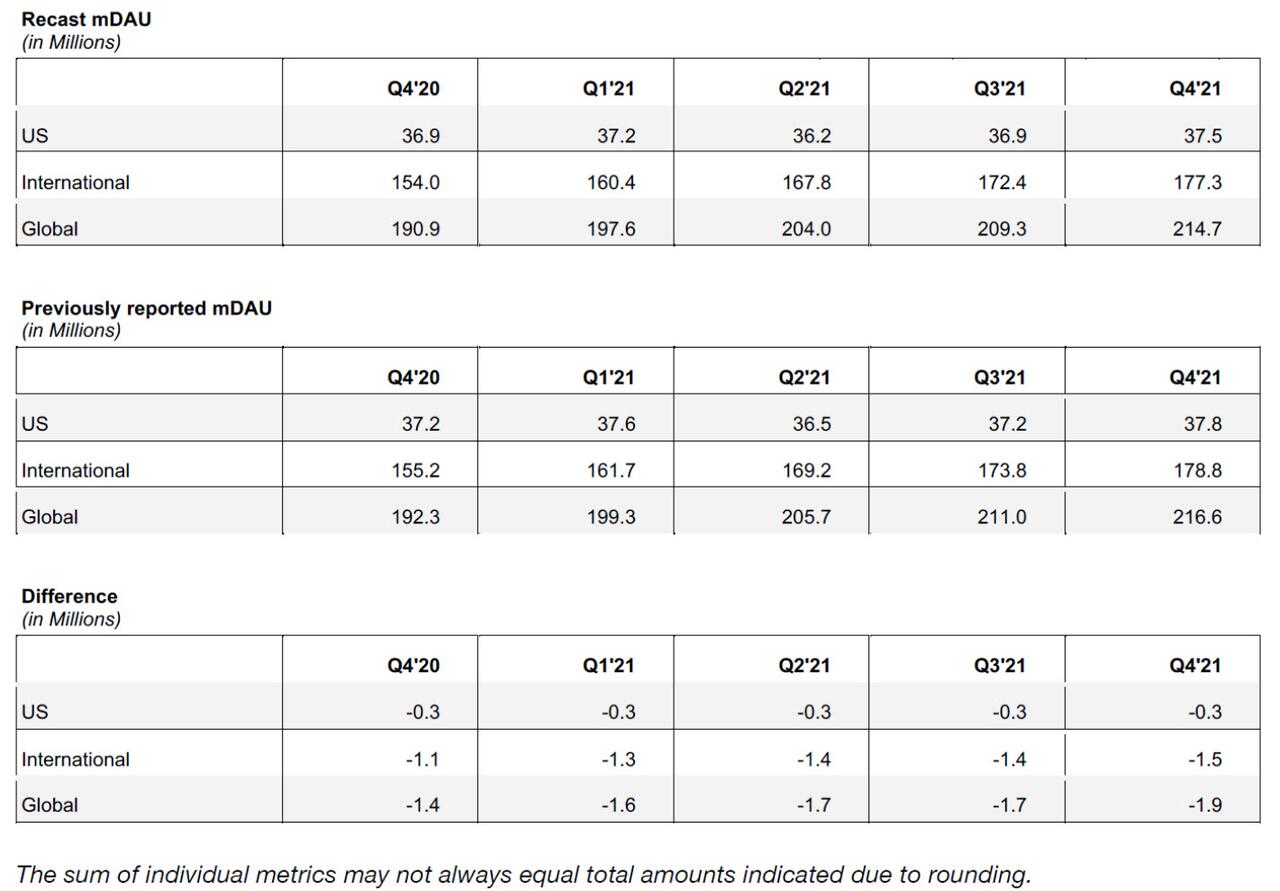
mDAU Recast

In March of 2019, we launched a feature that allowed people to link multiple separate accounts together in order to conveniently switch between accounts.

An error was made at that time, such that actions taken via the primary account resulted in all linked accounts being counted as mDAU.

This resulted in an overstatement of mDAU from Q1’19 through Q4’21.

The table below provides updated values for mDAU from Q4’20 to Q4’21 alongside historical reported values for those same time periods. We are including one decimal place for both the absolute values and growth rates to give more detail around the magnitude of the changes. Note that recast data is not available prior to Q4’20 due to data retention policies, but our estimates suggest the prior period adjustments are not likely to be greater than those in Q4’20.

The adjustments are all one-way (lower) and are not de minimus… 1.9 million fewer users globally in Q4 2021 than they initially disclosed.

Is someone covering-their-ass ahead of Musk’s deep-dive? And what other little surprises lurk below the surface of this leftist sanctuary?

The question many are asking now is – is this ‘admission’ material enough to warrant a price-adjustment for Musk?

Tyler Durden
Thu, 04/28/2022 – 09:00

via ZeroHedge News https://ift.tt/zbJ1E2j Tyler Durden

Recession On Deck: US GDP Shockingly Contracts In Q1 Driven By Inventory, Exports Plunge

Recession On Deck: US GDP Shockingly Contracts In Q1 Driven By Inventory, Exports Plunge

Heading into today’s first estimate of Q1 GDP, estimates were low – certainly far lower than the 6.9% final Q4 GDP number, the strongest since the third quarter of 2020. Commenting ahead of the print, Bloomberg said that  “a slowdown in the first quarter will prove temporary, a consequence of omicron and the drag from volatile inventories and trad.” Maybe, but what if it’ not temporary. And how big of a slowdown? Indeed, moments before the print we said that with just 3 GDP report to go until the midterms, it wouldn’t be a bad idea for the Biden admin to “kitchen sink” the quarter with e negative print.

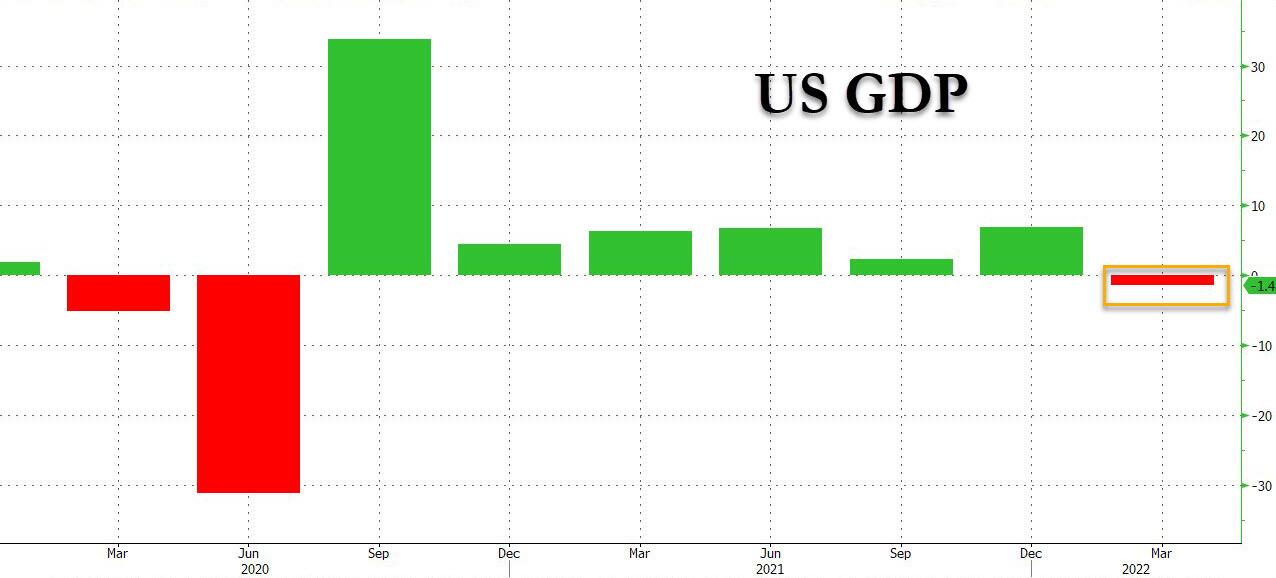
Well, we were right again, because moments ago the BEA reported that in Q1, the US in fact shrank by 1.4%, shocking consensus estimates of a 1.0% GDP print (to be fair, a few Wall Street analysts did predict a negative print but the consensus was by and large for continued growth).

What was behind the shocking contraction in the US economy? Two things mostly: a sharp drop in changes in private inventory and a huge swing in net exports (more below).

According to the BEA, the first quarter decrease in real GDP reflected decreases in inventory investment, exports, federal government spending, and state and local government spending, while imports, which are a subtraction in the calculation of GDP, increased. Consumer spending, business investment, and housing investment increased

Looking at the components, we find the following Q1 data:

  • Personal consumption rose 1.83%, up from 1.76% in Q4
  • Fixed Investments 1.27%, also up solidly from 0.50% in Q4
  • However, the change in private inventories was a huge hit to GDP (just as we warned last month it would be) subtracting -0.84% from GDP, vs adding 5.32% in Q4
  • Net trade was also ugly, with exports collapsing to -0.68% vs an increase of 2.24% in Q4. At the same time, imports were largely flat at -2.53%, vs -2.46% last quarter, resulting in a net trade print of -3.21% in Q1, vs a -0.22% decline in Q4.
  • Government consumption was unchanged at -0.48% vs -0.46% a quarter ago.

Bottom line: annualized GDP plunged from 6.9% growth in Q4 to a -1.43% shrinkage in Q4.

Some more details from the BEA:

  • The decrease in inventory investment primarily reflected decreases in wholesale (led by motor vehicles) and retail (led by “other” retailers as well as motor vehicle and parts dealers).
  • The decrease in exports reflected a decrease in goods (led by nondurable goods) that was partly offset by an increase in services (led by financial services).
  • The decrease in federal government spending primarily reflected a decrease in defense spending on intermediate goods and services.
  • The increase in imports primarily reflected an increase in goods (led by durable goods).
  • The increase in consumer spending reflected an increase in services (led by health care) that was partly offset by a decrease in goods. Within goods, a decrease in nondurable goods (led by gasoline and other energy goods) was partly offset by an increase in durable goods (led by motor vehicles and parts).
  • The increase in business investment reflected increases in equipment (led by information processing and related equipment) and intellectual property products (led by software as well as research and development).

Ok, what is really going on here? Well, in our view the US economy is already in a stagflationary recession, and the sooner the Biden admin admits this the better, which is precisely why it just did so. Why now? Because it hopes that after a brief recession in Q1 and Q2 – which it cane blame on Omicron and Putin – it’ hope is to present a Q3 GDP print, due just days before the midterm elections, that is solidly in the green for a hail mary bounce for Democrats.

We doubt it will work, but we are far more worried about just how serious the recession the US finds itself in, is.

That said, don’ worry – the odds of a Fed rate cut next week are still 0 as Powell scrambles to contain inflation which is now the primary directive of the Fed, economic growth be damned.

Tyler Durden
Thu, 04/28/2022 – 08:46

via ZeroHedge News https://ift.tt/KJf127M Tyler Durden

A Framework for Analyzing a Church Autonomy Defense

This continues a blog series about my new paper, “The Limits of Church Autonomy.” You can find Post 1 here, Post 2 here, and Post 3 here.

Both church autonomy and accountability are important principles. The problem in the current law is that the courts are unclear on how to avoid allowing one to swallow up the other. This section proposes some analytical revisions that would help to clean up what has become a doctrinal mess. In terms of doctrine, the shifts suggested here are modest and can be done without any change by the Supreme Court.

Religious conduct

The starting point is that church autonomy protects religious conduct. There has been confusion about whether conduct has to be based on religious belief, or whether reasons are needed at all for church conduct to receive church autonomy protection. Particularly in the employment cases, courts (including the Supreme Court) have frequently said that there need be no showing that particular conduct is religiously motivated. But in other cases, courts have said that only when the challenged action is religious is it protected.

The best way to reconcile the cases is to note that church autonomy protects religious conduct. But this is not the same as saying that everything happens within a church is religious, nor that there must be an articulated religious reason for every protected act. Instead:

The easiest case is when the conduct at issue is religious is done directly pursuant to religious doctrine or beliefs.

Beyond this, a set of classic, recognizable internal governance actions by religious institutions should be considered presumptively religious, without requiring the institution to provide a religious reason for each action. (This is the best way to rationalize the holding in ministerial exception cases that the church need not provide reasons for its employment decision to receive protection.) This would cover the selection, supervision, and retention of ministers; matters of membership; and matters of church discipline.

Rather than an open-ended protection of church government, the forms of church governance here need to be carefully limited. The presumption, historically, was that two forms of church discipline were immunized from judicial scrutiny: verbal corrections and excommunication. By verbal, I mean correction by words, whether written or spoken. By excommunication, I mean the removal of the person from membership in the religious institution and the exclusion of that person from ritual or sacramental observances.

In sum: conduct taken as part of church governance can be religious, even if it does not always have specific religious reasons for each individual act.

Consent

After considering whether conduct is “religious”—including presumptively religious matters of internal church governance—we turn to consent. Where consent comes in is to solve the problem of when to treat particular conduct as religious that does not easily fit the categories that have become classic instances of church governance in the case law.

Suppose, for instance, that Church X has an unusual form of discipline: a ceremonial slap on the wrist. This doesn’t fall into the narrow and cautious category of verbal rebuke that the cases (construed conservatively) have recognized. Arguably this is because physical slap is not a standard part of church practice. But if it were, there would have been as many battery suits as there have been defamation suits arising out of church discipline.

The solution on this point is consent. A religious institution can have the benefits of immunity when there is a clear consent to the later-challenged conduct. This is likely to be most important with unusual forms of discipline. A member could consent to a physical slap as a form of discipline, for instance. If consent was not coerced and was informed, this will count as a consent defense under tort law.

Here’s an example of how this could come into play: a mandatory reporting statute requiring church leadership to report child abuse. Imagine that a religious group objects to this as an infringement on its ability to self-govern. But there is no existing established tradition that reporting crime infringes on the prerogatives of the religious institution’s self-governance. To the contrary, the history suggests that this is what one would have expected religious entities to do, building on the English and common law history taken into the American context. Meanwhile, the people being protected by the mandatory reporting laws—children, the abused—either can’t or won’t consent to not report. This just isn’t going to be covered by church autonomy.

Consent also helps to solve the problem of privileging a particular set of religious practices. One possible objection to the approach outlined so far is that it privileges traditional forms of religion. Christian churches have had by far the most litigation in America. So of course, what is “recognizable” as church governance in the caselaw is going to be disproportionately shaped by this Christian tradition. If we basically freeze identifiable church governance activities with the easily-recognizable functions in the case law, that is effectively freezing a set of practices that are most identified with church practices: selection of ministers, discipline in the form of rebuke and disfellowshipping. On what basis could an unusual practice make its way into the category of church governance? Again, this is where consent could come into the picture.

The approach outlined so far will cover most cases that actually arise. It will also take the odds and ends of doctrinal tools already in use by the courts and organize them into a logically-structured analysis, rather than leaving them to be drawn upon in a grab-bag manner, with unpredictable and inconsistent results.

A backstop

Yet all that said, one might still worry about a more drastic reductio of church autonomy: a religious institution that actually has criminal conduct as part of its religious precepts. Why doesn’t religious autonomy protect human sacrifice or ritual sex with underage victims? For this, we might formulate a backstop principle, such as (at minimum) that church autonomy does not protect the direct cause of physical harm. This catches the egregious but exceptional case that slips through the other filters: if there is a religiously motivated act that causes physical harm, the perpetrator should still be subject to accountability before the civil authorities. One could base this on the history I sketched in an earlier post, and on early American history: by the time of the Constitution’s framing, it was well understand that whatever religious freedom meant, it didn’t protect “licentiousness” or acts violating the “public peace.”

The backstop is not perfect (and in the paper I reflect on some of the shortcomings). But it’s a starting point, and one that is entirely consistent with existing caselaw.

Lower courts can draw on this structure of analysis (and lots of helpful citations are in the paper) to (hopefully) decide these cases in ways that are clearer and avoid some of the analytical missteps that I described in an earlier post.

The post A Framework for Analyzing a Church Autonomy Defense appeared first on Reason.com.

from Latest https://ift.tt/befKTr4
via IFTTT

The Trouble For Big Tech Stocks In Two Charts

The Trouble For Big Tech Stocks In Two Charts

Authored by Jesse Felder via THeFelderReport.com,

This month (so far) has been the worst for the Nasdaq since the stock market was in the throes of the Great Financial Crisis back in 2008. And it shouldn’t be hard to understand what is plaguing the Big Tech stocks that make up the bulk of this index. In addition to capital flowsmacro economic trendsrisk appetites and insider activity, all of which warned of the current weakness in stock prices well ahead of time, there are two major bearish forces at work.

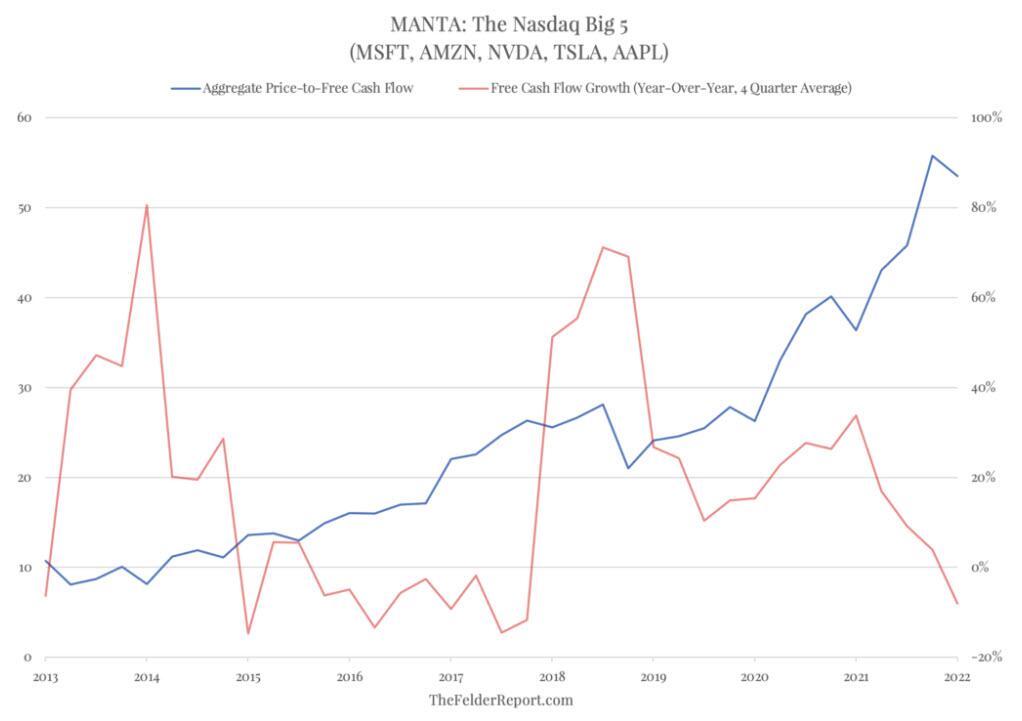
At the start of the month, the five largest components of the index (Microsoft, Amazon, Nvidia, Tesla and Apple, aka MANTA) traded at about 55-times their aggregate free-cash-flow (and nearly 70-times when you back out stock based compensation). Now that might not be totally obscene if it weren’t for the fact that free cash flow growth has recently turned negative. In that context, however, it’s hard to see how the most extreme valuation in the history of this group is at all sustainable.

Of course, this is only half of the story.

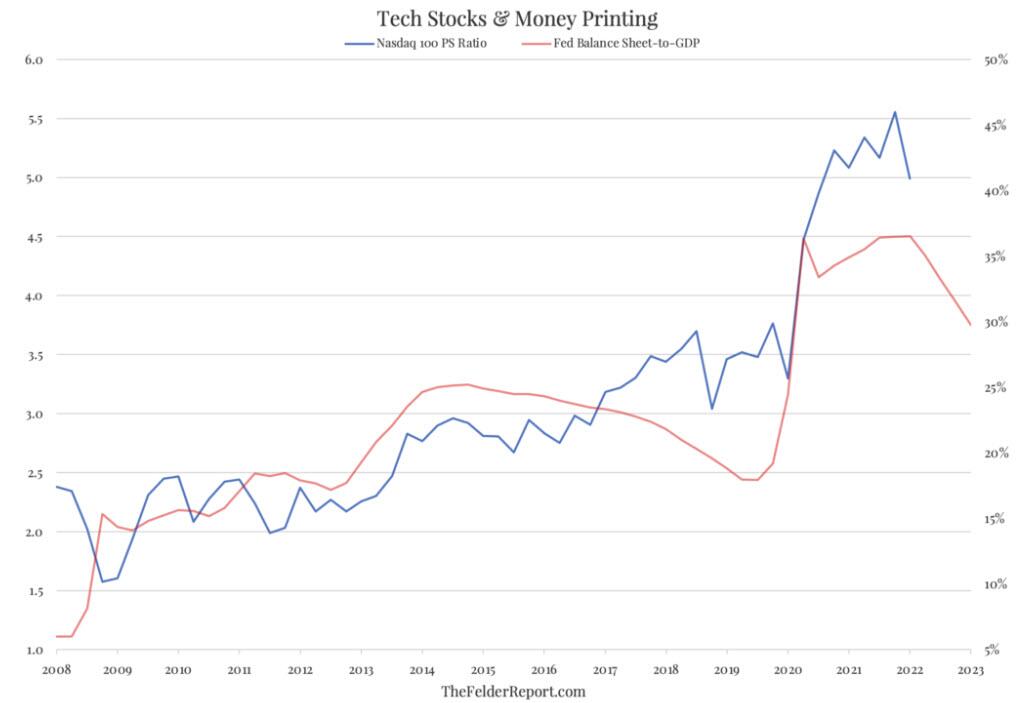
The other half is told by the Fed’s balance sheet to which Nasdaq valuations are highly correlated. We might infer from this relationship that money printing supports asset values and, when taken to an extreme, stokes “animal spirits” to the point at which a speculative mania is formed. And, truly, this is a story as old as central banking. The trouble for Big Tech is that raging inflation means the Fed will now have to put its money printer into reverse in an effort at reining in price pressures, not only in the real economy (where its tools are less effective) but also in the asset markets (where its tools are much more effective).

The bearish tandem of falling free cash flow and waning liquidity suggests extreme valuations could revert in a major way, depending on just how much and for how long free cash flow declines and by how much and for how long the Fed is committed to draining the markets of excess liquidity.

Considering the nature of the pandemic and the stimulus enacted as a result, it’s not unreasonable to think there was a significant pulling forward of demand for Big Tech products and services that will now leave a vacuum of demand for a prolonged period of time. In addition, because inflation is now a bigger problem for the Fed than any time in the last 40 years, it may be far more difficult for the central bank to once again pivot away from hawkish policies should the stock market continue its decline.

If these concerns prove valid, the recession already underway in both free cash flow and liquidity could be more significant than investors have become accustomed to enduring over the course of this long bull market. And, as such, the reversion in extreme valuations may have only just begun.

Tyler Durden
Thu, 04/28/2022 – 08:20

via ZeroHedge News https://ift.tt/2F81nki Tyler Durden

Morning Wood: Shares Of Perennial ARK Favorite Teladoc Destroyed By More Than 40% After Earnings Meltdown

Morning Wood: Shares Of Perennial ARK Favorite Teladoc Destroyed By More Than 40% After Earnings Meltdown

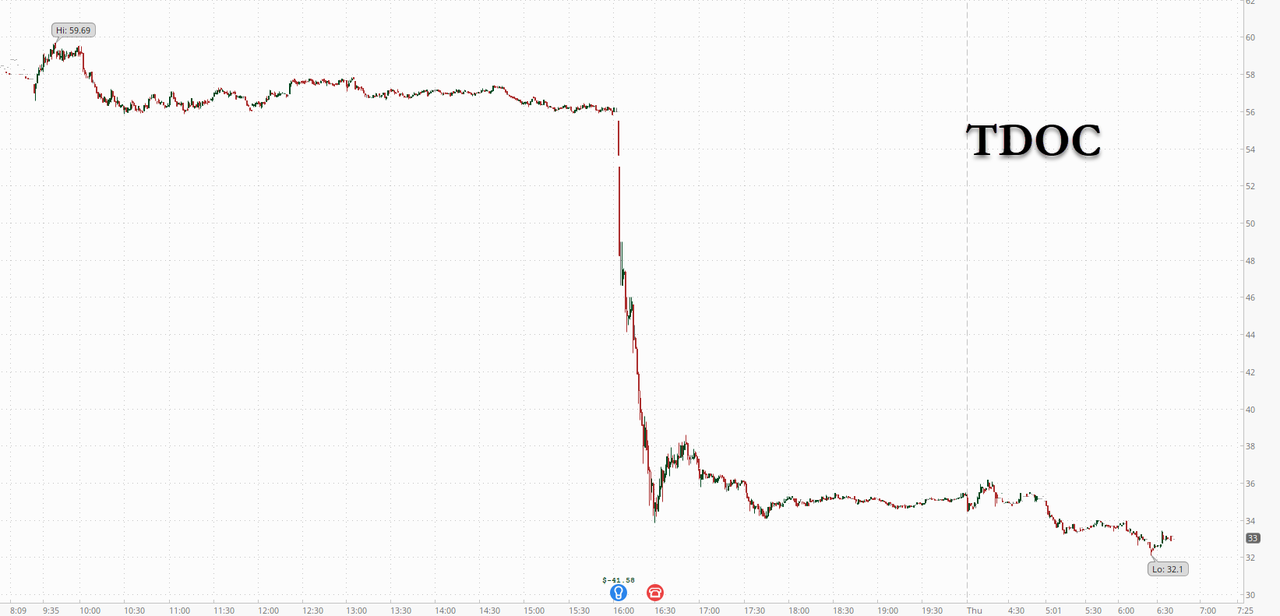
Shares of ARKK-favorite Teladoc (TDOC) have been absolutely mangled since the company posted an “alarming” outlook during its earnings report yesterday.

Shares are slated to open to day lower by about 40% after the company cut both its revenue and its earnings guidance. According to Bloomberg, analysts have been saying that the company’s outlook “fuels the bear argument” for the company. 

The company said it saw EBITDA at $39 million to $49 million for Q2, far below estimates of $71 million. For Q1, the company posted an EBITDA loss of $54.5 million versus a profit of $56.6 million from the year prior. 

CEO Jason Gorevic said: “While we continue to see sustainable growth across our suite of products and services, we are revising our 2022 outlook to reflect dynamics we are currently experiencing in the direct-to- consumer mental health and chronic condition markets. In the chronic condition market, we are seeing an elongated sales cycle as employers and health plans evaluate their long-term strategies to deliver the benefits and care that their populations need.”

Evercore analysts said that the deterioration in outlook since November is “particularly alarming” and that the company’s marketing spend is weighing on EBITDA.

Citi said that increasing competition has hurt the company’s growth and that “cracks” have been revealed in the business model. 

RBC called the results frustrating and said they didn’t expect “any signifiacnt long-only buying” until later in the year. Perhaps someone should give RBC Cathie Wood’s number…

Speaking of which, Wood was buying shares in Teladoc as recently as as 48 hours prior to the earnings blowup. It was reported that Wood added 44,940 shares of the company, worth $2.7 million, on Monday. Teladoc is ARKK’s #3 holding, with a 6.89% weighting. ARKK owns about 7% of the company, according to Cathie’s Ark

ARKK is trading near 52 week lows in the premarket session. 

Meanwhile, if anybody has been looking for Wood, she’s been partying in the Bahamas this week, apparently.

TDOC shares have hit their lowest level since 2018, well before the pandemic.

Shares have nearly fallen 90% from the company’s highs during the pandemic, which was close to $300 per share. 

Tyler Durden
Thu, 04/28/2022 – 08:03

via ZeroHedge News https://ift.tt/vMJBVGq Tyler Durden

A Framework for Analyzing a Church Autonomy Defense

This continues a blog series about my new paper, “The Limits of Church Autonomy.” You can find Post 1 here, Post 2 here, and Post 3 here.

Both church autonomy and accountability are important principles. The problem in the current law is that the courts are unclear on how to avoid allowing one to swallow up the other. This section proposes some analytical revisions that would help to clean up what has become a doctrinal mess. In terms of doctrine, the shifts suggested here are modest and can be done without any change by the Supreme Court.

Religious conduct

The starting point is that church autonomy protects religious conduct. There has been confusion about whether conduct has to be based on religious belief, or whether reasons are needed at all for church conduct to receive church autonomy protection. Particularly in the employment cases, courts (including the Supreme Court) have frequently said that there need be no showing that particular conduct is religiously motivated. But in other cases, courts have said that only when the challenged action is religious is it protected.

The best way to reconcile the cases is to note that church autonomy protects religious conduct. But this is not the same as saying that everything happens within a church is religious, nor that there must be an articulated religious reason for every protected act. Instead:

The easiest case is when the conduct at issue is religious is done directly pursuant to religious doctrine or beliefs.

Beyond this, a set of classic, recognizable internal governance actions by religious institutions should be considered presumptively religious, without requiring the institution to provide a religious reason for each action. (This is the best way to rationalize the holding in ministerial exception cases that the church need not provide reasons for its employment decision to receive protection.) This would cover the selection, supervision, and retention of ministers; matters of membership; and matters of church discipline.

Rather than an open-ended protection of church government, the forms of church governance here need to be carefully limited. The presumption, historically, was that two forms of church discipline were immunized from judicial scrutiny: verbal corrections and excommunication. By verbal, I mean correction by words, whether written or spoken. By excommunication, I mean the removal of the person from membership in the religious institution and the exclusion of that person from ritual or sacramental observances.

In sum: conduct taken as part of church governance can be religious, even if it does not always have specific religious reasons for each individual act.

Consent

After considering whether conduct is “religious”—including presumptively religious matters of internal church governance—we turn to consent. Where consent comes in is to solve the problem of when to treat particular conduct as religious that does not easily fit the categories that have become classic instances of church governance in the case law.

Suppose, for instance, that Church X has an unusual form of discipline: a ceremonial slap on the wrist. This doesn’t fall into the narrow and cautious category of verbal rebuke that the cases (construed conservatively) have recognized. Arguably this is because physical slap is not a standard part of church practice. But if it were, there would have been as many battery suits as there have been defamation suits arising out of church discipline.

The solution on this point is consent. A religious institution can have the benefits of immunity when there is a clear consent to the later-challenged conduct. This is likely to be most important with unusual forms of discipline. A member could consent to a physical slap as a form of discipline, for instance. If consent was not coerced and was informed, this will count as a consent defense under tort law.

Here’s an example of how this could come into play: a mandatory reporting statute requiring church leadership to report child abuse. Imagine that a religious group objects to this as an infringement on its ability to self-govern. But there is no existing established tradition that reporting crime infringes on the prerogatives of the religious institution’s self-governance. To the contrary, the history suggests that this is what one would have expected religious entities to do, building on the English and common law history taken into the American context. Meanwhile, the people being protected by the mandatory reporting laws—children, the abused—either can’t or won’t consent to not report. This just isn’t going to be covered by church autonomy.

Consent also helps to solve the problem of privileging a particular set of religious practices. One possible objection to the approach outlined so far is that it privileges traditional forms of religion. Christian churches have had by far the most litigation in America. So of course, what is “recognizable” as church governance in the caselaw is going to be disproportionately shaped by this Christian tradition. If we basically freeze identifiable church governance activities with the easily-recognizable functions in the case law, that is effectively freezing a set of practices that are most identified with church practices: selection of ministers, discipline in the form of rebuke and disfellowshipping. On what basis could an unusual practice make its way into the category of church governance? Again, this is where consent could come into the picture.

The approach outlined so far will cover most cases that actually arise. It will also take the odds and ends of doctrinal tools already in use by the courts and organize them into a logically-structured analysis, rather than leaving them to be drawn upon in a grab-bag manner, with unpredictable and inconsistent results.

A backstop

Yet all that said, one might still worry about a more drastic reductio of church autonomy: a religious institution that actually has criminal conduct as part of its religious precepts. Why doesn’t religious autonomy protect human sacrifice or ritual sex with underage victims? For this, we might formulate a backstop principle, such as (at minimum) that church autonomy does not protect the direct cause of physical harm. This catches the egregious but exceptional case that slips through the other filters: if there is a religiously motivated act that causes physical harm, the perpetrator should still be subject to accountability before the civil authorities. One could base this on the history I sketched in an earlier post, and on early American history: by the time of the Constitution’s framing, it was well understand that whatever religious freedom meant, it didn’t protect “licentiousness” or acts violating the “public peace.”

The backstop is not perfect (and in the paper I reflect on some of the shortcomings). But it’s a starting point, and one that is entirely consistent with existing caselaw.

Lower courts can draw on this structure of analysis (and lots of helpful citations are in the paper) to (hopefully) decide these cases in ways that are clearer and avoid some of the analytical missteps that I described in an earlier post.

The post A Framework for Analyzing a Church Autonomy Defense appeared first on Reason.com.

from Latest https://ift.tt/befKTr4
via IFTTT

Futures Rebound As Facebook Soars; Dollar Steamrolls Higher As Yen Crashes

Futures Rebound As Facebook Soars; Dollar Steamrolls Higher As Yen Crashes

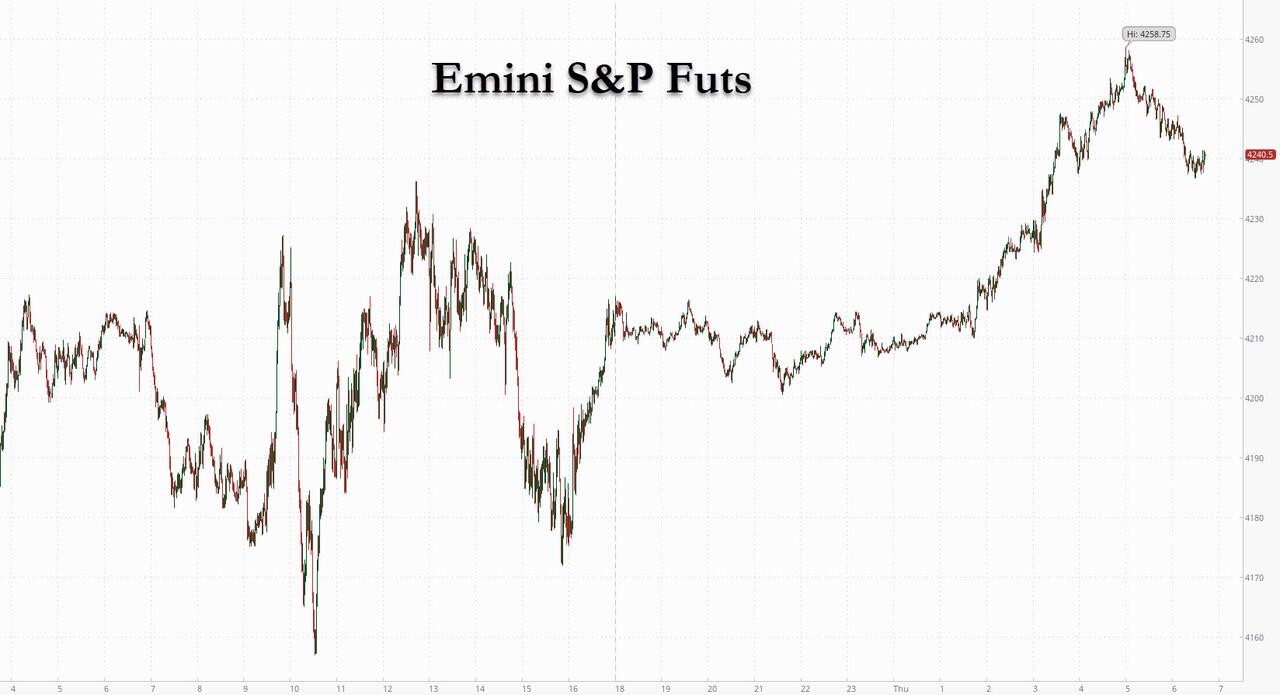
U.S. index futures, European bourses and Asian markets all rose as “good enough (if hardly stellar)” earnings reports from Facebook parent Meta Platforms and Qualcomm boosted sentiment (just don’t look at the collapse in Teladoc). As we hit the peak of earnings season, with Apple, Amazon and Twitter set to report earnings today, S&P futures jumped 1.5%, while he Nasdaq futs jumped 2.2%, fuelled by a nearly 20% surge in Meta, which would be its biggest post-earnings jump since 2013. Investors were happy after Facebook added more users than projected in the first quarter, even if revenue growth slowed to just 7%, the lowest since the IPO. The dollar continued its relentless ascent, boosted by a plunge in the yen (more here) rising to the highest level in more than five years thanks to nominal US yields which are the highest in developed markets. WTI futures traded at around $102 a barrel. The 10-year Treasury yield was down some 2 basis points to 2.8147%. Bitcoin climbed, trading just below $40,000.
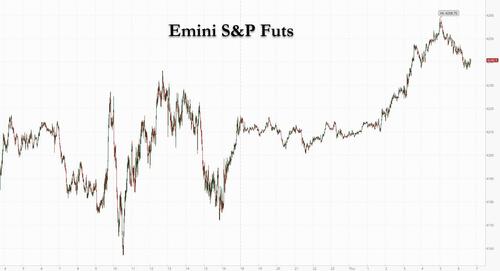
U.S. chip stocks traded higher in the premarket as Qualcomm, the biggest maker of chips that run smartphones, surged on a strong sales forecast easing fears about demand and the macroeconomic environment, while PayPal shares gained after it reported better-than-expected revenue and active user figures. Here are some other notable premarket movers:

  • Airline stocks gain in premarket trading after Southwest Airlines Co. said it expects a rebound in domestic travel to carry into the summer. 
  • PayPal (PYPL US) rises 3.6% in premarket trading after the payments firm reported better-than-expected first-quarter revenue and active user figures.
  • Pinterest shares (PINS US) rise 9% in premarket trading after quarterly earnings beat estimates, though analysts cut price targets amid questions over user engagement.
  • Teladoc Health (TDOC US) plunges 40% in premarket trading after cutting its revenue and earnings guidance, with analysts saying the outlook fuels the bear argument for the health-care technology company. Cathie Wood’s ARK Investment Management holds a stake.
  • Ford’s (F US) first- quarter results that were mixed, according to analysts. A “modest” beat in 1Q was mostly driven by European operations. Shares rise 2.8% in pre-market trading.
  • Atomera (ATOM US) surges as much as 18% in premarket trading, after the semiconductor materials and technology company entered into a new joint development agreement with a leading foundry partner.
  • Statera BioPharma (STAB US) soars 81% in U.S. premarket trading, after the biotech company announced a strategic agreement with Immune Therapeutics (IMUN US).
  • Sundial Growers (SNDL US) shares jump 11% in premarket trading after the cannabis producer reported 4Q adjusted Ebitda from continuing operations and net revenue that beat the average analyst estimate.
  • Amgen (AMGN US) drops 5.9% in postmarket trading after an IRS probe of prior tax years, the biotechnology company also left its annual outlook unchanged despite a first-quarter earnings beat.

“The bullish mood is very much earnings related after some of the disappointing news earlier in the week,” said Roger Lee, head of U.K. Strategy at Investec. “Meta, Qualcomm, Paypal helped reassure following on from Microsoft’s good numbers.”

Thursday’s relief rally punctuates a week of nerves marked by China’s struggle to suppress Covid, Russia’s war in Ukraine, halts of Russian gas exports to Poland and Bulgaria, and worries that Federal Reserve monetary tightening may tip the U.S. economy into a recession. Almost 70 companies in Europe are due to publish results Thursday. About 61% of the companies that have reported so far have beaten estimates.

Despite the rebound in the past two days, US stocks have had a very rough month, with the S&P 500 set for its worst monthly return in two years, while the tech-heavy Nasdaq 100 is set for a 12% loss this month, its worst performance since October 2008. That may reverse if Amazon.com and Apple – which are among the companies set to report quarterly numbers on Thursday – report blowout earnings.

“Ironically the better the corporate earnings backdrop, the less recession risk there is, so the Fed can increase rates more aggressively and all the implications that will have on valuations,” said Roger Lee, a strategist at Investec. “Paradoxically good corporate news could ultimately be bad news for the market.”

It was an exciting session for central bank watchers with the BOJ surprising markets with an announcement that it would hold daily, unlimited fixed-rate operations to defend Yield Curve Control, in the process crushing the yen. Meanwhile, Sweden’s central bank surprised most by raising its benchmark rate to send the krona soaring.

European stocks also rallied – the Stoxx 600 rose as much as 1.4% led by autos, tech and the banking sector although every industry group was in the green. Big individual contributors included TotalEnergies, Glencore and Capgemini, which all posted gains on buoyant earnings. DAX and CAC gain as much as 2%. Here are some of the biggest European movers today:

  • Standard Chartered shares rise as much as 17% in London, the most since November 2020, following a rally in Hong Kong. The lender delivered a “stunning” 44% beat versus quarterly pretax profit consensus, according to Investec.
  • Glencore gains as much as 2.7% in London after the commodity giant’s first-quarter production report; Morgan Stanley analysts say an uplift to marketing guidance overshadows weaker output.
  • Barclays climbs as much as 3.7% after reporting what Citi described as an “impressive set of results” for 1Q. The broker highlighted the investment banking segment, noting that its performance was the main driver for the pretax profit beat.
  • Smith & Nephew rises as much as 4.2% after reporting earnings that included beats in both overall revenue and all business areas. RBC notes the results were “well ahead” of both its own and consensus estimates.
  • Albioma advances as much as 16% after U.S. private equity firm KKR agreed to acquire the French solar and biomass power producer for EU50/share plus EU0.84 dividend, in a deal valued at around EU1.6b.
  • Whitbread gains as much as 4.9%, among the top performers in the Stoxx 600 Travel & Leisure Index, after the U.K. hotel operator reported results that Bernstein says show a “very strong start” to FY23.
  • J Sainsbury drops as much as 6.9% after the U.K. grocer reported FY22 results and forecast FY23 adjusted pretax profit in the range of GBP630m- GBP690m. The guidance suggests cuts to consensus, according to Morgan Stanley.
  • Delivery Hero falls as much as 12%, reversing an earlier 9% gain, with Goldman Sachs saying the company’s decision to stop reporting orders won’t be welcomed by investors. Analyst Rob Joyce notes that otherwise the company’s 1Q release was above guidance.
  • Elior falls as much as 5% after UBS lowered its price target on the French caterer to EU3.30 from EU6.60, citing the impact on business from the omicron Covid-19 variant as well as uncertainty over new management and targets. The stock is now down 54% YTD.
  • Weir Group drops as much as 6.4%, with analysts flagging the short-term hit for the mining-equipment firm related to its exit from Russia.

Asian stocks rose with Japan leading after the country’s central bank kept its easing stance unchanged, while the stabilizing of Covid cases in China also helped investor sentiment.  The MSCI Asia Pacific Index advanced as much as 1%, rebounding from its lowest since mid-2020. Australian miner BHP Group and Chinese internet giant Alibaba provided the biggest boosts to the benchmark, with financials and materials leading the sectoral advances.  Japan stocks outperformed in the region as the yen tumbled to the 130 per dollar level for the first time since 2002, bolstering exporters including Toyota Motor, which was the third-biggest contributor to the Asian measure’s gain. 

The Bank of Japan “didn’t shift to a tightening policy bias and the yen fell as a result so that helped to boost Japanese stocks,” said Fumio Matsumoto, chief strategist at Okasan Securities.  “Materials shares were doing well and I think their gains reflect easing of concerns over the global economic outlook, as cases in Shanghai are falling and iron ore prices seem to be rebounding,” Matsumoto said.   Stocks in China gained for a second day after fresh policy pledges to promote internet platform firms and easing virus outbreaks in Beijing and Shanghai buoyed sentiment. Equity gauges across Australia, South Korea and India also advanced.  The MSCI Asia Pacific Index is still poised for a fourth-straight weekly decline and its steepest monthly drop since March 2020

Japanese stocks jumped after the Bank of Japan maintained its ultra-easy monetary policy and the yen tumbled below the 130 per dollar level for the first time since 2002. The central bank kept its yield curve control settings and the scale of its asset purchases unchanged and said it would buy an unlimited amount of bonds at fixed-rates every business day to protect a 0.25% ceiling on 10-year government debt yields. The Japanese currency tumbled 1.4% against the greenback, bolstering the outlook for the nation’s exporters.

“It’s now abundantly clear to markets that Governor Kuroda, who is very strong-willed, and the BOJ will continue to insist that only when domestic wages rise more fully will inflation be persistent,” Nikko Asset Management strategist John Vail. “Until then, the BOJ will continue to cap bond yields, but some moderate policy tightening will likely occur later this year.” The Topix climbed 2.1% to close at 1,899.62, while the Nikkei advanced 1.7% to 26,847.90. Toyota Motor Corp. contributed the most to the Topix gain, increasing 3.2%. Out of 2,172 shares in the index, 1,720 rose and 395 fell, while 57 were unchanged

India’s benchmark equities index rose, tracking peers across Asia, buoyed by gains in Reliance Industries Ltd.  The S&P BSE Sensex advanced 1.2% to 57,521.06, a one-week high, while the NSE Nifty 50 Index also climbed by a similar magnitude. Reliance added 1.5% to rise to a record and was the biggest boost to the Sensex, which had 26 of 30 member-stocks trading higher.   All but one of 19 sectoral sub-indexes compiled by BSE Ltd. gained, led by a gauge of consumer goods companies.   In earnings, of the 12 Nifty 50 firms that have announced results so far, five have missed, while seven have either met or beat analyst estimates.

In rates, Treasuries advanced across the curve, clawing back a portion of Wednesday’s losses. Session highs were reached late in Asia session after the BOJ pledged to buy unlimited amount of bonds at a fixed rate every business day to cap 10-year yields at 0.25%. 10Y TSY Yields are richer by 1bp-2bp across the curve with curve spreads little changed, the 10-year yield around 2.815% outperforms bunds by 3.5bp, gilts by 3bp. The week’s coupon auction cycle concludes with $44b 7-year note sale at 1pm ET; Wednesday’s 5- year tailed by 0.9bp. European fixed income rallied after a soft Spanish inflation print, although the bulk of the move in the rates space is subsequently faded. German curve bear flattens, cheapening 2-3bps across the short end. Gilts bear steepened a touch. Peripheral spreads tighten with the belly of the Italian curve outperforming peers.

In FX, Bloomberg dollar spot index rises 0.4%, trading off the late Asia high. SEK outperforms in G-10, rallying after a surprise rate hike and more hawkish guidance. JPY is the standout underperformer with USD/JPY stalling near 131 after BOJ Kuroda’s press conference. JPY trades off worst levels after official comments that Japan will take appropriate action on FX if needed, describing the latest moves as warranting extreme concern. Some more details:

  • The yen plunged, hitting a 20-year low against the dollar after the Bank of Japan pledged to keep rates at rock-bottom levels, sparking more demand for the greenback. USD/JPY continued to climb in the European session, up as much as 2% to hit 131.01, its highest since April 2002, before pulling back after a Japanese finance ministry official said it will act appropriately on FX if needed. USD/JPY has jumped 7.3% so far this month, its best performance since late 2016. Jerky moves in the yen suggest that its Ministry of Finance will continue to jawbone the currency as it approaches the next key level of 135. “Markets will likely next test intervention possibilities and at what level such warnings may appear,” according to Yoshifumi Takechi, chief analyst at Money Partners in Tokyo. If the currency pair rises past 135, then the probability of intervention may rise, he said
  • The greenback boosted broadly, led higher on expectations that the Fed will raise interest rates by 50 basis points next week, embarking on an aggressive monetary tightening cycle. U.S. Treasuries advance, pushing two-year yield 2 basis points lower. “The focus of FX markets has primarily been on rate differentials and how bonds are adjusting given the continuous shift in growth conditions,” says Simon Harvey, head of FX analysis at Monex Europe, He adds that volatility in the bond market has also boosted the USD on safe-haven demand, suggesting that expectations for outperformance in U.S. rates is not the only driver of the stronger dollar. The Bloomberg Spot Dollar Index hits nearly 2-year high of 1,250 and is poised to post a near 5% gain in April, its best monthly performance since May 2012.
  • EUR/USD slides to a five-year low of 1.0483 hit in early European trade, before pulling back to around 1.0505. EUR on track to lose more than 5% vs USD in April, its worst month since 2015.
  • Swedish krona rallies after the Riksbank raises interest rates by 25 basis points from zero and signals up to three more hikes this year. EUR/SEK drops roughly 1% to 10.25, a one-week low, before paring move
  • GBP/USD drops 0.7% to touch 1.2462, lowest since July 2020, as rate differentials continue to favour the USD

In commodities, oil edged higher with West Texas Intermediate futures around $103 a barrel. Crude prices have struggled for direction this week as China’s spreading virus outbreak continued to weigh on the outlook for global demand. Natural gas prices in Europe declined following two days of gains as buyers considered options to keep getting supply from Russia without violating sanctions. Spot gold pared losses, now little changed at $1,888/oz. Base metals are mixed; LME nickel falls 0.9% while LME aluminum gains 0.7%.

Looking at the the day ahead, data releases will include German CPI for April and US Q1 GDP reading, alongside the weekly initial jobless claims. From central banks, we’ll hear from ECB Vice President de Guindos and the ECB’s Wunsch, and the ECB will also be publishing their Economic Bulletin. Finally, earnings releases include Apple, Amazon, Mastercard, Eli Lilly, Merck & Co., Thermo Fisher Scientific, Comcast, Intel, McDonald’s, Caterpillar and Twitter.

Market Snapshot

  • S&P 500 futures up 1.6% to 4,248.25
  • STOXX Europe 600 up 1.3% to 450.14
  • MXAP up 0.9% to 165.94
  • MXAPJ up 1.2% to 548.04
  • Nikkei up 1.7% to 26,847.90
  • Topix up 2.1% to 1,899.62
  • Hang Seng Index up 1.7% to 20,276.17
  • Shanghai Composite up 0.6% to 2,975.49
  • Sensex up 1.5% to 57,691.20
  • Australia S&P/ASX 200 up 1.3% to 7,356.89
  • Kospi up 1.1% to 2,667.49
  • German 10Y yield little changed at 0.83%
  • Euro down 0.1% to $1.0543
  • Brent Futures down 0.3% to $105.00/bbl
  • Gold spot down 0.2% to $1,882.45
  • U.S. Dollar Index up 0.29% to 103.25

Top Overnight News from Bloomberg

  • The ascendant U.S. dollar headed for its best month in a decade, as renewed yen selling cemented the greenback’s strength against major peers
  • As inflation fears surge, holders of U.S. government debt are having a rough ride. Investors have abandoned the market en masse, making the first quarter the worst on record and devastating the value of bond portfolios. But now fixed- income returns are starting to get a lift from that same boogeyman
  • The yen’s plunge to a 20-year low threatens to leave it significantly weaker for years to come, shaking up global money flows and undermining Japan’s efforts to get its fragile economy back on track
  • Russia’s war in Ukraine has created new bottlenecks and these “are exacerbated by additional supply chain difficulties stemming from new pandemic measures in Asia,” ECB Vice President Luis de Guindos tells lawmakers in Brussels
  • “My assessment is that we are very close to the peak and that we will start to see inflation decline in the second half of the year,” ECB Vice President Luis de Guindos says in Brussels
  • The spike in energy costs was behind recent inflation-forecasting mistakes by the ECB, including the biggest in its history, according to new research from the institution
  • “We expect underlying inflation to continue to rise, driven by high imported goods inflation, limited spare capacity in the Norwegian economy and prospects for rising wage growth,” Norges Bank Governor Ida Wolden Bache says in a statement
  • Turkey central bank raised its end-2022 inflation estimate to 42.8%, from 23.2% in previous inflation report

A more detailed look at global markets courtesy of Newsquawk

Asia-Pac stocks were higher across the board amid a slew of earnings updates and a dovish BoJ. ASX 200 gained with mining stocks mostly underpinned following production updates. Nikkei 225 benefitted as the BoJ reaffirmed its dovishness and kept its ultra-loose policy. Hang Seng and Shanghai Comp are both higher but with gains capped in the mainland due to ongoing lockdown fears  with Hangzhou city to conduct mass testing and after China’s Qinhuangdao city in the Hebei province locked down its district due to COVID.

Top Asian News

  • China Stocks Rise for Second Day as Shanghai Covid Cases Decline
  • StanChart Shares Soar 14% as Lender Raises Revenue Outlook
  • China Cuts Coal Import Tariffs to Zero to Increase Supply
  • Huawei’s Profit Dives 67% After U.S. Sanctions Wallop Phone Arm

Equities in Europe continue to gain heading into month-end, with overall sentiment across stocks bolstered by Meta (+17% pre-market) earnings yesterday. All sectors are in the green to varying degrees and clearly portray an anti-defensive bias – with the exception of Basic Resources, which sits at the bottom of the bunch after heavily outperforming yesterday. Stateside, US equity futures are firmer across the board, with the NQ clearly outpacing its peers.

Top European News

  • Erdogan Plans Meeting With Saudi Crown Prince to Revive Ties
  • Erdogan Says Jailed Businessman Kavala Is ‘Turkey’s Soros’
  • JPM Quants Expects Global Earnings Downgrades and Volatility
  • Riksbank Hikes Rate in U-Turn to Join Global Central Banks

FX:

  • The Buck’s bull run continues, with DXY up to 103.700, Euro losing 1.0500+ status and Sterling testing sub-1.2500 Fib before  retracements.
  • Swedish Krona soars after surprise Riksbank rate hike, higher repo path and slowdown in QE.
  • Japanese Yen extends losing streak following no change from ultra accommodative BoJ policy before partial recovery on extreme concern from Japan’s MOF.
  • Japanese MOF official says excess FX volatility is undesirable, recent FX moves are “extremely worrying”; will take appropriate action if needed, communicating closely with the BoJ and foreign currency authorities, via Reuters .
  • Yuan is weaker again as China increases efforts to contain covid and PBoC sets another softer onshore reference rate.

Fixed Income

  • EU debt rattled to a degree by Riksbank decision to taper QE and US Treasuries to a lesser extent
  • Bunds nearer 155.00 than 156.00, Gilts towards base of 119.68-08 range and 10 year T-note under 120-00 within a 120-01/119-19 band
  • BTPs outperform on the eve of month end auctions after breaching, but unable to retain 133.00+ status
  • Treasury curve flat ahead of 7 year issuance that normally entices foreign buyers even when the Dollar is not so elevated

Commodities

  • WTI June and Brent July post modest intraday gains, but in the grander scheme, prices are consolidating.
  • Spot gold briefly dipped under its 100 DMA (USD 1,877.50/oz) to a current low of around USD 1,871/oz as the Buck was rampant at the time.
  • Base metals markets are relatively mixed with some underperformance seen in LME nickel.
  • China is to grant zero-tariff on coal imports from May 1 2022 to March 31 2023 to increase supply.

US Event Calendar

  • 08:30: April Initial Jobless Claims, est. 180,000, prior 184,000; Continuing Claims, est. 1.4m, prior 1.42m
  • 08:30: 1Q GDP Annualized QoQ, est. 1.0%, prior 6.9%
    • 1Q Personal Consumption, est. 3.5%, prior 2.5%
    • 1Q GDP Price Index, est. 7.2%, prior 7.1%
    • 1Q PCE Core QoQ, est. 5.5%, prior 5.0%
  • 11:00: April Kansas City Fed Manf. Activity, est. 35, prior 37

DB’s Jim Reid concludes the overnight wrap

We’ve also released our April survey results this morning (see link here). This was our first survey since Russia’s invasion of Ukraine, and you can see the impact across a number of answers. More than 60% of respondents expect the next US recession by 2023, in line with our out of consensus house view, while inflation expectations were revised higher in the US and EU. The survey results also show expectations for bonds and the S&P 500 to dip from current levels along with much more, so do peruse the full results.

Whilst global growth concerns remain prominent in markets, with investors having to navigate Chinese lockdowns, major geopolitical tensions and the prospect of a Fed-induced hard landing, equities begun to stabilise yesterday and the S&P 500 managed to eke out a +0.21% gain, albeit only after another second-half selloff that saw the index move down from its intraday high of +1.56% around the US lunchtime. Even with the equity gains however, geopolitical developments led to a weaker performance among a broader section of European assets, with the Euro itself nearing the $1.05 mark for the first time in nearly 5 years as multiple signs pointed to a further escalation between the EU and Russia on the energy side.

In terms of those developments, markets woke up to the news that Gazprom would be stopping gas flows to Poland and Bulgaria, which saw European natural gas futures surge more than 20% following the open. Russia said this was because they hadn’t agreed to pay for gas in rubles, but European Commission President von der Leyen said in a statement that Russia was using “gas as an instrument of blackmail”, and warned companies not to accede to Russia’s demands to pay in rubles. Later in the session it was even reported by Bloomberg that Germany was prepared to support an EU ban on Russian oil, on the condition it was gradual and came with a transition period, so this fits into the pattern over recent days of an acceleration in the EU’s attempts to eliminate its dependence on Russian energy. According to the report, the Russian oil ban would be part of the sixth package of sanctions, and proposals could be put forward as soon as next week.

By the end of the session, European natural gas futures had pared back their initial gains, and “only” closed up +4.09% at €107.43/MWh. But as mentioned at the top, the bigger damage was seen to the Euro’s value, which closed at a 5-year low of $1.0557, having started the month above $1.10, and this morning is down yet further at $1.0515. Those declines also came in spite of remarks from ECB President Lagarde, who leant into recent suggestions that we could get a rate hike as soon as July. In her remarks, she said that asset purchases would be concluding “probably in July”, and that would also be the time to “look at interest rates and an increase in interest rates.”

European sovereign bonds had a pretty mixed performance against this backdrop, but there was a consistent story of widening spreads as investors favoured bunds over peripheral debt. In fact, the gap between Italian 10yr yields over bunds widened by +2.8bps to 177bps yesterday, which is the widest its been since June 2020. Similar moves were seen in credit markets too, where Itraxx Crossover widened +4.0bps to 414bps, which is just shy of its recent peak at 421bps on March 7, and up from 333bps just over 3 weeks ago. Havens were the beneficiary of yesterday’s moves though, with yields on 10yr bunds down -1.2bps, and the US Dollar index (+0.64%) strengthened for the 18th time in the last 20 sessions, surpassing its March 2020 peak to close at levels not seen since early 2017. This morning that trend has accelerated following the Bank of Japan’s policy decision (more on which below), and the index has risen a further +0.50% to trade at levels not seen since 2002, at 103.47.

These signs of stress weren’t as evident in equity markets yesterday, which begun to recover from their Tuesday slump on both sides of the Atlantic. The S&P 500 rose +0.21%, which meant it was no longer in negative territory on a rolling annual basis, which it had been the previous session for the first time since May 2020, whilst Europe’s STOXX 600 (+0.73%) also posted a decent advance. That said, the S&P 500 is still down -7.65% over the month of April, keeping it on track for its worst monthly performance since the initial phase of the pandemic in March 2020. The equity reversal caused the Vix to retreat -1.92ppts but still finished above 30 for only the second time since mid-March. And on top of that, US Treasuries snapped their gains from Monday and Tuesday, with the 10yr yield up +11.1bps to 2.83%, as a rise in real yields (+8.5bps) drove the move higher on another day of heightened rates volatility ahead of next week’s FOMC.

After the close, Meta posted sales slightly below analyst estimates with earnings beating. Shares were more than +13% higher after the close, after Facebook’s daily users surprised to the upside and the firm cut their expense outlook. Like many other firms that have reported, the war, current inflation, and issues with supply chains have forced some of the platform’s advertisers to cut spending.

Overnight in Asia, the main news comes from the Bank of Japan’s decision, where they left their main policy interest rates unchanged, but did announce a decision to buy unlimited 10-yr JGBs at 0.25% every business day. They also raised their inflation forecasts, now projecting core CPI to to reach +1.9% in the current fiscal year ending in March 2023, before moderating to +1.1% in the following two fiscal years. So a big difference in stance to the other major central banks like the Fed and the ECB which have been progressively moving in a hawkish direction over recent months, and this saw the Japanese Yen weaken further, currently trading at 129.69 per US dollar, which is a level unseen since 2002.

Against that backdrop, the Nikkei (+1.32%) is leading the equity gains in Asia, although other indices including the Hang Seng (+1.22%), the CSI 300 (+0.37%), the Shanghai Composite (+0.25%) and the Kospi (+0.81%) are all in positive territory this morning. Meanwhile oil prices have lost ground as concerns about Chinese demand persist, and Brent Crude is down -1.41% this morning to $103.84/bbl. Looking forward, equity futures in the US are pointing towards further gains today, with those on the S&P 500 (+0.74%) and the NASDAQ 100 (+1.34%) moving higher.

Looking forward, we’ve got a couple of important data releases today. One is the first look at US GDP in the first quarter, for which our US economists have published a preview (link here). They see the reading coming in at exactly 0.0. The other is the German CPI reading for April, which comes ahead of the flash CPI reading tomorrow for the entire Euro Area. Our economist has also published a preview for that one (link here).

On yesterday’s data, the US goods trade deficit for March rose to a record of $125.3bn (vs. $105.0bn expected). Otherwise, the number of pending home sales fell -1.2% in March, marking a 5th consecutive monthly decline.

To the day ahead, and data releases will include the aforementioned German CPI for April and US Q1 GDP reading, alongside the weekly initial jobless claims. From central banks, we’ll hear from ECB Vice President de Guindos and the ECB’s Wunsch, and the ECB will also be publishing their Economic Bulletin. Finally, earnings releases include Apple, Amazon, Mastercard, Eli Lilly, Merck & Co., Thermo Fisher Scientific, Comcast, Intel, McDonald’s, Caterpillar and Twitter.
Tyler Durden
Thu, 04/28/2022 – 07:46

via ZeroHedge News https://ift.tt/HRWOn3s Tyler Durden

School Choice Helps LGBT Students in Alabama


topicseducation

Homewood, Alabama, a suburb of 25,000 people south of Birmingham, is home to an excellent example of how charter schools can reach students who struggle in standard public school environments.

There you’ll find the Magic City Acceptance Academy, a public charter school that opened its doors last August after struggling for a year to get official permission. The academy says its mission is to facilitate “a community in which all learners are empowered to embrace education, achieve individual success, and take ownership of their future in a safe, LGBTQ-affirming learning environment.”

In addition to providing a standard curriculum for grades six through 12, Magic City offers wellness programs, psychological counseling, and help connecting families with health services. In its first year of classes, the school taught 232 students, drawn from all over the greater Birmingham area. All of those students’ families were drawn to a school focused on LGBT inclusion. Magic City founder and principal Michael Wilson says he hopes to enroll 325 to 350 students for the 2022–23 school year.

Many critics of charter schools claim they discriminate against underprivileged and minority students by catering to wealthy, privileged, or conservative families. Yet many charter schools cater to minority students and those with special needs. The list of charter schools focused on assisting LGBT students is small so far: The National Alliance for Public Charter Schools counts six of them. But charter schools are a promising way of extricating students from unwelcoming or oppressive public school environments.

Students need not be LGBT to attend Magic City. The goal is to create a friendly and welcoming environment for any child who is being bullied in traditional schools and is not getting the help or support he or she needs.

“There are some pretty horrific things that go on in schools,” Wilson says. “It may be about the student’s place on the LGBTQ spectrum but may be also because of autism or their skin color or because they’re a child of immigrants. They’re not comfortable where they are.”

School choice allows schools like Magic City to provide an environment that welcomes and supports LGBT children. It also creates room for other charter schools that appeal to more conservative families. The answer for students who feel unwelcome or underserved where they are is to expand the schooling market.

The post School Choice Helps LGBT Students in Alabama appeared first on Reason.com.

from Latest https://ift.tt/aC0hfsJ
via IFTTT