Doom Porn And Empty Optimism

Doom Porn And Empty Optimism

Authored by Charles Hugh Smith via OfTwoMinds blog,

If we can’t discern the difference between doom-porn and investing in self-reliance, then solutions will continue to be out of reach.

I’m often accused of calling 783 of the last two bubble pops (or was it 789? Forgive the imprecision). Like many others who have publicly explored the notion that the status quo isn’t actually sustainable despite its remarkable tenaciousness, I am pilloried as a doom-and-gloomer (among other things, ahem).

Fair enough, and I’m fine with the doom-and-gloom label (we have more fun!) as a generality. But many take any skepticism of the sustainability of the status quo as extending into some perverse delight in the prospect of collapse leading to a Zombie Apocalypse featuring black gunships and firefights over the planet’s last case of refried beans.

That is a mis-characterization of my premise that whatever is unsustainable eventually unravels. We are not god-like (other than the Federal Reserve, of course), and so our heartfelt desire to render the unsustainable sustainable via the power of empty optimism will fail, as magical thinking can change our internal emotional state (happy happy, it will all work out without any inconvenient sacrifice or change), but it can’t change the real world (alas).

This leaves us a choice: either 1) manage the unraveling with an eye on minimizing general adversity by investing our capital, resources and labor in transitioning to a sustainable economic model, or 2) squander our capital, resources and labor on propping up the final terminal phase of a waste-is-growth, hyper-financialized, hyper-globalized, perversely corrupt and unequal status quo in which the few exploit the many via their control of power and capital.

One analogy of this choice is pruning a fruit tree. If we let nature take its course, the most extended branch weighed down with the most fruit will break off under its own weight, an ugly splintering that puts the tree at risk. The alternative approach is to prune the most extended branches and thin the fruit to what the tree can productively bear.

That is my preferred approach to unsustainable systems.

The managed unraveling won’t be “bad,” it will simply be different. Those of us who look at our way of life as a system don’t see much point in value judgments that characterize the unraveling of unsustainable systems as doom-and-gloom, any more than the overloaded branch breaking is anything other than gravity acting on an over-extended branch.

Those who reckon that the unraveling of the waste is growth Landfill Economy is a catastrophe are clinging to a brittle branch. A living branch is flexible and bends in the breeze; a dead branch is brittle and breaks.

The unraveling will be different but it doesn’t have to be “bad.” Black gunships won’t have to blast the zombie hoards. The more likely path will be things simply fray and stop working reliably. Things that were always abundant may become sporadically scarce, or perhaps permanently scarce. Overly complex and wasteful systems will decomplexify, either via a controlled process or an uncontrolled collapse. Frugality will be incentivized, waste will be disincentivized. Phantom “wealth” will dissipate. Real wealth will be reassessed.

Capital, resources and labor will all be revalued. When stuff breaks down, there may not be enough capital, resources and silled labor to restore it to the good old days of endless abundance. What’s valued now may well be revealed as worthless. What’s mocked and ridiculed may turn out to be more valuable than what’s currently praised and admired.

We’ve been trained to view optimism as the most important trait, and therefore one that must be displayed in public. If life gives you lemon, make lemonade, etc. Anything less than more of everything for everyone, forever is frowned upon as lacking the desired optimistic confidence in human ingenuity and the magical power of self-interest to solve all problems.

America has lost the ability to discern the difference between the empty optimism of magical thinking and grounded-in-reality optimism which focuses on assessing the resources at hand and making tough choices about how best to maximize the value of those resources. As a general rule, this means to invest more, we must consume less.

This confusion between empty optimism and grounded optimism based on realistic assessments, tradeoffs, experimentation and adaptability manifests in one absurd fantasy after another: the U.S. has built a grand total of two nuclear reactors since 1995, but we’re going to magically build hundreds in the next few years to replace hydrocarbons.

We’re going to seamlessly transition without any sacrifice of comfort, convenience or cost from jet-fuel powered aircraft flying at 590 miles per hour to all-electric aircraft recharged by solar panels and wind turbines. (Never mind the panels and turbines have to be replaced every 20 years; the future is unlimited.)

And we’ll all be sitting around with our virtual-reality headsets getting rich buying and selling digital “value” in the Metaverse, while robots will do all the work and money will be printed and distributed to everyone. If we need to invest in whatever systems produce the robots, fine, we’ll just print another couple trillion so we can have it all: invest and consume at whatever scale we desire.

Missing in all the pipe dreams is any grasp that the real world has constraints that are becoming consequential. Systems that have reached extremes of unsustainability–hyper-globalization, hyper-financialization and hyper-self- exploitation–will unravel first and unravel fastest. This isn’t doom porn, it’s simply the way systems work. All systems have constraints, and the constraints of unsustainable systems become consequential in non-linear dynamics.

I like my comforts and conveniences as much as anyone: we’re all entitled to pursue our own interests. But to believe that the pursuit of self-interest will overcome all real-world constraints is magical thinking because there is no causal link between overcoming real-world constraints and self-interest.

We tend to solve systemic problems as a group, so cooperation is one of humanity’s core selective advantages. On occasion the lone genius invents a new technology that solves scarcities and adds new comforts and conveniences, but relying on this one model of change is folly. Social innovations are just as important as technological innovations.

Just as common sense suggests pruning the deadwood and thinning the fruit is a better use of our time than waiting for the overloaded branch to break, we would be better served by eliminating the waste and friction in the current systems that don’t add to our lives while consuming immense amounts of capital, resources and labor that would be much more productively invested elsewhere.

We would be better served by reducing our dependence on unsustainable systems such as hyper-globalization and hyper-financialization and invest in shortening long dependency chains, i.e. invest in self-reliance.

If we can’t discern the difference between doom-porn and investing in self-reliance, then solutions will continue to be out of reach.

*  *  *

My new book is now available at a 10% discount this month: Global Crisis, National Renewal: A (Revolutionary) Grand Strategy for the United States (Kindle $8.95, print $20). If you found value in this content, please join me in seeking solutions by becoming a $1/month patron of my work via patreon.com.

Tyler Durden
Thu, 04/28/2022 – 06:30

via ZeroHedge News https://ift.tt/ZujfMxm Tyler Durden

Yen Craters To 20 Year Low As BOJ Stuns Markets With Daily Fixed-Rate Operations To Defend YCC

Yen Craters To 20 Year Low As BOJ Stuns Markets With Daily Fixed-Rate Operations To Defend YCC

It was a little over a month ago – on March 24 – when we first laid out the big dilemma facing the Bank of Japan, which on one hand was hoping to avoid a currency collapse (for obvious reasons) and prevent a crash in the yen, while on the other hand, was also hoping to keep the 10Y yield below its extremely dovish 0.25% yield curve control rate ceiling. The problem is that while the BOJ can control one or the other, it can’t control both; this is what we said then: 

Japan, that paragon of MMT crackpots everywhere, suddenly finds itself trapped in a lose-lose dilemma: intervene in the bond market and spark a furious, potentially destabilizing and uncontrolled plunge in the yen which would also lead to galloping (if not worse) inflation, which could collapse what little faith remains in the BOJ, or do nothing and contain the slump in the yen while risking far higher yields which in a country where the debt is orders of magnitude greater than GDP, could also spell fiscal and monetary doom.

As a result, the market – having long gotten used to amicable interventions from the BOJ – will now surely test one of these two outcomes, and how the BOJ responds could have dramatic consequences for this original MMT test case. Should the BOJ’s reaction spark further erosion of faith in either Japan’s fiscal or monetary policies, the outcome for the world’s most indebted nation would be disastrous.

Sure enough, the market did test both outcomes, and after pushing the 10Y JGB yield to the upper bound of the YCC corridor of 0.25% and finding the BOJ willing to defend Japanese yields from further spikes, decided to focus its hammering on the yen instead, pushing it to two decade lows.

It’s also why we were paying particularly close attention to what the BOJ would announce in its decision early on Thursday – would it double down on Yield Curve Control defense, or would it finally turn its attention to the crashing yen and prop it up, perhaps by extending the YCC ceiling from 0.25% to 0.50% or higher (in line with what all other developed central banks are doing)?

Well, we got the answer and it was a doozy: the Bank of Japan on Thursday sparked a furious sell-off in the yen (and also the yuan) after shocking the market by doubling down on its Yield Curve Control and keeping its loose monetary policy intact, despite the crashing of the yen and growing pressure of inflation due to costlier imports.

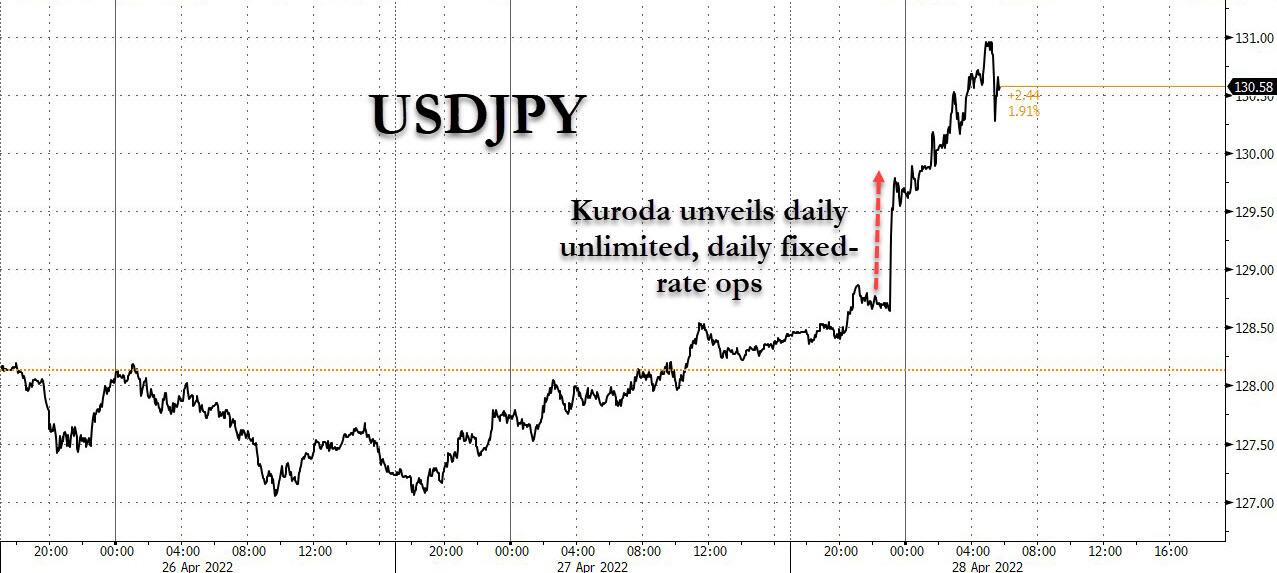
The yen cratered below 130 against the U.S. currency for the first time in 20 years in afternoon trading in Tokyo, when rather than introducing flexibility to its monetary policy, the central bank in a statement reiterated its commitment to the 10-year yield target, saying it will conduct an unlimited fixed-rate operation to buy 10-year Japanese government bonds at 0.25% every day, effectively ensuring a currency collapse.

Specifically, the BOJ maintained the status quo across all monetary policy parameters, including yield curve control (YCC), asset purchase programs, and forward guidance (some market observers were expecting adjustments to forward guidance). The central bank decided by an 8-1 majority vote to maintain the YCC, and by a unanimous vote to maintain guidelines for asset purchases. In regard to YCC, BOJ member Kataoka cast the dissenting vote (as he usually does), saying that it was desirable to lower short- and long-term interest rates “with a view to encouraging firms to make active business fixed investment for the post-COVID-19 era.”

In a separately released economic outlook report, the board members offered a median forecast of sharply higher inflation coming at 1.9% for fiscal 2022, compared with 1.1% predicted just three months ago, and 1.1% for the next fiscal year. Economic growth is forecast to slow sharply to 2.9% for the current fiscal year, versus 3.8% predicted three months ago. The BOJ’s outlook assumes core CPI inflation will continue to fall short of the inflation target of +2%, calling for +1.1% in both FY2023 and FY2024, while it expects new core CPI inflation (excludes fresh food and energy) to grow steadily, calling for +0.9% in FY2022, +1.2% in FY2023, and +1.5% in FY2024, respectively.

But the highlight, as noted above, is what the BOJ said regarding YCC, where it explicitly added to the statement that “the Bank will offer to purchase 10-year JGBs at +0.25% every business day through fixed-rate purchase operations, unless it is highly likely that no bids will be submitted” cementing the bank’s commitment to keeping yields in the world’ most indebted country (relatively speaking) at or below 0.25% 

On policy rates, the BOJ maintained forward guidance indicating that it “expects short- and long-term policy interest rates to remain at their present or lower levels.” Commenting on the move, Goldman said that “while the BOJ introduced daily fixed-rate operations to keep consistency with this forward guidance, in our view, we think the market is likely to view it as a strong dovish message. Indeed, post the MPM, the 10-year yield is down and the yen depreciated against the US dollar.”

It sure is, but more on that in a second.

  • Speaking at a press conference later in the day, BOJ Governor Kuroda focused on the two key issues: inflation and the daily fixed-rate ops. Here are the highlights:
  • Kuroda said “It Will Take Some Time to Get Sustainable Inflation” adding that current cost-push inflation will not be sustained as oil prices won’t keep rising.
  • Kuroda said that “while inflation will rise temporarily to 2%, it won’t last as the effect of energy prices will ease”, that “”Inflation expectations are rising, but are centered on the short-term”
  • The BOJ governor emphasized that the surge in inflation is not sustainable, saying “cost-push inflation isn’t sustainable” and that the “current rise in inflation expectations is also not sustainable”
  • And even though risks are tilted to the upside for prices right now, and are tilted to the downside for the economy, there is no need to seek an exit from monetary stimulus now given the BOJ’s outlook for prices today

In short, the BOJ is quadrupling down on the wrong assumption that inflation is transitory. It won’t be the first catastrophic mistake the BOJ has made.

Moving on, the BOJ’s senile governor explained that the central bank’s Fixed-Rate Bond operations are meant to stabilizing not jolt markets.

  • “The Bank of Japan’s decision to clarify its bond purchasing plans is designed to prevent speculation”, Kuroda said.
  • Kuroda also said that “the clarification on fixed ops doesn’t mean the BOJ wants to buy fewer bonds” which is good beause soon the BOJ will be flooded with sellers.
  • Finally, the central bank chief, said – or rather hoped – that fixed-rate ops aren’t causing excessive market moves

The outcome of this shocking announcement which basically cemented the BOJ’s commitment to low rates at the expense of a plunging currency, was immediate and brutal: the Japanese currency immediately tumbled, sliding below 130 vs the USD…

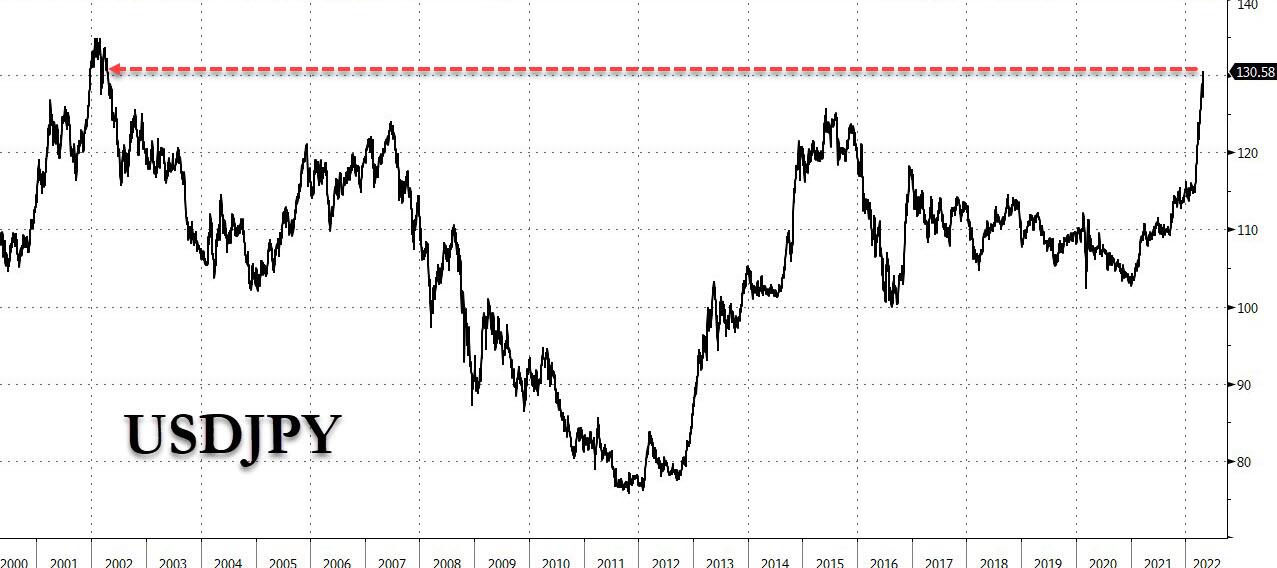
… and sending the USDJPY to the highest level since 2002!

Not even vigorous if futile attempts by the Ministry of Finance to talk the yen up had any success. Moments after the BOJ broke 131 vs the USD, a Japanese finance ministry official says recent forex moves warrant extreme concern, adding that it was important that currencies move stably in line with fundamentals.

The USDJPY briefly dipped 75 pips and resumed its blow out.

Putting the move in context, since the Fed started raising rates on March 16, the yen has fallen from 118 to 131 versus the dollar, hitting a 20-year low earlier today, as investors moved out of yen and into dollars for better investment yields. Kuroda has argued that a weaker yen is “a net positive” for the economy, even as the public becomes increasingly frustrated with BOJ policy, according to Nikkei Asia.

“The latest policy statement has left me with an impression that Kuroda has even hardened his stance,” said Hideo Kumano, chief economist at Dai-ichi Life Research Institute. He sure has, and as we said recently, the BOJ has found itself caught between a rock and a hard place. If it sticks to the loose monetary policy, it will exacerbate import-driven inflation. If it raises rates, it could hurt Japan’s sluggish recovery from COVID.

Commenting on the BOJ announcement, Noriatsu Tanji, chief bond strategist at Mizuho Securities in Tokyo said that the BOJ’s announcement to buy bonds with no limit was a surprise: “To make the announcement of buying unlimited bonds at a fixed rate in the policy statement, the BOJ is sending a very strong message that it is firmly committed to continuing the super-easy policy.” He added that “as days go by, players will cease to sell to the BOJ and will stop challenging the 0.25% level, driving down 10 year yields” and said that “this commitment should also help ease upward pressure on super-long yields” which are outside the BOJ’s YCC.

He’ may be right, but he didn’t say anything about what happens next to the crashing yen. And it is here that the move to 150 is now certain.

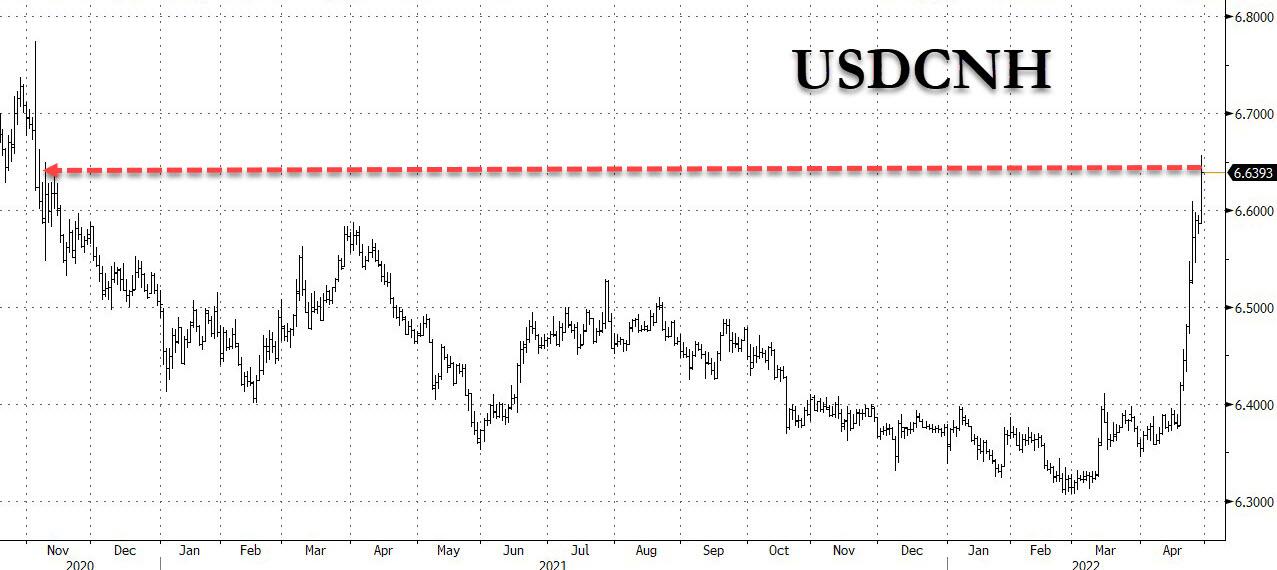
And while the collapse in the yen was viewed aken favorably by Japanese stocks, with the Topix spiking over 2% following the announcement, the Japanese decision to let the yen plunge was immiedately noted by its far bigger and more important neighbor China, whose offshore yuan also tumbled yen 0.8% lower, sending the USDCNH above 6.65, the highest level since November 2020…

… as suddenly the “The Biggest Story No-One Is Talking About” is what everyone is talking about – namely how long before the unprecedented easing divergence in Japan and China vs the tightening in the US and the west, leads to a historic crash.

As a reminder, in a note published late last week (available to all professional subscribers), SocGen’ Albert Edwards looked at the moves in the yen and yuan, and wrote that “surely all of us working in finance realize by now that something is likely to snap in the financial system and probably quite soon.”

Why? Because according to the SocGen strategist, “the rapidity of current market moves and the polarisation of the now extreme Fed (hawkish) and BoJ (dovish) policies almost guarantees that outcome…. Maybe the outcome wouldnt be so ugly if central bankers had not spent recent decades ramping up asset prices to todays grotesque levels through their monetary incontinence. But they did.”

Comparing the monetary policy divergence between the US and Japan to “a car crash in slow motion“, Edwards writes that polarization in central bank monetary policy between the US Federal Reserve and Bank of Japan is being stretched ever wider to the point where “at some point soon your life might even flash before you .”

If he is right, today’s BOJ decision may have just planted the seeds for the next monetary collapse. If so, keep a close eye on gold and cryptos, both of which will likely be trading far, far higher by the time the market realizes what just happened.

Tyler Durden
Thu, 04/28/2022 – 06:06

via ZeroHedge News https://ift.tt/qP0uVRQ Tyler Durden

School Choice Helps LGBT Students in Alabama


topicseducation

Homewood, Alabama, a suburb of 25,000 people south of Birmingham, is home to an excellent example of how charter schools can reach students who struggle in standard public school environments.

There you’ll find the Magic City Acceptance Academy, a public charter school that opened its doors last August after struggling for a year to get official permission. The academy says its mission is to facilitate “a community in which all learners are empowered to embrace education, achieve individual success, and take ownership of their future in a safe, LGBTQ-affirming learning environment.”

In addition to providing a standard curriculum for grades six through 12, Magic City offers wellness programs, psychological counseling, and help connecting families with health services. In its first year of classes, the school taught 232 students, drawn from all over the greater Birmingham area. All of those students’ families were drawn to a school focused on LGBT inclusion. Magic City founder and principal Michael Wilson says he hopes to enroll 325 to 350 students for the 2022–23 school year.

Many critics of charter schools claim they discriminate against underprivileged and minority students by catering to wealthy, privileged, or conservative families. Yet many charter schools cater to minority students and those with special needs. The list of charter schools focused on assisting LGBT students is small so far: The National Alliance for Public Charter Schools counts six of them. But charter schools are a promising way of extricating students from unwelcoming or oppressive public school environments.

Students need not be LGBT to attend Magic City. The goal is to create a friendly and welcoming environment for any child who is being bullied in traditional schools and is not getting the help or support he or she needs.

“There are some pretty horrific things that go on in schools,” Wilson says. “It may be about the student’s place on the LGBTQ spectrum but may be also because of autism or their skin color or because they’re a child of immigrants. They’re not comfortable where they are.”

School choice allows schools like Magic City to provide an environment that welcomes and supports LGBT children. It also creates room for other charter schools that appeal to more conservative families. The answer for students who feel unwelcome or underserved where they are is to expand the schooling market.

The post School Choice Helps LGBT Students in Alabama appeared first on Reason.com.

from Latest https://ift.tt/aC0hfsJ
via IFTTT

First-Ever “Hybrid” ETP Bets On Gold And Bitcoin As Inflation Hedge 

First-Ever “Hybrid” ETP Bets On Gold And Bitcoin As Inflation Hedge 

A novel exchange-traded product, combining Bitcoin and gold, has been launched on the SIX Swiss Exchange and comes when threats of stagflation have battered traditional 60/40 or risk-parity portfolios. 

Switzerland-based firm 21Shares and U.K. alternative investment provider ByteTree Asset Management announced Wednesday BOLD ETP (ticker BOLD) to provide “protection against inflation, giving optimal risk-adjusted exposure to bitcoin and gold.” 

BOLD ETP includes 81.5% Gold and 18.5% Bitcoin. The ETP will “rebalance monthly according to each asset’s inverse historical volatility (360-day),” 21Shares’ factsheet about the new product said. 

“Gold has historically delivered portfolio protection in inflationary environments, while Bitcoin is the digital equivalent of gold with growing adoption by investors as a distinct asset class and a core store of wealth,” said Charlie Erith, CEO of ByteTree Asset Management, in a statement

“In a time of rising structural inflation and heightened geopolitical risk, we believe this can act as an important risk and return diversifier in a balanced portfolio,” Erith said. 

21Shares co-founder and CEO Hany Rashwan said people in the crypto world view Bitcoin as a digital alternative to gold. He explained: 

“This hybrid product combines the traditional value of gold with the promising return rates of Bitcoin, which is considered by many as the new gold.”

BOLD’s effort to boost returns in this challenging macro environment comes as 60/40 portfolios have been battered by the down move of stocks and bonds. For the past two decades, stock and bond prices have usually moved inversely, but that’s not the case as inflation soars to decade highs as central banks rush to remove liquidity from the global financial system via quantitative tightening. 

However, Bloomberg Intelligence’s James Seyffart believes “gold and Bitcoin are more aptly described as complementary assets in a portfolio, rather than the common narrative that one supplements the other or is a substitute for the other.” 

 “Perhaps over time Bitcoin will exhibit characteristics more similar to gold, but right now, Bitcoin is still a risk asset in our view,” Seyffart said. 

Maybe the era of equities and bonds is coming to a close as a new era of structural inflation pushes more investors into gold and Bitcoin. 

Tyler Durden
Thu, 04/28/2022 – 05:45

via ZeroHedge News https://ift.tt/gZu3qhz Tyler Durden

A Mostly Wind- & Solar-Powered US Economy Is A Dangerous Fantasy

A Mostly Wind- & Solar-Powered US Economy Is A Dangerous Fantasy

Authored by Francis Menton via The Gatestone Institute,

  • When President Biden and other advocates of wind and solar generation speak, they appear to believe that the challenge posed is just a matter of currently having too much fossil fuel generation and not enough wind and solar; and therefore, accomplishing the transition to “net zero” will be a simple matter of building sufficient wind and solar facilities and having those facilities replace the current ones that use the fossil fuels.

  • They are completely wrong about that.

  • The proposed transition to “net zero” via wind and solar power is not only not easy, but is a total fantasy. It likely cannot occur at all without dramatically undermining our economy, lifestyle and security, and it certainly cannot occur at anything remotely approaching reasonable cost. At some point, the ongoing forced transition… will crash and burn.

  • [I]t doesn’t matter whether you build a million wind turbines and solar panels, or a billion, or a trillion. On a calm night, they will still produce nothing, and will require full back-up from some other source.

  • If you propose a predominantly wind/solar electricity system, where fossil fuel back-up is banned, you must, repeat must, address the question of energy storage. Without fossil fuel back-up, and with nuclear and hydro constrained, storage is the only remaining option. How much will be needed? How much will it cost? How long will the energy need to remain in storage before it is used?

  • There should be highly-detailed engineering studies of how the transition can be accomplished…. But the opposite is the case. At the current time, the government is paying little to no significant attention to the energy storage problem. There is no detailed engineering plan of how to accomplish the transition. There are no detailed government-supported studies of how much storage will be needed, or of what technology can accomplish the job, or of cost.

  • It gets worse:…. Ken Gregory calculated the cost of such a system as well over $100 trillion, before even getting to the question of whether battery technology exists that can store such amounts of energy for months on end and then discharge the energy over additional months. And even at that enormous cost, that calculation only applied to current levels of electricity consumption…. For purposes of comparison, the entire U.S. GDP is currently around $22 trillion per year.

  • In other words: we have a hundred-trillion-or-so dollar effort that under presidential directive must be fully up and running by 2035, with everybody’s light and heat and everything else dependent on success, and not only don’t we have any feasibility study or demonstration project, but we haven’t started the basic research yet, and the building where the basic research is to be conducted won’t be ready until 2025.

  • Meanwhile the country heads down a government-directed and coerced path of massively building wind turbines and solar panels, while forcing the closure of fully-functioning power plants burning coal, oil and natural gas. It is only a question of time before somewhere the system ceases to work…. [I]t is easy to see how the consequences could be dire. Will millions be left without heat in the dead of winter, in which case many will likely die? Will a fully-electrified transportation system get knocked out, stranding millions without ability to get to work? Will our military capabilities get disabled and enable some sort of attack?

  • No sane, let alone competent, government would ever be headed down this path.

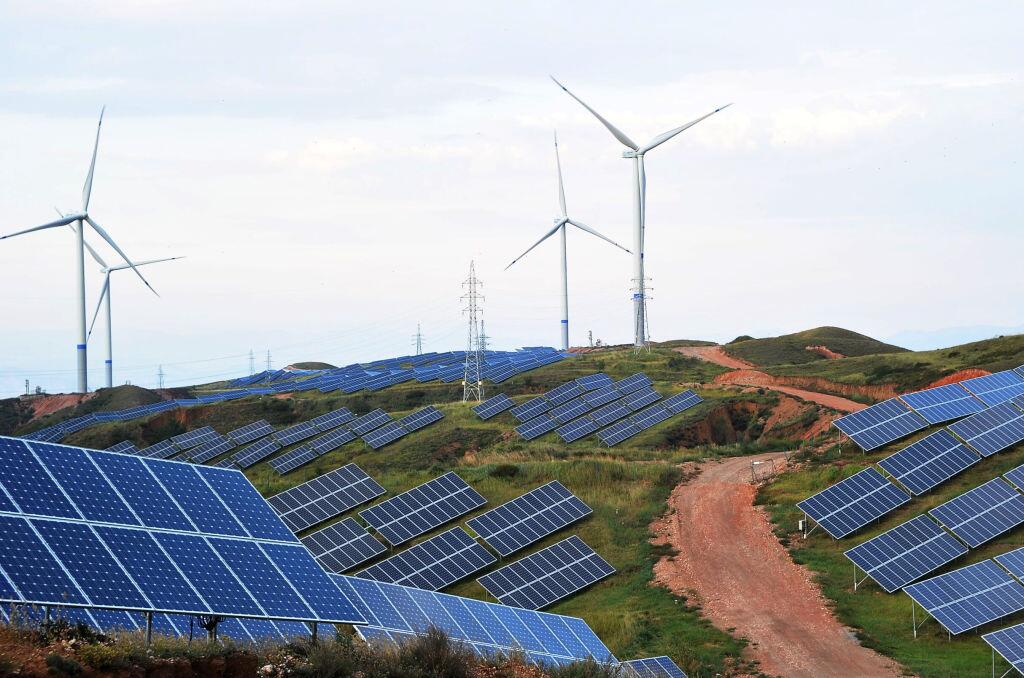
The Biden Administration’s proposed transition to “net zero” via wind and solar power is not only not easy, but is a total fantasy. It likely cannot occur at all without dramatically undermining our economy, lifestyle and security, and it certainly cannot occur at anything remotely approaching reasonable cost. At some point, the ongoing forced transition will crash and burn.
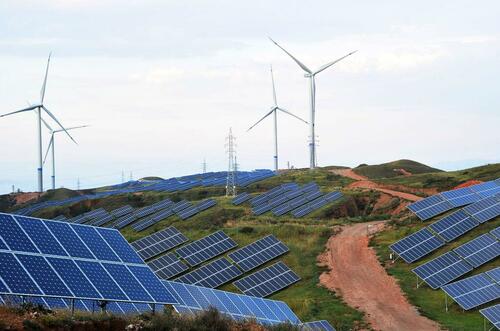
(Photo by VCG via Getty Images)

With or without Congressional support, President Joe Biden has determined to move the U.S. as quickly as possible toward an economy predominantly powered by wind- and solar-sourced electricity. In his earliest days in office, Biden issued multiple Executive Orders directing the federal bureaucracy to bend all efforts to achieve this goal. One of those early Executive Orders, dated January 27, 2021 and titled “Tackling the Climate Crisis At Home and Abroad,” stated:

“It is the policy of my Administration to organize and deploy the full capacity of its agencies to combat the climate crisis to implement a Government-wide approach that reduces climate pollution in every sector of the economy…”

When burned to generate energy, fossil fuels — coal, oil and natural gas — all emit carbon dioxide, otherwise known in Biden-speak as “climate pollution.” Thus, under Biden’s directive, they are all to be suppressed. The alternative of expanding nuclear power has meanwhile equally been made impractical by regulatory obstruction; and our potential hydro-electric capacity is already mostly in use. That leaves as the principal remaining option the generation of more electricity from wind and solar facilities; and indeed, the wind/solar electricity option is currently the subject of great regulatory favor, including extensive government subsidies and tax benefits.

On last year’s Earth Day, April 22, 2021, Biden issued a press release expanding on his Executive Orders and setting specific goals for the elimination of fossil fuels from the U.S. economy. Although Congress has not acted on any such proposals, the Earth Day press release supposedly committed the United States by unilateral executive action to “100 percent carbon pollution-free electricity by 2035,” and to a “net zero emissions economy by no later than 2050.”

We are thus as a country embarked on a government-ordered crash program to eliminate our fossil fuel electricity generation within a very short 13-year period, and to eliminate all usage of fossil fuels within a not-much-longer 28 years. When Biden and other advocates of wind and solar generation speak, they appear to believe that the challenge posed is just a matter of currently having too much fossil fuel generation and not enough wind and solar; and therefore, accomplishing the transition to “net zero” will be a simple matter of building sufficient wind and solar facilities and having those facilities replace the current ones that use the fossil fuels.

They are completely wrong about that.

The green energy advocates, including our President and his administration, entirely misperceive the challenge at hand. The proposed transition to “net zero” via wind and solar power is not only not easy, but is a total fantasy. It likely cannot occur at all without dramatically undermining our economy, lifestyle and security, and it certainly cannot occur at anything remotely approaching reasonable cost. At some point, the ongoing forced transition, should it continue, will inevitably hit physical and/or financial limits, and will crash and burn. But the circumstances under which the crashing and burning will occur are currently unknown. Thus, worse than being a mere fantasy, the attempt to accomplish a “net zero” transition is a highly dangerous fantasy, putting the lives, health, and security of all Americans at risk as the attempted transition proceeds to its inevitable failure.

The root of the mostly-unrecognized problem is that wind and solar generation facilities produce something fundamentally different from what fossil fuels produce. Fossil fuels produce energy that is reliable and dispatchable, that is, available when wanted and needed. The wind and sun produce energy that is intermittent, that is, available only when weather conditions permit, which often does not correspond to consumer demand.

Here is something that ought to be blindingly obvious, but unfortunately goes largely unmentioned in discussions of the green energy transition: No amount of incremental wind and solar power generation on their own can ever provide a reliable 24/7 electricity grid. Electricity gets produced the moment it is consumed, and therefore a reliable grid must provide electricity to meet consumer demand at all hours. To take just the most obvious example, wind turbines produce nothing when the wind is calm, and solar panels produce nothing at night; and therefore, a combined wind/solar system produces nothing on a calm night. Unfortunately, peak electricity demand often occurs in the evening, shortly after sunset, when the wind is calm or close to it. Without full back-up from some source, an electrical grid powered by the wind and sun will experience, as just this one example, a full blackout on every calm night. And it doesn’t matter whether you build a million wind turbines and solar panels, or a billion, or a trillion. On a calm night, they will still produce nothing, and will require full back-up from some other source.

Fossil fuels, and particularly natural gas, are fully capable of providing the back-up needed by a principally wind/solar electricity generation system. But our President now directs that fossil fuel back-up is “carbon pollution” and must be eliminated. The remaining option is storage of the energy from the time when it is produced (e.g., in the case of a wind/solar system, at noon on a windy June day) until the time when it is needed for consumption (e.g., 7 PM on a calm December night).

Which brings us to blindingly obvious statement number two: If you propose a predominantly wind/solar electricity system, where fossil fuel back-up is banned, you must, repeat must, address the question of energy storage. Without fossil fuel back-up, and with nuclear and hydro constrained, storage is the only remaining option. How much will be needed? How much will it cost? How long will the energy need to remain in storage before it is used? And, do storage systems exist that can store the energy for that period of time and return it without significant loss and at the rate required to keep the lights on?

If our government officials were remotely competent, while proposing a green energy transition for the country over a short period of years — and with hundreds of billions of dollars, if not trillions, being spent on the imminent transition — these questions should be at the forefront of their attention every day. Long before the U.S. ever got committed to transition to an energy system based mostly on wind and sun, it should quite obviously have been far down the road toward demonstration of the feasibility and cost of the energy storage systems that are capable of enabling the transition.

There should be highly-detailed engineering studies of how the transition can be accomplished. The requirements for amounts of batteries measured in gigawatt hours should be known at a high level of precision. The amounts of materials needed to produce the batteries should be known with an equally high level of precision. The technological capabilities of the batteries should be known with an also equally high level of precision (e.g., What is the optimum chemistry of the batteries to be used in the system? What will be loss of energy between input into the battery and consumption? How much in the way of additional generation facilities must be built to provide for this loss? How long can the batteries hold the charge? If charge added in June needs to be stored until December, do the proposed batteries have that capability? Do the proposed batteries need expensive climate control systems to enable them to hold the charge before it is used? And so on, and so on.)

Indeed, by this time, supposedly only 13 years from when we will have a carbon-free electricity system, there should be existing demonstration projects showing clearly what technology will be used, and that the proposed technology works and can be deployed at grid scale and at reasonable cost.

But the opposite is the case. At the current time, the government is paying little to no significant attention to the energy storage problem. There is no detailed engineering plan of how to accomplish the transition. There are no detailed government-supported studies of how much storage will be needed, or of what technology can accomplish the job, or of cost.

It gets worse: In the absence of any serious government effort to address the engineering challenge of energy storage necessary to back up a predominantly wind/solar electricity system, the task has instead fallen to a small number of volunteer amateurs, mostly retired engineers of one sort or another. Several such people have produced credible calculations indicating that backing up a predominantly intermittent wind/solar electricity system using only battery storage will require storage in the range of approximately 30 days of average usage to avoid significant risk of the batteries running out of charge and the system crashing. The high amounts of storage required are largely a consequence of the seasonality inherent in either wind or solar generation, e.g., solar facilities produce far more electricity in the summer than the winter.

One example of a serious effort to determine how much and what type of energy storage would suffice to back up a fully wind/solar electricity system was produced in 2018 by a man named Roger Andrews, a retired engineer then living in Mexico. Andrews’s work appeared on a website called Energy Matters in November 2018. Andrews considered two cases, one for California and the other for Germany, and obtained detailed data of electricity usage and of production by existing wind and solar facilities in those places in order to make his calculations.

Andrews’ spreadsheets, and charts appearing in his post, demonstrate that, largely due to seasonality of production from both the sun and wind, it would take approximately 30 days of stored electricity usage to get through an entire year with a wind/solar system. Andrews showed that batteries to hold that amount of charge would cost in excess of a full year’s GDP for either California or Germany, although, based on existing technology, batteries even at such enormous cost would not have the capability to hold the charge for sufficient months to fulfill their task. At the end of his post, Andrews concluded: “[B]attery storage is clearly not an option for a low-cost 100% renewable future.”

In a more recent example, in January 2022, a man name Ken Gregory — a retired engineer living in Calgary, Canada — undertook to produce a spreadsheet calculating storage requirements and costs for backing up a wind/solar electricity system for the case of the entire United States. Gregory’s work is accessible at this link. Gregory’s spreadsheet is based on detailed (in this case, hourly) data for actual consumption and generation from existing wind and solar facilities, with their wildly fluctuating output.

Gregory’s principal result is that full back-up by storage of the U.S. electricity system at current levels of consumption, and assuming all generation comes from wind and solar, would require something in the range of 250,000 gigawatt hours of battery capacity. Some of that energy would need to remain in storage for over six months, and be discharged over the course of months. Since U.S. electricity consumption is currently in the range of 3.7 million GWH per year, the 250,000 GWH storage requirement calculated by Gregory represents about 24 days of average usage, a result in the same range as the result reached by Andrews. Gregory calculated the cost of such a system as well over $100 trillion, before even getting to the question of whether battery technology exists that can store such amounts of energy for months on end and then discharge the energy over additional months. And even at that enormous cost, that calculation only applied to current levels of electricity consumption. The Biden “net zero” plan for 2050 involves the approximate tripling of electricity consumption, which by Gregory’s calculations would drive the cost of the necessary storage up to the range of some $400 trillion. For purposes of comparison, the entire U.S. GDP is currently around $22 trillion per year.

Obviously Gregory’s calculations could be questioned or modified as to many of his assumptions, and perhaps his calculation of the cost of such a system is too high — or maybe, too low. The fact remains that if the U.S. government were even slightly competent, it would have its own detailed engineering studies of how to accomplish its coerced energy transition, let alone, at this late date, demonstration projects for small cities or towns establishing the feasibility and cost of what is being proposed. None of that exists. Indeed, none of it is even in the works.

To fully understand the depths of incompetence with which the U.S. government is approaching this energy transition, consider the current effort of the federal Department of Energy called the Energy Storage Grand Challenge. Under this program, the DOE proposes to hand out grants to study the challenges of creating batteries to back up the electricity grid when the grid has gone almost fully wind/solar, and particularly to study the subject of the “long duration” batteries that will clearly be needed to store and then discharge massive amounts of energy over the course of months on end to deal with the issue of seasonality.

According to a piece that appeared in Energy Storage News in September 2021, here is the status of that effort: “The DOE is also helping to get a US $75 million long-duration energy storage research centre built at Pacific Northwest National Laboratory, which is expected to open by or during 2025.” In other words: we have a hundred-trillion-or-so dollar effort that under presidential directive must be fully up and running by 2035, with everybody’s light and heat and everything else dependent on success, and not only don’t we have any feasibility study or demonstration project, but we haven’t started the basic research yet, and the building where the basic research is to be conducted won’t be ready until 2025.

Meanwhile the country heads down a government-directed and coerced path of massively building wind turbines and solar panels, while forcing the closure of fully-functioning power plants burning coal, oil and natural gas. It is only a question of time before somewhere the system ceases to work. It is impossible to predict exactly when and where that will occur. But it is easy to see how the consequences could be dire. Will millions be left without heat in the dead of winter, in which case many will likely die? Will a fully-electrified transportation system get knocked out, stranding millions without ability to get to work? Will our military capabilities get disabled and enable some sort of attack?

No sane, let alone competent, government would ever be headed down this path.

*  *  *

Francis Menton is the President of the American Friends of the Global Warming Policy Foundation, and blogs at manhattancontrarian.com
Tyler Durden
Thu, 04/28/2022 – 05:00

via ZeroHedge News https://ift.tt/RPZTWea Tyler Durden

Brickbat: Philadelphia Beatdown


phillypolice_1161x653

Former Philadelphia Police Officer Darren Kardos has been charged with aggravated assault, reckless endangerment of another person, and other charges in the beating of Rickia Young. In October 2020, Young had gone to pick up her nephew from a friend’s house. Hours earlier, police had shot and killed Walter Wallace, and what began as peaceful protests had become violent. As she approached one intersection, officers ordered her to turn around. But as she tried to make a U-turn, several officers began hitting and rocking her SUV. Kardos broke the windows of the SUV and pulled Young out by the hair. Officers hit her with fists and batons and sprayed her with mace. Neither Young nor her nephew were charged with any crime. The city has agreed to pay $2 million to settle a lawsuit Young brought.

The post Brickbat: Philadelphia Beatdown appeared first on Reason.com.

from Latest https://ift.tt/mplXVdr
via IFTTT

What Are The Most-Produced Cash Crops In Africa?

What Are The Most-Produced Cash Crops In Africa?

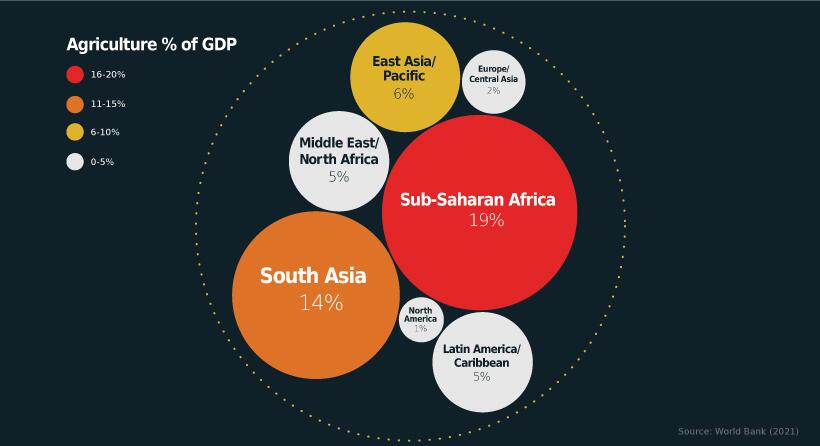
Agriculture makes up nearly 20% of Sub-Saharan Africa’s economy – a higher percentage than any other region worldwide.

From Nigeria to the fertile land across the East African Rift Valley, the continent is home to 60% of the world’s uncultivated arable land.

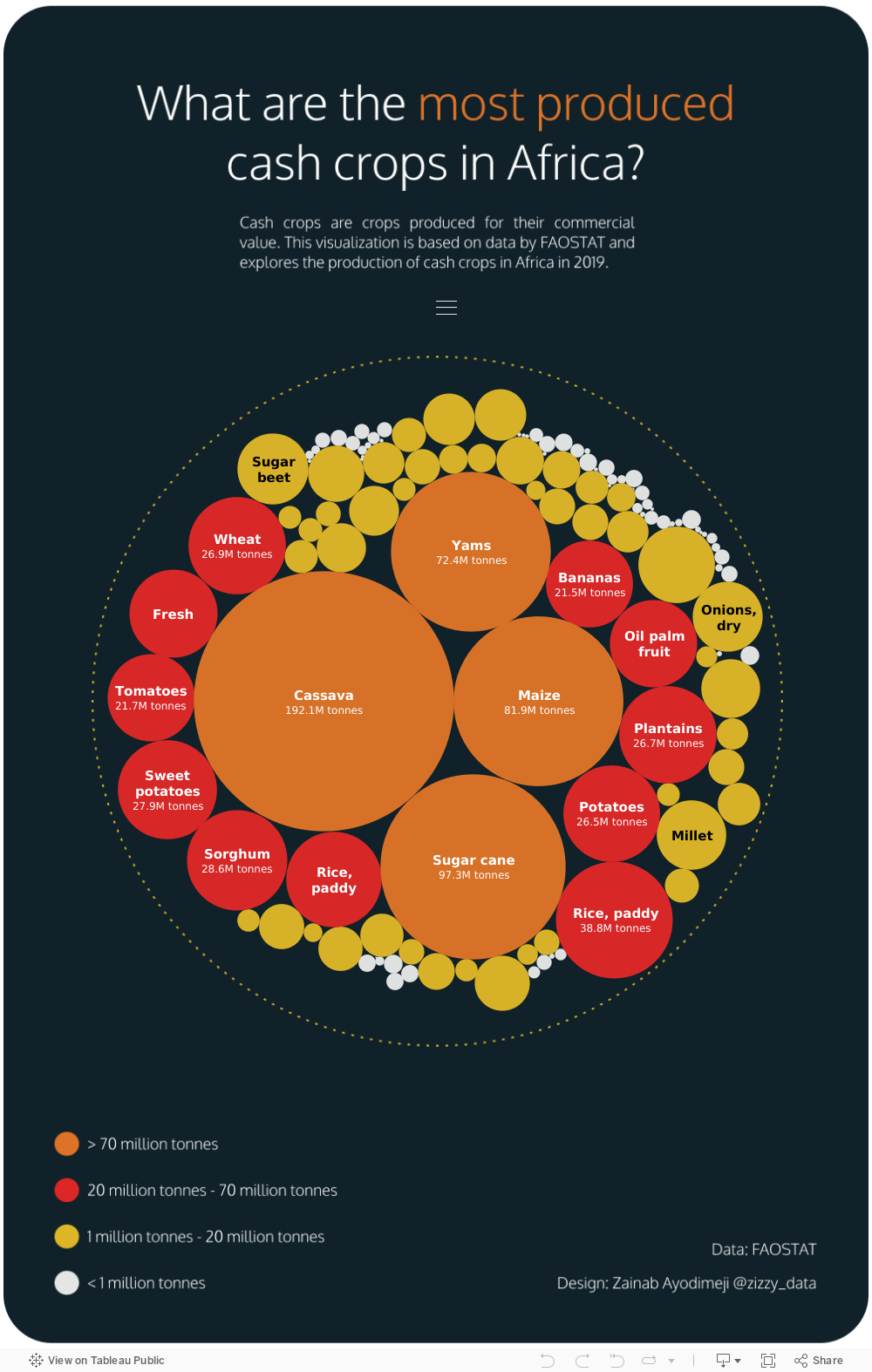
Given the massive role of agriculture across the region, Visual Capitalist provides this infographic from Zainab Ayodimeji shows the most produced cash crops in Africa and their share of total global production.

The Top 20 Cash Crops in Africa

Cash crops, such as coffee or rice, are crops that are produced for a salable market.

With data from the Food and Agriculture Organization Corporate Statistical Database (FAOSTAT), here are the most produced cash crops in Africa:

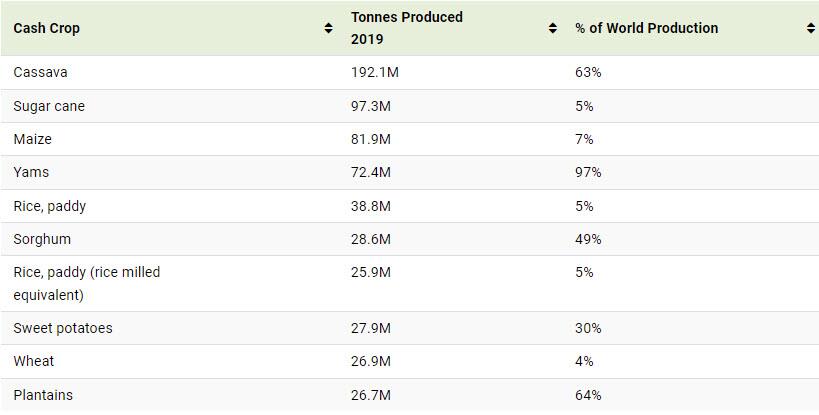
Cassava, also referred to as yuca, is the most produced cash crop by a wide margin. With nearly 200 million tonnes of it produced annually, Africa’s production of cassava makes up a majority (63%) of the global total.

While cassavas are not well known in the Western world, they feed 800 million people globally. Cassavas are an essential root vegetable that has similar uses to potatoes.

Sugar cane, maize, and yams are also significant cash crops.

Notably, Africa’s yam production is 97% of the global total. West Africa is known as the “yam belt,” covering Nigeria, Ghana, Benin, and Côte d’Ivoire. With over 60 million people across the yam belt directly or indirectly involved in its production, yam cultivation is an important component of the region’s economic vitality.

Agriculture Composition of GDP, by Region

While agriculture plays a significant role in Africa’s GDP, what role does it play across other regions around the world?

Like Sub-Saharan Africa, agriculture is a major part of South Asia’s economy. India produces nearly 24% of rice around the world, while Bangladesh produces over 7% of total global production. Meanwhile, over 14% of the global wheat supply is also produced by India.

On the other hand, agriculture makes up just 1% of North America’s GDP. The number of farms in the U.S. peaked in the 1930s and has sharply declined from almost 7 million to 2 million in 2020.

The Future of Africa’s Cash Crops

Despite Africa’s expansive agriculture sector, there remain bottlenecks to productivity.

In light of these challenges, several technological advances have the potential to improve farmers’ bottom lines. For instance, precision technology measures rainfall, soil information, and soil productivity. At the same time, remote sensing technology can provide information on weather and climate.

This, coupled with the majority of the world’s uncultivated arable land, presents a significant opportunity for cash crops going forward. By one estimate, cereal and grain production has the potential to increase threefold.


Tyler Durden
Thu, 04/28/2022 – 04:15

via ZeroHedge News https://ift.tt/TrtDxZ2 Tyler Durden

Brickbat: Philadelphia Beatdown


phillypolice_1161x653

Former Philadelphia Police Officer Darren Kardos has been charged with aggravated assault, reckless endangerment of another person, and other charges in the beating of Rickia Young. In October 2020, Young had gone to pick up her nephew from a friend’s house. Hours earlier, police had shot and killed Walter Wallace, and what began as peaceful protests had become violent. As she approached one intersection, officers ordered her to turn around. But as she tried to make a U-turn, several officers began hitting and rocking her SUV. Kardos broke the windows of the SUV and pulled Young out by the hair. Officers hit her with fists and batons and sprayed her with mace. Neither Young nor her nephew were charged with any crime. The city has agreed to pay $2 million to settle a lawsuit Young brought.

The post Brickbat: Philadelphia Beatdown appeared first on Reason.com.

from Latest https://ift.tt/mplXVdr
via IFTTT

UK Streaming Platform Censors ‘Homophobic’ Line In 2002 Spiderman Movie

UK Streaming Platform Censors ‘Homophobic’ Line In 2002 Spiderman Movie

Authored by Paul Joseph Watson via Summit News,

UK streaming platform ITV Player has censored a “homophobic” line from the 2002 Spiderman movie, in yet another example of older content being run through modern politically correct purity tests.

The line occurs when Tobey Maguire’s Spiderman is facing off against Bonesaw.

Spiderman says, “That’s a cute outfit. Did your husband give it to you?”

In the newly censored version, the line is reduced to, “That’s a cute outfit,” rendering the scene confusing and meaningless.

“They removed Peter Parker’s homophobia,” wrote one Twitter user who noticed the change and recorded it.

The original clip can be seen below.

This is just the latest example of cultural censors memory-holing historical content in order to conform to today’s hysterical standards of political correctness.

During the height of the 2020 Black Lives Matter riots, UK broadcaster Sky also tagged numerous movies, some little over a decade old, with a message warning viewers that they might be offensive.

“This film has outdated attitudes, language and cultural depictions which may cause offence today,” stated the trigger warning.

During the same year, PBS removed Gone With the Wind from its platform, in the process erasing the first black female actress to win an Oscar, while the BBC also announced it was removing Little Britain from its schedule despite the fact that the TV comedy series satirizes every demographic, often highlighting small minded attitudes of bigots.

Last year, NBC also announced that it was scanning 17,000 hours of past WWE content to weed out “racist” material in order to avoid it appearing on the network’s new Peacock streaming device.

Iconic books are also being re-written to reflect ‘modern attitudes’, including George Orwell’s 1984.

Ideological purity tests for art and culture. The Ministry of Truth would be proud.

*  *  *

Brand new merch now available! Get it at https://www.pjwshop.com/

In the age of mass Silicon Valley censorship It is crucial that we stay in touch. I need you to sign up for my free newsletter here. Support my sponsor – Turbo Force – a supercharged boost of clean energy without the comedown. Get early access, exclusive content and behinds the scenes stuff by following me on Locals.

Tyler Durden
Thu, 04/28/2022 – 03:30

via ZeroHedge News https://ift.tt/5vfPNO8 Tyler Durden