Facebook Soars After Reporting Solid User Growth Despite Revenue Miss And Weak Guidance

Facebook Soars After Reporting Solid User Growth Despite Revenue Miss And Weak Guidance

Heading into today’s earnings from social media giant Facebook Meta (technically, the second quarter since the company changed its name), markets are on edge after the recent dismal results from Netflix and yesterday’ Google fiasco, which prompted some to ask if the advertising business is hitting a speed bump, one which would have clearly negative consequences for Meta, which has achieved the impossible and is equally hated by both the right and the left. That said, at the end of the day, it’s going to come down to one thing: the company’s MAU/DAU growth, or lack thereof. Everything else is mostly noise.

To be sure, after last quarter’s epic devastation which saw the stock crater 20% in its biggest post-earnings drop on record, it appears that many investors were already preparing for the worst with Meta shares were down as much as 6.6% on Wednesday, with the Facebook parent dropping to its lowest level since April 2020 ahead of results. The day’s weakness came after a stray Bloomberg headline erroneously reported a much lower guidance for Facebook than expected. Meta shares are down nearly 50% thus far this year, making them the fourth-worst performing component of the Nasdaq 100 Index.

And while investors will be listening closely to how the company details its business environment, many would also love to know what Zuckerberg thinks of the Elon Musk-Twitter deal, especially since there is no love lost between Zuckerberg and Musk, or Jack Dorsey.

So with that in mind, here is what Facebook just reported for Q1, and why the stock is soaring after hours:

Revenues and earnings:

  • EPS $2.72, beating estimate $2.56
  • Revenue $27.91 billion, beating estimate $28.24 billion (Bloomberg Consensus)
    • Advertising rev. $27.00 billion, missing estimate $27.48 billion
    • Family of Apps revenue $27.21 billion, missing estimate $27.52 billion
    • Reality Labs revenue $695 million, beating estimate $677.1 million
    • Other revenue $215 million, beating estimate $189.3 million

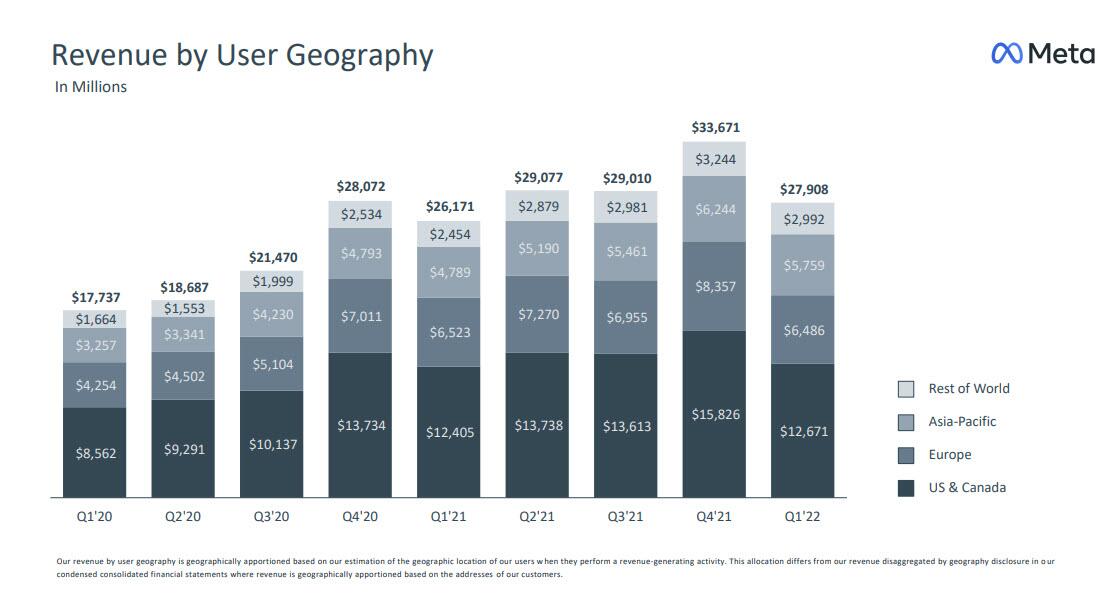
A red flag here: yes, revenue grew 7% YY, but that was the slowest pace of growth since the company went public in 2012. Meanwhile, US revenue barely grew in Q1 at $12.671BN, up from $12.405 BN.
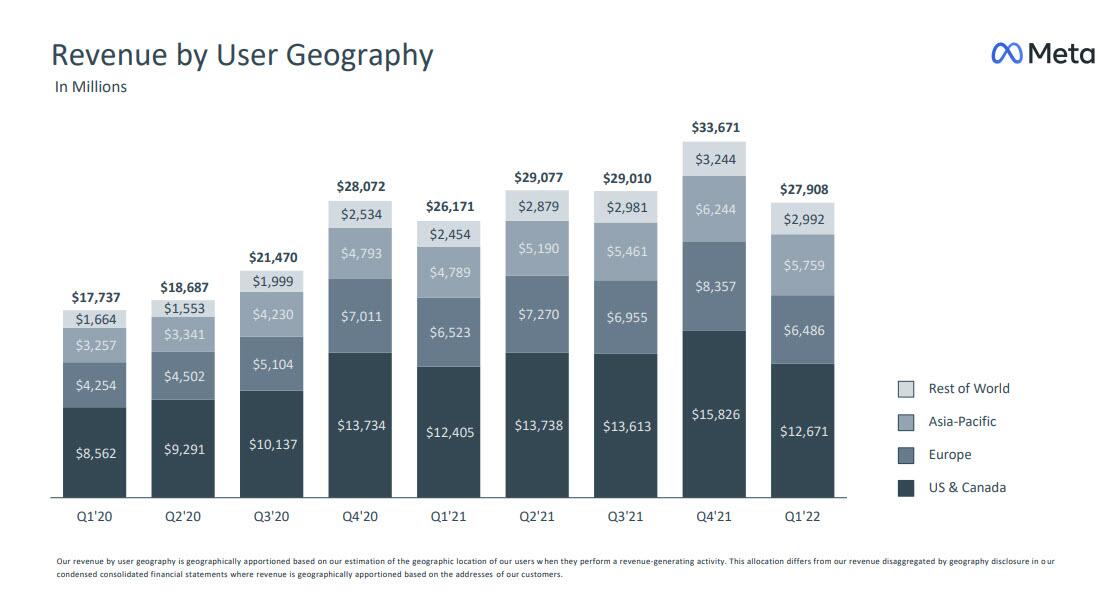
Why the revenue weakness? Well, the ad sales environment – as Google indicated yesterday – is getting more difficult: there’s the war in Ukraine, the Apple privacy changes that make it more difficult to target ads effectively, the supply-chain issues affecting advertisers, and inflation.

Operating income

  • Family of Apps operating income $11.48 billion
  • Reality Labs operating loss $2.96 billion
  • Operating margin 31%, estimate 29.8%

Users data:

  • Daily Active Users 1.96BN, beating Est. of 1.94BN, up 4% Y/Y
  • Monthly Active Users 2.94BN, missing Est. 2.95BN, up 3% Y/Y

One reason why the stock may be soaring after hours is after shrinking last quarter, US DAUs once again grew, from 195MM to 196MM.
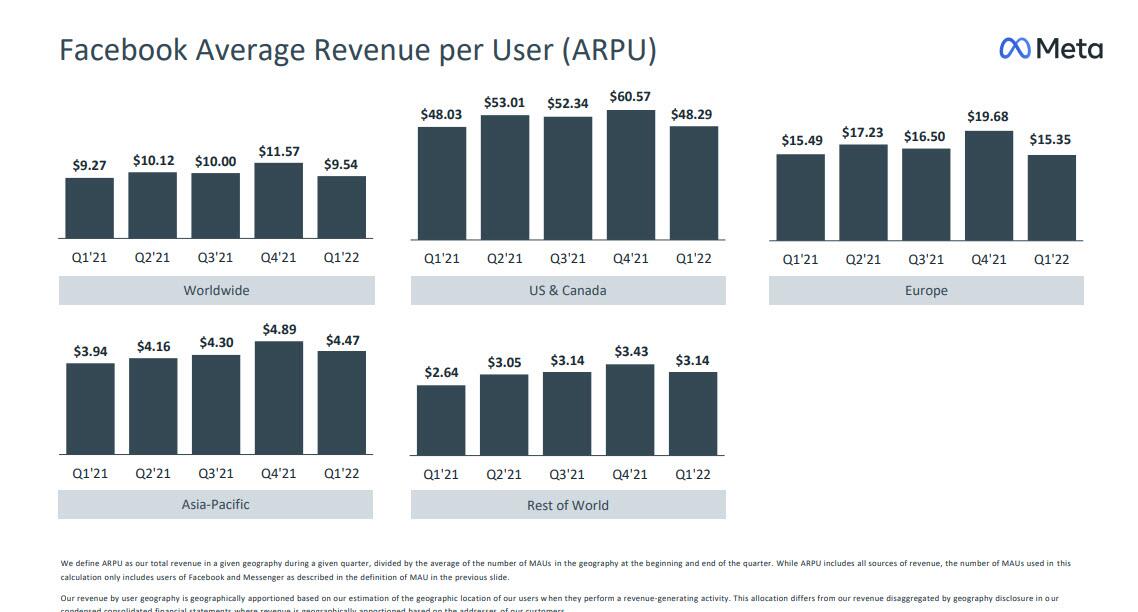
ARPUs were up in the US and worldwide, but dipped modestly in Europe.
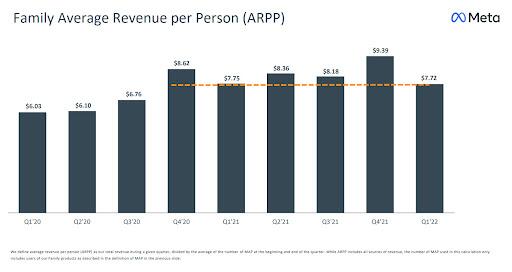
User metrics:

  • Average Family service users per day 2.87 billion, estimate 2.87 billion
  • Average Family service users per month 3.64 billion, estimate 3.63 billion
Some more data:

  • Capital expenditures – Capital expenditures, including principal payments on finance leases, were $5.55 billion for the first quarter of 2022.
  • Share repurchases – $9.39 billion Class A common stock shares repurchased. As of March 31, 2022, FB had $29.41 billion available and authorized for repurchases.
  • Cash and cash equivalents and marketable securities – $43.89 billion as of March 31, 2022.
  • Headcount – Headcount was 77,805 as of March 31, 2022, an increase of 28% year-over-year.

Last but not least, the company guidance. Here there was also some weakness, with the top end of the range missing consensus estimate sif coming higher than the earlier “leak” today.

  • Meta Platforms Sees 2Q Rev. $28B to $30B, Est. $30.74B
  • The s outlook reflects “softness in the back half of the first quarter that coincided with the war in Ukraine”

Some more details from the release:

  • We expect second quarter 2022 total revenue to be in the range of $28-30 billion. This outlook reflects a continuation of the trends impacting revenue growth in the first quarter, including softness in the back half of the first quarter that coincided with the war in Ukraine. Our guidance assumes foreign currency will be approximately a 3% headwind to year-over-year growth in the second quarter, based on current exchange rates.
  • In addition, as noted on previous calls, we continue to monitor developments regarding the viability of transatlantic data transfers and their potential impact on our European operations, and we are pleased with the progress on a political agreement.
  • We expect 2022 total expenses to be in the range of $87-92 billion, lowered from our prior outlook of $90-95 billion. We expect 2022 expense growth to be driven primarily by the Family of Apps segment, followed by Reality Labs.
  • We expect 2022 capital expenditures, including principal payments on finance leases, to be in the range of $29-34 billion, unchanged from our prior estimate.
  • Absent any changes to U.S. tax law, we expect our full-year 2022 tax rate to be above the first quarter rate and in the high teens.

While perhaps displeased by the weakness in revenues, investors will be pleased that Meta reduced its expense guidance. As Bloomberg notes, there was a lot of skepticism that Zuckerberg would be able to fund his grand visions for the metaverse on a dying social network. But it’s not dying, apparently, and it’s not as expensive.

Commenting on the quarter, Mark Zuckerberg said that “we made progress this quarter across a number of key company priorities and we remain confident in the long-term opportunities and growth that our product roadmap will unlock,” he said. “More people use our services today than ever before, and I’m proud of how our products are serving people around the world.”

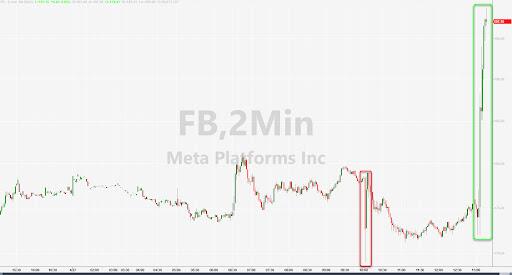
And unlike last quarter, when FB cratered by the most on record after an earnings release, this time investors have exhaled a collective sigh of relief and sent FB stock surging more than 10%.
Facebook’ Q1 earnings slide is below (pdf link)


Tyler Durden
Wed, 04/27/2022 – 16:32

via ZeroHedge News https://ift.tt/d7k0VGe Tyler Durden

A CDC Study Suggests Three-Fifths of Americans Have Been Infected by the Coronavirus


CoronaYakobchukDreamstime

Nearly three-fifths of Americans had been infected by the COVID-19 virus at least once as of February, according to new estimates from the Centers for Disease Control and Prevention (CDC). The results, which are based on seroprevalence research involving blood samples from all 50 states, indicate that infection prevalence varied widely across age groups: It was about 75 percent for children 11 and younger, 74 percent for 12-to-17-year-olds, 64 percent for 18-to-49-year-olds, 50 percent for 50-to-64-year-olds, and 33 percent for Americans 65 or older.

This study suggests that roughly 192 million Americans had been infected as of February, more than twice the number of cases that had been reported at the time. Based on the number of COVID-19 deaths recorded at the end of February, that estimate implies an overall U.S. infection fatality rate (IFR) of about 0.5 percent, which is substantially lower than the estimates used in early epidemiological models that projected as many as 2.2 million COVID-19 deaths in the United States, more than twice the current total. At the same time, the implied IFR is much higher than the estimates suggested by early seroprevalence studies in California and Florida.

Is 0.5 percent in the right ballpark? That depends on how well the CDC study measured the prevalence of infection. But it is also important to keep in mind that infection fatality rates can vary widely over time as the mix of patients changes, treatment improves, and vaccination becomes increasingly common; across age groups, since the risk for older people is vastly higher than the risk for younger people; and across locations with different demographics, patient characteristics, and health care capacities.

The blood samples for the CDC study were drawn for diagnostic purposes unrelated to COVID-19, and the researchers looked for anti-N antibodies, which are produced in response to infection but not in response to the vaccines approved for use in the United States. The New York Times reports that the study “used a test sensitive enough to identify previously infected people for at least one to two years after exposure.”

The researchers note four limitations: “First, convenience sampling might limit generalizability. Second, lack of race and ethnicity data precluded weighting for these variables. Third, all samples were obtained for clinical testing and might overrepresent persons with greater health care access or who more frequently seek care. Finally, these findings might underestimate the cumulative number of SARS-CoV-2 infections because infections after vaccination might result in lower anti-N titers, and anti-N seroprevalence cannot account for reinfections.”

Those limitations suggest that the total number of infections may be higher than the CDC’s estimate. The Times reports that “some scientists said they had expected the figures to be even higher, given the contagious variants that have marched through the nation over the past two years.” If the gap between reported cases and total infections is bigger than the CDC’s results suggest, that would imply a lower overall IFR.

In any case, a nationwide IFR estimate for a particular period of time obscures factors that have a big impact on the danger posed by COVID-19. In light of those factors, any single IFR estimate is apt to be misleading. Instead of trying to estimate the one “true” IFR, it makes more sense to recognize that there are many IFRs, contingent on time, location, and demographic variables.

In a January 2021 Bulletin of the World Health Organization article, Stanford epidemiologist John Ioannidis reported that the IFRs implied by seroprevalence studies “tended to be much lower than estimates made earlier in the pandemic.” But he also noted that “the infection fatality rate is not a fixed physical constant,” and “it can vary substantially across locations, depending on the population structure, the case-mix of infected and deceased individuals and other, local factors.”

Although it has long been clear that COVID-19 fatality rates are strongly correlated with age, the magnitude of the differences remains astonishing. According to the CDC’s “best estimate,” the IFR for people 65 or older is 9 percent, 4,500 times the IFR for children and teenagers (0.002 percent). A Lancet analysis published this month found that “age-specific IFR estimates form a J shape, with the lowest IFR [0.002 percent] occurring at age 7 years.” The estimated IFR “increas[es] exponentially” with age: from about 0.06 percent for a 30-year-old to 1 percent for a 60-year-old and 20 percent for a 90-year-old.

Parents of children who are not yet eligible for vaccination may be reassured by the CDC’s estimate that 75 percent of kids younger than 12 already had been infected by February. “That so many children are carrying antibodies may offer comfort to parents of those aged 5 and under,” the Times says, “since many may have acquired at least some immunity through infection.” But the most reassuring thing about the risk that COVID-19 poses to children in that age group is that it has always been tiny: According to the Lancet study, the IFR ranges from 0.002 percent for 5-year-olds to 0.005 percent for 1-year-olds.

That same study found that “all-age COVID-19 IFR varied by a factor of more than 30 across countries and territories during the pre-vaccine era.” The countries with the highest rates as of July 15, 2020, were Portugal (2.1 percent), Monaco (1.8 percent), Japan (1.8 percent), Spain (1.7 percent), and Greece (1.6 percent). When the researchers adjusted for age demographics, Portugal and Spain were still in the top five, but the other three countries were replaced by Peru, Oman, and Mexico.

“Because IFR is strongly related to age,” the authors report, “population age structure accounted for nearly three-quarters of variation in IFR estimates for in-sample countries on July 15, 2020.” But even when that factor was taken into account, “many North American and European countries continued to have high IFRs despite having greater access to health-care resources.” The researchers say possible explanations include “high SARS-CoV-2 transmission rates in the care home population of some locations” and “a higher prevalence of comorbidities that increase the severity of COVID-19 disease.”

The IFRs implied by CDC seroprevalence research conducted around the same time likewise varied widely across states, ranging from 0.1 percent in Utah to 1.4 percent in Connecticut. As with the international comparisons, age demographics probably explain much of the variation (the median age in Utah is substantially lower than the median age in Connecticut), but other factors (such as preexisting medical conditions) may also be important.

The Lancet study, which covered 190 countries and territories, also found that IFRs fell over time. Adjusted for age demographics, they ranged from 0.17 percent to 1.16 percent on April 15, 2020, and from 0.12 percent to 0.77 percent on January 1, 2021. The median IFR fell from 0.54 percent to 0.35 percent during that period. The age-standardized IFR for the United States, according to these estimates, fell from 0.73 percent to 0.43 percent.

IFRs were dropping well before vaccines were widely available, which may reflect a combination of shifting patient characteristics, improved treatment, and naturally acquired immunity. “The evidence suggests that a range of improvements in clinical management have contributed to substantive improvements in clinical outcomes that are likely to decrease the IFR over time,” the researchers say.

Vaccination, which dramatically reduces the risk of life-threatening symptoms, can be expected to push IFRs down further, although age still seems to be the most important predictor of infection outcomes. As Reason‘s Elizabeth Nolan Brown noted in September, “a Financial Times analysis found the COVID-19 mortality risk is about equal for vaccinated 80-year-olds and unvaccinated 50-year-olds, while an unvaccinated 30-year-old has less chance of dying than a vaccinated 45-year-old.”

The post A CDC Study Suggests Three-Fifths of Americans Have Been Infected by the Coronavirus appeared first on Reason.com.

from Latest https://ift.tt/iGb6YJI
via IFTTT

Russia Hoax: Durham Staffer Accidentally Reveals Emails Showing Coordination Between Fusion GPS And Media

Russia Hoax: Durham Staffer Accidentally Reveals Emails Showing Coordination Between Fusion GPS And Media

Authored by Sundance via The Last Refuge,

Another significant filing by John Durham’s special counsel team to the court was made Monday night.  {READ HERE} Within the filing the staff accidentally did not seal the attachments which are emails between Fusion GPS and many major media outletsWhoops.

First, the background

In a previous liable lawsuit by Alfa Bank against Fusion GPS, the Russian bank was able to get the internal emails between Fusion GPS and major media outlets as part of the lawsuit discovery phase.  Despite the lawsuit failing to advance, those prior emails now become evidence for John Durham to use in the case against Clinton lawyer Michael Sussmann.

Michael Sussmann, a Perkins Coie lawyer, is accused of lying to the FBI about who he was working for when Sussmann was trying to push the Trump-Russia collusion story to trigger an investigation.  Former FBI legal counsel James Baker has said Sussmann told the FBI he was operating independently as a concerned citizen.  However, Sussmann is defending himself by saying: (a) he never said he was not working for Clinton at the time he brought the FBI the material, a demonstrable falsehood; and (b) he was motivated by altruism, unrelated to efforts to help Clinton, another demonstrable falsehood.

As the case has proceeded all of the parties are now claiming legal and work product ‘privileges’ to stop Durham from using their communication and networked conspiracy against Michael Sussmann, and by extension them, in court.  Fusion GPS, Perkins Coie, Marc Elias, Michael Sussmann, Hillary for America (Clinton campaign), Robby Mook (Campaign Manager), along with Tech-Executive-1 Rodney Joffe, are all claiming some form of privilege.

Monday night, in a responsive filing connected to all of the privilege claims, John Durham deconstructed the nature of their defense. Techno-Fog has a good outline {SEE HERE} of the court documents.  However, attached to the filing were exhibits supposed to be filed under seal that the Durham staff “accidentally” did not seal right away.

The exhibit consists of the emails between Fusion GPS and media as the opposition research team attempted to push the Trump-Russia collusion story into the media bloodstream -through their ideologically aligned allies- in 2016.

The emails show how extensive Fusion GPS co-founders Glenn Simpson and Peter Fritsch pushed the Trump Russia story.  The emails show the coordinated effort of Fusion GPS with multiple journalists, producers and media outlets.  You can read the emails HERE.

I’m not going to publish the emails because the contacts, addresses, phone numbers etc. are not redacted; but you can clearly see the scale of who was involved.

The emails show journalists from Politico, The New York Times, Wall Street Journal, The Washington Post, CNN, ABC, CBS and NBC all feeding from the same trough of manipulated information being fed from Fusion GPS.  The journalists, producers and Fusion GPS all working in close coordination to push the false Trump-Russia collusion conspiracy.

The accidentally public emails highlight a soup-to-nuts ‘who’s-who‘ of political disinformation. {SEE HERE}

Additionally, the Durham filing itself {SEE HERE} gives us another granular look at how the prosecution is walking the tightrope of carefully balanced prosecution of leftist activists, lawfare people and political organizations outside government.

Within the filing the privilege claims are easily dispatched by prosecutor Andrew J. DeFilippis, Assistant Special Counsel to John Durham.  One key paragraph is a little funny in that the prosecution uses the defense position against them.  The prosecution states the “purported privilege holders who have intervened do so in a case in which the defendant has denied representing any client when he brought the Russian Bank-1 allegations to the FBI.”

The privilege controversy itself seemingly entraps Michael Sussmann.  How can Sussmann claim attorney-client privilege when his defense is to say he wasn’t working on behalf of any client when he brought the information to the FBI?   Whoopsie daisy.

All of that said, there’s another interesting aspect to this specific filing if you stand back away from the granular legal details and look at the arc of the prosecution within it.   It appears to me that Michael Sussmann is not the REAL target of this prosecution, Marc Elias is.

It looks like John Durham is using the prosecution of Sussmann, and all the details within the case, to box in a very easy prosecution of Michael Sussmann’s boss, the infamous Democrat lawyer, Marc Elias.   Read the filing and you see how Perkins Coie and Marc Elias are clearly and purposefully outlined as having the major role in the activity of Sussmann.  All prosecutorial roads against Sussmann are leading to Elias.

That risk would certainly explain why Marc Elias left Perkins Coie immediately after the Alfa Bank lawsuit against Fusion GPS revealed the connective tissue, and then John Durham start focusing on Perkins Coie and Michael Sussmann.

Given the ideological and political nature of the DOJ under AG Merrick Garland and Deputy AG Lisa Monaco, it makes sense that John Durham would not and importantly, could not, go directly at Marc Elias.

Marc Elias is the biggest Lawfare fish in the world of Democrats.  He is the primary legal mind and legal entity around the entire Democrat apparatus from elections to electoral maps.  Elias is the leftists modern legal Moses.

If John Durham was viewed to be targeting Elias directly, his special counsel investigation would be shut down tomorrow, regardless of political backlash.  Marc Elias is to outside government as Barack Obama is to inside government.

The DOJ would immediately stop Durham if he was obviously targeting Elias.  Inside the firestorm that follows, the political media would rally the wagons around protecting Garland, Monaco and Biden ….and after a few days of republicans in the legislative branch gnashing their teeth on Hannity, Ingraham et al, the explosive decision would blow over.   DC would make or create some massive shiny thing to cover the controversy.

Bottom Line: Marc Elias is protected by both wings of the professionally political UniParty.

That said, if in the prosecution of Michael Sussmann, it became obvious that Marc Elias was guilty of organizing a criminal conspiracy to defraud the Unites States government on behalf of the Clinton campaign, well, that would be incidental, and that’s how Durham could get to Elias.

Marc Elias is likely to be the biggest catchable fish in the carefully navigated prosecution of those outside government.

Keep watching.

Tyler Durden
Wed, 04/27/2022 – 16:20

via ZeroHedge News https://ift.tt/DBZGv5E Tyler Durden

City Council Furious at Cop Who Played Disney Songs To Keep from Being Recorded


SACCYT

Earlier this month, a Santa Ana, California, police officer blasted Disney songs in an attempt to keep videos of himself off of the Internet. Now, the city government is demanding answers.

On April 4, officers responded to a report of a stolen car in a residential neighborhood late at night. As a local YouTuber approached the scene, one officer began playing Disney songs at a high volume through loudspeakers. The music continued until Johnathan Ryan Hernandez, a Santa Ana city councilman who happened to live nearby, identified himself and asked the officer to stop. The officer admitted that he was playing the music to create a “copyright infringement” headache for the person filming.

Last week, at a Santa Ana City Council meeting, council members excoriated the officer’s actions. Councilman David Penaloza called it “one of the most embarrassing things I’ve ever seen.” Hernandez said, “There’s no reason to ever behave this way with members of the public, especially if you’re an officer with a badge and a gun.” And Mayor Vicente Sarmiento lamented that such an event “chills” the city’s efforts to “build trust with the community.”

After the video initially went viral, Santa Ana Police Chief David Valentin indicated that the officer was under investigation. Hernandez submitted an ordinance seeking to ban the practice, but as Valentin pointed out at the council meeting, the officer’s actions were already against policy: According to the Santa Ana Police Policy Manual, the department “recognizes the right of persons to lawfully record members of this department who are performing their official duties. Members of this department will not prohibit or intentionally interfere with such lawful recordings.”

The post City Council Furious at Cop Who Played Disney Songs To Keep from Being Recorded appeared first on Reason.com.

from Latest https://ift.tt/2IcgBx7
via IFTTT

If Elon Musk Is ‘Targeting’ Twitter Employees, Isn’t The Washington Post ‘Targeting’ Elon Musk?


sipaphotosthirteen420530

The Washington Post has accused billionaire Elon Musk, who is set to acquire Twitter for $44 billion, of “targeting” the company’s employees for harassment.

In actuality, all Musk did was offer some entirely valid criticisms of a specific, high-level employee: Vijaya Gadde, a top executive at Twitter and someone Politico once described as “the most important Silicon Valley executive you’ve never heard of.” And if criticizing someone on Twitter is equivalent to harassing them, has The Washington Post not committed the exact same crime?

The Post‘s confused and contradictory reporting on this issue notes that Saagar Enjeti, co-host of the podcast Breaking Points, named Gadde as Twitter’s “top censorship advocate” for her integral role in the company’s decisions to suspend former President Donald Trump’s account, and more infamously, to prevent users from sharing The New York Post‘s Hunter Biden story.

Musk replied to Enjeti’s tweet with this comment: “Suspending the Twitter account of a major news organization for publishing a truthful story was obviously incredibly inappropriate.”

Not only is Musk absolutely correct that muzzling the Hunter Biden story was a bad decision: Twitter actually agrees that it was a bad decision. Former CEO Jack Dorsey has described that action as a “total mistake” and repeatedly apologized for it. He clearly regrets working to suppress the story.

There’s really no headline here. If there is a headline, it should probably be: Elon Musk Agrees With Twitter That Censoring the Hunter Biden Story Was Wrong.

Yet here’s how The Washington Post headlined this revelation: “Elon Musk boosts criticism of Twitter executives, prompting online attacks.”

The author of that article, Post tech writer Elizabeth Dwoskin, summarized her reporting thusly:

This is a very bizarre line of reasoning. Musk did not pen any racist attacks on Gadde; he echoed an accurate criticism of Twitter policies for which she is directly responsible. Obviously, he is not at fault for nastier comments that come her way.

Yet Dwoskin is very clearly placing blame on both Musk and Enjeti, the latter of whom shared the request for comment he received from her at 2:06 a.m. Dwoskin asked Enjeti’s producer whether Enjeti had any concern “that mentioning a specific Twitter executive could result in attacks on that executive”?

“For example, one of the commenters on the tweets made racist comments against Gadde, and others said she should be fired,” said Dwoskin.

But taken to its logical conclusion, isn’t Dwoskin’s article doing the same thing? After all, she is directing criticism—legitimate in her view, but criticism nonetheless—at Enjeti and Musk. She “mentioned” them, to use her own terminology. No doubt this will produce some angry denunciations; Musk is currently receiving both hearty praise and relentless demonization as a result of his Twitter purchase. If Musk is “targeting” Gadde for harassment, what is the best way to describe a Washington Post article that wrongly maligns him? Isn’t Dwoskin “targeting” Musk?

If Dwoskin and the Post reject that analogy, this is what they are saying: when the media industry holds people to account, it’s noble and justified; but when people outside media hold people to account, it’s an act of targeted harassment. The media then insist these acts of targeted harassment (as they define it) are newsworthy, and the cycle repeats itself.

This was the subtext of last week’s Washington Post expose on Libs of TikTok, which revealed the name of the woman behind the influential rightwing Twitter account. Libs of TikTok collects and republishes videos depicting progressive teachers and activists making comments that attract mockery from conservatives; by exposing the account, The Washington Post sought to shed light on the inner workings of the rightwing outrage machine. But the woman’s identity wasn’t particularly important to the story, and revealing it undoubtedly subjected her to considerable opprobrium.

In response, fans of Libs of TikTok relentlessly assailed the story’s author, Taylor Lorenz. Much of the anti-Lorenz campaign was itself creepy and vile. But it’s getting somewhat difficult to delineate legitimate reporting that serves the public interest from malicious spotlighting of political foes, unless one takes the clearly dubious position that exposes crafted by journalists are de facto legitimate.

At the very least, The Washington Post should ween itself from the idea that mentioning someone means targeting them for harassment, or make piece with the criticism of its self-dealing double standard.

The post If Elon Musk Is 'Targeting' Twitter Employees, Isn't <em>The Washington Post</em> 'Targeting' Elon Musk? appeared first on Reason.com.

from Latest https://ift.tt/tT2pc0U
via IFTTT

A Bit More on the Florida Disney Special Government District Repeal Controversy

I blogged about this controversy Friday, and then quoted Prof. Michael Dorf’s and an experienced appellate lawyer’s take on Monday. Another lawyer, Dilan Esper, had a Twitter thread pointing to Kensington Volunteer Fire Department v. Montgomery County (4th Cir. 2012), which suggests that the legislature’s motivation for repealing the special government district run by Disney (which seems to be disapproval of Disney’s speech) is irrelevant:

A group of local volunteer fire and rescue departments (“LFRDs”) and several of their former administrative employees … brought suit … contending that Defendants eliminated part of Plaintiffs’ funding in retaliation for Plaintiffs’ opposition to legislation supported by Defendants.

The district court dismissed Plaintiffs’ complaint, declining to inquire into Defendants’ alleged illicit motive behind an otherwise facially valid budgetary enactment … We affirm.

The district court’s decision relied on U.S. v. O’Brien (1968), in which the Supreme Court declined to “strike down an otherwise constitutional statute on the basis of an alleged illicit legislative motive.”

O’Brien considered a First Amendment challenge to a federal statute that penalized the destruction of draft cards. Noting that the law did not facially abridge speech, the Court rejected an argument that the law was nonetheless unconstitutional because its purpose was to suppress free speech. The Court warned that it was a “hazardous matter” to inquire into legislative motives because “[w]hat motivates one legislator to make a speech about a statute is not necessarily what motivates scores of others to enact it, and the stakes are sufficiently high for us to eschew guesswork.” Accordingly, the Court “decline[d] to void [legislation] essentially on the ground that it is unwise legislation which Congress had the undoubted power to enact and which could be reenacted in its exact form if the same or another legislator made a ‘wiser’ speech about it.”

As Plaintiffs concede, the budget is facially valid. And in alleging that Defendants retaliated against them by eliminating funding for the LFRD administrative positions, Plaintiffs challenge Defendants’ legislative action. Plaintiffs, however, rely for support on cases in which the alleged retaliation was accomplished via executive action….

In trying economic times, and in response to the loss of $14.1 million in projected revenue following the defeat of the ambulance fee legislation, the County passed a budget that called for difficult cuts felt by many. As the district court concluded “there is no doubt that Defendants had the authority to pass the budget savings plan, and it appears to be a thoroughly ordinary cost savings measure.” Confronted with such a facially constitutional budgetary enactment, O’Brien instructs that we not strike it down “on the basis of an alleged illicit legislative motive,”

I appreciate Mr. Esper’s argument (which goes into this in considerable detail, and also discusses some possible distinctions between this case and Kensington); but I’m just not sure that First Amendment law really does preclude inquiries into legislative intent. Consider this summary of the law from Reed v. Town of Gilbert (2015):

Although “a content-based purpose may be sufficient in certain circumstances to show that a regulation is content based, it is not necessary.” Turner Broadcasting System, Inc. v. FCC (1994).

That is why we have repeatedly considered whether a law is content neutral on its face before turning to the law’s justification or purpose. See, e.g., Sorrell v. IMS Health, Inc. (2011) (statute was content based “on its face,” and there was also evidence of an impermissible legislative motive); U.S. v. Eichman (1990) (“Although the [statute] contains no explicit content-based limitation on the scope of prohibited conduct, it is nevertheless clear that the Government’s asserted interest is related to the suppression of free expression”); Members of City Council of Los Angeles v. Taxpayers for Vincent (1984) (“The text of the ordinance is neutral,” and “there is not even a hint of bias or censorship in the City’s enactment or enforcement of this ordinance”); Clark v. Community for Creative Non-Violence (1984) (requiring that a facially content-neutral ban on camping must be “justified without reference to the content of the regulated speech”); United States v. O’Brien (1968) (noting that the statute “on its face deals with conduct having no connection with speech,” but examining whether the “the governmental interest is unrelated to the suppression of free expression”). Because strict scrutiny applies either when a law is content based on its face or when the purpose and justification for the law are content based, a court must evaluate each question before it concludes that the law is content neutral and thus subject to a lower level of scrutiny….

Ward [v. Rock Against Racism] (1989) had nothing to say about facially content-based restrictions because it involved a facially content-neutral ban on the use, in a city-owned music venue, of sound amplification systems not provided by the city. In that context, we looked to governmental motive, including whether the government had regulated speech “because of disagreement” with its message, and whether the regulation was “‘justified without reference to the content of the speech.'”

This is one reason why I think the issue is difficult: One can indeed argue that the legislative action was unconstitutionally motivated by Disney’s past speech, though one can also argue (among other things) that denial of government power (rather than just, say, a tax exemption or a trash hauling contract) based on the powerholder’s speech is constitutional, whether the powerholder is (say) an appointed executive official or a corporation that is allowed to run a special government district.

Here is Mr. Esper’s response in our e-mail exchange; I don’t think it quite disposes of the issue, but I thought I’d pass it along:

My attempt to rationalize the cases, which are indeed all over the place, would be this—I think O’Brien involved a statute that on its face had nothing to do with speech at all. It was a prohibition on destroying or mutilating your draft card. And the government had an interest, however thin it was, in requiring people to keep their draft cards. So the only chance that the defendant really had to overturn the statute was if there’s a doctrine that says “even though this is, on its face, a prohibition on the mutilation of an important government form, if you can show that the real purpose of this wasn’t to administer the draft but rather to target a popular form of war protest, you win your case”. And SCOTUS said you can’t do that.

To put it another way, perhaps more clearly, O’Brien is an expressive conduct case. And one of the things that can happen in expressive conduct cases is that the government can ban or regulate the category of conduct for some non-speech related reason. For instance, if a county prohibits its citizens from burning anything or starting any fires in an area of the county with a lot of trees and kindling, we all understand that this prohibition could be enforced against flag burners or draft card burners. And what O’Brien adds is that even if the reason the county passed that ordinance was that people were burning flags out there to protest the government, it wouldn’t matter. It’s a law that doesn’t say anything about speech at all; it just prohibits starting fires. The government can do this, because it has a legitimate interest in the prohibition of fire-starting in a hazardous area, even if they really secretly or openly want to stop flag burning.

And the difference with Reed is Reed is a speech case, not an expressive conduct case. It is a sign regulation, and signs are speech. So now we have to determine whether the sign regulation is content based in how it differentiates some speech from other speech, and Reed says it was. Reagan National Advertising, which just came down, says that another sign regulation that differentiates some speech from other speech wasn’t content based. An interesting hypothetical would be what would happen if a municipality enacted an off premises sign ban (the type approved in Reagan National) to target a specific speaker who was dotting the community with off premises signs- would that be considered content based? I don’t know. But at the very least, the law seems to be that a speech-suppressive purpose can be considered in determining whether a speech regulation is content based.

This analysis at least fits with the other cases you cite. Sorrell involved the disclosure of medical records—speech.  Taxpayers for Vincent was a signage case. Hill was about abortion protest—and upheld the regulation anyway.

As for Ward and Clark, they upheld the regulations, both of which were facially directed at conduct rather than speech. Ward was about sound volume—didn’t matter what was playing at that volume and whether it had any expressive content at all. Clark was about sleeping in the park—again, didn’t matter why people were sleeping there, even though the government may have been targeting the homeless protesters.

The one case that you could argue is an outlier is Eichman, where the statute just prohibited the burning of a flag for any reason. Perhaps Eichman is a limitation on the O’Brien principle. But perhaps not, because unlike in O’Brien, there was no legitimate reason for the government to be concerned with flag burning anyway. The only reason for the government to worry specifically about burning flags was because they were a form of protest.

So what I think the cases really stand for is: (1) if a statute/ordinance specifically targets speech on its face, you can consider legislative intent when determining content neutrality (Reed); (2) if a statute/ordinance facially targets conduct but there is no legitimate governmental interest in regulating the specific conduct targeted, you can also consider legislative intent when determining content neutrality (Eichman); but (3) if a statute/ordinance facially targets conduct and there is a legitimate governmental interest in regulating the specific conduct targeted, O’Brien applies and legislative intent is irrelevant.

I’m sure that doesn’t fit every case out there. But it seems like a plausible way of putting the cases together.

The post A Bit More on the Florida Disney Special Government District Repeal Controversy appeared first on Reason.com.

from Latest https://ift.tt/6VZFRB5
via IFTTT

City Council Furious at Cop Who Played Disney Songs To Keep from Being Recorded


SACCYT

Earlier this month, a Santa Ana, California, police officer blasted Disney songs in an attempt to keep videos of himself off of the Internet. Now, the city government is demanding answers.

On April 4, officers responded to a report of a stolen car in a residential neighborhood late at night. As a local YouTuber approached the scene, one officer began playing Disney songs at a high volume through loudspeakers. The music continued until Johnathan Ryan Hernandez, a Santa Ana city councilman who happened to live nearby, identified himself and asked the officer to stop. The officer admitted that he was playing the music to create a “copyright infringement” headache for the person filming.

Last week, at a Santa Ana City Council meeting, council members excoriated the officer’s actions. Councilman David Penaloza called it “one of the most embarrassing things I’ve ever seen.” Hernandez said, “There’s no reason to ever behave this way with members of the public, especially if you’re an officer with a badge and a gun.” And Mayor Vicente Sarmiento lamented that such an event “chills” the city’s efforts to “build trust with the community.”

After the video initially went viral, Santa Ana Police Chief David Valentin indicated that the officer was under investigation. Hernandez submitted an ordinance seeking to ban the practice, but as Valentin pointed out at the council meeting, the officer’s actions were already against policy: According to the Santa Ana Police Policy Manual, the department “recognizes the right of persons to lawfully record members of this department who are performing their official duties. Members of this department will not prohibit or intentionally interfere with such lawful recordings.”

The post City Council Furious at Cop Who Played Disney Songs To Keep from Being Recorded appeared first on Reason.com.

from Latest https://ift.tt/2IcgBx7
via IFTTT

FANG FUBAR, Bonds & Boeing Battered As Dollar Index Nears 20-Year-High

FANG FUBAR, Bonds & Boeing Battered As Dollar Index Nears 20-Year-High

FANG stocks puked again…

led by weakness in GOOGL and FB – now back at a crucial support level, from right before the COVID crash…

Source: Bloomberg

And as Goldman’s Prime Desk notes, the cumulative net selling across the FAAMG complex over the past week was the largest over any 5-day period YTD.

Netflix is the biggest loser of the bunch but they are all ugly AF…

Source: Bloomberg

NFLX has a long way to fall to find any support…

Source: Bloomberg

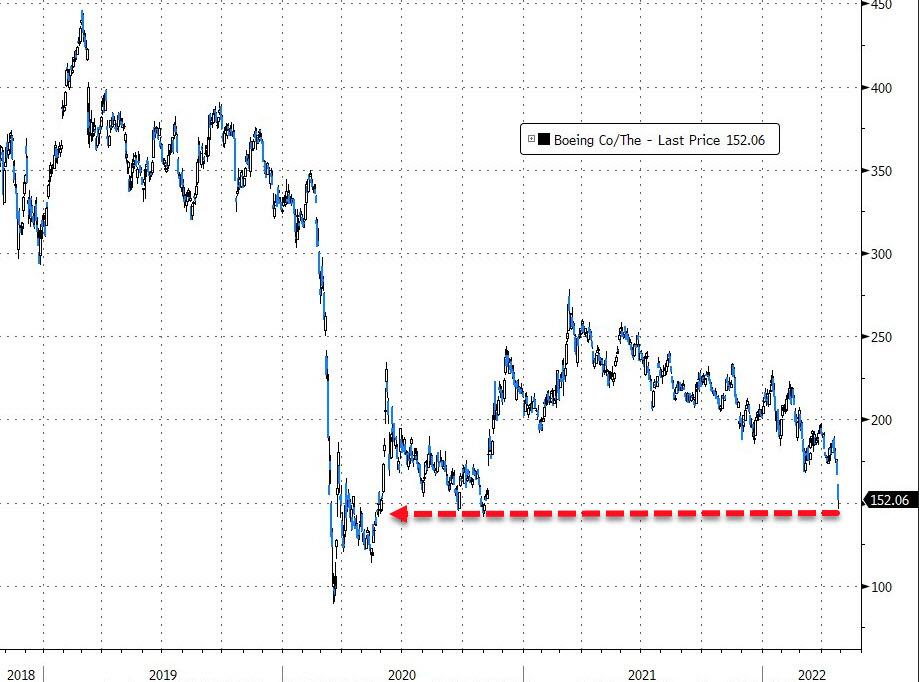
It wasn’t just the megacap tech stocks either as Boeing was battered lower today – testing back towards its lowest since June 2020…

Source: Bloomberg

After GOOGL tanked after hours last night, MSFT rescued the Nasdaq but it could not keep the dream alive all day as all the US majors traded in fits and starts, giving back gains in the last hour. Small Caps were the day’s biggest laggards

Equities continue to catch down to credit markets – which puked today after Carvana’s bonds were battered…

Source: Bloomberg

Treasuries were unceremoniously dumped today across the board with yields up around 8-10bps. The trading pattern was similar with buying in Europe and selling in US, but we note that Treasury yields are all still lower on the week…

Source: Bloomberg


The dollar index (DXY) extended recent gains this week, taking out the COVID crisis highs of March 2020…

Source: Bloomberg

…back to its highest against the small basket of fiat peers since 2002…

Source: Bloomberg

Meanwhile the Ruble is soaring (against the dollar and euro)…

Source: Bloomberg

European gas surged, after Russia halted flows to Poland and Bulgaria, escalating regional tensions and delivering a warning to the continent that it’s serious about cutting supplies amid a standoff over fuel payments.

Source: Bloomberg

And that helped lift US NatGas back above $7 (more LNG export demand?)…

Gold was dumped back below $1900, and didn’t immediately bounce back for a change…

Oil managed modest gains, with WTI rebounding off a $100 handle…

Finally, Bitcoin and Nasdaq continue to trade as if joined at the hip…

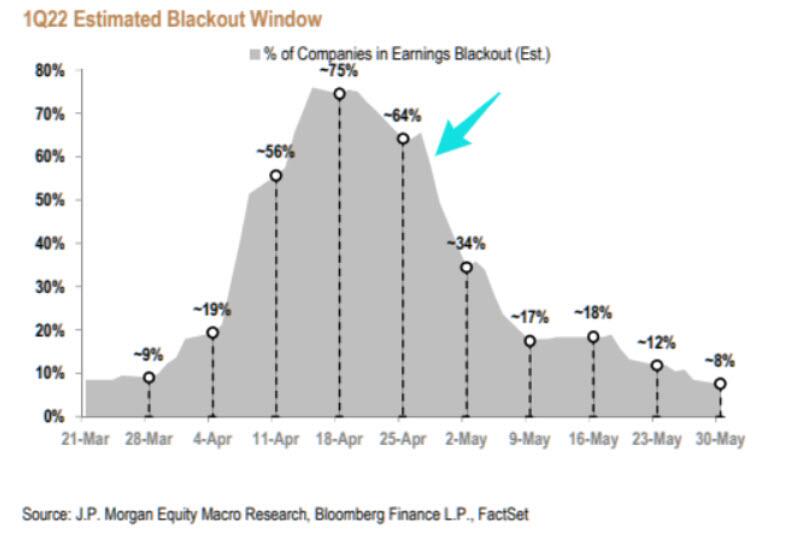
Is a bounce coming into the 5/4 FOMC window as the buyback window re-opens?

4200 remains a key line in the sand for the S&P.

Ok, one more thing, Biden is buggered as gas prices at the pump are on the rise again…

But don’t worry, The White House are on it… ALL OPTIONS REMAIN ON TABLE FOR CUTTING GASOLINE PRICES: PSAKI… Price Controls coming in 3…2…1… because they always work so well.

Tyler Durden
Wed, 04/27/2022 – 16:01

via ZeroHedge News https://ift.tt/4U0XQAn Tyler Durden

If Elon Musk Is ‘Targeting’ Twitter Employees, Isn’t The Washington Post ‘Targeting’ Elon Musk?


sipaphotosthirteen420530

The Washington Post has accused billionaire Elon Musk, who is set to acquire Twitter for $44 billion, of “targeting” the company’s employees for harassment.

In actuality, all Musk did was offer some entirely valid criticisms of a specific, high-level employee: Vijaya Gadde, a top executive at Twitter and someone Politico once described as “the most important Silicon Valley executive you’ve never heard of.” And if criticizing someone on Twitter is equivalent to harassing them, has The Washington Post not committed the exact same crime?

The Post‘s confused and contradictory reporting on this issue notes that Saagar Enjeti, co-host of the podcast Breaking Points, named Gadde as Twitter’s “top censorship advocate” for her integral role in the company’s decisions to suspend former President Donald Trump’s account, and more infamously, to prevent users from sharing The New York Post‘s Hunter Biden story.

Musk replied to Enjeti’s tweet with this comment: “Suspending the Twitter account of a major news organization for publishing a truthful story was obviously incredibly inappropriate.”

Not only is Musk absolutely correct that muzzling the Hunter Biden story was a bad decision: Twitter actually agrees that it was a bad decision. Former CEO Jack Dorsey has described that action as a “total mistake” and repeatedly apologized for it. He clearly regrets working to suppress the story.

There’s really no headline here. If there is a headline, it should probably be: Elon Musk Agrees With Twitter That Censoring the Hunter Biden Story Was Wrong.

Yet here’s how The Washington Post headlined this revelation: “Elon Musk boosts criticism of Twitter executives, prompting online attacks.”

The author of that article, Post tech writer Elizabeth Dwoskin, summarized her reporting thusly:

This is a very bizarre line of reasoning. Musk did not pen any racist attacks on Gadde; he echoed an accurate criticism of Twitter policies for which she is directly responsible. Obviously, he is not at fault for nastier comments that come her way.

Yet Dwoskin is very clearly placing blame on both Musk and Enjeti, the latter of whom shared the request for comment he received from her at 2:06 a.m. Dwoskin asked Enjeti’s producer whether Enjeti had any concern “that mentioning a specific Twitter executive could result in attacks on that executive”?

“For example, one of the commenters on the tweets made racist comments against Gadde, and others said she should be fired,” said Dwoskin.

But taken to its logical conclusion, isn’t Dwoskin’s article doing the same thing? After all, she is directing criticism—legitimate in her view, but criticism nonetheless—at Enjeti and Musk. She “mentioned” them, to use her own terminology. No doubt this will produce some angry denunciations; Musk is currently receiving both hearty praise and relentless demonization as a result of his Twitter purchase. If Musk is “targeting” Gadde for harassment, what is the best way to describe a Washington Post article that wrongly maligns him? Isn’t Dwoskin “targeting” Musk?

If Dwoskin and the Post reject that analogy, this is what they are saying: when the media industry holds people to account, it’s noble and justified; but when people outside media hold people to account, it’s an act of targeted harassment. The media then insist these acts of targeted harassment (as they define it) are newsworthy, and the cycle repeats itself.

This was the subtext of last week’s Washington Post expose on Libs of TikTok, which revealed the name of the woman behind the influential rightwing Twitter account. Libs of TikTok collects and republishes videos depicting progressive teachers and activists making comments that attract mockery from conservatives; by exposing the account, The Washington Post sought to shed light on the inner workings of the rightwing outrage machine. But the woman’s identity wasn’t particularly important to the story, and revealing it undoubtedly subjected her to considerable opprobrium.

In response, fans of Libs of TikTok relentlessly assailed the story’s author, Taylor Lorenz. Much of the anti-Lorenz campaign was itself creepy and vile. But it’s getting somewhat difficult to delineate legitimate reporting that serves the public interest from malicious spotlighting of political foes, unless one takes the clearly dubious position that exposes crafted by journalists are de facto legitimate.

At the very least, The Washington Post should ween itself from the idea that mentioning someone means targeting them for harassment, or make piece with the criticism of its self-dealing double standard.

The post If Elon Musk Is 'Targeting' Twitter Employees, Isn't <em>The Washington Post</em> 'Targeting' Elon Musk? appeared first on Reason.com.

from Latest https://ift.tt/tT2pc0U
via IFTTT

A Bit More on the Florida Disney Special Government District Repeal Controversy

I blogged about this controversy Friday, and then quoted Prof. Michael Dorf’s and an experienced appellate lawyer’s take on Monday. Another lawyer, Dilan Esper, had a Twitter thread pointing to Kensington Volunteer Fire Department v. Montgomery County (4th Cir. 2012), which suggests that the legislature’s motivation for repealing the special government district run by Disney (which seems to be disapproval of Disney’s speech) is irrelevant:

A group of local volunteer fire and rescue departments (“LFRDs”) and several of their former administrative employees … brought suit … contending that Defendants eliminated part of Plaintiffs’ funding in retaliation for Plaintiffs’ opposition to legislation supported by Defendants.

The district court dismissed Plaintiffs’ complaint, declining to inquire into Defendants’ alleged illicit motive behind an otherwise facially valid budgetary enactment … We affirm.

The district court’s decision relied on U.S. v. O’Brien (1968), in which the Supreme Court declined to “strike down an otherwise constitutional statute on the basis of an alleged illicit legislative motive.”

O’Brien considered a First Amendment challenge to a federal statute that penalized the destruction of draft cards. Noting that the law did not facially abridge speech, the Court rejected an argument that the law was nonetheless unconstitutional because its purpose was to suppress free speech. The Court warned that it was a “hazardous matter” to inquire into legislative motives because “[w]hat motivates one legislator to make a speech about a statute is not necessarily what motivates scores of others to enact it, and the stakes are sufficiently high for us to eschew guesswork.” Accordingly, the Court “decline[d] to void [legislation] essentially on the ground that it is unwise legislation which Congress had the undoubted power to enact and which could be reenacted in its exact form if the same or another legislator made a ‘wiser’ speech about it.”

As Plaintiffs concede, the budget is facially valid. And in alleging that Defendants retaliated against them by eliminating funding for the LFRD administrative positions, Plaintiffs challenge Defendants’ legislative action. Plaintiffs, however, rely for support on cases in which the alleged retaliation was accomplished via executive action….

In trying economic times, and in response to the loss of $14.1 million in projected revenue following the defeat of the ambulance fee legislation, the County passed a budget that called for difficult cuts felt by many. As the district court concluded “there is no doubt that Defendants had the authority to pass the budget savings plan, and it appears to be a thoroughly ordinary cost savings measure.” Confronted with such a facially constitutional budgetary enactment, O’Brien instructs that we not strike it down “on the basis of an alleged illicit legislative motive,”

I appreciate Mr. Esper’s argument (which goes into this in considerable detail, and also discusses some possible distinctions between this case and Kensington); but I’m just not sure that First Amendment law really does preclude inquiries into legislative intent. Consider this summary of the law from Reed v. Town of Gilbert (2015):

Although “a content-based purpose may be sufficient in certain circumstances to show that a regulation is content based, it is not necessary.” Turner Broadcasting System, Inc. v. FCC (1994).

That is why we have repeatedly considered whether a law is content neutral on its face before turning to the law’s justification or purpose. See, e.g., Sorrell v. IMS Health, Inc. (2011) (statute was content based “on its face,” and there was also evidence of an impermissible legislative motive); U.S. v. Eichman (1990) (“Although the [statute] contains no explicit content-based limitation on the scope of prohibited conduct, it is nevertheless clear that the Government’s asserted interest is related to the suppression of free expression”); Members of City Council of Los Angeles v. Taxpayers for Vincent (1984) (“The text of the ordinance is neutral,” and “there is not even a hint of bias or censorship in the City’s enactment or enforcement of this ordinance”); Clark v. Community for Creative Non-Violence (1984) (requiring that a facially content-neutral ban on camping must be “justified without reference to the content of the regulated speech”); United States v. O’Brien (1968) (noting that the statute “on its face deals with conduct having no connection with speech,” but examining whether the “the governmental interest is unrelated to the suppression of free expression”). Because strict scrutiny applies either when a law is content based on its face or when the purpose and justification for the law are content based, a court must evaluate each question before it concludes that the law is content neutral and thus subject to a lower level of scrutiny….

Ward [v. Rock Against Racism] (1989) had nothing to say about facially content-based restrictions because it involved a facially content-neutral ban on the use, in a city-owned music venue, of sound amplification systems not provided by the city. In that context, we looked to governmental motive, including whether the government had regulated speech “because of disagreement” with its message, and whether the regulation was “‘justified without reference to the content of the speech.'”

This is one reason why I think the issue is difficult: One can indeed argue that the legislative action was unconstitutionally motivated by Disney’s past speech, though one can also argue (among other things) that denial of government power (rather than just, say, a tax exemption or a trash hauling contract) based on the powerholder’s speech is constitutional, whether the powerholder is (say) an appointed executive official or a corporation that is allowed to run a special government district.

Here is Mr. Esper’s response in our e-mail exchange; I don’t think it quite disposes of the issue, but I thought I’d pass it along:

My attempt to rationalize the cases, which are indeed all over the place, would be this—I think O’Brien involved a statute that on its face had nothing to do with speech at all. It was a prohibition on destroying or mutilating your draft card. And the government had an interest, however thin it was, in requiring people to keep their draft cards. So the only chance that the defendant really had to overturn the statute was if there’s a doctrine that says “even though this is, on its face, a prohibition on the mutilation of an important government form, if you can show that the real purpose of this wasn’t to administer the draft but rather to target a popular form of war protest, you win your case”. And SCOTUS said you can’t do that.

To put it another way, perhaps more clearly, O’Brien is an expressive conduct case. And one of the things that can happen in expressive conduct cases is that the government can ban or regulate the category of conduct for some non-speech related reason. For instance, if a county prohibits its citizens from burning anything or starting any fires in an area of the county with a lot of trees and kindling, we all understand that this prohibition could be enforced against flag burners or draft card burners. And what O’Brien adds is that even if the reason the county passed that ordinance was that people were burning flags out there to protest the government, it wouldn’t matter. It’s a law that doesn’t say anything about speech at all; it just prohibits starting fires. The government can do this, because it has a legitimate interest in the prohibition of fire-starting in a hazardous area, even if they really secretly or openly want to stop flag burning.

And the difference with Reed is Reed is a speech case, not an expressive conduct case. It is a sign regulation, and signs are speech. So now we have to determine whether the sign regulation is content based in how it differentiates some speech from other speech, and Reed says it was. Reagan National Advertising, which just came down, says that another sign regulation that differentiates some speech from other speech wasn’t content based. An interesting hypothetical would be what would happen if a municipality enacted an off premises sign ban (the type approved in Reagan National) to target a specific speaker who was dotting the community with off premises signs- would that be considered content based? I don’t know. But at the very least, the law seems to be that a speech-suppressive purpose can be considered in determining whether a speech regulation is content based.

This analysis at least fits with the other cases you cite. Sorrell involved the disclosure of medical records—speech.  Taxpayers for Vincent was a signage case. Hill was about abortion protest—and upheld the regulation anyway.

As for Ward and Clark, they upheld the regulations, both of which were facially directed at conduct rather than speech. Ward was about sound volume—didn’t matter what was playing at that volume and whether it had any expressive content at all. Clark was about sleeping in the park—again, didn’t matter why people were sleeping there, even though the government may have been targeting the homeless protesters.

The one case that you could argue is an outlier is Eichman, where the statute just prohibited the burning of a flag for any reason. Perhaps Eichman is a limitation on the O’Brien principle. But perhaps not, because unlike in O’Brien, there was no legitimate reason for the government to be concerned with flag burning anyway. The only reason for the government to worry specifically about burning flags was because they were a form of protest.

So what I think the cases really stand for is: (1) if a statute/ordinance specifically targets speech on its face, you can consider legislative intent when determining content neutrality (Reed); (2) if a statute/ordinance facially targets conduct but there is no legitimate governmental interest in regulating the specific conduct targeted, you can also consider legislative intent when determining content neutrality (Eichman); but (3) if a statute/ordinance facially targets conduct and there is a legitimate governmental interest in regulating the specific conduct targeted, O’Brien applies and legislative intent is irrelevant.

I’m sure that doesn’t fit every case out there. But it seems like a plausible way of putting the cases together.

The post A Bit More on the Florida Disney Special Government District Repeal Controversy appeared first on Reason.com.

from Latest https://ift.tt/6VZFRB5
via IFTTT