Can Governmental Defendants Use Anti-SLAPP Statutes When They’re Sued Based on Their Speech?

Say Paul sues Don, claiming that Don libeled Paul. Don might be in the right, and he might eventually win—but it may take a lot of time and a lot of money. As a result, the Dons of the world will often settle, and agree to take down or retract their statements; the threat even of legally unfounded litigation might silence them.

Because of that, many states have enacted anti-SLAPP statutes, which (generally speaking) make it easier for defendants to quickly dispose of cases brought based on speech on matter of public concern. (The statutes are often raised in response to libel claims, but they also apply to other speech-based claims.) The statutes often have some mix of the following features:

  1. A right to move to get the case promptly dismissed.
  2. A stay of factual discovery stayed while the motion is being considered.
  3. Immediate appeal if the court denies the motion to dismiss.
  4. Payment by plaintiff of the defendant’s legal fees if the defendant wins the motion.

The plaintiff can respond to the motion by arguing that he has a legally viable claim. (Generally speaking, at this point, before discovery, the court doesn’t consider any factual disputes, but focuses on the legal issue.) But if plaintiff’s claim proves not to be legally viable, defendant wins quickly.

These statutes have often raised lots of interesting legal questions of their own, including whether governmental defendants can bring the same anti-SLAPP claims, if they are sued based on their speech. The California Supreme Court, for instance, held that governmental defendants are indeed entitled to bring anti-SLAPP motions (Vargas v. City of Salinas (Cal. 2009)), but today the Florida Court of Appeal interpreted the Florida statute differently (in Crosby v. Town of Indian River Shores, written by Jeffrey Kuntz and joined by Judge Dorian Damoorgian):

We answer a novel question in Florida: can governmental entities rely on Florida’s Anti-SLAPP statute as a defense to lawsuits filed by citizens against the governmental entity? As all statutory questions do, the answer depends on the specific text of the Florida statute.

SLAPP lawsuits, or Strategic Lawsuit Against Public Participation lawsuits, are “civil lawsuits and counterclaims … filed against countless citizens, businesses, and organizations because of their valid exercise of their right to petition, including seeking relief, influencing action, informing, communicating, and otherwise participating with government bodies, officials, or employees or the electorate.” See Ch. 00-174, Laws of Florida.

To stop SLAPP lawsuits, the Florida Legislature enacted the Citizens Participation in Government Act, Chapter 00-174, Laws of Florida. The legislation—codified at section 768.295, Florida Statutes (2021)—is Florida’s Anti-SLAPP statute. The Anti-SLAPP statute “protect[s] the right in Florida to exercise the rights of free speech in connection with public issues.” Section 768.295(3) specifically provides:

[a] person or governmental entity in this state may not file … any lawsuit … against another person or entity without merit and primarily because such person or entity has exercised the constitutional right of free speech in connection with a public issue, or right to peacefully assemble, to instruct representatives of government, or to petition for redress of grievances before the various governmental entities of this state ….

In our view, the legislature was clear. The Anti-SLAPP statute protects citizens from lawsuits filed because of their participation in public issues. It is just as clear that the Anti-SLAPP statute does not protect a governmental entity from lawsuits filed by its citizens.

The Anti-SLAPP statute applies when a “person or entity [is] sued by a governmental entity or another person.” When the “person or entity” claims the suit violates the Anti-SLAPP statute, the “person or entity may move the court for an order dismissing the action or granting final judgment in favor of that person or entity.” If that fails, “[t]he person or entity may file a motion for summary judgment, together with supplemental affidavits, seeking a determination that the claimant’s or governmental entity’s lawsuit has been brought in violation of this section.” And, the court “may award … the party sued by a governmental entity actual damages arising from a governmental entity’s violation of this section.”

If the Legislature intended for “governmental” entities to be protected by the statute, then the Legislature would have written “against another person or entity” as “against another person or government entity.” Instead, it wrote the opposite. In each instance where it referenced the party entitled to the protection of the Anti-SLAPP statute, the statute references person or entity. And in each instance where it referenced the party violating the Anti-SLAPP statute, the statute references the governmental entity or other person.

Additionally, the Anti-SLAPP statute specifically protects:

the constitutional right of free speech in connection with a public issue, or right to peacefully assemble, to instruct representatives of government, or to petition for redress of grievances before the various governmental entities of this state, as protected by the First Amendment to the United States Constitution and s. 5, Art. I of the State Constitution.

It protects the right guaranteed to each of us by the First Amendment. But “the First Amendment protects citizens’ speech only from government regulation; government speech itself is not protected by the First Amendment.” N.A.A.C.P. v. Hunt (11th Cir. 1990) (citing Columbia Broad. Sys., Inc. v. Democratic Nat’l Comm. (1973) (Stewart, J., concurring)). That “[g]overnment speech is regulated primarily by ‘the political process,’ not the Constitution,” is another basis to conclude the statute does not protect the Town….

Here, Crosby brought the claim against a governmental entity, the Town. The circuit court therefore erred when it allowed a governmental entity to rely on Florida’s Anti-SLAPP statute as the ground for granting its motion to dismiss….

Judge Melanie May dissented in relevant part:

As the majority correctly points out, the statute does not use the term “governmental entity” to indicate who the lawsuit is against. Instead, the legislature chose the term “entity,” a term broader than “governmental entity.” Rather than resort to legislative intent or statutory construction, my plain reading of the statute indicates the lawsuit’s object can either be a person or an entity regardless of whether the entity is governmental. Just because the Town of Indian Shores fits within both the definition of “governmental entity” and “entity” does not somehow mean it is not an entity in the broader sense of the term. It does not eliminate its protection under the statute….

While I find traditional canons of statutory interpretation unnecessary considering the text’s plain meaning, I believe they lend further support to my position and prevent us from limiting the statutory provision at issue. “Without some indication to the contrary, general words are to be accorded their full and fair scope” and “are not to be arbitrarily limited.”

Courts have been expressly cautioned not to “infer exceptions for situations that the drafters never contemplated and did not intend their general language to resolve” when confronted with generally worded provisions. Instead, “[t]he presumed point of using general words is to produce general coverage—not to leave room for courts to recognize ad hoc exceptions.” “[I]n the end, general words are general words, and they must be given general effect.”

Here, a person filed a lawsuit against an entity, the Town of Indian Shores, whose council members exercised their constitutional free speech rights in connection with a public issue. Section 768.295(3), Florida Statute (2021) protects the entity, albeit governmental, from such a suit….

Congratulations to Edward G. Guedes of Weiss Serota Helfman Cole & Bierman, P.L., who represented Crosby.

The post Can Governmental Defendants Use Anti-SLAPP Statutes When They're Sued Based on Their Speech? appeared first on Reason.com.

from Latest https://ift.tt/BMhTWpD
via IFTTT
DOJ Memos Dissuaded Marshals From Arresting Protestors At SCOTUS Justices’ Homes: Sen. Britt

DOJ Memos Dissuaded Marshals From Arresting Protestors At SCOTUS Justices’ Homes: Sen. Britt

Authored by Joseph Lord via The Epoch Times (emphasis ours),

A Senate Republican revealed during a March 28 hearing that an internal Department of Justice (DOJ) memo dissuaded U.S. Marshals from arresting protestors in violation of laws against picketing the homes of judges.

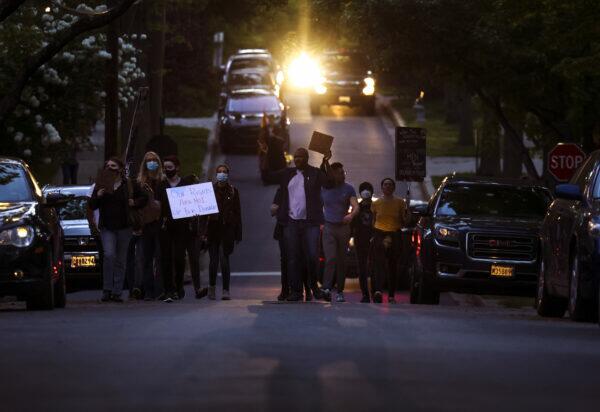
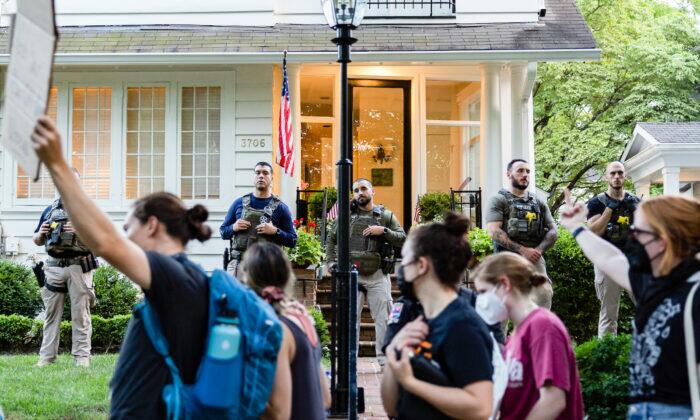
Law enforcement officers stand guard as abortion rights activists protest in front of Supreme Court Justice Brett Kavanaugh’s house in Chevy Chase, Md., on June 29, 2022. (Anna Moneymaker/Getty Images)

The materials revealed during the hearing show that U.S. Marshals were explicitly directed not to arrest protestors at the homes of Supreme Court (SCOTUS) justices.

People want justice to be blind,” said freshman Sen. Katie Britt (R-Ala.), who unveiled the findings during a hearing of the Senate Appropriations Committee. Attorney General Merrick Garland appeared before the panel to testify on the DOJ side of President Joe Biden’s proposed budget.

Section 1507 of U.S. Code prohibits the picketing of Supreme Court (SCOTUS) justices or other federal judges to change the outcome of a legal case. But when protestors demonstrated at the homes of conservative justices to protest their leaked abortion decision in June 2022, U.S. Marshals made few arrests in connection to the statute.

This, Britt revealed, was not a mistake. Rather, she showed that a DOJ memo had directly dissuaded agents from making arrests on the basis of Section 1507, instructing them to arrest protestors only as a “last resort” to protect the justices.

Section 1507 explicitly prohibits “picketing” or “parading” near the residences of judges or justices in order to influence the outcome of a case.

A few weeks earlier, Garland fielded questions from the Senate Judiciary Committee on his agency’s failure to prosecute those picketing the homes of justices.

Pro-abortion protesters outside the home of U.S. Associate Supreme Court Justice Brett Kavanaugh in Chevy Chase, Maryland, on May 11, 2022. (Kevin Dietsch/Getty Images)

During that and other testimony, Garland has insisted that the decision to arrest protestors lies with U.S. Marshals.

“U.S. Marshals have the authority to arrest anyone under that statute or any other federal statute,” Garland said. “The attorney general does not make the decision to arrest. The Marshals on the scene—they do make the decision of whether to arrest.”

But newly uncovered materials used to train Marshals to protect the homes of SCOTUS justices show that they were “actively discouraged” from making arrests on grounds of this statute, Britt said.

“Those materials show that the Marshals likely didn’t make any arrests because they were actively discouraged from doing so,” Britt said.

The training materials told the Marshals “to avoid, unless absolutely necessary, any criminal enforcement action involving the protestors.”

Marshals were also told, “Making arrests and initiating prosecutions is not the goal of the [Marshal Service] presence at SCOTUS residences.”

“The ‘not’ is actually italicized and underlined,” Britt noted.

The next slide of the training “not to engage in protest-related enforcement actions, beyond those that were strictly and immediately necessary and tailored to ensure the physical security of the justices.”

Read more here…

Tyler Durden
Wed, 03/29/2023 – 23:00

via ZeroHedge News https://ift.tt/0hcUyDv Tyler Durden

The Great Food Reset Has Begun

The Great Food Reset Has Begun

Authored by Thomas Fazi via UnHerd.com,

We all lose from the global war on farmers…

France is in flames. Israel is erupting. America is facing a second January 6.

In the Netherlands, however, the political establishment is reeling from an entirely different type of protest — one that, perhaps more than any other raging today, threatens to destabilise the global order.

The victory of the Farmer-Citizen Movement (BBB) in the recent provincial elections represents an extraordinary result for an anti-establishment party that was formed just over three years ago. But then again, these are not ordinary times.

The BBB grew out of the mass demonstrations against the Dutch government’s proposal to cut nitrogen emissions by 50% in the country’s farming sector by 2030 — a target designed to comply with the European Union’s emission-reduction rules. While large farming companies have the means to meet these goals — by using less nitrogen fertiliser and reducing the number of their livestock — smaller, often family-owned farms would be forced to sell or shutter. Indeed, according to a heavily redacted European Commission document, this is precisely the strategy’s goal: “extensifying agriculture, notably through buying out or terminating farms, with the aim of reducing livestock”; this would “first be on a voluntary basis, but mandatory buyout is not excluded if necessary”.

It is no surprise, then, that the plans sparked massive protests by farmers, who see it as a direct attack on their livelihoods, or that the BBB’s slogan — “No Farms, No Food” — clearly resonated with voters. But aside from concerns about the impact of the measure on the country’s food security, and on a centuries-old rural way of life integral to Dutch national identity, the rationale behind this drastic measure is also questionable. Agriculture currently accounts for almost half of the country’s output of carbon dioxide, yet the Netherlands is responsible for less than 0.4% of the world’s emissions. No wonder many Dutch fail to see how such negligible returns justify the complete overhaul of the country’s farming sector, which is already considered one of the most sustainable in the world: over the past two decades, water dependence for key crops has been reduced by as much as 90%, and the use of chemical pesticides in greenhouses has been almost completely eliminated.

Farmers also point out that the consequences of the nitrogen cut would extend well beyond the Netherlands. The country, after all, is Europe’s largest exporter of meat and the second-largest agricultural exporter in the world, just behind the United States — in other words, the plan would cause food exports to collapse at a time when the world is already facing a food and resource shortage. We already know what this might look like. A similar ban on nitrogen fertiliser was conducted in Sri Lanka last year, with disastrous consequences: it caused an artificial food shortage that plunged nearly two million Sri Lankans into poverty, leading to an uprising that toppled the government.

Given the irrational nature of the policy, many protesting farmers believe it can’t simply be blamed on the urbanite “green elites” currently running the Dutch government. They suggest one of the underlying reasons for the move is to squeeze small farmers from the market, allowing them to be bought out by multinational agribusiness giants who recognise the immense value of the country’s land — not only is it highly fertile, but it is also strategically located with easy access to the north Atlantic coast (Rotterdam is the largest port in Europe). They also point out that prime minister Rutte is an Agenda Contributor of the World Economic Forum, which is well known for being corporate-driven, while his finance minister and Minister of Social Affairs and Employment are also tied to the body.

The struggle playing out in the Netherlands would seem to be part of a much bigger game that seeks to “reset” the international food system. Similar measures are currently being introduced or considered in several other European countries, including Belgium, Germany, Ireland and Britain (where the Government is encouraging traditional farmers to leave the industry to free up land for new “sustainable” farmers). As the second-largest contributor to greenhouse gas emissions, after the energy sector, agriculture has naturally ended up in the crosshairs of Net Zero advocates — that is, virtually all major international and global organisations. The solution, we are told, is “sustainable agriculture” — one of the UN’s 17 Sustainable Development Goals (SDGs), which form their “Agenda 2030”.

This issue has now been pushed to the top of the global agenda. Last November’s G20 meeting in Bali called for “an accelerated transformation towards sustainable and resilient agriculture and food systems and supply chains” to “ensure that food systems better contribute to adaptation and mitigation to climate change”. Just a few days later, in Egypt, the COP27 annual Green Agenda Climate Summit launched its initiative aimed at promoting “a shift towards sustainable, climate-resilient, healthy diets”. Within a year, its Food and Agriculture Organization aims to launch a “roadmap” for reducing greenhouse emissions in the agricultural sector.

The endgame is hinted at in several other UN documents: reducing nitrogen use and global livestock production, lowering meat consumption, and promoting more “sustainable” sources of protein, such as plant-based or lab-grown products, and even insects. The United Nations Environment Programme, for example, has stated that global meat and dairy consumption must be reduced by 50% by 2050. Other international and multilateral organisation have presented their own plans for transforming the global food system. The EU’s Farm to Fork strategy “aims to accelerate our transition to a sustainable food system”. Meanwhile, the World Bank, in its climate change action plan for 2021-2025, says that 35% of the bank’s total funding during this period will be devoted to transforming agriculture and other key systems to deal with climate change.

Alongside these intergovernmental and multilateral bodies, a vast network of “stakeholders” is now devoted to the “greening” of agriculture and food production — private foundations, public-private partnerships, NGOs and corporations. Reset the Table, a 2020 Rockefeller Foundation report, called for moving away from a “focus on maximising shareholder returns” to “a more equitable system focused on fair returns and benefits to all stakeholders”. This may sound like a good idea, until one considers that “stakeholder capitalism” is a concept heavily promoted by the World Economic Forum, which represents the interests of the largest and most powerful corporations on the planet.

The Rockefeller Foundation has very close ties to the WEF, which is itself encouraging farmers to embrace “climate-smart” methods in order to make the “transition to net-zero, nature-positive food systems by 2030”. The WEF is also a big believer in the need to drastically reduce cattle farming and meat consumption and switch to “alternative proteins”.

Arguably the most influential public-private organisation specifically “dedicated to transforming our global food system” is the EAT-Lancet Commission, which is largely modelled around the Davos “multistakeholderist” approach. This is based on the premise that global policymaking should be shaped by a wide range of unelected “stakeholders”, such as academic institutions and multinational corporations, working hand-in-glove with governments. This network, cofounded by the Wellcome Trust, consists of UN agencies, world-leading universities, and corporations such as Google and Nestlé. EAT’s founder and president, Gunhild Stordalen, a Norwegian philanthropist who is married to one of the country’s richest men, has described her intention to organise a “Davos for food”.

EAT’s work was initially supported by the World Health Organization, but in 2019 the WHO withdrew its endorsement after Gian Lorenzo Cornado, Italy’s ambassador and permanent representative to the UN in Geneva, questioned the scientific basis for the dietary regime being pushed by EAT — which is focused on promoting plant-based foods and excluding meat and other animal-based foods. Cornado argued that “a standard diet for the whole planet” that ignores age, sex, health and eating habits “has no scientific justification at all” and “would mean the destruction of millenary healthy traditional diets which are a full part of the cultural heritage and social harmony in many nations”.

Perhaps more important, said Cornado, is the fact that the dietary regime advised by the commission “is also nutritionally deficient and therefore dangerous to human health” and “would certainly lead to economic depression, especially in developing countries”. He also raised concerns that “the total or nearly total elimination of foods of animal origin” would destroy cattle farming and many other activities related to the production of meat and dairy products. Despite these concerns, raised by a leading member of the world’s top public health body and shared by a network representing 200 million small-scale farmers in 81 countries, EAT continues to play a central role in the global push for the radical transformation of food systems. At the 2021 United Nations Food Systems Summit, which originated from a partnership between the WEF and the UN Secretary-General, Stordalen was given a leading role.

This complete blurring of the boundaries between the public and the private-corporate spheres in the agricultural and food sectors is also happening in other areas — with Bill Gates standing somewhere in the middle. Alongside healthcare, agriculture is the main focus of the Bill and Melinda Gates Foundation, which finances several initiatives whose stated aim is to increase food security and promote sustainable farming, such as Gates Ag One, CGIAR and the Alliance for a Green Revolution in Africa. Civil society organisations, however, have accused the Foundation of using its influence to promote multinational corporate interests in the Global South and to push for ineffective (but very profitable) high-tech solutions which have largely failed to increase global food production. Nor are Gates’s “sustainable” agricultural activities limited to developing countries. As well as investing in plant-based protein companies, such as Beyond Meat and Impossible Foods, Gates has been buying huge amounts of farmland in the US, to the point of becoming the biggest private owner of farmland in the country.

The problem with the globalist trend he embodies is obvious: ultimately, small and medium-scale farming is more sustainable than large-scale industrial farming, as it is typically associated with greater biodiversity and the protection of landscape features. Small farms also provide a whole range of other public goods: they help to maintain lively rural and remote areas, preserve regional identities, and offer employment in regions with fewer job opportunities. But most importantly, small farms feed the world. A 2017 study found that the “peasant food web” — the diverse network of small-scale producers disconnected from Big Agriculture — feeds more than half of the world’s population using only 25% of the world’s agricultural resources.

Traditional farming, though, is suffering an unprecedented attack. Small and medium-scale farmers are being subjected to social and economic conditions in which they simply cannot survive. Peasant farms are disappearing at an alarming rate across Europe and other regions, to the benefit of the world’s food oligarchs — and all this is being done in the name of sustainability. At a time when almost a billion people around the world are still affected by hunger, the lesson of the Dutch farmers could not be more urgent, or inspiring. For now, at least, there is still time to resist the Great Food Reset.

Tyler Durden
Wed, 03/29/2023 – 22:20

via ZeroHedge News https://ift.tt/uRtHsBE Tyler Durden

Senator Blocking Senior Military Promotions Over DOD Abortion Policy

Senator Blocking Senior Military Promotions Over DOD Abortion Policy

Sen. Tommy Tuberville is under bipartisan fire for his month-long blockade of promotions for generals and admirals, as the Alabama Republican demands the Pentagon halt its controversial abortion policy.

In October, the Department of Defense announced it would start covering travel and transportation costs for service members seeking out-of-state abortions — and granting them administrative leave so they don’t have to tap their vacation time.

Alabama Senator Tommy Tuberville at Tuesday’s Senate Armed Service Committee Hearing (Mariam Zuhaib/AP via NBC News)

In February, Tuberville announced he would use Senate rules to place a hold on promotions for generals and admirals — along with senior DoD civilian appointments requiring Senate approval — until the Pentagon ends the abortion policy. 

The hold prevents the Senate from approving promotions in batches by unanimous consent. They can still be approved using “regular order,” which takes much longer and would require Majority Leader Chuck Schumer to allocate time for floor votes on each promotion. That would take weeks.  

The abortion policy was the Pentagon’s response to the Supreme Court’s June overturning of Roe v Wade, freeing states to enact new restrictions on abortions. As he announced the policy via memorandum, Secretary of Defense Lloyd Austin said the high court decision “has impacted access to reproductive health care, with readiness, recruiting and retention implications for the force.”

“The practical effects of recent changes are that significant numbers of service members and their families may be forced to travel greater distances, take more time off from work, and pay more out of pocket expenses to receive reproductive health care,” he wrote. 

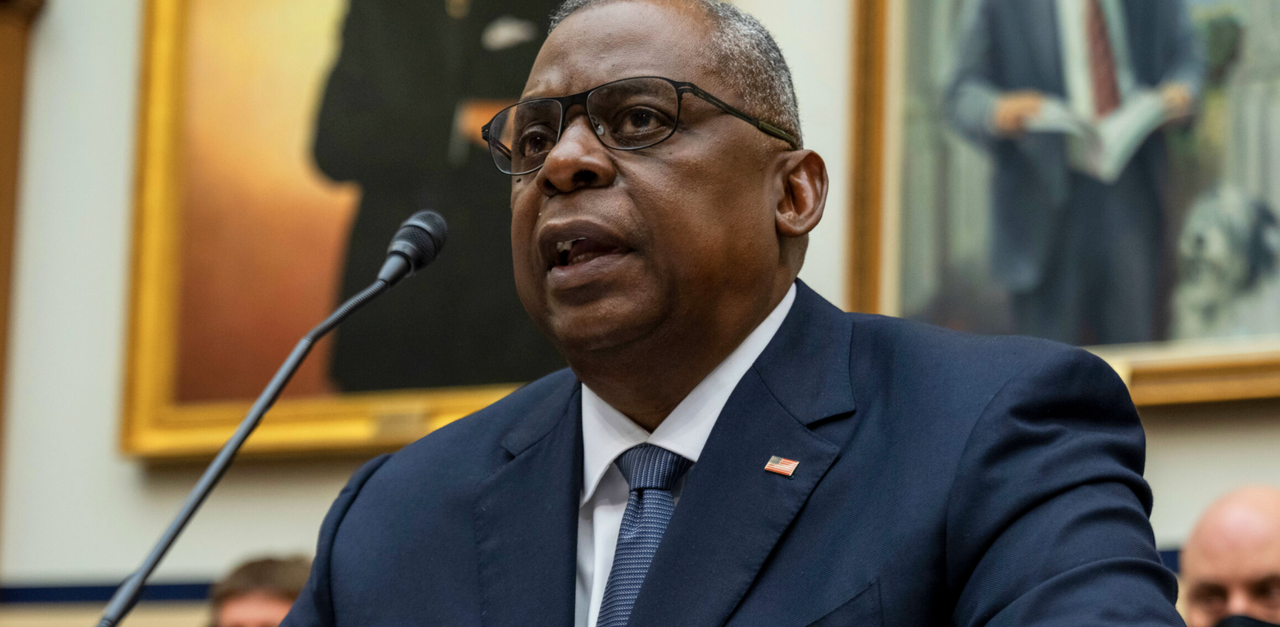
Secretary of Defense Lloyd Austin (DoD photo by Chad J. McNeeley)

Though the new policy doesn’t pay for abortion procedures themselves, Tuberville argues the Pentagon is using the policy as a backdoor means of funding abortions with taxpayer dollars, something that’s generally prohibited under federal law. 

“Federal law only allows the military to provide abortions in very narrow circumstances: rape, incest, and threat to the life of the mother,” Tuberville said on the Senate floor last week. “Yet, the Biden administration has turned the DoD into an abortion travel agency. They did it using a memo.”

Tuberville’s procedural hold on the military promotions is creating a growing backlog, with some 160 general and admiral promotions stopped in their tracks

The issue came up at a Senate Armed Services hearing on Tuesday, with Austin declaring that Tuberville’s hold posed a growing threat to military readiness. “Not approving the recommendations for promotions actually creates a ripple effect through the force that makes us far less ready than we need to be.”

In defending the abortion policy, Austin said, “Almost one in five of our troops is women. And they don’t get a chance to choose where they’re stationed. So almost 80,000 of our women are stationed in places where they don’t have access to non-covered reproductive health care” — an elaborate euphemism for an abortion that’s ineligible for taxpayer funding. 

Tuberville, the former college football coach, was criticized for his tactic by Democrats and Republicans alike.

Schumer said Tuberville was “taking our military, our national security, our safety hostage” and breaking with a tradition by which promotions sail through the Senate. Maine Republican Susan Collins expressed a more gentle “concern” over imposing consequences on generals and admirals who are “not making the policy” that Tuberville is fighting. 

Tuberville said he isn’t budging until the abortion policy is suspended or revoked, and shrugged off assertions that the policy mitigates what would otherwise be a recruiting handicap: “Over the past 40 years, I don’t recall one military person ever complaining that we weren’t performing enough abortions.” 

“[My promotion hold] is about not forcing the taxpayers of this country to fund abortions,” said Tuberville. “As long as I have a voice in this body, Congress will write the laws, not the secretary of defense, not the Joint Chiefs.”

Tyler Durden
Wed, 03/29/2023 – 21:20

via ZeroHedge News https://ift.tt/7R61eia Tyler Durden

All Talk, No Action On China

All Talk, No Action On China

Authored by Derek Scissors via RealClear Wire,

It might be easy to embrace recent warnings against a bellicose bipartisan consensus in Washington regarding China. But the real peril is that the true China consensus — which includes Democrats and Republicans, the administration and Congress — is to do nothing but talk, especially if action comes at a price.

Last month gave us a perfect example. February was full of anti-China speeches: Republican-run congressional hearings, Democratic-run hearings, and Biden administration revelations. In the end though, nothing of substance happened, nor is it likely to happen.

There is no standing up to the People’s Republic of China without costs. It has the world’s second largest economy as well as its second most powerful military. It is led by a dictator-for-life who intentionally hearkens back to a man who caused mass starvation. Winning even a peaceful contest would require sacrifices. Deterring Xi Jinping by preparing for conflict requires more. As sacrifice is not appealing to most American politicians, they instead spout rhetoric while hoping for a contest of convenience.

The administration’s actions include the Department of Commerce calling for tens of billions of dollars to vastly boost domestic semiconductor production, prioritizing it as a vital national interest. Given the PRC’s intent to globally dominate low-end chips, Commerce appears correct. But challenging as this goal is, Commerce is diluting its plan by also asking for better day care as part of the package. This, of course, is a counter-incentive for companies willing to build in the U.S. It creates an opposite effect to what was originally intended.

The administration has treated supply chains similarly, stirring in political priorities such as promoting green energy output without specific plans to secure green energy supply chains. While it is no surprise that political actors would use China as cover for executing domestic policies, it means far less gets done. Export controls on semiconductors were announced to great fanfare last October, with promises of more to come. Yet five months later, we don’t even have the final regulations.

Concerning licensing permissions, Commerce has gone from terrible to mediocre under the Biden administration. Last year, it accepted 70% of applications to export controlled items to the PRC. Not exactly tight restrictions, but still a substantial improvement over the Trump Commerce Department’s performance, during a supposed “trade war,” where the number may have been over 90%. 

Part of the blame is with Congress. Being placed on Commerce’s “Entity List,” which imposes license requirements on foreign individuals, entities, or governments, requires just a license application. Yet many members of Congress have pretended for years that this is a blacklist preventing designated foreign firms from receiving American technology. In fact, tens of billions of dollars’-worth in licenses have been granted to these firms, most of whom were also eligible for American investment. The Entity List has always been fraudulent, and Congress willingly plays along.

Will the new House Select Committee on China mean more effective legislation? Doubtful. Members within the Select Committee are genuinely concerned with the economic and military risks China poses, and they have allies elsewhere in Congress. But the Select Committee has no official jurisdiction — it can only talk, not act. This is an ideal outcome for those who want to appear politically strong while having no obligation at all to back up their words.

The Financial Services Committee, possibly the most important House committee, held a China hearing in early February. According to its Republican chairman and Republican-called witnesses, the top China threat is the U.S. responding in any serious way to China. Their conclusion: The U.S. should face up to the PRC’s military buildup, its domestic and international repression, and its economic predation by continuing to invest freely in the PRC.

With this “pressure” from some Republicans, the Biden administration does not feel compelled to truly compete. An executive order to address the more than $1 trillion the U.S. has invested in the PRC is many months overdue. Even if issued, it may prove an almost entirely empty action. 

Other consequences to inaction are looming. China continues to steal intellectual property (IP), subsidize production that uses the IP, and drive advanced American companies out of business. It will also spread repression and more intensely target Taiwan. Politicians who take this seriously must propose policies that involve some pain, because that is what’s required for the U.S. to win. Politicians who don’t take the PRC seriously are easy to spot. They’ll be pushing some domestic agenda unrelated to China, tilting at windmills, and, above all, talking.

Derek Scissors is a senior fellow at the American Enterprise Institute. He is also the chief economist of the China Beige Book. The views expressed are the author’s own.

Tyler Durden
Wed, 03/29/2023 – 21:00

via ZeroHedge News https://ift.tt/NoJiYRl Tyler Durden

India’s Grid Strained By Burgeoning Power Demand

India’s Grid Strained By Burgeoning Power Demand

By John Kemp, senior market analyst

India’s electricity transmission system is coming under increasing strain as booming power demand outstrips growth in despatchable generation.

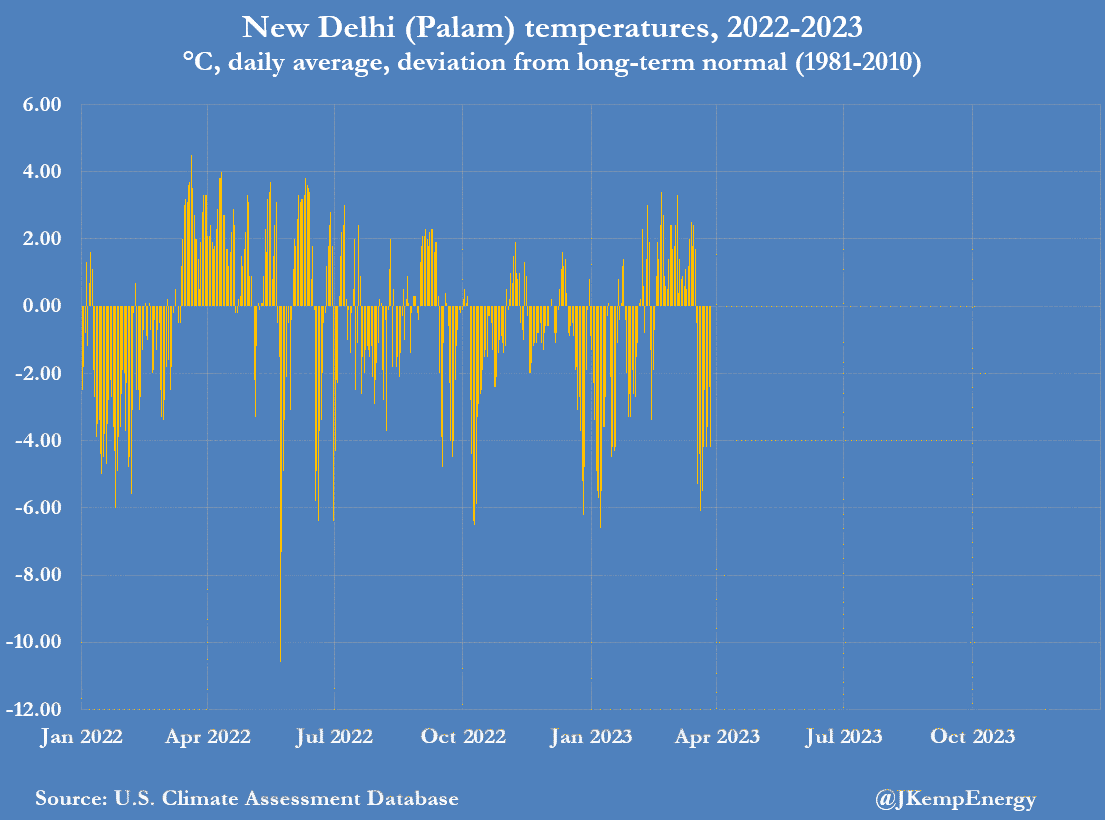
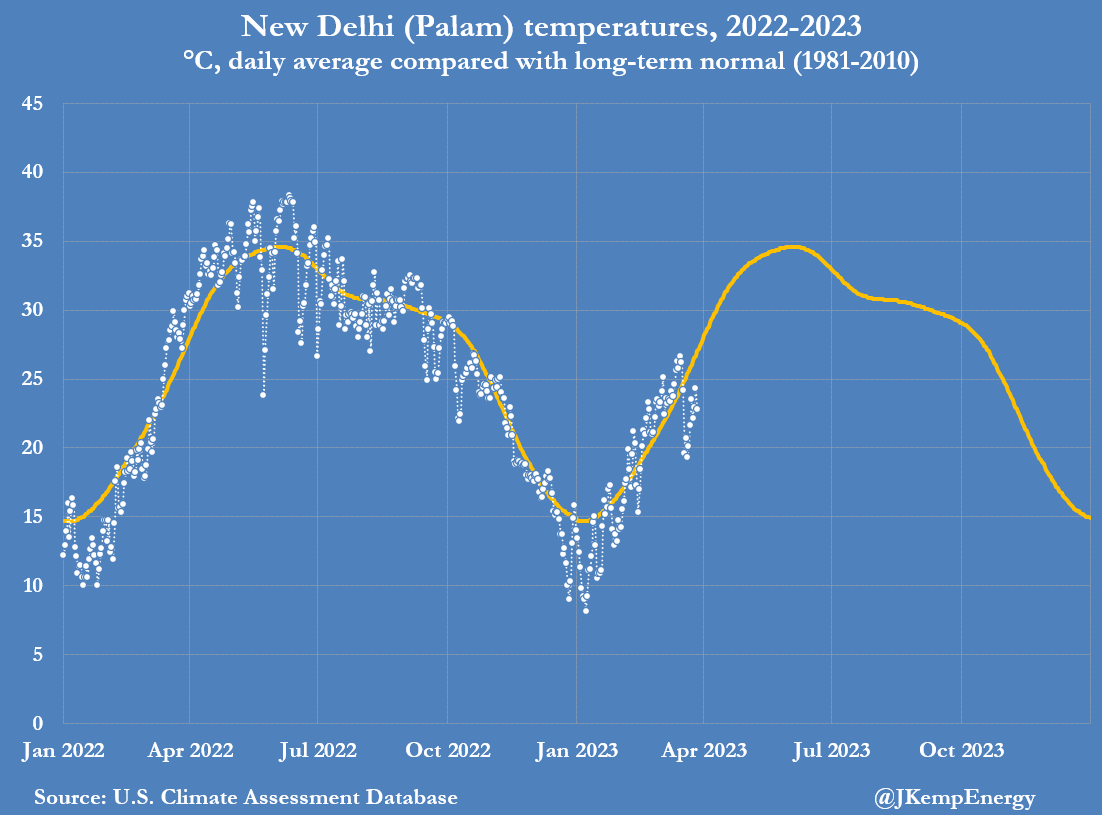
Mild temperatures in February and March have masked the struggle to meet fast-growing loads from industry as well as for refrigeration and air-conditioning.

But periods of more severe temperatures between April and September are likely to reveal the increasingly thin margin of spare generation.

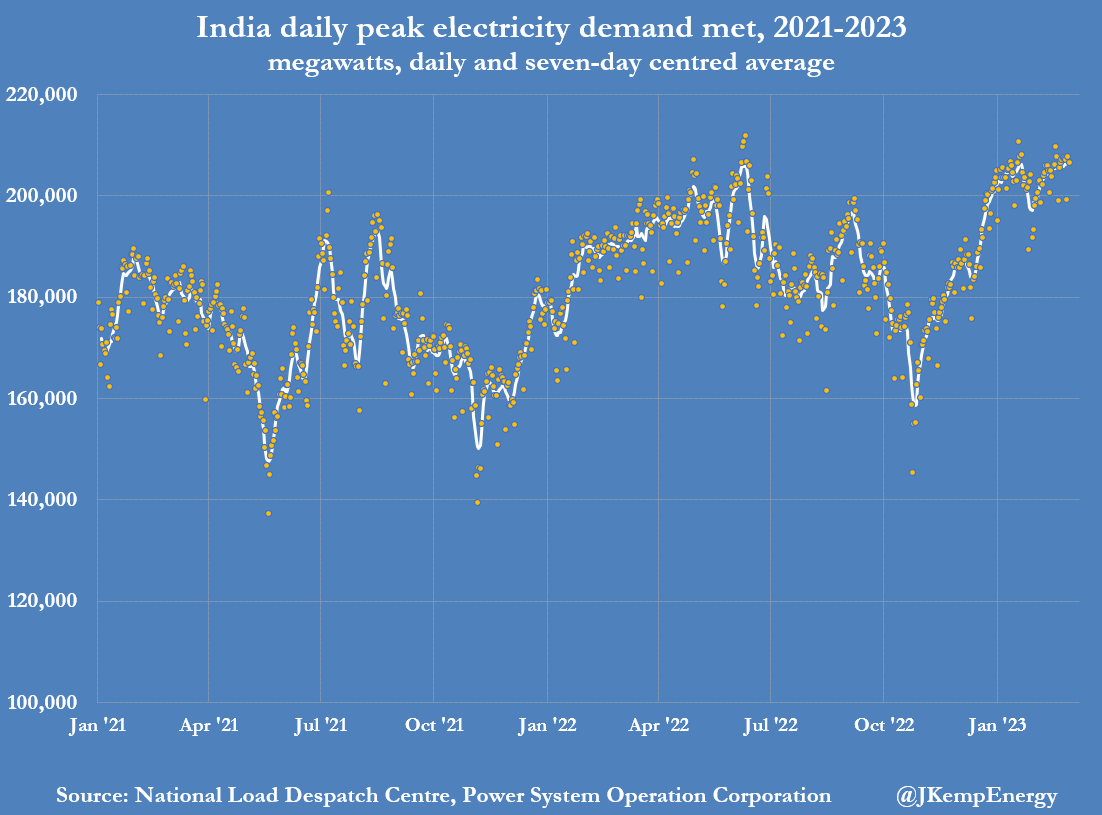
Total electricity consumption increased by 8% in February 2023 compared with the same month a year earlier and by 13% compared with February 2021, according to the Grid Controller of India.

Peak demand met was up by 8% compared with a year ago and 11% compared with 2021 (“Monthly report”, Grid India, March 23, 2023).

But generation capacity has increased by only 4% since 2022 and 9% since 2021, ensuring generation units must be used more intensively.

Like other countries before it, India is experiencing classic pressure on its transmission system associated with rapid industrialisation and electrification of the economy.

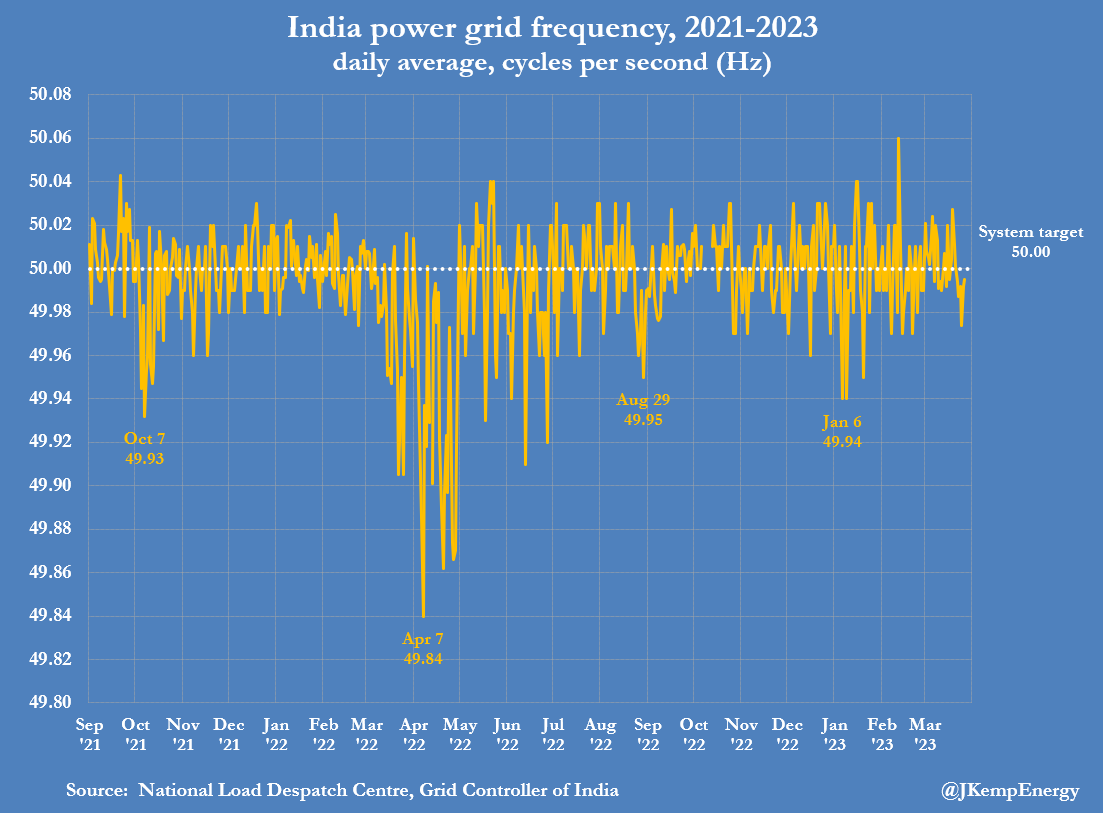
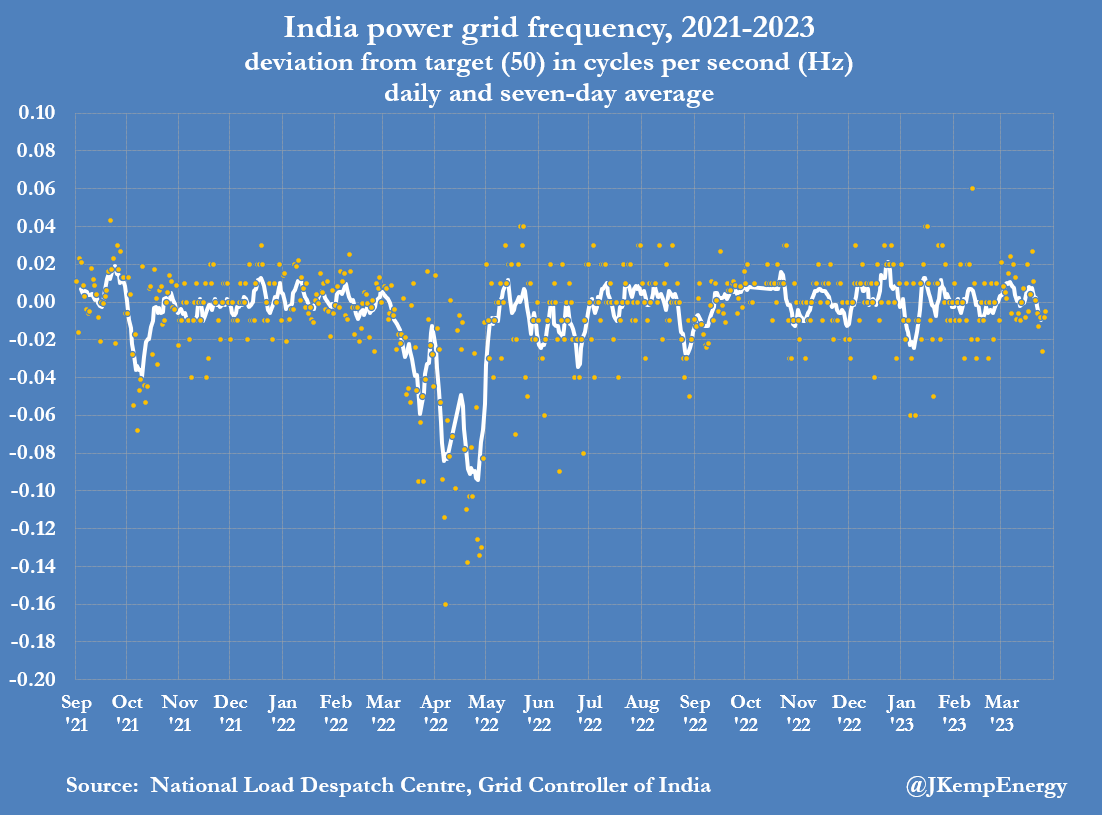
Pressure on the network is evident from the amount of time frequency on the transmission system is below the minimum target level.

Frequency is related to the balance between generation and load – excess generation causes frequency to accelerate, excess load causes frequency to drop.

Grid controllers are therefore instructed to keep frequency within tight limits to ensure the network remains stable and avert the risk of a cascading failure.

India’s grid is synchronised at 50.00 cycles per second (Hertz) with a maximum acceptable operating limit of 50.05 and a minimum of 49.90. But frequency fell below the minimum acceptable target of 49.9 Hz almost 11% of the time in February 2022 up from 6% in 2022 and 7% in 2021.

The increasing incidence of under-frequency shows controllers struggled to schedule enough firm generation to meet increasing demand on the system.

So far, periods of under-frequency have been modest, in contrast to March and April 2022 and October 2021, when severe under-frequency was the forerunner of widespread blackouts.

But strain on the system will increase as temperatures rise towards their summer peak in June and again in September-October after the monsoon fades.

The system is already running hard. Peak electricity demand in January (210,618 megawatts) and February (209,665) was only slightly lower than at the height of last summer in June 2022 (211,856).

India needs to maximise generation from all sources, fossil fuels (coal, gas and diesel) as well as renewables (hydro, solar and wind) this summer to keep the lights on.

Government policy aims to maximise the availability of firm generation by prioritising coal movements on the rail network, mandating coal imports, and building up inventories in the yards of coal-fired power stations.

Policymakers have ordered privately owned and captive coal-fired and gas-fired generators to ensure their units are ready to run in the event of an instruction from the grid.

Tyler Durden
Wed, 03/29/2023 – 20:20

via ZeroHedge News https://ift.tt/9XQ1ClW Tyler Durden

Apache Stronghold v. U.S.: Religious Freedom and Government Property

There’s long been a dispute about whether religious freedom provisions limit the government’s power related to religious sites on government land. These are usually American Indian sites, though in principle they might be other religious sites as well.

In Lyng v. Northwest Indian Cemetery Protective Ass’n (1988), the Court held that the Free Exercise Clause doesn’t give religious groups the legal right to stop various government activities related to such sites (even though at the time, after Sherbert v. Verner but before Employment Division v. Smith, the Court had read the Free Exercise Clause as securing a presumptive right to religious exemptions from generally applicable government action). But one enduring question has been whether the Religious Freedom Restoration Act of 1993 should be read as perpetuating Lyng, alongside other Sherbert-era precedents, or should be read as superseding it. (See my Intermediate Questions of Religious Exemptions, pp. 652-56 for more on some related matters.)

In any event, this issue is now up before the Ninth Circuit en banc, which heard argument last week on it in Apache Stronghold v. U.S. (see, e.g., this Deseret News article [Kelsey Dallas]); the panel had ruled, 2-1, against the religious freedom claims, but the Ninth Circuit agreed to rehear the case en banc. My colleague Gene Schaerr at Schaerr | Jaffe LLP, at which I’m a part-part-part-time Academic Affiliate, represents the Jewish Coalition for Religious Liberty, the International Society for Krishna Consciousness, the Sikh Coalition, and Protect The 1st as amici in the case.

In any event, Gene kindly put together an item on the case and the oral argument, which I’m passing along below; I’d be glad to add contrary views as well (and you can see some in the panel majority opinion):

Last week, the Ninth Circuit held a lively en banc oral argument in Apache Stronghold v. United States—a case raising crucial questions of religious freedom law and, most importantly, statutory interpretation.

The case focuses on an indigenous sacred site called Chi’chil Biłdagoteel, or Oak Flat, which has been sacred to Western Apaches since before European contact and remains the site of key religious ceremonies that, according to Apache belief, can’t take place elsewhere. The federal government has proposed transferring Oak Flat to a private company for a copper mine, which would swallow the site in a massive crater, ending the Apaches’ religious exercises there forever. The question is whether destroying the sacred site and ending the Apaches’ religious practices “substantially burdens” their religious exercise under the Religious Freedom Restoration Act (RFRA).

The answer under RFRA’s text seems obvious: ending a religious exercise forever “substantially burdens” it. As then-Judge Gorsuch explained, when the government doesn’t just penalize a religious exercise, but “prevents the plaintiff from participating in” it—as by not accommodating the practice in prison—the government “easily” imposes a “substantial burden.”

At oral argument, however, several Ninth Circuit judges wrestled with whether this commonsense textual argument should carry the day. Their questions centered on three areas of broad significance to the law of religious freedom and statutory interpretation.

First, Judges Nelson and Berzon asked whether the Supreme Court’s 1988 decision in Lyngv. Northwest Indian Cemetery controls the meaning of “substantial burden” in RFRA. In Lyng, the Supreme Court rejected a claim that the government violated the Free Exercise Clause by authorizing the paving of a road in a forest sacred to Native Americans.

But Lyng differs from the Apache Stronghold case in two respects. Factually, the road at issue in Lyng wouldn’t be built over the plaintiffs’ sacred sites, but a half-mile or more away—leaving the plaintiffs free to continue visiting their sites and engaging in the same religious exercises as before. They alleged instead that the sound of the road nearby would diminish the “efficacy” of their practices—a religious question that Lyng said civil courts “cannot … measur[e].”

More importantly, Lyng was decided under a different legal standard—the Free Exercise Clause, not RFRA. And considerations unique to the Free Exercise Clause drove the Court’s decision. For example, Lyng repeatedly emphasized that the “crucial word in the constitutional text”—and, thus, in the Court’s analysis—”is ‘prohibit'”—a word that isn’t used in RFRA. And Lyng repeatedly contrasted laws that “prohibit” religion with laws that have only “incidental effects” on religion. In other words, the decision to build a road wasn’t targeting religion; the religious harms were simply “incidental effects” of a broader “government program[],” requiring no heightened review.

This theory—that the trigger for heightened review under the Free Exercise Clause is a lack of neutrality—became the centerpiece of the Court’s approach to the Free Exercise Clause two years later in Employment Division v. Smith. And one of the leading cases Smith relied on for this rule was Lyng.

RFRA, by contrast, expressly rejects the distinction between targeted and incidental burdens on religious exercise. Indeed, the whole point of the statute was to apply strict scrutiny “in all cases where free exercise of religion is substantially burdened”—”even if the burden results from a rule of general applicability.” 42 USC 2000bb(b)(1), 2000bb-1(a).

Nor is Smith the only case to understand Lyng as being about neutrality and general applicability. Every Supreme Court free-exercise case since Lyng has characterized it as an example of Smith‘s neutral-and-generally-applicable standard in action—from Trinity Lutheran to Espinoza to Fulton—with Trinity Lutheran citing it as the leading example of how the Court, in applying the Free Exercise Clause, has been “careful to distinguish” between laws that are “neutral and generally applicable” and laws “that single out the religious for disfavored treatment.”

Other circuits have done the same. In Tenafly Eruv Association v. Borough of Tenafly, for example, Orthodox Jews sought access to government-controlled utility poles to create an eruv—a ceremonial area within which Orthodox Jews can carry objects during the Sabbath. When the government refused and was sued under the Free Exercise Clause, it defended based on Lyng, claiming that Clause does not apply to burdens resulting from government management of “its land.” But the Third Circuit disagreed, noting that Lyng was a case about neutrality, not just about government land—and that the Free Exercise Clause “applies not only when a coercive law or regulation prohibits religious conduct, but also when government denies religious adherents access to publicly available money or property.”

Second, Judge VanDyke offered several hypotheticals probing the role of alleged spiritual harm in the “substantial burden” analysis.  For example, would a substantial burden arise simply if someone believes they will go to hell if the government doesn’t sell them a particular piece of land?  But that and similar questions conflate two distinct issues—the spiritual consequences to a religious believer from not engaging in a religious exercise, and the objective obstacle the government places in the way of that exercise. The proper focus of the substantial-burden inquiry is on the latter—asking what the government has done to make the plaintiff’s religious exercise objectively more costly or difficult.

Take Hobby Lobby for example. The burden there wasn’t the divine wrath the business owners believed they might suffer if they covered abortifacients in their insurance plans. Rather, the burden was that the government made their religious exercise more costly by threatening large monetary penalties. Similarly, the burden in Yoder wasn’t the feared corruption of the Amish children’s souls from attending public school; it was that the government made their religious practice—foregoing public education—objectively more difficult by imposing criminal fines.

So too in Apache Stronghold: The burden isn’t the spiritual pain the Apaches will feel when their sacred site is destroyed.  It’s that the government makes it objectively more difficult to engage in their religious exercise by allowing a mining company to blow up their sacred site.

While focusing on alleged spiritual injury might seem superficially sympathetic to religious liberty claims, moreover, it would actually harm religious liberty in the long run. One reason is that determining whether particular spiritual consequences count as a substantial burden would enmesh courts in religious questions. (Would the plaintiff in Judge VanDyke’s hypothetical really go to hell? Would the Hobby Lobby plaintiffs really be complicit in abortion?)  That approach would also create immense pressure on courts to find other (atextual) ways to curtail RFRA—which is what the government asked courts to do (unsuccessfully) in the contraception-mandate litigation.

Judge VanDyke asked about one possible curtailment: simply deem some substantial burdens not “cognizable” under RFRA if they result from certain types of federal action—such as a decision about the use of federal land. But this novel idea runs headlong into RFRA’s text—which says it applies to “all Federal law, and the implementation of that law, whether statutory or otherwise.”

That idea also lacks any apparent basis in principle. If anything, the federal government should have less discretion in managing public lands than in enforcing its criminal laws, protecting public health and safety, or operating high-security prisons—all of which are already subject to RFRA. As Justice Scalia said in Smith: “it is hard to see any reason in principle or practicality why the government should have to tailor its health and safety laws to conform to the diversity of religious belief, but should not have to tailor its management of public lands” (citing Lyng).

And, if courts can make atextual, unprincipled carve-outs from RFRA for federal land, there is no reason they can’t make similar carve-outs for other disfavored religious liberty claims—such as those alleged to cause “third-party harms” (which the government and scholars asked the Court to carve out in Hobby Lobby) or those involving antidiscrimination laws.

The way to avoid all this is to follow RFRA’s text and precedent—asking whether the government has made it objectively more difficult for the plaintiff to engage in the particular religious exercise at issue. If so, the court should find a substantial burden, no matter the form of the federal action or the political valence of the case—and then let the government explain why it believes the burden is nevertheless justified.

Finally, Judge Collins inquired whether RFRA is applicable to the land-transfer at all, given that the transfer is authorized by a statute enacted after RFRA, and in the event of a conflict between two statutes, a later-enacted statute might be thought to trump an earlier-enacted one.

Notably, RFRA by its terms expressly tells courts how to resolve this question—instructing that RFRA applies to later-enacted statutes unless “such law explicitly excludes such application by reference to this chapter.” But the government, perhaps taking its cues from mining-interest amici, has offered a late-breaking argument that this provision of RFRA is unconstitutional. Notwithstanding Congress’s express direction, the government urges, a later-enacted law might be held to “impliedly” repeal RFRA without mentioning it.

That argument would be devastating for religious liberty. For thirty years, Congress has legislated against the background principle that RFRA applies to head off negative consequences from later statutes unless it is expressly displaced. To hold this provision unconstitutional would come as a shock both to Congress and to proponents of religious liberty—particularly after recent enactment of the Respect for Marriage Act, which was defended on the ground that RFRA would still apply to it. It would also open up an entirely new front for religious liberty’s opponents—who can argue not only that a later-enacted law complies with RFRA but that RFRA doesn’t apply in the first place, because Congress has (without saying so) overridden it.

Such a result doesn’t empower Congress—which is well aware of RFRA’s explicit-reference provision and needs nothing more than a simple majority to comply with it. It empowers judges—liberating them from the straightforward, narrow inquiry of whether a later-enacted law refers to RFRA and instead encouraging them to hunt for implied repeals in the later-enacted law’s penumbras and emanations. The Constitution requires nothing of the sort.

Nor does any countervailing precedent support the mining interests’ view. For example, one of their lead cases is the Supreme Court’s 1955 decision in Marcello. But Marcello didn’t ignore or strike down a provision requiring that later departures be express—it applied it. The earlier-enacted law there (the APA) said it supplied the procedure governing administrative litigation unless a later-enacted law displaced it “expressly.” The later-enacted law, meanwhile, said it supplied the “sole and exclusive procedure” in deportation cases. The Supreme Court held that this language “expressly supersedes” the APA—not that the APA’s express-repeal provision was unconstitutional.

Fortunately, we don’t need to wonder about the Supreme Court’s views on this subject. As an important amicus brief explains, the Court has twice applied RFRA’s explicit-reference provision in high-profile cases (Hobby Lobby and Little Sisters of the Poor). So has the Seventh Circuit, which in Korte v. Sebelius said that RFRA “accounts for” the rules governing the temporal allocation of legislative power, since Congress remains free to repeal it at any time (by complying with the explicit-reference provision). Thus, to rule otherwise would both conflict with the Supreme Court and create a novel circuit split.

[*****]

In short, RFRA’s text supplies a simple answer to the question presented in Apache Stronghold: The government “substantially burdens” religious exercise when it authorizes the complete physical destruction of a Native American sacred site, ending tribe members’ core religious exercises forever. This doesn’t mean the Apaches automatically win their case; it just means they get to the second step of the analysis—the balancing test of strict scrutiny.

The government fears that applying that test to federal land-use decisions would be unworkable. But federal land-use decisions are already subject to an alphabet soup of restrictive laws like NEPA, FLPMA, NHPA, NAGPRA, CWA, CAA, and ESA. For example, if the mine in this case threatened an endangered snail darter, the project couldn’t go forward under the Endangered Species Act at all—and the government wouldn’t even get a chance to satisfy strict scrutiny. So applying RFRA to federal land-use decisions still gives the Apaches’ fundamental right of religious freedom less protection than is already given to endangered animals.

The government’s policy argument is also the same argument Congress rejected in enacting RFRA. The Supreme Court in Smith feared that applying strict scrutiny to all governmental actions “across the board” would be “courting anarchy.” But Congress has told the federal courts not to be afraid of strict scrutiny: it is a “workable test for striking sensible balances between religious liberty and competing prior governmental interests.”

The question is whether the Ninth Circuit will apply RFRA’s plain text or will instead succumb to atextual, fear-based reasons for limiting RFRA’s reach.

The post <i>Apache Stronghold v. U.S.</i>: Religious Freedom and Government Property appeared first on Reason.com.

from Latest https://ift.tt/bpiFJBc
via IFTTT

Here’s How Wall Street’s March Madness Brackets Have Fared

Here’s How Wall Street’s March Madness Brackets Have Fared

How has your March Madness bracket fared? Many have been completely demolished over the last few weeks. 

This March is the craziest in decades. For the first time since 1979, not a single No. 1, 2, or 3 seed will advance to the NCAA Division I Men’s Basketball Championship’s Final Four National Semifinals. 

The Final Four matchups will commence on Saturday at around 6 pm ET, featuring Florida Atlantic taking on San Diego State, followed by UConn going head-to-head with Miami.

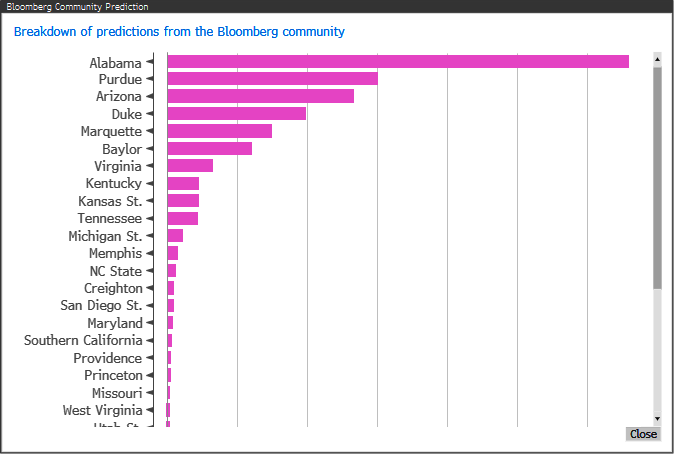
We want to turn out attention to savvy Wall Street traders, macro tourists, hedge fund portfolio managers, and business executives who utilize the Bloomberg Terminal. We want to shed light on their brackets, plus who they collectively think will win the tournament. 

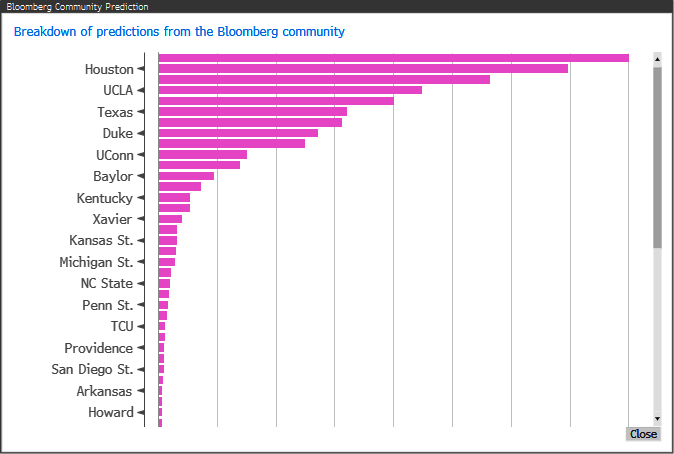
For the Florida Atlantic versus San Diego State slot, an overwhelmingly large number of Terminal users had Alabama, then Purdue, Arizona, Duke, Marquette, and Baylor. Just a slither had San Diego State, while Florida Atlantic was nowhere to be found. 

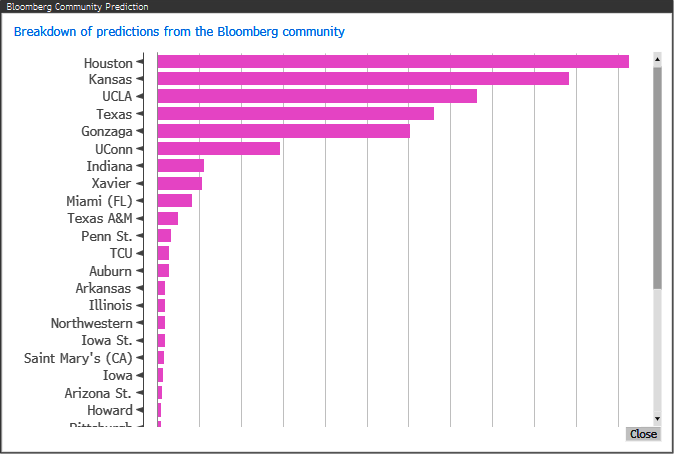
For the second game, UConn versus Miami, most Terminal users picked Houston, Kansas, UCLA, Texas, Gonzaga, and number six on the list UConn. Miami was the ninth pick. 

Here is the complete breakdown of the tournament winner predictions from Terminal users, with UConn ranking fifth, San Diego State 15th, Florida Atlantic 25th, and Miami didn’t make the cut. 

While we cannot disclose the names of the top-performing Terminal users, you can definitely take a look at the firms that employ them…

And for users who filled out their brackets for a cause. Here’s their ranking plus which charity. 

Clearly, not all Terminal users are geniuses. We’ll provide an update on their rankings prior to the championship game.

Tyler Durden
Wed, 03/29/2023 – 19:20

via ZeroHedge News https://ift.tt/H3GsmZl Tyler Durden

Politics Is Turning Us Into Idiots

Politics Is Turning Us Into Idiots

Authored by Lipton Matthews via The Mises Institute,

Political correctness in Western societies fosters polarization and a toxic culture of ignorance. Although people are rightly outraged by the cancellation of prominent figures, the most glaring consequence of political correctness is the proliferation of ignorance. When speakers are cancelled for contradicting sacrosanct opinions, this leads to an environment where people never arrive at the truth because ideas are not disputed in the public domain.

This devolution of Western culture stymies free speech and intellectual progression.

While some view cancel culture as primarily an assault on freedom, its effects are infinitely more pernicious. Societies evolve by exchanging inferior ideas for superior ones, and cancel culture is disrupting the mechanism filtering out bad ideas. Due to cancel culture, people hold steadfast to false doctrines; the belief that the gender pay gap is a result of discrimination is a classic example that continues to circulate despite evidence showing that gaps are an outcome of working hours and occupational segregation.

The effect of endorsing inaccurate assumptions is that such beliefs will be employed to justify misguided policies.

If people think that women on average earn less than men because of discrimination, they will lobby for policies to rectify the problem, and such policies could be expensive to implement. Entertaining ignorant beliefs will also make it difficult to improve social mobility and narrow the highly touted black-white achievement gap.

Current narratives state that blacks are underperforming in education because of racism, and some propose abolishing standardized tests as a tool to help black students. However, research shows that black students are likely to do well when teachers impose rigorous standards rather than when standards are diluted. Case after case reveals that when scrutinized, politically correct views fail to pass the accuracy test. Nonetheless, wrongheaded ideas are propagated as gospel to the detriment of intellectual progress.

People are entitled to express political opinions and promote them as accurate. However, critics are not obliged to accept folly as truth. The popularity of dubious ideas would not be a problem if proponents would desist from compelling critics to espouse these views or be expelled from polite society. Institutionalizing fallacious ideas has resulted in widespread confusion, especially since these fallacies are inconsistently applied. In polite society, it is objectionable to say that race is not a social construct, and even mainstream consensus purports that race is primarily a social category, but it must be noted that consensus is not evidence.

Yet, despite the acceptance that race is malleable, Rachel Dolezal became a pariah after she was exposed as a white woman pretending to be black. However, why should this pose a problem when race is a social construct? Culture is shared and learned, and we all have the capacity to appreciate foreign cultures. Based on the malleability of race, a white person identifying as black should not be seen as problematic. Sex is biological, so although a man can identify as a woman, he can never become a woman. Yet, activists are infuriated when white people identify as black, even though doing so is more logically plausible than a man identifying as a woman.

Some find white people identifying as black offensive because they claim that doing so provides these white people with benefits that belong to historically oppressed black people. But this is a double standard, since men who identify as women gain benefits that belong to women, who are also seen as oppressed. It is mind-boggling that woke activists can’t see the parallels between transracialism and transgenderism. Moreover, equally outrageous is that they don’t seem to recognize that trans women are depriving real women of benefits when trans women profit from gender quotas.

For years, feminists have been arguing that women have been disenfranchised. Today, many feminists, except for some radicals, advocate for the disenfranchisement of women by embracing male athletes who compete with females. Instead of empowering women, the idiocy of political correctness inspires feminists to endorse the marginalization of women. Allowing men to compete with women diminishes opportunities for female advancement, but stating the obvious will ruin one’s career.

Kathleen Stock was ruthlessly hounded by the unthinking mob for arguing that allowing men to identify as women creates dangerous spaces for women. Stock asserted that the desire to be seen as trans friendly has led companies to advocate policies that make women susceptible to violence:

Even more pressingly, if we lose a working concept of “female” . . . self-declared trans women (males) may well eventually gain unrestricted access to protected spaces originally introduced to shield females from sexual violence from males. We are already seeing the erosion of these, as companies and charities open formerly female-only spaces such as changing rooms, shared accommodation, swimming ponds, hospital wards, and prisons, to everyone out of a desire not to appear transphobic.

Moral blind spots and contradictions are baked into the psyche of political correctness. Another issue is that denying the genetics of IQ is fashionable despite evidence to the contrary. Politically correct thinkers struggle to appreciate that IQ is genetic, but they don’t have a problem accepting the heritability of other traits or diseases if they can prove that such inherited characteristics disadvantage minority groups. For example, many believe that blacks are more likely to suffer from high blood pressure because during the slave trade’s Middle Passage, Africans who retained salt had lower mortality rates. Therefore, they passed on genes conducive to salt retention, which leads to hypertension.

However, this idea was thoroughly debunked by Heidi L. Lujan and Stephen E. DiCarlo in an academic paper:

Available evidence suggests that the difference in salt-sensitivity between African-Americans and Caucasians (European-Americans) is significantly smaller than what the Slavery Hypertension Hypothesis suggests. In fact, Chrysant and colleagues were unable to find differences in the blood pressure response to salt by race, age, sex, or body weight. Thus, salt sensitivity is not a racial problem, but rather a human problem, and the generalization that blacks are salt sensitive and whites are not should be discarded.

Nevertheless, the evidence does not seem to disabuse politically correct activists of incorrect notions. Indeed, sensitive topics can be involved in political debates, but sympathizing with delusional people will create a generation of idiots and destroy civilization in the process.

Tyler Durden
Wed, 03/29/2023 – 19:00

via ZeroHedge News https://ift.tt/sBECVMt Tyler Durden

Turkey Halts 450Kb/d In Oil Output Via Kirkuk-Ceyhan Pipeline Amid Dispute With Iraq

Turkey Halts 450Kb/d In Oil Output Via Kirkuk-Ceyhan Pipeline Amid Dispute With Iraq

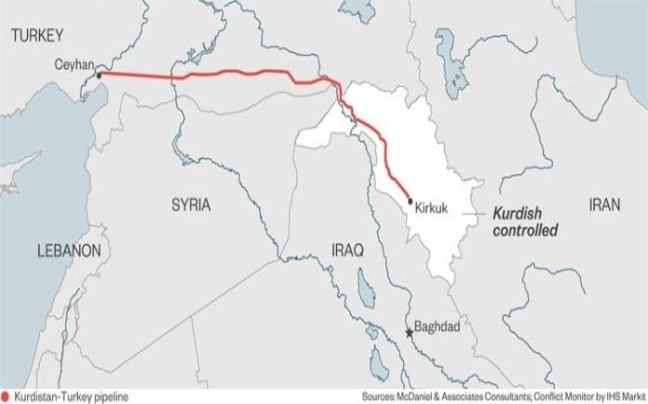
As Goldman noted overnight, the bank had received quite a few inbound client inquiries as to what may be behind the recent jump in crude oil prices which after tumbling to the lowest level since 2021 have rebounded back to almost $80/bbl. One answer may come from the semi-autonomous Kurdistan region of northern Iraq, where producers have shut in or reduced output at several oilfields following a halt to the northern export pipeline, company statements showed, with more outages on the horizon.

Iraq was forced to halt around 450,000 barrels per day of crude exports, or half a percent of global oil supply, from the Kurdistan region (KRI) on Saturday through a pipeline that runs from its northern Kirkuk oil fields to the Turkish port of Ceyhan, Reuters reported.

Turkey stopped pumping Iraqi crude from the pipeline after Iraq won an arbitration case in which it said Turkey had violated a joint agreement by allowing the Kurdistan Regional Government (KRG) to export oil to Ceyhan without Baghdad’s consent.

Iraq’s government said it’s up to Kurdistan to break the oil deadlock. “The ball now is the Kurds’ court,” Asim Jihad, a spokesman for Iraq’s Federal Ministry of Oil, said in an interview.

Meanwhile, oil firms operating in the KRI are being forced to halt output or move production into storage, which many say will reach capacity within days, as talks drag between Turkey, Baghdad and the KRG to resume exports.

Norwegian oil firm DNO said on Wednesday it had begun shutting down production at its Tawke and Peshkabir fields, where production averaged 107,000 barrels per day (bpd) last year. This represents a quarter of total Kurdish region exports, DNO said.

Genel Energy, a partner in the fields, said: “Peshkabir production was halted last night and plans drawn up to conduct deferred maintenance. Tawke production shutdown has started but will take an additional day or so.” Genel Energy’s remaining assets in KRI continue to flow into storage, the firm said. Production from its Sarta field can flow into storage until the end of the week, while tanks can hold production from Taq Taq until around April 21, a company spokesperson said on Wednesday. The fields produced a respective 4,710 bpd and 4,490 bpd last year.

Canada-based Forza Petroleum, formerly Oryx Petroleum Corp, was forced to shut in production earlier this week from the 14,500 bpd Hawler license, which produced an average 13,700 bpd in January and February.

Gulf Keystone has reduced production at the Shaikan oil field, which previously produced around 55,000 bpd, and said on Monday it would suspend production after a few days. The company declined to comment on current production levels.

Dallas-based HKN Energy, which operates the Sarsang block, said on Monday it would shut in operations “within a week if no resolution is reached” as its storage facilities approach capacity. The block produced 43,048 bpd in the fourth quarter of last year.

In response, the White House – which has been paranoid about even one drop of oil not hitting the global market on time – is pushing Iraq and Turkey to restart exports of crude oil and to resolve a dispute with Kurdish authorities as soon as possible, because the last thing Biden needs in addition to a bank crisis and deposit runs is another surge in gasoline prices.

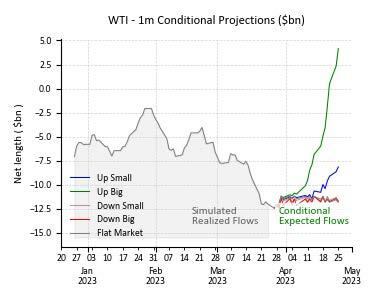
And while the Turkey-Iraq spat has taken off almost half a million barrels off the market, and pushed the price of Brent higher, the question is how long before CTAs – which are massively short oil – start to cover. As Goldman calcualted yesterday, “systematic positioning here leans short (went from short $10bn in energy before Feb 22 to now being short $30bn). Cot data re-affirming the above, with positioning coming in from late Feb/early-March highs.” A condition projection of CTA activity in oil shows massive buying in the coming weeks should the price of oil turn higher, creating a positive feedback loop of more buying and more short covering.

Tyler Durden
Wed, 03/29/2023 – 18:40

via ZeroHedge News https://ift.tt/HxuGjeY Tyler Durden