Big-Tech Trounces Small Caps As Rates Rip Ahead Of Powell

Big-Tech Trounces Small Caps As Rates Rip Ahead Of Powell

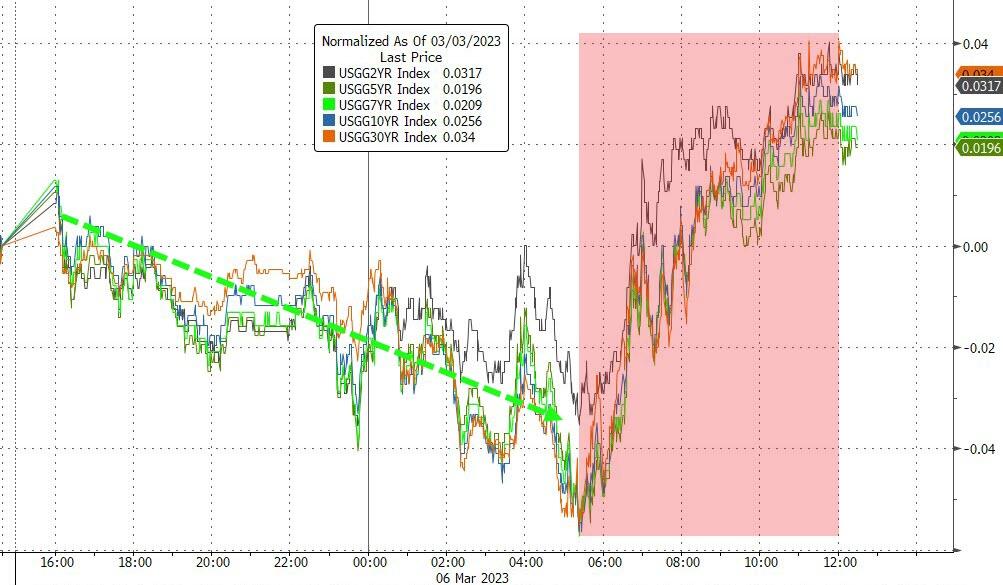
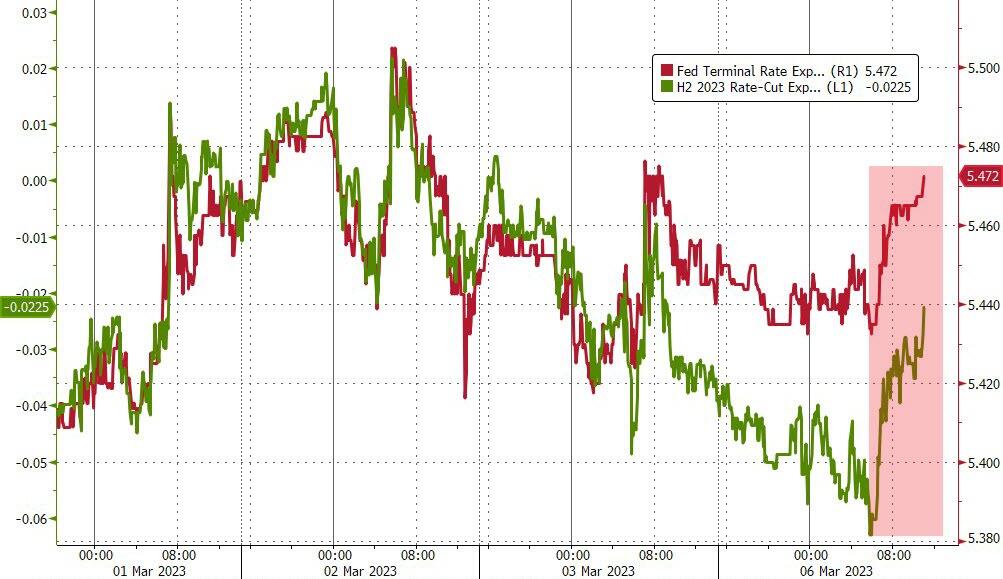
China growth forecasts sparked some weakness in crude (and bond yields lower) overnight but a smaller than expected drop in factory orders (and bounce in core orders) helped spark a rebound in everything… most notably, rate-trajectory expectations (with both the terminal rate rising and any hopes for cuts collapsing)…

Source: Bloomberg

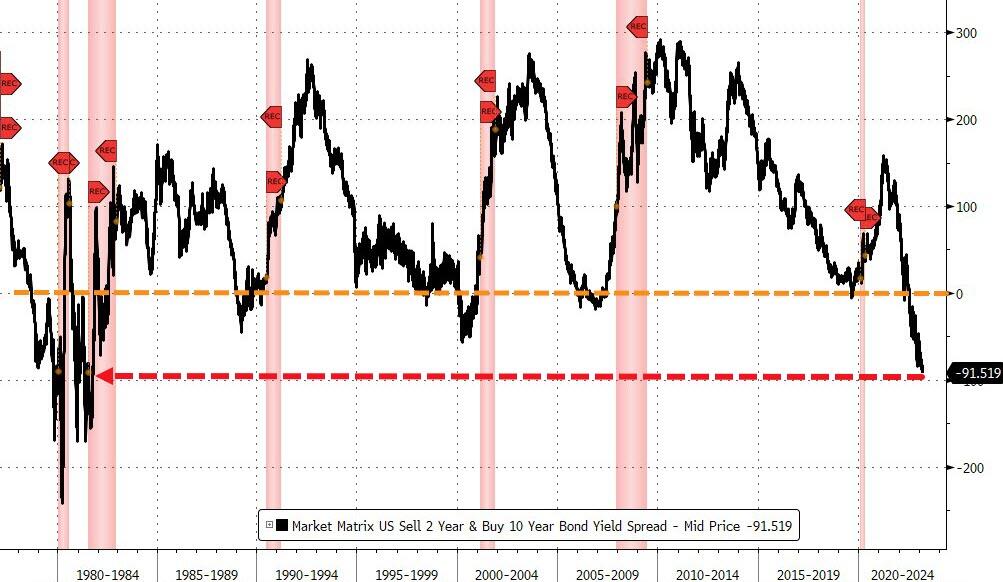
And at the same time, the yield curve (2s10s) pushed to a new cycle low, its most-inverted since Oct 1981, screaming recession…

Source: Bloomberg

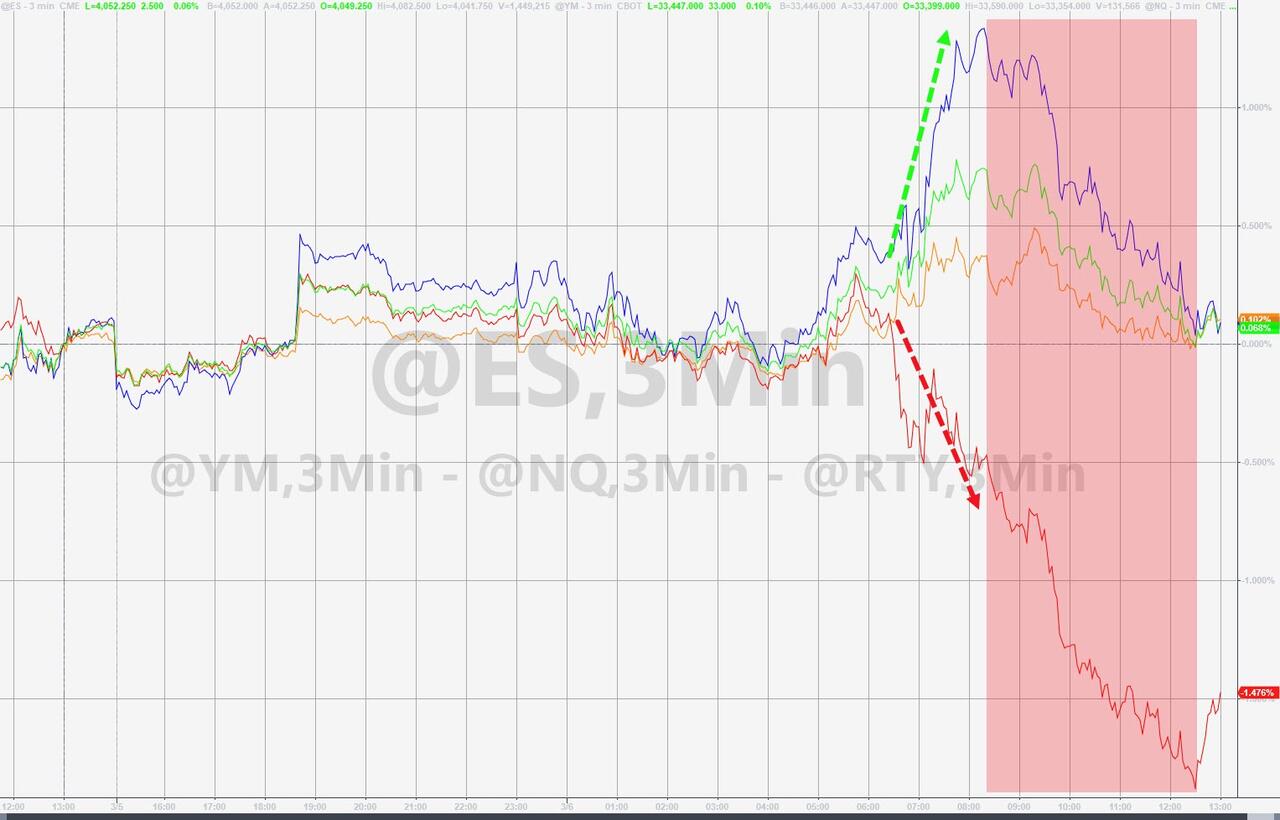
But rates rising and recession rearing did not stop investors buying big-tech, but from shortly after Europe closed, US equities all saw selling pressure but Small Caps the biggest loser all day. The Dow, S&P, and Nasdaq gave back their earlier gains by the close ahead of Powell tomorrow…

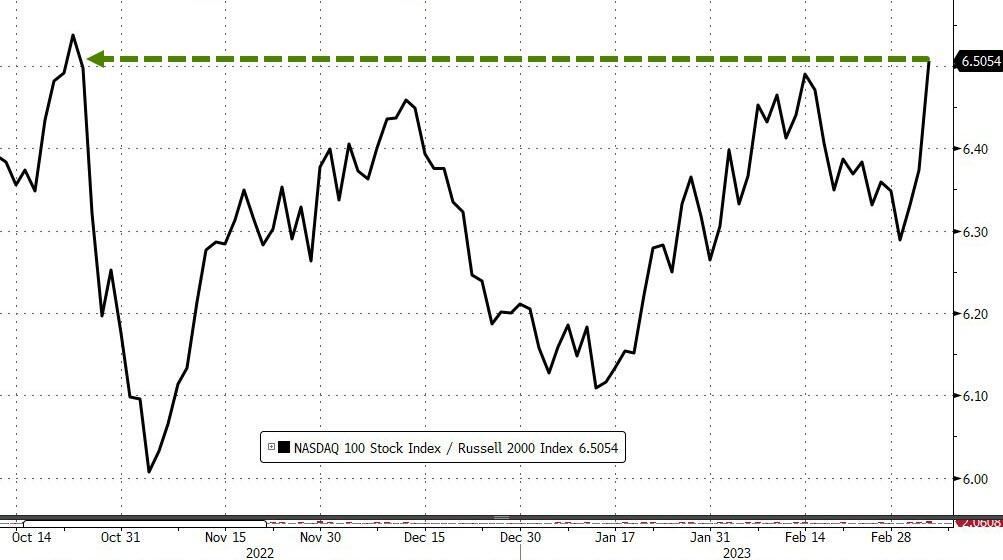
Nasdaq (mega tech) outperformed Russell 2000 (small caps) by almost 2% – the most since Nov 2021 – with Nasdaq at its ‘strongest’ relative to Russell 2000 since Oct 2022…

Source: Bloomberg

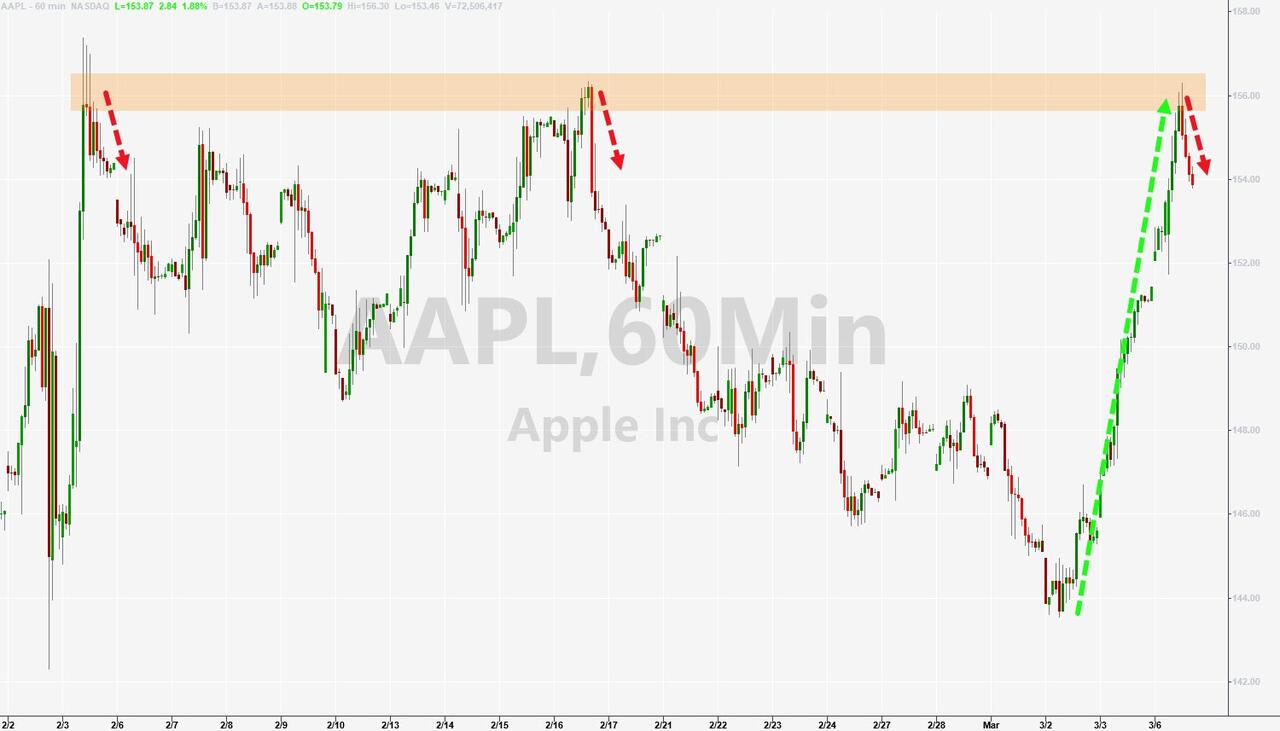
Goldman upgraded Apple – which likely helped support the mega-caps – but the giant tech company’s stock hit a wall again at around $156…

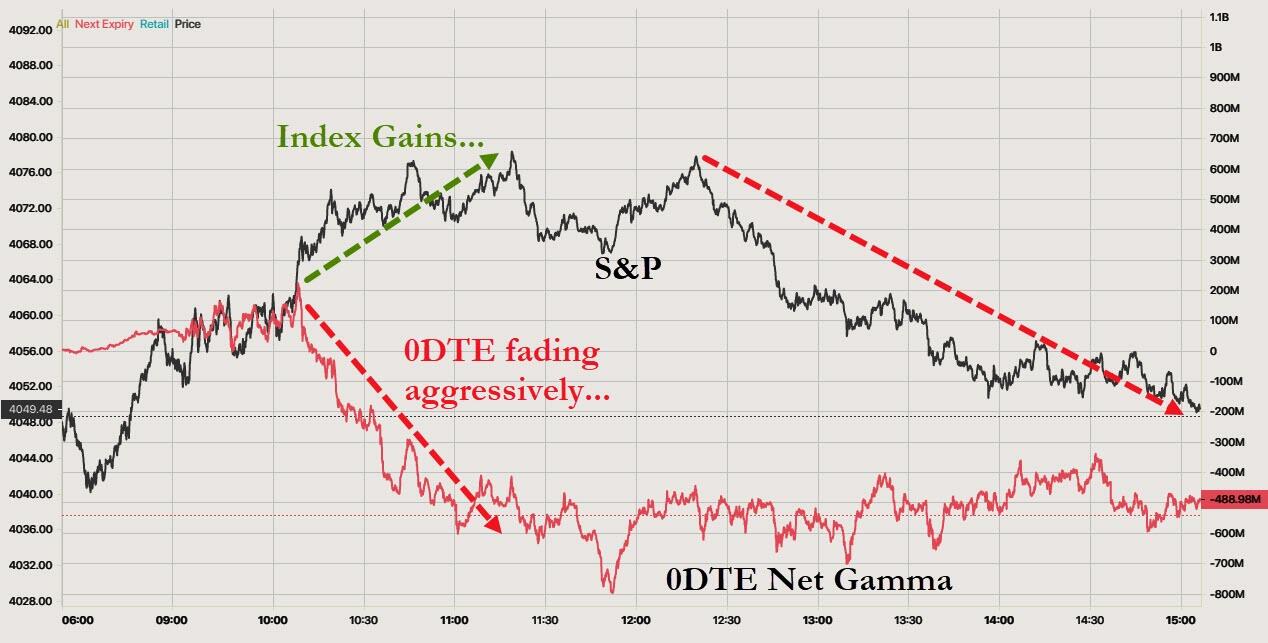
…and may help explain why early on we saw 0DTE traders fading the gains in the index (and then the index catching down to reality in the early afternoon)…

HIRO Indicator | SpotGamma™

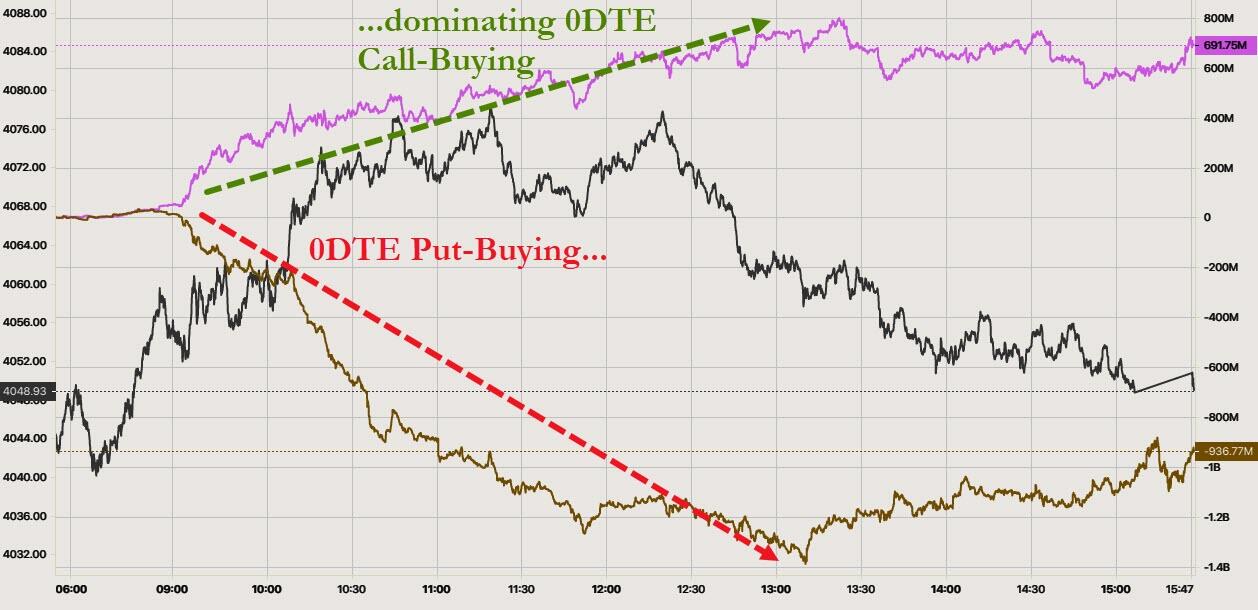
There was aggressive 0DTE put-buying from the cash open to around 1315ET, and not much give back…

HIRO Indicator | SpotGamma™

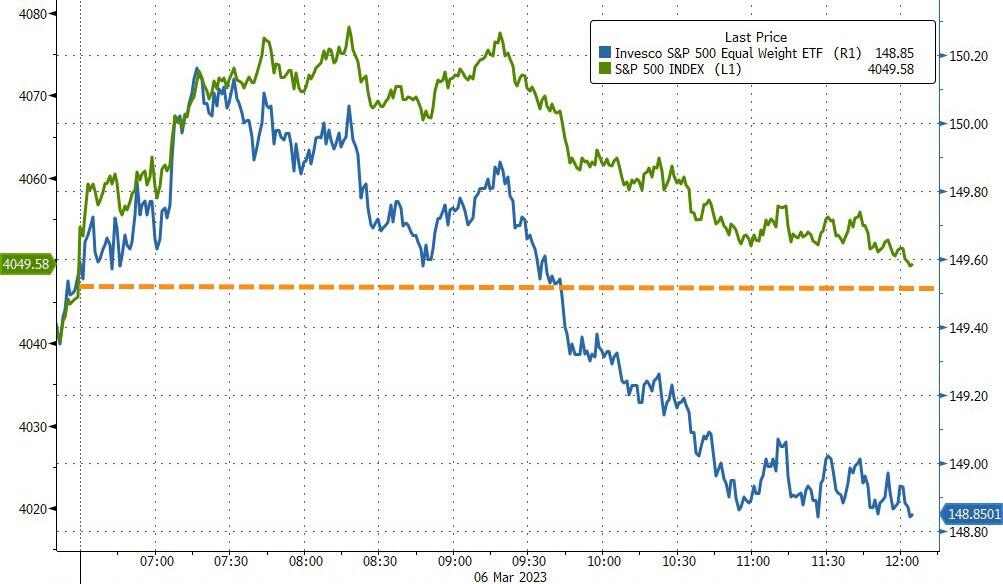
Furthermore, the mega-caps dominated performance as the equal-weight S&P dramatically underperformed

Source: Bloomberg

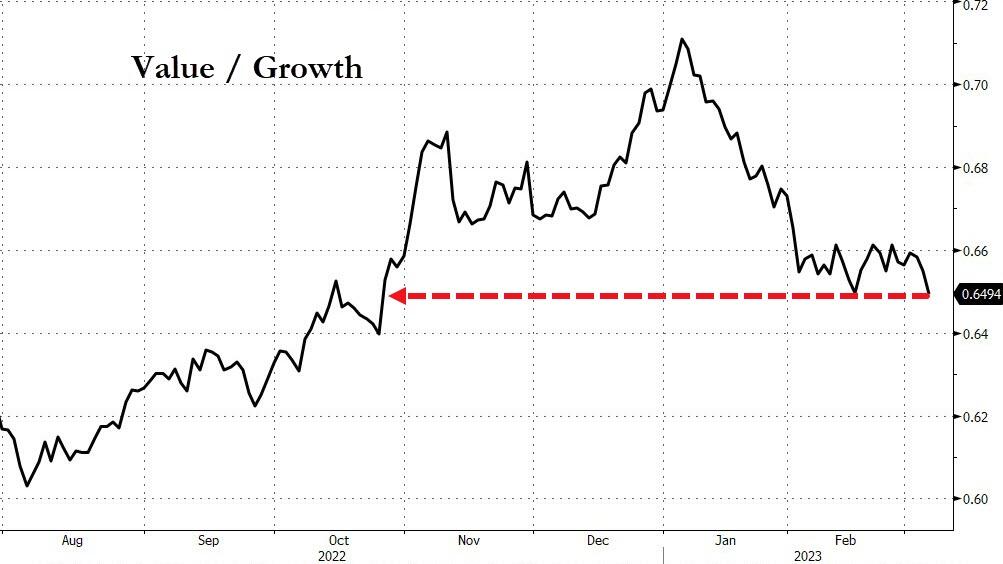
Value stocks underperformed growth once again, breaking to their relative weakest since Oct ’22…

Source: Bloomberg

It wasn’t a short-squeeze either as the early spike in “most shorted” faded shortly after the factory orders data…

Source: Bloomberg

Treasury yields were higher across the curve with the belly modestly outperforming after rallying overnight (weaker China growth?). That’s around an 8-10bps surge in yields during the US session

Source: Bloomberg

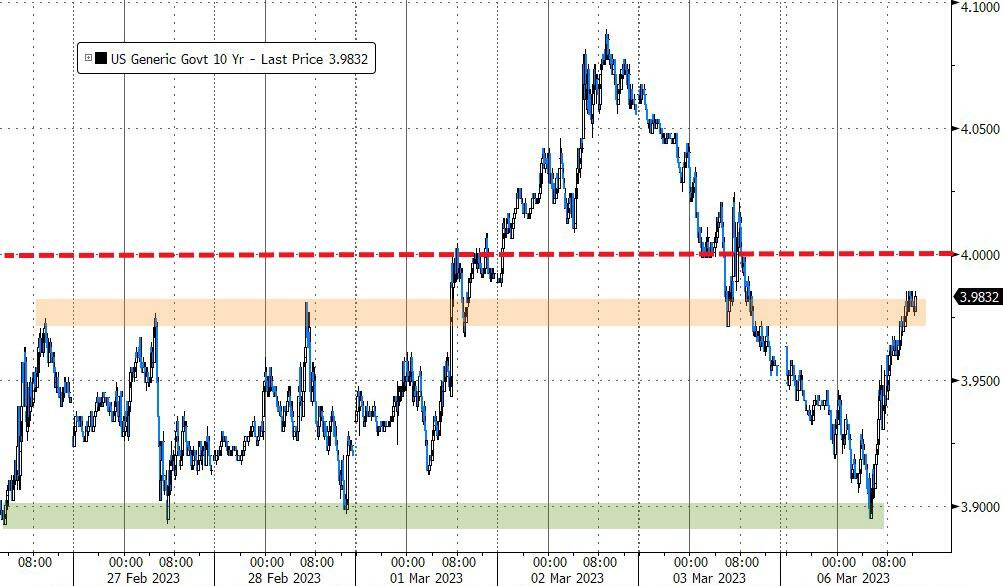
…with 10Y back up near 4.00%, but finding resistance at last week’s 3.98ish level…

Source: Bloomberg

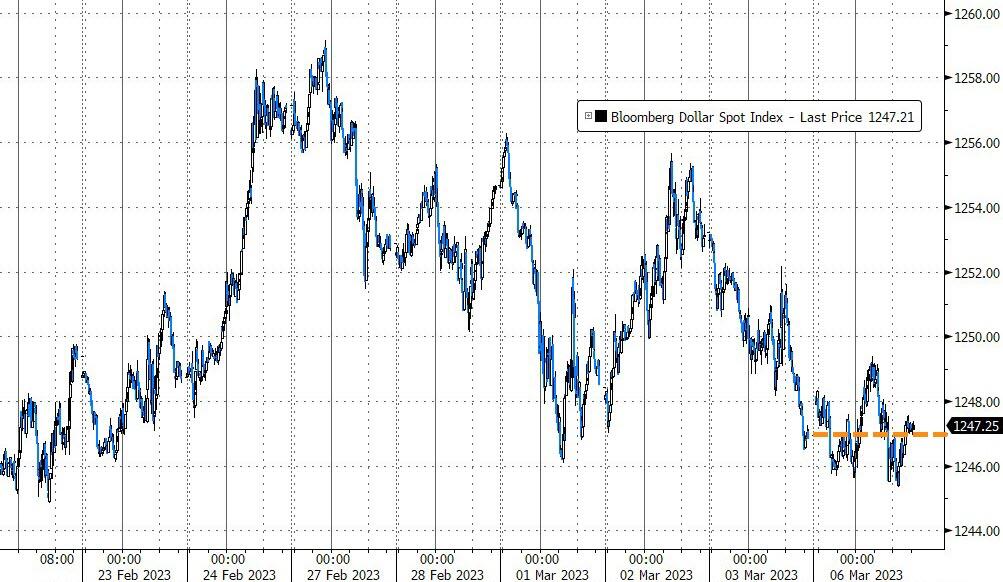
The dollar oscillated in a narrow range but ended the day basically unch…

Source: Bloomberg

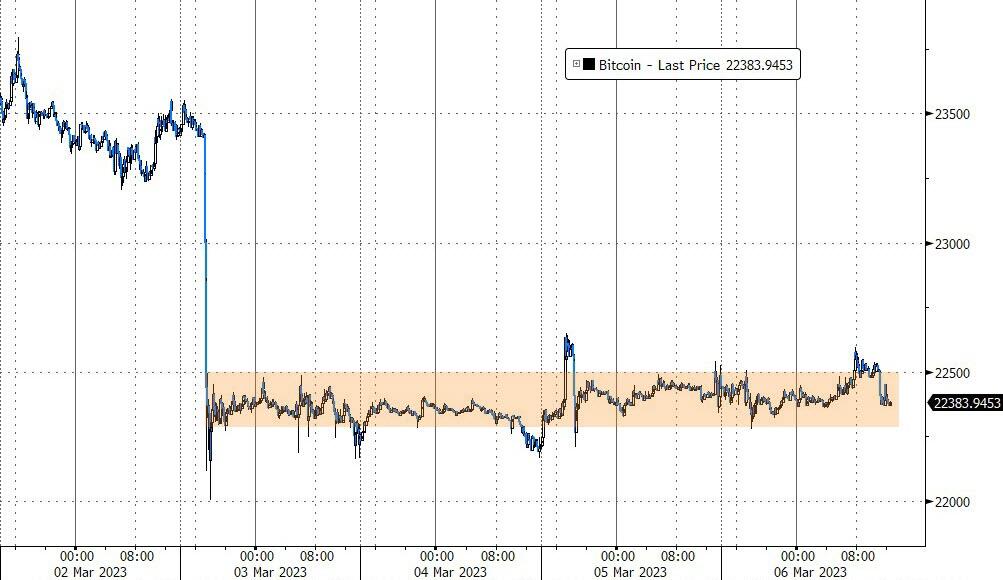
Bitcoin drifted largely sideways after Thursday evening’s plungegasm…

Source: Bloomberg

Oil prices ended the day higher after early (China) weakness. WTI spiked back above $80, three-week highs…

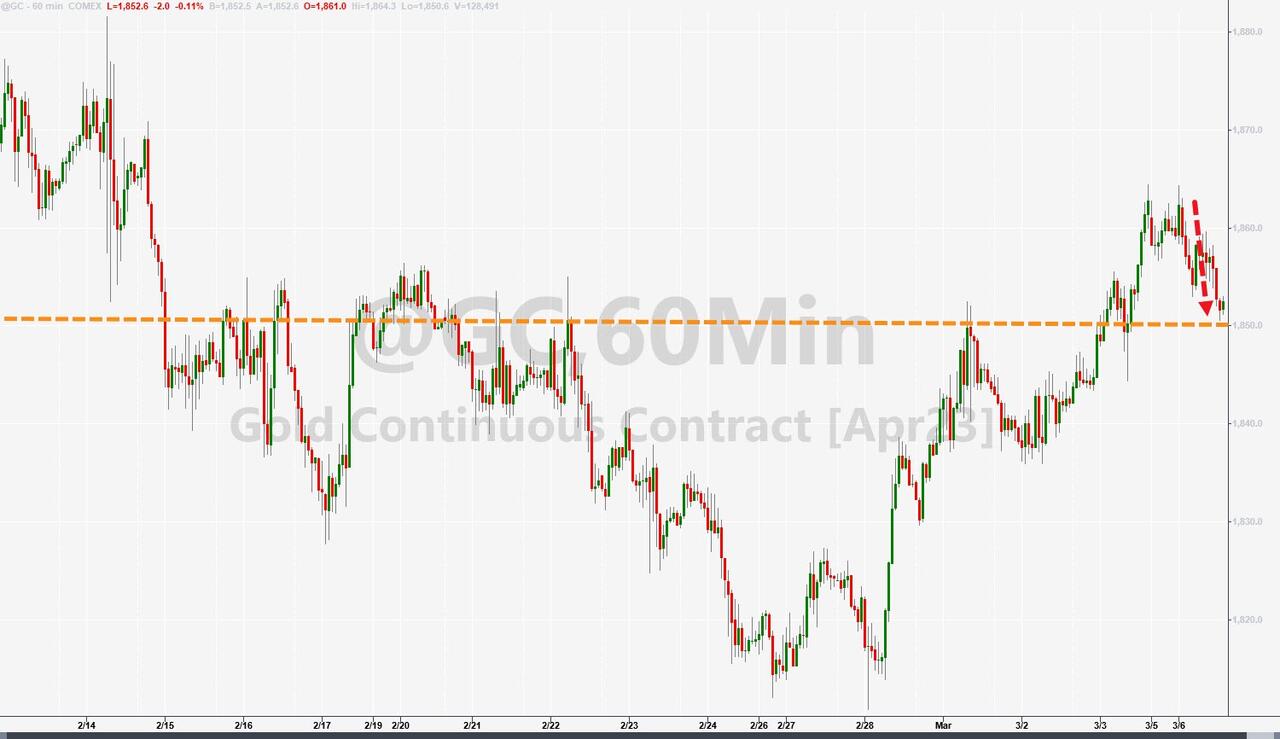
Gold futures ended very modestly lower but held above $1850…

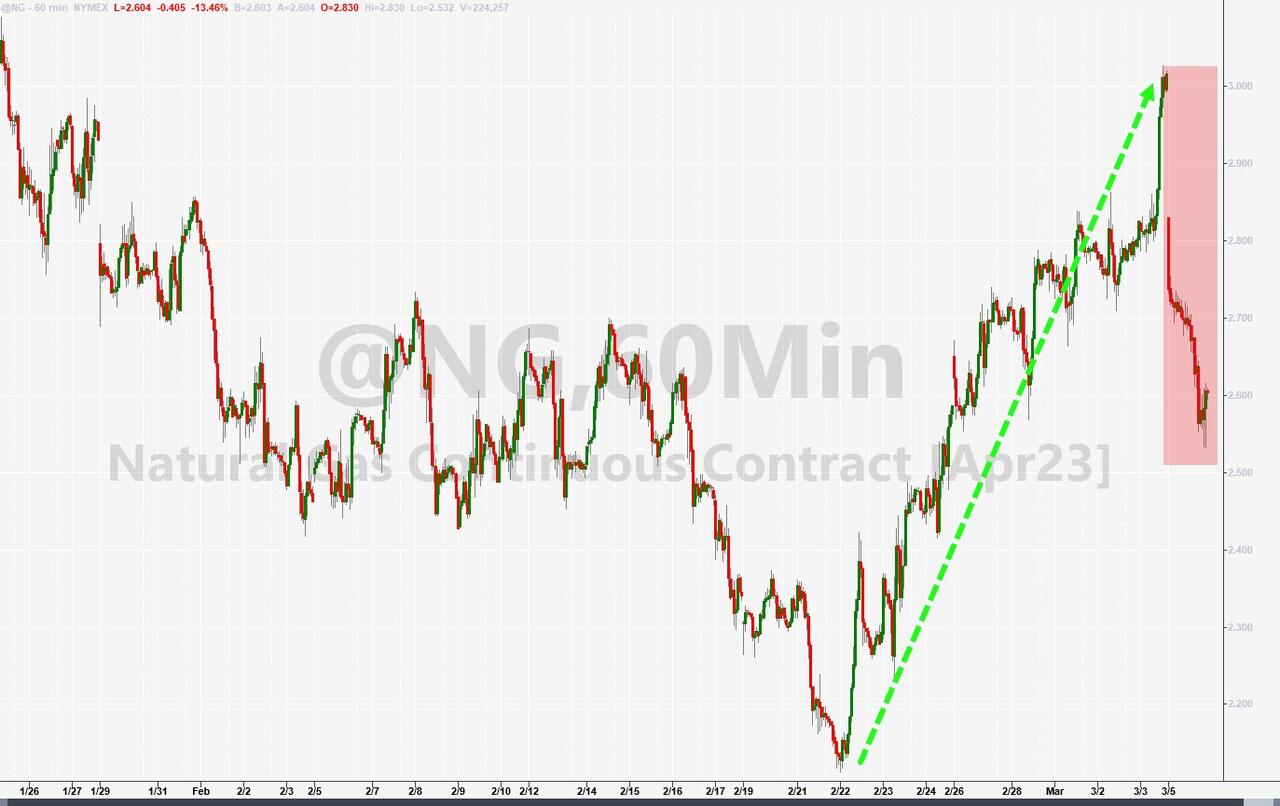
Having ripped back up to a $3 handle (after briefly tagging a $1 handle), US NatGas prices were clubbed like a baby seal today, puking over 13% as weather forecasts shifted milder over the weekend, slashing the outlook for heating demand at a time when larger-than-normal domestic inventories weigh on prices….

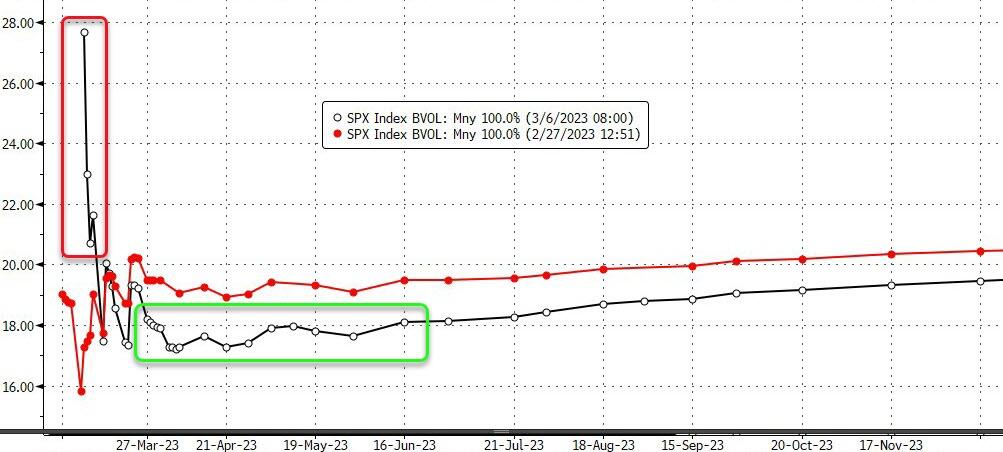
Finally, while investors are apparently more confident in the coming weeks, they are pricing considerably more uncertainty in to the markets this week…

Source: Bloomberg

With S&P implied vols notably elevated into payrolls (and Powell tomorrow), then fading back below 20 – and lower than at the start of last week.

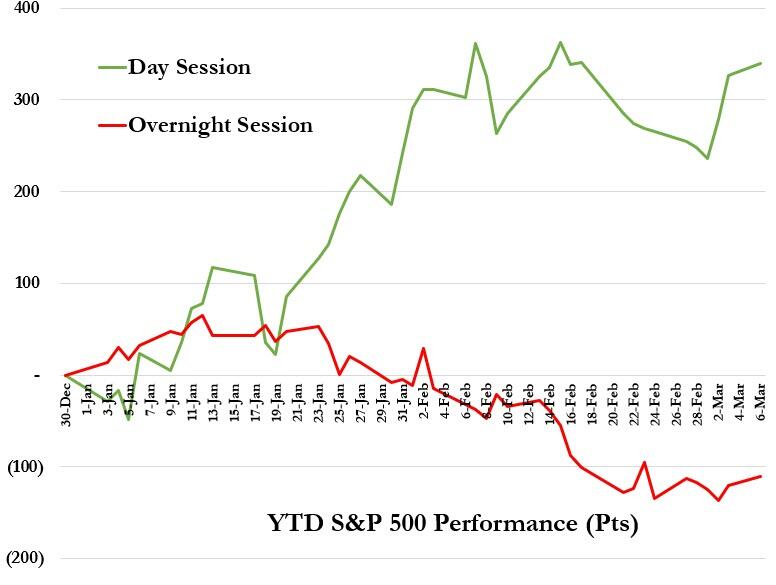
It’s also worth noting that the S&P has dramatically outperformed during the day-session in 2023 (relative to the overnight session)

A very different regime from the last few years “easy trade”.

Tyler Durden
Mon, 03/06/2023 – 16:00

via ZeroHedge News https://ift.tt/HJ4CjKq Tyler Durden

Peter Schiff: All Roads Lead To Hard Landing And Higher Inflation

Peter Schiff: All Roads Lead To Hard Landing And Higher Inflation

Via SchiffGold.com,

The markets still seem to believe the Federal Reserve can ratchet price inflation back down to 2% while bringing the economy to a relatively soft landing. In his podcast, Peter Schiff throws cold water on this hopeful narrative. He goes through the economic data that came out last week shows that all roads appear to lead to a hard landing and higher inflation.

The stock markets finished up last week thanks to optimism that the Fed will pause rate hikes this summer. Atlanta Fed president Raphael Bostic stoked that optimism when he said he’s in favor of lower — and slower — rate hikes. “Right now I’m still in very firmly in the quarter-point move pacing.”  Even though Bostic tempered his comments, saying he will go where that data takes him, Peter said that’s all the markets needed.

The bulls were grasping for straws and this is the one they grabbed.”

We saw big swings from Thursday’s lows to Friday’s highs in all the major stock indices.

Basically, all of the weekly gains were attributable to the Thursday-Friday rally, which was 100 percent the result of Fed-speak about the potential for a pause.”

There was quite a bit of weak economic data last week as well, including a 4.5% drop in durable goods orders. The Dallas Fed Manufacturing Survey came in at -13, below the low end of expectations. The Chicago and Richmond Fed manufacturing surveys were also weaker than expected. Meanwhile, the goods trade deficit was $91.5 billion.

We keep getting number after number that disappoints to the weak side on manufacturing. This flies in the face of a soft landing narrative, because it suggests that if we land at all, it’s not going to be soft. But maybe this is one of the reasons that investors are believing that we’re nearing the end of the rate hike cycle, and we’re going to get a pause followed by a pivot where we get our first cut.”

But Peter emphasized that just because we have a recession doesn’t mean inflation is coming down. In fact, it could be the exact opposite. Regardless, inflation certainly doesn’t appear to be cooling right now based on the productivity and cost numbers for the fourth quarter.

Anybody who is hoping that the Fed is winning the inflation battle, these numbers throw cold water all over that narrative.”

Productivity was down to 1.7% in Q4 from the 3.0% pace in Q3. Meanwhile, unit labor costs surged more than expected by 3.2%.

So, we have lower productivity and higher labor costs. This is not good if you think inflation is under control. The best way to control prices is with increasing productivity. But we’re not getting that. What we’re getting is increasing costs.”

Keep in mind that just because unit labor costs are rising doesn’t mean workers are getting paid more. Unit labor costs also include things like health insurance premiums, payroll taxes and regulations.

In fact, a lot of things the government does to increase labor costs results in fewer people getting hired. Because the government makes it so expensive to hire people that businesses try to avoid hiring where they can. So, they hire fewer people as a result of these rising labor costs.”

Peter reiterated that all of this flies in the face of the notion that inflation is coming under control.

And while there were a couple of better-than-expected economic data points, the rule was weak economic data.

But not only weak economic data, but inflationary data, not just with the weakness in productivity and spiking labor costs, but the fact that all of the manufacturing output is low. We need more supply. Well, we’re not getting it. We’re not producing more. We’re certainly consuming. So, where are we going to get the goods if we’re not producing them? We’re going to import them. That’s what you saw with the merchandise trade deficit. We’re importing the merchandise that we don’t have the industrial capacity to produce, and this is driving up our trade deficit, which will ultimately drive down the value of the dollar and push up domestic consumer prices.”

Peter said most of the optimism about the Fed slowing down its monetary tightening isn’t as much about the economy weakening as it is inflation weakening. But as Peter explained in a previous podcast, once the inflation genie is out of the bottle, it’s impossible to get it back in.

Peter reiterates this point by talking about inflation in the Eurozone.

What the markets still don’t get is even if we end up in a recession — in fact, even if we end up in a financial crisis — the inflation rate is not coming down. In fact, I believe the next recession will be a catalyst to send inflation to new highs. … They still don’t get the reality of stagflation. And they still don’t understand that you can have stronger inflation in a weaker economy. And in fact, this economy is going to be so weak that it’s going to supercharge inflation because the Fed is going to be forced to respond not only to the weakness in the economy, but in particular, the weakness in financial markets and the precarious fiscal position of the US government by unleashing massive inflation — maybe even more than unleashed during the lockdown periods of COVID, and that is going to send the inflation rate to new highs and bond prices to new lows.”

In this podcast, Peter also talks about:

  • The fact that the ECB’s inflation goals were asinine.

  • The Fed will soon break its money-losing record.

  • Debt is going to spiral out of control.

  • Big money is leaving crypto.

  • Markets don’t get that inflation isn’t coming down.

Tyler Durden
Mon, 03/06/2023 – 15:45

via ZeroHedge News https://ift.tt/R5DaSul Tyler Durden

Michael Wilson Turns Tactically Bullish, Sees S&P Rising To 4150

Michael Wilson Turns Tactically Bullish, Sees S&P Rising To 4150

After 9 consecutive weeks of urging clients to sell or short the rally, and famously saying on Jan 9 that the 3900 level in the S&P was an “easy sell” – which, come to think of it, is not that different from Marko Kolanovic telling JPMorgan clients throughout most of 2022 to buy the dip before turning bearish just as the market bottomed in October – Morgan Stanley’s Mike Wilson has finally capitulated, just as we said he would despite a barrage of disgruntled comments who viewed his words as gospel instead of what it really was: an attempt to load up the axed MS flow desk with easy retail money.

Recall, it was just last week when we wrote “New Bull Market Or Classic Bull Trap”: Wilson, Kolanovic Dispense Weekly Dose Of Market Doom, and reminded readers that Wilson is “forecasting the S&P 500 will slide as much as 24% to 3,000 points some time in the spring. Translation: Morgan Stanley has some very comitted buyers who would love to buy stocks lower, and certainly much lower.” And it was one month ago when we penned “Undaunted By “Hated Rally”, Mike Wilson And Marko Kolanovic Urge Clients To Stay Bearish” in which we said that after urging everyone to sell above 3,900, Wilson has kept his clients “out of the best start to the year in decades. In January, he said the economy was headed for a downturn, and the bank reduced its recommended equity allocation once again due to fears of a recession and central-bank overtightening. Last week, he said that the US economy’s disinflationary process could just be “transitory.” Stocks then surged.”

We then summarized our views on the matter by saying that the “Rally won’t end until Wilson and Marko turn bullish”

And so, with spoos having risen as high as 4,200 before dropping, yet failing to break below the 3,900 key support level last week at which point another furious squeeze sent e-minis surging to just shy of 4,100 this morning, one of the two strategists finally threw in the towel overnight.

In his latest Weekly Warm-Up note, just seven days after confidently declaring that “given our view on earnings, March is a high risk month for the bear market to resume” noting that “we think this rally is a bull trap”, this morning Mike Wilson pulls a 180 on his bearish view – at least for the near term – and writes that “equity markets survived a crucial test of support last week that suggests this bear market rally is not ready to end just yet” and concluding that “we could see further upside if the US dollar and interest rates continue their fall from Friday with next resistance for the S&P 500 at 4150 under such conditions.”

Some more details:

Wilson starts off by writing that given his comments last week around the technicals, “we thought it was important to provide a brief update after Friday’s price action” which as noted earlier was the latest short squeeze (as we had correctly previewed one week earlier) to be sparked by too many traders piling on the same bearish side that Wilson has been pitching for months. In short, Wilson writes, “equity markets went right to the brink of the critical support levels we discussed, and held.” Translation: those who expected the bear market to resume as Wilson explicitly said one week ago, lost money again.

More importantly, the MS strategist notes, markets “reacted strongly from those levels, which suggests this will not be a one day wonder and the bear market rally is not yet over.” Here is a snapshot of Wilson’s technical observations” 

First, while our comments will focus on the S&P 500, these observations apply to most of the other major indices as well–i.e., the Nasdaq, Russell 2000 and the Dow Industrials, which remains the weakest of the bunch, in our view. First, in Exhibit 1 one can see that the key support was tested severely over the past few weeks but on Friday, the market reacted strongly around the second test. We have to respect that successful test and now need to try and decide what it means.

Second, and in addition to the strong rebound, the S&P 500 was able to recapture its uptrend from the rally that began in October. However, there was not a positive divergence on the second retest as shown in the chart and that leaves open the door that this rally may still be on borrowed time despite the impressive price action on Friday. We would point out that one of the reasons we called the rally in October had to do with the fact that we did get a very strong positive divergence on that secondary low in mid October (see chart above).

True, Wilson correctly called the October rally. If only he had also correctly called the January/February rally instead of slamming it week after week, and only turning “tactically” bullish after the recent selloff failed to even recapture the level he said on Jan 9 – the very day the meltup start – was an “easy sell.

Third, and final, the other thing Wilson is watching closely from a technical standpoint is the longer term uptrend that began after the GFC in 2009:

We showed this trendline in prior notes and continue to think it is critical that the S&P 500 get back above it to confirm a new bull market. As shown in Exhibit 2, this trendline has provided critical resistance and support over the past 14 years during this secular bull market. More recently, it has been more of a resistance line and that level comes in today at around 4150. While we think the S&P 500 could make another attempt at this key resistance, it will require 2 things in particular to surmount it–lower 10-year US Treasury yields and a weaker dollar. In fact, we think Friday’s sharp fall in 10-year yields was an important driver of Friday’s bounce in stocks. The dollar, too, showed some signs of exhaustion and it would be helpful if it can decline more meaningfully.

So having capitulated on his call from last week which said March was a “high risk month for the bear market to resume”, what does Wilson think happens next? Well, after admitting that he was wrong and that more bear market rallies are coming, the MS strategist remains bearish, and says that “in the absence of a weaker dollar and lower yields, this bear market rally will fail. In other words, these are key variables to consider in one’s view for stocks over the next several weeks and even months.”

Well, of course they are: after all what the strategist just said is a truism; but it’s not Wilson’s job to teach finance 101, but rather to say where stocks go next – and thus yields and the dollar – not give “if… then…” assessments.

Wilson’s bottom line is that “there is plenty of bullish and bearish fodder in these charts and one will have to take their own view on the fundamentals to decide if this bear market rally is still intact or if a new bull market has begun.” Which is strange considering that up until last week, for nine weeks in a row, Wilson was adamantly confident that his view on fundamentals was right. Did Wilson’s conviction in his view fade? Why no, in fact as he himself concludes, “our view remains the same-the bear market is not over–but we acknowledge that Friday’s price action may extend it a few more weeks. Time will tell.”

What did happen is that having missed all of the January meltup and the violent Friday rebound, enough of Morgan Stanley’s high net worth clients complained that Wilson had kept them out of the market, and the bank’s permabearish analyst finally got a tap on the shoulder, prompting him to tell clients that going forward they have to “take their own view” if a new bull market has begun, and even if it hasn’t, Wilson takes a big step back from predicting imminent doom, and writes that “we could see further upside if the US dollar and interest rates continue their fall from Friday with next resistance for the S&P 500 at 4150 under such conditions.”

Tyler Durden
Mon, 03/06/2023 – 15:25

via ZeroHedge News https://ift.tt/fYXBSiD Tyler Durden

The EIA Vows To Improve The Accuracy Of Its Oil Data

The EIA Vows To Improve The Accuracy Of Its Oil Data

In August 2022, amid soaring pump prices and plummeting approval ratings, questions were raised about “very crooked numbers” regarding gasoline demand that helped hammer the price of oil lower ahead of The Midterms.

And while we previously highlighted the ‘strange’ seasonal adjustments across plain vanilla economic data, we now see outlier levels of ‘adjustment’ hitting the arcane EIA crude inventory data (coincidentally as Europe’s ban on Russian imports and Washington-led price-caps hit).

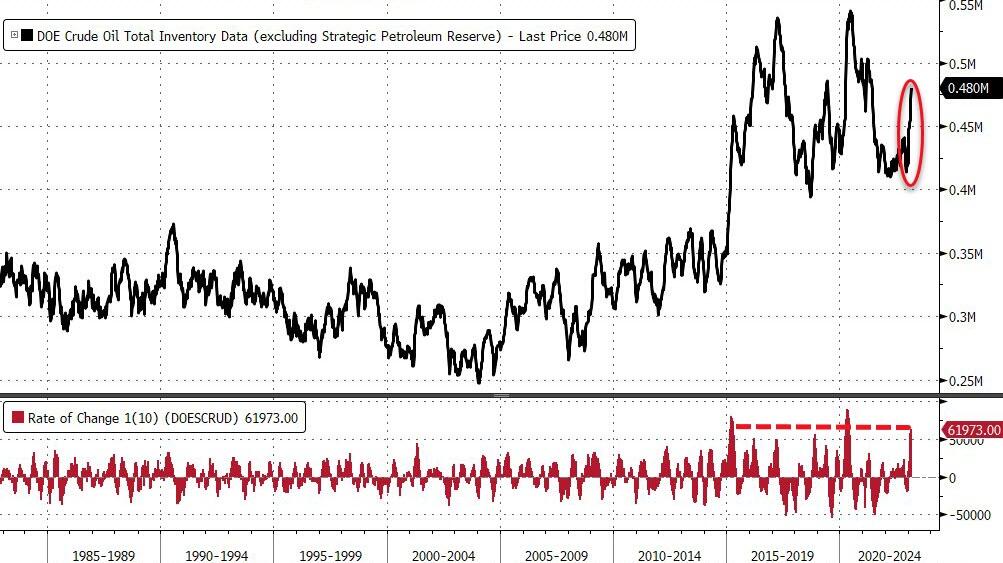
All of a sudden, US crude inventories have soared for 10 straight weeks – up a stunning 62 million barrels over that time (only comparable to 2020’s global lockdown demand collapse)…

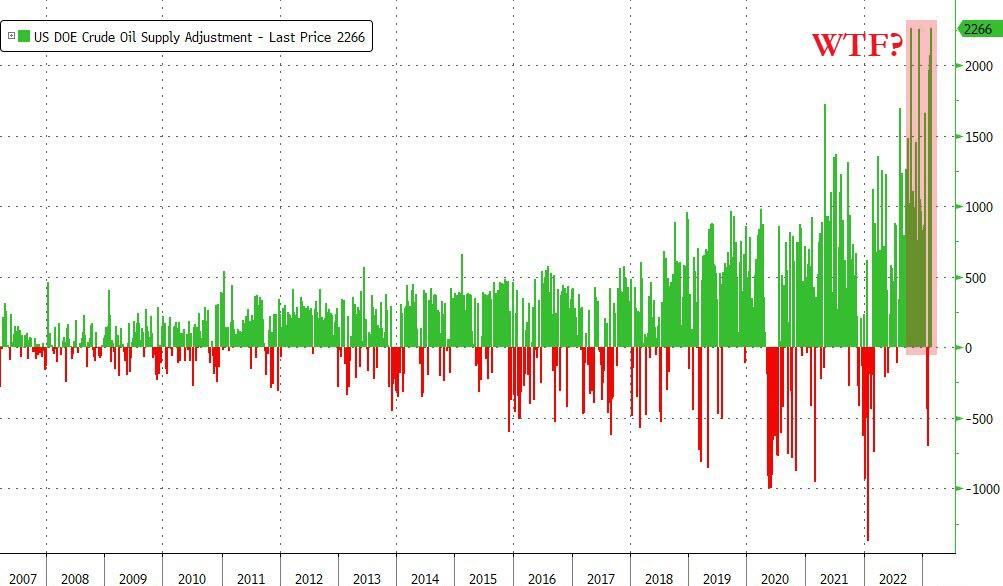
But… along with this sudden and shocking surge in reported inventory builds, the so-called “adjustment factor” used by EIA spreadsheet-builders to manage their data has exploded to record outlier highs week after week…

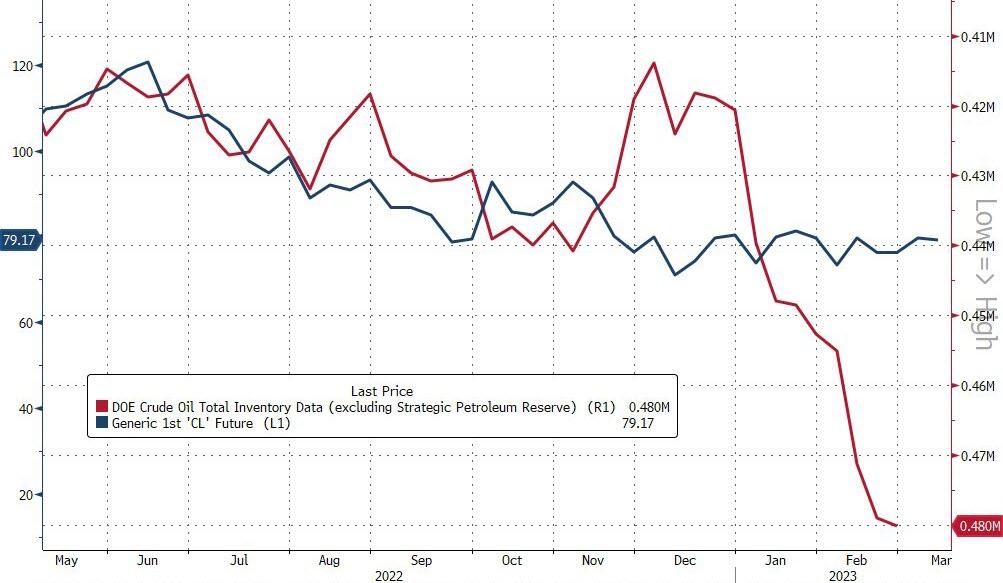
Oil prices have refused to follow this data, trading sideways as – according to the ‘reported’ data – supply is very much outpacing supply…

As OilPrice.com’s Tsvetana Paraskova reports, The EIA has baffled the market and analysts with high adjustments in its weekly and monthly U.S. oil data in recent years.

The so-called adjustment in weekly and monthly crude oil data, or “Unaccounted For Crude Oil” as it was previously referred to, has been used to balance the difference between oil supply entering the market and oil disposition, or oil leaving the market.

In the latest weekly petroleum status report, the data from the Energy Information Administration showed last week that the adjustment – the balancing item – was at 2.266 million barrels per day (bpd). That was equal to the highest adjustment since reporting data in that form began in 2001. U.S. crude oil exports were also the highest on record in the weekly data for the week to February 24—at 5.629 million bpd, per EIA data. 

However, as the EIA itself says, data collection for these numbers has been imperfect for years and needs a change of methodology to represent U.S. oil supply and demand data more accurately. 

The latest Petroleum Monthly Supply report also showed growing adjustment figures to explain the gap between supply and disposition. 

“In our Petroleum Supply Monthly, the crude oil supply adjustment more than doubled from Q1 2022 to Q4 2022. In the same time frame, the adjustment tripled in our Weekly Petroleum Status Report,” EIA Administrator Joe DeCarolis said in a Twitter thread on Friday.  

Last year, up to 4% of oil supply was unaccounted for, or “adjusted,” according to EIA data. “Or this might be smaller if disposition is overstated,” DeCarolis said.

The official offered explanations why such high adjustment levels have been seen in recent months and years. EIA analysis pointed to crude oil blending and under-reported production as the two principal contributors to the discrepancy in supply and disposition data.

Following a 90-day assessment of the high adjustment figures in EIA’s weekly and monthly crude oil data, the Administration is confident that some of the reported U.S. crude oil exports include other products, likely natural gasoline and naphthas (light hydrocarbons). These could be blended into crude or reported as crude exports, EIA’s DeCarolis says.

“That would mean that the amount of actual U.S. crude exports is slightly less than what is reported, or in other words, that disposition is overstated.”

There is a strong correlation between the jump in U.S. crude oil exports since 2016 and the increases in EIA adjustments, which hints at a relationship, the official noted.

The issue is further compounded by the fact that products that the EIA believes are being blended with crude oil also show up as product supplied, the proxy for demand. 

“So those products are being *double counted* on the disposition side of the equation,” DeCarolis said.  

Under-reported crude oil production is the second contributor to high adjustments. Field condensate is often collected in gas gathering lines or at the inlet to gas processing plants and introduced into the crude oil system as “light hydrocarbons”. Production data on these liquids is not collected in the current natural gas or crude oil surveys by the EIA. So they largely go unaccounted for as they enter the crude oil system, EIAs DeCarolis said. 

The EIA needs to update its surveys to better capture the changed U.S. oil production with the shale formations which are producing a “hydrocarbon soup,” with producers separating and processing those resources at multiple steps, DeCarolis said. 

“There always will be an adjustment in our petroleum data,” he noted. 

“But making changes to account for crude oil blending and under-reported production get us closer to balance, which will present a more accurate representation of the crude oil market.”   

The EIA will make changes to its surveys to account for the light hydrocarbons, which will take time. The Administration will also change its accounting methods for crude oil blending to get more accurate data on U.S. crude oil production, DeCarolis said.  

The EIA will publish on March 22 a This Week in Petroleum article that will provide more details on the findings and specific next steps to address the issue of more accurate representation of U.S. oil market data.  

Tyler Durden
Mon, 03/06/2023 – 15:06

via ZeroHedge News https://ift.tt/C1wBE3x Tyler Durden

At CPAC, Trans Issues Dominated. But Do Voters Care?


zumaglobaltwelve779680

From the speeches at this year’s Conservative Political Action Conference (CPAC), it would be easy to assume that transgender issues were the most pressing subject in American politics. In speech after speech, panel after panel, speakers hammered home the dangers of “gender ideology” and the importance of banning underage gender transitions and keeping school sports and bathrooms sex-segregated.

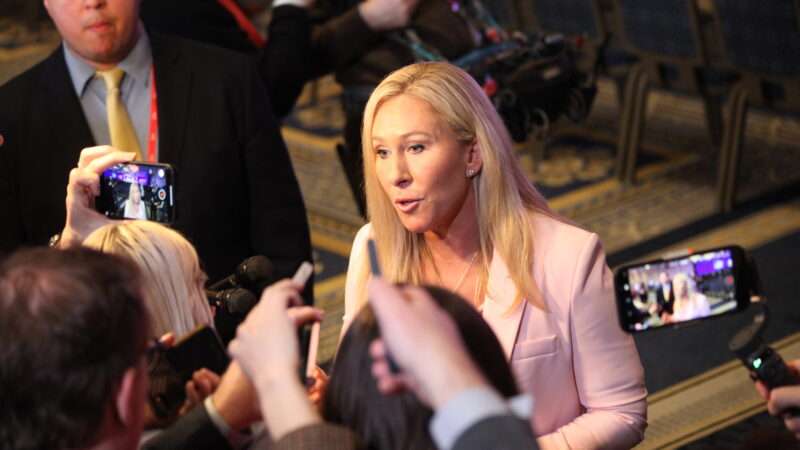
At CPAC, Rep. Marjorie Taylor Greene (R–Ga.) warned about a “billion-dollar industry that mutilates the genitals of children.” Presidential candidate and former South Carolina Gov. Nikki Haley said that President Joe Biden was making soldiers take “gender pronoun classes.” Conservative commentator Michael Knowles said, “Transgenderism must be eradicated from public life.” While their comments seemed to rile up the audience at CPAC, how do such statements play with the broader Republican base—or the independent voters they’ll need to sway in 2024?

Based on available polling data, not only do many self-identified Republicans and independents often have complex views on transgender issues, but it simply isn’t a topic that ranks highly in Americans’ political priorities.

According to a June 2022 poll from the Pew Research Center, Americans have surprisingly complex views on transgender issues, often supporting measures that protect transgender individuals from discrimination while expressing ambivalence in other areas. For example, almost two-thirds of respondents said they would support policies protecting transgender individuals from discrimination in “jobs, housing, and public spaces,” but only 38 percent said that someone’s gender can differ from their birth sex, a percentage that has actually been shrinking since 2017. Further, while there is still a clear partisan divide on transgender issues, nearly half of Republicans reported supporting anti-discrimination laws.

Republican respondents took consistently conservative positions on transgender issues, with large gaps between Republicans and Democrats on issues like youth medical transition and transgender athletes. However, there were still several responses that indicated a general ambivalence about some important elements of the current debate over gender identity.

For example, while 72 percent of Republican parents reported strong opposition to classroom instruction about gender identity in elementary school, this opposition cooled by 20 percentage points when parents were asked about middle- and high-school instruction. Most notably, many Republican parents didn’t seem to care much, with 40 percent reporting that it was neither good nor bad that their child had, or had not, learned about gender identity in middle or high school.

Continuing this trend, Republicans seemed less invested in transgender issues than their Democratic counterparts. Sixty-eight percent of conservative Republicans and Republican-leaning independents reported not following trans-related bills closely, while only 54 percent of liberal Democrats and Democrat leaners did. Over three-quarters of self-described “liberal” or “moderate” Republicans didn’t follow the issue closely.

Overall, it’s doubtful that transgender issues are of top concern to a significant portion of Americans, though it’s worth noting that specific polling is lacking. According to Gallup’s Most Important Problem survey, only 1 percent of Americans listed “LGBT rights” as the political issue most important to them in February 2023. While the actual concern for the issue is probably a bit higher—framing the question as “LGBT rights” would likely suppress responses from those who oppose pro-trans policies—the survey provides a sense of scale. As it turns out, economic issues overwhelmingly dominate Americans’ concerns. Poor government leadership, inflation, and the economy have topped the list since July 2022.

While inflammatory comments about gender identity may have gotten a warm reception at CPAC, opinion polling on the subject reveals a more complex picture. Republicans definitely swing more conservative on the subject than their Democratic counterparts, but they seem divided or uncertain about their stances on specific LGBT issues. And these issues are just not at the forefront of most Americans’ minds.

If Republicans continue to make transgender issues the focus of their campaigns, they may run into trouble with attracting more moderate voters.

The post At CPAC, Trans Issues Dominated. But Do Voters Care? appeared first on Reason.com.

from Latest https://ift.tt/QcBVSro
via IFTTT

Anger As Djokovic Withdraws From US Open; Still Banned From Entering Country Due To Vaxx Status

Anger As Djokovic Withdraws From US Open; Still Banned From Entering Country Due To Vaxx Status

Authored by Steve Watson via Summit News,

The world’s number one tennis player Novak Djokovic has withdrawn from the Miami Open and the U.S. Open because he is still banned from entering the country owing to his vaccination status.

While the news is being reported as a “visa dispute,” the reason Djokovic cannot complete is because he refuses to take the COVID vaccine.

Djokovic has appealed for a special dispensation to play in the tournaments, given that the restrictions are slated to end in April anyway.

Djokovic requested a vaccine waiver, however it was rejected by the Homeland Security Department in a blatant move to once make an example out of the premier athlete.

Senators Rick Scott and Marco Rubio of Florida expressed support for the 22 time grand slam victor, and called on Congress to throw out Joe Biden’s “bogus vaccine mandate.”

“It has come to our attention that your administration is in receipt of a request to waive the current vaccine mandate for international travelers entering the United States from top-ranked men’s tennis player Novak Djokovic,” the Senators wrote in a letter.

“We write to urge you to grant the requested waiver, which is necessary to allow Mr. Djokovic to compete in the Miami Open professional tennis tournament held in our home state of Florida beginning March 19, 2023,” the pair added.

The letter continues, “In September 2022, you plainly declared to a national audience on 60 Minutes that ‘the [COVID-19] pandemic is over,’ and, earlier this year, Dr. Anthony Fauci published a professional article acknowledging the limited efficacy of vaccines in protecting against respiratory pathogens, like the novel coronavirus.”

“In light of these changing circumstances, and admissions by you and members of your own administration, the current restrictive vaccine mandate which you have maintained for international travelers entering the United States seems outdated and worthy of rescission,” the Senators urge.

They add, “Mr. Djokovic is a world-class athlete in peak physical condition who is not at high-risk of severe complications from COVID-19. It seems both illogical and misaligned with the opinions of your own administration to not grant him the waiver he requests so that he may travel to the U.S. to compete in a professional event.”

How long are they going to carry on with this?

Video: CNN’s Lemon Says Unvaccinated “Idiots” Like Novak Djokovic Shouldn’t Be Part Of “Polite Society”

Video: Australian Tennis Officials Order Group To Hand Over Novak Djokovic Signs In Arena Or Leave

Video: Reporter Asks White House “How Come Migrants Are Allowed To Come In Unvaccinated, But World-class Tennis Players Are Not?”

*  *  *

Brand new merch now available! Get it at https://www.pjwshop.com/

In the age of mass Silicon Valley censorship It is crucial that we stay in touch. We need you to sign up for our free newsletter here. Support our sponsor – Turbo Force – a supercharged boost of clean energy without the comedown. Also, we urgently need your financial support here.

Tyler Durden
Mon, 03/06/2023 – 14:26

via ZeroHedge News https://ift.tt/6QbyLFg Tyler Durden

Bloomberg Terminal Users Embrace ‘Cash Is No Longer Trash’

Bloomberg Terminal Users Embrace ‘Cash Is No Longer Trash’

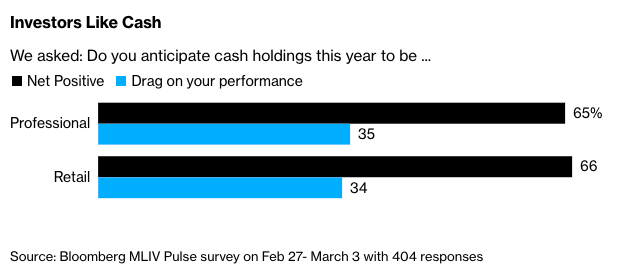
In a new survey, Bloomberg Terminal users have overwhelmingly agreed that cash in their portfolios would be a net positive this year, supporting the case ‘cash is no longer trash’ amid signs that higher-than-expected inflation data indicates global central banks will continue their ultra-hawkish stance to keep aggressively raising interest rates. 

Over 400 professional and retail investors participated in the latest MLIV Pulse survey. Two-thirds of professional respondents believe cash will be a net positive on their portfolios, while only 35% answered that cash holdings would drag on performance. Retail traders gave similar responses. 

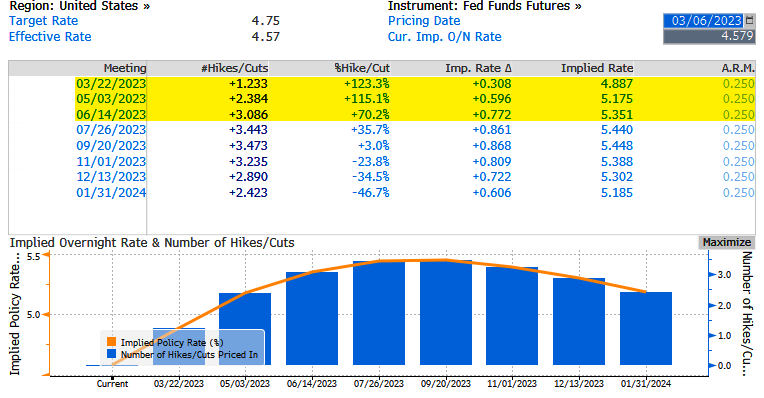
The appeal of cash stems from increasing nervousness as higher-than-expected inflation data means central banks will continue to raise interest rates through at least June, dashing hopes for a full-blown risk-on rally in equity markets. The Federal Reserve clearly has more work to do as the economy still runs hot. The Fed’s benchmark rate implied by overnight index swaps shows at least three more 25bps hikes through June, with a terminal rate of around 544 bps by mid-summer. 

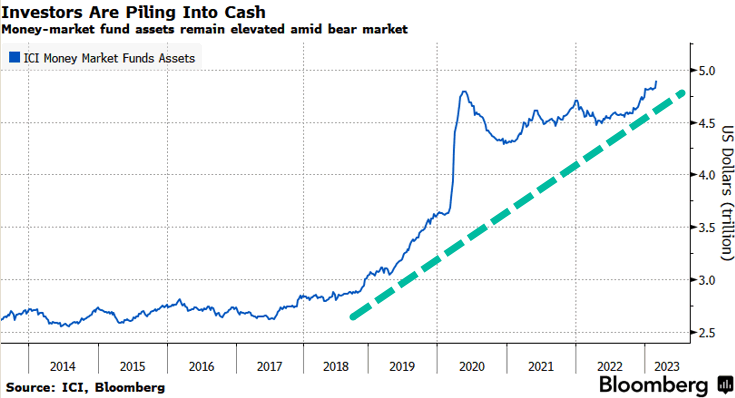
Bank of America Corp. notes, citing EPFR Global data, that during the week ending on March 1, global cash funds experienced inflows of $68.1 billion, whereas equity funds saw outflows of $7.4 billion. The significant inflows into cash suggest that investors are feeling nervous.

BofA’s Michael Hartnett wrote last Friday that the end of the bear market would coincide with credit market turmoil and lower home prices. He said until then, cash is as good as bonds and stocks. 

Tyler Durden
Mon, 03/06/2023 – 14:05

via ZeroHedge News https://ift.tt/UzTjwyv Tyler Durden

Fed Study Shows Loose Monetary Policy Leads To Disaster And Financial Crisis

Fed Study Shows Loose Monetary Policy Leads To Disaster And Financial Crisis

Authored by Mike Shedlock via MishTalk.com,

A Fed study shows the obvious… But Fed presidents never believe the few studies that ever make any sense…

Please consider the San Francisco Fed paper, Loose Monetary Policy and Financial Instability.

Much of the Fed report is truly Geek stuff and incomprehensible formulas. But the conclusions and many snippets ring home. 

Snips That Make Sense

Do periods of persistently loose monetary policy increase financial fragility and the likelihood of a financial crisis? This is a central question for policymakers, yet the literature does not provide systematic empirical evidence about this link at the aggregate level. In this paper we fill this gap by analyzing long-run historical data. We find that when the stance of monetary policy is accommodative over an extended period, the likelihood of financial turmoil down the road increases considerably. 

Kindleberger (1978) noted that “Speculative manias gather speed through expansion of money and credit or perhaps, in some cases, get started because of an initial expansion of money and credit” (p. 52). 

The originator of the natural rate concept, Wicksell (1898) hypothesized that low interest rates— and low-for-long periods in particular—spur house prices (p. 88). He even went further and argued that such increase in house prices could generate feedback as entrepreneurs expect further price increases (p. 88). Eventually, speculation starts to dominate markets (pp. 89–90), resulting in a boom-and-bust cycle (p. 90). Such a mechanism running from low interest rates set by the central bank, through behavioral responses in credit quantities and asset prices, also figures in the recent model of Kashyap and Stein (2023). 

Mian, Sufi, and Verner (2017) provide evidence that household debt booms are accompanied by a temporary boost in real activity. This boost, though, is short-lived and eventually reverses. Loose financial conditions boost the left tail of the predicted real GDP growth distribution in the short term at the expense of strong negative effects in the medium term without affecting the economy’s expected growth path.

When interest rates are relatively loose, financial intermediaries have incentives—or are even required—to search for yield and thus risk. This incentive to “search for yield” was famously put forward by Rajan (2005) as one source of financial risk. One example he gave was insurance companies. These institutions often face fixed long-term commitments and therefore increase their risk appetite when rates are low. 

Drechsler, Savov, and Schnabl (2018) also establish a theoretical link between lower interest rates and increasing leverage and thus risk exposure. 

Finally, from the experimental literature, Lian, Ma, and Wang (2019) find evidence for reference dependence and salience. In their experiments, an individual starting the experiment in a high interest rate environment will tend to make riskier investment decisions when shifted to a low interest rate environment. T 

The danger of low for long monetary policy is stressed in Boissay, Collard, Gal´ı, and Manea (2022). In their model, financial crises are the consequence of a central bank that keeps the policy rate too low for too long which in turn fosters an investment boom and eventually a capital overhang. Given this concern, we explicitly consider the consequences of persistently loose monetary policy as opposed to single periods of policy undershooting relative to the natural rate of interest. 

Our empirical analysis is based on the latest release of the Jorda-Schularick-Taylor (JST ` henceforth) Macrohistory Database which combines macro-financial data with a banking crisis chronology for 18 advanced economies over the period from 1870 until 2020. The database is described in Jorda, Schularick, and Taylor ` (2017). For this study, we shall ignore the world war periods (1914–18 & 1939–45) and we also exclude the German economy during hyperinflation (1922 & 1923), but we keep all other data points of the JST Database in the analysis that follows. Our final sample has 2457 country-year observations. 

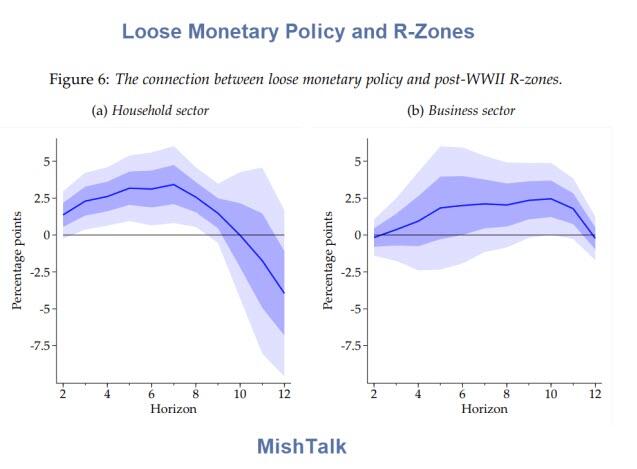
Are periods of persistently loose monetary policy more crisis-prone? This section argues that the answer to this question is in the affirmative. We see significant estimates in the medium term, that is around horizons of 5 to 10 years. Financial crises are predicted by loose monetary policy several years ahead. The importance of this empirical finding does not only arise from its high level of statistical significance and—as we will see below—robustness to model specification, but also from economic relevance. 

We do not find evidence for a positive link between loose monetary policy and financial vulnerabilities in the short term. If anything, point estimates indicate a negative relation between financial fragility and a loose stance at horizons below 4 years

Panels (a) and (b) of Figure 6 now show that, at this point, it is likely that the country has already experienced financial fragility by entering an R-zone. A loose stance of monetary policy predicts the emergence of credit market overheating in post-WWII advanced economies both in the household and in the business sector. 

Our historical evidence suggests that running such a high-pressure economy may not be sustainable in general. In the following, we argue that potential short-term gains come at the considerable cost in the form of heightened risk of disasters in real economic activity

Fed Conclusion

 This study provides the first evidence that the stance of monetary policy has implications for the stability of the financial system. A loose stance over an extended period of time leads to increased financial fragility several years down the line. The source of this fragility is associated with swings in those financial variables that have been identified by the literature as harbingers of financial turmoil. 

Policymakers should take the dangers imposed by keeping policy rates low for long seriously, and thus weigh the potential short-run gains of loose monetary policy against potentially adverse medium-term consequences. Such policies increase the risk of financial crises and thus the risk of high social, political, and economic costs. 

My Conclusion

The study is welcome but the conclusion was obvious. The Fed kept interest rates too low, too long three times in the past twenty-some years. 

The result was a dotcom boom and bust, a housing bubble followed by the Great Recession, and what many call an “everything bubble” right now.

These crises take time to brew, at least four years and up to ten or more. The Great Recession ended in 2009, so this crisis (ignoring the pandemic), is right on time. 

The asininity of this setup is a Fed again trying to produce inflation while ignoring raging inflation all around. 

The Fed only looks at consumer inflation, not all inflation. The Fed again ignored a massive speculative mania in housing, the stock market, and a new phenomenon, cryptocurrencies.

The Fed Uncertainty Principle

If you think the Fed will learn from this, you are mistaken. I have written about this several times. 

One of my favorite posts ever is “The Fed Uncertainty Principle” written April 3, 2008, well before the economic collapse. 

I reposted a shortened version on February 11, 2022.

Please consider The Fed Uncertainty Principle and a Big Swift Kick in the Pants

The Observer Affects The Observed

The Fed, in conjunction with all the players watching the Fed, distorts the economic picture. I liken this to Heisenberg’s Uncertainty Principle where observation of a subatomic particle changes the ability to measure it accurately.

The Fed, by its very existence, alters the economic horizon. Compounding the problem are all the eyes on the Fed attempting to game the system.

What happened in 2002-2004 was an observer/participant feedback loop that continued even after the recession had ended. The Fed held rates rates too low too long. This spawned the biggest housing bubble in history. The Greenspan Fed compounded the problem by endorsing derivatives and ARMs at the worst possible moment.

Fed Uncertainty Principle

The Fed, by its very existence, has completely distorted the market via self-reinforcing observer/participant feedback loops. Thus, it is fatally flawed logic to suggest the Fed is simply following the market, therefore the market is to blame for the Fed’s actions. There would not be a Fed in a free market, and by implication, there would not be observer/participant feedback loops either.

There are four corollaries the the Fed Uncertainty Rule. If you have not yet read the principle or need a refresher course, please click on the preceding link.

*  *  *

Please Subscribe to MishTalk Email Alerts.
Tyler Durden
Mon, 03/06/2023 – 13:46

via ZeroHedge News https://ift.tt/BZP7lAN Tyler Durden

Germany’s Scholz Signals ‘Assurances’ That China Won’t Arm Russia

Germany’s Scholz Signals ‘Assurances’ That China Won’t Arm Russia

Authored by Dave DeCamp via AntiWar.com,

German Chancellor Olaf Scholz said Sunday that China “declared” it will not provide Russia with weapons for its war in Ukraine despite US claims, signaling that the German leader received some sort of assurance from Beijing.

“We all agree that there should be no arms deliveries, and the Chinese government has declared that it will not deliver any either,” Scholz said at a press conference with European Commission President Ursula von der Leyen, according to POLITICO. “We insist on this, and we are monitoring it.”

Image source: dpa/picture alliance

Von der Leyen said that the US has provided “no evidence” to back up its assertion that China is considering arming Russia. “So far, we have no evidence of this, but we have to observe it every day,” she said.

While making the accusation, US officials have also signaled they don’t have evidence to back it up. When asked on Thursday how serious China is about arming Russia, National Security Council spokesman John Kirby replied, “We actually don’t know the answer to that question.” Kirby and other US officials have said they’ve seen no evidence that China has already sent weapons.

The US started making the accusation before China presented a 12-point peace plan to end the war in Ukraine, a proposal Ukrainian President Volodymyr Zelensky expressed openness to but was rejected by President Biden. Beijing also recently told the UN General Assembly that sending weapons to be used in the Ukraine war would prolong the conflict.

After making the claim, the US started pushing its allies to pledge to join in on sanctions against China if it does start arming Russia. In an interview that aired Sunday, Scholz said there would be “consequences” for Beijing if it shipped weapons for Russia’s use in the war.

On Friday, Scholz met with President Biden in Washington DC. According to a White House readout of the meeting, the two leaders “reiterated their commitment to impose costs on Russia for its aggression for as long as necessary.” Scholz and Biden only offered brief remarks to the press before their meeting and did not hold the customary joint press conference afterward.

The last time Scholz was in Washington and held a joint press conference with Biden was on February 7, 2022. At the press conference, President Biden vowed to “bring an end” to the Nord Stream 2 pipeline if Russia invaded Ukraine. A recent report from investigative journalist Seymour Hersh alleged that the Biden administration was already plotting to bomb both Nord Stream pipelines.

Tyler Durden
Mon, 03/06/2023 – 13:05

via ZeroHedge News https://ift.tt/iCtQu0V Tyler Durden

Police Officer’s Defamation Suit Over Claims That Circled-Finger Sign Was “White Supremacist” Dismissed

There’s finally a substantive decision in Olthaus v. Niesen, the case in which I argued before the Ohio Supreme Court challenging a pretrial prior restraint on defendant’s publishing plaintiff’s name, and in which my invaluable pro bono counsel Jeffrey M. Nye (Stagnaro, Saba & Patterson) argued on my behalf challenging plaintiff’s pseudonymity and the sealing of his affidavit. Here’s the heart of last week’s opinion by Judge Megan Shanahan in Olthaus v. Niesen:

Following the death of George Floyd, racial tensions were high throughout our country. Responding to public protests on policing in Cincinnati, Cincinnati City Council scheduled a series of public meetings in the summer of 2020 to hear from constituents. On June 24, 2020, during one such meeting, Plaintiff, a uniformed police officer, was assigned to City Hall to provide police services including crowd control and security for City Council’s chambers.

During that meeting, Plaintiff gave a hand signal that was interpreted by some as a “white supremacist” hand signal. According to Plaintiff, the hand signal was intended as an “okay” signal in response to an inquiry after a fellow officer that had just left the scene. The next day, through social media and filing a complaint with the Citizen’s Complaint Authority, Defendants commented upon the hand signal and upon Plaintiff.

Plaintiff filed a lawsuit [for, among other things, defamation -EV] to restrain Defendants from publishing derogatory comments about him and to prevent them from publishing information about his family. Plaintiff maintains that he gave the universal hand signal for “okay” and that Defendants misinterpreted the signal as a “white power” sign. He argues that being called a white supremacist cop casts him as the worst kind of villain in today’s society, damaging his professional and personal reputations and career, and threatening his safety and the safety of his family, colleagues, and friends….

Plaintiff states that in the current political atmosphere, Defendants’ statements rise above mere opinion and operate as statement of fact. An opinion does not become a statement of fact because of political atmosphere.

The Complaint does not allege actual malice on the part of Defendant Niesen. It alleges Defendants’ acts were malicious but it fails to plead any facts showing that Defendant Niesen made any statement with knowledge of the assertion’s falsity or reckless disregard for its truth. Indeed, the statements were either a) true, or b) opinion.

According to the allegations of the Complaint, on June 25, 2020, Defendant Niesen published a post on social media in which she portrayed Plaintiff falsely as a “white supremacist,” a term not subject to being proven true or false. She wrote that Plaintiff used a hand signal that white supremacists use. That statement, and the other statements made by Defendant Niesen, were true. Defendant Niesen’s post is constitutionally protected speech.

Accepting the factual allegations of the Complaint as true, it appear[s] beyond doubt that Plaintiff can prove no set of facts warranting a recovery against Defendant Niesen for false light invasion of privacy or defamation. Regarding the negligence/recklessness claim, Plaintiff alleges that Defendants disseminated information that they knew or should have known was false. As the Court has found the post to be constitutionally protected speech, the claim for negligence/recklessness fails as well….

The Complaint alleges that Defendant White filed a complaint with the Citizen’s Complaint Authority on June 25, 2020, and falsely accused Plaintiff of using the “white power” hand signal in the course of his employment. The accusation was not false. The hand signal was made. The intent behind the hand signal is disputed. Statements critical of public officials engaged in their official duties are actionable only if uttered with knowledge of their falsity or the reckless disregard of their truth. Publishing that it was the “white power” hand signal is not actionable as defamation or false light invasion of privacy.

The Complaint also states that Defendant White published on social media that Plaintiff is a “white supremacist kkkop” and a “white supremacist piece of shit.” As these statements are not verifiable as true or untrue, they are opinions and are protected speech….

According to the allegations of the Complaint, Defendant Noe posted on social media that Plaintiff is a “limp-dicked POS [piece of shit]” and a “white supremacist,” and that Plaintiff flashed the “white power symbol to Black speakers.” The first two statements are incapable of being proven true or untrue and the third statement, that a hand signal was made by Plaintiff, is true. What was intended to be conveyed by the hand signal is disputed. But “[h]onest misinterpretation does not amount to actual malice.” There is a basis in fact for Defendant Noe believing that the hand signal was a white power signal as it has come to be known as such. The language used by Defendant Noe “is value-laden and represents a point of view that is obviously subjective.” “It is not sufficient for [Plaintiff] to show that an interpretation of facts is false; rather, he must prove with convincing clarity that [Mr. Noe] was aware of the high probability of falsity.”

The Complaint further alleges that Defendant Noe “threatened to publicize Plaintiff’s personal identifying information in his social media posts.” As the [Ohio] Supreme Court noted, Defendant Noe did not express a clear intent to publicize name, address and phone number. Rather, he queried whether to do so would be legal and stated he would not do so unless told it was legal. Despite threatening to share this information, “while potentially offensive and disagreeable,” a claim for false light invasion of privacy will not lie. The statement neither casts Plaintiff in a light that would be highly offensive to a reasonable person, nor does the statement reflect that Defendant Noe had knowledge of or acted in reckless disregard as to the falsity of the publicized matter and the false light in which Plaintiff would be placed….

The Complaint alleges that Defendant Noe portrayed Plaintiff as a “white supremacist” by posting a “deceptively edited photograph” of Plaintiff on social media. [The supposed deceptive editing wasn’t heavily litigated, and to my knowledge the editing didn’t actually make any factual assertions about Plaintiff. -EV] Again, this Court finds that referring to a police officer as a “white supremacist” is not actionable. It is protected speech. Similarly, the threat to publish personal identifying information is not defamation as it is not a false statement made with some degree of fault that reflects injuriously on Plaintiffs reputation or affects him in his profession….

This strikes me as quite correct. Courts have held that statements that someone is Communist, racist, white supremacist, etc. are generally statements of opinion, because they express someone’s subjective evaluation of a person’s actions and inferred motivations. “Everyone is free to speculate about someone’s motivations based on disclosed facts about that person’s behavior.” Also, as I’ve noted in other contexts, quoting the Restatement of Torts:

A simple expression of opinion based on disclosed or assumed nondefamatory facts is not itself sufficient for an action of defamation, no matter how unjustified and unreasonable the opinion may be or how derogatory it is….

Illustrations:

[3.] A writes to B about his neighbor C: “I think he must be an alcoholic.” A jury might find that this was not just an expression of opinion but that it implied that A knew undisclosed facts that would justify this opinion.

[4.] A writes to B about his neighbor C: “He moved in six months ago. He works downtown, and I have seen him during that time only twice, in his backyard around 5:30 seated in a deck chair with a portable radio listening to a news broadcast, and with a drink in his hand. I think he must be an alcoholic.” The statement indicates the facts on which the expression of opinion was based and does not imply others. These facts are not defamatory and A is not liable for defamation….

Likewise, pointing out that a police officer made an OK gesture (which he did) and then saying that this is white supremacist is also an opinion.

Now actually falsely accusing someone of particular actions (e.g., falsely asserting that a police officer had shouted racial slurs at a suspect) could indeed be defamatory. But merely characterizing a person’s accurately-described actions as supposedly racist, and drawing inferences (without suggesting any specific personal knowledge) about the person’s motivations, is not actionable as defamation.

The post Police Officer's Defamation Suit Over Claims That Circled-Finger Sign Was "White Supremacist" Dismissed appeared first on Reason.com.

from Latest https://ift.tt/6vC1hSj
via IFTTT