The Decent Idea Buried in Trump’s Goofy ‘Freedom Cities’ Plan


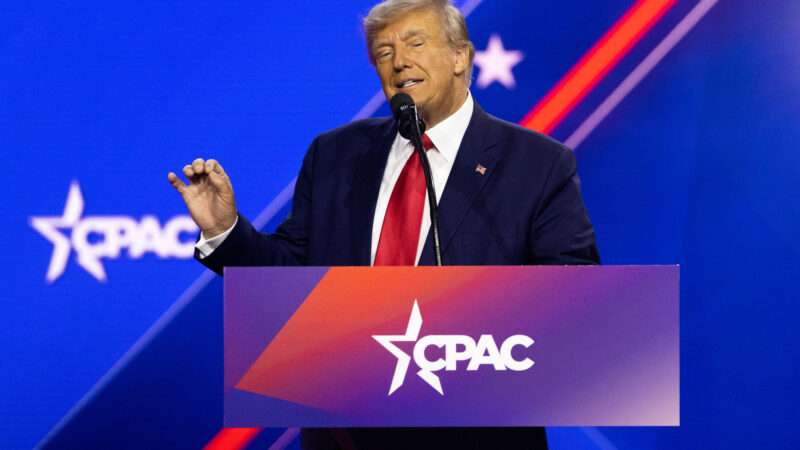
Donald Trump speaking at CPAC 2023

It might sound silly, but there’s half a good idea tucked away in Donald Trump’s proposal to create new “freedom cities” on federal lands.

“Past generations of Americans pursued big dreams and daring projects that once seemed impossible. They pushed across an unsettled continent and built new cities in the wild frontier,” Trump said in a Friday campaign video.

The former president and current presidential candidate wants to bring this pioneering magic back by holding design contests for 10 new cities to be constructed on a small portion of the federal government’s vast landholdings. The feds would vet submitted designs and then grant charters to the winners.

“These freedom cities will reopen the frontier, reignite the American imagination, and give hundreds of thousands of young people and other people, all hardworking families, a shot at home ownership and the American dream,” declared Trump. He also announced his intentions to jumpstart a flying car industry, revive American manufacturing, and bring beauty and safety back to America’s existing cities.

It’s basically the grandiose MAGA version of the liberal “abundance agenda,” which calls for America to build-baby-build until we have enough comfortably affordable housing to shelter one billion Americans.

Some of the proposals Trump outlined in his video are more ridiculous than others. As described, his vision of federally vetted and charted “freedom cities” certainly isn’t a particularly libertarian—or practical—idea.

Like other products of the marketplace, cities tend to emerge naturally where they make sense. They require some matchmaking between geographic advantage, available resources, pre-existing industry or infrastructure, and more to really get going.

America already has a lot of cities and towns with jobs and housing. Anyone trying to build a new city from scratch needs to ask themselves why people would move there and what would they do once they arrive.

Trying to bootstrap a whole new city from scratch would almost certainly require a mess of incentives, subsidies, and industrial policy that would be anathema to anything deserving the name “freedom city.” One need only look at Saudi Arabia’s “The Line” project to see how badly off-track new cities can get when their government sponsors treat them like a Lego set.

All that said, Trump is correct when he notes that the federal government owns nearly a third of U.S. lands (28 percent to be precise) and that much of it is ripe for new development. Making that happen wouldn’t require the feds to sign off on exquisitely designed charter cities. They’d just have to get out of the way.

The slightly less utopian but much more practical version of Trump’s “freedom cities” is a 2022 bill from Sen. Mike Lee (R–Utah), the Helping Open Underutilized Space to Ensure Shelter (HOUSES) Act. (I know.)

Lee’s proposal would allow state and local governments to purchase federally owned lands at below-market rates for the purposes of building new residential communities. Jurisdictions buying the federal lands would have to agree to a minimum density of one home per quarter acre. They also wouldn’t be allowed to purchase land located in national parks, monuments, wilderness preserves, or other protected areas. The U.S. Department of Interior would be approve the sales, with the revenue going to the maintenance of national parks, forest fire prevention, and public water infrastructure.

An August 2022 report on Lee’s bill, published by Congress’s Joint Economic Committee (JEC) Republicans, notes that the federal government owns a huge amount of land in Western states where home prices spiked during the pandemic.

Home prices increased 30 percent in Nevada and nearly 50 percent in Idaho from 2019 to 2021, according to the report. The federal government owns 80 percent of Nevada and 60 percent of Idaho. Much of that land is within the metro areas of Las Vegas and Boise.

The JEC report includes pictures of Las Vegas showing undeveloped federal lands surrounded by suburban subdivisions. Private developers would eagerly convert that land into new neighborhoods if they were allowed. The report’s authors estimate that the HOUSES Act could lead to as many as 2.7 million new homes, growing the housing stock by as much as 15 percent in some western states.

The HOUSES Act sputtered out in the Senate last year. The Bureau of Land Management came out strongly against it. Lee has yet to reintroduce it this Congress.

If it did pass, it probably wouldn’t produce the “freedom cities” Trump floated. But it could add a little bit of sweet freedom to existing cities in desperate need of new housing.

The post The Decent Idea Buried in Trump's Goofy 'Freedom Cities' Plan appeared first on Reason.com.

from Latest https://ift.tt/yOoxKkn
via IFTTT

Ending the Epicycles of the Establishment Clause

In the run-up to Dobbs, I identified many areas of the law that abortion had distorted. Among these epicycles were stare decisis, freedom of speech, facial challenges, the tiers of scrutiny, third-party standing, and so on. Dobbs, thankfully, ended these epicycles. (Alas, some litigants are trying to drag religious liberty into the fray.)

Like abortion, the Supreme Court’s doctrine concerning the Establishment Clause has distorted other areas of the law. As a threshold matter, I’m not even certain the Establishment Clause can be incorporated. I think the better answer, as Akhil Amar has written, is that this federalism provision prevents the federal government from interfering with state established churches. But that ship has probably sailed. Perhaps the most obvious category of distortion is standing. Flast v. Cohen allowed a taxpayer to contest government spending that may run afoul of the Establishment Clause. Flast is an anomalous outlier to Article III that permits taxpayer standing.

A related distortion of standing doctrine concerns the “offended observer” standard. In short, if a person sees or hears some government-related religious content that offends him, he has Article III standing. For example, Thomas Van Orden was an atheist who walked past the Ten Commandment monuments by the Texas Capitol. Boom, standing! I have long questioned standing in cases like Van Orden v. Perry. And more recently, Justice Gorsuch cast doubt on this doctrine in American Legion and Kennedy v. Bremerton.

Today Justice Gorsuch continued that theme on the *gasp* shadow docket. The Supreme Court denied cert in City of Ocala, Florida v. Rojas. In this case, a police chief organized a prayer vigil after a shooting spree. A resident of the City went to the vigil, knowing that she would be offended by the prayer. And that offense triggered standing. A cynic could argue the plaintiff attended the vigil for the sole purpose of generating standing. If the vigil truly bothered her, she could have stayed home.

Justice Gorsuch concurred in the denial of certiorari. He explained that the Court has never actually endorsed the “offender observer” standard. True enough, the Lemon test considered how a “reasonable observer” would view an endorsement of religion. But it is tough to square this doctrine with Valley Forge. And going forward, Kennedy has interred Lemon.

But if that logic ever made sense, it no longer does. In Kennedy, this Court put to rest any question about Lemon‘s vitality. We held that claims alleging an establishment of religion must be measured against the Constitution’s original and historical meaning, not the sensitivities of a hypothetical reasonable observer. 597 U. S., at ___ (slip op., at 22). And with the demise of Lemon‘s reasonable observer test, “little excuse” now remains “for the anomaly of offended observer standing.” American Legion, 588 U. S., at ___ (opinion of GORSUCH, J.) (slip op., at 9). “[T]he gaping hole it tore in standing doctrine in [the lower courts] should now begin to close.” Ibid. 

Still, Gorsuch did not think cert was warranted now. The case was on an interlocutory appeal, and the lower courts can consider Kennedy in the first instance.

Justice Thomas dissented from the denial of cert. He thought the issue was jurisdictional, so a remand was not warranted.

Because standing based on mere offense is in significant tension with Article III and our precedents, I would have granted certiorari to determine whether the courts below lacked jurisdiction.

Thomas agreed with Gorsuch’s opinion in American Legion, and identified the tension between Lemon and Valley Forge.

For decades, members of the Judiciary have noted that offended observer standing appears to be flatly inconsistent with our opinion in Valley Forge Christian College v. Americans United for Separation of Church and State, Inc., 454 U. S. 464 (1982). . . .

Offended observer standing appears to warp the very essence of the judicial power vested by the Constitution. Under Article III, federal courts are authorized “to adjudge the legal rights of litigants in actual controversies,” not hurtfeelings 

Thomas also explains how the Establishment Clause’s epicycles have distorted other areas of the law:

And, anomalous exceptions that expand an institution’s power have a tendency to swallow rules that limit it. The same is true here: Far from naturally receding, offended observer standing threatens to dilute Article III requirements in other areas. See, e.g., Gerber v. Herskovitz, 14 F. 4th 500, 506 (CA6 2021) (employinga direct analogy to offended observer cases to hold that individuals had standing to bring various federal statutory,due process, and free exercise claims solely because they suffered psychological harm from alleged legal violations).We should reconsider this seeming aberration before it further erodes bedrock Article III restrictions on the judicial power.

Thomas includes a lengthy string cite of several circuit court judges who have identified this anomalous exception to the usual standing doctrine:

In that case, we held “that ‘the psychological consequence presumably produced by observation of religious conduct with which one disagrees’ is ‘not an injury sufficient to confer standing under Article III, even though the disagreement is phrased in constitutional terms.'” Kondrat’yev v. Pensacola, 949 F. 3d 1319, 1335 (CA11 2020) (Newsom, J., concurring) (quoting 454 U. S., at 485–486; alterations omitted); Freedom From Religion Foundation, Inc. v. Mack, 49 F. 4th 941, 949 (CA5 2022) (Smith, J.) (“[T]he law of Establishment Clause standing is hard to reconcile with the general principle that standing is absent where a plaintiff has only a generalized grievance shared in substantially equal measure by all or most citizens” (internal quotation marks omitted)); Freedom From Religion Foundation, Inc.v. Obama, 641 F. 3d 803, 807 (CA7 2011) (Easterbrook, C. J.) (“[H]urt feelings differ from legal injury”); Barnes-Wallace v. San Diego, 530 F. 3d 776, 795 (CA9 2008) (Kleinfeld, J., dissenting) (“[B]eing there and seeing the offending conduct does not confer standing”); Doe v. Tangipahoa Parish School Bd., 494 F. 3d 494, 500 (CA5 2007) (DeMoss, J., specially concurring) (explaining that offended observer standing “opens the courts’ doors to a group of plaintiffswho have no complaint other than they dislike any government reference to God”); American Civil Liberties Union of Ohio Foundation, Inc. v. Ashbrook, 375 F. 3d 484, 497 (CA62004) (Batchelder, J., dissenting) (explaining that standing based on “unwelcome contact” with governmental religiousdisplays is “inconsistent with . . . Valley Forge“); Washegesic v. Bloomingdale Public Schools, 33 F. 3d 679, 684–685 (CA6 1994) (Guy, J., concurring) (explaining that offended observer standing “establishe[s] . . . a class of ‘eggshell’ plaintiffs of a delicacy never before known to the law”); Penkoski v. Bowser, 486 F. Supp. 3d 219, 231 (DC 2020)(McFadden, J.) (explaining that offended observer standing “cannot be squared with” Valley Forge).

Thomas explains that Establishment Clause cases that did not squarely address standing lack precedential effect:

Fortunately, “‘drive-by jurisdictional rulings of this sort’ carry ‘no precedential effect.'” Ibid. (quoting Steel Co., 523 U. S., at 91; alteration omitted). But we should not “continue to hold expressly that the injury in fact requirement is no different for Establishment Clause cases, while . . . implicitly assum[ing]standing in” those cases based on an injury that, “in a non-Establishment Clause case, would not get the plaintiff intothe courthouse.” Doe, 494 F. 3d, at 500 (DeMoss, J., specially concurring). Nor should we continue to countenance the undermining of our well-reasoned Valley Forge precedent by the Courts of Appeals.

The Court should jettison the “offended observer” standard. And eventually, the Court should get rid of Flast v. Cohen. Simply seeing a religious display, or being aware of government spending, should not give rise to a valid claim. To quote Justice Gorsuch, offended observes can simply avert their eyes. Consistent with Kennedy v. Bremerton, an Establishment Clause claim could only arise when there is some evidence of actual coercion. Separationism should no longer justify a distortion of Article III. The easiest way to prevent lower court judges from resisting Kennedy, and continue to quietly follow Lemon, is to divest “offended observers” of Article III standing.

The post Ending the Epicycles of the Establishment Clause appeared first on Reason.com.

from Latest https://ift.tt/k2wbeBW
via IFTTT

Four Americans Kidnapped By Armed Gunmen From Minivan In Mexico

Four Americans Kidnapped By Armed Gunmen From Minivan In Mexico

President Biden’s disastrous border policies put the safety of the American people at risk, as an announcement by the Federal Bureau of Investigation (FBI) said four Americans were kidnapped and assaulted upon crossing into northeastern Mexico from Texas. 

On Friday, four Americans crossed into Matamoros, Tamaulipas, Mexico, driving a white minivan with North Carolina license plates. Shortly after crossing into Mexico, “unidentified gunmen fired upon the passengers in the vehicle… all four Americans were placed in a vehicle and taken from the scene by armed men,” the FBI wrote in a statement

CBS News’ Christina Ruffini reports a Twitter post shows the moment four Americans were kidnapped in Mexico. Ken Salazar, US ambassador to Mexico, said in a statement that “an innocent Mexican citizen was tragically killed” in the same incident. 

According to Salazar, American law enforcement officials are collaborating with Mexican authorities to ensure the kidnapped Americans’ safe return.

After reports of the kidnapping began circulating on local media outlets, the US consulate in Matamoros issued an alert on Friday.

Event: The US Consulate Matamoros has received reports of police activity occurring in the vicinity of Calle Primera and Lauro Villar in connection to a shooting. Media reports indicate that one individual has been killed. US government employees have been instructed to avoid the area until further notice. The US Consulate General reminds US citizens that Tamaulipas is classified as Level 4: Do Not Travel in the State Department’s travel advisory for Mexico.

How long will it take for the Biden administration to acknowledge the missing Americans? 

Tyler Durden
Mon, 03/06/2023 – 12:33

via ZeroHedge News https://ift.tt/Q6m9OwB Tyler Durden

ESG As An Artifact Of ZIRP

ESG As An Artifact Of ZIRP

Authored by Peter Earle via The American Institute for Economic Research,

Founding myths tend to be mired in obscurity, and like many other investment trends, the roots of environmental, social, and governance (ESG) philosophies are unclear. 

The founding of the World Economic Forum is one origin. Stakeholder theory is another of ESG’s clear antecedents, especially as formalized in R. Edward Freeman’s 1984 book Strategic Management: A Stakeholder Approach. In 2004, the World Bank report “Who Cares Wins: Connecting Financial Markets to a Changing World” is another contender, providing as it did guidelines for firms to integrate ESG practices into their daily operations. And the publication of the reporting framework United Nations Principles for Responsible Investing in April 2006 (the most recent version of which can be found here) was another.

Wherever it began, ESG clearly hit its stride within the last five to ten years. Those were heady times, at least economically speaking, first characterized by zero interest rate policies (ZIRP) and then, during the pandemic, by massively expansionary monetary and fiscal programs. Yet in the last two years or so, the prevailing economic circumstances have changed considerably. Inflation at four-decade highs is battering firms by raising the cost of doing business. It is also negatively impacting corporate revenues, as consumers retrench by cutting back on expenditures. 

Nowhere are these effects more evident than in shareholder land, where the fourth-quarter 2022 S&P 500 earnings season is just about over. “Earnings quality” is an evaluation of the soundness of current corporate earnings and, consequently, how well they are likely to predict future earnings. For the past year, and certainly for the last quarter, the quality of earnings has been abysmal. One particular element – “accruals,” or cashless earnings – are their highest reported level ever, according to UBS. In that same report, we find the somewhat shocking revelation that nearly one in three Russell 3000 index constituents is unprofitable. 

For those and other reasons, a theme in many of the fourth-quarter corporate earnings reports has been cost-cutting: DisneyNewscorpeBayBoeingAlphabetDellGeneral Motors, and a handful of investment banks are all eliminating jobs and slashing unnecessary expenses. And although firms regularly write-off the value of certain assets and goodwill, that process accelerates during recessions. Firms are additionally contending with the highest interest rates they’ve faced since 2007, and in some cases back to 2001. A substantial amount of corporate debt assumed at lower interest rates is now more costly to service. 

Dividend payments, typically considered sacrosanct during all but the most severe financial straits, are being targeted for savings. February 24th in Fortune:

Intel, the world’s largest maker of computer processors, this week slashed its dividend payment to the lowest level in 16 years in an effort to preserve cash and help turn around its business. Hanesbrands Inc., a century-old apparel maker, earlier this month eliminated the quarterly dividend it started paying nearly a decade ago. VF Corp., which owns Vans, The North Face, and other brands, also cut its dividend in recent weeks as it works to reduce its debt burden … Retailers in particular face declining profits, as persistent inflation also erodes consumers’ willingness to spend. So far this year, as many as 17 companies in the Dow Jones US Total Stock Index cut their dividends, according to data compiled by Bloomberg. 

All of this suggests two things. 

First, if large firms are doing everything they can to reduce unnecessary overhead, feel-good initiatives and other corporate baubles are likely to face the chopping block – even if quietly. ESG observance is a costly trinket, bringing as it does compliance costs, legal costs, measurement costs, and opportunity costs. The reporting requirements associated with upholding ESG standards are high, and rising. In 2022, two studies attempted to estimate those costs:

Corporate Issuers are currently spending an average of more than $675,000 per year on climate-related disclosures, and institutional investors are spending nearly $1.4 million on average to collect, analyze and report climate data, according to a new survey released by the SustainAbility Institute by ERM … The survey gathered data from 39 corporate issuers from across multiple U.S. sectors, with a market cap range of under $1 billion to over $200 billion, and 35 institutional investors representing a total of $7.2 trillion of AUM … The SEC has released its own estimates for complying with its proposed rules, predicting first year costs at $640,000, and annual ongoing costs for issuers at $530,000. The study explored the specific elements covered by the SEC requirements, and found that issuers on average spend $533,000 on these, in line with the SEC estimates. Elements not included in the SEC requirements included costs related to proxy responses to climate-related shareholder proposals, and costs for activities including developing and reporting on low-carbon transition plans, and for stakeholder engagement and government relations.

Difficulty measuring costs means difficulty budgeting for them. Another recent report commented:

Although it is inherently difficult to assess the costs [of ESG], it is fair to anticipate significant costs for ambitious ESG goals. In an article in The Economist, a specific cost estimate was made in relation to offset a company’s entire carbon footprint. This was estimated to cost about 0.4 percent of annual revenues. This could already be a huge component for many companies, but it is only one aspect of merely one ESG factor. 

Yet that comment concludes with the kind of assurance that flows effortlessly from consultants well-positioned to, frankly, make a lot of money off of ESG compliance: “However, there is no real choice. The climate certainly cannot wait.” Given the recent backlash against ESG, whether driven by ideology or accounting, it’s clear that there is a real choice, and that choice is being invoked with increasing frequency throughout the commercial world. 

Second, the recent explosion of ESG adoption may have been in the spirit, if not embodying a strictly theoretical manifestation, of malinvestment as predicted by Austrian Business Cycle Theory (ABCT). Without engaging in a lengthy discussion of ABCT, artificially low interest rates (interest rates set by policymakers instead of markets) undercut the natural rate of interest generate signals and mislead entrepreneurs and business managers. Many years of negligible interest rates, indeed negative real rates, have given rise to bubble-like firms, projects, and I would argue, by extension, business concepts. The latter, which include but are not limited to ESG, seem feasible and arguably essential when the money spigots are open. When interest rates normalize and sobriety re-obtains, cost structures reassert themselves. It’s back to the business of business. 

Gone are the salad days of easy money, and with it the schmaltzy wishlists of niceties which a decade of monetary expansion permitted activists to blithely force upon corporate executives. In the face of rising interest rates, an uncertain path for inflation, budget-constrained consumers and rapidly deteriorating corporate earnings, shareholders are likely to take a closer look at how and where their money is being spent than they have in some time.

Although it is unlikely to disappear completely, the ESG fad is probably past the crest of its popularity. It’s time again for firms to focus, singularly and completely, on the inestimable task of making money. 

Tyler Durden
Mon, 03/06/2023 – 12:18

via ZeroHedge News https://ift.tt/T47I6dQ Tyler Durden

Ex-CNN President Jeff Zucker Ordered Staff To Ignore Lab-Leak Theory

Ex-CNN President Jeff Zucker Ordered Staff To Ignore Lab-Leak Theory

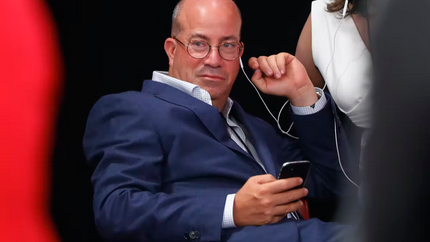
Former CNN president Jeff Zucker ordered network employees not to investigate the Covid-19 lab leak theory because he considered it a “Trump talking point,” a “well-placed” CNN insider told Fox News Digital on Monday.

The ‘theory’ was recently bolstered by a Department of Energy finding that a lab-leak was the most likely origin for the virus, while FBI Director Christopher Wray confirmed last week that his agency believes the same.

“People are slowly waking up from the fog,” the insider told Fox. “It is kind of crazy that we didn’t chase it harder.”

Throughout Zucker’s tenure as CNN’s chief, he pulled what was once widely seen as a straight-news organization to an anti-Trump operation. CNN bent over backwards to knock down what former President Trump and members of his administration said lending credibility to the lab-leak theory, as the White House was deemed a nemesis by the network. -Fox News

Fox News notes that on March 28, 2020, CNN‘s Oliver Darcy published a story with the headline:”Here’s how to debunk coronavirus misinformation and conspiracy theories from friends and family.”

“While the coronavirus pandemic has isolated family and friends inside their homes, it has in many cases increased online or over-the-phone communication with loved ones,” Darcy wrote. “But, in some cases, relatives and friends share poor information – whether it is bad science related to how to prevent the virus, debunked rumors about cities being put on lockdown, or conspiracy theories about the origins of Covid-19. While any strain of misinformation is not ideal, misinformation related to a public health crisis has an especially dangerous element to it,” he continued.

CNN host Fareed Zakaria notably said that “the far right has now found its own virus conspiracy theory” while discussing the lab-leak theory.

And on Feb. 18, 2020, CNN insisted that it was “possible, yet unlikely, that the lab was connected to the start of the outbreak.”

Meanwhile, during an interview with Dr. Anthony Fauci – who we recently learned ordered the fabrication of the ‘Proximal Origins’ paper ruling out the lab-leak – CNN‘s John Vause called the lab-leak theory “misinformation.”

Fauci responded that “theories that are not based on evidence and facts often can really mislead people.”

A CNN headline from April 2020 reading “Nearly 30% in the US believe a coronavirus theory that’s almost certainly not true” was based on a Pew Research poll taken at the time. 

“Its origin is up for debate, but it wasn’t made in a lab,” CNN reported. “There’s still much we don’t know about the coronavirus pandemic, but virus experts agree on one piece of its origin story: The virus likely originated in a bat, not in a Chinese lab.” -Fox News

CNN directly politicized the issue once again on May 5, 2020, when now-fired Chris Cillizza, wrote the headline “Anthony Fauci just crushed Donald Trump’s theory on the origins of the coronavirus,” in which he noted that Trump “has been making the case that the coronavirus originated not in nature but in a lab in Wuhan, China,” but that Fauci’s natural origins claim was more accurate.

“Now, before we play the game of ‘he said, he said’ remember this: Only one of these two people is a world-renowned infectious disease expert. And it’s not Donald Trump,” wrote Cillizza. “In short, Fauci’s view on the origins of the disease matters a whole lot more than Trump’s opinion about where it came from.”

“Especially because, outside of Trump and his immediate inner circle, most people in a position to know are very, very skeptical of the Trump narrative that the virus came out of a lab – whether accidentally or on purpose.”

And of course, it was more than just CNN

Tyler Durden
Mon, 03/06/2023 – 11:56

via ZeroHedge News https://ift.tt/zTySk5O Tyler Durden

From Consumer Sentiment To Unemployment – The Parallels

From Consumer Sentiment To Unemployment – The Parallels

Authored by Jim Colquitt via RealInvestmentAdvice.com,

On Friday, February 24th, the most recent reading of the University of Michigan Consumer Sentiment Index was released. It came in at 67.0 for February, an increase from January’s reading of 64.9.

As the name implies, the University of Michigan Consumer Sentiment Index measures consumer “sentiment” in the United States. Higher numbers suggest a more positive sentiment; lower numbers indicate a more pessimistic view. 

Investopedia notes the following regarding the University of Michigan Consumer Sentiment Index:

“Consumer sentiment is a statistical measurement of the overall health of the economy as determined by consumer opinion. It takes into account people’s feelings toward their current financial health, the health of the economy in the short term, and the prospects for longer-term economic growth, and is widely considered to be a useful economic indicator.”

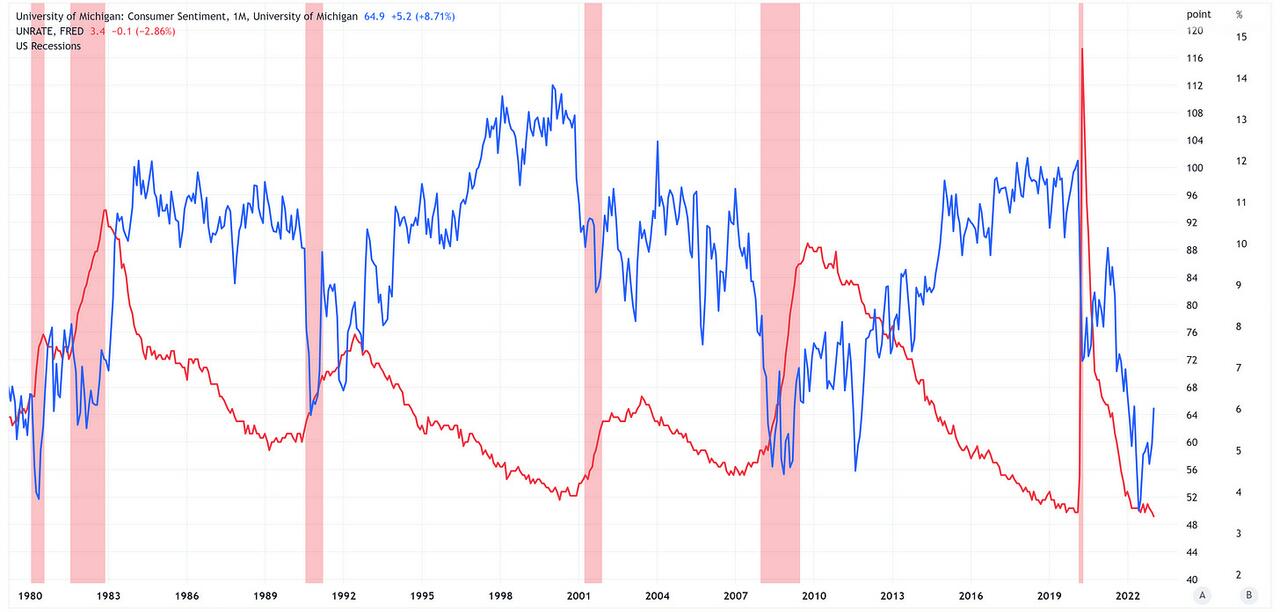
The chart below shows the University of Michigan Consumer Sentiment Index and the Unemployment Rate from the 1980s (Note: the red vertical bars denote US recessionary periods).

Two Observations

There are two observations to take away from this data.

  1. Both metrics trend over time, but the University of Michigan Consumer Sentiment Index appears to be extremely noisy in the process.

  2. There appears to be a negative correlation (i.e., when one goes up, the other one goes down) between the two metrics.

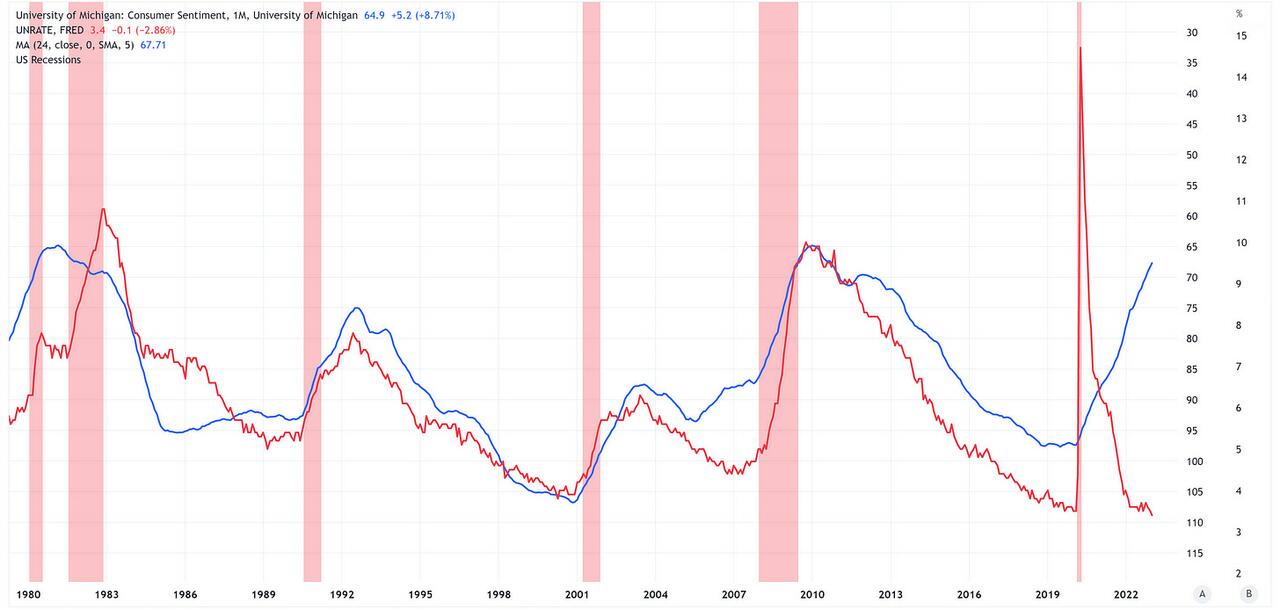
To strip out some of the “noise” in the chart below, I am displaying the 24-month moving average for the University of Michigan Consumer Sentiment Index (blue line). Additionally, I have inverted the University of Michigan Consumer Sentiment Index values to observe if the two metrics are negatively correlated.

When we do this, we find that while not a perfect match, they tend to track one another quite nicely.

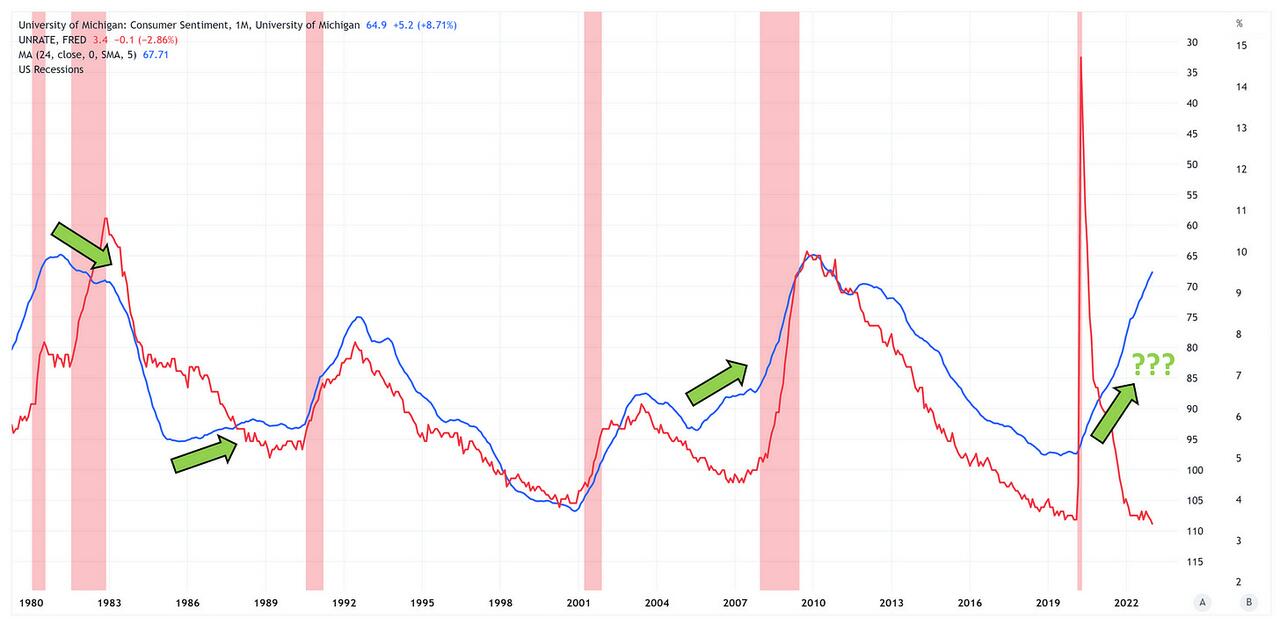
Because the two metrics tend to move in tandem with one another, this would suggest they are “coincident.” However, there are a few observations (green arrows in the chart below) where the University of Michigan Consumer Sentiment Index appears to be a “leading” indicator for the Unemployment Rate.

Another Way To Analyze The Data

Looking at the most recent green arrow in the chart above…is the University of Michigan Consumer Sentiment Index suggesting that the Unemployment Rate is about to start trending higher?

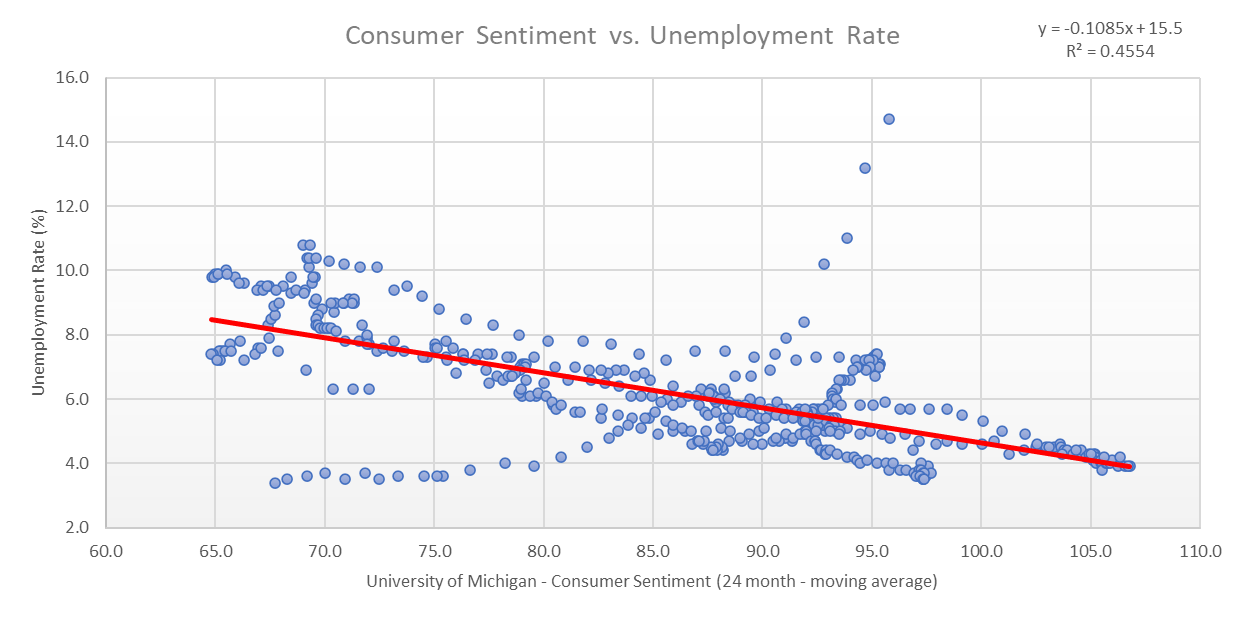
The chart below shows a scatter plot of the values from the previous graphs. The downward-sloping red line suggests a negative correlation between the two metrics.

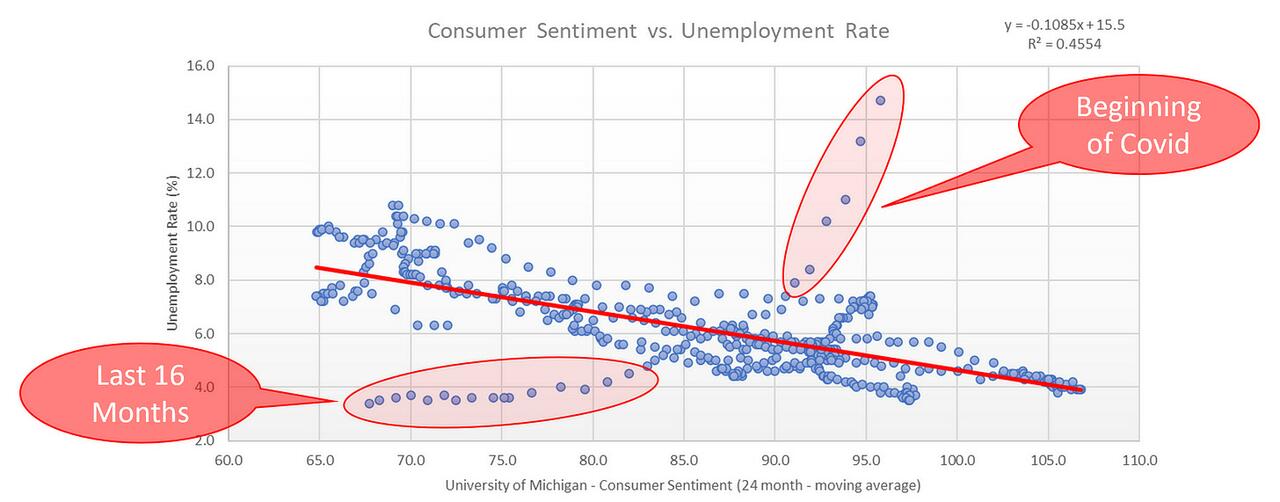
Another note from the chart above is that there appear to be two periods with outlying observations, which I’ve highlighted in the chart below. 

If we dive deeper into the origin of these anomalies, we find that one likely caused the other, which is often the case when we see the pendulum swing from one extreme to another.

Why Is This Important?

The first “distortion” results from the period immediately following the beginning of Covid, where the Unemployment Rate spiked, yet we didn’t see a massive drop-off in consumer sentiment. 

Fast forward, and we see the pendulum swing in the opposite direction, as evidenced by the last 16 months. During this time, we’ve witnessed record-low levels of unemployment even though “sentiment” in the US economy has begun to sour. 

It’s common to see dramatic swings like this from one extreme to another until the market returns to equilibrium.   

We get the scatter plot below if we strip out these two outlier periods. Note that this scatter plot has an r-squared value of 0.6931 which is statistically very strong, thus suggesting a reasonably tight relationship between these two metrics. 

The current value for the University of Michigan Consumer Sentiment Index – 24 Month Moving Average (67.3) suggests that the current Unemployment Rate should be between 7.0% and 10.0%. 

In my piece, Layoffs…What Are They Telling Us? I made the case that even the FOMC believes that the Unemployment Rate will increase, as they foreshadowed in their “Summary of Economic Projections” released in December.

How High Will The Unemployment Rate Go? 

I don’t know how high the unemployment rate will go. However, as noted above, the current reading for the University of Michigan Consumer Sentiment Index – 24 Month Moving Average would suggest that the Unemployment Rate should be somewhere in the 7.0% – 10.0% range. 

Alternatively, what if, in the coming months, we see a dramatic improvement in the University of Michigan Consumer Sentiment Index – 24 Month Moving Average, somewhere directionally towards its long-term average of ~86? You can see from the chart above that a value of 86 has historically corresponded to an unemployment rate of 5.0% – 7.0%.

Given that the Unemployment Rate is currently 3.4%, the University of Michigan Consumer Sentiment Index would suggest it “needs” to go higher. Is it going to 7.0% – 10.0%? I certainly hope not, but the high end for the FOMC’s range of outcomes for 2023 is 5.3%, so maybe the 5.0% – 7.0% range is at least within the realm of possibilities. 

As noted in “Layoffs…What Are They Telling Us?”:

Since the 1950’s, every time the unemployment rate had a sustained increase above its 12-month moving average, a recession has occurred.”

I followed by saying:

“The current unemployment rate is 3.4% and the current 12-month moving average is 3.59%.  If the FOMC is even directionally correct in their assessment of where the unemployment rate is heading in 2023, and subsequent years, the unemployment rate will easily cross above its 12-month moving average and will likely be sustained there for a period of time.”

Not to be draconian, but the takeaway is that we’re heading for a recession, and the University of Michigan Consumer Sentiment Index gives you advanced notice.

The question then becomes, “What should I do with this information?”. 

I would remind you of this historical fact:

If we look at history, we find that since the 1960’s, the S&P 500 has always made a new low once a recession began and the average decline from the start of a recession to the market trough is -29.2%.  Further, if we look at this same time period, we find that the average decline from the first FOMC rate cut to the market trough is -27.7%.”

It’s not too late to prepare for this potential outcome. 

Until next time…

Tyler Durden
Mon, 03/06/2023 – 11:35

via ZeroHedge News https://ift.tt/dms3pzM Tyler Durden

FSB Says It Thwarted High-Profile Assassination Attempt; Missiles & Drones Target Russian Border City

FSB Says It Thwarted High-Profile Assassination Attempt; Missiles & Drones Target Russian Border City

Russia says its large border city of Belgorod has come under fresh missile attack from Ukraine on Monday, following an uptick in drone attacks on various Russian cities and facilities.

The missiles were intercepted, the Russian military says. “At least one person was wounded in the southern Russian region of Belgorod on Monday after Russian forces shot down three missiles, the governor of the region bordering Ukraine said,” Reuters reports.

Russian city of Belgorod, some 700 kilometers south of Moscow, via AFP.

Governor Vyacheslav Gladkov described on Telegram that “The falling debris had also brought down some power lines near the town of Novy Oskol” but also said the damage has not been fully assessed.

“It’s known about one wounded, a man with shrapnel wounds to his hand,” Gladkov confirmed. He stopped short of naming Ukraine as being behind the attack, but over the course of the war there’s been numerous instances of fire coming from Ukrainian forces. The Russian city of some 400,000 people lies a mere 25 miles from the Ukrainian border.

On Saturday there were reports of a drone attack on a power substation at a village outside of Belgorod identified as Razumnoye, resulting in no injuries, however damage was reported.

The past week of threatening drone activity over Russian skies have made it clear that Ukrainian forces have stepped up attacks inside Russia. A series of attacks on Feb.28 were especially intense. The Kremlin has lately alleged Washington assistance in these attacks. 

Meanwhile, Russian state media is on Monday freshly alleging a covert plot to assassinate an influential media personality. “A Ukrainian bomb plot targeting the owner of a Russian TV channel has been thwarted by the Federal Security Service (FSB), the agency claimed on Monday,” RT writes. “It pinned the alleged assassination attempt on a Ukraine-based Russian-born neo-Nazi, who also claimed credit for a deadly cross-border raid last week.”

The FSB released and circulated the below videos

“The plot allegedly involved rigging a bomb to the car of billionaire Russian entrepreneur Konstantin Malofeev, owner of the Christian-focused TV channel Tsargrad, the FSB said in a statement,” the report continues.

While there’s no independent confirmation of the plot, RT concludes that “It compared the plan to the assassination of political activist and journalist Darya Dugina, whose car was blown up last August near Moscow.”

Tyler Durden
Mon, 03/06/2023 – 11:15

via ZeroHedge News https://ift.tt/nrDcC1f Tyler Durden

Federal Agency Advances Gas Stove Proposal From Commissioner Who Floated Ban

Federal Agency Advances Gas Stove Proposal From Commissioner Who Floated Ban

Authored by Zachary Stieber via The Epoch Times (emphasis ours),

A U.S. agency has advanced a request for information on gas stove hazards after it was filed by a commissioner who has floated banning the stoves.

The U.S. Consumer Product Safety Commission announced on March 1 it is seeking information from the public “on chronic chemical hazards from gas ranges.”

The commission released a draft public notice on the request for information, but has not released the final notice. The final one should be published in the Federal Register next week, a commission spokesperson told The Epoch Times via email.

Members of the public are being told they’re welcome to submit comments on how many U.S. homes have gas ranges, how the commission should evaluate risks related to gas stove usage, and what information should be part of labels with warnings about hazards on stoves, among other aspects of the issue.

The commission is also requesting “proposed solutions to those hazards.”

The vote to approve publication of the notice was 3–1, a commission spokesperson told The Epoch Times in an email. Commissioners Mary Boyle, Richard Trumka Jr., and Chair Alexander Hoehn-Saric voted in favor, while Commissioner Peter Feldman voted against.

Trumka, a Biden appointee, floated a ban on gas stoves in January.

Any option is on the table. Products that can’t be made safe can be banned,” he told Bloomberg at the time.

Trumka also wrote in an internal memorandum that “the need for gas stove regulation has reached a boiling point” and that the commission “has the responsibility to ban consumer products that emit hazardous substances, particularly, when those emissions harm children, under the Federal Hazardous Substances Act.”

“There is sufficient information available for CPSC to issue an NPR in FY 2023 proposing to ban gas stoves in homes,” Trumka also wrote. NPR stands for notice of proposed rulemaking.

The White House and Hoehn-Saric later said they weren’t in favor of banning gas stoves. Some lawmakers have introduced bills that would block the CPSC from banning gas stoves.

The approved request for information (RFI) “does not constitute or propose any regulatory action or ban,” Hoehn-Saric said in a statement this week. “The chronic hazards that can arise from toxic emissions should be studied and that is what we are doing with this RFI. I welcome the public’s input and data during the comment period.”

The RFI was initiated by Trumka during an October 2022 meeting.uld direct staff to prepare an RFI. The prepared RFI was later approved.

Read more here…

Tyler Durden
Mon, 03/06/2023 – 10:55

via ZeroHedge News https://ift.tt/pqPZX2U Tyler Durden

Jill Biden Slams Questions Over Biden’s Mental Competency As “Ridiculous”

Jill Biden Slams Questions Over Biden’s Mental Competency As “Ridiculous”

Authored by Paul Joseph Watson via Summit News,

First Lady Jill Biden has slammed concerns about her husband’s mental competency as “ridiculous” in response to presidential hopeful Nikki Haley calling for such tests to be administered to political candidates above the age of 75.

“Ridiculous,” she told CNN in an interview due to air later today, pointing to the president’s recent travel schedule and his surprise visit to Kiev in an effort to dismiss such worries.

“How many 30-year-olds could travel to Poland, get on the train?” she asked.

“Go nine more hours, go to Ukraine, meet with President Zelensky? So, look at the man,” added Biden.

I’m sure most 30-year-olds could accomplish that.

When asked if Biden should take a mental capacity test, given that he will be 81-years-old by the time he takes a second term in office, the First Lady responded, “We would never even discuss something like that.”

Biden’s wife appears to have missed the point – questions over whether Biden is up to it aren’t related to his physical health, but his mental acuity.

Such scrutiny popped up again when Biden visited Selma, Alabama to commemorate the 58th anniversary of “Bloody Sunday”.

Biden claimed he was involved in the civil rights movement when he was young, an assertion that prompted widespread skepticism.

“I was a student up north in the civil rights movement. I remember feeling how guilty I was, [that] I wasn’t here. How could we all be up there, and you going through what you went through,” he said.

There is no historical evidence to back up Biden’s claim, leading many on Twitter to brand the president a liar.

Following a physical exam last month, after which the White House declared the 80-year-old to be “healthy” and “vigorous,” former White House physician Ronny Jackson accused the Biden administration of ‘covering up’ Joe Biden’s cognitive decline.

“Is he on ANY drugs to treat his mental decline? This exam was a JOKE. COVER UP!!” Jackson tweeted, adding that no cognitive test was undertaken.

Prominent Democrats continue to express major doubts about Biden’s ability to successfully run again for president, but many of them are afraid to speak out publicly, it was recently revealed.

During his recent visit to Warsaw, Biden tripped and fell yet again as he was climbing the steps to board Air Force One.

*  *  *

Brand new merch now available! Get it at https://www.pjwshop.com/

In the age of mass Silicon Valley censorship It is crucial that we stay in touch. I need you to sign up for my free newsletter here. Support my sponsor – Turbo Force – a supercharged boost of clean energy without the comedown. Get early access, exclusive content and behind the scenes stuff by following me on Locals.

Tyler Durden
Mon, 03/06/2023 – 10:15

via ZeroHedge News https://ift.tt/RCKiIB8 Tyler Durden

Core US Factory Orders Jump More Than Expected In Jan, Aircraft Orders Plunge

Core US Factory Orders Jump More Than Expected In Jan, Aircraft Orders Plunge

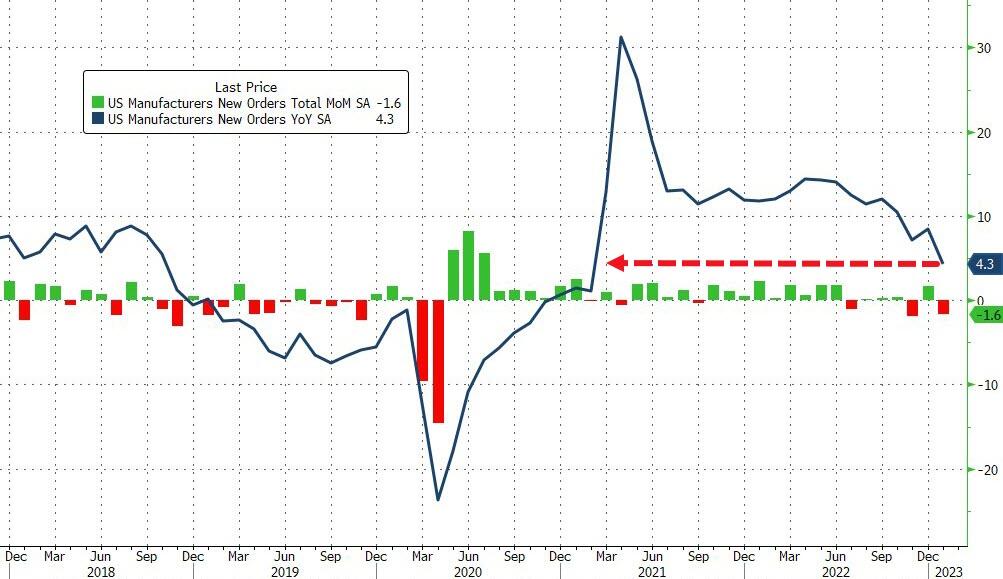
Following the ugly flash durable goods print (de-bound from Boeing bounce in Dec), US Factory Orders for January were expected to drop 1.8% MoM (after a 1.8% MoM rise in Dec). In fact, the headline print fell 1.6% MoM (better than expected). That leaves US Factory order YoY growth at its weakest since Feb 2021.

Source: Bloomberg

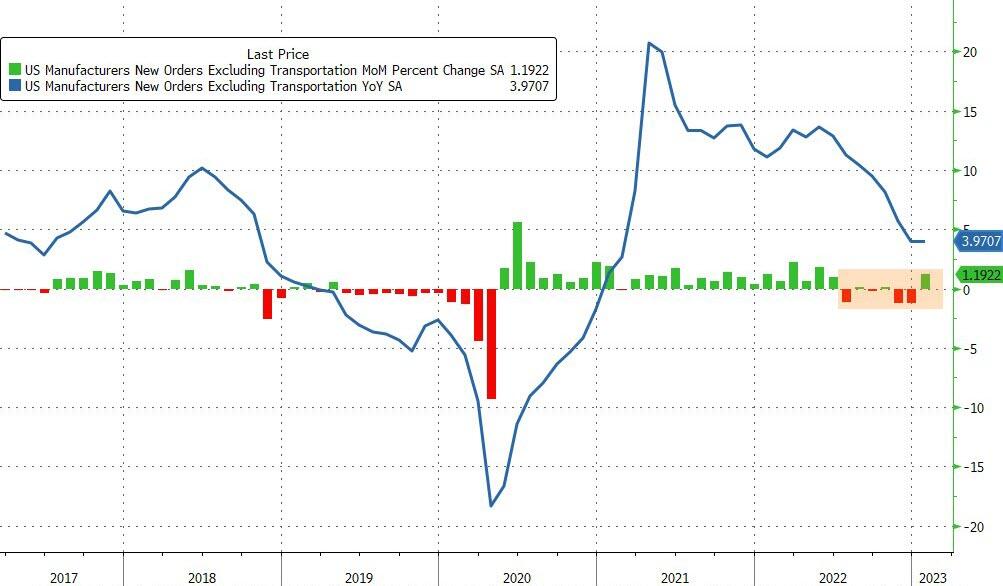
Core factory orders (ex-transports) rose 1.2% MoM, better than the +1.0% MoM expected after a 1.2% decline in Dec…

Source: Bloomberg

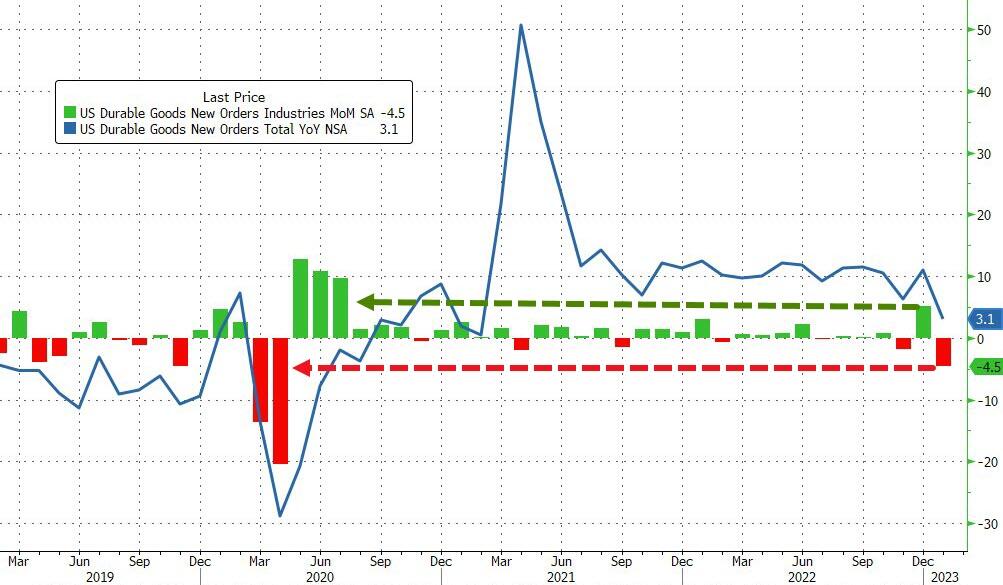
The final US Durable Goods Orders print confirmed the 4.5% drop reported in the flash print, dragging the YoY rise down to +3.1% (its weakest since Mar 2021)

Source: Bloomberg

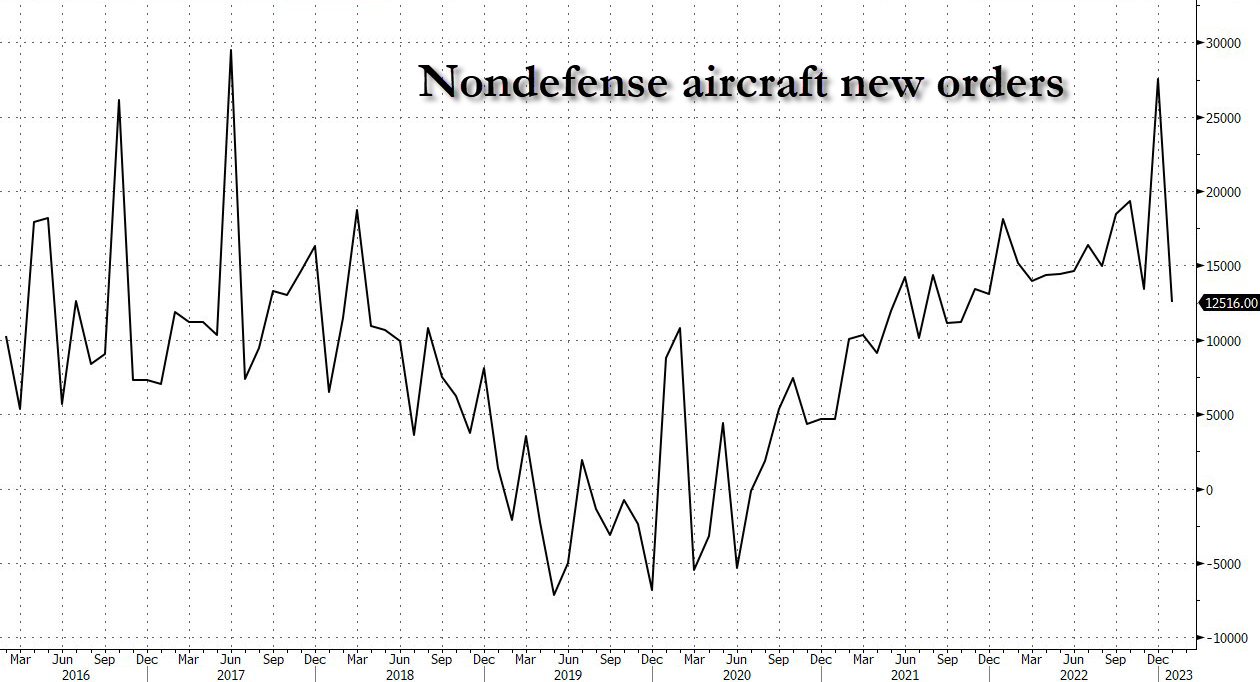
The big swing factor was no Boeing orders as non-defense aircraft new orders tumbled 54.6% MoM…

Additionally, the value of core capital goods orders, a proxy for investment in equipment that excludes aircraft and military hardware, confirmed it increased 0.8% last month after a downwardly revised 0.3% decline in December, Commerce Department figures showed Monday.

So, all in all, this is ‘good’ news for the economy and thus ‘bad’ news for The Fed.

Tyler Durden
Mon, 03/06/2023 – 10:07

via ZeroHedge News https://ift.tt/cnsH8F0 Tyler Durden