A Tale Of Ten Cities

A Tale Of Ten Cities

By Rabobank’s Benjamin Picton

A Tale of Ten Cities

The Daily is today, and on most Mondays from now on, coming to you from the Land Down Under, where it is currently the future (in a time-zone sense) – and that is appropriate given some of the themes in this particular missive.

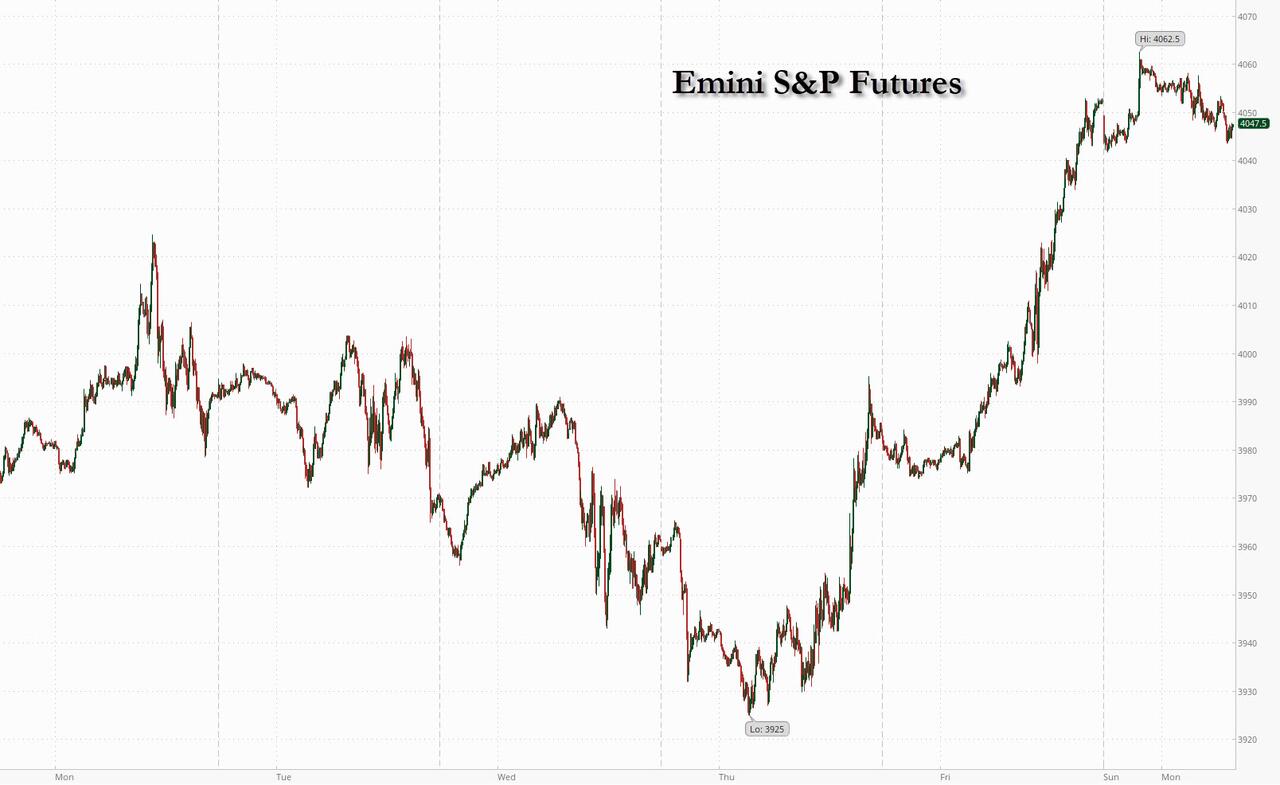
Futures markets are pointing to a flat start to the week after the US 10-year yield closed back below the 4% level on Friday, ISM and PMI data came in strong, and stocks finished up. The Fed’s Daly won’t have helped sentiment much with further promises of rates being higher for longer and warnings of structurally higher inflation. Neither will the ECB’s Christine Lagarde talk of the need to deal with the “monster” of inflation. Nor will the weekend’s China’s National People’s Congress, which set a “modest” GDP growth target of 5% while further centralizing control in the hands of Xi Jinping. Outgoing Premier Li Keqiang said “struggle creates brilliance.” Helpfully then, China’s defense spending will rise 7.2%, and the US is close to instigating capital controls to prevent investment in Chinese tech.

Li also said “Hard work builds the future.” In his trademark style, so did former President and 2024 aspirant Trump, who unveiled his vision for ten new ‘Freedom Cities’ to be built on federal land, opening a new American frontier to offer low cost homes to millions – and replete with flying cars. Trump’s vision was of the Jetsons, plural, as he also spoke of a baby bonus aimed at lifting a sagging fertility rate, and support for Medicare and social security. There was also a new (old?) program of public works to ”get rid of bad and ugly buildings and return to the magnificent classical style of western civilization.” These new spending promises are to be funded, at least in part, by universal tariffs via “America first” mercantilism. China should be nervous; and so should US allies and trade partners thinking of 1930s-style US isolationism while other Great Powers are returning to 1930s-style belligerence. So should markets, perhaps, because Trump dominated the conservative CPAC convention despite mainstream and social media not covering what he says anymore. Indeed, his grip on the Republican party still seems strong enough that an alternative Daily title suggested by the regular author of this Daily was ‘Trumpy Python’s Flying Car-cass’. 

While the US dreamed of flying cars, Europe was split on plans to phase out those with internal combustion engines: Germany and Italy are delaying final approval of the new law. And while that horse-power trading was going on, German Chancellor Scholz was in D.C. to meet President Biden to discuss the war in Ukraine. More horse-trading?

If the West isn’t backing down there, neither are the Russians. Foreign Minister Sergei Lavrov confirmed “it is existential for us,” and accused the West of hypocrisy, pointing at its actions in Serbia, Iraq, and Afghanistan, and saying “nobody gave a damn about anything but finances and macroeconomic policies” during those episodes. Even a broken clock is right twice a day, and he is quite right that it used to be possible to ignore geopolitics and focus only on quarterly earnings and what the Fed and other central banks might do. Now one needs to look at a whole lot more a whole lot more.

But sticking with the week ahead, there are plenty of catalysts for ordinary market volatility as three central banks meet to set policy rates, some key data hits our screens, and US Fed Chairman Powell delivers his semi-annual testimony before the US House and Senate Committees.

Today is covered in more detail below in the Day Ahead.

Tuesday, the RBA delivers its March policy rate decision. A 25bp hike to 3.65% is seen as a near certainty in the market, with only one economist amongst those surveyed by Bloomberg expecting rates to stay put. The picture is becoming more complicated for the Reserve Bank, however, following poor jobs figures for December and January, weak Q4 GDP growth, and slower than expected wage growth. The temptation will be to ease off hiking early, especially following the release of diabolical January building approval figures last week (-27.6%) and the Melbourne Institute inflation gauge for February coming in at +0.4% vs +0.9% prior. However, the implicit price deflator in the Q4 GDP was still very high (9.1%), and the RBA will have one eye on strong data and the hawkish tone emanating from the US. Falling behind the inflation curve and having to catch up later is not a prospect it would relish, so we expect that it will indeed be a 25bp hike tomorrow.

Tuesday also sees Fed Chairman Jerome Powell begin a two day testimony where he will speak on the semi-annual Monetary Policy Report. Powell will follow a stream of hawkish Fed speak in recent days, notably from Waller, Daly, and Barkin, though risk assets took some encouragement from Bostic last week when he said that he favoured a 25bps hike in March. It seems likely that Powell will continue the more hawkish tone as recent US data has mostly surprised to the upside.

Wednesday, the BoC meets. Markets, and our Christian Lawrence, expect an end to the hiking cycle and rates on hold at 4.5%.

Thursday sees US ADP and initial claims data.

On Friday, the BOJ is widely expected to leave rates unchanged at -0.1% and maintain the yield curve control (YCC) policy targeting the 10-year JGB yield at 0.5%. This will be the last BOJ meeting chaired by Haruhiko Kuroda, with Ueda-San due to take over from next month. Speculation as to Ueda’s policy preferences have been rife in the market, and there has been some suggestions that the YCC target may be lifted soon as the Japanese economy has started to show signs of a pickup in inflation.

Rounding out the week, Friday also has US non-farm payrolls following the blockbuster 517,000 figure for January that effectively reset expectations of the likely path of Fed monetary policy to ‘higher for longer’. The consensus of survey is a gain of 215,000 with the unemployment rate remaining steady at 3.4%.

Tyler Durden
Mon, 03/06/2023 – 09:50

via ZeroHedge News https://ift.tt/JC2Asb8 Tyler Durden

Key Events This Very Busy Week: Jobs, JOLTS, ADP And Two Powell Testimonies

Key Events This Very Busy Week: Jobs, JOLTS, ADP And Two Powell Testimonies

After a somewhat lazy start to March, we get a very busy 8 days for markets, culminating in the US CPI next Tuesday after payrolls this Friday, JOLTS and ADP on Wednesday, Claims on Thursday, and Powell getting things rolling tomorrow with his semi-annual monetary policy report to Congress. Here is a handy snapshot of the upcoming blizzard of events:

  • Tuesday: Powell at 10am will appear before the Senate Banking Committee to deliver the first day of the semi-annual monetary policy report to Congress; RBA Rate Decision.
  • Wednesday: ADP private employment at 8:15am (consensus 200k); JOLTS job openings at 10am (consensus 10,584k, last 11,012k) ; Powell speaks again at 10am; BOC Rate Decision.
  • Thursday: Initial jobless claims at 8:30am (GS 190k, consensus 195k, last 190k); Barr (voter) at 10am;
  • Friday: NFP at 8:30am (GS +250k, consensus +215k, last +517k); BOJ Rate Decision.

As DB’s Jim Reid writes in his weekly preview, it’s fairly uncontroversial to say that the last payrolls report published on February 3rd was a huge moment, and one that started a series of events that has meant that the last month has been a struggle for most financial assets, especially bonds (the worst February on record for the Global Agg). Remember that 36 hours before that payroll print, the relatively “dovish” FOMC had led to 10yr US yields hitting 3.33%. Last week at their peak they hit 4.08% before closing out at 3.95% on Friday.

As such if you thought the relatively random number generator that is payrolls is usually overhyped, you’ve seen nothing yet as we approach Friday’s big number. For those who have been on a sabbatical to another planet, last month it came in at +517k against +223k expected with fairly substantial upward revisions from the previous year as part of the annual review; most expectations however are for a reversal of the downward trendline as the January print was greatly influenced by one-time factors and seasonals.

Before we preview this, we should also say that other big highlights this week are the RBA (tomorrow), BoC (Wednesday) and BoJ meetings (Friday), and Powell’s semi-annual congressional testimony before House and Senate committees tomorrow and Wednesday. As discussed further below the BoJ is unlikely to change tack at this stage but every meeting is potentially live given what they did in December. We’ll review this and the rest of the week ahead after a brief payrolls preview.

For Friday DB’s economists expect +300k for both headline and private payrolls (consensus for both at +215k). As with January, February was also mild weather wise for the survey week (which can mean less leisure, hospitality and retail layoffs), although not as much as in the prior month. So the temperature will likely still be an influence. There was a reasonable question mark about seasonal distortions in the last report so who knows how that will impact this week’s report. Unemployment is expected to stay at 54-year lows of 3.4% with the risks it ticks down a tenth. We’ll give a fuller preview of average hourly earnings and the work week on Friday.

Don’t forget the JOLTs report on Wednesday which is viewed by many as a more accurate reflection of the tightness of the labor market with the main problem it always being a month behind the payroll report (we will have a note on this later today). Maybe it can help shed some light on how accurate January’s payrolls report was though. If it was accurate you should see an uptick in the hiring rate. Also important will be the job openings as usual to highlight the tightness in demand for labour.

Going back to the other highlights this week, Fed Chair Powell semi-annual testimony to the Senate Banking Committee tomorrow and to the House Financial Services Committee on Wednesday will of course be pored over for every subtle policy nuance. As they come before payrolls and next week’s equally crucial CPI report, it’s hard to see how he can be too confident about where the Fed is going to land. He may provide clues as to what employment and inflation numbers need to do to make the Fed act in a particular way, especially how it pertains to whether 50bps hikes are back on the table. Staying with central banks the RBA is seen as hiking 25bps tomorrow but the BoC seen as holding to their planned policy pause on Wednesday. Regarding this week’s BoJ meeting, consensus if for the central bank to adhere to its present monetary policy, with YCC removal seen unlikely, although you can’t rule it out given December’s surprise. This will also be the last monetary policy meeting for Governor Kuroda.

Other notable economic data releases in the US this week include factory orders (DB forecast -0.5% vs +1.8% in December) today, consumer credit tomorrow and the ADP and trade balance on Wednesday.

Turning to Europe, the focus will be on the UK with the release of the monthly GDP report on Friday, ahead of the March 23 BoE meeting. Elsewhere in the region, key releases include factory orders (tomorrow), retail sales and industrial production (Wednesday) for Germany and trade balance data for France (Friday).

In Asia the highlight might be the Chinese CPI and PPI reports due on Thursday. These will be released after last week’s blockbuster PMI readings showed a robust recovery and thus will be important to assessing the path of economic stimulus going forward. Our economists expect a 1.3% reading for the CPI (vs 2.1% in January) and a further YoY decline of -1.0% for the PPI (vs -0.8% in January).

On the earnings front, Q4 reporting season is now mostly over, but a few stragglers remain as shown in the table below.

Courtesy of DB, here is a day-by-day calendar of events

Monday March 6

  • Data: US January factory orders, UK February construction PMI, new car registrations, Japan January labor cash earnings, Germany February construction PMI, Eurozone January retail sales

Tuesday March 7

  • Data: US January wholesale trade sales, consumer credit, China February trade balance, foreign reserves, Japan January trade balance BoP basis, Japan February bank lending, Germany January factory orders
  • Central banks: Fed Chair Powell testifies to the Senate Banking Panel, ECB consumer expectations survey

Wednesday March 8

  • Data: US February ADP report, January trade balance, JOLTS report, Japan February M2, M3, Economy Watchers survey, January leading and coincident index, Italy January retail sales, Germany January retail sales, industrial production, Canada January international merchandise trade
  • Central banks: BoC decision, Fed Chair Powell testifies to the House Financial Service Committee, ECB’s Lagarde speaks, BoE’s Dhingra speaks
  • Earnings: Adidas, Thales

Thursday March 9

  • Data: US Q4 household change in net worth, initial jobless claims, China February CPI, PPI, money supply, Japan February PPI, machine tool orders, January household spending, France Q1 total payrolls
  • Central banks: Fed’s Barr speaks, ECB’s Vujcic speaks, BoE’s Breeden speaks
  • Earnings: Deutsche Post, Leonardo

Friday March 10

  • Data: US February jobs report, monthly budget statement, UK January trade balance, monthly GDP, industrial and manufacturing production, index of services, construction output, Italy January PPI, France January trade balance, Canada February jobs report, Q4 capacity utilization
  • Central banks: BoJ decision

* * *

Looking at just the US, Goldman writes that the key economic data releases this week are the JOLTS job openings on Wednesday and the employment situation report on Friday. Chair Powell will appear before the Senate Banking Committee on Tuesday and the House Financial Services Committee on Wednesday.

Monday, March 6

  • 10:00 AM Factory orders, January (GS -2.0%, consensus -1.8%, last +1.8%); Durable goods orders, January final (last -4.5%); Durable goods orders ex-transportation, January final (last -1.2%); Core capital goods orders, January final (last +0.8%); Core capital goods shipments, January final (last +1.1%): We estimate that factory orders decreased 2.0% in January following a 1.8% increase in December.

Tuesday, March 7

  • 10:00 AM Fed Chair Powell Speaks: Fed Chair Jerome Powell will appear before the Senate Banking Committee to deliver the first day of the semi-annual monetary policy report to Congress. Chair Powell’s prepared remarks will be released at 10:00 AM. The minutes to the February FOMC meeting, released February 22, noted that all participants continued to anticipate that “ongoing” rate increases would be appropriate going forward. “Some” participants noted that the easing in financial conditions over the previous few months “could necessitate a tighter stance of monetary policy.” Chair Powell last spoke in an interview with David Rubenstein on February 7.
  • 10:00 AM Wholesale inventories, January final (consensus -0.4%, last -0.4%)

Wednesday, March 8

  • 08:15 AM ADP employment report, February (GS +200k, consensus +200k, last +106k): We estimate a 200k rise in ADP payroll employment in February, reflecting strength in Big Data indicators but the persistent underperformance of ADP relative to nonfarm payrolls in recent months.
  • 08:30 AM Trade balance, January (GS -$68.0bn, consensus -$69.0bn, last -$67.4bn): We estimate that the trade deficit widened to $68.0bn in January.
  • 10:00 AM JOLTS job openings, January (GS 10,200k, consensus 10,584k, last 11,012k): We estimate that JOLTS job openings declined to 10,200k in January.
  • 10:00 AM Fed Chair Powell Speaks: Fed Chair Jerome Powell will appear before the House Financial Services Committee to deliver the second day of his semi-annual monetary policy report to Congress.

Thursday, March 9

  • 08:30 AM Initial jobless claims, week ended March 4 (GS 190k, consensus 195k, last 190k); Continuing jobless claims, week ended February 25 (consensus 1,659k, last 1,655k): We estimate that initial jobless claims were unchanged at 190k in the week ended March 4.
  • 10:00 AM Fed Vice Chair for Supervision Barr speaks: Fed Vice Chair for Supervision Michael Barr will discuss crypto at an event hosted by the Peterson Institute for International Economics. Speech text and a moderated Q&A are expected, and the event will be livestreamed.

Friday, March 10

  • 08:30 AM Nonfarm payroll employment, February (GS +250k, consensus +215k, last +517k); Private payroll employment, February (GS +240k, consensus +215k, last +443k); Average hourly earnings (mom), February (GS +0.30%, consensus +0.3%, last +0.3%); Average hourly earnings (yoy), February (GS +4.75%, consensus +4.7%, last +4.4%); Unemployment rate, February (GS 3.4%, consensus 3.4%, last 3.4%); Labor force participation rate, February (GS 62.4%, consensus 62.4%, last 62.4%): We estimate nonfarm payrolls rose by 250k in February (mom sa). Job growth tends to remain strong in February when the labor market is tight as some firms front-load spring hiring, and Big Data employment indicators were indeed strong in the month. We also expect high but falling US labor demand to more than offset rebounding layoffs in the information sector. We do not expect a large drag from weather in the February report. While temperatures partially normalized from an abnormally warm January, the February survey week exhibited little snowfall in major population centers, and the major winter storm of February 21st arrived three days after the end of the survey week. We estimate the unemployment rate was unchanged at 3.4%, reflecting a rise in household employment offset by flat-to-up labor force participation (we estimate unchanged on a rounded basis at 62.4%). We estimate a 0.30% increase in average hourly earnings (mom sa) that boosts the year-on-year rate to 4.75%, reflecting continued but waning wage pressures and neutral calendar effects.

Source: DB, BofA, Goldman

Tyler Durden
Mon, 03/06/2023 – 09:42

via ZeroHedge News https://ift.tt/nDQV6Wy Tyler Durden

Credit Suisse’s Biggest Backer Abandons Hope, Questions “Future Of Franchise”

Credit Suisse’s Biggest Backer Abandons Hope, Questions “Future Of Franchise”

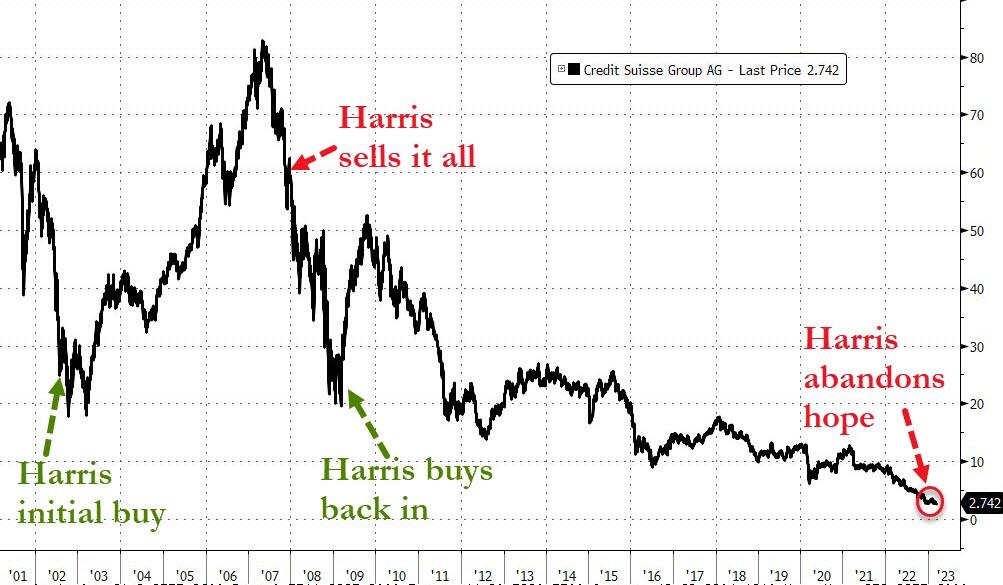
US investment manager Harris Associates has been among Credit Suisse’s most prominent supporters for years (owning as much as 10% of the flailing Swiss bank’s stock last year).

But now, that’s all over, as deputy chair and CIO David Herro tells The Financial Times that he has sold the firm’s entire stake in the bank over the last few months.

Harris started to cut its exposure in October following the bank’s SFr4bn ($4.3bn) fundraising, when Saudi National Bank supplanted it as the top investor, and had now divested completely.

“We have lots of other options to invest,” he added.

“Rising interest rates mean lots of European financials are headed in the other direction. Why go for something that is burning capital when the rest of the sector is now generating it?

With the stock hitting all-time record lows just last week, it seems Harris’ recent losses just broke

“It has been a measurable drag on our performance” Herro said.

“You can’t win every time — it is the business I am in. We meet every company we own, but you spend a lot more time with your problem children. Credit Suisse has been a drain of time and value for years.

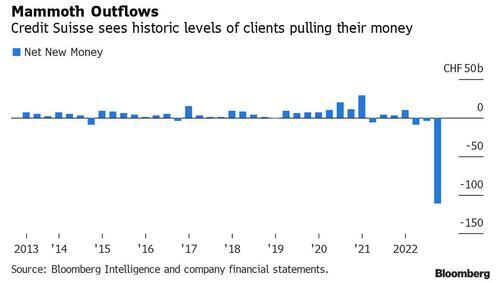
“There is a question about the future of the franchise. There have been large outflows from wealth management,” he said, referring to the SFr111bn withdrawn by Credit Suisse customers in the final three months of 2022, particularly after rumors appeared on social media about the bank’s financial health.

With the bank now offering extremely high deposit rates, as we detailed here, it raises concerns about how the business can sustain such a funding gap.

“We are ahead of our plan and have clear strategic objectives,” Dominik von Arx, a Credit Suisse spokesman, said in an emailed statement.

“We are laser focused on successfully executing our plan and on progressing toward our targets.”

However, Herro has lost patience:

“We feel the plan to restructure the investment bank, while a noble cause, is cumbersome and far more costly in terms of cash burn than we expected.”

The two largest shareholders in Credit Suisse are now the Saudi National Bank, which bought a 10 per cent stake as part of the capital raising last year, and the Qatar Investment Authority, which raised its stake to 7 per cent at the same time.

Tyler Durden
Mon, 03/06/2023 – 09:20

via ZeroHedge News https://ift.tt/7n81BXI Tyler Durden

China Setback Looms As Growth Target Disappoints

China Setback Looms As Growth Target Disappoints

By April Ma, Bloomberg Markets Live reporter and strategist

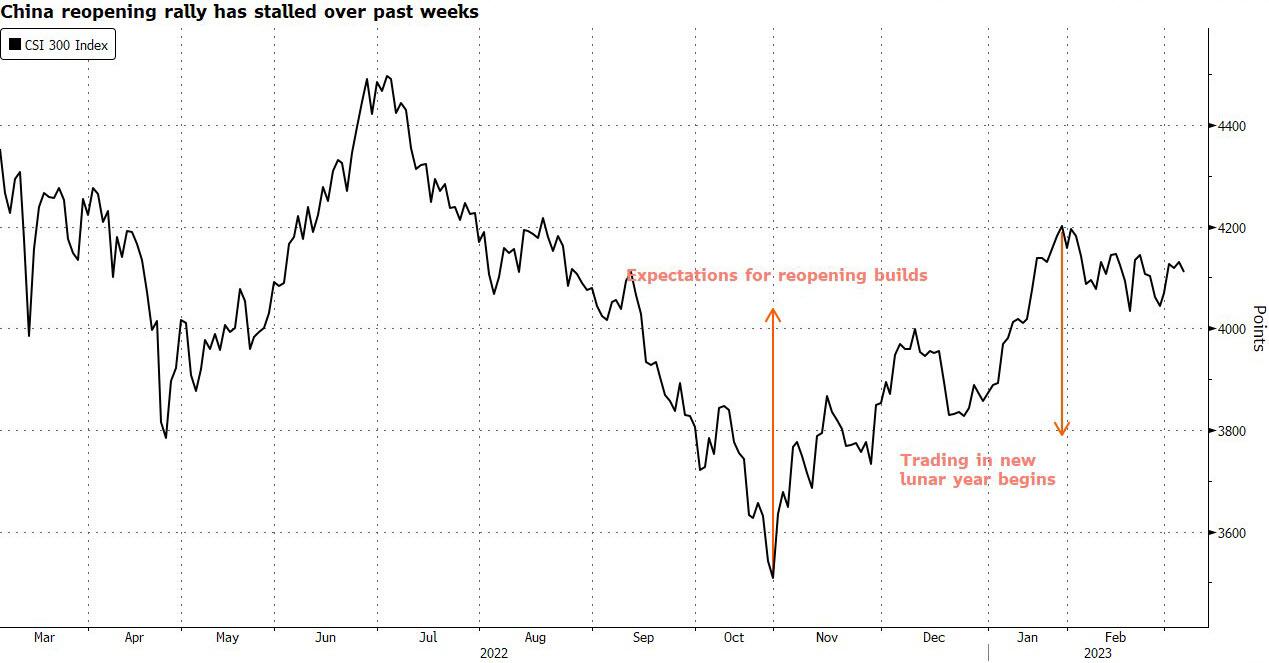
Chinese markets may come under pressure again on concerns that authorities will withhold stimulus after unveiling a conservative economic growth target that is below many investors’ expectations.

The consensus-lagging growth goal of around 5% for 2023, as Premier Li Keqiang outlined in a key address to open the National People’s Congress on Sunday, suggests strong monetary or fiscal help may be off the table for now. His last government work report at the annual parliamentary meetings also dampened hopes for more potent measures to ease an unprecedented property crisis.

“Frankly this number was not even in our possible scenarios,” said Li Weiqing, a fund manager at JH Investment Management Co., referring to the growth target. “I think this means that any anticipation for massive stimulus, either for real estate or for investment, is going to be seen as falsified, at least in the near term.”

The absence of more aggressive steps to boost growth threatens to weaken the momentum of a nascent rebound in Chinese shares last week following the release of robust manufacturing data. What may reshape market dynamics in the coming days will be potential sweeping changes to China’s bureaucracy and the lineup of a new Cabinet under Li Qiang, widely expected to be the next premier, as the political gathering continues.

Premier Li’s work report mostly repeated familiar official rhetoric from prudent monetary policy to maintaining a stable currency. The budget released on Sunday also suggests fiscal support will be restrained, with a mild deficit target increase and a special bond quota that heralds slower investments by local governments.

To be sure, some observers think Beijing has reasons to refrain from pursuing a more expansionary policy for now. “You need to take into account the fact that last year they fell vastly below target, so authorities want a more conservative target that is easy to reach without much effort this year,” said Hao Hong, chief economist at GROW Investment Group. “They want to avoid being overly aggressive.”

All eyes will now be on a suite of structural changes expected for government agencies, reforms designed to help the Communist Party consolidate its hold over the economy. Among them may be the revival of a powerful top-level commission that will further centralize financial policy formation. Fresh faces to be put in charge of the central bank and key ministries also will be keenly scrutinized.

“Given the complete reshuffling of the government, a key issue to watch in the next few months is how the new leaders will boost private sector confidence,” said Zhiwei Zhang, chief economist at Pinpoint Asset Management Ltd. “This is more important than the fiscal and monetary policies, in my view.”

Tyler Durden
Mon, 03/06/2023 – 09:00

via ZeroHedge News https://ift.tt/njD1P3s Tyler Durden

Watch: Vast Expanse Of US Military Hardware Positioned At Polish Port

Watch: Vast Expanse Of US Military Hardware Positioned At Polish Port

A Baltic monitoring media outlet has published footage of an enormous amount of American military equipment being prepared to move from the Port of Gdynia in Poland

The expanse of military hardware is being described as equipment belonging to the US Army’s 3rd Armored Brigade Combat Team, 1st Cavalry Division. Some Eastern European media reports are claiming that at least a portion of the equipment, which looks multiple football fields in length, are bound for Kiev.

Hundreds of heavy military vehicles can be seen in the footage, including armored personnel carriers, tanks and armored trucks. 

Despite claims that the equipment is bound for Ukraine, a source which widely circulated the footage, “Baltic Security”, wrote that it’s at the Polish port “in preparation for redeployment to the continental United States after serving in the Operation Atlantic Resolve.”

Russia’s Sputnik noted that “Some Polish and Ukrainian media outlets, however, did not think twice about claiming that part of the military hardware seen in the video would be redeployed to Ukraine, where Russia continues its special military operation.”

But it remains that “Neither the White House not the Pentagon have commented on the matter yet.”

“The footage comes as the US had already committed more than $100 billion worth of security and military assistance to Kiev since the beginning of the Russian special operation,” the state publication continued. Given how desperate that Ukrainian front lines, particularly in Bakhmut, are right now for more ammo and equipment – it would be surprising if these rows upon rows of hardware aren’t in the end headed for Ukraine.

Tyler Durden
Mon, 03/06/2023 – 08:40

via ZeroHedge News https://ift.tt/GJLp2kl Tyler Durden

Charter Boat Captains Don’t Have To Share Their Location Data With the Government, Court Rules


charter boat captain

Boat-tracking regulation is a warrantless search, court says. Can the government force charter boat captains to continuously transmit their location information to the authorities? It seems preposterous, but the Department of Commerce and the National Oceanic and Atmospheric Administration (NOAA) this privacy-infringing protocol in 2020. The rule required charter-boat captains to install—at their own expense—onboard monitoring systems that regularly relayed their boats’ GPS locations to the government.

A group of charter boat captains represented by the New Civil Liberties Alliance (NCLA) sued, saying the rule violated rights to due process, privacy, and freedom of movement, among other things.

The reason we were against this so much is it tracked us precisely where we were going,” Allen Walburn, one of the boat captains who brought the suit, told the Fort Myers Beach Observer and Beach Bulletin.

Another reason: The monitoring systems can be expensive, costing thousands of dollars to install in addition to a monthly service charge.

Now a federal court has sided with the captains.

“The asserted benefits from the GPS-tracking requirement do not bear any reasonable relationship to the undisputed costs,” the U.S. Court of Appeals for the Fifth Circuit in Louisiana held in its recent decision:

The Final Rule found that installation of a [monitoring] device would cost $3,000,
with an additional $40 to $75 per month in service fees. These are significant fees for charter-boat owners, for they primarily operate small businesses, with roughly $26,000 per year in net income. And in addition to the financial cost, of course, the regulation imposes a massive privacy cost; demanding that charter-boat owners transmit their exact location to the Government, every hour of every day forever, regardless of why they are using the vessel.

What benefits does the Government point to in response? Next to nothing.

The court concluded that the GPS requirement “violates the Administrative Procedure Act because it is arbitrary and capricious, in turn because the Government failed to address Fourth Amendment issues when considering it and failed to rationally consider the associated costs and benefits.” 

The requirement that charter boats transmit their GPS location to the Government appears to be a search, and no warrant authorizes that search,” it said.

The regulation—issued pursuant to the Magnuson-Stevens Fishery Conservation and Management Act of 1976—was proposed by NOAA. (The Commerce Department has delegated regulatory authority for the Magnuson-Stevens Act to that agency.) It which would have applied to charter boats in Alabama, Florida, Georgia, Louisiana, Mississippi, North Carolina, and South Carolina.

The court also ruled against another aspect of the new regulation, which would have required charter boat owners to report “all fish harvested and discarded, and any other information requested,” including “information about the permit holder, vessel, location fished, fishing effort, discards, and socio-economic data.” The court held that this rule violated the Administrative Procedures Act, because it “did not give fair notice that it would require the type of data specified.” 

There was concern that the new regulations would lead to surveillance of all recreational fishermen. “This [decision] stops that right in its tracks,” NCLA attorney John Vecchione told the Beach Observer and Beach Bulletin.


FREE MINDS

More lawmakers move to decriminalize psychedelic plants. “Local leaders in the city of Ferndale, Michigan, passed a resolution this week that advocates say decriminalizes psychedelic plants and fungi, including drugs such as psilocybin mushrooms, ayahuasca and DMT,” reports Marijuana Moment:

Ferndale is the fourth Michigan city to pass such a measure. Detroit, Ann Arbor and Hazel Park have adopted similar policy changes.

Last year activists also took steps to put psychedelics legalization on the statewide ballot, but they ultimately decided to delay the reform campaign and aim for 2024 instead.

While the resolution approved Monday by the Ferndale City Council cannot end Michigan’s statewide prohibition on psychedelics, it makes it the city’s “lowest law enforcement priority” to investigate and arrest people for “planting, cultivating, purchasing, transporting, distributing, engaging in practices with, or possessing” entheogenic plants and fungi.

Lawmakers in three other Midwestern states—Illinois, Iowa, and Missouri—are introducing legislation this year to decriminalize pscyhedelic plants. And a pair of Rhode Island lawmakers recently introduced a similar proposal. “State Rep. Brandon Potter and state Sen. Meghan Kallman are sponsoring legislation that would legalize the personal use of psilocybin, or psychedelic mushrooms,” reports Fox News. “Contingent on approval from the Food and Drug Administration…their bill would also permit psilocybin to be used to treat chronic mental health disorders.”


FREE MARKETS

The New York Times delves into Tennessee’s new “adult cabaret” law:

A bill signed into law this week in Tennessee makes staging “adult cabaret” on public property or anywhere a child could see it a criminal offense. The law forbids performances in those places by topless, go-go or exotic dancers, strippers, or male or female impersonators who, as the law defines it, provides entertainment that is “harmful to minors.”

The word “drag” does not appear in the legislation. And to some legal experts, the description provided in the letter of the law would not apply to drag as they know it. But many in the state are still trying to grasp how the measure will ultimately affect drag events, theater performances that involve drag, and even transgender and gender nonconforming people as they go about their lives.

The law is part of a cascade of legislation across the country fueled by a conservative backlash to drag events, which has also spurred protests from far-right groups and threats directed at performers. Now that it is one of the first to succeed, with lawmakers in other states pursuing legislation with similarly ambiguous language, the law has prompted concerns about how it will be enforced and the implications it could have.

A South Carolina lawmaker recently introduced a similar law.


QUICK HITS

• A Montana court has struck down a state law that would have required parental permission for a minor to get an abortion, while declining to rule yet on another law requiring parental notification.

• New Jersey wants to ban non-flushable baby wipes.

• Writer Stephen Elliott’s lawsuit against the creator of the “Shitty Media Men” list has been dismissed, after the creator—Moira Donegan—and Elliott reached a settlement. “Stephen got paid,” tweeted Katie Herzog, who talked with Elliott about the terms.

• Author “R.L. Stine is revising his popular Goosebumps books series and making edits to the published work with a more inclusive language,” notes Deadline. “The move from Scholastic comes after Penguin hired sensitivity readers to edit Roald Dahl’s books from language deemed inappropriate in today’s world.”

• Another train has derailed in Southern Ohio. This time, officials say no hazardous materials leaked.

The post Charter Boat Captains Don't Have To Share Their Location Data With the Government, Court Rules appeared first on Reason.com.

from Latest https://ift.tt/Kv34wQo
via IFTTT

Harlan Institute-Ashbrook Virtual Supreme Court—Round of 12

The topic for the 11th Annual Harlan InstituteAshbrook Virtual Supreme Court competition is Students for Fair Admission v. UNC. In February, twenty-six teams of high school students presented oral arguments in the semifinal round. Last week, we hosted arguments from the top-twelve advancing teams. The teams were superb. Truly, these high school students could compete in any law school moot court competition. The Round of 4 will be held later this month.

Match #1

Team #11965 v. Team #12048

Match #2

Team #12052 v. Team #12577

Match #3

Team #12063 v. Team #12041

Match #4

Team #11696 v. Team #11770

Match #5

Team #11762 v. Team #11695

Match #6

Team #11969 v. Team #12823

The post Harlan Institute-Ashbrook Virtual Supreme Court—Round of 12 appeared first on Reason.com.

from Latest https://ift.tt/8UTk5SN
via IFTTT

The Arc Of The “Public Intellectual”

I’ve long been fascinated by the concept of the “public intellectual.” I view this person as embodying two characteristics: first, an intellectual, as measured by scholarship; second, a public-facing scholar, as measured by media exposure. Generally, the press will not give an opportunity to a scholar unless she has already achieved a threshold level of scholarship. However, a person who achieves “public intellectual” status will invariably see a dip in scholarship, even if the media machine continues to churn.

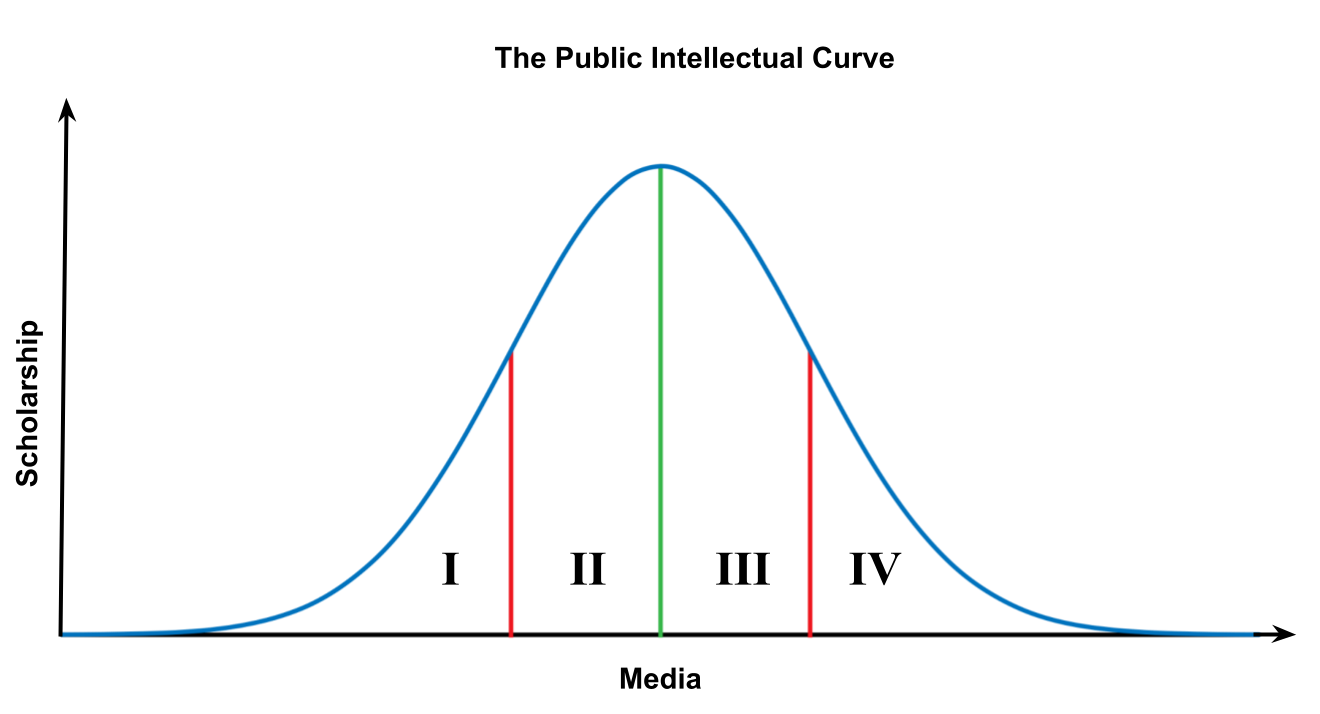
The arc of a public intellectual’s career can be represented on a graph. On the y-axis is scholarship. On the x-axis is media exposure.

The overwhelming majority of scholars never even make it onto the curve. Their work, while important for the literature, may not have resonance in public discourse. And for good reason. The best scholarship focuses on ideas for the sake of ideas, not based on what gets the most clicks. Moreover, most professors choose not to do media. It is time-consuming, and seldom contributes to a scholarly agenda. Professors can choose many other forms of service.

Some professors will gravitate–by chance or by choice–towards scholarship that touches on the zeitgeist. And if their publications meet some threshold of quality, the media calls will begin. I refer to this area as Zone I. Here, a professor’s greatest contribution is still to the literature, but she is increasingly called upon to speak to the press. Scholars may spend their entire careers in Zone I: publishing quality scholarship, and talking to the media on occasion. This is a career well-spent. But other scholars may ride up the curve.

In Zone II, professors continue to publish important scholarship, as they become fixtures in the press. At some threshold, they become the coveted public intellectual. The academic community reads and respects their scholarship, while elite institutions of media routinely call on them. The professors may choose to publish books with a popular press, rather than an academic press. And invariably, popular presses will push authors to be more edgy, and less scholarly. Footnotes do not sell books. On a book tour, they’ll give lectures to academic and non-academic audiences. Perhaps they will receive a regular column in a magazine or newspaper, that blends their academic curiosities with the news of the day. Or they’ll become a paid contributor on TV or radio. Media producers, like editors, also demand edginess. But at least for a time, as their media profile grows, they can maintain their scholarly output, as well as teaching and other service obligations. Perhaps some public intellectuals can spend their entire careers in Zone II. Alas, for everyone else, all good things come to an end.

Zone III represents the decline. Public intellectuals will spend more and more time on the “public” part of their job, and less time on the “intellectual” work. Dedicating hours to writing op-eds, popular books, recording podcasts, and (gasp) tweeting will necessarily take away time from academic scholarship. Often this decline can be masked. Public intellectuals can hire an army of super-smart research assistants who can prop up their scholarship. Or they will co-author with junior scholars who do the bulk of the work, but list their name second on the author block. But these scholars will seldom have the devoted time and solace that allowed them to develop their intellectual bona fides in the first place. Alas, the press doesn’t actually care if a person’s scholarship slips. Public intellectuals can tread on their work from decades earlier, as the media continues to call. Thus, in Zone III, even as a professor’s scholarship drops, the media exposure increases. There is a vicious cycle: the more a public intellectual seeks the public spotlight, the scholarly community regards her work less. And eventually, even Zone III comes to an end.

Zone IV represents the final chapter of a public intellectual’s career. After many years of declining scholarship, the professor is almost exclusively a media figure. Sure, she may publish things from time-to-time. Professors with high profiles can leverage their reputations to secure publications, such as invited pieces and symposium essays. But the professor becomes something of a has-been in scholarly debates. Yet, remarkably, the media keeps calling! Reporters are more interested in punchy lines than citable papers. Moreover, in this zone, the public intellectual may become more strident. Rather than using a scholarly tone, she will will sound not much different than a pundit on cable news who lacks an endowed chair. And often, due to aging, judgment and discretion begin to slip. These professors will cross lines they would have never crossed years earlier. At some point, the cycle concludes.

***

I have been very careful not to identify any scholars in particular, and where they fall on the curve–myself included. I’m sure readers will try to plot me and others on the graph.

The post The Arc Of The "Public Intellectual" appeared first on Reason.com.

from Latest https://ift.tt/4LVBiCY
via IFTTT

What If The Whole Point Is To End “The Fed Put”?

What If The Whole Point Is To End “The Fed Put”?

Authored by Charles Hugh Smith via OfTwoMinds blog,

Choose one, and only one: a stock market that inflates and pops in an endless series of ever-more destructive bubbles, or a real economy that is no longer in thrall to the engines of wealth inequality and speculative frenzy.

“The Fed Put”–the implicit Federal Reserve policy of bailing out the stock market as soon as it swoons by unleashing a flood of monetary stimulus–is now accepted as a guarantee not unlike financial gravity. Regardless of the bleatings of Fed officials, “everyone knows” the Fed will quickly “pivot” should the market swoon, slashing interest rates and ramping up liquidity via Quantitative Easing (QE).

Recall the definition of excess liquidity: the difference between real money growth and economic growth. The Fed juices excess liquidity not to further expansion in the real economy but to force-feed new money into the stock market and other risk assets.

The only possible result of “The Fed Put” is a credit/asset bubble, which is why we’re currently experiencing the third such monumental speculative bubble in 23 years.

“The Fed Put” is the logical endpoint of neoliberalism, which places “markets” (and thus finance) at the core of the real economy. The neoliberal fantasy is that “markets” solve all problems via the magic of “the invisible hand” and so everything becomes subservient to the gyrations of “markets.”

The second part of the fantasy is that “markets” are self-regulating, meaning there’s no need for a moral order or government regulations; the magic of markets includes a godlike ability to restrict its own motivations, i.e. greed and exploitation to maximize gains by any means available.

As has been proven time and again, any means available reliably includes fraud, embezzlement, malfeasance, destroying competition with cartels and monopolies, and so on. (Look at how perfectly unregulated crypto-markets have self-regulated themselves. It’s a wonder to behold such perfection, isn’t it?)

Neoliberalism conveniently ignores Adam Smith’s insight that markets require a strict moral order to avoid collapsing into savage exploitation. The neoliberal fantasy is that “markets” don’t need no stinkin’ moral order, greed and maximizing gains by any means available generate their own self-regulating structure via magic.

Let those who lost fortunes in the FTX debacle explain how perfectly this magic functions in the real world.

The Fed has taken on the role of Savior of the stock markets as a means of cementing its pre-eminence over the real economy. Fed apologists claim goosing the stock market promotes “the wealth effect” in which fatter stock valuations encourage the wealthy to spend more and borrow more than they would have otherwise done.

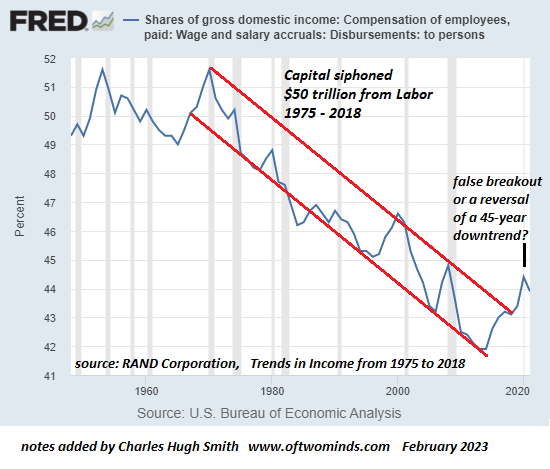
This happy story overlooks the fact that goosing the stock market vastly increases wealth inequality, in effect making the already-rich much, much richer while leaving all those who didn’t or couldn’t own big stakes in equities mired in the swamps of the real economy, where labor’s share of the economy has declined as capital’s share has soared.

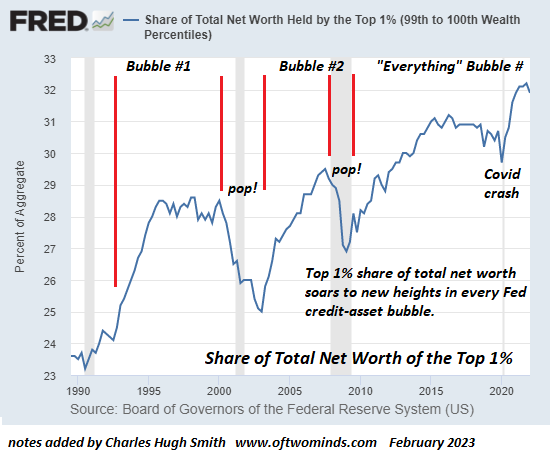
Making the real economy subservient to all-powerful markets and finance has destabilized the economy and society. Elevating markets to supremacy has created an endless series of credit-asset bubbles, each of which furthers wealth inequality (see chart of the top 1%’s wealth below) even as they devastate the real economy when they inevitably pop.

Elevating markets and finance to supremacy was all fun and games until some of the loot leaked into the global economy at an inopportune time when supply and geopolitical constraints emerged from a decades-long slumber to transform a deflationary hyper-globalization / hyper-financialization into an inflationary era of unhinged, destabilizing financial excess.

In other words, “The Fed Put” has completely distorted the real economy, and these structural distortions are now bearing the bitter fruit of the Fed’s delusional embrace of neoliberal fantasies.

Few if any seem to think the Fed might have awakened to the destructive potential of their delusion. Few if any ponder the possibility that the entire exercise of “fighting inflation” is also a backdoor policy of ending “The Fed Put”, but doing so without generating mass hysteria in all those betting the farm on the Fed “pivoting” to save the stock market yet again from its excesses.

If we read between the lines, the abandonment of “The Fed Put” is already clearly visible. No Fed official is going to say explicitly that “we’re no longer going to rescue the stock market every time it swoons.” That would crash the market as every punter who counted on the Fed panics.

The Fed’s implicit policy is to let all the True Believers in “The Fed Put” become bagholders, holding stocks all the way down to a “Fed-Putless” reality. The Fed will continue to issue statements about “being supportive” of this and that, and they may well “pause” raising rates, unleashing a temporary euphoria. But they won’t drop rates back to zero or boost their balance sheet by another $4 trillion just to keep an overvalued stock market plumply overvalued.

While speculators focus on the destruction of stock market valuations, they overlook the destruction of the real economy wreaked by “The Fed Put.” Choose one, and only one: a stock market that inflates and pops in an endless series of ever-more destructive bubbles, or a real economy that is no longer in thrall to the engines of wealth inequality and speculative frenzy.

For the past 25 years, the Fed has conflated the stock market and the real economy. This fantasy is no longer affordable. Either the Fed devotes itself to supporting the real economy, or it hastens the demise of the real economy by continuing to goose ever-more destructive speculative bubbles. It can no longer do both, and in choosing the real economy over the stock market, it is finally choosing wisely.

Perhaps “fighting inflation” is providing much needed cover for the ultimate goal of ending “The Fed Put.”

That the Fed has chosen the real economy over the stock market is “impossible,” of course, just as inflation was “impossible.” What’s possible and impossible may well change rather dramatically in the years ahead.

Please note that no one needs to “be in the market.” There are plenty of ways to invest in yourself without owning a single share (or zero-day to expiration option). This is the path of Self-Reliance.

New Podcast: Turmoil Ahead As We Enter The New Era Of ‘Scarcity’ (53 min)

*  *  *

My new book is now available at a 10% discount ($8.95 ebook, $18 print): Self-Reliance in the 21st Century. Read the first chapter for free (PDF)

Become a $1/month patron of my work via patreon.com.

Tyler Durden
Mon, 03/06/2023 – 08:20

via ZeroHedge News https://ift.tt/vDh8fub Tyler Durden

Futures Flat Ahead Of Event-Packed Week

Futures Flat Ahead Of Event-Packed Week

After a torrid two-day rally which took place as bears failed to push futures below the key 3,900 level, which sent spoos not only above 4,000 but back over key resistance levels, and which lifted the Nasdaq 100 to its best day since early February, US index futures were muted on Monday as investors awaited the latest jobs data for clues on the strength of the domestic economy (we get ADP, JOLTS and NFP this week) and comments from Fed Chair Powell on Tuesday. Contracts on the Nasdaq 100 and S&P 500 were little changed as of 7:45 am ET, after Chinese leaders set a lower-than-expected 5% economic growth goal, which implies Beijing is unlikely to deploy large-scale stimulus to shore up its economy as it emerges from Covid-era lockdowns. China’s tepid forecast also hit European stocks and commodities; the Bloomberg Dollar spot index reversed from the day’s lows, and was trading near session highs pressuring G-10 currencies. Treasuries eked out small gains, mirroring moves in global bond markets. Oil, gold and Bitcoin fell.
Among notable movers in premarket trading, Apple advanced as Goldman Sachs analysts initiated coverage with a buy rating, saying the iPhone maker’s growing installed base of users underpins the “Apple-as-a-Service” opportunity. Tesla swung between gains and losses after the automaker slashed the starting price of its Model X and Model S electric cars in the US for the second time this year, according to the company’s website: Model S price cut to $89,990 from $94,990; Model S Plaid cut to $109,990 from $114,990; Model X cut to $99,990 from $109,990; Model X Plaid cut to $109,990 from $119,990. Here are some other notable premarket movers:

  • NEXTracker rises 2% after being initiated at five brokerages, with the US solar power tracking provider’s market positioning and management team impressing analysts, but some noting that the benefits may now be priced in.
  • Silvergate falls 3.8% after the bank closed its flagship crypto payments network and Moody’s cut its ratings on the company.
  • Vir Biotechnology gains 4.7% after JPMorgan upgraded the biotech to overweight from neutral on the potential of the company’s flu shot and HBV therapies.

After a subdued February, the benchmark S&P 500 rallied on Friday to snap a three-week losing streak as investors bet on a slowdown in the pace of rate hikes. The index also bounced off a key support level at the 200-day moving average, setting it up to extend gains in the short term, according to Morgan Stanley strategists.

While the prevailing consensus emerging from the first day of China’s Two Sessions is that the lack of an ambitious GDP target (at 5%, it missed most estimates), meant that less stimulus would be injected, some analysts saw the unambitious target as positive if it prevents another bout of price growth stemming from the world’s No. 2 economy. Prices for iron ore, crude oil and copper fell, knocking a Bloomberg index of commodities as much as 1% lower.

“The inflation impulse may not be as extreme for the global economy,” Christian Mueller-Glissmann, head of asset allocation research at Goldman Sachs told Bloomberg Television. “Our biggest concern coming into this reopening was oil. A significant increase in oil prices would make the job for the Federal Reserve even more difficult.” Ironically, it has been Goldman’s commodities division that has been among the most vocal bulls on oil for 2023.

All eyes this week will be on Fed Chair Jerome Powell’s testimony to Capitol Hill before the monthly jobs report on Friday. In his address to lawmakers, Powell is expected to echo fellow central bankers in suggesting interest rates will go higher than policy makers anticipated just weeks ago if economic data continue to exceed expectations. Both events will be the next test for stock markets after “hotter-than-anticipated inflation caused some repricing as investors come to realize there’s more work to be done to bring inflation back down closer to target,” said Victoria Scholar, head of investment at Interactive Investor.

Elsewhere, and just as we predicted, after 10 consecutive weeks of bearishness with the S&P well above his “easy short at 3900” level, Morgan Stanley’s Michael Wilson, one of the biggest permabears on Wall Street, capitulated and said he’s expecting stocks to rally in the short term. Wilson pointed to the S&P 500’s resilience at the 200-day moving average last week, a widely-monitored technical indicator of an index’s momentum against its current price. The bounce off the line suggests it may now act as a support for the benchmark. Wilson said the index is likely to move higher if Treasury yields and the dollar continue to decline. “Equity markets survived a crucial test of support last week that suggests this bear market rally is not ready to end just yet,” the strategist wrote in a note Monday (more in a follow up note).

JPMorgan strategists, meanwhile, doubled down on their bearishness and said stock markets are set to come under pressure beyond the first quarter against the backdrop of “more normal” positioning, mixed corporate earnings, further policy tightening and the likely end of positive surprises in business activity.

“Powell could surprise markets this week with his testimony but they have already set it up so they hike in 25 basis-point increments,” Nikko Asset Management chief strategist John Vail said on Bloomberg Television. Vail predicted payrolls data to show a softer figure than the previous month, “and that may calm down some of the fears of the Fed.”

Europe’s Stoxx 600 index also retreated, with commodity and energy shares in particular feeling the heat from Beijing’s growth outlook; travel, retail and consumer products were best-performing sectors. The FTSE is down 0.4% as miners weigh. Over the weekend, we learned that Harris Associates, Credit Suisse’s biggest shareholder for many years, sold its entire stake in the lender. After cutting its 10% holding to 5% toward the end of last year, the firm exited its investment over the past three to four months, Chief Investment Officer David Herro said in an email. Separately, UBS cut employee bonuses for last year by 10% while simultaneously boosting pay for Chief Executive Officer Ralph Hamers. The bank’s compensation awards cap an uneven year, with a roughly 50% decline in advisory and capital markets offsetting gains in trading and inflows in wealth management. Here are some of the biggest movers on Monday:

  • Helvetia shares climbed as much as 4.4%, the most in almost a year, after results were better than expected, driven by a very strong performance for the Swiss insurer’s life business
  • Rheinmetall shares gain as much as 2.6% in Frankfurt on news the defense contractor will replace Fresenius Medical Care in Germany’s DAX Index effective March 20
  • GAM shares rise as much as 3.4% after the FT reported that the Switzerland-listed fund manager is trying to find a buyer ahead of results it has delayed by two months
  • Accor shares jump as much as 2.7% after the French hospitality group was upgraded to overweight from equal- weight at Barclays, which sees significant upside risks to consensus forecasts
  • Credit Suisse shares decline as much as 2.6% after one of the Swiss bank’s biggest backers, Harris Associates’ stock picker David Herro, sold his entire stake
  • Covestro shares decline 1.8% after Exane says recovery is now priced into the stock, downgrading its rating on the German chemicals producer
  • Pantheon Resources shares plunge as much as 53% after the oil and gas firm gave an update on reservoir performance for the Alkaid 2 well, which returned to production on 21 February
  • Belimo shares decline as much as 6.6% as the Swiss ventilation-equipment manufacturer’s capacity constraints due to a lack of qualified labor hampers its strong underlying growth drivers

Earlier in the session, Asia stocks were on track to reach their highest level in about two weeks as tech stocks climbed amid lower bond yields. Chinese equities lagged as Beijing’s modest economic growth target dampened hopes for stronger stimulus. The MSCI Asia Pacific Index climbed as much as 1.1% to a level last seen on Feb. 21, with tech-heavy gauges in South Korea and Taiwan higher as the 10-year US Treasury yield slipped below 4%. Stocks in Hong Kong and China underperformed the region, whipsawing earlier as the country’s annual parliamentary meetings entered their second day.  Meanwhile, Vietnam’s measure was higher after developers jumped on news that companies will be allowed to use other assets to make principal and interest payments on bonds. Thailand was closed for a holiday. Investors will watch Federal Reserve Chairman Jerome Powell’s testimonies before Senate and House committees this week.

Expectations for US nonfarm payrolls data due Friday will also drive trading as market watchers assess the Fed’s policy path and the ability for the US to navigate a potential recession. If the payrolls print is strong “it is likely to cement market expectations of a 50bp hike in March,” said Nomura strategists including Chetan Seth in a note. “If the economic slowdown/recession is delayed to late-2023 (or even 2024),” Asian stocks might not face a significant selloff immediately as long as labor market conditions don’t deteriorate, they added. Other events to watch this week include monetary policy decisions in Australia, Japan and Malaysia. The MSCI Asia has rebounded this month from a near 6% selloff in February as declines in Chinese stocks slow and US economic data point to robust trends

Japanese stocks climbed, with the Topix reaching a fresh 14-month high, as traders dialed back concerns over US rate hikes. The Topix rose 0.8% to close at 2,036.49, while the Nikkei advanced 1.1% to 28,237.78. Sony Group Corp. contributed the most to the Topix gain, increasing 2.6%. Out of 2,160 stocks in the index, 1,381 rose and 675 fell, while 104 were unchanged. “The first half of this week will be relatively strong, and the second half is likely to be a wait-and-see mood ahead of the Bank of Japan’s monetary policy meeting and employment statistics near the weekend,” said Naoki Fujiwara, chief fund manager at Shinkin Asset Management. 

Indian stocks posted their biggest two-day rally in more than four months as most peers in Asia advanced and a rebound in Adani Group shares boosted local investor sentiment. The S&P BSE Sensex rose 0.7% to 60,224.46 in Mumbai, while the NSE Nifty 50 Index advanced by a similar measure. Their two-day rally was the biggest such move since Oct. 6. The gauges are down around 1% and 2.2% this year, respectively.  Infosys contributed the most to the Sensex’s gain, increasing 1.9%. Out of 30 shares in the Sensex index, 24 rose and 6 fell.

In Australia, the S&P/ASX 200 index rose 0.6% to close at 7,328.60, extending gains to a third day. The benchmark was boosted by strength in banks and consumer discretionary stocks. Australia’s central bank is set to raise interest rates for a 10th straight meeting on Tuesday, with policymakers facing a complex messaging task for an outlook of slower economic growth and still-elevated inflation.  In New Zealand, the S&P/NZX 50 index rose 0.4% to 11,912.48

In FX, the Bloomberg Dollar Spot Index inched up as the greenback traded higher against most of its Group-of-10 peers. The Swiss franc rallied and was the best G-10 performer while the sovereign yield curve twist-flattened after CPI surprisingly increased 3.4% in February from a year earlier. That contrasted with the median estimate in a Bloomberg survey, which predicted a slowdown to 3.1%.

  • The euro was steady at around $1.0630. Currency volatility traded in a sea of green in the front-end, yet the move higher in euro-dollar quickly met a fresh round of selling. Bunds and Italian bonds climbed for a second day and money markets trimmed ECB tightening wagers after policymaker Centeno highlighted slowing headline inflation instead of the rising core gauge
  • China’s yuan weakens after the outgoing Premier Li Keqiang announced a disappointing growth target for this year at the National People’s Congress on Sunday. The 10-year sovereign bond yield falls to the lowest level in two weeks. China set a modest economic growth target of around 5% for the year, with the nation’s top leaders avoiding any large stimulus to spur a consumer-driven recovery already underway, suggesting less of a growth boost to an ailing world economy.
  • The Australian dollar weakened and is in danger of hitting its lowest point this year as China’s growth target disappoints and weak local data may cause the central bank to temper its policy stance at Tuesday’s meeting. The Melbourne Institute’s measure of inflation rate rose 6.3% from a year earlier in February, following a record of 6.4% increase in the previous month, driven mainly by the price increases in private motoring and new dwellings
  • The yen was steady against the dollar and demand for protection against a yen surge climbed in the options market as BOJ Governor Haruhiko Kuroda’s last policy meeting looms this week. The benchmark 10-year yield was flat just shy off the BOJ’s 0.5% policy ceiling

In rates, treasuries advance across the curve Monday, following wider gains across bunds while swap spreads tighten into the rally, suggesting receiving flows are occurring ahead of an expected busy week for IG credit issuance. Treasury yields remain richer by 0.5bp to 3bp across the curve with long-end-led gains flattening 2s10s, 5s30s spreads by 2bp and 1.2bp on the day; 10-year yields around 3.92% are richer by ~3bp vs Friday close with bunds slightly outperforming in the sector.  German 10-year borrowing costs initially dropped 7bps after dovish remarks from ECB’s Mario Centeno; however comments from ECB’s Holzmann – who said he expects four or more half-point rate hikes – trimmed gains for bunds early in the session and dragged Treasury yields off richest levels of the day. Treasury auctions resume Tuesday with 3-year note sale, followed by 10- and 30-year sales Wednesday and Thursday. Of note, the the three-month LIBOR rate for dollars, a major global lending benchmark, surpassed 5% for the first time in more than 15 years on Monday.

In commodities, oil declined at the start of the week after China set a cautious growth target for this year and refrained from unveiling any major new stimulus, while concerns lingered over further monetary tightening by the US Federal Reserve. Gold also dipped on the news.

Looking at today’s calendar, at 10 a.m., we get factory orders and durable goods data. At 11:30 a.m., the US will sell $57 billion of 13-week bills and $48 billion of 26-week bills. The CERAWeek energy conference starts in Houston, while earnings include Nutanix and Trip.com. ADP employment change and February jobs report are ahead this week. Fed speakers this week include Chair Powell before of the Senate Banking panel Tuesday, and again before the House Financial Services committee Wednesday

Market Snapshot

  • S&P 500 futures little changed at 4,049.00
  • STOXX Europe 600 little changed at 464.62
  • MXAP up 0.7% to 162.36
  • MXAPJ up 0.5% to 526.22
  • Nikkei up 1.1% to 28,237.78
  • Topix up 0.8% to 2,036.49
  • Hang Seng Index up 0.2% to 20,603.19
  • Shanghai Composite down 0.2% to 3,322.03
  • Sensex up 0.7% to 60,209.39
  • Australia S&P/ASX 200 up 0.6% to 7,328.60
  • Kospi up 1.3% to 2,462.62
  • German 10Y yield little changed at 2.68%
  • Euro little changed at $1.0638
  • Brent Futures down 0.6% to $85.34/bbl
  • Gold spot down 0.2% to $1,852.11
  • U.S. Dollar Index little changed at 104.55

Top Overnight News from Bloomberg

  1. The ECB is likely to continue tightening monetary policy by implementing “a fairly significant interest-rate increase,” according to Governing Council member Olli Rehn. The ECB will probably need to raise borrowing costs again after an increase already penciled in for next week, according to Chief Economist Philip Lane: BBG
  2. Retailers in France have agreed to offer the lowest possible prices for essential food items to help households cope with surging inflation, French Finance Minister Bruno Le Maire said on Monday: BBG
  3. China set a 2023 GDP growth target of “around 5%”, an achievable outlook (remember they fall far short of the 2022 goal) that’s approximately consistent with expectations (the St is modeling +5.3%), although it was a bit less than some were hoping to hear (many felt it would be “above 5%”) and suggests the gov’t remains somewhat cautious about the economic outlook despite a signs of a robust rebound. WSJ
  4. China adopted a relatively conciliatory tone toward Taiwan, talking about how it will work to restore exchanges and economic ties with the island. SCMP
  5. The Biden administration is preparing a new program that could prohibit U.S. investment in certain sectors in China, a new step to guard U.S. technology advantages during a growing competition between the world’s two largest economies. WSJ
  6. China has declared it won’t send weapons to Russia according to German Chancellor Scholz and the EU has seen no evidence so far of such a plan being considered. Politico
  7. South Korea’s CPI for Feb undershoots the St consensus, coming in at +4.8% (down from +5.2% in Jan and below the St’s +5% estimate), taking pressure off the country’s central bank. BBG
  8. Underlying inflation in the euro zone will stay high in the near term so a 50 basis point European Central Bank interest rate increase later this month is increasingly certain, ECB President Christine Lagarde told Spanish media group Vocento. Also, ECB’s Lane says further rate hikes beyond the March meeting will be appropriate. RTRS
  9. Credit Suisse lost one of its biggest backers. Harris Associates stock picker David Herro sold the firm’s entire stake in the bank, severing ties after about two decades. Harris was the biggest shareholder for many years, but had cut its 10% holding to 5% toward the end of 2022. BBG
  10. San Francisco Fed President Daly said the battle against inflation will require further rate increases with the cycle ceiling maintained for a longer period. FT
  11. While Fundamental L/S managers’ Net exposure to the Market factor (proxy of Net leverage) has increased in the past few months, Net exposure on a beta adjusted basis (i.e., when including both the Market and Market Sensitivity factors) has been falling rapidly since mid-January. In percentile terms vs. the past five years, Fundamental L/S Net exposure to the Market factor is currently in the 51st percentile (vs. 35th percentile at the end of 2022). However, when including both the Market and Market Sensitivity factors, Fundamental L/S Managers’ Net exposure is now near five-year lows in the 4th percentile (vs. 27th percentile at the end of 2022). GS PB
  12. On March 17, S&P Dow Jones and MSCI will dissolve the Data Processing & Outsourced Services group within Info Tech and reallocate its constituents to Financials and Industrials. The reclassification will add several growth stocks to the traditional value stocks in Financials. V, MA, and PYPL, the three largest stocks affected, will comprise 16% of Financials cap. Three takeaways: (1) The macro correlations of the sector will change modestly, but the sector will remain cyclical and positively correlated with rates. (2) Implied mechanical net ETF flows for stocks across affected sectors would represent less than 1% of market cap. (3) Mutual funds would become more overweight Financials and more underweight Tech. GS

A more detailed look at global markets courtesy of Newsquawk

APAC stocks were mostly positive as the majority of bourses took impetus from last Friday’s gains on Wall St where the Nasdaq outperformed amid a softer yield environment, although gains were capped after China announced a modest growth target of about 5% for 2023. ASX 200 was positive as strength in tech, financials and the consumer sector offset the weakness in the mining industry but with further upside limited heading into the RBA rate decision tomorrow where the central bank is widely expected to deliver a 10th consecutive rate hike. Nikkei 225 outperformed after topping the 28k level for the first time this year with SoftBank leading the advances following reports that its Arm unit is seeking to raise at least USD 8bln from a US IPO. KOSPI gained as softer-than-expected CPI data eased the pressure for the BoK to resume rate hikes and with South Korea unveiling a plan to ease tensions with Japan regarding wartime forced labour compensation. Hang Seng and Shanghai Comp. traded mixed with early pressure after China set its slowest growth target in over two decades and with the PBoC’s operations resulting in a significant net liquidity drain of CNY 329bln, although some of the losses were pared given that China also made several support pledges and following the announcement of further inclusions to the Stock Connect.

Top Asian News

  • Chinese Premier Li announced at the National People’s Congress that China’s 2023 GDP growth target is about 5.0% (exp. 5.0%-5.5%), while the target for CPI is around 3% and the jobless rate at around 5.5% for 2023. Premier Li also stated that China aims to create 12mln urban jobs and that it is essential to prioritise the economic recovery, as well as reiterated to expand domestic demand and prioritise the consumption recovery. China will step up proactive fiscal policy and effectively boost investment, extend and further refine policies on tax and fee cuts, and will implement prudent monetary policy in a targeted way.
  • China will prevent and control the epidemic in a more scientific, precise and efficient way, according to the work report. China is to support financial institutions to meet the effective needs of the real economy and will increase the proportion of direct financing, while it will increase loans to small and micro businesses, as well as further enhance credit support to tech and innovative SMEs. Furthermore, China’s public expenditure will grow 5.7% this year and military spending will increase at a faster pace of 7.2%, according to Reuters and FT.
  • NDRC Vice Chairman said China’s economy is steadily improving and consumption will be the main driver for growth this year, while they will prudently tackle risks related to real estate, finance and local government debt.
  • Taiwan’s government said China should respect the Taiwanese people’s commitment to core concepts of sovereignty, democracy and freedom, while it added that China should deal with cross-strait affairs pragmatically in a rational, equal and mutually respectful manner, according to Reuters.
  • South Korean Foreign Minister Park announced a plan for South Korea to compensate victims of Japan’s forced labour through its public foundation in which companies will voluntarily donate to the fund and said that cooperation between the two nations is critical in the face of the serious international security situation. It was later reported that Japanese PM Kishida said they welcome the South Korean government’s measures on wartime labour compensation and will work closely with South Korean President Yoon, while Japan’s Foreign Minister noted that South Korea’s plan will help restore healthy ties.
  • Hong Kong’s stock market operator is expected to reduce the proposed listing threshold for “specialist” technology companies as it dials up its overtures to allow eligible start-ups to raise funds, according to SCMP sources.

European bourses are posting modest gains of circa. 0.3% in a continuation of the firmer APAC handover where the upside was capped by China’s GDP targets. Though, the SMI and FTSE 100 buck the trend slightly and are mostly softer, given pressure in Credit Suisse and Basic Resources following Harris Associates divestment and benchmark pricing respectively. US futures are essentially unchanged given the above and as participants await the week’s commentary from Fed officials, incl. Chair Powell, and Friday’s NFP report. Apple (AAPL) initiated with Buy at Goldman Sachs; price target USD 199/shr.

Top European News

  • ECB President Lagarde said underlying inflation will stay high in the near term and that a 50bp rate hike later this month is increasingly certain, while she added that they must continue to take whatever measures necessary to bring inflation back to 2%, according to Spanish media group Vocento cited by Reuters.
  • ECB’s Lane says current information on underlying inflation pressures suggests that it will be appropriate to raise rates further beyond our March meeting and “While there has been a clear turnaround in energy inflation and there are some signs of deceleration for food inflation, momentum for core inflation has not declined. In particular, momentum in the goods category remains strong.”. Click here for more detail.
  • ECB’s Centeno says “rates increased too quickly. Now patience, the prices go down”, via La Stampa; ECB targets headline not core inflation. Lower inflation forecasts should be heeded in March. Responded that the decision must be based on data, when asked about possible 50bps hikes after March.
  • French Finance Minister Le Maire says they have come to an agreement with retailers to contain food inflation, worth several-hundreds-of-millions.

FX

  • The DXY is softer on the session, but has found a foothold above 104.50 within 104.34-63 extremes as participants look to Chair Powell and data later in the week.
  • CHF is the current outperformer following unexpectedly hot Swiss CPI, with USD/CHF down to within reach of 0.9300 (vs 0.9373 peak) while EUR/CHF slipped to an eventual 0.9924 low.
  • The next best, but little changed overall, is the EUR; though, the single currency has recouped from soft Sentix to reside at the mid-point of 1.0616-57 parameters and proved largely unreactive to ECB’s Lane on inflation.
  • Antipodeans and the Yuan are the laggards, in the wake of China’s 5.0% (exp. 5.0-5.5) 2023 GDP target; AUD down to 0.6728 with attention also on the upcoming RBA meeting where 25bp is expected, but a pause cannot be outruled.
  • SEK failed to benefit from Q4 current account given dovish-impulses via a weekend interview from Riksbank’s Thedeen, in which he dismissed intra-meeting action and dialled down the importance of the SEK on mon pol.
  • PBoC set USD/CNY mid-point at 6.8951 vs exp. 6.8932 (prev. 6.9117)
  • Norway’s government lowered its 2023 mainland GDP growth forecast to 0.9% from 1.7% and lowered the 2024 GDP growth forecast to 1.4% from 2.0%, while the government is to present a financially responsible budget which prioritises the expense imposed by the war in Ukraine, public services and helping those who are most in need, according to Reuters.

Fixed Income

  • Core benchmarks have managed to recover well from initial bouts of pressure, with yields softer across the curve in Europe and the US.
  • Specifically, Bunds and Gilts were pressured to 131.22 and 99.85 troughs respectively, but recording to around 131.50 and closer to 100.50.
  • Stateside, USTs are at the top-end of a 111.01+ to 111.13+ range, with the curve softer and action most pronounced in the long-end going into a relatively quiet US session before the week ramps up from Tuesday with the first of Chair Powell’s testimonies.

Commodities

  • Crude benchmarks are softer and at the lower-end of circa. USD 1/bbl parameters, following the underwhelming GDP targets set by the market’s largest buyer China.
  • Specifically, WTI Apr and Brent May are at the trough of USD 78.69-79.92/bbl and USD 84.71-85.83/bbl parameters respectively.
  • Saudi Arabia raised most of its official selling prices for April with the Arab light crude OSP to Asia set at Oman/Dubai + USD 2.50/bbl (prev. +2.00/bbl) and to Northwest Europe was set at ICE Brent + USD 1.00/bbl (prev. +0.50/bbl), while the OSP to the US was maintained at ASCI + USD 6.65/bbl, according to Reuters.
  • Goldman Sachs expects Brent to begin grinding higher this month and reach USD 100/bbl in December.
  • Spot gold is little changed above USD 1850/oz, and as such is between the 50- and 21-DMAs at USD 1869/oz and USD 1844/oz respectively; base metals are subdued given the aforementioned growth target from China.

Geopolitics

  • UK military intelligence said Ukrainian defence of the Donbas town of Bakhmut is under increasingly severe pressure with intense fighting taking place in and around the city, while regular Russian army and Wagner Group forces have made further advances into the suburbs of the city.
  • US Chairman of the Joint Chiefs of Staff General Milley made an unannounced visit to Syria to assess the mission, while the visit drew condemnation from Syria which stated that the visit was illegal and a flagrant violation of the country’s sovereignty, according to SANA.
  • IAEA report stated that Iran has given high-level assurances that it is open to resolving the safeguards issues and engaging in follow-up technical discussions. IAEA chief Grossi stated that he believes they can start implementing very concrete measures soon and that they agreed on access to information and places, according to Reuters.
  • North Korea said US-South Korea military drills are raising tensions to an extremely dangerous level and called on the UN to demand an immediate end to US-South Korea military drills. Furthermore, it said the US is causing the collapse of international arms control systems and the US, South Korea and Japan are crossing a dangerous line which cannot be tolerated, while North Korea said its nuclear weapons will ensure the balance of power in the region, according to KCNA.

US Event Calendar

  • 10:00: Jan. Factory Orders, est. -1.8%, prior 1.8%
    • Jan. Factory Orders Ex Trans, est. 1.0%, prior -1.2%
  • 10:00: Jan. Durable Goods Orders, est. -4.5%, prior -4.5%
    • Jan. -Less Transportation, est. 0.7%, prior 0.7%
    • Jan. Cap Goods Orders Nondef Ex Air, prior 0.8%
    • Jan. Cap Goods Ship Nondef Ex Air, prior 1.1%

DB’s Jim Reid concludes the overnight wrap

We had a power cut yesterday morning at home and I’ve never seen such distress over something so trivial. The TV didn’t work, the internet was down, the kids were in hysterics, my wife couldn’t have porridge or a cup of tea, and soup plans for lunch were in chaos. I told them all that they needed to put it all into perspective and that we were all incredibly lucky and privileged to have electricity and we shouldn’t take it for granted. I smugly grabbed a yoghurt for breakfast and put a wooly hat on while the family moaned. The outage only eventually lasted an hour. However, fast forward 7 hours and the power suddenly went off again during the first half of the game between Liverpool and Man United. I cursed and swore at the TV and shouted something about what sort of country do we live in if we can’t have constant power. It’s fair to say my family seized at the opportunity to get their own back. However, the interruption was thankfully brief and Liverpool delivered Manchester United joint worst-ever defeat in their 145-year history and nearly 6,000 games. A 7-0 thrashing.

So there’s a sprint to my step as we start a busy 8 days for markets, culminating in the US CPI next Tuesday after payrolls this Friday. It’s fairly uncontroversial to say that the last payrolls report published on February 3rd was a huge moment, and one that started a series of events that has meant that the last month has been a struggle for most financial assets, especially bonds (the worst February on record for the Global Agg). Remember that 36 hours before that payroll print, the relatively “dovish” FOMC had led to 10yr US yields hitting 3.33%. Last week at their peak they hit 4.08% before closing out at 3.95% on Friday.

As such if you thought the relatively random number generator that is payrolls is usually overhyped, you’ve seen nothing yet as we approach Friday’s big number. For those who have been on a sabbatical to another planet, last month it came in at +517k against +223k expected with fairly substantial upward revisions from the previous year as part of the annual review.

Before we preview this, we should also say that other big highlights this week are the RBA (tomorrow), BoC (Wednesday) and BoJ meetings (Friday), and Powell’s semi-annual congressional testimony before House and Senate committees tomorrow and Wednesday. As we’ll discuss below the BoJ is unlikely to change tack at this stage but every meeting is potentially live given what they did in December. We’ll review this and the rest of the week ahead after a brief payrolls preview.

For Friday our economists expect +300k for both headline and private payrolls (consensus for both at +215k). As with January, February was also mild weather wise for the survey week (which can mean less leisure, hospitality and retail layoffs), although not as much as in the prior month. So the temperature will likely still be an influence. There was a reasonable question mark about seasonal distortions in the last report so who knows how that will impact this week’s report. Our economists acknowledge the seasonals but the revisions at the same time to last year’s payrolls data suggest the labour market was stronger going into 2023 than previously thought, which means a fair amount of the recent job gains was likely genuine. Unemployment is expected to stay at 54-year lows of 3.4% with the risks it ticks down a tenth. We’ll give a fuller preview of average hourly earnings and the work week on Friday.

Don’t forget the JOLTs report on Wednesday which we feel is a more accurate reflection of the tightness of the labour market with the main problem it always being a month behind the payroll report. Maybe it can help shed some light on how accurate January’s payrolls report was though. If it was accurate you should see an uptick in the hiring rate. Also important will be the job openings as usual to highlight the tightness in demand for labour.

Going back to the other highlights this week, Fed Chair Powell semi-annual testimony to the Senate Banking Committee tomorrow and to the House Financial Services Committee on Wednesday will of course be pored over for every subtle policy nuance. As they come before payrolls and next week’s equally crucial CPI report, it’s hard to see how he can be too confident about where the Fed is going to land. He may provide clues as to what employment and inflation numbers need to do to make the Fed act in a particular way, especially how it pertains to whether 50bps hikes are back on the table. Staying with central banks the RBA is seen as hiking 25bps tomorrow but the BoC seen as holding to their planned policy pause on Wednesday.

Our Chief Japan economist previews the BoJ meeting here and expects the central bank to adhere to its present monetary policy, with YCC removal seen unlikely, although you can’t rule it out given December’s surprise. This will also be the last monetary policy meeting for Governor Kuroda.

Other notable economic data releases in the US this week include factory orders (DB forecast -0.5% vs +1.8% in December) today, consumer credit tomorrow and the ADP and trade balance on Wednesday.

Turning to Europe, the focus will be on the UK with the release of the monthly GDP report on Friday, ahead of the March 23 BoE meeting. Elsewhere in the region, key releases include factory orders (tomorrow), retail sales and industrial production (Wednesday) for Germany and trade balance data for France (Friday).

In Asia the highlight might be the Chinese CPI and PPI reports due on Thursday. These will be released after last week’s blockbuster PMI readings showed a robust recovery and thus will be important to assessing the path of economic stimulus going forward. Our economists expect a 1.3% reading for the CPI (vs 2.1% in January) and a further YoY decline of -1.0% for the PPI (vs -0.8% in January).

Staying with China, over the weekend the start of China’s 14th National People’s (annual) Congress (NPC), surprisingly set a modest growth target for this year of 5% rather than more than, or even 5.5%, that many economists had expected. Our economists’ have reviewed this surprise here.

Asian equity markets are advancing at the start of the week following Friday’s higher close on Wall Street. As I check my screens, the Nikkei (+1.28%) is leading gains across the region followed by the KOSPI (+1.07%) and the S&P/ASX 200 (+0.64%). However, Chinese stocks are lagging behind their peers this morning with the CSI (-0.56%) and the Shanghai Composite (-0.24%) edging lower on the lower-than-expected GDP target that reduced the probability of large stimulus injections. Meanwhile, the Hang Seng (+0.04%) is fluctuating between gains and losses in early trade. US equity futures are indicating a slight gain with those tied to the S&P 500 (+0.11%) and NASDAQ 100 (+0.24%) trading slightly higher.

Early morning data showed that South Korea’s consumer price index (CPI) rose +4.8% y/y in February, notching its slowest pace in 10 months (v/s +5.0% expected), down from January’s +5.2% increase, thus raising the possibility of no more hikes from the Bank of Korea (BOK).

Looking back on last week now. On Friday we saw the US ISM services index print above expectations at 55.1 (vs 54.5 expected). Looking at the release more closely, the subcomponents were very strong, with new orders up to 62.6 (vs. 60.4 in January), reaching its highest level since November 2021. The employment component hit its highest level since December 2021 at 54.0 (vs. 50.0 in January), adding to the still very strong US employment story, and the prices paid component was down to a two-year low of 65.6, albeit still well above the 50-mark and thus still indicating rising costs.

With evidence of a still-tight labour market and inflation stickiness over the course of the week, markets priced in further rate hikes by the Fed. The terminal rate (now September) was marginally lower (-0.5bps) on Friday, but up +4.2bps for the week to 5.444%. The rate priced in for the meeting at year-end was also up on the week, increasing +2.6bps to 5.307% (-1.8bps on Friday). This is up nearly 1pp from the lows just over a month ago.

Risk markets responded positively to the strong data on Friday, as equities posted a large gain with even fixed income trimming losses from earlier in the week. The S&P 500 was up +1.61% on Friday, and +1.90% on a weekly basis, whilst the NASDAQ Composite pushed ahead, climbing +1.97% on Friday and +2.58% over the week as big-ticket stocks like Apple (+2.94%) and Meta (+8.72%) outperformed (+3.35% and +6.14% on Friday, respectively). This price action was echoed in Europe, as the STOXX 600 rose +1.43% week-on-week (+0.92% on Friday).

10yr Treasuries gained on Friday as yields fell back -10.4bps, bringing the yield to 3.95%, leaving 10yr yields nearly unchanged (+0.9bps) on the week after closing at nearly 4.06% on Thursday as fixed income markets grappled with the prospect of higher Fed rates this policy cycle. 2yr Treasuries underperformed against this backdrop, as yields fell -2.9bps on Friday but were +4.3bps week-on-week, bringing the yield to 4.86%.

Looking across the Atlantic to Europe, German 10yr bund yields fell back –3.6bps on Friday to 2.72%. However, looking at yield movements on a week-on-week basis, 10yr bund yields were up +17.8bps, their largest weekly move higher so far this year.

Turning to commodity markets, with spring now here and a strong pace to European gas imports in the first week of March, European natural gas futures fell back last week, down -11.17% on a weekly basis (-3.51% on Friday). In contrast, oil posted gains last week, with WTI Crude up +4.40% to $79.68/bbl (+1.94% on Friday), and Brent Crude up +3.21% week-on-week (+1.27% on Friday).
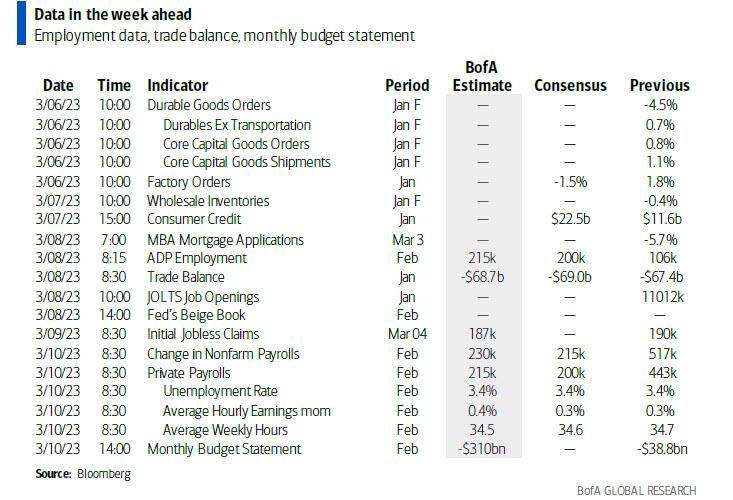
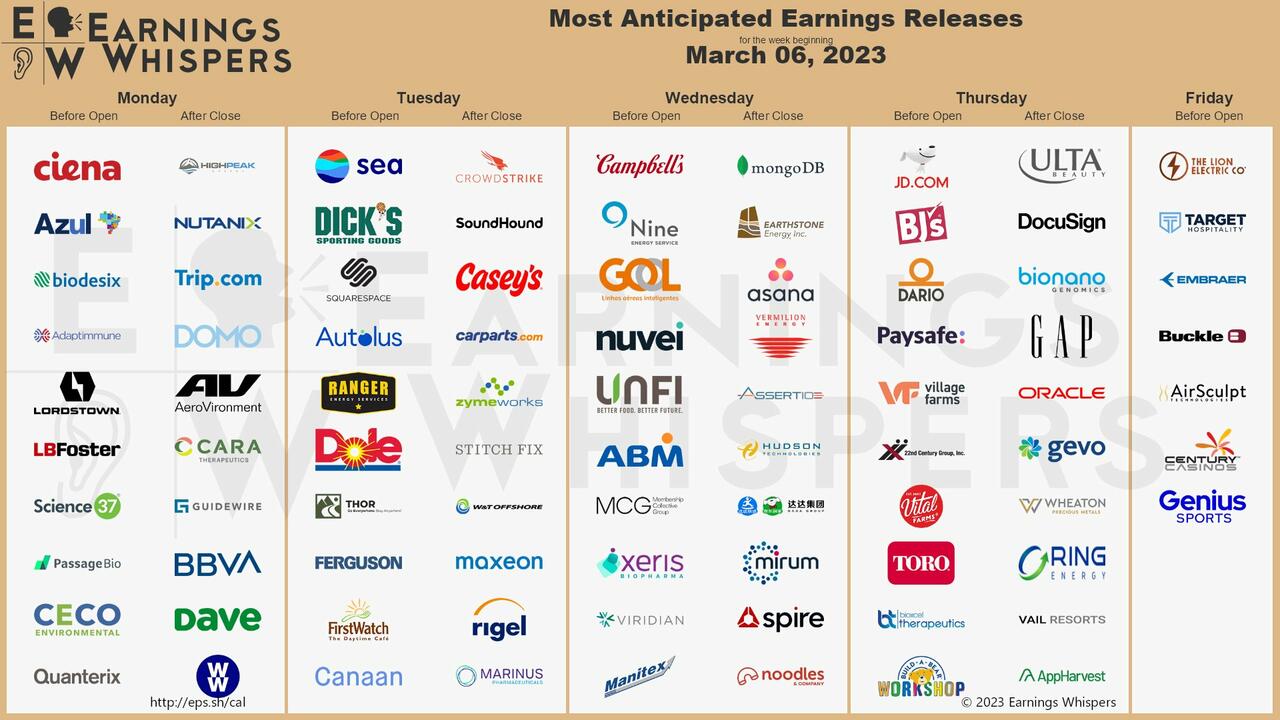
Tyler Durden
Mon, 03/06/2023 – 08:07

via ZeroHedge News https://ift.tt/Yf4zTrL Tyler Durden