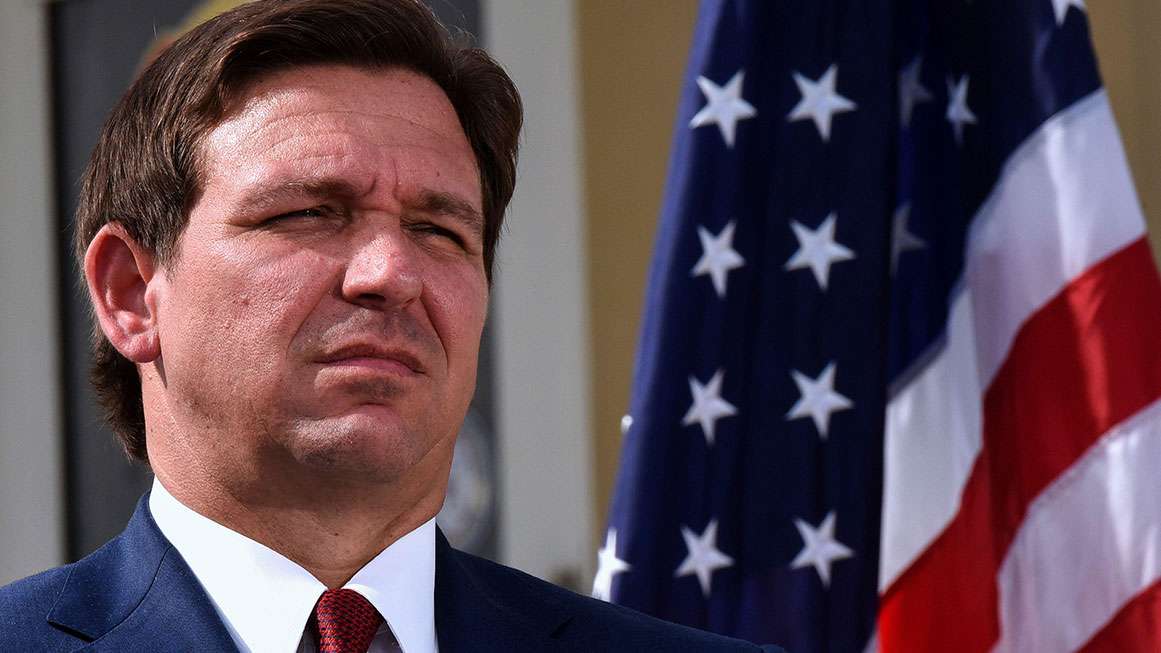
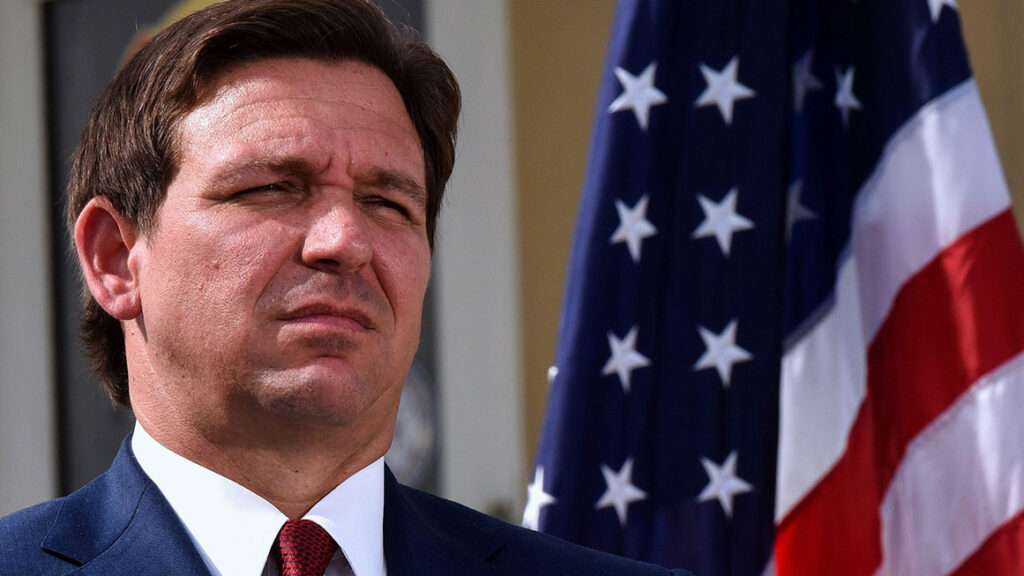
As a 12-year-old in 1991, DeSantis was part of a team from Dunedin, Florida, that qualified for the Little League World Series, the global youth baseball championship event held every summer since 1947 in the hills of Williamsport, Pennsylvania. “We were like local celebrities for a while,” he recalled 10 years later for an article published by the Yale Daily News. “We were the lead story in the local newspapers and on the front page of the Tampa area newspapers.”
In 1991, the Little League World Series hadn’t yet morphed into the two-week-long competition featuring 20 teams and wall-to-wall coverage on ESPN that it is today. Even so, it was newsworthy enough to lead local news coverage back home in Florida and to give young Ronald DeSantis, as he was listed on Dunedin’s roster, his first mention in an Associated Press wire report: He pitched five innings and hit a home run as Dunedin won, 23–7, against a team from Saudi Arabia in a consolation game on the tournament’s second day. Perhaps DeSantis was thinking back to that blowout victory when, a week after the 2022 midterm elections, a reporter asked the governor to respond to a forgettable barb from former President Donald Trump, and the newly reelected governor responded: “At the end of the day, I would just tell people to go check out the scoreboard from last Tuesday night.”
For Republicans across most of the country, DeSantis’ victory was a consolation prize for otherwise disappointing GOP results.
But in Florida, DeSantis was a star player on the front pages once again. His coattails carried Republicans to a supermajority in both state legislative chambers. For many in the GOP, his victory seemed to confirm that DeSantis was not just a rising star in the Republican Party but the next MVP.
DeSantis’ scoreboard view of politics is a natural fit for a Republican Party that has benched its former interest in any particular set of principles or policies in order to prioritize winning above all else. If winning requires embracing tried and true limited government policies, great. But if winning requires, as it more often seems to these days in conservative circles, wielding the power of the state against your enemies, that seems fine for Republicans too.
But what do they need to win? Polls suggest that many Republicans are looking for, essentially, a relief pitcher—someone who can take over for Trump, the tiring starting pitcher of the MAGA movement—while others believe the starter has another inning in him, at least. If the GOP decides to make a call to the bullpen, DeSantis figures to be first in line.
The qualities that make an effective chief executive and a useful relief pitcher are surprisingly similar. Both get called upon in the middle of ongoing action. Sometimes they have to step in with the bases loaded and the game tied. Other times, their job is to maintain a steady course and protect a comfortable lead. It’s a job that requires a cool head, a consistent delivery, and trusting the other guys on the field with you.
That’s the argument for DeSantis. More than that, it’s also the role that polls suggest many Republican voters are hoping their next presidential nominee will fill—and that has implications in the realms of both politics and policy.
But the governor doesn’t seem to be content with the important, but often overlooked, role of reliever. When DeSantis’ campaign auctioned off 500 replica baseball cards as a fundraiser for the governor’s 2022 reelection effort, the photo on the front was of a college-aged DeSantis holding a bat over his head, arms flexed, waiting on a pitch to smash. DeSantis is “going to bat” for Florida, promised one campaign ad hawking the cards.
For the past few years, he’s attempted to rebrand himself as a bombastic power hitter, ready to take a huge swing at whatever pitch the other team throws his way. That’s gotten DeSantis more attention from the fans and media—chicks dig the long ball, after all, and so do Republicans—but it has come with a cost.
In politics, unlike baseball, these two positions are not quite so mutually exclusive. But understanding how DeSantis fits into both roles reveals the tension between the competing claims at the center of his prospective candidacy. On one hand, he’s a competent conservative who has overseen a successful state through a challenging time—the type of pitcher you can trust when there are runners on base. On the other, he’s a brash anti-woke slugger whose authoritarian antics draw more attention, by design, than the results of his big swings.
However conservatives might rationalize away that tension during the coming season, libertarians can at least be heartened by DeSantis’ tendency to strike out when he takes a big cut at the Constitution. Indeed, while DeSantis might have come up through the farm system of a limited-government team, he’s donned a very different uniform since reaching the big leagues.
Big Leagues, Small Government
In college at Yale, DeSantis captained the baseball team while working on his undergraduate degree, posting a solid .313 batting average during his four years. But instead of pursuing sports, DeSantis went into law—and then politics. He shipped up to Harvard, earned a law degree, served in the Navy Judge Advocate General’s Corps, then moved back to Florida to run for Congress.
People have been coming to Florida for decades, and not just to watch spring training. That population boom has translated into more political power—the state has gained at least one seat in Congress following every census since 1930—and in 2012 there were two newly minted districts needing to be filled. With no incumbent to get in the way, DeSantis won a six-way Republican primary, then got 57 percent of the vote in the general election to carry a newly drawn GOP-leaning district that stretched south of Jacksonville along the Atlantic coast, including Daytona Beach and St. Augustine.
DeSantis had made it into the big leagues—and the game was changing.
DeSantis arrived in Congress in much the same way that he now hopes to arrive in the White House: by following the path carved by an unexpected revolution within the Republican Party. Two years before his first congressional campaign, the Tea Party wave had crashed across the midterm elections, carrying dozens of new Republican candidates into elected offices at all levels of government on the promise of shrinking the size and cost of government and restoring constitutional principles.
As he launched his first campaign for elected office, DeSantis eagerly hopped aboard the trend. “The Constitution is the focal point of American political life, providing the federal government its sole source of authority and safeguarding many of the God-given rights that Americans cherish,” DeSantis wrote in his 2011 book Dreams From Our Founding Fathers.
The book’s title and cover are unsubtle. It was meant as a direct response to Barack Obama’s own memoir, Dreams from My Father, and it alternated between being a love letter to the Framers and a condemnation of what DeSantis saw as then-President Obama’s betrayal of their principles.
“The reaction against the policies of Obama and his congressional allies by a large number of Americans has been motivated by their sense that the transformational change instituted in the nation’s capital betrayed” the principles and values outlined in the Constitution, DeSantis wrote, “by their fear that the Republic was being unmoored from her limited government roots.”
As a work of political writing, Dreams From Our Founding Fathers is clichéd and unmemorable. Today, nearly a decade since the Tea Party wave petered out and after the GOP traded talk of first principles for America First, it almost reads like a spoof of that bygone period in conservative politics.
But the book is notable as a point of reference in DeSantis’ career arc. He entered Congress as a firebrand for limited government and constitutional principles—and mostly lived up to that billing.
Shortly after taking office in 2013, he voted against providing federal funds to states and localities hit by Hurricane Sandy—something that’s not easy for a lawmaker from Florida to do—and pointedly criticized Congress’ “put it on the credit card mentality” that had driven the national debt to the now-quaint figure of $17 trillion.
He was a supporter of Wisconsin Republican Rep. Paul Ryan’s proposal to balance the federal budget by 2030. He was one of the founding members of the originally libertarian-ish House Freedom Caucus and was involved in the faction’s efforts to unseat House Speaker John Boehner in favor of Ryan in 2015. He supported the near-miss 2017 “Repeal and Replace” effort that would have undone large portions of Obama’s signature accomplishment, the Affordable Care Act. (And, in two appearances at the annual congressional baseball game, DeSantis posted a .333 batting average.)
DeSantis was, in short, a consummate small-government Republican congressman during the times when it was in vogue to be a small-government Republican. But he also seemed to have a sense that a curveball was coming.
When Boehner complained that Freedom Caucus members were acting out against the Republican establishment because it was helping them raise money for future campaigns, DeSantis told National Review that Boehner was getting it backward. “I don’t think that they would be able to generate outrage or generate dissatisfaction where none existed,” he said. “I think they’re tapping into an existing dissatisfaction with Republican leadership and with Washington, D.C., more generally.”
That dissatisfaction with Republican leadership culminated, a year later, with Republican voters choosing a political neophyte and former reality television star as their nominee for the presidency. With Trump’s endorsement, DeSantis narrowly won the 2018 gubernatorial election in Florida. In his victory speech that night, DeSantis was still playing the role of a small government conservative—he quoted Lincoln, talked up how Florida’s low tax rates translate into higher revenue by attracting investment, and credited outgoing Republican Gov. Rick Scott with having put the state on the right path, one that DeSantis would aim to follow.
He was, in short, promising to be an effective relief pitcher—a steady hand, taking over in the midst of a game.
Put Me In, Coach
As he gears up for a run at the GOP presidential nomination, that’s still what DeSantis is implicitly promising—except now he’s making the case that he should step in for Trump. Republican voters seem open to the possibility.
A December poll by Suffolk University and USA Today found that just 31 percent of Republicans want Trump to run again—but an overwhelming 61 percent say they want the next GOP president to continue Trump’s policies. That’s both a remarkable accomplishment for an administration that might have been the least policy-focused in American history and a serious blow to anyone who hopes the GOP will fully discard Trumpist populism in the near future. As David Paleologos, director of the Suffolk University Political Research Center, said, “Republicans and conservative independents increasingly want Trumpism without Trump.”
This early, polls reveal little or nothing about the likely outcome of the race. At this stage of the 2016 cycle, Trump was not considered a favorite, and former New Jersey Gov. Chris Christie at one time looked a lot like DeSantis does now. But polls can offer some insight into the shape of the electorate as the GOP tries to reassemble itself after the internal civil war that was the Trump presidency and the disappointments of the 2022 midterms.
“We are in an entirely different world than in 2016, when Trump was new, when he had the initiative, when he caught the rest of the party flat-footed,” says Patrick Ruffini, a longtime Republican pollster, a political adviser, and the co-founder of Echelon Insights, a Washington, D.C., polling firm. Echelon’s polling suggests that the GOP is divided into three overlapping camps, like a Venn diagram. Roughly a third of Republicans remain die-hard Trump supporters, while another 25 percent have always been hostile to the former president and now want him to go away. The remaining 40 percent are in the overlapping part: supportive of Trump but willing to look at alternatives.
DeSantis’ goal, as Ruffini sees it, is to persuade that middle group that “he’ll be all the things they like about Trump—taking no prisoners against the radical left—without the infighting, craziness, or drama.”
Ruffini says the 2022 midterms might have been an inflection point because so many Trump-backed candidates lost or underperformed. In Echelon’s monthly tracking polls, Trump held a 33-point lead over DeSantis as recently as October. By December, the two were in a virtual dead heat. “The key difference now is that Trump’s aura of ‘winning’ really has been seriously damaged,” says Ruffini.
Politically, then, the argument for picking DeSantis is pretty clear. As he said in December: Check the scoreboard.
In pitching terms, Trump was a crowd-favorite starter who had the unfortunate tendency to throw wild pitches, as in his dangerous mishandling of the aftermath of the 2020 election. So it’s easy to see why 65 percent of Republicans would like to see a reliever warming up in the bullpen, even as Trump insists he can play another inning.
But deciding that you need a relief pitcher and deciding which one to bring into the game are two different things. Indeed, the second question might be even more important than the first.
To that 65 percent slice of the GOP, DeSantis can hold up a record that any good relief pitcher would like to have: one that shows he’s effective even when he’s called into a crisis.
Catching COVID
“We’re not closing anything going forward,” DeSantis announced on September 25, 2020, about six months after the first wave of the COVID-19 pandemic triggered shutdowns of vast swaths of normal American life.
DeSantis’ initial handling of the pandemic reflected the uncertainties of the times. He’d pitched carefully, but deliberately: first refusing to issue a statewide lockdown even as he ordered bars, restaurants, and nightclubs to close, then reversing course on April 1 and ordering all Floridians to stay home for 30 days. The reopening came in fits and starts, with a new round of restrictions on business activity issued in June—including, as in many other states, a ban on serving alcohol in bars, even though bars were allowed to be open to half capacity.
By mid-summer, however, DeSantis made clear that he was not willing to go back to full lockdown, despite ongoing infections and deaths. It wasn’t “people going to a business” that was driving infections, he told reporters in June. By September, with the summer wave passing, DeSantis was focused on reopening the economy and the state’s schools. No longer would the state government leave people “twisting in the wind,” as DeSantis put it. Anyone who wanted to get back to work could do so. While private businesses would be allowed to reduce capacity or mandate mask-wearing, DeSantis’ order issued that same day banned local governments from issuing such requirements.
And, true to his word, nothing was closed going forward, even as other states returned to semi-lockdowns the following winter and school closures persisted elsewhere for months to come.
More than two years later, it’s easy to forget how bold that decision was—and how much DeSantis was attacked for it. Orlando Weekly ran a graphic depicting DeSantis using a coffin-shaped surfboard to ride a wave of skulls.
DeSantis’ COVID policies were seemingly informed by the lingering elements of his pre-Trump identity—including a focus on personal responsibility as the primary defense against the pandemic.
“The masks, we’ve basically said from the beginning, if you can’t social distance or if you’re in a face-to-face, then the masks are recommended. But you don’t need to be wearing it if you’re going for a jog or you’re on the beach and so some of this stuff can get out of hand. I want to be more reasonable about it,” DeSantis told Florida Politics in June 2020, as he laid out a multistep plan for reopening the state’s economy.
But it’s not just his handling of COVID that makes DeSantis look like a reliable reliever for national Republicans aiming to move on from the Trump years. In less stressful situations, he’s also shown an ability to keep throwing strikes.
School choice, an issue made even more important by the pandemic, has expanded in Florida under his watch. Families of four earning up to about $99,000 annually are now eligible for a private school scholarship program that he signed into law in 2021.
On the nuts-and-bolts of budgeting, too, DeSantis is a better-than-replacement-level governor. In stump speeches, DeSantis brags about the fact that Florida has roughly the same population as the state of New York, but has a state budget of only about half the size. He scored a “C” on the Cato Institute’s biannual gubernatorial scorecard this year, though his average score is mostly a reflection of what he didn’t do—no broad-based tax or spending cuts—than what he has done. He’s maintained Florida’s status as one of the lowest tax states in the country, and, as DeSantis loves pointing out, people keep flooding into the state.
But DeSantis, for whatever reason, seems to be unhappy playing the role of a relief pitcher. And as is often the case when a pitcher steps into the batter’s box, the results have been ugly.
Speak Loudly and Carry a Big Bat
In the innings after COVID, DeSantis has staked his national reputation on taking big swings in the culture war. “We fight the woke in the legislature,” DeSantis promised in his election night victory speech in November, which was worlds away from his restrained, conservative speech in 2018.”We fight the woke in the schools. We fight the woke in the corporations,” he said. “We will never, ever surrender to the woke mob. Florida is where woke goes to die.”
The term woke gained traction in the early 2000s on the political left as a way to describe someone who was aware of the ways that racism can be both subtle and systemic. But woke increasingly seems to mean different things depending on who is using the term. For those on the left, it is used to signal an appreciation for progressive ideals that extend beyond or intersect with racial issues. When DeSantis and other Republicans use it, it’s a convenient catch-all for anything conservatives currently dislike.
DeSantis has applied the label to everything from the NCAA to Ben and Jerry’s ice cream—the former for threatening to withhold championship events from states with laws discriminating against trans athletes, the latter for a statement issued by the company’s founders condemning Israel’s occupation of Palestinian territories. Some math books are “woke,” according to DeSantis, if they contain word problems that inject racial perspectives. Then–State Attorney Andrew Warren was accused of being woke after DeSantis suspended him for saying he would refuse to enforce the state’s abortion law. As part of a lawsuit subsequently filed by Warren against the state, several of DeSantis’ aides were reportedly asked to define the word, but that doesn’t seem to have narrowed things down.
DeSantis’ war on woke included asking the state’s GOP-controlled legislature in December 2021 to pass the Stop the Wrongs to Our Kids and Employees—or Stop WOKE—Act, which limited discussions of sexual orientation and gender identity in public schools and universities.
The STOP Woke Act drew harsh condemnation from free speech advocates. The law is “stuffed to the gills with vague language that leaves professors unsure which lessons are government-approved” and “constrains the ability of professors to play devil’s advocate and forbids them from ‘advancing’ viewpoints, even just for the sake of Socratic discussion,” according to the Foundation for Individual Rights and Expression, which filed a First Amendment lawsuit against it.
In November, Judge Mark Walker of the U.S. District Court for the Northern District of Florida called the law “positively dystopian” and issued a temporary injunction against the parts of the law that limit discussion of racial issues in college and university settings. Courts are still reviewing the constitutional merits of the law.
But one culture war soon begat another. When then–Walt Disney Company CEO Bob Chapek publicly criticized DeSantis over the passage of a bill banning discussions of gender and sexuality in grade school classrooms, the governor responded by asking state lawmakers to pass another bill, this time revoking Disney’s special tax status and its authority to operate a quasi-government that covers more than 25,000 acres of Floridian swampland-turned-resort.
DeSantis left no doubt that he was simply taking a swing at a private company because its CEO exercised his First Amendment rights. “You’re a corporation based in Burbank, California, and you’re going to marshal your economic might to attack the parents of my state,” DeSantis said when he signed the bill in April. “We view that as a provocation, and we’re going to fight back against that.” For good measure, he also called Disney woke.
The two-page bill did not seriously grapple with the consequences of abolishing the Reedy Creek Improvement District, which was granted to Disney as a pseudo-governmental entity in the 1960s. Disney is solely responsible for everything from water and fire services to building inspections within the zone. Far from being a special privilege granted to an out-of-state corporation, the existence of Reedy Creek frees local taxpayers in Orange and Osceola counties from having to foot the bill for Disney World’s basic services to supply its 77,000-employee work force and millions of annual visitors.
The legislation abolishing the district also ignored the bondholders who had bought shares of Reedy Creek’s debt over the years. “Florida simply cannot promise to prospective bondholders that it won’t interfere with Reedy Creek, and then dissolve Reedy Creek. If Reedy Creek is ever dissolved, it would be a monumental and complicated enterprise even on a years-long timeline,” Jacob Schumer, a Florida-based attorney, wrote for Bloomberg shortly after the law was signed.
Sure enough, the state already seems to be backing down. State Rep. Randy Fine (R–Palm Bay), the lawmaker who originally drafted the bill to strip Disney’s self-rule power, told the Tampa Bay Times in December that the announced departure of Chapek as Disney’s CEO makes it likely that lawmakers will pass a new bill making “a few modifications” to the Reedy Creek district instead.
DeSantis may have viewed Disney’s CEO expressing an opinion as a “provocation,” but in the end this is a story about a state government exerting significant pressure on a private company to change its CEO—and threatening to put Florida’s own taxpayers on the hook for huge expenses if the company refuses to comply.
That’s hardly the only such incident. With the help of a GOP-controlled state legislature, DeSantis has ordered social media companies to change how they moderate the accounts of prominent elected officials—prompted, seemingly, by Twitter’s decision to ban Trump on January 6, 2021. He’s used federal COVID relief funds to fly migrants from Texas to Massachusetts, threatened to jail some Floridians for voter fraud despite the fact that they’d voted legally, and ordered the state’s Department of Business and Professional Regulation to investigate holiday-themed drag shows.
Each prodigious swat is followed by the political equivalent of a gleeful bat-flip—a did-you-see-what-I just-did victory lap on social media and within the right-wing media sphere.
Those cheering for each of DeSantis’ culture war swings are being clear about why they like him: not because he’s following in Trump’s footsteps, but because he’s pushing beyond anything the 45th president did.
“DeSantis’s combativeness on hot-button social issues reflects Mr. Trump’s influence, but he’s gone even further and used government power as an instrument in the culture war—something Mr. Trump talked about but never really did,” wrote Rich Lowry, editor in chief of National Review, in a New York Times op-ed in May. “If any of Mr. DeSantis’s Republican admirers are hoping he will chart a path back to the pre-2016 party, they’ll probably be disappointed.”
Conservatives taken in by DeSantis’ culture warring might want to see where the ball lands before they start celebrating the governor’s home runs, however.
Take that social media law, for example—the Stop Social Media Censorship Act, which, among other things, required sites like Twitter and Facebook to host speech from elected officials and “journalistic enterprises,” even if those officials and journalists violated the sites’ terms of service. When he signed the bill in May 2021, DeSantis framed the bill as a pro–free speech measure and said the law would offer Floridians “guaranteed protection against the Silicon Valley elites.”
That’s a catchy sound bite, but it’s far from stable legal ground in a country where the First Amendment still exists. When attorneys for the state had to go before a federal judge to defend against a lawsuit seeking to block the law’s implementation, they struggled to articulate how it could pass constitutional muster. At one point, Northern District of Florida Judge Robert Hinkle asked the state’s attorneys if they had “ever dealt with a statute that is more poorly drafted.” He later granted the injunction, blocking the law’s implementation. In May 2022, the U.S. Court of Appeals for the 11th Circuit upheld that decision, ruling that the law was “substantially likely” to be a violation of social media platforms’ free speech rights. The law remains unenforced.
In his eagerness to swing at anything resembling wokeness, DeSantis is also undermining his record on COVID.
During the past year, DeSantis has turned away from his earlier pandemic strategy based on personal responsibility and instead embraced the exact logic once held by public health officials who favored lockdowns: Government knows best.
In November 2021, DeSantis signed a bill banning private companies in Florida from requiring that their employees get vaccinated against COVID-19 as a condition of employment. “Nobody should lose their job due to heavy-handed COVID mandates and we had a responsibility to protect the livelihoods of the people of Florida,” DeSantis said in a statement announcing his support for the bill. The governor’s office called it “the strongest pro-freedom, anti-mandate action taken by any state in the nation.”
But no matter how DeSantis describes it, the bill banning businesses from imposing vaccine mandates is still a government intrusion into the private interactions between workers and their employers. An anti-mandate mandate is still a mandate.
The vaccine mandate bill was antithetical to the individual-choice approach DeSantis had taken throughout the first 18 months of the pandemic. It also seems to have helped steer the governor further into the right-wing fever swamps of vaccine conspiracy theories.
It was a rather stunning about-face for DeSantis, who had been an unabashed advocate for the COVID-19 vaccines since even before they were available. He flew to D.C. to participate in one of Trump’s “Operation Warp Speed” media events in December 2020, during which he outlined plans for Florida’s vaccine distribution efforts. He made an appearance on Fox News in February 2021 from the home of a 94-year-old military veteran, who got his shot live on-air as DeSantis talked up how the state government was arranging house calls for elderly residents.
In July 2021, just a few months before banning private vaccine mandates, he was still talking about the shot as a matter of personal responsibility. “If you are vaccinated, fully vaccinated, the chance of you getting seriously ill or dying from COVID is effectively zero,” he said at a press conference in St. Petersburg. “Seventy-five percent of Floridians over the age of 50 have gotten shots, so we think that’s really, really positive.”
In December 2022, however, DeSantis announced a new state initiative to investigate what he says are the lies told by vaccine producers and promoters. He promised the effort would “come with legal processes that will be able to get more information and to bring legal accountability for those who committed misconduct.”
What to make of this sudden turn? Perhaps DeSantis noticed that Trump got booed at one of his own rallies after announcing that he’d received a booster.
Trump has continued to boast of the vaccines quickly developed as part of the “Operation Warp Speed” that his administration launched at the outset of the pandemic. He called DeSantis “gutless” for refusing to talk about his vaccine status.
At the very least, there’s a clear contradiction in DeSantis’ approach to the final stage of the pandemic: Was he misleading constituents when he promoted the jab, or is he doing that now by holding the opposite view? Or perhaps DeSantis’ newfound vaccine skepticism is just pure political cynicism.
A Swing and a Miss
Vaccine antics aside, possibly the best illustration of the contradiction at the center of DeSantis’ politics comes from two scripted remarks that the governor made just moments apart in September.
In the middle of his keynote address at the National Conservatism Conference in Miami, DeSantis bragged about how Florida’s businesses and tax coffers were benefitting from the influx of people fleeing places like New York and California during the pandemic. The state ran a $22 billion surplus last year, something DeSantis chalked up to booming population growth, a growing labor force, and record-high tourism totals.
In short, more people moving to Florida to seek freedom and a better way of life is great news for the state.
Not five minutes later, DeSantis bemoaned the influx of immigrants into the United States—and not just those who circumvent the law to get here. “Mass immigration, whether illegal immigration or whether it’s just mass immigration through the legal process,” he said. “That is not conducive to assimilating people into American society.” The crowd cheered.
More people moving into the United States to seek freedom and a better way of life, apparently, is bad news.
Immigration has been Florida’s secret weapon for much of its history—more people translates into greater economic and political power. DeSantis knows this, of course. He benefited from the creation of a new congressional district in the Sunshine State a decade ago, and now from the economic surplus of the immigration boom.
But he can’t, or won’t, apply those lessons to the nation as a whole. Worse, he seems to think it’s acceptable to use immigrants as pawns in his own political game.
In September, DeSantis used state emergency relief funds to fly dozens of migrants from San Antonio, Texas, to Martha’s Vineyard—the well-heeled and famously liberal Massachusetts island where Obama now owns a home. A state inspector general is probing whether DeSantis improperly used federal COVID relief funds to pay for the flights.
DeSantis’ defense is that the line item for the fiasco was actually included in the state budget, which means the legislature shares the blame. But even if the money was spent legally, the incident is telling. DeSantis hasn’t merely tried to layer his culture-war-slugger persona atop his existing persona; the two are often in direct opposition. State taxpayers are on the hook for more than $17 million in costs associated with lawsuits stemming from DeSantis’ culture war policies, the Miami Herald reported in December.
And DeSantis’ decision to elevate the culture war in an attempt to outflank Trump to the right might be politically questionable as well. There are a lot more people in the other parts of the GOP’s Venn diagram.
David Boaz, vice president of the Cato Institute and a longtime observer of the intersection between conservative and libertarian politics, says the best-case scenario for a DeSantis presidency is that he backs off the nonstop culture war and “realizes that the nation is not Florida.”
There are reasons to be optimistic—and spring training, after all, is a time for optimism. In a future where DeSantis is president, the 2024 election ends with Trump either losing or withdrawing. Maybe that’s enough to break Trump’s hold on the party, and maybe a freed DeSantis even rediscovers an earlier version of himself, evolving again into a small-government conservative. If not, maybe he at least appoints some good judges and governs as a mostly middle-of-the-road Republican.
But Boaz isn’t betting on that possibility. “His feud with Disney suggests that he has Trump’s instinct to use government power to hurt his critics, and his new anti-vaccine campaign is right out of the MAGA playbook,” Boaz says.
Boaz worries that DeSantis will be more like an American version of Hungarian Prime Minister Viktor Orbán, a pugnacious social conservative and favorite among American right-wing nationalists. In this outcome, Boaz says, DeSantis would turn out to be “a smart and disciplined politician using the power of the presidency and a slim popular majority to attack alternative power centers—Congress, the judiciary, business, media, universities—and implement nationalist and populist policies that would make us less prosperous and less free.”
Perhaps the best defense against that possibility is another contradiction at the center of DeSantis’ recent transformation. The idea that he’s a more competent version of Trump is undercut by the results of his most high-profile culture war policies, which, like Florida’s social media law, have been blocked by the courts or walked back. If this is what using state power to fight the culture war looks like, it’s not accomplishing much—except raising the political profile of the guy doing it.
But DeSantis is committed to the bit. “We will never surrender to the woke mob,” the governor declared in his second inaugural address on January 8. He used the occasion to confirm that private businesses are not to be exempt from the conflict. “Fighting for freedom is not easy because the threats to freedom are more complex and more widespread than in the past,” DeSantis said. “The threats can come from entrenched bureaucrats in D.C., jet-setters in Davos, and corporations wielding public power.”
“But fight we must,” he concluded.
Yogi Berra, the New York Yankees’ longtime catcher, once supposedly quipped to a reporter: “Baseball is 90 percent mental. The other half is physical.” You might be able to say nearly the same thing about contemporary conservative politics, where the culture war has taken on an outsized level of importance relative to actual policy making—and where the math and logic increasingly don’t seem to matter.
The closer you look at DeSantis’ record as a culture warrior, the less he seems like the fearsome power hitter many conservatives want to believe him to be. Sure, he takes big swings, flips the bats, hams it up for the TV cameras, and trots around the bases. But that increasingly looks like it’s in the hope that no one will notice how often he’s striking out.
There are plenty of strikeout-prone power hitters on the Republican bench at the moment. But there are few, if any, rock-solid relief pitchers: experienced players who can manage a tricky situation, calm nerves, and protect a lead. DeSantis has proven he’s effective in that role, even if he now seems unwilling to keep playing it. That would be a shame. Winning, after all, requires both effective offense and a pitcher who can keep the other team off the scoreboard.
The post Speak Loudly and Carry a Big Bat: Ron DeSantis Is on Deck appeared first on Reason.com.
from Latest https://ift.tt/O8RJVAT
via IFTTT