Brickbat: It’s Too Big


A Renfe high-speed train sitson the track at a rail station.

Spanish Secretary of State for Transport Isabel Pardo de Vera and Isaías Táboas, head of the state-owned railroad company Renfe, have resigned after Renfe ordered trains that would not fit into the nonstandard tunnels in the northern parts of the country the trains are to serve. The contractor selected to build the trains spotted the error before it began construction. But the mistake will delay the delivery of the trains by two years.

The post Brickbat: It's Too Big appeared first on Reason.com.

from Latest https://ift.tt/cAXS6w9
via IFTTT

Oil Investors Enjoy $128 Billion Bonanza By Defying Biden’s Orders

Oil Investors Enjoy $128 Billion Bonanza By Defying Biden’s Orders

At a time when woke western government have all but declared the death of fossil fuels (at some point in the next 30 or so years), things aren’t going quite as planned by the world’s most vocal of virtue signalers: with China putting Covid zero ahead of schedule and fully reopening its economy, worldwide oil demand is racing toward an all-time high and some of the smartest minds in the industry are forecasting $100-a-barrel crude in a matter of months.

However, having been burned one too many times by Biden’s catastrophic progressive agenda which demands more oil output and in exchange vows to crush end markets, US producers are refusing to invest more in future output and instead are playing the short game and looking to turn over as much cash as possible to investors before energy guru Hunter Biden (best known for his extremely valuable – in undisclosed – energy skillset which he brought to bear for Ukraine’s Burisma) turns his crack-addled attention to the US energy industry.

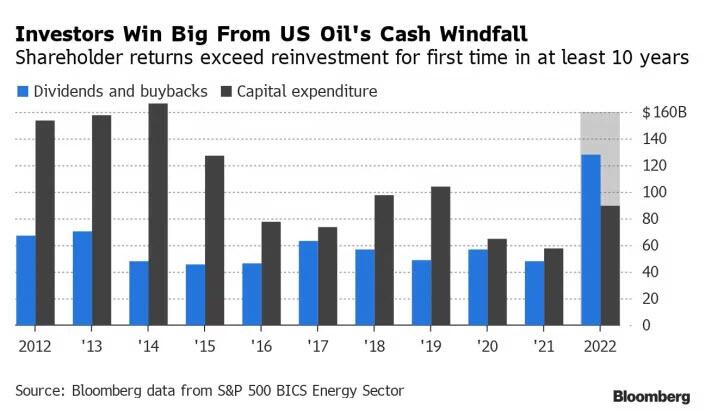
According to Bloomberg calculations, shareholders in US oil companies reaped a $128 billion windfall in 2022 thanks to a combination of global supply disruptions such as Russia’s war in Ukraine and intensifying Wall Street pressure to prioritize returns (dividends and buybacks) over finding untapped crude reserves. After all, why bother if progressives hope to put an end to evil internal combustion engines once and for all. Indeed, oil execs who in years past were rewarded for investing in gigantic, long-term energy projects are now under the gun to funnel cash to investors who are increasingly convinced that the sunset of the fossil-fuel era is nigh.

As a result for the first time in at least a decade, US drillers last year spent more on share buybacks and dividends than on capital projects, according to Bloomberg calculations.
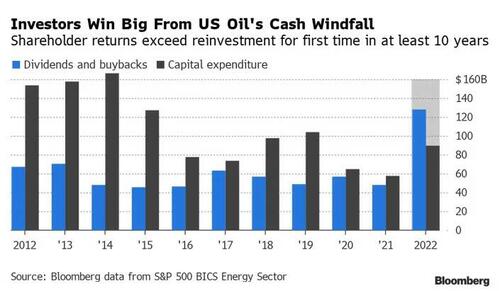
The $128 billion in combined payouts across 26 companies also is the most since at least 2012, and they happened in a year when US President Joe Biden unsuccessfully appealed to the industry to lift production and relieve surging fuel prices. Or, as Bloomberg puts it, “for Big Oil, rejecting Biden’s direct requests may never have been more profitable.

At the heart of the divergence is growing concern among investors that demand for fossil fuels will peak as soon as 2030, obviating the need for mutlibillion-dollar megaprojects that take decades to yield full returns. In other words, oil refineries and natural-gas fired power plants — along with the wells that feed them — risk becoming so-called stranded assets if and when they are displaced by electric cars and battery farms.

“The investment community is skeptical of what assets and energy prices will be,” John Arnold, the billionaire philanthropist and former commodities trader, said during a Bloomberg News interview in Houston. “They would rather have the money through buybacks and dividends to invest in other places. The companies have to respond to what the investment community is telling them to do otherwise they’re not going to be in charge very long.”

In other words, if BIden wants to rage at someone, he may as well target the anger at himself (who are kidding, we mean at those deep statists who set Biden’s agenda for him): if he hadn’t explicitly spelled out the end of the US energy industry, some may have been much more willing to invest in the future. The way it stands now, however… 

The upsurge in oil buybacks is helping drive a broader US corporate spending spree that saw share-repurchase announcements more than triple during the first month of 2023 to $132 billion, the highest ever to begin a year. Chevron alone accounted for more than half that total with a $75 billion, open-ended pledge. The White House lashed out and said that money would be better spent on expanding energy supplies; Biden’s toothless anger did not even prompt response. A 1% US tax on buybacks takes effect later this year.

Meanwhile, global investment in new oil and gas supplies already is expected to fall short of the minimum needed to keep up with demand by $140 billion this year, according to Evercore ISI, assuring much higher oil prices down the line. Meanwhile, crude supplies are seen growing at such an anemic pace that the margin between consumption and output will narrow to just 350,000 barrels a day next year from 630,000 in 2023, according to the US Energy Information Administration.

“The companies have to respond to what the investment community is telling them to do otherwise they’re not going to be in charge very long.” — Billionaire John Arnold said. Management teams from the biggest US oil companies recommitted to the investor-returns mantra as they unveiled fourth-quarter results in recent week and the 36% slump in domestic oil prices since mid-summer has only reinforced those convictions. Executives across the board now insist that funding dividends and buybacks takes priority over pumping additional crude to quell consumer discontent over higher pump prices. This may pose a problem in a matter of months as Chinese demand accelerates and global fuel consumption hits an all-time high.

“Five years ago, you would have seen very significant year-on-year oil-supply growth, but you’re not seeing that today,” Arnold said. “It’s one of the bull stories for oil — that the supply growth that had come out of the US has now stopped.”

The US is crucial to global crude supply not just because it’s the world’s biggest oil producer. Its shale resources can be tapped much more quickly than traditional reservoirs, meaning that the sector is uniquely placed to respond to price spikes. But with buybacks and dividends swallowing up more and more cash flow, shale is no longer the global oil system’s ace in the hole.

In the waning weeks of 2022, shale specialists reinvested just 35% of their cash flow in drilling and other endeavors aimed at boosting supplies, down from more than 100% in the 2011-2017 period, according to data compiled by Bloomberg. A similar trend is evident among the majors, with Exxon Mobil Corp. and Chevron aggressively ramping buybacks while restraining capital spending to less than pre-Covid levels.

Investors are driving this behavior, as evidenced by clear messages sent to domestic producers in the past two weeks. EOG Resources, ConocoPhillips and Devon Energy dropped after announcing higher-than-expected 2023 budgets while Diamondback Energy, Permian Resources and Civitas Resources all rose as they kept spending in check.

On top of shareholder demands for cash, oil explorers also are grappling with higher costs, lower well productivity and shrinking portfolios of top-notch drilling locations. Chevron and Pioneer Natural Resources are two high-profile producers reorganizing drilling plans after weaker-than-expected well results. Labor costs also are rising, according to Janette Marx, CEO of Airswift, one of the world’s biggest oil recruiters.

US oil production is expected to grow just 5% this year to 12.5 million barrels a day, according to the Energy Information Administration. Next year, the expansion is expected to slow to just 1.3%, the agency says. While the US is adding more supply than most of the rest of the world, it’s a marked contrast to the heady days of shale in the previous decade when the US was adding more than 1 million barrels of daily output each year, competing with OPEC and influencing global prices.

Demand, rather than supply-side actors like the American shale sector or OPEC, will be the primary driver of prices this year, Dan Yergin, vice chairman of S&P Global, told Bloomberg in an interview.

Oil prices will be determined by, metaphorically speaking, Jerome Powell and Xi Jinping,” Yergin said, referring to the Federal Reserve’s rate-hike path and China’s post-pandemic recovery. S&P Global expects global oil demand to reach an all-time high of 102 million barrels per day.

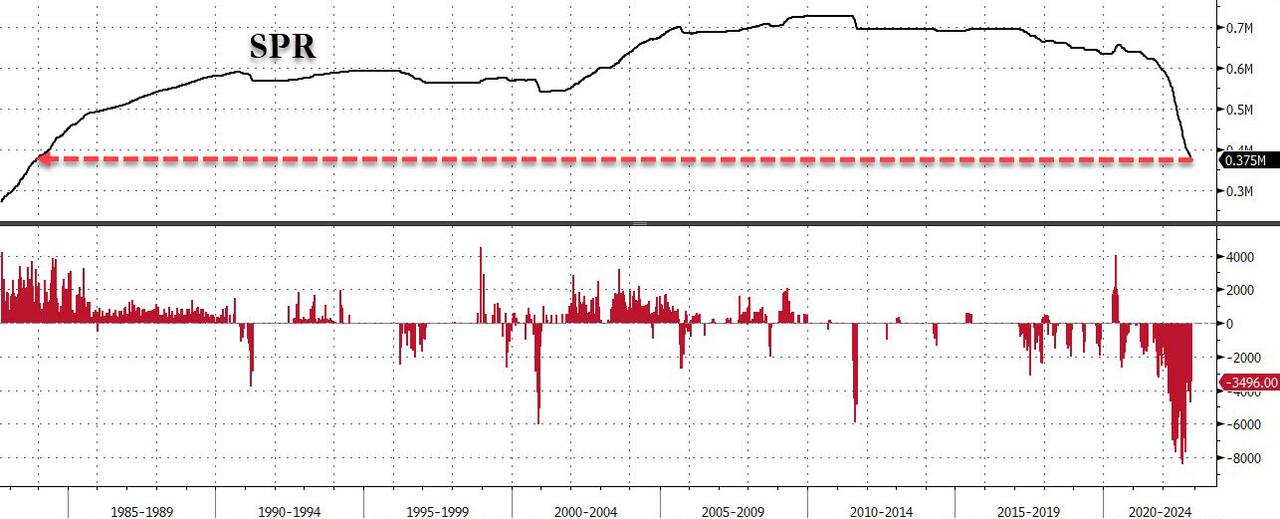
Meanwhile, with the case for higher oil prices building, US President Joe Biden has fewer tools at his disposal with which to counteract the blow to consumers. The president already has tapped the Strategic Petroleum Reserve to the tune of 180 million barrels in a bid to ease gasoline prices as they were spiking in 2022.
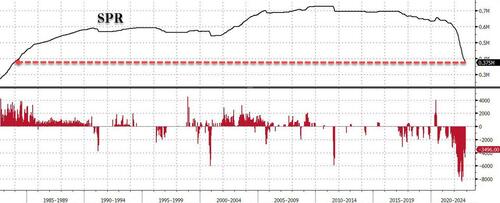
Energy Secretary Jennifer Granholm is likely to get a frosty reception at the CERAWeek by S&P Global event in Houston staring March 6 if she follows Biden’s lead and attacks the industry for giving too much back to investors. That business model is “here to stay,” said Dan Pickering, chief investment officer of Pickering Energy Partners.

“There’s going to be a point at which the US needs to produce more because the market is going to demand it,” Pickering said. “That’s probably when investor sentiment shifts to growth. Until then, returning capital seems like the best idea.”

Tyler Durden
Mon, 03/06/2023 – 04:15

via ZeroHedge News https://ift.tt/WD0ouHl Tyler Durden

The Real Threat Of 15-Minute Cities

The Real Threat Of 15-Minute Cities

Authored by John Mac Ghlionn via The Brownstone Institute,

Big Lies, Big Data, and the Rise of Bigger Brother

The Guardian’s Oliver Wainwright recently discussed a new “international socialist conspiracy” that has taken the world by storm. “Fringe forces of the far left,” he noted, “are plotting to take away our freedom to be stuck in traffic jams, to crawl along clogged ring roads and trawl the streets in search of a parking spot.” The name of this “chilling global movement?” he asked, sarcastically and somewhat contemptuously: The “15-minute city.”

Wainwright believes these cities are simply part of a “mundane planning theory.”

He’s wrong.

A few days after Wainwright’s piece was published, three academics called 15-minute cities (FMCs) “the hottest conspiracy theory of 2023.” In a truly elitist manner, they poked fun at those who dared to question the motive behind FMCs.

One needn’t be a card-carrying QAnon member to have fears over these Trojan-like creations. Before going any further, it’s important to get our definitions in order. As the political scientist Kelly M. Greenhill has noted, not all conspiracy theories are wacky, and not all conspiracy theories are wrong. Take the Watergate conspiracy theory, for instance, or the fact that Edith Wilson made most of the executive decisions after her husband, President Woodrow Wilson, suffered a stroke. Quite often conspiracy theories turn out to be accurate.

Also known as smart cities, FMCs are places where everything imaginable, from your place of work to your favorite pizzeria, is accessible either by foot or bike (not by car, though; they will be verboten) in 15 minutes or less. What’s so bad about this?

On first inspection, very little.

We are, after all, creatures of comfort. We live in a world where the mantra “Too Long, Didn’t Read (TL;DR)” now reigns supreme. We crave convenience; we crave expediency.

However, expediency isn’t always a good thing; sometimes it’s downright dangerous.

This is especially true when people, either consciously or otherwise, trade their freedom for ease of access to certain services.

FMCs may make it easier for citizens to get from A to B, but these creations will also make it easier for those in power to spy on us, to harvest our data, and enable Big Brother to become Bigger Brother.

As I write this, FMCs are being actively championed by the World Economic Forum (WEF), the group behind the “Great Reset” and the idea of owning nothing, having absolutely no privacy, and being very happy. This fact alone should concern all readers.

Want to discuss the WEF?

To many, I’m sure FMCs sound incredibly cool. But don’t be fooled by the name. FMCs are actually “smart cities.” As I have noted elsewhere, the word “smart” is really just a synonym for surveillance. These ultra-modern, tech-saturated monstrosities use hundreds of thousands of sensors to vacuum up copious amounts of personal data.

FMC policies are currently being rolled out in cities such as Barcelona, Bogotá, MelbourneParis, and the dystopian wasteland known as Portland. What do these cities have in common? Surveillance technology. Between now and 2040, cities right across the United States (and beyond) are predicted to spend trillions of dollars on the installation of additional cameras and biometric sensors. Sure, surveillance is bad now. But, as Randy Bachman famously hollered, you ain’t seen nothing yet.

By 2050, more than two-thirds of the world’s population will live in closely surveilled urban centers, like glorified rats in cramped cages. Contrary to popular belief, we no longer live in a panoptic society. When Jeremy Bentham, the English philosopher and social theorist, put forward the idea of this prison system, there was no internet. In truth, there weren’t even cars. We now live in a post-panoptic world—a digital panopticon, if you will—with huge social media platforms collecting personal user data before selling it to the highest bidder.

The companies running these platforms often work closely with government officials, identifying supposed sinners and punishing them in the swiftest of manners. As the writer Kylie Lynch has noted, these companies know absolutely everything about you; they have instant access to your browser history, your activity online, and now, rather worryingly, even your biometrics. Not surprisingly, these Big Tech companies will have a big impact on the FMCs of the future, by providing the underlying digital infrastructure needed to monitor us and ensure mass compliance.

FMC are wolves in sheep’s clothing. Don’t believe the countless stories telling you otherwise. It has become common for elitist, mainstream outlets to poke fun at those who dare to question the “we have your best interests at heart” narratives. We have been burned too many times before.

*  *  *

Republished from Epoch

Tyler Durden
Mon, 03/06/2023 – 03:30

via ZeroHedge News https://ift.tt/ds3io2r Tyler Durden

Which Countries Are Buying Russian Fossil Fuels?

Which Countries Are Buying Russian Fossil Fuels?

A year on from Russia’s initial invasion of Ukraine, Russian fossil fuel exports are still flowing to various nations around the world.

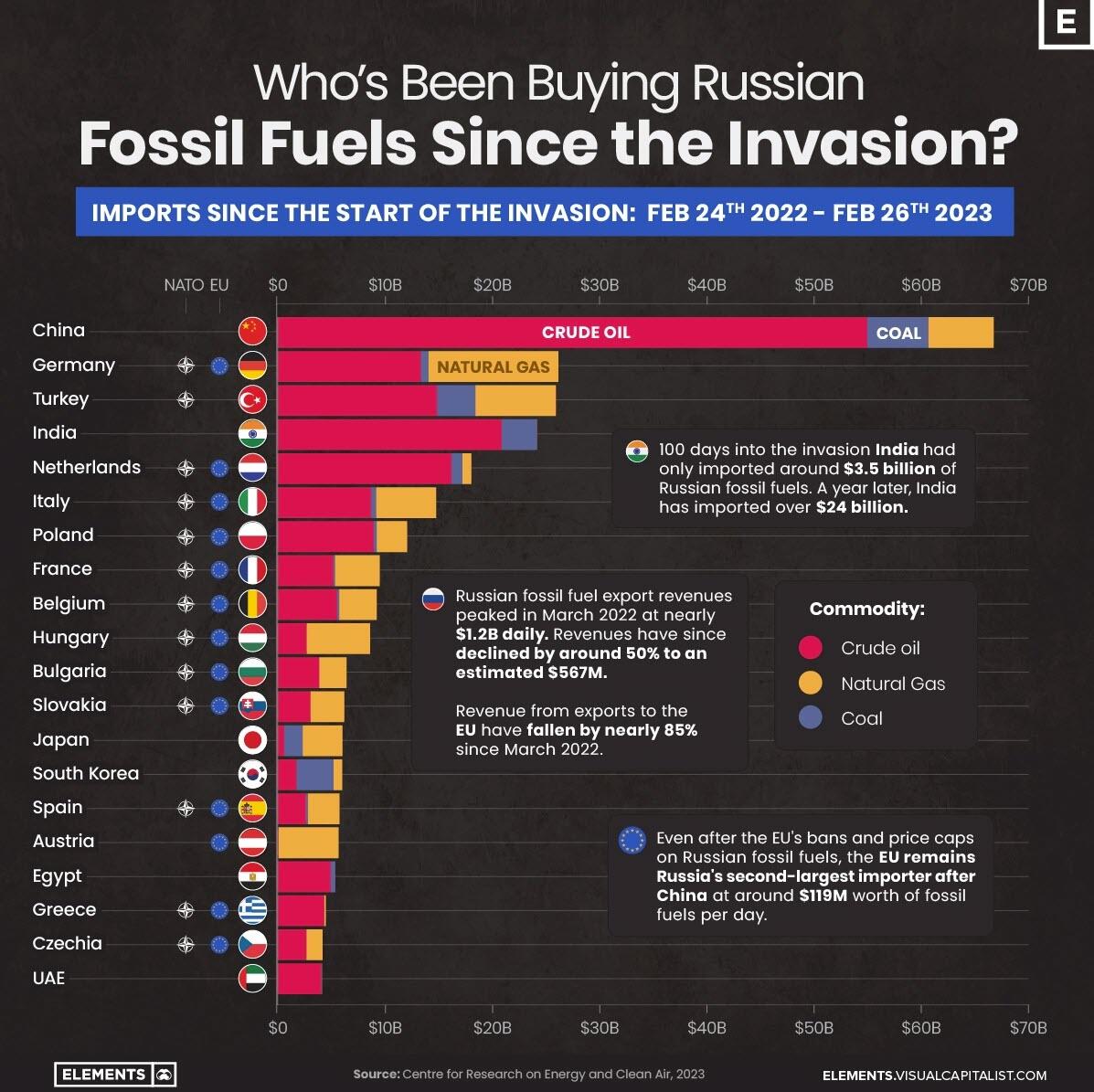
As Visual Capitalist’s Niccolo Conte details below, according to estimates from the Centre for Research on Energy and Clean Air (CREA), since the invasion started about a year ago, Russia has made more than $315 billion in revenue from fossil fuel exports around the world, with nearly half ($149 billion) coming from EU nations.

This graphic uses data from the CREA to visualize the countries that have bought the most Russian fossil fuels since the invasion, showcasing the billions in revenue Russia has made from these exports.

Top Importers of Russian Fossil Fuels

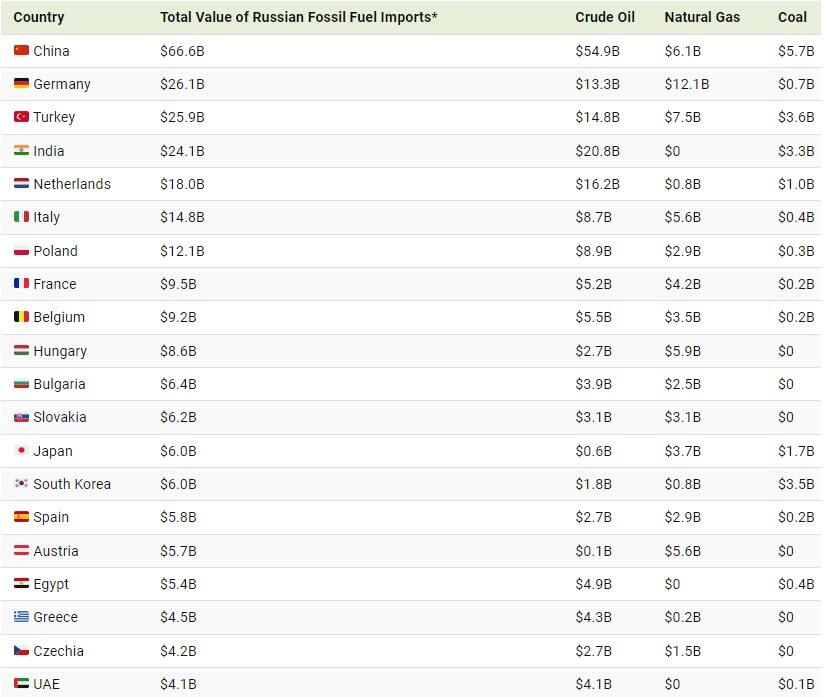
As one might expect, China has been the top buyer of Russian fossil fuels since the start of the invasion. Russia’s neighbor and informal ally has primarily imported crude oil, which has made up more than 80% of its imports totaling more than $55 billion since the start of the invasion.

The EU’s largest economy, Germany, is the second-largest importer of Russian fossil fuels, largely due to its natural gas imports worth more than $12 billion alone.

*Over the time period of Feb 24, 2022 to Feb 26, 2023 in U.S. dollars

Turkey, a member of NATO but not of the EU, closely follows Germany as the third-largest importer of Russian fossil fuels since the invasion. The country is likely to overtake Germany soon, as not being part of the EU means it isn’t affected by the bloc’s Russian import bans put in place over the last year.

Although more than half of the top 20 fossil fuel importing nations are from the EU, nations from the bloc and the rest of Europe have been curtailing their imports as bans and price caps on Russian coal imports, crude oil seaborne shipments, and petroleum product imports have come into effect.

Russia’s Declining Fossil Fuel Revenues

The EU’s bans and price caps have resulted in a decline of daily fossil fuel revenues from the bloc of nearly 85%, falling from their March 2022 peak of $774 million per day to $119 million as of February 22nd, 2023.

Although India has stepped up its fossil fuel imports in the meantime, from $3 million daily on the day of the invasion to $81 million per day as of February 22nd of this year, this increase doesn’t come close to making up the $655 million hole left by EU nations’ reduction in imports.

Similarly, even if African nations have doubled their Russian fuel imports since December of last year, Russian seaborne oil product exports have still declined by 21% overall since January according to S&P Global.

Other Factors Impacting Revenues

Overall, from their peak on March 24th of around $1.17 billion in daily revenue, Russian fossil fuel revenues have declined by more than 50% to just $560 million daily.

Along with the EU’s reductions in purchases, a key contributing factor has been the decline in Russian crude oil’s price, which has also declined by nearly 50% since the invasion, from $99 a barrel to $50 a barrel today.

Whether these declines will continue is yet to be determined. That said, the EU’s 10th set of sanctions, announced on February 25th, ban the import of bitumen, related materials like asphalt, synthetic rubbers, and carbon blacks and are estimated to reduce overall Russian export revenues by almost $1.4 billion.

Tyler Durden
Mon, 03/06/2023 – 02:45

via ZeroHedge News https://ift.tt/2fz0hWd Tyler Durden

The Skripal Case 5 Years On: BS Then, BS Now

The Skripal Case 5 Years On: BS Then, BS Now

Authored by Kit Knightly via Off-Guardian.org,

Today marks five years – five long years – since the “attack” on Sergei Skripal in Salisbury, England.

For those of you who may have had the details become obscure in three years of Covid fog, here is the “official story”:

  • Sergei Skripal, a Russian military intelligence officer, was found guilty of spying for the UK in 2006, and sentenced to 13 years in prison.

  • In 2010 he was released and traded to the United Kingdom as part of a spy swap. Having settled in the UK Sergei lived a quiet and comfortable life of retirement, allegedly.

  • Eight years later, in early 2018, with a Presidential election looming and just weeks before Russia was due to host the FIFA World Cup, Vladimir Putin decided to assassinate him for as yet obscure reasons.

  • The GRU, Russia’s military intelligence unit, dispatched two of their elite covert operatives, who proceeded to fly direct from Moscow under aliases they had allegedly already employed and using Russian passports.

  • These alleged assassins carried with them two perfume bottles full of “Novichok”, allegedly one of the deadliest nerve agents ever devised. This would be enough to kill around 800,000 people.

  • On arriving in the UK these highly-trained covert agents book a hotel with a CCTV camera on the front door, and the next day, March 3, they travel to Salisbury by train, allegedly to recon the area, then return to London. They are apparently observed by CCTV camera’s the entire time.

  • The following day, March 4, they again travel to Salisbury, this time the master assassins walk to Skripal’s house and somehow “smear” the liquid Novichok on the handle of his front door.

  • No eye-witness, photograph or piece of CCTV footage has ever been made publicly available to show either of these two men anywhere in the area of Sergei Skripal’s house.

  • The whereabouts of the opened bottle of poison have never been established.

  • Having applied the poison, the two highly trained assassins do two things before returning to London. 1) They drop their second, unopened, bottle of novichok (presumably enough to kill approx 400,000 people) in a charity donation bin, rather than destroying it or taking it back to Russia. 2) They stop by an antiques store to browse.

  • The two assassins leave the country that afternoon, flying direct to Moscow, without knowing if their alleged target is dead, and again making no effort to conceal their origins.

  • Despite both handling the poison, and somehow carrying enough of it back to contaminate their hotel room, neither of the men – nor any of the staff, train passengers or passersby who come into contact with them – ever become sick, even though only 1mg of Novichok is an allegedly lethal dose.

  • Later that afternoon, Sergei and Yulia Skripal are found “almost unconscious”on a park bench in Salisbury town centre. It is claimed this was due to contact with the Novichok smeared on Sergei’s door handle, though reports originally stated neither he nor his daughter had returned to the house, and the timing seems to make it unlikely they did

  • The person who found them was the most senior nurse in the British Army (likely in the area as part of Toxic Dagger, the British Military’s landmark chemical weapons training exercise which began Feb 20th and ran on until March 12th).

  • The nurse and her family administer “emergency aid” to the two alleged poisoning victims. Neither she nor anyone else on the scene, nor any of the first responders, ever experience any symptoms of nerve agent poisoning. Neither do any of the other people the Skripal’s came into contact with that day.

  • DS Nick Bailey, a CID officer is in contact with the Skripals or their home at this time and subsequently becomes ill. It has never been stated how exactly he was exposed. It was initially reported he was a first responder to the scene, but that story was changed and it was later claimed he visited the Skripal hpouse. Despite the alleged lethality of novichok in even very minute doses, Bailey is fit to return home after 18 days.

  • Porton Down, the British government’s chemical weapons research centre, is brought in to help identify what chemical – if any – the Skripals/Bailey were exposed to.

  • Within a month they release a statement claiming the poison was “a novichok like agent”, but that they could not pinpoint its origin. How they were able to test for a (at the time) theoretical chemical without having a sample to test against, has never been explained.

  • Porton Down is 8 minutes away from Salisbury by car.

  • Nearly four months later, in late June of 2018, Charlie Rowley finds the unopened perfume bottle a full of novichok (whether he bought it from a charity shop or found it in a bin is unclear, both stories have been reported). Upon using the perfume Rowley’s partner, Dawn Sturgess, falls ill. Later that day Rowley also falls ill. Sturgess dies in hospital two weeks later. But Rowley survives. Making him the fourth person in this narrative to survive exposure to an agent lethal in doses as small as 1mg.

  • Sergei Skripal and Julia both recovered and allegedly chose to live secluded lives. Sergei has not appeared in public at all since allegedly being found on that park bench. Yulia made one brief press statement. Their current whereabouts are totally unknown. Their family in Russia have apparently been denied all access to them. DS Bailey was initially also keen to maintain his privacy but has subsequently given at least one interview some while after the event.

This is the UK government’s “official version” of what happened.

Unvarnished and unsatirised. None of it is disputed, exaggerated or speculative.

It is the perfect example of a modern propaganda narrative. Convoluted, contradictory, and physically impossible.

It twines together familiar cliches.

The disputed and ever-evolving timeline, the timely bystander who happens to be a military officer, and the luckily timed “exercise” just prior.

These are all items on the “false flag” checklist since at least 9/11, if not before.

There are further details that render the story a true farce, and an obvious psy-op.

Reports that Skripal’s house was purchased for him by MI6 mean the idea there wasn’t constant surveillance of it absurd. If the “assassins” ever went to that house, there would be film of it.

The UK government issued censorship orders (“D notices”) for any mention of Pablo Miller, an MI6 agent, Skripal’s handler and neighbor.

Early reports that the Skripals were suffering from a fentanyl overdose were redacted after the fact.

In the years since the Skripal “attack” rolled out “Novichok” has been allegedly used again, this time on Alexei Navalny.

He didn’t die either. Completing the chemical’s transformation from an entirely hypothetical nerve agent, through the “deadliest neurotoxin” ever invented, to a “poison” that never, ever works.

Interestingly, the “novichok” poisoning actually foreshadowed Covid in a few weird ways.

There is the agent that is oddly efficiently identified by a lab, despite having no reference with which to identify it.

There is the chemical that we are told is SUPER DANGEROUS, and requires MAXIMUM PROTECTION…and yet people on the ground mill about without protecting themselves, and the deaths and illnesses never stack up with predictions.

There’s the well-timed exercise preceding the attack by only a few days.

There is the corporate media and pundits repeating buzz phrases like a hypnotist working a trick, or some religious mantra. Repeat after me, “there is no plausible alternative explanation”

But more interesting than that, is what comes next.

After all, now that Russia has shown they are willing to play along with globalist narratives, it may be time to “resolve” the Skripal issue.

Don’t be surprised if “new evidence” is leaked – by either side or both – in the near future. Or some agreement is made, or Sergei comes out of hiding.

Whatever happens, or whatever “new facts come to light”, it won’t ever be definitive of course. That’s important. It will just be kindling to keep the partisan fires burning.

Or, hell, maybe Russia will cop to it as part of some deal. Who knows anymore?

The Skripal “poisoning” was obviously bullshit when it happened, it is obviously bullshit now, and anything they choose to add will almost certainly be just more bullshit.

*  *  *

Off-Guardian has covered the Skripal Case in detail over the years, you can read those archives here. We also recommend Rob Slane’s work over at the blogmire, and Tim Norman’s piece published on Propaganda in Focus.

Tyler Durden
Mon, 03/06/2023 – 02:00

via ZeroHedge News https://ift.tt/DeXhy7Q Tyler Durden

The Great ‘Trifurcation’

The Great ‘Trifurcation’

Authored by Andrew Korybko via The Automatic Earth blog,

Tri-Multipolarity

The global systemic transition’s impending evolution towards tri-multipolarity could see the US-led West’s Golden Billion, the Sino-Russo Entente, and the de facto Indian-led Global South becoming the most prominent poles in International Relations, below which would be rising powers and regional groups. All actors would balance one another by multi-aligning within and between their respective levels, which might result in stabilizing global affairs much more than the prior unipolar and bi-multipolar orders did.

International Relations are hurtling towards tripolarity at an astounding pace as a result of the dramatic events that unfolded over the past year and especially the last month. Those readers who haven’t closely been following this megatrend might be taken aback by this assessment, hence the need for them to review the following analyses that’ll place everything into its appropriate context. After listing them, they’ll then be summarized for convenience before explaining what might soon come next:

The “New Détente”

To oversimplify the confluence of these complex trends, the US prioritized containing Russia in order to facilitate its containment of China, ergo the latest phase of the Ukrainian Conflict that it provoked via Moscow’s ongoing special operation there. Throughout the course of the NATO-Russian proxy war that followed, the US successfully reasserted its unipolar hegemony over the EU while destabilizing the globalized system upon which China’s grand strategy depends, thus giving it an edge over Beijing.

This in turn prompted President Xi to initiate an attempted “New Détente” during mid-November’s G20 Summit in Bali, during which time he hoped that China and the US could eventually reach a series of mutual compromises aimed at establishing a “new normal” in their ties. The purpose behind doing so was to delay the end of the bi-multipolar world order within which these two superpowers exerted the most influence over International Relations, which was challenged by India’s rise over the past year.

India’s Game-Changing Influence

That South Asian state became a globally significant Great Power during this time as a result of its masterful balancing act between the US-led West’s Golden Billion and the jointly BRICS– & SCO-led Global South of which it’s a part. Its kingmaker role in the New Cold War between them over the direction of the global systemic transition enabled the rest of the Global South to rise in India’s wake, thus revolutionizing International Relations by accelerating the emergence of tri-multipolarity.

The aforementioned sequence of events imbued the Sino-American “New Détente” with a sense of urgency since both superpowers had self-interested reasons for regaining joint control of these processes, though their attempted rapprochement was unexpectedly derailed by the balloon incident. The resultantly renewed influence of hardline factions over policymaking that occurred in the aftermath of that incident abruptly ended their incipient talks and placed them on the trajectory of intense rivalry.

China’s Grand Strategic Recalculations

In parallel with the abovementioned development, NATO declared that it’s in a so-called “race of logistics”/“war of attrition” with Russia, which implied that it’ll redouble its military support to Kiev even at the expense of meeting its own members’ minimum national security needs. Should that bloc succeed in making a breakthrough along the Line of Control (LOC), then it could catalyze the worst-case scenario of Russia’s “Balkanization” if those disadvantageous military-strategic dynamics spiral out of control.

Both President Putin and his predecessor Medvedev recently warned about that possibility, which remains unlikely for now but still can’t be discounted, thus contributing to China’s gradual recalibration of its approach to the NATO-Russian proxy war when coupled with the end of the “New Détente”. This directly led to the People’s Republic seriously considering the dispatch of lethal aid to its strategic partner in order to offset that worst-case scenario, thus prompting sanctions threats from the West.

“The Great Trifurcation”

In the event that China feels forced by NATO to aid Russia in such a way and the Golden Billion imposes sanctions against it in response, then it’s expected that a US-initiated Chinese-European “decoupling” along the lines of the prior US-initiated Russian-European one could potentially follow. Reuters’ exclusive report on Wednesday citing four unnamed US officials and other sources extended credence to the preceding scenario by revealing that the Golden Billion is indeed discussing multilateral sanctions.

Should those two developments take place – China arming Russia and then being sanctioned by the Golden Billion in a way that provokes their “decoupling” (whether gradual or instantaneous) – then International Relations would enter a period of tri-multipolarity characterized by the prominence of three poles that exert the most influence over global affairs, but whose influence nevertheless wouldn’t be absolute since it’ll be kept in check to an extent by rising powers and regional groups.

The Tri-Multipolar World Order

The three expected poles are the US-led West’s Golden Billion, the Sino-Russo Entente, and the de facto Indian-led Global South that’ll likely continue informally assembling into a new Non-Aligned Movement (“Neo-NAM”). Within the last-mentioned will reside rising powers like BrazilIranSouth Africa, and Turkiye, among others, alongside regional groups like the African Union (AU), ASEAN, and the Community of Latin American and Caribbean States (CELAC).

Each of these three categories of actors – the three poles as well as the rising powers and regional groups that sit below the former in this informal international hierarchy – are expected to balance one another by multi-aligning within and between their respective levels. India’s role will be the most important of them all since it’s poised to facilitate trade between the Golden Billion and the Sino-Russo Entente in the event that their potential “decoupling” is taken to an extreme, which can’t be ruled out.

India’s Kingmaker Role

Furthermore, India’s earlier virtual hosting of the Voice Of Global South Summit positioned this civilization-state as the center of gravity for its fellow developing peers, which bolsters the likelihood that the Neo-NAM will continue informally assembling around it. From there, India can promote its own financial, technological, and other platforms in order to provide Global South states with a neutral third choice between the Golden Billion and the Sino-Russo Entente’s respective ones in the New Cold War.

Those rising powers and regional groups that participate within the unofficially Indian-led Neo-NAM could also develop their own platforms too, but India’s might become the standard for facilitating engagement between them at their early stages. In parallel, global fora like the UN and G20 will no longer have much significance other than functioning as talking clubs, while interests-driven and regional groups will replace their prior role in promoting tangible cooperation between countries.

Concluding Thoughts

The global systemic transition’s impending evolution towards tri-multipolarity could see the US-led West’s Golden Billion, the Sino-Russo Entente, and the de facto Indian-led Global South becoming the most prominent poles in International Relations, below which would be rising powers and regional groups. All actors would balance one another by multi-aligning within and between their respective levels, which might result in stabilizing global affairs much more than the prior unipolar and bi-multipolar orders did.

*  *  *

Background Briefings

* 7 October 2021: “Towards Bi-Multipolarity

* 16 December 2021: “The Neo-NAM: From Vision To Reality

* 15 March 2022: “Why Did The U.S. Prioritize Containing Russia Over China?

* 26 March 2022: “Russia Is Waging an Existential Struggle in Defense of Its Independence & Sovereignty

* 22 May 2022: “Russia, Iran, And India Are Creating A Third Pole Of Influence In International Relations

* 6 June 2022: “India Is The Irreplaceable Balancing Force In The Global Systemic Transition

* 20 June 2022: “Towards Dual-Tripolarity: An Indian Grand Strategy For The Age Of Complexity

* 5 August 2022: “The Russian Foreign Ministry Comprehensively Explained The Global Systemic Transition

*  1 October 2022: “The Ukrainian Conflict Might Have Already Derailed China’s Superpower Trajectory

* 29 October 2022: “The Importance Of Properly Framing The New Cold War

* 19 November 2022: “Analyzing The US-Chinese-Russian-Indian Interplay In The Global Systemic Transition

* 29 November 2022: “The Evolution Of Key Players’ Perceptions Across The Course Of The Ukrainian Conflict

* 14 December 2022: “India’s Principled Neutrality Reaps Grand Strategic Dividends

* 28 December 2022: “The Five Ways That The US Successfully Reasserted Its Hegemony Over Europe In 2022

* 1 January 2023: “The New York Times Tried To Throw Shade On India’s Global Rise

* 7 January 2023: “India’s Global South Summit Is The Most Important Multilateral Event In Decades

* 11 January 2023: “Exposing Western Media’s Narrative Agenda In Spinning The Sino-American New Détente

* 4 February 2023: “The Chinese Balloon Incident Could Decisively Shift China’s & The US’ ‘Deep State’ Dynamics

* 14 February 2023: “NATO’s Self-Declared ‘Race Of Logistics’ Confirms The Bloc’s Military-Industrial Crisis

* 26 February 2023: “China Compellingly Appears To Be Recalibrating Its Approach To The NATO-Russian Proxy War

* 28 February 2023: “Just How Drastically Would The World Change If China Armed Russia?

* 1 March 2023: “Global Fora Like The UN & G20 Are Gradually Losing Their Importance

* 1 March 2023: “Germany Is Lying: Chinese Arms Shipments To Russia Wouldn’t Violate International Law

*  *  *

Support the Automatic Earth with Patreon

Tyler Durden
Sun, 03/05/2023 – 23:30

via ZeroHedge News https://ift.tt/42tHr6E Tyler Durden

Deporting Fentanyl Dealers Violates Sanctuary City Policies, Says SF Supervisor

Deporting Fentanyl Dealers Violates Sanctuary City Policies, Says SF Supervisor

Authored by Brad Jones via The Epoch Times (emphasis ours),

San Francisco County Supervisor Shamann Walton told San Franciscans this week the U.S. shouldn’t deport illegal immigrant drug dealers for selling fentanyl, the deadly synthetic opioid that was largely responsible for nearly 2,000 drug overdose deaths in the city since 2020.

“There’s been a drug issue in this country for a very long time. But there’s no way we’re going to stand by and allow people to say that one race or immigrants are responsible for these fentanyl deaths,” Walton said at a rally on the steps of City Hall on Feb. 28.

San Francisco County Supervisor Shamann Walton speaks at a rally at city hall in San Francisco on Feb. 28. (Video screenshot courtesy of JJ Smith)

Walton defended the city’s sanctuary policies that prohibit city authorities from assisting U.S. Immigration and Customs Enforcement (ICE) in response to a proposal by Supervisor Matt Dorsey to add fentanyl crimes to a list of violent crimes the city uses for cooperating with ICE. Dorsey’s proposal aligns with a recent push for a crackdown on fentanyl dealers initiated by District Attorney Brooke Jenkins.

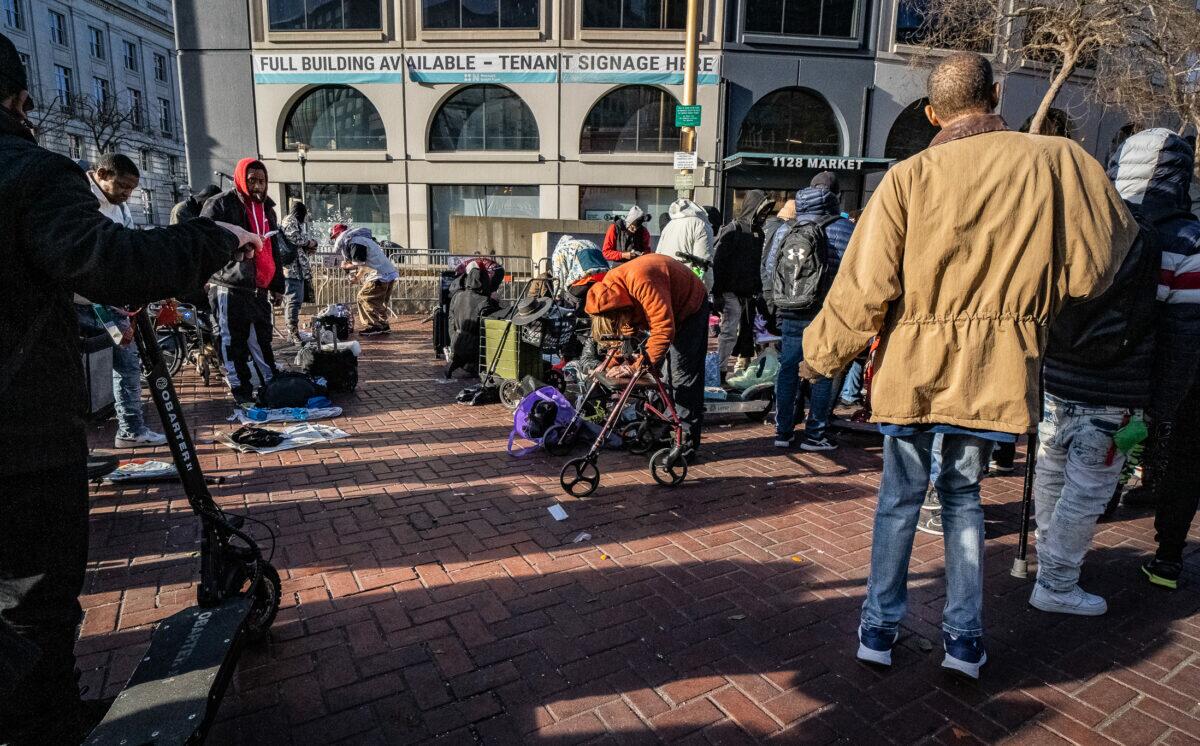
Homeless people gather near drug dealers in the Tenderloin District of San Francisco, Calif., on Feb. 22, 2023. (John Fredricks/The Epoch Times)

You cannot violate sanctuary policy for any reason. It goes against the morals of our fabric here in San Francisco, and it also allows people who don’t share our values to persecute people that need us the most,” Walton said at the rally. “People are going crazy over fentanyl because we’re starting to see more white people die from this drug. Where the hell were these people when my mothers and my grandmothers were on crack?”

J.J. Smith lives in the city’s infamous Tenderloin district, a hotspot for drug use, and he lost his brother to a fentanyl overdose in October. He told The Epoch Times on March 2 that Walton’s remarks came as “a shock” and “didn’t set well with a lot of people, even the black community.”

Smith said it’s no secret that drug dealers with connections to Honduras largely control the illicit fentanyl trade in the Tenderloin, which is not directly affecting Walton’s district.

Honduran dealers “are the only people in San Francisco that have large quantities of fentanyl,” he claimed. “We should care because it’s killing everybody, not only white people. And, even if it does kill only white people, who is to say that’s fair?”

Smith questioned the logic behind lesser punishments for fentanyl dealers when crack dealers in the 1980s and 1990s, including African Americans, were handed long prison sentences for their crimes.

“But now Walton is speaking about a deadly drug that’s killing more people than any drug that’s ever been on the market,” he said.

A homeless man sits passed out next to an empty syringe in San Francisco, Calif., on Feb. 23, 2023. (John Fredricks/The Epoch Times)

Jacqui Berlinn, co-founder of Mothers Against Drug Addiction and Deaths, told The Epoch Times she was offended by Walton’s comments.

Berlinn said she was a child during the crack cocaine epidemic of the 1980s, but that she is now fighting for her son Corey, who is addicted to fentanyl, and “for all citizens of all races” affected by the “poison flooding our cities.”

“We have members fighting with us who are black,” she told The Epoch Times in a text message. “Fentanyl is killing U.S. citizens of all races—disproportionately persons of color. It’s also poisoning U.S. children that had no idea what they were getting. There has never been a drug market so deadly as the one we are experiencing now.”

San Francisco was among the first 12 U.S. cities to declared itself a sanctuary city, prohibiting local police from stopping or arresting people based on their immigration status.

Walton was speaking at a noon rally in support of Supervisor Hillary Ronen’s proposed resolution denouncing criticism of sanctuary city policies at City Hall ahead of the Feb. 28 Board of Supervisors meeting. Supervisors Myrna Melgar and Dean Preston also attended the rally.

After nearly two hours of public comments, the board voted unanimously to continue debate on the issue at its next meeting on March 7.

San Francisco Public Defender Mano Raju said at the rally that city police unfairly target black and brown dealers and that the “war on drugs” was designed to target black and brown people for arrest and incarceration, while white dealers are rarely arrested.

“We also know that Latin X community members who are targeted are young and often survivors of labor, trafficking, and exploitation. Using our local resources to funnel these individuals to ICE detention facilities will subject them to horrific conditions that can lead to a death sentence for deportation,” he said. “And, all this cruelty is going to do nothing to stem the overdoses.”

Dorsey did not respond to requests for comment.

Tyler Durden
Sun, 03/05/2023 – 23:00

via ZeroHedge News https://ift.tt/7B0zG86 Tyler Durden

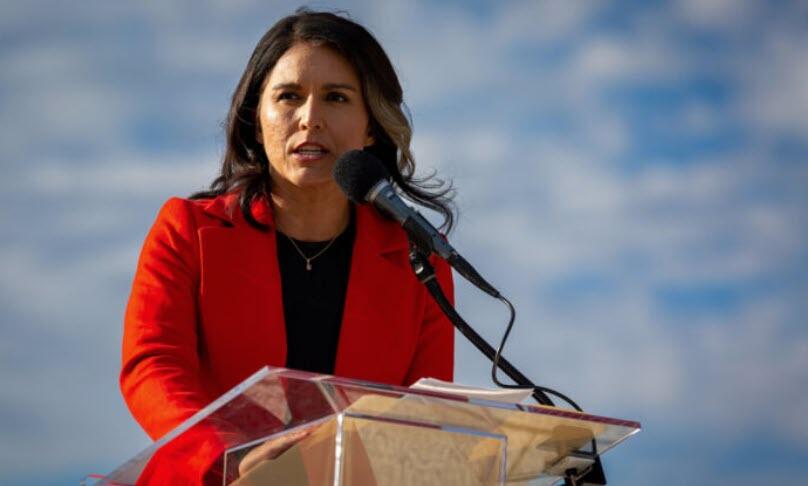
Tulsi Gabbard: Democrats Are The Party Of Division, Authoritarianism, & War

Tulsi Gabbard: Democrats Are The Party Of Division, Authoritarianism, & War

Authored by Liam Cosgrove via The Epoch Times,

Democrats are funding a dangerous war in Ukraine, stifling ideological dissent, and polarizing this country.

That was the message from former Democratic presidential candidate Tulsi Gabbard, speaking on the final day of CPAC.

The former congresswoman took shots at radical gender ideology and accused President Joe Biden of stoking racial tensions by embracing identity politics.

She accused Biden of “fanning the flames of divisiveness.”

“They reduce each of us to the color of our skin,” Gabbard said in her speech, saying the Democrats “have become the racists they claim to hate.”

Gabbard, now a registered independent, denounced her former political party for its reckless armament of Ukraine and warned that the policy of providing lethal aid is bringing the United States to the “brink of nuclear war.”

“They’ve sent now over $100 billion to fuel this proxy war,” she said.

On Friday, Secretary of State Anthony Blinken promised an additional $400 million in weaponry and utility gear to Ukraine, with tensions rising as Ukrainian President Zelenskyy has vowed to use Western arms to retake Russian-occupied Crimea.

Gabbard, a combat veteran who served two tours of duty in Iraq, has long espoused a message of ending “regime change wars” and advocating for a more restrained foreign policy. Many within the Republican Party align with Gabbard’s anti-war sentiments.

After watching Gabbard’s speech, Rep. Matt Gaetz (R-Fla.) told The Epoch Times that he supports her advocacy to end U.S. financial support for the Ukrainian military.

The congressman talked about working closely with Gabbard in the House Armed Services Committee and butting heads with the pro-war “so-called national security experts,” as he called them.

“I think we need a focused foreign policy based in realism, not fantastical dreams of turning countries like Syria into Jeffersonian democracies,” he said.

“I want a strong, well-funded, highly capable military that we rarely use.”

On the topic of gender, Gabbard called out progressives for rejecting “the fact that there is such a thing as a woman.”

“All the ladies can attest here that we are in fact real,” she said, adding that Democrats are confusing fiction with reality.

“Truth becomes whatever those in power say it is at any given time.”

After dropping out of the presidential race, Gabbard declined to seek reelection to Congress and has since focused on activism and public speaking.

Her political future remains uncertain, but Gabbard’s unique blend of progressive and non-interventionist views continues to make her a fascinating figure in American politics.

Tyler Durden
Sun, 03/05/2023 – 22:30

via ZeroHedge News https://ift.tt/8e6dsxt Tyler Durden

Bump Stocks Return To Store Shelves In These Three States

Bump Stocks Return To Store Shelves In These Three States

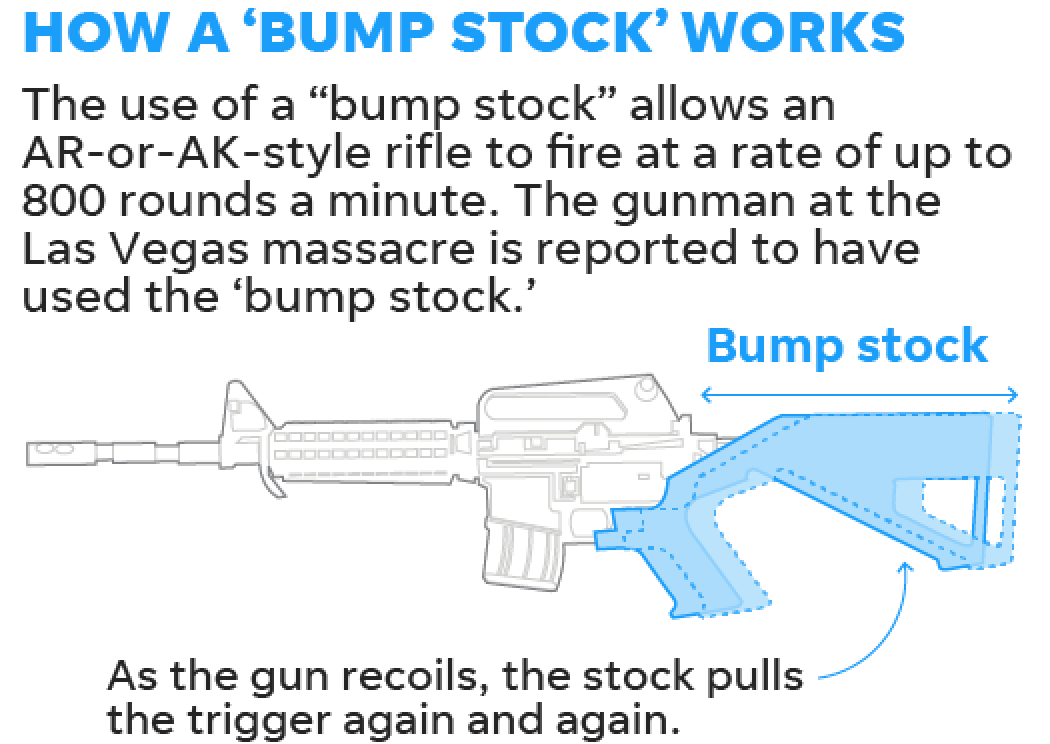
Following the Fifth Circuit Court of Appeals’ decision to invalidate the Bureau of Alcohol, Tobacco, Firearms and Explosives’ administrative ban on bump stocks, the Department of Justice was given until last Monday to challenge the ruling before the Supreme Court. However, since the DOJ did not take any action, the Fifth Circuit’s order became effective, which allowed three states, Texas, Louisiana, and Mississippi, to begin selling bump stocks once again. 

Michael Cargill, the owner of Austin’s Central Texas Gun Works, sued to challenge the ban in 2019 with New Civil Liberties Alliance, a litigation group that says it protects constitutional freedoms, including Second Amendment rights. 

They lost in federal court in Austin, and before a three-judge panel of the 5th Circuit, one of the country’s most conservative courts. 

Victory came after another hearing, this time before the full 5th Circuit. —The Dallas Morning News

The DOJ had until Monday to appeal the decision to the Supreme Court but let the deadline pass.

“Bump Stocks are now legal in TEXAS, LOUISIANA & MISSISSIPPI,” Cargill tweeted last week.

Cargill said his store plans to sell bump stocks soon. He said the retail price would be around $249, about 15% higher than pre-ban prices, primarily due to higher commodity, labor, and transportation costs. 

The ATF can still enforce the bump stock ban outside Texas, Louisiana, and Mississippi. 

“Essentially, the ATF is prevented from enforcing the rule for the time being in these three states,” South Texas College of Law professor Dru Stevenson said. 

As to why the DOJ didn’t ask the Supreme Court to consider the issue… Keeping the case in the Fifth Circuit’s jurisdiction would prevent the Supreme Court from agreeing with Cargill and overturning the ban nationwide. 

Tyler Durden
Sun, 03/05/2023 – 22:00

via ZeroHedge News https://ift.tt/aXMYENx Tyler Durden

Capitol Police, FBI Failed To Share “Credible Threats” Before Jan. 6 Breach: Watchdog

Capitol Police, FBI Failed To Share “Credible Threats” Before Jan. 6 Breach: Watchdog

Authored by Zachary Stieber via The Epoch Times,

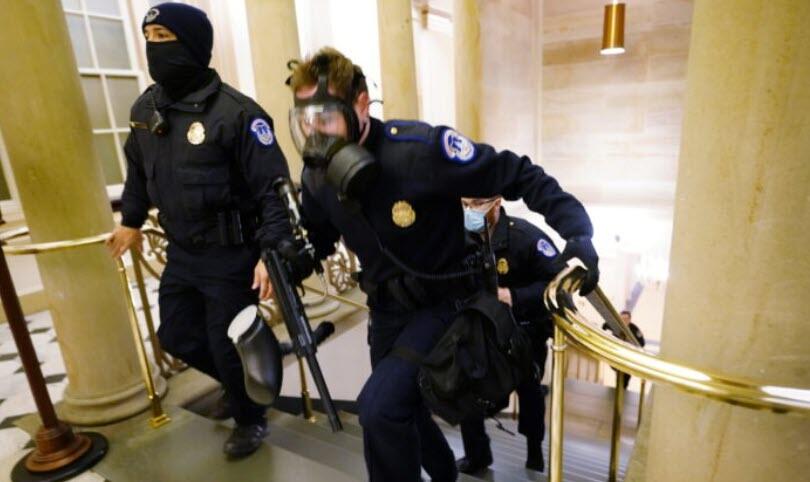
FBI agents and U.S. Capitol Police officers identified “credible threats” ahead of the Jan. 6, 2021, electoral vote certification but did not properly disseminate the intelligence, a watchdog says in a new report.

The FBI obtained information from human informants, social media, and other agencies and tracked suspected domestic terrorists traveling to Washington, according to the U.S. Government Accountability Office (GAO) report (pdf).

Capitol Police officials examined information developed from arrests and investigations, as well as open sources, and distributed a document three days before Jan. 6 that conveyed a subject of an investigation had said militia members planned to attend a Jan. 6 demonstration while armed, which would violate Washington law.

Both agencies assessed threats for credibility and reported that some of the threats were deemed credible.

But both failed to properly adhere to policies for processing or sharing information, the watchdog found.

FBI agents in San Antonio, Texas, for instance, received tips from the social media company Parler but did not develop reports based on the tips, as required.

“FBI officials noted that the FBI San Antonio Field Office did not develop any related reports on January 6 events as required by policy, such as Guardians, situational information reports, or intelligence information reports but did not indicate why not,” GAO said.

Such reports are distributed to state, local, and tribal law enforcement partners.

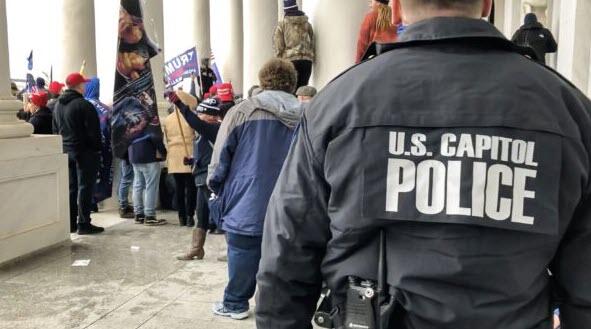
A U.S. Capitol Police officer monitors the crowd atop the east Rotunda steps on Jan. 6, 2021. (Bobby Powell/Special to The Epoch Times)

Rep. Ralph Norman (R-S.C.) said on “Just the News, No Noise” that the FBI “had a blueprint for what was going to happen, and they didn’t think about it and look at the consequences.”

The FBI did develop some reports, which it shared with partners, the GAO report noted.

‘Relevant Threat Information’ Omitted

Capitol Police officials, meanwhile, left out “relevant threat information” it received from other agencies in documents developed for Jan. 6, according to GAO.

“Capitol Police identified potential violence that could occur on January 6 in Washington, D.C. in advance of planned events. However, it did not consistently incorporate complete information into assessments of threats in its threat products, such as information obtained from other agencies regarding an individual traveling to Washington, D.C. to engage in violence at January 6 events,” the report said.

One example of information left out was a suspicious activity report from Washington Homeland Security officials that indicated an individual planned to travel to the nation’s capitol to engage in violence during Jan. 6 protests.

Capitol Police officials also failed to update a threat product to include important information, including information indicating violence might occur during the demonstrations, and did not consistently share relevant details across its agency, “resulting in some officers, agents and intelligence staff not having complete information,” the report stated.

Eight other agencies, including the National Park Service and the Secret Service, examined by GAO received information, but they either did not assess threats for credibility or did not identify any of the threats as credible.

The Department of Homeland Security Office of Intelligence & Analysis (DHS I&A) did not assess any reports or identify any credible threats before the department’s team charged with collecting information from open sources “did not share reports on January 6 open source threats with other DHS I&A divisions until after the Capitol attack occurred,” according to the watchdog.

Police officers set up barricades outside of the U.S. Capitol in Washington on Jan. 6, 2021. (Andrew Caballero-Reynolds/AFP via Getty Images)

DHS I&A also failed to share information with the Capitol Police “in a timely manner,” GAO said.

GAO made 10 recommendations, including advising FBI Director Christopher Wray, a Trump appointee, to assess why personnel did not adhere to policy in processing information related to Jan. 6 and, after an assessment, implement a plan for fixing what went wrong.

FBI Takes Note

Many of the agencies, including the FBI, agreed with the recommendations.

“We appreciate the GAO’s extensive fact gathering and thorough analysis in the report,” adding that “we will incorporate GAO’s conclusion that, despite collecting and sharing significant pieces of threat reporting, the FBI did not process all relevant information related to potential violence on January 6,” Larissa Knapp, an FBI official, said in a response to GAO.

“Our goal is always to disrupt and stay ahead of the threat, and we are constantly trying to learn and evaluate what we could have done better or differently, this is especially true of the attack on the Capitol,” Knapp also said.

The FBI declined to comment beyond Knapp’s letter. The Capitol Police and DHS did not respond to requests for comment.

U.S. Capitol Police Chief Thomas Manger told GAO that it is taking steps to implement the watchdog’s recommendation that the Capitol Police Board should establish policies for sharing information on possible threats across the agency.

Manger said the department is drafting policy that “will provide guidance for sharing threat-related information agency-wide.”

GAO previously concluded that DHS should have designated the Jan. 6 demonstrations as special, which would have triggered heightened security.

Another previous report found that many agencies were aware of open source, or publicly available, information on potential violence planned for Jan. 6.

Tyler Durden
Sun, 03/05/2023 – 21:30

via ZeroHedge News https://ift.tt/tT2CGvS Tyler Durden