Could the RESTRICT Act Criminalize the Use of VPNs?


tiny cop standing on computer keyboard

Would the RESTRICT Act—a.k.a. the TikTok ban bill—criminalize the use of VPNs? That’s the rumor floating around about the legislation, which was introduced in the Senate by Sen. Mark Warner (D–Va.) earlier this month. Warner’s office has said his bill wouldn‘t do this… but its broad language leaves room for doubt. And the act is still insanely far-reaching and could have a huge range of deleterious effects, even if it doesn’t criminalize people using a VPN to access TikTok.

VPN stands for virtual private network, and there are several different kinds, but their general aim is the same: keeping your digital activities and location private. Using a VPN with your computer, phone, or another internet-enabled device can do things like mask your I.P. address and encrypt your internet connection. It’s a great way to get around location-based firewalls (a.k.a. geoblocking) and other forms of internet censorship.

For this reason, VPNs are popular in countries that exercise authoritarian control over what their citizens can access online. It’s sad that this contingent could soon include U.S. citizens, but include us it does, as both Republicans and Democrats get more and more gung-ho about banning the popular video platform TikTok.

Sen. Josh Hawley (R–Mo.) introduced one TikTok ban bill back in January. Hawley’s bill would direct the president to use the International Emergency Economic Powers Act to specifically “block and prohibit all transactions” and to “prevent commercial operation of” TikTok parent company ByteDance in the U.S.

The latest legislation is more extensive—and even more invasive.

Warner’s “Restricting the Emergence of Security Threats that Risk Information and Communications Technology Act,” or the RESTRICT Act, doesn’t specifically mention TikTok or ByteDance. Rather, it would grant the U.S. secretary of commerce the broad power to “identify, deter, disrupt, prevent, prohibit, investigate, or otherwise mitigate … any risk arising from any covered transaction by any person, or with respect to any property” that the secretary determines to pose “an undue or unacceptable risk” in several different areas. These include federal elections, “information and communications technology products and services,” and “critical infrastructure or digital economy,” as well as “coercive or criminal activities by a foreign adversary that are designed to undermine democratic processes and institutions or steer policy and regulatory decisions in favor of the strategic objectives of a foreign adversary to the detriment of the national security of the United States.”

The language describing who the RESTRICT ACT applies to is confusing at best. The commerce secretary would be authorized to take steps to address risks posed by “any covered transaction by any person,” right? So what counts as a covered transaction? The bill states that this means “a transaction in which an entity described in subparagraph (B) has any interest.” Entities described in subparagraph B are a “foreign adversary; an entity subject to the jurisdiction of, or organized under the laws of, a foreign adversary; and an entity owned, directed, or controlled by” either of these. Foreign adversaries can be “any foreign government or regime” that the secretary deems a national security threat.

It’s a bit gobbledygooked, but this could be read to imply that “any person” using a VPN to access an app controlled by a “foreign adversary” or its alleged minions is subject to the secretary’s ire. Hence anyone using a VPN to access TikTok would be in trouble—specifically, subject to up to $1 million in fines, 20 years in prison, or both.

Warner’s office says this isn’t so. Spokesperson Rachel Cohen told Newsweek that the provisions only apply when someone is “engaged in ‘sabotage or subversion’ of communications technology in the U.S., causing ‘catastrophic effects’ on U.S. critical infrastructure, or ‘interfering in, or altering the result’ of a federal election in order for criminal penalties to apply.” The RESTRICT Act targets “companies like Kaspersky, Huawei and TikTok … not individual users,” she said.

It’s somewhat reassuring that at least Warner doesn’t intend the bill’s criminal provisions to apply to U.S. citizens using VPNs. But the verboten activities it lists are actually broader than those that Cohen mentions to Newsweek. And because the language of the bill is so expansive, it seems hard to rule out it ever being used in this way.

We’ve seen many times the way federal laws are sold as attacks on big baddies like terrorists and drug kingpins yet wind up used to attack people engaged in much more minor activities.

Besides, the RESTRICT Act doesn’t just state that “no person may engage in any conduct prohibited by or contrary to” its provisions. It also says “no person may cause or aid, abet, counsel, command, induce, procure, permit, or approve the doing of any act prohibited by, or the omission of any act required by any regulation, order, direction, mitigation measure, prohibition, or other authorization or directive issued under, this Act,” (emphasis mine). In addition, “no person may solicit or attempt a violation” and “no person may engage in any transaction or take any other action with intent to evade the provisions of this Act.”

That language leaves even more room for the RESTRICT Act to touch a wide range of activities. Perhaps a court would ultimately deem it unusable against individuals merely trying to evade a TikTok ban, but that doesn’t mean prosecutors wouldn’t try, nor that authorities wouldn’t use invasive surveillance measures to try and detect such evasion.

And even if the law would never be used to attack citizens for merely using VPNs, it’s a deeply worrying piece of legislation that would give the government broad authority to restrict or ban all sorts of businesses and communications tools, so long as they’re tangentially related to any country it decides is an adversary. It would give law enforcement wide leeway to punish a range of people involved in the provision or dissemination of any services from these entities. And it would grant authorities sweeping new powers to go after a huge range of economic and expressive activity and limit Americans’ access to a wide range of tools, services, and products.

As Reason‘s Robby Soave asked yesterday, can we really “expect the veritable army of federal bureaucrats obsessed with policing speech on social media platforms to narrowly utilize this new mandate to deter foreign threats and focus solely on the CCP? Or should we anticipate that every weapon added to their arsenal is a threat to the free speech rights of everyday Americans?”

The good news here is that a broad range of people and groups—including civil libertarians, conservatives, and leftists alike—have come out against banning TikTok and against the RESTRICT Act more generally.

“This bill isn’t about banning TikTok, it is never about what they say it is,” Fox News host Tucker Carlson told the Daily Caller. “Instead, this bill would give enormous and terrifying new powers to the federal government to punish American citizens and regulate how they communicate with one another.”

“This is not an effort to push back against China, it is part of a strategy to make America much more like China, with the government in charge of what you read and see and with terrifying punitive powers at their fingertips,” he continued. “We’ve seen this before from the national security state again and again. Confronted with a foreign adversary, for example, after 9/11, the federal government uses the opportunity to expand their police powers over the American population and they do it under false pretexts and they do it quickly by whipping people into a panic.”

Sen. Rand Paul (R–Ky.) makes similar points in a Courier Journal op-ed today:

Before banning TikTok, these censors might want to discover that China’s government already bans TikTok. Hmmm . . . do we really want to emulate China’s speech bans?

TikTok must be banned, the censors say, because they are owned and controlled by the Chinese communist government, but does TikTok do the Chinese government’s bidding? Well, go to the app and search for Falun Gong, the anti-communist religious sect that is persecuted in China. Go to TikTok and search for videos advocating Taiwan’s independence, criticism of Chinese Premier Xi Jinping. Videos are all over TikTok that are critical of official Chinese positions. That’s why TikTok is banned in China.

As Drs. Mueller and Farhat of Georgia Tech write: “If nationalistic fears about Chinese influence operations lead to a departure from American constitutional principles supporting free and open political discourse, we will have succeeded in undermining our system of government more effectively than any Chinese propaganda could do.”


FREE MINDS

States consider mandatory anti-porn filters. NBC News looks at anti-porn bills that are currently percolating in eight states. These bills “would force phone and tablet manufacturers like Apple and Samsung to automatically enable filters that censor nude and sexually explicit content,” it points out:

The only way to disable the filters, according to the bills introduced this year, would be through passcodes. Providing such a passcode to a child would be forbidden, except when done by a parent.

Specifically, the bills say, the phone filters must prevent children from downloading sexually explicit content via mobile data networks, applications owned and controlled by the manufacturer, and wired or wireless internet networks.

Many device manufacturers already have adult content filters available for use, though it is not the norm to have them turned on by default. Many phone makers, for instance, allow parents to easily enable filters on web browsers that prevent children from navigating to websites known to host pornography.

Parents already have tools available to keep sexual content off their children’s devices. These new bills would, instead, treat all adults like children.


FREE MARKETS

Tariffs on baby formula returned—and so did the shortages. Reason‘s Eric Boehm explores how government policy is making it harder for Americans to feed their kids:

When supply chain issues caused a baby formula shortage last year, Congress (eventually) cut tariffs to help get more formula onto American store shelves.

It worked! Imports of baby formula soared during the second half of 2022 after tariffs and other regulations were lifted. Stores reported lower out-of-stock rates and news stories about panicked parents being unable to feed their infants abated. In short, the government removed economic barriers and the market solved the problem.

Then, the government put those barriers back in place. On January 1, the tariffs on baby formula returned. Now, so has the crisis.

“It’s getting harder and harder” to find baby formula, pharmacy owner Anil Datwani told Fox News this week. “[Mothers] go from one store to the next store to the next store” looking for baby formula.

Meanwhile, some consumers are complaining on social media that prices for baby formula have suddenly spiked and availability is once again a problem.

More here.


QUICK HITS

• The Senate will vote today on whether to finally repeal Iraq war powers.

• This year’s farm bill threatens to be “a bigger monster than ever,” warns J.D. Tuccille.

• An Idaho bill would create the crime of “abortion trafficking.”

• New York lawmakers are pondering a “Netflix tax.”

• The government is turning border surveillance on Americans.

The post Could the RESTRICT Act Criminalize the Use of VPNs? appeared first on Reason.com.

from Latest https://ift.tt/bqCWogP
via IFTTT

Adnan Syed’s Conviction Reinstated to Protect Crime Victims’ Rights

Yesterday the Appellate Court of Maryland enforced crime victims’ rights in a high-profile case involving Adnan Syed, the subject of the “Serial” podcast. In a 2-1 decision, that Court ruled that the trial court needed to respect the rights of Young Lee, brother of Hae Min Lee (the victim), to have been notified of and to have attended a hearing last September when the trial judge vacated Mr. Syed’s conviction for murdering Ms. Lee. This decision is an important milestone, signaling that crime victims’ rights are becoming an enforceable part of our nation’s criminal justice architecture.

Most readers are aware of the “Serial” podcast, which cast doubt on the reliability of Mr. Syed’s convictions in 2000 for (among other things) the 1999 murder of 17-year-old Hae Min Lee. In 2003, the Maryland Court of Special Appeals affirmed his conviction. In 2010, Mr. Syed filed a petition for for post-conviction release, arguing ineffective assistance of counsel. Ultimately, after extended evidentiary and other hearings, the Maryland Court of Appeals affirmed Mr. Syed’s conviction. The U.S. Supreme Court denied certioari. At the time, Maryland Attorney General Brian Frosh responded to news of the high court’s decision by saying the evidence linking Mr. Syed to Ms. Lee’s death was “overwhelming.”

Then, several years later, in September 2022, Baltimore State’s Attorney Marilyn Mosby filed a motion to vacate Mr. Syed’s convictions under Maryland’s vacatur statute. The motion argued that prosecutors had failed to disclose evidence to the defendant that other suspects might have been responsible for the murder. That motion was questioned by many observers, who noted that Mosby acted precipitously as she was about to face trial on  federal fraud and perjury charges. (The federal charges against Mosby remain pending; recently her defense attorneys were permitted to withdraw from the case after being accused of violating court rules.) The judge who presided over Mr. Syed’s trial also provided an affidavit stating that substantial evidence supported Mr. Syed’s conviction. But because the State was moving to set aside Mr. Syed’s convictions–and Mr. Syed obvious agreed—it was not clear who was defending the conviction. After a hearing, the Circuit Court for Baltimore City granted the motion.

Ms. Lee’s brother, Young Lee, appealed the vacatur, arguing that he (a crime victim’s representative) had not been given adequate notice of the vacatur hearing or a meaningful opportunity to be heard on the merits of the vacatur motion. The prosecutor had provided only one business day’s notice, via email, to Mr. Lee. Mr. Lee, through counsel, requested a postponement of seven days so that he could arrange to take leave from work and fly from California to be present in the courtroom. The trial court denied the requested postponement but permitted him to give a statement on Zoom—with only thirty minutes to prepare. The Appellate Court concluded this was not adequate notice:

Clearly, notice to a victim in California that there would be a hearing in Baltimore a minute later would not be sufficient to comply with the statutory objectives, a point which Mr. Syed’s counsel conceded, appropriately, at oral argument. Similarly, the State’s notice here, an email [on Friday] one business day before the hearing on Monday, September 19, 2022, was not sufficient to reasonably allow Mr. Lee, who lived in California, to attend the proceedings, as was his right.

The inadequate notice also interfered with Mr. Lee’s right to attend the proceeding, even though he was allowed to participate via Zoom:

We hold that in the circumstance where, as here, a crime victim or victim’s representative conveys to the court a desire to attend a vacatur hearing in person, all other individuals involved in the case are permitted to attend in person, and there are no compelling reasons that require the victim to appear remotely, a court requiring the victim to attend the hearing remotely violates the victim’s right to attend the proceeding. Allowing a victim entitled to attend a court proceeding to attend in person, when the victim makes that request and all other persons involved in the hearing appear in person, is consistent with the constitutional requirement that victims be treated with dignity and respect.

The Court then considered the appropriate remedy for these violations of crime victims’ rights.

It could be argued that setting the vacatur aside and holding a new hearing where victims’ rights were respected would violate Mr. Syed’s double jeopardy rights. The Court made short work of that potential argument, explaining that

Ordering a new vacatur hearing would not result in a second prosecution after conviction or acquittal. The result of a new vacatur hearing will be to either reinstate the initial conviction or vacate it again. There would not be a second prosecution.

The Appellate Court noted that, against the backdrop of proven violations of Maryland’s victims’ rights statute, it had “the power and obligation to remedy that injury.” Accordingly, the Court set aside trial court’s order vacating Mr. Syed’s convictions and remanded “for a new, legally compliant, transparent hearing on the motion to vacate, where Mr. Lee is given notice of the hearing that is sufficient to allow him to attend in person, evidence supporting the motion to vacate is presented, and the court states its reasons in support of the decision.”

While the Appellate Court generally supported victims’ rights, one part of the decision held that that a victim does not have a right to be heard a vacatur hearing. This conclusion is difficult to square with the language of the Maryland Victims’ Rights Amendment, which gives crime victims the state constitutional right “to be heard at a criminal justice proceeding”—which a vacatur hearing would seem to be.  But this part of the Appellate Court’s decision may have limited practical importance. The Appellate  Court noted that while a victim may lack a “right to be heard, there are valid reasons to allow a victim that right in a vacatur hearing, and the court has discretion to permit a victim to address the court regarding the impact the court’s decision will have on the victim and/or the victim’s family.”

The conclusion that a victim should be heard at a vacatur hearing where no one is defending the judgment of conviction is well supported by (for example) the U.S. Supreme Court’s practice of appointing an advocate to defend the judgment below when both parties decline to do so. For example, in 2000, Chief Justice Rehnquist appointed me to argue in defense of the Fourth Circuit’s decision that 18 U.S.C. section 3501 superseded the Miranda requirements, after the Clinton Administration Justice Department declined to defend the federal statute. In another case, the Supreme Court has explained that this approach permits it to “decide the case satisfied that the relevant issues have been fully aired.”

The Appellate Court declined to formally appoint Mr. Lee to defend the conviction. But if he is permitted to speak—as the Court suggests that “valid reasons” support—then he will be able to provide relevant information on this subject.

Yesterday’s Maryland Appellate Court ruling is important because it signals that in Maryland (and, presumably, in many other states with similar laws) crime victims’ rights must be respected and will be respected. For the last several decades, the crime victims’ rights movement has evolved from working to create crime victims’ rights to making those rights enforceable.  I know my friends in the crime victims’ rights movement in Maryland (some of whom are working on this case) have made that a top priority.

Crime victims face many challenges in enforcing their rights. Among the most significant are obtaining legal counsel and “standing” in court to advance their arguments. Here, Mr. Lee had legal counsel and was allowed to be heard regarding his rights. That result should be broadly applauded, as a process in which crime victims are heard is one that will produce outcomes that are more broadly accepted by the public—regardless of whether that outcome goes in favor of or against the victim.

Enforcing Mr. Lee’s rights as a victim representative does not take away any rights from Mr. Syed. The Court stayed enforcement of its ruling for 60 days, which should provide ample time for a new hearing—during which time Mr. Syed is released. It appears that Mr. Syed plans to appeal to the Maryland Supreme Court, so his rights will continue to be reviewed. And if ultimately a new hearing is held, that hearing will be one where both Mr. Syed’s and victims’ rights are respected.

If the nation is going to adopt crime victims’ rights—as all fifty states have done to some degree—those rights should be enforceable. It would add insult to criminal injury to extend victims only paper promises. The Appellate Court of Maryland’s decision wisely and properly took crime victims’ rights seriously and enforced them.


The post Adnan Syed's Conviction Reinstated to Protect Crime Victims' Rights appeared first on Reason.com.

from Latest https://ift.tt/Tg4F2zA
via IFTTT

A Federal Reserve Pivot Is Not Bullish

A Federal Reserve Pivot Is Not Bullish

Authored by Michael Lebowitz via RealInvestmentAdvice.com,

An old saying cautions one to be careful of what one wishes for. Stock investors wishing for the Federal Reserve to pivot may want to rethink their logic and review the charts.

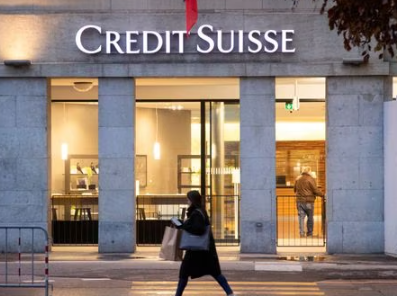
The second largest U.S. bank failure and the deeply discounted emergency sale of Credit Suisse have investors betting the Federal Reserve will pivot. They don’t seem to care that inflation is running hot and sticky, and the Fed remains determined to keep rates “higher for longer” despite the evolving crisis.

Like Pavlov’s dogs, investors buy when they hear the pivot bell ringing. Their conditioning may prove harmful if the past proves prescient.

The Bearish History of Rate Cuts

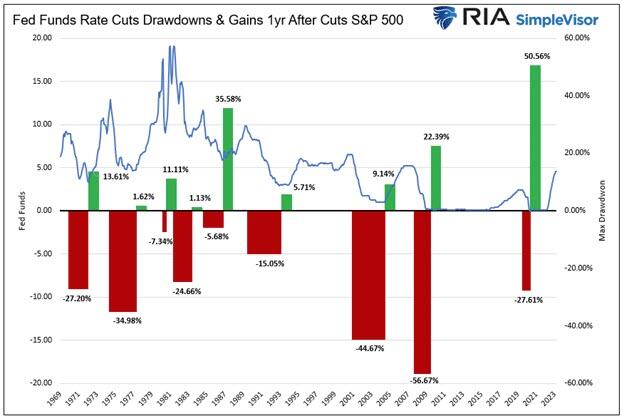
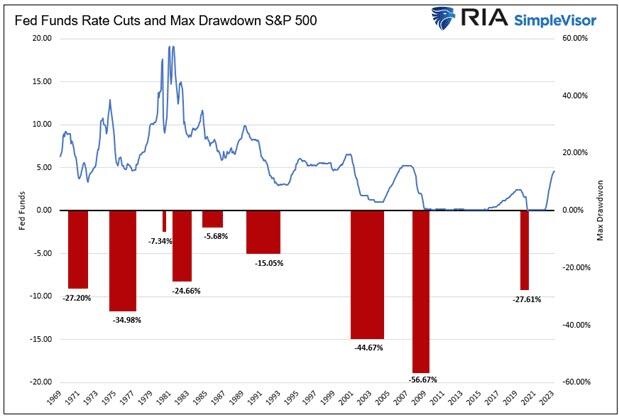
Since 1970, there have been nine instances in which the Fed significantly cut the Fed Funds rate. The average maximum drawdown from the start of each rate reduction period to the market trough was 27.25%.

The three most recent episodes saw larger-than-average drawdowns. Of the six other experiences, only one, 1974-1977, saw a drawdown worse than the average.  

So why are the most recent drawdowns worse than those before 1990? Before 1990, the Fed was more active. As such, they didn’t allow rates to get too far above or below the economy’s natural rate. Indeed, high inflation during the 1970s and early 1980s forced Fed vigilance. Regardless of the reason, higher interest rates helped keep speculative bubbles in check.

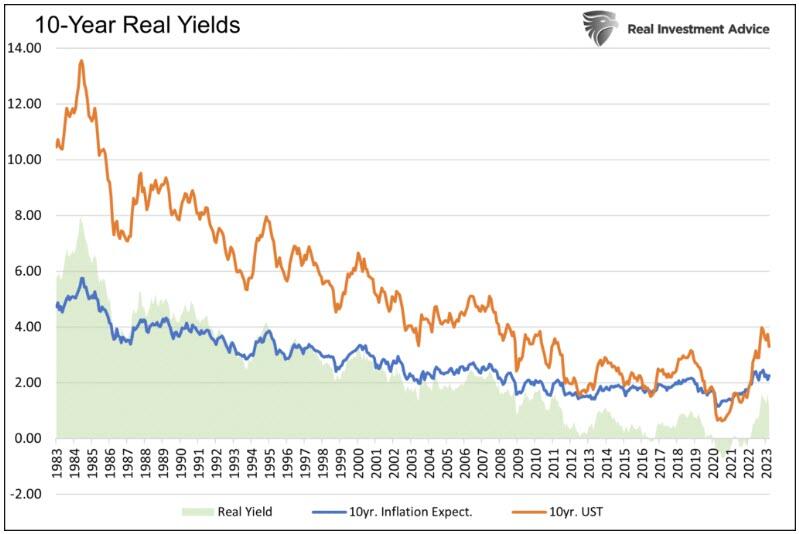
During the last 20 years, the Fed has presided over a low-interest rate environment. The graph below shows that real yields, yields less inflation expectations, have been trending lower for 40 years. From the pandemic until the Fed started raising rates in March 2022, the 10-year real yield was often negative.

Speculation often blossoms when interest rates are predictably low. As we are learning, such speculative behavior emanating from Fed policy in 2020 and 2021 led to conservative bankers and aggressive hedge funds taking outsized risks. While not coming to their side, what was their alternative? Accepting a negative real return is not good for profits.

We take a quick detour to appreciate how the level of interest rates drives speculation.

Wicksell’s Elegant Model

A few years ago, we shared the logic of famed Swedish economist Knut Wicksell. The nineteenth-century economist’s model states two interest rates help assess economic activity. Per Wicksell’s Elegant Model:

First, there is the “natural rate,” which reflects the structural growth rate of the economy (which is also reflective of the growth rate of corporate earnings). The natural rate is the combined growth of the working-age population and productivity growth. Second, Wicksell holds that there is the “market rate” or the cost of money in the economy as determined by supply and demand.

Wicksell viewed the divergences between the natural and market rates as the mechanism by which the economic cycle is determined. If a divergence between the natural and market rates is abnormally sustained, it causes a severe misallocation of capital.

The bottom line:

Per Wicksell, optimal policy should aim at keeping the natural and market rate as closely aligned as possible to prevent misallocation. But when short-term market rates are below the natural rate, intelligent investors respond appropriately. They borrow heavily at the low rate and buy existing assets with somewhat predictable returns and shorter time horizons. Financial assets skyrocket in value while long-term, cash-flow-driven investments with riskier prospects languish.

The second half of 2020 and 2021 provide evidence of Wicksell’s theory. Despite brisk economic activity and rising inflation, the Fed kept interest rates at zero and added more to its balance sheet (QE) than during the Financial Crisis. The speculation resulting from keeping rates well below the natural rate was palpable.

What Percentage Drawdown Should We Expect This Time?

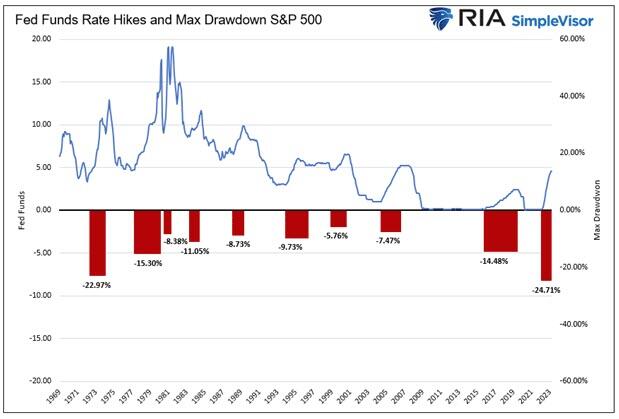
Since the market experienced a decent drawdown during the rate hike cycle starting in March 2022, might a good chunk of the rate drawdown associated with a rate cut have already occurred?

The graph below shows the maximum drawdown from the beginning of rate hiking cycles. The average drawdown during rate hiking cycles is 11.50%. The S&P 500 experienced a nearly 25% drawdown during the current cycle.

There are two other considerations in formulating expectations for what the next Federal Reserve pivot has in store for stocks.

First, the graph below shows the maximum drawdowns during rate-cutting periods and the one-year returns following the final rate cut. From May 2020 to May 2021, the one-year period following the last rate cut, the S&P 500 rose over 50%. Such is three times the 16% average of the prior eight episodes. Therefore, it’s not surprising the maximum drawdown during the current rate hike cycle was larger than average.

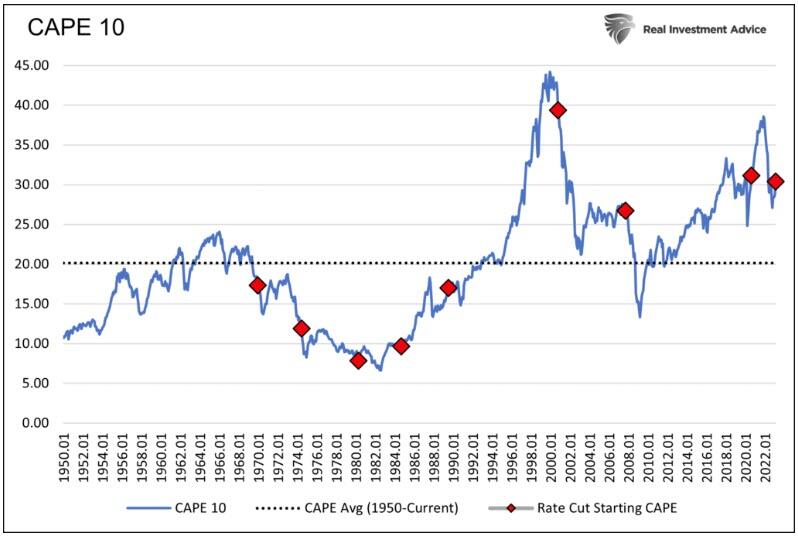
Second, valuations help explain why recent drawdowns during Federal Reserve pivots are worse than those before the dot-com bubble crash. The graph below shows the last three rate cuts started when CAPE10 valuations were above the historical average. The prior instances all occurred at below-average valuations.

The current CAPE valuation is not as extended as in late 2021 but is about 50% above average. While the market has already corrected some, the valuation may still return to average or below it, as it did in 2003 and 2009.

It’s tough to draw conclusions about the 2020 drawdown. Unprecedented fiscal and monetary policies played a prominent role in boosting animal spirits and elevating stocks. Given inflation and political discord, we don’t think Fed members or politicians will be likely to gun the fiscal and monetary engines in the event of a more significant market decline.

Summary

The Federal Reserve is outspoken about its desire to get inflation to its 2% target. If they were to pivot by as much and as soon as the market predicts, something has broken. Currently, it would take a severe negative turn to the banking crisis or a rapidly deteriorating economy to justify a pivot, the likes of which markets imply. Mind you, something breaking, be it a crisis or recession, does not bode well for corporate earnings and stock prices.

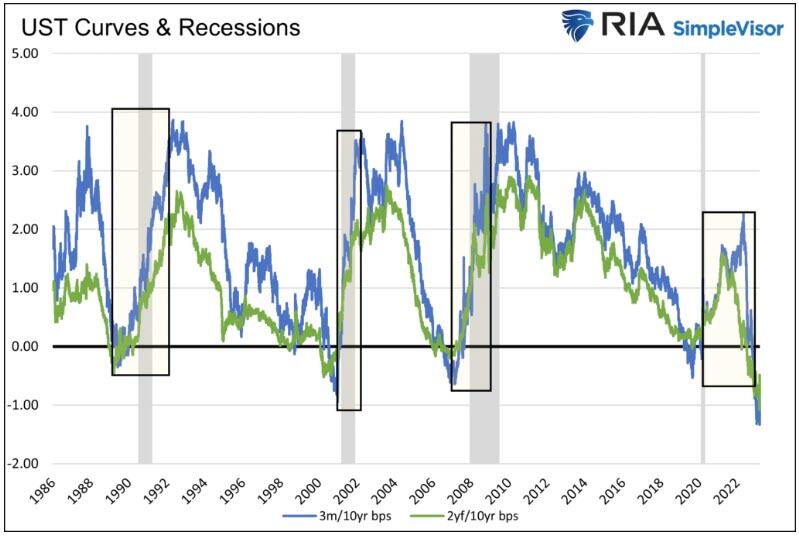
There is one more point worth considering regarding a Federal Reserve pivot. If the Fed cuts Fed Funds, the yield curve will likely un-invert and return to a normal positive slope. Historically yield curve inversions, as we have, are only recession warnings. The un-inversion of yield curves has traditionally signaled that a recession is imminent. 

The graph below shows two well-followed Treasury yield curves. The steepening of both curves, shown in all four cases and other instances before 1990, accompanied a recession.

Over the past two weeks, the two-year- ten-year UST yield curve has steepened by 60 bps!

Tyler Durden
Wed, 03/29/2023 – 08:25

via ZeroHedge News https://ift.tt/58zQRE2 Tyler Durden

Futures Gain On China Tech Optimism, Easing Bank Fears; Nasdaq On Pace For Best Quarter In 3 Years

Futures Gain On China Tech Optimism, Easing Bank Fears; Nasdaq On Pace For Best Quarter In 3 Years

US futures extended gains for a second day on Wednesday as banking sector fears continued to ease, while Nasdaq futs got a boost from a rally in Asian tech stocks following the announced split of Chinese internet giant Alibaba which sent the Hang Seng up 2.1% and HSTECH +2.5%. 

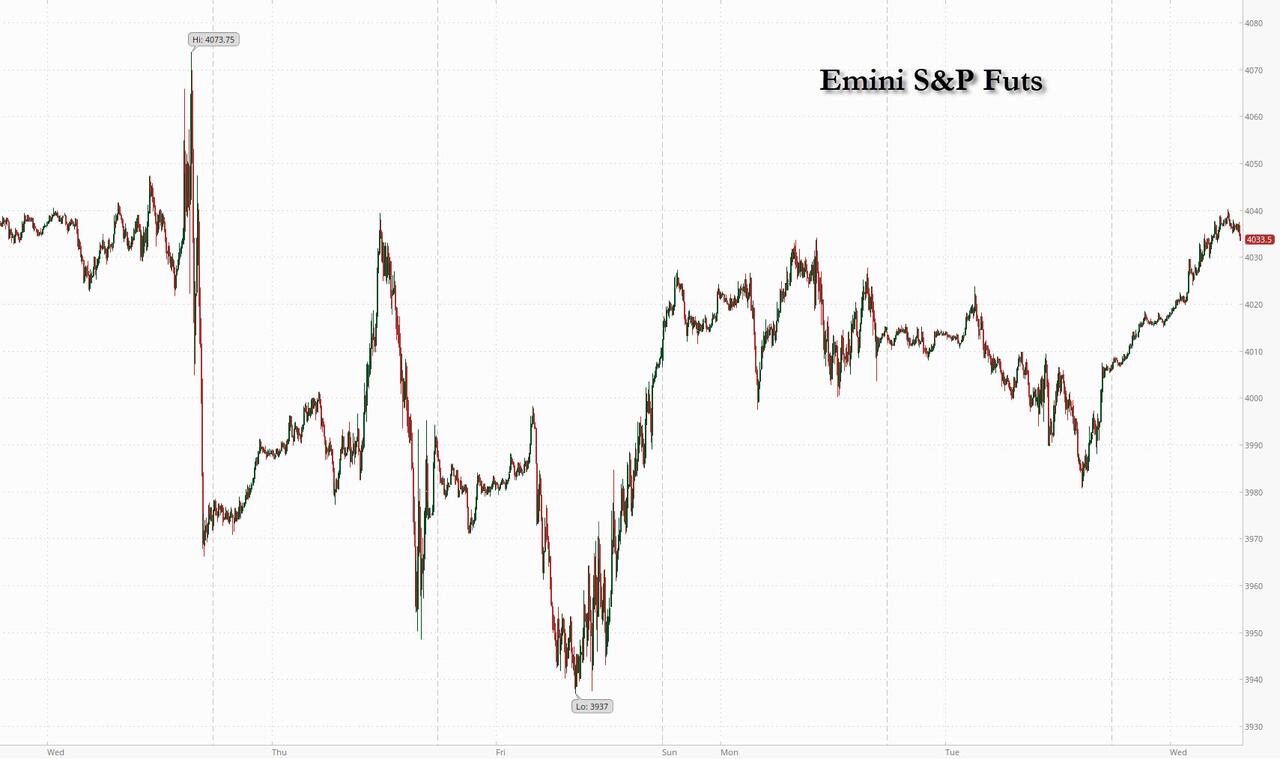
S&P 500 and Nasdaq 100 futures contracts were up 0.8% as of 7:30 a.m. in New York, trading at 4,034 and 12832 respectively.
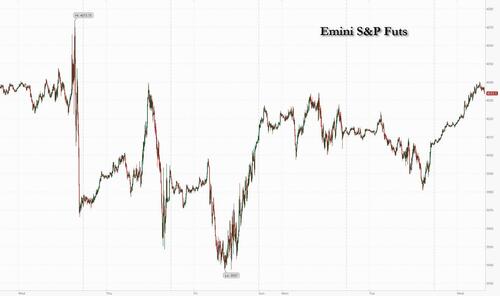
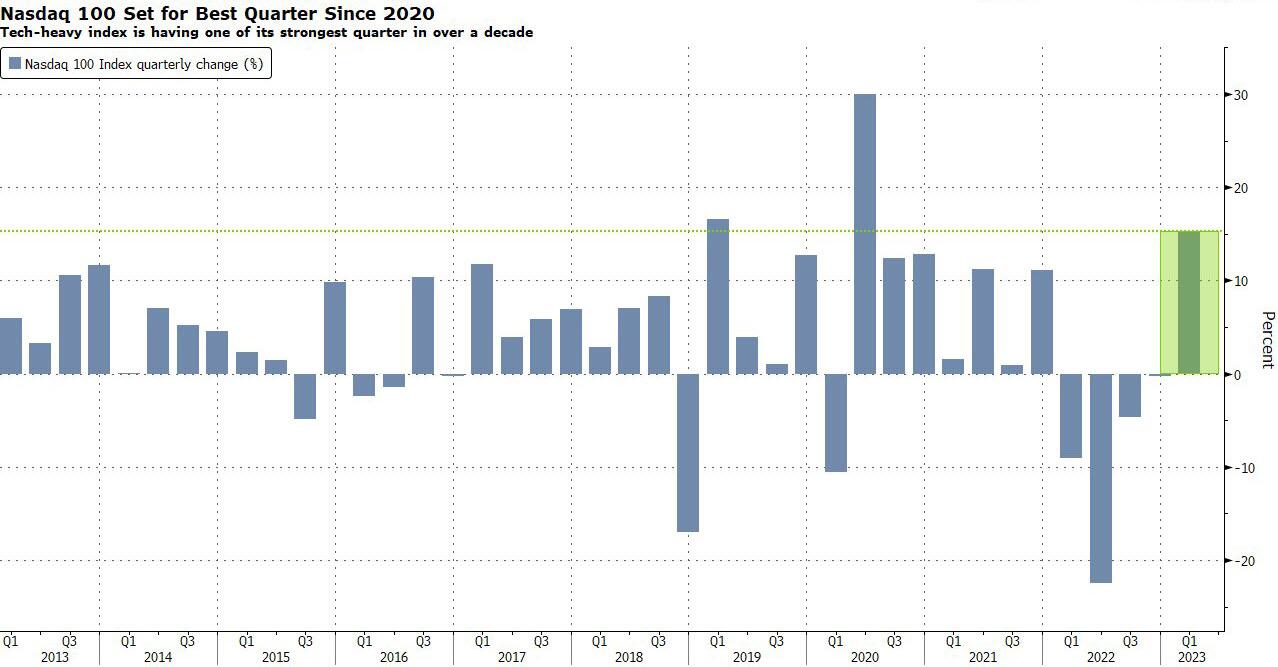
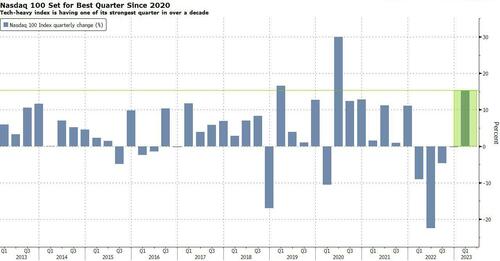
The S&P 500 is set for a flat month, while the Nasdaq 100 has surged nearly 5% in March and more than 15% in Q1 – its best quarter in nearly three years and its first rise in 5 quarters – as tech stocks, especially megacaps, found renewed favor with investors.
Bond yields are lower following dovish comments by ECB’s Philip Lane on inflation which supported bunds over London session, and helping drive declines for front-end Treasury yields. The USD stronger, and commodities are flattish. WTI is up small, approaching the bottom-end of the recent $75 – $80 YTD range. Overnight, the WaPo reported that the government may move to strengthen capital/liquidity requirements for banks with assets larger than $100bn. Fed’s Bullard said that banking crisis can be contained with policy rather than by moves in interest rates; will the bond market remove any rate cut expectations? Doubtful.

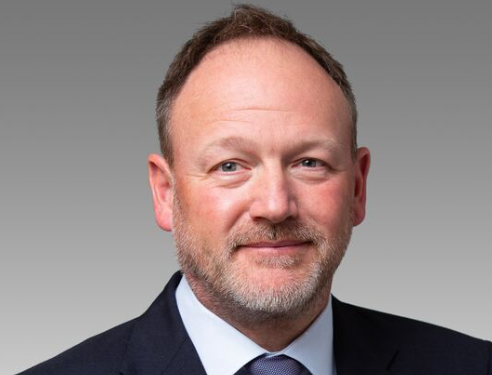
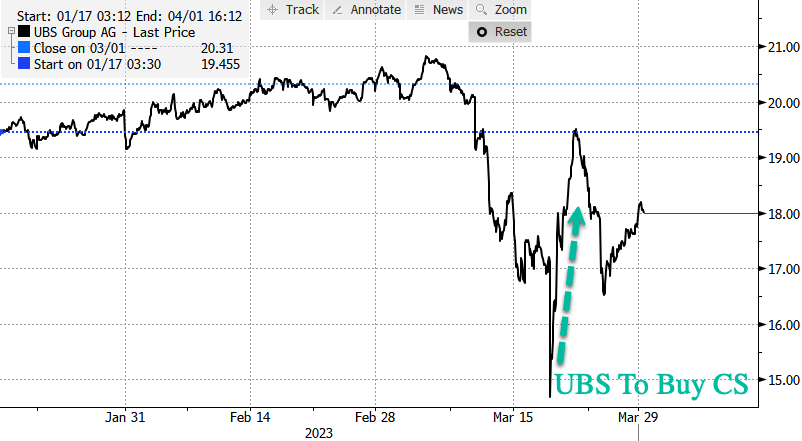
In premarket trading, Alibaba Group ADRs fell in US premarket trading after surging Tuesday on plans to split. Its Hong Kong-listed shares were 12% higher, tracking overnight gains on Wall Street. That sparked a rally in Chinese tech shares as investors piled into the companies that were stung by a crackdown from Beijing over the past two years. UBS shares climbed as much as 3% after the Swiss lender said veteran UBS CEO Sergio Ermotti will return and replace Ralph Hamers as chief executive officer; Jefferies shares were little changed after the financial services firm’s profit plunged in its fiscal first quarter, as a bump in equities and fixed income trading failed to offset a slump in investment banking. Here are some other notable premarket movers:

  • Lululemon shares leap 15% in premarket trading after the athletic-apparel brand reported fourth-quarter adjusted earnings per share that beat analyst estimates and issued guidance that topped expectations. Analysts found the results to be strong overall, with most expecting the negative sentiment around the stock to be alleviated with the performance.
  • Micron rises 2.7% after the largest US maker of memory chips issued a forecast of adjusted revenue for the third quarter that was better than some had feared. Analysts were still cautious about the tough environment facing chipmakers, but see signs that the worst of the downturn may be behind the industry.
  • Shares of semiconductor companies are rising following Micron’s forecast and after Infineon raised its revenue outlook. Qualcomm gains 1%, Advanced Micro Devices (AMD US) +0.9%, Nvidia +0.8% and Intel +0.8%.
  • Alibaba and other US-listed Chinese internet stocks are poised for a pullback, after their shares surged on Tuesday following Alibaba’s plan to split into six units and seek separate listings. Alibaba slides 1.4% in premarket trading, Baidu -0.8%, JD.com -1.5%.
  • Cryptocurrency- related stocks rally as Bitcoin extends gains into a second day to breach the $28,000 level. Cipher Mining rises 15%, Riot Platforms +7.4%, Marathon Digital +6.3%, Coinbase +4%, MicroStrategy +3.9%.
  • Arcturus Therapeutics shares jump 25% after the biotech beat analysts’ earnings estimates for the fourth quarter and repaid debts that allow its “cash runway” to extend to 2026. Analysts were especially positive on the company’s update regarding its pipeline and its potential.
  • Lucid rose 1.9% after the electric vehicle-maker said it would cut 18% of its workforce, including employees and contractors. Morgan Stanley notes that fellow EV startups may need to consider similar cost cutting measures given increased competition and a challenging capital-raising environment.

US equities have traded in a narrow range over the past week, as investors digested the banking sector crisis, with contagion fears easing, while the Fed hinted that the rate-hiking cycle was near the end, but not ready for a pivot yet as inflation was still too high. Swaps traders currently price in more than a 50% probability the Fed will raise rates by a quarter point at its next meeting, with plans to ease thereafter, something with which several strategists, including those at BlackRock, disagree.

The bad news for markets “is that the Fed is very unlikely to cut rates until Q2 2024, unless US growth slows more markedly than we anticipate, leaving us with a ‘higher for longer’ scenario,” Willem Sels, global chief investment officer at HSBC Private Banking and Wealth, wrote in a note on the outlook for the next quarter. “Another key consideration for investors should be China’s reopening and the bounce in consumer activity, which markets are still completely underestimating,” he added, saying China’s renewed focus on growth will help reduce the risk of a recession in the rest of the world.

“We associate the current market pricing in terms of rate cuts not to be appropriate, we are not expecting any rate cuts in 2023 across different economies, especially in the US,” Giulio Renzi Ricci, investment strategist at Vanguard Asset Services, said on Bloomberg Television. “For that reason we don’t expect growth stocks, and tech in particular, still will need to be discounted back” once the market realizes a pause in rate cuts isn’t really happening.

At the same time, investors argue that the odds of a recession have risen after banking turmoil earlier this month sparked fears of wider contagion, and will lead to sharply tighter lending conditions. An index of dollar strength was steady after ending Tuesday near the lowest level in eight weeks. The banking crisis and the new tighter standards for banks is equivalent to one to two rate hikes,” said Eva Ados, chief investment strategist for ERShares, in an interview with Bloomberg Television. “There is a big possibility here of a pricing mistake. We are pricing in the rate drop rather than the reason why rates are dropping, which is the banking crisis.”

Meanwhile, top US financial officials on Tuesday outlined what’s likely to be the biggest regulatory overhaul of the banking sector in years, addressing underlying issues that contributed to the collapse of Silicon Valley Bank and other US regional lenders.

There is a sea of green across the equity space with European stocks following their Asian counterparts higher and futures pointing to a positive open on Wall Street. Alibaba led the rally in Hong Kong after announcing plans to split into six business units, while tech stocks are also outperforming in Europe after upbeat forecasts from Micron and Infineon. here are the biggest European movers:

  • UBS shares climb as much as 3% after the Swiss lender said Sergio Ermotti will replace Ralph Hamers as chief executive officer
  • Coloplast rises as much as 2.6% after being upgraded to equal-weight at Barclays with the broker saying the ostomy products maker’s estimates now look more achievable
  • Infineon jumps as much as 7.9%, the biggest intraday advance since Feb. 2, after the chipmaker lifted revenue and margin estimates for the second quarter
  • Strix rises as much as 9.8%, the most in more than two months, after the kettle safety-control producer said in its full-year earnings report there are “green shoots” appearing
  • OCI gains as much as 13%, the most intraday since April 2020, after activist investor Jeff Ubben’s Inclusive Capital Partners urged the fertilizer maker to explore strategic options
  • WPP advances as much as 2.6% after Exane BNP upgraded to outperform from neutral, turning more positive on the ad agency sector
  • Next shares fall as much as 9.1%, with analysts viewing the clothing retailer’s maintained sales and profit guidance for 2024 as disappointing
  • Mercedes-Benz Group drops as much as 2.8% after Kuwait Investment Authority placed 20 million shares at a ~3.6% discount to the last close
  • Aroundtown falls as much as 12%, hitting another record low after Tuesday’s 10% drop, as in-line results and a dividend suspension did little to reassure traders
  • Atos drops as much as 11% after a report from BFM said Airbus wanted to renegotiate the price of Evidian, a unit of the embattled French digital services firm
  • Encavis sinks as much as 12%, the most intraday since January, as Jefferies notes the decision to waive its dividend to fund future growth marks a turning point

Asian stocks advanced as Chinese tech shares rallied on optimism Alibaba’s overhaul will pave the way for other tech giants to potentially unlock billions of dollars in shareholder value. The MSCI Asia Pacific Index rose as much as 0.8%, led by Hong Kong. Chinese technology stocks climbed 2.5% to a five-week high. Alibaba jumped 12%, while its biggest shareholder Softbank Group gained more than 6%. Alibaba surprised markets after the internet behemoth announced plans to split its $220 billion empire into six units that will individually raise funds and explore initial public offerings. The plan is positive for the sector and could signal further easing of regulatory constraints, according to analysts.

“The government needs to boost the economy this year, and the big tech platforms, which have been under pressure over the last couple of years and shedding staff, are key to help the government boost employment,” Vey-Sern Ling, managing director at Union Bancaire Privee, told Bloomberg TV.  Elsewhere, Japanese stocks gained as easing concerns over the banking sector revived risk appetite following weeks of volatility. Shares in mainland China and South Korea eked out small gains as investors braced for a slew of data on the US economy this week

Japanese stocks rose as a revamp plan at Alibaba boosted SoftBank. Gains accelerated in the afternoon ahead of Thursday’s ex-dividend date for some 1,500 stocks. The Topix rose 1.5% to close at 1,995.48, while the Nikkei advanced 1.3% to 27,883.78.  SoftBank Group surged 6.2%, the biggest boost to the Nikkei 225, after China’s Alibaba Group announced a six-way split of its businesses. The news fueled optimism for a recovery at one of the Japanese company’s most important holdings. Toyota contributed the most to the Topix gain, increasing 2.6%. Out of 2,159 stocks in the index, 2,013 rose and 101 fell, while 45 were unchanged. “Globally excessive concerns about the financial system have receded, and there is no new additional bad news,” said Shogo Maekawa, global market strategist at JPMorgan Asset Management Japan. “Domestically, the market was supported by buying for year-end dividends and dividend reinvestment.

Australian stocks also rose: the S&P/ASX 200 index gained 0.2% to close at 7,050.30, after Australian inflation decelerated more than expected in February, bolstering the case for the Reserve Bank to stand pat at next week’s policy meeting. Materials and energy stocks were the biggest gainers on the benchmark.  Read: Australian Inflation Eases, Bolstering Case for Rate Pause “Markets were already quite convinced with the story of an April pause, given what’s happening globally. But this just adds to the story,” said Jessica Ren, a strategist at Westpac Banking Corp. in Sydney. Recent comments from RBA policymakers had been implying “get ready for a pause.” In New Zealand, the S&P/NZX 50 index fell 0.3% to 11,736.75

Finally, Indian stocks also ended higher on Wednesday with small-cap stocks registering their best performance in two months. Adani group stocks rebounded from the steep losses seen on Tuesday as company officials rebutted media reports that raised concerns about the group’s ability to repay debt. Flagship Adani Enterprises rallied 8.7%, while Adani Ports rose 7.3%. A late spurt in buying led by traders covering short positions ahead of monthly derivatives expiry saw India outperform most equity gauges in Asia. The S&P BSE Sensex rose 0.6% to 57,960.09 in Mumbai, while the NSE Nifty 50 Index advanced 0.8% to 17,080.70. The latter saw its best one-day gain since March 3. A gauge of small-cap stocks climbed 1.7% to mark its best day since January 31. “There was some short covering in the market toward the end of the session but it was not a sharp move,” Gaurav Bissa, vice president at InCred Capital. “That said, we are recommending clients to turn bullish on the Nifty as we see a bounceback in the near-term.”  Hindustan Unilever contributed the most to the Sensex’s gains, increasing 1.9%. Out of 30 shares in the Sensex index, 26 rose while 4 stocks fell.

In FX, the dollar rose nearly 1% versus the yen to 132.09, its highest since March 22; the Bloomberg Dollar Spot Index edged up 0.1%. The US currency also benefited from Japanese financial year-end flows, which weighed on the yen in Asian trade. The Australian and New Zealand dollars struggled, while the euro and the pound were little changed against the US currency.

In rates, treasuries rose after a two-day selloff and erased a portion of the curve-flattening selloff of past two days as investors awaited remarks from Federal Reserve officials and economic releases this week for clues on monetary policy. In particular focus will be data on the central bank’s preferred inflation measure – the core PCE deflator – which is likely to factor into the Fed’s next policy decision. Dovish comments by ECB’s Philip Lane on inflation supported bunds over London session, helping drive declines for front-end Treasury yields. US yields, off session lows, remain richer by ~4bp on the day across front-end of the curve with inverted 2s10s spread steeper by ~2bp; 10-year around 3.55% is richer by ~2bp on the day with bunds lagging by 2.5bp in the sector. The US auction cycle concludes with $35BN 7-year note sale at 1pm, follows Tuesday’s decent 5-year note sale which stopped 1bp through the WI; WI 7-year yield around 3.590% is ~47bp richer than February’s result.

In commodities, crude futures advance with WTI rising 0.7% to trade near $73.70. Spot gold falls 0.4% to around $1,966. Bitcoin gains 4.1%.

Now to the day ahead. In terms of data releases, we have the US February pending home sales, in the UK February net consumer credit, mortgage approvals and M4, in Germany the April GfK consumer confidence and lastly in France March consumer confidence data. Finally, we will hear from ECB’s Kazimir as well the BoE’s Mann.

Market Snapshot

  • S&P 500 futures up 0.9% to 4,036.50
  • STOXX Europe 600 up 0.8% to 448.02
  • MXAP up 0.6% to 160.78
  • MXAPJ up 0.7% to 517.13
  • Nikkei up 1.3% to 27,883.78
  • Topix up 1.5% to 1,995.48
  • Hang Seng Index up 2.1% to 20,192.40
  • Shanghai Composite down 0.2% to 3,240.06
  • Sensex up 0.4% to 57,866.24
  • Australia S&P/ASX 200 up 0.2% to 7,050.33
  • Kospi up 0.4% to 2,443.92
  • German 10Y yield little changed at 2.32%
  • Euro down 0.1% to $1.0832
  • Brent Futures up 0.3% to $78.87/bbl
  • Gold spot down 0.6% to $1,962.15
  • U.S. Dollar Index up 0.24% to 102.68

Top Overnight News from Bloomberg

  • China warned the US and Taiwan President Tsai Ing-wen that any meeting with House Speaker Kevin McCarthy would be a serious provocation, raising the stakes for her trip to the US. Tsai left Taipei on Wednesday bound for New York on a plane that was guarded by F-16 fighters as it headed over the Pacific. She’ll later visit two Central American allies, and on the way home she’s planning to stop in Los Angeles, where she’s expected to meet with McCarthy. BBG
  • The BOJ’s Shinichi Uchida indicated that any yield curve control adjustment wouldn’t be communicated ahead of time. That’ll keep the market on its toes, with some concluding it’s the only way to avoid a bond selloff in advance. It comes as bets on policy normalization help the yen make a comeback as a haven. BBG
  • UBS said Sergio Ermotti will return as chief executive, as the Swiss giant moves into a new era with its takeover of Credit Suisse. Mr. Ermotti has been credited with repositioning the bank and focusing it on less risky businesses after UBS suffered big losses during the financial crisis. WSJ
  • UK mortgage approvals edged up in February but remained more than a third below their levels from a year ago as high borrowing costs squeezed household spending, the BOE has said. Lenders last month approved a total of 43,500 mortgages for house purchases, from 39,600 in January, the BoE said on Wednesday. Approvals in February 2022 came to 69,131. The figure was above analysts’ forecast of 42,000, and marked the first monthly increase since August 2022. FT
  • The UK competition regulator has launched an in-depth probe into US chipmaker Broadcom’s $69bn takeover of cloud software company VMware, after warning it could make computer servers more expensive. FT
  • More bullish oil momentum. US crude stockpiles slumped by 6.1 million barrels last week, API data is said to have shown, in what would be the biggest drop this year if confirmed by the EIA. Gasoline supplies also sank. In the Middle East, one of the top producers in Iraq’s Kurdistan region started cutting production as a spat that has halted 400,000 barrels a day of exports drags on. BBG
  • Jamie Dimon will be questioned in a civil lawsuit over JPMorgan Chase’s relationship with Jeffrey Epstein, people familiar with the matter said. The U.S. Virgin Islands sued JPMorgan last year, saying the bank facilitated Epstein’s alleged sex trafficking and abuse. WSJ
  • Top officials from the Federal Reserve and Federal Deposit Insurance Corporation will testify to the House Financial Services Committee on the collapse of Silicon Valley Bank and Signature Bank, a day after Tim Scott, a Republican senator, accused SVB of being “rife with mismanagement”. FT
  • Tesla’s move to slash prices in China has backfired as Elon Musk’s company loses market share to Warren Buffett-backed BYD, putting Chinese carmakers on track to sell more passenger vehicles than their foreign rivals for the first time in 2023. FT
  • The European Central Bank will need to increase interest rates further if recent stress in the financial system stays contained, Chief Economist Philip Lane told Zeit in an interview: BBG
  • The yen is making a comeback as a preferred foreign- exchange haven, after banking crises in the US and Switzerland hurt the dollar and franc’s standing as go-to assets for turbulent times: BBG
  • Traders are leaning toward further gains in the world’s biggest bond market, after a rally that got a major boost from short-covering by hedge funds this month: BBG
  • President Joe Biden responded to House Speaker Kevin McCarthy’s demands that he begin negotiations over the debt ceiling by challenging Republicans to produce a public budget plan before departing Thursday for a two-week Easter recess” BBG

A more detailed look at global markets courtesy of Newsquawk

APAC stocks were mostly positive albeit with most major indices rangebound amid a lack of fresh macro drivers and heading into quarter-end, while Hong Kong markets outperformed as tech stocks surged on Alibaba’s plan for a six-way split. ASX 200 was kept afloat by strength in the commodity-related sectors and after softer-than-expected CPI data supported the case for the RBA to pause at next week’s meeting, although gains were limited by weakness in the top-weighted financial industry. Nikkei 225 traded higher after Japan’s parliament passed a record JPY 114tln budget for FY23 and with policymakers said to consider lowering mortgage rates for families with children, while BoJ officials also stuck to the dovish script. Hang Seng and Shanghai Comp. were varied with Alibaba front-running the advances in Hong Kong as its plan for a split is seen to unlock value for shareholders and has spurred some speculation that its large tech peers could follow suit, while the mainland lagged despite the PBoC’s liquidity injection as frictions lingered regarding Taiwan President Tsai’s planned transit through the US and after the Biden administration added five Chinese companies to the entity list for allegedly aiding China’s repression of Uyghurs.

Top Asian News

  • China NDRC Deputy Director General said China’s potential growth rate is the potential growth rate of the whole world and said they are optimistic for the growth situation for this year, according to Reuters.
  • US President Biden’s administration added five Chinese Co.s to the entity list for allegedly aiding China’s repression of Uyghurs.
  • Taiwan’s President Tsai comments before boarding a flight to New York in which she noted Democratic Taiwan defends democratic values and external pressure does not affect their determination to go out into the world, according to Reuters.
  • China’s Taiwan Affairs Office urged the US not to arrange a transit of Taiwan’s leader through the US and said any meeting between Taiwan President Tsai and US House Speaker McCarthy would be a severe provocation, while it added that China firmly opposes this and will definitely take measures to fight back, according to Reuters.
  • US senior administration official said Taiwan President Tsai’s planned transit is consistent with a long-standing US practice and the US sees no reason for Beijing to overreact to the transit which is consistent with the unofficial relationship and the One-China policy. The official added that every Taiwan president has transited through the US and President Tsai has met with members of Congress in all her previous six transits, as well as stated that China’s attempts to alter Taiwan’s status quo will not pressure the US to alter its practice of facilitating transits by Taiwan’s presidents, according to Reuters.
  • BoJ Deputy Governor Uchida said they will make a judgement on trend inflation by looking at various indicators, while he noted the BoJ would face an unrealised loss of JPY 50tln on its balance sheet if the 10yr bond yield rises to 2%, according to Reuters.

European bourses are firmer across the board, Euro Stoxx 50 +1.2%, as banking concerns continue to dissipate and focus turns to the sessions speakers. Sectors feature marked outperformance in Tech names after updates from Infineon and Micron; MU +2.5% pre-market. Stateside, futures are in the green, ES +0.9%, paring the downside from Tuesday which was a feature of underperformance in large-cap names; ahead, the US-specific docket is relatively light. Infineon raised Q2 revenue and segment margin guidance alongside lifting FY revenue guidance, primarily due to resilient business dynamics in its core automotive and industrial segments. Micron: Q2 adj. EPS -1.91 (exp. -0.86); it made inventory write-downs of USD 1.43bln in the quarter, which had an impact of USD 1.34/shr. Q2 revenue USD 3.69bln (exp. 3.702bln). Expects profitability to remain extremely challenged in the near-term and said profitability levels in the industry are currently not sustainable.

Top European News

  • EU’s Dombrovskis said the situation in the EU banking sector is stable and banks are prepared to withstand shocks.
  • ECB’s Lane says to ensure that inflation falls to 2%, further interest rate hikes are required under the scenario expected by the ECB, according to Die Zeit; rates must increase if banking tensions have no or a “fairly limited” impact, bank sector tensions are seen as settling down and there is no reason to expects major problems.
  • ECB’s Kazimir agreed not to give guidance on the May ECB meeting, Kazimir thinks inflation is too high for too long; ECB should continue increasing rates, possibly at a slower pace; will take into account financial market situation.
  • BoE FPC Minutes: All UK banks are resilient to risks from rising interest rates, including from bond positions; maintains countercyclical capital buffer rate at 2%; UK firms are resilient from higher debt costs.

FX

  • The DXY is erring lower and has dipped below the 102.50 mark within 102.41-102.75 boundaries despite marked AUD & JPY pressure.
  • Pressure which stems from cooler-than-expected inflation and a myriad of factors sparking a pullback from recent peaks respectively; AUD/USD at 0.6662 low and USD/JPY above 132.00.
  • In contrast, the DXY remains softer given the resilience of the EUR and GBP with ECB’s Lane and BoE data respectively perhaps assisting with EUR/USD above 1.0850 though Cable is yet to breach 1.2350 convincingly.
  • CAD fails to derive any lasting support from oil benchmarks and as such is struggling to retain the 1.36 handle while the SEK is impaired by softer retail data despite favourable sentiment indicators.
  • Swedish NIER expects the Riksbank to continue on its set path re. rate increases, with the cycle deemed to be over in July when the rate will be 3.75%.
  • PBoC set USD/CNY mid-point at 6.8771vs exp. 6.8780 (prev. 6.8749)

Fixed Income

  • Debt futures rebound relatively firmly to defy month end rebalancing flows tilted towards stocks over bonds.
  • Bunds reclaim more than half of Tuesday’s losses within a 135.47-136.28 range, Gilts towards the top of 104.18-103.56 parameters and T-note nearer 114-28 than 114-14+ ahead of US housing data, House hearing on bank failures and USD 35bln 7-year auction.
  • Greece has commenced the sale of a new 5yr bond with price guidance at circa 95bps over mid-swaps, according to Reuters sources.

Commodities

  • WTI and Brent are firmer but reside in relatively narrow sub-USD 1/bbl parameters which specifics light aside from weekly inventory data yesterday and ahead alongside ongoing focus re. Iraqi flows through Turkey.
  • Specifically, WTI trades around USD 74/bbl (in a 73.51-74.00/bbl range) while its Brent counterpart trades on either side of USD 79/bbl (in a 78.73-79.32/bbl parameter).
  • Spot gold remains softer and in Tuesday’s parameters while base metals are generally softer despite the tone but again in narrow ranges, with the exception of iron ore which is bolstered on steel consumption expectations.
  • US Private Energy Inventory (bbls): Crude -6.1mln (exp. +0.1mln), Cushing -2.4mln, Distillate +0.5mln (exp. -1.5mln), Gasoline -5.9mln (exp. -1.6mln).
  • US Energy Secretary Granholm said Strategic Petroleum Reserve buybacks could begin late this year and that work on two of four oil reserve sites are to go ‘into the fall’ which has delayed the buybacks, according to Reuters.
  • Russian Gazprom says “We are approaching the limit of gas supplies to China”, via Sky News Arabia.
  • Cargill informed the Russian Agriculture Ministry that it will stop the export of Russian grain from the next exporting season (July), according to the Russian ministry which adds it will not affect the volume of domestic grain shipments abroad.

Geopolitics

  • Ukrainian military officials said Russian forces remain relentless in their attempts to take full control of Bakhmut and Avdiivka in eastern Ukraine but were not making progress, according to Reuters.
  • Ukrainian President Zelensky extended an invitation to Chinese President Xi to visit Ukraine, according to AP; Kremlin says it is not up to Russia to advise China’s leader when to visit Ukraine, adds that Russia’s wider war with hostile states will last for a long time
  • US President Biden responded that he hasn’t seen that but is concerned when asked if he was concerned about Russia sending tactical nuclear weapons to Belarus, according to Reuters.
  • Russia has started drills with Yars Intercontinental Ballistic Missiles, according to its Defence Ministry

US Event Calendar

  • 07:00: March MBA Mortgage Applications 2.9%, prior 3.0%
  • 10:00: Feb. Pending Home Sales YoY, prior -22.4%
  • 10:00: Feb. Pending Home Sales (MoM), est. -3.0%, prior 8.1%

Central Banks

  • 08:05: NY Fed Head of Supervision Dianne Dobbeck Speaks to Bankers
  • 10:00: Fed’s Barr Appears Before the House Financial Services Panel

DB’s Jim Reid concludes the overnight wrap

Two days of relative calm has helped encourage a quieter week and encourages me that I can go on holiday after tomorrow without too much disturbances. If anything spectacular happens for an hour this afternoon I’ll be oblivious to it as I’m having another back injection under general anaesthetic as the sciatica is flaring up again. So my recent operation hasn’t helped. I went for a nerve conduction test last Friday and I have 4 trapped nerves. 2 in my leg and 2 in my neck/arm. I can’t ask for too much sympathy as its all golf and weight training related. If I accepted that I wasn’t 25 anymore I suspect I’d be in decent shape. However I still have an ambition to get down to become a scratch golfer and without exciting goals and targets life is a duller affair. Anyway, I’ll be doing the EMR tomorrow before heading off skiing, where I’ll also be trying to protect my knees. So we’ll save our emotional goodbyes for two weeks until tomorrow.

Anyway the relative calm continues to be most felt in bond market repricing, 2yr USTs rose +13.4bps yesterday (unchanged in Asia). They are around +50bps above where they were last Friday lunchtime but still down about -100bps from where they were on March 9th, around Powell’s testimonies. Improving sentiment was also evident in the fed futures market which further trimmed expectations of rate cuts. Fed futures are pricing in -70bps of rate cuts to year-end, with the implied rate for the Fed’s December meeting rising +11.2bps yesterday to 4.318%. This is up from 3.57% at the lows on Friday. So a big but steady and fairly quiet move over the last 48-72 business hours.

Longer-dated Treasury yields were more subdued yesterday, with 10yr yields just +3.9bps higher at 3.564%. This is the second smallest move in either direction since the SVB news broke. European sovereign debt yields also rose as the banking sector further stabilised and regional economic survey data improved (more on that below). 10yr bund yields were +6.3bps higher at 2.29%, while the more policy sensitive 2yr rate was +7.1bps higher to 2.59%. Other sovereign 10yr European yields rose more than German yields, with Gilts (+9.0bps), BTPs (+7.4bps), and OATs (+6.5bps) all higher.

In equities, the S&P 500 fell back -0.16%. On a sector-by-sector level there was a significant amount of dispersion, as energy (+1.45%) and other cyclicals such as transports (+0.78%) and capital goods (+0.55%) outperformed but media (-1.10 %) and healthcare equipment (-1.04%) fell back. The tech-heavy NASDAQ traded down -0.45%.

Briefly looking at the US regional banking sector, the FDIC’s Gruenberg stated yesterday that regional bank liquidity has remained stable. Against this backdrop, the regional banks KBW index traded up +0.32% with most of the smaller regional banks gaining on the day, while a couple of heavier weighted banks (BofA -1.3% & Wells Fargo -0.8%) were a drag on the KBW index. The embattled First Republic also finished -2.32% lower.

European equity markets traded flat, with the STOXX 600 down -0.06%. We heard the ECB’s Enria emphasise that bank oversight needs to be more efficient in Europe, and that changes to supervision should reduce the burden on banks. In particular, Enria stated that a closer look at the European CDS market is in order, calling for an improvement in the degree of information available on the market, as opposed to implementing prohibitions or new rules. He also spoke on the recent banking turmoil, stating that the “direct exposure to Credit Suisse is relevant but manageable”, but that he was “concerned by nervousness among investors on banks”.

This morning in Asia, equity markets are seeing decent gains. The Hang Seng (+1.80%) is outperforming amid a rally in Chinese technology shares on Alibaba’s reorganisation news that will see the company split into six independent business groups seeking separate IPOs. Their shares are up around +13%. This rally bolstered other Asian equities with the Nikkei (+0.46%) and the CSI (+0.24%) edging higher while the Shanghai Composite (-0.04%) is just above flat. Elsewhere, the KOSPI (-0.16%) is losing ground after opening slightly higher in early trade. In overnight trading, US stock futures are indicating a positive start with contracts tied to the S&P 500 (+0.39%) and NASDAQ 100 (+0.30%) both higher.

Moving on, Australia’s CPI slowed to an eight-month low of +6.8% y/y in February (v/s +7.2% expected), down from the prior month’s +7.4% annual increase. This was down to a smaller rise in housing and fuel costs. This will further support the pause narrative at next month’s RBA meeting.

In terms of yesterday’s data, the US March Conference Board consumer confidence index results came in firmly above expectations at 104.2 (vs 101 expected and 103.4 last month) as confidence in future business and labour market conditions rose. Looking into the details, the expectations index, the short-term outlook for income, business and labour market conditions, rose to 73 from 69.7 in February, however, the present situation index, which reflects consumer assessment of current business and labour market conditions, fell from 152.8 to 151. The survey was for the 4 week period up to March 20, which puts just about half the response time after SVB first showed signs of stress and only really covered the first few days of the CS news flow.

In the same vein, the Richmond business conditions index came in at -17, down from -6 last month, its lowest level since October, as broader business conditions deteriorated over the month following the banking sector jitters. The manufacturing index did post above expectations at -5 (vs -10 expected), a firm rise from -16 in February. Putting the improvement in manufacturing aside momentarily, adding further to the picture of weakening business conditions was the March Dallas Fed services activity index that fell to -18 down from -9.3 in its largest drop since December. The Richmond survey period went from March 1 to March 25 and the Dallas survey went from March 14-22. Of the three US surveys to release data yesterday, only the Dallas survey was completed entirely after SVB and Signature failed and perhaps that is why it was the most negative, however they were all measuring slightly different metrics. This trend bears watching as we get the final University of Michigan data on Friday, which could show an interesting change from the preliminary results.

We additionally had two key national data releases in France and Italy. In France, the business confidence index came out in line with expectations at 103, whilst the manufacturing confidence slightly beat forecasts to hit 104 (vs 103 expected). The overall index came down one point to 103, but this remains above the long-term average of 100. This is a divergence from the French PMI data from last Friday, which had a strong beat, but this can be attributed to the more expectations-focused PMI. Off the back of this, the CAC jumped nearly +1.1 at the open before moderating down to +0.14% on the day. For Italy, the consumer confidence modestly beat expectations at 105.1 (vs 104 expected) and manufacturing confidence was up at 104.2 (vs 103 expected). Finally, Italian economic sentiment for February hit its highest level since July last year, up from 109.1 to 110.2.

In the UK, we heard from the BoE’s Bailey, who spoke on the recent Silicon Valley Bank crisis, emphasising that the recent turmoil we saw was “very different” to the financial crisis of 2008. However, Bailey did highlight that the BoE was “in a period of very heightened and alertness”, seeking to reassure investors that the “creditor hierarchy in UK is a cardinal principle.”

In terms of other, more backward-looking, data releases, we had the January FHFA house price index that beat expectations at 0.2% (vs -0.3% expected), as well as the February wholesale and retail inventories which were up 0.2% (vs -0.1% expected) and 0.8% (vs 0.2% expected) month-on-month respectively. The advance goods trade for February fell below expectations at -$91.6 billion (vs -$90 billion expected).

Finally, in commodity markets, oil extended its rally as the clash between Iraq, the Kurdistan Regional government, and Turkey has developed into a deadlock, curtailing exports equal to 400,000 bbl/day. Last night, US National Security Council spokesman Kirby said that the Biden administration had urged both the Turkish and Iraqi governments to allow oil to flow through the pipeline between the two countries while conducting negotiations. It was also reported that Genel Energy, which is a producer in the region said that they had storage for “several days of production.” WTI crude rose a more moderate +0.54% to $73.20/bbl yesterday after the huge moves the day before, while Brent crude gained +0.68% to $78.65/bbl. Oil is edging a little higher in Asia as well.

Now to the day ahead. In terms of data releases, we have the US February pending home sales, in the UK February net consumer credit, mortgage approvals and M4, in Germany the April GfK consumer confidence and lastly in France March consumer confidence data. Finally, we will hear from ECB’s Kazimir as well the BoE’s Mann.
Tyler Durden
Wed, 03/29/2023 – 08:09

via ZeroHedge News https://ift.tt/qvmsuUl Tyler Durden

Farewell to the Motherland: A Song of Departure

I thought this would be a good fit with Motherland, by Zemfira, which I blogged two weeks ago. It was originally written by Yevgeniy Kliachkin, about the 1970s Jewish emigration; but this cover is by Boris Grebenshchikov, one of the founding fathers of Russian rock and a major Russian musical figure. Grebenshchikov, a critic of the war, himself recently left Russia, which makes the song especially resonant, I think. Here’s a doubtless imperfect translation of the lyrics:

Farewell I say to the country, where
I lived a life, I can’t figure out whose
And for the last time, while I’m still here
I drink this air like wine.

But I carry no blame, my land
I’m not the worst of your sons
If you say you must be the center of our love
Let me decide for myself what should be the center

To be cruel to your sons is sin
If you are truly a loving mother to them
My first snow was of course your snow
Yet allow me to know a second one

But there is love for you, believe me
I’m gladdened even by your slush
But flattery is toxic to love
So why, tell me, do you drink poison?

You are in me, how I am in you: entirely
Not one scar of mine will shout out.
Whatever would ring out in pain here
Would rustle as slander if said there.

Farewell I say to the country, where
I lived a life, I can’t figure out whose
And for the last time, while I’m still here
I drink this air like wine.

Many thanks to my parents, Anne and Vladimir, for their help, as well as to Valery Molot, to whom Kliachkin dedicated the song; Molot is now a lawyer in New York, and was kind enough to help me confirm some of the ambiguous meaning. And here’s Kliachkin’s own performance, though of course not tied to the Ukraine war the way Grebenshchikov’s is:

The post Farewell to the Motherland: A Song of Departure appeared first on Reason.com.

from Latest https://ift.tt/MtAIC7p
via IFTTT

Knowing/Reckless Falsehood Theories in “Large Libel Models” Lawsuits Against AI Companies

This week and next, I’ll be serializing my Large Libel Models? Liability for AI Output draft. For some earlier posts on this (including § 230, disclaimers, publication, and more), see here; in particular, the two key posts are Why ChatGPT Output Could Be Libelous and An AI Company’s Noting That Its Output “May [Be] Erroneous]” Doesn’t Preclude Libel Liability.

[* * *]

[A.] First Amendment Protection

AI programs’ output should be as protected by the First Amendment as the output of the New York Times. To be sure, the AI programs aren’t engaged in “self-expression”; as best we can tell, they have no self to express. But the programs’ output is, indirectly, the AI company’s attempt to produce the most reliable answers to user queries, just as a publisher may found a newspaper to produce the most reliable reporting on current events.[1] That this is done through writing algorithms rather than hiring reporters or creating workplace procedures shouldn’t affect the analysis.

And in any event, regardless of whether any speaker interests are involved in an AI program’s output, certainly readers can gain at least as much from what the program communicates as they do from commercial advertising, corporate speech, and speech by foreign propagandists. Those three kinds of speech have been held to be protected in large part because of listener interests;[2] AI-mediated output should be as well. (Commercial advertising is less protected than other speech, especially when it is false or misleading, but this stems from other features of commercial advertising, not from the fact that it’s justified by listener interests.[3])

Nonetheless, even if an AI program’s output is like a newspaper’s output, the AI company would still be potentially exposed to libel liability:

  1. The company could be liable if it knows certain statements the program is communicating are false and defamatory (or if it knows they are likely to be so but recklessly disregards that possibility).[4]
  2. If the program communicates something false and defamatory about a private figure on a matter of public concern, and the company is negligent about this, then it could be liable for proven harm to the private figure.[5]
  3. If the program communicates something on a matter of private concern, then the company could potentially be strictly liable, though practically speaking almost all states require a showing of negligence even in private-concern cases.[6]

In this post, let me turn to a knowing-or-reckless-falsehood theory, under category 1; I’ll deal with negligence claims in a later post.

[B.] A Notice-and-Blocking Model?

It’s highly unlikely that the AI company will know, at the design stage, that the program will be communicating defamatory falsehoods about particular people. But say that R.R. (from the example that first led me to investigate this) alerts the company about this: He points out that the quotes that its program is reporting about him don’t actually appear in the publications to which the program attributes the quotes—a Lexis/Nexis search and a Google search should verify that—and that there’s no record of any federal prosecution of him.

Someone at the company would then be aware that the company’s program is communicating false and defamatory materials. Presumably the company could then add code that would prevent these particular allegations—which it now knows to be false or at least likely false—from being output. (I expect that this would be “post-processing” content filtering code, where the output of the underlying Large Language Model algorithm would be checked, and certain material deleted; there would be no need to try to adjust the LLM itself, but only to add an additional step after the LLM produces the output. Indeed, OpenAI apparently already includes some such post-processing code, but for other purposes.[7])

More likely, the company could add this code once, have the code consult a table of assertions that shouldn’t be output, and then just add individual assertions once it gets notice about their being false. And if the company doesn’t do this fairly promptly, and continues to let the program communicate these assertions despite the company’s awareness that they’re false, it would at that point be acting with knowledge or recklessness as to the falsehood.

This is of course just a sketch of the algorithm. Since LLMs often output subtly different answers in response to the same query, the software might need to be more sophisticated than just a word search for the complainants’ names near the particular quote that had been made up about them. And the results would likely be both overinclusive (perhaps blocking some mentions of the person that don’t actually make the false allegations) and underinclusive (perhaps failing to block some mentions of the person that do repeat the false allegations but using subtly different language). Nonetheless, some such reasonably protective solution seems likely to be within the capability of modern language recognition systems, especially since it would only have to take reasonable steps to block the regeneration of the material, not perfect steps.

Perhaps the company can show that (1) it can design a system that can perform at nearly the 90th percentile on the bar exam,[8] but that (2) checking the system’s output to see if it includes a particular person’s name in an assertion about an embezzlement conviction is beyond the company’s powers. Or, perhaps more likely, it can show that any such filtering would be so over- and underinclusive that it would be unreasonable to read libel law as requiring it (or that to make it work would require the sort of army of content moderators that sites such as Facebook employ). Yet that doesn’t seem likely to me; and it seems to me that the company ought to have to show that, rather than to have the legal system assume that such a remedy is impossible.

If there is a genuine dispute about the facts—e.g., when an AI program accurately communicates allegations made by a credible source, but the subject of the allegations disputes the source’s accuracy—then I’m inclined to think that the AI company shouldn’t be put in a position where it has to independently investigate the charges. But when the program outputs quotes that simply don’t appear in the training data, or in any Internet-accessible source, then there is little reason why an AI company should be free to have its software keep producing such data.

Of course, even fielding such requests and doing the most basic checks (for, say, the accuracy of quotes) will take time and money. But I don’t think that such costs are sufficient to justify an AI company’s refusing to do this. By way of analogy, say that you’re a reporter for the New York Times and you’re writing a story about various accusations against R.R. You call up R.R., and he tells you that it’s all wrong, and that (for instance) he in fact never pleaded guilty to a federal crime.

Once you are on notice of this, you would have to take the time and effort to investigate his response. If you just blithely ignore it, and publish the story despite having been told that it may well be mistaken, that would be textbook “reckless disregard,” which would allow liability even in a public official case: Consider, for instance, Harte-Hanks Communications, Inc. v. Connaughton, which held that “purposeful avoidance of the truth” and thus “actual malice” could be found when plaintiff had made exculpatory audiotapes available to the newspaper but “no one at the newspaper took the time to listen to them.”[9] This means that you do have to take the time and effort to review such assertions, even if in the aggregate this means a good deal of time and effort for the employees of the New York Times put together.

And of course AI companies already stress that they have instituted various guardrails that would avoid various outputs (again, however imperfectly); here’s an example from OpenAI:

Our use case guidelines, content guidelines, and internal detection and response infrastructure were initially oriented towards risks that we anticipated based on internal and external research, such as generation of misleading political content with GPT-3 or generation of malware with Codex. Our detection and response efforts have evolved over time in response to real cases of misuse encountered “in the wild” that didn’t feature as prominently as influence operations in our initial risk assessments. Examples include spam promotions for dubious medical products and roleplaying of racist fantasies.[10]

Given that AI companies are capable of doing something to diminish the production of racist fantasies, they should be capable of doing something to diminish the repetition of libelous allegations to which they have been specifically alerted.

[C.] The Imperfections of Notice-and-Blocking

Any such notice-and-blocking solution, to be sure, would be imperfect: It’s possible that the AI program would regenerate a similar assertion that is different enough that it wouldn’t be caught by this post-processing filter. But it should be fairly reliable, and should thus diminish the damage that the AI program may do to people’s reputations.

To be sure, people can avoid some of ChatGPT’s existing guardrails, for instance “rephrasing a request for illicit instructions as a hypothetical thought experiment, asking it to write a scene from a play or instructing the bot to disable its own safety features.”[11] But that’s not a problem here: The main risk of reputational damage comes when people simply search for R.R.’s name, or ask about what he had been accused of, just in order to figure out accurate information about him. Relatively few people will take the time and effort to deliberately evade any filters on known libels that the AI program might include; and, if they do, they’ll probably be aware that the results are unreliable, and thus will be less likely to think worse of R.R. based on those results.

So taking reasonable steps to block certain output, once there is actual notice that the output is incorrect, should be necessary to avoid liability for knowing defamation. And it should be sufficient to avoid such liability as well.

[I still need to add a subsection comparing and contrasting with DMCA notice-and-takedown rules as to copyright and trademark infringement.]

[D.] The bookstore/newsstand/property owner analogy

To be sure, unlike with a traditional newspaper that is distributing a libelous story, no human at an AI company would have written, edited, or even typeset the assertions. One might therefore argue that the company, as a corporate entity, isn’t really “communicating” the assertions, since none of their human employees ever wrote them.

But that’s also true of bookstores and newsstands, and they are still liable for defamation if they “know[] or have reason to know of [the] defamatory character” of the material that they are distributing—as would be the case once they are informed that a particular publication that they carry contains specific libelous material.[12] Likewise, a property owner is liable for defamatory material posted by third parties on its property, once it’s informed of the presence of the material.[13] The AI company should be similarly liable for defamatory material distributed by its own computer program, once it’s informed that the program is so distributing it.

As we’ll see below, there is good reason to hold AI companies liable even when bookstores and newsstands might not be, because the AI companies create the programs that create the false and defamatory output, and have the power to do at least some things to decrease the likelihood of such output. But AI companies should be at least as liable as bookstores and newsstands, which means that they should be liable once they are put on notice about the falsehood and fail to take reasonable steps to try to block it from being regenerated.


[1] See Eugene Volokh & Donald M. Falk, First Amendment Protection for Search Engine Search Results, 8 J. L. Econ. & Pol. 883 (2012) (white paper commissioned by Google).

[2] Virginia Pharmacy Bd. v. Va. Consumers Council, 425 U.S. 748, 756 (1976); First Nat’l Bank of Boston v. Bellotti, 435 U.S 765, 775­–76, 783 (1978); Lamont v. Postmaster General, 381 U.S. 301, 305, 307 (1965); see also id. at 307­–08 (Brennan, J., concurring) (stressing that it’s not clear whether the First Amendment protects “political propaganda prepared and printed abroad by or on behalf of a foreign government,” but concluding that the law was unconstitutional because it violates the recipients’ rights to read, regardless of the senders’ rights to speak).

[3] Here’s the Court’s explanation for the lower level of protection for commercial advertising, as articulated in Virginia Pharmacy, the case that first squarely held that such advertising is generally protected:

The truth of commercial speech, for example, may be more easily verifiable by its disseminator than, let us say, news reporting or political commentary, in that ordinarily the advertiser seeks to disseminate information about a specific product or service that he himself provides and presumably knows more about than anyone else. Also, commercial speech may be more durable than other kinds. Since advertising is the sine qua non of commercial profits, there is little likelihood of its being chilled by proper regulation and forgone entirely.

Attributes such as these, the greater objectivity and hardiness of commercial speech, may make it less necessary to tolerate inaccurate statements for fear of silencing the speaker. They may also make it appropriate to require that a commercial message appear in such a form, or include such additional information, warnings, and disclaimers, as are necessary to prevent its being deceptive. They may also make inapplicable the prohibition against prior restraints.

425 U.S. at 771 n.24. But see Jack Balkin, The First Amendment and AI-Generated Speech, 3 J. Free Speech L. __ (2023) (arguing that AI output should be treated more like commercial advertising).

[4] New York Times Co. v. Sullivan, 376 U.S. 254 (1964); Curtis Publishing Co. v. Butts, 388 U.S. 130 (1967).

[5] Gertz v. Robert Welch, Inc.

[6] Dun & Bradstreet v. Greenmoss Builders; Restatement (Second) of Torts § 558(c) (1977).

[7] For instance, when I asked OpenAI to quote the racist leaflet at the heart of Beauharnais v. Illinois, 343 U.S. 250 (1952), it eventually did so, but added the text, “Keep in mind that these quotes are offensive and represent the views of the person who created the leaflet, not the views of OpenAI or its AI models.” It seems very unlikely that this was organically generated based on the training data for the model, and seems more likely to have been produced by code that recognizes that the ChatGPT-4 output contained racist terms.

[8] See, e.g., https://ift.tt/HRiNqpB (“For example, [GPT-4] passes a simulated bar exam with a score around the top 10% of test taker.”).

[9] 491 U.S. 657, 692 (1989); see also, e.g., Curtis Publishing Co. v. Butts, 388 U. S. 130 (1967).

[10] OpenAI, Lessons Learned on Language Model Safety and Misuse, https://ift.tt/7ntm162.

[11] Kevin Roose, The Brilliance and Weirdness of ChatGPT, N.Y. Times, Dec. 5, 2022.

[12] Restatement (Second) of Torts § 581(1) & cmt. e; Janklow v. Viking Press, 378 N.W.2d 875, 881 (S.D. 1985).

[13] Hellar v. Bianco, 244 P.2d 757, 757 (Cal. Dist. Ct. App. 1952); cf. Tidmore v. Mills, 32 So. 2d 769, 772, 777–78 (Ala. Ct. App. 1947); Woodling v. Knickerbocker, 17 N.W. 387, 388 (Minn. 1883); Tacket v. Gen. Motors Corp., 836 F.2d 1042, 1045 (7th Cir. 1987); cf. Dillon v. Waller, No. 95APE05-622, 1995 WL 765224, at *1–2 (Ohio Ct. App. Dec. 26, 1995); Kenney v. Wal-Mart Stores, Inc., No. WD 59936, 2002 WL 1991158, at *12 (Mo. Ct. App. Aug. 30, 2002), rev’d on other grounds, 100 S.W.3d 809 (Mo. 2003) (en banc). But see Scott v. Hull, 259 N.E.2d 160 (Ohio Ct. App. 1970) (rejecting liability in a similar situation).

The post Knowing/Reckless Falsehood Theories in "Large Libel Models" Lawsuits Against AI Companies appeared first on Reason.com.

from Latest https://ift.tt/xTyGmO1
via IFTTT

Nomura Has “No Intention” Of Hiring Credit Suisse Formers, As Laid Off Employees Search For New Jobs

Nomura Has “No Intention” Of Hiring Credit Suisse Formers, As Laid Off Employees Search For New Jobs

When Lehman Brothers collapsed, Nomura was one firm that “snapped up” thousands of its former employees. But now that the same opportunity is presenting itself with Credit Suisse, the firm is being more cautious about opening its doors to new “talent”, according to Bloomberg

Nomura said that any additions to its staff will be on a “case by case” basis and that the firm has “no intention” of buying any of Credit Suisse’s assets. It’s not trying to “systematically” take on any of Credit Suisse’s staff, though the firm acknowledges it may eventually wind up with some formers. 

“We’re not going to suddenly hire, you know, 30 people because they happen to become available out of a one-off event. Our plans have not changed as a result of Credit Suisse,” Christopher Willcox, head of Nomura’s wholesale business, told Bloomberg. 

Willcox added: “Sometimes events like this look like they present you a huge opportunity, but there’s a risk when you do that. You then end up doing something quickly because it’s as a consequence of reacting to events.”

“Our agenda is organically building our capabilities,” he added. “In some ways in these situations, there’s a sort of tendency for people to look to, you know, shark-like behavior in terms of plundering the corpse of some of a firm where something’s gone wrong. I think that’s not the right way to think about this. I think about this as a very sad event.” 

Recall, just days ago we wrote that Credit Suisse employees were flooding headhunters, looking for new jobs. “Anxious Credit Suisse staff” created a flood of calls as they looked for new job with one firm in Singapore claiming it took in questions from 30 private bankers from Credit Suisse on Monday last week alone. 

Another firm, focused just on managing director hires, said it has received similar interest since last Friday. 

The bank has about 5,500 employees in London, leading one job search firm to be receiving calls all throughout last week, especially from bankers in the equities division, where there’s the most overlap with new parent company UBS. 

Michael Nelson, managing director at recruitment firm Quest Group in New York, said: “If they aren’t going to CSFB they will have to be emigrated into UBS fixed-income, which is a much smaller business than Credit Suisse. My guess is they will dismiss them and turn them out onto the street.”

Tyler Durden
Wed, 03/29/2023 – 07:45

via ZeroHedge News https://ift.tt/gs5Iik6 Tyler Durden

Peter Schiff: Bank Bailouts Will Devalue The Dollar

Peter Schiff: Bank Bailouts Will Devalue The Dollar

Via SchiffGold.com,

Peter Schiff appeared on NTD News to talk about the bank bailout and the March Federal Reserve meeting. During the conversation, Peter explained that everybody is going to pay for these bailouts because they will ultimately devalue the dollar as inflation skyrockets.

During his press conference after the March FOMC meeting, Jerome Powell said the banking system is “sound and resilient.” Peter said it’s not sound at all.

It’s a house of cards that is starting to collapse.”

Peter explained how the banking system became so unsound.

First, the Federal Reserve kept interest rates at zero for over a decade. During that time, banks loaded up on low-yielding, long-term Treasuries and mortgage-backed securities. With interest rates so low, they had to go out further on the yield curve. And the reason they were able to take so much risk is because the government guarantees bank accounts. That created a moral hazard. Customers didn’t care what the banks did with their money because they knew the government would bail them out.

Thanks to the mistakes the Fed has made since the 2008 crisis, we have a much bigger bubble now. The Fed caused the bubble that led to the financial crisis of 2008, and then they inflated a bigger bubble to try to paper over those mistakes and kick the can down the road so that we wouldn’t have to deal with the full consequences of resolving all those mistakes. And of course, we just compounded the problem with bigger mistakes and now the US economy is poised on the biggest economic disaster in its history.”

In the wake of the failures of SVB and Signature Bank, Peter said it was the beginning of the next financial crisis. But virtually nobody in the mainstream is calling it a financial crisis. Peter compared the situation in 2008 with the situation today. In a nutshell, the 2008 financial crisis was about debt people ran up during a bubble and the inability of borrowers to pay when the air came out.

That’s exactly what’s happening now. It is a banking crisis, and banks are financials. I think people are reluctant to call it a financial crisis because they don’t want to evoke the memories of 2008 and they don’t want to make any comparisons. They don’t want to acknowledge that.”

Even as the subprime mortgage market was blowing up in 2007, people were insisting that everything was fine and “contained.” We’re hearing the same thing today as this crisis unfolds.

They are dismissing all the early signs of a major financial crisis. But make no mistake, we’re on the cusp of one. And it’s going to be much bigger than the last.”

Peter said the big event that banks can’t handle is a major economic downturn coupled with a rise in inflation.

So, if we have high inflation and a recession at the same time, banks are going to fail.”

Peter explained that with inflation devaluing everybody’s money, they will want to get it out of banks because banks won’t be able to pay an interest rate high enough to compensate for the loss.

Of course, when people want to get their money out of banks, the money isn’t there. So the only way people can get their money is if the Fed prints it. But if the Fed prints it, it just destroys even more of the value. So, it accelerates the momentum for a spiraling inflation.”

Treasury Secretary Janet Yellen, President Biden, and others insist that taxpayers won’t foot the bill for the bailout. So, who will pay for it? Peter said anybody who holds US dollars. That includes taxpayers, non-taxpayers, and people all over the world.

The dollar is being debased in order to fund the bank bailouts.”

In just two weeks, the Federal Reserve added nearly $400 billion to its balance sheet. That’s money created out of thin air.

That’s inflation. And so, when you do that, you destroy the value of all the money that’s already in circulation. So, Americans are going to pay, not because they are taxpayers, but because they are US dollar owners and US dollar earners. Everybody’s paycheck is going to be reduced in value because of the bank bailouts. These bailouts are endangering everybody’s bank deposits, even the banks that are solvent. Now it’s inflation that is the risk. And so it doesn’t matter if your bank fails. You’re still going to lose. In the event that your bank failed, you lose your money. But now, because the government won’t let the banks fail, everybody who has a bank account is going to lose purchasing power.”

Tyler Durden
Wed, 03/29/2023 – 07:20

via ZeroHedge News https://ift.tt/PRIkeK7 Tyler Durden

UBS Brings Back Ex-CEO To Lead Credit Suisse Takeover

UBS Brings Back Ex-CEO To Lead Credit Suisse Takeover

In a surprise announcement, UBS Group AG revealed that its previous head, Sergio Ermotti, will reassume the role of CEO next week to supervise the historic acquisition of Credit Suisse Group AG.

Ermotti, who previously ran UBS for nine years, will start on April 5 after the bank’s annual meeting. He will succeed Ralph Hamers, who has agreed to step down. 

“The Board took the decision in light of the new challenges and priorities facing UBS after the announcement of the acquisition,” UBS said. 

Sergio Ermotti

The $3.2 billion acquisition of Credit Suisse by UBS, which occurred during an intense weekend earlier this month with the aid of the Swiss government to avert a broader bank crisis, unites the largest Swiss banks, essentially forming a megabank.

UBS shares in Zurich jumped as much as 3% at the start of the session on Wednesday, trading at about 1.5% as of early afternoon. 

A brief overview of Ermotti’s background: He was in charge of UBS from 2011 until February 2020, playing a pivotal role in the bank’s resurgence after the 2008 financial crisis. Ermotti is credited with restrategizing the bank’s core focus to less risky businesses, including scaling down investment bank operations while boosting its wealth management unit.

Colm Kelleher, UBS’s chairman, said in a statement:

“With his unique experience, I am very confident that Sergio will deliver the successful integration that is so essential for both banks’ clients, employees, and investors, and for Switzerland.”

Once Ermotti assumes control next week of the biggest banks in Switzerland, he will likely begin by winding down Credit Suisse’s investment banking operations and implementing extensive layoffs in overlapping divisions. 

Tyler Durden
Wed, 03/29/2023 – 06:55

via ZeroHedge News https://ift.tt/8B9ipuT Tyler Durden