Governance By Artificial Intelligence: The Ultimate Unaccountable Tyranny

Governance By Artificial Intelligence: The Ultimate Unaccountable Tyranny

Authored by Brandon Smith via Alt-Market.us,

It’s no secret that globalist institutions are obsessed with Artificial Intelligence as some kind of technological prophecy.

They treat it as if it is almost supernatural in its potential and often argue that every meaningful industrial and social innovation in the near future will owe its existence to AI.

The World Economic Forum cites AI as the singular key to the rise of what they call the “Fourth Industrial Revolution.” 

In their view, there can be no human progress without the influence of AI algorithms, making human input almost obsolete.

This delusion is often promoted by globalist propagandists.  For example, take a look at the summarized vision of WEF member Yuval Harari, who actually believes that AI has creative ability that will replace human imagination and innovation.  Not only that, but Harari has consistently argued in the past that AI will run the world much better than human beings ever could.

Harari’s examples of AI creativity might sound like extreme naivety to many of us, but he knows exactly what he is doing in misrepresenting the capabilities of algorithms.  Games like chess and Go are games of patterns restricted by rules, there only so many permutations of these patterns in any given scenario and AI is simply faster at spotting them than most humans because that is what it is designed to do by software creators.  This is no different that solving a mathematical equation; just because a calculator is faster than you does not mean it is “creative.”

There is a big difference between cognitive automation and cognitive autonomy.  AI is purely automation; it will play the games it is programmed to play and will learn to play them well, but it will never have an epiphany one day and create a new and unique game from scratch unless it is coded to do so.  AI will never have fun playing this new game it made, or feel the joy of sharing that game with others, so why would it bother?  It will never seek to contribute to the world any more than it is pre-programmed to do.

The manner in which globalists hype AI is very tactical, however.  When Harari claims that many people will become part of the “useless class” once AI takes over the economy, he is hinting at another globalist ideology based on elitism – Transhumanism.  The goal of transhumanism is to one day merge human bodies and human minds with technology and AI, and only a limited group of people will have the resources to accomplish this (the globalists).

Are you afraid of becoming part of the “useless class”?  Well, if you scrape and beg and serve every whim of the elitist establishment then maybe you will be lucky enough to get implants which allow you to interface with AI, and then your future employment and “usefulness” will be secured.  Doesn’t that sound nice?

But, like all the visions of narcissists there are delusions of godhood and then there is reality.  I continue to have serious doubts that AI will ever be legitimately autonomous or legitimately beneficial to humanity in any way beyond having the ability to calculate quickly within mathematical rules. Speedy data analysis can be useful in many areas of science, but it’s not really proof of autonomous intelligence, and algorithms can be predictive but not any more predictive than human beings looking at the same statistical data. There is nothing about AI that is impressive when one considers what little it actually accomplishes.

AI is a toy, a parlor trick, not a living entity with independent observations and conclusions. And, it’s certainly not a god-like being capable of showering us with scientific ambrosia or building a perfect civilization.  I predict that a society dependent on AI will actually stagnate and remain trapped in stasis, never really inventing anything of much value and never progressing.  It will only ever be concerned with homogenization – The merging of people with the algorithm.  That is where ALL the society’s energies will go.

As a point of reference to why AI is overrated, all we have to do is look at the behavior of AI programs like ChatGPT; the algorithm has been discovered on numerous occasions to contain extreme political biases always leaning to the far-left, including biases based in beliefs not backed in any way by scientific evidence. Interestingly, ChatGPT will even at times display a seemingly hostile response to conservative concepts or inconvenient facts. The bot will then DENY it is giving personal opinions even when its responses are consistently pro-leftist.

How is political bias possible for a piece of software unless it was programmed to display that bias? There is no objectivity to be found in AI, nor any creativity, it will simply regurgitate the personal opinions or biases of the people that created it and that engineered how it processes data.

Unlike a typical human teenager that seeks to adopt the opposing social or political beliefs of their parents in order set themselves apart, AI will never metaphorically dye its hair blue, pierce its nose and proclaim itself vegan – It will always do what its creators want it to do.  Another example of this dynamic is AI art, which essentially steals the stylistic properties of numerous human artists entered into its database and copies them. While imitation might be considered the highest form of flattery, it’s not the same as creativity.

This might not sound like much of a problem when it comes to a simple chatbot or the making of cartoons. But, it’s a massive problem when we start talking about AI influencing social and governmental policies.

The globalists argue that AI will be everywhere – In business, in schools, in corporate operations, in scientific enterprises, and even within government. It MUST run everything. Why? They don’t really say why other than to make vague promises of incredible advancements and previously unimaginable benefits. To date, there have been no profound innovations produced by AI, but I suppose pro-AI propagandists will say that the golden age is “right around the corner.”

The uses for AI are truly limited to helping humans with simple tasks, but there is still a cost.  A self driving car might be great for a person that is physically handicapped, but it can also be a crutch that convinces a population to never learn to drive themselves. By extension, AI is in a lot of ways the ULTIMATE crutch which leads to ultimate tyranny. If people are convinced to hand over normal human processes and decision making opportunities to automation, then they have handed over their freedoms in exchange for convenience.

More importantly, if algorithms are allowed to dictate a large portion of choices and conclusions, people will no longer feel a sense of accountability for their actions. Regardless of the consequences, all they have to do for the rest of their lives is tell themselves they were only following the suggestions (or orders) of AI. The AI becomes a form of external collectivized conscience; an artificial moral compass for the hive mind.

But who will really be controlling that moral compass and bottle-necking the decisions of millions of people? Will it be the AI, or the elites behind the curtain that manipulate the algorithm?

For many people this probably sounds like science fiction. Yes, there have been many fictional imaginings of what the world would be like in the shadow of AI – I would highly recommend the French New Wave film ‘Alphaville’ as one of the most accurate predictions on the horrors of AI and technocracy. However, what I am warning about here is not some far off theoretical future, it is already here. Take a look at this disturbing video on AI from the World Government Summit:

These are the blatant goals of globalists in plain view, with a sugar coating to make them more palatable. I wrote about the motivations of the elites and their worshipful reverence for AI in my article ‘Artificial Intelligence: A Secular Look At The Digital Antichrist’. That piece was focused on the philosophical drives that make globalists desire AI.

In this article I want to stress the issue of AI governance and how it might be made to appeal to the masses. In order to achieve the dystopian future the globalists want, they still have to convince a large percentage of the population to applaud it and embrace it.

The comfort of having a system that makes difficult decisions for us is an obvious factor, as mentioned above. But, AI governance is not just about removing choice, it’s also about removing the information we might need to be educated enough to make choices. We saw this recently with the covid pandemic restrictions and the collusion between governments, corporate media and social media. Algorithms were widely used by web media conglomerates from Facebook to YouTube to disrupt the flow of information that might run contrary to the official narrative.

In some cases the censorship targeted people merely asking pertinent questions or fielding alternative theories. In other cases, the censorship outright targeted provably factual data that was contrary to government policies. A multitude of government claims on covid origins, masking, lockdowns and vaccines have been proven false over the past few years, and yet millions of people still blindly believe the original narrative because they were bombarded with it nonstop by the algorithms. They were never exposed to the conflicting information, so they were never able to come to their own conclusions.

Luckily, unlike bots, human intelligence is filled with anomalies – People who act on intuition and skepticism in order to question preconceived or fabricated assertions. The lack of contrary information immediately causes suspicion for many, and this is what authoritarian governments often refuse to grasp.

The great promise globalists hold up in the name of AI is the idea of a purely objective state; a social and governmental system without biases and without emotional content. It’s the notion that society can be run by machine thinking in order to “save human beings from themselves” and their own frailties. It is a false promise, because there will never be such a thing as objective AI, nor any AI that understand the complexities of human psychological development.

Furthermore, the globalist dream of AI is driven not by adventure, but by fear. It’s about the fear of responsibility, the fear of merit, the fear of inferiority, the fear of struggle and the fear of freedom. The greatest accomplishments of mankind are admirable because they are achieved with emotional content, not in spite of it. It is that content that inspires us to delve into the unknown and overcome our fears. AI governance and an AI integrated society would be nothing more than a desperate action to deny the necessity of struggle and the will to overcome.

Globalists are more than happy to offer a way out of the struggle, and they will do it with AI as the face of their benevolence. All you will have to do is trade your freedoms and perhaps your soul in exchange for never having to face the sheer terror of your own quiet thoughts. Some people, sadly, believe this is a fair trade.

The elites will present AI as the great adjudicator, the pure and logical intercessor of the correct path; not just for nations and for populations at large but for each individual life. With the algorithm falsely accepted as infallible and purely unbiased, the elites can then rule the world through their faceless creation without any oversight – For they can then claim that it’s not them making decisions, it’s the AI.  How does one question or even punish an AI for being wrong, or causing disaster? And, if the AI happens to make all its decisions in favor of the globalist agenda, well, that will be treated as merely coincidental.

*  *  *

If you would like to support the work that Alt-Market does while also receiving content on advanced tactics for defeating the globalist agenda, subscribe to our exclusive newsletter The Wild Bunch Dispatch.  Learn more about it HERE.

Tyler Durden
Tue, 03/28/2023 – 23:45

via ZeroHedge News https://ift.tt/kAyRmhs Tyler Durden

I Finally Caught COVID. The Government Made the Experience Even Worse.


Paxlovid package

When I swallow, knives cut my throat.

I cough and sometimes can’t stop. That’s frightening.

I caught COVID.

Dodged it three years. But this week, I suddenly felt lousy, and a home test said: “positive.” The thermometer said: 101.8.

No big deal, I thought. Almost everyone gets COVID. Lots of people say it’s no worse than a cold.

I’m multi-vaccinated and boosted. My fever’s not super high. I’m fit. This will give me a chance to lie around.

But then came the knives to my throat, and the cough that makes it hard to breathe.

Darn. This is much worse than any flu I’ve had. I feel miserable. It hurts so much to talk that I just text.

I think, “COVID still kills several hundred Americans every day.” Will I be one? I do feel like I might die. But COVID mostly kills old people. Wait, that’s me!

Actually, I’m very old. 76. I didn’t think about being so old last week when I rode my bike and played volleyball. I felt like a kid. Now everything is different.

Half of American men don’t even make it to 73. I forget that when I feel good.

I check what hospital I should go to if I have trouble breathing. My doctor calls in a Paxlovid prescription.

Day 2

Paxlovid leaves a nasty metallic taste. Someone is mining silver in my mouth.

Ibuprofen knocked my fever is down, but it’s still above normal. The knives and strangling cough are still there.

Will I die? Short of that, will I have to go to the emergency room? Will they put me on a ventilator? I’m scared of that. I shouldn’t have looked it up on Google.

Google makes everything scarier. Will I get long COVID? Have brain fog? Get COVID pneumonia? I’ve got to stop Googling.

But at least I’m not getting worse.

Day 4

I’m getting better! Crisis over!

Every swallow still hurts, but my cough no longer scares me. I no longer fear I’m going to die.

Thank you, Paxlovid!

Was it Paxlovid that made the difference? No way to know. But three cheers for America’s much-vilified free market. Pfizer invented and produced this drug in just a year.

Pfizer did tests in which Paxlovid reduced deaths so much that the company was advised to stop the clinical trials and just give subjects the drug.

Still, the Food and Drug Administration (FDA) wouldn’t let the rest of us take it for another three months.

Government kills people by delaying approval of life-saving drugs.

Yes, we want to be sure any new drug is safe, and delaying months is a big improvement over the 10 years they usually take. But it’s still too long!

My brother’s potentially life-saving drug, gelsolin, has been inching through the review process for almost 10 years.

The FDA’s delays are a reason drugs cost so much.

At least during the pandemic, the FDA loosened regulations to get some medicines to people faster. Great.

But of course, once government is involved with anything, lots of things become more difficult.

Health and Human Services decided that they would distribute the pills.

One result: I can’t get Paxlovid delivered from my local pharmacy.

CVS says it delivers, but their phone system hangs up when I ask for that. I send my son to pick it up.

The cost? Zero dollars, proudly printed on the label.

When government pays for things, common sense often goes away.

Paxlovid comes with 19 pages of detailed…instructions?

There is nonsense like “important notice related to privacy,” telling me to sign and return a paper to CVS acknowledging “I have received CVS/Pharmacy Notice of Privacy.”

That’s another government complication, a HIPAA privacy rule. Government’s obsession with paperwork and rules deters medical research and forces all of us to lie, (c’mon, you’ve done it), claiming we read fine print almost no one reads.

I’m glad I’m not dead. I’m grateful to Pfizer for creating Paxlovid. I’m grateful I live in America.

But more and more, I hate the intrusions of our ever-growing government.

COPYRIGHT 2023 BY JFS PRODUCTIONS INC.

The post I Finally Caught COVID. The Government Made the Experience Even Worse. appeared first on Reason.com.

from Latest https://ift.tt/CcL27Jj
via IFTTT

The Israeli Fight Over Judicial Review Highlights the Dangers of Unconstrained Democracy


While Israeli critics of judicial review are right that it constrains democracy, their opponents are right that unconstrained democracy is a recipe for tyranny.

This week, in response to mass demonstrations and a nascent general strike, Israeli Prime Minister Benjamin Netanyahu delayed legislative consideration of his right-wing coalition’s judicial reform agenda. Both sides in the acrimonious battle over that plan say they are defending democracy, which is a misleading way to frame an issue that should be familiar to Americans.

The controversy, which Netanyahu said threatens to become “a civil war,” is really about what sort of democracy Israel should be—in particular, how much power judges should have to override the will of the majority. While Netanyahu’s allies are right that judicial review is a constraint on democracy, their opponents are right that unconstrained democracy is a recipe for tyranny.

More than two centuries ago in Marbury v. Madison, the U.S. Supreme Court established the principle that the judicial branch can override legislation that is inconsistent with the Constitution. “It is emphatically the province and duty of the Judicial Department to say what the law is,” Chief Justice John Marshall declared, and judges therefore must decide what happens when they “apply the rule to particular cases” and find that “two laws conflict with each other.”

The Israeli Supreme Court reached a similar conclusion in the 1995 case United Mizrahi Bank v. Migdal Cooperative Village, asserting the power to overturn statutes that conflict with Israel’s “basic laws.” Since the 1990s, Israeli law professors Amichai Cohen and Yuval Shany note, the court “has invalidated 22 laws or legal provisions” based on “its new powers of judicial review.”

Among other things, those cases involved treatment of asylum seekers, discriminatory tax rates, expropriation of Palestinian land, religious exemptions from military service, and due process for detainees. But the impact of judicial review extends beyond those specific decisions, Cohen and Shany observe, because the question of whether legislation can survive it “has become a dominant consideration in the legislative process.”

This is the “constitutional revolution” that Netanyahu’s coalition members resent, although that term is misleading, since Israel has no formal constitution and the Knesset, Israel’s parliament, can amend its basic laws at will. In response to what they see as undemocratic interference by unelected judges, legislators have proposed various contentious reforms.

The proposals including legislation that would guarantee the government a majority on the committee that selects judges, restrict the circumstances in which the Supreme Court can invalidate statutes, eliminate the precedential force of such decisions, and allow the Knesset to override them by a majority vote. In practice, Cohen and Shany say, those changes would mean “the end of judicial review of Knesset legislation.”

The plan’s supporters think it’s about time. “At school they told me that Israel is a democracy,” conservative commentator Evyatar Cohen wrote this week. “They said that as soon as I reach the age of 18 I can go to the polls and influence the future of the country, its character and goals.”

Newspaper columnist Nadav Eyal, by contrast, welcomed the pause that Netanyahu announced. “Israeli democracy may die one day,” he wrote. “But it will not happen this week, nor this month, nor this spring.”

Both of those takes elide the reality that untrammeled majority rule is a threat to civil liberties. Netanyahu himself has recognized that point.

“A strong and independent justice system,” he noted in 2012, is the difference between governments that respect “human rights” and governments that merely pay lip service to them. He promised he would “do everything in my power to safeguard a strong and independent justice system.”

Netanyahu, who faces corruption charges that will be adjudicated by that system, now presents himself as a mediator between his coalition partners’ demands and the concerns that have driven hundreds of thousands of Israelis to the streets in protest. The question is not only whether he can broker a compromise but whether it will preserve the safeguards he rightly described as essential to the rule of law and the protection of individual rights.

© Copyright 2023 by Creators Syndicate Inc.

The post The Israeli Fight Over Judicial Review Highlights the Dangers of Unconstrained Democracy appeared first on Reason.com.

from Latest https://ift.tt/nu8rcCH
via IFTTT

House Overwhelmingly Passes 1st Ever US Bill To Punish CCP’s Forced Organ Harvesting

House Overwhelmingly Passes 1st Ever US Bill To Punish CCP’s Forced Organ Harvesting

The US House of Representatives on Monday passed a bill to punish China for its forced organ harvesting from prisoners, which would sanction anyone involved in the act and require annual government reporting on such activities taking place in foreign countries.

A still image of a street poster from the documentary film ‘Hard to Believe.’ (Image: via Vimeo)

H.R. 1154, dubbed the Stop Forced Organ Harvesting Act of 2023, was supported by Sens. Tom Cotton (R-Ark.) and Chris Coons (D-Del.) along with more than a dozen other lawmakers leading the bill’s companion legislation introduced in the Senate.

“There is growing evidence that the Chinese Communist Party has and continues to harvest organs from persecuted religious groups, prisoners of conscience, and inmates,” said Sen. Tom Cotton, who introduced the bill in the Senate. “This bill will identify and punish CCP members involved in forced organ harvesting. It’s past time to hold Beijing accountable for these heinous acts.”

“It’s got real teeth. We’re not kidding,” Rep. Chris Smith (R-NJ) told the Epoch Times. “This is an atrocity, this is a crime against humanity, and it’s a war crime, because this is a war on innocent people in China, and [Chinese leader] Xi Jinping is directly responsible, but those who willingly engage in this will be held responsible.”

On the House floor, Rep. Susan Wild (D-Pa.), highlighted the annual reporting requirement in the bill, which she said would ensure that the United States makes “an informed assessment regarding the magnitude and prevalence of this problem.”

“Given the ongoing genocide, we cannot take Beijing at its word about what it is and is not doing,” she said. “We need to investigate and we need to verify.

“We should never look away from injustice and repression wherever it takes place.” -Epoch Times

Interestingly, Reps. Marjorie Taylor Greene (R-GA) and Thomas Massie (R-KY) did not vote for the bill because it amounts to US overreach, the lawmakers said.

The bill gives the President unilateral broad authority to sanction individuals and politicians without any adjudication or due process,” Massie told the Washington Examiner. “Furthermore, according to language in this bill, anyone who receives or offers compensation for an organ donation could be defined as an organ trafficker eligible for punitive actions from the US President.”

Greene called it a “flawed bill” that allows the US government inappropriate control over global affairs.

“American politicians are elected by American citizens to protect American interests,” Greene told the Examiner. “This bill, by promoting ‘the establishment of voluntary organ donation systems … in bilateral diplomatic meetings and in international forums,’ calls for non-American politicians, not elected by American citizens, to protect non-American interests. This is nothing more than another piece of legislation from the swamp that fails to put America First.”

Under the bill, the president would be required to provide Congress with a list of suspects who have participated in forced organ harvesting or human trafficking with the intent of organ harvesting. For each suspect on the list, the president must impose property- and visa-blocking sanctions, according to the legislation.

An identical version of the legislation has been introduced in the Senate, although it’s not clear when it may be brought up for a vote. -Washington Examiner

According to a study in the American Journal of Transplantation, Chinese transplant surgeons have been removing organs before donors are declared brain-dead.

Tyler Durden
Tue, 03/28/2023 – 23:25

via ZeroHedge News https://ift.tt/QufYJoC Tyler Durden

The Age Of Average

The Age Of Average

Authored by Alex Murrell,

Introduction:

In the early 1990s, two Russian artists named Vitaly Komar and Alexander Melamid took the unusual step of hiring a market research firm. Their brief was simple. Understand what Americans desire most in a work of art.

Over 11 days the researchers at Marttila & Kiley Inc. asked 1,001 US citizens a series of survey questions.

What’s your favourite colour? Do you prefer sharp angles or soft curves? Do you like smooth canvases or thick brushstrokes? Would you rather figures that are nude or clothed? Should they be at leisure or working? Indoors or outside? In what kind of landscape? 

Komar and Melamid then set about painting a piece that reflected the results. The pair repeated this process in a number of countries including Russia, China, France and Kenya.

Each piece in the series, titled “People’s Choice”, was intended to be a unique a collaboration with the people of a different country and culture.

But it didn’t quite go to plan.

Describing the work in his book Playing to the Gallery, the artist Grayson Perry said:

“In nearly every country all people really wanted was a landscape with a few figures around, animals in the foreground, mainly blue.”

Despite soliciting the opinions of over 11,000 people, from 11 different countries, each of the paintings looked almost exactly the same.

Komar and Melamid, People’s Choice

After completing the work, Komar quipped:

“We have been travelling to different countries, engaging in dull negotiations with representatives of polling companies, raising money for further polls, receiving more or less the same results, and painting more or less the same blue landscapes. Looking for freedom, we found slavery.” 

This, however, was the point. The art was not the paintings themselves, but the comment they made. We like to think that we are individuals, but we are much more alike that we wish to admit.

30 years after People’s Choice, it seems the landscapes which Komar and Melamid painted have become the landscapes in which we live.

This article argues that from film to fashion and architecture to advertising, creative fields have become dominated and defined by convention and cliché. Distinctiveness has died. In every field we look at, we find that everything looks the same.

Welcome to the age of average.

Let’s dive in.

Interiors all look the same

In 2011, Laurel Schwulst was planning to redecorate her New York apartment when she began searching the internet for interior design inspiration.

Before long, the designer had stumbled on the perfect research tool: AirBnB. From the comfort of her home the app gave her a window into thousands of others. She could travel the world, and view hundreds of rooms, without leaving her chair.

Schwulst began sharing images to her Tumblr, “Modern Life Space“. The blog became an ever-expanding gallery of interior design inspiration. But something wasn’t right.

Laurel Schwulst:

“The Airbnb experience is supposed to be about real people and authenticity. But so many of them were similar, whether in Brooklyn, Osaka, Rio de Janeiro, Seoul, or Santiago.”

Schwulst had identified an AirBnB design aesthetic that had organically emerged and was quickly spreading through the platform’s properties. White walls. Raw wood. Nespresso machines. Eames chairs. Bare brick. Open shelving. Edison bulbs. The style combines the rough-hewn rawness of industrialism with the elegant minimalism of mid-century design.

International Airbnb Style

But Schwulst wasn’t the only one to identify the trend. Aaron Taylor Harvey, the Executive Creative Director of Environments at Airbnb had spotted something similar:

“You can feel a kind of trend in certain listings. There’s an International Airbnb Style that’s starting to happen. I think that some of it is really a wonderful thing that gives people a sense of comfort and immediate belonging when they travel, and some of it is a little generic. It can go either way.”

This “Modern Life Space” or “International AirBnB Style” goes by a number of other names. It’s known as the Brooklyn Look, or according to the journalist Kyle Chayka, AirSpace:

“I called this style “AirSpace”. It’s marked by an easily recognisable mix of symbols – like reclaimed wood, Edison bulbs, and refurbished industrial lighting – that’s meant to provide familiar, comforting surroundings for a wealthy, mobile elite, who want to feel like they’re visiting somewhere “authentic” while they travel, but who actually just crave more of the same: more rustic interiors and sans-serif logos and splashes of cliche accent colours on rugs and walls.”

Perhaps this seems inevitable. Isn’t it obvious that a global group of hosts all trying to present their properties to a global group of travellers would converge on a single, optimal, appealing yet inoffensive style?

AirSpace, however, isn’t just limited to residential interiors. The same tired tropes have spread beyond the spaces where we live, and taken over the spaces where we work, eat, drink and relax.

In an in-depth investigation for The Guardian, Chayka documents how the AirSpace style of interior decor has become the dominant design style of coffee shops:

“Go to Shoreditch Grind, near a roundabout in the middle of London’s hipster district. It’s a coffee shop with rough-hewn wooden tables, plentiful sunlight from wide windows, and austere pendant lighting. Then head to Takk in Manchester. It’s a coffee shop with a big glass storefront, reclaimed wood furniture, and hanging Edison bulbs. Compare the two: You might not even know you’re in different spaces. It’s no accident that these places look similar. Though they’re not part of a chain and don’t have their interior design directed by a single corporate overlord, these coffee shops have a way of mimicking the same tired style, a hipster reduction obsessed with a superficial sense of history and the remnants of industrial machinery that once occupied the neighbourhoods they take over.”

And this isn’t just a trend that we can see in British coffee culture. The same trend has been identified in cities from Bangkok to Beijing and from Seoul to San Francisco.

AirSpace

According to The Verge:

“The coffee roaster Four Barrel in San Francisco looks like the Australian Toby’s Estate in Brooklyn looks like The Coffee Collective in Copenhagen looks like Bear Pond Espresso in Tokyo. You can get a dry cortado with perfect latte art at any of them, then Instagram it on a marble countertop and further spread the aesthetic to your followers.”

Once this interior design style became dominant in the world’s coffee shops, it began to spread throughout the wider hospitality sector.

Anne Quito, for example, writes about how the hipster makeover has made its way to restaurants in Quartz:

“Established restaurants are getting the hipster makeover. Traditional restaurants like Dickey’s Barbecue in Dallas, eateries in Toronto’s Chinatown and even the 47-year-old roadside diner chain Cracker Barrel—in the guise of its new biscuit joint Holler & Dash—are embracing chalkboard menus and reclaimed wood look to attract the affluent, design-savvy millennial.”

So, the interiors of our homes, coffee shops and restaurants have begun to converge upon a single style. But when we move outside, the story doesn’t get much better.

Architecture all looks the same

The anthropologist Marc Augé coined the term “non-place” to describe built environments that are defined by their transience and anonymity. Non-places, such as airports, service stations and hotels, tend towards utilitarian sterility. They prioritise function and efficiency over a softer sense of human expression and social connection.

In 1995, the Professor of Architecture and Urban Design at Harvard University, Rem Koolhaas, published an essay titled The Generic City:

“Is the contemporary city like the contemporary airport— ‘all the same’? Is it possible to theorise this convergence? And if so, to what ultimate configuration is it aspiring? Convergence is possible only at the price of shedding identity. That is usually seen as a loss. But at the scale at which it occurs it must mean something. What are the disadvantages of identity, and conversely, what are the advantages of blankness? What if this seemingly accidental, and usually regretted, homogenization was an intentional process, a conscious movement away from difference toward similarity?”

That opening question takes Augé’s idea of the sterile non-place and applies it to the city as a whole. Koolhaas, in effect, is arguing that soulless is becoming the default design direction of all urban architecture.

The generic city

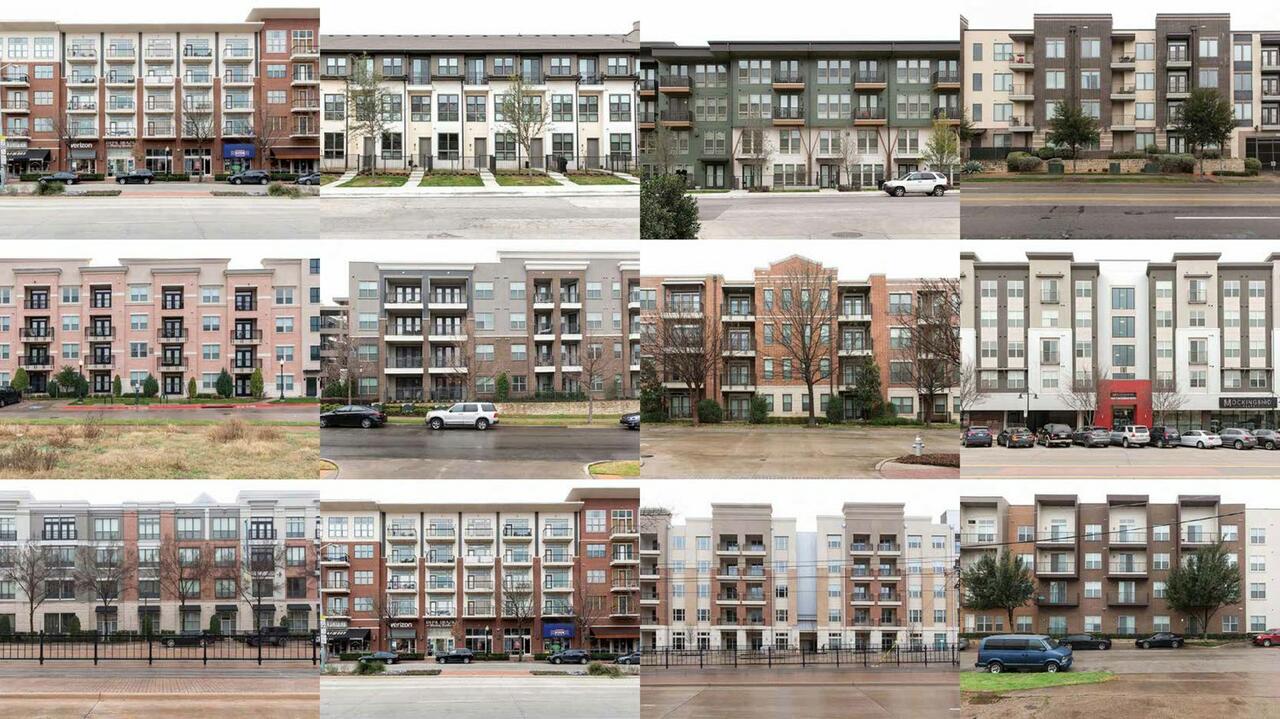
Almost 30 years after the publication of The Generic City I think it’s clear Koolhaas’ fears were well founded. Architecture’s march towards blank homogeneity is perhaps most obvious in the quick build, low-cost apartment blocks that have rapidly spread across the United States.

Justin Fox writing for Bloomberg:

“Cheap stick framing has led to a proliferation of blocky, forgettable mid-rises. (…) These buildings are in almost every U.S. city. They range from three to seven stories tall and can stretch for blocks. They’re usually full of rental apartments, but they can also house college dorms, condominiums, hotels, or assisted-living facilities. Close to city centers, they tend toward a blocky, often colorful modernism; out in the suburbs, their architecture is more likely to feature peaked roofs and historical motifs. Their outer walls are covered with fiber cement, metal, stucco, or bricks.”

This architectural style, characterised by boxy forms and unconvincing cladding, goes by names such as Fast-Casual Architecture and McUrbanism. But perhaps most commonly, these buildings are known as five-over-ones.

When Justin Fox drove across the US, he realised that they were not specific to one city or state. They were everywhere. And they were proliferating: 

“In 2017, 187,000 new housing units were completed in buildings of 50 units or more in the U.S., the most since the Census Bureau started keeping track in 1972. By my informal massaging of the data, well over half of those were in blocky mid-rises.”

But why is this the case? Why are the majority of large American buildings succumbing to the same style?

Coby Lefkowitz offers four reasons in his essay, “Why Everywhere Looks the Same”. First, unlike in the early 20th century, developers are increasingly constrained by building codes. Second, rapidly rising land costs cause developers to pack as many properties as possible into every site. Third, the rising barriers to entry have caused the industry to consolidate. And fourth, developers seek to reduce their costs by reusing the same plans across multiple sites:

“It would be disappointing enough to fail in gracing a land as physically beautiful as the US with the built companions it deserves. But it’s downright shameful that we deprive ourselves of living in interesting, meaningful, and wonderful places, given the thousands of precedents for inspiration worldwide, and many hundreds within our borders. Instead, we’ve copied and pasted our society from the most anodyne, the most boring, and the most bleh. We’ve all seen them. Covered with fiber cement, stucco, and bricks or brick-like material. They’ve shown up all over the country, indifferent to their surroundings. Spreading like a non-native species.”

America’s five-over-one architecture

Cities once felt rooted in time and place. The Victorian grandeur of London. The Art Deco glamour of New York. The neon modernity of Tokyo. But with anodyne architecture spreading across the United States, cities are beginning to lose their contextual identities. They are all starting to look the same:

“Institutional developers march forward, ignorant of what makes Portland, Maine different from Portland, Oregon, or Philadelphia from Kansas City. Unique local traditions? Completely different climates? Hah! Joke’s on us. A box fits just as well in any of these places.”

And it isn’t just the design of our residential buildings but our professional ones as well.

In an article for Grist, Heather Smith describes the homogeneity of the office parks she’d pass on the way to her mother’s place of work and how present day Silicon Valley feels so similar.

“All the offices and factories along the way to my mom’s office were smaller versions of the same thing — set back from the road, behind deep rectangles of rolling green lawn, no sidewalks. Sometimes clusters of begonias added accent marks, or regimented little bushes pruned into spheres or squares.”

Smith continues:

“I thought about this recently when I went driving through Silicon Valley, because I was surprised at how similar it was to the neighborhoods that I had grown up in. Not that it was an exact replica (…). But the architecture was the same — the same low-slung buildings, set back from the street by parking lots, each complex its own self-contained bubble, separated from the road by a row of trees.”

So, the places where we live and work have begun to converge upon a single style, but we’re also seeing the same trend occur in the way we travel between them.

Cars all looks the same

In 2015, the ex-Chairman of BBH London, Jim Carroll recalled his realisation 32 years earlier that aerodynamic tests had begun to make all cars look alike:

“Some of you will recall the day in 1983 when we woke up and noticed that the cars all looked the same. There was a simple explanation. They’d all been through the same wind tunnel. We nodded assent at the evident improvement in fuel efficiency, but we could not escape a weary sigh of disappointment. Modern life is rubbish.”

In Carroll’s opinion, because all vehicles underwent the same wind tunnel tests, manufacturers were independently converging on the same optimal set of forms, proportions and dimensions. And as a result, homogeneity in car design was increasing.

What Carroll didn’t realise was that things were about to get a lot worse.

Sat at a red light, Drew Magary took the opportunity to scope out some new car ideas. Suddenly he saw an SUV that looked attractive. But he couldn’t quite see the badge. Another car was blocking his line of sight:

“Maybe it’s a Bimmer,” I said to the dog. “It kinda looks like one.” It wasn’t. It was a Hyundai Santa Fe, which kinda resembles the Acura RDX, which kinda resembles the Volvo XC60, which kinda resembles the BMW X3. (…) These four models are all 75 inches wide, 66 inches high (save for the Volvo, which is 65), and they only differ in length by a maximum of three inches. They all have rear quarter windows smaller than a porthole on a submarine. They all have chrome accents to increase the glam factor by, like, five percent. And they all abhor right angles, (…). They’re spiritual clones, and they’re not exceptions in being so.”

The wind tunnel effect (original image source unknown)

But why do so many modern cars look the same?

Jim Carroll’s wind-tunnel theory is certainly one reason. Another is that the automotive giants increasingly share vehicle “platforms” between the many brands that they operate. And Ian Callum, who led design at Jaguar-Land Rover for two decades, provides a third theory.

“There was a time when you could identify the country the car came from. But today, basically every company makes cars for basically every country (…). Cars are now designed for the broadest possible audience, across the broadest number of countries, to be manufactured in the most efficient possible way.”

Callum continues:

“Before the typical car designer can even begin sketching out a model, they’re given specs from the packaging department (…). The measurements might vary within millimetres. These strict dimensions are agonisingly chosen to please the needs of the wind tunnel, to adhere to government safety regulations, to properly accommodate the average American family’s collective weight of 78,000 lbs., and to allow for enough cargo space for all their crap.”

These three theories explain why the three-dimensional design of cars has been converging over time. But they don’t explain why the colour of cars has converged as well.

According to data shared by Jökull Solberg, around 40% of cars sold in 1996 were monochromatic (black, white, silver or grey). 20 years later that figure had increased to 80%.

There are many suggestions for why this might be. Perhaps these colours come as standard and everything else is an optional upgrade. Perhaps brighter colours fade more quickly. Maybe people buy less vibrant colours when times are more turbulent. Maybe the resale market for monochromatic cars is more buoyant. Or maybe the paired-back design of smartphones informed stylistic trends in the auto industry. 

Regardless, the result is the same. Where once carparks were a kaleidoscope of reds, blues and greens, today they capture a sea of desaturation.

And what’s more? The visual identities of car brands seem to be following suit. In September 2020, Vauxhall released a modernised, minimal marque. According to Henry Wong at Design Week:

“Vauxhall unveiled its new logo last week, a “confidently British” look, which reworks the griffin icon and introduces a blue-and-red colour scheme. Most prominent is its new flat styling — a simplified version of the logo’s previous 3D look. Vauxhall calls the redesign the “progressive face of the brand”.”

The “blanding” of automotive brand identities

Vauxhall had ditched a logo that looked like a chrome sculpted bonnet badge and replaced it with a flatter, thinner, altogether simpler execution. But they weren’t the only one. As Wong says, at least five other major manufacturers had charted a similar course:

“It’s a familiar story within car branding of late. Audi first unveiled a minimalist-inspired rebrand in 2018, but it’s been followed by a host of other marques in the past year. Volkswagen, BMW, Toyota, Nissan have all revealed new branding and each with a flat logo.”

So, the cars we drive, their colours and their logos have begun to converge upon a single style, but we’re also seeing the same trend occur in the way we look ourselves.

People all look the same

In December 2019 the journalist Jia Tolentino set about investigating a troubling trend. Many celebrities and influencers had started to resemble each other. 

“This past summer, I booked a plane ticket to Los Angeles with the hope of investigating what seems likely to be one of the oddest legacies of our rapidly expiring decade: the gradual emergence, among professionally beautiful women, of a single, cyborgian face. It’s a young face, of course, with poreless skin and plump, high cheekbones. It has catlike eyes and long, cartoonish lashes; it has a small, neat nose and full, lush lips. It looks at you coyly but blankly, as if its owner has taken half a Klonopin and is considering asking you for a private-jet ride to Coachella.”

The look that Tolentino is describing is the result of (at least) three conspiring trends. The growing market for injectable treatments is driving a trend for physical enhancements. The rise of apps such as FaceTune is driving a trend for digital enhancements. And make-up techniques such as “strobing” and “contouring” are driving a trend for cosmetic enhancements. Over the last decade, these trends have developed in parallel, each feeding and fueling the other.

Starting at the top, Tolentino discusses the rising accessibility of beauty treatments such as Botox and fillers:

“Twenty years ago, plastic surgery was a fairly dramatic intervention: expensive, invasive, permanent, and, often, risky. But, in 2002, the Food and Drug Administration approved Botox for use in preventing wrinkles; a few years later, it approved hyaluronic-acid fillers, such as Juvéderm and Restylane, which at first filled in fine lines and wrinkles and now can be used to restructure jawlines, noses, and cheeks. These procedures last for six months to a year and aren’t nearly as expensive as surgery. (…) You can go get Botox and then head right back to the office.”

But the cost of achieving this look, which has become known as “Instagram Face”, is even lower than one may imagine. Whilst the average price per syringe of filler is $683, social sharers can now use apps to achieve similar results.

Instagram Face

Rebecca Jennings writing for Vox:

“Instagram Face is so ubiquitous that there are now special filters that give you the look digitally if you can’t afford the real thing. (…) Almost no one is born with Instagram Face — by virtue of it being associated with a digital platform, the look is always mediated and performed — and even those who have it naturally still use tools like FaceTune to enhance their already algorithmically perfect features.”

Finally, these physical and digital enhancements are complemented by a third, altogether less dystopian, trend: cosmetic enhancements. Here make-up, and an almost endless supply of YouTube tutorials, are used to alter the perceived bone structure of a face.

Julia Brucculieri for the Huffington Post:

“Social media influencers these days are starting to look like beauty clones. You know the look: a full pout, perfectly arched eyebrows, maybe some expertly applied eyeliner, topped off with a healthy dose of highlighter and cheek contouring. With a few makeup brushes, a contour palette and some matte lip color, you can be well on your way to looking like everyone else.”

So where did all of this begin?

According to the make-up artist Colby Smith, Kim Kardashian is patient-zero of Instagram face. Ultimately, he says, every social media star’s goal is to look like her.

And Smith isn’t the only one to hold this opinion. Writing for The Cut, Kathleen Hou offers a similarly provocative opinion.

“Instagram’s beauty posters tend to look like they’re all the same woman, and that woman is Kim Kardashian. Thanks to hundreds of “Get the Look” tutorials, it’s never been easier to strobe and contour yourself into a facsimile of the star. So, no wonder there’s a cloning effect.”

This may seem like an exaggeration. There is, however, a truth at the centre of the assertion.

When The New Yorker interviewed Beverley Hills based plastic surgeon Jason Diamond, he claimed around a third of all his patients aspire to become a Kardashian doppelgänger:

“I’d say that thirty percent of people come in bringing a photo of Kim, or someone like Kim—there’s a handful of people, but she’s at the very top of the list, and understandably so.”

And we haven’t only started to look alike from the neck up. Dame Vivienne Westwood, the late fashion designer best known for bringing the counter-cultural punk scene onto the catwalk, comments on the way clothing has started to conform:

“Everybody looks like clones and the only people you notice are my age. I don’t notice anybody unless they look great, and every now and again they do, and they are usually 70. We are so conformist, nobody is thinking. We are all sucking up stuff, we have been trained to be consumers and we are all consuming far too much. I’m a fashion designer and people think, what do I know? But I’m talking about all this disposable crap.”

So, the way we look and the way we dress has begun to converge upon a single style. But when we look at the content we consume, the story doesn’t get much better.

Media all looks the same

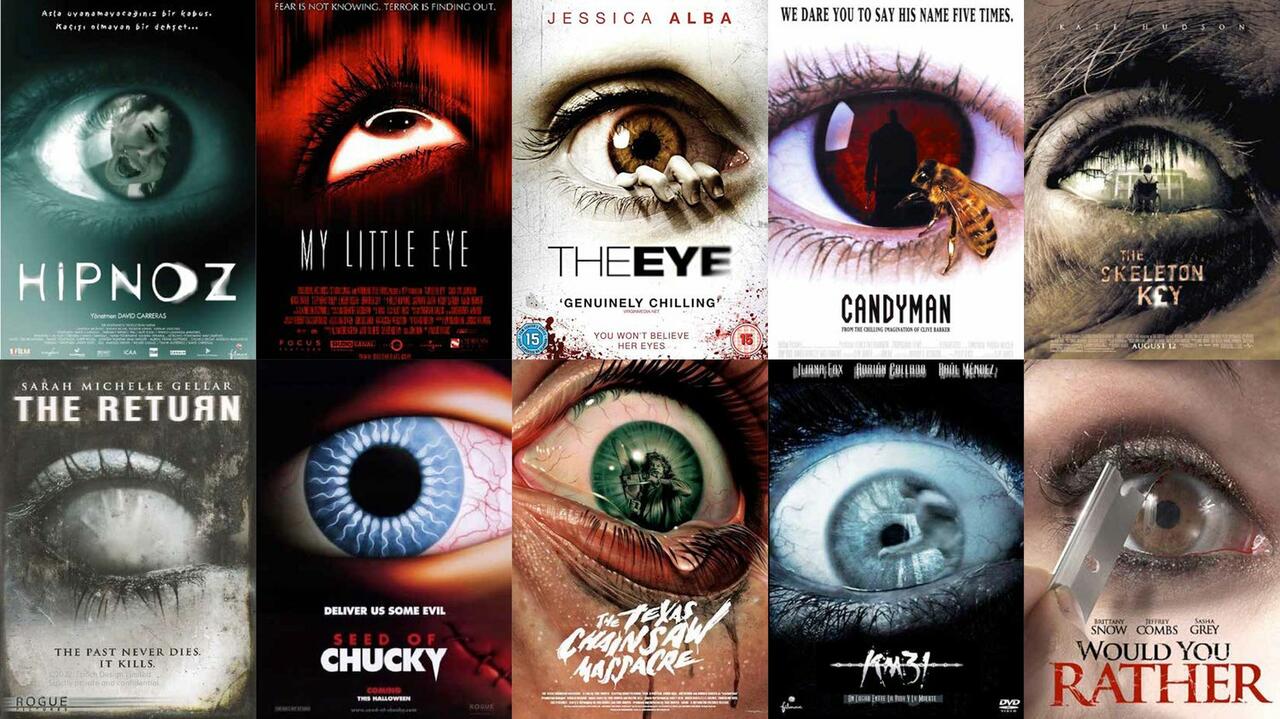
In the early 2010s, French blogger Christophe Courtois began curating movie posters that conformed to strikingly similar formulas.

Rom-coms often used a guy and a girl standing back-to-back against a white background. Horror films featured a close up of an eye. Action films opting for a lone character, dressed in black with their back to the camera.

Courtois’ series perfectly illustrates how, in the 21st Century, every genre of film sticks to a relatively narrow set of clichés, codes and conventions that promoters slavishly abide by.

Christophe Courtois’ cinematic clichés

In Hadley Freeman’s book Life Moves Pretty Fast, Oscar winning director Steven Soderbergh argues that this is the natural result of testing:

“If you’ve ever wondered why every poster and every trailer and every TV spot looks exactly the same, it’s because of testing. It’s because anything interesting scores poorly and gets kicked out. (…) I’ve tried to argue that maybe the thing that’s making it distinctive, and score poorly, actually would stick out if you presented it to these people the way the real world presents it. And I’ve never won that argument.”

But is the homogenisation of Hollywood a new phenomenon?

To find out Adam Mastroianni analysed the top 20 grossing films in every year since 1977 and coded whether each was part of a “multiplicity” (i.e. a sequel, prequel, franchise, spin-off, reboot etc.).

What he found was surprising: 

“Until the year 2000, about 25% of top-grossing movies were prequels, sequels, spinoffs, remakes, reboots, or cinematic universe expansions. Since 2010, it’s been over 50% ever year. In recent years, it’s been close to 100%.”

Mastroianni continues:

“In 2021, only one of the ten top-grossing films (the Ryan Reynolds vehicle Free Guy) was an original. There were only two originals in 2020’s top 10, and none at all in 2019.”

A further finding for the research was that the revenue generated by the top 20 movies was, until 2015, around 40% of that generated by the top 200. Since then however that 40% figure has begun to climb even higher, crossing the 60% threshold in 2021.

In short, the top 20 films are becoming both bigger and more alike.

But this isn’t just happening in film. In every corner of pop culture, a smaller number of “blockbusters” is claiming a larger share of the market. What were once creative powerhouses have become factories of the familiar.

Take books.

“It used to be pretty rare for one author to have multiple books in the top 10 in the same year. Since 1990, it’s happened almost every year. No author ever had three top 10 books in one year until Danielle Steel did it 1998. In 2011, John Grisham, Kathryn Stockett, and Stieg Larsson all had two chart-topping books each. (…) In the 1950s, a little over half of the authors in the top 10 had been there before. These days, it’s closer to 75%.”

You can see this creative convergence for yourself when you next visit a bookstore. In fiction you’ll see many popular books following a “girl with…” naming convention. Of course, there’s Larsson’s “The Girl with the Dragon Tattoo”, but we’ve also seen Paula Hawkins’ “The Girl on the Train”, M. R. Carey’s “The Girl With all the Gifts” and A. J. Grayson’s “The Girl in the Water”.

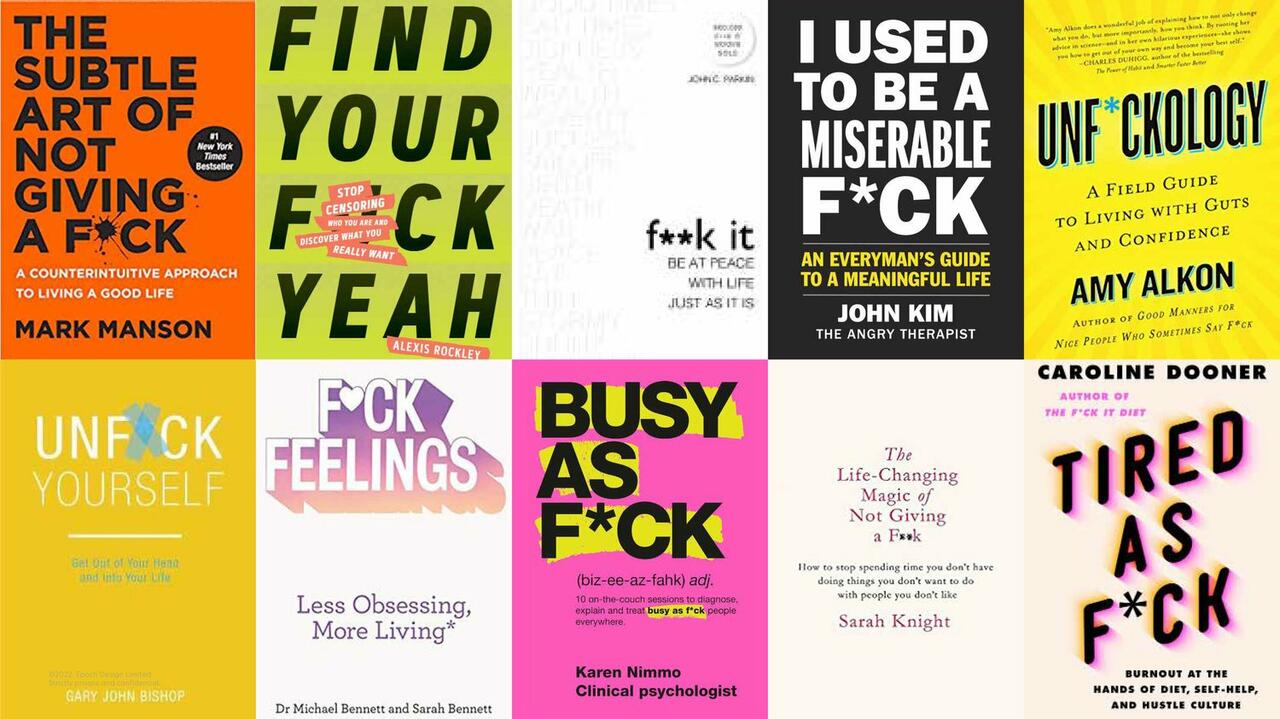
In non-fiction, if you visit the self-help category, you’ll notice that every book title seems to include a swear word. We have Mark Manson’s “The Subtle Art of not Giving a Fuck”, Sarah Knight’s “The Life Changing Magic of Not Giving a Fuck” and Alexis Rockley’s “Find your Fuck Yeah.”
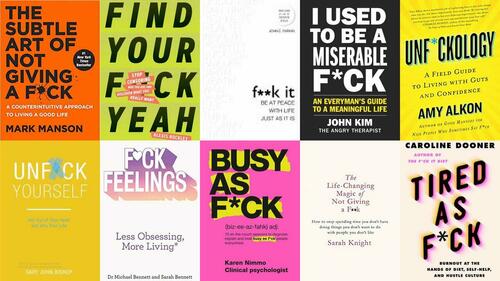
Sweary self-help books

Video games are no different.

In the late 1990s, 75% or less of the best-selling video games were franchise instalments. Since 2005, it’s been closer to 100%.

I’ll quote Keith Stuart, writing for The Guardian, at length:

“The absence of the E3 expo in Los Angeles for the past two years has left a gigantic vacuum in the video game calendar. Last week, the industry did its best to fill that gaping content maw with three online events – the Summer Game fest, the Xbox and Bethesda showcase and the PC gaming show. They were underwhelming for many seasoned players. Major reveals included a remake of The Last of Us, a remake of Call of Duty: Modern Warfare II, Street Fighter 6, Final Fantasy XVI and news about the reimagining of the classic role-player System Shock.”

So, our movies, books and video games have all begun to look the same. But it’s not just the content we consume. When we look at the content brands produce the story doesn’t get much better.

Brands all look the same

In 1982 the American fashion photographer Irving Penn shot an ad for Clinique that became known as “the shelfie”. The advert is simply a photograph of the inside of a medicine cabinet. A bright white background. Glass shelves. Bottles of pills. And a few well branded Clinique products.

Since this iconic 80s ad, many other brands have created their own shelfies, including Selfridges, e. l. f. and Billie. But this isn’t the only tried and tested trope.

Here’s AIGA Eye on Design:

“There are many more oft-mimicked setups like the shelfie currently bouncing around the zeitgeist; one omnipresent shot includes objects placed on a mirror reflecting the sky, giving the illusion of a product floating in midair. Another example uses a dense pattern of water droplets to refract a single item into a series of psychedelic miniatures, while yet another places subjects in front of faux scenic backdrops reminiscent of a low-budget Sears photo studio. Each of these distinct setups is utilized broadly and across industries, with the same composition and concept seen on the Instagram feeds of a major beverage syndicate and an indie skincare brand alike.”

Shelfies

In an article for The Cut, titled The Tyranny of Terrazzo, Molly Fischer pushes this thought one step further.

Whilst there is the shelfie trope and the mirror trope and the water droplet trope, these layouts all seem to share a surprisingly consistent style of art direction. They might be compositionally different, but they are conceptually alike:

“And then there are advertisements, making up a visual world of their own. The products on view (cookware, supplements, stretchy clothes) occupy blank pastel landscapes manipulated by a diversity of hands. These aren’t ads that bellow or hector; they whisper, in restrained sans-serif fonts, or chastely flirt, in letters with curves and bounce. They’re ads, sure, but they’re so well designed. In this era, you come to understand, design was the product. Whatever else you might be buying, you were buying design, and all the design looked the same.” 

Whilst Clinique’s original Shelfie hails from the 80s, it wasn’t until the 2010s that it became a more widely adopted style. And the majority of companies who did so were digital-first, DTC brands.

Elizabeth Goodspeed argues this is because these brands are more likely to draw inspiration from the same vast online sources. The result, she says, is a “moodboard effect”: 

“This kind of visual homogeneity is a common occurrence in the art direction world, where ubiquitous styles operate less like trends and more like memes; remixed and diluted until they become a single visual mass. In today’s extremely-online world, the vast availability of reference imagery has, perhaps counterintuitively, led to narrower thinking and shallower visual ideation. It’s a product of what I like to call the “moodboard effect.”

So, designers use the same online platforms, draw inspiration from the same sorts of imagery and, in turn, create broadly the same types of adverts.

But it isn’t just advertising that is causing brands to all look the same. Their visual identities are converging as well.

In December 2018, Thierry Brunfaut and Tom Greenwood published an article in Fast Company where they coined a new word: Blanding.

“The worst branding trend (…) is the one you probably never noticed. I call it blanding. The main offenders are in tech, where a new army of clones wears a uniform of brand camouflage. The formula is sort of a brand paint-by-numbers. Start with a made-up-word name. Put it in a sans-serif typeface. Make it clean and readable, with just the right amount of white space. Use a direct tone of voice. Nope, no need for a logo. Maybe throw in some cheerful illustrations. Just don’t forget the vibrant colors. Bonus points for purple and turquoise. Blah blah blah.”

Companies like AirBnB, Spotify and eBay have all dropped colourful logos with expressive typography for a straighter, stricter, altogether more muted, alternative.

The homogeneity of modern brands

Ben Schott writing for Bloomberg:

“Visually, blands are simple, neutral and flat. The palette is plain and pastel (with the occasional vibrant splash); the mood is upbeat and happy, or pensive and cool, but never truly real; the dress-code is smart-casual. Bland people are stock-photo attractive (or quirkily jolie laide). (…) Complex products and technical processes are illustrated by cute cartoons or Noun Project icons. Bland logos are confident but cute, utilizing an array of tweaks and twists to provoke the all-important “smile in the mind”.”

While the tech sector has led the way on blanding, we see the trend towards flatter, more lifeless, identities playing out in categories from the high-end world of fashion to the more mass world of personal care.

In a November 2021 article, title Distinction Rebellion, Contagious claimed that more and more brands seem content to drift along in a sea of sameness:

“Look up any new corporate brand identity unveiled over the past decade and you will almost certainly find yourself staring at a flattened and simplified version of the company’s old logo. The aesthetic has become so ubiquitous that it’s acquired its own name – blanding.”

So, advertising and brand identities are becoming more and more alike. But so too are the taglines brands employ.

Shai Idelson, Strategy Director at ad agency BBH, collected a list of 27 brands whose taglines follow the “Find Your X” sentence structure. These include Lucozade’s “Find Your Flow”, Rightmove’s “Find Your Happy” and Volvic’s “Find Your Volcano”.

Idelson says:

“I love end-lines. The delicate art of capturing a meaningful thought about a brand or a product in as few words as possible. A great end-line will touch my heart and stay in my memory forever. I still remember some from my childhood. But in the last few years, something happened to end-lines. (…) The linguistic similarity is staggering.” 

The same “insight” that sits behind the 27 taglines (that young consumers celebrate individuality above all else) has also led to the “X, Your Way” end line construction. We have Nespresso’s “Indulge, Your Way”, Sonos’ “Sound, Your Way”, Dunelm’s “Dun, Your Way” and many, many more.

And so brand adverts, identities and taglines are all starting to look the same. But where does this all leave us?

Conclusion

So, there you have it. The interiors of our homes, coffee shops and restaurants all look the same. The buildings where we live and work all look the same. The cars we drive, their colours and their logos all look the same. The way we look and the way we dress all looks the same. Our movies, books and video games all look the same. And the brands we buy, their adverts, identities and taglines all look the same.

But it doesn’t end there. In the age of average, homogeneity can be found in an almost indefinite number of domains.

The Instagram pictures we post, the tweets we read, the TV we watch, the app icons we click, the skylines we see, the websites we visit and the illustrations which adorn them all look the same. The list goes on, and on, and on.

UGC all looks the same

There are many reasons why this might have happened.

Perhaps when times are turbulent, people seek the safety of the familiar. Perhaps it’s our obsession with quantification and optimisation. Or maybe it’s the inevitable result of inspiration becoming globalised.

Regardless of the reasons, it seems that just as Komar and Melamid produced the “people’s choice” in art, contemporary companies produce the people’s choice in almost every category of creativity.

But it’s not all bad news.

I believe that the age of average is the age of opportunity.

When every supermarket aisle looks like a sea of sameness, when every category abides by the same conventions, when every industry has converged on its own singular style, bold brands and courageous companies have the chance to chart a different course. To be different, distinctive and disruptive.

So, this is your call to arms. Whether you’re in film or fashion, media or marketing, architecture, automotive or advertising, it doesn’t matter. Our visual culture is flatlining and the only cure is creativity.

It’s time to cast aside conformity. It’s time to exorcise the expected. It’s time to decline the indistinguishable.

For years the world has been moving in the same stylistic direction. And it’s time we reintroduced some originality.

Or as the ad agency BBH says.

When the world zigs. Zag.

Tyler Durden
Tue, 03/28/2023 – 23:05

via ZeroHedge News https://ift.tt/G1pu83e Tyler Durden

Trump Says He Has A Plan To ‘Solve’ Ukraine War In 24 Hours If Reelected

Trump Says He Has A Plan To ‘Solve’ Ukraine War In 24 Hours If Reelected

Former President Trump in a new Monday night interview on Fox News declared he would “solve” the Russia-Ukraine war “in 24 hours” if he’s elected president. His words came following his kickoff campaign rally for his 2024 White House bid held in Waco, TX over the weekend. 

He told a crowd of many thousands: “I will prevent World War III, which we’re heading into” – and was met with widespread applause. But in his Monday appearance on Sean Hannity’s show, Trump explained: “If it’s not solved, I will have it solved in 24 hours with Zelensky and with Putin.”

Via ABC: Helsinki summit in 2021

“The key is the war has to stop now because Ukraine is being obliterated,” Trump said.

Recently both Ukrainian and Western officials have admitted heavy losses and that more ammo is needed on the front lines in order to match the Russians’ superior artillery bombardment and supplies. For over the past month pro-Kremlin forces have made steady gains around the strategic city of Bakhmut in Donetsk, having nearly encircled it. But the Ukrainians have kept up the fight, and poured more manpower and weapons in. 

China has this month tried to mediate in order to jump-start peace negotiations between the two warring sides, and Beijing has even had close contact with the Zelensky administration, but these efforts haven’t appeared to go anywhere thus far, also amid Washington and NATO skepticism. 

As for Trump, he remains confident, having repeated lately that he can ‘get along with’ and talk to Putin candidly. According to more from the Monday night Hannity interview:

“So you’d prefer if you were president, you think you would have a negotiated settlement?” Hannity asked Trump.

“Within 24 hours,” the former president replied.

Trump went so far as to emphasize he gets along “very well” with Putin. Recent polls have shown that a majority of Republican voters want to avoid deeper US involvement in the war.

A new IPSOS-Axios poll shows a divide on Ukraine policy among conservatives, with the debate and momentum clearly shifting in favor of those who want to avoid deeper US involvement in the war.

“Four in five Republicans want the U.S. to remain the world’s leading power — but fewer than half support giving Ukraine weapons and financial support to try to save itself from Russia, according to the latest wave of the Axios-Ipsos Two Americas Index,” an IPSOS-Axios poll published earlier in mid-March found.

Tyler Durden
Tue, 03/28/2023 – 22:45

via ZeroHedge News https://ift.tt/NpnYAFS Tyler Durden

Watch: Record Snowpack Triggers Massive Avalanche At Utah Ski Resort

Watch: Record Snowpack Triggers Massive Avalanche At Utah Ski Resort

Utah has experienced one of its snowiest winter seasons in history. Ski resorts are repeatedly breaking snowfall records while the risk of avalanches soars. 

A video was shared on Twitter on Monday, capturing the dramatic scene of a massive avalanche at Sundance Resort.

Sundance Resort tweeted the avalanche injured no one, and it happened just outside the boundaries of its trails. 

Last Friday, Utah broke the record for snowpack with more than 700 inches of snow this season.

Due to the record-high snowpack, the Utah Avalanche Center has posted a “considerable” avalanche risk for many areas in the state.

So much for global warming in Utah… 

Tyler Durden
Tue, 03/28/2023 – 22:05

via ZeroHedge News https://ift.tt/cl2vfRB Tyler Durden

Ron Paul: The Best Way To Protect US Troops In Syria

Ron Paul: The Best Way To Protect US Troops In Syria

Authored by Ron Paul via RPI, [emphasis ZH]

Last week saw a sharp increase in attacks on US troops occupying northeastern Syria, with a drone strike against a US base blamed on “pro-Iran” forces and a US counter-strike said to have killed at least 19 people. After the US retaliation, another strike by “pro-Iran” forces hit a number of US sites in Syria. It may be just a matter of time before there are more strikes against the 900 US troops based in Syria against Syria’s wishes. One US contractor was killed last time. Next time it could be many more Americans.

What’s behind the sudden escalation? Fundamental changes in the Middle East over the past month have highlighted how indefensible is the continued US occupation of Syria and Iraq.

Take, for example, the recent historic mending of relations between former arch-enemies Saudi Arabia and Iran which was brokered by Washington’s own arch-enemy, China. US policy in the Middle East has long been “divide and conquer,” dating back at least to the Iran/Iraq war in the 1980s. US switching sides in that war guaranteed that the maximum amount of blood was spilled and that the simmering hatreds would continue to prevent any kind of lasting peace.

Via APF

Then the US invaded Iraq twenty years ago and turned Iraq into an Iranian ally. That’s neocon foreign policy for you: a 100 percent failure rate.

So this month China, which is interested in creating a regional transportation corridor that would include Iran, came in and instead of bombing, invading, and occupying – Washington’s modus operandi – actually brokered the restoration of diplomatic relations between Saudi Arabia and Iran.

Republicans and Democrats in the US both love to attack China, but China has achieved what the US has resisted for years: peace in the region. Should we be surprised that the continued US occupation is not welcome in the Middle East?

The United States occupies that huge chunk of Syria where the oil and agriculture is located and the goal appears to be producing profits for US multinational corporations from stolen natural resources and preventing the natural wealth of Syria to be used to rebuild that country. Is it any wonder why the US is so unpopular in the Middle East?

How hypocritical is it that the Biden Administration has spent $100 billion of our dollars to expel Russia from occupying proportionally less territory in Ukraine that Washington occupies in Syria? And Washington claims to stand for the “international rules-based order,” while they decimated an Iraq and Afghanistan that did not attack us, and before that a Serbia that could not have threatened us if it wanted to.

The end of the US occupation of the Middle East is upon us and the sooner we realize that the better. We have no business meddling in their politics, occupying their territory, and stealing their resources. Americans joined the US Military to defend the United States against all enemies, foreign and domestic, yet they have been manipulated by corrupt DC officials into occupying foreign lands and stealing their oil. Maybe this is why the US military cannot meet its recruitment goals?

Here’s an easy way to protect US forces in Syria from further “Iran-allied” attacks: Bring them home. Tomorrow. Do not wait another day!

Tyler Durden
Tue, 03/28/2023 – 21:45

via ZeroHedge News https://ift.tt/atuTSdg Tyler Durden

California City Caught In National Controversy Over Critical Race Theory

California City Caught In National Controversy Over Critical Race Theory

Authored by Brad Jones via The Epoch Times (emphasis ours),

Heightened tensions among opposing sides regarding the teaching of critical race theory—or its underlying tenets—in K–12 schools erupted into chaos at a local school board meeting in Temecula, California, last week, creating deeper rifts in the community.

A special meeting is held to discuss critical race theory with the Temecula Valley Unified School District Board and invited experts in Temecula, Calif., on March 22, 2023. (Brad Jones/The Epoch Times)

The otherwise sleepy city tucked away in southwest Riverside County known best for its wineries has become the latest crucible in the heated war of words over critical race theory, or CRT.

The Temecula Valley Unified School District fell under the national media spotlight in December when a slate of newly elected conservative school trustees—Joseph Komrosky, Jen Wiersma, and Danny Gonzalez—were sworn into office. The trio shifted the balance of power on the school board and voted to ban CRT at the board’s first meeting after the Nov. 8 election.

The other trustees, Steven Schwartz and Allison Barclay, opposed the resolution banning CRT, both claiming that the topic isn’t taught in district classrooms.

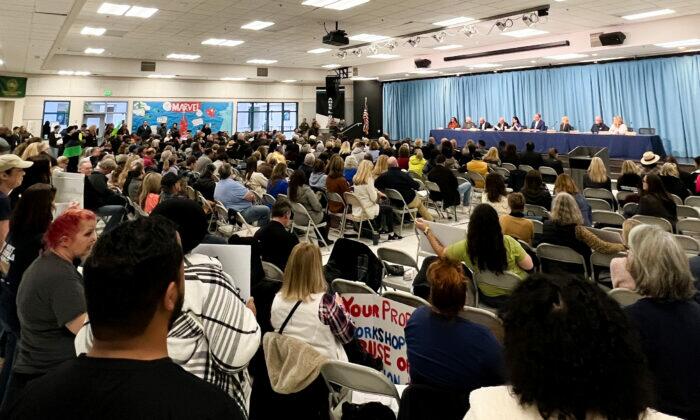
The special meeting on March 22, which lasted nearly five hours, was billed as a workshop to inform parents about CRT and why the school board banned it from being taught in classrooms.

We’re not debating whether we should have [CRT] or not. It is condemned. It is gone,” Komrosky said at the meeting. “We have local control here as school board members. We can make it explicitly clear what we condemn. Racism is morally reprehensible, and CRT is racism in disguise.

Dozens of activists, including parents, politicians, teachers, and students, showed up at James L. Day Middle School to protest the ban, while a few hundred others gathered to hear the presentations of six expert panelists.

People protest a special meeting to discuss critical race theory with the Temecula Valley Unified School District Board and invited experts in Temecula, Calif., on March 22, 2023. (Brad Jones/The Epoch Times)

The panelists were Dr. Joe Nalven, a professor of cultural anthropology, peace and justice, and indigenous religions at the University of San Diego; Walter H. Myers, an adjunct faculty member at Biola University and Master of Arts, Science, and Religion; Wenyuan Wu, director of Californians for Equal Rights, who spoke via Zoom; Esther Valdez-Clayton, an immigration attorney and former school board president; Brandy Shufutinsky, director of education and community engagement at the Jewish Institute for Liberal Values; and Chris Arend, former Paso Robles Joint Union High School District board member, who played an instrumental role in drafting the CRT ban resolution.

All of the panelists opposed CRT being taught in K-12 schools and told the audience that banning it is not a ban on teaching black history or ethnic studies, contrary to the signs and claims of protesters.

Audience Members Removed

The meeting got off to a raucous start with the public comment portion, as Deon Hairston, a local black pastor, gave a fiery speech against racism and the CRT ban.

Your continued blatant, willful ignorance of the black experience in this country is not only shameful, but also detrimental to the education and growth of our children,” he told the board and panelists who were invited to speak on the issue.

As he walked away from the podium, Hairston said a woman in the audience told him that, “If I feel that way, why don’t I get out of the country?” and he shouted the alleged comment to the crowd.

Hairston continued yelling and was warned twice before Komrosky told sheriff’s deputies to escort him out of the school auditorium.

As Hairston left the building, some protesters surrounded the woman and pointed at her, chanting “get that woman” and “kick her out,” and she was also later escorted out.

Gonzalez later told The Epoch Times the woman could be heard saying something, but he could not confirm what she said. The alleged comment was inaudible on recordings.

Komrosky suspended public comments and called a recess, but before order was restored, a student protester draped in a Pan-African flag confronted a parent. She walked towards the man and put her hand on his chest.

When the man said, “Don’t touch me,” San Jacinto City Councilor Brian Hawkins moved toward him, grabbing his arm and shouting repeatedly “That’s a child!” over the crowd until the man said “Shut up!” and walked away.

Deputies asked the man to leave and escorted him out.

The man, who asked not to be named for fear of retaliation, told The Epoch Times he has retained legal counsel and is prepared to sue anyone making false accusations against him.

A narrative being spread that he sought out the girl with the flag and got in her face is “is a complete lie,” he said.

Jenn Reeves, a local activist, recently posted video clips on TikTok of the incident between the man and the girl with the flag from the March 22 meeting, claiming Hawkins prevented the man from “assaulting” the girl.

But, several videos show the girl with the flag jumping in front of the man and putting her hand on his chest.

“I didn’t know what happened, and then I looked down. I saw it was a person, and I pointed at my chest. … I just said ‘Don’t touch me,’” the man said.

Hawkins, who was wearing a Black Panther Party hoodie under his open suit jacket, ran unsuccessfully for Congress as a Republican in 2022 and adamantly opposed CRT during his campaign.

San Jacinto City Councilor Brian Hawkins attends a special meeting to discuss critical race theory with the Temecula Valley Unified School District Board and invited experts in Temecula, Calif., on March 22, 2023. (Brad Jones/The Epoch Times)

He later told The Epoch Times he has changed his mind about CRT and left the GOP at the end of last year before registering as a Democrat in February.

The immediate solution for unity in the district is to repeal the CRT ban, Hawkins said.

“This piece of paper has caused more harm than good,” he said.

CRT Controversy

A San Diego parent who goes by the pseudonym Ben Richards and advocates for parents’ rights, told The Epoch Times that Temecula is now “the tip of the spear” in the national fight against critical race theory.

Richards claims there is a coordinated effort by educators and activist groups such as Fight Back Collective to portray those who oppose CRT as “white Christian nationalists” and “foment, coordinate and support leftist student walkouts,” in the district, Richards said.

Fight Back Collective states on its website that school boards across the United States “are being infiltrated by far-right white supremacists running on a campaign of ‘parents’ rights.’ Usually endorsed by hate groups such as Moms for Liberty and backed by dark money, these school board members are banning ‘CRT,’ attacking trans youth and LGBTQ+ kids, and running smear campaigns on teachers who support inclusivity.”

Students are being told they are either a racist, or an anti-racist and that in order to be the latter, they must become an activist and support CRT, Richards said.

“CRT seeks to create student activists and that is exactly what you’re seeing in Temecula,” he said.

Read more here…

Tyler Durden
Tue, 03/28/2023 – 21:05

via ZeroHedge News https://ift.tt/M7axVEf Tyler Durden

Clinton, Inc. Formed “Joint Venture” Of “Co-Conspirators” To Smear Trump: Durham

Clinton, Inc. Formed “Joint Venture” Of “Co-Conspirators” To Smear Trump: Durham

Special Counsel John Durham stated in a Monday night filing that Hillary Clinton’s 2016 campaign and researchers trying to dig up dirt on the Trump campaign “should be considered as co-conspirators” in an effort to smear Donald Trump with the Russia collusion hoax, Just the News reports.

According to Durham, Clinton and her cronies formed a “joint venture or conspiracy” in order to harm Trump’s chances of being elected.

Durham has just shown the whole world what major pieces of our Russiagate investigation revealed,” said former House Intelligence Committee GOP investigative counsel, Kash Patel. “Hard evidence, emails and text messages, showing the Clinton Campaign, Fusion GPS, Perkins Coie, Joffe, and the media were all synced in August of 2016 pushing the false Alfa Bank server story, while also all working on the Steele Dossier matter. Durham submits all this evidence as ‘joint venture conspiracy’ under the rules of evidence.”

Durham’s filing also highlights an unearthed text message from disgraced Clinton campaign lawyer Michael Sussmann in which he lies to the FBI about not working for Clinton when he hand-delivered now-discredited anti-Trump research prior to the election.

The existence of the text message between Sussmann and then-FBI General Counsel James Baker was revealed in a court filing late Monday night by Durham’s team. Prosecutors said they intend to show Sussmann gave a false story to the FBI but then told the truth about working on behalf of the Clinton campaign when he later testified to Congress.

“Jim – it’s Michael Sussmann. I have something time-sensitive (and sensitive) I need to discuss,” Sussmann texted Baker on Sept. 18, 2016, according to the new court filing. “Do you have availability for a short meeting tomorrow? I’m coming on my own – not on behalf of a client or company – want to help the Bureau. Thanks.”

Prosecutors said the text message will become essential evidence at trial to show Sussmann lied to the FBI. –Just the News

According to Durham, “The defendant lied in that meeting, falsely stating to the General Counsel that he was not providing the allegations to the FBI on behalf of any client,” adding “In fact, the defendant had assembled and conveyed the allegations to the FBI on behalf of at least two specific clients, including (i) a technology executive (“Tech Executive-1”) at a U.S.-based Internet company (“Internet Company-1″), and (ii) the Clinton Campaign.”

Sussmann eventually admitted he lied a year later during testimony in front of the House.

“We had a conversation, as lawyers do with their clients, about client 1 needs and objectives and the best course to take for a client,” Sussman told Patel in a sworn deposition. “And so it may have been a decision that we came to together. I mean, I don’t want to imply that I was sort of directed to do something against my better judgment, or that we were in any sort of conflict.”

Durham says he plans to present evidence that Sussmann worked with the Clinton campaign, ‘Tech Executive 1’ Rodney Joffe, and others in aforementioned “joint venture” to push the Russian collusion hoax, particularly the fabrication that Trump had a secret backchannel to the Kremlin via the Moscow-based Alfa bank.

“As an initial matter, the Government expects that the evidence at trial will show that beginning in late July/early August 2016, the defendant, Tech Executive-1, and agents of the Clinton Campaign were ‘acting in concert toward a common goal,’ … namely, the goal of assembling and disseminating the Russian Bank-1 allegations and other derogatory information about Trump and his associates to the media and the U.S. government,” reads the filing.

“The evidence of a joint venture or conspiracy will establish that in November 2016, soon after the Presidential election, Tech Executive-1 emailed a colleague, stating, “I was tentatively offered the top [cybersecurity] job by the Democrats when it looked like they’d win.'”

“In sum,” Durham’s filing concludes, “the above evidence, public information, and expected testimony clearly establishes by a preponderance of the evidence that the defendant and Tech Executive-1 worked in concert with each other and with agents of the Clinton Campaign to research and disseminate the Russian Bank-1 allegations.”

Tyler Durden
Tue, 03/28/2023 – 20:45

via ZeroHedge News https://ift.tt/2jUctsC Tyler Durden