Bombshell Vax Analysis Finds $147 Billion In Economic Damage, Tens Of Millions Injured Or Disabled

Bombshell Vax Analysis Finds $147 Billion In Economic Damage, Tens Of Millions Injured Or Disabled

A new report estimates that 26.6 million people were injured, 1.36 million disabled, and 300,000 excess deaths can be attributed to COVID-19 vaccine damages in 2022 alone, which cost the economy nearly $150 billion.
Research firm Phinance Technologies, founded and operated by former Blackrock portfolio manager Ed Dowd, Yuri Nunes (PhD Physics, MSc Mathematics) and Carlos Alegria (PhD Physics, Finance), split the impact of the vaccines into four broad categories to estimate the human costs associated with the Covid-19 vaccine; no effect or asymptomatic, those who sustained injuries (mild-to-moderate outcome), those who became disabled (severe outcome), and death (extreme outcome). Data on vaccine disabilities and injuries comes directly from the Bureau of Labor Statistics (BLS), while the excess death figures are derived from official figures on deaths in the US via two different methods (methodology here).

It’s important to note that people in one category (injured, for example) can move into latter categories of severity – which this analysis does not take into consideration.

“We need to remember that not only are these groupings an attempt to characterize different levels of damage from the inoculations, they are not static and could interact with each other,” reads the report. “For instance, there might be individuals who had no visible effects after vaccination but nonetheless could still be impacted.”

Individuals with mild injuries from the inoculations could, over time, develop severe injuries to the extent of being disabled, or an extreme outcome such as death.”

Estimating the economic cost

In analyzing each of the above categories, Phinance used absolute excess lost worktime (see previous report) to determine that the direct economic cost of vaccine injuries was $79.5 billion in 2022, and $52.2 billion for those with severe disabilities.

For deaths, Phinace used the average yearly absolute rise in excess deaths since 2021, which was 0.05% for the 25-64 year-old demographic, which amounted to $5.6 billion in lost productivity.

In total, they found a total “economic cost” of $147.8 billion in 2022 due to the Covid-19 vaccines.

As Dowd notes, these figures are just what can be currently measured, as things like “The knock effects such as lost productivity due to a worker being present but working at say 50%-75% of capacity is missed plus burn out from those picking up slack.”

“The multiplier effects are massive.”

 Now imagine the impact worldwide…

Tyler Durden
Tue, 03/28/2023 – 13:20

via ZeroHedge News https://ift.tt/0jWgkao Tyler Durden
The Case For Gold Is Looking Stronger

The Case For Gold Is Looking Stronger

Authored by Austin Mann via Knowledge Leaders Capital blog,

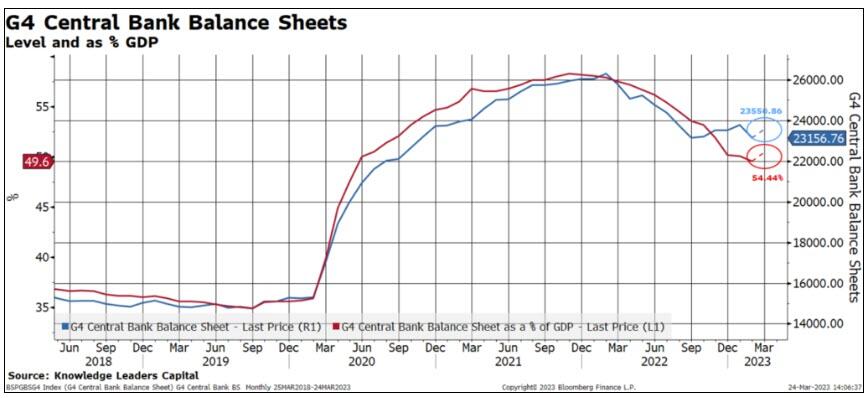
The Federal Reserve’s balance sheet grew by $394B in the past two weeks.

In the context of all G4 central banks, this move alone erases half of all quantitative tightening (QT) progress since the beginning of the year. A directional change like this could indicate the end of a short quantitative tightening cycle.

The dotted lines in the chart below demonstrate how this move would look without any additional balance sheet expansion from other G4 central banks.

So far, the ECB has been able to avoid a similar balance sheet expansion.

Credit Suisse did not require intervention, and the applicable policy came from the Swiss National Bank, not the ECB.

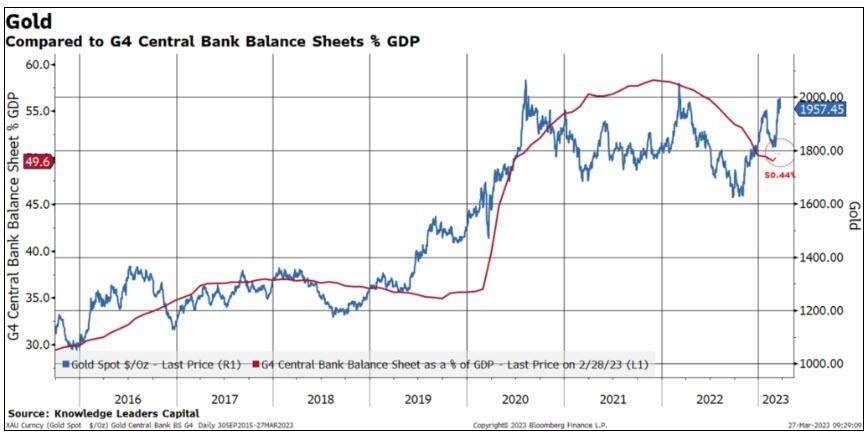
The price of gold in USD is correlated to G4 balance sheets as a percent of GDP.

Additional G4 central bank interventions causing a further increase in central bank balance sheets could be beneficial for gold.

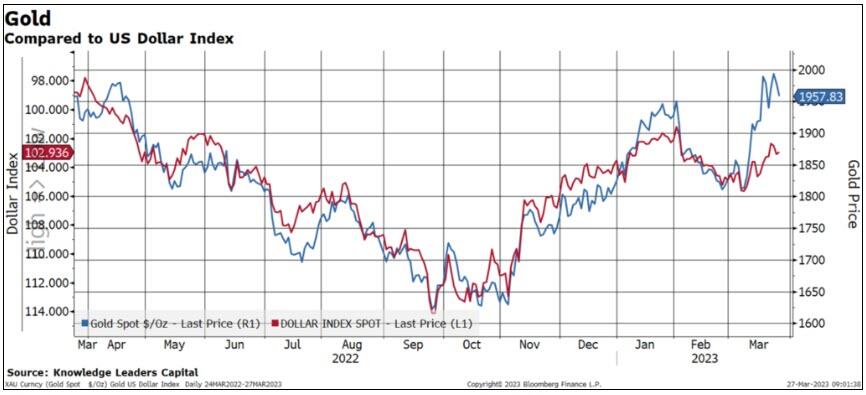
The price of gold is inversely correlated to the US dollar and now suggests a near 4% drop in the USD.

As of 12.31.22, none of the securities mentioned were held in the Knowledge Leaders Strategy.

Tyler Durden
Tue, 03/28/2023 – 13:06

via ZeroHedge News https://ift.tt/tWR6erN Tyler Durden

After Price Cuts, Teslas Now Lose Value Faster Than Rivals

After Price Cuts, Teslas Now Lose Value Faster Than Rivals

Those price cuts Tesla has recently put in play to help spur business may wind up not being the “perfect plan” after all.

That’s because a report from FT this morning says that Tesla vehicles wind up losing their value faster than rival vehicles after price cuts. In fact the “value of second-hand Tesla cars has collapsed since the electric-vehicle maker embarked on a series of price cuts,” the report notes.

A new Model 3 with a long-range battery, bought in January this year in the UK for £57,435 is estimated to fall 46% in value to £31,300 by January 2024, the report says, citing figures from industry pricing agency CAP HPI.

It seems clear the depreciation is a result of the price cuts. Over 12 months, the same model only fell 4% in price after September 2021. It was £48,435 new and was worth £46,300 a year later, FT wrote. 

Alarmingly for potential Tesla owners, competitors don’t seem to be experiencing a comparable loss of value. A £50,395 electric Polestar 2 purchased in January would be worth about £33,000 at the start of 2024, FT wrote. This is a 35% drop, compared to the 46% plunge for Tesla. 

The report notes that the steeper depreciation could results in Teslas being more expensive via financing deals. 

In the beginning of March, we noted that Tesla also cut prices on its Model S and Model X vehicles. This decision follows the investor day event held at the end of February, wherein Elon Musk stated that price cuts had sparked demand for more affordable models.

Musk claimed that the demand for Teslas was nearly unlimited and would increase significantly as the company made its vehicles more affordable. The recent price reductions for the S and X models imply that these vehicles may not have experienced the same boost in demand as the rest of the lineup when the company reduced prices earlier this year. 

In January, Tesla slashed the prices of its more affordable vehicles by as much as 20%, which enabled buyers to qualify for the tax incentive by putting the vehicles under a $55,000 cap. 

Musk directly addressed the price cuts during the investor day: “We found that even small changes in the price have a big effect on demand, very big.” 

And, apparently, an effect on residual value…

Tyler Durden
Tue, 03/28/2023 – 12:45

via ZeroHedge News https://ift.tt/TCtO2I5 Tyler Durden

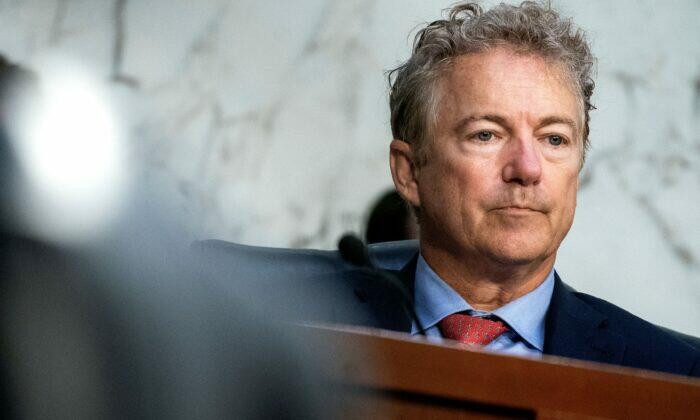
Staffer For Sen. Rand Paul “Brutally” Stabbed

Staffer For Sen. Rand Paul “Brutally” Stabbed

Authored by Mimi Nguyen Ly via The Epoch Times,

A staffer from Sen. Rand Paul’s (R-Ky.) office has been attacked in Washington, D.C., according to a statement from the congressman’s office.

In a statement to outlets, Paul said that a member of his staff “was brutally attacked in broad daylight in Washington, D.C.,” over the weekend.

“I ask you to join Kelley and me in praying for a speedy and complete recovery, and thanking the first responders, hospital staff, and police for their diligent actions,” he added.

“We are relieved to hear the suspect has been arrested. At this time we would ask for privacy, so everyone can focus on healing and recovery.”

In a statement on Monday, the Metropolitan Police Department of the District of Columbia (MPD) said the attack took place on March 25 and police were dispatched around 5:17 p.m. to 1300 block of H Street, Northeast, in response to a reported stabbing.

The victim was taken to a hospital for “treatment of life-threatening injuries.”

There has been no update as to the staffer’s condition as of late Monday.

The victim was identified as Phillip Todd, who serves on the Senate Homeland Security Committee, according to The Independent, citing MPD’s report. Paul is the top Republican on the committee.

According to the MPD report, the attacker “popped out” from corner to attack Todd, who was walking down the street with another person at the time.

The attacker stabbed Todd and subsequently ran off.

The suspect, Glynn Neal, 42, was arrested on the same day of the attack. He was charged with assault with intent to kill with a knife, according to the MPD statement.

Neal had been sentenced in 2011 to more than 12 years in prison for compelling two women to engage in prostitution, according to a release (pdf) from the Department of Justice.

Neal was released from prison just one day before the stabbing, reported Fox5DC, citing Federal Bureau of Prisons records.

The attack occurred weeks after Rep. Angie Craig (D-Minn.) was attacked in an elevator inside her Washington, D.C. apartment building on Feb. 9. The suspect, a homeless man, was arrested on the same day.

Tyler Durden
Tue, 03/28/2023 – 12:25

via ZeroHedge News https://ift.tt/azUkcpb Tyler Durden

“Economic Headwinds Are Building” – Jeff Gundlach Warns Of Imminent Recession

“Economic Headwinds Are Building” – Jeff Gundlach Warns Of Imminent Recession

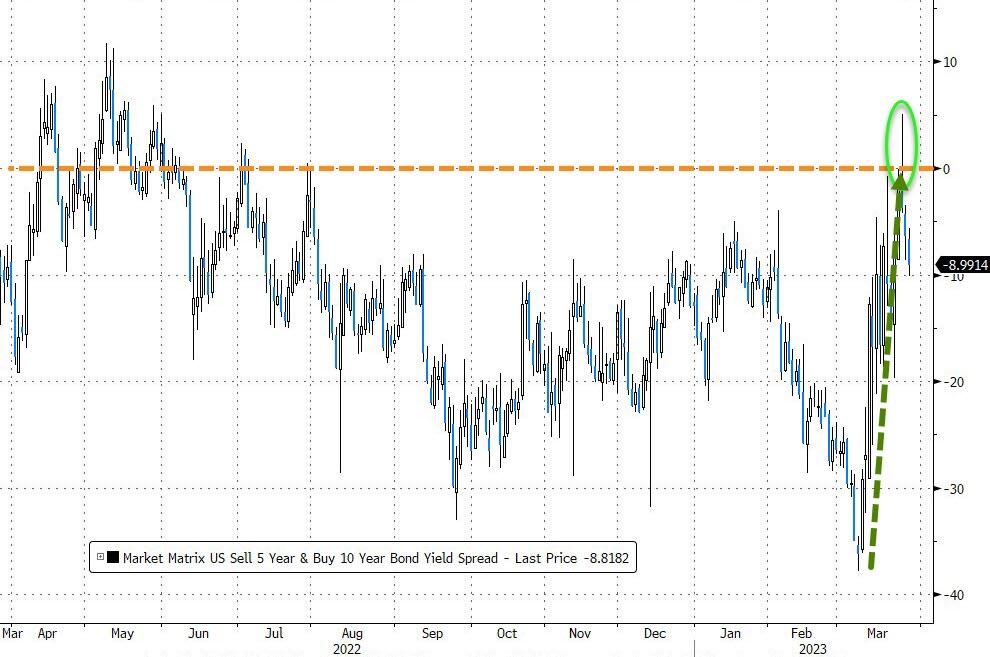
Echoing his comments from earlier this month, ‘Bond King’ Jeff Gundlach warns of an imminent recession – within the next few months – as the yield-curve suddenly steepens…

“The economic headwinds are building, we’ve been talking about this for a while, and I think the recession is here in a few months,” Gundlach said Monday during an interview with CNBC.

“All we really need is the unemployment rate to go higher.”

In fact, the 5s10s spread actually uninverted last week…

As Gundlach previously noted:

“In all the past recessions going back for decades, the yield curve starts de-inverting a few months before the recession,” adding that,

“I think it’s within four months at the most. Almost every indicator is flipped into high probability. The only one that hasn’t is the unemployment rate.”

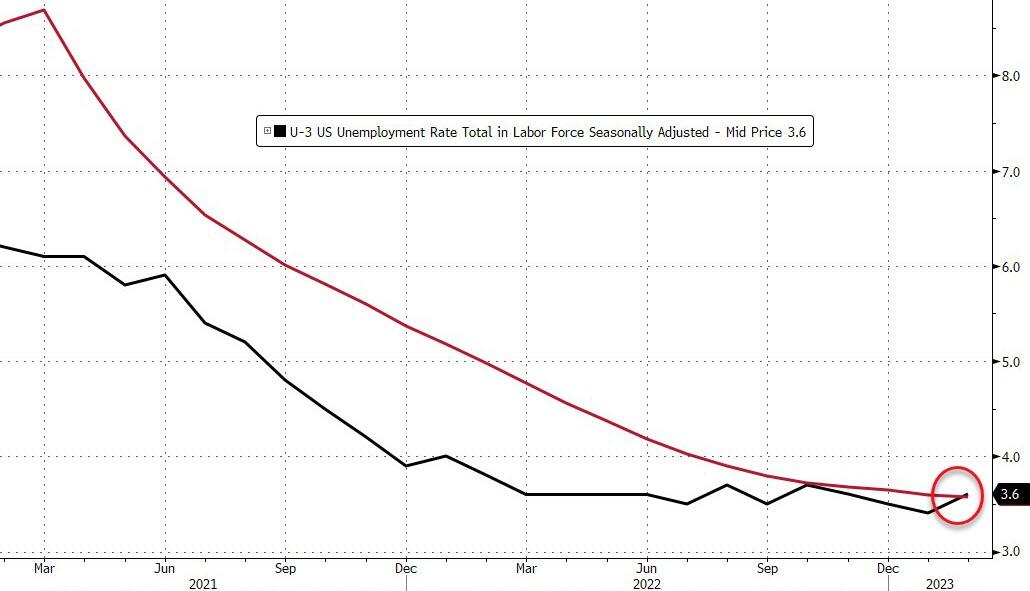
And with reference to that, Gundlach previously pointed out that at 3.6%, the unemployment rate just crossed back above its 12-month moving average…

Which, historically has been “a reliable indicator you’re on the doorstep” of recession.

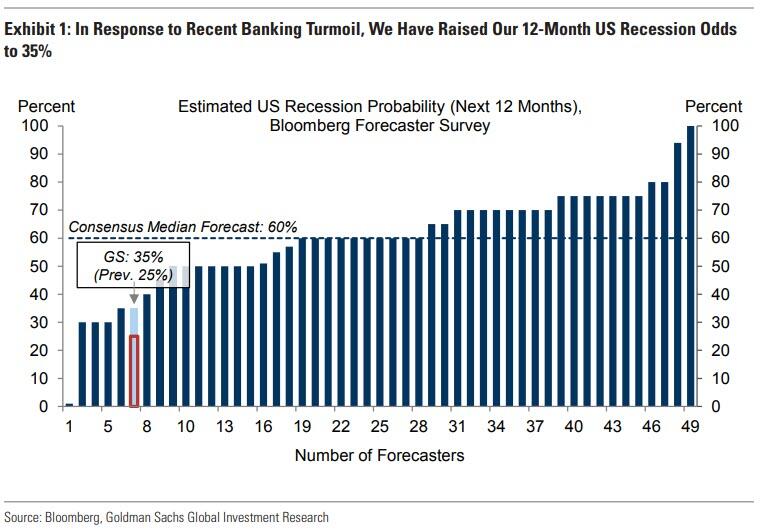
Gundlach is far from alone as even Goldman Sachs’ Jan Hatzius increased his forecast of recession odds within the next year to 35% (still well below the consensus 60% odds of recession)…

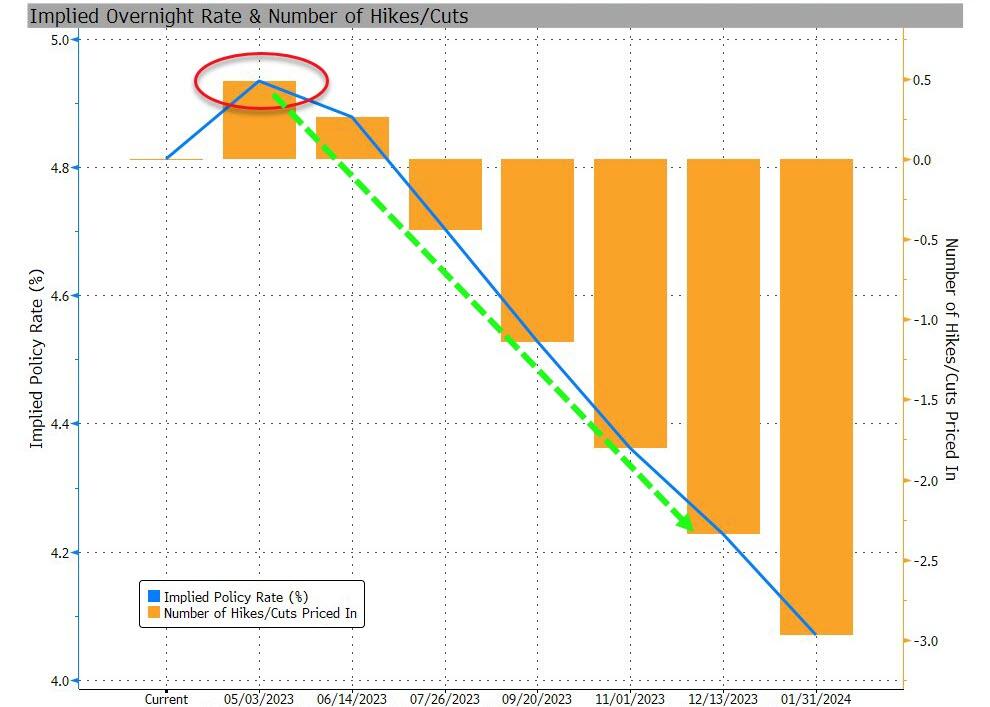
The Doubleline Capital founder also said he believes The Fed will “capitulate” and will cut interest rates “a couple of times” this year.

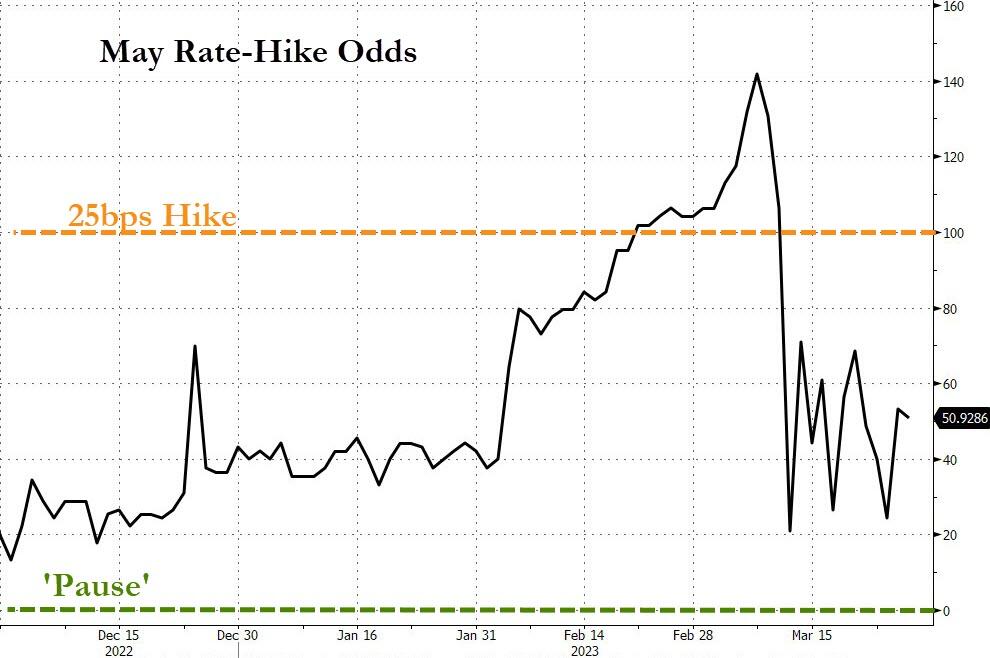
More directly, he warned that if the Fed raises rates again in May, the difference “between what you can get on T-bills and what you can get in the banking system will grow.”

He warned that such a scenario would “counter-productively cause great shrinkage of liquidity in the banking system, maybe some more problems with unrealized losses,” he said.

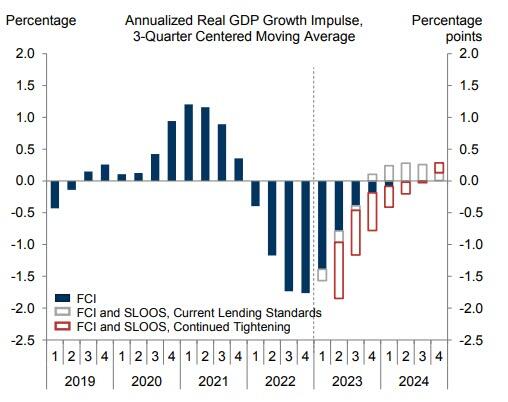
As Goldman notes, further monetary policy tightening combined with the contraction of the credit impulse from banks themselves will have a more serious drag on real GDP growth…

The new ‘bond king’ also opined on the insane volatility that markets (especially bond markets) have been experiencing recently:

The markets are so volatile, so much movement that it’s almost impossible to sell on weakness. The markets just go from a mineshaft type of decline and that’s true in the credit markets and I think it’s true in other risk assets as well,” Gundlach said.

The overall state of the economy is “clearly weak,” Gundlach concluded.

Watch the full interview below:

Tyler Durden
Tue, 03/28/2023 – 12:05

via ZeroHedge News https://ift.tt/8MyEUYx Tyler Durden

New York Lawmakers Want To Use a ‘Netflix Tax’ To Pay for the Subway


Subway seats in New York City

After New York City’s Metropolitan Transportation Authority (MTA) approved a budget authorizing a 5.5 percent fare increase to address chronic budget shortfalls, the state assembly flew into action coming up with ways to avoid that. New York’s latest tax scheme would attempt to pay for the MTA by hiking taxes on everyone from streaming services like Netflix to small delivery businesses to digital workers —basically, on everyone except the actual riders of public transportation.

Under its 2023 budget, the MTA is set to run a $600 million deficit, even after using nearly $1.8 billion in federal pandemic-related aid. Things will get even worse once that federal aid runs out—in 2025, the MTA is set to run a $3 billion deficit

In place of fare increases, Gov. Kathy Hochul has now proposed an increase on the top payroll tax rate paid by employers: from 0.34 percent to 0.5 percent in New York City and surrounding counties served by MTA trains and buses. State legislators have countered with a hodgepodge of proposals, including a 2 percent increase on the top statewide corporate tax rate, applying state and local sales taxes to streaming services, and a new $0.25 “delivery fee” on delivery transactions within New York (with some exceptions).

While in general taxes are difficult to directly connect to the government services a taxpayer receives, user fees are not—the fee paid is directly related to the service received. With the ridership landscape fundamentally changing, that model is becoming increasingly untenable as the MTA refuses to adapt.

Transit ridership in New York City, like in other cities across the country, took an enormous hit during the pandemic, with ridership rates dropping below 40 percent of pre-pandemic levels. While ridership rates have somewhat bounced back post-COVID, it’s unlikely that they’ll return to pre-pandemic levels anytime soon. MTA ridership levels for February 2023 across buses and subways was about 65 percent of those of February 2019.

Rates of remote work may have peaked during the pandemic, but most Americans returning to the office aren’t doing so on a daily basis, preferring instead to settle on a hybrid arrangement of working from the office some days and from home on others. To the New York City government, those days residents spend working from home are days residents are not swiping their MTA cards.

But most government agencies don’t believe that a shrinking mandate means less funds are required, and they try to fight the tide. The proposed solution by New York legislators to shift the burdens onto the perceived “winners” of the increasingly digitized economy has unfortunately been the preferred response.

Corporate income tax increases are nothing new, but “streaming taxes” are. While other states and localities have looked to target digital and streaming services for special taxes, New York’s proposal would actually just be subjecting Netflix to the normal statewide sales tax. That’s at least better than, say, Chicago, which subjects streaming services to its 9 percent “amusements” tax instead of its 1.5 percent sales tax. It’s certainly better than East St. Louis, Illinois, which attempted to penalize streaming companies for “trespassing” on city property to deliver streaming services to its residents. 

But possibly even worse than a streaming tax is the seemingly innocuous $0.25 “delivery fee.” A similar law was passed in Colorado in 2021, requiring sellers to charge a $0.27 fee on all deliveries within the state. While not an enormous amount of money, this “fee” has given smaller retailers disproportionate headaches over the difficulty of tacking it on to invoices and including it in their sales tax compliance systems. For small businesses already struggling with the fallout of new state laws requiring remote sales tax collection, this would be yet another kick in the gut.

Taken together, these tax proposals represent an effort to shift the burden of paying for an overspending MTA off of the New Yorkers who use it and onto other taxpayers, including those who are out-of-state. That’s a strategy New York has already aggressively pursued through its “convenience of the employer” rule.

Despite how the phrase sounds, “convenience of the employer” rules are anything but convenient. They effectively require employees who work for New York companies to continue paying New York taxes even if they work remotely out of state and never set foot in New York throughout the year. Not only does this violate basic principles of tax fairness, but it also subjects taxpayers to the risk of double taxation when they get stuck in a tug of war between the tax departments of their state of residence and New York.

These aggressive policies of exporting tax burdens are a major reason that New York is ranked 47 out of 50 on a recent report by the National Taxpayers Union Foundation that ranked states on their tax policies toward remote workers. They also represent New York’s determination to refuse to acknowledge or embrace the change brought about by the pandemic, choosing instead to try to creatively shift tax burdens elsewhere.

But whether New York likes it or not, things have changed. Taxpayers can choose to live further from their jobs and don’t have to sit on packed trains every day if they don’t want to. Unfortunately, it seems that just about the only people who won’t have to pay for the MTA refusing to acknowledge that fact are the people who still use it.

The post New York Lawmakers Want To Use a 'Netflix Tax' To Pay for the Subway appeared first on Reason.com.

from Latest https://ift.tt/mgLyuFk
via IFTTT

Is It Time To Refill The Strategic Petroleum Reserve?

Is It Time To Refill The Strategic Petroleum Reserve?

Authored by Robert Rapier via OilPrice.com,

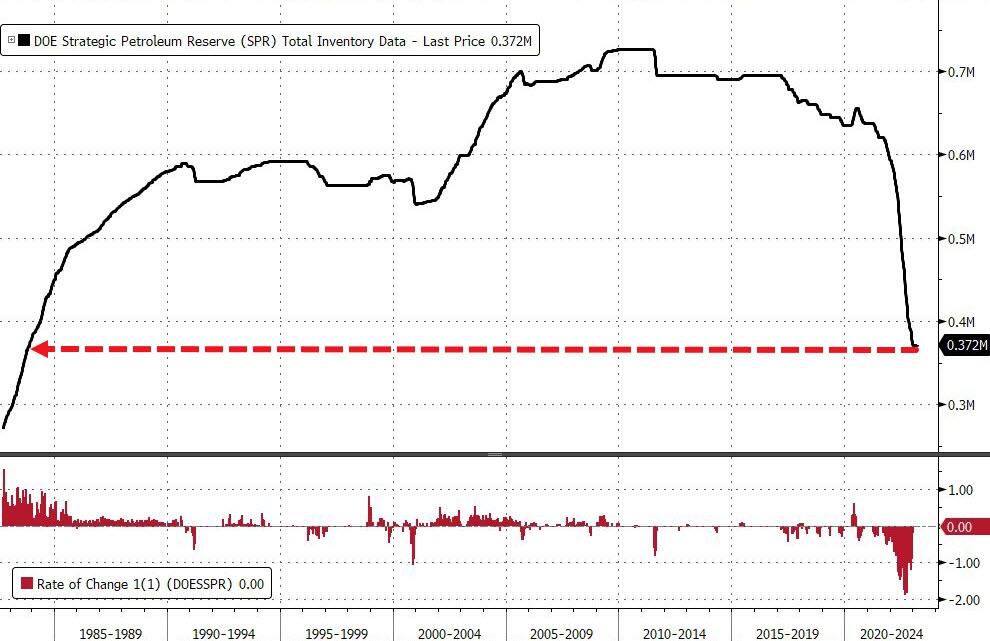
  • The Biden Administration has sold 266 million barrels of oil from the Strategic Petroleum Reserve since his inauguration.

  • In October, with prices still above $80, the administration announced that it would refill the SPR when oil was priced between $67 and $72.

  • If the Biden Administration refills the SPR now he would not only be helping to protect the country from supply disruptions but could claim to have turned a profit.

There is a narrative that I hear from time to time that President Biden made billions of dollars for the country by selling oil from the Strategic Petroleum Reserve (SPR) last year at high prices and buying it back at low prices. The only problem is that the story is only half true.

The Biden Administration did indeed sell a lot of oil from the SPR last year.

Further, oil prices in 2022 were the highest they had been in years, averaging nearly $95 a barrel — the highest level since 2013.

However, the Biden Administration hasn’t bought back any of the 266 million barrels of oil that have been removed from the SPR since his inauguration. If Biden wants to legitimately receive credit for successfully playing as an oil speculator, then he needs to put the oil back. Right now, all he has done is deplete oil reserves that were built up under several previous administrations (Democratic and Republican).

Previously, the Biden Administration had resisted calls to refill the SPR, citing high prices. In October, with oil prices still above $80, the administration announced it would set up a process to refill the SPR when oil was priced between $67 and $72 a barrel.

As Bloomberg energy and commodities columnist Javier Blas pointed out on Twitter, the entire futures curve for West Texas Intermediate (WTI) is now below that range:

“The whole WTI futures curve is now below the bottom range of $67-$72 a barrel given by the White House to buy crude for the SPR. That’s the **whole curve, including the contract for immediate delivery**. Let’s see if the Biden administration pulls the trigger.”

Of course, the public loves low oil prices.

Last year’s massive SPR release probably helped arrest the spike in oil prices.

The risk of buying back that oil is that oil prices may stop falling.

But, not refilling the SPR leaves the U.S. with a significantly lower insurance policy against any oil supply disruptions. This would seem to be an opportune time to put at least some oil back into the SPR, while claiming credit for selling high and buying low.

Tyler Durden
Tue, 03/28/2023 – 11:50

via ZeroHedge News https://ift.tt/PM0qp9v Tyler Durden

Russia Calls Out ‘Nuclear Weapons Hypocrisy’: US Has Tactical Nukes In 5 Non-Nuclear Weapon States

Russia Calls Out ‘Nuclear Weapons Hypocrisy’: US Has Tactical Nukes In 5 Non-Nuclear Weapon States

The Kremlin has blasted what a Russian official called the United States’ “vivid example of hypocrisy” as part of the latest war of words in the wake of President Putin’s announcing he has stationed tactical nuclear weapons in neighboring Belarus.

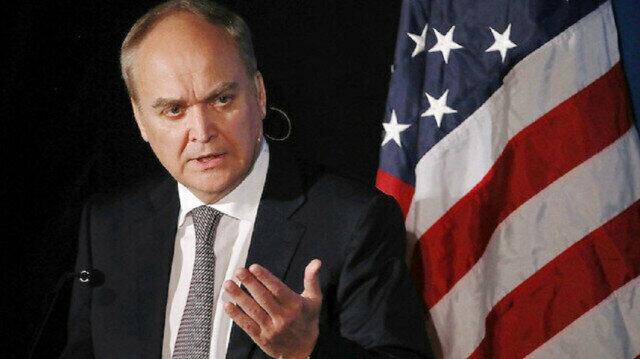
Russian Ambassador to the United States Anatoly Antonov on Tuesday called out Washington’s “extremely short memory” – given it “has long been systematically destroying the legal basis of bilateral relations in strategic sphere,” which is a reference to the collapse of multiple nuclear treaties of late, including ‘Open Skies’ and the INF Treaty in 2019. New START is also looking to come to an end at the rate things are going.

Russian amb. to US Anatoly Antonov

At the start of this week Western officials sounded the alarm over Putin’s fresh announcement, which many within NATO countries interpreted as but the latest ‘expansionist’ threat.

CBS recounts of what Putin said:

Russia has ratcheted up tensions with the West amid its ongoing war against Ukraine, with President Vladimir Putin saying Moscow will deploy “tactical nuclear weapons” in Belarus. The Russian leader said 10 fighter jets capable of carrying tactical nuclear weapons — generally a reference to smaller weapons used for limited battlefield attacks, rather than larger, long-range “strategic” nuclear weapons — were already deployed in Belarus. Putin said Russia would also position nuclear-armed Iskander hypersonic missiles, with a range of around 300 miles, in Belarus.

In response, the US State Department condemned the Russian leader’s “irresponsible nuclear rhetoric,” and said that “no other country is inflicting such damage on arms control, nor seeking to undermine strategic stability in Europe.”

The scathing denunciation had been issued by US State Department representative Vedant Patel. Amb. Antonov addressed the American official by name, saying, “As for Mr Patel’s words regarding our President’s statements on the Russian-Belarusian cooperation in the military-nuclear sphere, it is a vivid example of hypocrisy of the American politics,” in a statement released by the Russian Embassy.

Antonov underscored that the US has long stationed nuclear weapons not far from Russia: “For the last 60 years Washington has been playing a key role in NATO’s nuclear sharing missions by supporting deployment of its tactical nuclear weapons in five non-nuclear weapon statesBelgium, Germany, Italy, Netherlands, and Turkey,” he said. Putin had days ago voiced a similar rationale…

The Russian ambassador to the US at the conclusion of his statement cited a proverb: “If your face is crooked, do not blame the mirror,” in reference to the charge of US ‘nuclear hypocrisy’. 

As for failing nuclear treaties, New START is the latest which looks to be faltering, after Russia recently declared it is suspending participation over US violations. According to the latest being reported in The Wall Street Journal on Tuesday, Washington will no longer be sharing data on its nuclear forces with Moscow. Though sharing of nuclear data is stipulated under the terms of the treaty, the US has cited the Russian side’s lack of participation as the driving reason behind the move.

Tyler Durden
Tue, 03/28/2023 – 11:30

via ZeroHedge News https://ift.tt/ItLVCoO Tyler Durden

Regulators Blame Friday’s Deutsche Bank Crash On Single CDS Trade

Regulators Blame Friday’s Deutsche Bank Crash On Single CDS Trade

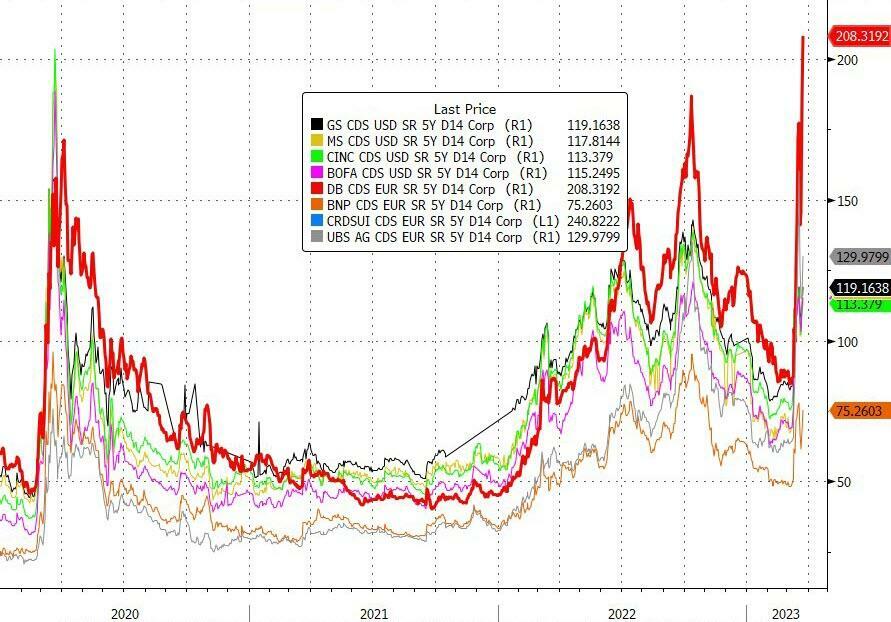
Last Friday, what was already a bad global banking crisis following the implosion of the US regional banking sector and the collapse of Credit Suisse last weekend, turned much worse when as we showed at the time, the CDS of Deutsche Bank blew out to levels wider than those hit during the covid crash…

… and sparking another global market rout amid growing fears that the largest European bank could fail next.

The CDS – and stock – rout prompted a barrage of verbal defense by everyone from Wall Street analysts (working for other banks and thus who are thus quite incentivized, and conflicted, in preventing a bank crash that would dwarf Lehman) and European politicians (who would be on the hook for the multi-billion bailout and/or depression should DB fail), and for now this has succeeded with both DB stock and CDS stabilizing in the past few days. Meanwhile, realizing they must quickly bolt down all the “weakest links” moments ago Bloomberg reported that regulators are taking a page out of the post-Lehman playbook and as part of the scapegoating campaign which looks at everyone but those responsible, are “singling out a trade on Deutsche Bank AG’s credit default swaps that they suspect fueled a global selloff on Friday.”

The trade in question, according to Bloomberg sources, represents a laughable €5 million ($5.4 million) bet on swaps tied to the German bank’s junior debt, which also happens to be the smallest tradable denomination and blaming the near collapse on DB on one single CDS trade is equivalent to blaming the May 2010 flash crash on two-bit stay-at-home daytrader Navinder Sarao (which, come to think of it, is precisely what happened so we aren’t that shocked). And to frontrun the perpetual mockery from those whoa actually know how the CDS market works, BBG was quick to note that CDS contracts can be illiquid, “so a single bet can trigger big moves.” Yes it can… and a big move will trigger even bigger counter moves, assuming there is anyone in the market with any conviction. It is the fact that nobody was willing to take the other side on the smallest possible short risk bet targeting DB’s junior debt, that speaks volumes about this idiotic “explanation” for why DB almost went down last Friday.

Of course, if one is dumb enough to believe that one single, solitary trade can spark a marketwide avalanche, then what happens next is obvious:

The suspected knock-on effect was a rout that sent banking stocks tumbling, government bonds higher and CDS prices for lenders soaring, trimming about €1.6 billion off Deutsche Bank’s market cap and more than €30 billion off an index that tracks European banking stocks.

So yeah, tens of billions in value wiped out because of literally the smallest possible CDS increment one can trade. Good narrative-shaping there, guys.

There is a reason why regulators are scrambling to pin the blame on some tiny family office that was hoping to hedge against a DB collapse: European banks and their regulators have sought to underline that they have a close watch on risks — including rising rates — and that the industry is on a sound footing. Events last Friday showed just how clueless Europe’s regulators are. One could say they are almost as clueless as their US peers who allowed the regional bank crisis to reach a level where nobody knows what is safe anymore.

Amid the unwanted attention, German lender published a presentation on Monday that cited its “well diversified portfolio” of deposits, a key focus for investors following the collapse of Silicon Valley Bank. Deutsche Bank and the broader index rebounded on Monday, erasing some of Friday’s losses.

So who gets to be the Nav Sarao of this bank crisis? We don’t know yet, because according to BBG, “it’s unclear who placed the relevant trades or why they did it.” Hilariously, even BBG admits that this wasn’t some premeditated attempt by some rookie to crash the banking system, but rather concedes that “some data point to the trades being for hedging purposes, said one of the people.”

And just in case the laughter isn’t loud enough yet, the report goes on to note that “there’s also a trade on Deutsche Bank’s five-year, senior CDS contracts executed on Thursday that attracted scrutiny, one of the people said.”

Oh, so it wasn’t one CDS trade… it was two. Well, congrats to DB for surviving not one but two short trades!

The search for triggers underscores a general lack of transparency in the asset class, which Andrea Enria, the European Central Bank’s top oversight official, flagged on Tuesday. He also called for global financial regulators to take a closer look at the CDS market.

“There are markets like the single name CDS market which are very opaque, very shallow, very illiquid,” Enria said at a conference hosted by German newspaper Handelsblatt. “With a few millions, you can move the CDS spreads” of a major bank “and contaminate also stock prices and possibly also deposit outflows,” he said, without naming any banks.

And just like in 2008, the demonization of CDS traders has begun. Unfortunately, it also means that the crisis is only just starting, and before it is done, plain vanilla stock shorts will also be thrown under the bus and shorting itself will be prohibited.

Tyler Durden
Tue, 03/28/2023 – 11:15

via ZeroHedge News https://ift.tt/7Se2vya Tyler Durden

Media Loses Confidence In Preferred Pronouns After Transgender Shooter Attacks Christian School

Media Loses Confidence In Preferred Pronouns After Transgender Shooter Attacks Christian School

Authored by Paul Joseph Watson via Summit News (emphasis ours),

The media appears to have developed a sudden confusion surrounding preferred pronouns after a woman who identified as a man attacked a Christian school in Nashville, killing three children and three adults.

BRENDAN SMIALOWSKI via Getty Images

28-year-old Audrey Hale carefully planned out the assault on The Covenant School, leaving behind maps and a manifesto, the details of which have yet to be revealed.

Given Hale’s transgender identity, many have speculated that the massacre was motivated by Tennessee’s recent ban on all forms of “gender-affirming” transgender care for minors as well as drag queen shows, although others have suggested the motive was Hale’s resentment at having been made to attend the school.

Whatever the motive, the media’s reaction was to lose confidence in its assertion that transgender pronouns should be respected.

Despite Hale, a biological woman, having started identifying as a man in recent months, BBC News expressed confusion over the issue, despite authorities making clear the culprit was transgender.

 The New York Times also claimed there was “confusion” surrounding the shooter’s transgender identity, despite such confusion only being expressed by the newspaper itself.

Some even accused the NYT of de facto apologizing for “misgendering” the killer.

The newspaper initially reported that the culprit was a “woman,” but later changed their description.

USA Today also appeared to apologize on behalf of authorities for initially stating that the shooter was in fact a biological woman.

Meanwhile, Newsweek appeared to blame anyone other than the culprit for the shooting, citing the ban on drag queen shows, gender-affirming care and “assault weapons” remaining legal, with the news outlet almost appearing to attempt to justify the carnage.

The meme below just above sums up the media’s bizarre reaction.

*  *  *

Brand new merch now available! Get it at https://www.pjwshop.com/

ALERT!

In the age of mass Silicon Valley censorship It is crucial that we stay in touch.

I need you to sign up for my free newsletter here.

Support my sponsor – Turbo Force – a supercharged boost of clean energy without the comedown.

Get early access, exclusive content and behind the scenes stuff by following me on Locals.

Tyler Durden
Tue, 03/28/2023 – 11:14

via ZeroHedge News https://ift.tt/mhM0vwl Tyler Durden