Relief Rallies & Remembering Bear Stearns

Relief Rallies & Remembering Bear Stearns

Authored by Lance Roberts via RealInvestmentAdvice.com,

Despite an ongoing “banking crisis,” investors continue to chase stocks triggering several bullish buy signals. As noted in this past weekend’s newsletter, two primary reasons exist for this current dichotomy. The first is psychological, and the second is purely technical.

The psychological component of the recent disregard of underlying financial and economic risk is the “Pavlovian” response to Central Bank interventions. To wit:

Classical conditioning (also known as Pavlovian or respondent conditioning) refers to a learning procedure in which a potent stimulus (e.g., food) becomes paired with a previously neutral stimulus (e.g., a bell). Pavlov discovered that when he introduced the neutral stimulus, the dogs would begin to salivate in anticipation of the potent stimulus, even though it was not currently present. This learning process results from the psychological “pairing” of the stimuli.

Importantly, for conditioning to work, the “neutral stimulus,” when introduced, must get followed by the “potent stimulus” for the “pairing” to complete. For investors, as the Fed introduced each round of “Quantitative Easing,” the “neutral stimulus,” the stock market rose, the “potent stimulus.” 

As shown, there is a high correlation between Fed balance sheet changes and the market since 2009.
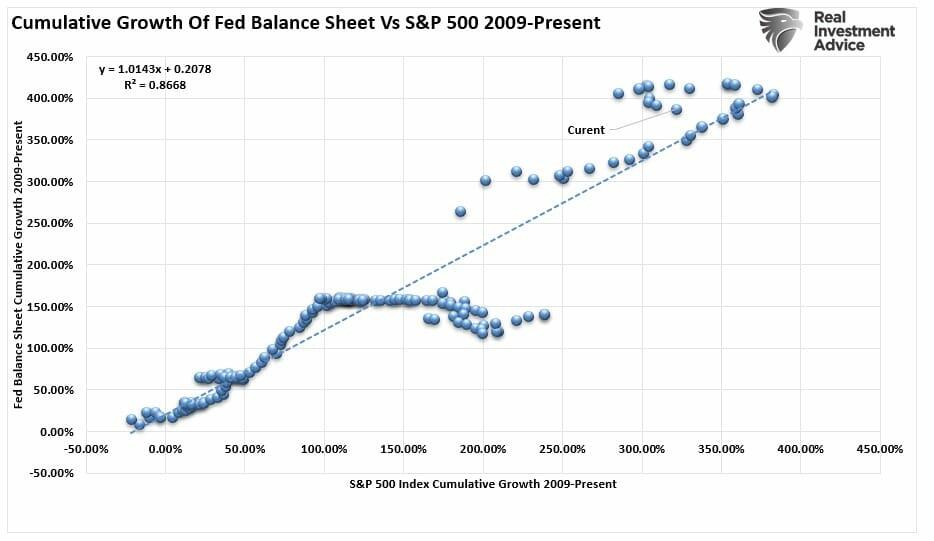
Given that correlation, it should not be surprising that investors began to “salivate” as recent interventions to offset the “banking crisis” by providing liquidity was the effective “ringing of the bell.”
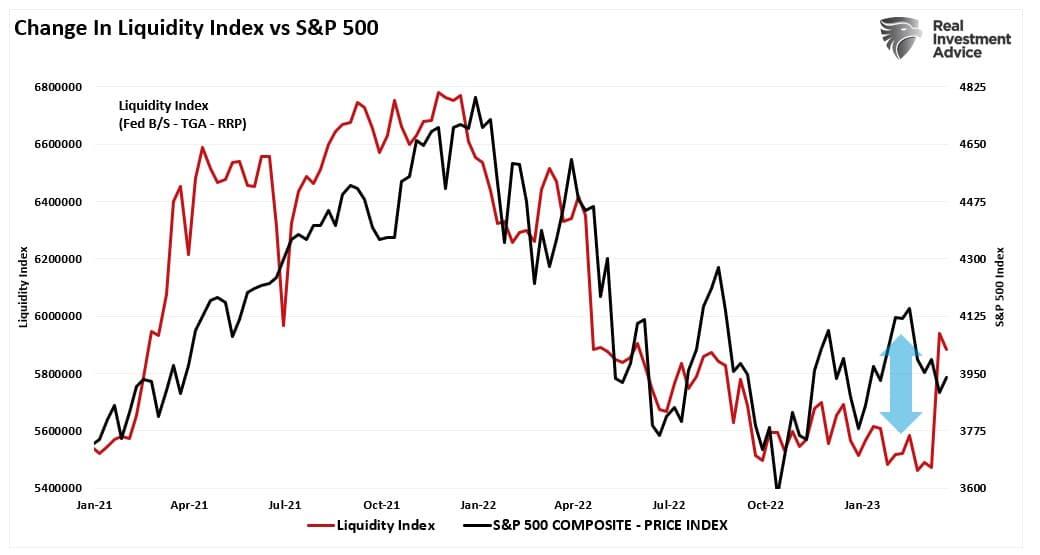
As discussed in “Not QE,” these liquidity programs are not asset purchase programs but rather loans that must be repaid. However, the reversal of the Fed’s balance sheet tightening process was all that investors needed to see.
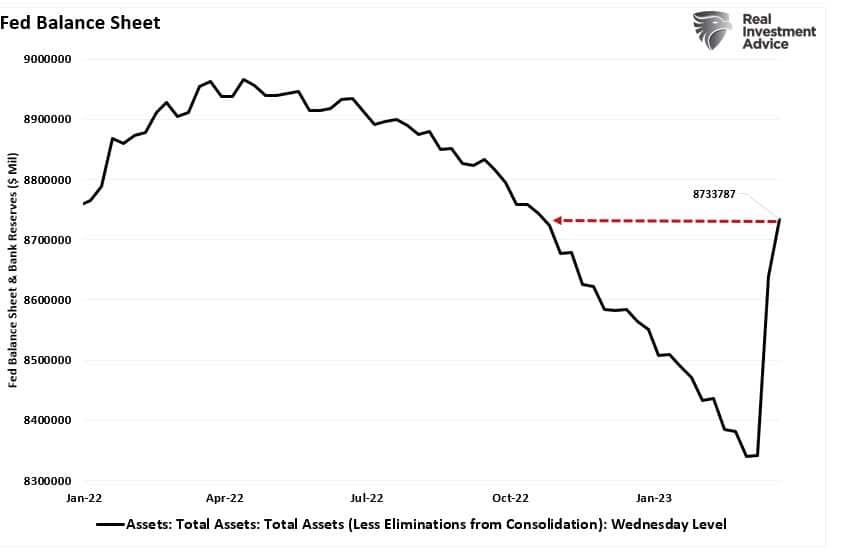
That was enough to spark a rally and trigger bullish buy signals that provided technical support for the market.

4200 Before The Next Decline

In an early February article, we discussed the “sell signals,” which led us to recommend reducing equity exposures,

“Our primary short-term ‘sell’ indicator has triggered for the first time since early December. Such has previously provided excellent signals of corrections and rallies. The chart below is courtesy of SimpleVisor.com and shows our proprietary money-flow indicator and the Moving Average Convergence Divergence (MACD) signal.

While that sell signal does NOT mean the market is about to crash, it does suggest that over the next couple of weeks to months, the market will likely consolidate or trade lower. Such is why we reduced our equity risk last week ahead of the Fed meeting.”

Following that article, the market declined, taking out the 200-DMA and breaking the critical uptrend support from the October lows. The market did hold support at the December lows keeping the bullish trend intact.

Those signals have now reversed, suggesting investors should cautiously increase equity risk for a short-term rally.
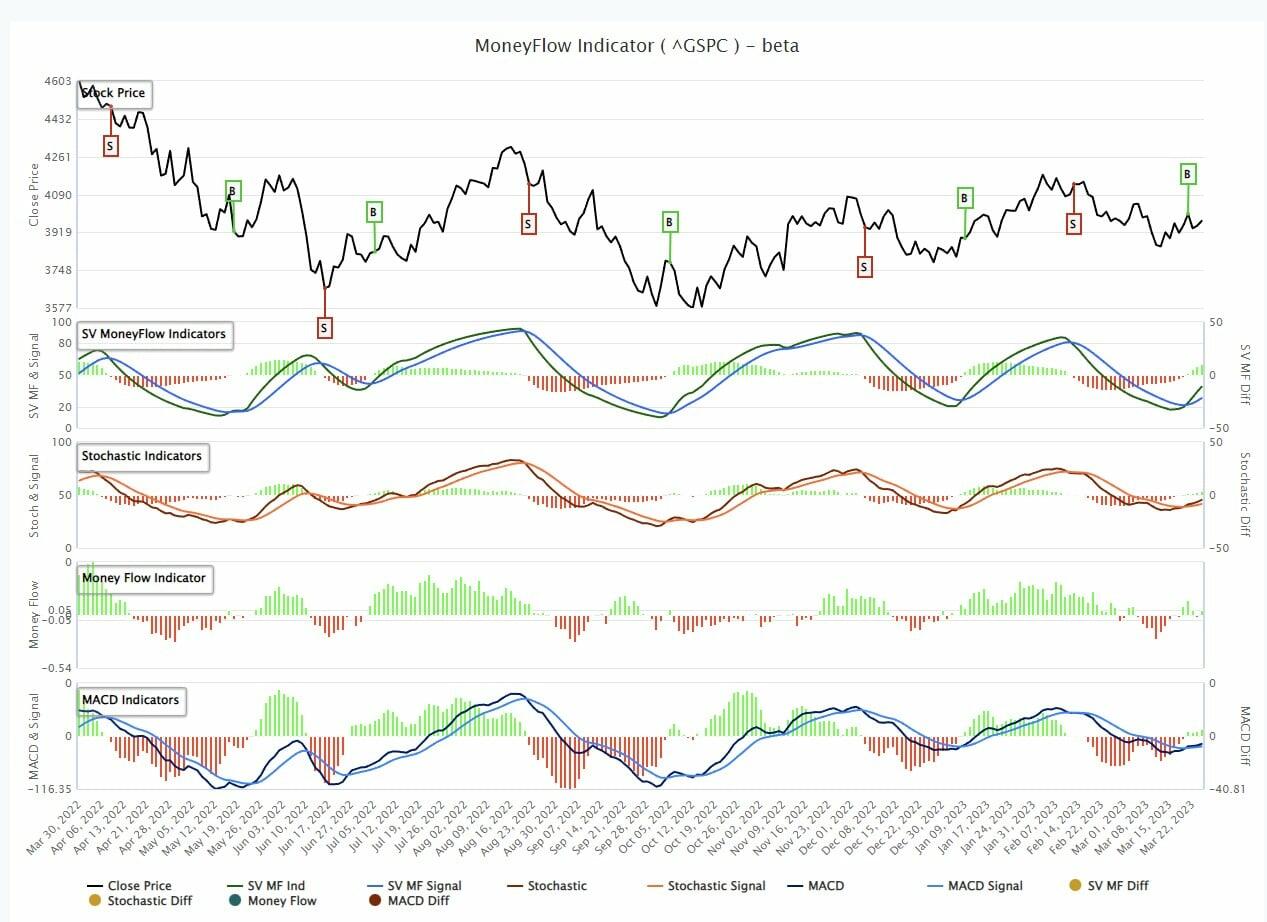
That MoneyFlow signal is also confirmed by the Moving Average Convergence Divergence indicator (MACD) “buy signal.” 
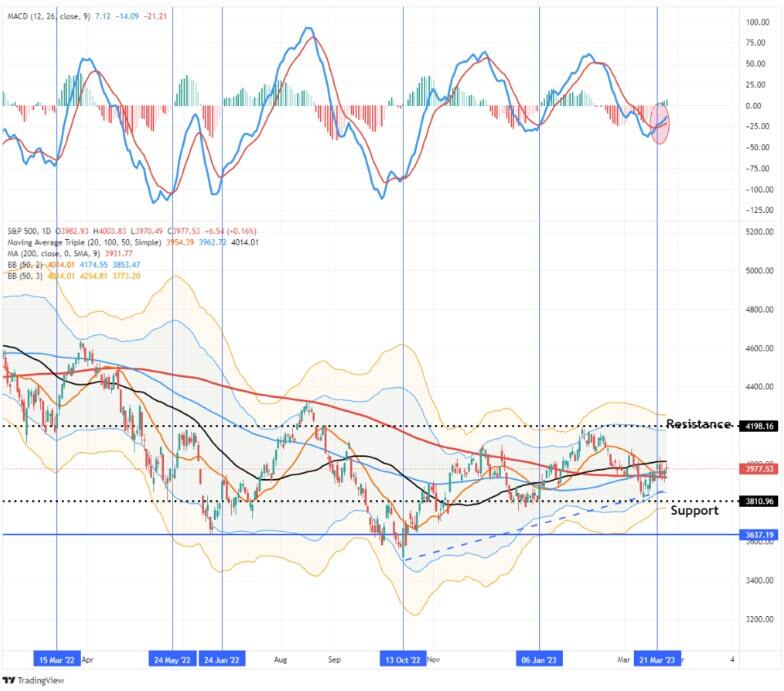
As noted above, there are many reasons to remain cautious of the markets over the 6-9 months as the “lag effect”of rate hikes impacts both the economy and earnings.

However, with these buy signals in place, investors should modestly increase equity exposure, as the likely path for stock prices is higher over the next two weeks to two months. As shown, the most likely target for the S&P 500 is 4200 before serious resistance is encountered and a reasonable level to take profits and again reduce risk.
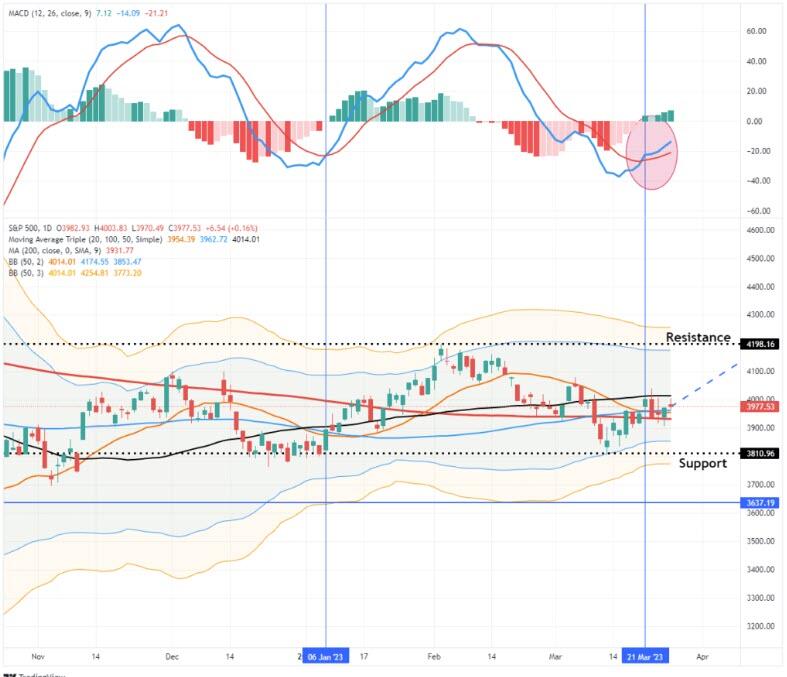
However, with the banking crisis still unfolding, such could limit the upside to equity prices near term, which could keep any rally contained between 4000 and 4100. We will watch our technical indicators for the next signal to reduce equity risk regardless of where markets are trading.

Remembering Bear Stearns

The obvious question is, “how could markets possibly trigger bullish buy signals, and rally, amid a global banking crisis?”

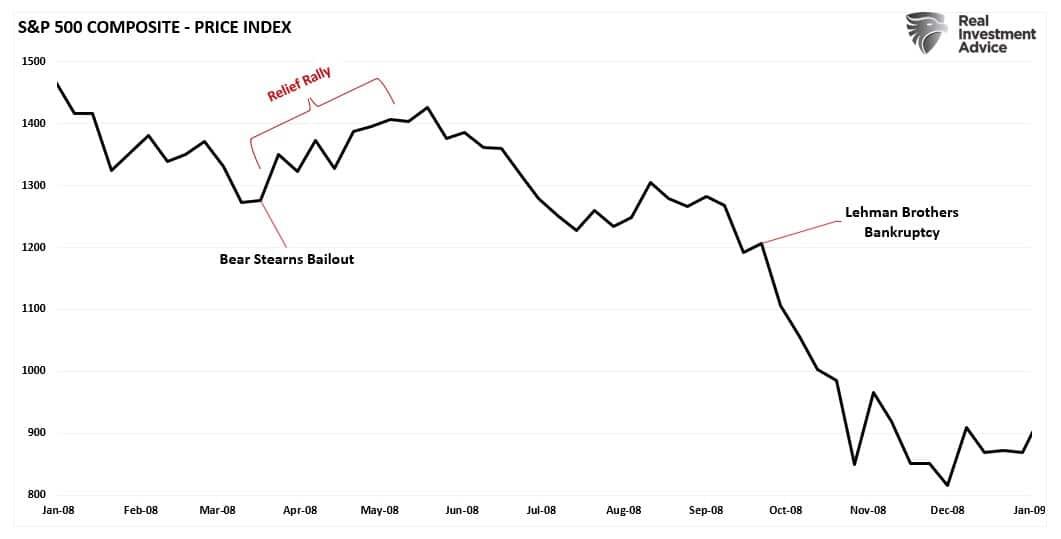
A brief history review reminds us of a similar situation amid the early stages of the “subprime mortgage crisis.” At that time, Bear Stearns had two mortgage funds, ironically called “High-Grade Structured Credit” and “High-Grade Structured Credit Enhances Leverage,” that failed as the subprime credit market imploded and liquidity evaporated. The rest, as they say, is history.

On March 14, 2008, the Federal Reserve Bank of New York (“FRBNY”) agreed to provide a $25 billion loan to Bear Stearns collateralized by unencumbered assets from Bear Stearns to provide Bear Stearns the liquidity for up to 28 days that the market was refusing to provide. Shortly thereafter, FRBNY had a change of heart and told Bear Stearns that the 28-day loan was unavailable to them. 

The deal was then changed to where FRBNY would create a company (eventually becoming Maiden Lane LLC) to buy $30 billion worth of Bear Stearns’ assets, and JPMorgan Chase would purchase Bear Stearns in a stock swap worth $2 a share, or less than 7 percent of Bear Stearns’ market value just two days before.” – Wikipedia

The market had been under pressure since the beginning of the year as the Bear Stearns drama unfolded. The subsequent bailout and reassurances of “financial stability” catalyzed a relief rally into June.
Conclusion

As noted above, we have a similar setup in the markets currently with negative investor sentiment and reassurances from the Federal Reserve that the “banking system is sound and resilient.”

Whether it is or not remains to be seen, and Powell’s statement reminded me of Ben Bernanke’s infamous declaration before Congress in 2007:

“We do not expect significant spillovers from the subprime market to the rest of the economy or to the financial system.”

While I am not saying we are about to have a financial crisis, I do suggest there is an elevated level of risk to the markets.

  • Extracting cash from the markets into 4%-plus money market funds reduces buying power.

  • The economy is slowing, which will reduce earnings growth.

  • The Fed’s previous rate hikes are only now beginning to impact the economy.

  • Bank lending standards are rapidly tightening, putting further restraints on economic growth.

  • Inflation is slowing down, reducing corporations’ pricing power and squeezing margins.

  • Unemployment will rise in the months ahead.

Just as in 2008, the economy was in a recession; we didn’t realize it yet as the economic data didn’t fully reflect it. However, in hindsight, the Bear Stearns debacle was a vital clue something in the system had broken.

While we see many similarities in the financial system today, that doesn’t mean markets can’t rally based solely on “hope” and “optimism.”

A rally toward 4200 is possible, as investor psychology is not always logical.

However, we will use that rally to reduce risk and rebalance portfolios to protect against the final bearish leg of this market as the realization of the economic recession becomes visible.

Tyler Durden
Tue, 03/28/2023 – 10:30

via ZeroHedge News https://ift.tt/t13rEVT Tyler Durden
Watch Live: Senate Banking Committee Hunts For Bank Failure Scapegoats

Watch Live: Senate Banking Committee Hunts For Bank Failure Scapegoats

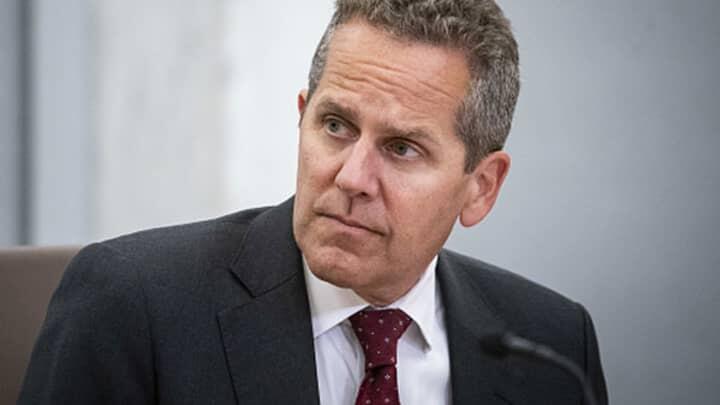
The US Senate Banking Committee has convened a hearing on the regulatory response to the recent string of bank failures that has upended the finance industry and roiled markets. Among those asked to appear is Michael Barr, the Federal Reserve’s vice chair for supervision.

Watch Live here:

Democrat Sherrod Brown gavels the hearing in, and starts off by applauding regulators for acting swiftly to protect depositors of SVB.

“Ohio small-business owners simply wanted to make payroll,” he said. Then he blames a panic by venture capitalists on Twitter in part for the bank run.

Brown blames Trump-era bank regulators, bank executives and others.

He dings the other side of the aisle for never seeing a “Wall Street wish list” they didn’t want to grant.

“When there’s a bank crash, there’s no libertarians in Silicon Valley,” Brown adds.

Senator Tim Scott, the top Republican on the Banking Committee, starts giving his opening remarks. “By all accounts, this was a classic tale of negligence.”

He says Barr and San Francisco Fed President Mary Daly were focused on climate change and asks whether that enabled SVB to take more risks.

“Our regulators appear to have been asleep at the wheel.”

“What were the supervisors thinking?” Scott asks.

Scott blames the bank, regulators and inflation under Biden for the failures.

Scott wants more information about why FDIC didn’t sell SVB successfully in the first few days, calling the auction process “a black hole.” He questions whether it was because of a White House aversion to all mergers.

So business as usual – all politics and no action.

*  *  *

In his prepared remarks, released yesterday, Fed Vice Chair for Supervision Michael Barr says regulators “will continue to closely monitor conditions in the banking system and are prepared to use all of our tools for any size institution, as needed, to keep the system safe and sound.”

But, Barr had plenty of blame to spread around in his prepared remarks ahead of today’s  Senat Banking Committee hearing.

Primarily, Barr notes the bank’s management was a disaster (our words not his):

SVB failed because the bank’s management did not effectively manage its interest rate and liquidity risk, and the bank then suffered a devastating and unexpected run by its uninsured depositors in a period of less than 24 hours. “

“SVB’s failure is a textbook case of mismanagement.

“At the same time, the bank failed to manage the risks of its liabilities.”

The bank waited too long to address its problems

Then ‘social media’ exaggerated the risk…

“In response, social media saw a surge in talk about a run, and uninsured depositors acted quickly to flee. Depositors withdrew funds at an extraordinary rate…”

And finally, the deregulation efforts undertaken during Trump’s presidency were highlighted as a potential trigger for why The Fed missed this huge screw up…

…was subject to a less stringent set of enhanced prudential standards than would have applied before 2019; they include less frequent stress testing by the Board, no bank-run capital stress testing requirements, and less rigorous capital planning and liquidity risk management standards.

… In addition, SVB was not subject to the supplementary leverage ratio, and its capital levels did not have to reflect unrealized losses on certain securities.

we are evaluating whether application of more stringent standards would have prompted the bank to better manage the risks that led to its failure.

Barr concludes by suggesting stiffer regulations are to come… which will ‘cost’ small and medium-sized banks far more – relatively speaking – than the ‘Big 4’

“…we plan to propose a long-term debt requirement for large banks that are not G-SIBs, so that they have a cushion of loss-absorbing resources to support their stabilization and allow for resolution in a manner that does not pose systemic risk. We will need to enhance our stress testing with multiple scenarios so that it captures a wider range of risk and uncovers channels for contagion, like those we saw in the recent series of events. We must also explore changes to our liquidity rules and other reforms to improve the resiliency of the financial system.”

Very politically palatable for his audience today.

The US Treasury will be represented at today’s hearing by Nellie Liang, the department’s undersecretary for domestic finance. Liang has been a key player behind the scenes in coordinating the responses of different regulatory agencies to the banking crisis. Liang may, among other things, may be asked to clarify the administration’s approach to protecting uninsured bank deposits.

Another witness this morning will be Martin Gruenberg, chair of the Federal Deposit Insurance Corp., which seized SVB and Signature and is working on the sale of their assets. He’ll be grilled by senators on how the FDIC has handled that process.

Earlier, Erik Nelson, macro strategist at Wells Fargo Bank said on Bloomberg TV:

“Barr’s comments today will be very interesting. I do suspect he will be pressed on questions about deposit insurance and how the recent issues around the banking sector have been resolved and what that means for the playbook going forward.

“It’s certainly an important day today. We’ll really want to get sense of how is the market behaving around some of these banking whether in the credit market or equity market. That’s what I’m watching most closely, as opposed to looking at typical indicators like Fed pricing or what FX are doing.”

Tyler Durden
Tue, 03/28/2023 – 10:20

via ZeroHedge News https://ift.tt/2rwuRAY Tyler Durden

A Textbook Case Of Mismanaging Everything, Everywhere, All At Once

A Textbook Case Of Mismanaging Everything, Everywhere, All At Once

By Michael Every of Rabobank

A textbook case of mismanagement

A textbook case of mismanagement” is how the Fed Vice Chair responsible for bank supervision is going to describe SVB when he testifies to Congress today. He will also stress the Fed is prepared to use “all of our tools for any size institution, as needed, to keep the system safe and sound.” While reassuring to some, to critics that will sound like a textbook case of mismanagement of moral hazard that ends up in future financial crisis headlines and further Fed bailouts.

Fed Vice Chair for bank supervision Michael Barr

Indeed, @JackFarley96 fintwits: “On July 16, 2019, The Federal Reserve & FDIC received a letter warning them about issues with US regional banks and their potential failure. The letter was sent by a group of senior central bankers and regulators, including Paul Volcker, Sheila Bair, and Jean-Claude Trichet, and Sir Paul Tucker, the then-chair of The Systemic Risk Council. Tucker had this to say to me last week: “in 2019 the Fed and the FDIC effectively decided to formally cease resolution planning for large regional banks.””  Who is going to be pointing fingers at whom today?

As Philip Marey covers in his latest report on the Fed (‘It gets cloudy after the pivot’), “The banking turmoil has strengthened markets’ belief that the Fed is going to cut rates before the end of the year. However, the implied policy rate path should be taken with a grain of salt, as the uncertainty about the rate path has increased substantially. So markets are pricing in a stronger pivot, but the exact rate path has become less clear.” That lack of clarity may have played a role in the ugly 2-year US Treasury auction yesterday, which also smacks of a textbook case of mismanagement – unless the Fed wanted to confuse markets about the rates path ahead.

Meanwhile, we see mismanagement of data in market analysis. For example, Bloomberg just stressed that Fed support for banks, if not via rate cuts, implies either balance sheet expansion (QE, not QT) or credit easing via liquidity support (so acronyms). Rate hikes and acronyms: who knew this could happen?! The point made is that all three are bad for the US dollar. Which is true: but they are worse for everyone else in the same boat!

ECB data show February, i.e., pre-crisis, already saw record deposit withdrawals from Eurozone banks due to rising rates. This went into money market funds or bank bonds, which does not smack of a lack of confidence – but it still says the cost of capital is going to increase. Moreover, Reuters says ‘ECB tells banks to cut lending to indebted borrowers after binge’, noting: “The ECB has told banks to cut lending to the most indebted borrowers, which could poke a hole in their balance sheets if the economy turns south or interest rates rise…. Leveraged transactions have grown to a EUR500bn pile on the books of the Eurozone’s 28 largest lenders from EUR300bn in 2018 as record-low interest rates made banks seek returns in riskier parts of the market.”

In Australia, Westpac CEO Peter King, speaking at a local banking summit, stressed the issue for struggling mortgage holders is the duration of higher rates. In other words, everyone will tighten their belts and eat less smashed avo on toast in 2023 to keep up their home loan payments; but if rates don’t start falling back in 2024 then things start to look ugly: one can also point to the UK, or Canada, or New Zealand, or just about anywhere and say the same kind of thing. Given three of the four key Aussie datapoints the RBA is looking to before its next meeting have been strong or in-line, with retail sales up 0.2% m-o-m today as expected, and only CPI to follow tomorrow, then 25bps in April looks baked into the cake for now.

In short, it’s not just the US with issues related to higher rates on big piles of rate-sensitive lending; and it’s not just the US who will have to find either traditional or hybrid solutions. It’s still likely to be the ‘least dirty shirt in the dirty laundry basket’.

On those hybrid policy responses, Monday saw the perfect headline underlying the geopolitical reality now leaning on economics and markets which this Daily tries to hammer home. Norwegian ammunition manufacturer Nammo is complaining it can’t up production because a new TikTok data center is using up all the spare electricity in the area. They literally say: “We are concerned because we see our future growth is challenged by the storage of cat videos.” That’s a ‘guns or butter’ political-economy choice that a single interest rate isn’t going to help: too high, and you get neither guns nor ‘butter’; too low, and you only get ‘butter’.

Of course, in the case of TikTok one could just ban it, as the US Congress seems increasingly likely to do given the head of the US spy agency publicly calls it a “Trojan horse”. However, that’s as political-economy as it gets too: closing off some forms of ‘butter’ by fiat. As is the US regulatory attack on crypto platform Binance. This Daily has long argued the US authorities were ultimately likely to do unto crypto what FDR did unto gold in the 1930s, i.e., regulate it away as a real dollar rival. It was a textbook case of mismanagement to presume otherwise.  

Yet a larger game is afoot. The Saudis making a huge investment into a new Chinese refinery and Riyadh accepting payment for USD-priced oil from Kenya in Shillings (as Kenya’s president states: “I will give you one piece of advice, forget the dollar. This market will soon change fundamentally. We don’t need dollars anymore.”) testify to a textbook case of White House foreign policy mismanagement. Even CNN and Fox News are now worrying about the end of US dollar hegemony as we shift towards more global barter priced in US dollars and cleared in third currencies. (For now.)

Yet the end of US dollar hegemony can’t happen unless the US, and the US alone, mismanages its economy on a far more epic scale than it currently is: and history shows a major war is usually required too.

The latter is a topic of conversation, as the Financial Times notes the worrying symmetry with the 1930’s in the Japanese PM’s recent visit to Kyiv as Xi Jinping visited Moscow: if you think the rates outlook is cloudy now, try looking at those dark storm clouds on the horizon. Maritime-executive.com, linking both points, op-eds that ‘To Prepare to Fight, China is Studying America’s WWII Pacific Campaign’, stressing (as we did back in 2021’s ‘In Deep Ship’) that control of maritime logistics, i.e., supply chains, and the ability to disrupt them, are of critical importance.

Combine that with The Economist cover last week being ‘The World According to Xi’, with Russia, Iran, and Saudi Arabia orbiting a Chinese planet (in response to which I was asked: “Where is the German satellite?”), and the Indian chief of army staff delivering the keynote at a conference on China’s Rise and Its Global Implications in which he called it “totalitarian” and “belligerent”, and one is left saying ‘tick tock, tick tock’ not just TikTok. (Which India already banned.)

Meanwhile, on the US as uniquely problematic, all Western economies have their own issues. Saudi Arabia is building a giant cube 400m * 400m * 400m giant gold cube filled with a central TV screen. (Really.) And as some flag Jack Ma visiting China and Bloomberg stresses “Beijing extended its efforts to court foreign investment,” promising it will “unswervingly” open up a “broad space” for foreign firms, Henry Gao argues ‘Beijing’s Regulatory Crackdown Is Unlikely to End Any Time Soon’, underlining: “the types of businesses pursued by digital giants such as Alibaba are now regarded as “unhealthy,” or more specifically, not in line with the industrial policies of China…. Bias for heavy industrial development is reaffirmed by Xi’s party congress report, which emphasizes that the key focus of economic development should be the “real” economy, that is, only the industrial and agricultural sectors. The tertiary sector –services– is almost ignored in his report. When mentioned, it is only considered to be a supplementary activity “deeply integrated with advanced manufacturing and modern agriculture.”” He concludes the next Beijing target is finance – which means a hybrid monetary-fiscal-regulatory-industrial policy.

Moreover, Gao elsewhere points out new State Council Working Rules show its ‘guiding thoughts’ section has deleted all previous references to Marxism, Leninism, Mao, and Deng, the Three Represents, and the Scientific Development Outlook, and keeps only Xi Jinping Thoughts on Socialism with Chinese Characteristics in the New Era. One might think that worthy of a market comment or two: but of course the market never read or understood any of the above anyway – or maritime-executive.com.

Furthermore, the new working rules state all major decisions and problems must be reported to the CCP Central Committee first; all State Council members shall resolutely implement the decisions of the Party Central Committee, and refrain from speech and behaviour that contradicts the decisions of the CCP Central Committee; and leading comrades of the State Council do not publicly publish books and speeches, do not send congratulatory letters, congratulatory telegrams, inscriptions, or prefaces. Gao concludes: “Li Keqiang might be the weakest Premier compared to the ones before him, but he will be the strongest Premier compared to everyone after him.”

Against this kind of backdrop, huge potential volatility awaits. For example, Kyle Bass again claims: “The Hong Kong Dollar is on the precipice of disaster. It broke through the weak side of the peg at the open today due to the beginning of significant capital outflows from global fiduciaries that have been forced to re-underwrite the danger of investing in China. SVB – a lesson.” Of course, the rebuttals to this are various and vocal.

To conclude, is everywhere seeing a textbook case of mismanagement all at once, or just some – or none? And what does the world look like on the other side of the currently cloudy outlook? I suggest our current textbooks will be on fire, for a start.

Tyler Durden
Tue, 03/28/2023 – 10:13

via ZeroHedge News https://ift.tt/SUtfeYx Tyler Durden

The Government Is Turning Border Surveillance on Everyday Americans


Security cameras pictured next to the U.S.-Mexico border

There is perhaps no stretch of American land as politicized as the U.S.-Mexico border—and perhaps no place as surveilled.

Physical reminders of that fact are everywhere. There are towering fences and walls. Border agents stand guard, patrolling the boundary in trucks. But border security is becoming increasingly stealthy and high-tech as the government erects a “virtual wall”—a fortification not made of steel and concrete, but drones, surveillance towers, and artificial intelligence.

Proponents of a harsher border say this virtual wall is a more humane and efficient way of keeping undocumented immigrants out of the country and a more effective means of intercepting traffickers. But in reality, the virtual wall has a lot of the problems that other border technologies and tactics do: It’s been expensive, broadly expanded the surveillance abilities of unaccountable government agencies, and forced migrants into taking more dangerous journeys rather than keeping them out. More dollars are being spent, more migrants are dying, and more civil liberties violations are occurring.

“The political discourse around the border tends to be built around a fantasy that the borderlands are a desert wasteland, and the only people crossing it are human traffickers, drug smugglers, and cartels,” says Dave Maass, director of investigations at the Electronic Frontier Foundation (EFF), a digital rights organization. “As a result, border technology is framed around these so-called ‘crises,’ with little regard for the negative impact on the communities and commerce you find at the border.”

Last week, EFF released a public map of surveillance towers in the borderlands—the first time such a directory has been made available. Though it isn’t complete, the map marks the positions of over 300 existing towers and roughly 50 planned ones. “The tower systems are able to automatically detect and track objects up to 7.5 miles away and assist agents in classifying objects 3 miles away, depending on regional requirements,” according to EFF. Customs and Border Protection (CBP) is also “in the process of installing 200 Autonomous Surveillance Towers (ASTs) from Anduril Industries that are controlled by artificial intelligence software.”

“By viewing these towers on the map,” says Maass, “you can really get a sense of how these towers are installed in residential communities, be it urban or rural, and not just in the remote expanses of the Southwest.”

The government hasn’t disclosed much about the towers beyond their expense, leaving the people who study and live in the borderlands with incomplete information. Sam Chambers, a geography and migration researcher at the University of Arizona, says that those studying surveillance in the borderlands previously “had to rely on documents such as environmental impact statements or other public records to know where a tower may be or had been built—and that was limited to specific districts and had to be verified.” Otherwise, researchers had to “learn by word of mouth or searching for them themselves.”

Much of the surveillance happening in the borderlands occurs without the knowledge of the people living there. Last July, CBP launched a surveillance blimp over Nogales, Arizona, without first informing local officials. “We weren’t aware that they were going to put it up,” Edward Dickie, city manager of Nogales, told Reason at the time. (It has since been removed.) CBP plans to install new surveillance towers in Imperial Beach and El Cajon, California, but “officials in both cities said they were unaware of the federal government’s plans,” according to Voice of San Diego.

In the government’s eyes, the definition of the border itself is slippery, giving it broad surveillance discretion. Federal law allows Border Patrol to conduct warrantless stops and searches “within a reasonable distance from any external boundary of the United States,” including on private land within 25 miles of the border. “Decades-old federal regulations, issued without public comment or debate, define that reasonable distance as ‘100 air miles’ from any external boundary,” according to the Project on Government Accountability (POGO), which released a report on the border enforcement zone in January. Almost two-thirds of the American population lives within the zone.

What’s more, POGO found little evidence that checkpoints in the enforcement zone are ensnaring undocumented immigrants. “Checkpoints accounted for only 2% of Border Patrol arrests between fiscal years 2016 and 2020,” it reported. “The existence of checkpoints can also lead to migrants dying in the countryside in attempts to avoid them.”

This cuts to one of the misconceptions about the “virtual wall“—that it is more humane that a physical wall. Chambers notes that his past research “has demonstrated that border surveillance towers force people into remote terrain where they will face excessive physical exertion and extended exposure to the elements.” He says there’s “nothing to suggest that a ‘virtual wall’ is humane,” adding that “surveillance tech is not necessarily distinct from a physical wall.”

“The two work in tandem to isolate human beings and multiply the bodily and mental harm of border crossing,” says Chambers. “What differentiates them most is that towers have been more readily ignored by those not impacted.”

Border security and immigration enforcement are affecting more and more people, though. At airports, customs officials are uploading data from travelers’ electronic devices to a massive database that CBP agents can file through without a warrant. In 2020, as people protested the killing of George Floyd across the country, the Department of Homeland Security turned border technology on them, surveilling demonstrations in over 15 cities, including New York City and Philadelphia. Immigration and Customs Enforcement has access to driver’s license data for three in four American adults.

“Smart” border enforcement has come at a massive cost—something that implicates every American taxpayer. The Secure Border Initiative Network, a mid-2000s “virtual fence” project, came in at $1 billion by the time it was scrapped—$19 million for each mile it covered. In FY 2022, Congress allocated $425 million for border surveillance. Between 1993 and 2019, Border Patrol’s budget jumped from $363 million to $4.9 billion.

Still, as last week’s surveillance tower map shows, the federal government is trudging ahead with a plan that will put more Americans under watch, and at great expense. “Border politics has a short memory, and not enough skepticism is applied to this technology that has been found time and time again to be expensive and ineffective,” says Maass. “Despite more than 20 years of growing surveillance at the border, we don’t hear CBP and other border security proponents claiming that the problem, at least as they define it, has been alleviated.”

The post The Government Is Turning Border Surveillance on Everyday Americans appeared first on Reason.com.

from Latest https://ift.tt/l0Nkys8
via IFTTT

Defamation and Copyright

Several commenters asked: If AI companies don’t have a copyright in works created by their programs, how can they be held liable under defamation law?

Defamation law and copyright law are two different bodies of law, aimed at serving different interests, and with different definitions. That’s why people can routinely be sued for defamation even when their works aren’t copyright protected. For instance,

[1.] The phrase “John Smith is a convicted child molester” is a short and simple phrase that’s uncopyrightable. (Even if some highly creative short phrases might be copyrightable, the combination of a preexisting name and the preexisting “is a convicted child molester” phrase certainly isn’t copyrightable.) Yet it could indeed be defamatory.

[2.] If Alan Author writes a libel of Paula Plaintiff (pro tip: never libel people whose names start with P), and Donna Defendant copies Alan’s libel, that could indeed be defamatory, if Donna has the requisite mental state—even though the copyright is owned by Alan, not by Donna. (That’s true regardless of whether Donna copied Alan’s work with his permission, engaged in fair use, or infringed Alan’s work.) This actually often happens, when Donna is a newspaper publisher who publishes Alan’s op-ed. (Newspapers often publish op-eds by people who aren’t their employees, without getting an assignment of copyright, but only a nonexclusive license to publish; in that situation, the copyright remains owned by the author, but the newspaper may be independently liable for defamation.)

[3.] If I spontaneously say “John Smith is a convicted child molester,” and follow it up with five sentences of explanation, that oral statement not protected by copyright because it’s not fixed in a tangible medium of expression. But it could be defamatory, assuming the elements of slander are satisfied.

In all these examples, the defendants are potentially liable, because defamation law cares about what the defendants communicated, and about whether it’s false, reputation-damaging, said with the requisite mental state, and unprivileged. But the defendants aren’t copyright owners, because copyright law is concerned with a very different thing (providing the incentive for creative expression fixed in a tangible medium). This doesn’t itself tell us that AI companies are liable for their programs’ uncopyrighted work, of course; I discuss that in much more detail here. But it does explain, I think, why copyright law has nothing to do with the question.

The post Defamation and Copyright appeared first on Reason.com.

from Latest https://ift.tt/H7gGu98
via IFTTT

Banning TikTok Is a Power the Federal Government Doesn’t Deserve


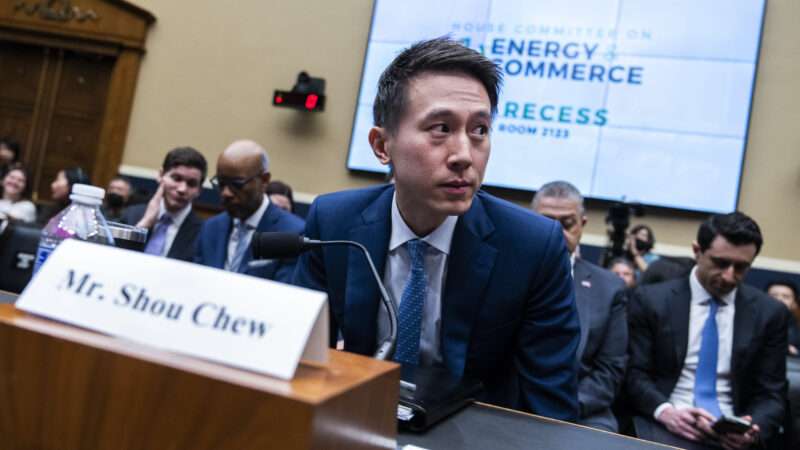
Shou Zi Chew

Last week, members of Congress relentlessly grilled Shou Zi Chew, the CEO of Chinese social media giant TikTok. Anger toward Chew was remarkably bipartisan: Both Republicans and Democrats consider TikTok an addictive service that harms kids, provides a vector for Chinese government propaganda, and captures the personal data of millions of Americans.

These concerns are not entirely unfounded. The Chinese government’s thirst for censorship is well documented: The Chinese Communist Party (CCP) has gone to great lengths to prohibit content relating to Winnie the Pooh wherever it might appear, for instance, due to the character’s resemblance to President Xi Jinping. And when Google attempted to relaunch in China, the government forced the company to restrict searches relating to Tiananmen Square. Chew testified before Congress that political dissent is widely available on TikTok, but there is plenty of evidence that the social media platform has suppressed content shown in the U.S. at the Chinese government’s behest.

China isn’t the only one playing that game. The U.S. government has also shown great interest in controlling what information its citizens consume online. Both the Twitter Files and the Facebook Files have shown that American social media companies have faced relentless pressure to restrict speech on controversial subjects like COVID-19 vaccines, Hunter Biden, and the 2020 election. Federal agencies including the State Department, Department of Homeland Security, Centers for Disease Control and Prevention (CDC), the FBI, and even the White House have all communicated with moderators at social media companies, urging them to take action against legal speech.

The U.S. government’s behavior on this front has been so disreputable—so thoroughly at odds with the principles of the First Amendment—that all Americans should be deeply skeptical of efforts by federal lawmakers and bureaucrats to claim for themselves even more power over tech platforms. But that’s precisely the point of the TikTok hearings: to give Congress a pretext to unilaterally ban TikTok.

It’s worth repeating that TikTok’s position as an entity beholden to the CCP is genuinely worrying, and though investigators have not produced much compelling evidence of genuine malfeasance in the data-collection category, no one should be overly naive about the CCP’s capabilities. As the Foundation for Individual Rights and Expression (FIRE) noted in a statement about banning TikTok: “We recognize the significant national security threat posed by troves of sensitive information in the hands of an adversarial government. The legal obligations of Chinese companies with regard to data sharing with the Chinese Communist Party are startling.”

Even so, FIRE rightly frets that banning TikTok would ultimately “shut down an immensely popular means of communication for the tens of millions of Americans who use the app every day to share and consume information, news, ideas, political advocacy, and creative content.” TikTok, as FIRE points out, is a vital platform for people to engage in free expression—including and especially young people. The U.S. government taking action against the platform is itself an act of vast censorship.

Worse still, there is every reason to think the U.S. government will misuse this newfound power to unilaterally banish specific social media platforms. The Restrict Act, a bipartisan bill that would authorize the Commerce Department to take action against TikTok also empowers it to “deter, disrupt, prevent, prohibit, and mitigate transactions involving information and communications technology products in which any foreign adversary has any interest and poses undue or unacceptable risk to national security.” The bill is supported by the Biden administration.

But the Biden administration’s FBI has taken the position that American social media companies were infiltrated by Russian bots and that companies like Twitter are failing democracy by refusing to censor even more content. Mainstream media outlets and a coalition of government-supported think tanks have incorrectly accused social media platforms of being little more than useful idiots for Russian-backed disinformation campaigns.

Should we expect the veritable army of federal bureaucrats obsessed with policing speech on social media platforms to narrowly utilize this new mandate to deter foreign threats and focus solely on the CCP? Or should we anticipate that every weapon added to their arsenal is a threat to the free speech rights of everyday Americans?

If the U.S. government really wants to counter Chinese tyranny, it should take greater pains not to resemble China’s own approach to speech. Confusingly, some media commentators who oppose TikTok on grounds that the Chinese government is an enemy seem to almost admire the CCP’s preference for state-issued propaganda. Zaid Jilani, a reporter at News Nation, and Batya Ungar-Sargon—my friend and co-host of The Hill‘s news show, Rising—both observed recently that China does not grant its citizens full access to TikTok. The Chinese version of TikTok, notes Ungar-Sargon, “kicks off kids after 40 minutes of use, and much of the content is taken up with educational videos about how to garden and how to be a good citizen.”

China is run by a government that denies its citizens fundamental free speech rights. It denies them full political rights. It is complicit in genocide. Its COVID-19 lockdowns were among the most repressive in the world. And it has covered up information about the pandemic’s origin. The CCP’s habit of restricting kids’ access to uncensored content and propagandizing them into “good citizenship” is authoritarian; American lovers of freedom should recoil, not seek to emulate this.

We should be especially wary of equipping our own government with similar tools. Today, TikTok—tomorrow, who knows?

The post Banning TikTok Is a Power the Federal Government Doesn't Deserve appeared first on Reason.com.

from Latest https://ift.tt/RvtjGdx
via IFTTT

Ending Chevron Deference in the States


Chevron

The Supreme Court’s controversial 1984 decision in Chevron v. Natural Resources Defense Council requires federal judges to defer to administrative agencies’ interpretations of federal laws that the latter administer, so long as Congress has not clearly addressed the issue in question, and the agency’s view is “reasonable.” Many conservatives and libertarians have long sought to overturn Chevron, and some hope that doing so will seriously constrain the administrative state. By contrast, defenders of Chevron (many of them on the political left) fear that overruling it would greatly hamper regulatory agencies, and prevent them from using their expertise effectively.

So far, at least, the Supreme Court has not been willing to overturn Chevron, though it has issued a number of decisions limiting its reach. But as my co-blogger Jonathan Adler notes in a recent article for the Brennan Center, many states have barred such deference to agencies when it comes to their state law. Jonathan discusses a recent Ohio Supreme Court decision holding that deference to agencies is only permissible if a statute is ambiguous, and even then never mandatory.

In another recent article (coauthored with Bradyn Lawrence), my wife Alison Somin (an attorney with the Pacific Legal Foundation), defends a proposed Nebraska law that would ban judicial deference to agencies in that state. The bill may well pass in the near future.

As Jonathan notes, Ohio is just one of many states that have either banned judicial deference to agencies or severely constrained it. The list isn’t limited to conservative red states like Utah and Florida. It also includes the blue state of Delaware (a longtime rejector of deference) and purple states such as Michigan, Arizona, and Wisconsin. Some of these states restrict deference by state supreme court decision, others by legislation or the enactment of constitutional amendments.

The results of these state-level experiments should temper both hopes and fears associated with ending Chevron deference at the federal level. Ending or restricting judicial deference to agencies hasn’t gutted the administrative state in any of these jurisdictions or even come close to it. Neither has it ended the use of agency expertise on regulatory issues and turned over policymaking to ignorant yahoos (or at least the yahoos don’t seem to have much more influence than they would have otherwise). The no-deference and low-deference states have not become libertarian utopias (or dystopias, depending on your point of view).

So far, at least, the state experience reinforces points I made back in 2018 about the limited impact of ending Chevron deference:

[M]any people tend to forget that the Supreme Court only decided the Chevron case in 1984, and we had a large and active administrative state long before then. Somehow, the powerful agencies established in the Progressive era, the New Deal, the Great Society, and the Nixon administration managed to survive, thrive, and regulate without Chevron.

Pre-Chevron administrative agencies did enjoy the benefit of less extensive forms of judicial deference, such as Skidmore deference.” Those would likely persist even if Chevron were to be severely limited or overruled. But even if the Supreme Court were to completely eliminate judicial deference to administrative agencies’ interpretations of federal law (thereby treating them the same as any other litigant), the latter would still wield enormous discretionary power. In a world where there are far more federal laws than any administration could hope to effectively enforce, they would still have broad discretion to determine which violators to go after, and how aggressively. They would also retain control over a broad array of technical questions….

Even on the specific question of interpretation of statutory law, the elimination of formal deference probably would leave in place a good deal of deference in practice. Across a wide range of issues, generalist judges seeking to manage large case-loads may still give special weight to the views of supposedly expert agencies, even if they are not formally required to do so. This is especially likely to happen when it comes to questions that are highly technical and not ideologically controversial….

To the extent that ending Chevron would put agencies on a tighter leash, it is far from clear that this would necessarily benefit the political right more often than the left. As my VC co-blogger (and leading administrative law scholar) Jonathan Adler points out in a New York Times article, a reduction in judicial deference could stymie deregulatory policies as readily as those that increase regulation. The Chevron decision itself deferred to a Reagan administration policy that shifted air pollution regulation in ways decried by environmentalists….

In policy areas such as immigration and drug prohibition, most conservatives—especially since the rise of Trump—actually favor more regulation than most of the left does. Pereira v. Sessions, one of the Supreme Court’s recent decisions cutting back on Chevron deference, strikes down a policy that sought to make it easier to deport immigrants. The same is true of then-Judge Gorsuch’s most famous lower court opinion criticizing Chevron.

But there are still likely to be important benefits to ending or at least curbing this form of deference. As Alison points out, doing so is a matter of basic fairness in the judicial process:

Chevron and its state clones require judges to abandon their traditional role as umpires who call balls and strikes. Instead, they require judges to put a thumb — and in some cases, more like an anvil — on the scales in favor of the government.

The Nebraska bill would reject the presumption in favor of agency interpretation with one in favor of one preserving liberty in cases where the law is vague. For reasons Alison outlines, this would be a beneficial change. But it is not entailed merely by barring judicial deference to agencies. It requires additional legislation, like the relevant provision of the Nebraska bill (or application of a constitutional rule to the same effect).

In addition to promoting more impartial adjudication, getting rid of Chevron deference  can reduce partisan swings in legal interpretation, and end judicial abdication of duty. I summarized these points in my 2018 post:

Ending Chevron deference would not gut the administrative state…. It would, however, have some important beneficial effects. It would put an end to what then-Judge—and future liberal Supreme Court justice—Stephen Breyer, writing in 1986, called an “abdication of judicial responsibility.” Neil Gorsuch expressed similar views more recently, calling Chevron a judge-made doctrine for the abdication of the judicial duty.” The Constitution gives judges, not agency bureaucrats, the power to interpret federal law in cases that come before the courts….

The elimination of Chevron would also increase the stability of legal rules, and make it harder for administrations to play fast and loose with the law. As Gorsuch pointed out in a well-known opinion he wrote as a lower court judge, Chevron deference often enables an agency to “reverse its current view 180 degrees anytime based merely on the shift of political winds and still prevail [in court].” When the meaning of federal law shifts with the political agendas of succeeding administrations, that makes a mockery of the rule of law and undermines the stability that businesses, state governments, and ordinary citizens depend on to organize their affairs. A new administration should not be able to make major changes in law simply by having its agency appointees reinterpret it.

The post Ending Chevron Deference in the States appeared first on Reason.com.

from Latest https://ift.tt/dNaJGCq
via IFTTT

No Pseudonymity in Employment Lawsuit Claiming Discrimination Based on Past Opiate Addiction

From yesterday’s decision by Magistrate Judge Barbara Moses (S.D.N.Y.) in Doe v. Black Diamond Capital Mgmt. LLC:

Now before the Court is the motion of plaintiff “John Doe” for an order granting leave to proceed under a pseudonym, or in the alternative, to seal his complaint. {[H]is brief does not discuss the standards for sealing judicial documents in this Circuit, nor otherwise flesh out this point.} For the reasons that follow, the motion will be denied….

Plaintiff previously suffered from an opiate addiction. Additionally, he was arrested in 2014, for drug possession, but “successfully completed a drug treatment program and was never convicted of any crime.” As of April 19, 2022—the date on which he filed this action—plaintiff had been sober for five and a half years.

Plaintiff alleges that on June 21, 2021, he was contacted by an executive search firm, SG Partners, regarding an Associate position on the Private Equity Team at defendant Black Diamond Capital Management (BDCM). [He got an offer, but it was then rescinded after he informed BDCM of his past addiction. -EV] [Plaintiff sued under the Americans with Disabilities Act] (asserting that his prior addiction constitutes a disability cognizable under 42 U.S.C. § 12102(1)(A)), the New York State Human Rights Law, and the New York City Human Rights Law….

[P]laintiff argues that litigating under his true name would cause “embarrassment to himself and his family,” due to the “societal stigma commonly associated with addiction,” and damage to his current and future job prospects, because “[t]he industry in which Plaintiff sought employment (and which he maintains employment currently) is not as large as some may think, and Plaintiff has a legitimate fear that his current and future job prospects may be negatively impacted if his former addiction is revealed.” He adds that since he litigated before the EEOC in his own name, BDCM already knows his true identity, and has been supplied with all of his “filed charge materials” from the EEOC….

Ordinarily, “[t]he title of [a] complaint must name all the parties.” This rule, “though seemingly pedestrian, serves the vital purpose of facilitating public scrutiny of judicial proceedings” and “cannot be set aside lightly.” It also safeguards “the ‘public’s common law right of access to judicial proceedings’ which is a right ‘supported by the First Amendment.'” Accordingly, there is a strong presumption that litigants must proceed under their true names…. Courts in this Circuit, faced with a request by a party to proceed anonymously or pseudonymously, balance that party’s privacy concerns against “both the public interest in disclosure and any prejudice to the defendant” ….

The Court does not doubt that plaintiff considers his history of drug addiction and his 2014 arrest to be both sensitive and personal. However, this case does not involve any of narrow categories that courts in this Circuit have recognized as so “highly sensitive” as to warrant anonymity. See, e.g., Doe v. Skyline Automobiles (S.D.N.Y. 2019) (noting that “cases relating to birth control, abortion, homosexuality, welfare rights of illegitimate children, and abandoned families” have been found to be “highly sensitive and of a personal nature,” but “allegations of sexual assault, by themselves, are not sufficient to entitle a plaintiff to proceed under a pseudonym”); Michael v. Bloomberg L.P. (S.D.N.Y. Feb. 11, 2015) (rejecting request to proceed anonymously in wage and hour case because it was not “the type of unusual case involving matters of a highly sensitive or personal nature—i.e., claims involving sexual orientation, pregnancy, or minor children—in which courts have justified anonymous plaintiffs proceeding pseudonymously”).

Tellingly, plaintiff does not cite a single case from within the Second Circuit to support his contention that his past addiction and arrest record qualify as “highly sensitive” under the Sealed Plaintiff standard. Nor has the Court located any such authority. Plaintiff’s fear of embarrassment to himself and his family, while plausible, does not tip the [analysis] in his favor. It is well-settled that “claims of public humiliation and embarrassment” are “not sufficient grounds for allowing a plaintiff in a civil suit to proceed anonymously.”

Similarly, plaintiff’s categorization of his past addiction as a disability does not alter the calculus. Disability is not typically considered “highly sensitive,” and in any event must be pleaded—and hence disclosed—in every disability discrimination lawsuit. See, e.g., Doe v. Trustees of Columbia Univ. in City of New York (S.D.N.Y. 2021) (plaintiff with Asperger syndrome, suing for disability discrimination, was not entitled to proceed anonymously); Vega v. HSBC Sec. (USA) Inc. (S.D.N.Y. 2019) (plaintiff who claimed discrimination based on major depressive disorder and attention deficit disorder was not entitled to proceed under a pseudonym because, although his disability was “personal in nature,” it was not “highly sensitive”)….

Plaintiff argues that if he litigates this action under his own name he “could face retribution in the industry in which he works,” and thus that he has a “legitimate fear” that his job prospects “may be negatively impacted if his former addiction is revealed.” He is also “concerned that disclosure of his identity and history of addiction would cause additional anxiety and stress and would aggravate his illness and possibly cause a relapse.”. However, both species of harm are described in only in general, conclusory terms, ungrounded in any specifics (beyond plaintiff’s allegations as to his experience at BDCM) and unsupported by any evidence. Consequently, even though the potential harm to his job prospects is the same kind of harm that plaintiff brought this action to remedy, neither the second nor the third factor supports his request for leave to proceed anonymously…. “Without corroboration from medical professionals . . . [plaintiff’s] general allegation of potential trauma is ‘mere speculation’ about a risk of psychological injury that cannot support her motion to proceed under a pseudonym.”

Even where plaintiffs have presented affidavits, courts frequently reject claims of psychological harm and career damage where the affidavits are vague or speculative. Here, there is no evidence at all to support plaintiff’s contention that pursing this case in his own name “could” damage his job prospects and “would” cause additional anxiety that could “possibly” cause a relapse….

[A] defendant is [also] always at a disadvantage when sued by an anonymous plaintiff, such that it must “defend [itself] publicly [before a jury] while plaintiff could make [his] accusations from behind a cloak of anonymity.” Moreover, if the case goes to trial, a judicial grant of anonymity may imply that plaintiff is more credible, meriting “extra-solicitous treatment,” and further “disadvantage Defendants at all stages of litigation, including settlement, discovery, and trial.” …

[P]laintiff contends … that forcing him to sue publicly would contravene sound public policy because it would effectively discourage those with addiction (“a form of mental illness”) from publicly pursuing their legal claims. This argument proves too much. Denying anonymity to a plaintiff who prefers it will inevitably have some chilling effect on the willingness of such a plaintiff to sue at all. This is true not only for plaintiffs with mental illness but also for those who were sexually assaulted, those who were falsely arrested or improperly convicted, those who were discriminated against based on sexual orientation or gender identity, and many other plaintiffs who have suffered harms that can and should be redressed through litigation. There is thus no need for the Court to consider the potential chilling effect on a specific group of potential litigants separately from its application of the Sealed Plaintiff balancing test, which already “requires a district court to exercise its discretion in the course of weighing competing interests.”

In Rapp v. Fowler (S.D.N.Y. 2021), plaintiff C.D.—who alleged that he was sexually abused, when he was 14 years old, by a well-known adult actor—made a similar plea, arguing “that there is a competing public interest in keeping the identity of those who make sexual assault allegations anonymous so that they are not deterred from vindicating their rights.” Further, C.D. (unlike plaintiff here) advised that he would discontinue his claims, to protect his mental health, if the motion for leave to proceed anonymously were denied. As the Rapp court explained, however, its job was to balance the interests [relevant to a pseudonymity claim] (including the plaintiff’s), not to make sure that C.D. would persist in his claims. “Though C.D. is correct that the public generally has an interest in protecting those who make sexual assault allegations so that they are not deterred from vindicating their rights, it does not follow that the public has an interest in maintaining the anonymity of every person who alleges sexual assault or other misconduct of a highly personal nature.” So too here. The fact that plaintiff’s addiction can be characterized as mental illness does not lend additional weight to his motion for leave to proceed anonymously….

The post No Pseudonymity in Employment Lawsuit Claiming Discrimination Based on Past Opiate Addiction appeared first on Reason.com.

from Latest https://ift.tt/4PWE0j5
via IFTTT

Rare Grant of Pseudonymity to a Libel Plaintiff, Where There’s Evidence of Risk of Violent Attack

From yesterday’s decision by Magistrate Judge Laura Lothman Lambert (M.D. Fla.) in Doe v. Predator Catchers, Inc.:

[D]efendant Predator Catchers, Inc. … “has as its purported mission, the investigation into … and public exposure of sexual predators, principally those preying on minors.” … [P]laintiff alleges Predator Catchers uses vigilante tactics, including setting up fake profiles on internet dating websites to lure individuals into potential trysts through sexually suggestive messaging. Predator Catchers then publicly, through various internet platforms, accuses individuals of attempting to engage in sexual encounters with minors.

Plaintiff maintained a profile on Tinder, an online dating application; on March 2, 2022, he matched with a woman named Jessie. Plaintiff and Jessie first sent messages to each other using the Tinder platform and then transitioned to communicating via text messaging. Eventually, Jessie invited plaintiff to meet at her grandmother’s house in Mayport, Florida. According to plaintiff, Jessie’s Tinder profile pictures depicted an adult, as did the five other photographs she sent him via text; plaintiff also alleges that he confirmed Jessie was over 18 years old.

Plaintiff later traveled to the Mayport address provided by Jessie and was greeted by an adult female. Schmutte, [founder and president of Predator Catchers,] who was also present at the address, then confronted plaintiff, while he recorded him, and accused him of attempting to have sex with a minor. Schmutte also allegedly threatened to strike plaintiff in the face. According to the complaint, Schmutte states there is no case against plaintiff at the end of the recording.

Still, Schmutte’s recording was posted, in edited form, on various internet websites, with a photograph of plaintiff, and the caption: “he said he was 38. The decoy was 13.” In the comments section of the posting, various individuals threatened violence against plaintiff. Plaintiff maintains that he never initiated a sexual encounter with or made any suggestive comments toward Jessie, and that he relied on Tinder’s policy not to permit an individual under 18 years’ old to connect with an individual over 18 years’ old. Plaintiff further alleges that he has been humiliated by defendants’ actions, suffered mental distress, and been financially burdened by efforts to minimize the effect of the incidents on his life.

Plaintiff sued defendants in a five-count complaint, alleging defamation (count I), invasion of privacy (count II), intentional inflection of mental distress (count III), assault (count IV), and a violation of Florida Statutes § 815.06, Offenses Against Users of Computer, Computer Systems, Computer Networks, and Electronic Devices, (count V)….

The Court begins [its] analysis considering the constitutional implications of the openness of judicial proceedings, particularly in light of the First Amendment. Doe v. Stegall (5th Cir. 1981) (“First Amendment guarantees are implicated when a court decides to restrict public scrutiny of judicial proceedings.”). As a result, under Fed. R. Civ. P. 10(a), parties in a lawsuit must identify themselves in their pleadings. Rule 10 is more than administrative; it reflects both the constitutional importance of open judicial proceedings and the “the public’s legitimate interest the facts of a lawsuit, including the identities of the parties.”

A party may proceed anonymously, however, by establishing that his privacy right outweighs the presumption of openness in the judicial proceeding. Id. at 1316-17 (additional quotations and citation omitted). Mere embarrassment is not enough; rather, the party moving for anonymity must establish the case “involve[s] matters of a highly sensitive and personal nature, real danger of physical harm, or where the injury litigated against would be incurred as a result of the disclosure of the [party’s] identity.” …

Weighing plaintiff’s privacy rights against the presumptive openness of judicial proceedings and considering the relevant factors outlined above, I find [several] factors weigh in favor of plaintiff and that he should be able to proceed anonymously. First, the very nature of the case implicates highly intimate information of a personal and sexual nature. As shown above, plaintiff alleges he was seeking a personal, and apparently intimate relationship through a dating app, and believed he was communicating and ultimately meeting with an individual of who was over 18 years old. Although plaintiff claims that he believed to be meeting an adult, he alleges that when confronted by Schmutte, he was accused of attempting to engage in sexual conduct with a minor. Plaintiff also alleges that Schmutte recorded the encounter and posted it on the internet with a photograph of plaintiff, including a caption that implied he was intentionally seeking a relationship with a minor.

As the Court has explained, the harm that plaintiff alleges as grounds for the lawsuit—that defendants falsely portrayed him as a sexual predator of children— would be amplified if he is required, at this stage, to proceed under his name. Plaintiff could become further associated with having a sexual interest in minors, which is patently illegal conduct. And while mere embarrassment does not justify proceeding anonymously; a showing of “social stigma” may be “sufficient to warrant proceeding anonymously.” The Eleventh Circuit explained that, “‘[c]ourts have permitted plaintiffs to proceed anonymously in cases involving mental illness, homosexuality, and transsexuality’ because ‘the social stigma attached to the plaintiff’s disclosure was found to be enough to overcome the presumption of openness in court proceedings.'” See also Roe v. Aware Woman Ctr. for Choice, Inc. (11th Cir. 2001) (reversing an order denying a motion to proceed anonymously in a case involving abortion in part because of the highly sensitive and personal nature of the procedure); Stegall (explaining that by challenging government activity, the plaintiffs revealed their personal beliefs and practices and holding that religion is a “quintessentially private matter.”).

Second, plaintiff has submitted particularized evidence, specifically evidence of threats directed toward him, that establish a likelihood he would be threatened by violence or physical harm if he proceeded in his real name. Plaintiff contends that Schmutte threatened to “smash him in the face” and later made a social media post portraying plaintiff as a sexual predator that resulted in multiple threatening comments. One comment, reviewed by the Court, reads that “one bullet fixes that problem” insinuating the commenter wants to (or feels someone should) shoot plaintiff. Fairly recently, the Eleventh Circuit recognized that “[i]n today’s digital age” harassing comments posted on a website may be enough to establish that an anonymous plaintiff would be subject to threats and harassment if she had to proceed under her own name.

The information contained on social media or other internet sites alleging plaintiff has a sexual interest in children, paired with evidence of actual threats toward him in the public comment section of those postings establishes a likelihood that physical violence may committed against him. Compare Strike 3 Holdings v. Doe (M.D. Fla. 2023) (holding that the defendant could not proceed anonymously in a copyright infringement action involving the downloading of adult content because “embarrassment alone fails to amount to good cause or compelling justification to proceed under seal” where there was no showing the defendant would be threatened by physical violence or physical harm or that the other factors applied)…

The public certainly has an interest in the subject matter of the lawsuit, yet as the Court has explained, the name of the plaintiff does not further that interest in any meaningful way. {This order does not prevent defendant from moving to preclude the use of pseudonyms later in the litigation.}

Congratulations to Samuel Grier Wells, who represents Doe.

The post Rare Grant of Pseudonymity to a Libel Plaintiff, Where There's Evidence of Risk of Violent Attack appeared first on Reason.com.

from Latest https://ift.tt/94NhVRu
via IFTTT

New IRS report provides fascinating glimpse into your “fair share”

Every year the IRS publishes a detailed report on the taxes it collects. And the statistics are REALLY interesting.

A few weeks ago the agency released its most recent report. So this is the most objective, up-to-date information that exists about taxes in America.

This is important, because, these days, it’s common to hear progressive politicians and woke mobsters calling for higher income earners and wealthier Americans to pay their “fair share” of taxes.

But this report, directly from the US agency whose job it is to tax Americans, shows the truth:

The top 1% of US taxpayers paid 48% of total US income taxes.

And that’s just at the federal level, not even counting how much of the the local and state taxes the wealthy paid.

Further, the top 10% paid nearly 72% of total income taxes.

Meanwhile, the bottom 40% of US income tax filers paid no net income tax at all. And the next group, those making between $30-$50,000 per year, paid an effective rate of just 1.9%.

(Again, this is not some wild conspiracy theory; these numbers are directly from IRS data.)

But the fact that 10% of the taxpayers foot nearly three-fourths of the tax bill still isn’t enough for the progressive mob. They want even more.

The guy who shakes hands with thin air, for example, recently announced that he wants to introduce a new law that would create a minimum tax of 25% on the highest income earners.

But the government’s own statistics show that the highest income earners in America— those earning more than $10 million annually— paid an average tax rate of 25.5%. That’s higher than Mr. Biden’s 25% minimum.

So he is essentially proposes a unnecessary solution in search of a problem.

I bring this up because whenever you hear the leftist Bolsheviks in government and media talking about “fair share”, they always leave out what exactly the “fair share” is.

The top 1% already pay nearly half the taxes. Exactly how much more will be enough?

Should the top 1% pay 60% of all taxes? 80%? At what point will it be enough?

They never say. They’ll never commit to a number. They just keep expanding their thinking their scope.

Elizabeth Warren, for example, quite famous stopped talking about the “top 1%” and started whining about the “top 5%”. And then the “top 10%”.

She has already decided that the top 5% of wealthy households should not be eligible for student loan forgiveness or Medicare.

And when she talks about “accountable capitalism” on her website, Warren calls out the top 10% for having too much wealth, compared to the rest of households.

Soon enough it will be the “top 25%” who are the real problem…

Honestly this whole way of thinking reminds me of Anthony “the Science” Fauci’s pandemic logic on lockdowns and mask mandates.

You probably remember how reporters always asked “the Science” when life could go back to normal… and he always replied that it was function of vaccine uptake, i.e. whenever enough Americans were vaccinated.

But then he kept moving the goal posts. 50%. 60%. 70%. It was never enough. And there was never a concrete answer.

This same logic applies to what the “experts” believe is the “fair share” of taxes which the top whatever percent should pay.

They’ll never actually say what the fair share is. But my guess is that they won’t stop until 100% of taxes are paid by the top 10% … and the other 100% of taxes are paid by the other 90%.

Source

from Sovereign Research https://ift.tt/UP7GKvl
via IFTTT