“Delay Your Home Purchase” – Bob Shiller Warns As Prices Slide For 7th Straight Month

“Delay Your Home Purchase” – Bob Shiller Warns As Prices Slide For 7th Straight Month

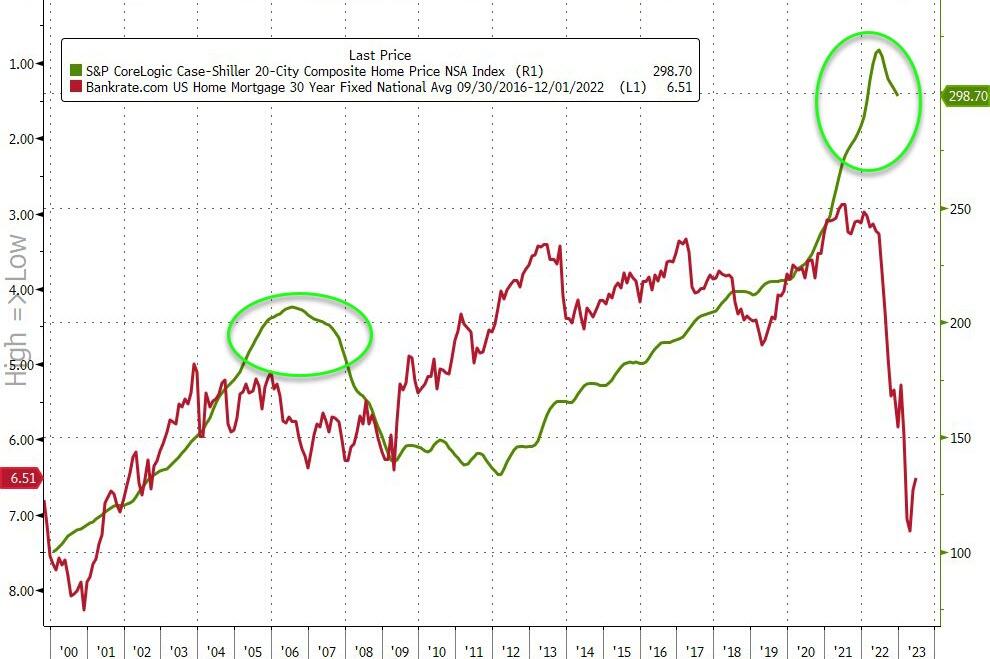
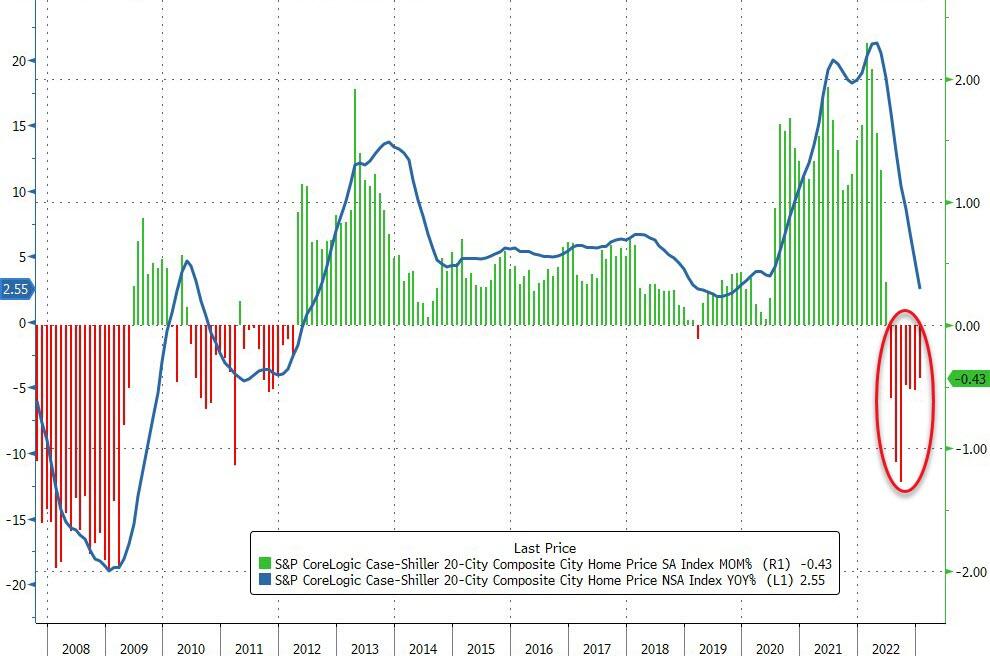
US home prices, according to S&P CoreLogic’s Case-Shiller index, fell for the 7th straight month (-0.42% MoM) leaving the home price index up 2.55% YoY (in January – this data is always very lagged) – the lowest growth since Nov 2019.

Source: Bloomberg

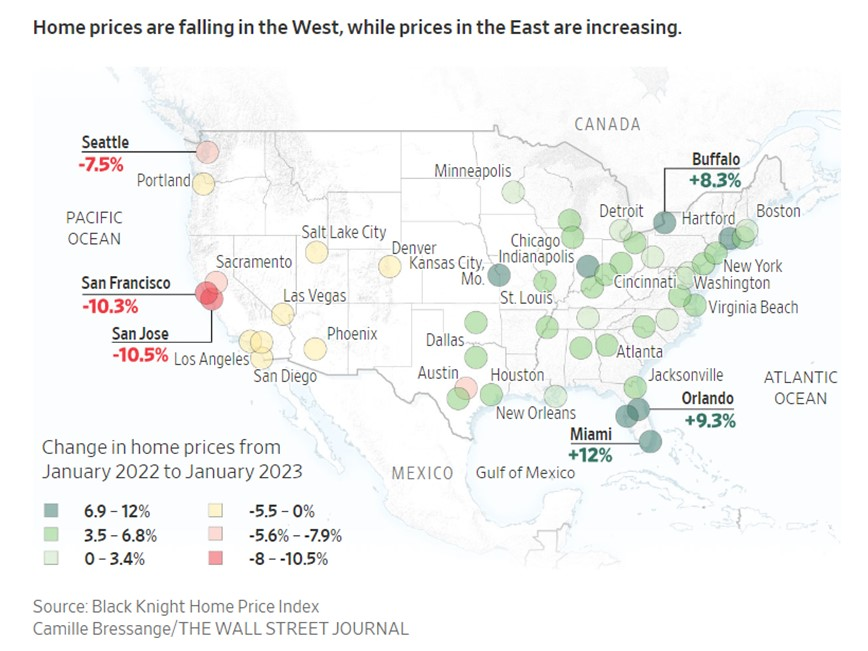
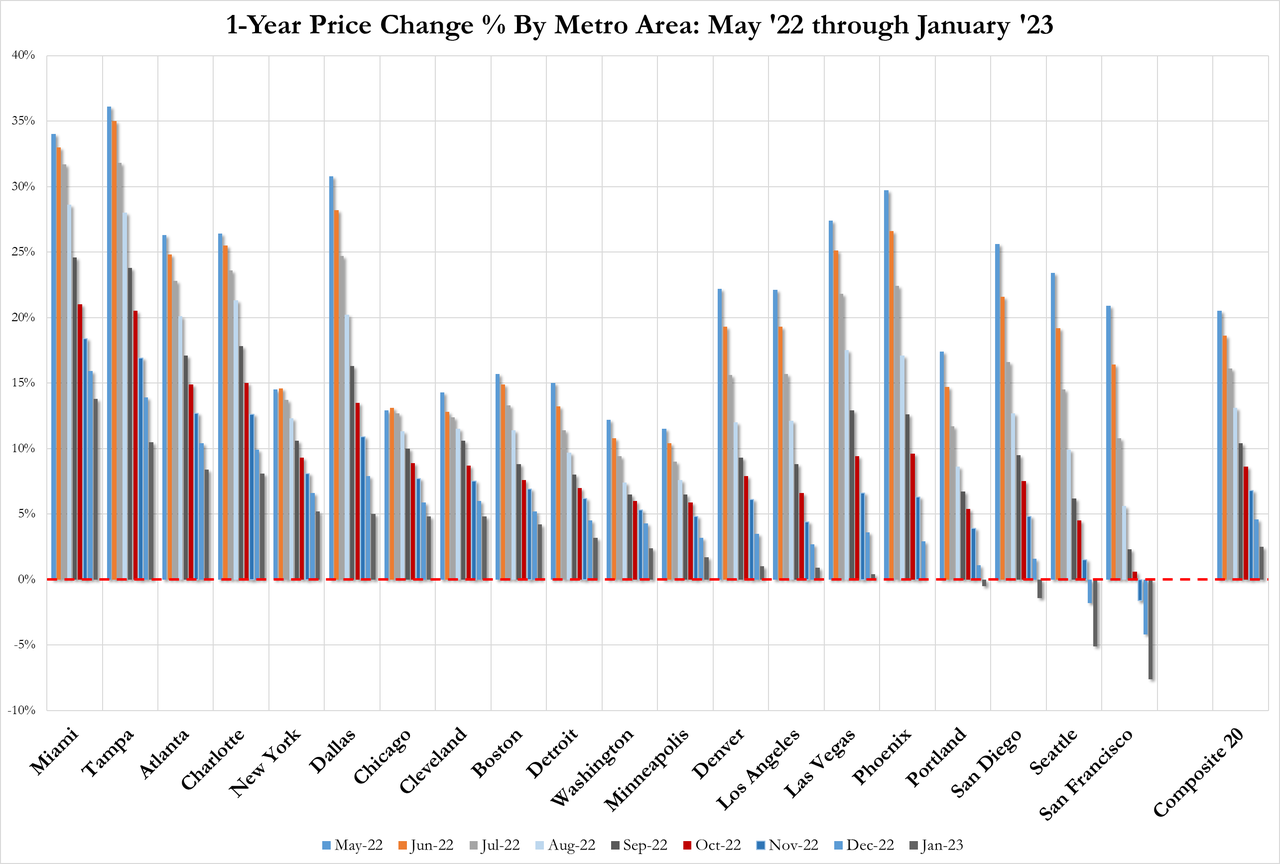
“One of the most interesting aspects of January’s report is the continued weakness in home prices on the West Coast, as San Diego and Portland joined San Francisco and Seattle in negative year-over-year territory,” Craig J. Lazzara, managing director at S&P Dow Jones Indices, said in statement.

“It’s therefore unsurprising that the Southeast (+10.2%) continues as the country’s strongest region, while the West (-1.5%) continues as the weakest.

Source: Bloomberg

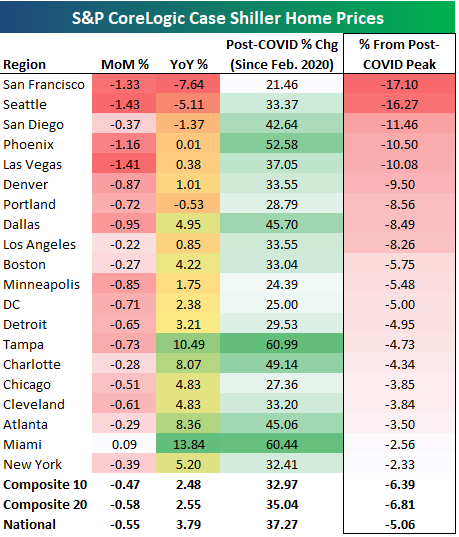
San Francisco and Seattle are down the most from their highs (New York and Miami are down the least). Home prices in Miami and Tampa are still up over 60% since COVID…

Finally, the man behind the home price index – Yale economist Bob Shiller – told CNBC’s “Closing Bell: Overtime” Monday. “Home prices are very, very high by historical standards.” 

“I would extrapolate the downturn somewhat – it’s going to continue,” he added.

“Maybe if you have a good chance to delay your purchase, it might be a good time to do it.”

“It might get a little cheaper after another six months.”

We suspect that is what Powell is hoping for, and judging by mortgage rates, prices have a long way to fall…

Unless The Fed folds.


Tyler Durden
Tue, 03/28/2023 – 09:11

via ZeroHedge News https://ift.tt/gisASB3 Tyler Durden

West Virginia Legislature Enacts RFRA, With Abortion Carveout

The West Virginia legislature has enacted a version of the Religious Freedom Restoration Act (RFRA). (H/T Religion Clause) But there are several exceptions to the rule:

(2) Nothing in this article may be construed to create a cause of action by an employee against a nongovernmental employer; nor may anything in this article be construed to constitute a defense to any claim based upon a refusal to provide emergency medical services as required by the Emergency Medical Treatment and Active Labor Act, 42 U.S.C. § 1395dd; nor may anything in this article be construed to protect actions or decisions to end the life of any human being, born or unborn, including, but limited to, any claim or defense arising out of a violation of §16-2F-1 et seq., §16-2I-1 et seq., §16-2M-1 et seq., §16-2O-1, §16-2P-1, §16-2Q-1, §16-2R-1 et seq., §16-5-22, §30-1-26, §33-42-8, or §61-2-8 of this code.

Here, West Virginia is trying to get ahead of the post-Dobbs litigation in other contexts. For example, in Indiana and other states, abortion rights groups have invoked RFRAs to challenge abortion laws. This option would not be viable in West Virginia.

I discuss the religious liberty and abortion in a new article, co-authored with Howie Slugh and Tal Fortgang.

The post West Virginia Legislature Enacts RFRA, With Abortion Carveout appeared first on Reason.com.

from Latest https://ift.tt/7HWYhgo
via IFTTT

Fed’s First Rate Cut May Be Right Around The Corner

Fed’s First Rate Cut May Be Right Around The Corner

Authored by Simon White, Bloomberg macro strategist,

The labor market, the yield curve, inflation and a stock-market selloff are poised to force the Federal Reserve into a rate cut sooner than the market is currently pricing.

In markets, it pays to remember that things take longer to happen than you think they will, and then they happen much faster than you thought they ever could. It was only two weeks ago that the market was expecting up to another four rate hikes. Now it’s effectively pricing the end of the rate-hike cycle, and the first cut by the end of the third quarter.

But there are several reasons why there could be another abrupt alteration in the state-of-play, with the first cut coming as early as June, and potentially significant cuts priced in before the end of the year:

  • Signs of deterioration in the job market that gain momentum very quickly;

  • A recession that now looks unavoidable and could begin as early as June;

  • Inflation that is long past its cycle peak; and

  • A rapid fall in velocity leading to a stock-market selloff

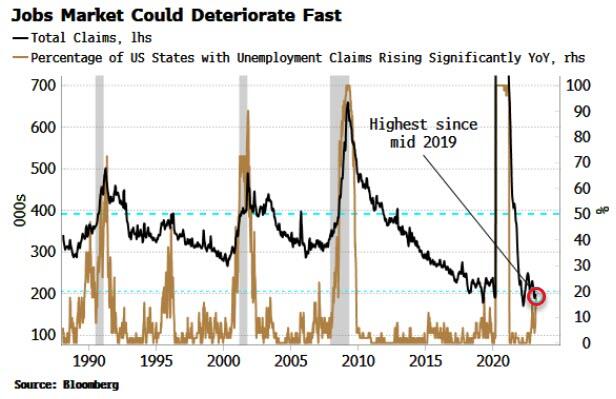
One of the surprising aspects of this cycle has been the resilience in the labor market. But that looks about to change. Unemployment claims are one of the most leading measures of the job market. The headline number has remained low, but the real information content comes from looking under the surface.

The chart below shows that almost a fifth of US states are seeing claims rise more than 25% on an annual basis. This is at a level that is often preceded by a further rapid deterioration and a jump higher in the nationwide number, which has in most cases culminated in a recession.

Moreover WARN notices are rising sharply. These must be filled in by employers 60 to 90 days ahead of plant closings and mass lay-offs, and lead unemployment claims.

Not only does a recession look unavoidable, it could happen as soon as the summer. Yield-curve inversions tell you a recession is on the way at some point, but a more imminent sign is when the curve steepens.

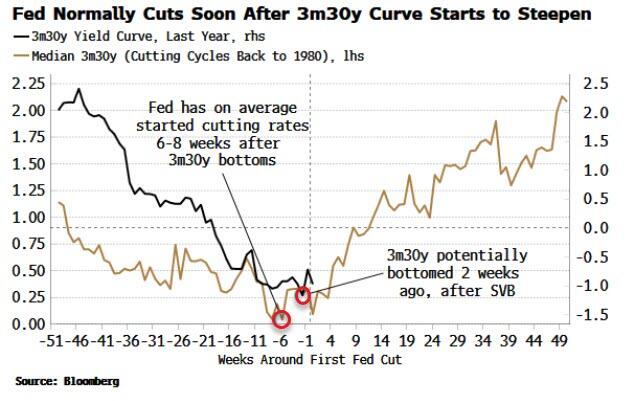
The part of the curve that typically starts steepening first is the 3-month/30-year segment
This began to steepen in early February, and has kept steepening apart from a brief spasm in the wake of SVB. This is historically consistent with a recession beginning as soon as June, and would match the raft of leading indicators that are anticipating a slump.

The Fed typically starts cutting rates 2-3 months before the recession starts, and 6-8 weeks after the 3m-30y curve begins steepening. If the curve bottomed two weeks ago, that’s consistent with the first cut as early as May.

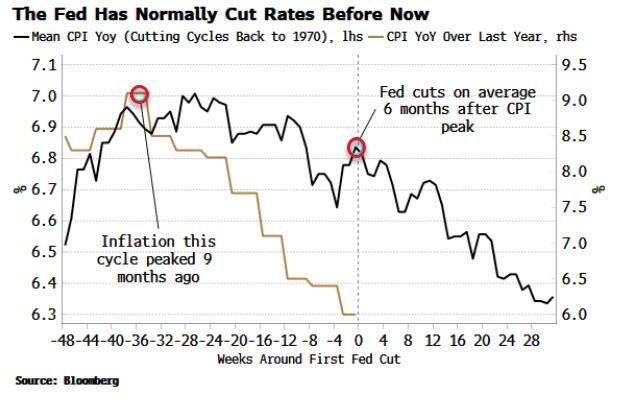
Would inflation stop the Fed cutting, even if the jobs market were markedly worsening and a recession looked imminent? Historically speaking, no. On average, the Fed starts cutting rates six months after CPI peaks. Inflation, in this cycle, peaked nine months ago, and has since fallen by a third.

To be sure, there are still plenty of worrying aspects to inflation, from elevated profit margins, to sticky core measures. But the Fed is adept at moving the goal posts when it needs to, and – barring a rapid re-acceleration – inflation is unlikely to be enough on its own to hold the central bank back from easing if it needs to.

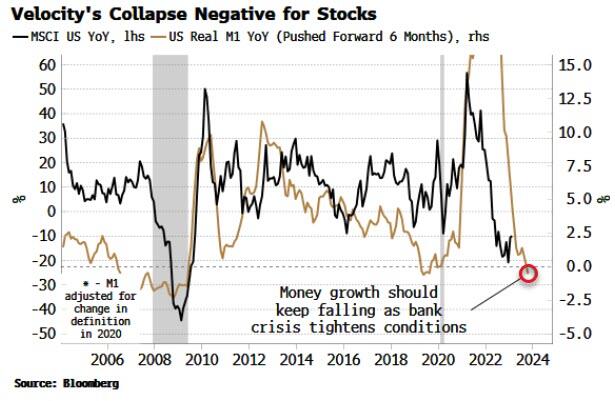
Nevertheless, the elephant in the room is the stock market. With the S&P still hovering around 4,000 the Fed is unlikely to cut. But the banking crisis is leading to a sharp tightening in financial conditions. Don’t be fooled by the recent expansion of the Fed’s balance sheet, velocity is being sucked out of the system rapidly.

Stocks are highly exposed to this fall. As data last week confirmed, deposits are leaving the banking system, and from there heading to higher-yielding money market funds and thus the RRP, where their velocity is effectively zeroed. The fall in deposits is likely to lead to an even bigger contraction in real money growth, precipitating another drop in equities.

This would solve the Fed’s financial conditions dilemma, in that it will not ease until these tighten. The dirty little secret about FCIs (financial conditions indexes) is that they are highly correlated to equities. If stocks are soon a lot lower after a velocity-induced selloff, there will be little to stop the Fed cutting rates, perhaps by a lot, when the economy is showing marked signs of distress.

Cutting rates would also, at a stroke, improve the solvency of the regional-bank sector, the focal point of the current crisis. Estimates are that the US banking sector overall is harboring losses of $2 trillion in hold-to-maturity portfolios, which would rapidly diminish as rates fell, as well as reducing the need (for now) of more Fed lending programs.

The market does not currently see the first full cut priced until September, but it could come much more abruptly than you think. Another rate hike looks like a distant possibility – the Fed would gain little when the front of the curve is now so inverted – leaving July and August Fed Funds futures with excellent risk-reward.

Tyler Durden
Tue, 03/28/2023 – 08:45

via ZeroHedge News https://ift.tt/jDsmTUu Tyler Durden

Biden Border Crisis: 39 Dead After Fire Rips Through Mexican Migrant Center

Biden Border Crisis: 39 Dead After Fire Rips Through Mexican Migrant Center

A devastating fire ripped through a migration center near the US-Mexico border, claiming the lives of at least 39 people. 

According to NBC News, the fire occurred at the National Migration Institute (INM) in Ciudad Juarez, Mexico. INM released a statement and said the dead were “foreign migrants.”

INM said 39 had died so far, and another 29 were injured. Most people staying in the facility were from Central and South American countries, preparing to enter the US. 

The facility is located directly across the border from El Paso, Texas. 

Mexican authorities have yet to release the cause of the fire. The incident comes as the Biden Administration ignited the worst border crisis in decades, if not in the country’s history, by removing deterrent-focused immigration policies and border enforcement tools.

The consequences of disastrous open border policies include death, drugs, and chaos, affecting not just border regions but also American cities. 

Tyler Durden
Tue, 03/28/2023 – 08:29

via ZeroHedge News https://ift.tt/ZYCoOrH Tyler Durden

Futures Flat As Attention Turns To Fed Rate Hikes

Futures Flat As Attention Turns To Fed Rate Hikes

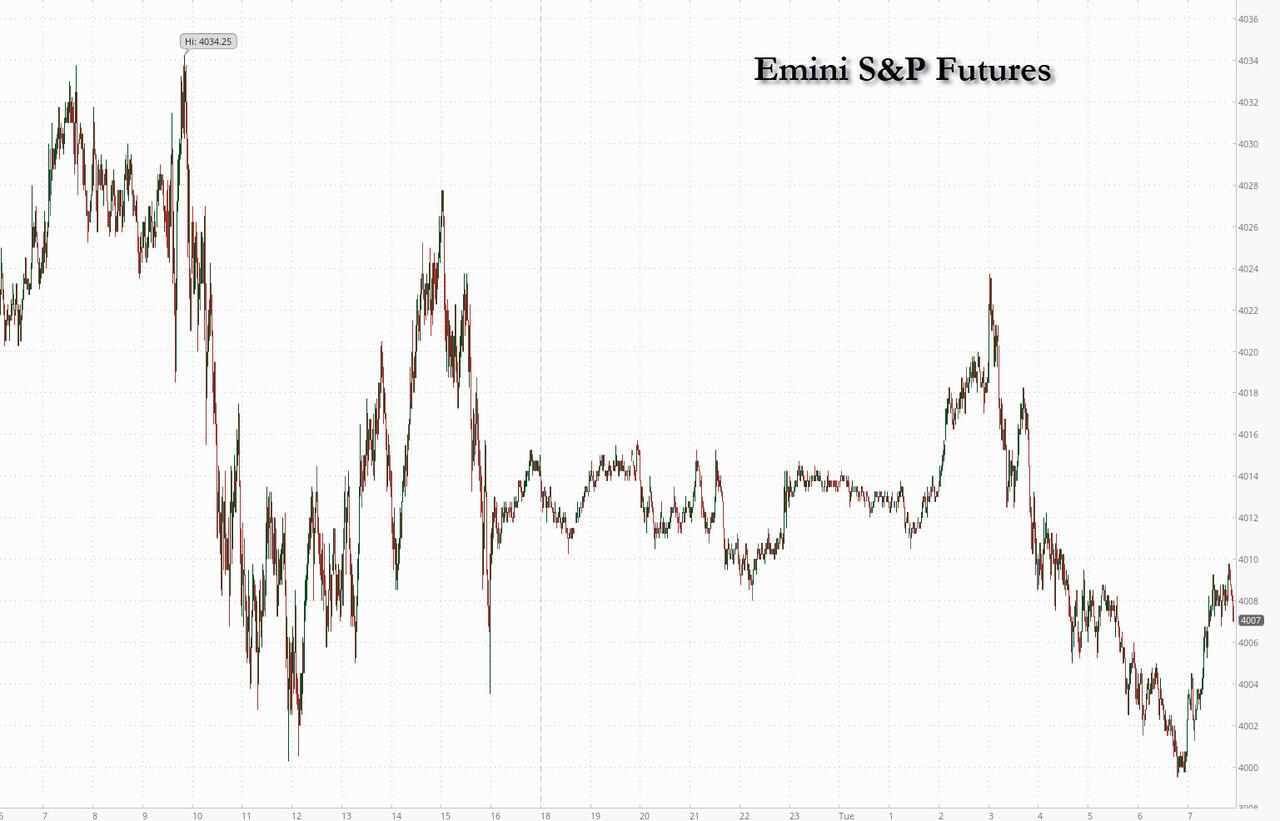
US futures are flat with bond yields reversing an overnight drop, lifted by the belly of the curve; the USD weaker for 8 of the past 9 days, and commodities mostly higher as investors shift their focus back to concerns about inflation and potential further monetary tightening from the recent banking-industry chaos; after all, a bank hasn’t failed in at least a few days.  WTI has soared 5.6% this week.

S&P 500 contracts were little changed as of 7:45 a.m. ET, after earlier gaining as much as 0.4% and closing 0.2% higher on Monday. Nasdaq 100 futures slid 0.2% after the tech-heavy benchmark lost 0.7% on Monday following strong gains over the previous two weeks. European stocks advanced along with Asian equities and the dollar traded lower as fears of broader contagion from the banking turmoil eased.

According to JPM, If bank contagion fears subside, we may see a resurgence in both bond yields and commodities as growth, before the banking crises, was stronger than expected led by the US and a reopened China. “However, banking crises typically have wide-ranging, and negative, impacts on growth and employment.” Today’s macro data focus includes inventories, housing prices, regional mfg updates, and Consumer Confidence. Keep an eye on the confidence number as that can impact spending.

In premarket trading, Alibaba shares soared 9% after the Chinese e-commerce company planned to split into six units that will individually explore IPOs. Shares in fellow Chinese ADRs also rallied. First Republic Bank gained 3.1% adding to a 12% jump on Monday after First Citizens BancShares’s agreement to buy Silicon Valley Bank reassured investors in regional lenders. PVH climbed 12% in premarket as the owner of Calvin Klein and Tommy Hilfiger issued stronger-than-expected earnings forecasts. Lyft rose as much as 5.2% after the ridesharing company appointed David Risher as CEO. Here are some other notable premarket movers:

  • Array Technologies gains 3.7% after Truist Securities raises the solar equipment manufacturer to buy from hold, saying it has made significant progress addressing past challenges related to its product portfolio, execution and margin structure.
  • Carnival Corp. is raised to equal-weight from underweight at Wells Fargo as the cruise operator has low near-term refinancing risk, its business in Europe is holding up well, and its annual Ebitda forecast is reasonable. Its shares gain 1.7% after dropping 4.8% on Monday following its earnings report.
  • Ciena Corp. shares are up 3.2% in premarket trading after Raymond James upgraded the communications equipment company to strong buy from outperform.
  • Occidental Petroleum advances as much as 2.2% after being upgraded to outperform from market perform at Cowen, with the broker saying the oil and gas company stands out for its “superior” exposure to oil pricing, share support, capital structure and differentiated catalyst rich profile. .
  • PVH shares surge 12% after the parent company of Calvin Klein and Tommy Hilfiger issued stronger-than-expected forecasts for revenue growth and reported fourth-quarter earnings per share that beat estimates. Analysts found the company’s performance to be strong, flagging the beat to EPS as well as the strong outlook. .
  • Viking Therapeutics said it plans to initiate a Phase 2 study of VK2735 in patients with obesity in mid-2023 based on Phase 1 trial results. Shares gain 50%.
  • Virgin Orbit fell more than 9.5% after the launch provider placed workers on furlough as it seeks rescue financing or bankruptcy.

“For now, it looks like the major stress around the banking crisis is calming down and markets can switch back to monitoring the inflation-recession dynamics,said Marija Veitmane, senior multi-asset strategist at State Street Global Markets in London.

As jitters in the banking sector subside, investors are again turning their attention to economic fundamentals and the outlook for Federal Reserve policy. Swaps have meanwhile priced in a more than 50% probability of a rate hike at the next meeting; they continue to expect sharp easing later however, with pricing suggesting the policy rate will slide to around 4.3% in December, down from around 4.95% in May.

Not all agree. “We see major central banks moving away from a ‘whatever it takes’ approach, stopping their hikes and entering a more nuanced phase that’s less about a relentless fight against inflation but still one where they can’t cut rates,” strategists at BlackRock Investment Institute, including Wei Li and Alex Brazier, wrote in a note.

Hugh Gimber, global market strategist at JPMorgan Asset Management, also doesn’t foresee rate cuts anytime soon, even if hikes pause, and cautions against stock-market optimism on it. “I think the market is right to price a Fed pause,” he said in an interview on Bloomberg TV. “The question here is how big the feed through from a deterioration in lending standards is to really get inflation lower towards target, and I’m not that convinced we will see that very quickly. I think we would need a pretty significant economic shock to get there in 2H. Rate cuts are more of a 2024 story.”

European stocks are in the green although they’ve pared gains since the open as investors remain cautious amid risks to the global financial system. The Stoxx 600 has trims gains to 0.2% while Deutsche Bank swings to a ~2% fall from from ~2% rise. Energy, miners and autos are the strongest-performing sectors. Here are the most notable European movers:

  • GSK gains as much as 0.9% after it announced positive results from an endometrial cancer drug trial. Shore Capital describes the published data as “promising”
  • Ocado shares rise as much as 5.7% after the online grocer’s retail joint venture with Marks & Spencer beat sales expectations in the first quarter
  • Zalando shares rise as much as 3.2% as HSBC upgrades the online fashion retailer to buy from hold, saying its momentum is moving in the right direction
  • Marks & Spencer shares gain as much as 3.1% as Credit Suisse hikes its price target, saying the UK retailer’s recovery momentum is building
  • Eurocash jumps as much as 11% after the retailer posted record 4Q Ebitda of 308m zloty and cut debt ratios, seen by analysts as a soothing signal
  • Telecom Italia shares rise as much as 3.4% after Bloomberg reported that Italian state-backed lender CDP plans to raise its offer for the carrier’s landline network
  • Diageo shares slip as much as 0.9% after the British distiller said Ivan Menezes plans to retire as chief executive officer, which analysts say is a loss
  • Embracer shares slump as much as 15%, after the video-game maker said licensing deals with several industry partners are unlikely to be completed before the month ends
  • Norma shares fall as much as 15% as Baader highlights the tech hardware firm’s conservative FY23 margin outlook due to ongoing burdens from efforts to restructure
  • CMC Markets falls as much as 6.3%, adding to a 21% drop Monday when the online trading company released a downbeat earnings update late in the session
  • Schibsted shares drop as much as 9.6% as a weaker short-term guidance for the Norwegian media and classified advertising group offsets higher longer-term targets
  • Synthomer shares drop as much as 19% with Morgan Stanley saying it sees further consensus downgrades ahead for the UK chemicals firm following its FY results

Elsewhere in markets, Asian stocks gained as a lull in new developments in the banking sector gave investors a chance to adjust positions and assess whether the Federal Reserve will lower rates to buttress the US economy.  The MSCI Asia Pacific Index rose as much as 0.9%, halting a two-day losing streak. A sub-gauge of financial shares jumped more than 1% as they followed US peers higher. Australia, Japan and South Korea advanced. Hong Kong’s Hang Seng Index gained about 1%, while China’s mainland indexes fluctuated. “Asia still remains relatively well insulated from the latest round of US/European bank turmoil,” Citigroup analysts including Johanna Chua wrote in a note. “Direct exposure of Asia to the affected financial institutions is very limited.” Asia’s regional equity gauge has climbed more than 2% over the past week as US bank shares regained their footing after tumbling last week and fanning fears of a looming economic slowdown. Doubleline Capital’s Jeffrey Gundlach said on CNBC that he expects a US recession to start in a few months, and that the Federal Reserve will need to respond “very dramatically.”

Japanese stocks rose for a second day as concerns around financial institutions cooled after First Citizens BancShares Inc. agreed to buy failed Silicon Valley Bank.  The Topix rose 0.2% to close at 1,966.67, while the Nikkei advanced 0.2% to 27,518.25. Sumitomo Mitsui Financial Group contributed the most to the Topix gain, increasing 2.7%. Out of 2,159 stocks in the index, 799 rose and 1,232 fell, while 128 were unchanged. “Overall risk tolerance has increased now that the Silicon Valley Bank situation appears to have calmed down,” said Ryuta Otsuka, strategist at Toyo Securities. “However, it is hard to expect large market moves in Japan as we are approaching the end of the fiscal year.”

Australian stocks extended rose with the S&P/ASX 200 index rising 1% to close at 7,034.10, extending gains for a second session, boosted by mining shares and banks. Lithium miners, some of the benchmark’s most shorted names, rallied after Liontown rebuffed a takeover bid from Albemarle.  Equities across Asia climbed, US stock futures edged higher and the dollar declined as fears of broader contagion from the banking turmoil eased. Investors await Australia’s CPI print due Wednesday.  In New Zealand, the S&P/NZX 50 index rose 1.4% to 11,771.27

Stocks in India were mostly lower on Tuesday as key gauges headed for their fourth consecutive monthly decline amid tepid sentiment for global equities.  The S&P BSE Sensex fell 0.1% to 57,613.72 in Mumbai, while the NSE Nifty 50 Index declined 0.2%. The benchmark gauge has slipped about 2.1% this month and is on course for its longest losing monthly streak since Feb. 2016. Software major Infosys contributed the most to the Sensex’s decline, decreasing 0.8%. Out of 30 shares in the Sensex index, 11 rose, while 19 fell. All 10 companies related to the Adani Group fell, led by a 7% plunge in flagship firm Adani Enterprises after a newspaper report said the conglomerate will probably seek more time to repay a $4 billion loan it took out last year.  Foreign investors have been buyers of $1.3b of local shares this month through March 24, mainly on back of GQG Partners’ stake purchase in Adani companies. “Barring gains in select banking and metal stocks, other sectors witnessed profit-taking as caution prevailed ahead of the F&O expiry on Wednesday,” Kotak Securities analyst Shrikant Chouhan said.

In FX, the Bloomberg Dollar Spot Index slipped 0.1%, marking its eighth day of declines in the past nine sessions, weighed by a jump in the yen on domestic demand ahead of the fiscal year-end in Japan.  Exporters in Japan and Australia added to the selling of the dollar as they increased hedging to cover prior long positions in the greenback, Asia- based FX traders said. The New Zealand dollar and Japanese yen are the best performers among the G-10s while the Swiss franc is the weakest.

In rates, the five-year Treasury yield rises as much as 7 basis points to 3.67%, while the two-year yield climbs 4 basis points to 4.04% after sliding as low as 3.89% earlier in the session; a selloff in Treasuries since the start of the week has lifted most yields from six-month lows reached on Friday. 10-year yields around 3.55%, cheaper by 2bps on the day with bunds lagging by additional 5bp in the sector; 2-year yields cheaper by around 7bp on the day, remain above 4% level vs. Monday’s 3.954% auction stop. As BBG’s Beth Stanton notes, Monday’s poorly-bid 2Y auction is now under water vs its 3.954% stop with May rate hike back in favor. Auction cycle continues with $43b 5Y at 1pm. WI yield 3.65% is between last two 5Y stops. The US auction cycle resumes with $43b 5-year note sale at 1pm, follows Monday’s poor 2-year result; WI 5-year at 3.63% is ~48bp richer than February’s stop-out. German two-year borrowing costs are up 12bps.

Traders are now betting on a roughly 50/50 chance that the Fed will deliver a final quarter-point hike in May, followed by a similar-sized cut in September; market pricing reflects a diminishing outlook for a series of cuts in the coming months, and a growing view that the Fed may keep rates on hold for longer. BlackRock sees the Fed continuing to raise interest rates despite traders betting otherwise as fears of a banking crisis convulse markets. “We don’t see rate cuts this year – that’s the old playbook when central banks would rush to rescue the economy as recession hit,” its strategists write in a note. “We see a new, more nuanced phase of curbing inflation ahead: less fighting but still no rate cuts.”

In commodities, crude futures advance with WTI up 0.5% to trade near $73.15. Spot gold falls 0.3% to around $1,951. European and US gas benchmarks diverge slightly in European trade; Morgan Stanley writes that “prices likely still need to move lower to incentivize an adequate supply response, but we may be approaching the bottom”.

Looking to the day ahead, we will have a number of data releases from the US including the Conference Board consumer confidence, the Richmond Fed manufacturing index and business conditions, the Dallas Fed services activity, the January FHFA house price index, and February’s wholesale and retail inventories and advance goods trade balance. We will also have Italy’s March manufacturing and consumer confidence as well as economic sentiment data, and from France the March manufacturing and consumer confidence data. The BoE’s Bailey will testify today on the Silicon Valley Bank crisis, and we will also hear from ECB’s Muller. Finally, we will have earnings releases from Micron, Walgreens Boots Alliance and Lululemon.

Market Snapshot

  • S&P 500 futures little changed at 4,009.00
  • STOXX Europe 600 up 0.3% to 446.06
  • MXAP up 0.6% to 159.53
  • MXAPJ up 0.6% to 512.94
  • Nikkei up 0.2% to 27,518.25
  • Topix up 0.2% to 1,966.67
  • Hang Seng Index up 1.1% to 19,784.65
  • Shanghai Composite down 0.2% to 3,245.38
  • Sensex little changed at 57,596.88
  • Australia S&P/ASX 200 up 1.0% to 7,034.09
  • Kospi up 1.1% to 2,434.94
  • German 10Y yield little changed at 2.30%
  • Euro up 0.2% to $1.0818
  • Brent Futures up 0.5% to $78.49/bbl
  • Gold spot down 0.2% to $1,952.30
  • US Dollar Index down 0.17% to 102.69

Top Overnight News

  • Alibaba plans to split its $220 billion business into six main units encompassing e-commerce, media and the cloud, each of which will explore fundraising or IPOs when the time’s right. Group CEO Daniel Zhang will head up the cloud intelligence division, a nod to the growing role AI will play in the e-commerce leader’s portfolio in the long run. BBG
  • Binance’s CEO Changpeng Zhao shot back at the CFTC, calling its lawsuit over alleged violations of derivatives regulations “unexpected and disappointing,” given compliance efforts and cooperation with regulators. His firm doesn’t trade for profit or manipulate the market, he said. The suit has “an incomplete recitation of facts.” BBG
  • China has significantly expanded its bailout lending as its Belt and Road Initiative blows up following a series of debt write-offs, scandal-ridden projects and allegations of corruption. A study published on Tuesday shows China granted $104bn worth of rescue loans to developing countries between 2019 and the end of 2021. The figure for these years is almost as large as the country’s bailout lending over the previous two decades. FT
  • Semiconductor companies seeking federal grants under the Chips Act could face a tough decision: take Washington’s help to expand in the U.S., or preserve their ability to expand in China. The Biden administration last week proposed new rules detailing restrictions chip companies would face on operations in China and other countries of concern if the companies accept taxpayer funding. WSJ
  • Balances at the Fed’s RRP facility climbed, even as rates in the private market rose as much as 15 bps above the central bank’s offering yield. Ninety-eight counterparties parked $2.22 trillion at the RRP, up $1.7 billion from Friday. BBG
  • The Federal Reserve’s top official on banking supervision has blamed the collapse of Silicon Valley Bank on a “textbook case of mismanagement”, saying the board of the US central bank had been briefed on the troubles at the California lender in mid-February. FT
  • The Treasury’s top domestic policy official Nellie Liang will tell Congress regulators are ready to repeat steps taken after recent bank failures. She testifies today with the Fed’s chief of banking supervision, Michael Barr, and FDIC head Martin Gruenberg. The ECB’s top oversight official urged global scrutiny of the CDS market. And BOE boss Andrew Bailey said UK banks are strong. BBG
  • Calm returned to Israeli cities Tuesday and protests against Israeli Prime Minister Benjamin Netanyahu’s judicial overhaul dispersed after the premier agreed to suspend the controversial plan and Israeli President Isaac Herzog offered to host compromise talks between the two sides. WSJ
  • DIS has eliminated its next-generation storytelling and consumer experiences unit, the small division that was developing metaverse strategies, according to people familiar with the situation, as part of a broader restructuring that is expected to reduce head count by around 7,000 across the company over the next two months. WSJ
  • In the battle for the biggest prize in China’s trillion-dollar pension market, BlackRock Inc. and other global firms have little chance of attracting clients like Judy Deng: BBG
  • The Federal Deposit Insurance Corp. stuck to its guns and didn’t offer bailouts to keep two lenders from collapsing. Instead, it struck deals that included millions of dollars of sweeteners for the acquiring banks that sent their stocks soaring: BBG
  • The US took its most forceful move yet on Monday to crack down on crypto exchange Binance Holdings Ltd. and its chief executive officer Changpeng Zhao: BBG

A more detailed look at global markets courtesy of Newsquawk

Asia-Pac stocks traded mixed with a mild positive bias as global banking sector fears continued to dissipate and with early advances led by energy after the recent surge in oil prices although gains were capped in the region as North Korean nuclear rhetoric stoked geopolitical concerns. ASX 200 was boosted amid strength in the commodity-related sectors with outperformance in energy after oil prices notched the largest daily gain since October and financials were also lifted as Australia downplayed the risks to domestic banks from the recent global banking issues. Nikkei 225 was indecisive despite Japan reiterating plans for a JPY 2.2tln economic stimulus package with trade stuck in a narrow range near 27,500 after the nuclear rhetoric by North Korea which called for the scaling up of weapons-grade nuclear materials and included similar language used before its last nuclear test in 2017. Hang Seng and Shanghai Comp. were choppy ahead of key earnings results and after PBoC liquidity efforts.

Top Asian News

  • China’s Foreign Ministry said Premier Li Qiang met with foreign representatives at the China Development Forum in Beijing on Monday and met with executives including Apple (AAPL) CEO Cook, while Li told executives China will unswervingly expand its opening up, according to Reuters.
  • US and Japan reached a trade deal for critical EV battery minerals in which the deal prohibits enacting export restrictions on lithium, cobalt, nickel, manganese and graphite, according to US officials. Furthermore, the deal includes provisions to combat non-market practices, while access for Japanese automakers to the battery minerals portion of USD 7,500 in US EV tax credit depends on the tax guidance this week from the US Treasury.
  • China is reportedly aiming to set up 30+ key auto chips standards by 2025, according to the Ministry of Industry and Information Technology.
  • A magnitude 5.7-5.9 earthquake occurred offshore Eastern Aomori Prefecture, Japan; NHK says it has a prelim. magnitude of 6.1; no tsunami warning issued.

European bourses were initially firmer across the board in a continuation of the APAC tone, though benchmarks have since eased from best and are flat/mixed. Sectors are mixed with Energy outperforming while Banking names were firmer but have eased off of best levels and incrementally into the red alongside the broader benchmarks throughout the morning. Stateside, futures are mixed/flat, though with the bias inching further into the red, as the region awaits todays Senate Banking Committee hearing on the recent banking turmoil with Fed’ Barr in attendance. Meta Platforms Inc. (META) plans to lower some bonus payouts and will more frequently assess employee performance, according to an internal memo, part of a sweeping revamp of the social-media company that includes large head-count reductions, WSJ reports.
Alibaba (BABA/9988 HK) business unit can reportedly pursue fundraising and IPOs when ready, according to Bloomberg; Alibaba to restructure into six main business divisions.

Top European News

  • Kantar UK Supermarket update (Mar): Grocery price inflation has climbed again to reach 17.5% over the four weeks to 19 March 2023, a new record based on our latest market data.
  • ECB’s Muller says inflation is slowing but it is too early to declare a victory.

Banks

  • ECB’s Enria says current events confirm that strong, demanding supervision is needed more than ever. Adds, there have been some fast outflows of bank deposits in some cases.
  • BoE’s Bailey says does not think any of the features of recent banks issues are causing stress in the UK; Ramsden says will keep a close eye on bank funding costs.
  • US Treasury official Liang said the US government will use tools to prevent banking contagion again if warranted and that the US financial system is significantly stronger now due to stronger capital and liquidity requirements, while she added the US must ensure that banking regulations and supervision are appropriate for today’s risk and challenges, according to her prepared testimony, according to Reuters.
  • French PNF Financial Prosecutors says searches are underway at five banking/financial firms located within Paris and the Paris La Defense district re. a tax probe, German prosecutors assisting. Societe General (GLE FP) confirms its offices are being searched.
  • S&P says they are yet to see any meaningful contagion for APAC from the US regional banks/Credit Suisse (CSGN SW) turmoil.

FX

  • The USD has been incrementally softer throughout the morning within relatively narrow 102.52-102.76 parameters, most recently the DXY has attempted to pare initial downside.
  • Action which comes to the mixed fortune of peers, with AUD, NZD and JPY outperforming given the risk tone and as the JPY attempts to recover from Monday’s pressures; holding below 0.67, 0.625 and above 131.00 respectively.
  • CHF resides as the laggard, with downside seemingly stemming from the risk tone rather than any fresh Swiss banking concern, EUR/CHF above 0.99 to a 0.99300 peak.
  • In close proximity is the CAD which is unable to benefit from crude upside while GBP and EUR are contained around 1.08 and 1.23 respectively vs USD with Central Bank speak thus far not moving the dial.
  • Citi month-end model: Prelim. estimate points to moderate USD selling vs all major currencies ex-EUR, via Reuters. Click here for more detail.
  • PBoC set USD/CNY mid-point at 6.8749 vs exp. 6.8737 (prev. 6.8714)

Fixed Income

  • EGBs are under pressure in a continuation of the firmer risk tone from APAC trade; however, benchmarks are off worst levels as equities inch into the red.
  • Specifically, Bunds are below 136.00 with the associated 10yr yield firmly above 2.30% though yet to breach 2.35%.
  • Gilts and the EZ periphery are in-line with mentioned core counterparts and have been unaffected by numerous Central Bank officials where the focus has been on recent banking turmoil.
  • Supply wise, the Italian and German sales passed without fanfare and were well-received overall though demand was slightly softer when compared to the prior outings.

Commodities

  • Crude benchmarks continue to climb aided by the softer dollar and the latest geopolitical tensions re. N. Korea; WTI and Brent holding above USD 73/bbl and USD 78/bbl respectively.
  • European and US gas benchmarks diverge slightly in European trade; Morgan Stanley writes that “prices likely still need to move lower to incentivize an adequate supply response, but we may be approaching the bottom”.
  • Spot gold is pressured by the risk tone and failing to benefit from the softer USD with the yellow metal below the USD 1959/oz 10-DMA and holding around USD 1950/oz currently, base metals conversely are modestly firmer.
  • Russian Deputy PM Novak says the domestic fuel and energy complex is sustainable despite challenges, hopes to agree on key contract terms for the Power of Siberia 2 gas pipeline to China this year. Russia should look to produce at least 100mln/T of LNG per year by 2030.

Geopoliitcs

  • Russian Defence Ministry said it fired supersonic anti-ship missiles at a mock target in the Sea of Japan.
  • North Korean leader Kim guided the nuclear weaponisation programme and inspected nuclear trigger technology during a recent simulation. Kim also called for constant efforts to improve nuclear capability and said the country should be fully ready to use nuclear weapons at any time, while he called for the scaling up of weapons-grade nuclear materials to exponentially increase nuclear weapons arsenal. North Korea also alleged that US and South Korea military drills involving an air carrier are aimed at pre-emptive nuclear strike and said that US anti-North Korean activities are intensifying to unacceptable levels, according to KCNA.
  • North Korea is reportedly preparing to resume foreign diplomatic activity after three years of COVID isolation, according to FT; North Korean officials recently resumed travels to Russia and China.
  • Belarus’ Foreign Minister says they have been forced to take steps ensuring security in the face of NATO potentially increasing within neighbouring nations, via Tass.

Crypto

  • Binance CEO said the CFTC complaint appears to have an incomplete recitation of the facts and they do not agree with the issues alleged in the complaint. Binance CEO said they intend to respect and collaborate with US and other regulators around the world, while he added that Binance.com does not trade for profit or manipulate the market under any circumstances, according to Reuters.

US Event Calendar

  • 08:30: Feb. Advance Goods Trade Balance, est. -$90b, prior – $91.5b, revised -$91.1b
  • 08:30: Feb. Retail Inventories MoM, est. 0.2%, prior 0.3%
    • Wholesale Inventories MoM, est. -0.1%, prior -0.4%, revised -0.3%
  • 09:00: Jan. FHFA House Price Index MoM, est. -0.2%, prior -0.1%
  • 09:00: Jan. S&P Case Shiller Composite-20 YoY, est. 2.55%, prior 4.65%
    • S&P/Case-Shiller US HPI YoY, prior 5.76%
    • S&P/CS 20 City MoM SA, est. -0.50%, prior -0.51%
  • 10:00: March Conf. Board Consumer Confidence, est. 101.0, prior 102.9
    • Expectations, prior 69.7
    • Present Situation, prior 152.8
  • 10:00: March Richmond Fed Index, est. -10, prior -16
  • 10:30: March Dallas Fed Services Activity, prior -9.3

Central Banks

  • 10:00: Fed’s Barr Appears Before Senate Banking Panel

DB’s Jim Reid concludes the overnight wrap

After a hectic 2 and a half weeks that has felt like a year, the week has started on a much calmer footing. I’m on holiday for a couple of weeks from Thursday so I’m hoping that I don’t have to do zoom meetings from the ski slopes. My ski outfit and technique won’t make that a pretty sight.

As we highlighted in our CoTD yesterday (link here) we have to be careful not to fight the battle of the last war. Large banks in the US and Europe are completely different entities than they were going into the GFC. For large US banks for example, securities and loans/leases on their balance sheets as a % of deposits are lower than when our data starts in 1985 and at below 100% are massively down from their GFC peaks of over 150%. We don’t have the same long term data for Europe but the declines since the GFC are of similar magnitudes.

In contrast corporates are more levered now than during the GFC and this cycle could ultimately be more corporate default focused vs financials as per say 2001-2002 rather than 2008-09. See Steve Caprio’s full note here for more on this and how corporate spreads are too tight to financials now.

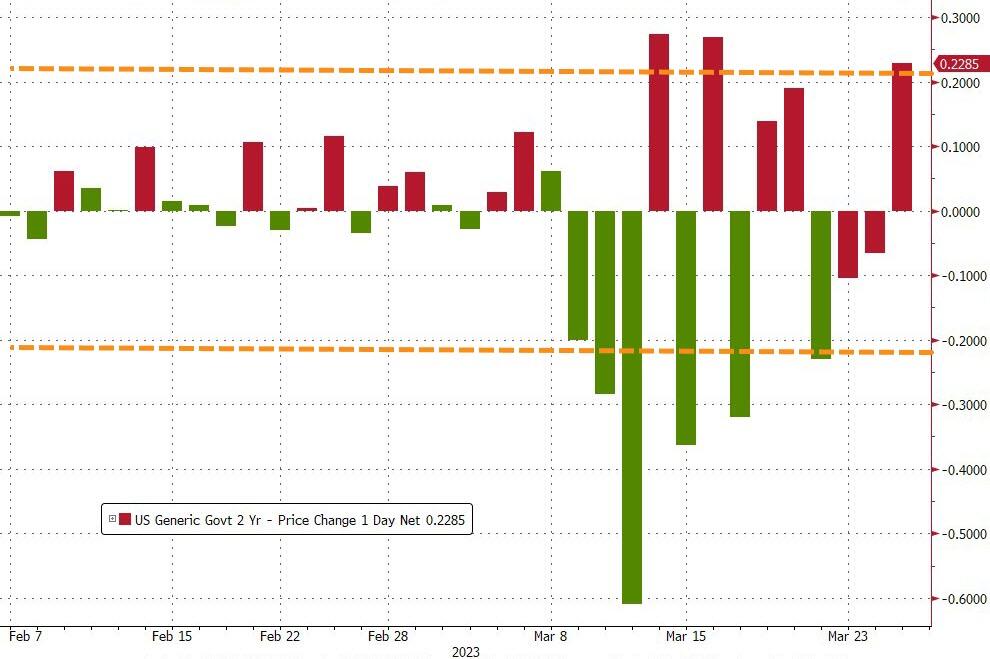
So no new news was good news yesterday and some risk premium was removed from the market. This was most evident in bonds with US 2yr and 10yr yields up +22.9 bps and +15.4bps respectively. The S&P 500 was up +0.80% in the first hour of trading but did retrace the entire move back to flat before rallying in the US afternoon to finish with a an overall modest gain of +0.17%, whilst the STOXX 600 climbed +1.05%. US banks led the US move higher, having traded off their lows from last week, with the S&P 500 banks index up +3.05%. European banks were earlier +1.69% higher.

Narrowing in, First Citizens jumped 49% at the market open after its agreement to buy SVB Financial Group’s Silicon Valley Bank, ending the day up by +53.74%. First Republic Bank similarly jumped at the open by +27.45% after a Bloomberg report that US authorities were considering an expansion to their emergency lending facility, the Bank Term Funding Program, that had been created on March 12 with the collapse of SVB and Signature Bank. Against this backdrop, the gauge of regional US banks, the KBW index, closed up +2.54% yesterday, with the leaders including First Republic (+12.14%), Comerica (+5.40%) and KeyCorp (+5.31%).

Improving risk sentiment saw investors pare back their expectations of Fed rate cuts, as the implied rate for the Fed’s May meeting gained +9.2bps, bringing it to 4.950%. In other words, fed futures are now pricing in a 53% chance of a +25bps hike in May. For December’s meeting, markets trimmed their expectations of rate cuts from over -94bps on Friday to nearly -74bps, as the implied rate rose +29.5bps to 4.206%.

Back on this side of the pond, the German March Ifo business confidence index printed above expectations at 91.2 (vs 88.3 expected), and up from 88.5 for February. The other two individual components of the release also beat expectations, with business climate rising to 93.3 (vs 91 expected) and current assessment at 95.4 (vs 94.1 expected). Although the Ifo survey typically demonstrates less sensitivity to financial market uncertainty relative to other surveys coming from Germany such as the ZEW survey, the release is consistent with last Friday’s PMIs that suggested the Eurozone economy remains in, or at least was in decent shape, before the banking crisis hit.

Consequently, the DAX outperformed relative to the broader STOXX 600 index, up +1.14%, whilst the STOXX 600 advanced by +1.05%. For the latter, all major sectors were in the green, with sector leaders including health care (+1.93%), utilities (+1.31%) and autos (+1.89%). The CAC also gained yesterday, up by +0.90%. Following from Friday’s jitters about European banking sector stability, ECB’s Simkus emphasised that ‘bank liquidity, capitalisation (are) high in euro area.’ ECB’s De Cos echoed this sentiment, stating ‘euro-zone banks (are) well-prepared for adverse scenarios’.

We also heard from several other ECB’s speakers yesterday, as ECB’s Schnabel stated she had pushed for the ECB statement to say that more hikes were a possibility as opposed to the verbal assurance that had been made by President Lagarde. ECB’s Centeno’s comments were more dovish, as he stated that they “don’t see long-term inflation expectations de-anchoring”, with “no signs of second-round effects in wage-setting.” Markets moved to price in a modestly higher terminal rate as Eurozone overnight index swaps for July were up +7.5bps bringing the rate to 3.321%. The rate for year-end also increased, up +11.5bps to 3.226%, pricing in a 1 in 3 chance of a -25bps rate cut by December. Against this backdrop, yields across the German sovereign yield curve were up yesterday, with the 10yr bund yield climbing +9.8bps higher bringing the yield to 2.227%. The 2yr yield gained +12.8bps to 2.521%

Asian equity markets are mostly higher overnight. As I type, the Hang Seng (+0.60%), the KOSPI (+0.44%) and the Nikkei (+0.07%) are higher but with stocks in mainland China mixed with the CSI (-0.16%) edging lower while the Shanghai Composite (+0.05%) is oscillating between gains and losses. US stock futures are a little higher with contracts tied to the S&P 500 (+0.16%) and NASDAQ 100 (+0.17%) printing mild gains. Meanwhile, yields on 10yr Treasuries (-1.89bps) are slightly lower, trading at 3.51% while 2Yr Treasuries (-3.5bps) are trading at 3.96% as we go to press.

In early morning data, retail sales in Australia rose +0.2% m/m in February, in-line with market expectations, down from a revised +1.8% increase in January, signifying that households are reining in spending in response to higher interest rates. The subdued data adds to the case for a pause by the Reserve Bank of Australia (RBA) at its April 4th meeting. Meanwhile, the CPI data scheduled to be released tomorrow will be of note for the central bank.

Turning to commodities, WTI crude futures performed strongly yesterday, rising +5.13% to over $72.81/bbl, whilst Brent crude gained +4.17% to $78.12/bbl. European natural gas futures also gained +3.49% yesterday. The rally in energy prices was due to both supply-side and demand-side pressures. On demand, the rally in bank stocks and purchase of SVB seemed to ease concerns of a wider financial crisis. Meanwhile, a legal dispute between the Iraqi semi-autonomous region of Kurdistan and Turkey has put about 400,000 bbl/day of exports in limbo. This come as French refineries are running at a fraction of normal capacity due to the ongoing protests in the country. A Bloomberg report had as much as 80% of the nation’s crude-processing capacity stalled.

Finally, yesterday also saw the release of the Dallas Fed Manufacturing Activity for March which fell below expectations at -15.7 (vs -10 expected). This was a further decline from -13.5 last month as perceptions of broader business conditions deteriorated over the month.

Now looking to the day ahead, we will have a number of data releases from the US including the Conference Board consumer confidence, the Richmond Fed manufacturing index and business conditions, the Dallas Fed services activity, the January FHFA house price index, and February’s wholesale and retail inventories and advance goods trade balance. We will also have Italy’s March manufacturing and consumer confidence as well as economic sentiment data, and from France the March manufacturing and consumer confidence data. The BoE’s Bailey will testify today on the Silicon Valley Bank crisis, and we will also hear from ECB’s Muller. Finally, we will have earnings releases from Micron, Walgreens Boots Alliance and Lululemon.

Tyler Durden
Tue, 03/28/2023 – 08:09

via ZeroHedge News https://ift.tt/X98mJN4 Tyler Durden

What “Publication” Means in Defamation Cases: ChatGPT et al. Do It

This week and likely next, I’ll be serializing my Large Libel Models? Liability for AI Output draft. For some earlier posts on this (including § 230, disclaimers, and more), see here. Here, I want to explain why I think the “publication” requirement for defamation liability is satisfied in such situations.

[* * *]

Some have also argued that statements by AIs in response to user queries aren’t really “published,” because they are just one-on-one responses (which may differ subtly in wording or even content for different users). But defamation law has always applied to one-on-one writings (such as personal letters,[1] or notes with comments on an ex-employee’s job record[2]) and one-on-one oral statements (for instance, in telephone calls[3]). The Restatement (Second) of Torts captures it well, making it clear that “publication” in libel cases is a legal term of art:

Publication of defamatory matter is its communication intentionally or by a negligent act to one other than the person defamed.[4]

Some other legal rules require something more like the lay meaning of “publication.” For instance, the false light and disclosure of private facts torts are limited to statements that are given “publicity,” meaning ones that make an assertion “public, by communicating it to the public at large, or to so many persons that the matter must be regarded as substantially certain to become one of public knowledge.”[5] Likewise, certain copyright law principles turn on whether defendant engaged in “publication,” meaning “distribution . . . to the public,” or performed or displayed a work “publicly,” meaning (among other things) “at a place open to the public or at any place where a substantial number of persons outside of a normal circle of a family and its social acquaintances is gathered.”[6] But such publication in the colloquial sense is not required for libel liability.[7]

Of course, even if publication to a substantial group of people were required (as would be the case for the false light tort, see Part III.A), that could still be found when a statement, even with some variation, was distributed to many people at different times. Indeed, the copyright law definition of what counts as “public[]” performance of a copyrighted work (such as a song) recognizes that:

To perform or display a work “publicly” means—

(1) to perform or display it at a place open to the public or at any place where a substantial number of persons outside of a normal circle of a family and its social acquaintances is gathered; or

(2) to transmit or otherwise communicate a performance or display of the work to a place specified by clause (1) or to the public, by means of any device or process, whether the members of the public capable of receiving the performance or display receive it in the same place or in separate places and at the same time or at different times.[8]

And this makes sense: After all, if I post something on my web site, it will only be communicated to readers one at a time as they visit it, perhaps one today, one next week, another the week after, and so on—yet that should still be properly seen as, say, giving “publicity” to the information for false light or disclosure of private facts purposes.

[1] See, e.g., Restatement (Second) of Torts § 577 ill. 7.

[2] [Cite.]

[3] See, e.g., Restatement (Second) of Torts § 577 ill. 8.

[4] Restatement (Second) of Torts § 577(1). A statement said just to the plaintiff—e.g., accusing someone of being a thief, when no-one else is present—can’t be libelous because it can’t damage the plaintiff’s reputation with third parties.

Note that the “intentionally or by a negligent act” in this section refers to the act of communication; the formulation precludes liability when, say, a person’s note in his desk is unexpectedly seen by a third party (compare id. ill. 5, which imposes liability when the note is negligently left where it can be seen). It doesn’t refer to knowledge or negligence as to the falsehood of the statement; that is the subject of the rules described in Parts I.F–I.H.

[5] See Restatement (Second) of Torts §§ 652D cmt. a, 652E cmt. a.

[6] 17 U.S.C. § 101.

[7] See Restatement (Second) of Torts § 652D cmt. a (reaffirming that publication for libel purposes, unlike publicity for false light and disclosure of private facts purposes, “includes any communication by the defendant to a third person”).

[8] 17 U.S.C. § 101.

The post What "Publication" Means in Defamation Cases: ChatGPT et al. Do It appeared first on Reason.com.

from Latest https://ift.tt/4uUW5HO
via IFTTT

Alibaba Shares Soar After Company Unveils Breakup Into Six Companies

Alibaba Shares Soar After Company Unveils Breakup Into Six Companies

The South China Morning Post reported that Alibaba Group Holding is preparing to overhaul its massive operations.

The company plans to split its $220 billion empire into six independently run entities:

  • Cloud Intelligence Group
  • Taobao Tmall Commerce Group
  • Cainiao Smart Logistics
  • Local Services Group 
  • Global Digital Commerce Group 
  • Digital Media and Entertainment Group

SCMP noted that Alibaba’s shares in New York and Hong Kong would remain unaffected under its first significant overhaul since its founding more than two decades ago. 

In a statement, Alibaba said the overhaul is “designed to unlock shareholder value and foster market competitiveness.”

SCMP provided more details about the letter to employees and the future corporate organization structure: 

Alibaba’s group chief executive Daniel Zhang will sit at the apex of the holding company, but will devolve all operational decisions including hiring and firing, research, profit and losses to the CEOs of each business unit, according to his letter to the company’s employees.

“This transformation will empower all our businesses to become more agile, enhance decision-making, and enable faster responses to market changes,” Zhang said. “With this change, middle and back office functions at [Alibaba] will be slimmed down, while only functions required for listed company compliance will be retained.”

Each business unit will be given a pathway to raising funds through initial public offerings, said Alibaba.

Alibaba shares listed in New York jumped more than 7% in premarket trading, indicating the market welcomes the move as it might unlock intrinsic value.

Here’s what Wall Street analysts are saying about the news (list courtesy of Bloomberg): 

Vey-Sern Ling, managing director at Union Bancaire Privee: 

  • “Alibaba is trading at depressed valuation multiples as a group. This is made worse by loss-making units, like cloud, digital entertainment etc, which drag overall profitability and hence pull down its overall valuation” 
  • “If business units can spin off and IPO, it can help to crystallize value for Alibaba and make it more transparent for investors”

Marvin Chen, an analyst at Bloomberg Intelligence:

  • The move is “one step in the direction” of China’s campaign to curb monopolistic practices of tech giants 
  • “While China tech spin offs are not uncommon, the move looks to be more encompassing, including core businesses, that may serve as a blueprint for the industry going forward”

Xiadong Bao, fund manager at Edmond de Rothschild Asset Management: 

  • “Together with yesterday’s headline of Jack Ma and today’s news on private sector entrepreneurs, these changes of perception should help market to confirm that China is refocus on growth” 
  • The market should welcome the move given the gap between Alibaba’s intrinsic value and current market value

Steven Leung, executive director at UOB Kay Hian: 

  • News follows Beijing’s vow to support the private sector, which is necessary if China wants to achieve its 5% GDP growth target 
  • “We are not sure if Ant Group can be listed any time soon, but at least its subsidiaries could be able to do more fundraising,” which is beneficial to the whole company

Yang Wei, fund manager at Longwin Investment Management: 

  • The shake up will help Alibaba solve some of the problems associated with firms that become bulky and suffer from a lack of efficiency 
  • Its cloud business, for instance, is likely the first to get public funding while others that do not help the digitization of the economy will get lower priority 
  • Move should not expedite expectations of Ant Financial’s listing

Gary Dugan, chief executive officer at Global CIO office: 

  • Plan to spit up business is assumed to have had some kind of “blessing from the authorities” in which case it’s seen as a solution for “unlocking the value inside the business” 
  • Sees move as positive for tech sector as it implies authorities are happy to companies to flourish but not concentrated in power

Today’s announcement coincided with the return of its billionaire co-founder Jack Ma to China after more than a year abroad. 

Tyler Durden
Tue, 03/28/2023 – 07:45

via ZeroHedge News https://ift.tt/YsxPAg6 Tyler Durden

Je T’Accuse: To Bond Killers & Other Villains Destroying Our World

Je T’Accuse: To Bond Killers & Other Villains Destroying Our World

Authored by Matthew Piepenburg via GoldSwitzerland.com,

From bond markets to border wars, the world is openly and objectively tilting toward disaster. Many of us already know this, but what can be done?

The Latest Fiasco

As I look back on just the latest and entirely predictable hours, days and weeks of waste occurring in the global debt markets in general, and the U.S. Treasury markets and banking systems in particular, the billions and trillions sloshing and churning through emergency swap lines, discount windows and broken financial systems almost defies belief.

For the last two years, we have consistently shouted from the roof tops that the “bond market was the thing,” and that when it eventually broke, markets (and innocent financial lives) would tilt toward implosion, immediately followed by more centralized controls from the very policy makers who caused the crisis.

Bond Market Disaster: Guilt So Easy to See, Responsibility So Carefully Denied

And now, almost is if on cue, we are seeing yet another crisis in the bond market and yet another scramble among the guilty to re-arrange the deck chairs on a financial Titanic of literally their own design.

As my colleague, Egon von Greyerz, has warned for years in general and this January in particular (see minute 12:18 in the following link), the banks would be the next domino to fall after prior dominoes (the repo markets of 2019, the sovereign bond fall of March 2020, and the gilt implosion of 2022) had already (and so-clearly) pointed the way.

None of these total bond implosions were accidents, black swans or market aberrations.

Each of these credit-event dominoes are the direct and openly obvious result of a history-blind, power-satisfied, economically-ignorant and math-defying financial leadership (left or right, blue, red, purple or pink) who have been successfully telling us for years that they could solve a debt disaster (circa 2008) with more debt, which they would then pay for with money created at the Eccles Building by a fricking mouse-click.

This was, of course, an openly farcical solution/policy and openly dishonest ruse to buy time, consolidate power and pave the road for less rather than more prosperity, freedom and transparency.

But as Goebbels once said from a pre-implosion Berlin, “the bigger the lie, the easier it is to believe.”

In case there is any doubt of this, just consider Janet Yellen’s bumbling ignorance in her recent appearance before the U.S. Senate.

She literally has no grasp on the math of her own Treasury Department or the ticking timebomb dangers of the US deficit.

But Yellen is not alone.

We’ve shown patterns from Greenspan to Biden, Draghi to Johnson or Legarde to Kuroda, and Neuman to SBF, that the financial world is literally full of mental midgets masquerading as financial giants.

A New Banality, a New Evil

In fact, the financial data is literally so bad, and the numbers so high, that like the millions of lives destroyed in the second world war, the trillions in value now perishing in the post-08 “new normal” have become almost “banalized,” a word I borrow from Hannah Arendt’s description of the Holocaust, which was, doubtless, a slow drip of madness in which large swaths become accustomed to the “banality of evil.”

But now we are seeing a different banality, a different form of madness in something as otherwise so boring and seemingly benign (yet massively consequential) as the US Treasury market.

In fact, and as shown below, we are all currently living under a banalization of real-time economic evil, a waste of such magnitude that it is tilting us inevitably toward a financial crisis with unavoidable human consequences and political de-volutions.

So yes, let’s look at those “boring” bond markets and examine both the forest and the trees of an epic disaster “banally” playing out right before our tired eyes.

Unprecedented Bond Risk Hiding in the Open

As I recently observed, there’s something very unsettling when the most important bond in the global financial system–one for which 1) bank safety and liquidity levels are measured, 2) derivative markets are collateralized and 3) global sovereign nations hold (> $7 trillion) as reserve assets—suddenly loses its shine, trust and credibility.

In short: The UST matters.

Sadly, however, after years of backing unsustainable debt levels and exporting U.S. inflation around the world, no one trusts this critical sovereign bond anymore.

In fact, Uncle Sam’s infamous IOU is less of a promise of “risk-free-return” than it is an objectively corrupted symbol of “return-free-risk.”

Hard to believe?

Volatility Like Never Before

Well, let’s just look at the unprecedented (and so-oft predicted/warned) volatility in the UST market of recent days.

Last week, for example, liquidity in US Treasuries (and German bunds, btw) sank like a rock, with ripple effects throughout the world.

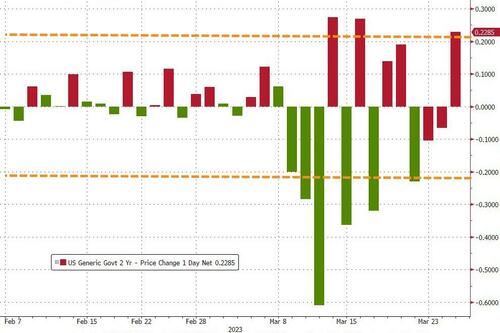
On Monday, the 2-Year UST saw yields fall in single-day trading to levels not seen since 1987.

By Tuesday and Wednesday, intra-day volatility levels in the UST market surpassed those of the Great Financial Crisis of 2008.
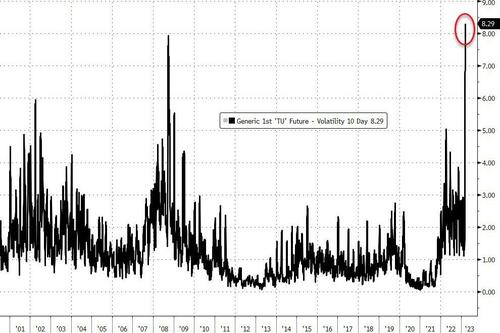
But that’s not the real record-breaker. Far from it.

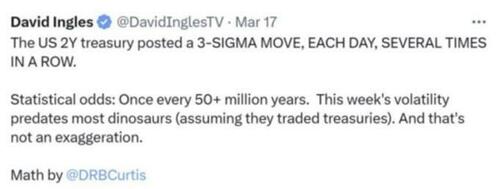
As Bloomberg’s David Ingles confirmed, last-week’s extreme volatility and yield-moves in the 2-Year UST posted 3-sigma moves, something that MIT mathematicians argue should only occur statistically once every 50+ million years.
Hmmm.

Uh-oh?

Something Big Just Broke

And yet, despite all these “statistically defying” shocks, we, and many other mathematical realists, have been warning throughout 2022, that the bond market, rather than central bankers, was the real indicator to follow and trust.

We also argued that eventually this very same bond market, under the pressure of Powell’s Volcker-enamoured ego and rate hikes, would eventually “break,” and oh boy, has it broken.

Oceans of Currency Destroying Liquidity En Route

Finally, we also argued that eventually a bursting bond market would require oceans of new liquidity to prevent the UST volatility from blowing up global banking, FX, bond and risk asset markets.

This is not because market predictions are so accurate or because we have a magical set of tarot cards at our Zurich office.

No.

This was easy to see because we respect basic math, history and common sense, three skills which policy makers around the world are doing their very best to “cancel.”

In short, the bond market is more accurate, honest and predictable than policy makers like Powell, or openly asleep-at-the-wheel leaders pushed into power (for easy and pre-planned manipulation) like Biden.

Or stated even more simply: The bond market has broken because, well… all bubbles always and inevitably do the same thing: They pop.

And as warned recently, the currency bubble is always the last bubble to do so.

Drunk at the Wheel: What Comes Next?

So, what will the mental midgets and drunk-at-the-wheel, QE-addicted centralized planners do next?

How will they “solve” for the bond volatility spreading from their own Keynesian petri dishes of MMT gone wild?

Sadly, the pattern is all too familiar throughout history, as I painstakingly outlined from Frankfurt last summer… See Here.

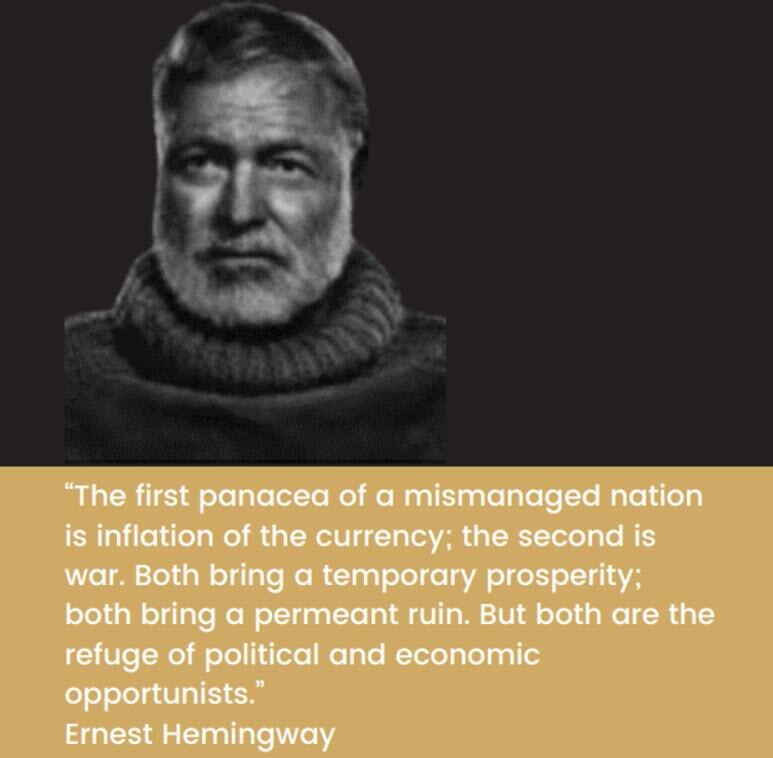
Hemingway Said it Best: Inflation, Currency Destruction & War

But rather than follow the empty words of politicos, the financial bias of hedge fund managers or even the so-called “book talking” of gold buggers from Switzerland, let’s go to Papa Hemingway, who never studied applied math or sought office in DC.
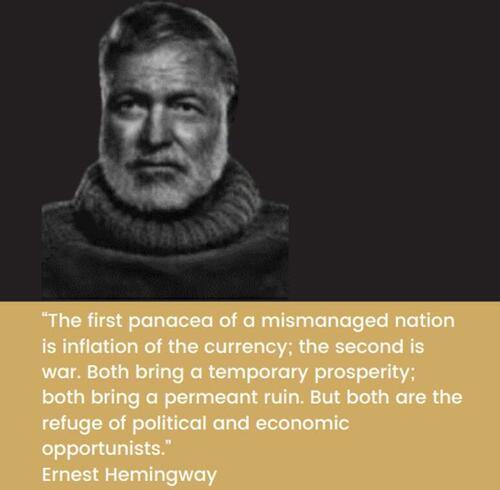
So, there you have it. Our current and future direction as pursued by political and economic opportunists, boils down to this: Currency debasement, inflation and war.

Such a sensational prognosis is even easier to see, because we are literally living it right now.

Powell, told us inflation was “transitory.” That was not a mistake; it was a lie.

As I’ve argued in countless interviews and articles, all debt-soaked nations need inflation (and negative real rates) to inflate away debt.

Powell was hoping to mis-report actual inflation while openly pretending to fight it.

His real aim in the rate hikes of 2022 was not inflation (which he needs), but to have something to cut when the recession, which he also re-defined in 2022, became undeniable.

By raising rates yesterday, he’d have something to pause and then cut for tomorrow’s recession.

And that recession, folks, is coming at us at full speed.

Expect More Magical Money

Given the fact that no nation in history has defeated a recession with a strong currency or rising rates, and given the fact that our current bond market is literally screaming for trillions in liquidity, there’s no alternative in the months and years ahead to prevent this real-time bond crisis from sending the world into a global depression without resorting to more magical, instant and completely artificial liquidity.

In short, expect more mouse-click trillions and more inherently inflationary (and hence currency-destroying) QE or QE-like backdoor mechanizations (i.e., repo games, bank bailouts/ins, discount window loans, cash swaps etc.).

Expect More Centralized Controls

As importantly, and as pre-warned countless times, expect more centralized controls, including most obviously, that clever wolf in sheep’s clothing known as CBDC, the blunt and sickening realities of which I’ve outlined in sober detail.

Like Sam Bankman Fried, Bernie Madoff or countless un-named bad bankers or sticky-fingered fraudsters, the USA and the US Fed will not be able to resist steeling money from their clients—namely the people.

CBDC opens the door for that tempting moment in time when a “crisis” arrives which, in the name of “national security,” the government will need to take “just a bit of your money” to save you and the nation.

And what easier way to do that than via direct access to your CBDC?

Once you start thinking like a corrupt politico or desperately broke fund manager, the real narrative, motives and build-up to CBDC is so easy to track, see and predict.

And then, of course, there’s Hemingway’s other warning: War.

Spreading Freedom or Just a Warfare State?

Oddly, I know as many military veterans as I do Wall Street supermen, and frankly most of my mentors have seen combat from Vietnam to Afghanistan.

Soldiers are not only my favorite mentors; they are my favorite people. They actually do the work and assume the most risk.

And many of them, true patriots to the core, have begun to question just what the hell the US accomplished from Bagdad to Kaboul, Damascus to the Gulf of Sidra.

Freedom? Democracy? Those elusive WMD?

This was never their faut—they were lions led by donkeys.

Now other donkeys are fighting yet another obvious US proxy war in Ukraine, the most corrupt country in Europe in a border war between two autocrats. Many, of course, have different views on this. That is entirely fine.

Meanwhile, our own border with Mexico remains wide open to invisible armies of death-spreading drugs destroying our cities from the inside as Zelensky asks for billions of US and other Western tax dollars to spin his (and the Western media’s) bogus claim to be George Washington 2.0.

Our politicos give him standing ovations in Congress so they can get 2 minutes of Twitter fame and a photo-opp as “lovers of freedom” and social justice, when most of them don’t know an iota of the twisted history of Zelensky’s spurious rise to power in general or the map location of the Ukraine in particular.

So, yes. Hemingway was right. We can expect more currency debasement, war and inflation.

Change Will Come from Us, not “Them”

I tell my own children not to be victims. I tell them not to come to me with just problems, but with problems and solutions.

My admitted and foregoing frustrations (rant?) are not enough. We need solutions. We need informed vision, humble wisdom, open debate (remember the smarter days of Vidal vs. Buckley?) and a plan.

Gold is obviously one attempt at a solution to the currency debasement and inflationary waves emanating form our broken bond markets.

Fine.

But we also need to avoid the inaction that comes from warranted cynicism.

The plethora of Adam Neumans, Sam Bankman Frieds, Bernie Madoffs, inept central bankers, over-paid commercial bankers, IQ-deficient puppet leaders and comically embarrassing media platforms unmasked by mavericks from Russell Brand to Bret Weinstein can make us informed yet jaded.

Hidden Heroes

But despite the headlines of our public figures and failures, there is a majority of mostly hidden heroes all around us.

There are great people, giants of integrity working to do good—whether selling baguettes or fixing cavities, whether struggling as single parents, making medical miracles or coaching baseball.

From the polo fields to the ghettos, I still believe most folks seek to do good and care about the intuitive knowledge of being better versions of themselves tomorrow than they were yesterday.

As JFK said just weeks before his murder (coup) in 1963:

“For, in the final analysis, our most basic common link is that we all inhabit this small planet. We all breathe the same air. We all cherish our children’s future. And we are all mortal.”

Yes, there is much that divides us—but so much more that unites us.

Massive cultural differences exist between Italians and Brits or Americans and Nigerians, and yes, being white or black, straight or gay, rich or poor, left or right, educated or uneducated, militant or tree-hugger means vastly unique and different experiences, challenges and lines between us.

But despite all the hysteria and all the self-censorship that flows from the toxic and divisive identity politics spreading like a nerve gas through our so-called “media info sources” and Instagramed vanity, more of us are awakening to these tricks to actively distract us from this simple yet increasingly ignored fact: We are all human, and at root, the majority of us wish to do, see and be good.

Pollyannish?

Perhaps.

Je T’Accuse!

But to those actively seeking to promote personal vanity, legacy, power and broken narratives over objective truth, greater freedoms and open accountability, there are more of us to accuse you, and more of us to see through you.

To those central bankers who believe more unprecedented debt levels can solve an already unprecedented debt crisis of their own making: Je t’accuse!

To those unelected power-brokers flying environmentally toxic private jets to and fro Switzerland to exploit climate change narratives to consolidate more personal power and political influence: Je t’accuse!

To those weapons lobbyists, hidden neocons and war-mongering donkeys leading young lions into avoidable wars by sending the likes of a Kamala Harris to push an archaic NATO spin rather than to aggressively and sincerely seek peace solutions: Je t-accuse!

To those media outlets run by partisan corporate boards whose overpaid yet under-educated prompt-readers (rather than extinct investigative journalists) push propagandized political narratives rather than objective facts (which insults rather than nourishes the public’s right to think and act for themselves): Je t’accuse!

To those who would sacrifice personal liberties in the name of security, who lie about everything from transitory inflation, the definition of a recession, the honest measures of inflation, unemployment and even the true origins of a global virus or the actual efficacy of their big-pharma “vaccines”: Je t’accuse!

As for the rest of us. Stay informed, but don’t stay silent, hopeless, numb or afraid.
Tyler Durden
Tue, 03/28/2023 – 07:20

via ZeroHedge News https://ift.tt/U8gR9xq Tyler Durden

Watch: Ukrainian Soldiers Seen With Depleted Uranium Ammo In UK

Watch: Ukrainian Soldiers Seen With Depleted Uranium Ammo In UK

Ukrainian soldiers have been filmed alongside depleted uranium ammunition that Britain is supplying to their country for the fight against Russia.

The footage is contained in a documentary the UK Ministry of Defence (MoD) released Sunday as Ukrainian tank crews completed their training.

A depleted uranium shell on display at a British course for Ukrainian tank crews. Screengrab: UK MoD

Britain is gifting 14 Challenger 2 tanks to Ukraine together with depleted uranium shells, which Declassified revealed last week.

An MoD spokesperson told the media that the “impact to personal health and the environment from the use of depleted uranium munitions is likely to be low”.

But the decision to supply the ammunition sparked a furious reaction from the Kremlin, with Vladimir Putin pledging on Saturday to retaliate by moving ‘tactical’ nuclear weapons into Belarus.

British & Ukrainian soldiers with depleted uranium ammunition used for Challenger 2 tanks. Screengrab: UK MoD

The depleted uranium (DU) ammunition seen in the MoD documentary is marked “inert”, suggesting it could be a replica. A blue and silver training shell is visible next to it, an expert told Declassified

Doug Weir from the Conflict and Environment Observatory said: “The orange and black munition in the video appears to be an inert display version of the UK’s 120mm CHARM3 DU ammunition.”

CHARM3 is a technical term for Britain’s stockpile of depleted uranium shells. 

Snippet of the UK MoD footage can be viewed here:

Read the rest of the report at Declassified UK

Tyler Durden
Tue, 03/28/2023 – 06:55

via ZeroHedge News https://ift.tt/Mz5fQqF Tyler Durden

EU Members Clash Over Nuclear Energy’s Role In Climate Policy

EU Members Clash Over Nuclear Energy’s Role In Climate Policy

Authored by Michael Kern via OilPrice.com,

  • The EU is in the process of expanding its renewable energy targets to reduce CO2 emissions.

  • Countries are divided over whether nuclear energy should be considered a part of renewable energy targets.

  • France leads the campaign to recognize nuclear energy as a CO2-free contributor, while Germany, Portugal, and others oppose it.

The European Union needs to work on a divide among its member countries regarding the role of nuclear energy in achieving their renewable energy goals. This disagreement may delay the progress of one of the EU’s primary climate policies.

On Wednesday, negotiators from EU countries and the European Parliament will engage in their final round of discussions to establish more ambitious EU objectives to expand renewable energy throughout the next decade.

These goals are crucial for Europe’s commitment to reduce CO2 emissions by 2030 and to become independent of Russian fossil fuels. However, the negotiations have become bogged down by a dispute over whether fossil fuels produced using nuclear power should be considered part of the renewable energy targets.

France is spearheading a push to classify “low-carbon hydrogen” – hydrogen produced from nuclear energy – as equal to hydrogen created from renewable electricity.

France is joined by countries such as Romania, Poland, Hungary, and the Czech Republic, all of which seek greater acknowledgment of nuclear energy’s CO2-free contribution to climate objectives.

On the other hand, Germany, Spain, Denmark, Portugal, and Luxembourg oppose this view, arguing that including nuclear power in renewable energy targets would divert attention from the urgent need to expand solar and wind energy across Europe significantly.

On Monday, EU ambassadors met again in an attempt to resolve the ongoing dispute. During a meeting of EU countries’ ambassadors last Friday, nations reaffirmed their established positions, according to EU officials. This has led to doubts surrounding the success of the negotiations in finalizing the law.

In addition to the nuclear energy debate, countries disagree on other aspects of the law, such as the types of wood fuel that can be considered renewable energy sources.

France, one of the world’s leading nuclear-powered nations, is interested in whether nuclear energy is recognized under renewable energy targets. The country plans to construct new reactors and modernize its extensive fleet of nuclear facilities.

Agnès Pannier-Runacher, the French energy minister, will host a meeting of pro-nuclear countries’ ministers on Tuesday to discuss the issue further, according to a source from the French ministry.

France has also expressed disappointment with other recent EU decisions prioritizing renewable technologies over nuclear power

Last week, European Commission President Ursula von der Leyen announced that “cutting-edge nuclear” projects would only receive access to specific EU incentives designed to support green industries. In contrast, “strategic” technologies, such as solar panels, would be granted full benefits.

As the EU strives to achieve its climate goals, the disagreement over the role of nuclear energy in renewable energy targets could significantly delay progress on one of the bloc’s central climate policies. The outcome of the final round of negotiations on Wednesday and the subsequent discussions among pro-nuclear countries’ ministers may determine the future direction of the EU’s renewable energy strategy.

Tyler Durden
Tue, 03/28/2023 – 06:30

via ZeroHedge News https://ift.tt/I9sWGdf Tyler Durden