Alibaba Shares Jump As Jack Ma Makes Rare Appearance In China

Alibaba Shares Jump As Jack Ma Makes Rare Appearance In China

Jack Ma, Alibaba Group Holding’s founder, returned to China after spending a year abroad and visited a school he established in 2017. The billionaire experienced a multi-year rift with Beijing following his criticism of regulators in 2020. This news prompted a jump in Alibaba’s shares trading in Hong Kong.

According to South China Morning Post, Ma met with teachers and students at Hangzhou Yungu School. He discussed the future of education in the era of artificial intelligence. 

“We must use AI to solve problems, not to be controlled by AI,” Ma said. 

He also said: “ChatGPT and similar technologies are just the beginning of the AI era. We should use artificial intelligence to solve problems instead of being controlled by it.” 

Since late 2020, Ma has maintained a discreet presence after criticizing Chinese regulators for halting the planned IPO of Alibaba’s affiliate, Ant Group.

The billionaire has spent most of the last year in Japan. He recently celebrated Lunar New Year in Hong Kong and traveled to Singapore and Australia.

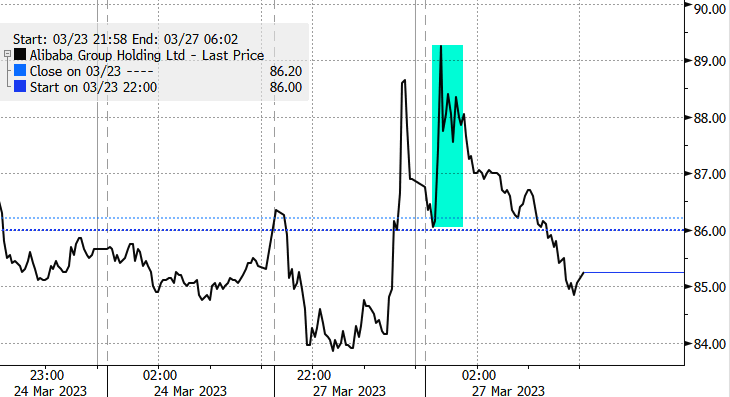
Shortly after the SCMP’s report, Alibaba’s shares that trade in Hong Kong jumped 4% but gave up most gains late in the session. Shares in New York are flat in premarket trading. 

And while Beijing is attempting to restore a business-friendly image after a multi-year crackdown on technology companies, Bloomberg noted Chinese authorities made attempts to persuade Ma to stay and help repair the image of the business community. However, the media outlet said Ma has decided to focus on agriculture technology research. 

The good news: 

“Jack Ma showing up in Hangzhou after more than a year away from China should be positive for market sentiment,” said Vey- Sern Ling, managing director at Union Bancaire Privee. 

What this appearance also means is that Ma does not perceive a risk of arrest or, even worse, vanishing. It could also suggest further regulatory normalization for tech companies.

Tyler Durden
Mon, 03/27/2023 – 06:55

via ZeroHedge News https://ift.tt/1hdq3Nn Tyler Durden

Hedge Fund CIO: In Times Like These, Markets Push Prices To The Point Of Maximum Policymaker Pain

Hedge Fund CIO: In Times Like These, Markets Push Prices To The Point Of Maximum Policymaker Pain

By Eric Peters, CIO of One River Asset Management

“I have not considered or discussed anything having to do with blanket insurance or guarantees of all deposits,” answered Janet Yellen, when asked on Wednesday whether Treasury would circumvent Congress to insure all deposits.

Naturally, this accelerated the bank run, as rational economic actors moved their money.

“Certainly, we would be prepared to take additional actions if warranted,” said Yellen on Thursday, attempting to reverse Wednesday’s damage.

And this made it more likely that additional action will become warranted. Because in times like these, markets sniff out weakness, and push prices to the point of maximum pain. Policymaker panic.  

“In such an environment, our ultimate goal is clear: we must – and we will – bring down inflation to our medium-term target in a timely manner,” declared Christine Lagarde, determined, schooled in the importance of conveying confidence during times of crisis.

“In current conditions, a robust strategy calls for a data-dependent approach to making policy and a clear reaction function so that the public understands the sources of information that will be important to us,” continued the ECB President.

“To that end, our future policy path will be determined by three factors; (1) our assessment of the inflation outlook in light of the incoming economic and financial data, (2) the dynamics of underlying inflation, and (3) the strength of monetary policy transmission,” explained Lagarde.

It all sounded great to just about everyone, except investors, and especially traders.

Because (1) a central bank’s inflation outlook in times of great economic uncertainty is profoundly unreliable, (2) the dynamics of underlying inflation are wildly unstable when inflation is this high, and (3) monetary policy transmission in a highly indebted hyper-financialized global economy can appear too weak one day and precipitate a bank run the next.

“At the same time, I have made clear that there is no trade-off between price stability and financial stability. We have plenty of tools to provide liquidity support to the financial system if needed and to preserve the smooth transmission of monetary policy,” said Lagarde, presumably hoping that if she said it with great certainty, we would all forget the lessons of decades of trading and a century of financial history.

You see, central banks do not have the power to determine how monetary policy is transmitted. Markets decide. And there is always a trade-off that central banks must make between price stability and financial stability. To deny this is to invite markets to press our policy makers to the point where they must choose one or the other.

Tyler Durden
Mon, 03/27/2023 – 06:30

via ZeroHedge News https://ift.tt/90jAn6h Tyler Durden

Millennials – The “Buy Now, Pay Later” Generation

Millennials – The “Buy Now, Pay Later” Generation

According to the Statista Consumer Insights, U.S. Millennials stand out as the “buy now, pay later” generation, with 56 percent of those born between 1980 and 1994 saying they used online schemes that allow for the interest-free payment of goods and services in several installments.

Infographic: Millennials - The

You will find more infographics at Statista

As seen in data by the Statista Brand Profiler, Paypal was the most used “buy now, pay later” service among the generation, followed by Afterpay, Klarna and Affirm.

In comparison, just 36 percent of Gen X (born between 1965 and 1979) and 49 percent of Gen Z (born after 1995) said they used such services.

Participation was lowest among Baby Boomers (born 1946-1964) at just 26 percent.

While certain payment plans with standard timelines are usually free of interest when using BNPL, postponing payments can incur extra costs.

Here, 14 percent of Millennials in the survey said this had happened to them in the past 12 months. This is compared to 11 percent of Gen Z, 8 percent of Gen X and 5 percent of Baby Boomers.

Tyler Durden
Mon, 03/27/2023 – 05:45

via ZeroHedge News https://ift.tt/uHMQt5T Tyler Durden

E.E. Cummings Celebrated Libertarian Utopia


book2

The Enormous Room, by E. E. Cummings, New York Review Books, 288 pages, $16.95

Exactly a century after it first appeared, E.E. Cummings’ novel The Enormous Room has been republished, reminding us that its author may have been the most profoundly libertarian writer in American literature. Beginning as a critic of authoritarian social situations, he wrote here mostly about his imprisonment in a French military detention camp at La Ferté-Macé during World War I. Eccentric and yet evocative, this classic is no less visceral a century later.

As a congenital free spirit, Cummings felt confined more than most. “The right-hand long wall contained something like ten large windows, of which the first was commanded by the somewhat primitive cabinet,” he wrote. “There were no other windows in the remaining walls; or they had been carefully rendered useless. In spite of this fact, the inhabitants had contrived a couple of peep-holes—one in the door-end and one in the left-hand long wall; the former commanding the gate by which I had entered, the latter a portion of the street by which I had reached the gate. The blocking of all windows on three sides had an obvious significance: les hommes were not supposed to see anything which went on in the world without; les hommes might, however, look their fill on a little washing-shed, on a corner of what seemed to be another wing of the building, and on a bleak lifeless abject landscape of scrubby woods beyond—which constituted the view from the ten windows on the right.”

Published before Cummings turned 30, The Enormous Room became his single most popular book. On the back of this new edition is an encomium from T.E. Lawrence, a.k.a. Lawrence of Arabia: “From it I knew, more keen than from my own senses, the tang of herded men, and their smell. The reading is as sharp as being in prison, for all but that crazed drumming against the door which comes from solitary confinement.” (When Lawrence reminds us that he too had been imprisoned, we note, by contrast, that few contemporary writers had a similar nasty experience.)

The best parts of The Enormous Room are Cummings’ memories of other prisoners, each uniquely portrayed. For example: “Celina Tek was an extraordinarily beautiful animal. Her firm girl’s body emanated a supreme vitality. It was neither tall nor short, its movements nor graceful nor awkward. It came and went with a certain sexual velocity, a velocity whose health and vigour made everyone in La Ferté seem puny and old. Her deep sensual voice had a coarse richness. Her face, dark and young, annihilated easily the ancient and greyish walls. Her wonderful hair was shockingly black. Her perfect teeth, when she smiled, reminded you of an animal. The cult of Isis never worshipped a more deep luxurious smile. This face, framed in the night of its hair, seemed (as it moved at the window overlooking the cour des femmes) inexorably and colossally young. The body was absolutely and fearlessly alive. In the impeccable and altogether admirable desolation of La Ferté and the Normandy Autumn Celina, easily and fiercely moving, was a kinesis.”

He adds: “The French Government must have already recognized this; it called her incorrigible.”

Notwithstanding his gut anarchism, Cummings did not write political polemics. He didn’t sign petitions or march in the streets. The only sign of his “activism” that I can find is a 1948 letter to his daughter where he mentions working with “Margaret Dasilva, widow of Carlo Tresca, America’s leading (murdered just a few years ago in NYC City by the USSR) anarchist.”

Yet the anti-authoritarians recognized Cummings as one of their own. In his classic 1929 Anthology of Revolutionary Poetry, the anarchist editor Marcus Graham reprinted Cummings’ “Impressions,” with these closing stanzas:

in the mirror
i see a frail
man
dreaming
dreams
dreams in the mirror

and it
is dusk     on earth

a candle is lighted
and it is dark.
the people are in their houses
the frail man is in his bed
the city
sleeps with death upon her mouth
having a song in her eyes
the hours descend
putting on stars….

in the street of the sky night walks scattering poems.

Here and elsewhere, Cummings celebrated a libertarian utopia in which no one invades anyone else’s life. This is also the subject of another, more familiar Cummings poem known only by its opening line: “anyone lived in a pretty how town.” Even during the 1930s, he was nobody’s fool.

This centennial reprint from New York Review Books is peculiar. As far as I can tell, its text reproduces what has long been available, initially from the legendary publishing firm Boni & Live-right, later from the Modern Library, later from other reprinters, some of which publish sloppily. It does not acknowledge the “typescript edition with illustrations by the author” that Liveright published in 1978.

The 1978 edition is superior in several respects. First of all, it includes the sketches prepared by Cummings himself, as much a visual artist as an author who illustrates his text in complementary ways. Second, it restores many French phases and, in a further departure that its author intended, prints them without the customary italics for languages other than English. Cummings’ typescript also makes the stylistic choice of eliminating the spaces following commas. The typescript edition has other additions, including an introduction written by the young author’s father, then a prominent minister, who describes the efforts to get his son released from prison.

The Modern Library edition, by contrast, includes a 1932 preface by Cummings that is oddly not reprinted here, even though it has this marvelous passage about the Soviet Union: “Russia, I felt, was more deadly than war; when nationalists hate, they hate by merely killing and maiming human beings; when Internationalists hate, they hate by categorying and pigeonholing human beings.”

Cummings never again wrote a popular extended prose text. For his later European adventure—his 1931 report on Soviet Russia, EIMI—he favored a more liberating prose, exemplifying stylistic deviance in his critique of a society that cracked down on any and every sort of deviance. But it resembles The Enormous Room in one important respect: EIMI is a dispatch from a prison that was an entire society.

The post E.E. Cummings Celebrated Libertarian Utopia appeared first on Reason.com.

from Latest https://ift.tt/ZhPYVeo
via IFTTT

US Expert Panel To Meet To Determine Which Adverse Events COVID-19 Vaccines Cause

US Expert Panel To Meet To Determine Which Adverse Events COVID-19 Vaccines Cause

Authored by Zachary Stieber via The Epoch Times (emphasis ours),

A group of U.S. experts is set to meet soon as part of a project to determine which adverse events the COVID-19 vaccines cause.

A person receives a COVID-19 vaccine in New York City on Oct. 21, 2021. (Michael M. Santiago/Getty Images)

The National Academies of Sciences, Engineering, and Medicine (NASEM) has appointed a committee to review evidence on the relationship between the vaccines and specific adverse events that have occurred after vaccination, including infertility and sudden death.

The committee’s process includes establishing methods, reviewing literature, drawing conclusions, and preparing a report.

The committee will make conclusions about the causal association between vaccines and specific adverse events,” the NASEM website states.

While their work is funded by the U.S. Centers for Disease Control (CDC) and the U.S. Department of Health and Human Services (HHS), the sponsors will not be able to examine the report before it is published to the public, Kathleen Stratton, a NASEM official, said during a recent meeting.

“What that means is that if a sponsor doesn’t like what the committee has to say—the conclusions of the committee—… the sponsor can’t prevent the report from being made public,” Stratton said. “This is a very powerful tool that we have.”

Dr. Tom Shimabukuro, a CDC official, told panel members recently that the CDC would help members locate studies and data from the agency. “We very much value your expertise and your independence. We look forward to working with you, look forward to seeing the results of your findings,” he said.

The upcoming meeting will be held on March 27 and March 31, the latter of which will include time for public comments. The rest of the two-day meeting will be held behind closed doors.

The panel already met on Jan. 25 and Feb. 1.

Your conclusions will help inform injury compensation recommendations and decisions when assessing whether specific adverse events are causally associated with vaccines,” Dr. George Reed Grimes, the official in charge of the HHS Division of Injury Compensation Programs, told panel members during the meeting.

The report is slated to be published in March 2024.

Specific Issues

HHS officials directed NASEM to convene the ad hoc committee to review “the epidemiological, clinical, and biological evidence” in assessing whether the vaccines cause certain conditions.

The adverse events include conditions that officials already say are caused by one or more of the vaccines, including myocarditis, a type of heart inflammation caused by all four of the vaccines available in the United States, and thrombosis with thrombocytopenia syndrome, an often-fatal condition caused by the Johnson & Johnson vaccine.

The other specific events are:

  • Bell’s Palsy
  • Capillary leak syndrome
  • Chronic headaches
  • Chronic inflammatory demyelinating polyneuropathy
  • Guillain-Barrè Syndrome
  • Hearing loss
  • Infertility
  • Shoulder injuries
  • Sudden death
  • Thromboembolic events like pulmonary embolism
  • Tinnitus
  • Transverse myelitis

A NASEM panel last produced a vaccine adverse event report in 2012. The report ran nearly 900 pages.

Read more here…

Tyler Durden
Mon, 03/27/2023 – 05:00

via ZeroHedge News https://ift.tt/abKM62V Tyler Durden

Brickbat: Move It Along


A stone statue of a young person listening to music, placed on a wooden bench against a stone wall.

For almost 20 years, stone benches have graced the sidewalks of San Francisco’s Bernal Heights neighborhood. They were first placed there by residents to make the place more attractive and to give them places to socialize. The sidewalks are very wide. One local TV station measured the distance from the curb to the benches and found it was nearly 14 feet. But after an anonymous complaint, city officials have told residents that no one ever got a permit to place the benches there. The people who own the homes near the benches will have to pay $1,400 for an encroachment permit or have them removed.

The post Brickbat: Move It Along appeared first on Reason.com.

from Latest https://ift.tt/nwPDUY8
via IFTTT

Ukraine Urges Emergency UN Security Meeting Over Putin Plan To Put Nukes In Belarus

Ukraine Urges Emergency UN Security Meeting Over Putin Plan To Put Nukes In Belarus

Ukraine is calling on its allies in the United Nations to convene an emergency UN Security Council meeting in order to condemn what it calls the Kremlin’s “nuclear blackmail.”

The Ukrainian foreign ministry issued a statement Sunday, saying “Ukraine expects effective measures to counter the Kremlin’s nuclear blackmail by the United Kingdom, China, the USA and France, in particular, as permanent members of the UN Security Council.”

“We demand to immediately convene an extraordinary meeting of the UN Security Council for this purpose,” it added.

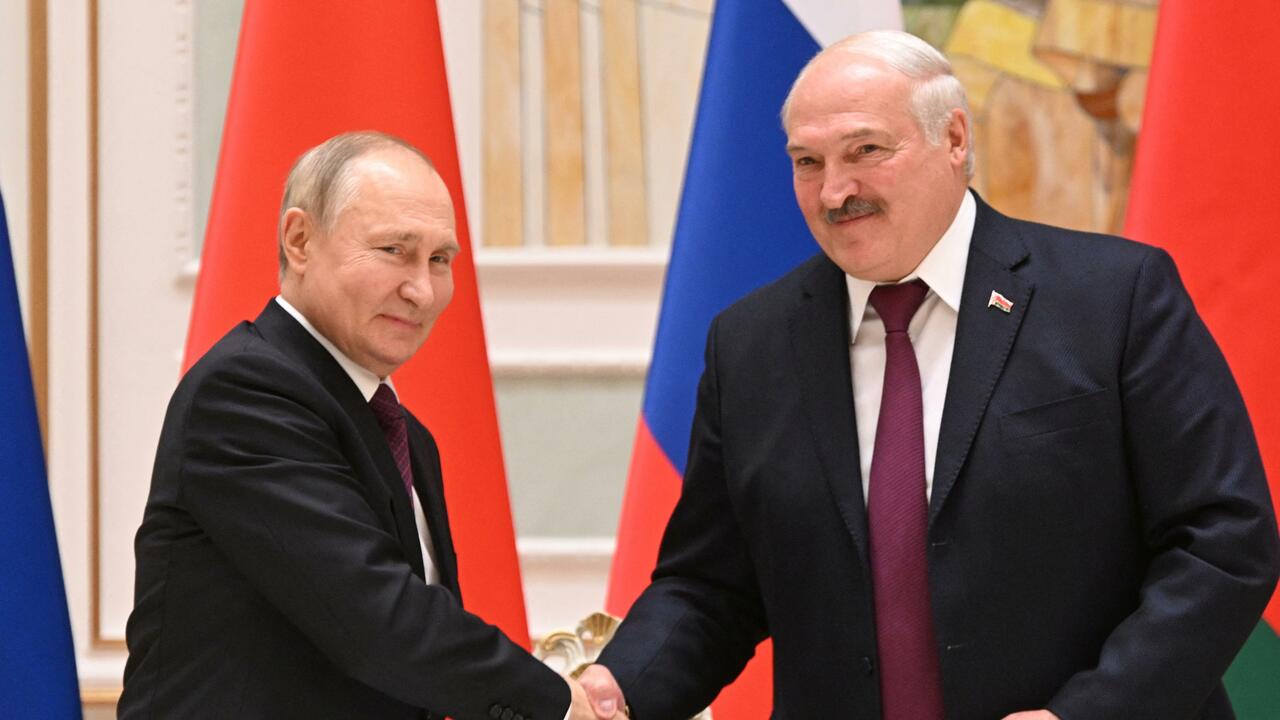
This after on Saturday Tass news agency quoted President Vladimir Putin as saying Russia had struck a deal with neighboring Belarus to station tactical nuclear weapons on its territory in a major escalation aimed at both Kiev and the West.

Putin sought to justify the ultra-provocative move as something necessary to counter NATO: “We are doing what they have been doing for decades,” Putin said. Likely he has Turkey in mind, which lies just across the Black Sea from Russia’s south. The US, and thus NATO, has kept tactical nukes in Turkey for decades, part of a “nuclear sharing” policy with allies.

As The New York Times reports, Putin said nukes could be stationed in Belarus as early as the summer:

President Vladimir V. Putin of Russia said he would be able to position nuclear weapons in Belarus by the summer, a claim that analysts said was likely bluster but which underscored the Kremlin’s determination to use its vast nuclear arsenal to pressure the West to back down from its support of Ukraine.

Western officials condemned Mr. Putin’s remarks as irresponsible, even as they said that they saw no indication that Russia was making changes to how it deploys nuclear weapons.

“He said that 10 Belarusian warplanes have already been retrofitted to carry Russian nuclear weapons, and that a storage facility for the warheads would be ready by July 1,” the report adds.

But there’s some debate over how significant such a move would be, given that “Analysts also pointed out that even if Russia were to transfer some of its warheads, the action wouldn’t substantially change the nuclear threat posed by Russia since it can already target a vast range of territory from inside its own borders,” according to the Times. And again, it’s long been the case that US tactical nukes are hosted in European countries, which Moscow has long condemned.

Tyler Durden
Mon, 03/27/2023 – 04:15

via ZeroHedge News https://ift.tt/QbgtOmn Tyler Durden

French Strikes A Cautionary Tale For US

French Strikes A Cautionary Tale For US

Authored by Adeline Von Drehle via RealClearPolitics.com,

In the city’s 14th municipal district, known here as an “arrondissement,” people walk in the street as mounds of trash stake their claim on the sidewalk.

And walk they must. Sanitation workers aren’t the only ones on strike. Transportation workers are also among the many refusing to work in retaliation against French President Emmanuel Macron’s pension reform plan. The plan aims to raise the retirement age from 62 to 64.

Thursday marked the ninth day of inter-union national strikes since the bill was introduced in January, days of protest in which virtually every French union member participates. Transportation, sanitation, and energy unions, however, have been on daily renewable strikes since March 7. Trains and planes arriving to, departing from, and crossing over France are experiencing major delays and cancelations. Teachers are walking off the job. The stench of weeks-old trash mingles with pain au chocolat.

Last Thursday, Macron ordered Prime Minister Élisabeth Borne to buck Parliament and ignore overwhelming public opinion and impose the pension reform plan via Article 49.3 of the French Constitution. The article permits passage of the bill while bypassing a vote at the National Assembly, though it is still subject to revision from the Constitutional Council before it becomes law. Macron lost his parliamentary majority last year, and the plan had support neither from the left nor the far right, but from Macron’s centrist alliance alone.

Immediately following the employment of Article 49.3, some 7,000 demonstrators flooded Place de la Concorde, a grand square in central Paris famous for housing the guillotine during the French Revolution. More than 230 years later, it remains a site of unrest. Protestors charged riot police armed with stones and were met with tear gas. Over 300 activists were arrested.

The public outrage is two-fold. On one hand, the French despise the plan. Activists would rather see taxes increase on the wealthy. Yet Macron insists that because France’s retired population is expected to increase from 16 to 21 million people by 2050, that won’t be nearly enough, and his proposal is the surest way to make the French economy competitive.

“It’s in the greater interest of the country,” Macron said. “Between opinion polls and the national interest, I chose the national interest.”

Pushing it by way of Article 49.3, though, has been seen by many as a slap in the face to the democratic process. Far-left lawmaker Mathilde Panot put it simply: “The government is already dead in the eyes of the French; it doesn’t have any legitimacy anymore.”

Lawmakers on the left and right each filed a no-confidence motion against Macron’s government, though both were rejected by the National Assembly on Monday. One motion lost by just nine votes, increasing the pressure on Macron to either withdraw his reform or replace Borne to refresh his government’s image. Mass union strikes and protests in France are not uncommon. But the battle lines in this fight may foreshadow a future fight in the United States.

In last month’s State of the Union address, President Biden seemingly achieved rare unanimity on one key issue: Social Security and Medicare. For now, it appears both parties have agreed to leave the programs untouched – irrespective of what the actuary tables portend.

“Let’s stand up for seniors. Stand up and show them we will not cut Social Security. We will not cut Medicare,” Biden exhorted members of Congress, most of whom began clamoring to their feet.

The conversation about Social Security was sparked by Republicans’ mere mention of the same issue that is roiling France: delaying the retirement age.

One of these plans, proposed by the Republican Study Budget Committee, suggests raising the retirement ages for both Social Security and Medicare from 66 or 67 (depending on date of birth) to 70. The increase in retirement age would be gradual. Based on the proposal, people born after 1977 would have a full retirement age of 70.

Democrats, for their part, would like to see money from additional payroll taxes on the wealthy shore up senior benefit programs. Currently, payroll taxes are capped at $160,200. Proposals on the left look to extend the solvency of Social Security and Medicare while reapplying payroll taxes on incomes as high as $400,000.

The retired population in the United States is expected to increase from 17% to 22% by 2050, a jump equal in proportion to that of France.

America’s aging demographic suggests a potential clash that is generational as well as ideological.

“Gen Z and Millennials will rely on their Social Security benefits even more than current seniors do,” says Max Richtman, president and CEO of the National Committee to Preserve Social Security and Medicare.

Citing “massive student debt, disappearing pensions, and the ever-widening wealth gap,” he argues that Americans 40 and under will find it more difficult to accumulate wealth over the course of a career.

The vast majority of strikers and protestors in France are two-to-four decades from retirement age. And while the United States is perhaps too sprawling, diverse, and individualistic to experience crippling national strikes, Congress need only to look across the Atlantic Ocean to understand just how serious people are about their government benefits.

Tyler Durden
Mon, 03/27/2023 – 03:30

via ZeroHedge News https://ift.tt/uaXroJT Tyler Durden

Germany To Expel 30 Russian Diplomats As Spying Fears Ratchet

Germany To Expel 30 Russian Diplomats As Spying Fears Ratchet

Russia’s diplomatic links to Europe continue to collapse at a moment nuclear rhetoric is increasing and growing more dangerous. Simple communication among governments also continues to grow worse, making conflict de-escalation among major powers all the more difficult.

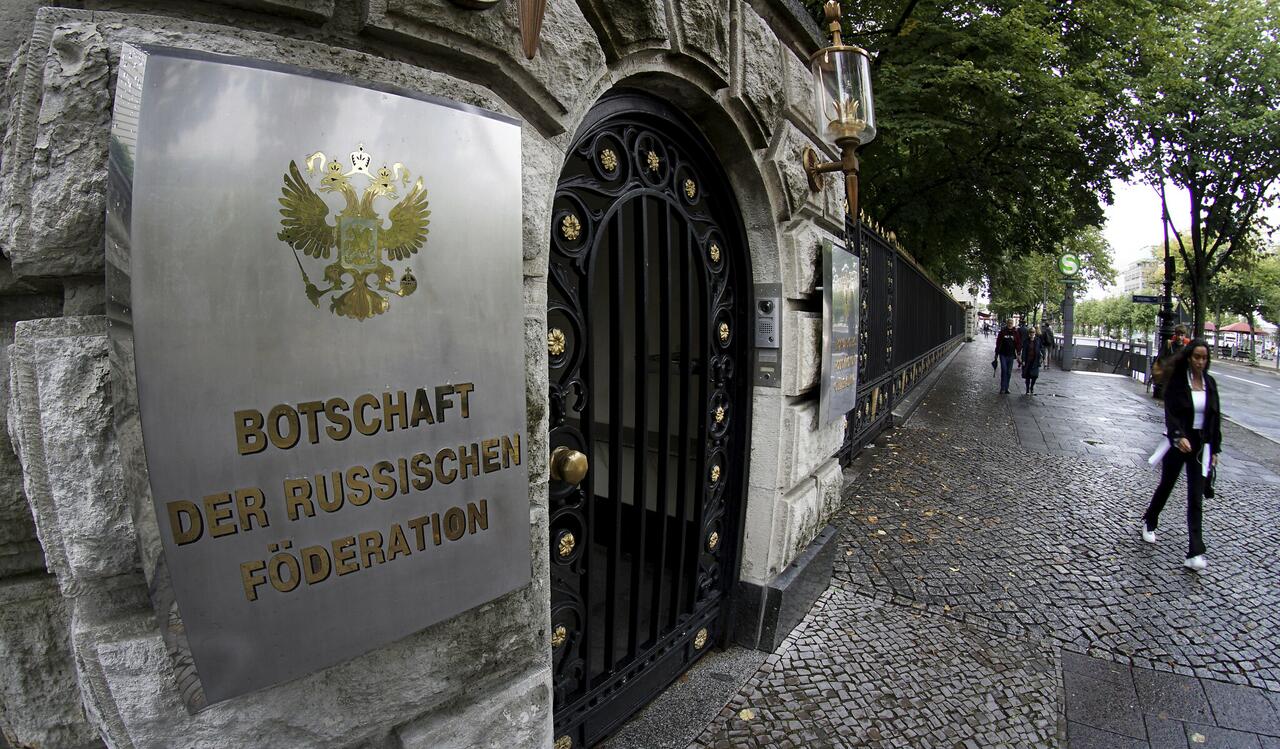
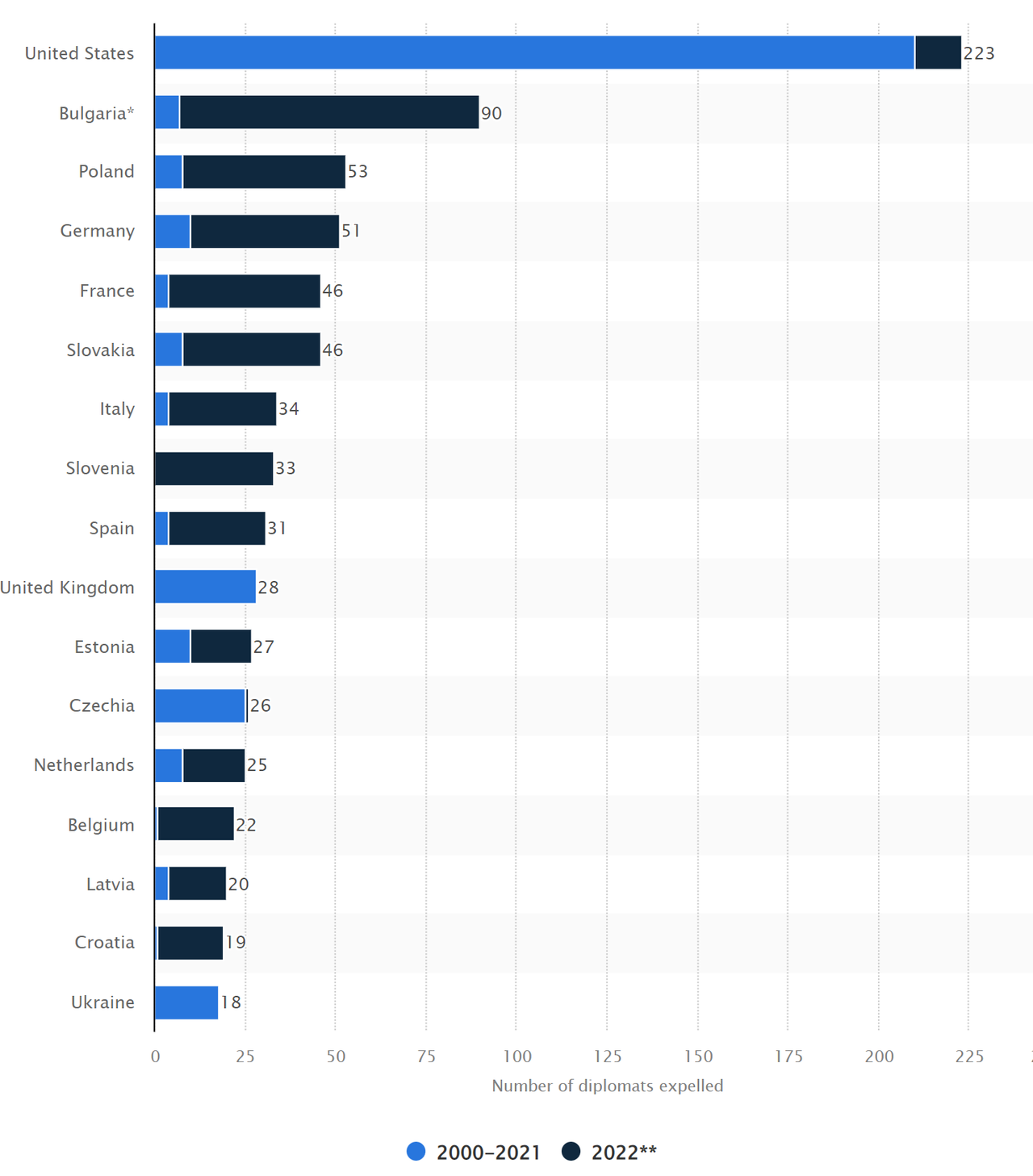
Germany announced Saturday that it is planning to expel more than 30 Russian diplomats from Berlin. German Federal Minister for Foreign Affairs Annalena Baerbock indicated to local media plans for the new wave of expulsions Saturday.

Russian embassy in Berlin, Germany, via AP

A German media source cited officials as saying “More decisive action must be taken against Moscow’s spies.”

Allegations of spying have driven large-scale expulsions at various times over the past two years, put have picked up in frequency and scale particularly after the Feb.24, 2022 Russian invasion of Ukraine.

Germany has claimed that the presence of Russian intelligence agents and officials in Berlin has greatly increased of late, with German officials asserting the embassy is now staffed even better than during the Cold War.

Other countries which are backers of Ukraine have also continued to take punitive measures against Russian diplomats. 

Number of Russian diplomats expelled worldwide from 2000 to 2022, by country”:

figures as of late January 2023.

You will find more infographics at Statista

“Last month, Estonia expelled 21 Russian embassy staffers, saying it would host only eight diplomatic officials on its territory — matching the size of Tallinn’s team in Moscow,” Politico reports over the weekend. “The Kremlin responded by kicking Estonian Ambassador Margus Laidre out of Russia — the first ambassadorial expulsion from the country in the year since Russia launched its full-scale invasion of Ukraine,” the publication added. “Tallinn then ended Russian Ambassador Vladimir Lipayev’s tenure on Pikk Street.”

This and other Russian embassies and consulates in Europe have faced accusations of acting as ‘spy hubs’ – far beyond what’s considered the ‘normal’ presence of intel agents and officials. 

Tyler Durden
Mon, 03/27/2023 – 02:45

via ZeroHedge News https://ift.tt/9BPgtZV Tyler Durden

Zelensky Admits Ukraine Already Ran Out Of Ammo

Zelensky Admits Ukraine Already Ran Out Of Ammo

Authored by Andrew Korybko via TheAutomaticEarth.com,

The US-led West’s Mainstream Media (MSM) began reporting more accurately on the military-strategic dynamics of the NATO-Russian proxy war in Ukraine since the start of the year, but the true test of their comparatively improved integrity will be whether they raise awareness about Zelensky’s latest damning admission. In an interview with Japanese newspaper Yomiuri Shimbun, he candidly told his interlocutors that “We do not have ammunition. For us the situation in the East is not good.”

This is a major revelation for several reasons.

  • First, it proves that Russia is winning NATO’s self-declared “race of logistics in the sense that its armed forces still have ammo to continue fighting while the West’s Ukrainian proxies already ran out of that which their patrons provided over the past year.

  • Second, the aforesaid aid that was already extended to this crumbling former Soviet Republic exceeds $100 billion, which makes Russia’s leading position in this “race of logistics” all the more impressive.

  • Third, Zelensky’s admission adds credence to what the Washington Post recently reported regarding how poorly Kiev’s forces are faring in this conflict, especially its “severe ammunition shortages” that one of its sources spoke about. Fourth, the preceding points drastically decrease the chances that Kiev’s upcoming counteroffensive will achieve much of anything and actually make it increasingly likely that such a move would be an epic mistake that could ultimately lead to a decisive Russian breakthrough.

  • And finally, it can therefore be expected that Zelensky and his agents of influence across the West will beg for even more aid, arguing that the failure to pay up would risking making their prior investments in this proxy war all for naught if Kiev ends up losing to Russia. The problem, however, is that no amount of money can make ammunition appear out of thin air since it requires a lot of time to scale production accordingly to meet these newfound exorbitant needs.

The very fact that Ukraine is out of ammunition proves that the West’s defeat in its self-declared “race of logistics” with Russia might already be a fait accompli by this point since it’s clear that Kiev can’t keep pace with its opponent despite being backed by all of NATO’s military-industrial capacity. Zelensky almost certainly didn’t realize that his candid admission essentially amounted to this, but it’s presently unclear whether the MSM will inform their audience about this or not.

On the one hand, doing so could contribute to his forthcoming begging campaign, but it could also backfire if taxpayers start asking whether it’s worth ponying up even more money if Ukraine already ran out of ammo despite the over $100 billion in aid that it’s received thus far. After all, if that astronomical sum wasn’t enough to keep their guns firing, then there’s no telling how much will be needed for Kiev to reconquer more of its lost territory like it intends to do.

Not only that, but as was earlier explained, no amount of money can make ammunition appear out of thin air. Quite clearly, fundamental changes in the Ukrainian Armed Forces are needed in order to indefinitely perpetuate this conflict like the US is plotting to do, but its fighters can’t immediately transition to using exclusively Western equipment when they’re used to operating Soviet-era wares. This poses a dilemma since Russia keeps moving further ahead in this “race of logistics” as each day goes by.

Objectively speaking, the military-strategic dynamics are trending in the Kremlin’s favor, which would ordinarily compel Kiev to seriously consider China’s peace plan if it wasn’t for its American overlords preventing it from doing so. The longer that Zelensky remains resistant to the very thought of a ceasefire, the greater the chances are that Russia will transform its growing advantage in its “race of logistics” with NATO into a decisive victory that could result in Ukraine losing even more territory.

*  *  *

Support the Automatic Earth via Patreon.

Tyler Durden
Mon, 03/27/2023 – 02:00

via ZeroHedge News https://ift.tt/eOJYlgn Tyler Durden