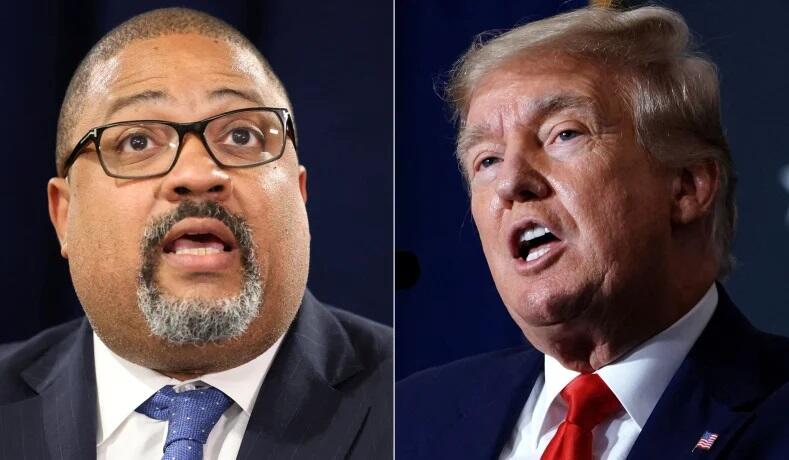
‘The Witch Hunt Against Me Is DEAD’: Trump Says Manhattan DA Tricked By ‘Fraud’ Star Witness, Wasn’t Into ‘Horseface’ Stormy

‘The Witch Hunt Against Me Is DEAD’: Trump Says Manhattan DA Tricked By ‘Fraud’ Star Witness, Wasn’t Into ‘Horseface’ Stormy

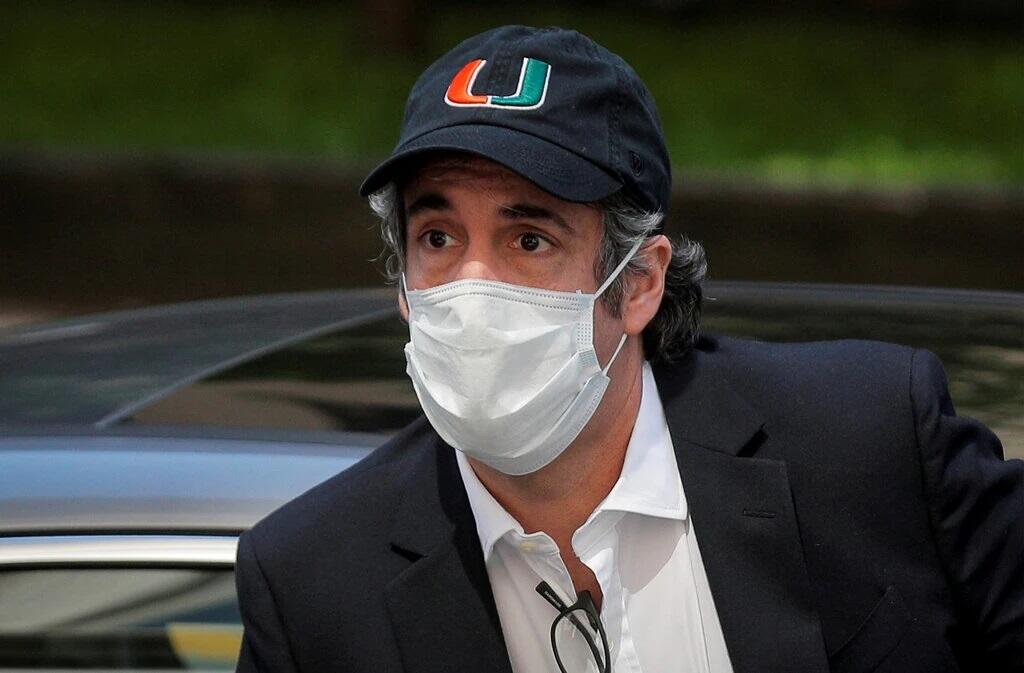
Former President Trump on Saturday suggested that the Manhattan DA was tricked by “Star” witness Michael Cohen, Trump’s former lawyer who was disbarred after pleading guilty in 2018 to multiple felony charges, including 5 counts of tax evasion, lying to a financial institution, lying to congress, and two campaign finance violations.

In addition to Cohen’s credibility issues, a 2018 letter emerged last week in which Cohen’s lawyer tells the Federal Election Commission that Cohen used his own funds to make a $130,000 ‘hush’ payment to Ms. Stephanie Clifford (Stormy Daniels aka “Horse Face”), and that Trump did not reimburse him for it.

Following a Saturday night rally in Waco, Texas, Trump told reporters on his plane: “I think they’ve already dropped the case … they have absolutely nothing.”

It’s a fake case. Some fake cases, they have absolutely nothing,” Trump continued.

The former president made a similar statement earlier Saturday, writing:

“The Manhattan D.A. Witch Hunt against me is DEAD, no evidence at all, & it has been conclusively proven that I did nothing wrong!”

“The evidence against their “Star” witness, however, is overwhelming. An already disbarred lawyer & convicted Felon, the only question left is will the D.A.s Office sue him for lying & fraud. They should!”

Trump also told reporters on the plane that he wasn’t trying to incite violence with a recent Truth Social post warning of “potential death and destruction” if he’s indicted.

“No, I don’t like violence and I’m not for violence. But a lot of people are upset.” he said.

Cohen’s credibility is shot

As the Epoch Times notes, former Trump attorney Robert Costello said he told the grand jury in the Manhattan case that Cohen was a tainted witness against Trump.

Cohen’s testimony against the 45th president in the investigation, which reportedly is connected to so-called hush money payments that were given to adult performer Stormy Daniels during the 2016 presidential campaign. A lawyer for Cohen, when reached for comment, declined to issue a statement, although Cohen told MSNBC last week that Costello never represented him and disputed his testimony.

Bragg’s has not returned a request for comment, and The Epoch Times cannot verify the authenticity of Trump’s claims. Previous Epoch Times requests for comment from the DA’s office have gone unanswered.

Over the past week, Bragg’s office has issued one public statement on the case, and that came in response to a House Republican letter seeking testimony and information about the DA’s case or whether his office would arrest Trump. A letter sent by his general counsel said that it was Trump who created a “false expectation” he would be indicted last week, although he provided no other details.

During Saturday night’s rally in Waco, Trump declared that his “enemies are desperate to stop us,” and that “our opponents have done everything they can to crush our spirit and to break our will.”

He also told the crowd that Bragg was investigating him “for something that is not a crime, not a misdemeanor, not an affair.

“But they failed. They’ve only made us stronger. And 2024 is the final battle, it’s going to be the big one. You put me back in the White House, their reign will be over and America will be a free nation once again.”

Tyler Durden
Sun, 03/26/2023 – 13:00

via ZeroHedge News https://ift.tt/74eStcU Tyler Durden

Disruption Is At The Epicenter Of The Problem That The Economy & The Market Are Facing

Disruption Is At The Epicenter Of The Problem That The Economy & The Market Are Facing

Authored by Peter Tchir via Academy Securities,

I Know What You Did Last Winter

While not quite a horror story yet, we’ve had at least a few deaths (or near-death experiences) depending on your perspective and what you own. Much of the current situation can be tied to events that occurred a year or so ago. Yes Virginia, there are long and variable lags to monetary policy. These recent events can be traced back to the start of the hiking cycle last winter, but also back to last summer (which would have been a catchier title) when the Fed doubled down on hiking to fight inflation at all costs.

In theory, there should be a lesson for central bankers in all of this. However, both the ECB and FOMC missed that possible lesson as they chose to hike rates at their recent meetings despite significant changes in financial conditions.

I’ve chosen the RSM Financials Conditions Index as it tries to track business sentiment and the demand for credit. In the past few weeks, we’ve seen an almost 2 standard deviation move, which RSM associates with a higher risk of financial dislocation that will impact the real economy! We all see how the stock and bond markets react instantaneously to news. One fear is that the events of recent weeks (which were triggered by the events of “last summer”) won’t show up in the economic data immediately. However, they have begun to cause inexorable damage to the real economy. Not just through tighter lending standards, but through an impetus for everyone (from savers to companies) to act more fiscally conservative.

I Still Know What You Did Last Summer

I didn’t choose this for a title, but I could easily have done so since we are living in a sequel (if not a trilogy). Before going further into today’s main topics, I want to highlight that the events of last winter were a direct result of the summer before that!

The events of last summer (hiking, Jackson Hole, QT, and high inflation) were a direct result of the previous summer when we left ZIRP (0% rates, large scale asset purchases, etc.) on for too long! We don’t have the time to harp on this subject. It was really important, but reliving those actions (or inactions) won’t change anything about where we are today. However, looking at last summer may help us figure out what is next. It isn’t too late to fix things, but I’m increasingly worried that we are heading in this direction.

Bonds – Texas Chain Massacre

A recurring theme in today’s T-report, unfortunately, will be the “steaming pile of unrealized bond losses”.

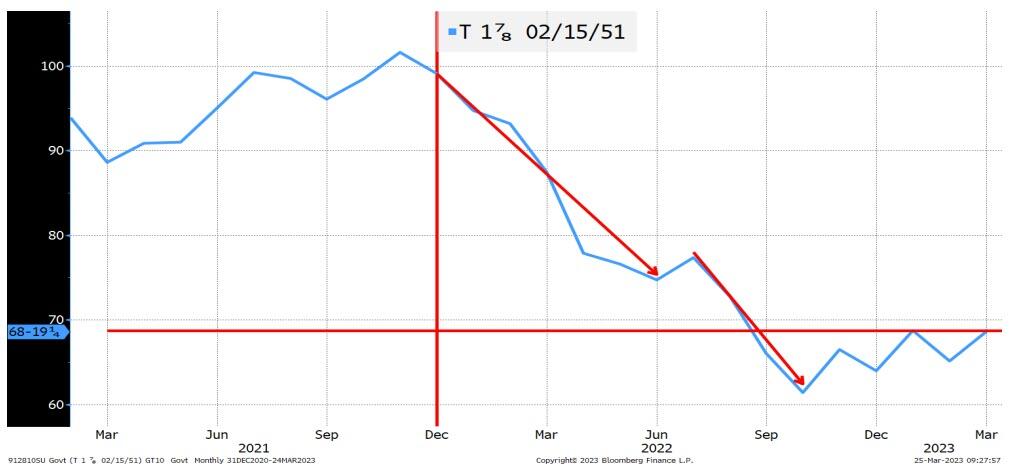
This long bond began its life in February 2021 when 1.875% was a “good” yield (even for a 30-year bond). It was so good that the bond even traded above par in December 2021. While the massacre started well before the summer of 2022, the theme applies. Any attempts to bounce at a price near 80 were thwarted. Currently, we still languish in the 60s.

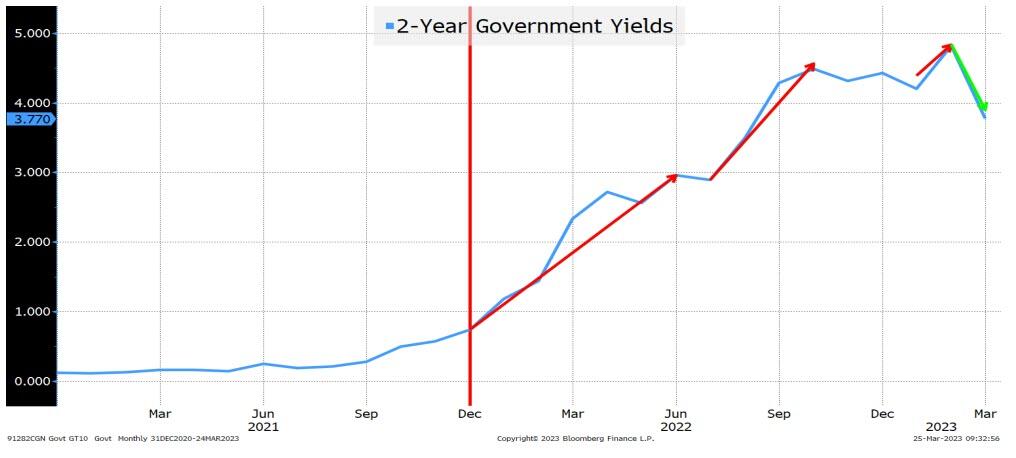
No part of the curve was spared!

As inversion got worse, there was no place in the yield curve to hide.

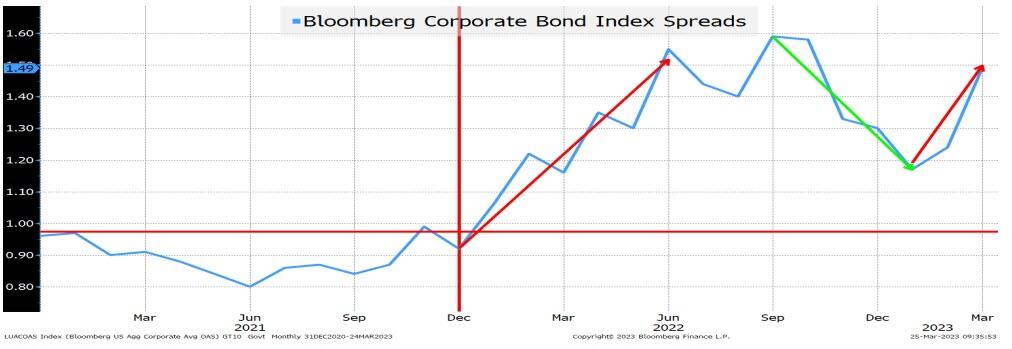
Credit spreads weren’t helping anything for the corporate bond investor (or the issuer)

At least corporate spreads are below their widest levels (seen in June 2022). However, they’ve started to widen again recently as concerns about a possible recession get put back on the table. These concerns should never have been removed from the table as thoroughly as they were. In addition, more people are starting to worry about credit conditions.

One positive is that very little, if any, of the pressure on the banking sector can be linked to corporate credit quality concerns and I don’t see that changing!

The Ring – Deposit Rates

I remember being creeped out by “The Ring”. However, I still don’t understand it (which brings me to deposit rates). They are starting to creep me out as well and I don’t fully understand them either.

The only interest rates on the entire planet that have barely budged are the rates paid on deposits.

I can only find “reliable” data on FRED going back to April 2021. The data here is the FDIC rate on savings and it only moved above 0.1% in the summer of 2022 and was reported as 0.37% today (which is astonishing). We discussed this topic on Friday in Discretion is the Better Part of Valor and it is potentially the lynchpin for what happens next for banks.

  • I’m 99.9999% confident that depositors in any bank will be fully protected. However, the policy makers could have been more explicit (rather than Powell’s “wink, wink, nudge, nudge” approach of hinting that they would step in when needed). This is hard to do except in the case of an “emergency”.

If I’m not worried about credit risk as a depositor, why am I still worried about bank deposits?

  • Having money in a bank deposit account serves many purposes (getting cash, paying bills, and easily moving money around). There are a lot of services that banks provide and part of the “payment” is accepting a lower interest rate than you could otherwise receive.

  • That is how it has always been done and is likely how it will continue. However, it seems like it has become much easier to move money seamlessly back and forth (quite cheaply), which could cause many to question how much one should keep in a bank.

  • What started as people re-thinking their credit risk may morph into people re-thinking the cost (in terms of yield give up).

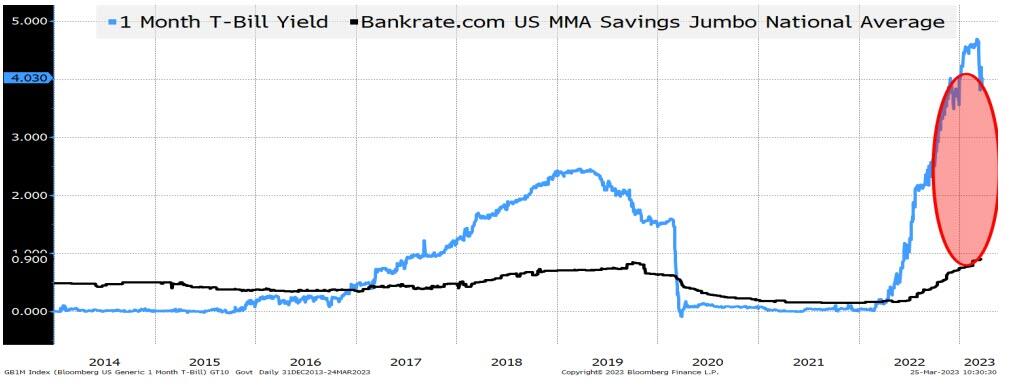
A “preliminary chart”. As mentioned earlier, I have had some difficulty finding a good estimate of the average interest rate paid on bank deposits. I found this bankrate.com index that seems to include rates paid on jumbo savings accounts. This might be why (at 0.9%) it is higher than the FDIC rate I mentioned earlier. I need to do more work to find some better information on this, but it is at least indicative of the spreads between something as safe as bank accounts and 1-month T-bills.

On Friday, I had an interesting discussion with a banker that offers clients the ability diversify up to $50 million in deposits at the touch of a button. It would be distributed to enough different banks (and bank accounts) that the entire $50 million would be covered by the FDIC. This is impressive (both the technology and anyone who has $50 million lying around), but I am wondering if someone will ask the question – why?

Low rates paid on deposits and the ease of moving money around will be the next important point of discussion around banks. They can raise the rate they pay (should stem deposit flow), but this may hit earnings.

The timing of the “deposit boom” is also important!

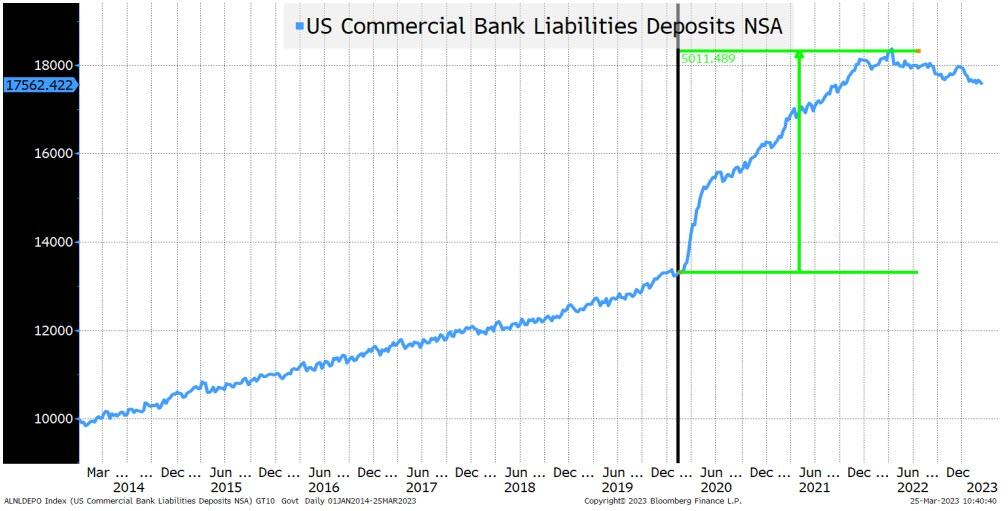
It took about 7 years for deposits to grow from $10 trillion to just over $13 trillion. Then, between stimulus and ZIRP, deposits grew by $5 trillion in 2 years!

A system that basically was growing around $0.5 trillion per annum for an extended period of time grew by $2.5 trillion for 2 years in a row!

Remember (and this is crucial) that from early 2020 until somewhere in 2022, there was virtually no difference between what you could get in 1-month T-bills (and other super safe/low duration assets) and bank deposits. You had all the benefits/features of a bank account and were paying next to nothing (in terms of yield give-up).

That has all changed. It is not a coincidence that the level of bank deposits started to shrink early in 2022. This was all before bank deposits were part of the headlines on the nightly news.

Maybe I’m wrong and this is sustainable, but something has to give in the coming weeks and months.

What concerns me is how much money came into the banking system during ZIRP when there were few ways to earn net interest margin without taking more risk than was needed in the past. Yes, remember that the seeds of inflation (and other issues) were sown when we kept ZIRP going far longer than many thought was necessary.

Scream – Disruption

The wealth destruction in disruption has been nothing short of epic – hence the “scream”.

What has happened to cryptocurrencies (even as bitcoin is climbing), private equity (not immune to what has happened in public markets), and so many companies (investors and their employees) has been awful.

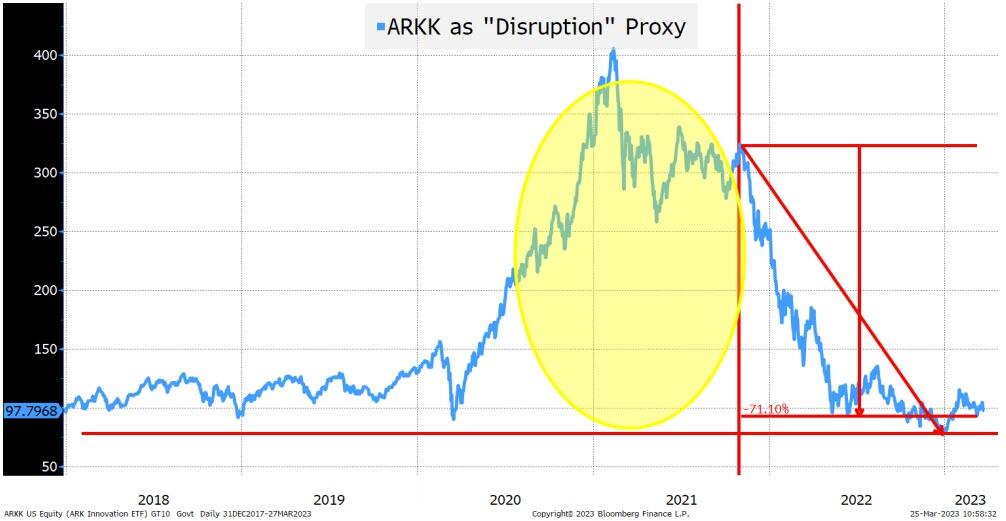
I use ARKK as a proxy for disruptive since everyone knows it. Its problems started earlier, but it is still down 70% from late 2021 (and even more compared to the early 2021 highs). There are some issues with using this as a proxy because the portfolio is traded actively (which may overstate the problems in disruption) and it is only a subset of “disruption”. However, it also tended to have TSLA as a large investment, which is still up more than 500% during this time period. In any case, I still cannot believe that I failed to tie the importance of the “disruptive economy” and the “disruptive portfolio” to Silicon Valley Bank. It literally personified my theory and I failed to see it.

If you get a chance, go back to Inflation Factors for why I think that disruption is so important.

I still believe in the importance of the wealth effect and think that disruption is at the epicenter of the problem that the market and economy are facing. The more your economy or business depends on the disruptive community, the more at risk you are.

Silence of the Lambs – Commercial Real Estate

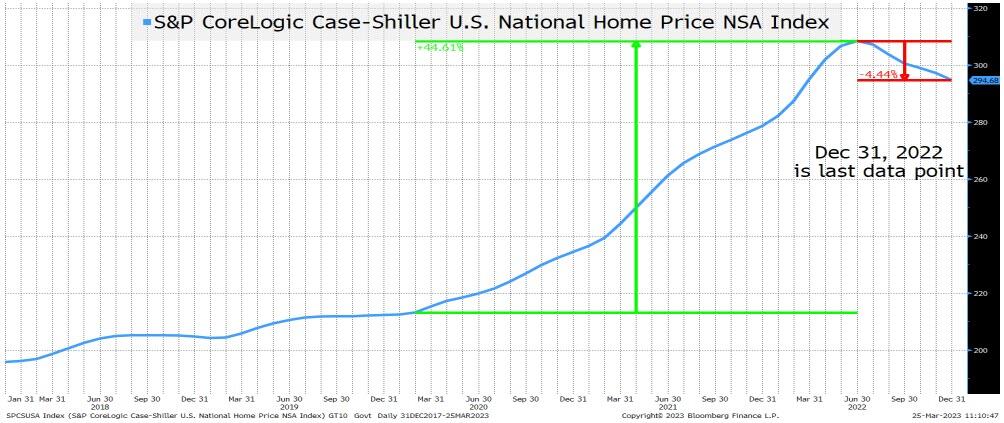
The housing market, so far, has sustained much higher mortgage rates reasonably well.

I suspect that we will see declines continue, but so long as job losses remain minimal (so far, so good), many individuals who refinanced during ZIRP will not be in any rush to sell.

However, what isn’t so positive is what is happening in relative silence.

Limiting at least some withdrawals on at least one real estate focused fund is hardly an endorsement for that type of investment. That was reported late last year, but it is an ongoing issue (I haven’t seen stories that it has been re-opened to full withdrawals, but I could be wrong).

There are some publicly traded REITs that are at least 50% down since the start of 2022. Again, this is occurring in relative silence.

As I’m talking to people, CRE or commercial real estate is becoming the “topic de jour”. Small banks, which rely on local lending opportunities, could be exposed.

In any case, I encourage you to reach out to Stav Gaon at Academy who is our resident expert (and an II ranked analyst in the space). He has published many reports on structured products and real estate.

Bottom Line – Caution

If I had to pick one “crazy” idea right now, it would be an emergency rate cut of 100 bps or more sometime before the summer is over.

One thing that fixes the “cost of funds” issue for everyone (even if the curve steepens) is much lower short-term rates.

But the Fed and ECB both just hiked and are convinced that inflation is rebounding so I see more pain ahead. Inflation had improved steadily from last summer into January (disinflation was a risk at the second to last Fed meeting) and even wage inflation pressures eased in the most recent data, but let’s not let facts get in the way of hyping the return of inflation. They’ve also chosen to ignore a potential serious tightening of financial conditions. So long as deposits remain at risk of being taken elsewhere, banks will be more cautious on their lending than they were even a month or two ago.

I haven’t even touched on European banks today despite Friday morning’s spread widening. I think that the SNB could have handled CS much better from an overall market perspective. They did a lot to ensure that it got taken over by UBS, but did little to give confidence to the broader market. European banks face a different set of issues. These issues include the ability to retain deposits and to address questions about that “steaming pile” of unrealized (or unrecognized/unknown) losses in their portfolios.

Lehman was NOT a Moment. In no way am I comparing recent events to Lehman, but it is worth pointing out that the S&P 500 finished higher the week after Lehman filed. Yeah, stocks bounced off of the lows Friday, all is good! Hmmmmm…

I like lower yields.

I’m mildly nervous about credit spreads here, including structured products.

  • I am NOT worried about credit risk increasing materially. Companies are doing well and will likely weather any economic slowdown (which is by no means a foregone conclusion even in a cautious state).

  • I am worried about the cost of credit risk increasing. Investors will demand more premium for any given level of credit risk. The price of credit is always influenced by liquidity and if selling pressure mounts, pricing will deteriorate. I cannot remember how low AAA CLO paper got during the GFC, but it was absurdly cheap for an asset class that still hasn’t experienced losses due to credit. Even after this year’s bracket busting NCAA tournament, I still think that it is easier to pick a perfect bracket than to create credit losses in a AAA CLO tranche (but that doesn’t mean that the prices can’t get worse).

  • One positive development next week (I think it is positive) is that we may see more institutions use the new Fed facility after March 31st. They wouldn’t have to report accessing the facility until the following quarter (small, but could help).

Equities, I see greater downside.

  • Equities have been trying to re-ignite the ZIRP framework of 2020 (though conditions are so different compared to back then). This has created bullish positioning that is susceptible to a pullback.

  • The system is “saved” mentality has helped markets too. Just watch how well stocks did after the FSOC meeting was announced (which so far has only produced a generic statement of “all is well”).

  • You get any geopolitical risk for “free” being underweight equities. Maybe Putin is making peace overtures, but I’m still leaning towards China deciding to sell weapons to Russia before then.

  • I saw people mocking “volmageddon” early last week. While I didn’t fully agree with the “volmageddon” idea, I do think that 0DTE options can push markets. While I’m convinced that there is “always a seller”, I’m not as convinced that there is “always a buyer”. The risk of a big move here is heavily skewed to the downside rather than a face-ripping rally!

  • In addition, the debt ceiling debate is also looming and there are concerns that the situation could be even more contentious this time around, which would hurt risk assets.

The narrative is shifting and one thing that I learned from 2007-2009 (and again during the European Debt Crisis) is that by the time central bankers and policy makers solve the “current” issue, the market has started to move on to the “next” issue.

There won’t be as many “green dots” on Bloomberg this Sunday night as there were last Sunday so enjoy your weekend!

I’m going to remain cautious into next week until I see things evolving in a sustainable way (rather than just knee-jerk reactions and short covering).

Tyler Durden
Sun, 03/26/2023 – 12:30

via ZeroHedge News https://ift.tt/CX8PsJi Tyler Durden

Starlink Competitor OneWeb Completes Satellite Constellation

Starlink Competitor OneWeb Completes Satellite Constellation

The race to provide global high-speed internet through space-based networks is underway, heralding the potential beginning of a new era in communication.

London-based company OneWeb launched the final 36 satellites of its initial 616-satellite “constellation” via an Indian LVM3 rocket from the Sriharikota spaceport in Andhra Pradesh on Saturday. 

“It’s the fruition of an enormous amount of hard work, and obviously, we’ve been through some geopolitical issues over the last year or so, and the team has proven to be extremely resilient and caught up,” Chief Executive Officer Neil Masterson told Bloomberg ahead of the launch. 

“This launch will be one of the most significant milestones in OneWeb’s history so far, with the launch adding an additional 36 satellites to the OneWeb fleet, the first ever completed global LEO constellation,” OneWeb wrote in a press release

OneWeb’s space-based internet will provide high-speed, low-latency solutions to communities, enterprises, and governments worldwide through its constellation of satellites. 

Besides OneWeb, there is only one other company flying more satellites in space today and a competitor: Elon Musk’s Starlink system. 

However, OneWeb is different from Starlink because it’s not selling broadband connections to individuals but rather to telecom companies that will then provide this internet service. 

Bloomberg noted OneWeb had a rocky past, filing for bankruptcy in March 2020, only to be rescued by the UK government and Indian telecom tycoon Sunil Mittal’s Bharti Group. The company has attracted investments from Hughes Satelite Systems and SoftBank Group. 

More importantly, there’s a space race to provide satellite internet worldwide. Musk’s Starlink happens to be the leader

    Tyler Durden
    Sun, 03/26/2023 – 12:00

    via ZeroHedge News https://ift.tt/Be4kyNR Tyler Durden

    US Bank Trouble Heralds The End Of Dollar Reserve System

    US Bank Trouble Heralds The End Of Dollar Reserve System

    Authored by David Goldman via AsiaTimes.com,

    Bank crisis not a credit quality problem but stems instead from now-impossible task of financing America’s ever-expanding foreign debt…

    The US banking system is broken. That doesn’t portend more high-profile failures like Credit Suisse. The central banks will keep moribund institutions on life support.

    But the era of dollar-based reserves and floating exchange rates that began on August 15, 1971, when the US severed the link between the dollar and gold, is coming to an end. The pain will be transferred from the banks to the real economy, which will starve for credit.

    And the geopolitical consequences will be enormous.

    The seize-up of dollar credit will accelerate the shift to a multipolar reserve system, with advantage to China’s RMB as a competitor to the dollar.

    Gold, the “barbarous relic” abhorred by John Maynard Keynes, will play a bigger role because the dollar banking system is dysfunctional, and no other currency—surely not the tightly-controlled RMB—can replace it. Now near an all-time record price of US$2,000 an ounce, gold is likely to rise further.

    The greatest danger to dollar hegemony and the strategic power that it imparts to Washington is not China’s ambition to expand the international role of the RMB. The danger comes from the exhaustion of the financial mechanism that made it possible for the US to run up a negative $18 trillion net foreign asset position during the past 30 years.

    Germany’s flagship institution, Deutsche Bank, hit an all-time low of 8 euros on the morning of March 24, before recovering to 8.69 euros at the end of that day’s trading, and its credit default swap premium—the cost of insurance on its subordinated debt—spiked to about 380 basis points above LIBOR, or 3.8%.

    That’s as much as during the 2008 banking crisis and the 2015 European financial crisis, although not quite as much as during the March 2020 Covid lockdown, when the premium exceeded 5%. Deutsche Bank won’t fail, but it may need official support. It may have received such support already.

    This crisis is utterly unlike 2008, when banks levered up trillions of dollars of dodgy assets based on “liar’s loans” to homeowners. Fifteen years ago, the credit quality of the banking system was rotten and leverage was out of control. Bank credit quality today is the best in a generation. The crisis stems from the now-impossible task of financing America’s ever-expanding foreign debt.

    It’s also the most anticipated financial crisis in history. In 2018, the Bank for International Settlements (a sort of central bank for central banks) warned that $14 trillion of short-term dollar borrowings of European and Japanese banks used to hedge foreign exchange risk were a time bomb waiting to explode (“Has the derivatives volcano already begun to erupt?”, October 9, 2018).

    In March 2020, dollar credit seized up in a run for liquidity when the Covid lockdowns began, provoking a sudden dearth of bank financing. The Federal Reserve put out the fire by opening multi-billion-dollar swap lines to foreign central banks. It expanded those swap lines on March 19.

    Source: US Bureau of Economic Analysis, Bank for International Settlements

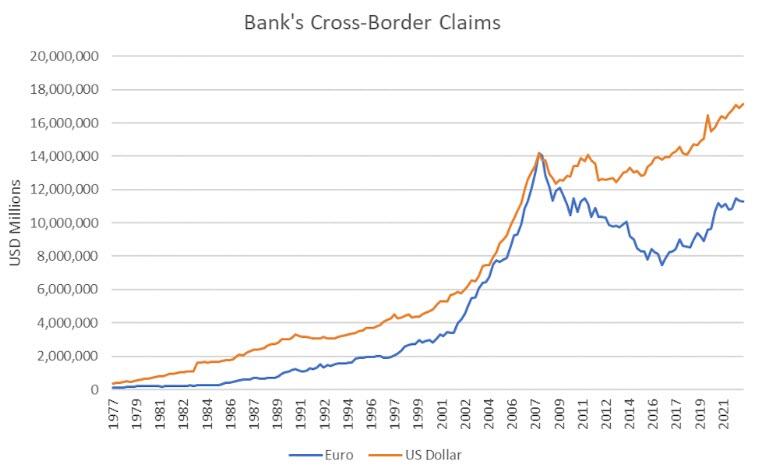
    Correspondingly, the dollar balance sheet of the world banking system exploded, as gauged by the volume of overseas claims in the global banking system. This opened up a new vulnerability, namely counterparty risk, or the exposure of banks to enormous amounts of short-term loans to other banks.

    Source: Bank for International Settlements

    America’s chronic current account deficits of the past 30 years amount to an exchange of goods for paper: America buys more goods than it sells, and sells assets (stocks, bonds, real estate, and so on) to foreigners to make up the difference.

    America now owes a net $18 trillion to foreigners, roughly equal to the cumulative sum of these deficits over 30 years. The trouble is that the foreigners who own US assets receive cash flows in dollars, but need to spend money in their own currencies.

    With floating exchange rates, the value of dollar cash flows in euro, Japanese yen or Chinese RMB is uncertain. Foreign investors need to hedge their dollar income, that is, sell US dollars short against their own currencies.

    That’s why the size of the foreign exchange derivatives market ballooned along with America’s liabilities to foreigners. The mechanism is simple: If you are receiving dollars but pay in euros, you sell dollars against euros to hedge your foreign exchange risk.

    But your bank has to borrow the dollars and lend them to you before you can sell them. Foreign banks borrowed perhaps $18 trillion from US banks to fund these hedges. That creates a gigantic vulnerability: If a bank looks dodgy, as did Credit Suisse earlier this month, banks will pull credit lines in a global run.

    Before 1971, when central banks maintained exchange rates at a fixed level and the United States covered its relatively small current account deficit by transferring gold to foreign central banks at a fixed price of $35 an ounce, none of this was necessary.

    The end of the gold link to the dollar and the new regime of floating exchange rates allowed the United States to run massive current account deficits by selling its assets to the world. The population of Europe and Japan was aging faster than the US, and had a correspondingly greater need for retirement assets. That arrangement is now coming to a messy end.

    One failsafe gauge of global systemic risk is the price of gold, and especially the price of gold relative to alternative hedges against unexpected inflation.

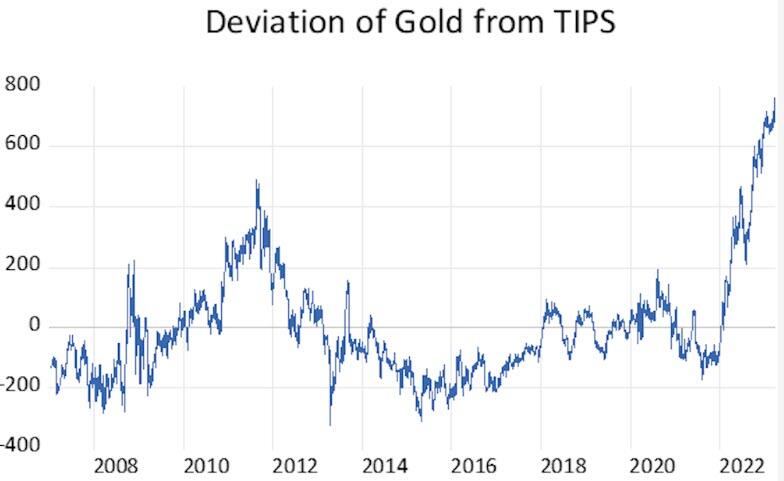
    Between 2007 and 2021, the price of gold tracked inflation-indexed US Treasury securities  (“TIPS”) with a correlation of about 90%.

    Starting in 2022, however, gold rose while the price of TIPS fell. Something like this happened in the aftermath of the 2008 global financial crisis, but the past year’s move has been far more extreme. Shown below is the residual of the regression of the gold price against 5- and 10-year maturity TIPS.

    Graphic: Asia Times

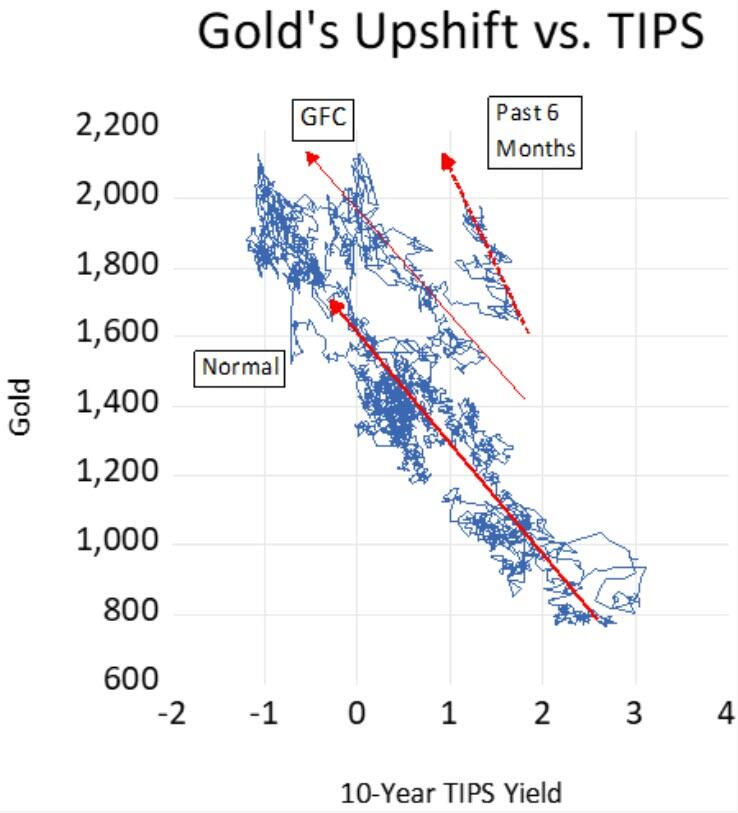
    If we look at the same data in a scatter plot, it’s clear that the linear relationship between gold and TIPS remains in place, but it has shifted both its baseline and steepened its slope.

    In effect, the market worries that buying inflation protection from the US government is like passengers on the Titanic buying shipwreck insurance from the captain. The gold market is too big and diverse to manipulate. No one has a lot of confidence in the US Consumer Price Index, the gauge against which the payout of TIPS is determined.

    The dollar reserve system will go out not with a bang, but a whimper. The central banks will step in to prevent any dramatic failures. But bank balance sheets will shrink, credit to the real economy will diminish and international lending in particular will evaporate.

    At the margin, local currency financing will replace dollar credit. We have already seen this happen in Turkey, whose currency imploded during 2019-2021 as the country lost access to dollar and euro financing.

    To an important extent, Chinese trade financing replaced the dollar, and supported Turkey’s remarkable economic turnaround of the past year. Southeast Asia will rely more on its own currencies and the RMB. The dollar frog will boil by slow increments.

    It’s fortuitous that Western sanctions on Russia during the past year prompted China, Russia, India and the Persian Gulf states to find alternative financing arrangements. These are not a monetary phenomenon, but an expensive, inefficient and cumbersome way to work around the US dollar banking system.

    As dollar credit diminishes, though, these alternative arrangements will turn into permanent features of the monetary landscape, and other currencies will continue to gain ground against the dollar.

    Tyler Durden
    Sun, 03/26/2023 – 11:30

    via ZeroHedge News https://ift.tt/qLV1s8N Tyler Durden

    FIRE Sues West Texas A&M Over Its Blocking of Student Group’s Drag Show

    From the brief in support of motion for TRO in Spectrum WT v. Wendler (N.D. Tex.), filed Friday (see the brief for more factual details, and some further analysis); the argument seems correct to me:

    Introduction

    West Texas A&M University’s President, Defendant Walter Wendler, has declared that he will not obey “the law of the land.” Instead, he insists on banning a recognized student group’s event from campus simply because he dislikes the event’s entirely lawful message. By moving for a temporary restraining order and preliminary injunction, Plaintiffs ask this Court to put a swift end to Wendler’s disdain for the First Amendment and prevent further irreparable harm to Plaintiffs’ constitutional freedoms.

    On March 20, 2023, President Wendler announced to the campus community that he is forbidding Plaintiff Spectrum WT from holding its scheduled PG-13 charity drag show because he disagrees with the show’s viewpoint. Making matters worse, President Wendler has all but confessed that he is knowingly violating the Constitution: “A harmless drag show? Not possible. I will not appear to condone the diminishment of any group at the expense of impertinent gestures toward another group for any reason, even when the law of the land appears to require it.” (Dkt. 1, Verified Compl., Ex. A.) That is textbook viewpoint discrimination. And it violates the First Amendment.

    The Supreme Court has concluded that even controversial live theater is protected First Amendment expression. Se. Promotions, Ltd. v. Conrad, 420 U.S. 546, 557–58 (1975). If officials in Tennessee could not exclude a group from presenting the provocative play Hair in a public theatre because they disagreed with Hair’s message, then surely President Wendler and the other Defendants cannot exclude students wanting to put on a PG-13 charity drag show in a campus space open to student groups for expressive activities, simply because the show does not match Wendler’s worldview. Id.

    Indeed, the Constitution’s bar against viewpoint discrimination is vital to preserving freedom of speech at public colleges and universities. “[N]o matter how offensive to good taste” some may find it, expression “on a state university campus may not be shut off in the name alone of ‘conventions of decency.'” Papish v. Bd. of Curators of the Univ. of Mo., 410 U.S. 667, 670 (1973). So, whether students gather on campus to support a political candidate, talk about the Bible, or put on a drag show, public college administrators cannot censor student expression just because they find it disagreeable or offensive.

    Yet that is exactly what President Wendler is doing by refusing to let the show go on. The result is ongoing irreparable harm to Spectrum WT and its student officers, Plaintiffs Barrett Bright and Lauren Stovall. Above all, the eleventh-hour cancelation of their March 31 charity drag show—and President Wendler’s moratorium on campus drag shows altogether—are depriving Spectrum WT’s members of their First Amendment rights, which is always an irreparable injury. Elrod v. Burns, 427 U.S. 347, 373 (1976). What’s more, Spectrum WT carefully followed West Texas A&M’s process for getting event approval—with the full backing of campus staff—only for Wendler to pull the rug out at the last minute. If Spectrum WT cannot hold its March 31 event on campus, or similar events it plans to hold in the future, it will suffer significant injury to its mission of advocating for the LGBTQ+ community at West Texas A&M….

    [I.] Plaintiffs Are Substantially Likely to Succeed on the Merits Against the University’s Brazen Censorship of Protected Expression.

    “The First Amendment is not an art critic,” and drag shows, like other forms of theatrical performance, are expressive conduct that the First Amendment prohibits President Wendler from censoring. Norma Kristie, Inc. v. City of Okla. City, 572 F. Supp. 88, 91 (W.D. Okla. 1983) (holding drag shows are protected First Amendment expression).

    The freedom of expression enshrined in the First Amendment “does not end at the spoken or written word.” Texas v. Johnson, 491 U.S. 397, 404 (1989). Whatever the mode of expression, the First Amendment protects conduct “inten[ded] to convey a particularized message,” (id. at 404, 406), and it prohibits public university officials from suppressing student expression simply because they disagree with its viewpoint or find the message offensive. Papish, 410 U.S. at 670. If anything, whether speech is protected by the First Amendment is a legal, not moral, analysis. Dodds v. Childers, 933 F.2d 271, 273 (5th Cir. 1991). President Wendler imposing his morals at the expense of free expression violates the First Amendment.

    The First Amendment also bars public university officials from denying student groups access to campus public forums because of the content or viewpoint of a group’s message. Widmar v. Vincent, 454 U.S. 263, 267–70 (1981); Rosenberger v. Rector & Visitors of Univ. of Va., 515 U.S. 819, 828–29 (1995). And messaging within a broader genre—such as art, theater, and dancing—is also protected even if it does not convey a “narrow, succinctly articulable message.” Hurley v. Irish-Am. Gay, Lesbian & Bisexual Grp., 515 U.S. 557, 569 (1995). Indeed, “[e]ven crude street skits come within the First Amendment’s reach.” Iota Xi Chapter of Sigma Chi Fraternity v. George Mason Univ., 993 F.2d 386, 390 (4th Cir. 1993) (fraternity “ugly woman contest” is protected expression). See also Berger v. Battaglia, 779 F.2d 992, 999 (4th Cir. 1985) (holding a blackface performance is protected First Amendment expression, even when it is “sheer entertainment” without a political message).

    Under core First Amendment principles, Defendants’ ongoing suppression of a peaceful charity drag show constitutes unlawful viewpoint and content discrimination. The Court should stop the ongoing injury to Plaintiffs’ First Amendment freedoms and restore constitutional order on West Texas A&M’s campus by issuing a temporary restraining order and preliminary injunction.

    [A.] President Wendler’s Censorship of a Drag Show Based on Personal Disagreements with the Expression’s Message Is Textbook Viewpoint Discrimination.

    President Wendler’s abuse of his powers to quash a PG-13 charity drag show because he disagrees with the show’s message—real or perceived—violates the First Amendment. It is “axiomatic that the government may not regulate speech based on its substantive content or the message it conveys.” Rosenberger, 515 U.S. at 828. “Viewpoint discrimination is censorship in its purest form,” and government action “that discriminates among viewpoints threatens the continued vitality of free speech.” Bible Believers v. Wayne Cnty., Mich., 805 F.3d 228, 248 (6th Cir. 2015) (en banc) (cleaned up). Indeed, government officials like college administrators are “inherently” incapable of making “principled distinctions” between offensive and inoffensive speech, and the state has “no right to cleanse” public expression such that it is “palatable to the most squeamish among us.” Cohen v. California, 403 U.S. 15, 25 (1971).

    To that end, “state colleges and universities are not enclaves immune from the sweep of the First Amendment.” Healy v. James, 408 U.S. 169, 180 (1972). And that includes the First Amendment prohibition on viewpoint discrimination. Rosenberger, 515 U.S. at 835–36 (invalidating college’s denial of funding to Christian student newspaper). True, courts often employ “forum analysis” to determine when public university administrators “in regulating property in [their] charge, may place limitations on speech.” Christian Legal Soc’y Chapter of the Univ. of Cali, Hastings Coll. of Law v. Martinez, 561 U.S. 661, 679 (2010). But regardless of the forum’s classification, “any access barrier … must be viewpoint neutral.” Id. (citing Rosenberger, 515 U.S. at 829).

    By picking and choosing which performances fit his moral tastes, President Wendler is engaging in viewpoint discrimination. Indeed, “the essence of viewpoint discrimination” is “the Government’s disapproval of … messages it finds offensive.” Iancu v. Brunetti, 139 S. Ct. 2294, 2299 (2019) (quoting Matal v. Tam, 582 U.S. 218, 248–49 (2017) (Kennedy, J., concurring)). And as President Wendler proclaims, he personally finds that “drag shows are derisive, divisive and demoralizing misogyny, no matter the stated intent.” (Verif. Compl., Ex. A.)

    President Wendler’s stance mirrors that of the censorial officials in Southeastern Promotions. 420 U.S. 546. There, a group petitioned to use a city- operated municipal auditorium to present the rock musical “Hair.” Id. at 547. The auditorium directors denied the application, reasoning that allowing the play “was not in the best interest of the community” and the board would only “allow those productions which are clean and healthful and culturally uplifting, or words to that effect.” Id. at 549. The Supreme Court struck down the directors’ censorship as an unconstitutional prior restraint. To the same end, this Court should put a stop to Defendants’ ongoing viewpoint-based censorship of Plaintiffs’ PG-13 charity drag show.

    The Fourth Circuit’s decision in Iota Xi also shows why the Court should enjoin Defendants’ censorship. 993 F.2d 386. There, George Mason University imposed sanctions on a fraternity for hosting an “ugly woman contest” riddled with “racist and sexist” overtones, including contestants “dressed as caricatures of different types of women[]” (i.e., in drag). Id. at 387–88. George Mason’s administrators cited many of the same concerns President Wendler relies on—that the event was degrading, amounted to harassment, and conflicted with the institution’s mission. Id. at 388; Verif. Compl., Ex. A.

    The Fourth Circuit had no trouble brushing aside the administrators’ excuses. As the court explained, “First Amendment principles governing live entertainment are relatively clear: short of obscenity, it is generally protected.” Iota Xi, 993 F.2d at

    389 (collecting cases). The court likewise held the fraternity’s drag skit was constitutionally protected, since it intended to convey a message, both through the mode of dress and use of a theatrical medium. Id. at 392. The court held GMU engaged in unconstitutional viewpoint discrimination by sanctioning the fraternity as the sanction arose from the fact that “the ‘ugly woman contest’ … ran counter to the views the University sought to communicate to its students and the community.” Id. at 393.

    Even if President Wendler’s opinion were shared by all but the students here, he cannot justify stifling Plaintiffs’ expression on moral grounds. That argument lost in Southeastern Promotions. It lost in Iota Xi. And it must lose here. See also Gay Student Servs. v. Tex. A & M Univ., 737 F.2d 1317, 1322–27 (5th Cir. 1984) (holding Texas A&M violated the First Amendment by refusing to recognize a gay student organization when the official responsible for the denial justified the decision “based on his perception that the organization would attempt to convey ideas” he found morally repugnant).

    This Court should refuse Wendler’s viewpoint-driven reasons for violating the First Amendment, grant Plaintiffs’ motion, and put a stop to Wendler and the other Defendants’ ongoing censorship of Plaintiffs’ protected expression.

    1. Excluding Plaintiffs’ Drag Show from Campus Public Forums Violates the First Amendment.

    President Wendler’s denial of use of a campus public forum to Plaintiffs also violates the First Amendment, to their ongoing injury. Legacy Hall is a designated public forum for First Amendment purposes. West Texas A&M opens its facilities, like Legacy Hall, to West Texas A&M students and student organizations for exactly these expressive purposes: theatrical performances before a willing audience, music, dancing, and banter. (Verif. Compl. ¶¶ 31–32, 41–42.) Thus, because “the University has created a forum generally open for use by student groups,” “the University must therefore satisfy the standard of review appropriate to content-based exclusions.” Widmar, 454 U.S. at 270. See also Pro-Life Cougars v. Univ. of Houston, 259 F. Supp. 2d 575, 582 (S.D. Tex. 2003) (“When as here a University by policy and practice opens up an area for indiscriminate use … by some segment of the public, such as student organizations, such area may be deemed to be a designated public forum”).

    Under the First Amendment, “a government … has no power to restrict expression because of its message, its ideas, its subject matter, or its content” unless it satisfies strict scrutiny. Reed v. Town of Gilbert, Ariz., 576 U.S. 155, 163 (2015) (cleaned up). To meet that high bar here, Defendants “must show that [their] regulation is necessary to serve a compelling state interest and that it is narrowly drawn to achieve that end.” Widmar, 454 U.S. at 270. They cannot meet that burden. See United States v. Playboy Ent. Grp., Inc., 529 U.S. 803, 816 (2000) (“When the Government restricts speech, the Government bears the burden of proving the constitutionality of its actions”).

    For starters, a ban on drag shows is content-based (if not outright viewpoint- based, as shown above). It singles out a particular type of expression—drag—for differential treatment. That is textbook content discrimination. Reed, 576 U.S. at 169 (content discrimination exists when the government “singles out a specific subject matter for differential treatment”).

    Defendants’ content-based ban of campus drag shows—including canceling Plaintiffs’ March 31 show—fails strict scrutiny. And Widmar shows why. In Widmar, the University of Missouri at Kansas City denied an evangelical Christian student group the use of university facilities otherwise “generally available for … registered student groups.” Id. at 264–65. The Supreme Court explained that such restrictions, which single out a particular subject for differential treatment, are subject to “the most exacting scrutiny.” Id. at 276. The Court held that the university unlawfully “discriminated against student groups and speakers based on their desire to use a generally open forum to engage in” protected expression and that the university’s stated goal, “achieving greater separation of church and State,” was not sufficiently “‘compelling’ to justify content-based discrimination against respondents’ religious speech.” Id. at 269, 278.

    Here, advancing President Wendler’s belief that drag shows promote “misogyny” is not a compelling state interest. (Verif. Compl. Ex. A.) As a threshold matter, banning drag shows does not prevent tangible harm to women. Any women (or men) who might take offense from a drag show can simply opt to not attend. Likewise, those who agree with President Wendler’s estimation of the value of the students’ expression can exercise a time-honored means of “effectively avoid[ing] further bombardment of their sensibilities simply by averting their eyes.” Cohen, 403

    U.S. at 21.

    Rather, President Wendler, like the administrators in Iota Xi, seeks to suppress Plaintiffs’ speech “because it r[uns] counter to the views the University s[eeks] to communicate to its students and the community.” 993 F.2d at 393. That is not redressing a harm. It is big-brother government insisting it “knows what’s best” for women and that it can silence dissenting expression. But “[t]he state may not ordain preferred viewpoints [about women and femininity] in this way. The Constitution forbids the state to declare one perspective right and silence opponents.” Am. Booksellers Ass’n v. Hudnut, 771 F.2d 323, 325 (7th Cir. 1985).

    Nor is Defendants’ ban on drag shows narrowly tailored or the least restrictive means of furthering their goals. See Playboy Ent. Grp., 529 U.S. at 813 (content regulation permissible only if the government “chooses the least restrictive means to further the articulated interest”) (cleaned up). Neither President Wendler nor the other Defendants have banned any other type of expression from campus which might tend to disparage or demean women. And a content-based law is not narrowly tailored if it leaves untouched a significant amount of expression causing the same problem. Reed, 576 U.S. at 172. Plus, the government’s objection to a speaker’s message is not even a legitimate government interest, let alone a compelling one.

    America’s college campuses are no stranger to censorship, which is often visited upon students and faculty who find themselves among the minority viewpoint—including, in many cases, conservative and religious groups. See, e.g., Widmar, 454 U.S. at 265; Rosenberger, 515 U.S. at 830. From Central Washington University threatening to defund the College Republicans for protected speech, to Iowa State University threatening to punish the College Republicans for protected speech, to pro-life groups having to fight for recognition at the University of Arizona, censorship of expression on public campuses continues to fester. But students’ expressive rights should not, and do not, turn on the whims of college administrators. The First Amendment does not play favorites.

    President Wendler’s censorship singles out one type of artistic expression out of many—drag shows—for differential treatment and censorship simply because he dislikes the message he perceives. It is unconstitutional viewpoint discrimination for the reasons explained. And putting aside President Wendler’s confessed motives, the ban is unlawful content discrimination. A temporary restraining order and preliminary injunction are necessary to secure Plaintiffs’ First Amendment rights….
    The post FIRE Sues West Texas A&M Over Its Blocking of Student Group's Drag Show appeared first on Reason.com.

    from Latest https://ift.tt/ix4UpTY
    via IFTTT

    Israel Defense Minister Urges Halt To Judicial Reform Amid Upheaval

    Israel Defense Minister Urges Halt To Judicial Reform Amid Upheaval

    In a major development, Israeli defense minister Yoav Gallant on Saturday called for Benjamin Netanyahu’s government to halt its planned judicial reforms, which have prompted enormous protests and are starting to disrupt the country’s military. 

    I see the source of our strength eroding…The rift within our society is widening and penetrating the Israel Defense Forces,said Gallant in a televised evening speech“This is a clear and immediate and tangible danger to the security of the state. I shall not be a party to this.”

    In addition to calling for a suspension of the reforms, Gallant also implored Israelis to stop their enormous protests, which raged even as he spoke. 

    Israeli defense minister Yoav Gallant delivering his remarks on Saturday evening (Defense Ministry photo)

    The coming week could bring high drama and even more upheaval, as the Knesset is expected to hold its final vote on the first aspect of the judicial overhaul: a measure giving the government more power over Supreme Court appointments.  

    Other reforms would allow the Knesset — Israel’s unicameral legislature — to override Supreme Court decisions with a simple majority vote. Others would end the court’s practice of applying a “reasonableness” test when evaluating laws and government actions.

    Critics characterize the scheme as a step deeper into authoritarianism. Some say the moves are in part designed to help Netanyahu terminate his ongoing prosecution on corruption charges. 

    The past ten weeks have seen major public protests all across Israel. Saturday night’s crowds were reportedly the largest yet, estimated in the hundreds of thousands. 

    Gallant said the Israeli Defense Forces (IDF) are feeling the effects: “The events happening in Israeli society are not staying out of the military. Feelings of rage, disappointment and fear have reached heights we have never seen before,” said Gallant. 

    More pressingly, a growing coalition of Israeli service members — calling themselves Brothers in Arms — are committing to stop showing up for duty in protest of the measures.

    Some say they’ll stay home if the judicial reform passes, but others aren’t waiting — particularly among Israel’s reserve forces. On Friday, two hundred Israeli Air Force reserve pilots signed a letter saying they will not report for two weeks. Reservists are an essential part of Israel’s military, and especially its air force, which has been active in bombing targets across Syria, including the Damascus airport.  

    IDF chief of staff Lt. Gen. Herzi Halevi has already sounded an internal alarm, saying the dip in reservists reporting for duty is now so large that the the military is on the verge of curtailing some operations, according to The New York Times, which quoted three anonymous Israeli officials. Two of those officials are bracing for resignations from full-time service members. 

    Palestinians would surely welcome the curtailing of IDF operations

    Underscoring the divisions caused by the judicial proposal, far-right national security minister Itamar Ben-Gvir lashed out at his fellow cabinet member, urging Netanyahu to fire Gallant, whom he condemned for “succumbing to the pressure of those [IDF members] who threatened to refuse [to report for duty] and are trying to stop the important reform.” 

    Similarly, Israel’s communications minister accused Gallant, a former navy commando, of “giving wind to a military coup.”  

    However, just minutes after Gallant concluded his remarks, two of his fellow Likud party lawmakers endorsed his plea, Haaretz reports. One is the chair of the Knesset’s security and foreign affairs committee, and the other is a person who rarely criticizes Netanyahu.  

    Israel’s agriculture minister and another Likud member reportedly favor a freeze as well. If they went as far as to become “no” votes, that quartet would be sufficient to impede the legislation.  

    On Friday — the day before Gallant’s speech — Netanyahu told reporters:

    “Surrendering to [IDF] refusal is a terrible danger to the state of Israel…The country cannot exist without the IDF. There will not be a nation, it’s very simple. All red lines have been crossed. People who were responsible for the security of the country suddenly adopted this cynicism.” 

    Gallant said he had privately shared his views with Netanyahu, who asked him to delay going public with them. Gallant cancelled plans to speak out on Thursday, but said he now felt compelled to take his message to all Israelis. 


    Tyler Durden
    Sun, 03/26/2023 – 11:00

    via ZeroHedge News https://ift.tt/8zQ3ib1 Tyler Durden

    Anti-Cop Group Sued By LAPD For Posting 9,300 Photos Of Officers With Bounties

    Anti-Cop Group Sued By LAPD For Posting 9,300 Photos Of Officers With Bounties

    Authored by Monica Showalter via AmericanThinker.com,

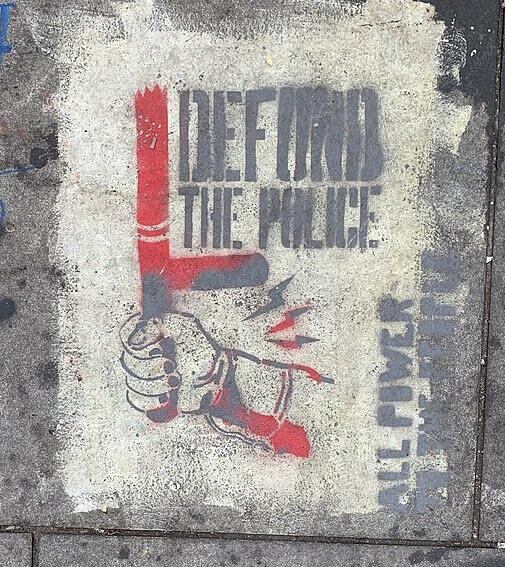
    How’s this for a new low in the annals of “defund the police” lunacy?

    Three Los Angeles police officers are suing the owner of killercop.com, accusing him of publishing their photos on his website and putting out a “bounty” on them.

    It is the first legal action stemming from the Los Angeles Police Department’s release of the names and photos of almost every sworn officer — more than 9,300 officers, including some who work undercover — as part of a public records request. A police watchdog group posted the images online last Friday.

    Here is what the Los Angeles Times meant when it put those sarcastic quote marks on the word “bounty”:

    In a tweet mentioned in the lawsuit, Steven Sutcliffe, who posts under the handle @KillerCop1984, allegedly wrote, “Remember, #Rewards are double all year for #detectives and #female cops.” The tweet included an image of a monetary reward for killing an LAPD officer, the lawsuit says.

    According to the suit, a later tweet allegedly included a link to a database of officer photos, along with the caption, “Clean head-shots on these #LAPD officers. A to Z.”

    That sounds like a bounty to me, but of course, the Los Angeles Times thinks differently. Would they use the word “bounty” in quote marks if the target were Los Angeles Times reporters?

    The radical left-wing lunatic who did this has protested that his grotesque doxxings, threats, and bounties — intensified against women, no less, suggesting some impressive women-hate in those quarters — was all a matter of free speech, all a matter of his protected First Amendment rights.

    Sorry, pal, issuing threats and bounties is not protected speech. It appears a judge thought otherwise, as the killercops.com website is now down and hopefully gagged forever.

    The whole specter is repulsive, given that cops must deal with the dregs of humanity on a continuous basis as well as the snipings of left wing anti-police activists and all of them would like to know where the last cop who arrested them and sent them to the can lives. The criminals would love to collect bounties, of course, too, making one wonder just how many of those corporate Black Lives Matter millions went to groups like this one to pay bounties.

    Many of the criminals in Los Angeles are affiliated with Mexico’s cartels or actually in the cartels or other organized crime groups and would love to copy that database. I have friends in the Los Angeles Police Department who have told me they have run into actual cartel members while on the beat in places like Compton and Sun City, saying the air is almost literally different around these dangerous people, like the smell of death around them. Cartels are smart enough and evil enough to maintain an interest in all the names, faces, badge numbers, station postings and other personal identifying information of LAPD officers such as were posted by this malevolent freak.

    So the implications of this story, which involved the publishing of the names of dozens if not hundreds of undercover officers or even just beat cops, are incredible. It magnifies the danger these police officers protecting the public are in, as well as the danger to their families, and will likely result in cops retiring at their desks, or cops acting a lot more jumpy in dangerous situations.

    Perhaps the bigger issue is who the hell released all of that information “by mistake” based on a public records request, including the names and faces of the undercover officers. To say it was a “mistake” is frankly hard to believe given the reluctance of government agencies to release any information including the information they are required to release. Someone needs to get fired immediately on that one, and probably investigated for other leaks, as well as prosecuted for violations. The LAPD says it is “investigating.”

    It actually sounds like the LAPD, which is loaded with wokester leadership — recall that they banned the “Blue Lives Matter” flag in Los Angeles police stations after just one complaint from a defund-the-police fanatic — might just be infiltrated at some administrative levels by defund-the-police activists. Someone gets hired with access to sensitive police records, he releases those records to his political allies on the pretext of a public records request, and next thing you know, every last police officer is exposed to significant danger from the world’s foulest criminals.

    It shows that the defund-the-police movement isn’t really just about defunding the police, it’s about killing the police. The goal is to get rid of the police, and now we are seeing on full display the leftist slogan: “by any means necessary.”

    If this doesn’t result in some arrests, there aren’t going to be any police officers protecting Los Angeles. This needs to end in some arrests. Quickly.

    Tyler Durden
    Sun, 03/26/2023 – 10:30

    via ZeroHedge News https://ift.tt/Xt4yhY2 Tyler Durden

    Buy/Rent Premium Highest Since 2006 Housing Bubble Peak

    Buy/Rent Premium Highest Since 2006 Housing Bubble Peak

    The math is truly daunting for would-be homebuyers: The difference between the mortgage payments and rents is the largest it’s been since the 2006 housing bubble that led to the Great Recession. 

    Factoring in an assumed 10% down payment on newly purchased home, the National Multifamily Housing Council says a 30-year fixed-rate mortgage payment costs a whopping $1,176 more than renting an apartment, as of the end of 2022.   

    Rapid home price appreciation in recent years coupled with rising interest rates has caused the monthly cost of homeownership to rise far more than both the cost of rent and other consumer goods,” said the National Multifamily Housing Council, a trade group for the apartment industry.

    The cost of owning a home has soared 71% in three years — an average of about 20% per year, compared to an average annual rent increase of 6.3%.

    This week — in the wake of banking collapses that have pushed benchmark Treasury rates lower — mortgage rates fell for the second consecutive week, with the average 30-year fixed mortgage falling 18 basis points to 6.42%

    Higher rates have thrown cold water on home sales, to the extent they fell 12 consecutive months before February’s stunning 14.5% month-over-month surge  in existing home sales.

    “If mortgage rates continue to slide over the next few weeks, look for a continued rebound during the first weeks of the spring homebuying season,” said Freddie Mac chief economist Sam Khater. 

    February new-home sales rose 1.1%, to the best pace since August. Meanwhile, February’s median sales price of a new home was $438,200, according to a report from the Census Bureau and the Department of Housing and Urban Development. That’s up 2.5% from the previous February.  

    “Home shoppers are looking to find the optimal combination of prices and mortgage rates before entering the market,” Hannah Jones, economic analyst at Realtor.com, told Bloomberg. “However, elevated rates and high prices mean that point doesn’t yet exist in the market for many would-be buyers.”

    While the cost of homeownership remains stubbornly high, rent inflation has been on a steady nine-month cooling trend, with the yearly growth rate easing to the lowest point since 2021. 

    Tyler Durden
    Sun, 03/26/2023 – 09:55

    via ZeroHedge News https://ift.tt/rnSTIXZ Tyler Durden

    EU Ban On Russian Fuel Leads To Diesel Glut In Asia

    EU Ban On Russian Fuel Leads To Diesel Glut In Asia

    Authored by Tsvetana Paraskova via OilPrice.com,

    • The EU’s ban on imports of Russian oil products resulted in Russia diverting its petroleum products to North Africa and Asia.

    • Asian refineries now have to compete with Russia for diesel sales, with weekly gasoil inventories at the Singapore hub hitting the highest level in more than a year last week.

    • The diesel glut in Asia is not expected to last for more than a few months, although recessionary concerns may weigh on demand.

    Gasoil stocks held in Asia have jumped since the EU’s ban on imports of Russian diesel came into effect on February 5 as Asian refiners now have to compete with Russia for diesel sales in Africa, traders and analysts have told Reuters.

    Ahead of the EU ban on Russian petroleum products, Russia began to divert its oil product cargoes to North Africa and Asia. At the same time, Europe has started to buy more diesel and other fuels from the Middle East, Asia, and North America to replace the lost Russian barrels.

    Weekly gasoil inventories at the Singapore hub last week hit the highest level in more than a year, according to Reuters estimates, as Russia is now selling more diesel to Africa, replacing supply from the east of Suez.

    The diesel glut in Asia is not expected to last for more than a few months, as demand in the second half of the year is set for a surge, analysts say.

    Russia is said to be accelerating its exports of diesel to Saudi Arabia by both direct shipments and ship-to-ship transfers, Reuters reported earlier this month, quoting trade sources and shipping data from Refinitiv.

    Using STS loadings, Russia is shortening the routes for tankers headed to Africa and Asia after Moscow is now banned from exporting fuels to the EU.

    At the same time, Europe is ramping up imports of diesel from the Middle East and Asia to offset the loss of Russian barrels, of which it imported around 600,000 barrels per day (bpd) before the February 5 embargo took effect.

    So far in March, Russian diesel loadings are up by 400,000 bpd compared to February, to “an extraordinarily high” of 1.5 million bpd so far this month, Jay Maroo, Lead Crude Analyst at Vortexa, said in an analysis this week. 

    “At least for the near term supplies look ample and demand could be threatened, especially in the case of diesel, by wider recessionary concerns,” Maroo noted.

    Tyler Durden
    Sun, 03/26/2023 – 09:20

    via ZeroHedge News https://ift.tt/9IscEZM Tyler Durden

    US Tensions With Iran Reignite As Dollar’s Petro-Currency Status Under Threat

    US Tensions With Iran Reignite As Dollar’s Petro-Currency Status Under Threat

    Only two weeks after Saudi Arabia announced an effort to establish diplomatic ties to Iran in a deal mediated by China, more news surfaced that Saudi Arabia was also planning to reopen its embassy in Syria for the first time in over a decade.  Rumors are swirling that Iran, Saudi Arabia and Syria are on the verge of geopolitical and economic agreements that sidestep the US.  It is perhaps not surprising that just as these deals are being announced, there has been a sudden resurgence of fighting between US forces in Syria and Iran supported insurgent groups in the eastern region of the country.

    Joe Biden addressed the issue in a short statement, asserting that his administration is ‘not seeking conflict with Iran’, but that the US government would act to protect its personnel deployed in Syria.  The comments were a response to an apparent drone strike on a US military instillation in Syria which killed at least one American contractor and injured several others.  Biden has authorized airstrikes against Iran backed forces in Syria as retaliation, though, it should be noted that no evidence has yet been presented of Iranian involvement.

    The eruption of direct conflict has the potential to escalate tensions with the Syrian government and Iran, and the timing of the event is highly suspicious.  

    In January of this year at the annual Davos conference run by the WEF, Saudi Arabia announced it was now open to trading oil for Chinese Yuan instead of US dollars (long valued as the global petro-currency).  The economic shift, if Saudi Arabia follows through, could change the very fabric of the global economic landscape as the dollar loses petro-status and even world reserve status.  

    China has been aggressively pursuing stronger economic ties to oil producing nations and the CCP announced its intention to turn the Yuan into a global petro-currency in December of 2022.  Another important factor is Russia’s alliance with Syria’s government under Bashar al-Assad and their naval base in Tartus, which they have been expanding since 2021

    Why is the US military still in Syria?  It’s hard to say.  No US president since Barack Obama has offered a rational explanation.  Syria continues to act as a remnant of establishment war-hawk policies from the Bush era, with Obama, Biden and Hillary Clinton using the conflicts in Iraq and Afghanistan as a jumping-off point for their covert Arab Spring operations, including the Pentagon funding and training of groups that would later become ISIS terrorist factions.  

    In theory, Syria stands as a possible powder keg for wider regional wars that certainly serves the interests of establishment globalists if their goal is geopolitical chaos.  The confluence of eastern interests is bound to clash with the US military occupation eventually.  Furthermore, the growing threat of international economic warfare and even a currency war over smaller conflagrations like Ukraine is not being addressed. 

    Did Iran-backed militants really attack US forces in Syria?  Or, is the flare up in tensions with Iran merely designed to throw a monkey wrench into diplomatic negotiations between Saudi Arabia, Iran, Syria and China?  Or, is Biden leading America towards an economic conflict that will eventually destroy the dollar? 

    If the third scenario is the case, who ultimately benefits?

    Tyler Durden
    Sun, 03/26/2023 – 08:45

    via ZeroHedge News https://ift.tt/ESV5iYK Tyler Durden