Which Countries Hold The Most US Debt?

Which Countries Hold The Most US Debt?

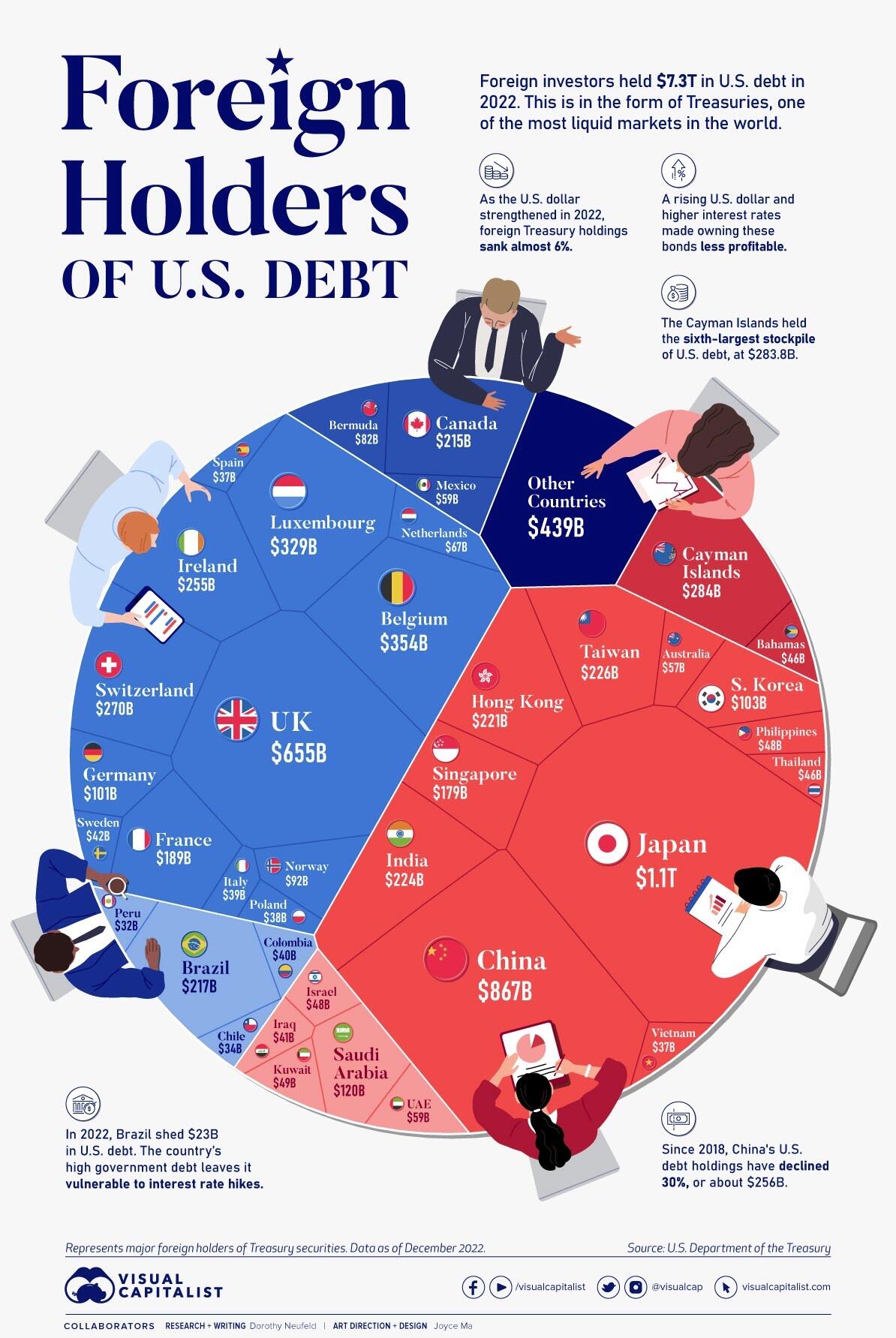
Today, America owes foreign investors of its national debt $7.3 trillion.

These are in the form of Treasury securities, some of the most liquid assets worldwide. Central banks use them for foreign exchange reserves and private investors flock to them during flights to safety thanks to their perceived low default risk.

Beyond these reasons, foreign investors may buy Treasuries as a store of value. They are often used as collateral during certain international trade transactions, or countries can use them to help manage exchange rate policy. For example, countries may buy Treasuries to protect their currency’s exchange rate from speculation.

In the graphic below, Visual Capitalist’s Dorothy Neufeld and Joyce Ma show the foreign holders of the U.S. national debt using data from the U.S. Department of the Treasury.

Top Foreign Holders of U.S. Debt

With $1.1 trillion in Treasury holdings, Japan is the largest foreign holder of U.S. debt.

Japan surpassed China as the top holder in 2019 as China shed over $250 billion, or 30% of its holdings in four years.

This bond offloading by China is the one way the country can manage the yuan’s exchange rate. This is because if it sells dollars, it can buy the yuan when the currency falls. At the same time, China doesn’t solely use the dollar to manage its currency—it now uses a basket of currencies.

Here are the countries that hold the most U.S. debt:

Rank Country U.S. Treasury Holdings Share of Total
1 🇯🇵 Japan $1,076B 14.7%
2 🇨🇳 China $867B 11.9%
3 🇬🇧 United Kingdom $655B 8.9%
4 🇧🇪 Belgium $354B 4.8%
5 🇱🇺 Luxembourg $329B 4.5%
6 🇰🇾 Cayman Islands $284B 3.9%
7 🇨🇭 Switzerland $270B 3.7%
8 🇮🇪 Ireland $255B 3.5%
9 🇹🇼 Taiwan $226B 3.1%
10 🇮🇳 India $224B 3.1%
11 🇭🇰 Hong Kong $221B 3.0%
12 🇧🇷 Brazil $217B 3.0%
13 🇨🇦 Canada $215B 2.9%
14 🇫🇷 France $189B 2.6%
15 🇸🇬 Singapore $179B 2.4%
16 🇸🇦 Saudi Arabia $120B 1.6%
17 🇰🇷 South Korea $103B 1.4%
18 🇩🇪 Germany $101B 1.4%
19 🇳🇴 Norway $92B 1.3%
20 🇧🇲 Bermuda $82B 1.1%
21 🇳🇱 Netherlands $67B 0.9%
22 🇲🇽 Mexico $59B 0.8%
23 🇦🇪 UAE $59B 0.8%
24 🇦🇺 Australia $57B 0.8%
25 🇰🇼 Kuwait $49B 0.7%
26 🇵🇭 Philippines $48B 0.7%
27 🇮🇱 Israel $48B 0.7%
28 🇧🇸 Bahamas $46B 0.6%
29 🇹🇭 Thailand $46B 0.6%
30 🇸🇪 Sweden $42B 0.6%
31 🇮🇶 Iraq $41B 0.6%
32 🇨🇴 Colombia $40B 0.5%
33 🇮🇹 Italy $39B 0.5%
34 🇵🇱 Poland $38B 0.5%
35 🇪🇸 Spain $37B 0.5%
36 🇻🇳 Vietnam $37B 0.5%
37 🇨🇱 Chile $34B 0.5%
38 🇵🇪 Peru $32B 0.4%
  All Other $439B 6.0%

As the above table shows, the United Kingdom is the third highest holder, at over $655 billion in Treasuries. Across Europe, 13 countries are notable holders of these securities, the highest in any region, followed by Asia-Pacific at 11 different holders.

A handful of small nations own a surprising amount of U.S. debt. With a population of 70,000, the Cayman Islands own a towering amount of Treasury bonds to the tune of $284 billion. There are more hedge funds domiciled in the Cayman Islands per capita than any other nation worldwide.

In fact, the four smallest nations in the visualization above—Cayman Islands, Bermuda, Bahamas, and Luxembourg—have a combined population of just 1.2 million people, but own a staggering $741 billion in Treasuries.

Interest Rates and Treasury Market Dynamics

Over 2022, foreign demand for Treasuries sank 6% as higher interest rates and a strong U.S. dollar made owning these bonds less profitable.

This is because rising interest rates on U.S. debt makes the present value of their future income payments lower. Meanwhile, their prices also fall.

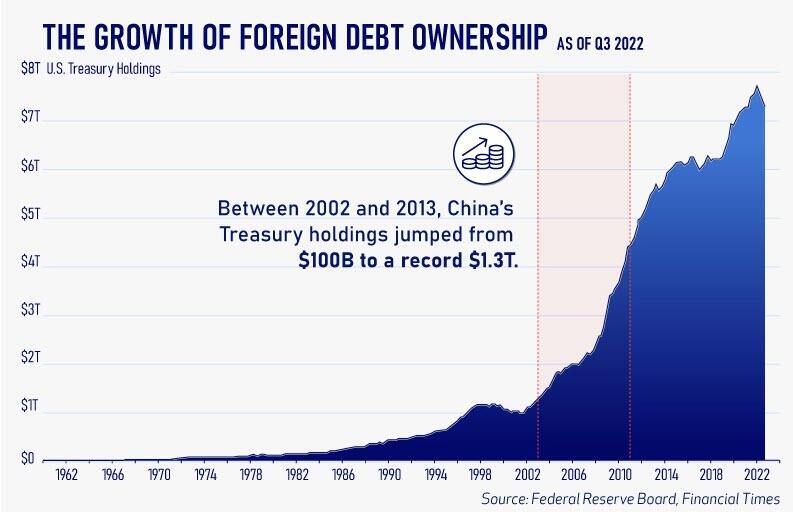
As the chart below shows, this drop in demand is a sharp reversal from 2018-2020, when demand jumped as interest rates hovered at historic lows. A similar trend took place in the decade after the 2008-09 financial crisis when U.S. debt holdings effectively tripled from $2 to $6 trillion.

Driving this trend was China’s rapid purchase of Treasuries, which ballooned from $100 billion in 2002 to a peak of $1.3 trillion in 2013. As the country’s exports and output expanded, it sold yuan and bought dollars to help alleviate exchange rate pressure on its currency.

Fast-forward to today, and global interest-rate uncertainty—which in turn can impact national currency valuations and therefore demand for Treasuries—continues to be a factor impacting the future direction of foreign U.S. debt holdings.

Tyler Durden
Sun, 03/26/2023 – 18:00

via ZeroHedge News https://ift.tt/vuWYaLz Tyler Durden

Panic In Philly As Chemical Spill Sends Residents Scrambling For Bottled Water

Panic In Philly As Chemical Spill Sends Residents Scrambling For Bottled Water

Philadelphia officials warned area residents on Sunday to drink only bottled water “out of caution” following the spill of a latex product along a tributary of the Delaware River.

City of Phila recommends using bottled drinking water from 2PM 3/26/2023 until further notice for all Phila Water Department customers,” reads a text message from city officials which was sent to area residents and reported by CNN. “Contaminants have not been found in the system at this time but this is out of caution due to a spill in the Delaware River.”

 Following the notice, long lines formed at ShopRite, Target and other area stores, with ShopRite limiting customers to three bottles each.

“As has been reported, on Friday night a chemical spill occurred in Bristol Township, Bucks County which released contaminants into the Delaware River,” said Mike Carroll, the city’s deputy managing director for transportation, infrastructure and sustainability. “The Philadelphia Water Department (PWD) became aware of this through the Delaware Valley Early Warning System (EWS) and has been evaluating the situation since that time to understand potential impacts to the public. Although early indications have not revealed contamination, we are still monitoring the situation and conducting testing.”

According to the Philadelphia Water Department’s website, it provides water to over “2 million people in Philadelphia, Montgomery, Delaware, and Bucks counties.”

Tyler Durden
Sun, 03/26/2023 – 17:00

via ZeroHedge News https://ift.tt/GrWuAhE Tyler Durden

New Documents Expose Government Censorship Efforts At Facebook And WhatsApp

New Documents Expose Government Censorship Efforts At Facebook And WhatsApp

Authored by Jonathan Turley,

New emails uncovered in the ongoing Missouri v. Biden litigation reportedly show that the Biden Administration’s censorship efforts extended to Facebook to censor private communications on its WhatsApp messaging service.

In recent months, the Twitter Files revealed an extensive and secret effort by the FBI and other agencies to censor citizens on social media. I testified on that effort. Democratic members oppose efforts to investigate the full scope of this effort and even denounced those calling for greater transparency as “Putin lovers” and apologists for insurrectionists and racists. Yet, the evidence of an extensive censorship and blacklisting effort by the Administration continues to mount.

Facebook (now known as Meta) is accused of working with the government to target citizens with dissenting views on Covid and the pandemic.

According to emails obtained through discoveryBiden’s Director of Digital Strategy Rob Flaherty pressed Facebook executives to be more aggressive with censorship. Flaherty reportedly objected that “I care mostly about what actions and changes you’re making to ensure you’re not making our country’s vaccine hesitancy problem worse…I still don’t have a good, empirical answer on how effective you’ve been at reducing the spread of vaccine-skeptical content and misinformation to vaccine fence sitters.”

Just a few weeks ago, I wrote that the congressionally created, federally funded National Endowment for Democracy (NED) had supported blacklisting efforts at the British-based Global Disinformation Index (GDI). The index was widely ridiculed for targeting ten conservative and libertarian sites as the most dangerous sources of disinformation; it sought to persuade advertisers to withdraw support for those sites, while listing their most liberal counterparts as among the most trustworthy.

At the time, I noted that the Biden administration had played us for chumps. As we celebrated the demise of the infamous Disinformation Governing Board with its “Disinformation Nanny,” the Biden administration never disclosed a larger censorship program.

Shortly after my column posted in The Hill, the NED wrote to me to say that it was discontinuing support for the GDI. 

Microsoft also was forced into retreat after it was shown to be pushing the GDI’s biased blacklist.

Then we learned of additional funding going through the State Department’s Global Engagement Center (GEC).

We also know of backchannel communications with the CDC and other agencies.

It is assumed that the comprehensive effort to censor was not limited to Twitter. This is another indication of such efforts with Facebook. However, the Democratic leadership has opposed such an investigation for years. They have even refused to accept the email evidence. When I testified on the Twitter Files, Rep. Debbie Wasserman Schultz (D-Fla.) criticized me for offering “legal opinions” without actually working at Twitter. As I have noted, it is like saying that a witness should not discuss the contents of the Pentagon Papers unless he worked at the Pentagon. It was particularly bizarre because I was asked about the content of the Twitter Files.  The content — like the content of the Pentagon Papers — are “facts.” The implication of those facts are opinions.

Members like Wasserman Schultz will likely continue to refuse to acknowledge these new emails. However, the public has repeatedly shown in polls that they want transparency on the censorship efforts. The House may be able to guarantee that transparency as its need continues to rise with new evidence of the government’s efforts to silence dissenting views on social media.

Tyler Durden
Sun, 03/26/2023 – 16:30

via ZeroHedge News https://ift.tt/Fhl9QUI Tyler Durden

WTF Headline Of The Day

WTF Headline Of The Day

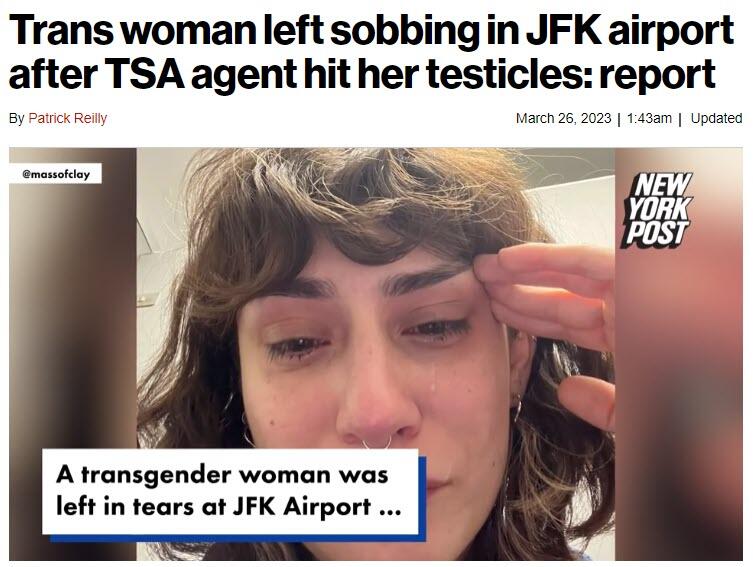
Nobody likes getting punched in the balls… especially if you’re a woman…

Image Source: NYPost

A transgender woman has called for the dismantling of airport TSA screenings after she claimed an agent punched her in the testicles and “yelled at me for having a penis”.

The flyer posted a since-deleted selfie showing her sobbing in a bathroom stall following the episode, complaining that her “balls still hurt so bad”.

“I don’t want the TSA agent that hurt me fired,” she said in a separate post.

“I want her educated and the entirety of TSA abolished altogether.”

The Daily Mail reports that after the accusations were posted to social media, the airport said they were investigating the incident.

“We apologize again for your experience,” it said in response on Twitter.

“Your comments have been noted and shared.”

We here at ZeroHedge stand alongside our trans women friends – no one should have to suffer getting punched in the balls just to get through security at airports.

Tyler Durden
Sun, 03/26/2023 – 16:00

via ZeroHedge News https://ift.tt/iHF2wPQ Tyler Durden

‘Go, Go, Go! Help Them Up! Push Them Up’: New Leaked J6 Footage ‘Shows DC Metro Cop Encouraging People To Go Towards The Capitol’

‘Go, Go, Go! Help Them Up! Push Them Up’: New Leaked J6 Footage ‘Shows DC Metro Cop Encouraging People To Go Towards The Capitol’

Authored by Chris Menahan via Information Liberation,

Newly leaked footage from January 6th shows undercover DC Metropolitan Police officers pushing protesters to move towards the US Capitol and helping them climb the scaffolding outside the Capitol building.

The full video was leaked Saturday on Rumble by an anonymous account named OverwatchJ6:

From The Epoch Times, “Prosecutor Admits DC Police Officers Acted as Provocateurs at US Capitol on Jan. 6”:

A federal prosecutor admitted in court papers that three D.C. Metropolitan Police Department undercover officers acted as provocateurs at the northwest steps of the U.S. Capitol on Jan. 6, 2021.

The admission came in a March 24 filing before U.S. District Judge Rudolph Contreras that seeks to keep video footage shot by the officers under court seal.

Prosecutors accused the case defendant—William Pope of Topeka, Kansas—of an “illegitimate” attempt to unmask the video as part of his alleged strategy to try the case in the news media. Pope filed a motion to remove the court seal on Feb. 21.

“The defendant is not entitled to ‘undesignate’ these videos to share them with unlimited third parties,” said Assistant U.S. Attorney Kelly Moran. “His desire to try his case in the media rather than in a court of law is illegitimate, and the government has met its burden to show the necessity of the protective order.”

The feds worked together with the media to smear everyone involved in this protest for two years straight and bias the already biased DC juries against them but their victims are not allowed to share this footage to defend themselves?

The fact these cases are even being tried in DC is an absolute disgrace. J6 protesters are blatantly being denied their right to a fair trial on top of being held indefinitely in pre-trial detention and tortured in prison.

Videos long hidden under court seal have become a major topic, especially with prosecutors disclosing in a number of high-profile Jan. 6 cases the involvement of multiple FBI informants.

Pope is seeking to lift the court seal on the undercover video as part of his drive to obtain full access to video evidence held by the government. Pope is representing himself in the criminal case being prosecuted against him. At a hearing on March 3, Judge Contreras seemed sympathetic to Pope’s motion to unmask the videos.

“The officer clearly incited that area, and we still don’t have video from all other undercover MPD,” Pope told The Epoch Times. “And as the numerous informants in the Proud Boys trial demonstrates, we are only just beginning to scratch the surface on FBI involvement.”

[…] “This video clearly evidences undercover law enforcement officers urging the crowds to advance up the stairs and scaffolding towards the Capitol on January 6,” Pope wrote in an earlier case filing. “The government may claim that incidents like this did not happen, but the facts show they did.”

Prosecutor Moran acknowledges such in a motion filed on March 24.

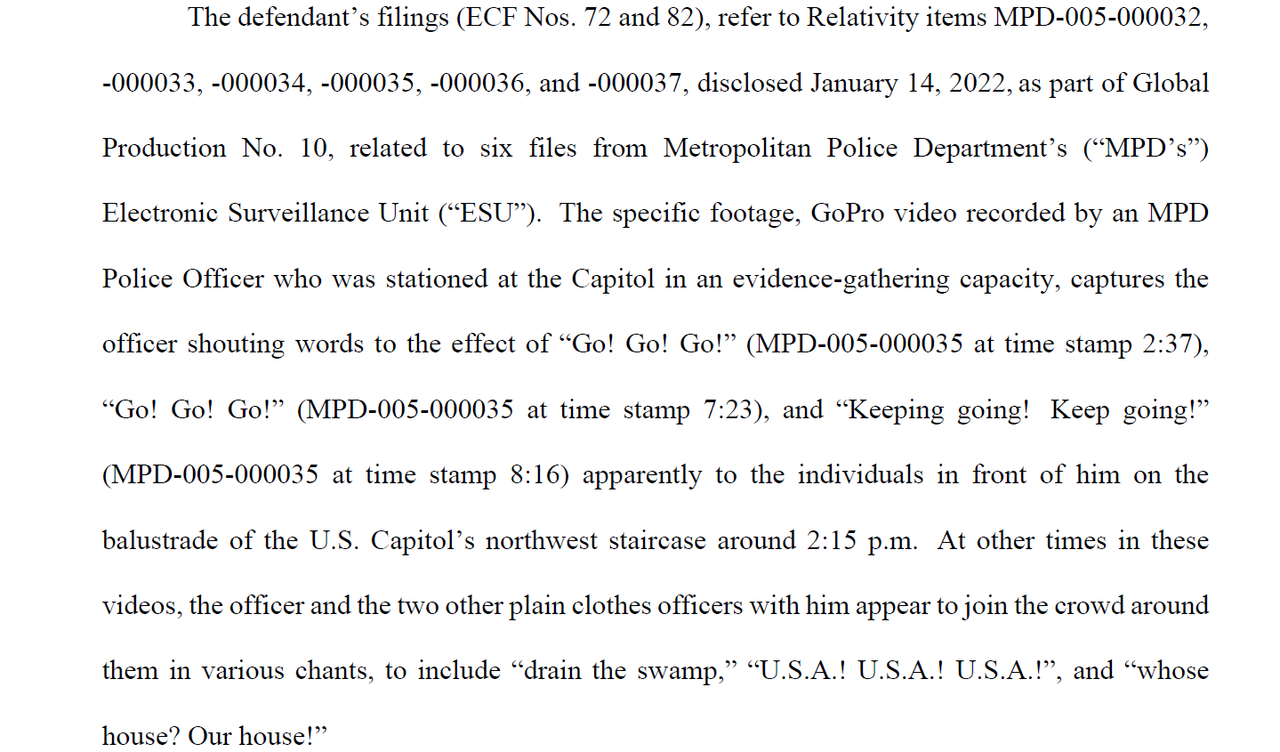
“The specific footage, GoPro video recorded by an MPD police officer who was stationed at the Capitol in an evidence-gathering capacity, captures the officer shouting words to the effect of, “Go! Go! Go!” Moran wrote.

“At other times in these videos, the officer and the two other plainclothes officers with him appear to join the crowd around them in various chants, including “drain the swamp,” “U.S.A.! U.S.A.! U.S.A.!”, and “Whose house? Our house!”

Moran also argued against unsealing large amounts of closed-circuit television (CCTV) security video, which she said could put officers at risk.

“There are very specific and highly worrisome risks associated with the specific videos the defendant seeks to share en masse,” she wrote.

“Given the highly volatile nature of the discourse surrounding these cases, releasing the identities of the officers depicted in these videos—officers the defendant now claims to have instigated the entire attack on the U.S. Capitol—would surely put the lives of those officers at risk.”

Pope told The Epoch Times that he never made such a claim. He has not yet filed a response to the government’s memorandum.

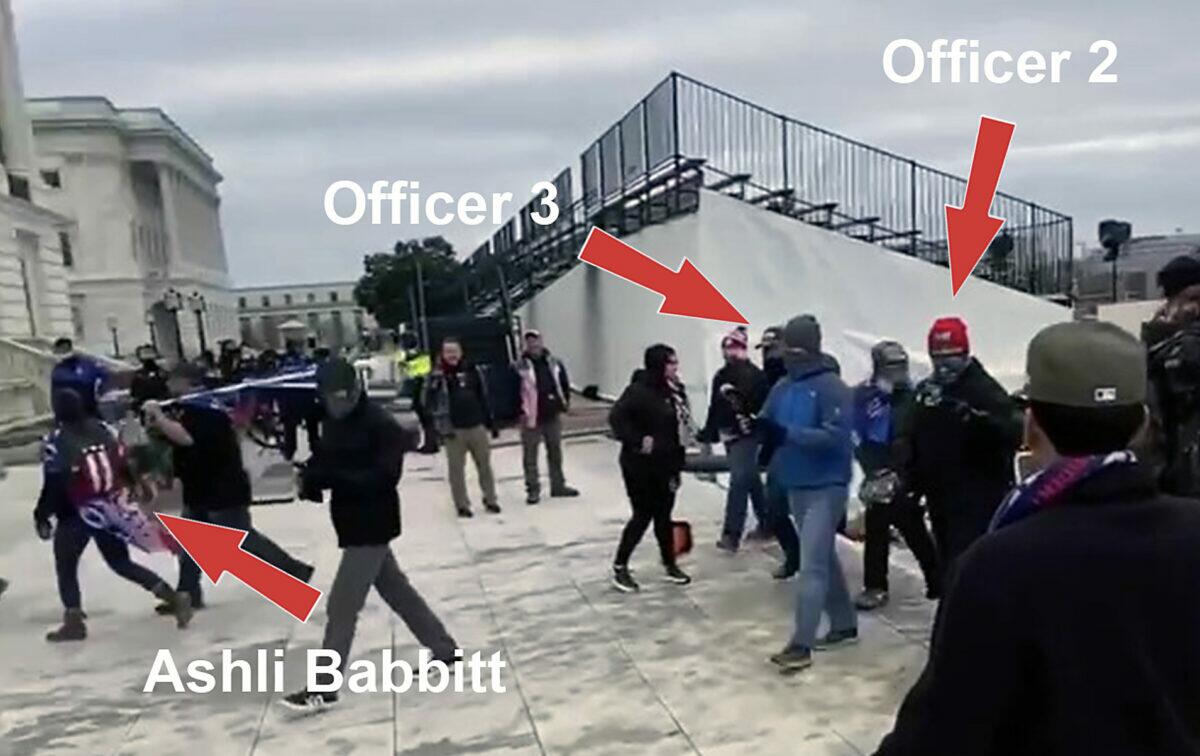
Another video Pope discovered in his research shows Officer 2 and Officer 3 walking behind the late Ashli Babbitt on the northwest steps. About an hour later, Babbitt was shot at the entry of the Speaker’s Lobby by Capitol Police Lt. Michael Byrd. She died a half-hour later.

The only “risk” involved in releasing this footage and more from J6 is the police and feds being caught helping provocateur the event.

House Speaker Kevin McCarthy and Tucker Carlson need to get on with it already and release the 40,000 hours of footage they have to the public.

Follow InformationLiberation on Twitter, Facebook, Gab, Minds and Telegram.

Tyler Durden
Sun, 03/26/2023 – 15:30

via ZeroHedge News https://ift.tt/a7rcHQO Tyler Durden

NYPD Overtime Budget On Pace For Record As Cop Shortage Worsens

NYPD Overtime Budget On Pace For Record As Cop Shortage Worsens

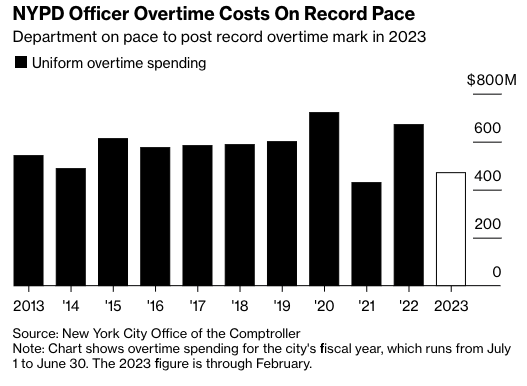
The New York City Police Department is experiencing its biggest officer exodus in twenty years, leading to a shortage of personnel. As a result, officers are now increasing their hours on patrols, causing the overtime budget to swell, on track to hit the highest level in a decade this year, according to Bloomberg

New York City Comptroller Brad Lander published a new report outlining that the NYPD has exceeded its budget by $98 million, spending $472 million on overtime through February. Lander’s office said the department is on track to spend more than $740 million, which would be the highest in a decade. The NYPD’s fiscal year ends on June 30. 

While newly-elected Mayor Eric Adams has pledged to reduce NYPD overtime spending, the department is suffering a severe staffing crisis following the protests and riots of 2020 that were sparked by George Floyd’s death. Then defunding the police movement swept in as progressive lawmakers demanded a reduction in police budgets. 

On top of all of that, left-leaning media outlets demonized officers and led to a further exodus that continues to this day. Data from NYC Police Pension Fund found that 1,955 officers retired in 2022, and another 1,746 quit, indicating a total of 3,701 left the force just last year — the largest exodus since 2002, following the 9/11 attacks. 

So what’s clear is that the soaring overtime budget results from officers working longer hours because of a shortage of personnel. NYPD has lowered its standards for new officers in an attempt to boost numbers on the streets. 

Meanwhile, robberies, burglaries, felony assaults, and grand larceny are surging. How can New Yorkers rest assured that they will be protected as a cop shortage plagues the metro area?

Tyler Durden
Sun, 03/26/2023 – 15:00

via ZeroHedge News https://ift.tt/PeYhy6z Tyler Durden

Mattresses, Social Media, Smart Phones, & Failure Of The Fed

Mattresses, Social Media, Smart Phones, & Failure Of The Fed

Authored by Mike Shedlock via MishTalk.com,

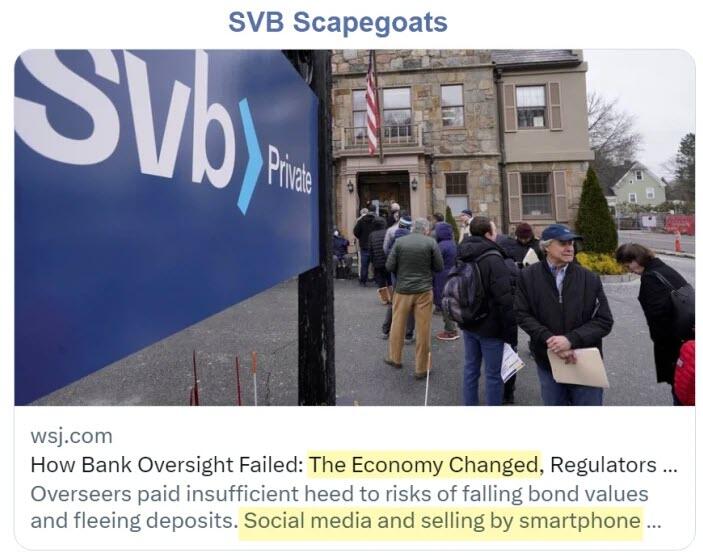
The Fed is looking for scapegoats. It got some assistance from the Wall Street Journal…
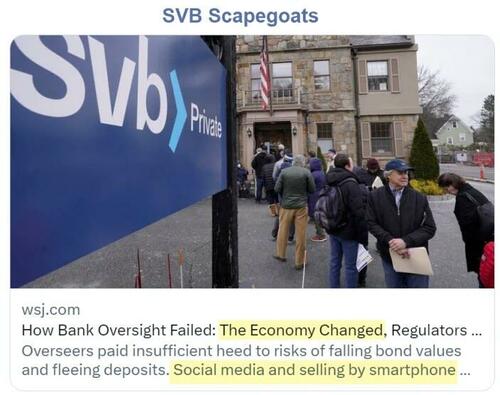
Silicon Valley Bank Scapegoats

Please consider The Economy Changed, Regulators Didn’t

On March 8, Silicon Valley Bank and Signature Bank were both, according to public disclosures, “well capitalized,” the optimal level of health by federal regulatory standards. Days later, both failed. 

“The question we were all asking ourselves over that first week was, ‘How did this happen?’” Federal Reserve Chair Jerome Powell said Wednesday.

Banking regulators will spend months, if not years, getting to the bottom of what happened.

What none of the regulators or bankers anticipated was how fast depositors could flee, which appears to be a new reality in the age of smartphone apps and social media.

“The speed of the run…is very different from what we’ve seen in the past,” Mr. Powell said Wednesday. “And it does kind of suggest that there’s a need for possible regulatory and supervisory changes, just because supervision and regulation need to keep up with what’s happening in the world.”

FDIC officials are discussing how to manage public confidence as social media expands people’s ability to “electronically panic,” a person familiar with the talks said.

“The speed of the run…is very different from what we’ve seen in the past,” Mr. Powell said Wednesday. “And it does kind of suggest that there’s a need for possible regulatory and supervisory changes, just because supervision and regulation need to keep up with what’s happening in the world.”

Scapegoat Nonsense

The idea that the economy changed (it’s always changing), and smart phones and social media are largely responsible for the failure of Silicon Valley Bank is a bunch of scapegoat nonsense.  

OK, social media increased the speed at which SVB failed, but that has nothing to do with the cause of the failure. 

Social media did increase the speed of the failure, but smart phones played no role at all. To initiate a wire from bank A to bank B requires an account at both banks. Whether this was done by computer, a regular land line, or a smart phone makes no difference in speed.    

Banking regulators will spend months, if not years, getting to the bottom of what happened.

What a hoot, yet I have no doubt it’s true.

In Fed Q&A Jerome Powell Wonders “How Did Bank Failures Happen?”

The question we are asking ourselves the first weekend is how did this all happen.”

There is no need for a study. I outlined twelve reasons for the bank failures, none of which had anything to do with smart phones or the changing economy.

Please consider In Fed Q&A Jerome Powell Wonders “How Did Bank Failures Happen?”

How Did This Happen?

  1. The Fed held interest rates too low too long, once again.

  2. The Fed even wanted to make up for lack of prior inflation, initially welcoming the pickup of inflation.

  3. The Fed failed to understand how $9 trillion in QE would fan asset bubbles.

  4. The Fed failed to understand how three rounds of fiscal stimulus, the largest in history, would fan inflation.

  5. The Fed presidents believe in economic models such as inflation expectations that its own studies prove do not work.

  6. When inflation did pick up, the Fed kept insisting that inflation was transitory.

  7. Even when the Fed finally realized inflation was not transitory, it kept QE going until the bitter end, not wanting to disturb prior forward guidance.

  8. The San Francisco Fed, whose job it was to monitor Silicon Valley Bank (SVB) was asleep at the wheel.

  9. The Fed considers treasuries a risk-free asset, ignoring duration risk.

  10. The Fed ignored a record concentration of long-term treasury and mortgage assets at SVB despite understanding the interest rate risk of those assets.

  11. The Fed’s forward guidance has been a disaster. It openly encouraged speculation.

  12. The Fed reduced reserve requirements on deposits to ZERO. 

If you are looking for one item and one item only look at point 12. The reserve requirement on deposits is ZERO

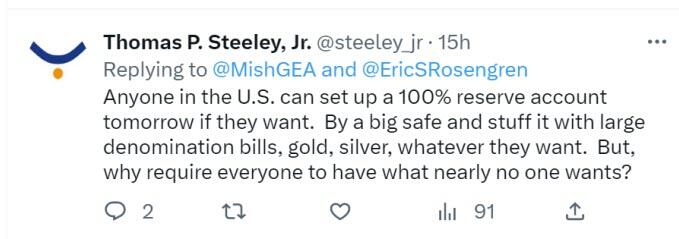
The discussion triggered a bunch of silly responses on Twitter but this one takes the cake for financial illiteracy. 

Mattress Solution
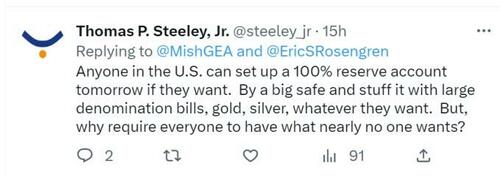
Anyone in the U.S. can set up a 100% reserve account tomorrow if they want. By a big safe and stuff it with large denomination bills, gold, silver, whatever they want. But, why require everyone to have what nearly no one wants?

Wow!

Try making a $1 million payroll out of a safe or a mattress. 

Heck, try paying for anything with $10,000 in cash. You will have a quick knock on the door wondering where you got the money and more than likely it will be confiscated as drug money.

As for “But, why require everyone to have what nearly no one wants,” it seems to me that there was a run on SVB to the tune of hundreds of billions of dollars because there was amazing demand for a safekeeping bank. 

FDIC only covers $250,000. The bank run happened precisely because there was no safekeeping by the bank. 

Not Designed for Speed

Not Designed for Speed

Here’s another hoot from the same article.

The supervisory process has not evolved for rapid decision making. It is focused on consistency over speed. In a fast-moving situation, the system is not as well-designed to force change quickly.”

Again, this has nothing to do with speed. It has everything to do with a zero reserve requirement on deposits plus a Fed that crammed about $9 trillion in deposits down banks throats while ignoring duration mismatch of bank investments of those funds.

We do have consistency, that’s for sure. We have consistency of doubling down on failed policies and not learning from past mistakes.

Fed Policy: It’s Not Fractional Reserve Banking, It’s ZERO Reserve Banking

If you think we have fractional reserve banking, we don’t. We have zero reserve banking.

For further discussion, please see Fed Policy: It’s Not Fractional Reserve Banking, It’s ZERO Reserve Banking

Part of my proposal is admittedly controversial. I propose a 100% gold-backed dollar. But we do not even have a 100% dollar-backed dollar.

All SVB or any bank had to do to maintain 100% liquidity was park deposits at the Fed or in extremely short duration US Treasuries. 

Reader Question

My posts also triggered this question. “Are you proposing that banks stop making loans from their deposits?

The fact of the matter is loans create deposits. And so did QE to the tune of nearly $9 trillion.

Fictional Reserve Lending 

If anyone thinks I am a johnny-come-after-the-fact-lately I have written about the problem many times, at least once in 2009 an again in 2020. 

Please consider my March 2020 article Fictional Reserve Lending Is the New Official Policy

Official policy finally caught up with reality. Reserves are fictional.

With little fanfare or media coverage, the Fed made this Announcement on Reserves: “On March 15, 2020, the Board reduced reserve requirement ratios to zero percent effective March 26, 2020. This action eliminated reserve requirements for all depository institutions.

What’s Changed Regarding Lending?

Essentially, nothing.

The announcement just officially admitted the denominator on reserves is zero.

There are no reserve lending constraints (but practically speaking, there never were).

When Do Banks Make Loans?

  1. They meet capital requirements

  2. They believe they have a creditworthy borrower

  3. Creditworthy borrowers want to borrow

BIS Working Papers No 292 Unconventional Monetary

In 2009, I referred to BIS Working Papers No 292 Unconventional Monetary

The article addresses two fallacies

Proposition #1: an expansion of bank reserves endows banks with additional resources to extend loans

Proposition #2: There is something uniquely inflationary about bank reserves financing

From the BIS

The underlying premise of the first proposition is that bank reserves are needed for banks to make loans. An extreme version of this view is the text-book notion of a stable money multiplier. 

In fact, the level of reserves hardly figures in banks’ lending decisions. The amount of credit outstanding is determined by banks’ willingness to supply loans, based on perceived risk-return trade-offs, and by the demand for those loans

The main exogenous constraint on the expansion of credit is minimum capital requirements.

The central bank has a monopoly over interest rate policy, but not over balance sheet policy. This raises tricky questions about coordination, operational independence and division of responsibilities

Balance sheet policies can have a significant impact on the financial risks absorbed by the central bank. The extent depends on their characteristics and on how much they are relied upon. This, too, raises questions about operational autonomy and credibility, largely reflecting the impact of losses on the financial position of the central bank. 

Read those points over and over until they sink in. I discussed that article in 2009 and again in 2020. 

Three Key Points 

  1. Deposits result from loans and QE policy.

  2. The central bank has a monopoly over interest rate policy, but not over balance sheet policy. The FDIC is supposed to address the latter. And in the case of SVB, the San Francisco Fed was also asleep at the wheel.

  3. Social media, smart phones, and the WSJ notion “The Economy Changed, Regulators Didn’t” are scapegoats to a problem I addressed in 2009. 

What to Expect

Banking regulators will spend months, if not years, getting to the bottom of what happened.

They will conclude the problems are social media, smart phones, and the WSJ notion that the economy changed but regulators failed to keep up. 

*  *  *

Please Subscribe to MishTalk Email Alerts.
Tyler Durden
Sun, 03/26/2023 – 14:30

via ZeroHedge News https://ift.tt/sdCrvbR Tyler Durden

IPO Market Shattered By Banking Crisis

IPO Market Shattered By Banking Crisis

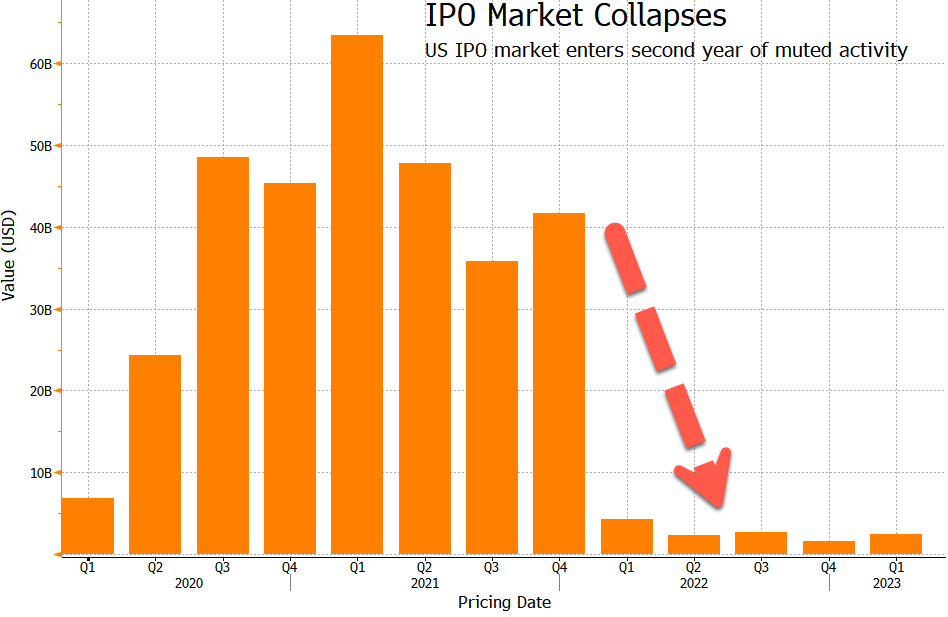
Prior to Silicon Valley Bank’s collapse, US funding markets were already facing difficulties, with startup CEOs concentrating on cutting expenses and protecting their dwindling cash reserves. The downturn in IPOs directly resulted from Fed Chair Powell’s aggressive interest rate hikes. With the added impact of the SVB debacle, the US and global IPO markets have come to a standstill. 

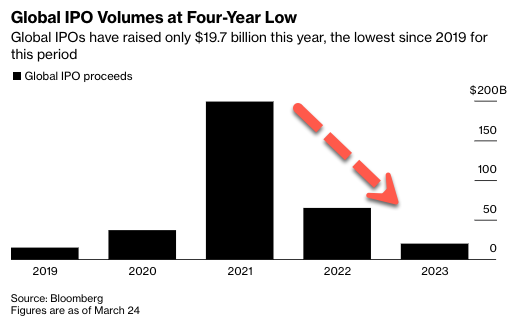
Bloomberg data shows companies worldwide raised a paltry $19.7 billion via IPOs in 2023. That’s down a staggering 70% year-on-year and the lowest comparable amount since 2019. The most significant decline was in the US, where only $3.2 billion has been raised. The subdued activity will likely remain locked in place until easier monetary conditions are seen. 

“Rates is the number one issue, and there is a clear debate around how long the tightening lasts or changes direction and at what speed,” Udhay Furtado, co-head of ECM, Asia Pacific at Citigroup Inc., told Bloomberg. 

“There are a number of things people will need to see, including central bank direction, to ascertain whether it’s the second, third, or fourth quarter,” Furtado said, referring to when IPO deals might restart. 

Last week, we pointed out that funding challenges for startups pose a problem for venture capital funds that paid record-high prices for these companies, as they cannot offload their positions to retail in the secondary market. 

For the last year, readers have been well-informed about the drought in offerings (recall: “IPOs Vanish As Market Mayhem Saps Deal Appetite”). 

Turmoil in the IPO markets is creating massive problems:

“We’ve been stalled for more than a year.

“It caught people off guard because they didn’t expect to not have the ability to IPO in this amount of time,” said Patricia Adams, a partner at Vinson & Elkins LLP. 

On a positive note, secondary offerings have surged $76 billion this year, a 48% increase from a year ago, Bloomberg data show. Companies have also turned to convertible bonds, which allow them to borrow more cheaply, given the securities have a call option. 

Returning to SVB, the bank had been a major player in the venture debt space, offering loans to high-risk, early-stage companies. However, with SVB no longer in the picture, it is widely anticipated that such capital will be scarcer and more costly. We spoke with one Wall Street firm about the changing landscape of funding in the VC space — who said large investment banks, such as Goldman, are now stepping in to fill the gap left by SVB, providing funding lines to cash-strapped startups at deep valuation discounts. 

Tyler Durden
Sun, 03/26/2023 – 14:00

via ZeroHedge News https://ift.tt/1WKlHTi Tyler Durden

Democracy Died in Darkness in Harvard Trial Sidebars

Recently, there was much consternation about Judge Kacsmaryk’s decision to delay posting notice of a hearing. Indeed, a coalition of media organizations actually argued that this decision could violate the First Amendment! Ultimately, the proceeding went as planned, with no disruptions or incidents. There were protests outside. And the event was widely covered by the press. Thankfully, democracy did not die in the darkness.

Throughout this entire process, I chuckled. People who had zero experience with federal district court litigation suddenly became experts. In reality, trial judges have vast discretion over their dockets and courtrooms. In any normal case, this sort of request would never have raised an eyebrow. And the information would have never leaked to the press. But, with the abortion ad-hoc nullification machine at maximum power, all the usual rules are ignored.

If you’d like some evidence of how much power judges have to keep their proceedings secret, consider the sidebar conference. Generally, everything a judge says is in open court. But the judge can ask the parties to “approach” the bench, at which point the judge and attorneys can have a private conversation that the witness, jury, and other parties cannot hear. Some courts have noice-cancelling devices that make it impossible to even hear anything. (The district court that I clerked in did not have that technology, and was very small, so the parties were asked to speak low, but not too low so that the court reporter could not hear them.) Generally, the court reporter transcribes these proceedings. But sidebars may be redacted from the public transcripts.

A particularly egregious exercise of sidebar-redaction came during the Harvard affirmative action trial in Boston federal district court. Jannie Suk Gersen, a professor at Harvard, writes about what happened in Judge Allison Burroughs courtroom. During the trial, the judge held lengthy sidebar discussions with counsel, and declined to release those matters in the public transcript. Indeed, those sidebars were not initially included in the record that was transmitted to the United States Supreme Court!

The secrecy would continue. Gersen filed a letter with the court, asking to unseal the sidebars. Judge Burroughs held two hearings about which sidebars to unseal. And the public was barred from those hearings! Only Suk and the other attorneys could attend. Lawyers for Harvard objected to release the information, even as the case was pending before the Supreme Court! Why?

… Harvard argued vigorously against unsealing certain sidebars, reminding the judge that concern about “the press gallery” was the reason she had sealed some discussions in the first place and maintaining that she should keep them sealed “because of the increased or the continuing public attention on this case.”

Imagine that. A district court limiting some access to the public in light of “continuing public attention.”

Apparently, the Supreme Court became concerned by the incomplete record, and asked for the sealed proceedings. Recently, the District Court sent the Supreme Court a “password protected and encrypted” thumb drive containing sealed materials. And what was Judge Burroughs trying to keep secret? A crass joke about Asian-American college applicants.

Thomas Hibino worked at the Boston location of the Department of Education, Office of Civil Rights. William Fitzsimmons is the Harvard Dean of Admissions. In 2012, Hibino emailed Fitzsimmons an attached memo:

On November 30, 2012, amid a friendly back-and-forth about lunch plans, Hibino e-mailed Fitzsimmons an attachment that he described as “really hilarious if I do say so myself!” Hibino explained, “I did it for the amusement of our team, and of course, you guys”—presumably Harvard admissions officers—”are the only others who can appreciate the humor.” The joke memo had been written on Harvard admissions-office stationery, during the earlier investigation. It was purportedly from an associate director of admissions and parodied the admissions officer downplaying an Asian American applicant’s achievements. The memo denigrated “José,” who was “the sole support of his family of 14 since his father, a Filipino farm worker, got run over by a tractor,” saying, “It can’t be that difficult on his part-time job as a senior cancer researcher.” It continued, “While he was California’s Class AAA Player of the Year,” with an offer from the Rams, “we just don’t need a 132 pound defensive lineman,” apparently referring to a slight Asian male physique. “I have to discount the Nobel Peace Prize he received. . . . After all, they gave one to Martin Luther King, too. No doubt just another example of giving preference to minorities.” The memo dismissed the fictional applicant as “just another AA CJer.” That was Harvard admissions shorthand for an Asian American applicant who intends to study biology and become a doctor, according to the trial transcript.

Fitzsimmons e-mailed Hibino back, “I’m stunned!” Fitzsimmons apparently believed that the admissions officer whose name was on the Harvard stationery had actually authored the memo. She “passed away a few years ago and I’d forgotten that she had such a sense of humor,” he wrote. “We’ll ‘de-construct’ at lunch. Where should we go?” Hibino wrote to clarify, “No, no! I did that from purloined stationery from your shop! Pretty convincing, huh?!!!!! I forget—are we getting together here or there?” (Through Harvard’s press office, Fitzsimmons declined to comment, and calls and messages to Hibino were not returned.)

It seems the Office of Civil Rights stole stationary from Harvard, which they used to put together this awful memo. The Dean of Admissions thought the memo was funny. Justice Kagan recently mused that maybe she has no sense of humor. Maybe I don’t have a sense of humor either. I’m not laughing.

And it also isn’t funny that the judge tried to keep this information out of the record:

The sidebars about the memo show that S.F.F.A. wanted to question Fitzsimmons, during his courtroom testimony, about his reaction to the memo’s “stereotypical comments about Asian Americans.” S.F.F.A. argued that the dean of admissions was “laughing along” with a joke including Asian stereotypes. Harvard objected that the memo and Fitzsimmons’s reaction should be excluded as “irrelevant,” because it was “so tangentially related to anybody’s credibility” or to a claim of Harvard’s “discriminatory animus” against Asian Americans. Furthermore, Harvard claimed that the move to introduce this evidence was “calculated to be handed to the press” and “intended to embarrass Dean Fitzsimmons.”

This information would seem to at least be relevant to the Supreme Court’s consideration. But the trial judge, apparently, thought it better to keep this matter out of the record. Gersen continues:

Judge Burroughs did not think that it was fair to assume that Fitzsimmons found the stereotypes in the memo funny, and she didn’t want what she saw as his “wholly ambiguous” comment to be public. “It has the potential to be explosively prejudicial, not to me because I take it for what it is, but in terms of the external world’s response to this,” she said. “At some point, I feel for the guy,” she added, asserting that asking him about the memo on the stand would be “designed for media consumption and not for any great search for the truth.” She ruled the memo and e-mails not relevant, and excluded them; if there were a jury, it would not have heard about them. And because she also sealed the sidebars, the press and the public knew nothing of them, either. . . .

But we also know that Judge Burroughs thought that the material could “explosively” affect how the public saw the facts. So, her decision was not just to exclude the evidence but also to seal it and attempt, even long after the trial ended, to prevent the public from knowing about a federal official’s allegedly anti-Asian remarks. An attorney familiar with the case told me, “Judge Burroughs mistakenly conflated admissibility under the rules with her own decision, as the fact finder, that this evidence would have no weight with her. And then, because it would have no weight, it would be sealed to prevent embarrassment to Harvard witnesses.”

Are judges allowed to make decisions based on concerns about media consumption?Back to Judge Kacsmaryk. He delayed posting the announcement of a hearing till the evening before. The public still would have been able to attend, and the press could have schlepped from Dallas. It would have been harder to bus in protestors. And there was not enough time to dry-clean their Gileadian bonnets. But Kacsmaryk’s position was a reasonable attempt to deal with an unknown security situation.

The post Democracy Died in Darkness in <i>Harvard</i> Trial Sidebars appeared first on Reason.com.

from Latest https://ift.tt/Ib7jnG0
via IFTTT

David Stockman On The Status Of The Everything Bubble Created By The Fed

David Stockman On The Status Of The Everything Bubble Created By The Fed

Authored by David Stockman via InternationalMan.com,

The Wall Street Journal recently brought word that a professor Efraim Benmelech of the finance department at Northwestern University thinks the Fed is hurting housing and the consumer too much.

Opined he,

….those higher interest rates are making mortgages more expensive and leading to fewer home sales. That leads to less spending on appliances, paint and other home goods, because people commonly buy those items ahead of a sale and after moving.

“The actions of the Fed are leading to lower consumption,” he said.

You don’t say!

Then again, has it occurred to the good professor that the years and years of ultra low mortgage rates engineered by the Fed were totally unnatural, uneconomic and not sustainable?

The evidence for that is in the chart below. It shows that for most of the last three decades, the Fed drove the after-inflation or “real” interest rate on 30-year mortgages steadily lower until it actually turned negative.

Inflation-Adjusted Interest Rate on 30-Year Fixed Rate Mortgages, 1990 to 2023

Stated differently, the unfolding recession is a long overdue and necessary purge of artificial economic activity stimulated and subsidized by the central bank’s own financial repression policies.

The Fed’s belated attempt to “normalize” interest rates, therefore, is not a mean-spirited policy to deliberately cause labor, manufacturing capacity and other economic resources to be idled. To the contrary, it’s a belated attempt to unshackle markets from the excesses, bubbles, malinvestments, inefficiencies and unsustainabilities that were the inherent results of decades of reckless money-printing.

One of the many bubbles created by the Fed’s relentless monetary expansion of recent years might be termed the “labor bubble”. By that we are referring to the madcap hiring undertaken by corporate HR departments in the aftermath of the Covid Lockdown disruption.

As it happened, they failed to meet staffing needs in the early days of the re-opening in 2021 owing to the fact that millions of workers had left the active labor force thanks to massive stimmies, early retirements and other welfare state inducements, along with mom and dad’s basements and checkbooks. So HR departments plunged into hiring “just in case” the re-opening boom of 2021 and early 2022 continued. In effect, they began to hoard labor.

Spotify CEO Daniel Ek admitted as much in a recent missive to employees announcing a 6% cut in the company’s workforce:

“In hindsight, I was too ambitious in investing ahead of our revenue growth. And for this reason, today, we are reducing our employee base by about 6% across the company. I take full accountability for the moves that got us here today,” the exec said.

Of course, the re-opening and stimmy boom didn’t last—notwithstanding the Fed’s massive money-pumping and monetization of the public debt issued to finance the $6 trillion of Covid bailouts.

Since the spring of 2021 when the stimmies peaked, the US economy has actually been slouching toward idle. In fact, once you strain out of the GDP numbers the one-time inventory rebuilding, which was necessitated by the drastic depletion of merchandise stocks triggered by the stimmy based consumer spend-a-thons, there is hardly any organic growth left.

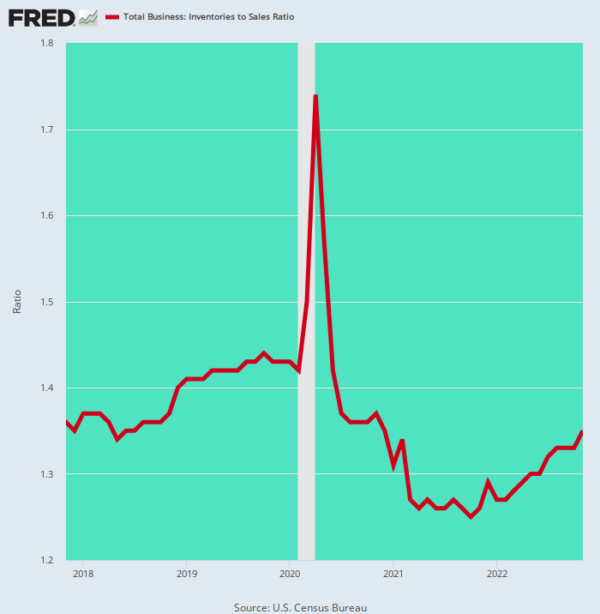
As shown in the chart below, the combination of Dr. Fauci’s Virus Patrol and the Washington spenders did a real number on the business economy. First, the normal business inventory-to-sales ratio exploded to the upside during the initial lockdowns and spending collapse, and then plunged to unprecedented lows as the stimmy-fueled boom in Amazon orders drained the system of its working inventories.

Whipsaw of Business Inventory-to-Sales Ratio, 2018 to 2022

Since reaching bottom in October 2021 inventories have been rebuilt to nearly normal levels, but that’s just the problem. The GDP gain reflected in the inventory rebuild is just a case of “one and done”. In fact, with the interest cost of carrying inventories now rising rapidly it is likely that the business sector restocking is over.

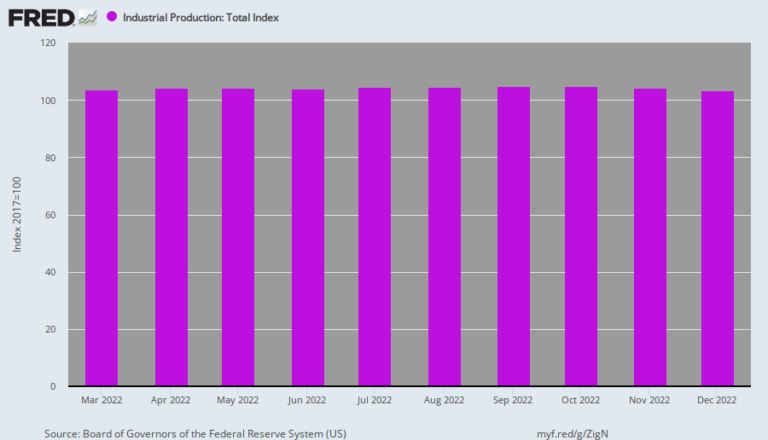
As we indicated, once you peel back the effect of inventory restocking, the stagnation of the US economy is starkly apparent. For instance, in the case of the industrial production index, which covers all of manufacturing, energy, mining and utility output, the level in March 2022 stood at 103.5.

As it happened, the index posted at a nearly identical 103.4 in December. Call it nine months of “growth” to nowhere!

Industrial Production Index, March to December 2022

Needless to say, none of this madness would have happened without the enabling hand of the Federal Reserve.

*  *  *

The truth is, we’re on the cusp of an economic crisis that could eclipse anything we’ve seen before. And most people won’t be prepared for what’s coming. That’s exactly why bestselling author Doug Casey and his team just released a free report with all the details on how to survive an economic collapse. Click here to download the PDF now.

Tyler Durden
Sun, 03/26/2023 – 13:30

via ZeroHedge News https://ift.tt/mFrsdiK Tyler Durden