Eurasian Integration Including Iran Proceeds Despite US “Maximum Pressure” Campaign

Eurasian Integration Including Iran Proceeds Despite US “Maximum Pressure” Campaign

Authored by Conor Gallagher via NakedCapitalism.com,

The Riyadh – Tehran detente deal could be a major win for not only the Middle East but also larger projects seeking more integration of greater Eurasia.  If the deal is implemented, China’s Belt and Road Initiative could become a key component of the economic futures of both Saudi Arabia and Iran. The rapprochement could also pay dividends for the International North-South Transport Corridor (INSTC) project, which  runs from St. Petersburg to Mumbai in India via Azerbaijan (or the Caspian Sea) and Iran and across the Arabian Sea. The “sanction-proof” corridor connects the Indian subcontinent with Russia without needing to go through Europe while simultaneously being 30 percent cheaper and 40 percent shorter than the existing routes.

Following the announcement of the Saudi Arabia – Iran rapprochement deal brokered by China, the chairman of the Russian State Duma Committee on International Affairs Leonid Slutsky praised the deal and explained how it corresponds with Russia’s collective security concept for the Persian Gulf region. He paid particular attention to the INSTC, saying:

In this regard, I view the International North-South Transport Corridor project, which will become the key factor for positive feedback for security, stability and development in this most important region, as a strategic one. The launch of the Corridor will become a milestone event not only in logistics, but also in politics and in security architecture of the Greater Eurasia, it will become the most important economic superstructure atop the strategic basis, achieved in Beijing.

The INSTC was announced back in the early 2000s, but progress was slow until recently when the West’s actions put it into overdrive. The sanctioning of Moscow and Tehran and the severing of Europe from Russian energy created the incentive to accelerate investments by key stakeholders. The authorities in Tehran realize their centrality on the India-Russia trade route, and considering that India’s imports from Russia quadrupled last year, one can deduct the potential upside for Iran. With an investment boost from Russia, Tehran has been trying to speed up the completion of improved railway networks that will connect to the existing railways of Russia and Azerbaijan and Chabahar Port in southeastern Iran.
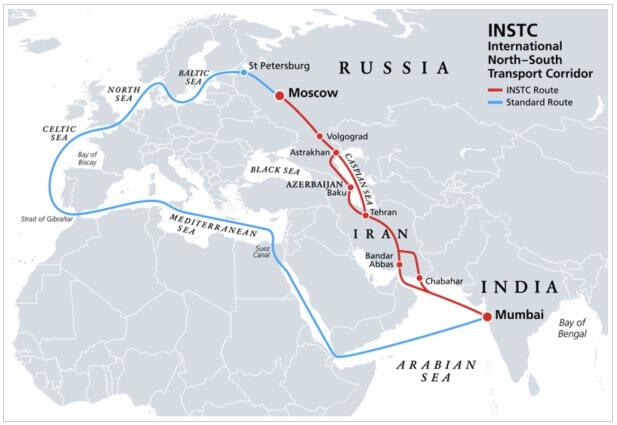
Yet the major impediment to the INSTC reaching its full potential remains Iranian infrastructure. Much of the transit of goods on the INSTC still takes place on roads in Iran. Much of Iran’s railway is single track, and regular container train services from Moscow to Iran have to rely on transloading.

The government in Tehran is trying to prioritize the improvement of port capacity, rail and road infrastructure, transportation terminals and the modernization of its transportation fleet. The Iran Chamber of Commerce, Industries, Mines and Agriculture is also starting a new Transports Internationaux Routiers or International Road Transport center in the southern port city of Bandar Abbas to expedite the processing of transit cargoes. However, there is a clear need for further investment in transportation infrastructure, which has been difficult due to US sanctions on Iran.

Saudi Arabia’s Finance Minister Mohammed Al-Jadaan said March 15 that Saudi investments into Iran could happen “very quickly” following the agreement to restore diplomatic ties. He added that he does not see any impediment as long as the terms of agreements are respected by Tehran.

Any Saudi economic dealing with Iran would undercut US sanctions imposed to pressure Tehran, if not violating them outright. With tens of billion of dollars in Iranian assets blocked worldwide, the prospect of Saudi investments could jumpstart the INSTC and help maintain the peace between Riyadh and Tehran.

China’s desire to keep the peace could also bring investments. Scott Ritter writes at Energy Intelligence:

With China providing infrastructure-generating investment capital through its Belt and Road Initiative, the new Iran-Saudi détente could evolve into a regional economic relationship that supplants the US-led defense relationships that have defined Middle East politics for decades.

China would have to work around US sanctions in order to increase investments in Iran, but the two countries have already found a workaround to continue the oil trade, with most being rebranded as from a third country. If a China were to up its investments in Iran, it would mark a shift. From Silk Road Briefing:

Russia has now overtaken China as the biggest investor in Iran. This follows Moscow’s conflict with Ukraine from late February last year, as a result of which Iran and Russia have strengthened their economic and investment ties. The UAE, Afghanistan, Turkey and China are the next biggest investors. Although China that was expected in Iran to be the major investor, Beijing reduced its exposure in 2022, and concentrated more on investing into the Belt and Road Initiative infrastructure such as logistics centers, border facilities etc. that would facilitate its own export capabilities to Iran and the region.

Foreign investment flows to Iran have been decreasing from 2012-13 when the volume stood at US$4.5 billion. The lowest level was recorded in 2015-16 with only US$945 million of FDI inflows. UNCTAD estimated that the volume of FDI inflows to Iran stood at US$3.372 billion, US$5.019 billion, US$2.373 billion and US$1.508 billion from 2016 to 2019.

According to the United Nations Conference on Trade and Development, Iran attracted an estimated US$1.425 billion in Foreign Direct Investment in 2021 to register about a 6% rise compared to US$1.342 billion in 2020. In 2022, however, and despite the sanctions, the total volume of investments attracted to Iran hit US$5.95 billion. Out of this figure Chinese companies invested only about US$185 million.

Additionally, Secretary of the Iranian Supreme National Security Council, Ali Shamkhani, announced on Monday that Tehran concluded an agreement with the United Arab Emirates to facilitate trade movement between the two countries using the Emirati currency, the dirham.

The UAE has not confirmed any such agreements as it would run afoul of US sanctions, which have created a financial crunch in Iran. Tehran is hoping that better ties with Persian Gulf Arab countries can help reduce that pressure. It remains to be seen how far these countries will go in order to provide Iran an economic lifeline.

But should diplomatic and economic relations between GCC members and Iran continue to improve, it could spell the end to US efforts to apply “maximum pressure” on Tehran and another nail in the coffin of US influence in the region. It would also cement Iran’s position as key nexus in new global trade routes like China’s BRI and the INSTC.
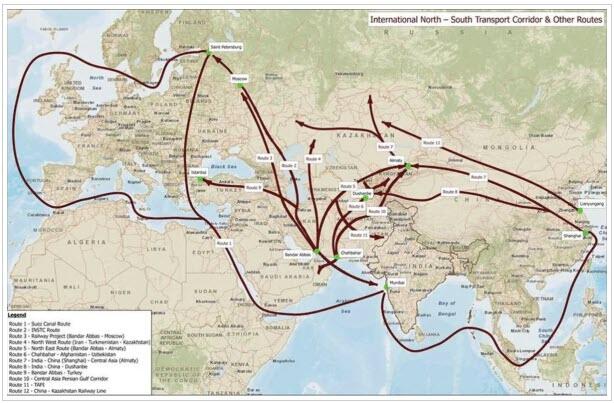
The US, by trying to put maximum economic pressure on Iran and Russia, hinting that China is next, and the ill-fated oil price cap, has only helped drive the integration of Russia, China, Iran, Saudi Arabia, and more.

Despite all the sanctions and western pressure on countries to isolate Moscow, Russian trade is on the upswing. Iran is eager to cash in on its position between India and Russia, who are rapidly increasing their trade volume. From India Shipping News:

Ruscon, a leading multimodal transport logistics provider in Russia, has significantly expanded its containerized service network from the Black Sea Port of Novorossiysk to Nhava Sheva and Mundra in west India as volumes rapidly rise.

The company, a Deli Group subsidiary, has now increased its tonnage deployments from one vessel to four vessels to provide a weekly sailing frequency on the route.

Additionally, an extra stop has been introduced at Saudi Arabia’s Jeddah Port. The service rotation already includes a call at Istanbul Port in Turkey.

According to Reuters, Russia began exporting diesel to Saudi Arabia in February after the EU enacted its embargo on seaborne imports of Russian oil. The Saudis are now expected to export the Russian diesel to other countries after some refining.

Russia’s largest ocean container carrier, Far Eastern Shipping Co., also recently added a direct Novorossiysk to Nhava Sheva route. And many other countries are jumping in and providing vessels after western sanctions forced regular mainline operators to halt operations into and out of Russia. Even the New York Times begrudgingly admits:

Ami Daniel, the chief executive of Windward, a maritime data company, said he had seen hundreds of instances in which people from countries like the United Arab Emirates, India, China, Pakistan, Indonesia and Malaysia bought vessels to try to set up what appeared to be a non-Western trading framework for Russia.

India’s imports of crude oil from Russia reached a record of 1.6 million barrels per day in February, which was more than one-third of India’s imports and more than the combined imports from traditional suppliers Iraq and Saudi Arabia.

India has been making a profit turning around and selling the refined oil to the US and EU, which are unable to purchase directly from Russia due to sanctions. The same story is occurring in North Africa, which buys up Russian crude and increases supplies to Europe as a sanctions workaround.

Russian wheat and fertilizer exports also rose in 2022 despite sanctions, much of the former going to the Middle East and North Africa (MENA) region, which is the top destination for Russian food exports. Much of the fertilizer went to INdia.

Iran and Russia are cooperating to build ships and vessels in the Caspian Sea. In October, Iran announced Moscow’s readiness to allow Iranian ships to pass through the Volga River. Russia had previously not allowed foreign ships to use the Volga River or the Volga-Don canal, but if the agreement is implemented, Iran will have access to the longest river in Europe, and have access to the Volga-Don Canal, which provides the shortest connection between the Caspian Sea and the Mediterranean.

For another look at how Western sanctions are backfiring and only drawing countries closer to countries the US is trying to isolate, take the Eurasian Economic Union (EAEU) members of  Belarus, Kazakhstan, Armenia and Kyrgyzstan, which are also all being boosted by anti-Russian sanctions. From Silk Road Briefing: 

It has had the unexpected effects of boosting regional GDP growth rates: in their “Regional Economic Prospects” report, the European Bank for Reconstruction and Development (EBRD), analysts noted that Kazakhstan’s 2022 GDP growth reached 3.4% instead of the previously anticipated 2%.

Part of that has been due to sanctions, with an increase in income due to the re-export to Russia of computers, household appliances and electronics, auto parts, electrical and electronic components. Exports of non-energy goods from Kazakhstan to Russia in 2022 increased by 24.8% and amounted to US$18.9 billion. …

An EAEU Intergovernmental Council meeting held in early February this year showed that the economic situation in all EAEU members states is stable, and mutual trade is growing. Anti-Russian sanctions actually significantly contribute to this growth, meaning that for EAEU members especially, as well as countries such as China and India, the attractiveness of Russia as an economic partner has grown.

India, Turkey, and Egypt are among the countries discussing free trade agreements with the EAEU. And Iran signed one in January.  The primary driver for the Iran-EAEU integration is to upgrade Iran’s transport and logistics infrastructure, i.e., the INSTC.

The importance of the INSTC and its link to the Middle Corridor, which enables Russian traffic to head east via Kazakhstan to China, and vice-versa, is growing to include the entire region. At a joint press briefing with US Secretary of State Anthony Blinken in February Kazakhstan’s Foreign Minister Mukhtar Tleuberdi made it clear that EAEU economic participation is critical for Astana, and Kazakhstan would not be opting out of such a beneficial arrangement in order to please the US.

It was just another reminder of how the INSTC and Middle Corridor represent the growing integration of the EAEU, MENA, China, and India, and the US’ fading influence.

Tyler Durden
Sun, 03/26/2023 – 08:10

via ZeroHedge News https://ift.tt/JY1RiXb Tyler Durden
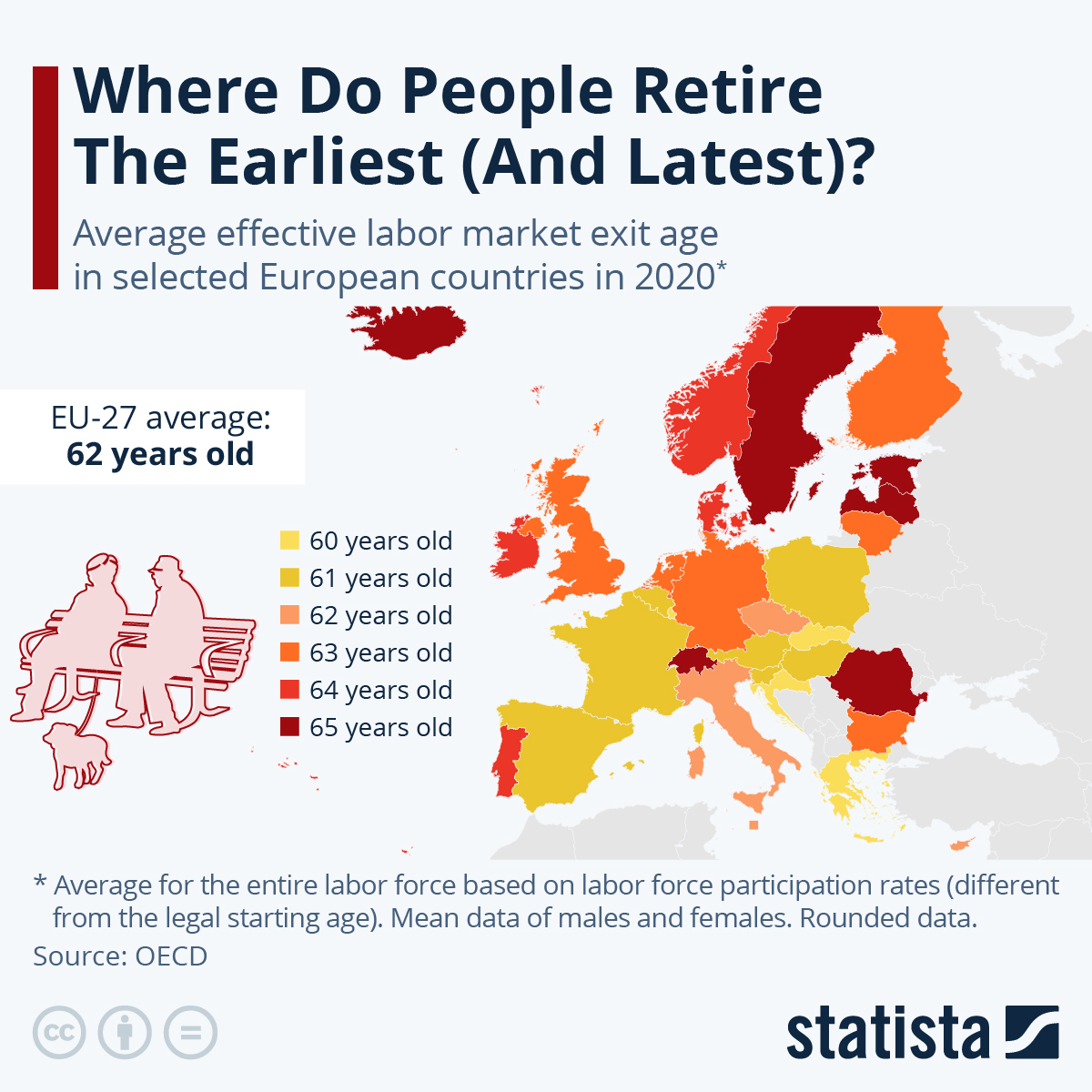
Where Do Europeans Retire The Earliest (And Latest)?

Where Do Europeans Retire The Earliest (And Latest)?

In most countries, the average effective labor market exit age is lower than the official full pension age.

As Statista’s Anna Fleck notes, in the European Union, for example, the majority of Member States have set the legal retirement age at around 65 (62 to 67), but as the most recent data from the OECD shows, many Europeans actually leave the professional world earlier.

Infographic: Where Do People Retire The Earliest (And Latest)? | Statista

You will find more infographics at Statista

In Europe, it’s common for people in Sweden, Iceland, Switzerland, Latvia, Estonia and Romania to leave the labor market comparatively later (averaging 65 years old, when the mean is calculated for men and women).

By contrast, the average labor market exit age is closer to 60 in Luxembourg, Slovakia, Croatia and Greece.

Other countries on the continent with a comparatively early retirement age include France, Belgium, Spain and Austria (61), while the EU-27 average is 62 (2020 data).

Tyler Durden
Sun, 03/26/2023 – 07:35

via ZeroHedge News https://ift.tt/6jUIaRz Tyler Durden

Eminent Oxford Scientist Says Wind Power “Fails On Every Count”

Eminent Oxford Scientist Says Wind Power “Fails On Every Count”

Authored by Chris Morrison via DailySceptic.org,

It could be argued that the basic arithmetic showing wind power is an economic and societal disaster in the making should be clear to a bright primary school child. Now the Oxford University mathematician and physicist, researcher at CERN and Fellow of Keble College, Emeritus Professor Wade Allison has done the sums. The U.K. is facing the likelihood of a failure in the electricity supply, he concludes.

“Wind power fails on every count,” he says, adding that governments are ignoring “overwhelming evidence” of the inadequacies of wind power, “and resorting to bluster rather than reasoned analysis”.

Professor Allison’s dire warnings are contained in a short paper recently published by the Global Warming Policy Foundation. He notes that the energy provided by the Sun is “extremely weak”, which is why it was unable to provide the energy to sustain even a small global population before the Industrial Revolution with an acceptable standard of living. A similar point was made recently in more dramatic fashion by the nuclear physicist Dr. Wallace Manheimer. He argued that the infrastructure around wind and solar will not only fail, “but will cost trillions, trash large portions of the environment and be entirely unnecessary”.

In his paper, Allison concentrates on working out the numbers that lie behind the natural fluctuations in the wind. The full workings out are not complicated and can be assessed from the link above. He shows that at a wind speed of 20mph, the power produced by a wind turbine is 600 watts per square metre at full efficiency. To deliver the same power as the Hinkley Point C nuclear plant – 3,200 million watts – it would require 5.5 million square metres of turbine swept area.

It is noted that this should be quite unacceptable to those who care about birds and other environmentalists. Of course, this concern does not seem to have materialised to date. Millions of bats and birds are calculated to be slaughtered by onshore wind turbines every year. Meanwhile, off the coast of Massachusetts, work is about to start on a giant wind farm, complete with permits to harass and likely injure almost a tenth of the population of the rare North Atlantic Right whale.

When fluctuations in wind speed are taken into account in Allison’s formula, the performance of wind becomes very much worse. If the wind speed drops by half, the power available falls by a factor of eight. Almost worse, he notes, if the wind speed doubles, the power delivered goes up eight times, and the turbine has to be turned off for its own protection.

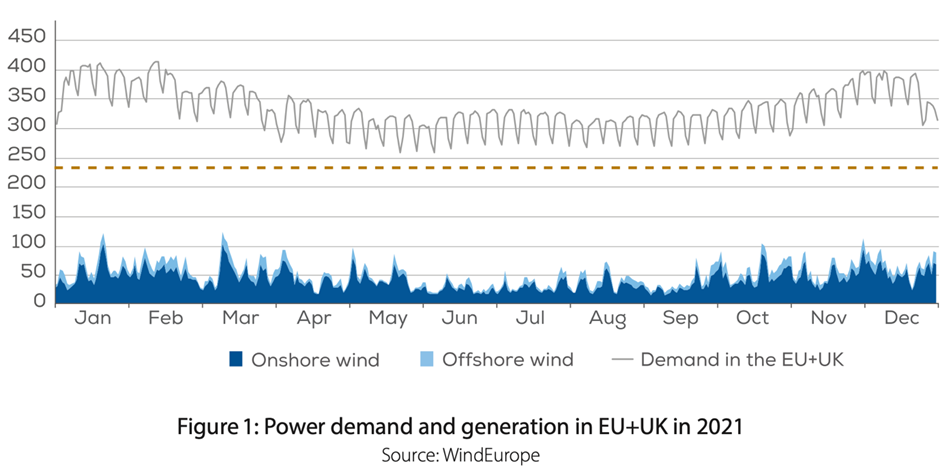
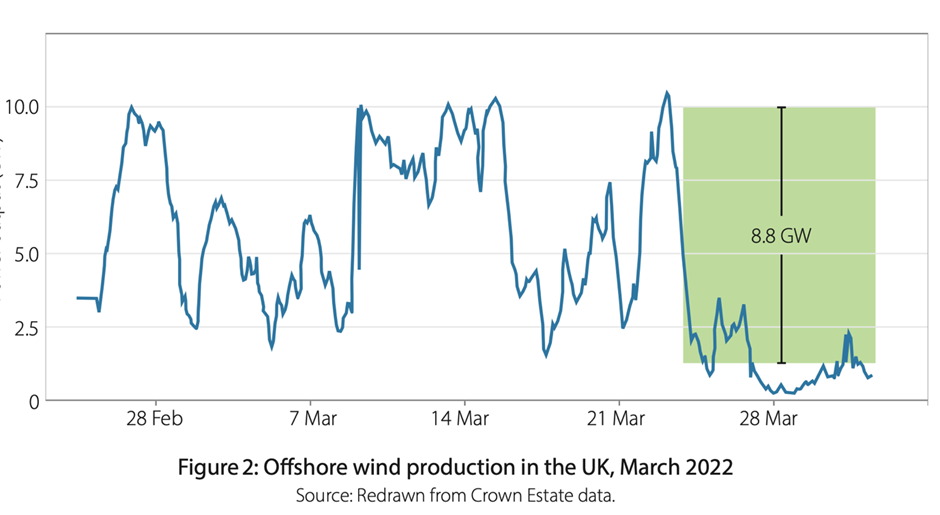
The effect of the enhanced fluctuations is dramatic, as shown in the graph above. The installed nominal generating capacity in the EU and U.K. in 2021, shown by the brown dashed line, was 236 GW, but the highest daily output was only 103 GW on March 26th. The unreliability is shown to even greater effect in the second graph that plots the wind generated offshore in the U.K. in March last year.

For eight days at the end of the month, power generation slumped, presumably, says Allison, because the wind speed halved. The 8.8 GW daily loss over the period was noted to be 1,000 times the capacity of the world largest grid storage battery at Moss Landings in California. When it comes to the enormous batteries needed to store renewable power, Allison notes the problems with safety, as well as mineral shortages. Batteries will never make good the failure of offshore wind farms, even for a week, and he points out they can fail for much longer than that.

Others have recently looked in more detail at the costs of battery storage. The American lawyer and mathematician Francis Menton, who runs the Manhattan Contrarian site, reviewed recent official cost reports and found that “even on the most optimistic assumptions” the cost could be as high as a country’s GDP. On less optimistic assumptions, the capital cost alone could be 15 times annual GDP. Last year, Associate Professor Simon Michaux warned the Finnish Government that there were not enough minerals in the world to supply all the batteries needed for Net Zero. Michaux observed that the Net Zero project may not go fully “as planned”. Meanwhile, Menton concluded, with an opinion that some might consider unduly charitable: “It is hard to avoid the conclusion that the people planning the Net Zero transition have no idea what they are doing.”

Professor Allison has done his sums based on basic physics and freely available information. “Whichever way you look at it, wind power is inadequate. It is intermittent and unreliable; it is exposed and vulnerable; it is weak with a short life-span,” he concludes.

Tyler Durden
Sun, 03/26/2023 – 07:00

via ZeroHedge News https://ift.tt/5nWhbGp Tyler Durden

‘All the Parents Want Is a Chance To Make That Choice’


interview

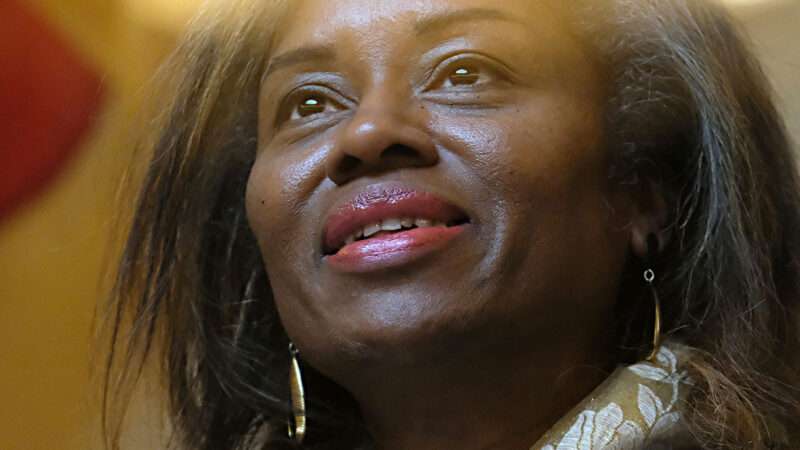
Brown v. Board of Education was never about black kids getting into a white school. It was always about ultimately a parent being able to decide where their children should attend school,” argues Virginia Lt. Gov. Winsome Earle-Sears. The African-American Republican is one of the driving forces behind a new bill that would create “backpack funding” for kids in Virginia, which would allow parents to use the state’s portion of per-pupil funding—somewhere between $4,000 and $6,000—at any public or private school, for tutoring, books, and other educational expenses. If the bill passes, Virginia would join eight other states (at press time) with education savings accounts (ESAs) that accomplish similar goals.

Earle-Sears was born in Jamaica in 1964 and grew up in New York City before joining the Marines and eventually settling in Virginia, where she has served in the House of Delegates and on the Virginia Board of Education. She was elected lieutenant governor in 2021 on the same ticket as Republican Glenn Youngkin, in an election where controversies over critical race theory, COVID-19 schooling, and other issues related to education played a significant role.

In January, Nick Gillespie sat down with Earle-Sears for The Reason Interview With Nick Gillespie to talk about the school choice movement in Virginia and how it shouldn’t be controversial for parents to decide how their children are educated.

Reason: Why is supporting education savings accounts a priority for you?

Winsome Earle-Sears: Because the scores are showing that our children aren’t learning. When we’re looking at 20 percent of black children only able to read by the time that they reach the third, fourth grade, that’s a travesty. And we have seen through the years that no matter what was tried, it’s not working. And so parents are saying it is time to do something differently, so that we can get different results. Nothing will do, I think, as much as these ESAs will do, because it will drive competition. Competition will raise all boats.

Why will ESAs spur better education outcomes?

When parents are able to choose where their children should attend school, that’s a whole game changer, because now the money follows the child instead of the brick building.

I don’t understand, frankly, how it can be controversial for a parent to make the decision on the child’s education and the child’s future. We know that as soon as anything else happens with a child, they call the parents. So why should this be any different? And by the way, there are people who say that this program helps the rich. Do you think rich parents are waiting on a government program to determine where to send their children to school? The answer is no. They have already made that choice. It is for the rest of us now to have that same opportunity.

Did you go to public or private school?

I went to public school in Jamaica as well as in New York. And my children also went to public school.

Did you feel like your parents had enough choice over where you went to school?

The intriguing thing is that when my father first brought me to America, when I was 6 years old and I entered the public school in New York, they discovered that I was not learning anything. And indeed in Jamaica, a Third World country in the 1960s, I had already had pre-K and I was starting to move into elementary school. And so I was sent back to Jamaica for school.

When I came back, I entered the ninth grade and I was told—even with my transcripts showing that I had had chemistry, physics, and biology—they said, “No, that was general science.” But no, in Jamaica, you actually have chemistry, physics, and bio. So guess what? I aced everything.

With my children, we moved from California, where [my husband and I] were both in the Marine Corps. We decided to come to Virginia. I think just by the grace of God, we were able to move into a neighborhood that had a wonderful school system. It was one of the “better neighborhoods.” We didn’t know that. And so they had access to this, that, and the other. My children were even learning Japanese, if you can imagine, in elementary school. So it turns out that we bought the cheapest house in one of the best neighborhoods. But what about those parents who don’t have that opportunity?

Critics say that ESAs divert public tax dollars from public schools. Is that a legitimate criticism?

To whom does the tax money belong to in the first place? Where did the money come from? Two-thirds of the funds stay with the public schools. One-third of the money will follow the child to whatever school, homeschool, tutoring, whatever the parent wants to do.

I would have loved it, when I had my business, if my customer said, “I’m leaving you,” and I could say, “Well, two-thirds of your money stays with me.” That’s what this is about. All the federal funding stays with the local schools. All the local money stays with the local schools. People say, “All we need to do is just give the schools more money.” Wait a minute. We’ve been doing that and doing that, and it’s still not working right now. For example, if a child is to attend Richmond Public Schools, the [per-pupil spending] is $16,000 per year, and the children are still failing.

The state of Virginia is willing to contribute between $4,000 and $6,000 for one child’s education. Can you explain how that works?

It’s not a voucher because it’s not direct money from the state to the parent for the child. It’s going to go to a third party, and they will make the decision once they receive the request to send the money on.

Some of the pushback is, “That’s not enough money.” If we took all of the money, then they would say we’re defunding the schools. You can’t please the naysayers. The naysayers already have that choice.

You have to ask yourself, finally, what is really behind all this? It’s about control, you know. This is about who will control the money. And let me tell you something. We must not fool ourselves. If we were to get ESAs through, I can tell you the teachers unions will come right to the private schools and say you all should unionize. They don’t really care. They’re following the money.

What are the similarities between today’s school choice movement and the civil rights movement in the 1950s and ’60s?

Brown v. Board of Education was never about black kids getting into a white school. It was always about, ultimately, a parent being able to decide where their children should attend school. It’s really that simple. But when you have redlining and zoning issues, then you have segregated schools, and it is mostly affecting black and brown children. Majority of the schools, when you look at them now, especially in the urban areas, they’re all black and most of them are failing.

When I sat on the Virginia State Board of Education, we were able to grade the schools. And if you’re failing, you don’t have access to the children anymore. We’re going to put the children elsewhere. Guess what? After I left the board, they lowered the standards to the point where they got rid of the ability to tell an “A” school from a “B” school. The children are in failing schools.

We have heard from so many parents from all income strata: public housing, middle-class, etc. And one mother said, “I am working two and three jobs,” just so her son can have the ability to go to this school. She wants a choice.

You and Gov. Youngkin were elected in some significant part due to parental outrage over K-12 curricula, including the way state history was being taught. Last fall, the Board of Education in Virginia rejected the Youngkin administration’s new history and social studies guidelines. How are the new guidelines, submitted recently, different?

I wouldn’t say that it was about the way that history was being taught. They were teaching critical race theory, which is a Marxist theory, which was trying to talk about equal outcomes. There is no such thing. It was also teaching that you’re privileged, for example, if you are white, if you are heterosexual, if you are male, if you’re married, if you’ve served in the armed forces, and silly things like that, because now it encompasses just about everybody. It really was sowing seeds of chaos because then you were creating a morale issue in the schools.

The white child was told that the white child is an oppressor and the black child was told, “You’re a victim. You’re the oppressed.” The children aren’t learning. I don’t send my child to school for you to indoctrinate. I send my child for you to educate. And that’s what we were finding was the problem.

So nothing actually changed. And in fact, for example, Martin Luther King Jr. would be mentioned in more places than he had been before. It’s just that, unfortunately, they collapsed everything and it appeared that we were taking him out in certain areas when we weren’t.

A drowning man, as they say, will clutch at a straw. And when people realize that things are going to change, they throw up every roadblock that they can. They did it in Florida. And now that Florida has all those charter schools and school choice, do you know who’s benefiting the most? Black children. Their scores have gone through the roof. In Virginia, with our ESAs, we’re learning from all the other states that have already implemented them. We’re learning from what other people have done. All the parents want is a chance to make that choice.

How has your personal experience informed how we should talk about history in schools in a country that is so vast and diverse?

My father came to America from Jamaica in 1963, 17 days before Martin Luther King Jr. gave his “I Have a Dream” speech. He came at the height of the civil rights movement. He knew what was happening in America, and yet he begged to get in, filled out the documents, and jumped through hoops and waited his turn. He came with $1.75, took any job he could find, used that money to put him through school, and now he’s comfortably retired. He came at a time when there were actual dog whistles, when we really couldn’t sit anywhere we wanted, and when we couldn’t live where we wanted.

My husband’s family, which is from Virginia—of the 15 children that his great-grandparents had, 13 of them have college degrees. They’re black. There was a time when things were really bad for us. I asked my father, “Why would you come?” And he said, “Because this is where the jobs and the opportunities were.” So now I would say to you, here I am. How could I say to my father that the reason why I did not succeed is because I am black? I have to make my own way in this world. And here I am. I am second in command in the former capital of the Confederate States. Do not tell me that times have not changed.

Now, is it utopia? Of course it’s not. There is no such nation. What we do know is that wherever you live, there is going to be some kind of “ism.” Racism. If it’s not that, it’s classism. If it’s not, it’s colorism. It’s some kind of “ism.” We people, not just Americans, know how to divide ourselves.

So what we have to say to our children is, “Look at us.” We have overcome. Every time an obstacle is thrown in our way, we have overcome it. The slaves in the fields did not die so that we could be here talking about how we are victims. No, we are overcomers.

We’re not going to deny history. Heavens, no. We must teach all of history. We must talk about the truth of history. We must talk about the Founders, some of which were, in fact, slaveholders. They were imperfect people. They left us the Constitution. They left us the Declaration of Independence, under which I was elected and under which Barack Obama was elected president, not just once, but twice. We have a saying in church, “I may not be what I’m supposed to be, but I ain’t what I used to be.” And that’s America. People are still dying to come into America. Just look at the Southern border.

Did the arbitrariness of COVID lockdowns in K-12 education pour gas on the fire of the school choice movement?

Our children weren’t learning even before COVID. For example, I went to a majority-black school and I visited the principal. She said to me, “Normally the children come to me two years behind.” But then she says, “Not only are they two years behind, but as a result of COVID policies shutting our schools down, the kids are now four years behind.” She threw her hands in the air. She asked me, “What am I supposed to do? How do I help these children?”

The beauty of ESAs is that it will reduce class size as well. So, yes, some children will not be there. Two-thirds of the money stays. But now we’ve also reduced class size. It’s a win-win.

What’s the likelihood that legislation that changes how Virginia funds education will pass?

As they say, Rome wasn’t built in a day. Slavery was not gone in a day. We are saying we’re not going back. And yes, it’s going to take a small miracle. It’s going to take a miracle because there are people who have nefarious agendas and they’re using the suffering of black people to further keep us apart and at each other’s throats.

I am hoping that it is God’s will that things change. It’s already started because there are so many black parents, for example, who came to the education subcommittee who begged and pleaded for change to happen so that they could have the money to send their children to school. And every single Democrat on that subcommittee looked them in the eye and voted no, including the ones who send their children to private school. So their eyes are opening.

It’s going to be a tough fight. It’s one worth having. We are going to keep in the fight until the parents get to make that choice.

This interview has been condensed and edited for style and clarity. For a podcast version, subscribe to The Reason Interview With Nick Gillespie.

The post 'All the Parents Want Is a Chance To Make That Choice' appeared first on Reason.com.

from Latest https://ift.tt/Trvb3P4
via IFTTT

Johnstone: US Officials Really, Really Want You To Know The US Is The World’s “Leader”

Johnstone: US Officials Really, Really Want You To Know The US Is The World’s “Leader”

Authored by Caitlin Johnstone via Medium.com,

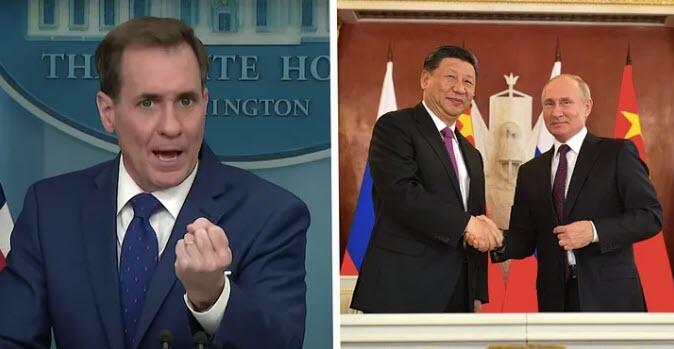
In response to questions he received during a press conference on Monday about Xi Jinping and Vladimir Putin cementing a “new era” in strategic partnership between China and Russia, the White House National Security Council’s John Kirby made no fewer than seven assertions that the US is the “leader” of the world.

Here are excerpts from his comments:

  • “The two countries have grown closer. But they are both countries that chafe and bristle at U.S. leadership around the world.”

  • “And in China’s case in particular, they certainly would like to challenge U.S. leadership around the world.

  • “But these are not two countries that have, you know, decades-long experience working together and full trust and confidence. It’s a burgeoning of late based on America’s increasing leadership around the world and trying to check that.”

  • “Peter, these are two countries that have long chafed, as I said to Jeff — long chafed at U.S. leadership around the world and the network of alliances and partnerships that we have.”

  • “And we work on those relationships one at a time, because every country on the continent is different, has different needs and different expectations of American leadership.”

  • “That’s the power of American convening leadership. And you don’t see that power out of either Russia or China.”

  • “But one of the reasons why you’re seeing that tightening relationship is because they recognize that they don’t have that strong foundation of international support for what they’re trying to do, which is basically challenge American leadership around the world.”

The illusory truth effect is a cognitive bias which causes people to mistake something they have heard many times for an established fact, because the way the human brain receives and interprets information tends to draw little or no distinction between repetition and truth. Propagandists and empire managers often take advantage of this glitch in our wetware, which is what’s happening when you see them repeating key phrases over and over again that they want people to believe.

We saw another repetition of this line recently at an online conference hosted by the US Chamber of Commerce, in which the US ambassador to China asserted that Beijing must accept the US as the “leader” of the region China happens to occupy.

US empire managers are of course getting very assertive about the narrative that they are the world’s “leader” because that self-appointed “leadership” is being challenged by China, and the nations which support it with increasing openness like Russia. Most of the major international news stories of our day are either directly or indirectly related to this dynamic, wherein the US is struggling to secure unipolar planetary domination by thwarting China’s rise and undermining its partners.

The message they’re putting out is, “This is our world. We’re in charge. Anyone who claims otherwise is freakish and abnormal, and must be opposed.”

Why do they say the US is the “leader” of the world instead of its “ruler”, anyway? I’m unclear on the difference as practically applied. Is it meant to give us the impression that the US rules the world by democratic vote? That this is something the rest of the world consented to? Because I sure as hell don’t remember voting for it, and we’ve all seen what happens to governments which don’t comply with US “leadership”.

I’m not one of those who believe a multipolar world will be a wonderful thing, I just recognize that it beats the hell out of the alternative, that being increasingly reckless nuclear brinkmanship to maintain global control. The US has been in charge long enough to make it clear that the world order it dominates can only be maintained by nonstop violence and aggression, with more and more of that violence and aggression being directed toward major nuclear-armed powers. The facts are in and the case is closed: US unipolar hegemony is unsustainable.

The problem is that the US empire itself does not know this. This horrifying trajectory we’re on toward an Atomic Age world war is the result of the empire’s doctrine that it must maintain unipolar control at all costs crashing into the rise of a multipolar world order.

It doesn’t need to be this way. There’s no valid reason why the US needs to remain in charge of the world and can’t just let different people in different regions sort out their own affairs like they always did before. There’s no valid reason why governments need to be brandishing armageddon weapons at each other instead of collaborating peacefully in the interest of all humankind. We’re being pushed toward disaster to preserve “American leadership around the world,” and I for one do not consent to this.

* * *

My work is entirely reader-supported, so if you enjoyed this piece please consider sharing it around, throwing some money into my tip jar on PatreonPaypal, or Substack, buying an issue of my monthly zine, and following me on FacebookTwitterSoundcloud or YouTube. If you want to read more you can buy my books. The best way to make sure you see the stuff I publish is to subscribe to the mailing list for at my website or on Substack, which will get you an email notification for everything I publish. Everyone, racist platforms excluded, has my permission to republish, use or translate any part of this work (or anything else I’ve written) in any way they like free of charge. For more info on who I am, where I stand, and what I’m trying to do with this platform, click here. All works co-authored with my husband Tim Foley.

Bitcoin donations:1Ac7PCQXoQoLA9Sh8fhAgiU3PHA2EX5Zm2

Tyler Durden
Sat, 03/25/2023 – 23:30

via ZeroHedge News https://ift.tt/XGpd5sM Tyler Durden

Asian Voters Abandoning Woke Democrats As Crime Rises In Cities

Asian Voters Abandoning Woke Democrats As Crime Rises In Cities

You might have heard the recent story of a CNN news crew that had their car broken into while they were filming a segment on crime in San Francisco, CA.  While the irony of this is amusing to many of us, one group of people that is not laughing is Asian-Americans in the Bay Area who are growing weary of the overall damage done by leftist social justice policies.  That CNN crew was, in fact, shooting a story on the very issue of Asian voters who say they are moving away from progressive Democratic leadership and seeking out more moderate candidates, as well as Republican candidates.

The reasons for this shift are many. 

  • First, it has long been the assumption among leftist elitists that they own American minorities as a voting block and that “only whites” are conservative.  The arrogance of this thinking aside, Democrats often find themselves confounded by the percentage of minorities that are in fact moderate or conservative in their voting habits.  While many minorities might feel compelled by social pressure and propaganda to vote Democrat, the damage that is hitting their pocket books and making their streets unsafe cannot be hidden forever. 

  • Second, while leftists often claim that anti-Asian hate crimes are caused by “racist white conservatives”, a cursory glance at video footage and the prosecution records of the majority of the perpetrators of these attacks shows this is not the case.  In New York City in 2020 during the onset of the media hype on anti-Asian hate, only 2 out of 20 people arrested in connection with Asian attacks were white.   

  • Third, it has been social justice politics in places like San Francisco that have encouraged police defunding efforts while enabling criminals.  When the worst elements of society see leftist organizations like BLM and Antifa rioting in the streets and setting neighborhoods ablaze while being applauded by city politicians, they tend to feel empowered to act on their darkest impulses. 

In every single metropolis where woke politicians take control, the city starts to collapse.  From LA to New York, from San Francisco to Austin, from Portland to Seattle, the results are always the same, and now it’s not just conservatives pointing out the root problem.

Tyler Durden
Sat, 03/25/2023 – 23:00

via ZeroHedge News https://ift.tt/65rpOaA Tyler Durden

No, We Don’t Need More Nuclear Weapons

No, We Don’t Need More Nuclear Weapons

Authored by Ryan McMaken via The Mises Institute,

Republicans and Democrats may quibble over how federal tax dollars might be spent on various social welfare programs like Medicaid and food stamps. But alongside Social Security, there is one area of federal spending that everyone can apparently agree on: military spending. Last year, the Biden administration requested one of the largest peacetime budgets ever, at $813 billion. Congress wanted even more spending and ended up approving a budget of $858 billion. In inflation-adjusted terms, that was well in excess of the military spending we saw during the Cold War under Ronald Reagan. This year, Joe Biden is asking for even more money, with a new budget request that starts at $886 billion. Included in that gargantuan amount—which doesn’t even include veterans spending—is billions for new missile systems for deploying nuclear arms, plus other programs for “modernizing” the United States’ nuclear arsenal.

Indeed, over the past year, the memo has gone out among the usual advocates of endless military spending that the US needs to spend much more on nuclear arms. This is a perennial position at the Heritage Foundation, of course, which has never met a military pork program it didn’t like. Moreover, in recent months, the Wall Street Journal has run several articles demanding more nuclear arms. The New York Post was pushing the same line late last year. Much of the rhetoric centers on the idea that Beijing is increasing its own spending on nuclear arms and thus the United States must “keep up.” For instance, last month, Patty-Jane Geller insisted that the US is in an “arms race” with China. Meanwhile, writers at the foreign-policy site 1945 claimed Congress must “save” the American nuclear arsenal.

Congress will surely be happy to cooperate. Such spending is an enormous cash cow for weapons manufacturers, although it has little to do with actual military defense. The US nuclear arsenal is huge, and China’s efforts to expand its own arsenal will have no effect on the already substantial deterrent effects of the US’s existing nuclear arsenal. Although the 1945 article insists that China soon “will field a peer or superior arsenal to the United States,” it’s difficult to see by what metric this is actually true.

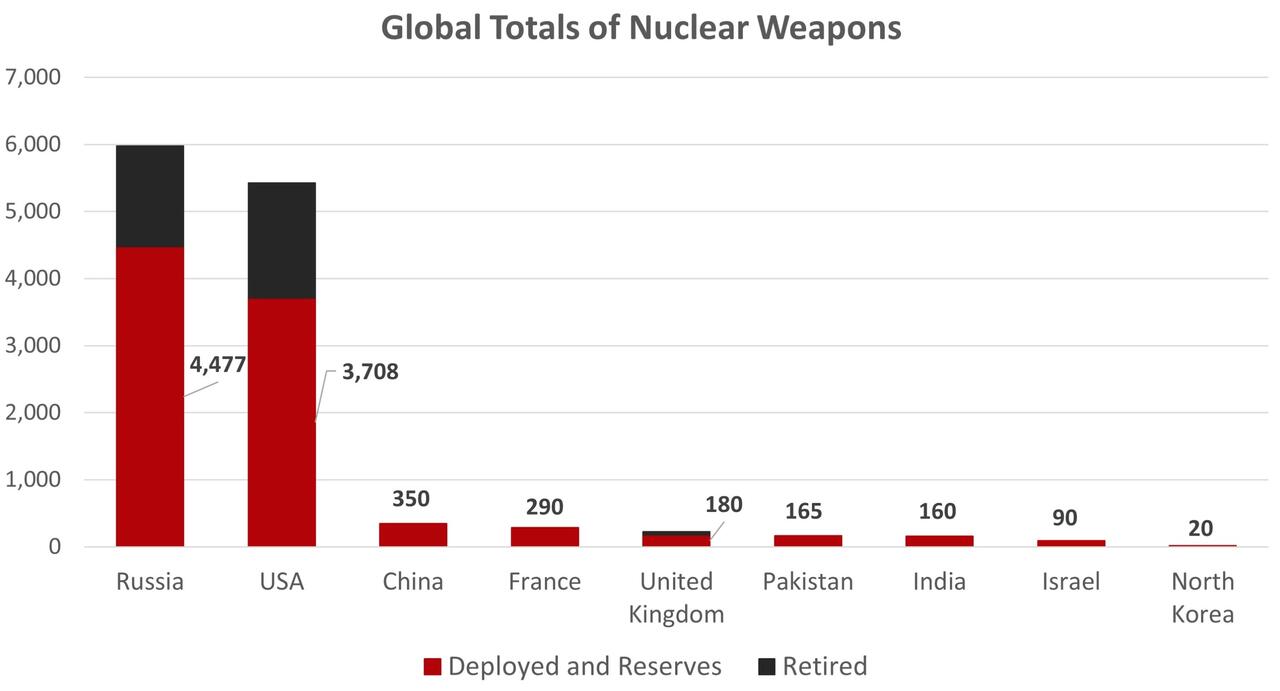
Contrary to claims that the US nuclear arsenal needs to be “saved” or it will soon be eclipsed by the Chinese arsenal, the US remains well in the lead of every single nuclear power except Russia. Even if Beijing increases its arsenal to one thousand warheads, as the New York Post breathlessly predicts, the Chinese arsenal will remain well behind that of the US.

This is true even if we remove all the retired US warheads from the equation. In that case, Moscow retains the global lead with more than forty-four hundred weapons, and the US comes in second with more than thirty-seven hundred. Presently, Beijing has approximately 350 of these weapons, France has 290, and the rest of the world is well behind that.

Source: Data from Our World in Data, “Inventories of Nuclear Weapons.

Like Moscow, Washington has a full-blown and well-developed nuclear triad, complete with a fleet of nuclear subs that can launch up to twenty missiles—each containing multiple independently targeted warheads—land-based missile silos, and bombers. Each option provides ways to deliver hundreds of warheads. The submarine fleet, of course, is constantly mobile, ensuring first-strike survivability.

The Nonexistent Missile Gap

This won’t stop advocates of more spending from calling for more. They’ll always have reasons why there is some sort of missile gap. Lately, the obsession is with hypersonic missiles and having various forms of delivery, as well as the claim that the current gap between the US arsenal and rival arsenal is not sufficiently large.

There’s a reason US advocates of an aggressive nuclear posture invented the “missile gap” myth during the Cold War. It sows doubt about US security and ensures a certain level of paranoia about US nuclear capability. Nowadays, it’s acknowledged that the missile gap was always a myth, but this was much less known in the days when debates over US rocket technology were a frequent cause for alarm and debate. Nonetheless, the nonfactual basis of the “gap” was known at least as early as the 1960s, and then defense secretary Robert McNamara noted to John F. Kennedy:

There was created a myth in the country that did great harm to the nation. It was created by, I would say, emotionally guided but nonetheless patriotic individuals in the Pentagon. There are still people of that kind in the Pentagon. I wouldn’t give them any foundation for creating another myth.

How Much Do Numbers Matter?

The myth persists, however, and Geller claims: “Given the hundreds of new Chinese missile launchers and other new weapons, the U.S. will need more nuclear weapons to hold these targets at risk. In nuclear deterrence, numbers matter.”

How much do numbers really matter? Yes, in matters of deterrence, ten is certainly better than zero. But is three thousand better than one thousand, or even one hundred? That logic often works with conventional arms, but it makes little sense with nuclear arms, a single unit of which can destroy an entire city. As John Isaacs noted last year in the National Interest:

In the nuclear age, a country that deployed 1,000 nuclear weapons rather than an adversary’s 500 is not twice as powerful since a handful of weapons could devastate both countries. But the Pentagon and political leaders did not learn this critical lesson. This is a numbers game that may have been relevant for tanks and battleships before [the invention of nuclear weapons] but is not today.

What is key in nuclear deterrence is not simply numbers. Nuclear strategist Albert Wohlstetter identified this problem in the early 1960s and concluded that “the criterion for matching the Russians plane for plane, or exceeding them is, in the strict sense, irrelevant to the problem of deterrence.” Rather the key, Wohlstetter went on, is creating a force that is “survivable” to ensure the possibility of a retaliatory “second strike.” This is what establishes deterrence.

Wohlstetter certainly wasn’t the only one to come to this conclusion. In a 1990 essay titled “Nuclear Myths and Political Realities,” Kenneth Waltz—perhaps the most influential scholar of international relations of the past fifty years—concludes that the total number of missiles in these enormous arsenals is of little importance for nations that are already well above the threshold for achieving nuclear deterrence.

What really matters is the perception that the other side has second-strike capability, and this certainly exists in both US-Russia and US-China relations. Once each regime knows that the other regime has second-strike capability, the competition is over. Deterrence is established. Waltz notes:

So long as two or more countries have second-strike forces, to compare them is pointless. If no state can launch a disarming attack with high confidence, force comparisons become irrelevant. . . . Within very wide ranges, a nuclear balance is insensitive to variation in numbers and size of warheads.

The focus on second-strike capability is key because pro-arms-race policy makers are quick to note that if a regime’s first strike is able to destroy an enemy’s ability to retaliate in kind, then a nuclear war can be “won.”

Second-Strike Capability Evens the Score

But, as shown by Michael Gerson in “No First Use: The Next Step for U.S. Nuclear Policy” (2010) establishing second-strike capability—or, more importantly, the perception of it—is not as difficult as many suppose. Gerson writes:

A successful first strike would require near-perfect intelligence, surveillance, and reconnaissance (ISR) to detect, identify, and track all of the adversary’s nuclear forces; recent events surrounding U.S. assessments of Iraq’s suspected WMD [weapons of mass destruction] capabilities forcefully demonstrate the challenges of reliable, accurate, and unbiased information. Intelligence regarding where an adversary’s nuclear weapons are located and if the state is actually planning to attack could be wrong or incomplete, and an attempted first strike based on inaccurate or incomplete information could have far-reaching negative consequences.

The threat of a successful first strike can be countered through a variety of methods, including secrecy and the ability to shift weapons delivery channels. This is why the US, Russian, and Chinese regimes have long been so enthusiastic about the so-called nuclear triad. It is assumed that if nuclear weapons can be delivered by submarine, aircraft, and land, then it is impossible for an opposing regime to destroy all three at once and achieve first-strike victory.

But even in the absence of a triad, an opposing regime that seeks a total first-strike victory has few grounds for much confidence. As Waltz shows, “nuclear weapons are small and light; they are easy to move, easy to hide, and easy to deliver in a variety of ways.” That is, if a regime manages to hide even a small number of planes, subs, or trucks, this could spell disaster for the regime attempting a successful first strike. Gerson explains:

A nuclear first strike is fraught with risk and uncertainty. Could a U.S. president, the only person with the power to authorize nuclear use and a political official concerned with re-election, his or her political party, and their historical legacy, ever be entirely confident that the mission would be a complete success? What if the strike failed to destroy all of the weapons, or what if weapons were hidden in unknown areas, and the remaining weapons were used in retaliation?

Nor must it be assumed that a large number of warheads is necessary to achieve deterrence. Waltz recalls that Desmond Ball—who advised the US on escalation strategies—convincingly asserted that nuclear deterrence could be achieved with as few as fifty warheads.

Proceeding on the assumption that an enemy has no warheads left following a first strike requires an extremely high level of confidence because the cost of miscalculation is so high. If a regime strikes and misses only a few of the enemy’s missiles, this could lead to devastating retaliation both in terms of human life and in terms of the first-strike regime’s political prospects.

This is why a rudimentary nuclear force can achieve deterrence even with a small but plausible chance of second-strike capability. A small nuclear strike is nonetheless disastrous for the target, and thus “second-strike forces have to be seen in absolute terms.” Waltz correctly insists that calculating an arsenal’s relative dominance is a waste of time: “the question of dominance is pointless because one second-strike force cannot dominate another.”

The US Is Already Far beyond the Deterrence Threshold

One could certainly debate how much the US nuclear stockpile could be cut without sacrificing deterrence. Given the enormous size of the stockpile, however, the answer is that “most of it” could be cut. Indeed, the US arsenal could be cut by 90 percent and still have hundreds of warheads available for silos, submarines, and bombers.

Moreover, reductions in the arsenal are prudent for reasons of avoiding unintended nuclear war. As Wohlstetter noted, a prudent policy also requires “strategic nuclear forces to be not only capable of riding out and operating coherently after an actual preemptive attack against them; but also completely controllable in times of peace, crisis, and war—and especially in the face of ambiguous warning—so as to avoid unauthorized operations, accidents, and war by mistake.” Having large numbers of nuclear warheads actually is imprudent because it creates more potential for accidents, mistakes, and unauthorized use. Maintenance remains expensive and risky.

In spite of all this, it remains popular among some to keep arguing for more nuclear expansion year after year. Surely, some of these advocates are true believers, but there is also a lot of money at stake for government contractors. Thus, in one form or another, the myth of the missile gap – and its modern variants – endures.

Tyler Durden
Sat, 03/25/2023 – 22:30

via ZeroHedge News https://ift.tt/7tyRvBe Tyler Durden

Ford’s “Blue Oval City” Aims To Open In 2025, Produce 500,000 Next Gen Electric Trucks A Year

Ford’s “Blue Oval City” Aims To Open In 2025, Produce 500,000 Next Gen Electric Trucks A Year

Ford is getting close to unveiling its next generation electric pickup plan at its BlueOval city mega-campus in West Tennessee.

An update from the company this week said that the new plant – which is designed to be radically efficient and carbon neutral – is “taking shape and preparing to build Ford’s next-gen electric truck, code named Project T3, in 2025”. 

The Project T3 is being called by the company “a once-in-a-lifetime opportunity to revolutionize America’s truck” as Ford, along with other legacy auto manufacturers continue to shift their business models from an ICE base to an EV base. 

Slated to start production in 2025, the plant will be capable of producing 500,000 EV trucks a year at full production – and most notably the next generation of Ford’s electric truck. Here’s a sneak preview of what the second gen pickup will look like:

Bill Ford, Ford’s executive chair said: “BlueOval City is the blueprint for Ford’s electric future around the world. We will build revolutionary electric vehicles at an advanced manufacturing site that works in harmony with the planet, aligning business growth and innovation with environmental progress.”

“Project T3 is a once-in-a-lifetime opportunity to revolutionize America’s truck. We are melding 100 years of Ford truck know-how with world-class electric vehicle, software and aerodynamics talent. It will be a platform for endless innovation and capability,” said Jim Farley, Ford president and CEO.

Ford’s PR reads:

Project T3 is short for “Trust The Truck” – a code name that stuck after the development team made it their rallying cry. The team’s single guiding principle has been to create a truck people can trust in the digital age – one that’s fully updatable, constantly improving, and supports towing, hauling, exportable power and endless new innovations owners will want.

The assembly plant will use carbon-free electricity from the day it opens. For the first time in 120 years, Ford also is using recovered energy from the site’s utility infrastructure and geothermal system to provide carbon-free heat for the assembly plant – saving about 300 million cubic feet of natural gas typically needed each year to heat similarly sized vehicle assembly plants.

Here’s the video stream of Ford’s update on the campus:

Tyler Durden
Sat, 03/25/2023 – 22:00

via ZeroHedge News https://ift.tt/bRPpeKu Tyler Durden

Military Officials: Diversity Training Makes Soldiers Feel “Included”

Military Officials: Diversity Training Makes Soldiers Feel “Included”

Authored by Eric Lundrum via AmGreatness.com,

Top military officials in the Biden Administration recently attempted to defend far-left “diversity” training in the military, claiming that such sessions make all soldiers feel more “included.”

As the Washington Free Beacon reports, Air Force Chief of Staff General C.Q. Brown gave an interview for Defense One defending the practice of diversity training, claiming that “when people join our military, they want to look around and see somebody who looks like them.”

“They want to be part of a team, and feel like they’re included,” Brown added.

Brown praised the practice for its alleged efforts to build “cohesive” teams for all service members, “no matter their background.”

Similarly, General David Berger, Commandant of the Marine Corps, claimed that he has seen “zero evidence” of any negative impact from such left-wing policies when it comes to the end result of making stronger Marines.

House Republicans are currently attempting to cut funding for such far-left practices in the military; other examples include a program in the Army for training soldiers on how to use “gender pronouns,” and a similar training video for the Navy discussing pronouns and “safe spaces.”

Senator Roger Wicker (R-Miss.) declared that the Biden Administration’s efforts to force politics into the military are “shaping the Department of Defense into an institution that is spearheading toxic social policies instead of restoring military strength.”

“On the House Armed Services Committee, we are laser-focused on the threats we face and the capabilities we need to defeat them,” said Congressman Mike Rogers (R-Ala.), chairman of the Armed Services Committee.

The fight over the politicization of the military comes as most branches struggle with reaching the appropriate levels of recruitment numbers in recent years. Last year, the U.S. Army missed its minimum recruitment goal by 15,000.

Tyler Durden
Sat, 03/25/2023 – 21:30

via ZeroHedge News https://ift.tt/ApjkVIl Tyler Durden