Commercial Real Estate Faces Perfect Storm: The Demise Of Downtown Office Buildings

Commercial Real Estate Faces Perfect Storm: The Demise Of Downtown Office Buildings

Authored by Tom Czitron via The Epoch Times,

In the mid-1970s I was a struggling business and economics student. I paid for my tuition and personal expenses with physically demanding summer and part-time jobs and some student debt.

I dreamed of one day working on Canada’s version of Wall Street, which was located in Toronto at the corner of King and Bay streets. That dream came true in the spring of 1980 when the Dominion Bond Rating Service hired me as a junior analyst. Four of the five big Canadian banks occupied the corners of King and Bay in their impressive skyscrapers. A block away were the golden towers of Canada’s largest financial institution, the Royal Bank of Canada. A book published in 1982 was named “Towers of Gold, Feet of Clay,” a reference to the fact the two RBC towers literally have a thin layer of gold coating their windows.

Locating the banks and brokers so closely together made sense at the time. There was no internet, no email, no cellphones, and no video conferencing. There weren’t even spreadsheets available at the beginning of the 1980s. When bankers and brokers met to discuss a new equity or bond issue, relevant executives would meet in one of their boardrooms. In those days, there were almost no food courts. Plebes like myself would pack a sandwich and some fruit and work through lunch. Every other Friday my boss would take us to a deliciously tacky restaurant named Ed’s Warehouse and we would order the only item on the menu: roast beef with frozen peas and watery mashed potatoes. The big shots would eat lunch at pretentious restaurants and private men’s clubs.

At 6 p.m. the entire area shut down, except for a few investment bankers burning the midnight oil to write up deals. As Bay Street and Toronto grew, more people flocked to the Financial District. Food courts, bars, and pubs opened. People began staying in the area after work to have dinner and drinks. Eventually, grotesque condominiums were built nearby to house those who didn’t want to commute, had no children, or didn’t make enough to afford a single-family home.

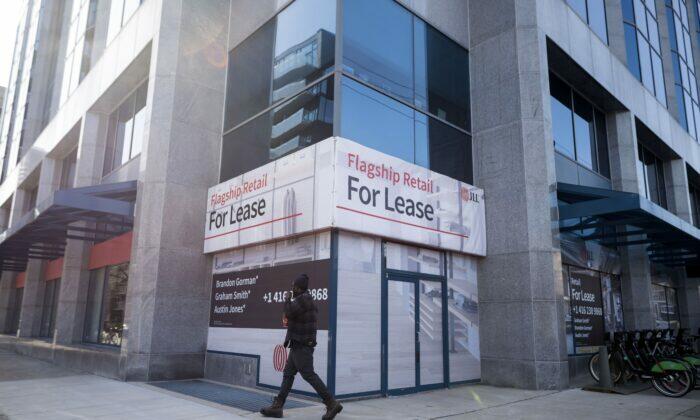
Fast forward to 2023. Three years after the onset of the lockdowns, many offices remain half empty. The pre-2020 crowds who ate and shopped in the underground area beneath the towers are far smaller. In fact, before the lockdowns the underground was overcrowded to the point of being an introvert’s worst nightmare. The changes in the Toronto Financial District mirror the story of most downtown cores of major cities across North America, if not the industrialized world.

The trend of people working from home is here to stay. Office space is expensive, and in the case of many workers, any drop in productivity is offset by the savings in rent. Unlike those of us who worked in the 1980s, we now have video conferencing, email, and all sorts of tools to help us work. In my case, I spent most of my time alone analyzing investments, portfolios, and the economy. Coming into the office wasted my time. I was ahead of my time. The one-way commuting time in cities like New York, Los Angeles, and Toronto average one hour. Working from home literally gives workers significantly more time to actually live. They can now avoid being stuck in traffic or being crushed by other people taking public transportation, some of whom seem to have not showered since the last financial crisis.

If these were not reasons enough to eschew large office buildings, the downtown areas have become dirty and dangerous. One block away from Scotiabank’s head office in Toronto earlier this year, an 89-year-old woman was violently shoved to the ground by a thug and killed right outside Starbucks. I have bought my morning coffee over a thousand times at that location. It was in broad daylight, right before the lunch hour. Wild-eyed junkies come out at night, and a few blocks away you can buy drugs near restaurants where the upper classes feast on $200 meals.

What do these lamentations about the demise of financial districts have to do with the outlook for commercial real estate? My point is to emphasize that commercial real estate is entering a perfect storm the likes of which we’ve never seen on a systemic level. Individual cities like Detroit have collapsed and many Wall Street firms moved to mid-town beginning in the 1970s, but this is now happening in most cities.

A societal change in the desirability and need to work in large downtown office buildings is occurring. This reality will hit home due to our current financial problems. Office real estate with be hammered, and unlike the past this is a secular change coinciding with a cyclical downturn. Profitable office real estate relies on a few parameters. It is actually a very simple business. A landlord charges rent. After expenses, the landlord makes income. If rents increase, the value of the property goes up and more rent can be charged. The building can be sold at a large profit.

The largest expense for a landlord is usually interest costs. That is because of debt. A landlord may buy a building for $100 million using $20 million in equity and $80 million in debt. (Obviously this is a theoretical example for illustrative purposes. The owner will take out a loan for a few years at, for example, 3 percent. In this case interest would cost $2.4 million. If the building is fully occupied, rents collected total $6 million and operating costs are $1 million, the landlord will make $2.6 million. His return on his $20 million in equity is 13 percent ($2.6 million divided by $20 million). (Again, this is just an illustration).

This works out great both in theory and in practice. Rents eventually go up and the value of the building goes up. The landlord is happy, the tenants are happy if the building is well managed, and the bankers are also happy because they are earning $2.4 million on a property with a collateral value of $100 million. That interest eventually goes to the bank’s depositors and shareholders. Everyone wins. Ain’t capitalism grand!

We have gone through a prolonged period of artificially low interest rates that were below inflation. That era ended in late 2020 as inflation spiked. Real estate companies became reliant on these historically unprecedented low rates. Now with rates rising dramatically and in a short period of time, the commercial real estate sector, especially in the office building subsector, is at the beginning of a perfect storm. As leases expire, tenants will reduce the amount of square footage they will rent. Consequently, vacancy rates will soar. Landlords will have to cut rents to keep tenants. Lower rents plus increased vacancy rates will result in cratering revenue.

If this was not bad enough, as loans mature they will be renewed at significantly higher rates. Real estate investments that were once cash cows will become bottomless money pits. This vicious circle continues as the value of these properties drops. Banks will see the value of their collateral drop and therefore not be able to roll over the entire loan. Our hypothetical building now has negative equity—the amount of the loan is higher than the value of the building.

Banks will be negatively impacted as the commercial real estate market falls. Anyone exposed to banks through their mutual funds and pension plans will see their wealth decline. Public and private pension plans are significant investors in real estate. If this situation gets as bad as some think it will, pension plans may also struggle with their liabilities.

Artificially low rates and the deterioration of our once great cities have resulted in a dire situation that will affect us all. We are in a great reckoning. Although it may seem strange, our desire for security and ease has made things less secure and more difficult. In retrospect, the homeless junkies who begged you for change over the years were a harbinger of bad times.

Tyler Durden
Sat, 03/25/2023 – 12:30

via ZeroHedge News https://ift.tt/itF4BMA Tyler Durden

America’s Average Apartment Size Plunges

America’s Average Apartment Size Plunges

The idea of living in a Manhattan-style micro apartment has become a reality for many Americans renting new apartments. 

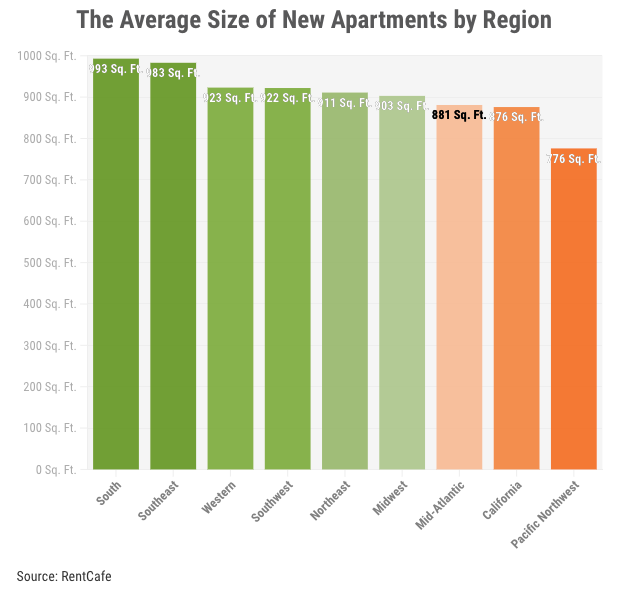
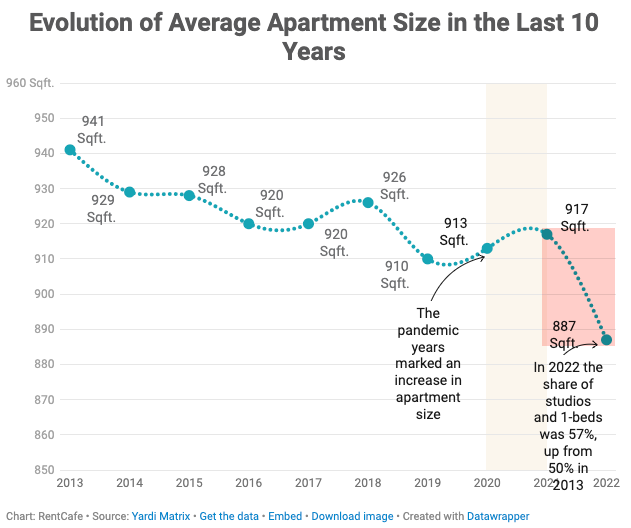
According to a new report, the average size of new apartments in 2022 was 887 square feet — a 54-square-foot drop since a decade ago. But in the last year, apartment sizes have plunged 30 square feet.

Real estate firm RentCafe attributed the plunge in average apartment sizes to an increase in the construction of more studio and one-bedroom units. 

The smallest apartments, on average, were in the Pacific Northwest. 

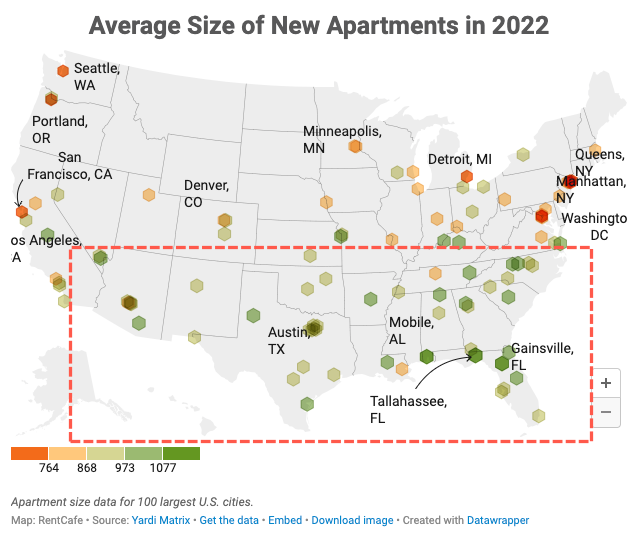
For those searching for more space and cheaper rents, try searching in the Southern US. 

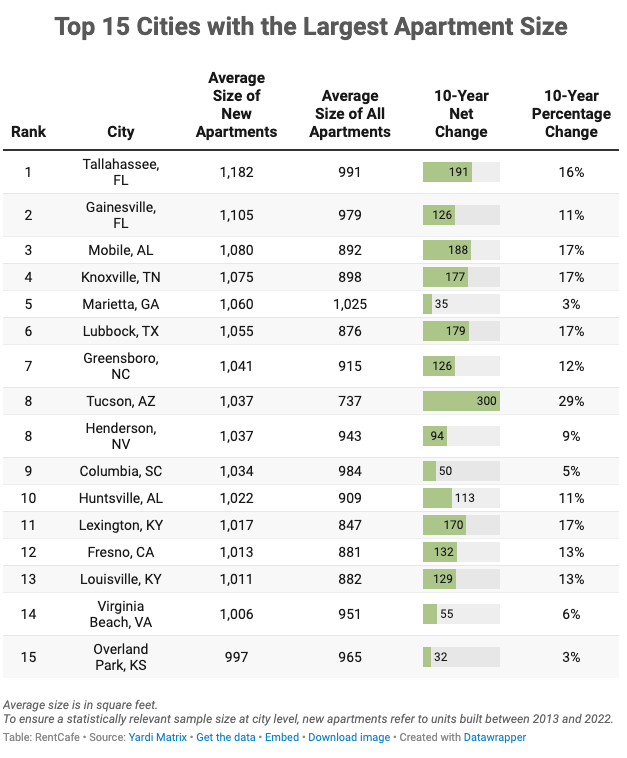
Here are the top 15 cities with the largest apartment sizes.

And the top 15 cities with the smallest apartment sizes. 

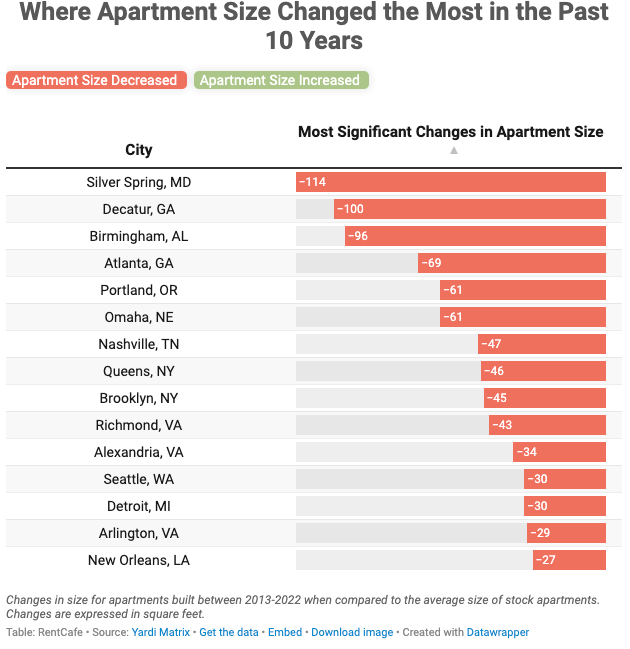
Silver Spring, Maryland, apartments saw the biggest decrease in size over the last ten years. 

 Meanwhile, in Tucson, Arizona, apartments saw the largest increase. 

To avoid renting an overpriced micro apartment, most Americans will have to migrate south.

Tyler Durden
Sat, 03/25/2023 – 12:00

via ZeroHedge News https://ift.tt/kHJZghb Tyler Durden

Top General Admits Pentagon Is Training Coup Leaders In Africa

Top General Admits Pentagon Is Training Coup Leaders In Africa

Authored by Dave DeCamp via AntiWar.com,

Gen. Michael Langley, the head of US Africa Command (AFRICOM), was grilled by Rep. Matt Gaetz (R-FL) on Thursday about African soldiers who received US military training and went on to carry out coups.

Langley insisted only a “very small number” of Africans who receive US training later go on to be involved in coups against civilian governments and said the programs focus on “core values.”

When asked by Gaetz if the US shares “core values” with Guinea coup leader Col. Mamady Doumbouy, Langley replied, “Absolutely … In our curriculum, we do.” Doumboy and his forces carried out a coup in 2021 while US Green Berets were in the country training them, and he still leads Guinea to this day.

Gaetz also referenced a January 2022 coup in Burkina Faso, which was led by Lt. Col. Paul-Henri Sandaogo Damib, who had a long history of participating in US training exercises. Later that year, in September 2022, Damib was ousted in another coup led by Capt. Ibrahim Traore. When asked by journalist Nick Turse if Traore also received US training, the Pentagon said it didn’t know.

Writing for Responsible Statecraft, Turse said since 2008, US-trained soldiers in Africa have “attempted at least nine coups (and succeeded in at least eight) across five West African countries, including Burkina Faso (three times), Guinea, Mali (three times), Mauritania, and the Gambia.”

Langley insisted that the “core values” AFRICOM’s training focuses on include “respect for civilian governance” and said the command will “continue with our persistence in assuring that they harbor democratic norms, democratic values, apolitical.” Gaetz said those values aren’t sticking.

“Just a moment ago, you said we shared core values with Colonel Doumbouya. You said that just moments ago in response to my question, and his core value seems to be leading a coup. So I don’t think it has stuck. I think we should at least know how many countries we train the coup plotters,” he said.

Tyler Durden
Sat, 03/25/2023 – 11:30

via ZeroHedge News https://ift.tt/glBrbEm Tyler Durden

Oil Companies Fail to Convince the Eighth Circuit Climate Cases Should Be Removed to Federal Court

On Thursday, a unanimous panel of the U.S. Court of Appeals for the Eighth Circuit rejected arguments by fossil fuel companies that state-law-based tort claims concerning climate change should be heard in federal court. On this basis the panel in Minnesota v. American Petroleum Institute affirmed the district court’s remand of the case to state court.

Judge Kobes wrote for the court, joined by Judges Grasz and Stras, making quick work of the various arguments for removal. The arguments here are straight-forward, and align with the conclusions of the five other federal circuit courts to have considered such claims (the 1st, 3rd, 4th, 6th, and 9th Circuits). [This post is long, so the rest is below the jump.]

 Of particular interest (to me at least) the Court explained why the oil companies were mistaken to argue that state-law-based climate change claims are completely preempted by federal law. (Note that to justify removal, the defendant oil companies have to demonstrate complete preemption of the state law claims, not mere federal preemption, and this is a higher hurdle to clear.)

To determine whether a state-law claim is completely preempted, we ask whether Congress intended a federal statute to provide “the exclusive cause of action for the claim asserted and also set forth procedures and remedies governing that cause of action.” Beneficial Nat’l Bank, 539 U.S. at 8. Because “[t]he lack of a substitute federal [cause of] action would make it doubtful that Congress intended” to preempt state-law claims, “without a federal cause of action which in effect replaces a state law claim, there is an exceptionally strong presumption against complete preemption.” Johnson, 701 F.3d at 252. Complete preemption is very rare. The Supreme Court has applied it to only three statutes: § 301 of the Labor Management Relations Act, Avco Corp. v. Aero Lodge No. 735, 390 U.S. 557, 560–61 (1968); § 502(a) of ERISA, Metro. Life Ins. Co. v. Taylor, 481 U.S. 58, 66 (1987); and §§ 85 and 86 of the National Bank Act, Beneficial Nat’l Bank, 539 U.S. at 10–11.

Contrary to the Energy Companies’ insistence, federal common law on transboundary pollution does not completely preempt Minnesota’s claims. At several points in our nation’s history, courts have applied federal common law to public nuisance claims involving transboundary air or water pollution. Boulder III, 25 F.4th at 1258–61 (detailing the history of federal common law in pollution cases); City of New York v. Chevron Corp., 993 F.3d 81, 91 (2d Cir. 2021) (collecting cases). And the Second Circuit recently held that federal common law still provides a defense—ordinary preemption—to state-law public nuisance. New York, 993 F.3d at 94–95. Though, there is a serious question about whether, and to what extent, this area of federal common law survived subsequent federal environmental legislation.

Even if federal common law still exists in this space and provides a cause of action to govern transboundary pollution cases, that remedy doesn’t occupy the same substantive realm as state-law fraud, negligence, products liability, or consumer protection claims. There is no substitute federal cause of action for the state-law causes of action Minnesota brings, which means we apply the strong presumption against complete preemption. And more importantly, the federal law at issue is common law, not statutory. Because Congress has not acted, the presence of federal common law here does not express Congressional intent of any kind—much less intent to completely displace any particular state-law claim. Boulder III, 25 F.4th at 1262.

Because Congress has not acted to displace the state-law claims, and federal common law does not supply a substitute cause of action, the state-law claims are not completely preempted.

As Judge Kobes notes, the U.S. Court of Appeals for the Second Circuit concluded that similar claims were preempted by federal law. That court did not need to reach the question of  complete preemption, however, as that case had been filed in federal court and there was thus no need to context removal. Also, for what it’s worth, I believe the Second Circuit bollixed the preemption analysis for reasons I explain in this post and this article.

Judge Stras wrote separately to address the seemingly anomalous result that concerns about transboundary pollution are able to brought in state court rather than federal court. I agree with Judge Stras’s suggestion that this is odd, and that problems like climate change are better addressed at the federal level than the state level. Yet for reasons I explain below, fixing this qould require more than relaxing the standard for complete preemption or removal.

Here are some excerpts from Judge Stras’s opinion:

Artful pleading comes in many forms. This is one of them. Minnesota purports to bring state-law consumer-protection claims against a group of energy companies. But its lawsuit takes aim at the production and sale of fossil fuels worldwide. I agree with the court that, as the law stands now, the suit does not “aris[e] under” federal law. 28 U.S.C. § 1331. I write separately, however, to explain why it should. . . .

There is no hiding the obvious, and Minnesota does not even try: it seeks a global remedy for a global issue. According to the complaint, energy production has “caused a substantial portion of global atmospheric greenhouse-gas concentrations.” Those gases, the argument goes, have resulted in “climate change”—a label that appears in the complaint over 200 times. The relief sought is ambitious too: a far-reaching injunction, restitution, and disgorgement of “all profits made as a result of [the companies’] unlawful conduct.” . . .

Minnesota has strong views about how to deal with the issue. Other states do too. . . . This is, in effect, an interstate dispute.

Not surprisingly, disputes between states are as old as the country itself. . . . Interstate disputes were so common and complicated, in fact, that the Framers specifically vested original jurisdiction over them in the Supreme Court. . . . The rule of decision in these cases has always been “known and settled principles of national or municipal jurisprudence”—what we now know as the federal common law. . . .

State law is no substitute. . . . When it comes to “outside nuisances” like this one, courts have long looked to common-law principles like “considerations [of] equity,” “quasi-sovereign interests,” and the need for “caution.” Georgia v. Tenn. Copper Co., 206 U.S. 230, 237–38 (1907) (emphasis omitted); . . . Applying state law, by contrast, only raises the risk of conflict between states, which never “agree[d] to submit to whatever might be done” to their citizens. . . . For that reason, state law has never “st[oo]d in the way” of using “recognized” (federal) common-law principles. . . . see The Federalist No. 80 (Alexander Hamilton) (“Whatever practices may have a tendency to disturb the harmony between the States, are proper objects of federal superintendence and control.”).

The point is that federal law still reigns supreme in these types of disputes, notwithstanding Erie’s famous declaration that “[t]here is no federal general common law.” Erie R.R. Co. v. Tompkins, 304 U.S. 64, 78 (1938); . . . The reason is the “‘overriding . . . need for a uniform rule of decision’ on matters influencing national energy and environmental policy.” City of New York, 993 F.3d at 91–92 (quoting Illinois v. City of Milwaukee, 406 U.S. 91, 105 n.6 (1972), superseded by statute, Federal Water Pollution Control Act Amendments of 1972, Pub. L. No. 92-500, 86 Stat. 816). As the Second Circuit has put it in circumstances like these, conflicts between states with different tolerances for greenhouse-gas emissions can only be resolved at the federal level because of the “unique[] federal interests” involved. . . .

Today’s lawsuit is as good an example as any. . . .

The problem, of course, is that the state’s attempt to set national energy policy through its own consumer-protection laws would “effectively override . . . the policy choices made by” the federal government and other states. Ouellette, 479 U.S. at 495. Regulating the production and sale of fossil fuels worldwide, in other words, is “simply beyond the limits of state law.” City of New York, 993 F.3d at 92. . . .

The complaint itself all but dares the companies to raise a federal-preemption defense. And no one doubts that they will or that it will be the focal point of the litigation. There is no reason for the removal rules to operate in such a confounding way.

And at one point, they didn’t. See Tennessee v. Union & Planters’ Bank, 152 U.S. 454, 460 (1894) (collecting cases). If there was a “real and substantial dispute or controversy which depend[ed] altogether upon the construction and effect of an act of Congress,” even if “the claim . . . might[] possibly be determined by reference alone to State enactments,” it was removable. R.R. Co. v. Mississippi, 102 U.S. 135, 140 (1880); see Union & Planters’ Bank, 152 U.S. at 460–62 (discussing the history). Perhaps for a “uniquely federal interest[]” like interstate pollution, it should still be that way. City of New York, 993 F.3d at 90; see Franchise Tax Bd., 463 U.S. at 11–12 (describing the well-pleaded complaint rule “as a quick rule of thumb” that “may produce awkward results”).

But only Congress or the Supreme Court gets to make that call. And we have our marching orders: even the strongest arguments for removal don’t work here.

I agree with Judge Stras that it is odd that these sorts of cases are being brought in state court under state law, and cannot be brought under federal law. The problem, however, is not that current removal jurisprudence is particularly stingy. The problem is that under current law — Milwaukee II and AEP v. Connecticut in particular, there is no federal law to govern the dispute, and thus no federal law to preempt the state law claims (a point I explain at greater length here).

Under Milwaukee II and AEP, the federal common law of interstate nuisance is displaced by the enactment of the Clean Water Act and Clean Air Act, leaving only state law to address such claims, a point the Supreme Court expressly affirmed in Ouellette. Put another way, even if the cases could be removed (and contrary to the conclusions of the Second Circuit in CIty of New York v. Chevron, there would still be no federal law to preempt the state law claims.

Federal common law can have preemptive effect, as Judge Stras notes, but that requires there to be federal common law, and the federal common law of interstate nuisance has been displaced. Further, neither the Clean Water Act nor the Clean Air Act preempts state-law claims of this sort. Indeed, contrary to the Second Circuit’s analysis, pollution control has historically been handled under state law (whether through common law causes of action or state and local regulation). Federal pollution control statutes were enacted against this background of state law, and only preempt state law in a few narrow instances (usually involving goods that are sold across state lines). Thus even if one were to adopt a broad notion of field or conflict preemption, it is still exceedingly difficult to argue that federal law—in this case, the Clean Air Act—was intended to preempt state-law-based claims arising out of climate change concerns.

Congress could change this state of affairs by enacting a federal climate change statute that preempts or constrains state law claims, but it has yet to do so. Indeed, other than the Infliation Reduction Act [sic], a spending bill, Congress has never enacted a statute for the purpose of controlling greenhouse gases or otherwise mitigating climate change. (It has enacted a few small statutes that have such effect, such as laws implementing international treaties concerning ozone-depleting substances, but the purpose of such laws was not to address greenhouse gases as such).

The Supreme Court could also address Judge Stras’s concern. Yet, as indicated above, a more permissive removal doctrine would not do the trick. Unless the justices are inclined to invent a good-for-climate-change-only carve out to existing doctrine, the only way for the Court to allow for the preemption of state law claims would be to resurrect the federal common law of interstate nuisance, and this would require overturning the doctrine of displacement announced in Milwaukee II and applied to air pollution in AEP.

Overturning Milwaukee II would be a dramatic step. Nonetheless, I would be okay with this result, as I believe the doctrine of displacement was invented to relieve the Court of having to consider interstate pollution disputes under its original jurisdiction. In my view, the displacement doctrine makes little sense in those contexts in which there needs to be federal law, such as in the context of interstate pollution, as it makes it too easy to eliminate federal common law causes of action, particularly where Congress has neither indicated its intention to displace such claims nor created a viable substitute.

A better approach would be to allow federal common law to operate unless preempted. The analysis here should be similar to what occurs under state law all the time. When states enact pollution control statutes (as they did long before the federal government got into the act), state courts would consider whether state legislatures expressly or necessarily barred state law claims from operating. The result is a test that it far more difficult to meet than under existing displacement doctrine, but a little bit more permissive than federal preemption doctrine under cases like Virginia Uranium (as the federalism concerns that may justify a presumption against preemption are not in play when a sovereign is preempting its own common law). It would also be perfectly fine for Congress to preempt all climate-based litigation in the process of enacting a meaningful climate policy, such as a carbon tax. (Indeed, I would support such a move.)

What would not be a satisfactory or justifiable outcome would be for the Supreme Court to hold that climate-related claims can be removed and preempted by a federal common law that otherwise does not exist for the purpose of bringing climate-based claims. Such overt policy-making is not the province of federal courts, and a Court holding to such effect, in the absence of such an instruction from Congress, would be lawless and unprincipled. And this is all the more reason why Congress needs to get off the climate policy sidelines.

The post Oil Companies Fail to Convince the Eighth Circuit Climate Cases Should Be Removed to Federal Court appeared first on Reason.com.

from Latest https://ift.tt/5YvRgnV
via IFTTT

Shocking Video Shows Chocolate Factory Explosion In Pennsylvania

Shocking Video Shows Chocolate Factory Explosion In Pennsylvania

Update

An explosion at a chocolate factory in Pennsylvania on Friday resulted in the tragic loss of five lives, with six individuals still unaccounted for.

*   *   * 

On Friday evening, a devastating explosion rocked a chocolate factory in Pennsylvania, tragically leaving two people dead, nine unaccounted for, and eight others injured.

West Reading Borough Police Department Chief Wayne Holben confirmed to Fox News the blast occurred at the R.M. Palmer Co. chocolate factory in West Reading, about 60 miles northwest of Philadelphia, around 1700 ET. 

Shocking footage of the explosion emerged on social media. 

“The explosion was so big that it moved that building four feet forward,” Mayor Samantha Kaag told reporters. She said, “It wasn’t a great scene to come into. It was pretty scary.” 

Kaag said she felt the explosion at her home, four or five blocks from the factory.

“I didn’t hear a boom,” she said. “I just felt it shake my house.”

Law enforcement officials stated that the cause of the explosion is currently under investigation. This incident adds to the increasing number of food processing plants throughout the US experiencing fires or, in this instance, devastating explosions.

Tyler Durden
Sat, 03/25/2023 – 11:00

via ZeroHedge News https://ift.tt/oRfL0kG Tyler Durden

Das: Is A Full-Blown Global Banking Crisis In The Offing?

Das: Is A Full-Blown Global Banking Crisis In The Offing?

Authored by Styajit Das via NewIndianExpress.com,

If everything is fine, then why are US banks borrowing billions at punitive rates at the discount window… a larger amount than in 2008/9?
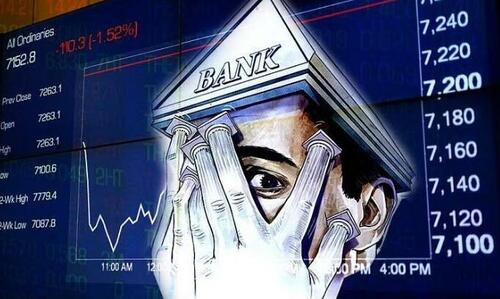
Financial crashes like revolutions are impossible until they are inevitable. They typically proceed in stages. Since central banks began to increase interest rates in response to rising inflation, financial markets have been under pressure.

In 2022, there was the crypto meltdown (approximately $2 trillion of losses).

The S&P500 index fell about 20 percent. The largest US technology companies, which include Apple, Microsoft, Alphabet and Amazon, lost around $4.6 trillion in market value  The September 2022 UK gilt crisis may have cost $500 billion. 30 percent of emerging market countries and 60 percent of low-income nations face a debt crisis. The problems have now reached the financial system, with US, European and Japanese banks losing around $460 billion in market value in March 2023.

While it is too early to say whether a full-fledged financial crisis is imminent, the trajectory is unpromising.

***

The affected US regional banks had specific failings. The collapse of Silicon Valley Bank (“SVB”) highlighted the interest rate risk of financing holdings of long-term fixed-rate securities with short-term deposits. SVB and First Republic Bank (“FRB”) also illustrate the problem of the $250,000 limit on Federal Deposit Insurance Corporation (“FDIC”) coverage. Over 90 percent of failed SVB and Signature Bank as well as two-thirds of FRB deposits were uninsured, creating a predisposition to a liquidity run in periods of financial uncertainty.

The crisis is not exclusively American. Credit Suisse has been, to date, the highest-profile European institution affected. The venerable Swiss bank — which critics dubbed  ‘Debit Suisse’ — has a troubled history of banking dictators, money laundering, sanctions breaches, tax evasion and fraud, shredding documents sought by regulators and poor risk management evidenced most recently by high-profile losses associated with hedge fund Archegos and fintech firm Greensill. It has been plagued by corporate espionage, CEO turnover and repeated unsuccessful restructurings.

In February 2023, Credit Suisse announced an annual loss of nearly Swiss Franc 7.3 billion ($7.9 billion), its biggest since the financial crisis in 2008. Since the start of 2023, the bank’s share price had fallen by about 25 percent. It was down more than 70 percent over the last year and nearly 90 percent over 5 years. Credit Suisse wealth management clients withdrew Swiss Franc 123 billion ($133 billion) of deposits in 2022, mostly in the fourth quarter.

The categoric refusal — “absolutely not” — of its key shareholder Saudi National Bank to inject new capital into Credit Suisse precipitated its end. It followed the announcement earlier in March that fund manager Harris Associates, a longest-standing shareholder, had sold its entire stake after losing patience with the Swiss Bank’s strategy and questioning the future of its franchise.

While the circumstances of individual firms exhibit differences, there are uncomfortable commonalities – interest rate risk, uninsured deposits and exposure to loss of funding.

***

Banks globally increased investment in high-quality securities — primarily government and agency backed mortgage-backed securities (“MBS”). It was driven by an excess of customer deposits relative to loan demand in an environment of abundant liquidity. Another motivation was the need to boost earnings under low-interest conditions which were squeezing net interest margin because deposit rates were largely constrained at the zero bound. The latter was, in part, driven by central bank regulations which favour customer deposit funding and the risk of loss of these if negative rates are applied.

Higher rates resulted in unrealised losses on these investments exceeding $600 billion as at end 2022 at
Federal Deposit Insurance Corporation-insured US banks. If other interest-sensitive assets are included, then the loss for American banks alone may be around $2,000 billion. Globally, the total unrealised loss might be two to three times that.

Pundits, most with passing practical banking experience, have criticised the lack of hedging. The reality is that eliminating interest rate risk is costly and would reduce earnings. While SVB’s portfolio’s duration was an outlier, banks routinely invest in 1- to 5-year securities and run some level of the resulting interest rate exposure.

Additional complexities inform some investment portfolios. Japanese investors have large holdings of domestic and foreign long-maturity bonds. The market value of these fixed-rate investments have fallen. While Japanese short-term rates have not risen significantly, rising inflationary pressures may force increases that would reduce the margin between investment returns and interest expense reducing earnings.

It is unclear how much of the currency risk on these holdings of Japanese investors is hedged. A fall in the dollar, the principal denomination of these investments, would result in additional losses. The announcement by the US Federal Reserve (“the Fed”) of coordinated action with other major central banks (Canada, England, Japan, Euro-zone and Switzerland) to provide US dollar liquidity suggests ongoing issues in hedging these currency exposures.

Banking is essentially a confidence trick because of the inherent mismatch between short-term deposits and longer-term assets. As the rapid demise of Credit Suisse highlights, strong capital and liquidity ratios count for little when depositors take flight.

Banks now face falling customer deposits as monetary stimulus is withdrawn, the build-up of savings during the pandemic is drawn down and the economy slows. In the US, deposits are projected to decline by up to 6 percent. Financial instability and apprehension about the solvency of individual institutions can, as recent experience corroborates, result in bank runs.

***

The fact is that events have significantly weakened the global banking system. A 10 percent loss on bank bond holdings would, if realised, decrease bank shareholder capital by around a quarter. This is before potential loan losses, as higher rates affect interest-sensitive sectors of the economy, are incorporated.

One vulnerable sector is property, due to high levels of leverage generally employed.

House prices are falling albeit from artificially high pandemic levels. Many households face financial stress due to high mortgage debt, rising repayments, cost of living increases and lagging real income. Risks in commercial real estate are increasing. The construction sector globally shows sign of slowing down. Capital expenditure is decreasing because of uncertainty about future prospects. Higher material and energy costs are pushing up prices further lowering demand.

Heavily indebted companies, especially in cyclical sectors like non-essential goods and services and many who borrowed heavily to get through the pandemic will find it difficult to repay debt. The last decade saw an increase in leveraged purchases of businesses. The value of outstanding US leveraged loans used in these transactions nearly tripled from $500 billion in 2010 to around $1.4 trillion as of August 2022, comparable to the $1.5 trillion high-yield bond market. There were similar rises in Europe and elsewhere.

Business bankruptcies are increasing in Europe and the UK although they fell in the US in 2022. The effects of higher rates are likely to take time to emerge due to staggered debt maturities and the timing of re-pricing. Default rates are projected to rise globally resulting in bank bad debts, reduced earnings and erosion of capital buffers.

***

There is a concerted effort by financial officials and their acolytes to reassure the population and mainly themselves of the safety of the financial system. Protestations of a sound banking system and the absence of contagion is an oxymoron. If the authorities are correct then why evoke the ‘systemic risk exemption’ to guarantee all depositors of failed banks? If there is liquidity to meet withdrawals then why the logorrhoea about the sufficiency of funds? If everything is fine, then why have US banks borrowed $153 billion at a punitive 4.75% against collateral at the discount window, a larger amount than in 2008/9? Why the compelling need for authorities to provide over $1 trillion in money or force bank mergers?

John Kenneth Galbraith once remarked that “anyone who says he won’t resign four times, will“. In a similar vein, the incessant repetition about the absence of any financial crisis suggests exactly the opposite.

***

The essential structure of the banking is unstable, primarily because of its high leverage where around $10 of equity supports $100 of assets. The desire to encourage competition and diversity, local needs, parochialism and fear of excessive numbers of systemically important and ‘too-big-to-fail’ institutions also mean that there are too many banks.

There are over 4,000 commercial banks in the US insured by the FDIC with nearly $24 trillion in assets, most of them small or mid-sized. Germany has around 1,900 banks including 1,000 cooperative banks, 400 Sparkassen, and smaller numbers of private banks and Landesbanken. Switzerland has over 240 banks with only four (now three) major institutions and a large number of cantonal, regional and savings banks.

Even if they were adequately staffed and equipped, managers and regulators would find it difficult to monitor and enforce rules. This creates a tendency for ‘accidents’ and periodic runs to larger banks.

Deposit insurance is one favoured means of ensuring customer safety and assured funding. But that entails a delicate balance between consumer protection and moral hazard – concerns that it might encourage risky behaviour. There is the issue of the extent of protection.

In reality, no deposit insurance system can safeguard a banking system completely, especially under conditions of stress. It would overwhelm the sovereign’s balance sheet and credit. Banks and consumers would ultimately have to bear the cost.

Deposit insurance can have cross-border implications. Thought bubbles like extending FDIC deposit coverage to all deposits for even a limited period can transmit problems globally and disrupt currency markets. If the US guarantees all deposits, then depositors might withdraw money from banks in their home countries to take advantage of the scheme setting off an international flight of capital. The movement of funds would aggravate any dollar shortages and complicate hedging of foreign exchange exposures. It may push up the value of the currency inflicting losses on emerging market borrowers and reducing American export competitiveness.

In effect, there are few if any neat, simple answers.

***

This means the resolution of any banking crisis relies, in practice, on private sector initiatives or public bailouts.

The deposit of $30 billion at FRB by a group of major banks is similar to actions during the 1907 US banking crisis and the 1998 $3.6 billion bailout of hedge fund Long-Term Capital Management. Such transactions, if they are unsuccessful, risk dragging the saviours into a morass of expanding financial commitments as may be the case with FRB.

A related option is the forced sale or shotgun marriage. It is unclear how given systemic issues in banking, the blind lending assistance to the deaf and dumb strengthens the financial system. Given the ignominious record of many bank mergers, it is puzzling why foisting a failing institution onto a healthy rival constitutes sound policy.

HSBC, which is purchasing SVB’s UK operations, has a poor record of acquisitions that included Edmond Safra’s Republic Bank which caused it much embarrassment and US sub-prime lender Household International just prior to the 2008 crisis. The bank’s decision to purchase SVB UK for a nominal £1 ($1.20) was despite a rushed due diligence and admissions that it was unable to fully analyse 30 percent of the target’s loan book. It was justified as ‘strategic’ and the opportunity to win new start-up clients.

On 19 March 2023, Swiss regulators arranged for a reluctant UBS, the country’s largest bank, to buy Credit Suisse after it become clear that an emergency Swiss Franc 50 billion ($54 billion) credit line provided by the Swiss National Bank was unlikely to arrest the decline. UBS will pay about Swiss Franc 0.76 a share in its own stock, a total value of around Swiss Franc 3 billion ($3.2 billion). While triple the earlier proposed price, it is nearly 60 percent lower than CS’s last closing price of Swiss Franc1.86.

Investors cheered the purchase as a generational bargain for UBS. This ignores Credit Suisse’s unresolved issues including toxic assets and legacy litigation exposures. It was oblivious to well-known difficulties in integrating institutions, particularly different business models, systems, practices, jurisdictions and cultures. The purchase does not solve Credit Suisse’s fundamental business and financial problems which are now UBS’s.

It also leaves Switzerland with the problem of concentrated exposure to a single large bank, a shift from its hitherto preferred two-bank model. Analysts seemed to have forgotten that UBS itself had to be supported by the state in 2008 with taxpayer funds after suffering large losses to avoid the bank being acquired by foreign buyers.

***

The only other option is some degree of state support.

The UBS acquisition of Credit Suisse requires the Swiss National Bank to assume certain risks. It will provide a Swiss Franc 100 billion ($108 billion) liquidity line backed by an enigmatically titled government default guarantee, presumably in addition to the earlier credit support. The Swiss government is also providing a loss guarantee on certain assets of up to Swiss Franc 9 billion ($9.7 billion), which operates after UBS bears the first Swiss Franc 5 billion ($5.4 billion) of losses.

The state can underwrite bank liabilities including all deposits as some countries did after 2008. As US Treasury Secretary Yellen reluctantly admitted to Congress, the extension of FDIC coverage was contingent on US officials and regulators determining systemic risk as happened with SVB and Signature. Another alternative is to recapitalise banks with public money as was done after 2008 or finance the removal of distressed or toxic assets from bank books.

Socialisation of losses is politically and financially expensive.

Despite protestations to the contrary, the dismal truth is that in a major financial crisis, lenders to and owners of systemic large banks will be bailed out to some extent.

European supervisors have been critical of the US decision to break with its own standard of guaranteeing only the first $250,000 of deposits by invoking a systemic risk exception while excluding SVB as too small to be required to comply with the higher standards applicable to larger banks. There now exist voluminous manuals on handling bank collapses such as imposing losses on owners, bondholders and other unsecured creditors, including depositors with funds exceeding guarantee limit, as well as resolution plans designed to minimise the fallout from failures. Prepared by expensive consultants, they serve the essential function of satisfying regulatory checklists. Theoretically sound reforms are not consistently followed in practice. Under fire in trenches, regulators concentrate on more practical priorities.

The debate about bank regulation misses a central point. Since the 1980s, the economic system has become addicted to borrowing-funded consumption and investment. Bank credit is central to this process. Some recommendations propose a drastic reduction in bank leverage from the current 10-to-1 to a mere 3-to1. The resulting contraction would have serious implications for economic activity and asset values.

In Annie Hall, Woody Allen cannot have his brother, who thinks he is a chicken, treated by a psychiatrist because the family needs the eggs. Banking regulation flounders on the same logic.

As in all crises, commentators have reached for the 150-year-old dictum of Walter Bagehot in Lombard Street that a central bank’s job is “to lend in a panic on every kind of current security, or every sort on which money is ordinarily and usually lent.”

Central bankers are certainly lending, although advancing funds based on the face value of securities with much lower market values would not seem to be what the former editor of The Economist had in mind. It also ignores the final part of the statement that such actions “may not save the bank; but if it do not, nothing will save it.”

Banks everywhere remain exposed. US regional banks, especially those with a high proportion of uninsured deposits, remain under pressure.

European banks, in Germany, Italy and smaller Euro-zone economies, may be susceptible because of poor profitability, lack of essential scale, questionable loan quality and the residual scar tissue from the 2011 debt crisis.

Emerging market banks’ loan books face the test of an economic slowdown. There are specific sectoral concerns such as the exposure of Chinese banks to the property sector which has necessitated significant ($460 billion) state support.

Contagion may spread across a hyper-connected financial system from country to country and from smaller to larger more systematically important banks. Declining share prices and credit ratings downgrades combined with a slowdown in inter-bank transactions, as credit risk managers become increasingly cautious, will transmit stress across global markets.

For the moment, whether the third banking crisis in two decades remains contained is a matter of faith and belief. Financial markets will test policymakers’ resolve in the coming days and weeks.
Tyler Durden
Sat, 03/25/2023 – 10:30

via ZeroHedge News https://ift.tt/4XMQpf2 Tyler Durden

Ex-Morgan Stanley Adviser Stole Millions From NBA Players

Ex-Morgan Stanley Adviser Stole Millions From NBA Players

Ex-Morgan Stanley investment advisor Darryl Cohen and three accomplices were charged with allegedly defrauding current and former NBA players out of millions of dollars. 

In the indictment, which was unsealed on Thursday, Damian Williams, the United States Attorney for the Southern District of New York, and Michael J. Driscoll, the Assistant Director in Charge of the New York Field Office of the Federal Bureau of Investigation, said Darryl Cohen, NBA agent Charles Briscoe, financial planner Brian Gilder, and Calvin Darden were involved in “two schemes to defraud professional basketball players.”

The DoJ said Cohen, Briscoe, Gilder, and Darden were all arrested yesterday morning. 

COHEN and GILDER were arrested this morning in, respectively, Chatsworth, California, and North Ridge, California, and will be presented later today in the United States District Court for the Central District of California. BRISCOE was arrested this morning in Katy, Texas, and will be presented later today in the United States District Court for the Southern District of Texas. DARDEN, JR. was arrested this morning in Atlanta, Georgia, and will be presented later today in the United States District Court for the Northern District of Georgia.

Cohen, the former Morgan Stanley advisor, allegedly directed basketball players to contribute to a nonprofit, which the defendants then used for their own personal gain. The DoJ reported the fraud scheme amounted to over $13 million, affecting four professional basketball players. 

Williams said the four “defendants believed that defrauding their professional athlete clients of millions of dollars would be a layup.” He added:

“That was a huge mistake, and they now face serious criminal charges for their alleged crimes.”

FINRA filings from 2021 show Morgan Stanley fired Cohen due to “transactions not disclosed to or approved by Morgan Stanley and use of an unapproved platform to engage in inappropriate communications with clients.” 


Tyler Durden
Sat, 03/25/2023 – 09:55

via ZeroHedge News https://ift.tt/Mdo4gNG Tyler Durden

World Bank Says Ukraine’s Reconstruction Will Cost $411 Billion & Rising

World Bank Says Ukraine’s Reconstruction Will Cost $411 Billion & Rising

Authored by Dave DeCamp via AntiWar.com,

The World Bank said in a new report that Ukraine’s reconstruction will cost at least $411 billion over the next ten years, a number that will rise as the war drags on.

The report said the $411 billion figure should be seen as a “minimum as needs will continue to rise as long as the war continues.”

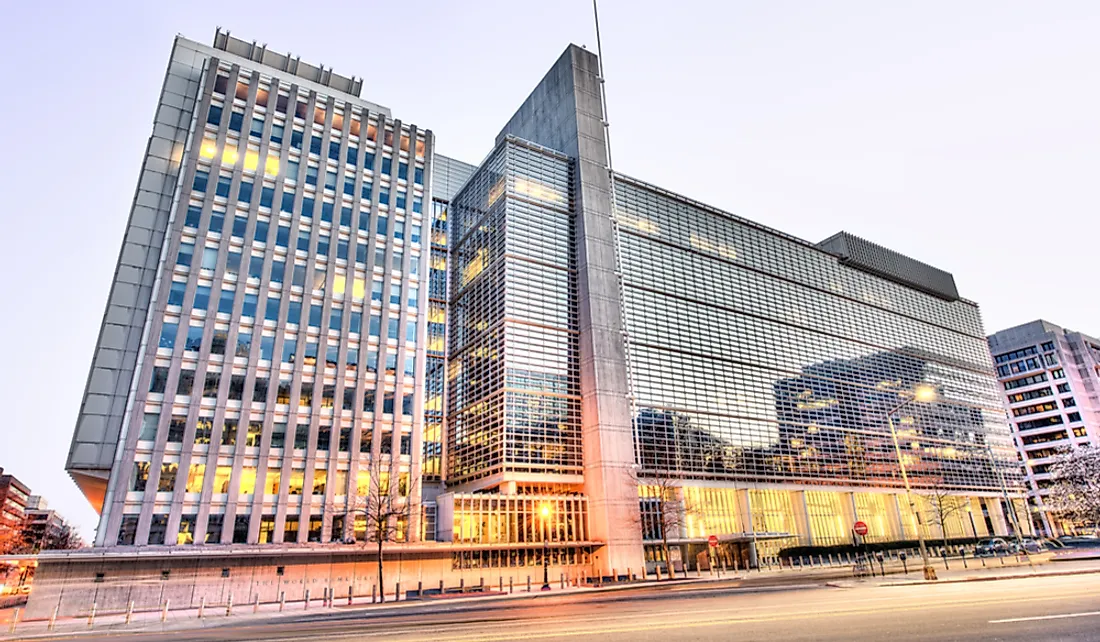
Headquarters of the World Bank in Washington, DC. via Shutterstock

World Bank Vice President Anna Bjerde previously estimated the reconstruction would cost between $525 billion-$630 billion, but the report issued Wednesday was more precise and was produced jointly with the US and Ukrainian governments.

After the new report came out, Bjerde said Ukraine’s reconstruction will take “several years” and will require public investments “complemented by significant private investment to increase the available financing for reconstruction.”

American investment firms and banks are looking to cash in on the reconstruction project. Bankers from JP Morgan Chase visited Ukraine in February and signed a memorandum of understanding with President Volodymyr Zelensky and agreed to help raise private capital for a new fund for Ukraine’s reconstruction.

In January, Zelensky addressed the US National Association of State Chambers and said American corporations would find “big business” in rebuilding Ukraine.

“Everyone can become a big business by working with Ukraine. In all sectors — from weapons and defense to construction, from communications to agriculture, from transport to IT, from banks to medicine,” he said.

The new estimate from the World Bank comes as there is no sign that the fighting in Ukraine will end anytime soon. China recently launched an initiative to try and foster peace talks between the warring sides, but it’s not yet clear if it will lead to real negotiations.

Tyler Durden
Sat, 03/25/2023 – 09:20

via ZeroHedge News https://ift.tt/6YJ5Usg Tyler Durden

The ESG “Cover Your Ass” Tour Begins As Managers Scramble To Remove References In Pitch Decks

The ESG “Cover Your Ass” Tour Begins As Managers Scramble To Remove References In Pitch Decks

It’s bad enough for “asset managers” that ESG stocks and funds are getting pummeled while people look for flights to actual safety, as opposed to unprofitable publicly traded trash with a shiny “green energy approved” label, but now these same managers are being forced to bury their heads in the sand to try and sidestep political scrutiny over their poor investing decisions.

Who could have thought that investing would actually have turned out to be about risk aversion and companies generating actual cash?

Fund managers are now doing damage control for their ESG pitches of years past, Bloomberg wrote this week:

Eleven major banks and money managers told Bloomberg News that they’re adjusting the language they use in pitch books, marketing materials and investor reports when seeking to sell funds and take part in financial deals. In some cases this means avoiding using the ESG acronym and related terms in Republican-led states, while for blue states, they’re playing up their ESG credentials, according to representatives of the financial firms who asked not to be named discussing private information.

In other words, they’re covering up their idiotic investing “strategies” of years past, wherein they picked companies from a list of Greta Thunberg-approved entities, many of whom still likely used questionable labor tactics and had little governance. 

Calling the change a “high wire act”, Bloomberg writes that it also “reflects the dramatic politicization of the $8.4 trillion ESG market, with Republicans firing broadsides at anything connected with pursuing environmental, social or good governance goals”.

Florida Governor Ron DeSantis has been one of the outspoken voices delivering the much needed reality check to these asset managers, for example. 

And because of this managers “are becoming “coy” about referring to their climate goals to US clients”, Arthur Krebbers, who runs ESG capital markets for corporates at Edinburgh-based NatWest Group Plc, told Bloomberg. 

“The term ESG just became too politicized,” commented Trey Welstad, a money manager at Integrity Viking Funds. He removed the ESG label from his $72 million socially responsible fund (whatever that means). 

Bloomberg highlighted other cover-ups messaging changes in the U.S.:

In San Francisco, an asset manager who asked not to be named said he started to reword the emails he sends his clients. Before ESG became a punching bag for Republicans, his firm discussed environmental issues associated with their investments. Now, client emails focus more on navigating the financial markets.

ESG research firm Util said it best, we think: “The first rule of ESG is, don’t talk about ESG.”

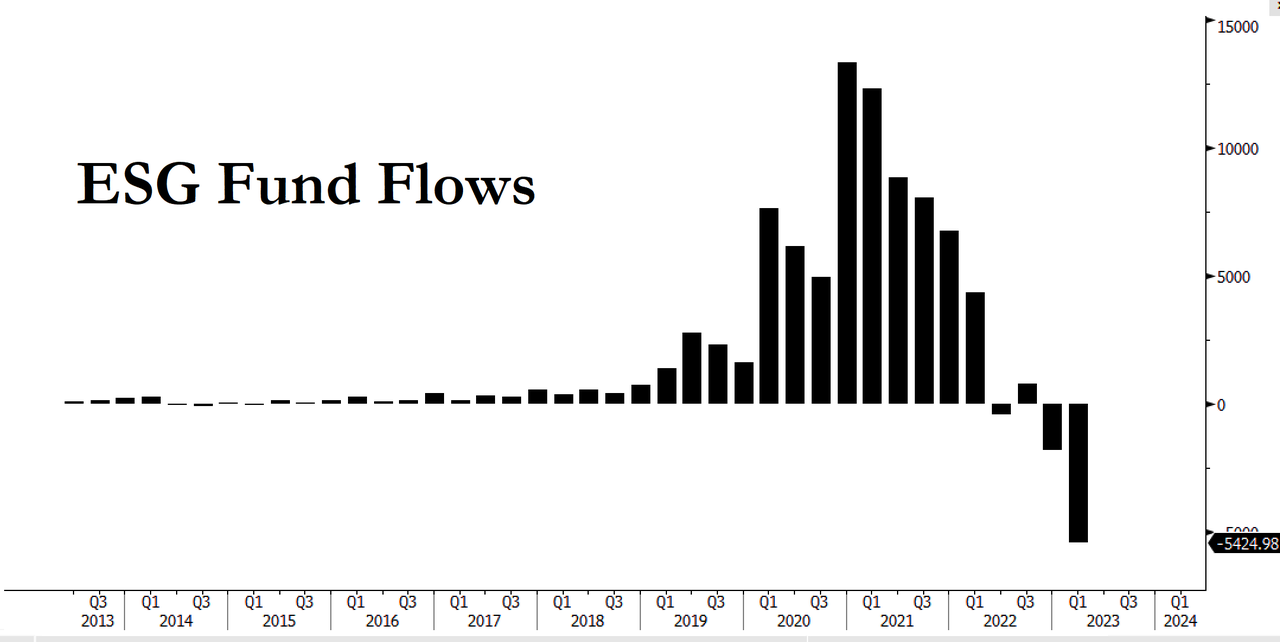
Recall, just days ago we wrote about a deluge of outflows from one of the largest ESG ETFs. 

ETF expert Eric Balchunas wrote last week that on Friday, the ESGU ETF “saw a record smashing $4b in outflows”. That was followed by another $1 billion on Monday of this week.

You can read Bloomberg’s full ESG post-mortem here

Tyler Durden
Sat, 03/25/2023 – 08:45

via ZeroHedge News https://ift.tt/3Ahd9jt Tyler Durden

“Unfathomable Devastation”: At Least 23 Dead After Tornado Tears Through Mississippi

“Unfathomable Devastation”: At Least 23 Dead After Tornado Tears Through Mississippi

At least 23 people were killed and dozens injured after severe thunderstorms and a tornado struck rural Mississippi on Friday night, according to officials from the Mississippi Emergency Management Agency (MEMA).

“We have numerous local and state search and rescue teams that continue to work this morning. A number of assets are on the ground to assist those that have been impacted,” MEMA tweeted. 

Search-and-rescue operations are underway in the towns of Silver City and Rolling Fork. A tornado late last night caused significant damage to homes, businesses, and infrastructure, leaving many residents without power and needing emergency assistance.

Resident Brandy Showah told CNN: 

“I’ve never seen anything like this… This was a very great small town, and now it’s gone.”

Mississippi Governor, Tate Reeves, tweeted that search and rescue teams are active this morning. He confirmed the 23 deaths. He said: “The loss will be felt in these towns forever. Please pray for God’s hand to be over all who lost family and friends.” 

Tyler Durden
Sat, 03/25/2023 – 08:30

via ZeroHedge News https://ift.tt/dJRSNGY Tyler Durden