How Scotch Whisky Came To Be

How Scotch Whisky Came To Be

Authored by Gerry Bowler via The Epoch Times,

A single line in a royal financial account leads us into the fascinating history of Scotch whisky. On June 1, 1495, a secretary penned the following: “To Friar John Cor, by order of the King, to make aqua vitae, VIII bolls of malt.” This is the earliest mention we have of the manufacture of distilled spirits in Scotland—eight barrels of malt to make aqua vitae, “the water of life” (“usquebaugh” in Gaelic.)

The use of intoxicating beverages is as old as civilization itself; humans have been drinking beer and wine for thousands of years. These drinks were safer than local water supplies and provided valuable nutrients to men, women, and children on a daily basis. The average Englishman of the Middle Ages drank anywhere from 250 to 400 gallons of beer a year.

However, taking advantage of the powers of distillation to increase alcohol content and purify the liquor is much more recent. It seems to have developed, perhaps surprisingly, in medieval monasteries where monks who were the chemists and physicians of the day used their knowledge of herbs, fermentation, and alchemy to make useful medicines. Friar John Cor seems to have belonged to the Dominican Order. By the 15th century, these monks had mastered a complicated process of several steps to produce Scotch whisky.

First, barley—a hardy grain able to be grown in northern climates—is malted, that is steeped in water, allowed to germinate. and then dried. The grain is mashed in water, and yeast is added which ferments the sugars into ethanol.

Then, the liquid is poured into a still where it is heated. The alcohol evaporates before the water, and this vapour rises and condenses again into a liquid. It undergoes a second distillation which separates the “heart” (clean, desirable alcohol) from less desirable elements. Each distillation increases the percentage of alcohol to a very high level. The liquid is now diluted, poured into oak casks, and allowed to age for a number of years, taking on the flavour of the wood, changing colour, and becoming a more complex beverage.

The Protestant Reformation in Scotland and England destroyed the monastic system, leaving alcohol innovation and production in the hands of private individuals. Hundreds of stills were set up, serving a growing public taste for Scotch. But a complication arose when first the Scottish and then (after the Union of 1707 joined the Scots and English) the British government sought to tax the production of whisky. This created a steady demand for the product of illegal, unlicensed (and thus cheaper) distilleries that operated relatively free from official harassment, hidden in glens and sheltered by fog, remoteness, and tolerant locals in the Highlands.
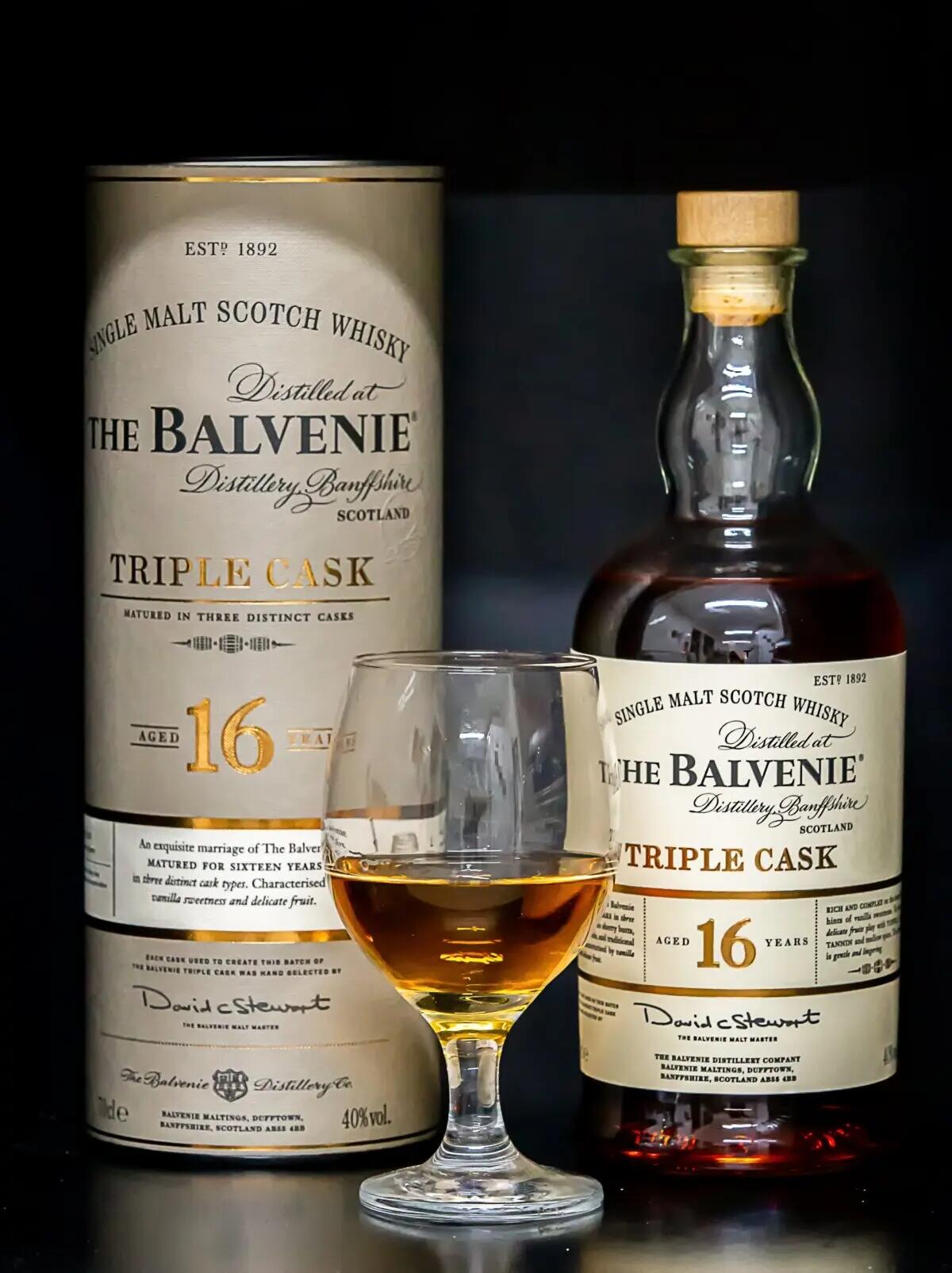
Triple cask single malt Scotch whisky aged for 16 years from the Balvenie distillery in Dufftown, Scotland. Adilson Sochodolak/Shutterstock

The legal trade emerged triumphant, however, in the 19th century after the tragic Highland Clearances when lairds started evicting their tenants to make way for more profitable sheep farming. Coupled with easier government regulation of the trade, new techniques that produced a smoother whisky, and disastrous vine diseases on the Continent that cut back on the availability of wines, a class of prosperous Scottish distilleries emerged, many of which still exist today. By the late 1800s, whisky was rivalling brandy as the preferred drink of the wealthier classes around the globe.

In the 21st century, Scotch whisky is a carefully defined product that ensures high standards and distinguishes it from imitations and foreign rivals. Methods of production, ingredients, alcohol content (at least 80 proof), and aging (at least three years) are strictly controlled, and wise consumers can tell by the labelling just what they are buying.

Single malt Scotch is made from 100 percent malted barley in old-fashioned pot stills at a single distillery. This is the most expensive and prestigious variety, some costing many thousands of dollars a bottle. Single grain Scotch is made at one distillery but contains barley and other grains. Blended Scotch is a mixture of malts and other grains made from the product of different distilleries. This is the sort that is the most commonly encountered. Blended malt Scotch consists of malts from different distilleries (appealing to those who want the malty experience but don’t want to pay high-end prices), while blended grain Scotch is a mixture of grains from different distilleries.

Whisky connoisseurs have their own terminology and can rival wine snobs in their alleged ability to distinguish regional variations and describe tastes. Be prepared to hear talk of “smoky,” “peaty,” briny,” or “complex,” and listen to arguments over the virtues of Scotch from Islay, the Islands, or the Highlands.

Slàinte Mhath!

Tyler Durden
Sat, 05/31/2025 – 08:10

via ZeroHedge News https://ift.tt/3B9PyIX Tyler Durden
The Champions League’s Global Appeal Is Paying Off

The Champions League’s Global Appeal Is Paying Off

When the UEFA Champions League Final between Inter Milan and Paris Saint-Germain kicks off at the Allianz Arena in Munich today, it will be the first final without a club from either England, Spain or Germany since Mourinho’s FC Porto beat AS Monaco in 2004.

It will also be a game of European football heritage versus a new footballing power, as Inter with its rich legacy will play a PSG that has been transformed from a mid-table club to a serial league winner and global brand since the takeover by Qatar Sports Investments in 2011. Ironically, the current PSG squad, which is arguably the least star-studded in years after the likes of Neymar, Messi and Mbappé all left, is given the best chance of finally winning the Champions League, a title the club has been chasing for more than a decade now.

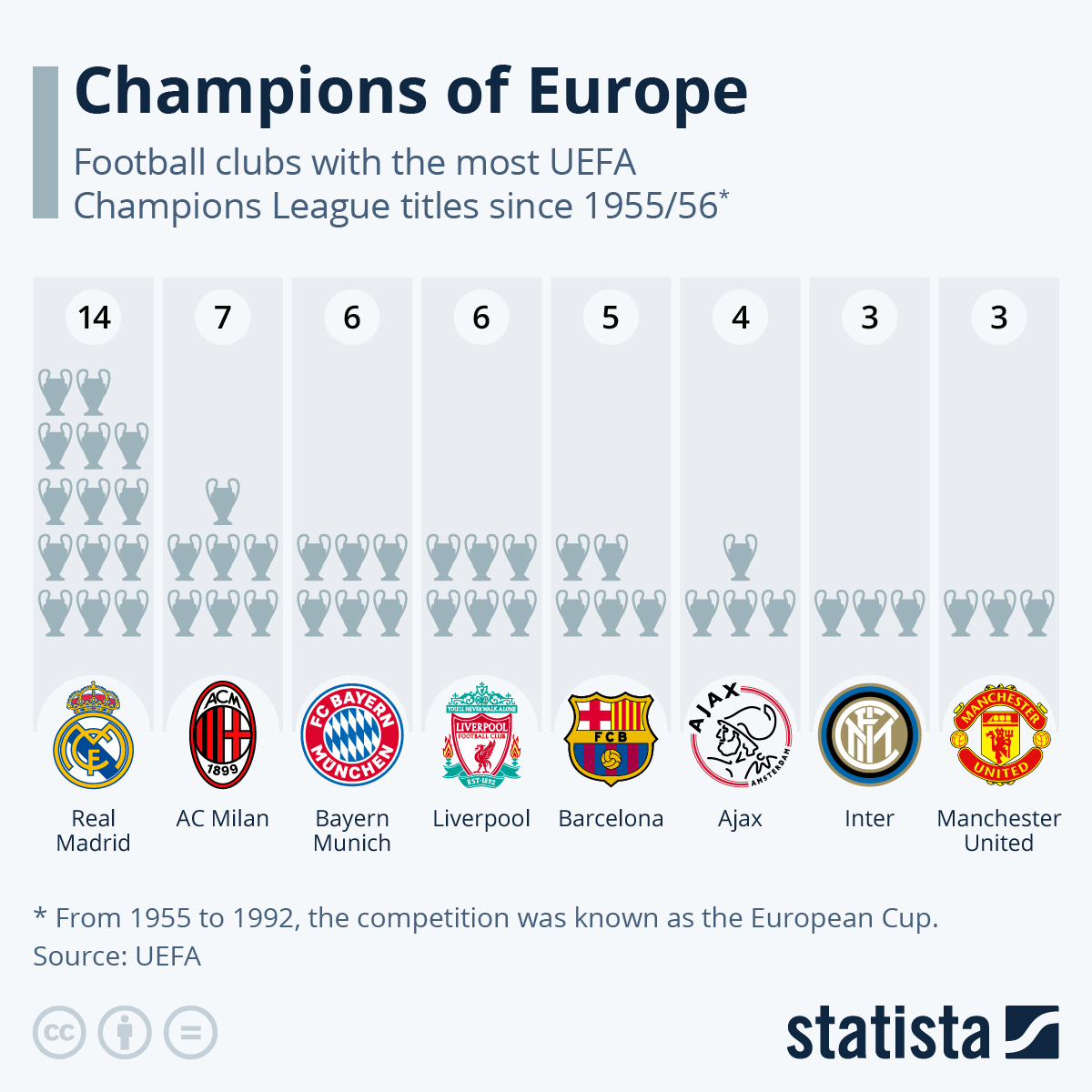
As the following chart shows, Inter won the Champions League (or the European Cup as it was previously called) three times already, most recently in 2010. Real Madrid is in a league of its own in terms of European triumphs, however. The outfit from the Spanish capital won 15 Champions League titles, leading AC Milan (7), Liverpool and Bayern (6) by a wide margin.

Infographic: Champions of Europe | Statista

You will find more infographics at Statista

Additionally, football fans from all across the globe will be watching.

After all, it is the biggest club competition in the world, where fans get to watch star-studded teams compete for European glory and a place in the game’s history books.

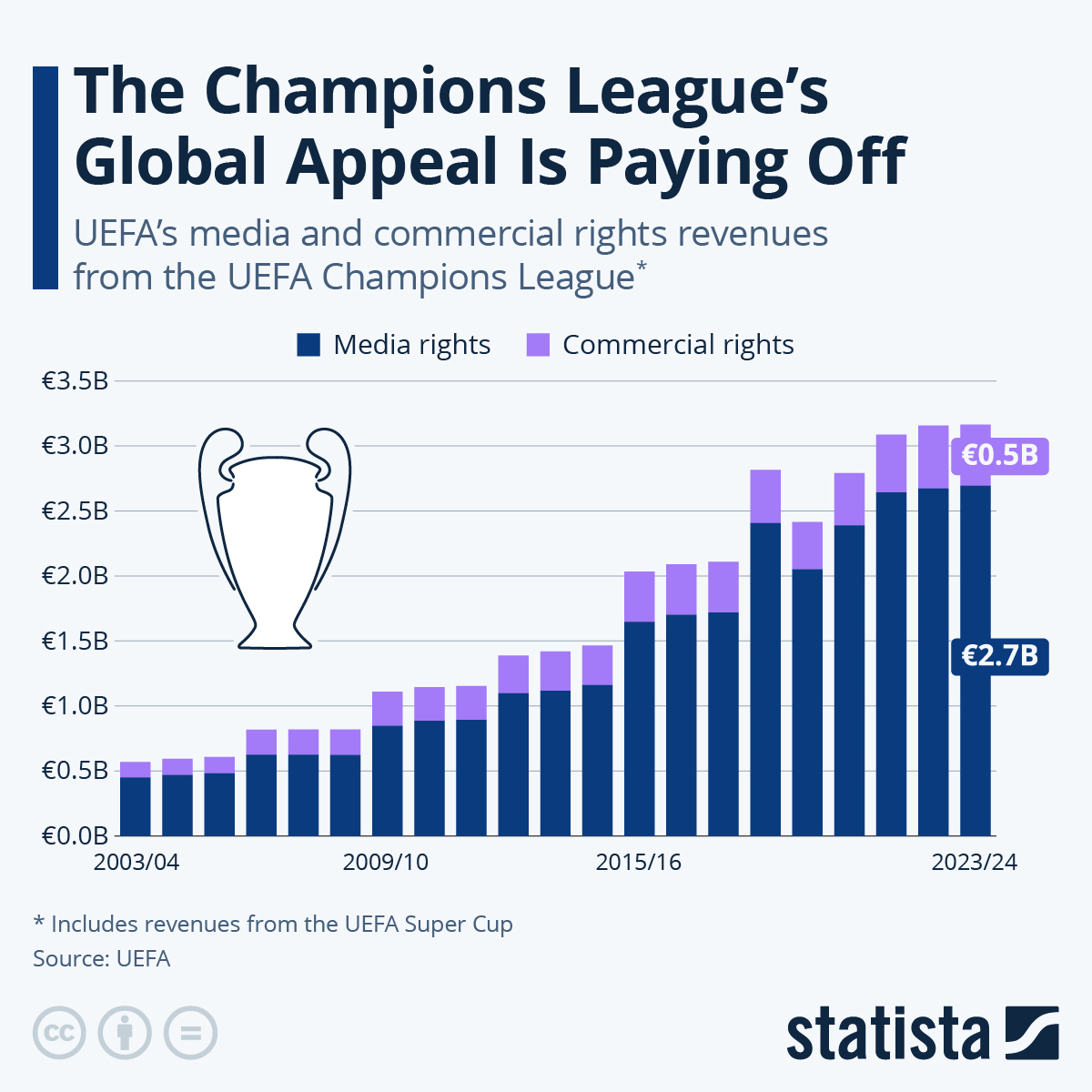
As Statista’s Felix Richter reports, for UEFA, Europe’s football governing body, the competition’s global appeal is paying off handsomely. Over the past two decades, the media and commercial rights for the Champions League have more than quintupled in value. In the 2023/24 season, UEFA made €3.2 billion from Champions League rights, up from just €569 million in the 2003/04 season.

Infographic: The Champions League's Global Appeal Is Paying Off | Statista You will find more infographics at Statista

Looking at UEFA’s lower-tier club competitions, the Europa League and the Conference League, highlights how far ahead the Champions League is in terms of its status and commercial appeal. Last season, UEFA’s combined revenue from Europa League and Conference League media and commercial rights amounted to €478 million, which is just 15 percent of what the Champions League brought in.

Tyler Durden
Sat, 05/31/2025 – 07:35

via ZeroHedge News https://ift.tt/SH0RkOG Tyler Durden

“AI and the Death of Literary Criticism”

A very interesting piece by Prof. Thomas Balazs in Quillette. An excerpt:

When ChatGPT can analyse Hamlet as well as any grad student, we might reasonably ask, “What is the point of writing papers on Hamlet?” Literary analysis, after all, is not like building houses, feeding people, or practising medicine. Even compared to its sister disciplines in the humanities (e.g., history or philosophy) the study of literature serves little practical need. And, besides, when machines can build houses as easily as people, we won’t need people to build houses either.

So, why do we teach English literature (or “language arts,” as some secondary schools now call it) at all? According to the nineteenth-century British literary critic Mathew Arnold, the purpose of studying and teaching literature is “to know the best that is known and thought in the world, and by in its turn making this known, to create a current of true and fresh ideas.” … English literature was, in truth, a substitute for religion. We wanted people to be good, but we no longer believed in God. Instead, we believed in Shakespeare, Milton, and eventually Toni Morrison. Until we didn’t.

It’s always been problematic, though, this idea that literature makes you a better person. Besides the obvious counterfactuals—the allied soldiers allegedly found copies of Johann Wolfgang von Goethe’s works in the desk drawers of Nazi prison guards when they liberated the camps—there were the problems that always arise when you try to push your religion on other people.

Our religion was literature, and like any people of true faith, we deeply believed in it, thought it was essential, thought everyone must be saved through it. The remarkable thing was that we somehow convinced American college presidents of the idea, but then again, many of them, like University of Chicago president Robert Hutchins, creator of the “Common Core” and advocate of “Great Books,” were members of the same religion. Not all countries make students of mathematics and engineering take literature courses, but in the United States we do. So for nearly a century, we evangelised our religion to college students, some of whom were already in love with reading and therefore happy to worship at the Temple of Literature. Many were not, but, nonetheless, we rammed Shakespeare, Herman Melville, and Toni Morrison down their throats—to make them better people.

That doesn’t mean that it necessarily stayed with them…. Some students of the right temperament and with the right intellectual predilections are drawn to the Temple of Literature, but most are not. For most, it is like going to Sunday school—they endure it reluctantly and quickly forget any lessons learned.

But that’s just an excerpt; here’s the whole thing.

The post "AI and the Death of Literary Criticism" appeared first on Reason.com.

from Latest https://ift.tt/V2l5sFU
via IFTTT

How Making GLP-1s Available Over the Counter Can Unlock Their Full Potential

When the Food and Drug Administration (FDA) approved Byetta (exenatide) in 2005, doctors thought it was just approving the first glucagon-like peptide-1 (GLP-1) agonist to treat Type 2 diabetes. But this new drug class had the potential to treat a host of other problems.

GLP-1 agonists mimic the body’s intrinsic GLP-1, a hormone that stimulates insulin release, suppresses the hormone glucagon, slows the muscles that move food through the intestinal tract, and decreases appetite. GLP-1s indirectly
cause weight loss by slowing the movement of food through the stomach and intestines, extending the feeling of fullness. Researchers soon discovered they also directly act on GLP-1 receptors in the brain to reduce appetite and cravings. During clinical trials and postapproval surveillance, clinicians noticed people on GLP-1s losing weight.

Clinicians began prescribing GLP-1s off-label—not for a purpose or in a dose the FDA specifically approved—soon after seeing the drug’s weight loss effects. By 2014, the FDA approved the GLP-1 Type 2 diabetes drug Victoza (liraglutide) to treat obesity under a different brand name, Saxenda. Both brands contain the same drug but have different dosing instructions. Since then, other drug manufacturers have followed the same strategy.

The makers of the GLP-1 Ozempic(semaglutide) got the FDA to approve the same drug in a different dose under the name Wegovy to treat obesity. Later, the FDA permitted the makers of Mounjaro (tirzepatide) to market it for weight loss as Zepbound. Getting FDA approval for these rebranded products allows drugmakers to use existing patent laws to extend their exclusivity for the new indication—enabling them to charge higher prices. It also makes it easier for them to secure insurance coverage.

***

As clinicians and clinical researchers learned more about the direct effect that GLP-1s have on food cravings, they set out to find if they may help reduce cravings for other substances and perhaps even help people with substance-use disorders.

A 2023 study found that people using GLP-1 medications for weight loss also drank less alcohol. More recently, research co-authored by National Institute on Drug Abuse Director Nora Volkow suggested that GLP-1 agonists could help prevent relapse in those with alcohol-use disorder. Together, these findings suggest that the drugs may reduce alcohol cravings.

Volkow and colleagues published a study in 2024 suggesting GLP-1s might also reduce the desire to consume cannabis. There is anecdotal evidence they may even cut nicotine cravings.

There is emerging evidence that GLP-1s can similarly reduce cravings for opioids.
If so, GLP-1s can supplement or, in some
situations, replace methadone and buprenorphine, two proven medications for
opioid-use disorder. Even if they only work
in conjunction with methadone or buprenorphine, they might reduce patients’ dose requirements and reliance on them.

Even more exciting, there is early evidence that GLP-1 might reduce cravings for stimulants such as cocaine and methamphetamine. Presently, there are no medications for stimulant-use disorders.

Some researchers are now looking into whether GLP-1s can reduce compulsive behavior, including compulsive gambling.

GLP-1s are not without risks. In addition to common side effects such as nausea and diarrhea, these drugs can occasionally cause pancreatic inflammation and, in very rare cases, are linked to a rare form of thyroid cancer in people with a genetic predisposition.

***

As I explain in my book Your Body, Your Health Care, in 1951 Congress gave the FDA exclusive power to decide which drugs manufacturers could sell over the counter (OTC) and which ones adults could only purchase with a prescription—a permission slip from a government-licensed health care provider. Before that law, manufacturers made those decisions. If they believed a drug was too complex or carried a high risk of misuse, they would choose to have it sold by prescription only, in part to protect themselves from liability.

If Congress removed the FDA’s monopoly power to require prescriptions, it is possible that some 20 years after GLP-1s appeared on the market, competition from new brands will incentivize some makers of GLP-1 products to market them over the counter.

Ibuprofen carries the risks of kidney damage, hypertension, ulcers, and cardiovascular events. The FDA approved ibuprofen as a prescription drug in 1974. Ten years later it removed obstacles to people buying it over the counter. If adults are competent to buy and use ibuprofen with proper labeling instructions after 10 years, why can’t they use GLP-1s with proper labeling instructions after 20 years?

Imagine how people would benefit
if they could buy GLP-1s over the counter. Drugs tend to be dramatically less expensive when they are available OTC. Prescription drugs usually carry higher price tags than do OTC products, mainly because insurance covers prescriptions but not OTC purchases. When people pay out of pocket, they look for better deals, which pressures companies to keep prices competitive. Once insurance takes over the cost, shoppers stop paying attention to price and drugmakers can charge the deeper-pocket third-party payers more without worrying about losing customers.

If people are worried they might be drinking too much alcohol, using too much cannabis, or addicted to opioids, meth, or cocaine, wouldn’t it be great if they could simply buy a GLP-1 over the counter? This way they could, if GLP-1s’ effects in these areas pan out, privately and discreetly reduce their substance use to a safer level without facing any stigma.

Until adults can get these drugs over the counter, removing the FDA’s restrictions on compounding pharmacies can go a long way toward making GLP-1s less expensive. Under the Food, Drug, and Cosmetic Act of 1938 and its amendments, compounding pharmacists can make and sell products to consumers without needing FDA approval, as long as they use FDA-approved ingredients from licensed facilities. But the FDA prohibits pharmacies from creating drugs that “essentially copy” commercially available ones—though this restriction is lifted during critical product shortages.

After the FDA approved Wegovy for weight loss, demand for this and other GLP-1s soared, resulting in shortages of the FDA-approved brands. In late 2022, the FDA declared a shortage of Zepbound, Wegovy, and other GLP-1s and allowed compounding pharmacies to create essential copies. These pharmacies helped increase patient access to these effective drugs at significantly lower prices than the commercially manufactured versions.

In February 2025, the FDA announced that the shortage was “resolved.” This means consumers will return to paying more for the commercially available product. The higher prices may force some people to stop taking the drug altogether. Compounding pharmacies are exploring alternatives, such as creating products with different doses or delivery systems than those used in commercially available drugs.

One way to improve the situation would be for Congress to remove FDA barriers to compounding pharmacies making products that are essentially copies of commercially available off-patent products.

Imagine a future where GLP-1s are readily accessible—through compounding pharmacies or OTC options—offering hope and healing to millions. For those battling obesity or substance-use disorders, these medications could become life-changing tools for reclaiming health and opportunity. Achieving that future will require bold policy decisions that lift needless restrictions and put transformative care within everyone’s reach.

The post How Making GLP-1s Available Over the Counter Can Unlock Their Full Potential appeared first on Reason.com.

from Latest https://ift.tt/Tm5xOA3
via IFTTT

How Making GLP-1s Available Over the Counter Can Unlock Their Full Potential

When the Food and Drug Administration (FDA) approved Byetta (exenatide) in 2005, doctors thought it was just approving the first glucagon-like peptide-1 (GLP-1) agonist to treat Type 2 diabetes. But this new drug class had the potential to treat a host of other problems.

GLP-1 agonists mimic the body’s intrinsic GLP-1, a hormone that stimulates insulin release, suppresses the hormone glucagon, slows the muscles that move food through the intestinal tract, and decreases appetite. GLP-1s indirectly
cause weight loss by slowing the movement of food through the stomach and intestines, extending the feeling of fullness. Researchers soon discovered they also directly act on GLP-1 receptors in the brain to reduce appetite and cravings. During clinical trials and postapproval surveillance, clinicians noticed people on GLP-1s losing weight.

Clinicians began prescribing GLP-1s off-label—not for a purpose or in a dose the FDA specifically approved—soon after seeing the drug’s weight loss effects. By 2014, the FDA approved the GLP-1 Type 2 diabetes drug Victoza (liraglutide) to treat obesity under a different brand name, Saxenda. Both brands contain the same drug but have different dosing instructions. Since then, other drug manufacturers have followed the same strategy.

The makers of the GLP-1 Ozempic(semaglutide) got the FDA to approve the same drug in a different dose under the name Wegovy to treat obesity. Later, the FDA permitted the makers of Mounjaro (tirzepatide) to market it for weight loss as Zepbound. Getting FDA approval for these rebranded products allows drugmakers to use existing patent laws to extend their exclusivity for the new indication—enabling them to charge higher prices. It also makes it easier for them to secure insurance coverage.

***

As clinicians and clinical researchers learned more about the direct effect that GLP-1s have on food cravings, they set out to find if they may help reduce cravings for other substances and perhaps even help people with substance-use disorders.

A 2023 study found that people using GLP-1 medications for weight loss also drank less alcohol. More recently, research co-authored by National Institute on Drug Abuse Director Nora Volkow suggested that GLP-1 agonists could help prevent relapse in those with alcohol-use disorder. Together, these findings suggest that the drugs may reduce alcohol cravings.

Volkow and colleagues published a study in 2024 suggesting GLP-1s might also reduce the desire to consume cannabis. There is anecdotal evidence they may even cut nicotine cravings.

There is emerging evidence that GLP-1s can similarly reduce cravings for opioids.
If so, GLP-1s can supplement or, in some
situations, replace methadone and buprenorphine, two proven medications for
opioid-use disorder. Even if they only work
in conjunction with methadone or buprenorphine, they might reduce patients’ dose requirements and reliance on them.

Even more exciting, there is early evidence that GLP-1 might reduce cravings for stimulants such as cocaine and methamphetamine. Presently, there are no medications for stimulant-use disorders.

Some researchers are now looking into whether GLP-1s can reduce compulsive behavior, including compulsive gambling.

GLP-1s are not without risks. In addition to common side effects such as nausea and diarrhea, these drugs can occasionally cause pancreatic inflammation and, in very rare cases, are linked to a rare form of thyroid cancer in people with a genetic predisposition.

***

As I explain in my book Your Body, Your Health Care, in 1951 Congress gave the FDA exclusive power to decide which drugs manufacturers could sell over the counter (OTC) and which ones adults could only purchase with a prescription—a permission slip from a government-licensed health care provider. Before that law, manufacturers made those decisions. If they believed a drug was too complex or carried a high risk of misuse, they would choose to have it sold by prescription only, in part to protect themselves from liability.

If Congress removed the FDA’s monopoly power to require prescriptions, it is possible that some 20 years after GLP-1s appeared on the market, competition from new brands will incentivize some makers of GLP-1 products to market them over the counter.

Ibuprofen carries the risks of kidney damage, hypertension, ulcers, and cardiovascular events. The FDA approved ibuprofen as a prescription drug in 1974. Ten years later it removed obstacles to people buying it over the counter. If adults are competent to buy and use ibuprofen with proper labeling instructions after 10 years, why can’t they use GLP-1s with proper labeling instructions after 20 years?

Imagine how people would benefit
if they could buy GLP-1s over the counter. Drugs tend to be dramatically less expensive when they are available OTC. Prescription drugs usually carry higher price tags than do OTC products, mainly because insurance covers prescriptions but not OTC purchases. When people pay out of pocket, they look for better deals, which pressures companies to keep prices competitive. Once insurance takes over the cost, shoppers stop paying attention to price and drugmakers can charge the deeper-pocket third-party payers more without worrying about losing customers.

If people are worried they might be drinking too much alcohol, using too much cannabis, or addicted to opioids, meth, or cocaine, wouldn’t it be great if they could simply buy a GLP-1 over the counter? This way they could, if GLP-1s’ effects in these areas pan out, privately and discreetly reduce their substance use to a safer level without facing any stigma.

Until adults can get these drugs over the counter, removing the FDA’s restrictions on compounding pharmacies can go a long way toward making GLP-1s less expensive. Under the Food, Drug, and Cosmetic Act of 1938 and its amendments, compounding pharmacists can make and sell products to consumers without needing FDA approval, as long as they use FDA-approved ingredients from licensed facilities. But the FDA prohibits pharmacies from creating drugs that “essentially copy” commercially available ones—though this restriction is lifted during critical product shortages.

After the FDA approved Wegovy for weight loss, demand for this and other GLP-1s soared, resulting in shortages of the FDA-approved brands. In late 2022, the FDA declared a shortage of Zepbound, Wegovy, and other GLP-1s and allowed compounding pharmacies to create essential copies. These pharmacies helped increase patient access to these effective drugs at significantly lower prices than the commercially manufactured versions.

In February 2025, the FDA announced that the shortage was “resolved.” This means consumers will return to paying more for the commercially available product. The higher prices may force some people to stop taking the drug altogether. Compounding pharmacies are exploring alternatives, such as creating products with different doses or delivery systems than those used in commercially available drugs.

One way to improve the situation would be for Congress to remove FDA barriers to compounding pharmacies making products that are essentially copies of commercially available off-patent products.

Imagine a future where GLP-1s are readily accessible—through compounding pharmacies or OTC options—offering hope and healing to millions. For those battling obesity or substance-use disorders, these medications could become life-changing tools for reclaiming health and opportunity. Achieving that future will require bold policy decisions that lift needless restrictions and put transformative care within everyone’s reach.

The post How Making GLP-1s Available Over the Counter Can Unlock Their Full Potential appeared first on Reason.com.

from Latest https://ift.tt/Tm5xOA3
via IFTTT

Escobar: Trilateral Summit Raises 21st Century New Silk Road Spirit

Escobar: Trilateral Summit Raises 21st Century New Silk Road Spirit

Authored by Pepe Escobar,

The first ever ASEAN-China-GCC trilateral summit earlier this week in Malaysia is even more than a cross-regional, South-South breakthrough.

The 17 nations united on the same table in Kuala Lumpur graphically demonstrated, as evoked by Malaysian Prime Minister and current ASEAN chair Anwar Ibrahim, how “from the ancient Silk Road to the vibrant maritime networks of Southeast Asia to modern trade corridors, our peoples have long connected through commerce, culture, and the sharing of ideas.”

Call it the 21st century New Silk Road spirit. And it’s no wonder China is right at its heart, via interlocked Belt and Road Initiative (BRI) projects – from infrastructure to trade development. China, Southeast Asia and a large part of West Asia do conform a Golden Triangle of natural resources, manufacturing and a large consumer base.

The final declaration of the Malaysia summit of course had to celebrate these “enduring and deep historical and civilizational ties”, as well as geoeconomics, in a drive to “promote economic development in the wider Asia-Pacific [note the correct terminology] and Middle East [old terminology: the correct one is ‘West Asia’].”

So it’s natural that China proposed the possibility of including the West Asian Arab nations of the GCC in the Regional Comprehensive Economic Partnership (RCEP), the vast 15-member trade pact that includes China and ASEAN (but not self-excluded India).

Free trade was the key theme in Kuala Lumpur – from the recently completed China-ASEAN Free Trade Area 3.0 upgrade to the upcoming China-GCC Free Trade Agreement negotiations. In contrast to Trump 2.0, the trilateral committed to “strengthen the resilience of industrial chains and supply chains”, everything geared towards long-term, tariff and sanction-free sustainable trade.

Last year, ASEAN’s total trade with China and GCC surpassed $900 billion, almost twice the $453 billion in trade with the US. And yes, trade de-dollarization is the way to go all across Asia. Right before the summit, China and Indonesia jointly announced that from now on, trade between both powerhouses is only in yuan and rupiah.

The final declaration was explicit on exploring “local currency and cross-border payment cooperation” – in tandem with promoting “high-quality BRI cooperation and seamless connectivity, including the development of logistics corridors and digital platforms”, and advancing “sustainable infrastructure construction.” The trilateral is engaged in building a web of pan-Asia connectivity corridors – the prime geoeconomic theme of the 21st century.

The trilateral had to refer to Gaza – although not as forcefully as it should. At best, the final declaration “endorses the advisory opinion rendered by the International Court of Justice on 19 July 2024, including its finding that the United Nations, in particular the General Assembly and the Security Council, which requested the advisory opinion, should consider specific modalities and further actions to bring an end to the illegal presence of the State of Israel in the Occupied Palestinian Territory as soon as possible”; and to “achieve the two-State solution based on the 1967 borders in accordance with international law.”

How East, Southeast and West Asia Connect to BRICS

East Asia, historically, is most of all a mosaic of transnational regions linked by maritime corridors. The first globalization happened – where else – in Asia, from the opening of the trans-Pacific route linking the “New World” to the Philippines in 1511 to the takeover of Malacca – the great Southeast Asian emporium – by the Portuguese in 1571.

But even before the Vasco da Gama era, East and Southeast Asia formed a relatively integrated economic zone, with ports from Malacca to Nagasaki shining as trade centers crammed with Arab, Chinese, Indian and Japanese merchants. Malacca boomed thanks to excellent infrastructure, moderate port tariffs and a sound fiscal regime: a much better deal compared to the subsequent predatory Portuguese and Dutch colonial set up, all the way to admiral Alfred Mahan conceptualizing the principles of sea power to the benefit of the thalassocratic US.

Former Singapore Foreign Minister George Yeo has clearly explained how China and South East Asia have been relieving – with spectacular success – their historic, culture and trade connections. This summit taking place in Malaysia, home of the historically crucial crossroads Malacca, is a touch of poetic justice.

Add to it Indonesia President Prabowo – a former Suharto general, and his son-in-law – effusively praising China’s firm anti-imperialist stance since 1949 and during the Cold War, right in front of Chinese Prime Minister Li Qiang. A 21stcentury parallel can be made with the legendary Spirit of Bandung in 1955, when Indonesia’s Sukarno – a leader of the Non-Aligned Movement (NAM) – was side by side with Zhou EnLai.

The ASEAN-China-GCC summit may be able to advance moves that the inestimable Prof. Michael Hudson deem absolutely necessary for BRICS members – and quite a few in Kuala Lumpur will be at the table at the BRICS summit in Rio in early July.

Prof. Hudson has conclusively demonstrated how landlord classes, monopolies and residues of European colonialism will have to go for BRICS nations to “achieve the same kind of take off that made England, Germany, US industrial leaders of the world.” That means to drastically “cut back payments to foreign investors concentrated on raw material rent” and to subdue “the rentier class.”

Prof. Hudson argues that when it comes to “how to free their economies – rent, creditor payments – this is what China did. China had a revolution. After the revolution it did not have a financial class. China made money creation a public utility – an arm of the Treasury; it created money to finance tangible investments in capital formation, factories, housing – a little too much – huge public infrastructure, urban transportation, high-speed rail.”

What I previously defined as “The BRICS Lab” – all those models being constantly tested, starting last year in Russia before the Kazan summit – is indeed trying to answer questions posed by Prof. Hudson in several ways: “We need to create our money. Elites should not keep benefitting from regressive taxation. How to industrialize? No more economic rent.”

The Chinese, predictably, are already at the next level of the integration business. This is their “magic weapon” to “defeat the enemy”: “The construction of the ‘dual circulation’ of the domestic and foreign markets, uniting as many living forces as possible to form a united front to deal with unilateralism. Most of the southern countries are natural allies. The feasibility of close linkage between ‘South-South cooperation’ and ‘dual circulation’ is increasing day by day.”

Jeffrey Sachs, in Kuala Lumpur, ahead of the ASEAN-China-GCC summit, succinctly nailed the New Silk Road spirit: “If you put together Japanese skill, Korean skill, Chinese skill, ASEAN skill, oh my God: no one could possibly compete (…) Diplomacy requires a table and two chairs. The military requires $1 trillion a year. Which do you think is the better deal?”

Tyler Durden
Fri, 05/30/2025 – 23:25

via ZeroHedge News https://ift.tt/vxVezJu Tyler Durden

Mapping Every Understaffed Air Traffic Control Tower In The US

Mapping Every Understaffed Air Traffic Control Tower In The US

Earlier this year, the U.S. experienced one of its deadliest air mishaps in two decades.

An American Airlines passenger plane collided with a U.S. Army Black Hawk helicopter sending both into the Potomac River.

ℹ️ For reference: American Airlines has one of the worst track-records when it comes to crashes.

In the immediate aftermath, officials mentioned that short-staffed air traffic control towers may have played a role. This was later deemed not the cause, but air traffic control staffing shortages are plaguing 44% of all FAA regulated towers, latest data shows.

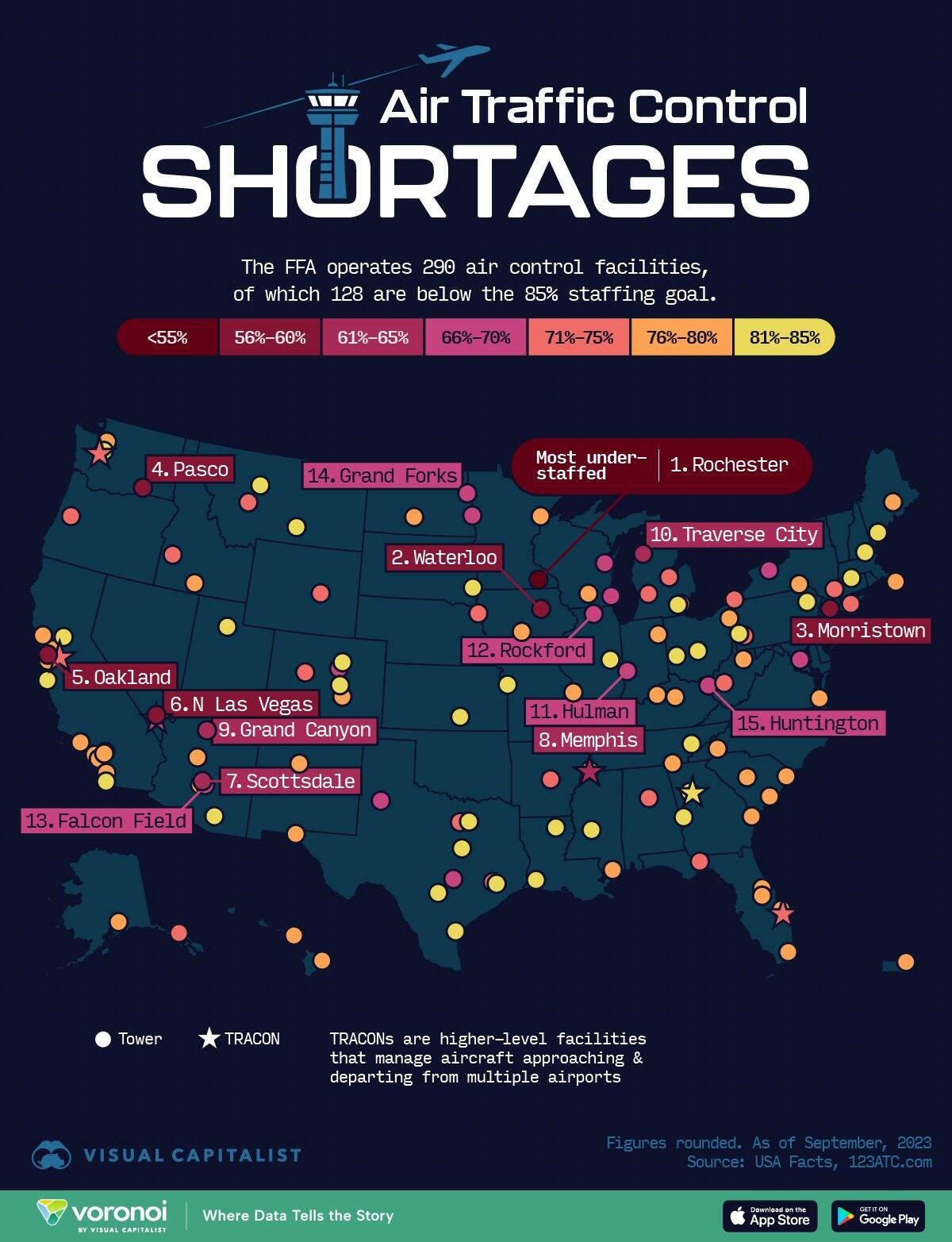
Visual Capitalist’s Pallavi Rao maps out every single tower that is below the 2024-guideline staffing threshold (85%) per the latest available data current to September 2023, published by the FAA.

Ranked: All Short-Staffed Air Traffic Control Towers

128 of the 290 FAA-operated air traffic control towers across the country are short-staffed.

Rochester Tower, located in Minnesota has less than half the required controllers per 2024 requirements.

The table below lists all facilities by the percentage of staff filled.

Rank Facility Facility Code % Staffed
1 Rochester Tower RST 47.8
2 Waterloo Tower ALO 56.5
3 Morristown Tower MMU 57.9
4 Pasco Tower PSC 58.8
5 Oakland Tower OAK 60.0
6 North Las Vegas Tower VGT 60.0
7 Scottsdale Tower SDL 62.5
8 Memphis TRACON M03 63.4
9 Grand Canyon Tower GCN 64.3
10 Traverse City Tower TVC 64.3
11 Terre Haute /Hulman Tower HUF 65.5
12 Rockford Tower RFD 65.6
13 Falcon Field Tower FFZ 66.7
14 Grand Forks Tower GFK 66.7
15 Huntington Tower HTS 66.7
16 Las Vegas TRACON L30 67.9
17 Andrews Tower ADW 68.2
18 Centennial Tower APA 69.2
19 Fargo Tower FAR 69.2
20 Green Bay Tower GRB 69.2
21 Lubbock Tower LBB 69.2
22 Milwaukee Tower MKE 69.4
23 Willow Run Tower YIP 69.6
24 Austin Tower AUS 70.0
25 Rochester Tower ROC 70.3
26 Tallahassee Tower TLH 70.8
27 Charleston Tower CRW 71.0
28 Allegheny Tower AGC 71.4
29 Aspen Tower ASE 71.4
30 St Lucie Tower FPR 71.4
31 Grand Rapids Tower GRR 71.4
32 Hayward Tower HWD 71.4
33 Saginaw Tower MBS 71.4
34 Orlando Tower MCO 71.4
35 Sioux Gateway Tower SUX 71.4
36 Casper Tower CPR 72.2
37 Seattle TRACON S46 73.1
38 Hooks Tower DWH 73.7
39 Juneau Tower JNU 73.7
40 Little Rock Tower LIT 73.7
41 Boise Tower BOI 73.8
42 Meacham Tower FTW 73.9
43 Islip Tower ISP 73.9
44 Birmingham Tower BHM 74.4
45 Erie Tower ERI 75.0
46 Eugene Tower EUG 75.0
47 Helena Tower HLN 75.0
48 Poughkeepsie Tower POU 75.0
49 Fort Wayne Tower FWA 75.9
50 Duluth Tower DLH 76.0
51 Youngstown Tower YNG 76.0
52 Binghamton Tower BGM 76.2
53 Ontario Tower ONT 76.2
54 Madison Tower MSN 76.7
55 Long Beach Tower LGB 76.9
56 John Wayne Tower SNA 76.9
57 Vero Beach Tower VRB 76.9
58 El Paso Tower ELP 77.1
59 Memphis Tower MEM 77.1
60 Norfolk Tower ORF 77.1
61 Gulfport Tower GPT 77.3
62 San Juan Tower SJU 77.3
63 Tamiami Tower TMB 77.3
64 Bangor Tower BGR 77.4
65 Albuquerque Tower ABQ 77.8
66 Bismarck Tower BIS 77.8
67 Hilo Tower ITO 77.8
68 Myrtle Beach Tower MYR 77.8
69 Prescott Tower PRC 77.8
70 Pueblo Tower PUB 77.8
71 Sanford Tower SFB 77.8
72 Savannah Tower SAV 78.1
73 Nantucket Tower ACK 78.6
74 Columbia Tower CAE 78.6
75 Concord Tower CCR 78.6
76 Camarillo Tower CMA 78.6
77 Palomar Tower CRQ 78.6
78 Des Moines Tower DSM 78.6
79 Bowman Tower LOU 78.6
80 Merrill Tower MRI 78.6
81 Paine Tower PAE 78.6
82 Palo Alto Tower PAO 78.6
83 Sonoma Tower STS 78.6
84 Spirit Tower SUS 78.6
85 Twin Falls Tower TWF 78.6
86 Maui Tower OGG 78.9
87 Chattanooga Tower CHA 79.2
88 Clarksburg Tower CKB 79.2
89 Charleston Tower CHS 79.3
90 Asheville Tower AVL 80.0
91 Chino Tower CNO 80.0
92 Central Florida TRACON F11 80.0
93 Lexington Tower LEX 80.0
94 Phoenix Tower PHX 80.0
95 Corpus Christi Tower CRP 80.5
96 Northern California TRACON NCT 80.5
97 Wilkes-Barre Tower AVP 80.8
98 Bradley Tower BDL 81.0
99 Champaign Tower CMI 81.0
100 Lake Charles Tower LCH 81.0
101 Monroe Tower MLU 81.0
102 Knoxville Tower TYS 81.1
103 Dayton Tower DAY 81.3
104 Manchester Tower MHT 81.3
105 Colorado Springs Tower COS 81.5
106 Atlanta TRACON A80 81.8
107 Columbus Tower CMH 81.8
108 Sioux Falls Tower FSD 81.8
109 Jackson Tower JAN 81.8
110 Salt Lake City Tower SLC 81.8
111 Tuscon Tower TUS 81.8
112 San Diego Tower SAN 82.1
113 San Antonio Tower SAT 82.1
114 Pittsburgh Tower PIT 82.2
115 Wichita Tower ICT 82.5
116 Great Falls Tower GTF 82.6
117 Atlanta Tower ATL 82.7
118 Denver Tower DEN 82.9
119 Ann Arbor Tower ARB 83.3
120 Billings Tower BIL 83.3
121 Columbus Tower CSG 83.3
122 Monterey Tower MRY 83.3
123 Downtown Tower MKC 84.2
124 Waco Tower ACT 84.6
125 Dallas Love Tower DAL 84.6
126 Houston Intercontinental Tower IAH 84.6
127 Portland Tower PWM 84.6
128 Seattle Tower SEA 84.8

Of particular interest are the short-staffed TRACONs (Terminal Radar Approach Control); these are bigger facilities that assist with landing and departure for larger areas.

In fact, these numbers are a more optimistic view of the staffing shortage. They include fully-certified controllers, those that have transferred from a different facility and getting familiar with a new environment, and those just out of academy who are picking up on-the-job skills.

If looking at just the fully certified controllers, these rates drop even further.

For reference, it takes roughly 2–3 years for an academy graduate to become fully certified.

Why is There an ATC Staffing Shortage?

There are a few interlinked reasons.

As a mentioned earlier, it’s a difficult (and long) training process, which takes a minimum of 2-3 years. The COVID-19 pandemic interrupted or paused training and now the system is playing catch-up.

The attrition rate of employees is high due to long hours and on-the-job stress. And finally, there’s a mandatory retirement age (56) which leads to a yearly employee loss.

This shortage is pushing controllers into 60-hour workweeks, in turn leading to a higher burnout rate.

Need more data related to flying? Check Out: All the Things Americans Find Unacceptable on Planes for interesting cultural insights.

Tyler Durden
Fri, 05/30/2025 – 23:00

via ZeroHedge News https://ift.tt/ABg1Y2m Tyler Durden

Wolves Wreak Havoc On Cattle Herds In California

Wolves Wreak Havoc On Cattle Herds In California

Authored by Brad Jones via The Epoch Times (emphasis ours),

Descendants of rewilded wolves are taking a heavy toll on cattle in Northern California and Oregon, killing calves and full-grown animals and putting stress on cow-calf operations and ranchers’ pocketbooks.

A gray wolf approaches a bull, caught on a game camera in June 2023. Ken Tate, Tina Saitone/UC Davis

Because wolves are listed as an endangered species under state and federal law, ranchers are hamstrung: They can’t shoot or harass these protected predators. The penalty for killing a wolf is steep; federal law carries a maximum sentence of one year in prison and a $100,000 fine, unless a rancher can prove that it was in self-defense.

While animal advocacy groups say the wolves are native apex predators that belong in California and other western states, some ranchers argue that there’s nothing natural about wolves’ stalking domestic cattle because there isn’t enough natural prey.

They’re welfare wolves,” Janna Martin Gliatto, an owner at Table Rock Ranch in northern California, said. “We have entitled wolves—multiple generations.

One wolf pack, known as the Whaleback Pack, near her ranch doesn’t seem inclined to hunt elk or deer, she said.

Since November 2021, wolves have killed at least 44 head of cattle at the Martin family’s ranch in Siskiyou County, Gliatto told The Epoch Times. Of those confirmed wolf kills, three were adult cows, and the rest were calves.

There’s a handful of people and ranches like us that have been hit really hard,” she said. “I’ve had so much carnage.”

The protection of wolves has been a “costly experiment” for ranchers and taxpayers who foot the bill for it, Gliatto said.

In 2021, state lawmakers voted to disburse $3 million to the California Department of Fish and Wildlife (CDFW) to develop a pilot program to mitigate the effects of wolves on livestock producers.

The resulting Wolf-Livestock Compensation Program was started in 2022, and by March 2024, the funds were exhausted after 109 claims were paid out to livestock producers for wolf depredation in Siskiyou, Lassen, Plumas, and Tulare counties.

Gliatto received two years of partial compensation to pay a range rider to patrol the herd at night, “but the funds ran out, so now it’s out-of-pocket,” she said.

In 2024, the state appropriated another $600,000 for the CDFW to continue the Wolf-Livestock Compensation Program, but the program no longer subsidizes ranchers for the cost of deterrent efforts such as range riders and is limited to compensation for direct loss only.

CDFW spokeswoman Katie Talbot said California’s wolf population is estimated at between 50 and 70 in total. The agency has confirmed that 163 cattle and six sheep have been killed or injured by wolves since 2011, when the first collared wolf from Oregon entered California, Talbot told The Epoch Times in an email.

Debbie Bacigalupi (front) and her mother, Donna, tend to a calf at Cold Springs Ranch in Siskiyou County, Calif., in May 2024. The family shares a fence line with Table Rock Ranch and has also lost calves to suspected wolf attacks. John Fredricks/The Epoch Times

She said that of the initial $3 million Wolf-Livestock Compensation Program fund, more than $2 million was paid out for direct loss and deterrence efforts to ranchers in Siskiyou County, while those in Lassen and Plumas counties received about $490,000 and $476,000, respectively. About $16,000 went to Tulare County. Since October 2024, the average compensation per head was $2,870, Talbot said.

Examining Expenses

A recently released study by University of California–Davis professor Tina Saitone, a livestock and rangeland economics specialist, found that one wolf can cause between $69,000 and $162,000 in direct and indirect cattle losses, from outright attacks, lower pregnancy rates in cows, and decreased weight gain in calves.

Saitone’s research team used motion-activated field cameras, GPS collars, wolf scat analysis, and cattle tail-hair samples to show how the expanding protected gray wolf population is affecting cattle operations, “leading to millions of dollars in losses,” according to the study.

The research showed that during the 2022 and 2023 summer seasons, 72 percent of wolf scat samples from the Lassen Pack—in western Lassen and northern Plumas counties—contained cattle DNA. It also found elevated hair cortisol levels in cattle that ranged in areas with wolves, indicating an increase in stress.

Aside from the financial effects, Gliatto said the wolf issue has been emotionally taxing on ranchers who’ve witnessed continual attacks on their herds and “hypocrisy” over what is considered humane treatment of cattle.

Ranchers are afraid to brand their cattle because some animal rights groups view the practice as inhumane, but, she said, “you can have a wolf literally tear your animals apart while they’re alive and eat them, and people just turn a blind eye.”

According to Gliatto, wolves wouldn’t be thriving in the wild without heavily supplementing their diet with cattle, which, in some cases, is their primary food source.

The wolves have created fierce competition at the top of the food chain because there aren’t enough deer and elk to feed them and other predators such as mountain lions, bears, and coyotes, she said.

We have a huge predator bubble,” Gliatto said.

CDFW reported that there were seven documented wolf packs in California in 2024, along with evidence of other wolves in the state.

A game camera captures a gray wolf from the Lassen pack among a herd of cattle in July 2022.

Return of the Wolf

The first wolves showed up at Gliatto’s ranch in 2020.

A lone male wolf, OR-85, collared in February 2020, left his natal Mount Emily pack near La Grande, Oregon, crossed into California, and found a mate from another pack from southwestern Oregon. The pair formed the Whaleback Pack and have produced 21 pups since 2021, according to CDFW.

Tracking showed cluster points of OR-85 near an elk herd on ranchland that the family leased, but the pack doesn’t feed on them, Gliatto said.

The elk herd, often spotted at Grass Lake, stopped going there, she said.

“They just moved away from the wolves, and the wolves didn’t follow them,” Gliatto said.

Instead, she said, the wolves have become habituated to preying on cattle at her family’s ranch, which typically has more than 1,500 head, including cow-calf pairs, and replacement heifers.

Table Rock Ranch borders timberland at the forest-edge of a mountain range, so when wolves descend into the valley, her cattle are the first meal they see. Hence, from a wolf’s perspective, it makes no sense to go farther down into the valley, where there are more people and less cover, Gliatto said.

Amaroq Weiss, an attorney and the senior West Coast wolf advocate at the Center for Biological Diversity, said some cattle herds are hit harder than others.

You constantly have animals that are vulnerable because they’re not being checked on,” she told The Epoch Times. “They’ve eaten poisonous weeds, they’ve gotten wounded for some reason, they’re having birthing complications. All those things are going to draw wolves in.”

Wolves aren’t targeting the closest ranch or the first cattle herd they encounter, and they will often roam through pastures filled with cattle “and just keep on going out the other end of the pasture to hunt wild prey,” Weiss said.

The Whaleback Pack, and some others in California, cover immense territories compared with most wolf packs in other western states that have more elk and deer, because “they’re looking for a food source,” she said.

Siskiyou County wolf liaison Patrick Griffin, who investigates suspected wolf kills for the U.S. Fish and Wildlife Service, said the 44 confirmed kills at Table Rock Ranch “sounds accurate,” noting that it has been the hardest-hit ranch in the state.

More than 80 “confirmed” or “probable” cattle kills have been attributed to the Whaleback Pack, Griffin told The Epoch Times.

Read the rest here…

Tyler Durden
Fri, 05/30/2025 – 22:35

via ZeroHedge News https://ift.tt/6NEmZvQ Tyler Durden