These Are Most Affordable US Cities To Buy A Home In 2025
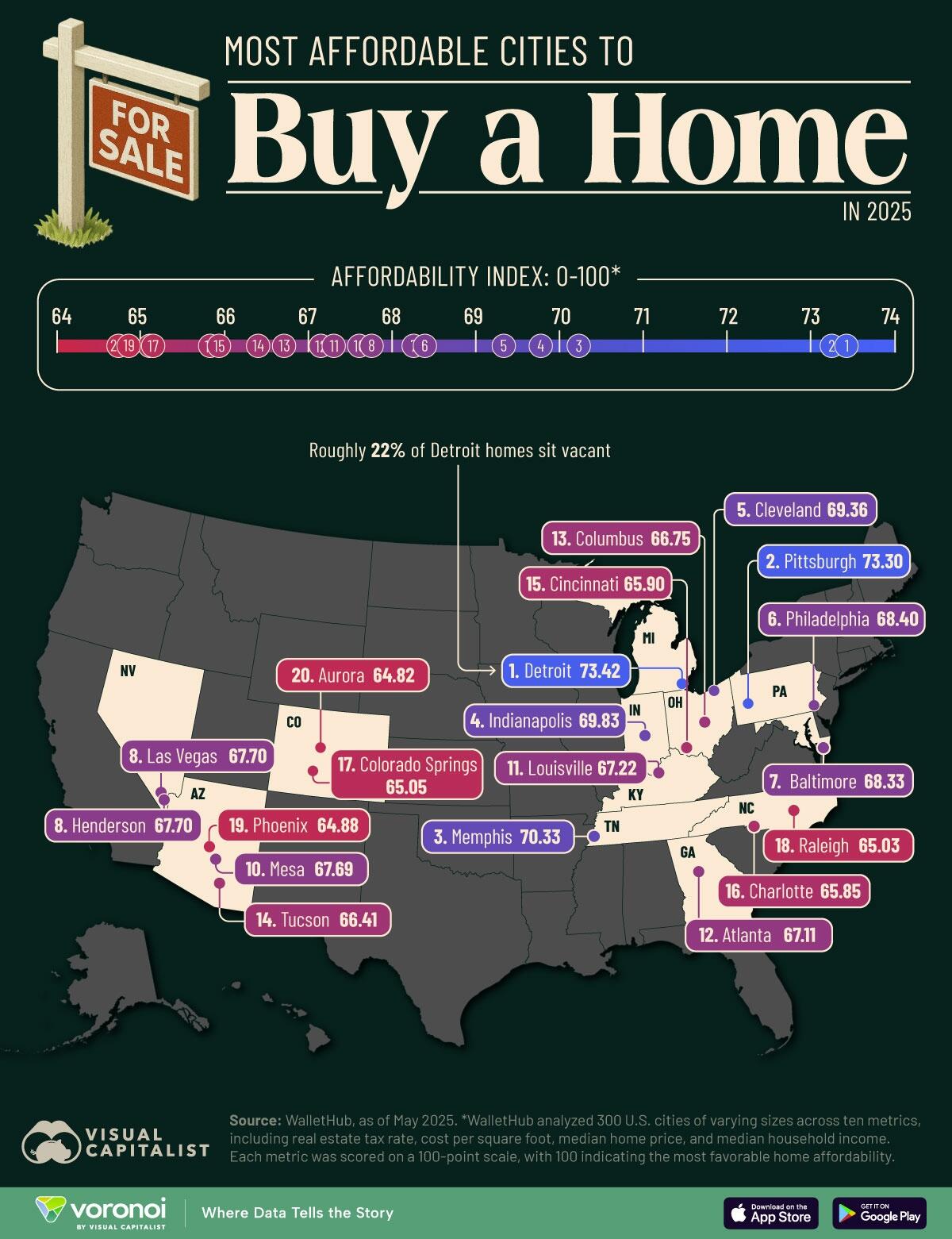
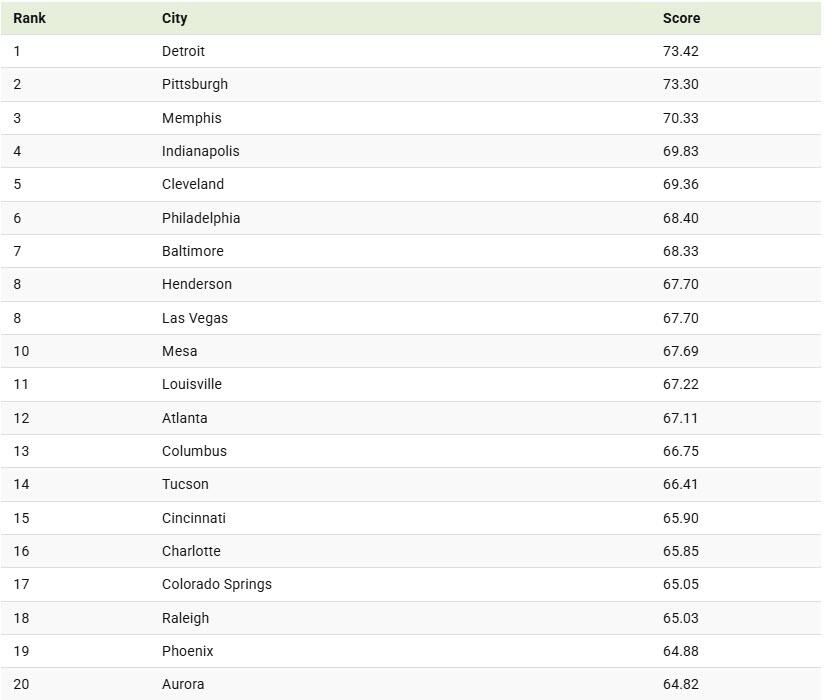
WalletHub analyzed 300 U.S. cities of varying sizes across ten metrics, including real estate tax rate, cost per square foot, median home price, and median household income. Each metric was scored on a 100-point scale, with 100 indicating the most favorable conditions for home affordability. For this map, only cities with a population over 100,000 were considered.
Detroit leads the list, with a median price per square foot of around $87. The city has faced significant challenges over the decades, including financial crises and the decline of the auto industry, prompting many residents to leave.
Today, more than 22% of homes in Detroit are vacant, creating a strong buyer’s market. According to WalletHub, Detroit is also one of the top cities where buying a home offers greater long-term value than renting. The city was also considered the most affordable large American city in 2025, according to another study.
Also in the Rust Belt, Pittsburgh, PA, ranks as the second-most affordable city for homebuyers, with a median home price approximately 3.8 times higher than the median household income.
Like Detroit, Memphis, TN—ranked third—has also been highlighted as one of the most affordable large cities in the country for working families.
If you enjoyed this map, check out this map on Voronoi about the income needed to buy a home in every U.S. state.
Scientists are sounding the alarm on what they call an overlooked threat to public health: synthetic chemicals from packaging and processing equipment contaminating the food supply—particularly ultra-processed items—and potentially fueling a rise in chronic health conditions.
A comprehensive review article recently published in Nature Medicine highlights some of the most prevalent types and sources of synthetic chemical contaminants in food: chemicals known as food contact chemicals (FCCs), which may contribute to chronic health conditions, including endocrine disruption, reproductive issues, and increased cancer risks.
Why Food Contact Chemical Contamination Goes Unnoticed
The widespread nature of FCC contamination may have escaped public attention because these chemicals migrate invisibly into food through routine processes we usually consider safe.
Unlike visible food safety concerns such as bacterial contamination or spoilage, FCCs transfer silently from materials that come into contact with food through four key routes, as identified by the researchers: transportation, processing, packaging, and preparation.
Transportation introduces FCCs through storage containers and tubing systems used to move food products. During this stage, chemicals from container coatings and transport equipment can leach into foods—especially when exposed to temperature changes or extended contact periods.
Food processing—the industrial transformation of raw ingredients into finished products—exposes foods to machinery, conveyor systems, and processing equipment that contain various synthetic materials. The high temperatures and mechanical processes involved in manufacturing can accelerate chemical migration from these surfaces.
Plastic food packaging represents a significant source of contamination, as it involves prolonged direct contact between synthetic materials and food products.
Food preparation, which differs from processing because it involves the final steps before consumption, often includes heating. Higher temperatures lead to increased migration, the researchers noted.
All FCCs that migrate into food or drinks are important because people will likely ingest them, the authors wrote.
The study identified how specific harmful substances migrate through these pathways. Bisphenol A diglycidyl ether—a known endocrine disruptor and potential carcinogen—transfers from coatings of metal food storage containers during transportation and storage.
Phthalates migrate from polyvinyl chloride tubing into milk during processing and transport. Even cleaning agents used to disinfect storage and transport containers can leave residues that end up in food.
Fast food products face particularly high contamination levels because they encounter multiple packaging types throughout the production and service chain, including disposable containers, wrappers, and serving material, said Bryan Quoc Le, a food scientist and principal food consultant at Mendocino Food Consulting, in an interview with The Epoch Times.
Serious Health Risks From FCC Exposure
The health implications of FCC exposure extend far beyond minor concerns, with research linking these chemicals to severe chronic conditions that affect millions of people, according to the study.
Phthalates in food packaging pose significant reproductive health risks, with certain types linked to preterm birth. This early delivery increases the risk of developing chronic conditions later in life, including kidney disease and diabetes.
Di(2-ethylhexyl)phthalate (DEHP)—a man-made chemical used as a plasticizer—demonstrates particularly concerning effects in adults, with studies associating exposure with obesity and diabetes. Some evidence shows a 40 to 69 percent probability that DEHP exposure directly causes these conditions.
Perfluorooctanoic acid—another common food contact chemical—carries even more severe risks. The International Agency for Research on Cancer has classified it as carcinogenic to humans, meaning it definitively causes cancer in people exposed to sufficient levels.
Bisphenols, including the well-known bisphenol A (BPA), function as endocrine disruptors, interfering with the body’s hormone systems. This disruption can affect reproductive health, metabolism, and development, particularly in children and pregnant women.
Alternatives like bio-based coatings, perfluoroalkyl and polyfluoroalkyl substances (PFAS)-free barriers, and safer plasticizers are currently available, but they come with trade-offs in cost, performance, and shelf life, said Vineet Dubey, a Los Angeles environmental attorney who focuses on consumer safety issues, in an interview with The Epoch Times.
“As always, change will take time and requires the buy-in of food companies, which have already invested in technology, factories, and industrial farm-to-table systems that package food the ‘old’ way,” he noted.
Ultra-Processed Foods–The Highest Risk Category
Ultra-processed foods face the greatest contamination risk due to their complex manufacturing processes and extensive packaging requirements, according to the recent study.
These products include breakfast cereals and bars, ready-made frozen meals, processed meats like chicken nuggets, energy drinks with significant added sugar, packaged bread, sodas, snacks like cookies and chips, candy, and condiments like ketchup and mayonnaise, Dr. Mia Kazanjian, the co-director of Stamford Health’s Breast Center, who was not involved in the study, told The Epoch Times.
“These are the foods that are exposed to these chemicals most during the packaging, processing, and storage,” she said.
Protecting Yourself From Food Contact Chemicals
Despite the widespread nature of FCC contamination, people can take practical steps to reduce their exposure and protect their health.
Dietary Changes
Health experts recommend reducing the consumption of ultra-processed foods when possible. Instead, prioritize fresh, whole foods that require minimal processing and packaging.
When purchasing packaged foods, choose products with minimal packaging or packaging made from safer materials. Glass and stainless steel containers pose significantly lower risks than plastic alternatives because they are less likely to leach harmful chemicals into food.
Storage Solutions
Replace plastic food storage containers with glass or stainless steel alternatives. These materials resist chemical migration better.
Avoid heating food in plastic containers, as elevated temperatures accelerate chemical migration from plastic into food. Transfer food to glass or ceramic containers before microwaving or heating.
Preparation Practices
Use wooden, glass, or stainless steel utensils and cutting boards instead of plastic alternatives when possible. Plastic cutting boards can contain hundreds of chemicals.
Choose fresh ingredients over packaged alternatives when possible, and prepare meals at home rather than relying on heavily packaged convenience foods.
Call to Action
Kazanjian expressed hope that in the foreseeable future, our food system can be redesigned to minimize the use of potentially hazardous synthetic chemicals.
“It starts with more widespread awareness,” she said, adding that the more people know about this, the more advocacy there will be, and the more movement we will have toward a safer food supply—but it will take time.
“But certain things can be done in short order,” Kazanjian added. “For example, we need more advanced testing to pick up on all the chemicals in these products. Then we need food companies to avoid using them and invest in safer alternatives.”
Lead study author Jane Muncke emphasizes the need for a “holistic” approach to policymaking that integrates considerations of planetary and human health, including FCCs and their effects.
Recent regulatory action provides some hope. In 2022, the U.S. Food and Drug Administration revoked authorizations for 23 phthalates in food contact use and limited use to nine compounds. The U.S. Environmental Protection Agency now requires manufacturers and processors of Di-n-pentyl phthalate, a specific phthalate, to notify the agency before starting or resuming new uses.
According to Muncke, all food packaging, processing equipment, and other food contact materials require adequate safety testing regarding migrating food contact chemicals and microplastics using modern testing methods.
Quoc Le said, “The more we learn about this topic, the clearer it becomes that there is a real problem, which may explain many health problems that exist today—especially those that are severe and undiagnosed in some individuals.”
Visualizing SpaceX’s Stunning Global Lead As ‘Made-In America’ Rockets Dominate
SpaceX has secured a commanding lead in the global space launch industry for several years, propelled by its reusable Falcon 9 and Falcon Heavy rockets that have drastically lowered launch costs. Barring a major technological breakthrough by a government-backed or deep-pocketed private rival, Elon Musk’s rocket empire is poised to maintain dominance well into 2030—and possibly beyond.
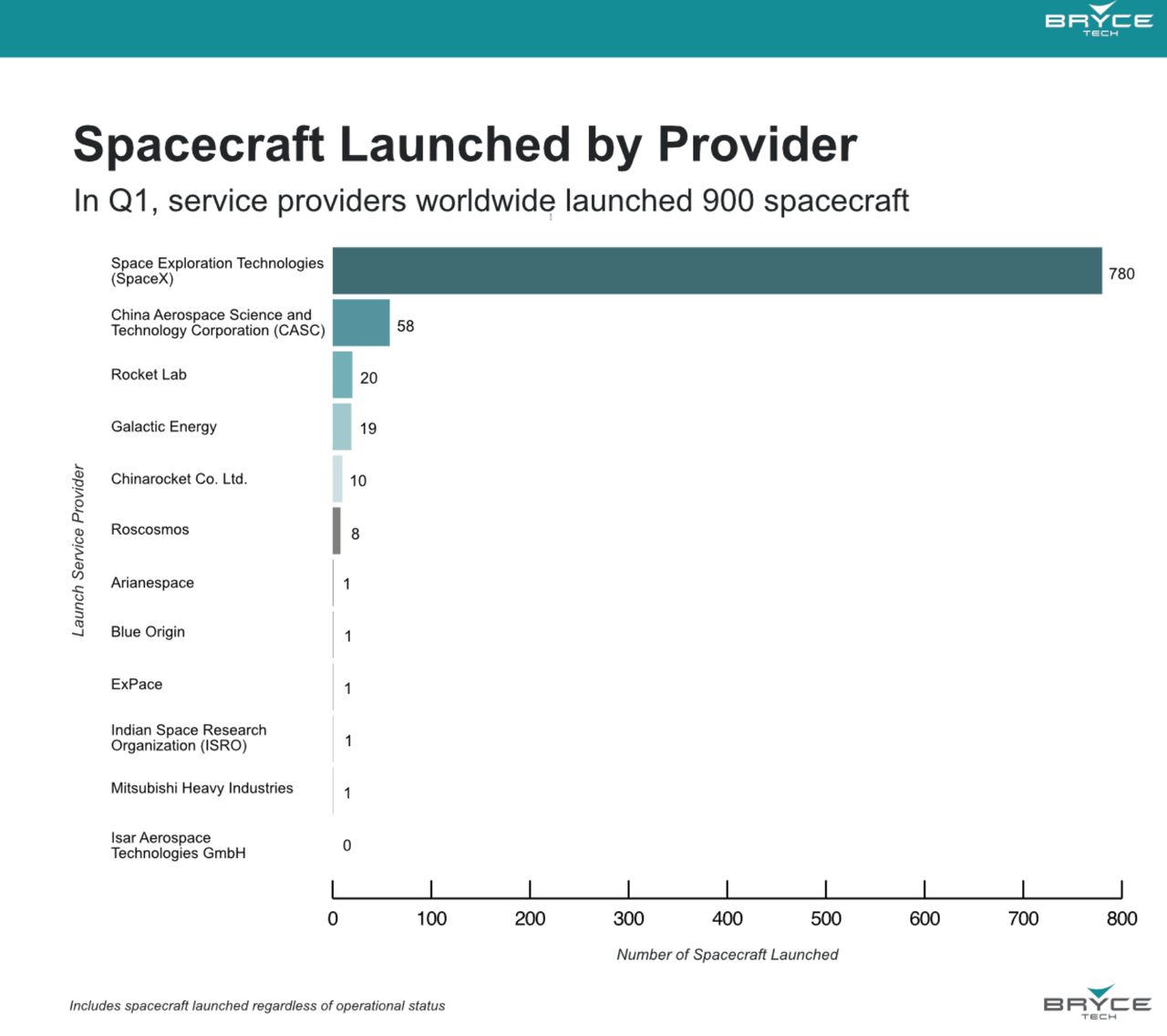
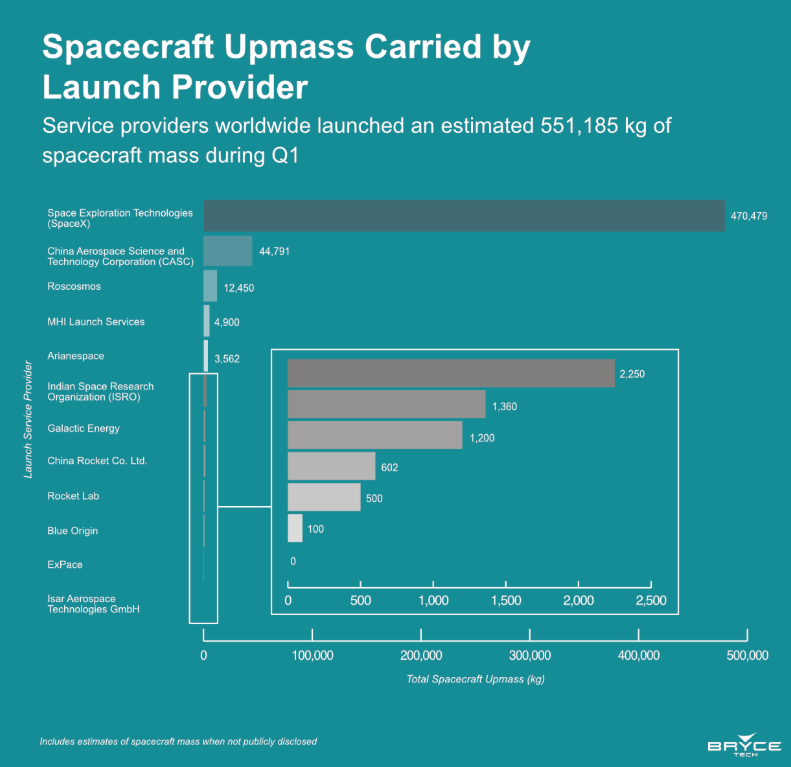
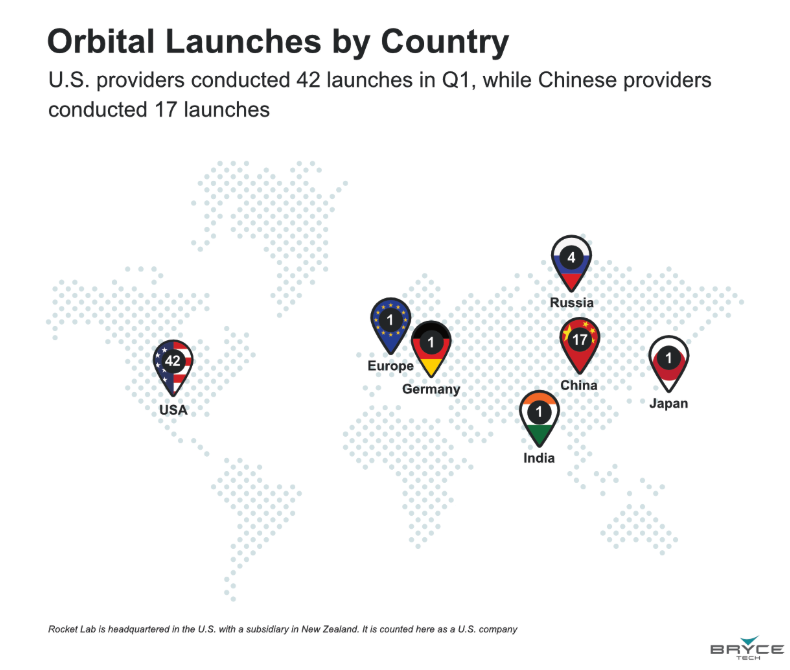
New data from analytics and engineering firm BryceTech for 1Q25 illustrates the scale of SpaceX’s dominance in the global orbital space launch race, surpassing not only domestic rivals but also major spacefaring nations like China and Russia.
In Q1, SpaceX led all rocket launches with 36 missions, followed by China with 12, 5 with US-based Rocket Lab, and Russia with 4.
In terms of satellite deployments, SpaceX dominated the quarter with 900, followed by China with 58 and Rocket Lab with 20. The majority of SpaceX’s payloads were Starlink internet satellites.
SpaceX’s ability to drive down launch costs has led it to become the leader in all upmass carried to space for the quarter.
SpaceX powers much of America’s rocket program. Without Musk’s company in the equation, the data clearly shows that China would be leading the space race.
Starship’s ninth flight test marked a major milestone for reuse with the first flight-proven Super Heavy booster launching from Starbase, and once more returned Starship to space → https://t.co/Gufroc2kUzpic.twitter.com/RNJkj5OobP
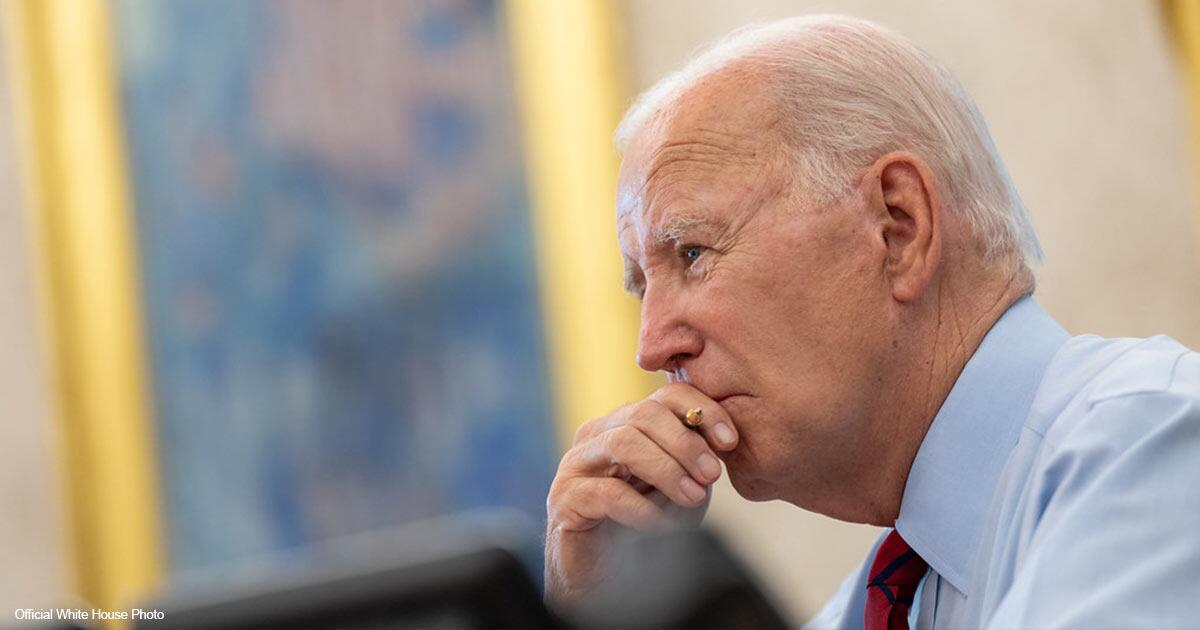
President Joe Biden issued 162 executive orders over the course of his Oval Office tenure, but according to a new report, most of them were signed by “autopen,” giving rise to concerns that unelected White House staffers may have had more say in shaping policy than the president. The report is furthering those concerns and suggesting that Biden may not have even been aware of the existence of the orders being signed in his name.
The American energy advocacy group Power the Future published the report Wednesday, examining eight Biden-era executive orders on climate change and U.S. energy policy, and found “no evidence” that Biden ever spoke about or acknowledged the existence of any of these orders. “Not in a press conference. Not in a speech. Not even a video statement,” Power the Future’s report stated. Power the Future Executive Director Daniel Turner said in a statement, “Americans deserve to know which unelected staffers or radical unnamed activists implemented sweeping change through an autopen. The Biden energy agenda destroyed the livelihoods of energy workers and fueled the record-high inflation that broke the budgets of millions of Americans.” He asked, “The question is simple, and deserves an immediate answer: what did Joe Biden know, and when did he know it?”
According to the Oversight Project, dedicated to government accountability, practically every order signed by Biden was signed via autopen, with the exception of his announcement withdrawing from the 2024 presidential election. The Oversight Project cited House Speaker Mike Johnson (R-La.), who questioned Biden on an executive order affecting liquefied natural gas (LNG) and reported that the president didn’t remember signing the order. “He looks at me, stunned, and he said, ‘I didn’t do that,’” Johnson recounted. He continued, “And I said to him, ‘Mr. President, yes you did, it was an executive order, like, you know, three weeks ago.’ And he goes, ‘No, I didn’t do that.’ … It occurred to me … he was not lying to me. He genuinely did not know what he had signed.”
“For investigators to determine whether then-President Biden actually ordered the signature of relevant legal documents, or if he even had the mental capacity to, they must first determine who controlled the autopen and what checks there were in place,” the Oversight Project wrote in a social media post. The accountability organization continued, “Given President Biden’s decision to revoke Executive Privilege for individuals advising Trump during his first Presidency, this is a knowable fact that can be determined with the correct legal process…”
The “autopen” has been the subject of significant controversy in recent years due to Biden’s excessive use of the technology. Devices have been around for centuries, allowing individuals to replicate their signature or sign multiple documents at once. Thomas Jefferson, for example, kept an early prototype, then called a “polygraph,” in the White House and another in his residence at Monticello. The device allowed a user to sign multiple documents at once but did require the signer to be present and to actively use the machine.
In the late 1930s, an automated version of the machine was developed, called the “autopen,” which would store a template of a signature that could be reproduced without the presence of the actual signer. The autopen became commercially available in the early 1940s and was quickly purchased by politicians, government officials, celebrities, and others. The first U.S. president to use an autopen was reportedly Harry Truman, although he only used the device to sign checks and answer mail. Likewise, most other presidents — such as John F. Kennedy, Richard Nixon, or Gerald Ford — who used an autopen relegated their use of the instrument to signing checks, correspondence, and autographs.
George W. Bush considered using the autopen to sign executive orders and legislation and even got the Department of Justice’s (DOJ’s) approval to do so, but still insisted on signing such documents himself, flying to Washington, D.C. to sign emergency legislation in 2005, for example. Barack Obama was the first president to use the autopen to sign legislation, giving his approval to sign Patriot Act extensions via autopen while he was visiting France in 2011, the National Defense Authorization Act while vacationing in Hawaii in 2012, and fiscal legislation in 2013.
President Donald Trump has openly refused to use autopen signatures for executive orders and other legal documents. “We may use it, as an example, to send some young person a letter because it’s nice,” Trump told reporters in March. Contrasting his limited use of the autopen against Biden’s much broader use, Trump added, “But to sign pardons and all of the things that he signed with an autopen is disgraceful.” Trump has also suggested that pardons — and, potentially, executive orders — signed by the Biden administration via autopen may be legally “void” if the president didn’t know what he was signing or didn’t authorize its signature.
The Washington Stand asked the DOJ about potential investigations and, if applicable, prosecutions of the Biden administration’s autopen use and was told, “No comment here.”
Company Gives Russian Servicemen $190K Bounty For Destroying F-16 Jets In Ukraine
Cash rewards for shooting down American F-16 fighter jets? That’s a real headline out of the Ukraine war…
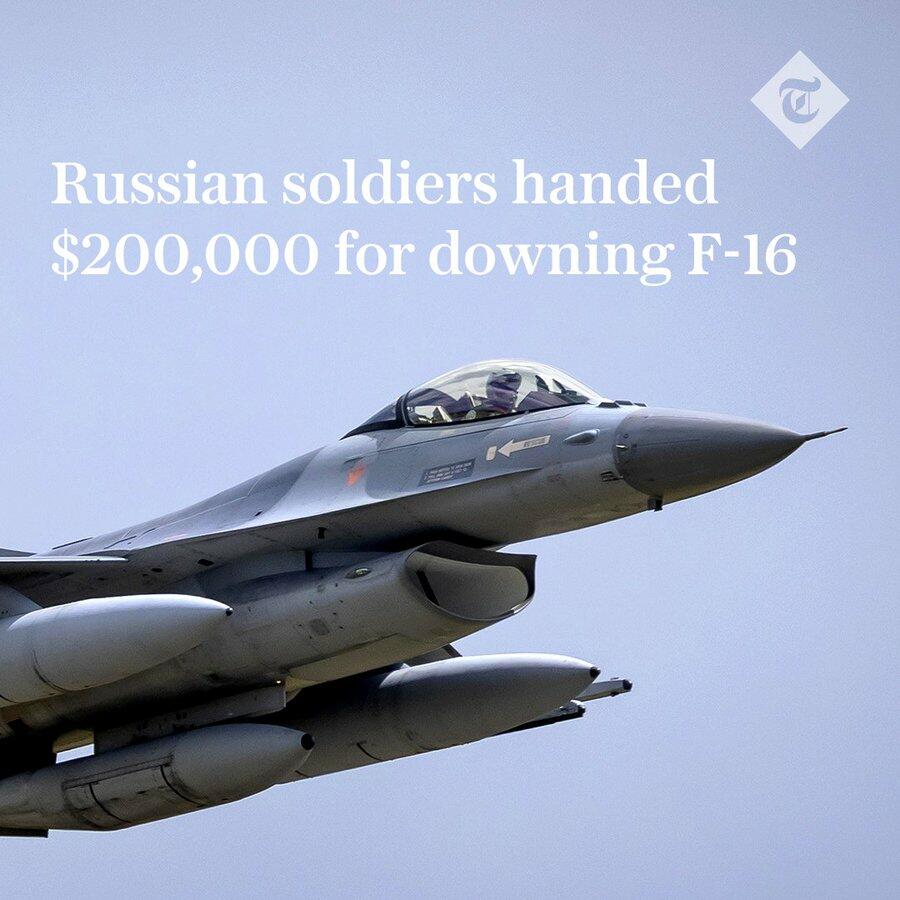
“A Russian company awarded a dozen servicemen a total of 15 million rubles ($190,000) for destroying U.S.-made F-16 fighter jets in Ukraine,” the Amsterdam-based Moscow Times reports. And they are even publish photos of the ‘award ceremony’.
“Fores, a Yekaterinburg-based fracking components supplier, said Friday that it handed out the cash prizes to troops at a location near the Russian-Ukrainian border,” MT continued. “Photos shared from the ceremony showed the soldiers’ faces blurred.”
Russian state sources have reported on at least three confirmed downed Western-supplied F-16s so far in the 3+years-long war, and the Kremlin has called the aircraft “sitting ducks”.
In some instances, Ukraine has claimed that jets have simply crashed while operating in intense battle environs, only to have the Russian defense ministry then assert back that they were shot down.
A second US-donated F-16 went down down over Ukraine last December, after prior to that there was a reported incident last August. Another was downed more recently. Conflicting reports have at times even mentioned a ‘friendly fire’ incident as the potential cause of one downing.
Fores has boasted that it’s the first company to ever offer huge financial payouts for the destruction of Western military equipment. It had actually paid out rewards for prior successful attacks on Leopard 2 and Abrams tanks.
Earlier, Fores Director General Sergey Shmotyev said on the sidelines of the St. Petersburg International Economic Forum that his company would will pay a bonus of 15 million rubles for the first F-16 fighter jet that could be shot down in Ukraine. In December, the businessman confirmed his intentions to TASS.
Based in the Urals, Fores makes proppants for the oil industry. It has supported the Russian Army since the launch of the special military operation. To date, the company has donated 237.7 million rubles ($3 million) toward the purchase of hardware, communications devices, jamming systems, thermal sights, medicines, and evacuation equipment. It has also purchased more than 500 tons of healthcare products and medicinal drugs for the special military operation zone.
Raining money? Russian soldiers hope so, in a somewhat macabre patriotic game…
It was starting in early 2024, when a European and US training program for Ukrainian fighter pilots was well underway, that Fores began announcing huge cash bounties for downing Ukrainian F-16s.
As for the tank reward program, Fores paid out 5 million rubles (about $65K) for the first take destroyed, starting in 2023, and has continued issuing payouts of 500,000 rubles per vehicle. Several videos have emerged of UK, US, and French battle tanks burning and destroyed.
Every year, since 1992, the UN General Assembly votes on a resolution brought forth by Cuba’s government regarding the need to end the US embargo. Each time the resolution is brought, Cuba’s government attributes the country’s economic hardships — such as shortages, rationing, and limited access to goods — to the long-standing US embargo, which it frames as a form of “economic warfare.” In its 2023 estimate, Cuba claimed the embargo has costits economy a total of $1.34 trillion, adding roughly $13 million in losses each day over the past year. This is an enormous number — and just as enormous a pile of rubbish.
The Cuban government attributes the figure to lost export revenues, trade reallocation costs, and disruptions in production and services. While these categories may sound reasonable at first glance, the regime assumes that all such disruptions are caused by the embargo, not by its own dysfunctional socialist policies. To top it off, the government even attributes emigration and talent loss — 4 percent of the total cost — to the embargo, as if decades of central planning and political repression had nothing to do with people fleeing the country.
Finally, it assumes that all losses in tourism are due to the embargo and not the nationalization of hotels, bars, and restaurants (in the 1960s) or the tight price controls and rationing (which continue today). Together, these fudged numbers account for 45 percent of the total cost, and that assumes the rest is based on “true” number.
The point of this exercise in statistical deception is to shift blame.
Cuba used to be one of the richest countries in Latin America. Its living standards — in the 1920s — even matched those of some poorer American states. Globally, Cuba was among the wealthier nations. Today, it lingers near the bottom of international rankings. To deflect blame for the disastrous effects of the socialist policies implemented by Fidel Castro after 1959 — and largely maintained ever since — the regime points to the US embargo. It wasn’t Castro and his successors who slowed Cuba’s growth and impoverished the nation by global standards. No, it was the Americans and their embargo that kept the Revolution from bearing its true fruits.
The problem is that there is no doubt that embargoes make nations poorer! The US embargo clearly makes Cubans poorer — this is a near consensus. But by how much? As long as that question lingers, Cuba’s government can get always with promoting rubbish studies that serve to legitimize their rule.
Fortunately, there is now a way to disentangle the effects of different factors explaining Cuba’s economic evolution since 1959.Alongside João Pedro Bastos and Jamie Bologna Pavlik, we separated the effect of Cuba’s socialist policies from those of the embargo and those of Soviet aid to the country.
This was possible thanks to two new advances.
The first was a new series for GDP per capita in Cuba that is consistent over time and which can be matched with Soviet transfers to the country; this way, we can evaluate Cuba with and without transfers.
The second is a relatively novel method in economics — the synthetic control method, which can be used to estimate the causal effect of an intervention (i.e., a treatment just like in a laboratory experiment). It consists in constructing a weighted combination of control units (here: other countries) that approximates the characteristics of the treated unit before the intervention. For Cuba, the intervention is Fidel Castro’s socialist policies. This “synthetic control” serves as a counterfactual — what would have happened in the absence of the treatment (i.e., Cuba continues with a non-socialist and non-democratic regime as was the case before 1959). The difference between the observed outcomes of the treated unit and its synthetic counterpart after the intervention provides an estimate of the treatment effect.
Combined, this allows us to observe the trajectory of Cuba’s economy net of Soviet transfers but still accounting for the effects of the US embargo. By 1989, our results show that Cuba was approximately 55 percent poorer than it would have been in the absence of both socialism and the embargo. In other words, even before the collapse of Soviet support, the costs of central planning and isolation had already taken a severe toll on Cuban living standards.
So, what about the embargo? After stripping out the Soviet subsidy, we can use trade data to simulate how much trade openness was lost due to the embargo. Trade openness — measured as the ratio of total trade (exports plus imports) to GDP — plummeted after 1960 as Cuba was cut off from its most natural trading partner and was forced to reallocate to less efficient trading partners (European countries, Soviet bloc countries, other developing nations). Simply put, Cuba was forced into inefficient trade relationships. This, in turn, affected productivity.
By reapplying the synthetic control method using trade data, we can construct a counterfactual level of trade openness in the absence of the embargo. The resulting gap provides a measure of lost openness attributable to the embargo, which can then be converted into a cost figure by using standard estimates of the growth effects of trade openness. This approach yields an estimate of the economic cost of the embargo independent of domestic policies.
So how big a deal is the embargo? At worst, it accounts for about 10 percent of the economic gap attributable to the combination of the Revolution and the embargo; at best, it explains less than 3 percent. In other words, yes — the embargo has made Cubans poorer, and it may even have helped the regime endure longer by providing a convenient scapegoat. But it simply doesn’t explain much. The true source of Cuba’s decline is the regime’s own policies. These policies placed the country on a trajectory that dragged it from the top tier of global rankings to the bottom.
Next year, when yet another resolution condemning the embargo is tabled before the UN General Assembly, let us hope at least one journalist will point out the absurdity of the regime’s estimates. Let us some representative in the Assembly will state what truly needs to be said: the embargo may be unwise, but the primary cause of Cuba’s poverty is the repressive socialist regime that has extinguished the economic freedom of its people.
A very interesting item in the Executive Functions substack newsletter, written by a leading expert on Presidential power:
On Wednesday, the U.S. Court of International Trade (CIT) ruled that the International Emergency Economic Powers Act (IEEPA) did not authorize President Trump’s sprawling tariff policies and permanently enjoined them. On Thursday a federal district court in the District of Columbia reached the same conclusion about IEEPA for different reasons, and issued a preliminary injunction.
Before these rulings, I disagreed with most of thecommentary on Trump’s IEEPA sanctions and thought that the legal issues here were hard and close. Neither ruling convinced me otherwise. In what follows I explain why, though I must be necessarily selective in addressing complicated opinions chock full of technical arguments.
As I explain in the end, I think the lawfulness of Trump’s IEEPA tariffs depends a lot on the proper application of the major questions doctrine (MQD) that both the CIT and the district court under-examined. Indeed, I think the major questions doctrine will be the central issue before the Supreme Court when these cases reach it. A reader in a hurry might skip the long intervening statutory interpretation technicalities and go directly to the more interesting and to my mind consequential analysis of the MQD’s relevance at the end of this piece.
The Case for Trump’s Tariffs Under IEEPA
IEEPA grants the president a number of emergency authorities, one of which is the authority to “regulate … importation … of … any property in which any foreign country or a national thereof has any interest by any person.” It further provides that the president may exercise this authority “to deal with any unusual and extraordinary threat, which has its source in whole or substantial part outside the United States, to the national security, foreign policy, or economy of the United States, if the President declares a national emergency with respect to such threat.” …
A very interesting item in the Executive Functions substack newsletter, written by a leading expert on Presidential power:
On Wednesday, the U.S. Court of International Trade (CIT) ruled that the International Emergency Economic Powers Act (IEEPA) did not authorize President Trump’s sprawling tariff policies and permanently enjoined them. On Thursday a federal district court in the District of Columbia reached the same conclusion about IEEPA for different reasons, and issued a preliminary injunction.
Before these rulings, I disagreed with most of thecommentary on Trump’s IEEPA sanctions and thought that the legal issues here were hard and close. Neither ruling convinced me otherwise. In what follows I explain why, though I must be necessarily selective in addressing complicated opinions chock full of technical arguments.
As I explain in the end, I think the lawfulness of Trump’s IEEPA tariffs depends a lot on the proper application of the major questions doctrine (MQD) that both the CIT and the district court under-examined. Indeed, I think the major questions doctrine will be the central issue before the Supreme Court when these cases reach it. A reader in a hurry might skip the long intervening statutory interpretation technicalities and go directly to the more interesting and to my mind consequential analysis of the MQD’s relevance at the end of this piece.
The Case for Trump’s Tariffs Under IEEPA
IEEPA grants the president a number of emergency authorities, one of which is the authority to “regulate … importation … of … any property in which any foreign country or a national thereof has any interest by any person.” It further provides that the president may exercise this authority “to deal with any unusual and extraordinary threat, which has its source in whole or substantial part outside the United States, to the national security, foreign policy, or economy of the United States, if the President declares a national emergency with respect to such threat.” …
Legislation that would have banned anyone under the age of 18 from using or creating social media accounts in Texas stalled in the Senate this week after lawmakers failed to vote on it.
House Bill 186, filed by state Rep. Jared Patterson (R-Frisco), would have prohibited minors from creating accounts on social media sites such as Instagram, TikTok, Facebook, Snapchat, and others by requiring the platforms to verify users’ age.
The measure previously passed the GOP-controlled state House with broad bipartisan support in April, but momentum behind the bill slowed at the eleventh hour in the state Senate this week as lawmakers face a weekend deadline to send bills to Gov. Greg Abbott’s desk.
The legislative session ends on Monday.
In a statement on the social media platform X late Thursday, Patterson said the bill’s failure to pass in the Senate was “the biggest disappointment of my career,” adding that no other bill filed this session “would have protected more kids in more ways than this one.”
The Republican lawmaker said he believed its failure to pass meant “I’ve failed these kids and their families.”
“I felt the weight of an entire generation of kids who’ve had their mental health severely handicapped as a result of the harms of social media,” the lawmaker said. “And then there’s the others – the parents of Texas kids who’ve died as a result of a stupid social media ‘challenge’ or by suicide after being pulled down the dangerous rabbit holes social media uses to hook their users, addict them on their products, and drive them to depression, anxiety, and suicidal ideation.”
“Finally, there’s the perfectly happy and healthy teens in Texas today, who will find themselves slowly falling off the edge before the legislature meets again in 2027,” he stated.
Patterson suggested he would try and pass the measure again when the Texas Legislature meets in 2027.
House Bill 186 would have prohibited a child from entering into a contract with a social media platform to become an account holder and required platforms to verify that a person seeking to become an account holder is 18 years of age or older before allowing them to create an account.
The legislation would have also required social media platforms to delete accounts belonging to individuals under the age of 18 at a parent or guardian’s request.
Provisions in House Bill 186
According to the bill, the accounts would need to be removed no later than 10 days after receiving such a request, and the platforms would also be required to cease “further use or maintenance in retrievable form, or future online collection, of personal information collected from the child ’s account, on all of its platforms.”
Additionally, the measure would have required platforms to provide a “reasonable, accessible, and verifiable means by which a parent or guardian” could make a request to have their child’s account deleted.
If signed into law, the bill would have gone into effect in September 2025.
Social media companies’ failure to comply with the legislation would have been considered a deceptive trade practice, meaning they could face legal action under Texas consumer protection laws.
While the measure was widely championed by Republicans, it drew sharp condemnation from tech trade groups and critics who branded it an unconstitutional limit on free speech.
Trade association Netchoice said the bill’s core provisions were “unconstitutional,” while the age-verification stipulation “presents heightened threats to privacy and undermines the state’s interest in protecting the privacy of users.”
In addition, the association said the HB 186 “usurps parental decision making.”
The bill’s failure to make it past the state Senate comes as Abbot signed into law a separate measure this week requiring Apple and Google to verify the age of online app store users.
That legislation also requires parental consent to download apps and make in-app purchases for users under 18.
Utah passed a similar bill earlier this year. California is also set to make it illegal for social media platforms to knowingly provide addictive feeds to children without parental consent, beginning in 2027.
Florida passed a similar law last year banning social media accounts for children under the age of 14 and requiring parental permission for 14- and 15-year-olds.
“Billion-Dollar Ghost Town” Surrounds Under Armor Headquarters
The Baltimore Peninsula—formerly known as Port Covington—is a 235-acre, large-scale mixed-use waterfront redevelopment in South Baltimore, which one YouTuber has called it a “billion-dollar ghost town.”
“This video explores Baltimore’s newest and swankiest waterfront neighborhood,” YouTuber “Building Tales” wrote in the description of the video, adding, “It’s a beautiful Saturday, but there’s just one thing missing … people.”
The video description continued, “On this particular Saturday I walked around for a half hour and could just about count all the people I saw on one hand. So what’s going on here… why are there all of these beautiful new buildings but seemingly no one here to use them?”
Major developers of the waterfront redevelopment project include:
Sagamore Ventures (Kevin Plank, Under Armour founder)
Goldman Sachs Urban Investment Group
MAG Partners (New York-based, led by MaryAnne Gilmartin)
MacFarlane Partners (San Francisco-based real estate firm)
Financing on the deal included:
Public and private financing: Over $5.5 billion in total investment planned
Largest TIF (Tax Increment Financing) in Baltimore history: $660 million approved in public bonds to fund infrastructure
So far, the struggling apparel brand Under Armour remains the large anchor tenant at Baltimore Peninsula, with a new global headquarters. Much of the surrounding office and retail space has been built on speculation, with hopes that additional tenants will follow.
According to one industry insider, a key challenge facing Baltimore City’s commercial real estate market is the growing number of competing business districts—both completed and under development—that are attracting tenants, such as Harbor East.
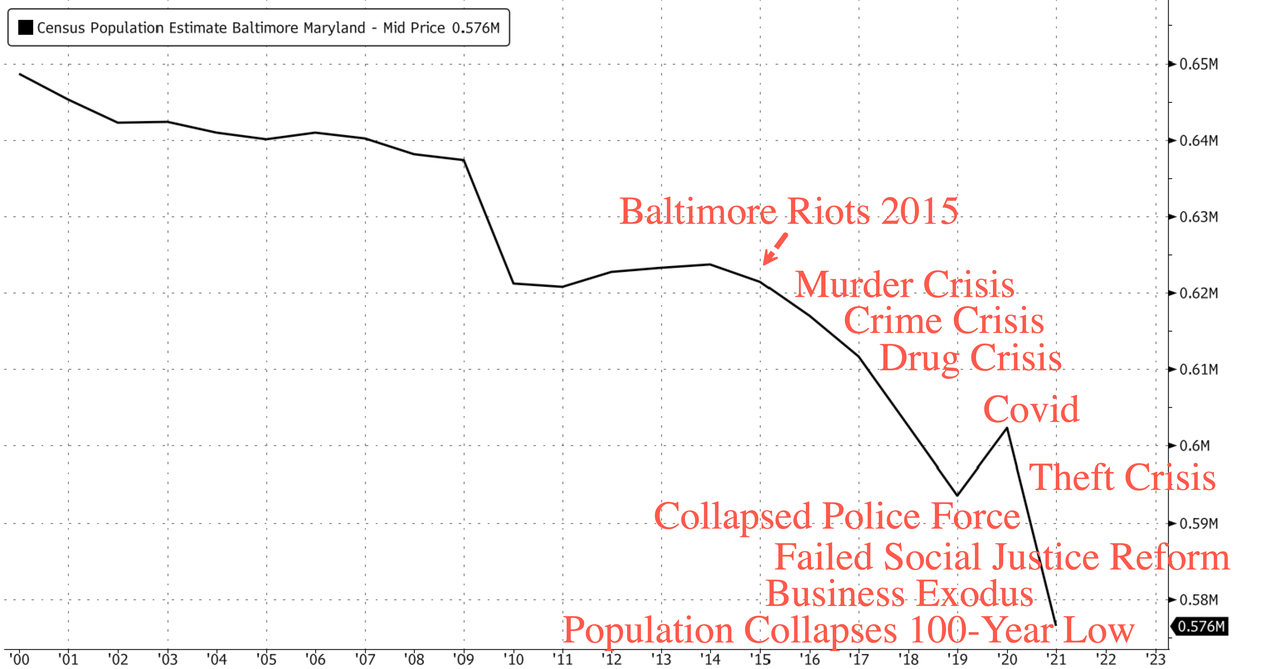
The broader issue is that Baltimore City Hall remains under the control of radical leftist activists whose decade-long social justice experiment has backfired, igniting recent and broader violent crime waves. The population in the metro area has plunged to a 100-year low as residents and businesses flee the crime-infested area.
Whether it’s the population collapse, violent crime, mass exodus of residents, or the sight of a “ghost town” in a major new commercial development—Baltimore’s decline all points back to one root cause: decades of failed progressive leadership at City Hall.