Centralized AI Threatens A Democratic Digital Future

Centralized AI Threatens A Democratic Digital Future

Authored by Manouk Termaaten (founder and CEO of Vertical Studio AI) via CoinTelegraph.com,

Major corporations control decentralized AI (DeAI) companies, leaving decentralized AI in the dust. To build a more decentralized world, the sector must actively execute upon a focused DeAI strategy, with shared standards between projects, without compromise.

In April, a UN report warned that AI’s $4.8-trillion market is dominated by a mere 100 companies, most of which are based in the US and China. Centralized AI incumbents have the money and the connections to control this massive new industry, which means significant implications for society. 

These companies, all employing centralized AI technology, have run into their fair share of headaches. For example, Microsoft’s Copilot garnered attention for creating explicit, inappropriate images, such as children in compromising scenarios. This sparked a public and regulatory backlash.

Although Microsoft created stricter moderation, it had already demonstrated that centralized AI can harbor problems in part due to its closed-source code. 

Citadel was wrapped up in an AI trading scandal in the financial sector, as algorithms allegedly manipulated stock prices via artificial volume creation.

Google’s Project Maven, a Pentagon pilot program used in military tech, has raised ethical questions.

“We believe that Google should not be in the business of war,” reads a letter penned by Google employees and addressed to Sundar Pichai, the company’s CEO. The employees requested that Google leave Project Maven.

“We ask that Project Maven be cancelled, and that Google draft, publicize and enforce a clear policy stating that neither Google nor its contractors will ever build warfare technology,” the letter states.

So much for “Don’t be evil” — the company’s old slogan.

These situations give us clear examples of the potential failures of centralized AI, including ethical lapses, opaque decision-making and monopolistic control. DeAI’s open-source ethos, community governance, audit trails and computer facilities can give more than a few massive corporations an edge in the future of AI. 

Centralized AI gains more power 

Corporations and nation-states maintain an upper hand in AI development today — not DeAI projects. Nation-states and corporations can and do outspend DeAI.

Nation-states see that the stakes are high, as Russian President Vladimir Putin highlighted when he warned that the country that wins the AI race will “become the ruler of the world.” The People’s Republic of China aims to become the global leader in AI by 2030. 

AI will likely develop an authoritarian bent and feature the pervasive lack of privacy proliferating across today’s World Wide Web, all defined by a corporate state that maintains only a veneer of sharing the fundamental values of the Enlightenment.

DeAI faces an uphill battle

The chances for DeAI to carve out a considerable market share are relatively small. The incumbents are so well-resourced that the battle is one of David and Goliath. Nation-states and corporations will maintain the lead on access to AI, making it all but guaranteed that most of the world will interface with AI first on centralized systems, giving them early adopter status. 

But on a long enough timeline — decades or hundreds of years — DeAI can win market share via open-sourced models and transparent developer documentation.

To realize the vision of DeAI, the sector will have to maximize AI’s benefits with security. DeAI must execute on privacy and data control, resilience, scalability, reduced latency, access democratization and cost-efficiency. It must do this as a community and express its values to the world — regulators, consumers, investors and more. 

DeAI brings numerous advantages over centralized AI systems, like improved privacy and data control, no single point of failure, edge computing and democratized access.

Despite these advantages, AI will undoubtedly be dominated by the prominent state-enterprise apparatus characteristic of the neoliberal world. 

To create a more decentralized world, it’s time to proactively implement a clear DeAI strategy and establish common standards across projects, ensuring these are upheld without compromise.

Tyler Durden
Fri, 05/30/2025 – 18:25

via ZeroHedge News https://ift.tt/cBimfWd Tyler Durden

Trump’s Tariffs Deliver Record $23 Billion Revenue In May

Trump’s Tariffs Deliver Record $23 Billion Revenue In May

U.S. tariff revenues reached an all-time high in May as President Donald Trump’s trade policies started to fill government coffers.

According to the May 28 Daily Treasury Statement, revenues from “customs and certain excise taxes” climbed to a record high of $23.28 billion this month, up from $17.431 billion in April.

May was the first full month that Trump’s levies took effect. Most of the tax collections occurred on May 22, exceeding $16 billion.

Shortly after his April 2 “Liberation Day” announcement, the administration imposed 10 percent tariffs on nearly every country in the world.

Fiscal year-to-date—the federal government’s fiscal year runs from October 1 to September 30—tariff revenues total $93.85 billion.

As Andrew Moran reports for The Epoch Times, Customs and Border Protection (CBP) says that it has been implementing and enforcing the president’s tariffs “using all our enforcement and revenue collection authorities.”

“CBP enforces tariffs through a combination of legal authority, advanced systems, and operational procedures designed to ensure that duties owed are paid,” the CBP said in a report earlier this month.

“We have fulfilled the demand and remain committed to facilitating legitimate trade while upholding a robust enforcement posture.”

Last month, the CBP conducted 33 audits, leading to the collection of $117 million in duties and fees owed to the U.S. government. Officials found that imported goods had been “improperly declared.”

Despite the sizable increase in tariff revenues, it still accounts for a relatively small portion of overall government receipts.

In April, Washington generated $850 billion in revenues, meaning levies represented approximately 2 percent of the total amount.

Despite the president’s estimates, tariffs are only producing less than $1 billion per day for the U.S. government.

President Donald Trump meets with Salvadoran President Nayib Bukele in the Oval Office of the White House on April 14, 2025. Brendan Smialowski/AFP via Getty Images

During a meeting with Salvadoran President Nayib Bukele last month, Trump stated that the United States was “taking in billions and billions of dollars” from his trade agenda.

“We were losing 2 billion a day. … Now we’re making $3 billion a day,” he said.

The president has repeatedly threatened new or higher tariffs since the “Make America Wealthy Again” event on April 2.

“Remember, I am empowered to ‘SET A DEAL’ for Trade into the United States if we are unable to make a deal, or are treated unfairly,” Trump said in a May 27 post on social media platform Truth Social.

Looking at Revenue Projections

Senior administration officials have presented substantial revenue projections based on the president’s tariff plans.

In a March 31 interview with “Fox News Sunday,” the president’s senior trade adviser, Peter Navarro, forecast that tariffs could raise approximately $600 billion a year, or about $6 trillion over a decade.

“The message is that tariffs are tax cuts, tariffs are jobs, tariffs are national security. Tariffs are great for America. They will make America great again,” Navarro said.

Treasury Secretary Scott Bessent speaks to reporters during a briefing at the White House on April 29, 2025. Travis Gillmore/The Epoch Times

Economists have presented more conservative estimates.

The Tax Foundation, for example, anticipates Trump’s higher import duties will lead to more than $2.1 trillion in revenue over 10 years.

Officials, including Treasury Secretary Scott Bessent, have suggested that tariffs could be a major source of income for the federal government. Speaking to reporters at a White House press briefing, Bessent stated that tariff revenue could “give income tax relief.”

This would, however, be only temporary.

According to the senior Cabinet secretary, reliance on tariff revenue would diminish as more companies onshore and reshore manufacturing, bolstering domestic income.

“If we’re successful, tariffs would be a melting ice cube, in a way, because you’re taking in the revenues as the manufacturing facilities are built in the U.S., and there should be some level of symmetry between the taxes we begin taking in with the new industry from the payroll taxes as the tariffs decline,” Bessent told CNBC’s “Squawk Box” on April 8.

The administration’s tariffs have now faced legal hurdles, which might throw a wrench in fiscal projections.

A three-judge panel at the New York-based U.S. Court of International Trade blocked the president’s global tariffs. A second court also handed down an order blocking Trump’s use of emergency powers to implement tariffs.

An appeals court ruled that the president’s tariffs could stay in place.

Scores of White House officials have shrugged off the legal roadblocks.

In a May 30 interview with CNBC’s “Squawk Box,” U.S. Trade Representative Jamieson Greer stated that the president has “other tools” to implement his trade agenda.

U.S. Trade Representative Jamieson Greer testifies before the Senate Finance Committee in the Dirksen Senate Office Building in Washington on April 8, 2025. Kayla Bartkowski/Getty Images

“All these things are on the table,” Greer said. “The reality is, we have this enormous trade deficit. It got worse over the Biden years, and if we don’t fix the global trading system, it’s just going to get even worse going forward. We have to fix it.”

According to the Census Bureau, the U.S. goods trade deficit narrowed sharply in April, declining to $87.6 billion. This is down 46 percent from the record high of $162.3 billion registered in March.

Tyler Durden
Fri, 05/30/2025 – 18:00

via ZeroHedge News https://ift.tt/jvfiG5K Tyler Durden

Bob Menendez Does Not Deserve a Pardon

“People talk about the Trump [Department of Justice] DOJ,” Bob Menendez, the disgraced former senator from New Jersey, posted on X Friday, “but it was the Democrats who started weaponizing the Justice Dept.”

The timing of that message was interesting. Menendez, a Democrat, is scheduled to report to federal prison on June 17, after a jury convicted him of accepting almost $1 million in bribes in exchange for, among other things, favors that benefited foreign governments.

The scheme was extensive. Menendez—along with his wife, Nadine—took gold bars, $480,000 in cash, and a $60,000 Mercedes-Benz convertible from three New Jersey businessmen, who, in return, had Menendez leverage the power of his office in a litany of corrupt ways. That included helping secure hundreds of millions of dollars in military aid to Egypt; assisting Egyptian-American entrepreneur Wael Hana in preserving a monopoly granted to him by that same country; attempting to influence multiple criminal investigations in a way that would satisfy two of his bribers; and promoting the interests of Qatar so that New Jersey real estate developer Fred Daibes could lock down a multi-million dollar investment from a fund associated with the Qatari government. This list is not exhaustive.

The former senator was convicted last year on all 16 counts, which included bribery, honest services wire fraud, obstruction of justice, and acting as a foreign agent, among several others. A judge sentenced him to 11 years in prison, which was, in some sense, a break, considering that the federal sentencing guidelines recommended a minimum of 24 years in prison. (His wife was convicted last month on all counts—15 in her case—and is scheduled to be sentenced in June.) 

Menendez’s Friday post coincides not only with his looming prison sentence but also with the spate of pardons recently granted by President Donald Trump. It’s understandable why the former senator would want to pull out all the stops here. Prison, to put it mildly, sucks. Trump should still decline to indulge him.

Whether or not the president will be moved remains unclear. Among his recent pardons is Paul Walczak, an executive who was convicted of withholding millions of dollars in taxes from his employees’ paychecks and then keeping the funds for himself. His pardon came shortly before he was to report to prison for an 18-month sentence—and after his mother attended a Trump fundraiser dinner at Mar-a-Lago, where, according to the invitation, admission cost $1 million. But perhaps more analogous to Menendez’s situation is the pardon given to Scott Jenkins, the disgraced former Virginia sheriff who, in exchange for cash payments, gave out auxiliary deputy sheriff badges so recipients could invoke special privileges.

It is not exactly a mystery why the pardon power’s reputation is in the toilet. The problem is a bipartisan one—former President Joe Biden, for his part, issued preemptive pardons for his family members, Anthony Fauci, and others, which does not exactly instill confidence in the rule of law. Neither does pardoning people who sufficiently endear themselves to the chief executive. Pardon Attorney Ed Martin captured those motivations best on X: “No MAGA left behind,” he wrote Monday, as he thanked Trump for pardoning Jenkins.

But the pardon power, for all the negative attention it has received in recent months, can be an incredible tool for good. It is effectively the only lever to check overzealous prosecutors and unjust sentences in the federal system. Some of Trump’s pardons make the case for this. Most famously there was Alice Marie Johnson, who was sentenced to life in prison without the possibility of parole in the ’90s for her role as a drug mule in a cocaine ring; Trump initially commuted her sentence and later pardoned her in 2020. Listed in the latest round of pardons were John Moore and Tanner Mansell, two Florida diving instructors who were convicted of theft after freeing sharks they thought had been caught illegally—which, as Reason‘s Jacob Sullum notes, was a bizarre misuse of the discretion afforded to prosecutors.

That is the sort of thing clemency is for: to give a lifeline to people who may have been railroaded by the government, which sometimes gets creative and fanatical in its attempts to punish people. It is not supposed to be a get-out-of-jail-free card for well-connected, powerful people who can flatter the president. After all, Menendez, as a senator, was one of the most powerful people in the country. His case was not an example of politicizing justice, though a pardon would be.

The post Bob Menendez Does Not Deserve a Pardon appeared first on Reason.com.

from Latest https://ift.tt/9kRsOKN
via IFTTT

12-Year-Old Tennessee Boy Arrested for Instagram Post Says He Was Trying To Warn Students of a School Shooting

After posting a screenshot of two people planning to “shoot up” a Nashville school, a 12-year-old DuPont Tyler Middle School student was arrested and charged with threats of mass violence. Although his charges were later dismissed, school officials opted to expel the boy without properly assessing whether the threat was valid or whether he had authored the messages himself. 

Directly following a school shooting at Antioch High School earlier this year, which resulted in the death of two students and injury to a third, Nashville School District officials were on high alert for other potential threats. The day after the shooting, James, a seventh grade student, was flagged by the FBI for a concerning Instagram post. According to ProPublica, the post depicted a text conversation between two individuals: One said they would “shoot up” a Nashville school if the second would attack another. “Yea,” the second replied, “I got some other people for other schools.” 

When asked about the post, James told school officials he had reposted a screenshot from a Spanish-language news site. He was subsequently arrested and charged with making threats of mass violence. 

Under Tennessee law, when a student is suspected of threatening mass violence, a threat assessment is required “to determine whether the threat of mass violence made by the student was a valid threat.” If the director of schools determines the threat is not valid, the school is not allowed to expel the student.

However, records obtained by ProPublica show that school officials failed to conduct a proper threat assessment and missed crucial steps. Melissa Nelson, a national school safety consultant who trains schools on managing threats, told ProPublica that James’ assessment was “gross mismanagement of a case.” Rather than seek out information to help confirm whether the threat was valid—like notifying and interviewing James’ parents—or pursue options provided by the threat assessment tool to deescalate potential future violence, school officials jumped straight to expulsion after he was arrested. 

“Even if a child is expelled, what I always train is: Out of sight, out of mind doesn’t help,” she said. “Expelling a child doesn’t de-escalate the situation or move them off the pathway of violence. A lot of times, it makes it worse.” 

John Van Dreal, a former school administrator who helped the Nashville School District set up its current threat assessment process, agreed. Choosing to skip directly to expulsion is “actually about the most dangerous thing you can do for the student,” Van Dreal said, “and honestly for the community.”

During an appeal hearing, James maintained that he was not the original author of the texts. When asked if he understood that the screenshot in question appeared to be a conversation he, himself, was having, he replied, “I just wanted to let people know, feel heroic. I didn’t want more people to get hurt.” 

When pressed during that same hearing on why the school chose to expel James without additional investigation, Assistant Principal Angela Post said that it was up to law enforcement, not the school, to investigate the threat. She also admitted that the assessment did not make a determination whether James was the original author of the text, and she couldn’t recall whether school staff investigated the origin of the original threat. By her logic, James’ arrest was evidence enough that the threat was valid, and therefore, expulsion was necessary. 

But since James’ arrest, law enforcement hasn’t treated him like a violent threat. After serving a night in a juvenile detention facility, James agreed to six months of pretrial diversion and court supervision. His supervision was lifted earlier than expected after he completed his pretrial diversion terms, and his case has been dismissed. 

However, following his appeal with the Nashville School District, officials found that the decision to immediately expel James “was not a due process violation.”

The post 12-Year-Old Tennessee Boy Arrested for Instagram Post Says He Was Trying To Warn Students of a School Shooting appeared first on Reason.com.

from Latest https://ift.tt/129MT5S
via IFTTT

Arkansas S. Ct. Vacates Gag Order on Man Accused of Murdering His Teenage Daughter’s Alleged Sex Abuser

From Thursday’s decision in Spencer v. State, written by Justice Courtney Hudson and joined by Justices Rhonda Wood, Shawn Womack, Cody Hiland, and Nicholas Bronni:

On November 27, 2024, Spencer was charged by felony information with second-degree murder … for the shooting death of sixty-seven-year-old Michael Fosler…. The circumstances of the shooting were as follows. In July 2024, Fosler had been charged with numerous sexual offenses against Spencer’s teenage daughter, and he was released on bond. On the night of the shooting, Spencer awoke to his dog barking and realized that his daughter was gone. Spencer found a “hoodie” on a stuffed animal placed in her bed. As a result, he left in his truck to search for her. Spencer located Fosler’s truck—with his daughter inside—and he forced Fosler’s truck off the highway. After an altercation, Spencer called 911 to report that he had shot Fosler. Fosler died at the scene.

On December 4, 2024, the State filed a motion for gag order alleging that Spencer’s arrest had garnered media coverage throughout the state and the nation. Attached to the motion was a press release from Spencer’s attorneys, Erin Cassinelli and Michael Kaiser, criticizing the decision to charge Spencer criminally as “targeting [a] heroic father.” The State also pointed to a television interview in which defense counsel allegedly stated that they felt confident that the community would side with Spencer “because every one of them would have done the same thing for their child or their neighbor’s child or member of their family.” The State argued that a gag order was necessary to preserve the integrity of the jury pool and to ensure the right of a fair trial for both the State and the defendant.

The trial court ordered:

It is the Order of this Court that no party to this action, nor any attorney or agency connected with this case, directly or indirectly, nor any judicial employee or officer of this Court, nor any public official now holding office, including but not limited to law enforcement officials, nor any agent, deputy or employee of any such persons, nor any person subpoenaed to testify at the trial of the case[,] [n]either shall the defendant nor his family shall do any of the following:

  1. [R]elease or authorize the release for public dissemination of any purported extrajudicial statement of the Defendant relating to this case;
  2. Release or authorize the release of any documents or exhibits or any evidence, the admissibility of which may have to be determined by the Court;
  3. Make any statement for public dissemination as to the existence or possible existence of any document, exhibit, or any other evidence;
  4. Express outside of the Court an opinion or make any comment for public dissemination as to the weight, value, or effect of any evidence as tending to establish the guilt or innocence of the Defendant;
  5. Make any statement outside of Court for public dissemination as to the weight, value, or effect of any testimony that has been given;
  6. Issue any statement for public dissemination as to the identity of any prospective witnesses, or their probable testimony or the effect thereof;
  7. Make any out of court statement for public dissemination as to the weight, value, source, or effect of purported evidence alleged to have been accumulated as a result of the investigation of this matter;
  8. Make any statement for public dissemination as to the content, nature, substance, or effect of any testimony which may be given at any proceeding related to this matter with any attorney of record or any agent thereof.

The order expressly excluded:

  1. Factual statements of the Defendant’s name, age, residence, occupation, or family status;
  2. The circumstances of the arrest, namely the time and place of arrest, the identity of the arresting and investigating officers and agencies, and length of the investigation;
  3. The nature, substance, and text of the charges, including a brief description of the offense(s) charged;
  4. Quotations from, or any reference without comment to, public records of the Court in this case, or to other public records or communications heretofore disseminated to the public;
  5. The scheduling and result of any stage of the judicial proceeding held in open court or in an open public session;
  6. Any request for assistance in obtaining evidence;
  7. Discussion by any witness or prospective witness of any matter in connection with the case with any of the attorneys representing the Defendant or the State.

The Arkansas Supreme Court unanimously vacated the order, reasoning:

Here, the circuit court’s order is extremely broad as to the persons restrained from speaking. It restrains the parties; their attorneys; “any public official now holding office,” along with their staff; witnesses; court staff; and the defendant’s family. The order is also extremely restrictive as to what information is being shielded from public view. It restricts filings and perhaps courtroom proceedings from public view. The order implicates Spencer’s right to a public trial as well as the public’s right to know how its officials are conducting these criminal proceedings. The State points out that Spencer raises arguments regarding the gag order’s application to public officials and to his family, the restriction on public and press access to the court file, and the due-process rights of nonparties as to entry of the order without notice. However, Spencer clearly has standing to bring this petition requesting that this court vacate the gag order in his criminal case, and we will address Spencer’s arguments to the extent necessary to resolve the issues raised in the petition….

Based on the U.S. Supreme Court’s limited precedents in the area, the Arkansas Supreme Court concluded:

In the absence of Supreme Court precedent, the federal circuits and the states have taken different approaches to gag orders. Some courts have adopted the “clear and present danger” or “serious and imminent threat” standard [citing the D.C., 6th, 7th, and 9th Circuits, as well as the Hawaii and Nevada Supreme Courts]. Other courts have adopted the “substantial likelihood of material prejudice” standard [citing the 3d and 5th Circuits]. Still other courts have adopted a “reasonable likelihood” of prejudice standard [citing the 4th and 10th Circuits and the Kentucky Court of Appeals].

When determining which standard to apply, we must initially recognize whose speech is being restricted. We can identify three categories of persons potentially subject to gag orders: (1) attorneys of record; (2) non-attorney trial participants (such as criminal defendants, witnesses, and court staff); and (3) the public at large (i.e., those who are not participating in the trial).3 Because the gag order entered here included members of all three categories, we review each to establish the appropriate standards. {We do not address gag orders on the press in this opinion because the order before us does not impose restrictions on the press, nor does any member of the press challenge it.}

First, we address attorney speech. The Supreme Court has recognized that speech by an attorney is subject to greater regulation than speech by others. See Gentile v. State Bar of Nevada (1991). The Court recognized that states have historically regulated admission to the bar and exercised authority to discipline attorneys; attorneys have access to non-public information and are viewed as authoritative, both of which pose a greater potential risk to the fairness of a trial; and attorneys are officers of the court. Id. at 1066. For these same reasons, we find it appropriate to allow greater regulation of attorney speech in the context of a criminal trial than would be permissible for the speech of non-attorney trial participants or members of the public. Thus, we hold that attorneys in Arkansas may be restrained from extrajudicial speech that poses a substantial likelihood of material prejudice to an ongoing criminal proceeding. This is consistent with attorneys’ existing obligation under Rule 3.6 of the Arkansas Rules of Professional Conduct regarding trial publicity.

Next, we consider the free-speech rights of non-attorney trial participants. These persons are not subject to the same rules and restrictions as attorneys. But, as participants in the trial, their speech has the potential to have a greater impact than the speech of non-trial participants. See Sheppard v. Maxwell (1966) (“Neither prosecutors, counsel for defense, the accused, witnesses, court staff nor enforcement officers coming under the jurisdiction of the court should be permitted to frustrate its function.”) Thus, we conclude that free-speech protections for non-attorney trial participants are greater than those of attorneys of record but less than those of the public at large. Therefore, we hold that the speech of non-attorney trial participants may be restrained only to the extent that it poses a serious and imminent threat of material prejudice to an ongoing criminal proceeding.

Finally, we address prior restraints on the public, whose speech is afforded the most protection in the context of gag orders. Restraining the speech of the public raises obvious issues regarding lack of due process. We cannot fathom why the circuit court believed it could prohibit the speech of “any public official now holding office.” In fact, it is difficult to foresee any circumstance in which a prior restraint on the speech of a member of the public, which would include a public official, could be constitutional.

Having established the legal standards to be applied, we turn to the additional findings a circuit court must make in every case to justify the entry of a gag order restricting the speech of any individual. First, the circuit court must determine whether alternative measures would protect the parties’ right to a fair trial. See Nebraska Press Ass’n v. Stuart (1976). Here, Spencer suggests that extensive voir dire of prospective jurors, using an expanded jury pool, giving cautionary instructions, changing venue, or postponing the trial are alternatives that should be considered before restraining speech, but the circuit court heard no evidence and made no findings in this regard. In addition, the circuit court must find that a gag order would be likely to accomplish the goal of preventing prejudice to the proceedings. Again, there was no such finding in this case. Finally, a gag order must be narrowly tailored to prohibit only what is necessary to protect the integrity of the ongoing judicial proceedings. In other words, the restrictions imposed must not be overly broad. Here, many of the prohibitions on speech listed in the gag order were overly broad. For example, prohibiting the public expression of an opinion as to “the weight, value, or effect of any evidence as tending to establish the guilt or innocence of the [d]efendant” by any public official is clearly overbroad.

In sum, before entering a gag order, a circuit court must specifically find, based on evidence in the record, that (1) the prospectively limited speech would pose a sufficient threat of material prejudice to an ongoing criminal proceeding, depending on whether the limitation applies to attorneys of record, non-attorney trial participants, or members of the public; (2) after consideration of alternative less restrictive measures, none would sufficiently protect the parties’ right to a fair trial; (3) the prohibitions would be likely to prevent material prejudice to the proceedings; and (4) the prohibitions are narrowly tailored to prohibit only what is necessary to prevent material prejudice to the ongoing proceedings.

The court concluded that the gag order was “far too broad and too restrictive of speech protected by the First Amendment,” and was also unconstitutionally vague (e.g., in failing to define “family”). It therefore vacated the order; and though it did “not foreclose the possibility that, after an evidentiary hearing, the circuit court may issue a subsequent gag order narrowly tailored to specific factual findings supported by the record,” it “emphasize[d] that a gag order ‘should be a last resort, not a first impulse.'”

The court also faulted the trial court for sealing the case:

Here, after the court’s order was entered, the case filings were removed from public view. The inherent authority to seal parts of court files is tempered by the requirements that a request to seal part of a file must be particularized, that there must be some good cause for sealing part of a file, such as a trade secret, and that it should be in effect for only so long as is necessary to protect the specified interest.

Not only are the written records inaccessible to the public, but also, the briefs and statements from counsel at oral argument indicate that the Lonoke County Circuit Court’s courtroom was at least partially closed to the public during Spencer’s arraignment. Although it appears the circuit court intends to close further proceedings to the public, we caution the court from doing so without an evidentiary basis and adherence to the required constitutional analysis set out in Waller v. Georgia (1984)…. “[T]he right to a public trial is one of the most important safeguards in the prosecution of persons accused of crime.”

Justice Rhonda Wood also wrote a separate opinion, arguing that the court should have focused instead on the Arkansas Constitution (but reached the same result under the same test as it adopted with regard to the First Amendment).

Justice Bronni also added, joined by Shawn Womack, Cody Hiland:

Public officials aren’t immune from public criticism—judges and prosecutors included. Because the circuit court’s gag order violates that principle, I join the majority’s opinion granting the writ and vacating that order. But that sweeping order is only one part of a troubling pattern of attempts to shield this case from public view—beginning with a nonpublic arraignment and ending with a handwritten note sealing “[t]he entire case” from public view. We cannot allow that pattern to continue unchecked.

So I’d invoke this court’s superintending authority and reassign this matter to a new circuit court judge. Anything less suggests that what’s happened so far is within the acceptable range of disagreement or administration—and it isn’t.

Begin with the gag order itself. On its face, that order targets a broad swath of people, barring them from “[e]xpress[ing] … an opinion, or mak[ing] any comment” about whether the evidence “tend[s] to establish the guilt or innocence of the Defendant.” Worse, the order itself was sealed, raising serious concerns about selective enforcement. And it doesn’t explain why such an extreme remedy was warranted, instead just declaring it would “help ensure all parties get a fair trial.”

Nor did the circuit court explain why it extended the gag order beyond what even the State thought was appropriate, broadening it to cover the defendant’s family and, even more significantly, sealing “[t]he entire case.” On the contrary, the circuit court entered that order just six minutes after the clerk docketed the defendant’s 19-page opposition to the State’s motion—or barely enough time to make a pot of coffee. That approach cannot be squared with the First Amendment, and it underscores that the gag order wasn’t a last resort but an unconstitutional impulse.

Context suggests why. The same circuit court that issued the gag order here also granted Michael Fosler’s release on bail. It’s that decision—which the defendant’s lawyers called a decision to release “a predator” who “repeatedly violated [the defendant’s] child … on a low bond”—that set off a chain of events that led to the fatal confrontation that’s the subject of this case. And it’s that criticism that the State claimed, and the circuit court effectively concluded, justified gagging the defendant, his lawyers, and others. This sequence raises serious concerns. Indeed, if openness “enhances … the appearance of fairness so essential to public confidence in the system,” then secrecy has the opposite effect—it erodes trust.

The effort to shield these proceedings from public view also didn’t begin with the gag order; it started with the circuit court’s decision to arraign the defendant away from public view. And even setting aside the potential constitutional concerns raised by a nonpublic arraignment, that decision highlights the order on review here isn’t an isolated problem. Rather, it suggests a Star Chamber-like atmosphere. We cannot allow that to continue.

Ultimately, judges and prosecutors enjoy “no greater immunity from criticism than other persons or institutions.” Nor should they. “Public vigilance serves us well, for ‘the knowledge that every criminal trial is subject to contemporaneous review in the forum of public opinion is an effective restraint on possible abuse of judicial power.'” Instead, “justice should not only be done, but should manifestly and undoubtedly be seen to be done.”

So I join the majority’s decision granting the writ and vacating the gag order, but I would go a step further. The repeated attempts to veil these proceedings in “[s]ecrecy … can only breed ignorance and distrust of the courts and suspicion concerning the competence and impartiality … of the entire criminal justice system.” …

Chief Justice Karen Baker and Justice Barbara Webb didn’t participate. Erin Cassinelli and Michael Kiel Kaiser (Lassiter & Cassinelli) represent Spencer.

The post Arkansas S. Ct. Vacates Gag Order on Man Accused of Murdering His Teenage Daughter's Alleged Sex Abuser appeared first on Reason.com.

from Latest https://ift.tt/qehDfcO
via IFTTT

Do Lower Court Judges Time Their Decisions to Take Senior Status (or Retire) Based on Who May Replace Them?

Do lower court judges time their decisions to take senior status or retire, and thus create a vacancy for a President to fill, based upon who they think might replace them? It is an interesting (and timely) question–and one that can be informed by more than anecdote and intuition.

Back in 1995, James F. Spriggs, II and Paul J. Wahlbeck published a paper looking at lower court retirement decisions between 1893 and 1991, “Calling It Quits: Strategic Retirement on the Federal Courts of Appeals, 1893-1991.” Perhaps unsurprisingly, they found that retirement rates increased significantly among judges appointed by a President of the same party as the current occupant of the White House. Other studies, including “Judges as Party Animals: Retirement Timing by Federal Judges and Party Control of Judicial Appointments” by Ross M. Stolzenberg and James Lindgren have reached similar conclusions.

More recently, John Deschler and Maya Sen looked at whether ideology, distinct from partisan affiliation, influences judges’ decisions to leave active status. Their paper, “The Role of Judge Ideology in Strategic Retirements in U.S. Federal Courts,” published last year, suggests it does. Here’s the abstract:

The widely recognized phenomenon of federal judges retiring strategically has key implications for the composition of the judiciary, particularly given polarization between the two U.S. political parties. Using fine-grained measures of judicial ideology, we examine how ideology shapes such strategic retirements. First, we show that since Reagan’s election, Democratic appointees to lower federal courts have been more likely to retire strategically than Republican ones. Second, we find that more ideologically conservative Republican appointees are more likely to strategically retire than are moderate Republican appointees but only suggestive evidence of a similar pattern among more liberal Democratic appointees. Third, as explanation, we find that moderate Republican appointees appear to “wait out” retiring strategically under more conservative recent presidents, such as Donald Trump, opting instead to retire under Democrats such as Joe Biden. Taken together, our results offer a key insight: ideology, and not just party, can be an important factor in driving strategic retirement.

Setting aside whether Trump should be characterized as more “conservative” than other Republican presidents, and whether the Trump effect found here is properly characterized as a function of “ideology,” the study does seem to find a Trump effect on judges’ decisions to create vacancies.

Why might this matter? One reason it might matter is that judges who are wavering may be more likely to retire if they fell more confident in the sort of nominee who would replace them. At this moment there are 22 circuit court judges who were appointed by Republican Presidents who are eligible for senior status but have not yet announced any intention to step down, as well as 42 district court judges.

This suggests that if the White House wants to maximize the administration’s influence on the judiciary, it should seek to appoint the sort of judges that are likely to instill confidence in judges who are eligible to take senior status, particularly in the beginning. (In other words, it should seek to nominate judges of the caliber that it nominated during the first term.) And if it fails to do so, it may discover that it ends up with fewer vacancies to fill.

Trump’s first judicial appointment of the second term would seem to fit the bill here. The second appellate nomination, Emil Bove, has been more polarizing. So the jury is out on whether Trump’s judicial nominations will, on the margin, encourage more sitting judges to create vacancies for President Trump to fill.

The post Do Lower Court Judges Time Their Decisions to Take Senior Status (or Retire) Based on Who May Replace Them? appeared first on Reason.com.

from Latest https://ift.tt/WAByhZq
via IFTTT

Why It Is So Difficult For Trump To Clean Up Biden’s Ukraine Mess

Why It Is So Difficult For Trump To Clean Up Biden’s Ukraine Mess

Authored by Fred Fleitz via American Greatness,

Whenever I go on British TV news programs for interviews about President Trump’s efforts to stop the fighting in Ukraine, I am usually asked two leading questions by condescending British TV hosts: “Do you think President Trump’s Ukraine policy has failed?” and “Do you think Russian President Putin is playing President Trump?’

I always answer that these are biased questions that misrepresent how the war in Ukraine started and Trump’s efforts to end it.

Indeed, President Trump has not yet succeeded in ending this brutal war. Russian President Putin has indeed been difficult to deal with, has failed to abide by his commitments with Trump and his officials, and has escalated the war despite Trump’s peace efforts.

It is unfair to portray these potentially temporary outcomes as failures of Trump’s Ukraine policy, as they ignore that his peace efforts aim to address an enormous foreign policy crisis caused by his predecessor that may not be easily fixed or solved.

Biden emboldened Putin to invade Ukraine by ignoring the Russian leader’s fear of Ukraine moving closer to the West and joining NATO. Although Biden and his senior officials never explicitly called for Ukraine to join NATO, they dangled NATO membership before Ukrainian President Zelensky and repeatedly said this decision was up to Ukraine. Biden further confused the situation by stating several times in 2021 that the United States and NATO would stand behind Ukraine’s “sovereignty and territorial integrity,” statements that sounded like Biden offered Ukraine security guarantees. In addition, during a June 2021 NATO Summit, NATO reaffirmed the commitment made at the 2008 NATO Bucharest Summit that Ukraine would one day become a member.

Biden also encouraged Putin to invade Ukraine with extraordinarily weak American national security policies. The most notorious was the disastrous U.S. withdrawal from Afghanistan. Putin was emboldened to invade by other cases of Biden’s foreign policy incompetence, especially Biden’s statement weeks before Russian troops crossed into Ukraine when he said the U.S. and its allies might be divided on how to respond if a Russian invasion was a “minor incursion.”

In addition, Biden destroyed U.S. relations with Russia after the start of the war by repeatedly demonizing Putin and failing to engage in diplomacy with the Russian leader to end the war. Biden never spoke with Putin after Russia invaded Ukraine in February 2022. Instead, he repeatedly harshly criticized Putin, often calling him a war criminal. Biden also likened Putin to Hamas after the horrific October 7, 2023, Hamas terrorist attack against Israel.

Biden and European leaders also pursued policies that caused the war to become a stalemate, which Ukraine will eventually lose. They refused to give Ukraine the weapons it requested in mid-2022 that probably would have enabled it to repel Russian forces from most of its territory. This refusal allowed the Russian army to recover and regroup after suffering heavy losses at the beginning of the invasion. Biden followed this mistake with a policy to arm Ukraine “for as long as it takes” with no strategy either for a Ukrainian victory or to negotiate an end to the war.

Therefore, to say that Trump came to the war in Ukraine as president with the deck stacked against him is an understatement. Although Putin is ultimately responsible for this deadly and unprovoked war, it would not have happened if Biden had not antagonized Putin and ignored his sensitivities about Ukraine. U.S. and European policies also made it impossible for Ukraine to win the war in 2022, made the war worse, and discouraged diplomacy to end the conflict.

In addition, this conflict was made more complex after Biden’s mishandling of U.S.-Russia relations drove Putin into the arms of Chinese President Xi, causing Russia and China to declare a “no limits” partnership and create a new anti-Western axis. Iran and North Korea are at least informal members of this axis.

Trump finds the Ukraine war difficult to end because Biden’s foreign policy failures were so severe. This does not mean the war is unsolvable. But it may mean that the Ukraine mess Biden left for Trump will be far more difficult to clean up than anyone thought.

It is possible that Biden’s Ukraine mess can’t be cleaned up, and the Russian leader will refuse to reach a peaceful settlement on any terms short of Ukrainian capitulation. I also believe the odds are long for a peace agreement right now and that it might take months or years of negotiations to reach a possible peace agreement acceptable to Ukraine.

The next time I am on the BBC and am asked about this issue, I plan to stress that I believe President Trump is ready for the possibility that the Ukraine War is unsolvable and will make clear, if he concludes that the war cannot be ended, that the failure lies with Biden. I will also say that Trump will probably take steps if the Ukraine War cannot be ended to ensure that similar conflicts do not break out in the future and to keep the United States out of similar wars.

Tyler Durden
Fri, 05/30/2025 – 17:40

via ZeroHedge News https://ift.tt/IXrfyZn Tyler Durden

Houthis Vow “Hot Summer” As Israel’s National Airline Added To Target List

Houthis Vow “Hot Summer” As Israel’s National Airline Added To Target List

President of the Houthi Supreme Political Council, Mahdi al-Mashat, has warned Israel of a “hot summer” ahead, as the militant group allied to Iran has refused to halt its missile fire on Israel in relation to the ongoing Gaza war.

Israeli airstrikes earlier this week took out the last remaining planes operated by national carrier Yemenia Airways at Sanaa international airport. The airport is completely demolished after multiple rounds of Israeli attacks, and with runways blown to pieces. 

Israel has stressed this is direct retaliation for Houthi missiles which have repeatedly targeted Ben Gurion International Airport, including a ballistic missile which was sent – and intercepted – on Thursday.

Source: AirlineGeeks

“The upcoming operations will differ in quantity and quality from previous operations carried out deep inside the Israeli entity,” Yemeni sources were quoted in a regional publication as saying.

The new statement warned that this “will include Israeli civilian aircraft on the target list” – meaning that main national carrier El Al Israel Airlines will be targeted, per Lebanon’s Al-Akhbar.

Thursday night saw the Houthi military spokesman boast that a missile sent against Ben Gurion airport caused “millions of usurping Zionists to rush to shelters and bringing the airport to a standstill.”

Israeli media has described while confirming the intercept over or near Tel Aviv, “Since March 18, when the IDF resumed its offensive against Hamas in the Gaza Strip, the Houthis in Yemen have launched 42 ballistic missiles and at least 10 drones at Israel. Several of the missiles have fallen short.”

One of the Houthis’ rare ‘successes’ was the direct impact of one of the missiles on Ben Gurion airport in early May, which injured several people fleeing the scene.

The below is the full translated statement of Ansarallah’s Mahdi al-Mashat warning Israel of a “hot summer” ahead:

“The government of the filthy Netanyahu is unable to protect you, and the coming surprises are painful. To the Zionist herds: You should wait for a hot summer. I say to all companies that continue to arrive at the Ben Gurion Airport … that they are at risk at any moment. I call on all travelers around the world to avoid traveling with companies that continue to fly [there], as they are subject to our sanctions and are not safe,” he said. 

What’s become clear in the wake of Trump’s declared ‘ceasefire’ with the Houthi’s in the Red Sea as that the US Navy and CENTCOM have largely pulled back their defense support to Israel in its southern region.

There were reports saying that the Pentagon was blowing through costly ammunition at an alarming pace in defense of Israel, and the decision was made to withdraw from the Red Sea theatre.

Tyler Durden
Fri, 05/30/2025 – 17:20

via ZeroHedge News https://ift.tt/gdITh5H Tyler Durden

Hawaii Becomes First State To Charge Tourists For Carbon Footprint

Hawaii Becomes First State To Charge Tourists For Carbon Footprint

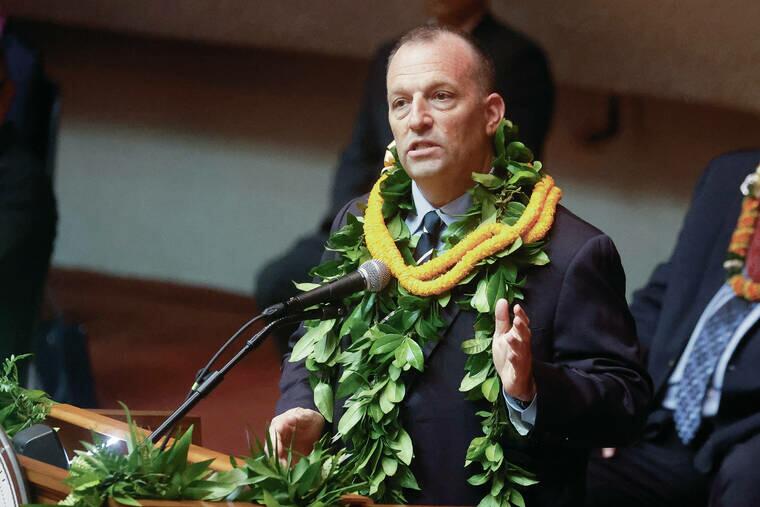
Hawaii became the first U.S. state to establish a climate impact fee on tourism this week, placing an additional tax on visitors to fund “climate change resiliency projects”.  As the country’s inaugural “Green Fee,” Act 96 will raise the state’s current transient accommodations tax (TAT) by 0.75% for a total of 11% placed upon the nightly lodging rate, effective Jan. 1, 2026, according to a press release by Governor Josh Green’s office.

“Today Hawaiʻi ushers in the first Green Fee in the nation. Once again, Hawaiʻi is at the forefront of protecting our natural resources, recognizing their fundamental role in sustaining the ecological, cultural and economic health of Hawaiʻi. As an island chain, Hawaiʻi cannot wait for the next disaster to hit before taking action. We must build resiliency now, and the Green Fee will provide the necessary financing to ensure resources are available for our future,” said Governor Green.

Green is ostensibly referring to the disastrous Maui fires in 2023 which did $5.5 billion in property damage and became an international embarrassment for the Hawaiian state government.  Of course, as we reported at the time, the fires had nothing to do with “climate change” and everything to do with the state’s gross mismanagement of water resources and fire response.

The new Green Fee will apply to travelers staying in hotels, short-term vacation rentals and for the first time ever, cruise ships. For a nightly hotel rate of $300, the tax would add an extra $2.25 each day.  This might not seem like much, but Hawaiian officials expect the tax to generate up to $100 million per year, and like all progressive governments, they are licking their chops over the possibilities.

In essence, carbon footprint schemes are a tax on an invisible byproduct with an imaginary climate impact.  These are taxes to solve a problem which does not exist.  So, the sky is truly the limit on how far carbon taxes can be taken to bleed the American public and fuel further government expansion.  It begins with a tax on hotel rooms, but there’s nothing stopping the state from adding the same fees to everything from boat rentals to tiki torches. 

Furthermore, if Hawaiian residents think they will be spared from such taxes, they are in for a rude awakening.  The new Green Fee also applies to people living in Hawaii who stay at hotels and resorts, and there’s little doubt that more taxes are incoming as the Green Fee sets the precedent.  Some legislators have pushed for carbon tax “kickback” to residents of the state, but this would represent a minimal offset if carbon taxes spread to all areas of the economy.

Keep in mind, Hawaii already has one of the highest tax burdens for citizens in the entire US.

Hawaii’s carbon reduction plans call for a 70% cut in emissions by 2030, using a “phased-in system” with a carbon tax rate of $80 per ton of carbon emissions by that year.  Hawaii want zero emissions by 2045.  Meaning, a green fee on hotels is just the beginning and everything with a carbon footprint will ultimately be taxed into oblivion.

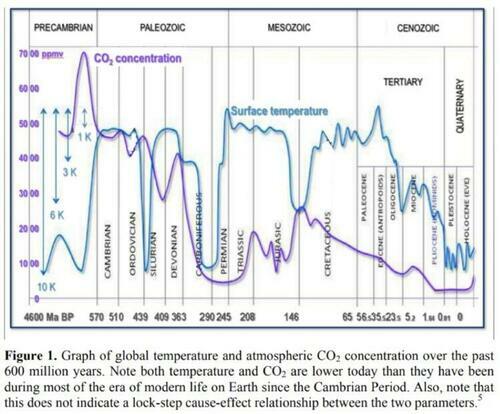
As we have noted many times, there is zero concrete evidence of a causation relationship between carbon emissions and climate change.  All climate models used by scientists in the field to justify their global warming claims rely on data collected from the 1880s onward.  That’s a tiny window of 140 years in the Earth’s climate history and conveniently ignores long term data from before the advent of human industry.

When we examine Earth’s temperatures over millions of years, it’s easy to see that modern civilization exists in one of the coldest periods, not the warmest.  Numerous warming periods have occurred in the past with no human activity to cause the events.

And, if we look at the behavior of the carbon content of the Earth’s atmosphere over this same time period, it’s obvious that there is no correlation between rising carbon and rising temperatures.

In other words, the entire basis for carbon taxation has been debunked.  The only reason governments continue to push for emissions fees is because they know a large percentage of the population isn’t aware of this information.  Government and NGO funded climate scientists continue to spread disinformation on global warming because they have access to billions upon billions of dollars in grant money if they promote the narrative.  The farce is simply far too lucrative to abandon.   

Tyler Durden
Fri, 05/30/2025 – 16:40

via ZeroHedge News https://ift.tt/CwI9n1k Tyler Durden

Bob Menendez Does Not Deserve a Pardon

“People talk about the Trump [Department of Justice] DOJ,” Bob Menendez, the disgraced former senator from New Jersey, posted on X Friday, “but it was the Democrats who started weaponizing the Justice Dept.”

The timing of that message was interesting. Menendez, a Democrat, is scheduled to report to federal prison on June 17, after a jury convicted him of accepting almost $1 million in bribes in exchange for, among other things, favors that benefited foreign governments.

The scheme was extensive. Menendez—along with his wife, Nadine—took gold bars, $480,000 in cash, and a $60,000 Mercedes-Benz convertible from three New Jersey businessmen, who, in return, had Menendez leverage the power of his office in a litany of corrupt ways. That included helping secure hundreds of millions of dollars in military aid to Egypt; assisting Egyptian-American entrepreneur Wael Hana in preserving a monopoly granted to him by that same country; attempting to influence multiple criminal investigations in a way that would satisfy two of his bribers; and promoting the interests of Qatar so that New Jersey real estate developer Fred Daibes could lock down a multi-million dollar investment from a fund associated with the Qatari government. This list is not exhaustive.

The former senator was convicted last year on all 16 counts, which included bribery, honest services wire fraud, obstruction of justice, public official acting as a foreign agent, among several others. A judge sentenced him to 11 years in prison, which was, in some sense, a break, considering that the federal sentencing guidelines recommended a minimum of 24 years in prison. (His wife was convicted last month on all counts—15 in her case—and is scheduled to be sentenced in June.) 

Menendez’s Friday post coincides not only with his looming prison sentence but also with the spate of pardons recently granted by President Donald Trump. It’s understandable why the former senator would want to pull out all the stops here. Prison, to put it mildly, sucks. Trump should still decline to indulge him.

Whether or not the president will be moved remains unclear. Among his recent pardons is Paul Walczak, an executive who was convicted of withholding millions of dollars in taxes from his employees’ paychecks and then keeping the funds for himself. His pardon came shortly before he was to report to prison for an 18-month sentence—and after his mother attended a Trump fundraiser dinner at Mar-a-Lago, where, according to the invitation, admission cost $1 million. But perhaps more analogous to Menendez’s situation is the pardon given to Scott Jenkins, the disgraced former Virginia sheriff who, in exchange for cash payments, gave out auxiliary deputy sheriff badges so recipients could invoke special privileges.

It is not exactly a mystery why the pardon power’s reputation is in the toilet. The problem is a bipartisan one—former President Joe Biden, for his part, issued preemptive pardons for his family members, Anthony Fauci, and others, which does not exactly instill confidence in the rule of law. Neither does pardoning people who sufficiently endear themselves to the chief executive. Pardon Attorney Ed Martin captured those motivations best on X: “No MAGA left behind,” he wrote Monday, as he thanked Trump for pardoning Jenkins.

But the pardon power, for all the negative attention it has received in recent months, can be an incredible tool for good. It is effectively the only lever to check overzealous prosecutors and unjust sentences in the federal system. Some of Trump’s pardons make the case for this. Most famously there was Alice Marie Johnson, who was sentenced to life in prison without the possibility of parole in the ’90s for her role as a drug mule in a cocaine ring; Trump initially commuted her sentence and later pardoned her in 2020. Listed in the latest round of pardons were John Moore and Tanner Mansell, two Florida diving instructors who were convicted of theft after freeing sharks they thought had been caught illegally—which, as Reason‘s Jacob Sullum notes, was a bizarre misuse of the discretion afforded to prosecutors.

That is the sort of thing clemency is for: to give a lifeline to people who may have been railroaded by the government, which sometimes gets creative and fanatical in its attempts to punish people. It is not supposed to be a get-out-of-jail-free card for well-connected, powerful people who can sufficiently flatter the president. After all, Menendez, as a senator, was one of the most powerful people in the country. His case was not an example of politicizing justice, though a pardon would be.

The post Bob Menendez Does Not Deserve a Pardon appeared first on Reason.com.

from Latest https://ift.tt/9kRsOKN
via IFTTT