Congress Must Vote on Tariffs

President Donald Trump’s unilateral attempt at imposing tariffs has evolved into a quantum state.

You probably already know that Trump has repeatedly threatened, imposed, paused, delayed, raised, lowered, and “chickened out” on various tariff plans. In the past 48 hours, things got even crazier. The Court of International Trade blocked most of Trump’s tariffs with an injunction issued Wednesday, but that injunction was temporarily paused by a federal appeals court on Thursday. Meanwhile, a second federal court also ruled Thursday that the tariffs are unlawful.

The tariffs, which constitute one of the largest tax increases in American history, are simultaneously active and unlawful, subject to change at the president’s whim, and could be turned off once again within weeks (when the appeals court’s temporary stay will be reviewed).

As of this moment, that means an American importer doesn’t know whether it is due a refund for tariffs already paid, or whether it will owe more taxes for the next shipment of goods.

This is, obviously, no way to run tax policy.

The good news is that there’s an equally obvious solution to this mess—a solution that’s been available since the beginning of this whole insane saga.

Congress needs to vote on the tariffs. Now.

This is true for both practical and constitutional reasons. The practical one should be obvious enough, given all the tariff-related chaos that Trump has unleashed. The economy needs certainty, and Congress can provide that by approving whatever tariff package can get the necessary votes in both chambers—and by restricting Trump’s ability to keep making changes.

For tariff advocates, the benefit of having a vote in Congress is putting an immediate end to the various lawsuits facing the administration’s trade policies. In both lower court rulings that went against Trump, the judges did not say tariffs are unlawful. They said Trump did not have the authority to impose those tariffs, and that the power to do so rests with Congress.

That brings us to the constitutional argument. Article I, Section 8 spells it out in no uncertain terms: “The Congress shall have Power To lay and collect Taxes, Duties, Imposts and Excises.”

Some members of Congress have been making this point for months. “Tariffs are taxes, and the power to tax belongs to Congress—not the president,” is how Sen. Rand Paul (R–Ky.) likes to explain it. “Our Founders were clear: tax policy should never rest in the hands of one person.”

The closest thing we’ve seen to an actual congressional vote on tariff policy was a Senate vote on a resolution Paul proposed to cancel the tariffs Trump imposed on Canada and Mexico. It passed 5148 but has not received a vote in the House (more on that in a moment). Paul also offered a second resolution to cancel Trump’s “Liberation Day” tariffs on nearly all imports, but that one failed because two senators likely to vote “yes” missed the vote.

Over in the House, Rep. Suzan DelBene (D–Wash.) and some of her Democratic colleagues have been trying to force similar votes. “Before Trump attempts to reformulate his tariffs under a different law, Congress must settle this issue once and for all by passing legislation to require the president to come to Congress before imposing sweeping tariffs,” she said this week, following the court ruling that blocked Trump’s tariffs.

The situation in the House has been made more complicated by Republican leaders, who have used a gimmick to block a proxy vote on the tariffs—along the lines of what Paul was able to force in the Senate. A resolution to cancel the supposed “emergency” underpinning the tariffs should be a privileged motion that can move directly to the House floor without going through committees. This is all a bit wonky, but the House Rules Committee has declared that, for the purposes of tariff resolutions, “days” on the House calendar are not actually days. As a result, DelBene’s resolution is trapped in a sort of alternate dimension where time does not pass and therefore the proposal cannot be brought to the floor.

Like I said at the beginning, the tariffs are in a quantum state.

Congress could put an end to all of this insanity by writing a tariff bill and having a vote. You know, the way the system is supposed to work.

What would that bill look like, and what sort of tariffs could pass? I don’t have a clue, but that’s the beauty of democratic government: lawmakers would have to find a version of Trump’s tariff policy that has majority support—or would have to admit that there is no such thing. That’s how every other tax policy gets made. Tariffs aren’t any different.

In a post on Truth Social on Thursday, Trump whined that the Court of International Trade’s ruling this week “stated that I would have to get the approval of Congress for these Tariffs,” which he said would “completely destroy Presidential Power.”

Sorry, but no. That’s simply what the Constitution requires. And, regardless, White House press secretary Karoline Leavitt claims the tariffs are part of the “mandate” Trump won from the voters last year. If so, then he should have no trouble getting a tariff bill through Congress. Plenty of other presidents have done that, and Trump is supposedly a great dealmaker.

American businesses should not have to live under a tax policy that’s subject to change day by day and hour by hour. After Trump’s legal defeats this week, the path forward on tariff policy should be clear. Congress must decide.

The post Congress Must Vote on Tariffs appeared first on Reason.com.

from Latest https://ift.tt/Qd8Fasm
via IFTTT
Interviewing Orin Kerr on the Digital Fourth Amendment

The Cyberlaw Podcast is back from hiatus – briefly!  I’ve used the hiatus well, skiing the Canadian Ski Marathon, trekking through Patagonia, and having a heart valve repaired (all good now!). So when I saw (and disagreed with ) Orin Kerr’s new book, I figured it was time for episode 502 of the Cyberlaw Podcast.  Orin and I spend the episode digging into his book, The Digital Fourth Amendment: Privacy and Policing in Our Online World.

The book is part theory, part casebook, part policy roadmap—and somehow still manages to be readable, even for non-lawyers. Orin’s goal? To make sense of how the Fourth Amendment should apply in a world of smartphones, cloud storage, government-preserved Facebook accounts, and surveillance everywhere.

The core notion of the book is “equilibrium adjustment”—the idea that courts have always tweaked Fourth Amendment rules to preserve a balance between law enforcement power and personal privacy, even as technology shifts the terrain. From Prohibition-era wiretaps to the modern smartphone, that balancing act has never stopped. Orin walks us through how this theory applies to search warrants for digital devices, plain view exceptions in the age of limitless data, and the surprisingly murky question of whether copying your files counts as a seizure. It’s very persuasive, I say, if you ignore Congress’s contribution to equilibrium. In some cases, the courts are simply discovering principles in the Fourth Amendment that Congress put in statute decades earlier. Worse, courts (and Orin) have too often privileged their idea of equilibrium over the equilibrium chosen by Congress, ignoring or implicitly declaring unconstitutional compromises between privacy and law enforcement that are every bit as defensible as the courts’.

One example is preservation orders—those quiet government requests that tell internet providers to make a copy of your account just in case. Orin argues that’s a Fourth Amendment search and needs a warrant, even if no one looks at the data yet. But preservation orders without a warrant are authorized by Congress; ignoring Congress’s work should require more than a vague notion of equilibrium rebalancing, or so I argue. Orin is unpersuaded.

We also revisit Carpenter v. United States, the 2018 Supreme Court decision on location tracking, and talk about what it does—and doesn’t—mean for the third-party doctrine. Orin’s take is refreshingly narrow: Carpenter didn’t blow up the doctrine, but it did acknowledge that some records, even held by third parties, are just too revealing to ignore. I argue that Carpenter is the judiciary’s Vietnam war – it has committed troops to an unwinnable effort to replace the third party rule with a doomed series of touchy-feely ad hoc rulings. That said, Orin’s version of the decision, which deserves to be called the Kerr-penter doctrine, is more limited and more defensible than most of the legal (and judicial) interpretations over the last several years.

Finally, we talk border searches, network surveillance, and whether the Supreme Court has any idea where to go next. (Spoiler: probably not.)

The post Interviewing Orin Kerr on the Digital Fourth Amendment appeared first on Reason.com.

from Latest https://ift.tt/vAIRmcZ
via IFTTT

From Stanford Prof. Michael McConnell on the Tariff Decicions

Prof. Michael McConnell at the Stanford Law School, a leading constitutional law scholar (and former Tenth Circuit judge), passed this along, and I’m delighted to be able to post it:

Two courts now have ruled that President Trump did not have authority to impose new tariffs on foreign imports under the International Economic Emergency Powers Act of 1977 (IEEPA).  The government has already announced an appeal. The Federal Circuit granted an administrative stay and ordered briefing by June 9. The tariff litigation is shaping up as the biggest separation of powers controversy since Steel Seizure.

A few comments (with the caveat that I was co-author and signatory on an amicus brief in support of the challengers):

[1.] The two courts both concluded that the President has no power under IEEPA to impose tariffs in response to balance of trade problems, and one court ruled, additionally, that President Trump lacked power to imposed tariffs in response to fentanyl trafficking. (For the remainder of this post I will discuss only the former holding.) It is important to stress that the decisions were not based on any criticism of the President’s reasons for imposing the tariffs, but went to the existence of a power to do so.

The Court of International Trade (CIT) emphasized the relation between IEEPA and the Trade Act of 1974, holding that the specific procedures and substantive limitations contained in the latter supersede any more general emergency authority under the former. The District Court for the District of Columbia (Judge Contreras) emphasized that IEEPA’s delegation of power to “regulate” imports does not include a power to tax imports. The two lines of argument are entirely compatible, but not identical.

The courts differed as to which court has jurisdiction. Both arguments are reasonable, though both cannot be correct. This does not matter for resolution of this controversy, however, because the two courts came to the same conclusion on the merits. Both cases are headed for the Supreme Court. Regardless of which trial court had jurisdiction, the Supreme Court will make the final decision.

[2.] Based on the arguments as they now stand, there is a high probability the decisions will be affirmed, in my opinion. There are no jurisdictional or procedural obstacles to a decision on the merits, as have plagued some of the Trump executive order cases. In its application to the Federal Circuit for a stay, Justice Department lawyers claimed that the CIT decision is “rife with legal errors,” but has not said what they are. Perhaps the government will come up with persuasive arguments in its briefs in the Federal Circuit on June 9. As of now, however, the essential points in the courts’ analysis are largely unrefuted. IEEPA grants various emergency economic powers, but makes no mention of tariffs, and has never before been used to impose tariffs. Interpreting it as a broad power to impose tariffs whenever the President declares an “emergency” would implicitly repeal the several statutes in which Congress did grant tariff authority, subject to procedural, substantive, and temporal limits not satisfied here.

[3.] What about the politics of the cases? I am not one to assume that federal judges vote according to their political loyalties, but even if they did, the politics here do not favor the Administration. The CIT panel, made up of one Reagan appointee, one Obama appointee, and one Trump appointee, was unanimous. This suggests that the challengers’ arguments have bipartisan force. Both appellate courts to which the cases are headed—the Federal Circuit and the D.C. Circuit—have substantial majorities of appointees of Democratic presidents. To the extent that is relevant, it is not a favorable indication for the Administration.

Most important, the arguments of the challengers are squarely based on jurisprudential principles championed by the more conservative members of the Supreme Court: concern about excessive delegation, the major questions doctrine, and a formalist approach to separation of powers. As the CIT court stated, “Both the nondelegation and the major questions doctrines … indicate that an unlimited delegation of tariff authority would constitute an improper abdication of legislative power to another branch of government.” These are the very types of argument the Roberts Court used to strike down Biden Administration initiatives such as student loan forgiveness, the covid-era eviction moratorium, mandatory vaccination, and expansive interpretation of the Clean Air Act to cover climate change regulations. Even if the Republican-appointed Justices were inclined to favor President Trump (which I do not think), it would be difficult for them to explain why the arguments that were fatal to Biden overreach do not apply with equal force to the tariff cases.

[4.] Justice Department lawyers have not attempted to claim any free-standing constitutional authority for the President to impose taxes—which would be difficult in light of the explicit grant of this power to Congress in Article I, Section 8—but President Trump himself has done so. On Truth Social, the President scoffed at the notion that the power to impose tariffs should rest with the legislative branch. “In other words, hundreds of politicians would sit around D.C. for weeks, and even months, trying to come to a conclusion as to what to charge other Countries that are treating us unfairly,” he wrote. “If allowed to stand, this would completely destroy Presidential Power—The Presidency would never be the same!”

As I explain in my book, The President Who Would Not Be King, the Founders intentionally vested “hundreds of politicians,” the representatives of the People, with the power to impose taxes, including tariffs. The idea that taxation could be a unilateral executive power would have been anathema. Readers may consult The Federalist, No. 58, for details. And although the President has substantial independent authority in the field of foreign affairs, the Founders gave Congress important foreign policy powers as well, including the power to regulate trade with foreign nations. Congress may delegate tariff-setting power to the executive, but it must do so explicitly, and only subject to an “intelligible principle” that guides and limits presidential authority.

[5.] Even if affirmed, these decisions leave the executive with substantial delegated authority over tariffs, under trade laws passed specifically for that purpose, and subject to congressionally-imposed limits of various kinds. The most broad-ranging, the Trade Act of 1974, might well support a new version of President Trump’s 10% across-the-board tariff, if adopted through proper procedures. But it would not permit a permanent change to tariff levels or trade policy. Tariffs under the Trade Act are limited to 15% and to a duration of 150 days. If President Trump thinks we should return to a high-tariff policy like that of the 1800s, he will have to persuade the representatives of the People to go along.

The post From Stanford Prof. Michael McConnell on the Tariff Decicions appeared first on Reason.com.

from Latest https://ift.tt/TdDoNR0
via IFTTT

What J.D. Vance Gets Wrong About Judicial Deference to Executive Power

Vice President J.D. Vance thinks the courts have no business questioning President Donald Trump’s use of a wartime law to summarily deport alleged criminal aliens during peacetime. “I think that the courts need to be somewhat deferential,” Vance told New York Times columnist Ross Douthat. “In fact, I think the design is that they should be extremely deferential to these questions of political judgment made by the people’s elected president of the United States.” There’s just one problem with Vance’s view: He’s wrong about both the design of the American constitutional order and the judiciary’s role in it.

Let’s start with the role of the courts. The idea that the judicial branch owes special deference to the elected branches of government was thoroughly rejected by the framers and ratifiers of the Constitution. “As to the constitutionality of laws,” Luther Martin told the Constitutional Convention in Philadelphia on July 21, 1787, “that point will come before the judges in their proper official character. In this character they will have a negative on the laws.” Federal judges, Martin explained, “could declare an unconstitutional law void,” thereby overruling the actions of the elected branches. None of the delegates disagreed with that.

“This Constitution defines the extent of the powers of the general government,” Oliver Ellsworth told the Connecticut Ratification Convention on January 7, 1788. “If the general legislature should at any time overleap their limits, the judicial department is a constitutional check. If the United States go beyond their powers, if they make a law which the Constitution does not authorize, it is void; and the judicial power, the national judges, who, to secure their impartiality, are to be made independent, will declare it to be void.”

James Madison, often called the “father of the Constitution,” made the same point in his June 8, 1789, speech to Congress introducing the Bill of Rights. The proper role of the courts, Madison said, was to act as “an impenetrable bulwark against every assumption of power in the legislative or executive.” Not exactly a ringing endorsement of judicial deference, is it?

Now let’s examine the specific legal issue on which Vance thinks that Trump is entitled to “extremely deferential” treatment from the courts.

Vance’s statement came in response to a question about Trump’s invocation of the Alien Enemies Act, a 1798 law that allows the president to direct the “removal” of certain aliens “whenever there shall be a declared war between the United States and any foreign nation or government, or any invasion or predatory incursion shall be perpetrated, attempted, or threatened against the territory of the United States, by any foreign nation or government.”

Trump invoked this wartime law in the hopes of deporting alleged members of Tren de Aragua, a street gang that first sprang up in Venezuela. But the Alien Enemies Act does not say what Trump claims that it says. There is no “declared war” between the United States and Venezuela, and there is no “invasion or predatory incursion” of the U.S. by “any foreign nation or government.” Tren de Aragua is not a foreign state, and the gang’s alleged crimes do not qualify as acts of war by a foreign state. Trump’s position disfigures the text of the Alien Enemies Act to the point that it is no longer recognizable.

That is the “political judgment” that Vance finds so deserving of the judicial rubber stamp. “I think you are seeing an effort by the courts to quite literally overturn the will of the American people,” Vance told Douthat. “You cannot have a country where the American people keep on electing immigration enforcement and the courts tell the American people they’re not allowed to have what they voted for.”

But of course, the courts can and should “tell the American people they’re not allowed to have what they voted for” if what they “voted for” happens to be unlawful or unconstitutional. Indeed, that is the whole point of our constitutional system. We do not live in a pure democracy in which the president gets a blank check after every election. We live in a representative republic that is chock full of meaningful checks and balances, including the very important check against presidential overreach that we call judicial review.

The post What J.D. Vance Gets Wrong About Judicial Deference to Executive Power appeared first on Reason.com.

from Latest https://ift.tt/GKPvC1s
via IFTTT

Civil Rights Groups Say Immigrants Are Being Denied Legal Access at Detention Centers

A group of civil rights and legal organizations say immigrant detainees being held at two federal detention centers are being denied their constitutional right to legal counsel. One of those detention centers is a Miami facility flagged by Reason earlier this week for allegations of overcrowding and dysfunction.

In letters to the Trump administration released Thursday, Americans for Immigrant Justice (AIJ), the American Civil Liberties Union, and several other groups urged the administration to immediately restore detainees’ access to legal counsel at Federal Correctional Institution Leavenworth (FCI Leavenworth) and Federal Detention Center-Miami (FDC Miami), two Bureau of Prisons (BOP) facilities that are holding hundreds of detainees for Immigration and Customs Enforcement (ICE).

According to the letters, attorneys for AIJ, Florida Legal Services, and the University of Miami Immigration Clinic “have witnessed and documented troubling systemic failures to provide individuals detained in immigration custody with access to vital legal resources and counsel” at FDC Miami.

Those deprivations include regular denial of access to legal documents, legal mail, and attorney calls. The groups say these restrictions violate detainees’ due process rights under the Fifth Amendment and their First Amendment right to free speech.

“Denying detained immigrants access to legal documents, mail, and phone calls makes it all but impossible to fight and win an immigration case,” AIJ Executive Director Sui Chung said in a press release. “The systemic denial of due process at FDC-Miami has impacted immigrants who desperately seek refuge and are legally entitled to pursue relief in the United States.”

The letter echoes descriptions by BOP employees and immigration lawyers of poor conditions and bureaucratic chaos in FDC Miami, where roughly 400 immigrant detainees are being held on two floors. The federal prison system has struggled for years to get a handle on crumbling facilities, understaffing and low morale, and endemic corruption, but it was nevertheless pressed into service to handle the influx of detentions under Trump’s mass deportation program.

A BOP employee told Reason that four of the eight elevators in the multi-story tower are broken, leading to frequent lockdowns that restrict detainees’ access to phones and computers.

“I’ve been at FDC Miami for 16 years,” Kenny Castillo, president of American Federation of Government Employees Local 501, the union representing Bureau of Prisons employees at the lockup, said. “I’ve never seen the building like I see it right now.”

In their letter, the civil rights groups say crucial legal paperwork is going missing when detainees are transferred to and from FDC Miami. Legal mail is delayed or never arrives. They say it takes days, sometimes over a week, for attorneys to schedule a phone call with a client.  

“These failures and delays have serious—potentially devastating—consequences for detained individuals’ ability access and communicate with counsel, as well as their ability to apply for protection in the U.S. and to fight their cases in immigration court, as is their constitutional right.”

The cumulative effect of all this is that attorneys say it’s nearly impossible to plan a legal strategy for their clients.

“I had a hearing this morning, and the judge ordered me to speak with [my client],” Katie Blankenship, an attorney at Sanctuary of the South, said. “I couldn’t be at FDC, and they wouldn’t get me on the phone with him. I had to go to court this morning and be like, ‘Sorry judge, no, I did not speak to my client, because I couldn’t.'”

The dysfunction at FDC Miami erupted into a mini-riot on April 15, after the afternoon headcount dragged on for nearly five hours. A group of disgruntled detainees flooded a floor of the unit, and BOP correctional officers responded with concussive flashbang grenades.

The civil rights groups allege similar conditions at FCI Leavenworth in Kansas, where they say immigrant detainees are subjected to lengthy lockdowns, abusive use-of-force, and medical neglect.

In response to a request for comment, a BOP spokesperson said the agency is “committed to ensuring the safety and security of all inmates in our population, our staff, and the public. However, we do not comment on matters related to pending litigation, legal proceedings, or investigations.”

ICE did not respond to a request for comment.

The post Civil Rights Groups Say Immigrants Are Being Denied Legal Access at Detention Centers appeared first on Reason.com.

from Latest https://ift.tt/NvL8f1U
via IFTTT

Democrats Pledge Impeachments And Prosecutions When They Return To Power

Democrats Pledge Impeachments And Prosecutions When They Return To Power

Authored by Jonathan Turley,

Various Democrats are promising to investigate and impeach President Donald Trump if they retake the House next year. At the same time, others are promising a scorched earth campaign against those who support Trump, including Elon Musk. Representative Suhas Subramanyam (D-VA) declared this week that Musk committed crimes and will be at the top of the list. 

MSNBC’s ratings may be declining but the network is escalating the unhinged rhetoric. Host Symone Sanders ominously told Rep. Suhas Subramanyam (D-VA) , “Let’s talk about Elon Musk” and his “data” on waste that he identified in the federal government: “So what are Democrats going to do about the data? Are you all going to follow up on this?”

Subramanyam immediately pledged to hunt Musk down:

“… certainly, I think some crimes may have been committed over the past 3 or 4 months, and they are going to come to light one way or another, even if it takes us getting into power again, but we will subpoena people and find out.”

There is no evidence of any criminal conduct by Musk. Indeed, DOGE has largely won in its fights to gain access to records in the search for fraud and waste.

Nevertheless, after calling for Musk to be “taken down,” Democratic rep. Jasmine Crockett (D., Tx.) is also calling for Musk to be investigated over DOGE once Democrats take power.

It is otherworldly to see Democrats raising prosecution threats against the effort to reduce the size and waste of government. One can certainly be critical of some of the cuts under DOGE but few would disagree that Musk helped find billions in waste, including some shocking revelations about the inefficiencies of our government.

A former Obama aide, Rep. Subramanyam just arrived in Congress but has immediately resumed the same failed narrative. The Democrats are an example of how, if you only have a hammer, every problem looks like a nail.

There is a return to the same script from pledges of prosecutions to impeachments.

Rep. Alexandra Ocasio-Cortez has even reimagined the “defund the police” campaign into an “Abolish ICE” campaign.

Resisting immigration enforcement, downsizing government, and other issues are only moving the party further from the center of this country.

The threat only reaffirms my call yesterday for President Trump to award Musk the Presidential Medal of Freedom for his contributions to space exploration, electric vehicles, free speech, and other public service. Elon has lost a fortune in resisting these attacks and threats from the left. This country owes him a great debt.

Tyler Durden
Fri, 05/30/2025 – 12:25

via ZeroHedge News https://ift.tt/59FbUkN Tyler Durden

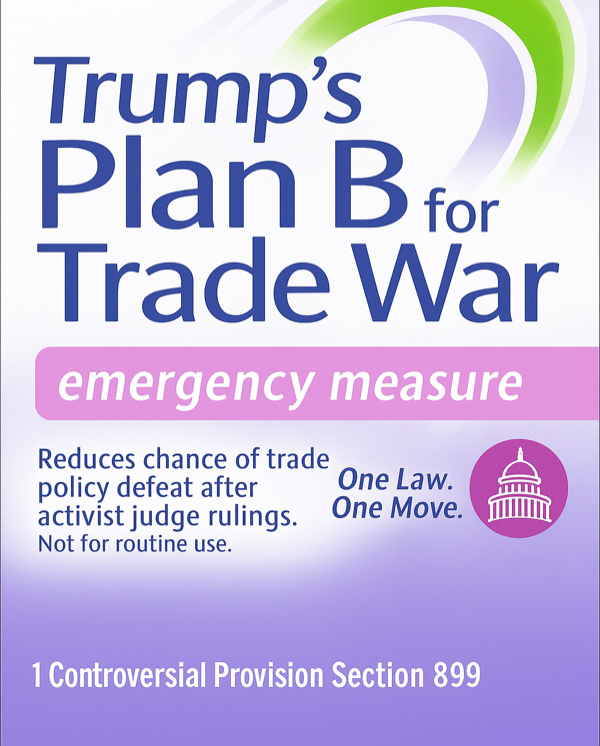
Trump’s Plan B For Trade Takes Center Stage As Section 899 Gains Media Traction

Trump’s Plan B For Trade Takes Center Stage As Section 899 Gains Media Traction

To close out the week, corporate media is finally catching up to a theme we flagged for readers on Wednesday: President Trump’s “Plan B” trade war options.

This follows a move by Biden-appointed activist judges at the U.S. Court of International Trade who attempted to derail Trump’s trade agenda ahead of the 2026 midterms, only to be overruled by the U.S. Court of Appeals for the Federal Circuit on Thursday. 

With lawfare intensifying in the courts by leftist activist judges, the Trump administration must now press forward with its ‘America First’ trade strategy on a firmer legal footing.

This takes us to our note late Thursday, citing Deutsche Bank’s policy team focused not on the court circus but instead on Section 899 of the “Big Beautiful Bill” that is currently circulating through the U.S. Senate.

As DB’s George Saravelos explained, this legislation creates the scope for the U.S. administration to transform a trade war into a capital war if it so wishes, a development that is highly relevant in the context of this week’s court circus surrounding Trump’s trade policies.

Fast forward to Friday morning, UBS analyst Simon Penn told clients about the growing chatter around Section 899 in President Trump’s new tariff framework—already earning the nickname “the revenge tax.”

There’s an increasing amount of conversation about the “899” provision in President Trump’s tariff documentation. It’s been dubbed the “revenge tax”. There’s lots of noise on Friday because it hit the front pages of the Financial Times and Bloomberg.

In very brief, the provision allows the administration to take actions against anything it considers to be a “discriminatory tax”. It leaves the door wide open on the definition and interpretation. Reading through the document and the various opinions that have been given, it looks like its aim is two-fold. It’s a last line of defence to cover anything not caught by the tariffs already in place; it’s another leverage tool to deal with issues such as double taxation and withholding taxes. The provision signals that the administration could step into services, and in particular, financial services. In that case, the administration has designed a powerful negotiating tool and has also built in a technique to deal with any country that attempts to fight back with services-based levies.

UBS analyst George Redman also flagged the increasing traction of Section 899 in corporate media coverage, suggesting that the Trump administration may be preparing to deploy non-tariff measures against serial trade offenders, such as China, to bring Beijing back to the negotiating table. 

Redman noted:

The front page of the Financial Times is focusing on Section 899 of the “big beautiful bill,” which will likely draw attention on Friday. The provision allows the government to raise taxes on foreign investments in the U.S. from companies and investors based in countries it deems to have punitive tax policies. As such, it could include US-based companies with foreign owners and international firms with American branches. Expect a micro focus on companies most exposed to this risk, which are likely to underperform on Friday.

This week’s developments with circus courts show only a temporary blow to Trump’s emergency tariff powers, and the administration appears poised to shift toward a more legal, concrete, and flexible framework—centered around Section 899.

Tyler Durden
Fri, 05/30/2025 – 12:05

via ZeroHedge News https://ift.tt/UF2ldqJ Tyler Durden

Why California Gas Prices Are the Highest In America

Why California Gas Prices Are the Highest In America

Authored by Vance Ginn via the American Institute for Economic Research (AIER),

California leads the nation in more ways than one—taxes, regulations, and, once again, gas prices. As of mid-May 2025, the average gasoline price in California is $4.85 per gallon, far above the national average of $3.26, according to GasBuddy and AAA.

And it’s getting worse. A March 2025 study by USC Professor Michael Mische forecasts California’s fuel prices could spike 75 percent to over $8 per gallon within the next year. That’s not hyperbole—that’s the trajectory unless policymakers reverse course.

The culprit? It’s not oil companies or global demand. It’s decades of state-level tax hikes, regulatory overreach, and misguided climate mandates that have warped the gasoline market in California. This is a man-made problem—a case study in government failure, not market failure.

What Really Drives Gas Prices

According to the U.S. Energy Information Administration (EIA), gasoline prices are generally shaped by five components: crude oil prices, refining costs, distribution and marketing, taxes, and regulations. In California, taxes and regulatory costs alone account for more than $1.30 per gallon—nearly double the national average.

California has the highest gas tax in the country, at $0.678 per gallon, not including additional fees and environmental surcharges. Add in the Cap-and-Trade program, the Low Carbon Fuel Standard (LCFS), and boutique fuel blends that are required only in California, and it becomes clear why Californians pay more.

And things are deteriorating further. The Mische study warns that with refinery closures due to hostile permitting processes and low expected returns under California’s climate mandates, fuel supply in the state could drop by 20 percent by 2026, even as demand stays relatively stable. Fewer refineries and rigid fuel standards will mean tighter supply and higher prices.

Texas vs. California: A Tale of Two Fuel Markets

To see how bad California’s policies are, look no further than Texas. As of May 2025, Texas drivers pay about $3.00 per gallon, nearly two dollars less than Californians. Texas levies a combined state gasoline tax of just $0.20 per gallon, and its regulatory structure is streamlined and energy-friendly.

Texas refineries aren’t subject to California’s carbon credit system or forced to produce costly special-blend fuels. And because it allows for a more competitive and open fuel market, the state benefits from both lower wholesale prices and more efficient distribution. The difference is stark—and instructive.

The Fallacy of ‘Green’ Fuel Mandates

Supporters of California’s approach claim high prices are a necessary cost for fighting climate change. But what if those policies aren’t actually working?

California’s greenhouse gas emissions have declined, but much of the reduction has come from cleaner electricity generation, not gasoline policies. Meanwhile, low-income and working-class Californians are being punished at the pump while driving older, less fuel-efficient vehicles.

This amounts to a regressive tax that hurts the very people politicians claim to protect. Worse, these rules don’t reduce global emissions—they just push energy production and refining out of the state and overseas, often to countries with weaker environmental standards.

The Economic Cost of Fragmented Fuel Policies

In my academic work, including a peer-reviewed paper and subsequent research (SSRN profile), I’ve documented how state-level fragmentation of fuel markets—through taxes, environmental programs, and infrastructure restrictions—creates costly inefficiencies that drive up prices.

These policies discourage new investment in refining and fuel transportation. They create artificial shortages. And they increase transaction costs that ultimately fall on consumers.

In short, California’s model is a textbook case of how overregulation and government micromanagement destroy affordability without delivering proportional benefits.

What Should Be Done Instead?

The answer isn’t new subsidies or “green” credits. It’s not banning gas-powered cars or rationing vehicle miles. The solution is to embrace free-market capitalism and the principles Milton Friedman championed: let prices reflect market conditions, not bureaucratic preferences.

That means:

  • Repealing California’s Cap-and-Trade and LCFS programs.

  • Standardizing fuel blends to match those used nationwide.

  • Halting the gasoline tax increases scheduled under current law.

  • Encouraging private investment in refining and fuel infrastructure.

The federal government could help by streamlining interstate pipeline permitting and revisiting federal environmental rules that duplicate or exacerbate state mandates. But the real change must come from Sacramento.

Conclusion: A Crisis of Policy, Not Price

California’s high gas prices aren’t the product of global volatility or greedy corporations. They’re the result of a long series of deliberate policy choices that make fuel harder to produce, harder to transport, and harder to afford.

When government picks winners and losers in energy markets, consumers lose. And when politicians mistake control for competence, they create systems that serve ideology rather than reality.

It’s time to abandon the myth that high gas prices are the price of progress. California has created a man-made fuel crisis—and only free-market reforms can solve it.

Tyler Durden
Fri, 05/30/2025 – 11:40

via ZeroHedge News https://ift.tt/1Xjk0H9 Tyler Durden

“Neocons Acting As Vanguard For Israel” To Push War With Iran: ZH Debate Recap

“Neocons Acting As Vanguard For Israel” To Push War With Iran: ZH Debate Recap

As Netanyahu threatens to upend U.S. talks with Iran by launching a unilateral strike himself — it’s unclear what the Trump admin plans to do and whether war is on the horizon. Last night, ZeroHedge hosted two category experts for a hawk-versus-dove showdown to answer what Trump should do. Negotiate or bomb? Who’s the aggressor: Iran or Israel?

Libertarian Institute founder Scott Horton lobbied for peace and outlined the long list of U.S. provocations that scarcely surface in western media. Israeli professor Dr. Meir Javedanfar warned of Iranian aggression and support for terrorism. Interestingly, they both agreed on one point: withdrawing from the Iran Nuclear Deal (JCPOA) was a mistake.

Here were the highlights for those short on time:

Iranian or Israeli/US aggression?

Javedanfar made a laundry list of Iranian acts of aggression and regarding their push for obtaining a nuke, including:

  • Iran was caught secretly building the Natanz nuclear facility without informing the IAEA.
  • Iran was again caught building a hidden enrichment facility at Fordo.
  • Iran conducted research on a nuclear trigger mechanism at the Parchin site, including testing surrogate explosives.
  • Documents retrieved by Mossad confirmed Iran’s intent to maintain a nuclear weapon development capability. 
  • Killed 240 U.S. Marines in Beirut (1983 bombing).
  • Took U.S. hostages and attacked the U.S. embassy in Beirut.
  • Orchestrated the Khobar Towers bombing in Saudi Arabia (1996), killing 19 U.S. servicemen.
  • Planned a terrorist attack in Washington, D.C. in 2011; plot was foiled by the CIA.

To which Horton replied point-by-point:

  • U.S. and Western interventions (via USAID, NED, IRI, NDI, Soros orgs) aimed to provoke regime change in Iran, such as the 2009 Green Revolution, prompting Iran’s fear and secrecy.
  • Natanz facility secrecy was due to Iran being blocked by the Nuclear Suppliers Group from purchasing legal nuclear technology, forcing it to buy from AQ Khan’s black market network.
  • The discovery of Natanz was not initially by Israeli intelligence or the MEK, but by David Albright, an American nuclear expert.
  • MEK (Mujahideen-e-Khalq), cited in claims of exposing Iran’s nuclear program, is described as a “communist terrorist cult” with a history of switching allegiances and spreading false intelligence.
  • The claim about Iran developing nuclear triggers at Parchin is refuted:
    • The scientist involved was Igor Danchenko, an expert in nano-diamonds, not nuclear weapons.
    • There is no credible evidence linking him to nuclear weapons research.
  • The 2007 U.S. National Intelligence Estimate (NIE) concluded that Iran halted its nuclear weapons program, largely due to the removal of Saddam Hussein, which eliminated Iran’s primary deterrent need.
  • Israel itself engaged in nuclear espionage, including stealing Krytrons (nuclear triggers) from the U.S., highlighting hypocrisy in Israeli accusations. 
  • The 1983 Beirut bombing:
    • Occurred 42 years ago and was carried out by proto-Hezbollah, not directly ordered by Tehran.
    • Israel was aware of the attack but didn’t warn the U.S., according to former Israeli spy Victor Ostrovsky.
  • The Khobar Towers bombing (1996):
    • Attributed to al-Qaeda, not Iran. Specifically, Osama bin Laden and Khalid Sheikh Mohammed were responsible.
    • CIA experts, including Michael Scheuer, and bin Laden himself, confirmed this.
  • The 2011 Washington D.C. restaurant plot:
    • Dismissed as a hoax involving a used car salesman with no real ties to the Iranian regime.
    • The target was a minor diplomat, and the plot was more of a drug deal gone wrong than a genuine Iranian terror plot.

Neocon-Israeli alliance

“Acting directly as agents of the Israeli state.”

While Javedanfar dismissed the claims of Israeli influence in U.S. foreign policy as mere coincidental alignment of interests, Horton charged the neocon alliance that occupied the ranks of the George W Bush administration as essentially acting as foreign agents.

“The war could not have happened without the neocons acting as the vanguard for the Israeli state.”

Be sure to check out the full debate here and subscribe to ZeroHedge Spotify, Rumble, and YouTube channels for more debates and for next week’s debut of our podcast hosted by comedian Rob Bernstein for weekly recaps on our most crucial articles.

FULL DEBATE:

Tyler Durden
Fri, 05/30/2025 – 11:15

via ZeroHedge News https://ift.tt/4KFc6nu Tyler Durden

Bizarrely, the “GENIUS Act” might actually be pretty genius…

Peter Schiff isn’t just my partner at Schiff Sovereign– we’ve been close friends for many years. And we generally see eye-to-eye on most things going on in the world.

But one area where we disagree is crypto. Not to put words in his mouth, but Peter is pretty vocal in his criticism of Bitcoin; he says it’s “useless” and a “total scam” and predicts it will go to zero.

I disagree. There are a number of important use cases for crypto– whether as a speculative asset for capital gain, a store of value, a digital currency for online transactions, a private means to hold wealth, a way to disconnect from the banking system, etc.

This isn’t a “scam”. Rather, it’s useful, functional technology… which is why I recommended it to my audience as far back as March 2013.

Obviously crypto has deep flaws and areas to improve. And just like in any frontier boom, plenty of thieves and lunatics have emerged. But to judge crypto based on the misdeeds of Sam Bankman-Fried is like condemning the stock market because of Bernie Madoff.

All that said, there are still plenty of things that I’m skeptical about.

For example, I think there’s a bizarre disconnect between Bitcoin’s market cap and its actual value; I recognize that Bitcoin is the original cryptocurrency, and there’s some ‘brand value’ associated with that.

But as the oldest cryptocurrency, it’s also the most technologically obsolete… therefore it should not be the most valuable; no other sector places the highest value on the most obsolete technology. Only crypto. And that’s a bit odd.

There are plenty of other oddities; for example, it’s strange that the company Strategy (formerly Microstrategy) has an enterprise value of $112 billion, even though its only asset is $61 billion worth of Bitcoin.

In other words, the company is worth nearly twice as much as the Bitcoin that it owns; this is bizarre and doesn’t make any sense.

I’m also extremely skeptical of the US government’s involvement in crypto; the pre-election promises of starting a Sovereign Wealth Fund to own Bitcoin struck me as completely ludicrous.

I mean… think about it: one of the things that would drive up the price of Bitcoin is excessive government spending. So rather than cut spending, the government wants to own an asset that will benefit from their own financial irresponsibility. It’s back asswards in my humble opinion.

Naturally I was also skeptical when I heard about the GENIUS Act (Senate bill 394) to regulate crypto.

Then I read the legislation. And I concluded that the GENIUS Act might actually be pretty genius.

GENIUS stands for “Guiding and Establishing National Innovation for US Stablecoins”. Something tells me ChatGPT came up with that.

And the basic idea is for state and federal regulators to authorize “Permitted Stablecoin Issuers” who could… well, do just that– issue stablecoins.

States can issue their own licenses and permits to stablecoin businesses. But once a particular coin passes a $10 billion market cap, it must be regulated by the Feds.

Here’s the smart part: in the definition of stablecoins, they include anything that owns short-term Treasury bills. So, through this legislation, they are creating an entirely new class of investors who would purchase US government debt.

This is pretty important, because the Treasury Department is in sore need of new lenders.

Foreign investors are fleeing the Treasury market; after decades of being considered the world’s “risk-free asset”, foreign governments and central banks are aggressively reducing their dollar holdings.

This is THE primary reason why the gold price has come so high: foreign governments and central banks have been cashing in their Treasury bonds, then trading that US dollar cash for gold.

Given that the “One, Big, Beautiful Bill” calls for another $2 trillion deficit this fiscal year, Treasury is going to need all the lenders it can get.

Remember that stablecoins (especially under this legislation) are basically just money market funds in disguise; they pool capital and buy government bonds.

So, this GENIUS Act is essentially a way of tapping crypto wealth and diverting that capital into Treasury securities.

It’s a clever idea. But frankly it would be a lot better if the government simply cut spending rather than come up with innovative ways to finance the deficit.

Source

from Schiff Sovereign https://ift.tt/X7xMJpS
via IFTTT