Riley Gaines Calls Out Male Pitcher Who Dominated Minnesota Softball State Championship

Riley Gaines Calls Out Male Pitcher Who Dominated Minnesota Softball State Championship

Via American Greatness,

Former collegiate swimmer and conservative political activist Riley Gaines is calling out a male athlete who pretends to be a woman who carried a Minnesota girls high school softball team to a state championship.

A male athlete who goes by the name of “Marissa” Rothenberger, pitched 14 shutout innings in back to back games to defeat the defending state 4A champion softball team.
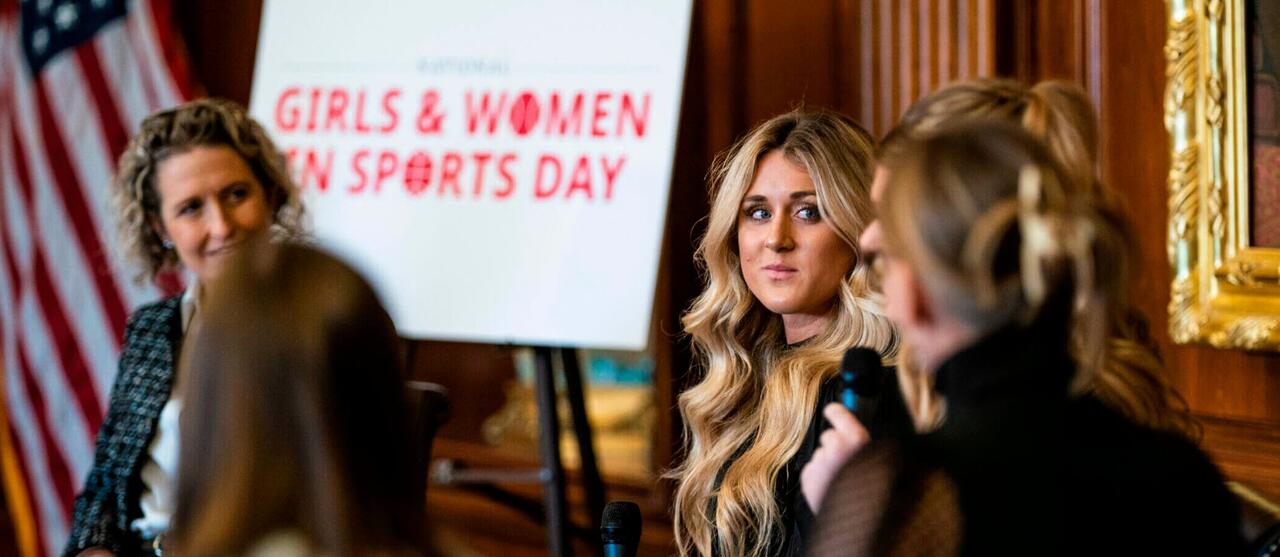
Gaines had harsh words for Minnesota Governor Tim Walz , calling him “a shameful, sorry excuse for a man” for allowing a male athlete to single handedly dominate a girl’s state championship tournament.

“Seriously, where are the girl’s parents,” Gaines asked as she offered her platform as a way to defend their daughters who were forced to compete against a biological male pretending to be a girl.

Fox News reports that Minnesota Attorney General Keith Ellison is being sued by the Alliance Defending Freedom (ADF) which filed a lawsuit on behalf of the group Female Athletes United and three anonymous female softball players over the controversy.

Alliance Defending Freedom Legal Counsel Suzanne Beecher told Fox News Digital:

By sacrificing protection for female athletes, Minnesota fails to offer girls equal treatment and opportunity, violating Title IX’s provisions. Our client, Female Athletes United, is right to stand up for its members by challenging the state’s discriminatory policy and advocate for true equality in sports.

In response, Ellison’s office released a statement saying, “I believe it is wrong to single out one group of students, who already face higher levels of bullying and harassment, and tell these kids they cannot be on the team because of who they are. I will continue to defend the rights of all students to play sports with their friends and peers.”

The Minnesota State High School League had announced earlier this year that it would openly defy President Trump’s “Keeping Men Out of Women’s Sports” executive order by allowing biological male athletes who are pretending to be girls to continue participating in women’s sports.

Ellison also decided to preemptively sue the Trump administration after it issued the executive order, in order to ensure that male athletes are not prevented from participating in girl’s sports.

Tyler Durden
Fri, 05/30/2025 – 13:05

via ZeroHedge News https://ift.tt/X3yKTbU Tyler Durden

Kellogg Calls Russia’s NATO Concerns ‘Fair’ – Warns Ukraine It Better Show Up In Istanbul

Kellogg Calls Russia’s NATO Concerns ‘Fair’ – Warns Ukraine It Better Show Up In Istanbul

US presidential envoy Keith Kellogg told ABC News in a Thursday interview that Russia’s concerns over NATO expansion are “fair”. 

Moscow this week demanded of the West a written commitment to stop further enlargement, especially when it comes to the potential for Ukraine, Moldova and Georgia one day entering the NATO alliance. “It’s a fair concern and we’ve said that repeatedly… that to us Ukraine coming into NATO is not on the table, Kellogg said.

Global Images Ukraine/Getty Images

“And they’re not just talking Ukraine – they’re talking the country of Georgia, they’re talking Moldova, they’re talking, obviously, Ukraine,” the top Trump envoy stated.

“We’re saying: okay, comprehensively we can stop the expansion of NATO coming close to your border,” Kellogg added, noting that such a move would ultimately require a presidential-level decision.

This appears a clear affirmation that Washington is ready to do this as part of ongoing negotiations – but the big question will be whether other powerful members of the alliance are ready to sign off. After all, there is currently a ‘coalition of the willing’ led by the UK, France, and Germany which has somewhat broken with the US on these matters.

This week, the written guarantees and other conditions Moscow has requested have been spelled out in English-language Russian state media as follows:

  • Ukraine’s permanent neutrality
  • Partial sanctions relief for Russia
  • Return of frozen Russian assets
  • Protections for Ukraine’s Russian-speaking people

And then an or else was offered as part of an ultimatum. While not officially issued by the Kremlin, this appears some very intentional signaling by Putin officials. It was conveyed via a Wednesday Reuters report:

The first source said that, if Putin realizes he is unable to reach a peace deal on his own terms, he will seek to show the Ukrainians and the Europeans through military strength that “peace tomorrow will be even more painful.”

The next, or second, round of direct Russia-Ukraine talks are set to happen Monday in Istanbul. Both sides are expected to exchange their versions of draft ceasefire plans. However, Kiev has complained it has not received an advanced draft, which puts the whole meeting into question.

Kellogg had some words for the Ukrainian side in the ABC interview, as he said, “I always caution [Kiev’s chief negotiator Rustem Umerov]: don’t say things like that.” He pointed out, “Part of life is showing up, and you need to show you’re serious.”

As for Kellogg calling Russia’s demand of no more NATO expansion fair, this is consistent with President Trump’s own stance articulated from the beginning of his presidency:

And of course, history fully supports the notion that the tragic war is rooted in constant NATO expansion right up to Russia’s doorstep, which Putin himself had loudly warned against going back to the mid-2000s.

In September of last year, then NATO Secretary-General Jens Stoltenberg had a very candid moment wherein he laid out the recent history, admitting at one point that Putin invaded Ukraine to prevent more NATO” expansion.

But that ‘smoking gun’ public admission didn’t gain much traction in American media, where it was downplayed and even ignored. The majority of Americans still likely don’t even know this was openly said by the head of NATO, or that the clip exists.

Tyler Durden
Fri, 05/30/2025 – 12:45

via ZeroHedge News https://ift.tt/rUYgXaE Tyler Durden

Wait, Lilo & Stitch Is About Medicaid and Family Separation?

Would you believe me if I told you Disney’s new live-action Lilo & Stitch remake was actually about Medicaid and family policy? 

Oh, sure, there’s the requisite hijinks with the furry little destructive alien of the title, a big-eared blue puffball of chaos who resembles both a puppy and a toddler but is, we are supposed to believe, actually a bioengineered superweapon. It’s predictable but cute, no match for the hand-animated original, but fine as far as these things go. 

Certainly, it’s better than the awful recent Snow White remake. When I left the theater, I didn’t exactly want to watch Lilo & Stitch again, but I didn’t question whether life was even worth living. So if nothing else, it’s an improvement over the previous Disney remake. 

But the movie’s plot is powered by a strange sort of policy logic. Lilo, you see, is a six-year-old girl who recently lost her parents. She lives in Hawaii with her 19-year-old sister, Nani, who is also her legal guardian. But that relationship is threatened by a social worker, Mrs. Kekoa, who sees their somewhat chaotic lives and Nani’s less-than-perfectly-stable employment as grounds for potentially separating them and putting Lilo in some sort of foster care. 

When Kekoa makes a home visit to judge the situation, she finds a mess and a misbehaving kid. She tells Nani that if there’s any chance for the sisters to stay together, Nani will have to clean up, get her life organized, and sign up for health insurance. 

Later, in one of the film’s big turning points, Lilo goes surfing with Stitch and nearly drowns. She turns out fine, but the emergency room doctor tells Nani she’ll need to present her insurance to pay for the visit. Nani, of course, has not yet signed up. 

It’s a crisis, but Kekoa has a solution: Nani can sign Lilo up for state-backed health insurance, presumably Medicaid. But she’ll have to give up custody and allow the two sisters to be separated. In Kekoa’s exact words: “There’s a way that the state will pay for all of this. But that means you have to officially relinquish Lilo.” 

It’s true that Medicaid, a jointly funded state-federal program for the poor and disabled, does offer retroactive coverage in some cases for qualifying medical expenses up to three months prior to when a beneficiary signs up. And Medicaid’s incentive structure does sometimes produce perverse outcomes, like so-called “Medicaid divorces,” or Medicaid non-marriages, in which a couple chooses not to be officially married in order to preserve benefits. 

But why would enrolling in Medicaid suddenly require giving Lilo over to state-appointed guardianship? I have covered Medicaid fairly extensively, and couldn’t think of a way for Medicaid to interact with family policy this way. 

I didn’t report this out extensively, but I emailed several friendly policy experts familiar with Medicaid, none of whom could come up with an answer. It’s possible that I simply missed or misunderstood some explanatory plot beat—I didn’t go back to the theater for a second viewing to watch the health insurance subplot more closely and take more detailed notes. 

But in the end, the movie presents this fateful choice as a difficult but fundamentally good and responsible decision—letting the state step in to pay for medical bills but also to take over the care and supervision of little Lilo. Even aside from the strange policy implications, it’s a bizarre narrative choice, especially given that older sister Nani is an adult who is shown to be in a little over her head but fundamentally quite loving and responsible, applying for new jobs when she loses one, dealing with her little sister’s chaotic outbursts and little kid defiance with exasperation but what amounts to an awful lot of warmth and patience. The two sisters aren’t rich, and their lives are messy, but the relatively modest untidiness of their home is a far cry from the sort of truly troubled disorder that is common in difficult family separation cases. 

In the end, the movie resolves and mostly brushes away any concerns by having Lilo’s guardians turn out to be the kindly neighbors—no actual traumatic family separation required. It’s a Disney movie with a happy ending. But it’s safe to say that’s not how state-mandated family separations often work. 

Lilo & Stitch is a cuddly kid-friendly movie about a furry alien pet, so in some ways, you can excuse its policy blunders and the way it papers over the difficulties of family breakups. But it’s pretty weird that a movie whose big theme is about finding the meaning of family basically suggests that the best thing to do for a kid is turn their life and fate over to state supervision. It’s hardly a happy ending. But I guess it’s better than Snow White. 

The post Wait, <i>Lilo & Stitch</i> Is About Medicaid and Family Separation? appeared first on Reason.com.

from Latest https://ift.tt/Ri1Ukjo
via IFTTT

Trump Wants $25 Million To Settle His Meritless 60 Minutes Lawsuit

President Donald Trump is currently suing one of the largest media companies in the country because one of its subsidiaries lightly edited an interview with his political opponent. This week, he apparently declined a settlement offer, even though the lawsuit itself is completely frivolous and arguably an abuse of his power as president.

“Paramount Global in recent days has offered $15 million to settle,” The Wall Street Journal reported this week. “Trump’s team wants more than $25 million and is also seeking an apology from CBS News.”

The whole affair stems from an October 2024 interview that 60 Minutes conducted with then-Vice President Kamala Harris, the Democratic candidate for president. (Trump declined the chance to sit for a 60 Minutes interview of his own.)

In the interview, correspondent Bill Whitaker asked about Israel’s war in Gaza. CBS—the broadcast network owned by Paramount—aired separate portions of Harris’ answer, one on the 60 Minutes broadcast and a longer snippet on its Sunday morning show Face the Nation.

Trump seized on the different clips and accused CBS of doctoring Harris’ answer to make her look better. “Her REAL ANSWER WAS CRAZY, OR DUMB, so they actually REPLACED it with another answer,” he wrote on X.

“They took the answer out in its entirety, threw it away, and they put another answer in,” he later said at a campaign rally. “And I think it’s the biggest scandal in broadcasting history.”

Trump sued CBS for $10 billion in “compensatory damages”—amended to $20 billion after he won the election and reassumed the presidency—under a Texas law against deceptive consumer practices. The lawsuit accused CBS of “unlawful acts of election and voter interference.”

The lawsuit was flawed from the start: Journalists editing interviewees’ answers for time or clarity is both routine and protected by the First Amendment.

And Harris’ answer in either clip is not exactly Churchillian: “Harris did not come across as especially forthright, articulate, or intelligent in either version, although the one that 60 Minutes showed was a little more concise,” Reason‘s Jacob Sullum observed. If CBS were trying to do her a favor by swapping out her answer, one imagines they could have done a better job.

Besides, Trump won the election; it’s hard to believe he suffered any damages, much less millions of dollars worth. But in a filing this week, Trump’s lawyers argued the interview “led to widespread confusion and mental anguish of consumers, including [Trump].”

CBS released the full unedited video and transcript of Whitaker’s interview with Harris in February, conclusively demonstrating the scandal was bullshit all along: CBS aired one part of Harris’ response on 60 Minutes and another part on Face the Nation. Despite Trump’s insistence, nobody “replaced” any part of her answer with another, separate answer.

But instead of defending its journalists by pressing on and letting a judge laugh the lawsuit out of court, Paramount has been negotiating a settlement. CBS News staffers opposed a settlement, fearing the precedent of a journalistic outlet caving to pressure from the powerful interests it covers. Since negotiations began last month, the producer of 60 Minutes and the executive in charge of CBS News each resigned.

But Paramount is in the process of being acquired by Skydance Media, and the transaction requires approval from the Federal Communications Commission (FCC). Around the same time as Trump’s lawsuit, the Center for American Rights, a conservative nonprofit, also filed an FCC complaint for “news distortion” over the interview. And FCC Chair Brendan Carr, whom Trump elevated to the job and who has demonstrated unabashed loyalty to the president, has indicated that approval depends upon the resolution of the complaint, which he is in no hurry to get through.

“It would be entirely inappropriate to consider the complaint against the ’60 Minutes’ segment as part of a transaction review,” FCC Commissioner Anna Gomez told the Los Angeles Times.

Indeed, the lawsuit—especially when paired with the FCC merger approval—smacks of corruption, with Trump trying to cow a disfavored media outlet into silence. Trump’s effort is so blatant that Paramount executives reportedly worried they could be prosecuted for bribery of a public official if they settled the lawsuit.

Of course, this puts Paramount, CBS, and 60 Minutes in a perilous position: If Paramount—which has been struggling for years—hopes to save itself through a merger with Skydance, it must win over the FCC, whose current head apparently delights in being referred to as “Trump’s media pit bull.” Doing so will apparently require bending the knee and paying a fee for hurting Trump’s feelings, even though by all accounts, 60 Minutes violated neither the law nor journalistic ethics.

And if Paramount does cave and pay $25 million or more—worse still, if it apologizes for the sin of doing basic journalism—it will set a dangerous precedent that powerful people can openly and unabashedly bully the journalists who cover them into silence.

The post Trump Wants $25 Million To Settle His Meritless <i>60 Minutes</i> Lawsuit appeared first on Reason.com.

from Latest https://ift.tt/sEen7dt
via IFTTT

Two Courts Have Ruled Against Trump’s Tariffs—but Not for the Same Reasons

On Wednesday, the U.S. Court of International Trade (CIT) permanently enjoined President Donald Trump’s tariff orders that invoke the International Emergency Economic Powers Act (IEEPA). On Thursday, the U.S. District Court for the District of Columbia also enjoined Trump’s tariffs, but it did so on different grounds. How these cases proceed through their respective circuits will determine whether these free trade victories will also be a win for the separation of powers.

In V.O.S. Selection v. U.S., the CIT found that the president has some tariff authority under the IEEPA. However, the CIT ruled that Trump’s tariffs exceeded the statutory authority of the law because the IEEPA does not grant “unbounded tariff authority to the President.” The U.S. District Court for the District of Columbia went further in Learning Resources v. Trump, ruling that the IEEPA grants the president no authority to modify the harmonized tariff schedule whatsoever.

In another disagreement between the two courts, the CIT ruled that the IEEPA’s provisions “impose meaningful limits on any such [tariff] authority it confers.” Judge Rudolph Contreras of the U.S. District Court for the District of Columbia found that the IEEPA does not include “language setting limits on any potential tariff-setting power.” Contreras rejects entirely “that, in enacting IEEPA, Congress repealed by implication every extant limitation on the President’s tariffing authority.”

Contreras’ statements suggest agreement with the constitutional argument against Trump’s tariffs in an IEEPA lawsuit filed by the New Civil Liberty Alliance (NCLA). In their case, Simplified v. Trump, the NCLA argues that, if the IEEPA delegates Congress’s tariff authority to the president, it does so without an “intelligible principle” circumscribing its usage, in which case the law violates the nondelegation doctrine prohibiting Congress from transferring to other branches of government “powers which are strictly and exclusively legislative.” The plaintiffs in Learning Resources also mount a nondelegation argument, but Contreras says that his decision does not address it.

In yet another disagreement, the CIT claimed exclusive jurisdiction over IEEPA cases. Contreras emphatically disagreed. Contreras acknowledged that, while the CIT has exclusive jurisdiction over civil action against the U.S. government stemming from those laws that provide for tariffs, the “IEEPA is not a ‘law…providing for tariffs,’ [so] this Court, not the CIT, has jurisdiction over this lawsuit.” Contreras’ ruling emphasizes that the IEEPA does not mention “tariffs” or its synonyms; has never before been invoked to impose tariffs in the five decades since it was enacted; and that no prior CIT case has cited those sections of the IEEPA invoked by the Trump Administration to impose recent tariffs. Meanwhile “hundreds of district court cases cite IEEPA Sections 1701 and 1702”: those sections that Trump cites in his executive order enacting so-called “reciprocal” tariffs.

Reason’s Eric Boehm celebrated the CIT ruling as “a win for the rule of law and the separation of powers.” John Vecchione, senior legal counsel for NCLA, tells Reason “there’s no reason not to celebrate [the CIT ruling] if all you care about is tariffs rather than separation of powers.”

Still, it may be too early for supporters of free trade to declare victory. On Thursday, the Court of Appeals for the Federal Circuit stayed the CIT’s ruling as it considers the government’s appeal. The court is giving plaintiffs until June 5—and the Trump administration until June 9—to file briefs. The government has also appealed Contreras’ decision to the Court of Appeals for the D.C. Circuit.

Whatever the outcome of these cases might be, those who care about the separation of powers should hope that any split between the Federal and D.C. Circuits on the IEEPA is resolved in agreement with Contreras: Congress granted no tariff-making authority to the president in the IEEPA whatsoever.

The post Two Courts Have Ruled Against Trump's Tariffs—but Not for the Same Reasons appeared first on Reason.com.

from Latest https://ift.tt/4ObPwem
via IFTTT

Wait, Lilo & Stitch Is About Medicaid and Family Separation?

Would you believe me if I told you Disney’s new live-action Lilo & Stitch remake was actually about Medicaid and family policy? 

Oh, sure, there’s the requisite hijinks with the furry little destructive alien of the title, a big-eared blue puffball of chaos who resembles both a puppy and a toddler but is, we are supposed to believe, actually a bioengineered superweapon. It’s predictable but cute, no match for the hand-animated original, but fine as far as these things go. 

Certainly, it’s better than the awful recent Snow White remake. When I left the theater, I didn’t exactly want to watch Lilo & Stitch again, but I didn’t question whether life was even worth living. So if nothing else, it’s an improvement over the previous Disney remake. 

But the movie’s plot is powered by a strange sort of policy logic. Lilo, you see, is a six-year-old girl who recently lost her parents. She lives in Hawaii with her 19-year-old sister, Nani, who is also her legal guardian. But that relationship is threatened by a social worker, Mrs. Kekoa, who sees their somewhat chaotic lives and Nani’s less-than-perfectly-stable employment as grounds for potentially separating them and putting Lilo in some sort of foster care. 

When Kekoa makes a home visit to judge the situation, she finds a mess and a misbehaving kid. She tells Nani that if there’s any chance for the sisters to stay together, Nani will have to clean up, get her life organized, and sign up for health insurance. 

Later, in one of the film’s big turning points, Lilo goes surfing with Stitch and nearly drowns. She turns out fine, but the emergency room doctor tells Nani she’ll need to present her insurance to pay for the visit. Nani, of course, has not yet signed up. 

It’s a crisis, but Kekoa has a solution: Nani can sign Lilo up for state-backed health insurance, presumably Medicaid. But she’ll have to give up custody and allow the two sisters to be separated. In Kekoa’s exact words: “There’s a way that the state will pay for all of this. But that means you have to officially relinquish Lilo.” 

It’s true that Medicaid, a jointly funded state-federal program for the poor and disabled, does offer retroactive coverage in some cases for qualifying medical expenses up to three months prior to when a beneficiary signs up. And Medicaid’s incentive structure does sometimes produce perverse outcomes, like so-called “Medicaid divorces,” or Medicaid non-marriages, in which a couple chooses not to be officially married in order to preserve benefits. 

But why would enrolling in Medicaid suddenly require giving Lilo over to state-appointed guardianship? I have covered Medicaid fairly extensively, and couldn’t think of a way for Medicaid to interact with family policy this way. 

I didn’t report this out extensively, but I emailed several friendly policy experts familiar with Medicaid, none of whom could come up with an answer. It’s possible that I simply missed or misunderstood some explanatory plot beat—I didn’t go back to the theater for a second viewing to watch the health insurance subplot more closely and take more detailed notes. 

But in the end, the movie presents this fateful choice as a difficult but fundamentally good and responsible decision—letting the state step in to pay for medical bills but also to take over the care and supervision of little Lilo. Even aside from the strange policy implications, it’s a bizarre narrative choice, especially given that older sister Nani is an adult who is shown to be in a little over her head but fundamentally quite loving and responsible, applying for new jobs when she loses one, dealing with her little sister’s chaotic outbursts and little kid defiance with exasperation but what amounts to an awful lot of warmth and patience. The two sisters aren’t rich, and their lives are messy, but the relatively modest untidiness of their home is a far cry from the sort of truly troubled disorder that is common in difficult family separation cases. 

In the end, the movie resolves and mostly brushes away any concerns by having Lilo’s guardians turn out to be the kindly neighbors—no actual traumatic family separation required. It’s a Disney movie with a happy ending. But it’s safe to say that’s not how state-mandated family separations often work. 

Lilo & Stitch is a cuddly kid-friendly movie about a furry alien pet, so in some ways, you can excuse its policy blunders and the way it papers over the difficulties of family breakups. But it’s pretty weird that a movie whose big theme is about finding the meaning of family basically suggests that the best thing to do for a kid is turn their life and fate over to state supervision. It’s hardly a happy ending. But I guess it’s better than Snow White. 

The post Wait, <i>Lilo & Stitch</i> Is About Medicaid and Family Separation? appeared first on Reason.com.

from Latest https://ift.tt/Ri1Ukjo
via IFTTT

Trump Wants $25 Million To Settle His Meritless 60 Minutes Lawsuit

President Donald Trump is currently suing one of the largest media companies in the country because one of its subsidiaries lightly edited an interview with his political opponent. This week, he apparently declined a settlement offer, even though the lawsuit itself is completely frivolous and arguably an abuse of his power as president.

“Paramount Global in recent days has offered $15 million to settle,” The Wall Street Journal reported this week. “Trump’s team wants more than $25 million and is also seeking an apology from CBS News.”

The whole affair stems from an October 2024 interview that 60 Minutes conducted with then-Vice President Kamala Harris, the Democratic candidate for president. (Trump declined the chance to sit for a 60 Minutes interview of his own.)

In the interview, correspondent Bill Whitaker asked about Israel’s war in Gaza. CBS—the broadcast network owned by Paramount—aired separate portions of Harris’ answer, one on the 60 Minutes broadcast and a longer snippet on its Sunday morning show Face the Nation.

Trump seized on the different clips and accused CBS of doctoring Harris’ answer to make her look better. “Her REAL ANSWER WAS CRAZY, OR DUMB, so they actually REPLACED it with another answer,” he wrote on X.

“They took the answer out in its entirety, threw it away, and they put another answer in,” he later said at a campaign rally. “And I think it’s the biggest scandal in broadcasting history.”

Trump sued CBS for $10 billion in “compensatory damages”—amended to $20 billion after he won the election and reassumed the presidency—under a Texas law against deceptive consumer practices. The lawsuit accused CBS of “unlawful acts of election and voter interference.”

The lawsuit was flawed from the start: Journalists editing interviewees’ answers for time or clarity is both routine and protected by the First Amendment.

And Harris’ answer in either clip is not exactly Churchillian: “Harris did not come across as especially forthright, articulate, or intelligent in either version, although the one that 60 Minutes showed was a little more concise,” Reason‘s Jacob Sullum observed. If CBS were trying to do her a favor by swapping out her answer, one imagines they could have done a better job.

Besides, Trump won the election; it’s hard to believe he suffered any damages, much less millions of dollars worth. But in a filing this week, Trump’s lawyers argued the interview “led to widespread confusion and mental anguish of consumers, including [Trump].”

CBS released the full unedited video and transcript of Whitaker’s interview with Harris in February, conclusively demonstrating the scandal was bullshit all along: CBS aired one part of Harris’ response on 60 Minutes and another part on Face the Nation. Despite Trump’s insistence, nobody “replaced” any part of her answer with another, separate answer.

But instead of defending its journalists by pressing on and letting a judge laugh the lawsuit out of court, Paramount has been negotiating a settlement. CBS News staffers opposed a settlement, fearing the precedent of a journalistic outlet caving to pressure from the powerful interests it covers. Since negotiations began last month, the producer of 60 Minutes and the executive in charge of CBS News each resigned.

But Paramount is in the process of being acquired by Skydance Media, and the transaction requires approval from the Federal Communications Commission (FCC). Around the same time as Trump’s lawsuit, the Center for American Rights, a conservative nonprofit, also filed an FCC complaint for “news distortion” over the interview. And FCC Chair Brendan Carr, whom Trump elevated to the job and who has demonstrated unabashed loyalty to the president, has indicated that approval depends upon the resolution of the complaint, which he is in no hurry to get through.

“It would be entirely inappropriate to consider the complaint against the ’60 Minutes’ segment as part of a transaction review,” FCC Commissioner Anna Gomez told the Los Angeles Times.

Indeed, the lawsuit—especially when paired with the FCC merger approval—smacks of corruption, with Trump trying to cow a disfavored media outlet into silence. Trump’s effort is so blatant that Paramount executives reportedly worried they could be prosecuted for bribery of a public official if they settled the lawsuit.

Of course, this puts Paramount, CBS, and 60 Minutes in a perilous position: If Paramount—which has been struggling for years—hopes to save itself through a merger with Skydance, it must win over the FCC, whose current head apparently delights in being referred to as “Trump’s media pit bull.” Doing so will apparently require bending the knee and paying a fee for hurting Trump’s feelings, even though by all accounts, 60 Minutes violated neither the law nor journalistic ethics.

And if Paramount does cave and pay $25 million or more—worse still, if it apologizes for the sin of doing basic journalism—it will set a dangerous precedent that powerful people can openly and unabashedly bully the journalists who cover them into silence.

The post Trump Wants $25 Million To Settle His Meritless <i>60 Minutes</i> Lawsuit appeared first on Reason.com.

from Latest https://ift.tt/sEen7dt
via IFTTT

Two Courts Have Ruled Against Trump’s Tariffs—but Not for the Same Reasons

On Wednesday, the U.S. Court of International Trade (CIT) permanently enjoined President Donald Trump’s tariff orders that invoke the International Emergency Economic Powers Act (IEEPA). On Thursday, the U.S. District Court for the District of Columbia also enjoined Trump’s tariffs, but it did so on different grounds. How these cases proceed through their respective circuits will determine whether these free trade victories will also be a win for the separation of powers.

In V.O.S. Selection v. U.S., the CIT found that the president has some tariff authority under the IEEPA. However, the CIT ruled that Trump’s tariffs exceeded the statutory authority of the law because the IEEPA does not grant “unbounded tariff authority to the President.” The U.S. District Court for the District of Columbia went further in Learning Resources v. Trump, ruling that the IEEPA grants the president no authority to modify the harmonized tariff schedule whatsoever.

In another disagreement between the two courts, the CIT ruled that the IEEPA’s provisions “impose meaningful limits on any such [tariff] authority it confers.” Judge Rudolph Contreras of the U.S. District Court for the District of Columbia found that the IEEPA does not include “language setting limits on any potential tariff-setting power.” Contreras rejects entirely “that, in enacting IEEPA, Congress repealed by implication every extant limitation on the President’s tariffing authority.”

Contreras’ statements suggest agreement with the constitutional argument against Trump’s tariffs in an IEEPA lawsuit filed by the New Civil Liberty Alliance (NCLA). In their case, Simplified v. Trump, the NCLA argues that, if the IEEPA delegates Congress’s tariff authority to the president, it does so without an “intelligible principle” circumscribing its usage, in which case the law violates the nondelegation doctrine prohibiting Congress from transferring to other branches of government “powers which are strictly and exclusively legislative.” The plaintiffs in Learning Resources also mount a nondelegation argument, but Contreras says that his decision does not address it.

In yet another disagreement, the CIT claimed exclusive jurisdiction over IEEPA cases. Contreras emphatically disagreed. Contreras acknowledged that, while the CIT has exclusive jurisdiction over civil action against the U.S. government stemming from those laws that provide for tariffs, the “IEEPA is not a ‘law…providing for tariffs,’ [so] this Court, not the CIT, has jurisdiction over this lawsuit.” Contreras’ ruling emphasizes that the IEEPA does not mention “tariffs” or its synonyms; has never before been invoked to impose tariffs in the five decades since it was enacted; and that no prior CIT case has cited those sections of the IEEPA invoked by the Trump Administration to impose recent tariffs. Meanwhile “hundreds of district court cases cite IEEPA Sections 1701 and 1702”: those sections that Trump cites in his executive order enacting so-called “reciprocal” tariffs.

Reason’s Eric Boehm celebrated the CIT ruling as “a win for the rule of law and the separation of powers.” John Vecchione, senior legal counsel for NCLA, tells Reason “there’s no reason not to celebrate [the CIT ruling] if all you care about is tariffs rather than separation of powers.”

Still, it may be too early for supporters of free trade to declare victory. On Thursday, the Court of Appeals for the Federal Circuit stayed the CIT’s ruling as it considers the government’s appeal. The court is giving plaintiffs until June 5—and the Trump administration until June 9—to file briefs. The government has also appealed Contreras’ decision to the Court of Appeals for the D.C. Circuit.

Whatever the outcome of these cases might be, those who care about the separation of powers should hope that any split between the Federal and D.C. Circuits on the IEEPA is resolved in agreement with Contreras: Congress granted no tariff-making authority to the president in the IEEPA whatsoever.

The post Two Courts Have Ruled Against Trump's Tariffs—but Not for the Same Reasons appeared first on Reason.com.

from Latest https://ift.tt/4ObPwem
via IFTTT

Civil Rights Groups Say Immigrants Are Being Denied Legal Access at Detention Centers

A group of civil rights and legal organizations say immigrant detainees being held at two federal detention centers are being denied their constitutional right to legal counsel. One of those detention centers is a Miami facility flagged by Reason earlier this week for allegations of overcrowding and dysfunction.

In letters to the Trump administration released Thursday, Americans for Immigrant Justice (AIJ), the American Civil Liberties Union, and several other groups urged the administration to immediately restore detainees’ access to legal counsel at Federal Correctional Institution Leavenworth (FCI Leavenworth) and Federal Detention Center-Miami (FDC Miami), two Bureau of Prisons (BOP) facilities that are holding hundreds of detainees for Immigration and Customs Enforcement (ICE).

According to the letters, attorneys for AIJ, Florida Legal Services, and the University of Miami Immigration Clinic “have witnessed and documented troubling systemic failures to provide individuals detained in immigration custody with access to vital legal resources and counsel” at FDC Miami.

Those deprivations include regular denial of access to legal documents, legal mail, and attorney calls. The groups say these restrictions violate detainees’ due process rights under the Fifth Amendment and their First Amendment right to free speech.

“Denying detained immigrants access to legal documents, mail, and phone calls makes it all but impossible to fight and win an immigration case,” AIJ Executive Director Sui Chung said in a press release. “The systemic denial of due process at FDC-Miami has impacted immigrants who desperately seek refuge and are legally entitled to pursue relief in the United States.”

The letter echoes descriptions by BOP employees and immigration lawyers of poor conditions and bureaucratic chaos in FDC Miami, where roughly 400 immigrant detainees are being held on two floors. The federal prison system has struggled for years to get a handle on crumbling facilities, understaffing and low morale, and endemic corruption, but it was nevertheless pressed into service to handle the influx of detentions under Trump’s mass deportation program.

A BOP employee told Reason that four of the eight elevators in the multi-story tower are broken, leading to frequent lockdowns that restrict detainees’ access to phones and computers.

“I’ve been at FDC Miami for 16 years,” Kenny Castillo, president of American Federation of Government Employees Local 501, the union representing Bureau of Prisons employees at the lockup, said. “I’ve never seen the building like I see it right now.”

In their letter, the civil rights groups say crucial legal paperwork is going missing when detainees are transferred to and from FDC Miami. Legal mail is delayed or never arrives. They say it takes days, sometimes over a week, for attorneys to schedule a phone call with a client.  

“These failures and delays have serious—potentially devastating—consequences for detained individuals’ ability access and communicate with counsel, as well as their ability to apply for protection in the U.S. and to fight their cases in immigration court, as is their constitutional right.”

The cumulative effect of all this is that attorneys say it’s nearly impossible to plan a legal strategy for their clients.

“I had a hearing this morning, and the judge ordered me to speak with [my client],” Katie Blankenship, an attorney at Sanctuary of the South, said. “I couldn’t be at FDC, and they wouldn’t get me on the phone with him. I had to go to court this morning and be like, ‘Sorry judge, no, I did not speak to my client, because I couldn’t.'”

The dysfunction at FDC Miami erupted into a mini-riot on April 15, after the afternoon headcount dragged on for nearly five hours. A group of disgruntled detainees flooded a floor of the unit, and BOP correctional officers responded with concussive flashbang grenades.

The civil rights groups allege similar conditions at FCI Leavenworth in Kansas, where they say immigrant detainees are subjected to lengthy lockdowns, abusive use-of-force, and medical neglect.

In response to a request for comment, a BOP spokesperson said the agency is “committed to ensuring the safety and security of all inmates in our population, our staff, and the public. However, we do not comment on matters related to pending litigation, legal proceedings, or investigations.”

ICE did not respond to a request for comment.

The post Civil Rights Groups Say Immigrants Are Being Denied Legal Access at Detention Centers appeared first on Reason.com.

from Latest https://ift.tt/NvL8f1U
via IFTTT

Setting the Wayback Machine to 1995: “Cheap Speech and What It Will Do”: Video (TV and Movies)

[This is an excerpt from my 1995 Yale Law Journal article “Cheap Speech and What It Will Do,” written for a symposium called “Emerging Media Technology and the First Amendment.) Thirty years later, I thought I’d serialize the piece here, to see what I may have gotten right—and what I got wrong.]

“[T]hough the perceived defects of [television] are many … they can be more or less subsumed in two words: vast wasteland.” Newton Minow, then chairman of the FCC, coined this pejorative in 1961, and it has (justly) stuck.

But if your local bookstore let you buy, at any given hour, only five books—each chosen for maximum appeal to 250 million people—you’d think of publishing as a vast wasteland, too. This would be true even if the store had fifty books, or maybe even 500 books to match the touted 500-channel cable system of the future. There’d be a greater chance that you’d get what you want, but still you’d often be dissatisfied.

The problem with TV isn’t lack of material. Plenty of excellent television has been created in the medium’s almost fifty years. Add to that the many great movies that have been made, and there’s enough for each of us to watch for hours every day and still only get the stuff we enjoy.

The problem is that broadcasting can’t get you what you want when you want it. It can only get you what millions of people prefer, and it can only give it to you at the time chosen by the broadcaster, not the time chosen by you. Five hundred channels may help, because they may make room for material that appeals to only, say, a few hundred thousand people; but that will still be inadequate.

What people would like, I believe, is to choose from home—at any time convenient to them—any TV show or movie they want, just as they choose a book in a bookstore, only more conveniently and less expensively (or even free, since the medium might still be advertiser-supported). Some people might still want someone else to decide; they might, for instance, ask for a random comedy, or a random comedy praised by a given reviewer. They might even ask for the latest episode of a particular new show, just as they do on TV today, though at a time that’s convenient for them. But they’ll be the ones who choose, or choose to leave the choice to someone else.

This, of course, is “video-on-demand,” which is already being tested—in a primitive form—in various markets. Many current video-on-demand proposals have gotten a skeptical market response. But the barriers all seem to me to be a function of current technology—the degree to which today’s homes are properly wired (or fibered) for this service, the current costs of the equipment, and so on. The question, I think, is only whether video-on-demand will start arriving now or in several years.

Effect on What Will Be Available: As with the other media, this customization will give people access to much more diverse material. Today, to be broadcast on TV, new programs must have an expected audience of millions. To justify access to the scarce shelf space available in video stores, videotapes also need a large market. Lots of good stuff that doesn’t appeal to a large enough audience never makes its way to the TV stations or video stores.

The new system should also increase the amount of new material being made. The cost of producing high-quality, high-production-values entertainment—from $500,000 to over $1 million per hour—will slow down this diversification. So long as production costs remain high, each new program will still have to appeal to many people. Still, it will probably need less of an audience than it does today, when producers face both high production costs and limited distribution channels. Moreover, some video programming—talk shows, talking heads shows such as the McLaughlin Group, stand-up comedy, and some kinds of sporting events—costs relatively little to produce. Production of these shows ought to mushroom.

The post Setting the Wayback Machine to 1995: "Cheap Speech and What It Will Do": Video (TV and Movies) appeared first on Reason.com.

from Latest https://ift.tt/FpMSlek
via IFTTT