The Coming Judicial Nomination Wars On The Right

Yesterday, I mused on whether the President may ignore geographic constraints when selecting circuit court nominees. The impetus behind that post, of course, was Emil Bove’s nomination to Justice Alito’s old seat on the Third Circuit, even though Bove has no clear geographic connection to New Jersey. At the end of my post, I offered some praise of Bove, at least based on my interaction with him during the Special Counsel litigation.

Yet, there is strong opposition to Bove on the right. On May 19, Ed Whelan described Bove as a “DOJ Henchman.” Whelan closed with an admonition:  “Picking Bove would send the opposite message, and it might well deter some sitting judges from stepping down from active service to create more vacancies that Trump could fill.” Whelan’s subtle message was that Trump should pick someone else, or else he will get fewer vacancies. This statement was as much predictive as it was suggestive–he was signaling to the Bush I and II judges they should not give up their seats to Trump. Jon Adler expressed a similar message on X, saying that fewer judges may take senior status if the “caliber” of Trump’s nominees are weaker.

On the other hand, Mike Fragoso–who is now Whelan’s colleague at EPPC–suggests that many of the Republican judges who are eligible are refusing to take senior status, independent of Bove. I tend to agree with Fragoso. Judges have very idiosyncratic views on taking senior status. Maybe at the margins, someone interested in stepping down will not, but I am skeptical.

Perhaps during a prior time, Whelan’s post would have been enough to stop the nomination. But here, Whelan’s post seems not to have had any effect on Trump’s decision making. Indeed, senior officials in DOJ rejected Whelan’s argument.

With Bove nominated, Whelan has now leveled up the discourse with a lengthy post critical of Bove. It reads like the sort of commentary that Whelan has provided about countless Democratic nominees. At the end, Whelan concludes “Republican senators who have the foresight and sense to prevent this scenario should defeat Bove’s nomination.” Again, this sentence is as much predictive as suggestive: he is telling Republican senators to block Bove’s nomination as part of a line of defense against Trump picking future similar nominees. I have no idea how influential Whelan’s post will be with Republican Senators, given that Trump has lined up solidly behind Bove.

Further, we can’t separate these issues from President Trump’s post last night that criticized the Federalist Society, and Leonard Leo in particular, for their advice on judicial nominees in during the first administration. And on the horizon is the specter that the three Trump Justices will soon have to resolve the legality of the tariff plan, which is the centerpiece of the President’s entire economic agenda. The Gold Clause Cases comes to mind as an analogy. Let’s see what kind of blue plate special the Chief tries to whip up.

As I’ve written before, there is a storm brewing that most people–inside and outside the judiciary–do not quite yet see. People might think they are pumping the breaks, when in fact they are slamming their feet on the accelerator. They think they are dousing the flames with water, when if fact they are spraying kerosene. They think they are averting crisis, when in fact they are driving towards it.

In the past, the most vigorous clashes over judges happened between the left and the right. I think the next round of wars will be on the right. The left can sit back and enjoy the fireworks.

Update: I thought of another analogy. A generation ago, a President nominated his lawyer to a federal judgeship. Conservatives screamed that this nominee was utterly unqualified for the person. The President flinched, withdrew the nominee, and appointed someone that was more palatable. That playbook may have worked in 2005, but it will not work in 2025. I can tell that Emile Bove is not Harriet Miers, and Donald Trump is not George W. Bush.

The post The Coming Judicial Nomination Wars On The Right appeared first on Reason.com.

from Latest https://ift.tt/Eu7hz1N
via IFTTT
SCOTUS Allows Trump Administration to Revoke Parole Status of Noncitizens Present under CHNV Program

Today, in Noem v. Doe, the Supreme Court granted the Trump Administration’s application for a stay of a district court order that barred the Department of Homeland Security from revoking “parole” status for an estimated 500,000 noncitizens from Cuba, Haiti, Nicaragua, and Venezuela under the so-called “CHNV” program. Justice Jackson dissented, joined by Justice Sotomayor.

The Court’s order in Noem v. Doe should not be surprising. As even Justice Jackson acknowledged in her dissent, the decision to offer noncitizens parole “is discretionary by statute.”

The language of 8 U.S.C. §1182(d)(2)(A) is quite clear:

The Secretary of Homeland Security may, . . . in his discretion parole into the United States temporarily under such conditions as he may prescribe only on a case-by-case basis for urgent humanitarian reasons or significant public benefit any alien applying for admission to the United States, but such parole of such alien shall not be regarded as an admission of the alien and when the purposes of such parole shall, in the opinion of the Secretary of Homeland Security, have been served the alien shall forthwith return or be returned to the custody from which he was paroled and thereafter his case shall continue to be dealt with in the same manner as that of any other applicant for admission to the United States.

While it is certainly disruptive to revoke a noncitizen’s parole status, it is something the Secretary clearly has the power to do. Unlike in the Alien Enemies Act cases, there is little question about the scope of the Administration’s authority or the way it is being exercised. Further it is not clear that such discretionary choices are even subject to judicial review.

Justice Jackson objected to the stay on the grounds that granting a stay should reflect “more–much more” than the likelihood that one party will prevail. While leaving hte district court’s injunction in place would prevent the DHS Secretary from exercising her discretion, and inhibit the administration’s ability to pursue its immigration and foreign-policy objectives through power expressly delegated by Congress, she believes the Court should have shown greater solicitude for the effects of revoking parole on the program’s beneficiaries. “Even if the Government is likely to win on the merits, in our legal system, success takes time and the stay standards require more than anticipated victory.” Yet under this approach, one administration could effectively tie the hands of its successor by granting parole or other status to large groups of noncitizens, without regard for what Congress enacted. Immigration law is not, and should not be, this sort of one-way ratchet.

Today’s order is a reminder that the President retains ample authority to direct immigration policy and undo the policies of his predecessors. All that is necessary is exercising those authorities forthrightly. (And if one does not like that a single President can exercise authority in this way, that is a question to take to Congress.)

The post SCOTUS Allows Trump Administration to Revoke Parole Status of Noncitizens Present under CHNV Program appeared first on Reason.com.

from Latest https://ift.tt/UK8LTc5
via IFTTT

Judge Kim R. Gibson (1948-2025)

Judge Kim R. Gibson (1948-2025)

I had the honor of clerking for Judge Kim R. Gibson in the Western District of Pennsylvania from 2009-2011. This was the most formative experience of my career. In that brief tie, I learned so much about the law, being a lawyer, and life. Judge Gibson passed away today at the age of 77. My co-clerk Adele and I were fortunate enough to visit the Judge a few weeks ago, and it was a moment I will always treasure.

The Western District of Pennsylvania shared this obituary of Judge Gibson, which I am happy to pass on:

Judge Kim Gibson has passed away in Somerset, PA. Kim had turned 77 yesterday.

Kim devoted his entire adult life to serving his country and his neighbors. Born in Trenton, NJ, Kim entered the United States Military Academy at West Point in 1966, graduating with his Bachelor of Science degree in 1970. Upon being commissioned a Second Lieutenant in the United States Army, Kim took one of the hardest paths possible, completing both Airborne and Ranger training before serving as an Armor Officer, on active duty in that assignment until 1975. Kim’s service in the Army on active and Reserve duty extended for 26 years, and he retired as a Colonel in the Judge Advocate General Corps in 1996.

Kim attended the Dickinson School of Law, graduating magna cum laude in 1975, where he served as an editor of the Dickinson Law Review. He was a graduate of the Judge Advocate General School at the University of Virginia, and remained on active duty in the Army JAG Corps until 1978. He was recalled to active duty during Operation Desert Storm in 1991.

While Kim was in solo practice in Somerset PA, he served as the Public Defender, as the Solicitor for the Somerset School District, as counsel to the Office of Children and Youth Services and as the Solicitor for Somerset County. In 1997, he was elected by the voters of Somerset County to the Court of Common Pleas, serving in that role until joining the federal bench in September, 2003. While a state court judge, Kim established a Juvenile Drug Court, one of the first in the Commonwealth. Kim came to our Court upon his nomination by President George W. Bush, and served as a District Judge beginning in 2003. He moved to senior status in 2016, but that shift was more theoretical than actual, as he continued to handle a full and active case load until his final illness. While a Judge of our Court, Kim was called upon by Chief Justice John G. Roberts, Jr. to serve as a member of the Judicial Conference’s Court Administration and Case Management Committee, the committee that sits at the crossroads of all of the work of the federal courts. Kim was an Adjunct Professor of Law at the Penn State Dickinson School of Law, and a member of its Board of Counselors. As a leader of the bench and Bar, Kim was a valued mentor to many, especially to our own Judges Stephanie Haines and Chris Brown, and to the scores of young people he coached in Little Leagues Baseball.

Kim’s service to the Nation extended even beyond his first career in the Armed Forces and then his second as a practicing lawyer representing the public’s interests, and then his third career on the bench. Kim was called to serve as the co-chair of the Flight 93 Memorial Task Force, a commission established by an Act of Congress, on which he was responsible for leading a diverse group of family members, public officials, community leaders and others in developing and the constructing the Memorial and national park site that commemorate the bravery and patriotism of the passengers and crew of United Flight 93 on September 11, 2001 as they brought down that airliner near Shanksville, PA before its hijackers could reach their intended target in the Nation’s Capital, thereby saving innumerable lives. The Flight 93 Memorial will be yet another perpetual testament to Kim’s life of service to all of the rest of us.

Each of us will have our own favorite and most cherished memory of Kim. His life and career were marked with service and thoughtfulness, always. His mentorship extended to his dozens of law clerks, almost all having the opportunity to work with Kim for a single year, right from law school, as he felt so strongly about providing those opportunities to as many law students as he could. His courtesy to lawyers and especially litigants and the public set the standard for any judge, and his gentle chuckle and good cheer, coupled with his constant courtesy and consideration for others were his hallmarks. We in the Court, his neighbors in Somerset County, his friends and colleagues across the country, and the public that he served with unwavering dedication, will miss him dearly.

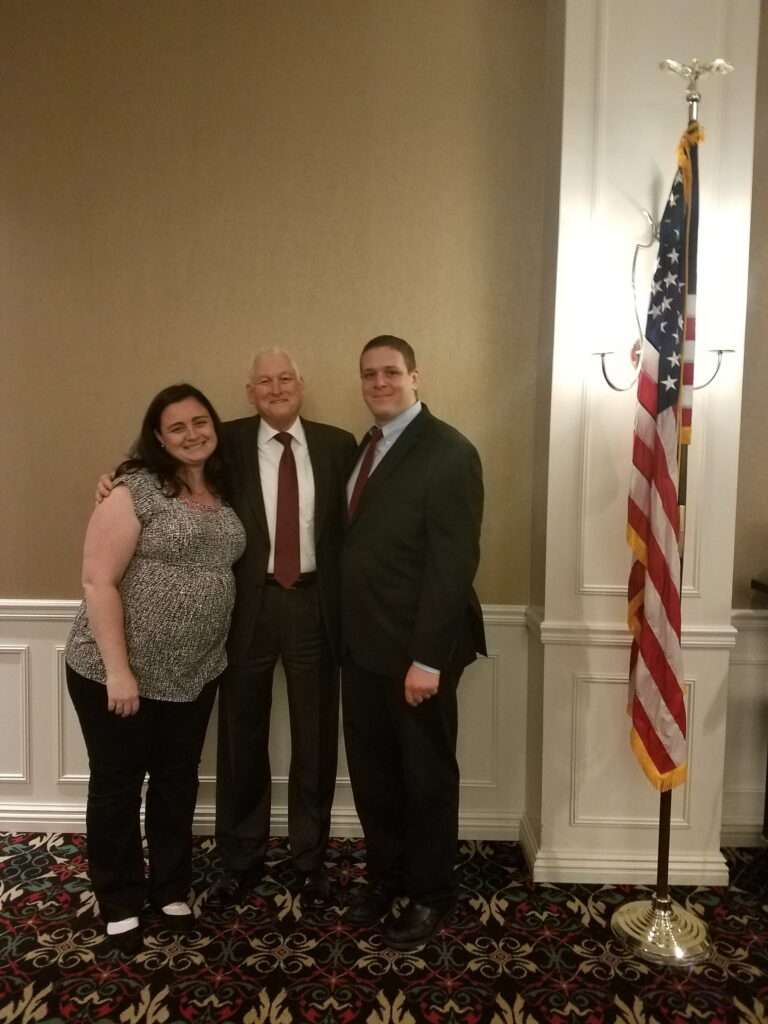
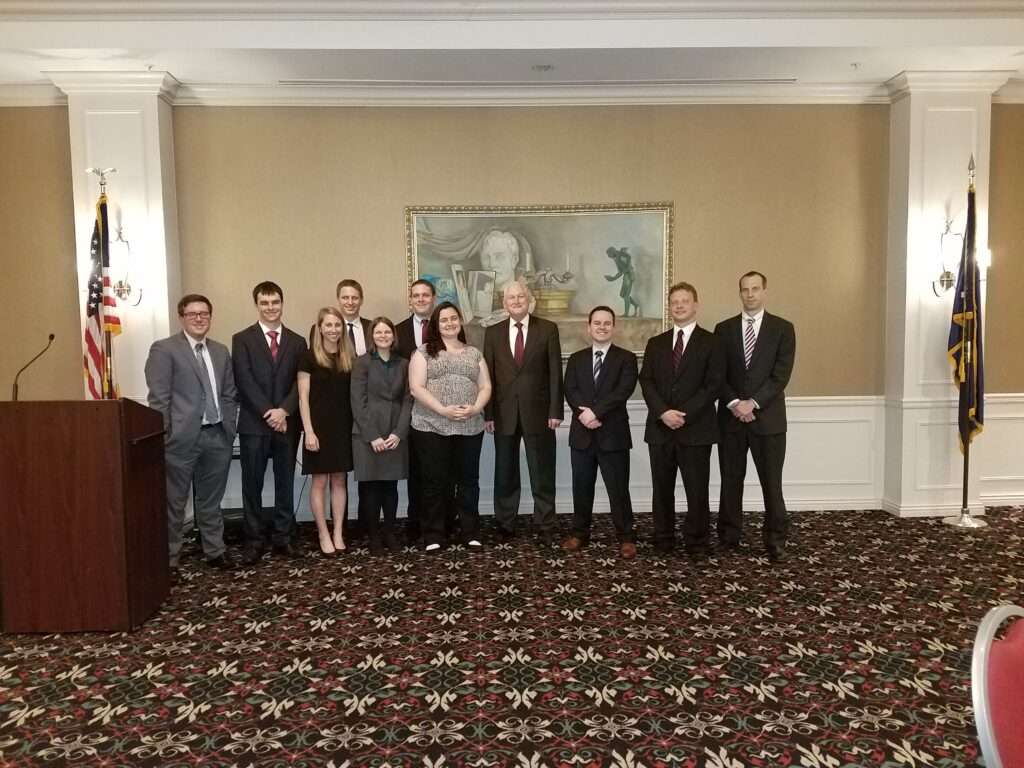
On May 30, 2017, exactly eight years ago today, Judge Gibson held a ceremony when he took senior status. This was a special day for the judge, as many of his former law clerks attended. I recorded his remarks, and took some photos.


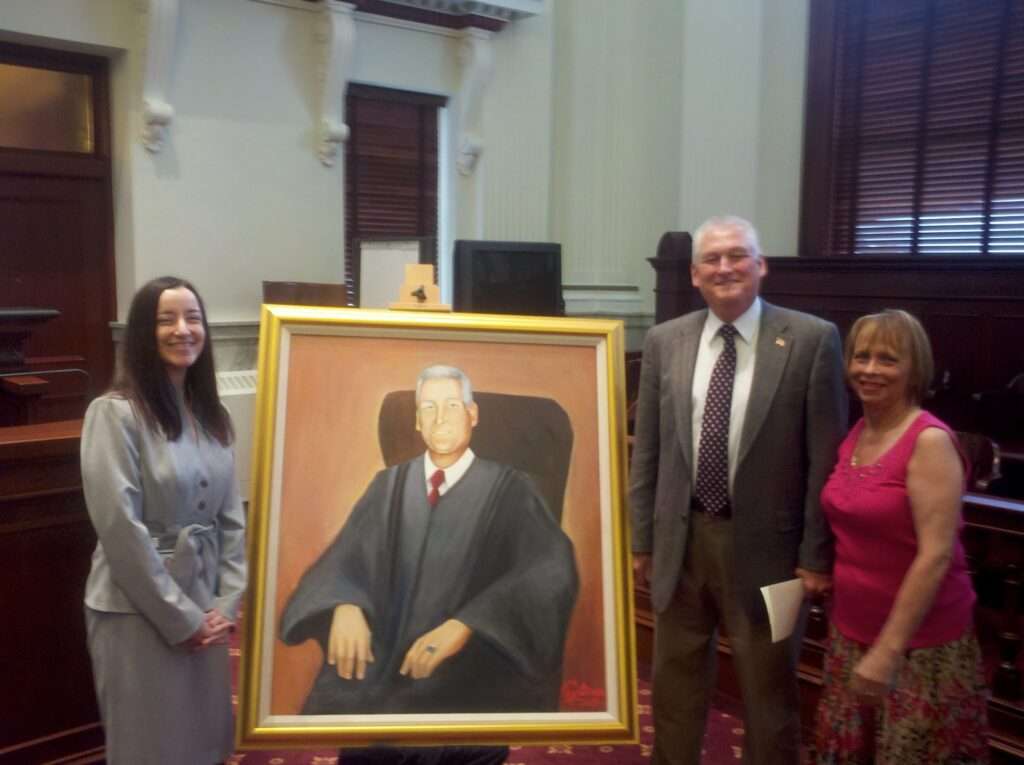
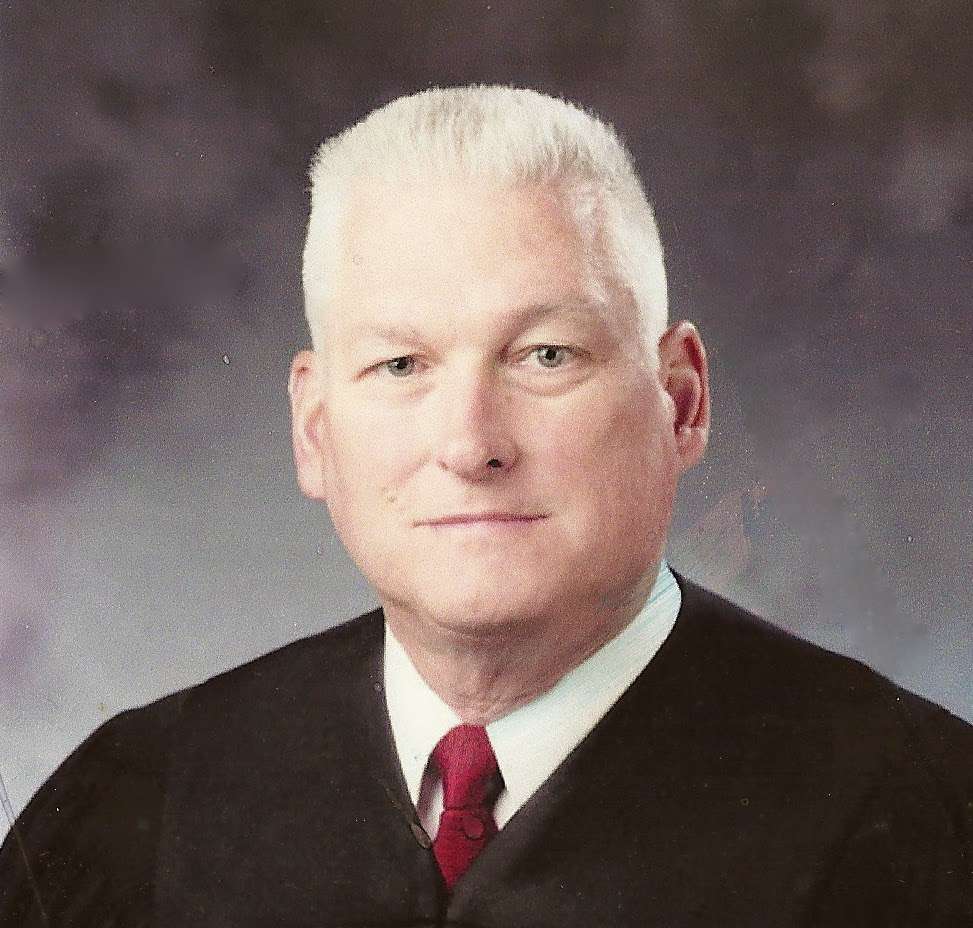
Here is a photo of Judge Gibson from 2011. His daughter Erin painted his portrait, which was displayed at the Somerset County Courthouse.


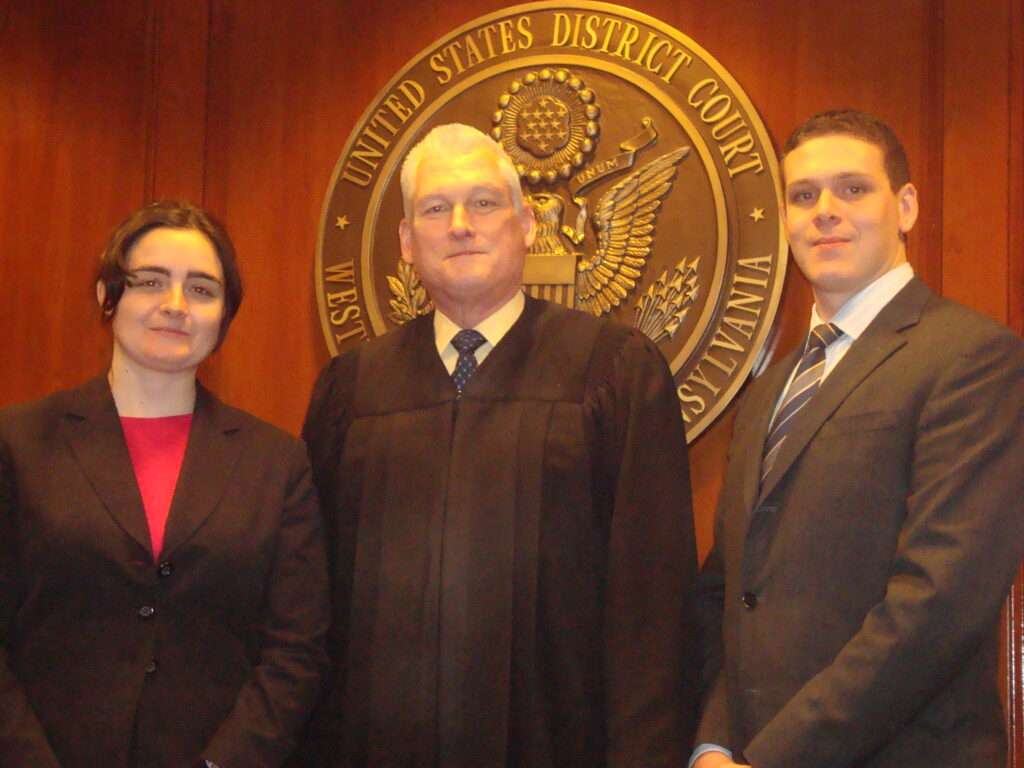
And here is a photo of my co-clerk and I back in February 2010.


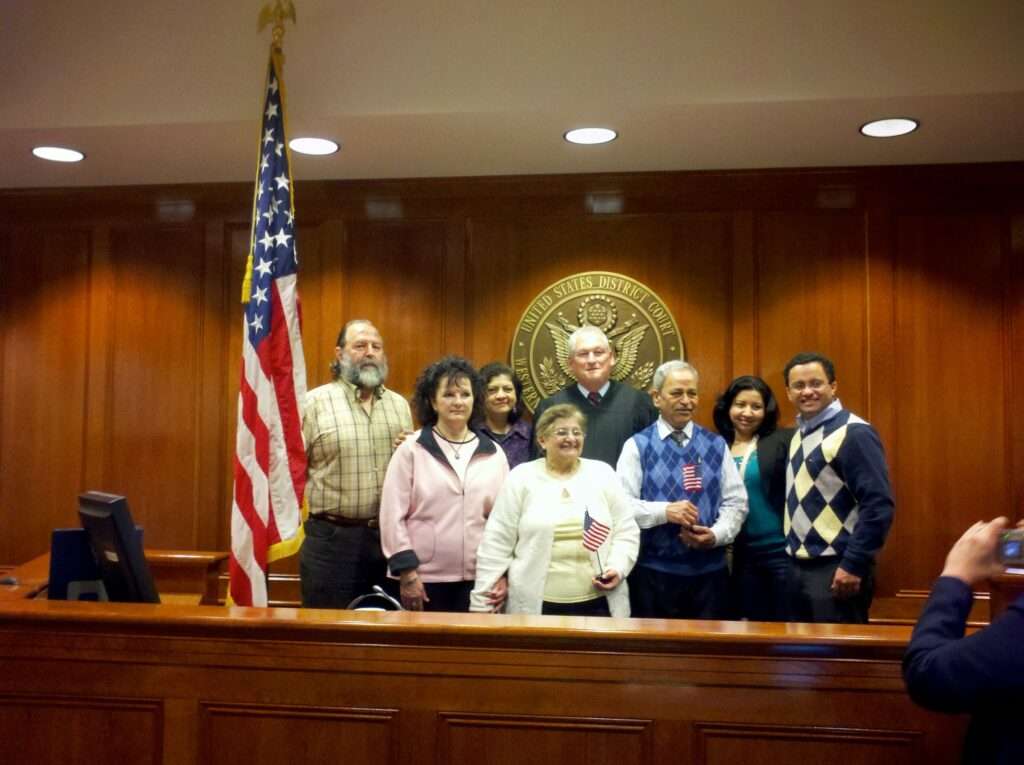
One of Judge’s favorite parts of the job was presiding over naturalization ceremonies. He always gave every new citizen an American flag. I asked if I could give them Constitutions. As usual, he humored me.

I will always thank Judge Gibson for giving me my introduction to academia. (I wrote about my experience here.) Judge knew I had some interest in teaching. For some time, the Dean of the Penn State Law School had been asking him to teach a class. He never quite got around to it. Early on in the clerkship, he asked me if I was interested in teaching the class with him. I jumped on it. We put together a syllabus for a federal courts class and started in January 2010. Every week, we traveled to State College. I would do my best to teach the theory, Judge Gibson would then explain how things really worked. We had a very good schtick.  Here is one of the videos I uploaded to YouTube back in the day. If you watch, you’ll see it was an early version of the 100 Cases book I published years later with Randy Barnett.

We will miss Judge Gibson dearly.

The post Judge Kim R. Gibson (1948-2025) appeared first on Reason.com.

from Latest https://ift.tt/sE8zxA7
via IFTTT

Texas Ten Commandments Bill Is the Latest Example of Forcing Religious Texts in Public Schools

Texas has become the latest state to pass a law requiring the Ten Commandments to be displayed in public school classrooms. The bill, which is already being legally challenged and is unlikely to pass constitutional muster, is part of a recent trend of red states attempting to inject religious texts into the classroom.

Senate Bill 10 requires public schools to “display in a conspicuous place in each classroom of the school a durable poster or framed copy of the Ten Commandments.” The poster is required to only contain the text of the Ten Commandments and must be at least 16 inches wide and 20 inches tall. Further, if a school doesn’t have an acceptable poster in each classroom, the bill requires them to accept any privately donated poster. 

The bill was passed by the Texas state House on Saturday and overwhelmingly approved in the state Senate with a 28–3 vote on Wednesday. While S.B. 10 has not yet been enacted, Texas’ Republican Gov. Greg Abbot said in a social media post earlier this month that he would sign the bill if it passed the Legislature.

Similar bills have been recently signed into law in Louisiana and Arkansas. While Louisiana’s Ten Commandments bill tried to avoid legal scrutiny by directing schools to only use private donations, not public funds, Texas’ bill makes no such distinctions. The bill states that a school “may, but is not required to, purchase posters . . . using district funds.” Louisiana’s bill was halted in federal court last November, shedding doubt on the Texas bill’s ability to survive a First Amendment challenge.

The day after the bill was passed, the American Civil Liberties Union (ACLU) and several other groups announced that they were suing to stop the bill from becoming law.

“We all have the right to decide what religious beliefs, if any, to hold and practice. Government officials have no business intruding on these deeply personal religious matters,” reads a Thursday statement from the ACLU. “S.B. 10 will subject students to state-sponsored displays of the Ten Commandments for nearly every hour of their public education. It is religiously coercive and interferes with families’ right to direct children’s religious education.”

The post Texas Ten Commandments Bill Is the Latest Example of Forcing Religious Texts in Public Schools appeared first on Reason.com.

from Latest https://ift.tt/qxfkvD9
via IFTTT

DOGE’s Newly Listed ‘Regulatory Savings’ for Businesses Have Nothing to Do With Cutting Federal Spending

This month the Department of Government Efficiency (DOGE) published new estimates of “savings” from various regulatory changes, which it says total $29.4 billion so far. The New York Times suggests several reasons to question these numbers but overlooks the most fundamental problem: Although deregulation accounts for about 17 percent of the $175 billion in total “estimated savings” that DOGE claims, the numbers in this category generally have nothing to do with federal spending, the project’s ostensible target.

One possible exception: DOGE claims changes to the rules governing health insurance subsidies under the Patient Protection and Affordable Act will save $10 billion, and at least some of that may represent reduced federal spending. But according to an “unnamed senior administration official” quoted by the Times, DOGE’s estimates of the impact from regulatory changes “represent cost savings for regulated parties.”

DOGE plausibly claims deregulation will reduce costs for businesses, and it may also benefit consumers in various ways. But those benefits have no impact on the annual budget deficit or the accumulating national debt. It is therefore illogical to include such “regulatory savings” in a tally that is supposed to show how far DOGE has gone in tackling those problems.

Even if we ignore this conceptual confusion and accept DOGE’s numbers, its progress represents a drop in the bucket of the federal government’s fiscal incontinence, which is mainly due to spending over which DOGE has no control. DOGE’s avowed accomplishments also fall far short of the ambitious goals set by Elon Musk, the billionaire entrepreneur who unofficially ran the initiative until his recent pivot back to his businesses. Musk, who originally thought DOGE could reduce annual federal spending by “at least” $2 trillion, cut that target in half in February. But as recently as late March, he was still confident that DOGE could achieve $1 trillion in annual savings.

On its face, DOGE’s current estimate falls about 83 percent short of that goal. But because that estimate includes multi-year savings, such as projections of the total that would have been spent under canceled grants and contracts, it does not tell us how much DOGE claims to be saving in any given fiscal year.

In April, Musk projected that the savings in FY 2026, when DOGE is scheduled to sunset, would be about $150 billion. But that estimate, which refers to a specific year, should not be confused with DOGE’s periodically updated “estimated savings,” a number that includes spending reductions that span multiple years.

Keeping that distinction in mind, there are reasons to doubt whether even these modest savings will materialize. News organizations have identified many problems in DOGE’s “Wall of Receipts,” which lists canceled or modified contracts, grants, and leases. The errors include contracts that were not actually canceled, contracts that were terminated during the Biden administration, iffy estimates of savings on contracts that had not been awarded yet, contracts that were counted multiple times, conflation of contract caps with actual spending, the inclusion of past spending in estimates of future savings, and overvaluation of contracts and grants.

The Times, which publicized many of those mistakes, sees similar exaggeration in DOGE’s new list of “regulation repeals and modifications.” Reporters Coral Davenport and Stacy Cowley “examined 10 of the largest claims on the leaderboard” and concluded that “several did not show evidence of savings to households.”

Right away we see a problem. DOGE does not claim the “regulatory savings” accrue to “households,” although it does say its total “estimated savings,” which include the “regulatory savings,” amount to $1,086.96 “per taxpayer.” In any case, both ways of framing the numbers overlook the point that DOGE is supposed to be reducing federal spending. Its estimates of “regulatory savings” for businesses are irrelevant in that context.

Instead of delving into that puzzle, Davenport and Cowley question the wisdom of various regulatory changes. They note, for example, that DOGE “claims that the Energy Department’s proposals to reverse 16 efficiency standards on appliances like dishwashers and microwaves will save Americans a combined $4 billion.” Yet according to “government scientists’ own accounting,” they say, “appliance efficiency standards saved the average American household about $576 in 2024 on water and gas bills.”

That is not exactly an apples-to-apples comparison, and it takes for granted the paternalistic premise that consumers are not smart enough to assess their own interests. Left to their own devices, Davenport and Cowley assume, Americans would irrationally discount the long-term savings from reduced utility bills. They might prefer cheaper appliances that save them money up front or dishwashers that use more water per cycle but clean dishes better in less time. In any event, appliance manufacturers are free to tout the cost-cutting advantages of more “efficient” models, which may or may not persuade any particular consumer. As Davenport and Cowley see it, that would give Americans more freedom than the federal government should allow.

What does any of this have to do with the accuracy of DOGE’s numbers? According to “multiple experts in regulatory policy,” Davenport and Cowley say, “many of the numbers DOGE and the Trump administration cite show little to no evidence of the comprehensive cost-benefit analysis” that “has historically undergirded agency regulations,” which considers the impact on “individuals and households” as well as regulated businesses.

Davenport and Cowley see a similar problem with DOGE’s estimate that rescinding the Biden administration’s limits on credit card late fees “will save Americans $9.5 billion.” That can’t be right, they say, because “government analysts” in the prior administration “calculated that the rule would save millions of customers an average of $220 per year,” totaling “about $10 billion annually, mostly in avoided bank penalties.”

By ignoring those savings, Davenport and Cowley think, DOGE is presenting a misleading picture. Yet the estimate that they cite does not take into account the unintended results of capping late fees, which could hurt consumers.

“Individuals considered risky are still able to access credit because of contractual terms like late fees,” Reason Contributing Editor Veronique De Rugy noted in 2023. “Lighten the fees and delayed payments will increase, making lending money riskier for institutions. When that happens, the only tools left to manage risk will be higher interest rates—which means higher costs even for responsible borrowers—or outright denials of low-income credit card applicants.”

Whatever the merits of the policy that the Trump administration reversed, the savings DOGE is claiming based on that change do not imply any reduction in government spending. Nor do the savings it attributes to relaxed appliance efficiency standards, which may increase consumer freedom but have no impact on federal outlays.

“The cost savings from [those] unprecedented deregulatory actions represent projected savings to both consumers and manufacturers based on a variety of factors, including increased choice of lower cost appliances and lower compliance costs,” a Department of Energy spokeswoman told the Times. That is all well and good, but it does not explain why those savings should be counted in any calculation of the Trump administration’s success at curtailing runaway federal borrowing.

Given DOGE’s track record, there is ample reason to be wary of the dollar figures it attaches to particular regulatory changes. To begin with, DOGE does not specify what period of time is covered by each item. Are these total savings or annual savings?

Davenport and Cowley offer more grounds for skepticism. They note, for example, that DOGE says rolling back water efficiency standards for commercial washers “would save Americans $1.9 billion.” That seems implausible, they say, since “the entire market for commercial washers is about $6.5 billion.” They quote Steve Cicala, co-director of the National Bureau of Economic Research’s Project on the Economic Analysis of Regulation, who says “there’s just no way that number makes any sense.”

Susan Dudley, “an expert in regulatory policy at George Washington University” who “served as the senior regulatory official in the George W. Bush administration,” concurs. “I don’t understand how anyone thinking this through could account for that claim of savings,” she told the Times. “This was one of my concerns with DOGE from the beginning. They’re not doing their homework, and they’re not showing their work.”

That take jibes with the impressions of budget experts such as the Manhattan Institute’s Jessica Riedl, the American Enterprise Institute’s Nat Malkus, and the Cato Institute’s Romina Boccia. But in this case, the problem is not just that DOGE’s numbers are unreliable or that its results are unimpressive even when taken at face value. The problem is that DOGE implicitly portrays “regulatory savings” for businesses as a step, however tiny, toward federal fiscal sanity.

The post DOGE's Newly Listed 'Regulatory Savings' for Businesses Have Nothing to Do With Cutting Federal Spending appeared first on Reason.com.

from Latest https://ift.tt/HzhpGja
via IFTTT

Short Circuit: An inexhaustive weekly compendium of rulings from the federal courts of appeal

Please enjoy the latest edition of Short Circuit, a weekly feature written by a bunch of people at the Institute for Justice.

Call for papers: Scholars, next year IJ’s Center for Judicial Engagement is going to celebrate and confer upon “The Other Declarations of 1776.” Accordingly, we invite papers on the history, meaning, and impact of state declarations of rights from 1776. It’s going to be a blast. Please send us proposals. Click here for more.

Recently, Prof. Samuel Bray opined that it would be “folly” to incorporate the Seventh Amendment’s civil-jury right against the states—an argument occasioned by IJ’s latest cert petition. As you might expect, we politely disagree. IJ’s own Jared McClain, one of the petition’s authors, has therefore penned a neutron bomb of a response.

Check out the latest episode of Unpublished Opinions, IJ’s roundtable podcast. Wherein Patrick Jaicomo reflects on his recent SCOTUS argument and Anya Bidwell can’t get enough of Fanny Burney.

  1. Four days after Media Matters published an article reporting that Elon Musk endorsed an antisemitic conspiracy theory while Twitter was placing corporate ads next to pro-Nazi content, the Texas AG launched an investigation into Media Matters for potential deceptive trade practices and issued a sweeping demand requiring the group to produce a slew of records. MM sues in DC, alleging 1A retaliation. AG: You can’t sue me there, or for that, and even if you could, you lose. D.C. Circuit: Not only is the suit proper, but also the PI barring enforcement of document production is completely appropriate.
  2. Does the Controlled Substances Act violate the Commerce Clause as applied to purely intrastate cultivation, manufacture, possession, and distribution of marijuana pursuant to state law? First Circuit: The Supreme Court said “no” back in 2005, and “no” is still the answer. The fact that Congress has since made use of appropriations riders preventing the DOJ from using any funds to prosecute state-legal marijuana doesn’t change the analysis. And the law is fine under the Due Process Clause as well, despite the plaintiffs’ thorough canvassing of marijuana’s historical pedigree.
  3. For thirty years, the town of Nantucket, Mass. has required a rental car to hold one of a limited set of rental-car “medallions”—a practice which has (shockingly) resulted in a small cartel of local businesses (plus one national chain) holding all the medallions themselves. And that, says the First Circuit, is a-okay by us.
  4. Plainclothes Mt. Vernon, N.Y. officers grab sexagenarian pedestrian and, without identifying themselves, cuff him and hustle him into their unmarked car as he yells himself hoarse begging bystanders to call 911. Oops! He’s not their suspect (who’s wanted for misdemeanor groping). Second Circuit (unpublished): These things happen.
  5. Second Circuit: Even though the defendant failed to even respond to the complaint, the district court nonetheless dismissed this case because the alleged copyright infringement was fair use, which was error because this totally isn’t fair use! Concurrence: Guys, don’t freak out, but I think I’ve come up with an easier way to resolve this case.
  6. Plaintiff: New York City cancels tax-refund checks after only six months without notice. Now, I didn’t get one of those checks myself, but I sell things for a living, and so if somebody had been able to cash their refund check after seven months, that unidentified somebody might have bought some things from me. Second Circuit (unpublished): Let us just stop you right there.
  7. Allegation: On overnight flight, Penn State fencing coach gropes female fencing coach (who is unaffiliated with the school). He also repeatedly and unsuccessfully insists that they join the Mile High Club. Later, she is pressured to keep quiet. District court: She’s neither a PSU student nor employee; her Title IX claims are dismissed. Third Circuit: Actually, for some claims she is within Title IX’s “zone of interests.” And some of her state-law claims against the groper are undismissed as well.
  8. Does the First Amendment constrain the ability of government to remove books from public libraries? Fifth Circuit (en banc): Nope. Libraries’ curation decisions are gov’t speech, and not at all akin to the dissent’s over-caffeinated invocations of book burning.
  9. NLRB: So, 10 years ago, we found that this small business violated federal labor law, but then we just kind of . . . forgot about it for a while? Anyway, we just remembered, and so we think it’s time to punish them. Fifth Circuit: Ten years? Ten? Years? Ten years?
  10. Texas passes law to prevent vision plans from promoting vision-service providers they may be affiliated with. A First Amendment violation? Fifth Circuit: Indeed. We generally presume consumers don’t benefit from having information withheld from them.
  11. Allegation: Some Texas state employees sought to destroy pro-life organization that provides reproductive healthcare services across the state. This included feeding lies to the Texas Observer for a “hit piece,” while another encouraged a disgruntled former employee of the organization to swipe confidential documents from the organization’s Dropbox account that she still had access to. Fifth Circuit: The state employee who encouraged the Dropbox access used the disgruntled former employee as a state agent in a way that, if true, super violates the Fourth Amendment and leaves him without qualified immunity. Moreover, his argument that the organization lost its reasonable expectation of privacy in the contents of the documents by uploading them to Dropbox is bollocks.
  12. Houston motorist flees, crashes his vehicle, and does not follow orders to show his hands. Officers shoot him dead. Officers: And his widow does not have standing to sue us. Fifth Circuit: She most certainly does. But it doesn’t violate the Fourth Amendment to shoot if officers reasonably thought someone might have a gun, even if turns out there wasn’t one.
  13. Another week, another episode of the Seventh Circuit‘s brooking no sloppiness from hapless lawyers.
  14. Federal-jurisdiction mavens may be interested in footnote 6 of this Eighth Circuit opinion, which informs us that the parties have already settled this case but that settlement (for unexplained reasons) “does not render this appeal moot.”
  15. “The central question in this case is whether ‘Eleanor’ is a copyrightable character. Eleanor is a collection of Ford Mustangs featured across four films, most recently in Gone in 60 Seconds (2000).” Ninth Circuit: Sadly for Eleanor, this assortment of sports cars is not really a character. But don’t worry, the court reassures us that the Batmobile is.
  16. In 2008, applicant applies for permission to build a 500-mile transmission line to carry power from a wind farm in New Mexico to market in Arizona and beyond. Ninth Circuit (2025): Which the feds granted without sufficient consideration of whether historic properties are affected. Case undismissed!
  17. Washington State spa, where patrons are sometimes naked, only serves biological women, leading to state investigation after a trans woman with male genitalia is denied service. Ninth Circuit: The investigation didn’t violate various provisions of the First Amendment. Dissent: The state statute doesn’t actually bar the spa’s conduct.
  18. Allegation: Oakland, Calif. police officers engage in an unauthorized high-speed chase without turning on their lights or sirens, without informing dispatch, and with the intent to harm the suspect. The suspect loses control of his car, killing and severely injuring innocent bystanders. Whom police then ignore. Ninth Circuit: No qualified immunity. Dissent: Shocking, deeply disturbing, but QI.
  19. And in en banc news, the D.C. Circuit will not reconsider its decision that Steve Bannon is contemptible (as in subject to sanctions for contempt of Congress—we avoid politics here). Three judges think there are separation of powers problems.

New case: In 1960, in Jones v. United States, the Supreme Court gutted the Fourth Amendment’s oath-or-affirmation requirement, deep-sixing our noble history and tradition of issuing warrants based only on sworn, first-hand accounts from real accusers. Which was bad for all of us in general, and bad in particular for IJ client Michael Mendenhall, whose Denver townhome was searched based on third-hand hearsay from a patently unreliable source. Click here to learn more.

The post Short Circuit: An inexhaustive weekly compendium of rulings from the federal courts of appeal appeared first on Reason.com.

from Latest https://ift.tt/MUF30yx
via IFTTT

The Coming Judicial Nomination Wars On The Right

Yesterday, I mused on whether the President may ignore geographic constraints when selecting circuit court nominees. The impetus behind that post, of course, was Emil Bove’s nomination to Justice Alito’s old seat on the Third Circuit, even though Bove has no clear geographic connection to New Jersey. At the end of my post, I offered some praise of Bove, at least based on my interaction with him during the Special Counsel litigation.

Yet, there is strong opposition to Bove on the right. On May 19, Ed Whelan described Bove as a “DOJ Henchman.” Whelan closed with an admonition:  “Picking Bove would send the opposite message, and it might well deter some sitting judges from stepping down from active service to create more vacancies that Trump could fill.” Whelan’s subtle message was that Trump should pick someone else, or else he will get fewer vacancies. This statement was as much predictive as it was suggestive–he was signaling to the Bush I and II judges they should not give up their seats to Trump. Jon Adler expressed a similar message on X, saying that fewer judges may take senior status if the “caliber” of Trump’s nominees are weaker.

On the other hand, Mike Fragoso–who is now Whelan’s colleague at EPPC–suggests that many of the Republican judges who are eligible are refusing to take senior status, independent of Bove. I tend to agree with Fragoso. Judges have very idiosyncratic views on taking senior status. Maybe at the margins, someone interested in stepping down will not, but I am skeptical.

Perhaps during a prior time, Whelan’s post would have been enough to stop the nomination. But here, Whelan’s post seems not to have had any effect on Trump’s decision making. Indeed, senior officials in DOJ rejected Whelan’s argument.

With Bove nominated, Whelan has now leveled up the discourse with a lengthy post critical of Bove. It reads like the sort of commentary that Whelan has provided about countless Democratic nominees. At the end, Whelan concludes “Republican senators who have the foresight and sense to prevent this scenario should defeat Bove’s nomination.” Again, this sentence is as much predictive as suggestive: he is telling Republican senators to block Bove’s nomination as part of a line of defense against Trump picking future similar nominees. I have no idea how influential Whelan’s post will be with Republican Senators, given that Trump has lined up solidly behind Bove.

Further, we can’t separate these issues from President Trump’s post last night that criticized the Federalist Society, and Leonard Leo in particular, for their advice on judicial nominees in during the first administration. And on the horizon is the specter that the three Trump Justices will soon have to resolve the legality of the tariff plan, which is the centerpiece of the President’s entire economic agenda. The Gold Clause Cases comes to mind as an analogy. Let’s see what kind of blue plate special the Chief tries to whip up.

As I’ve written before, there is a storm brewing that most people–inside and outside the judiciary–do not quite yet see. People might think they are pumping the breaks, when in fact they are slamming their feet on the accelerator. They think they are dousing the flames with water, when if fact they are spraying kerosene. They think they are averting crisis, when in fact they are driving towards it.

In the past, the most vigorous clashes over judges happened between the left and the right. I think the next round of wars will be on the right. The left can sit back and enjoy the fireworks.

The post The Coming Judicial Nomination Wars On The Right appeared first on Reason.com.

from Latest https://ift.tt/Eu7hz1N
via IFTTT
SCOTUS Allows Trump Administration to Revoke Parole Status of Noncitizens Present under CHNV Program

Today, in Noem v. Doe, the Supreme Court granted the Trump Administration’s application for a stay of a district court order that barred the Department of Homeland Security from revoking “parole” status for an estimated 500,000 noncitizens from Cuba, Haiti, Nicaragua, and Venezuela under the so-called “CHNV” program. Justice Jackson dissented, joined by Justice Sotomayor.

The Court’s order in Noem v. Doe should not be surprising. As even Justice Jackson acknowledged in her dissent, the decision to offer noncitizens parole “is discretionary by statute.”

The language of 8 U.S.C. §1182(d)(2)(A) is quite clear:

The Secretary of Homeland Security may, . . . in his discretion parole into the United States temporarily under such conditions as he may prescribe only on a case-by-case basis for urgent humanitarian reasons or significant public benefit any alien applying for admission to the United States, but such parole of such alien shall not be regarded as an admission of the alien and when the purposes of such parole shall, in the opinion of the Secretary of Homeland Security, have been served the alien shall forthwith return or be returned to the custody from which he was paroled and thereafter his case shall continue to be dealt with in the same manner as that of any other applicant for admission to the United States.

While it is certainly disruptive to revoke a noncitizen’s parole status, it is something the Secretary clearly has the power to do. Unlike in the Alien Enemies Act cases, there is little question about the scope of the Administration’s authority or the way it is being exercised. Further it is not clear that such discretionary choices are even subject to judicial review.

Justice Jackson objected to the stay on the grounds that granting a stay should reflect “more–much more” than the likelihood that one party will prevail. While leaving hte district court’s injunction in place would prevent the DHS Secretary from exercising her discretion, and inhibit the administration’s ability to pursue its immigration and foreign-policy objectives through power expressly delegated by Congress, she believes the Court should have shown greater solicitude for the effects of revoking parole on the program’s beneficiaries. “Even if the Government is likely to win on the merits, in our legal system, success takes time and the stay standards require more than anticipated victory.” Yet under this approach, one administration could effectively tie the hands of its successor by granting parole or other status to large groups of noncitizens, without regard for what Congress enacted. Immigration law is not, and should not be, this sort of one-way ratchet.

Today’s order is a reminder that the President retains ample authority to direct immigration policy and undo the policies of his predecessors. All that is necessary is exercising those authorities forthrightly. (And if one does not like that a single President can exercise authority in this way, that is a question to take to Congress.)

The post SCOTUS Allows Trump Administration to Revoke Parole Status of Noncitizens Present under CHNV Program appeared first on Reason.com.

from Latest https://ift.tt/UK8LTc5
via IFTTT

Who’s Programming The AI, Mr. President?

Who’s Programming The AI, Mr. President?

Authored by Maureen Steele via American Greatness,

President Trump’s new legislative centerpiece – the One Big Beautiful Bill – has a promising name and some compelling goals: reduce government bloat, streamline agencies, and modernize operations with cutting-edge technology.

But there’s a problem. A big one.

No one will tell us who’s programming the AI.

This sweeping bill includes a 10-year moratorium on any state or local government regulating artificial intelligence. According to The Washington Post and AP, more than 60 existing state-level laws will be overridden if this provision passes. All regulatory authority over AI—including systems that will be used in law enforcement, healthcare, defense, and finance—will be centralized in the federal government for a decade.

Even worse? The bill empowers the Department of Commerce to deploy “commercial AI” across virtually every federal agency—from the IRS to Homeland Security—according to Indian Express and The Verge.

And yet, no one in the White House or Congress has revealed who is writing the AI code, what datasets it’s trained on, whether it can be independently audited, or whether it’s bound by the U.S. Constitution.

This isn’t just a transparency issue. This is a constitutional crisis in the making.

To be clear, President Trump’s instincts here may be sound. We’ve long needed to shrink the federal leviathan and replace unconstitutional bureaucracies with systems that serve the people—not special interests.

But good intentions won’t protect us from unseen programmers, black-box algorithms, and unaccountable automation.

This bill mandates AI integration across government “to improve efficiency and security.” But efficiency isn’t liberty. Security isn’t sovereignty. And no AI—no matter how “smart”—should be allowed to rewrite, ignore, or reinterpret constitutional rights.

According to Business Insider, the AI moratorium’s stated goal is to “foster innovation” and avoid a “fragmented regulatory landscape.” In reality, it strips states of their authority to protect their citizens from deepfakes, algorithmic bias, digital censorship, and mass surveillance.

This is not governance. This is outsourced tyranny, hidden under the guise of modernization.

So let’s ask the question about what happens when AI is weaponized. If the systems being implemented were open source, transparent, built entirely on constitutional jurisprudence, and auditable by the public, we’d be having a very different conversation.

Instead, we’re facing a future where an algorithm may determine whether you’re eligible for services, a machine learning system may flag you as a “threat” based on your social media posts, and a black-box model may deny you a loan, reject your legal challenge, or freeze your bank account.

And you’ll never be told why.

You’ll never meet the person who made the decision—because there won’t be one.

And you won’t be able to sue.

Let’s not forget: AI is only as trustworthy as the data and ideology behind it. Who’s writing the rules? Google? Palantir? A Pentagon contractor? A committee of DEI officers? Are any of them being held to the Constitution?

The bill provides no clarity and no enforceable limits.

Many Americans have noticed that Trump, while visionary and bold, often surrounds himself with personnel who do not share his America First convictions.

Look no further than Susie Wiles—a long-time D.C. insider and lobbyist who acts as a gatekeeper to the former president. She’s known for blocking conservative constitutionalists from delivering vital information to Trump. The concern here is obvious: if Trump is not being properly briefed, then he may be backing legislation that completely contradicts the very values he’s trying to protect.

He’s been misled before, and this bill may be the worst example yet.

If AI is going to be deployed in government, then it must be open source—so the public can verify it—bound to the Constitution, not corporate code; audited regularly by independent, civilian-led review boards; and subject to judicial challenge if it infringes on rights.

Anything less is a betrayal of American sovereignty.

The One Big Beautiful Bill is not a harmless modernization measure. It is a potential gateway to technocratic control, where the power of law enforcement, taxation, and surveillance is handed over to machines we can’t see, question, or hold accountable.

Call your U.S. senators now. Demand: Removal of the AI moratorium. Clear constitutional guardrails and transparency, auditing, and public oversight of all AI code deployed in federal agencies.

Let them know: We are not giving the republic away to an algorithm.

This is the fight. If we lose this one, there may be no one left—human or otherwise—to fight the next.

*  *  *

Views expressed in this article are opinions of the author and do not necessarily reflect the views of ZeroHedge.

Tyler Durden
Fri, 05/30/2025 – 13:45

via ZeroHedge News https://ift.tt/gizBcCs Tyler Durden

Watch Live: Trump And Musk Hold Press Conference On DOGE Chief’s Last Day

Watch Live: Trump And Musk Hold Press Conference On DOGE Chief’s Last Day

President Donald Trump and Elon Musk are holding a press conference on Musk’s last day as the head of the Department of Government Efficiency (DOGE).

“I am having a Press Conference tomorrow at 1:30 P.M. EST, with Elon Musk, at the Oval Office. This will be his last day, but not really, because he will, always, be with us, helping all the way. Elon is terrific! See you tomorrow at the White House,” Trump wrote on Truth Social.

Watch Live:

As the Epoch Times notes further, since Trump took office, Musk has led DOGE with the goal of identifying opportunities for spending and personnel cuts across the federal government amid record national debt. DOGE’s efforts have drawn criticism from Democrats and legal challenges.

Musk announced on May 28 that he planned on leaving the federal government as his 130-day term as a special government employee is ending.

“As my scheduled time as a Special Government Employee comes to an end, I would like to thank President @realDonaldTrump for the opportunity to reduce wasteful spending,” Musk said in a post on the social media platform X.

“The @DOGE mission will only strengthen over time as it becomes a way of life throughout the government.”

Musk has recently criticized the House-passed One Big Beautiful Bill Act, expressing his concerns over the budget deficit.

While the bill makes sweeping cuts to federal programs like the Supplemental Nutritional Assistance Program (SNAP), also known as food stamps, and Medicaid—specifically through the imposition of more stringent income and work requirements, in addition to an increased financial burden on states to fund the entitlements—some officials have estimated that it could still negatively impact the deficit.

According to the Congressional Budget Office, the legislation could increase the deficit by $3.8 trillion over 10 years—prompting criticism from Musk and other budget hawks.

“I was disappointed to see the massive spending bill, frankly, which increases the budget deficit, not just decreases it, and undermines the work that the DOGE team is doing,” Musk said during an appearance on “CBS Sunday Morning.” “I think a bill can be big or it can be beautiful, but I don’t know if it can be both.”

Trump has been outspoken in his support of the package, personally working to sway conservative critics. After Musk’s comments, the president said on May 28 “I’m not happy about certain aspects of it, but I’m thrilled by other aspects of it.”

House Speaker Mike Johnson (R-La.) has endorsed the package, saying it would be “jet fuel for the U.S. economy.”

In response to the DOGE-related concerns, White House Deputy Chief of Staff for Policy Stephen Miller said in a post on X that spending cuts recommended by DOGE could only be handled through a rescissions package or appropriations bill.

The White House on May 28 confirmed it would soon send Congress a $9.4 billion request to cut spending, wrapping in several of DOGE’s suggested cuts to the U.S. Agency for International Development.

Tyler Durden
Fri, 05/30/2025 – 13:25

via ZeroHedge News https://ift.tt/gbU1X4P Tyler Durden