Short Circuit: An inexhaustive weekly compendium of rulings from the federal courts of appeal

Please enjoy the latest edition of Short Circuit, a weekly feature written by a bunch of people at the Institute for Justice.

Happy 250th! IJ is excited to celebrate America’s Big 250 but in our own way. We’re partnering with the Liberty & Law Center at Scalia Law School and holding a conference called “The Other Declarations of 1776.” It’s an examination of the various declarations of rights that the new states adopted in 1776, including their histories, legacies, and controversies. Plus there’s an 18th-century-style mock argument with wigs. It’s Friday, April 10 in Arlington, Va. Register here!

New on the Short Circuit podcast: Our John Wrench interviews some tip-top legal scholars with the latest on economic liberty, history and tradition, and more.

  1. Plaintiff: Look, if you’re going to convict me for “knowingly” possessing a firearm despite having been convicted of misdemeanor domestic violence, you have to let me introduce evidence that we specifically tried to structure my guilty plea in state court so it wouldn’t count as misdemeanor domestic violence. First Circuit: Shan’t. Conviction affirmed.
  2. At beginning of the COVID-19 pandemic, New Yorker develops business plan to buy PPE masks in bulk and sell individual units at a 50% markup. Yikes! The President had declared masks a scarce resource under the Defense Production Act—triggering an anti-hoarding law—and one of the business partners in the plan is actually an undercover FBI agent. Jury convicts our entrepreneur of a hoarding conspiracy under the DPA. The Second Circuit affirms, spending many pages explaining why the word “accumulate” in the statute does not require hoarding over an extended time. Your summarist is wondering the whole time why the FBI is devoting its agents to a war on market-clearing prices, and on a rather modest markup at that.
  3. Do civil-rights advocacy organizations have standing to challenge allegedly grievous defects in South Carolina’s juvenile-detention system? Fourth Circuit (2-1): No. “We do not doubt the sincerity of plaintiffs’ desire to ameliorate the harm that may befall juveniles in . . . custody, only the wisdom of their decision to sue in place of those whose interests they seek to advance.” Dissent: One of the organizations is required by federal statute to protect the constitutional rights of people with mental illnesses. Of course it has standing.
  4. Montgomery County, Md. schools require staff to use students’ preferred pronouns and keep students’ gender identities confidential from parents absent consent. A substitute teacher sought a PI on free exercise and free speech grounds; the district court denied the PI and dismissed both claims. Fourth Circuit: Rightly so. Employment Div. v. Smithmay be a “punch-drunk fighter,” but it’s still knocking out free exercise claims unless/until the Supreme Court says otherwise. And this speech is merely part of the job description. Dissent: A rationale that will age poorly when entire states use it to ban teachers from using preferred pronouns altogether.
  5. Allegation: Reynoldsburg, Ohio officer grabs woman (who’s accused of being a very bad neighbor) as she opens front door without giving her a chance to comply with order to step outside. When she tenses up and pulls back, he performs a takedown maneuver that results in injuries that require four surgeries. District court: Could be excessive force. Sixth Circuit (unpublished): Qualified immunity. There are no cases on point, and we’re pretty sure this was reasonable given the aggressive, barking dogs and guns inside her house.
  6. In which the Sixth Circuit reminds us that, while facial claims are supposed to be easier in the First Amendment context, they remain super-duper hard.
  7. A Battle Creek, Mich. animal-control officer allegedly demands that two civilians go corral a dangerous dog while the officer sits comfortably in the cab of his truck. (The dog, predictably, mauls them both.) And that may have been an ungentlemanly act, says two-thirds of this Sixth Circuit panel, but it was not an unconstitutional one.
  8. Sixth Circuit: Proving a regulatory taking requires you to show that the city upset your investment-backed expectations, but the record shows that your only expectations should have been that the city would behave badly here. Case dismissed!
  9. When the Second Amendment was adopted, there were no serial numbers on guns. So does that mean it’s unconstitutional to prosecute someone today for “obliterat[ing]” one on a handgun? Seventh Circuit: If you wave your hands hard enough you can kind of see gun-recordy stuff like this at the Founding.
  10. When should courts address an argument raised for the first time on appeal? One-third of this Seventh Circuit panel thinks they’ve spotted this rara avis. But, be warned, the full panel fully agrees that “[t]he facts of this case are disturbing.”
  11. Can you hear me now? We’ve all been in Zoom meetings or webinars where the discussion is dominated by technical snafus, but rarely does that spawn federal litigation. Here, though, a Missouri charity loses out on beaucoup bucks when its online art auction fails because of a broken YouTube link managed by its auction vendor. Perhaps unsurprisingly the vendor is broke, but is its insurance company on the hook? Eight Circuit: Nope, the policy excludes losses arising from electronic data mishaps, and that’s just what this is.
  12. During COVID-19 lockdowns in a California prison, one prisoner is forced to stay either in his cell or in a crowded work area with about 130 other inmates. He is denied outdoor recreation time. Ninth Circuit: And there’s no qualified immunity for the warden.
  13. “Shotgun pleading” has nothing to do with the Second Amendment. It is, however, often hard to find the sweet spot between not pleading enough facts and pleading so many, and then repeatedly incorporating them by reference, that shotgun pleading emerges. For further guidance and confusion compare the Ninth Circuit‘s majority and dissenting opinions in this Portland, Or., shotgun story of right-wing vs. left-wing violence, a riot prosecution, and a whole bunch of immunities.
  14. As Bill Clinton might say, what does the word “include,” include? According to the Ninth Circuit that word’s use in an Idaho law banning the use of certain sexual material in schools is pretty inclusive, making the law not only cover speech concerning certain activities associated with that former President but a whole bunch of other speech that the First Amendment protects. Therefore, the court ruled that under the Miller test the law should be preliminarily enjoined.
  15. During El Salvador’s “state of exception,” national police and soldiers repeatedly detained and beat a man who eventually sought asylum and relief under the Convention Against Torture. An immigration judge and the board of immigration appeals denied relief. Tenth Circuit: Yes, he was probably persecuted—but it wasn’t politicalAnd yes, gov’t officials beat him several times, caused him significant ear damage, had him sleep on a metal bed with no mattress, and forced him to exercise nude. But that’s mere “abuse,” not “torture.” Petition for review denied.
  16. Colorado and Kansas share a border. Pot is legal in Colorado. In Kansas it is not. So perhaps it is not surprising that for years Kansas cops have engaged in unconstitutional tactics during roadside stops of out-of-state drivers. District court: I’m gonna get this stuff to stop by ordering a set of policies. Tenth Circuit: Actually, the stuff is pretty messy. We’ll keep the injunction for some training, but that’s it. Dissent: I can’t believe you guys are allowing the “Kansas Two-Step.”
  17. Allegation: Macon County, Ala. deputy sheriff swings by the office while off duty, gets intoxicated, speeds homeward in his police truck, sans lights, and kills another driver. A violation of the driver’s due-process rights? Eleventh Circuit (over a dissent): We’re going to assume that the deputy was acting under color of state law. We’re also going to assume that the deputy’s conduct “shocked the conscience.” But he gets qualified immunity even so.
  18. A legally blind man who spent ~18 days in two Georgia jails sued sheriffs under the ADA and Rehabilitation Act after staff wouldn’t help him read forms, navigate, use phones, provide medications, or file grievances. Eleventh Circuit: He’s not entitled to money damages because there’s no evidence that the sheriffs intentionally discriminated against him, nor is he entitled to injunctive relief because the claim is moot—he was released, charges were dropped, so no reason to believe he’ll be incarcerated again. Affirmed.
  19. And in en banc news, the First Circuit will reconsider its decision about a Cambridge, Mass. police officer who was disciplined for posts he made on his private Facebook account. The court ordered supplemental briefing on a number of issues related to the Pickering balancing test.
  20. And in additional en banc news, the Sixth Circuit will reconsider its decision about class action certification in certain auto valuation cases, thus (at least for now) wiping out a circuit split.
  21. And in even more en banc news, the Eleventh Circuit will reconsider its decision on ERISA exhaustion and pleading standards.

Sonja Trauss is the executive director of YIMBY Law, an organization dedicated to ending the housing shortage in California. Sonja and YIMBY Law send letters to cities, offering views on housing-related policies. This is a routine practice carried out by individuals and groups across the political spectrum every single day. But the California State Bar is now signaling that the simple act of writing a letter to the government by Sonja and YIMBY Law is an unauthorized practice of law and threatening legal action. This is a clear violation of the First Amendment and the fundamental American right to petition the government. IJ is standing with Sonja and YIMBY Law and demanding the Bar back down.

The post Short Circuit: An inexhaustive weekly compendium of rulings from the federal courts of appeal appeared first on Reason.com.

from Latest – Reason.com https://ift.tt/kByW2hL
via IFTTT
Conference for arms law scholars

DATE: May 28-29, 2026

LOCATION: Durham, NC

ABSTRACTS DUE: February 20, 2026

The Duke Center for Firearms Law and the University of Wyoming Firearms Research Center invite applications to participate in the seventh annual Firearms Law Works-in-Progress Conference. The conference will be held at Duke Law School in Durham, NC, on May 28 and 29, 2026. We ask all those interested in presenting a paper at the conference to submit an abstract by Friday, February 20, 2026.

At the Firearms WIP Conference, scholars and practitioners present and discuss works-in-progress related to firearms law and policy broadly defined, including Second Amendment history and doctrine, federal and state gun regulation, and the intersection between firearms law and other areas of law. The Firearms WIP Conference is the only legal works-in-progress event specifically focused on firearms law and policy. Summaries of past conferences, including paper titles and attendees, are available here: 2019, 2020, 2021, 2022, 2023, 2024, and 2025.

Conference sessions are lively discussions among authors, discussants, and participants. Each accepted paper is assigned to a panel of three to four scholars with a moderator who will summarize the papers and then lead a discussion. Sessions run from Thursday afternoon through Friday afternoon. There will be a casual dinner and social event Thursday evening following the afternoon session. All conference participants are expected to read the papers in advance and to attend the entire conference.

We accept papers on a wide array of topics related to firearms, including from scholars who are new to the field and interested in exploring the interaction between firearms law and other disciplines. Although participation at the conference is by invitation only, we welcome paper proposals from scholars and practitioners all over the world. Please feel free to share this call for submissions widely.

Submission Details

  1. Titles and abstracts of papers should be submitted electronically to firearmslaw@law.duke.edu no later than February 20, 2026. Abstracts should be no longer than one page, and should be submitted as a PDF file saved under the file name “[last name, first name] – [paper title].” Please use the subject line “WIP Paper Submission” in your email.
  2. Authors will be informed whether their paper has been accepted no later than March 13, 2025.
  3. Workshop versions of accepted papers will be due in mid-May, so that they can be circulated to moderators and other conference participants in advance of the conference.

We expect that participants’ home institutions will cover travel expenses to the extent possible. However, the Duke CFL and the Wyoming FRC are able to cover some costs of lodging and travel expenses for authors who would not otherwise be able to attend. This support is intended to encourage submissions from junior faculty, especially those who are new to the field.

The post Conference for arms law scholars appeared first on Reason.com.

from Latest – Reason.com https://ift.tt/P4te2sd
via IFTTT

How Americans Are Fighting a British Censorship Invasion


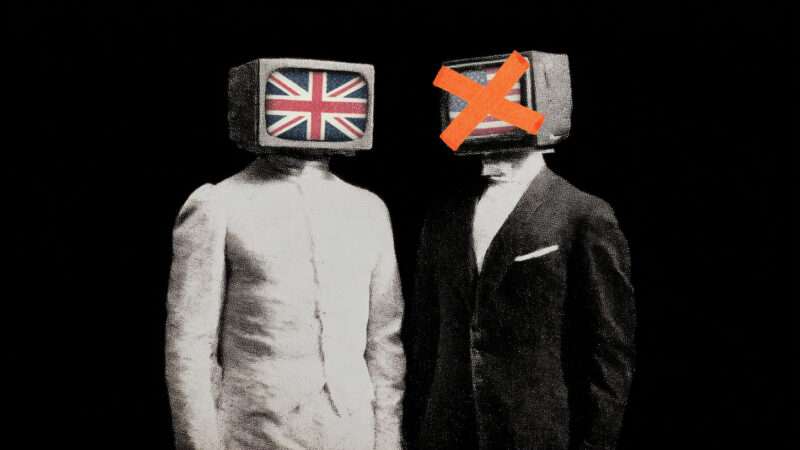
Against a black background, a body of a person wearing all white whose head is replaced by a TV set showing the British flag, next to the body of someone wearing a dark suit whose head is replaced by a TV set showing the American flag with orange tape over it. | Illustration: Midjourney

The Online Safety Act has crippled free speech in the United Kingdom. Most Americans may assume they’re safe from censorship on this side of the Atlantic, but the U.K. is now attempting to enforce the Online Safety Act on U.S. companies.

The Online Safety Act grants the U.K.’s online regulator, Ofcom, sweeping authority to restrict and censor online content under the guise of protecting children. The results have been disastrous. In compliance with these rules, social media companies in the U.K. have set age restrictions on a wide range of content: Reddit pages discussing Ukraine and Gaza, a parliamentary speech about the rape of a minor, and even an image of the famous Francisco Goya painting Saturn Devouring His Son.

American social media users have yet to encounter Ofcom’s censorship on their timelines, but U.K. regulators have quietly been pressuring U.S. companies to comply with their orders, sparking outrage among a small but tenacious coalition of American legislators and free speech lawyers. 

Tech policy lawyer Preston Byrne has been exchanging volleys with the Brits for months. He represents four U.S. websites targeted by Ofcom: 4chan, Gab.com, Kiwi Farms, and Personal Autonomy LLC (the provider of the forum Sanctioned Suicide). When Ofcom imposed a fine of 20,000 British pounds (the equivalent of $27,427) on 4chan for failing to comply with an information request, Byrne refused to entertain their demands.

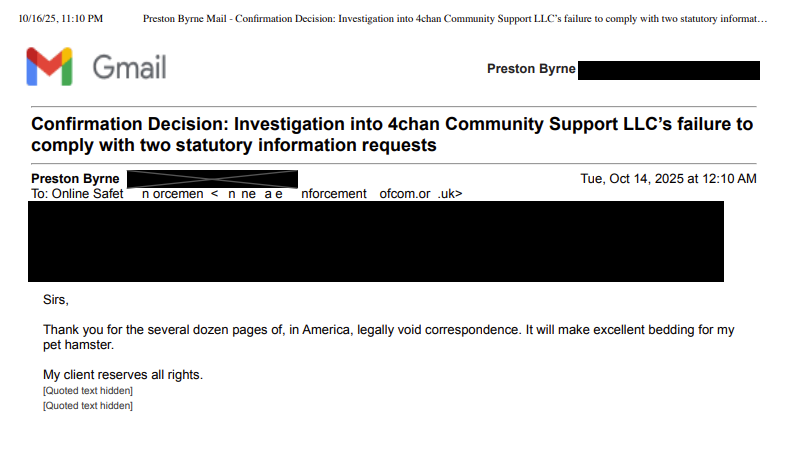
“I don’t think you understand quite how easy it’s been to parry them. We just write back to them and say, ‘no,'” Byrne tells Reason. In one email response to Ofcom, he told the U.K. regulators their demands on 4chan were “legally void” and would make “excellent bedding” for his “pet hamster.”

Screenshot of an email from Preston Byrne to Ofcom that reads, in part, "Thank you for the several dozen pages of, in America, legally void correspondence. It will make excellent bedding for my pet hamster."
Preston Byrne

Byrne is confident in the First Amendment’s ability to block Ofcom’s unenforceable demands, but he’s not sure everyone is as committed to resisting global censorship. If Ofcom keeps pressuring people, he says, the risk is that “enough people will say, ‘OK, we just want the hassle to go away. So what we’re going to do is we’re going to comply because the letters are scary, and we’re not free speech activists and we don’t think that the U.K.’s rules are so bad.'”

The Guaranteeing Rights Against Novel International Tyranny & Extortion (GRANITE) Act, which was originally proposed on Byrne’s blog, would allow U.S. companies and individuals to sue foreign governments that attempt to censor Americans. If the U.S. successfully sued a foreign government in a U.S. court, the foreign country’s assets could be forfeited.

Such a move would have teeth because these foreign countries’ economies would break down if they didn’t have access to the U.S. banking system,” Byrne wrote in his proposal. “The UK, for example, has 47 billion [pounds]”—that’s about $63 billion—”custodied in North American banks in order to support its currency.”

Byrne hoped the bill would debut in New Hampshire—the GRANITE Act for the Granite State—but Wyoming has become the first to formally introduce the legislation. The bill’s sponsor, Wyoming state Rep. Daniel Singh (R–Cheyenne), says he believes Wyoming has a “libertarian ethos” that’s “unique to the Mountain west,” making it a natural home for the legislation.

The bill would prohibit “the state from recognizing, enforcing or cooperating with certain foreign judgments.” The bill would impose a civil penalty on any state employee or official who enforces a foreign order that violates the First Amendment. The bill also confirms that foreign censorship orders are not enforceable in Wyoming courts.

State-level laws like these might provide some defense against global censorship, but Byrne thinks federal legislation would be more effective. Foreign governments can usually shield themselves from U.S. lawsuits under the Foreign Sovereign Immunities Act (FSIA), but a federal version of the GRANITE Act could amend the FSIA and allow Americans to bring lawsuits against foreign governments.

A federal version of the bill could soon be introduced. Late last year, U.S. Under Secretary of State for Public Diplomacy Sarah Rogers told GB News that the federal government was working on a version of the GRANITE Act.

Members of Congress are becoming increasingly vocal about global censorship. In July 2025, Rep. Jim Jordan (R-Ohio) accused U.K. regulators of threatening to censor the U.S.-based companies Reddit and Rumble, writing on X: “As long as foreign legislators, judges, and regulators continue their attempts to silence US citizens, we will not stop fighting back.” Then, in December, Sen. Eric Schmitt (R–Mo.) wrote on X that he was “working on legislation to protect American speech from foreign subversion.”

“I think there’s a really good chance that the United States is going to be able to mount a legislative response here,” Bryne says. And that, he hopes, “will make it financially impossible or very, very punitive for foreign countries to get away with this sort of stuff.” Maybe the U.S. can defeat British tyranny once again.

The post How Americans Are Fighting a British Censorship Invasion appeared first on Reason.com.

from Latest – Reason.com https://ift.tt/tcQjhNw
via IFTTT

The Second Amendment at Protests and Demonstrations

There’s been some debate recently about whether laws banning carrying weapons at political protests and demonstrations (either by the protests and demonstrators or others) are consistent with the Second Amendment. I thought I’d pass along what federal appellate judge have said about this recently.

[1.] From the Fourth Circuit just ten days ago in Kipke v. Moore, in a majority opinion by Judge Roger Gregory, joined by Chief Judge Albert Diaz:

Under Maryland law, a “person may not have a firearm in the person’s possession or on or about the person at a demonstration in a public place or in a vehicle that is within 1,000 feet of a demonstration in a public place after: (i) the person has been advised by a law enforcement officer that a demonstration is occurring at the public place; and (ii) the person has been ordered by the law enforcement officer to leave the area of the demonstration until the person disposes of the firearm.” … [W]e hold that Maryland’s prohibition on carrying guns near public demonstrations is consistent with our national historical tradition of promoting peaceful assemblies, particularly given the interaction between the rights the First and Second Amendments preserve.

To start, the First Amendment protects “the right of the people peaceably to assemble.” By including the “peaceably” caveat, the Founders made clear that not all assemblies are lawful, and that the government may constitutionally disperse assemblies that threaten the public peace. As the Supreme Court explained, “violence has no sanctuary in the First Amendment, and the use of weapons, gunpowder, and gasoline may not constitutionally masquerade under the guise of ‘advocacy.'” So, we must read the right to bear arms in conjunction with the First Amendment’s protection of the right to peaceably assemble. Though the right to bear arms surely is “not a second-class right,” neither are the rights to free speech and free assembly.

Second, our history, both before and after the ratification of the Second Amendment, demonstrates a long-standing tradition of government regulating permissible assembles, including regulating arms at public assemblies. Beginning with the reign of King Edward IV in the fifteenth century, and subject to only minor alterations, “[t]he riotous assembling of twelve persons, or more, and not dispersing upon proclamation,” was a criminal offense under English law up until the Revolution. As Blackstone concluded, “our ancient law … seems pretty well to have guarded against any violent breach of the public peace; especially as any riotous assembly on a public or general account ….” The American colonies built on this tradition, enacting unlawful assembly statutes that ordered dispersal of assemblies, particularly where individuals were armed with weapons.

So, evidence from the time of the Founding demonstrates that the Founders had a tradition of limiting and carefully scrutinizing any threats of violence at public assemblies and saw the presence of weapons as a greater threat to the public peace than unarmed assemblies. Justices of the Peace were entrusted with broad authority to arrest groups of citizens who threatened the peace. One action that was considered to threaten that peace was to show armor—in other words, showing an intention, or “at least an apparent tendency,” to engage in violence. As states enacted statutes codifying this tradition, they lowered the number of individuals necessary to constitute a riot if those individuals were armed, demonstrating an anxiety around armed assemblies. And the oft-included requirements that Justices of the Peace must first order a dispersal is akin to the Maryland provision requiring a police officer to first instruct an individual with a gun to leave before that individual can be found in violation of the statute.

Continuing into the 19th century, numerous jurisdictions, including Tennessee, Texas, Arizona, Oklahoma, and Missouri, historically prohibited carrying firearms at places of public assembly or gathering. Maryland’s bans on firearms are consistent with these historical traditions.

[2.] From Judge Steven Agee’s dissent in Kipke:

Maryland has not come forward with evidence that—at the Founding—States enacted measures prohibiting firearms at public demonstrations. On the contrary, the historical record reflects quite the opposite. As the district court observed, “[j]ust before the ratification of the Second Amendment, ‘six out of the thirteen original colonies required their citizens to go armed when attending … public assemblies.'” Specifically, in the 150 years before the Second Amendment’s enactment, American colonies up and down the Atlantic enacted laws requiring men to bring firearms with them to church and other public gatherings. For example, a 1643 Connecticut law cited the possibility of attacks as the basis for each household to “‘bring a musket, pystoll or some peece, with powder and shott to e[a]ch meeting.'” And a 1642 Maryland law forbade able-bodied men from “go[ing] to church or Chappell … without [a] fixed gunn and 1 Charge at least of powder and Shott.” Given that the Second Amendment codified a preexisting right, such colonial laws illuminate that our Founders would never have commonly understood that right to permit the government to prohibit carrying firearms at public demonstrations.

These specific colonial-era laws also reinforce the broader historical record from the Founding Era. Americans owned firearms and they carried those arms with them when they left home. To return to St. George Tucker’s appraisal, “[i]n many parts of the United States, a man no more thinks, of going out of his house on any occasion, without his rifle or musket in his hand, than a European fine gentleman without his sword by his side.” Put bluntly, “‘Americans certainly did not think that bringing guns to town was a problem’—it ‘was normal.'”

The majority opinion dismisses such Founding-Era evidence based on the misguided notion that laws governing riotous assembly permit the regulation of armed assemblies. But that’s a red herring—Bruen instructs courts to look to the Founding Era to determine whether a modern-day restriction is grounded in the Nation’s tradition of restricting firearm carriage. As already discussed, the affray laws did not address the sort of widespread prohibitions on presence and possession of firearms contemplated by Maryland’s modern prohibition. When it comes to public demonstrations and firearms, the Founding-Era record reveals: (1) no nationwide consensus of prohibiting the mere presence firearms at public gatherings, and (2) numerous examples of firearms being required at public gatherings. It’s the combined effect of these two components of the historical record that compels the conclusion the Second Amendment does not permit governments to prohibit mere possession of firearms at any public demonstration.

Additional considerations bolster this conclusion. As observed elsewhere, Founding-Era required-carry laws “establish[ ] an expectation that the person next to you in the crowd is armed, thus undermining the majority’s assumption that an armed person in the assembly threatens the public good.” Put another way, the existence of these Founding-Era examples illuminates the falsity of the position that locations where the public gathers en masse carry a national tradition of being inherently “sensitive” such that they fall within a class of permissible firearms restrictions.

The majority’s prefatory observation about the interplay of the First and Second Amendment further obfuscates the analysis. No one disputes that the First Amendment protects “the right of the people peaceably assemble,” or that—consistent with the Second Amendment—a state can prohibit firearms from being used in a manner that disrupts the peace. But Maryland’s law prohibits the mere presence of firearms during public demonstration under circumstances unrelated to maintaining the peace. By presuming that the mere presence of firearms somehow threatens peaceful public assembly, Maryland’s law subjugates the Second Amendment right to public carriage for lawful purposes to the First Amendment right to assemble. It also ignores that restricting open carry may itself have First Amendment implications. That’s precisely what the Supreme Court has cautioned against by reminding courts and legislatures that the Second Amendment is “not a second-class right.”

Given the absence of Founding-Era regulations to support Maryland’s broad prohibition of firearms at and near public demonstrations, the majority opinion instead cites a host of inapplicable laws as supposed analogues. None meet Bruen‘s exacting standards. As previously discussed, “affray” and other prohibitions on riotous or unlawful assembly targeted the manner in which arms were carried, not their mere presence or possession. The critical question for these jurisdictions was not whether an assembly was armed, but whether it constituted an “affray,” i.e., a disturbance of the peace. And while a handful of states and territories dating from 1869 to 1890 enacted broader assembly-oriented provisions, as explained above, the Supreme Court deems such examples much too sparse—and from a period much too late—to substantiate proof of a nationwide understanding at the time of the Founding.

[3.] From Wolford v. Lopez (9th Cir. 2024) (opinion by Judge Susan Graber, joined by Judges Mary Schroeder and Jennifer Sung):

In the California cases, the district court held that Plaintiffs are likely to succeed in challenging California Penal Code section 26230(a)(10), which prohibits carry in:

[a] public gathering or special event conducted on property open to the public that requires the issuance of a permit from a federal, state, or local government and sidewalk or street immediately adjacent to the public gathering or special event but is not more than 1,000 feet from the event or gathering, provided this prohibition shall not apply to a licensee who must walk through a public gathering in order to access their residence, place of business, or vehicle.

Defendant does not argue that there is a national tradition of banning firearms specifically at permitted public gatherings. Instead, Defendant argues that there is a national tradition of banning firearms at public gatherings in general and, because permitted gatherings are a subset of all public gatherings, the challenged provision falls within the tradition. We agree with the district court that Plaintiffs are likely to succeed.

Public gatherings have existed since before the Founding, so Defendant must show an enduring national tradition with respect to public gatherings. As with places of worship, Defendant cannot point to a single regulation of public gatherings until after the ratification of the Fourteenth Amendment. Shortly after 1868, several States and territories prohibited the carry of firearms at public gatherings: Georgia and Texas in 1870, Missouri in 1879, Arizona in 1889, Oklahoma in 1890, and Montana in 1903. We agree with Defendant that those statutes carry some evidentiary weight, particularly because they were enacted soon after the ratification of the Fourteenth Amendment. But, as we determined with respect to places of worship, we conclude that Plaintiffs are likely to succeed because of the lack of any prohibition on the carry of firearms in public gatherings until after the ratification of the Fourteenth Amendment.

Our conclusion is buttressed in part by the Supreme Court’s admonition not to interpret the “sensitive places” doctrine too broadly. See Bruen (rejecting as “far too broad[ ]” the notion that “all places of public congregation that are not isolated from law enforcement” could qualify as “sensitive”). California’s law applies to all gatherings that require any governmental permit, as well as to the adjoining sidewalk or road….

In sum, because no jurisdiction had prohibited the carry of firearms at public gatherings until after the ratification of the Fourteenth Amendment, we hold that Plaintiffs are likely to succeed on their challenge to California Penal Code section 26230(a)(10).

See also opinions in Koons v. Attorney General (3d Cir. 2025), vacated, rehearing en banc granted.

The post The Second Amendment at Protests and Demonstrations appeared first on Reason.com.

from Latest – Reason.com https://ift.tt/XSVv4G6
via IFTTT

Will AI Benefit Everyone?


Technology authors Perry Metzger and Brian Merchant | Graphic by Adani Samat

Technology authors Perry Metzger and Brian Merchant debate the resolution, “Artificial Intelligence will provide enormous net benefits to nearly every member of society.”

Metzger is taking the affirmative. He is the co-founder and chairman of the board of Alliance for the Future, and the author of science comic Computers: How Digital Hardware Works.

Merchant is taking the negative. He is a reporter in residence at the AI Now Institute. He’s also the author of two books, The One Device: The Secret History of the iPhone and Blood in the Machine: The Origins of the Rebellion Against Big Tech.

The debate is moderated by Soho Forum Director Gene Epstein.

The post Will AI Benefit Everyone? appeared first on Reason.com.

from Latest – Reason.com https://ift.tt/iLlUD0g
via IFTTT

State Appellate Judge on the Second Amendment and Felons

From Alaska Court of Appeals Judge Timothy Terrell’s concurrence Wednesday in Ivyories v. State:

I write separately to set out my view that the Second Amendment does not permit persons convicted of nonviolent felonies to be deprived of their gun rights after they have served their sentence and any post-release supervision period….

A majority of federal circuit courts have continued to rely on the language from the United States Supreme Court in Heller and succeeding cases and have concluded that statutes prohibiting felons from possessing firearms do not violate the Second Amendment. But the Third Circuit has rejected this view and concluded that persons convicted of nonviolent felonies should not necessarily permanently lose their gun rights. Other circuits have leaned toward that approach or left open the issue of whether some felons (particularly nonviolent felons) may have a viable as-applied challenge to felon-in-possession bans.

I agree with the Third Circuit and write separately to add my voice to the list of judges and courts who have concluded that felon-in-possession bans are unconstitutional as applied to those persons convicted of nonviolent felonies. I recognize that, in Alaska, this issue is currently governed by the Alaska Supreme Court’s decision in Farmer v. State. Accordingly, I will not analyze the underlying legal issues in detail. However, cognizant of the possibility that the Alaska Supreme Court may choose to revisit its holding in Farmer, I note below the cases pertinent to the key issues and lay out other jurists’ observations that are helpful in thinking about the scope of the Second Amendment.

Why the Alaska Supreme Court has a valid basis to revisit its holding in Farmer v. State

Looking at the issue in a vacuum (without the Farmer holding), I agree with those federal circuit courts that have concluded that the statements in Heller and later Supreme Court decisions about the validity of felon-in-possession bans do not resolve whether the Second Amendment permits the permanent disarmament of persons convicted of nonviolent felonies.

First, with respect to Heller‘s statement that felon-in-possession bans fall into the category of “presumptively lawful measures,” I agree with Ninth Circuit Judge Lawrence VanDyke’s recent partial dissent in United States v. Duarte, where he stated the following:

The majority extracts from Heller‘s footnoted statement that felon-in-possession laws are “presumptively lawful” the apparent per se rule that all felon-in-possession laws are constitutional, warranting “the categorical application of § 922(g)(1) to felons.” … But “[m]aking the leap from presumptively constitutional to always constitutional … is too much for that overused line to bear, no matter how you read it.”

Heller speaks only in terms of a presumption. A presumption must be defeasible. So the Court’s statement that felon-in-possession laws are only presumptively lawful implies that felon-in-possession laws must be unlawful in at least some instances. And it is especially unusual to put such weight on Heller‘s dicta that felon-in-possession laws are presumptively constitutional, because it is black-letter law that all legislation is entitled to a presumption of constitutionality. But no one thinks that that longstanding presumption gives statutes passed by Congress blanket immunity from searching constitutional scrutiny.

Second, as the Sixth Circuit pointed out in United States v. Williams, the validity of felon-in-possession statutes was not at issue in Heller, so the Court’s statements about such statutes were dicta, which should not be applied uncritically to determine whether the statutes violate the Second Amendment. The Sixth Circuit also noted that reexamination of the issue was appropriate because Bruen had changed the required method of analysis for Second Amendment claims.

Third, although Heller and Bruen referred to the Second Amendment rights of “law-abiding, responsible” persons, the Rahimi Court disagreed with the United States’s use of this language when it argued that gun rights belong only to the responsible. The Court noted that while such citizens are undoubtedly among the class of persons who enjoy Second Amendment rights, it had not meant to suggest that this was a limitation on the class of persons who possessed such rights.

Given the recent developments in Second Amendment case law, the Alaska Supreme Court would be entitled to reexamine the constitutionally permissible scope of Alaska’s felon-in-possession statute, AS 11.61.200, i.e., whether persons convicted of nonviolent felonies may be prevented from possessing concealable firearms for ten years after they have been discharged from their sentence.

Preliminary observations about when felon-in-possession bans may be applied to persons convicted of nonviolent felonies

I note that I am not advancing a categorical argument that firearms bans can never be applied to persons convicted of nonviolent felonies.

First, whether convicted of a violent or a nonviolent felony, all felons temporarily lose the right to possess firearms while they are serving their sentence in prison. As a Third Circuit judge recently observed, “It is as ancient as it is obvious that a person who is imprisoned or otherwise confined does not have the right to bear arms for the duration of confinement.”

Second, governments have passed statutes that continue this disability after the inmate is released from prison on parole, probation, or other forms of supervised release, and courts have analyzed whether such restrictions are permitted by the Second Amendment. My concurrence only concerns firearms bans that continue in effect after a felon has been unconditionally discharged from service of their sentence.

Felons are among “the people” protected by the Second Amendment

I turn now to the first step of the two-step analysis for Second Amendment claims set out in Bruen — determining whether “the Second Amendment’s plain text covers an individual’s conduct.” In deciding the first step of the Bruen analysis, courts have grappled with the question of whether felons are among “the people” protected by the Second Amendment, which provides in pertinent part that “the right of the people to keep and bear Arms, shall not be infringed.”

As then-Judge Barrett explained in her dissent in the Seventh Circuit’s decision in Kanter v. Barr, there are two approaches to evaluating what persons and groups fall within the Second Amendment’s coverage:

There are competing ways of approaching the constitutionality of gun dispossession laws. Some maintain that there are certain groups of people — for example, violent felons — who fall entirely outside the Second Amendment’s scope. Others maintain that all people have the right to keep and bear arms but that history and tradition support Congress’s power to strip certain groups of that right. These approaches will typically yield the same result; one uses history and tradition to identify the scope of the right, and the other uses that same body of evidence to identify the scope of the legislature’s power to take it away.

Initially, there seemed to be a consensus among scholars, relying on what has been termed the “virtuous citizenry” theory, that the right to bear arms could be taken away from those persons who had removed themselves from the community of virtuous, law-abiding citizens by engaging in felony conduct, and some circuit courts adopted that view. But the Supreme Court cast doubt on the viability of that theory in Rahimi when it rejected the government’s argument that the Second Amendment’s protections extend only to “law-abiding, responsible” persons and found the term “responsible” too vague. Moreover, many federal circuit courts — including those that have upheld the validity of felon-in-possession bans as applied to nonviolent felons under the Bruen analysis — have now concluded that felons do fall presumptively within the scope of the Second Amendment’s protections, i.e., felons are part of “the people” protected by the Second Amendment. I find the analysis of these courts persuasive and conclude that felons are part of “the people” protected by the Second Amendment and do not fall categorically outside its scope.

There is no past analogue for disarming nonviolent felons

The second step of the Bruen analysis requires courts to examine whether there is a historical analogue of government firearm regulation that is sufficiently similar to the challenged law so as to support the conclusion that the government may validly enforce the statutory firearms limitation. I agree with those courts and judges that have concluded there is no long-standing historical analogue for permanent disarmament of felons, much less those convicted of nonviolent felonies. As the Ninth Circuit stated in United States v. Chovan:

[I]t is not clear that such prohibitions are so longstanding. The first federal firearm restrictions regarding violent offenders were not passed until 1938, as part of the Federal Firearms Act. See C. Kevin Marshall, Why Can’t Martha Stewart Have a Gun?, 32 Harv. J.L. & Pub. Pol’y 695, 698, 708 (2009) (noting that “one can with a good degree of confidence say that bans on convicts possessing firearms were unknown before World War I”).

I recognize that these decisions are currently a minority among the circuit courts. But I agree with the Sixth Circuit in Williams that the real lesson of all the historical analogues put forth in defense of disarmament provisions is that it is only permissible to disarm persons or groups who pose a real risk of physical violence to others. It is dangerousness that is the touchstone of the ability to disarm. {Some courts have concluded that it is not necessary that a crime be one that always involves violence and that some crimes, such as drug trafficking, have such a substantial connection to violence that a person convicted of that offense may be prohibited from possessing firearms. I express no view other than to note that a strict dichotomy between crimes that are invariably committed by violence and crimes that may be committed without violence may not necessarily be the appropriate standard for assessing an as-applied challenge to a felon-in-possession statute.} I find it an unacceptable diminishment of the Second Amendment that a person who commits a nonviolent felony, such as tax fraud, loses their gun rights, even after they have completely served their sentence.

{The statute at issue in this case, AS 11.61.200, only generally imposes a ten-year ban on the possession of concealable firearms (running from the date of unconditional discharge on the prior felony), not a lifetime ban. But a ban of such length clearly impinges on constitutional rights. As applied to persons convicted of violent felonies, such a ban is constitutional for the reasons set out in State v. Eberhardt (La. 2014). As to the fact that this statute only bars the possession of concealable firearms, i.e., handguns, and does not prohibit the possession of long guns, that contention was addressed in Heller, where the Supreme Court stated that “[i]t is no answer to say, as petitioners do, that it is permissible to ban the possession of handguns so long as the possession of other firearms (i.e., long guns) is allowed.” The Court went on to state, “It is enough to note, as we have observed, that the American people have considered the handgun to be the quintessential self-defense weapon.”}

I believe that when the United States Supreme Court is squarely faced with the question of whether persons convicted of nonviolent felonies may successfully raise an as-applied challenge to felon-in-possession statutes, it will answer this question in the affirmative. I agree with Justice Barrett’s observation that “the Second Amendment is not absolute” and that it permits regulation that is consistent with our Nation’s tradition of firearm regulations, but it is also the case that Second Amendment rights are not second-class constitutional rights. The justifications for disarming nonviolent offenders are insufficient to strip away this fundamental right from persons who have fully served their sentences.

The post State Appellate Judge on the Second Amendment and Felons appeared first on Reason.com.

from Latest – Reason.com https://ift.tt/TRGZSfB
via IFTTT

Butt Me No Butts: Teacher’s Firing for Reading “I Need a New Butt!” Children’s Book to Class Overturned

A short excerpt from Tuesday’s long decision by Mississippi Court of Appeals Judge Anthony Lawrence in Price v. Hinds County School Dist.:

Toby Price, a licensed educator and assistant principal, read to the Gary Road Elementary School second-grade class on “Read Across America Day.” Since the educator who was scheduled to read to the class did not appear on a Zoom session, Price—at the last minute—stepped in to read and selected a book entitled “I Need a New Butt!” from his personal collection. The picture book was intended to be humorous and depicted a child searching for a “new butt.” As such, the book contained references to and illustrations of “butts,” “butt cracks,” and “farts.” {The child imagines a litany of possibilities for his “new butt,” such as “a butt that’s armor-plated[,]” “a bumper butt made of chrome[,]” “[a] rocket butt[,]” an “arty-farty butt[,]” and “[a] robo-butt[.]” The book concludes with the child finding his father bending over to repair a sink only to discover his father’s butt also had a crack in it.}

Following the reading, a student began repeating the word “butt” incessantly. Price was placed on administrative leave that day and fired two days later.

The court concluded that the firing decision “was arbitrary, capricious, and lacked substantial evidence,” and was thus invalid under state law:

The Board’s decision was detailed in its reasoning as follows: (1) the book at issue “contained pictures of child and adult nudity and inappropriate activities”; (2) Price previously “acknowledged the problematic nature” of such books; (3) the book caused a “negative, immediate impact”; (4) Price violated the Mississippi Code of Ethics; and (5) Price was not a credible witness….

This Court notes that “[t]he superintendent of a school district may dismiss a licensed school employee for good cause.” However, “in a hearing concerning a dismissal, the burden is on the superintendent to show that a principal or teacher has been dismissed for good cause.” …

“[T]he terms ‘arbitrary’ and ‘capricious’ imply a lack of understanding of or a disregard for the surrounding facts and settled controlling principles.” “An act is arbitrary when it is not done according to reason or judgment, but depending on the will alone.” On the other hand, an action is “capricious” if it is “done without reason, in a whimsical manner, implying either a lack of understanding of or a disregard for the surrounding facts and settled controlling principles.”

With those definitions in mind, this Court finds the School Board’s decision arbitrary and capricious. The school’s library contained a number of books depicting “nudity” and “inappropriate activities.” Several of those books were entered into evidence at the hearing and reviewed by this Court. The books included numerous mentions of the word “butt,” naked children running through the street, a child disobeying numerous school rules, a person dancing naked in the rain, a person standing in only a raincoat which exposes his butt, and what appeared to be “[s]omething’s head where their bottom should be.” There is simply no stark contrast between this book’s content and the content of the others. The evidence before this Court does not support a finding that the book “I Need a New Butt!” was more severe in nature than the other books contained in the library.

Further, the school had allowed similar books—even one with the same author and illustrator as the subject book—to be read to elementary students in the past. The record reflects that Price not only read a similar book to students in the past, but that reading was streamed live, recorded, and posted on Gary Road Elementary’s Facebook page. At the time of the hearing, the post was still on Gary Road Elementary’s social media pages. In sum, the school allowed the reading of a similar book to occur without issue and allowed the content to remain available on its social media page. The books in the school’s library discussed “butts” and contained pictures of butts, but the school district complained in particular about “I Need a New Butt!”

Price’s termination was based on a book similar in nature to other books contained in the library, which leads this Court to believe the decision was indeed reached “in a whimsical manner.” In sum, the decision of the School Board demonstrates “a lack of understanding of or a disregard for the surrounding facts and settled controlling principles.” Therefore, we conclude that the decision to uphold Price’s termination lacked substantial evidence and was reached in an arbitrary and capricious manner.

The court therefore didn’t reach Price’s arguments that the decision violated the Due Process Clause or the First Amendment.

Joel Frank Dillard represents Price.

The post Butt Me No Butts: Teacher's Firing for Reading "I Need a New Butt!" Children's Book to Class Overturned appeared first on Reason.com.

from Latest – Reason.com https://ift.tt/wF6WR3Y
via IFTTT

Key Inflation Metric Hits 3 Percent, Despite Trump’s Claim That Rising Prices Are ‘Solved’


US Dollars tinted red | Photo: PedaltotheStock/Envato

Inflation is stubbornly refusing to be vanquished by presidential edict.

Prices paid to domestic producers for their goods jumped by 0.5 percent during December, according to Department of Labor data released Friday morning. That surge in higher wholesale prices brought the annualized producer price index (PPI) to 3 percent for the year. December’s sharp increase in the PPI defied expectations and followed tamer increases of 0.1 percent in October and 0.2 percent in November.

More alarming is the so-called “core PPI,” which does not include more volatile categories like food and fuel prices. In December, core PPI increased by 0.7 percent, and climbed by 3.3 percent over the course of last year.

The PPI is often seen as an early warning signal about inflation at the consumer level—that’s what is measured by the more well-known consumer price index, which rang in at 0.3 percent in December and 2.7 percent for 2025. That’s because higher prices at the wholesale level will likely be passed along to the retail level in the coming months.

The new inflation report comes at an awkward time for President Donald Trump, who declared earlier this week that inflation had been “solved.”

“It’s over,” Trump told an Iowa crowd at a Fox News town hall event. “We have it good where prices are coming way down.”

The data also figures to complicate the ongoing fight between Trump and the Federal Reserve. Trump wants the central bank to cut interest rates more quickly to help juice the economy, but the Federal Reserve voted earlier this week to hold interest rates steady, in part because “inflation remains somewhat elevated.

High interest rates are generally seen as a check against inflation, since they encourage households and businesses to save rather than borrow or spend. Lower interest rates would ease budgetary pressure from the national debt and could make it easier for Americans to borrow, but they also might trigger another bout of higher inflation at a time when prices are already rising faster than the Fed’s stated goal of 2 percent annually.

Hours before the new inflation report was published on Friday, Trump named Kevin Warsh, a former member of the Federal Reserve’s board, to be the next chairman of the central bank. Warsh must be confirmed by the Senate. Federal Reserve Chairman Jerome Powell’s term ends in May, but Trump has been trying to force Powell to step down earlier.

Trump may not be able to reduce inflation by changing the leader of America’s central bank or by declaring prices to be falling, but he’s also not totally powerless. It is undeniable that Trump’s tariffs are putting upwards pressure on prices, while also not providing the economic boost the administration promised.

Until that policy changes, it’s hard to take Trump seriously when he talks about making life more affordable.

The post Key Inflation Metric Hits 3 Percent, Despite Trump's Claim That Rising Prices Are 'Solved' appeared first on Reason.com.

from Latest – Reason.com https://ift.tt/Onh1XzV
via IFTTT

My New Lawfare Article on “Minnesota’s Compelling Tenth Amendment Case Against Trump’s ICE Surge”

Earlier today, Lawfare published my article “Minnesota’s Compelling 10th Amendment Case Against Trump’s ICE Surge.” Here is an excerpt:

The federal government’s brutal and often illegal use of Immigration and Customs Enforcement (ICE) personnel and other federal agents in Minnesota has generated extensive litigation. On Jan. 12, one particularly crucial case was filed by the state of Minnesota and the cities of Minneapolis and St. Paul, arguing that the federal Metro Surge operation—deploying thousands of ICE and other federal agents to the Twin Cities—violates the 10th Amendment. That amendment states that “powers not delegated to the United States by the Constitution, nor prohibited by it to the States, are reserved to the States respectively, or to the people.” In a series of decisions supported primarily by conservative justices, such as Printz v. United States (1997) (written by conservative icon Justice Antonin Scalia), the Supreme Court has held that the federal government cannot “commandeer” state and local officials to do the federal government’s bidding, or to help enforce federal laws.

Control over state and local government personnel is one of the powers reserved to the states by the 10th Amendment. In addition, as legal scholar Michael Rappaport has shown, the original meaning of the Constitution indicates that such control is a basic element of the sovereignty inherent in being a state in the first place….

Part of the purpose of the federal “surge” is to coerce Minnesota jurisdictions into giving up their sanctuary policies and using their resources to assist federal deportation efforts. As federal District Judge Katherine Menendez noted in a hearing in the case on Jan. 26, Trump administration officials have repeatedly indicated that this is one of their objectives. Attorney General Pam Bondi suggested as much in a Jan. 24 letter to Minnesota Gov. Tim Walz. A Jan. 16 White House statement explicitly indicates that Minnesota’s “sanctuary defiance” is “responsibl[e] for the enhanced enforcement operations in Minnesota.” A recent statement by Trump “border czar” Tom Homan indicates that the administration will not withdraw immigration enforcement officers from Minnesota unless state and local governments curb sanctuary policies and extend “cooperation” to federal immigration enforcers….

The Minnesota case is not exactly analogous to previous anti-commandeering rulings by federal courts. But that is in part because it represents an even more blatant violation of the 10th Amendment. In Printz and other cases, such as New York v. United States (1992) and Murphy v. NCAA, the Supreme Court struck down congressional legislation requiring states to help enforce various types of federal laws, or to enact legislation of their own. In a series of decisions during the first Trump administration, and continuing in the second, numerous lower federal courts ruled that the president cannot order states to aid in immigration enforcement actions, and cannot withhold federal funds from sanctuary jurisdictions in cases where doing so would be “coercive” or Congress had not authorized immigration-related conditions on recipients.

The administration’s current actions are more egregious than those struck down in previous anti-commandeering rulings. Here, there is no congressional authorization for federal coercion of states; the president is acting on his own. And the direct use of force is even more blatantly coercive than illegally withholding federal grants. If the federal government cannot coerce states by enacting commandeering laws and imposing grant conditions, surely it cannot do so at the literal point of a gun….

If allowed to stand by the courts, the federal action in Minnesota would set an extremely dangerous precedent. It could easily be used against a variety of state policies, including those of conservative “gun sanctuaries”—such as Montana and Missouri—which restrict state and local assistance efforts to enforce federal gun control laws. A future Democratic administration could send thousands of armed agents to harass gun owners and disrupt state and local government operations until gun sanctuary jurisdictions drop their restrictions.

Indeed, the Minnesota operation has already threatened gun rights traditionally prized by conservatives. Administration officials have defended the killing of Alex Pretti on the grounds that he was carrying a gun at the time—even though he had a legal permit to do so, never drew the weapon, and federal agents took it from him before they shot him.

The post My New Lawfare Article on "Minnesota's Compelling Tenth Amendment Case Against Trump's ICE Surge" appeared first on Reason.com.

from Latest – Reason.com https://ift.tt/BvpWlZd
via IFTTT

There Are No Good Reasons To Subsidize Sports Stadiums. Governments Keep Doing It Anyway.


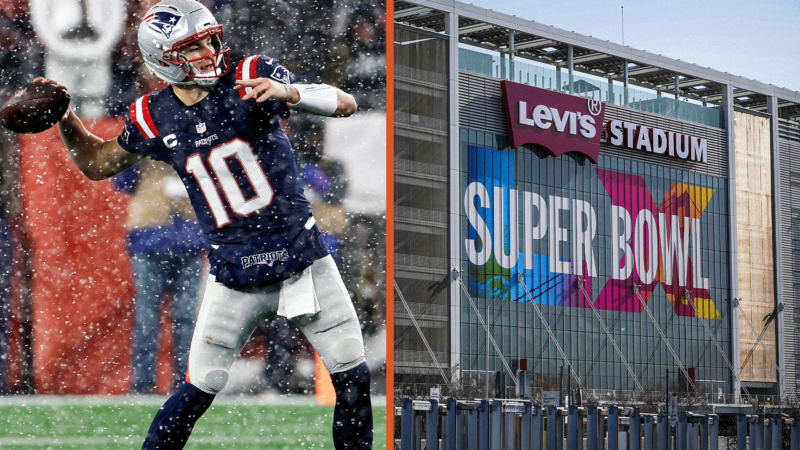
New England Patriot's player and Levi Stadium, sight of the Super Bowl | Credit: Dylan Stewart/Image of Sport/Eric Canha/Cal Sport Media/Newscom

This year’s Super Bowl between the Seattle Seahawks and the New England Patriots will feature several interesting story lines: Sam Darnold’s redemption arc, Mike Vrabel’s coaching job, and the Seahawks hoping to avenge themselves for the infamous Malcolm Butler interception. With the betting line in Seattle’s favor at press time, it seems the public is hoping to cash in on a Seahawks win. But there are reasons why freedom-loving football fans should be cheering for New England: the Patriots are one of a handful of NFL teams that play home games in a privately funded stadium.

Of the NFL’s 32 teams, only five—the New York Giants, New York Jets, Los Angeles Chargers, Los Angeles Rams, and the Patriots—did not receive government subsidies to build their home stadiums. While it may now be common for ultrarich team owners to receive lavish subsidies to build new stadiums or upgrade existing ones, this hasn’t always been the case. “Almost all stadiums that were built at the beginning of the 20th century were private stadiums,” economist J.C. Bradbury recently explained to Reason‘s Eric Boehm. Up until recently, “owners would have been laughed at if they went to the local city council or county commission and asked for money to help them build a stadium,” Bradbury adds.

This is clearly no longer the case. In recent years, state governments have greenlit millions of dollars for stadium projects for the Buffalo Bills ($850 million) and the Tennessee Titans (a record $1.26 billion). Last year, the Washington Commanders announced they would build a new $3.7 billion stadium in the nation’s capital, with a cool $1 billion coming from D.C. residents.

What might justify such flagrant levels of subsidies? Pride in the local sports team is certainly one reason. But oftentimes lawmakers push this funding as a way to boost local economies; not only will these stadiums bring in revenue through games, but also through events and concerts, the argument goes.

If stadiums are meant to revitalize the economy, they are dropping the ball. In a 2022 paper, J.C. Bradbury, along with economists Dennis Coates and Brad Humphreys, noted that “nearly all empirical studies find little to no tangible impacts of sports teams and facilities on local economic activity, and the level of venue subsidies typically provided far exceeds any observed economic benefits.” As the Center for Economic Accountability points out: “Sports compete with other local businesses for consumers’ entertainment dollars, rather than creating ‘economic development’ out of thin air.”

This public spending comes with tradeoffs. “We see these people spending money in and around stadiums, but what we don’t see is their foregone spending, that is, they’d be spending it elsewhere in the community,” says Bradbury.

It also comes with corruption. “This pervasive lack of transparency in the planning and negotiation process around stadium subsidies also creates an environment where corruption can flourish,” writes John C. Mozena, a senior fellow at Reason Foundation, the nonprofit that publishes Reason. In 2023, former Anaheim, California, Mayor Harish Sidhu “pled guilty to four federal felonies while the city was negotiating a stadium deal with the Los Angeles Angels baseball team” and admitted to “pass[ing] inside information to the team’s negotiators and attempt[ing] to influence the city’s decisions in favor of the Angels in return for an expected $1 million campaign contribution from the team,” according to Mozena. This scandal ultimately led to the cancellation of the Angels’ new stadium deal.

Despite all of the evidence of why stadium subsidies are a losing play, these wealth redistribution schemes aren’t going away anytime soon. Ohio lawmakers are hoping to spend $600 million on a new stadium for the Cleveland Browns, and last year, Oregon’s Legislature approved $800 million in state bonds for an MLB stadium in Portland, even though no professional team has announced plans to move to the state.

Ending public support for these projects would protect taxpayers and hardly impact professional teams. “If we stop funding all sports stadiums tomorrow, then the world wouldn’t change hardly at all,” says Bradbury. “Basically, just these wealthy owners would say, ‘OK, I guess I gotta fund it myself.”

The post There Are No Good Reasons To Subsidize Sports Stadiums. Governments Keep Doing It Anyway. appeared first on Reason.com.

from Latest – Reason.com https://ift.tt/i07yNTL
via IFTTT