Don Lemon Arrested By Federal Authorities Over Minnesota Church Protest

Don Lemon Arrested By Federal Authorities Over Minnesota Church Protest

Former CNN anchor Don Lemon was arrested by federal authorities late Thursday night on charges that he violated federal law when he entered the Cities Church in St. Paul, Minnesota and shoved a microphone in people’s faces to livestream reactions after activists stormed the church on Jan. 18. 

The protesters, chanting “ICE Out!” – interrupted services because one of its pastors is also an official with Immigration and Customs Enforcement (ICE).

Lemon originally faced charges related to allegedly violating federal laws protecting religious exercise/houses of worship (e.g., the FACE Act or 18 U.S.C. § 241 conspiracy to deprive civil rights) by interfering with the church service.

Lemon’s attorney, Abbe Lowell, said his client was taken into custody by federal agents Thursday night in Los Angeles while he was covering the Grammy awards. He is expected to make his first court appearance there. 

Lemon insists that while he was tipped off ahead of time about the demonstration, he did not know they would disrupt the service.

“Don has been a journalist for 30 years, and his constitutionally protected work in Minneapolis was no different than what he has always done,” said Lowell. “The First Amendment exists to protect journalists whose role it is to shine light on the truth and hold those in power accountable.”

The DOJ originally sought to charge eight people over the incident, including Lemon, citing a law that protects people seeking to participate in a service in a house of worship – however a magistrate judge whose wife reportedly works in AG Keith Ellison’s office only approved charges against three people, rejecting the evidence against Lemon and others as insufficient. 

Despite the denials, a federal grand jury returned an indictment against Lemon. Looks like the party is over, for now. 

Tyler Durden
Fri, 01/30/2026 – 09:25

via ZeroHedge News https://ift.tt/6FDRYey Tyler Durden

US Producer Prices Unexpectedly Surged In December

US Producer Prices Unexpectedly Surged In December

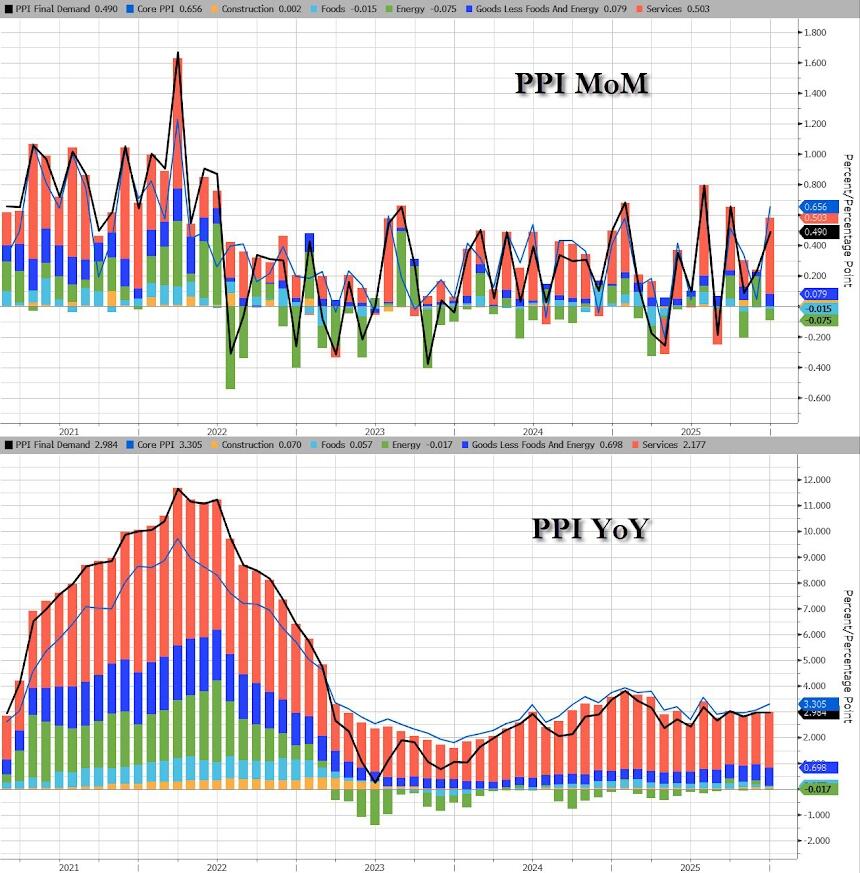
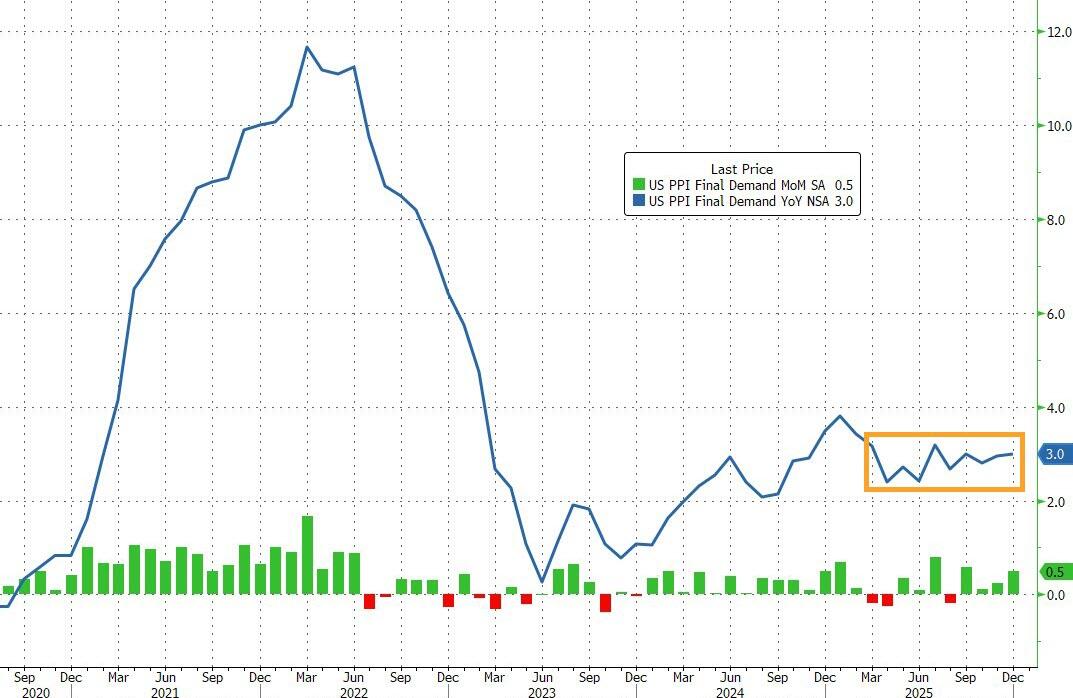
Following the cooler than expected Consumer Price Inflation, Producer Prices came in considerably hotter than expected at the headline level in December. PPI rose 0.5% MoM (vs +0.2% MoM exp), lifting headline PPI to +3.0% YoY.

Source: Bloomberg

Services costs dominated the rise in the headline PPI (not Goods – which would be affected by tariffs).

Source: Bloomberg

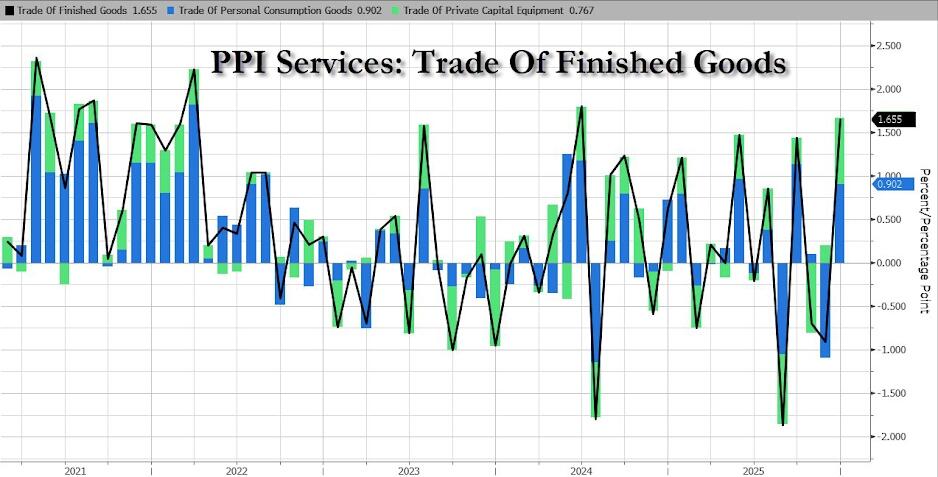
Final demand services: The index for final demand services advanced 0.7 percent in December, the largest increase since moving up 0.9 percent in July. Two-thirds of the broad-based December rise in prices for final demand services can be traced to a 1.7-percent jump in margins for final demand trade services. (Trade indexes measure changes in margins received by wholesalers and retailers.) The indexes for final demand services less trade, transportation, and warehousing and for final demand transportation and warehousing services also moved up, 0.3 percent and 0.5 percent, respectively.

  • Product detail: Over 40 percent of the December increase in prices for final demand services can be traced to a 4.5-percent rise in margins for machinery and equipment wholesaling. The indexes for guestroom rental; food and alcohol retailing; health, beauty, and optical goods retailing; portfolio management; and airline passenger services also advanced. Conversely, prices for bundled wired telecommunications access services fell 4.4 percent. The indexes for automotive fuels and lubricants retailing and for long-distance motor carrying also moved lower.

Services costs jumped as a measure of trade profit margins surged by the most since mid-2024.

Source: Bloomberg

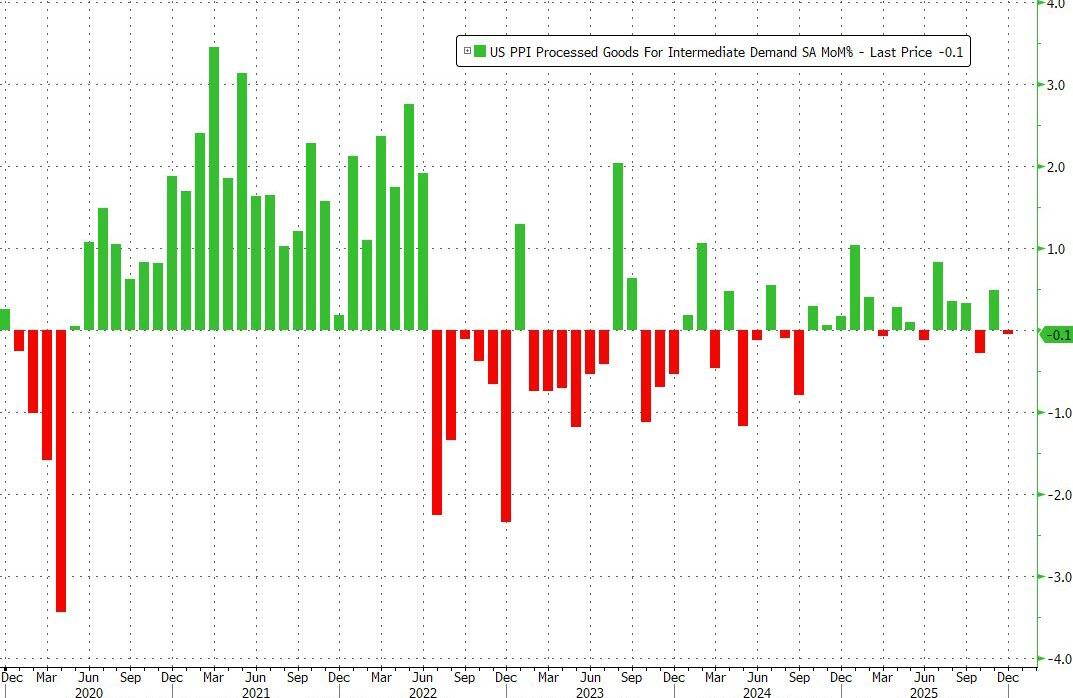
Final demand goods: Prices for final demand goods were unchanged in December following a 0.8-percent increase in November. In December, a 0.4-percent advance in the index for final demand goods less foods and energy offset declines in prices for final demand energy and for final demand foods, which fell 1.4 percent and 0.3 percent, respectively.

  • Product detail: Within final demand goods in December, the index for nonferrous metals moved up 4.5 percent. Prices for residential natural gas, motor vehicles, soft drinks, and aircraft and aircraft equipment also increased. In contrast, the index for diesel fuel dropped 14.6 percent. Prices for gasoline, jet fuel, beef and veal, and iron and steel scrap also decreased.

Source: Bloomberg

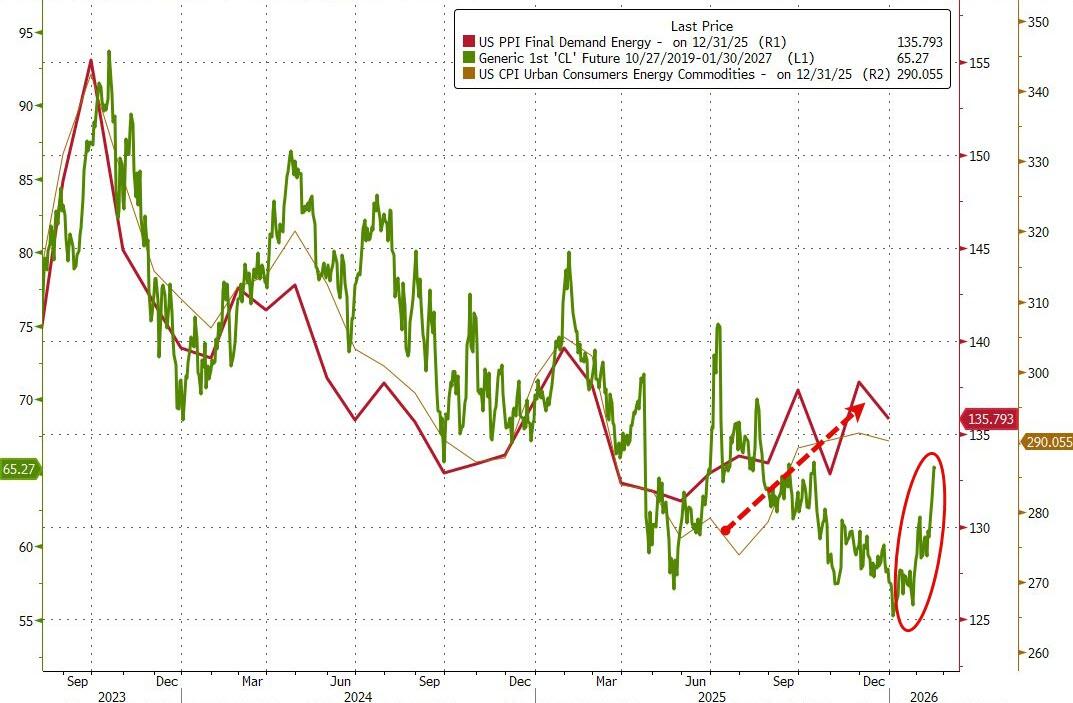
Interestingly, PPI Energy costs dipped (as did CPI), but remain notably elevated from six months ago, despite the price of energy actually being dramatically lower.

Source: Bloomberg

The problem for the incoming Fed Chair is though, as the chart shows, energy costs have started to rise rapidly since the last macro data.

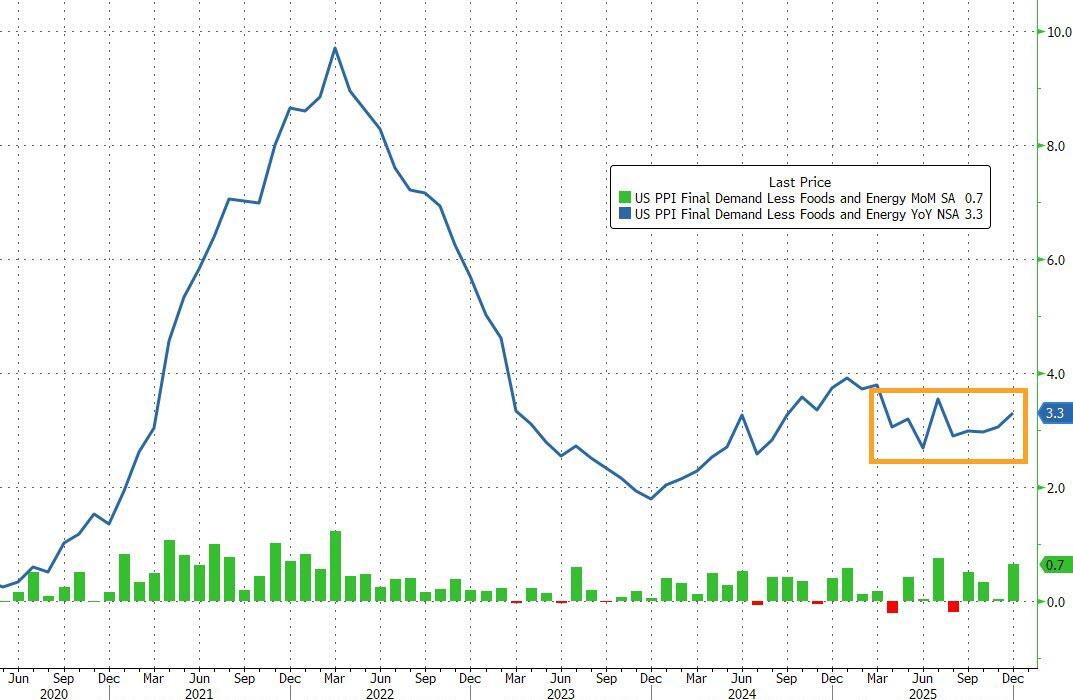
Core PPI (ex Food and Energy) surged even more – up 0.7% MoM (vs +0.2% MoM exp), pulling the core up 3.3% YoY…

Source: Bloomberg

That is the biggest MoM jump since July 2025 (and second biggest MoM jump since March 2022) and the YoY figure is inflecting higher.

While elevated relative to the Fed’s mandate, there remains no sign of the runaway tariff hyperinflation that Democrats had ‘priced in’ to their survey responses (and establishment economists were convinced were imminent).

Tyler Durden
Fri, 01/30/2026 – 08:44

via ZeroHedge News https://ift.tt/Y60JrEN Tyler Durden

Stocks Slide, Gold And Bitcoin Tumble After Trump Taps Warsh As Next Fed Chair

Stocks Slide, Gold And Bitcoin Tumble After Trump Taps Warsh As Next Fed Chair

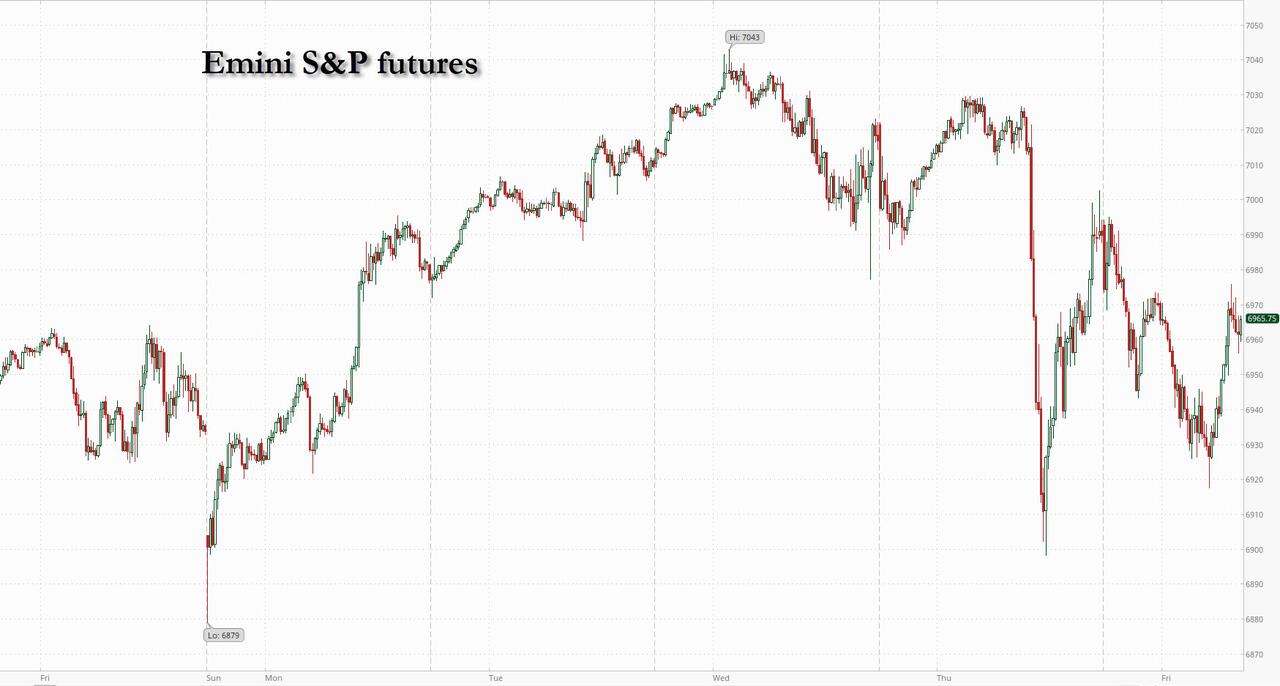
US futures slumped, the dollar rallied sharply, the Treasury curve steepened with 10Y yield rising as high as 4.28% and gold and bitcoin tumbled on what was at first speculation and then confirmation, that President Trump is nominating Kevin Warsh – widely viewed as the most hawkish of the handful of candidates – as the next Fed chair. As of 8:00am ET, S&P futures slid 0.4% but were well off session lows double that, while Nasdaq futures dropped 0.6% as markets brush aside strong Apple results. Pre-market, almost all Mag 7 stocks are lower with META (-1.5%), GOOGL (-1.4%) and NVDA (-1.4%) the biggest laggards; TSLA added +2.0%, the only exception in Mag 7. European stocks are all green while Asian equities join in the risk exodus, with Hong Kong indexes the biggest losers. Kospi flips an early 1.9% rally to a loss before turning positive again. The US Dollar is higher to 96.62; the yield curve steepened (30y +2.8bp vs. 2y -0.6bp) on the market view that Warsh is more hawkish than Trump expects. Commodities are mostly lower: Brent futures tumbled back below $70 a barrel following a three-day rally, while precious metals tumbled – gold fell 5% to 5100, silver plunged -12% under $100 while base metals are higher. US economic calendar includes December PPI (8:30am) and January MNI Chicago PMI (9:45am). Fed speaker slate includes Miran (11:10am), Musalem (1:30pm), Miran (3pm) and Bowman (5pm).

In premarket trading, Mag 7 stocks are mostly lower: Apple (AAPL) slips 0.7% after the iPhone maker warned that rising component costs are threatening to squeeze margins. The company also posted its largest first-quarter sales growth in over four years, driven by strength in its closely-watched iPhone segment (Tesla +2.3%, Microsoft +0.5%, Amazon -0.7%, Nvidia -0.9%, Alphabet -0.5%, Meta -1.2%)

  • Precious metals miners tumble, set to extends Thursday’s losses, as gold and silver sell off heavily.
  • American Express (AXP) falls 3% after the payment company reported earnings per share for the fourth quarter that missed the average analyst estimate.
  • Charter Communications (CHTR) rises 6% after the cable operator reported a gain in pay-TV customers. Its fourth-quarter earnings also beat expectations.
  • Deckers Outdoor (DECK) rises 12% after the owner of the Ugg and Hoka footwear brands raised its annual earnings and sales forecast, beating the average analyst estimate. Analysts note strength in the retailer’s direct-to-consumer channels in the US.
  • KLA Corp. (KLAC) falls 8% after the chip company reported results for the second quarter and gave an outlook. The stock has surged 39% so far this year as of Thursday’s close.
  • MaxLinear (MXL) falls 14% after the semiconductor device company’s results were seen as disappointing in key business lines.
  • Olin (OLN) falls 8% after the maker of ammunition and chemicals said it anticipates first quarter 2026 adjusted Ebitda will be lower than fourth quarter levels.
  • Sandisk (SNDK) rises 24% as the computer hardware and storage company’s second-quarter revenue beat expectations. Raymond James analyst upgraded the stock to outperform from market perform.
  • Schneider National (SNDR) falls 19% after the trucking company reported adjusted earnings per share below Wall Street expectations.
  • Market conditions were softer than expected in much of the fourth quarter, creating a “very truncated peak season,” CEO Mark Rourke said.
  • SoFi Technologies (SOFI) rises 5% after the online lender reported net interest income and adjusted net revenue above estimates.
  • Stryker (SYK) gains 1% after the maker of surgical products gave forecasts for adjusted revenue and organic growth for the full year, where the midpoints of the outlook topped the average analyst estimate.
  • Verizon Communications (VZ) rises 1% after the telecom company’s fourth-quarter results beat expectations on key metrics, including wireless customers. It also gave an outlook that is ahead of the consensus on metrics like adjusted earnings and free cash flow.

In corporate news, US law enforcement is investigating allegations that Meta personnel can access WhatsApp messages, despite the company’s claims that the chat service is private and encrypted. SpaceX is said to be considering a potential merger with Tesla or an alternative combination with AI firm xAI. An IPO is also possible with SpaceX said to weigh a June listing, around Musk’s birthday, and could seek to raise as much as $50 billion. In other AI news, Amazon is said to be in talks to invest as much as $50 billion in OpenAI and expand an agreement that involves selling computer power to the AI startup. 

US stock futures slumped as Trump nominated Kevin Warsh as Fed chair, the candidate who once was vocally in favor of shrinking the Fed’s balance sheet and limiting its influence, hardly what Trump wants as he pushes the Fed to ease financial conditions aggressively. 
The choice of Warsh as Trump’s nomination to be the next Federal Reserve chair is viewed as more hawkish than other contenders. 
Long viewed as an inflation hawk, his prospects have rippled through markets, with the dollar gaining versus all its major peers while Treasuries fell, led by the long-end as 30-year yields jumped five basis points. 

“We advise against overdoing the Warsh hawkish trade across asset markets, and even see some risk of a whipsaw,” wrote Evercore ISI economists led by Krishna Guha. “We see Warsh as a pragmatist, not an ideological hawk in the tradition of the independent conservative central banker.”

Not everyone agreed:  “A Fed led by Warsh is likely to pursue a more cautious, gradual approach to monetary policy rather than aggressive rate cuts,” said Dilin Wu, a research strategist at Pepperstone. “Markets that have priced in a more rapid rate cut — particularly high-valuation tech stocks — may face headwinds.”

While Apple earnings reassured tech investors after a volatile Thursday that included a Microsoft selloff that wiped out $357 billion in value, the second-largest loss for a single session in stock market history, the sentiment boost was quickly erased amid fears Warsh could soon pull the punchbowl. Apple reported the fastest year-on-year revenue growth in 16 quarters, bizarrely driven by China where it’s sales had been in steady decline, and is projecting between 13% and 16% sales growth for the March quarter, the highest since March 2021. Focus on the conference call centered on costs, specifically surging memory prices, although Apple’s midpoint of gross margin guidance for fiscal 2Q at 48.5% would be higher than 1Q’s reported 48.5%.

“I see today’s fall in Nasdaq futures as a short-term move and see this as a buying opportunity, should there be a bigger fall,” said David Rainville, portfolio manager at Sycomore AM. “I don’t think that having someone slightly more hawkish than expected at the Fed is a bad thing in itself for tech on the long run.”

Memory prices remain in focus with Sandisk’s blowout guidance, with a surge in after hours trading only adding to gains that have lifted the storage and memory maker more than 1,100% over the last six months. The rally has pushed it to the top of the S&P 500 leaderboard, with the second-, third- and fourth-best performers exposed to the same dynamic. 

BofA strategists warn global stocks are overbought, and the proportion of MSCI indexes above key moving averages has breached their sell-signal threshold.  Some 89% of MSCI stock indexes traded above their 50-day and 200-day moving averages in the week ended Jan. 28, a Bank of America team led by Michael Hartnett wrote in a note. That breached the 88% threshold that they view as a sell signal. Inflows into US stocks resumed in the week at $9.2 billion according to BofA citing EPFR Global data. Gold had the biggest inflows since October at $6.7 billion. 

Elsewhere, Trump also reached a tentative deal with Senate Democrats to avert a disruptive US government shutdown, though lawmakers are almost certain to miss the Friday night deadline to enact the measure. Oil retreated after a three-day rally as risk-off sentiment swept across broader markets, even as Trump’s escalating threats against Iran kept the market on edge.

Colgate-Palmolive, Chevron, Exxon Mobil, American Express and Verizon are among companies expected to report results before the market opens. 

European shares rise Friday, supported by positive earnings news, pushing the Stoxx 600 up 0.3% to 608.98. The region’s miners are among the biggest laggards after the copper price retreated from record highs, while travel and leisure shares outperform. Here are the biggest movers Friday:

  • Alten shares jump as much as 19%, the most since 2002, after the technology consulting firm reported fourth-quarter revenue growth that analysts described as surprisingly strong
  • Electrolux shares jump as much as 22%, their biggest intraday gain on record, after the Swedish home appliances firm reported strong fourth-quarter earnings
  • Swatch shares gain as much as 8.1%, the most since October, as analysts note encouraging revenue trends that overshadow an operating profit miss. The Swiss watch maker also said it expects substantial growth
  • Adidas gains as much as 6.2%, the most since April, after the sportswear company reported preliminary fourth-quarter operating profit that beat consensus estimates and announced a share buyback program
  • Elis gains as much as 3.6% to trade at the highest in over two months, after the French cleaning services group delivered robust organic growth in the fourth quarter, with Southern Europe and Latin America performing strongly
  • Raiffeisen shares rise as much as 1.9% after the Austrian lender reported dividends per share for the full year that beat estimates and forecasted a stable return on equity excluding Russia
  • Signify slumps as much as 15%, the most since 2020, after the lighting specialist issued a profit warning for 2026, with adjusted Ebita margin now seen significantly below analyst expectations
  • SKF falls as much as 7.6%, the most since November, after the Swedish ball-bearings maker reported its latest earnings. Analysts flagged costs and tax effects related to the firm’s announced separation of its automotive arm
  • The Stoxx 600 Basic Resources is the worst-performing subsector on the European bourse on Friday, shedding as much as 3.8%, after copper prices sank from a record
  • Antofagasta declined as much as 7.1% in London, the most since July, after UBS cut the base metals miner to neutral from buy, saying the catalysts for the stock have mostly “played out”
  • Maersk shares fall as much as 2.9% after Nordea downgraded the Danish shipping and logistics firm to sell from hold, seeing downside risk to earnings
  • Billerud drops as much as 17%, hitting the lowest since February 2014, as fourth-quarter results from the Swedish paper company miss expectations on continued European weakness

Unlike Europe, Asian equities fell, led by technology stocks, as investors weighed rising costs tied to artificial intelligence and prospects for US rate cuts under a new Federal Reserve chair. The MSCI Asia Pacific index fell as much as 1.2%, with TSMC, Alibaba and Tencent among the biggest drags. Benchmarks in Hong Kong and Taiwan dropped more than 1%. Indonesian equities rebounded after a two-day market rout that led to the bourse’s chief stepping down. Investors are also watching an expected dinner hosted by Nvidia CEO Jensen Huang with key supply-chain partners during his visit to Taiwan. Major earnings next week include Alphabet, Amazon.com and Toyota.

In FX, the US dollar pares of 0.6% to 0.3% as markets ponder the prospect of Kevin Warsh being appointed Fed Chair.

In rates, the US yield curve steepens on expectations he would favor a smaller balance sheet, pushing the 2- to 30-year spread wider by about 4bps. The yield on 10-year Treasuries rose one basis point to 4.25%, having earlier risen as high as 4.28%. Money markets added to bets on a rate cut in June, with two reductions priced in for 2026. JGB futures tick higher after Tokyo inflation cools more than expected and 2-year bond auction passes without drama. Australian curve a touch flatter with 10-year yield down 3 bps. German and UK 10-year yields are both up about a basis point, with Bunds digesting a stronger-than-expected fourth-quarter GDP print and turning focus to CPI, as regional releases point to upside risks.

In commodities, Precious metals have had a volatile session, with spot gold and silver briefly slipping below $5,000 and $100 an ounce respectively before climbing back above them, though both remain sharply lower on the day. Base metals have also come under pressure to a lesser extent, with LME copper down about 1.6%.  Oil retreated as risk-off sentiment swept across broader markets, though Trump’s escalating threats against Iran are keeping the market on edge. Brent traded around $70 a barrel on Friday after climbing above that level in the previous session for the first time since July.

The London Metal Exchange suffered a one-hour delay to the start of trading on Friday after a technical problem, causing confusion among traders after a week of intense volatility and eye-watering price gains.

Bitcoin just won’t stop falling, plunging more than 5% as it extended a rout that gathered pace on Thursday. The token is now down more than 30% from an all-time high reached in October. Over $1.5 billion in bullish positions across all tokens have been liquidated in the past 24 hours, according to CoinGlass data.

Today’s US economic calendar includes December PPI (8:30am) and January MNI Chicago PMI (9:45am). Fed speaker slate includes Miran (11:10am), Musalem (1:30pm), Miran (3pm) and Bowman (5pm).
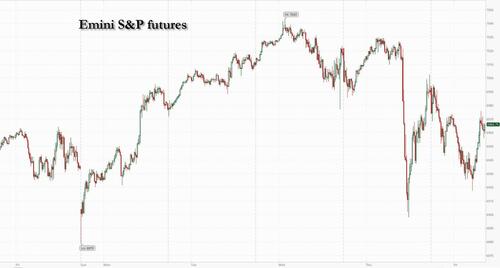
Market Snapshot

  • S&P 500 mini -0.4%
  • Nasdaq 100 mini -0.6%
  • Russell 2000 mini -1.4%
  • Stoxx Europe 600 +0.3%
  • DAX +0.4%
  • CAC 40 +0.3%
  • 10-year Treasury yield +2 basis points at 4.25%
  • VIX +2.2 points at 19.04
  • Bloomberg Dollar Index +0.4% at 1182.92
  • euro -0.4% at $1.1919
  • WTI crude -1.4% at $64.51/barrel

Top Overnight News

  • President Trump said he intends to nominate Kevin Warsh to be the next chair of the Federal Reserve. BBG
  • Gold and silver slumped while the dollar rose. A Warsh-led Fed may temporarily cool the greenback-debasement trade by easing concerns over central bank independence. BBG
  • President Donald Trump and Senate Democrats reached an agreement to fund the federal government as a Friday midnight deadline for a partial shutdown approaches.: WSJ
  • Speaker Johnson said he’s not confident that a government shutdown will be avoided.
  • China plans to sell about $29 billion in special bonds to recapitalize some its largest insurers, people familiar said, strengthening the biggest players amid pressure to consolidate. BBG
  • Large US companies are set to lay off at least 52,000 workers as the jobs market cools: FT.
  • White House said President Trump will sign executive orders at 11:00EST and is participating in a policy meeting at 14:00EST. Trump confirms he’s signing a historic executive order to combat the scourge of addiction and substance abuse.
  • China has given its top AI startup DeepSeek approval to buy Nvidia’s H200 artificial intelligence chips with regulatory conditions that are still being finalized. ByteDance, Alibaba, and Tencent had been given permission to purchase more than 400,000 H200 chips in total. RTRS
  • Volodymyr Zelenskiy said Ukraine is ready to halt strikes on Russian energy infrastructure if Moscow abides by a US proposal for a weeklong truce. BBG
  • Trump warned the UK and Canada against striking new business deals with China, after their leaders visited Beijing this month in an effort to deepen ties. BBG
  • The euro-zone’s largest economies all grew at the end of last year. German GDP rose 0.3% in the fourth quarter, beating an initial estimate. Spain reported a speedier-than-expected expansion of 0.8%, while France and Italy also grew. BBG
  • Headline PPI probably held at 0.2% in December, adding to evidence that tariff price pressure up the supply chain is fading. The core rate likely rose to 0.2% from a flat reading in November. BBG
  • Trump sues the IRS and Treasury for $10bln over tax return leaks.

Trade/Tariffs

  • China is to lower tariffs on whisky imports to 5% from February 2nd.
  • US President Trump said it is ‘very dangerous’ for the UK to get into business with China and even more dangerous for Canada to get into business with China.
  • US President Trump threatens to charge Canada a 50% tariff on any and all aircraft sold to the US.
  • White House noted that US President Trump signed an executive order declaring a national emergency and establishing a process to impose tariffs on goods from countries that sell or otherwise provide oil to Cuba.

A more detailed look at global markets courtesy of Newsquawk

APAC stocks were pressured heading into month-end, as the Apple-related euphoria following record iPhone sales, was dampened as yields gained and the dollar strengthened on reports that the Trump administration is preparing for the nomination of Kevin Warsh as the next Fed Chair. ASX 200 was dragged lower by underperformance in miners and resources stocks as metal prices took a hit.  Nikkei 225 swung between gains and losses following a slew of data releases, including softer-than-expected Tokyo CPI, better-than-expected Industrial Production and weak Retail Sales, but with the downside in the index cushioned by a weaker currency. Hang Seng and Shanghai Comp underperformed with little fresh drivers and indirect pressure from US President Trump, who warned of dangers for the UK and Canada regarding getting into business with China, while CK Hutchison shares were hit after reports that the Panama Supreme Court ruled the Co.’s ports contract is unconstitutional.

Top Asian News

  • The probe into the Air India crash leans toward deliberate pilot action, Bloomberg reported.
  • Hitachi (6501 JT) is reportedly seeking a buyers for its data storage business, according to Bloomberg.
  • LG Electronics (066570 KS) final Q4 (KRW) loss 828bln, oper. loss 109bln (prelim. loss 109bln), rev. 23.9tln (prelim. 23.9tln).

European equities (STOXX 600 +0.3%) have opened mostly on a firmer footing. Strength comes amid a rebound in the DAX 40 (+0.7%) after yesterday’s SAP-induced pressure, a narrative added to by strong Adidas (+5.2%) earnings. European sectors are mostly in the green, leading are Banks, Travel & Leisure and Technology. The former have been underpinned by reports that Kevin Warsh is likely to be the next Fed Chair, which has bolstered global yields. Furthermore, the sector benefits from gains in Caixabank (+4.0%) after the Co. announced that it expects NII to grow in 2026. To the downside, Basic Resources has been weighed down by pressure in metal prices, whilst energy has been pinned down by crude as the complex gives back gains.

Top European News

  • UK and China weigh a cross-border asset management scheme to deepen market ties, according to SCMP.
  • US Treasury said semi-annual currency report concluded no major US trading partners manipulated currency to gain unfair trade advantage during four quarters through June 2025.

FX

  • DXY is on a firmer footing today, following reports that the US administration is leaning towards Kevin Warsh to replace Fed Chair Powell – President Trump said he will make the announcement on Friday. Further details surrounding specific timing is currently light, aside from a couple of appearances towards the later part of the day. As it stands, Warsh’s odds have risen to ~94% (prev. 34% pre-report), whilst Rieder has fallen to ~4% (prev. 34.6% pre-report). DXY currently at the upper end of a 96.16-96.76 range.
  • G10s are entirely losing against the firmer Dollar, with clear underperformance in the Aussie as it takes a hit from the pressure seen across underlying metals prices. JPY also towards the bottom of the pile, with USD/JPY currently trading at the upper end of a 152.86-154.38 range. Two factors for the JPY today; a) widening yield differentials as traders weigh a potential Warsh pick, b) softer-than-expected Tokyo CPI, better-than-expected Industrial Production and weak Retail Sales.
  • EUR has had a slew of EZ data to digest throughout the day. French GDP contracted a touch from the prior, whilst Spanish, Italy and Germany was a little more upbeat. The German figure itself spurred some minor pressure in the single currency at the time, with the pair then trundling lower as the morning progressed. No move to the EZ GDP metrics, which topped exp. but contracted a touch from the prior. At the same time was the release of several German State CPIs, which on balance was more-or-less in-line with what is expected from the mainland figure due at 13:00 GMT. One point to note is that the NRW state held a bit more of a hawkish skew (0.1% M/M vs prev. 0.0%; mainland expects 0.0%). Currently trades in a 1.1894-1.1974 range.

Fixed Income

  • USTs on the backfoot as Kevin Warsh will reportedly be nominated by President Trump later today for the Fed Chair position. Reaction occurring as while Warsh has called for immediate rate cuts, his policy stance is net-hawkish vs the other options available to Trump. While Warsh will likely call for lower policy rates, given his recent commentary and the clear pressure from the administration, the main point of focus will be on the balance sheet, as Warsh has long been critical of QE and a large balance sheet. USTs at a 111-17+ low, a tick above Thursday’s base, which itself is a tick above the WTD 111-15+ low. Amidst this, yields are firmer across the curve, which itself is steeper with action led by the long-end, as while Warsh is a hawkish pick vs the other options, he ultimately will still try to push rates lower in the near term, which may drive inflation and by extension rates higher on a longer horizon.
  • That aside, the morning’s stronger-than-expected German Q4 GDP sent Bunds to a 128.07 low with losses of 26 ticks at most. In proximity, we saw the German state CPIs hit ahead of the 13:00GMT mainland figure, the M/M skew was broadly in-line with the mainland consensus, while the Y/Y skew was a hawkish one. For reference, German CPI is expected at 2.0% Y/Y (prev. 1.8%) and 0.0% M/M (prev. 0.0%).
  • Gilts gapped lower by 26 ticks before slipping further to a 90.59 trough, given the bias from USTs. Since, the benchmark has rebounded a touch and is holding around 90.90, some 10 ticks above opening levels, but still in the red by c. 15 ticks.
  • Japan sold JPY 2.2tln in 2-year JGBs; b/c 3.88x (prev. 3.26x); average yield 1.253% (prev. 1.129%). Lowest accepted price 100.080 vs. prev. 99.920. Weighted average price 100.090 vs prev. 99.942. Tail in price 0.010 vs prev. 0.022.
  • Australia sold AUD 1bln 4.25% March 2036 bonds, b/c 3.34, avg. yield 4.8039%.

Commodities

  • Crude benchmarks started the Asia-Pac session on the backfoot, partially driven by the stronger greenback, but primarily by comments from President Trump, who said he plans to have talks with Tehran and hopes the US do not have to use the big, powerful ships. WTI dropped to a trough of USD 64.30/bbl following the potential Fed Chair announcement reports re. Warsh, before immediately paring back the entirety of the move. Around 30 minutes later, on the Trump comments, prices steadily dropped, and WTI hit a low of USD 63.65/bbl. Benchmarks have since consolidated in a broad c. USD 1.00/bbl range.
  • Precious metals slide as European trade continues, with spot XAU currently trading at USD 5090/oz, nearly USD 500/oz lower from the ATH made in Thursday’s session. The yellow metal briefly lost USD 5k/oz, slipping to a USD 4941/oz trough before rebounding.
  • Spot silver has slipped even further and has wiped out the entirety of this week’s gains, to sub-100/oz. This comes following the recent strength in the greenback as Kevin Warsh emerges as the frontrunner for the Fed Chair role, with markets suggesting that he is more hawkish than other candidates such as Rick Rieder. President Trump is set to announce the pick later today.
  • Alongside precious metals, base metals have been hit by the stronger dollar, with 3M LME Copper briefly tagging USD 13.1k/t before slightly paring back losses but remaining below USD 13.5k/t. For context, the red metal was trading at USD 14.53k/t just 18 hours ago.
  • OPEC+ likely to keep its pause on oil output increases for March at Sunday meeting, according to sources.
  • ArcelorMittal (MT NA) and Liberia sign a new long-term mineral development agreement. “The expansion project, which is nearing completion, will see iron ore shipments increase from historic levels of approximately 5 million tonnes per annum (mtpa) to 20 mtpa in 2026 alongside improvements in product quality to higher grade, higher value ore.”. “The Company is also undertaking feasibility studies for further expansion of its iron ore asset beyond 20 mtpa.”.
  • Explosion reported in an oil refinery at northwestern Turkish province of Kocaeli, while causes of the explosion at the oil refinery are unknown, according to Al-Arabiya.
  • LME trading has now opened following a delay due to technical issues.
  • White House clarifies that US sanctions relief for Venezuela covers refining and other downstream activities, but not upstream production and White House official said more announcements on Venezuela sanctions easing are expected.
  • London Metal Exchange delays market opening due to technical issues, according to Bloomberg.

Geopolitics: Ukraine

  • Russia’s Kremlin said US President Trump personally asked Russian President Putin to halt strikes on Kyiv until Feb 1 and create favourable conditions for negotiations.
  • Ukraine’s President Zelensky said the compromise on territory has not yet been reached; Ukraine will not strike Russian energy infrastructure if Russia halts its attacks on Ukraine’s energy infrastructure. Halting strikes on energy targets is a US initiative and a personal proposal of US President Trump. said he is inviting Putin to Kyiv if Putin “dares”. No official ceasefire agreement on energy target exists between both countries. Reiterates readiness for leaders summit in any format, but not in Moscow or Belarus.

Geopolitics: Middle East

  • US President Trump said he plans to have talks with Tehran and there are big, powerful ships going to Iran, he hopes they don’t have to use them. said:He told the Iranians ‘no’ to nuclear weapons, stop killing protesters, and that they have to do something.
  • US President Trump said have a team headed to Iran.

US Event Calendar

  • 8:30 am: United States Dec PPI Final Demand MoM, est. 0.2%, prior 0.2%
  • 8:30 am: United States Dec PPI Ex Food and Energy MoM, est. 0.2%, prior 0%
  • 8:30 am: United States Dec PPI Final Demand YoY, est. 2.76%, prior 3%
  • 8:30 am: United States Dec PPI Ex Food and Energy YoY, est. 2.9%, prior 3%
  • 9:45 am: United States Jan MNI Chicago PMI, est. 43.65, prior 43.5, revised 42.7

DB’s Jim Reid concludes the overnight wrap

Morning from Milan where Winter Olympics fever was clear from my hotel where a number of the organising committees were setting up yesterday. Unlike Eddie “the Eagle” Edwards I haven’t managed to bluff my way into the Ski Jump to represent team GB next week. My knee surgeon will be relieved. On that topic a couple of weeks ago I suggested I uploaded my scans into AI to ask what was wrong with my knee. It was nearly right and essentially my right knee cap groove has worn away and I’ll probably have a knee cap replacement in the winter (after my back has recovered) that will no doubt be upgraded to a full knee replacement at some point in the next 1-10 years as the rest of the knee is on borrowed time. I have been offered a viscosupplement injection instead that inserts a permanent gel into your knee, although my surgeon said he wouldn’t have it as there hasn’t been enough evidence of its long-term effect on your body! If anyone has had any experience of them let me know. Meanwhile my back surgeon has cleared me to start a gradual return to golf earlier than I thought. So chipping now, three quarter swings in a few weeks and then hopefully ready for the Masters in April. My nerve is still damaged and constantly irritable but he said that could take 12-18 months to repair if it is going to. Frustrating.

One sporting battle that seems to drawing to a close is the race for the Fed Chair nomination. Last night President Trump said he would announce his Fed pick this morning. In the last few hours, Bloomberg reported that the administration was preparing for Kevin Warsh to be nominated, with his odds on Polymarket spiking to 92% as I type. As a reminder, Warsh served as Fed Governor during between 2006 and 2011, a period that included the Fed’s response to the GFC. While his recent comments have been supportive of lower rates, in the past he’s been hawkishly critical of the Fed’s expansive use of its balance sheet. Our US economists published a note on what a Warsh nomination would mean for the Fed shortly before Christmas (see here).

Treasuries and equity futures have reacted negatively in response overnight. While 2yr yields are little changed, 10yr and 30yr yields are +3.4bps and +4.6bps higher as I type, with S&P 500 futures -0.36% lower as I type. So the initial market reaction consistent with a view that the Fed put for asset prices could be less strong under Warsh as Chair than under other candidates. Gold (-3.10%) and oil (-1.30%) have also sold off overnight, while the dollar (+0.31%) is benefitting.

Prior to this, markets had showed some resilience amid heightened volatility yesterday as several assets mostly recovered after sharp plunges. The S&P 500 (-0.13%) almost fully reversed a -1.54% intra-day slump, though the NASDAQ (-0.72%) did see a decent pullback, driven by the biggest daily decline for Microsoft (-9.99%) since the pandemic turmoil of March 2020. Precious metals saw a volatile day too, with gold (-0.77%) finally ending a run of 8 consecutive daily gains to close at $5,375/oz. At one point it had fallen -5.7% on the day in what seemed like a sudden deleveraging. Given that the total value of Gold in the world is around $37tn, that was a $2.1tn brief slump. Providing some perspective, it was only Monday that we first went above $5000/oz and we’re still about 4% above that level despite the decline this morning. Yesterday’s mood also wasn’t helped by the geopolitical backdrop, as speculation about a potential US strike on Iran helped push Brent crude oil above $70/bbl again.

The tech slump was arguably the biggest story yesterday, which came after Microsoft’s earnings following the previous day’s close. As a reminder, their capital expenditures were above analysts’ estimates, which added to concern about how quickly these would pay off. Together with weak results by business software provider SAP (-16.07%) in Europe this hit a whole bunch of software stocks, with ServiceNow (-9.94%) and Workday (-7.65%) also among the worst performers in the S&P 500. However, the Mag-7 (-0.05%) were little changed, with the group supported by Meta (+10.40%) after their own outlook was better than expected. Moreover, the equal weight S&P 500 was far calmer and closed +0.13% with 287 stocks actually closing higher on the day as the broader equity mood improved.

After the close yesterday, we also heard from Apple, which delivered a solid Q4 sales beat ($143.8bn vs $138.4bn est.) and upbeat Q1 revenue growth guidance (13-16% vs 10% expected), driven by strong sales of the new iPhone 17 and a rebound in China. However, rising costs took some of the shine off that strong top line, with Apple’s shares rising about half a percent in after-hours trading following a +0.72% gain in the regular session. In other overnight tech news, Bloomberg reported that SpaceX is considering a potential merger with either Tesla or Elon Musk’s AI firm xAI.

In the meantime, geopolitical fears continued to ramp up yesterday, which pushed oil prices up to their highest level in months even if they’ve moved a bit lower this morning. For instance, Brent crude (+3.60%) moved up to $70.86/bbl at the US close, their highest level since July. Of course, Trump warned on Wednesday that a “massive Armada” was heading to Iran, but yesterday we then heard from an AP report that Iran had issued a warning to ships at sea that they planned to run a drill that included live firing in the Strait of Hormuz. And with oil prices heading higher, that’s revived concern about inflation, with the US 5yr inflation swap (+2.7bps) closing at a 3-month high of 2.53%. 

On the topic of commodities, the rally in precious metals finally showed signs of reversing. Initially, gold prices had looked set for a further gain, reaching an all-time intraday record of $5595/oz as we were going to press yesterday. However, they then sharply reversed course after the US open, plummeting down to $5,106/oz, before paring back those losses to close “only” -0.77% lower on the day at $5,375/oz. So that ended a run of 8 consecutive daily gains for gold, which had been the biggest 8-day advance since Lehman Brothers’ collapse in 2008, at +17.9%. It was a similar story for silver too, which slipped back -0.86% from its record high but a much better close than the -8.4% fall intraday.

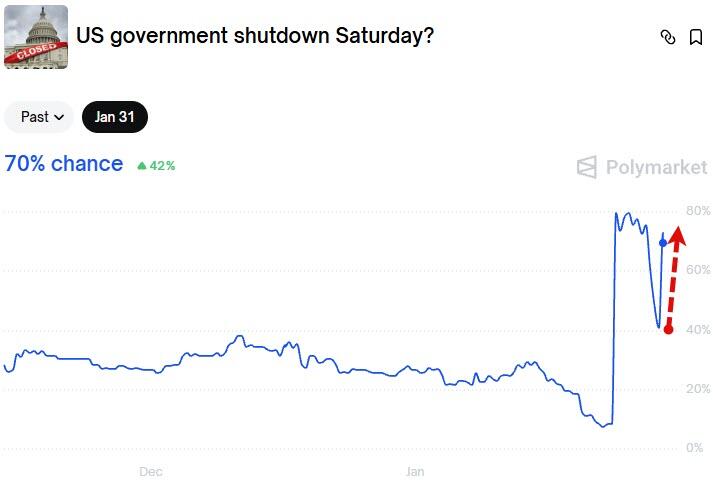
Otherwise, another risk that is still in the process of being resolved is the potential for a US government shutdown tonight. For context, this emerged as a key issue last weekend, after Democrats called on funding for the Department of Homeland Security to be taken out of a government funding bill. Last night the White House and Senate Democrats reached a deal that would provide a two-week stopgap for Homeland Security funding while funding other departments until the end of the fiscal year in September. While political agreement now appears to be in place, procedural hurdles may still lead to a brief partial shutdown starting at midnight tonight, especially as the House is not currently in session. Polymarket odds for a shutdown on Saturday are at 67%, having been as low as 35% yesterday. 

Meanwhile, the latest US data was slightly underwhelming yesterday, with the weekly jobless claims coming in at 209k (vs. 205k expected) in the week ending Jan 24, alongside a +10k upward revision to the previous week, which now stands at 210k. On top of that, the November trade deficit widened more than expected to $56.8bn (vs. $44.0bn expected). So that helped push the Atlanta Fed’s GDPNow estimate for Q4 down to an annualised +4.2%, down from +5.4% previously.

Earlier in Europe, we saw a similar risk-off move yesterday, with the STOXX 600 down -0.23%, whilst Germany’s DAX (-2.07%) had its worst performance since September after the slump by SAP (-16.07%). However, there was some more promising economic data from Europe, as the European Commission’s economic sentiment indicator for the Euro Area reached a 3-year high of 99.4 (vs. 97.1 expected). Even so, the risk-off tone dominated, and sovereign bonds rallied further as investors priced in a growing chance of an ECB rate cut this year, which is now seen as a 31% chance by the September meeting. So yields on 10yr bunds (-1.8bps), OATs (-0.9bps) and BTPs (-1.9bps) all moved lower in response.

In Asia the Hang Seng (-1.78%), Shanghai Composite (-1.19%) and the CSI (-1.01%) are all underperforming. Elsewhere, the Nikkei (-0.18%) and the S&P/ASX 200 (-0.67%) are also trading in negative territory. The KOSPI (+0.62%) is defying the broader regional trend, supported by strong performances from major chipmakers.

Early morning data indicated that the headline Tokyo CPI inflation decreased to +1.5% year-on-year in January (compared to +1.7% expected), marking its lowest level since February 2022. This represents a slowdown from +2.0% in the previous month. Core inflation, which excludes fresh food, also moderated, rising by +2.0% from a year earlier (versus +2.2% expected) and a previous reading of 2.3%. This moderation aligns core inflation with the Bank of Japan’s 2% target after several months of stronger outcomes. The data alleviates pressure on the BOJ to raise rates again in the near future, despite a still tight labor market. JGBs are 1-2bps lower across the curve and the Yen has fallen -0.65%. So one to watch a week after the Treasury “rate check”.

Looking at the day ahead, data releases will include the Euro Area Q4 GDP reading and the December unemployment rate, whilst in Germany we’ll also get the flash CPI print and unemployment for January. In the US, we’ll get the PPI for December as well. Central bank speakers include the ECB’s Vujcic, and the Fed’s Musalem. Finally, today’s earnings releases include Exxon Mobil and Chevron

Tyler Durden
Fri, 01/30/2026 – 08:41

via ZeroHedge News https://ift.tt/pVcK6Y0 Tyler Durden

Nvidia Aided DeepSeek AI Breakthrough With “Extensive Technical Support,” House China Chair Warns

Nvidia Aided DeepSeek AI Breakthrough With “Extensive Technical Support,” House China Chair Warns

Congressman John Moolenaar (R-MI), chairman of the House Select Committee on the CCP, penned a letter to Commerce Secretary Howard Lutnick that Nvidia provided extensive technical support to DeepSeek, enabling the startup to achieve chatbot performance breakthroughs despite US export controls on advanced AI chips to China to mitigate the risks of the technology falling into the hands of Beijing’s military.

“While NVIDIA asserts its relationship with DeepSeek is “to promote the [AI] ecosystem flywheel and improve NVIDIA’s products,” documents produced to the Committee reveal NVIDIA provided extensive technical support that enabled DeepSeek—now integrated into People’s Liberation Army (PLA) systems and a demonstrated cybersecurity risk—to achieve frontier AI capabilities,” Moolenaar wrote in the letter sent to Lutnick’s office on Wednesday.

Moolenaar continued, “These findings demonstrate why rigorous enforcement of the Department’s H200 export rule, which requires certification that chips will not serve military purposes, is essential—even if such enforcement effectively prevents H200 exports to the PRC altogether.”

DeepSeek’s release sent shock waves through US markets last year – about this time – over risks that Chinese AI models were developed with far less computing power, fueling concerns that China was catching up with the US despite export restrictions on advanced AI chips to China.

Moolenaar explained in the letter that Nvidia’s engineers helped DeepSeek dramatically improve training efficiency from export-controlled H800 chips, and proposed distributing DeepSeek as an Nvidia enterprise product, undermining the intent of export controls.

“Nvidia treated DeepSeek accordingly – as a legitimate commercial partner deserving of standard technical support,” he said.

Moolenaar requested a Commerce Department briefing by Feb. 13 on the enforcement of the H200 and expanded safeguards to protect America’s AI leadership.

Meanwhile, President Trump’s administration approved sales of Nvidia’s H200 to China with some restrictions, including that the chips not be sold to companies linked to the Chinese military. The H200 is more powerful than the H800 chips DeepSeek used.

Last week, Chinese regulators told Alibaba, Tencent, and ByteDance that approvals to purchase the H200 chips were nearing.

Approval would represent a material bull catalyst for Nvidia stock and a major win for CEO Jensen Huang, who has stated that the China AI chip opportunity alone could generate up to $50 billion in revenue over the coming years.

“If even the world’s most valuable company cannot rule out the military use of its products when sold to (Chinese) entities, rigorous licensing restrictions and enforcement are essential to prevent such assurances from becoming superficial formalities,” Moolenaar wrote.

“Chips sales to ostensibly non-military end users in China will inevitably result in a violation of the military end-use restrictions,” he added.

Separate but notable, LLMs are already being used by the Ukrainian military to more effectively target Russian forces, primarily for SIGINT operations. The rise of LLMs in battle cannot be stopped, and many anti-war critics lack firsthand exposure to modern battlefields, where it is clear that the military use of LLMs is underway. The focus, therefore, should be on understanding and preparing for this emerging threat.

Tyler Durden
Fri, 01/30/2026 – 08:25

via ZeroHedge News https://ift.tt/wNrsbya Tyler Durden

Trump And Senate Dems Strike Shutdown Deal

Trump And Senate Dems Strike Shutdown Deal

Update (0950ET): President Donald Trump and Senate Democrats struck a deal to avert a prolonged shutdown for most of the federal government. 

The deal will fund all of the government except DHS until September. DHS, meanwhile, will receive funding for two weeks while lawmakers negotiate changes following public outrage over two shootings in Minneapolis by ICE agents.

“If Republicans don’t do s— for two weeks, DHS shuts down and there’s little incentive for us to reopen without the guardrails on ICE,” a Democratic aide told NBC News

While the Senate is aiming to vote today, it still needs to pass through the House – which returns to Washington on Monday, before it can be sent to Trump’s desk for his signature. 

This means that funding will temporarily lapse for several agencies starting tomorrow (ahem). 

*  *  *

The odds of a government shutdown have surged back up to 70% (according to prediction markets), after a bipartisan deal brokered by President Donald Trump and Senate leaders to avert a partial government shutdown ran into trouble late on Jan. 29 as objections from lawmakers prevented a quick vote.

The Senate had been hoping to vote Thursday night on a government funding package after leaders struck an agreement earlier in the day and Trump publicly endorsed it. The effort stalled after at least one senator objected, forcing leaders to delay consideration until Friday.

Leaving the Capitol just before midnight Thursday after hours of negotiations, Senate Majority Leader John Thune (R-S.D.) told reporters there were “snags on both sides” as he and Senate Minority Leader Chuck Schumer (D-N.Y.) worked to clear objections ahead of a Friday midnight deadline.

“Hopefully, people will be of the spirit to try and get this done tomorrow,” Thune said as the Senate was scheduled to reconvene on Friday.

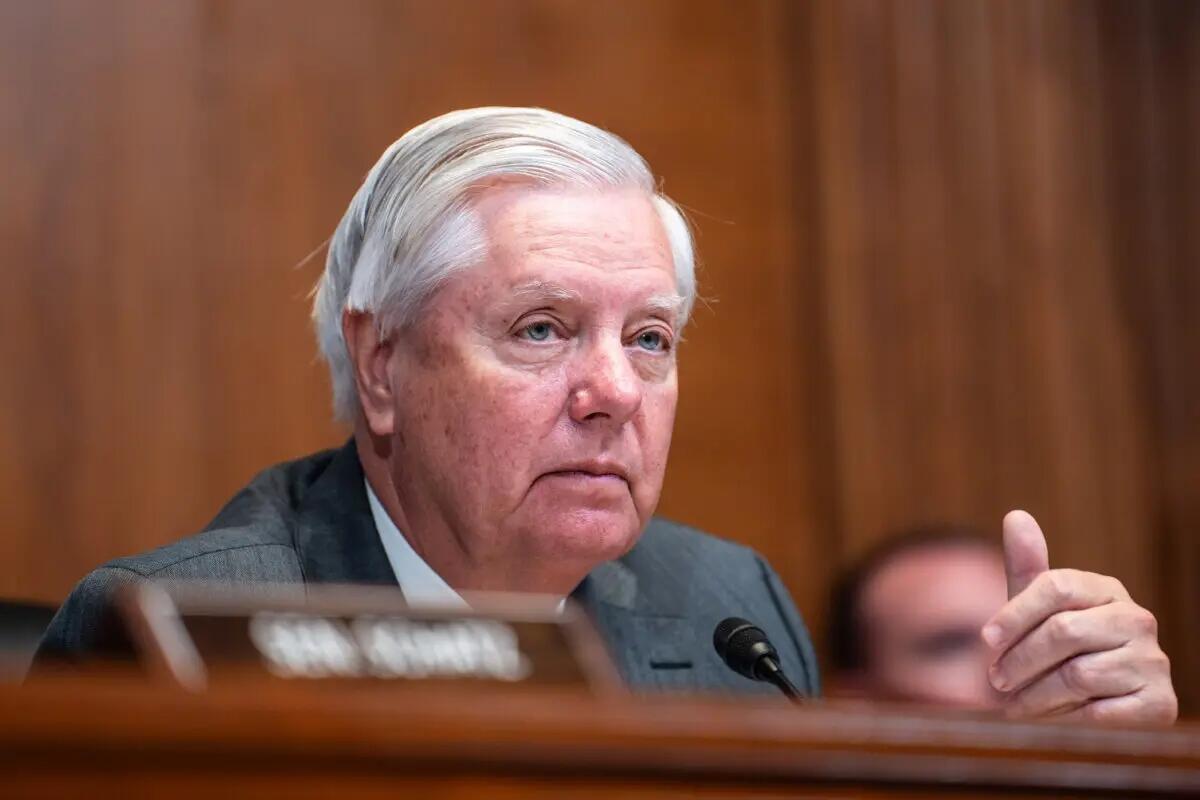
As Tom Ozimek details below via The Epoch Times,the delay came after Sen. Lindsey Graham (R-S.C.) placed a hold on the package, blocking the unanimous consent needed to fast-track the vote. Graham pointed to language in the bill that would repeal the so-called Arctic Frost provision that would allow senators to sue if their phone records were collected as part of former special counsel Jack Smith’s probe.

Smith’s investigation, codenamed Arctic Frost, was opened on the premise that it was criminal of the Trump campaign to arrange alternative sets of electors in states where the campaign was challenging the 2020 election results.

As part of the probe, the Department of Justice (DOJ) and the FBI, under President Joe Biden, pursued sensitive and private information related to political opponents, including Trump, his advisers and attorneys, Congressional Republicans, and a handful of conservative groups. The investigation was dropped after Trump was elected to a second term in the White House.

“What senator wouldn’t want notification that they’re looking at your phone?” Graham said on Jan. 28, according to The Hill.

“I fixed the problem that people had. I’m not going to ignore what happened. If you were abused, you think you were abused, your phone records were illegally seized—you should have your day in court. Every senator should want to make sure this never happens again.”

Graham also signaled that he had an issue with the lack of full-year funding for the Department of Homeland Security (DHS).

Sen. Lindsey Graham (R-S.C.) during a hearing on Capitol Hill in Washington on Dec. 3, 2025. Madalina Kilroy/The Epoch Times

“The cops need us right now,” he said. “They’re being demonized. They’re being spat upon. They can’t sleep at night.“

While Thune told reporters that there were hang-ups on both sides of the aisle, Schumer laid the blame for the delay squarely on Republicans.

“Republicans need to get their act together,” he told reporters as he left Capitol Hill for the night late Thursday.

DHS Funding Split Off After Deal

The snag came hours after the White House and Senate Democrats announced a deal under which Senate Democrats would provide the votes to pass five House-passed spending bills that fully fund the departments of Defense, Labor, Health and Human Services, Education, Transportation, and Housing and Urban Development. Full-year funding for DHS would be removed from the bill and replaced with two-week funding to allow more time for negotiations over immigration enforcement policy.

Democrats have vowed to oppose full-year funding for DHS, which oversees Immigration and Customs Enforcement (ICE), following the fatal shooting of Alex Pretti in Minneapolis by federal agents.

Democrats have laid out their demands for supporting the larger DHS funding package.

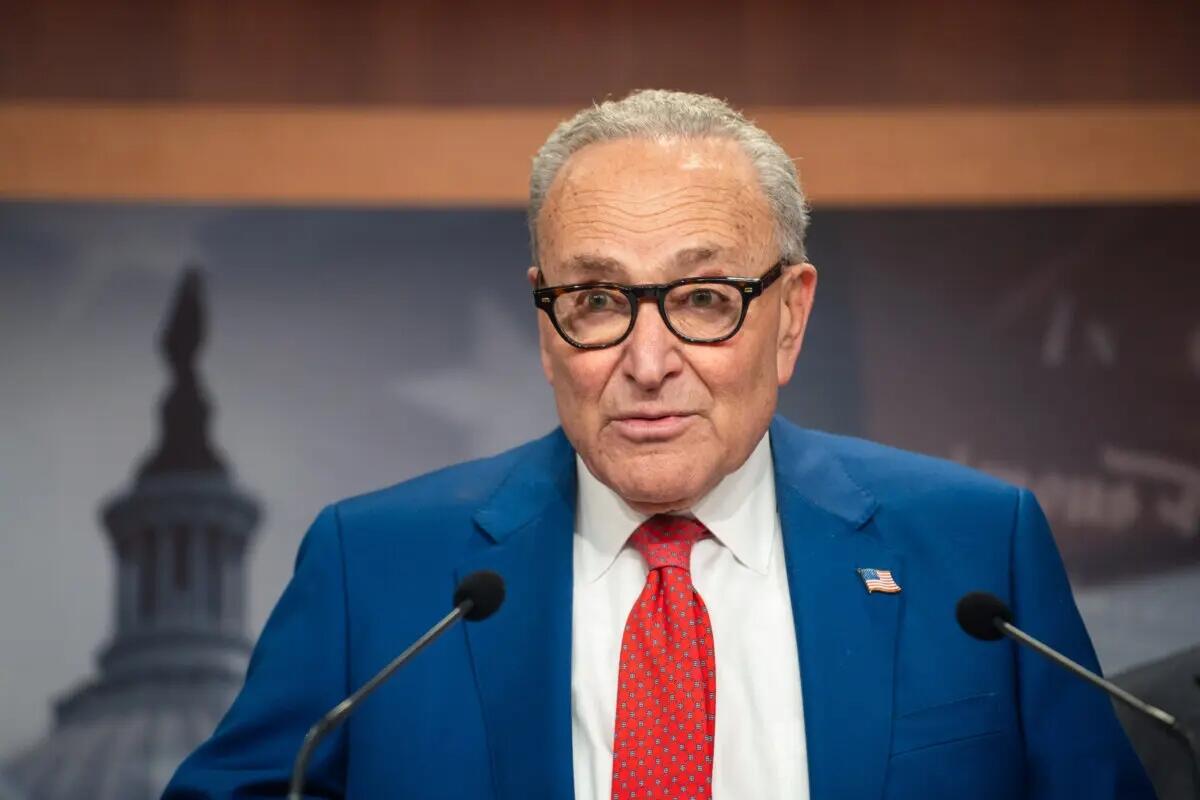
Senate Minority Leader Chuck Schumer (D-N.Y.) speaks at a press conference on Capitol Hill in Washington on Jan. 14, 2025. Madalina Kilroy/The Epoch Times

Schumer said on Jan. 28 that Democrats want “an end to roving patrols” of ICE agents in U.S. cities, while calling for a solution that would require warrants and coordination with local and state law enforcement.

Schumer also said Democrats want “to enforce accountability,” with the Senate Democratic leader adding that “federal agents should be held to the same use-of-force policies that apply to state and local law enforcement, and be held accountable when they violate these rules.”

Democrats also want reforms that would require ICE and other immigration agents to wear body cameras, remove masks, and always carry proper state identification while carrying out immigration enforcement activities, Schumer said.

Some Republicans have signaled openness to reforms at DHS, though they said they are against shutting down the government over the issue.

Sen. Josh Hawley (R-Mo.) has backed Trump’s calls for a “thorough investigation” into the Pretti shooting.

Hawley said his primary concern is preventing a shutdown, which he said would be “terrible.”

To that end, he said that he plans to vote for the DHS funding bill.

Tyler Durden
Fri, 01/30/2026 – 07:45

via ZeroHedge News https://ift.tt/B4fKRA5 Tyler Durden

The Case Against Deferring to Presidential Invocations of the Insurrection Act

Donald Trump has often threatened to invoke the Insurrection Act as a tool for using the military against his domestic opponents. Many observers believe this became more likely after the Supreme Court ruled against his efforts to federalize state National Guard units and use them for domestic law enforcement under a different statute.

The conventional wisdom on the Insurrection Act is that the president is entitled to broad judicial deference if he invokes it. In an important new article, Prof. Josh Braver (University of Wisconsin) argues that the conventional wisdom is wrong. Here is the abstract:

This article argues that courts do not owe substantial deference when the President seeks to deploy the military domestically under three of the Insurrection Act’s four trigger provisions. The exception is Section 252, which authorizes deployment “[w]henever the President considers” that has become “impracticable to enforce the laws . . . by the ordinary course of judicial proceedings.” This Article defends that claim through analysis of the Act’s text, statutory history, and legislative history.

The core argument turns on a single word of the Insurrection Act: “considers.” When, and only when, a trigger is keyed to what the President “considers,” courts owe deference. Two negative-implication arguments clarify and strengthen that inference. First, Congress used “considers” in Section 252’s judicial-proceedings trigger, but withheld comparable language from every other trigger, signaling that Section 252 is the sole grant of trigger deference. The statutory and legislative history confirm that this was no accident: Section 252’s “considers” traces to an 1861 amendment that added discretionary language to the judicial-proceedings trigger. This language was widely understood as necessary to resolve controversy over whether the President could deploy force against the seceding States at the civil war’s outset.

Second, where Congress uses “considers” elsewhere in the Act, it does so to confer deference over the choice and scale of forces (“means deference”), not over whether the trigger is satisfied. Using ‘considers’ for means while omitting it from triggers underscores that Sections 251 and 253 withhold trigger deference by design.

The withholding of trigger deference from Section 253 in particular has a structural logic: Section 253 is the only trigger provision that lacks any comparable ex ante check by another institution, making judicial scrutiny especially necessary ex post. And because Section 253(2) is the Act’s broadest and most abuse-prone trigger, that judicial check is especially crucial.

While Josh concludes that more deference is due under Section 252 than the other parts of the statute, even Section 252 deference has important limitations:

Two points should reassure. First, Section 252 presupposes an actual judicial proceeding: an injunction, a warrant, an order, or some comparable process to be enforced. And mere resistance is not enough; it must also be “impracticable to enforce the laws” through that process. The only exception is a genuinely collapsed judiciary—courts shuttered, process unavailable— an extraordinary condition that cannot be conjured by rhetoric alone.
Second, “substantial deference” is not abdication, especially given the trigger’s demanding terms. In 2025, two district judges confronting the Chicago and Portland National Guard deployments under a neighboring statute with analogous language applied a deferential framework yet still ruled against the Administration. The Ninth Circuit initially reversed in the Portland litigation on the ground that the district court’s analysis was not deferential enough; but it later granted rehearing en banc, and it might well have applied deference and still struck down the deployment. The Supreme
Court intervened first, effectively mooting the dispute before the Ninth Circuit could rule.

In a recent Dispatch article (non-paywalled version here), I made a more general case that courts should not defer to executive invocations of emergency powers. Rather, the government should have to prove that the emergency that supposedly justifies their use actually exists. This is consistent with Josh’s argument that, under the Insurrection Act, there is no deference on “triggers” for the use of the act, though – if the “trigger” is present – there could be some deference with regard to the issue of whether the use of the military is a necessary response. See also Part V of my new article, “Immigration is Not Invasion,” which argues against deferring to executive claims that an invasion has occurred, thereby justifying the use of various sweeping emergency powers.

Josh Braver is also my coauthor on “The Constitutional Case Against Exclusionary Zoning,” Texas Law Review (2024). We have very different political ideologies and views on legal theory, but nonetheless agree on a great many things!

The post The Case Against Deferring to Presidential Invocations of the Insurrection Act appeared first on Reason.com.

from Latest – Reason.com https://ift.tt/B6GPlnw
via IFTTT

Trump Taps Kevin Warsh To Lead Fed


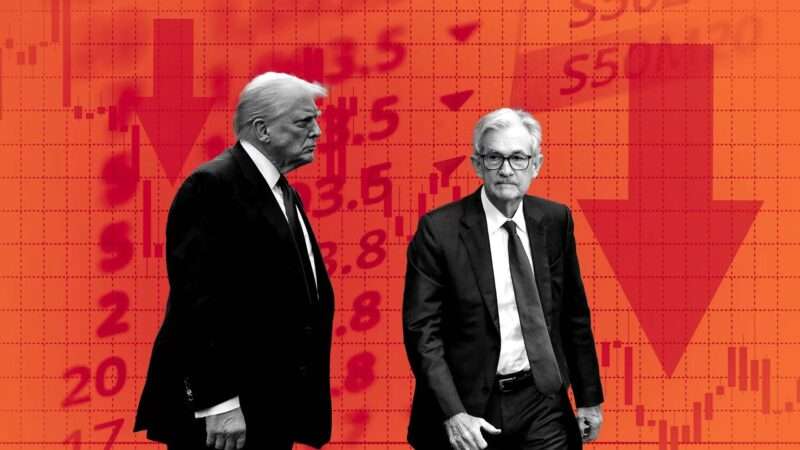
President Donald Trump and Jerome Powell, with a down red arrow. | (Illustration: Eddie Marshall | Aaron Schwartz | picture alliance| Consolidated News Photos | Aaron Schwartz | Sipa USA | Engdao Wichitpunya | Dreamstime.com | Newscom)

Kevin Warsh is President Donald Trump’s pick to be the next Chairman of the Federal Reserve.

Trump has grumbled publicly about current Fed Chair Jerome Powell practically since the beginning of his second term. Now, the president has named a replacement. Not surprisingly, Warsh is a prominent critic of the Fed—and Powell. 

Warsh was a Fed governor during the financial crisis, and like Trump, he favors lower interest rates in the short term. During the pandemic, Warsh also warned that ongoing expansions of the central bank’s balance sheet could spark inflation. As The Wall Street Journal notes, he’s usually been “more concerned about the risks of higher inflation than weaker growth.” 

But in recent years, he has devoted himself to something more like a structural critique of the central bank. In a lengthy speech published by Cato Journal in 2018, he talked about “the knowledge problem and fed policy”—yes, that’s a Friedrich Hayek reference—and made the case for a more humble approach to central banking. 

We know far less than we purport about the price formation process,” he wrote, and “still less about the economy’s resilience to economic and financial shocks; and less still about the current constellation of loose monetary policy, stagnant wages, and elevated financial asset prices.” 

One of the big worries about Trump’s search for a new Fed chief is that he’d end up choosing someone who simply answered to the president’s whims, undermining the central bank’s independence. This is an issue that libertarians have worried about too: On The Reason Roundtable recently, Reason Editor in Chief Katherine Mangu-Ward argued that even if you’re a strong critic of the Fed, allowing it to become a fundamentally political body—an extension of politics and presidential moods—would be even worse. An independent Fed is preferable to one controlled by Trump or whoever ends up in the Oval Office next. 

As it turns out, Warsh has strong opinions about Fed independence himself. In a 2010 speech, he made the case for a more nuanced view. “The Fed is not independent from government,” he said. “It is independent within government.” Warsh’s main message was that the Fed can’t hide behind independence or use it to shield officials from accountability. “Central bankers should not be pampered princes,” Warsh has said. In his view, the Fed had grown too large and too unwieldy. Unchecked growth has made it worse at its core responsibilities: fighting inflation and providing liquidity. This overreach made the Fed less trustworthy, which was a problem, he said, because the “Fed’s greatest asset is its institutional credibility.”

Warsh’s critique includes moments in which the Fed has rushed to prop up some failing part of the economy. “The Fed,” he said, “as first-responder, must strongly resist the temptation to be the ultimate rescuer.” The Fed shouldn’t be asked to backstop every aspect of the economy or fix policy mistakes made by Congress. “The Federal Reserve,” he once said, “is not a repair shop for broken fiscal, trade or regulatory policies.” 

Fundamentally, Trump has picked a long-time critic of a major governmental institution to run it. That’s in character for the president, who has stacked his administration’s top ranks with opinionated outsiders. But Warsh, unlike some of Trump’s picks, is a serious person with insider experience and a thoughtful critique of the Fed’s role and self-conception.  

Will Warsh get the chance to put his stamp on the central bank? We may not find out for months. Powell’s term ends in May, and Warsh must still be confirmed by the Senate, which could be a challenge

Shutdown (kinda, sorta, maybe) averted? Senate Democrats and Trump have agreed on a deal intended to avert an extended government shutdown. But there will probably still be at least a brief shutdown this weekend anyway. And a shutdown that could stretch into next week.

As this newsletter noted yesterday, the funding deal that reopened the government after last year’s 43-day shutdown is set to end on Saturday. (This is how Congress budgets now, in haphazard, two-month chunks.) The next set of extensions was expected to breeze through, avoiding a shutdown or drawn-out conflict.

But Department of Homeland Security (DHS) funding became a sticking point after Alex Pretti’s killing last weekend. Senate Democrats said this week that they wouldn’t renew funding for the agency unless changes are made to its immigration enforcement tactics. An initial test vote on DHS funding failed yesterday afternoon. 

Late last night, however, a deal came together in the Senate that the president has said he supports. It’s quite clear the president doesn’t want another long shutdown; the last one was not a political winner for Republicans.

The new deal is essentially an exercise in kick-the-can, giving lawmakers more time to negotiate reforms to immigration enforcement while the rest of the government stays open. 

The Senate still has to vote on the deal, however, and doesn’t plan to do so until this afternoon. If passed, the deal then has to be passed by the House, which currently isn’t scheduled to return to session until Monday. Even if the House acts quickly upon return, that means the government will partially shut down this weekend. The House could also decide to slow-walk its approval, demanding changes to the deal that keep the government in shutdown mode for days, or perhaps even longer.

As is often the case in Washington, it’s the day before a government shutdown deadline, and everything is still up in the air.

However, Trump’s seal of approval and stated desire to avert an extended shutdown might keep the House from holding up the process for long. On Thursday night, Speaker of the House Mike Johnson allowed that “We may inevitably be in a short shutdown situation.” But, he said, “the House is going to do its job.”

Congress? Doing its job? I’ll believe it when I see it. 


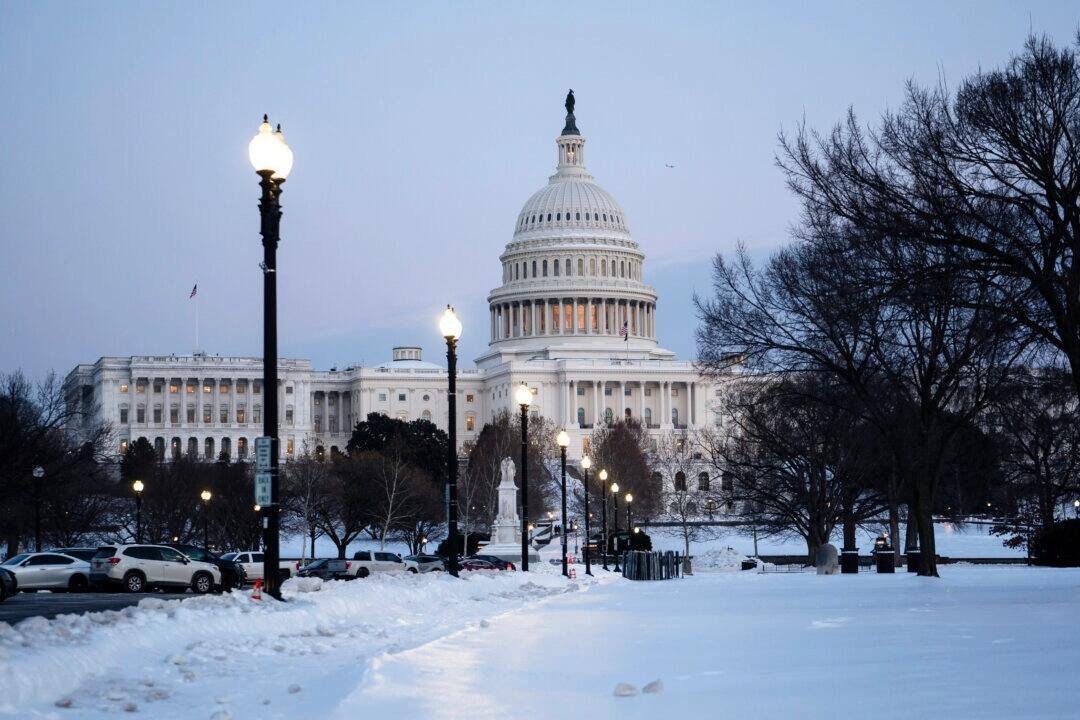
Scenes from Washington, D.C.: The temperature has been below freezing all week, and the White House Rose Garden is covered in snow and ice. 


QUICK HITS

  • In The Wall Street Journal, former Reasoner Emma Camp writes that Trump destroyed Millennial Optimism
  • Former CNN anchor Don Lemon was arrested in California and charged with “conspiracy to deprive rights.” If that’s a crime, Immigration and Customs Enforcement is in trouble.
  • So much for affordability! Trump wants to prop up home prices. “People that own their homes,” he said, “we’re gonna keep them wealthy. We’re gonna keep those prices up. We’re not gonna destroy the value of their homes so that somebody who didn’t work very hard can buy a home.”  
  • Even when it has accidents, Waymo is safer than a human driver.
  • Pixar’s next movie is about NIMBY robobeavers. I am not kidding. The movie follows “a girl who transfers her mind into a robotic beaver to help the animals fight the local mayor’s construction plans.” 
  • If you don’t like Pixar’s latest, it looks increasingly like you’ll just be able to make your own animated movie, or video game, or something else entirely, with new generative AI tools like Google DeepMind’s Genie. Yes, it can play Doom
  • Speaking of outsider critics tapped to lead federal institutions: The New York Times‘ Ross Douthat interviews Doctor Jay Bhattacharya on restoring trust in science and public health after the failures of COVID-19. 
  • Amazon might invest $50 billion in OpenAI after announcing a wave of layoffs driven by AI efficiency gains. The 16,000 workers the company let go are, as they say, feeling the AGI. 
  • Construction on the $16 billion Hudson Gateway tunnel linking New York and New Jersey is set to pause after the Trump administration pulled funding. 
  • No ICE in Maine? Sen. Susan Collins (R–Maine) says that large-scale immigration crackdown operations have ceased in her state.  
  • The man who allegedly sprayed Minnesota Rep. Ilhan Omar (D–Minn.) with vinegar during an event in Minneapolis on Tuesday has been charged with one felony count of terroristic threats and one count of fifth-degree assault. 
  • Hasbro is being sued by its own shareholders for printing too many Magic cards and devaluing them in the process. 
  • Some celebrities are pushing for a strike intended to end ICE raids in Minnesota. And Bruce Springsteen put out a song protesting ICE, called “Streets of Minneapolis.” It is…not a good song. 

The post Trump Taps Kevin Warsh To Lead Fed appeared first on Reason.com.

from Latest – Reason.com https://ift.tt/lbGp3jD
via IFTTT

The Case Against Deferring to Presidential Invocations of the Insurrection Act

Donald Trump has often threatened to invoke the Insurrection Act as a tool for using the military against his domestic opponents. Many observers believe this became more likely after the Supreme Court ruled against his efforts to federalize state National Guard units and use them for domestic law enforcement under a different statute.

The conventional wisdom on the Insurrection Act is that the president is entitled to broad judicial deference if he invokes it. In an important new article, Prof. Josh Braver (University of Wisconsin) argues that the conventional wisdom is wrong. Here is the abstract:

This article argues that courts do not owe substantial deference when the President seeks to deploy the military domestically under three of the Insurrection Act’s four trigger provisions. The exception is Section 252, which authorizes deployment “[w]henever the President considers” that has become “impracticable to enforce the laws . . . by the ordinary course of judicial proceedings.” This Article defends that claim through analysis of the Act’s text, statutory history, and legislative history.

The core argument turns on a single word of the Insurrection Act: “considers.” When, and only when, a trigger is keyed to what the President “considers,” courts owe deference. Two negative-implication arguments clarify and strengthen that inference. First, Congress used “considers” in Section 252’s judicial-proceedings trigger, but withheld comparable language from every other trigger, signaling that Section 252 is the sole grant of trigger deference. The statutory and legislative history confirm that this was no accident: Section 252’s “considers” traces to an 1861 amendment that added discretionary language to the judicial-proceedings trigger. This language was widely understood as necessary to resolve controversy over whether the President could deploy force against the seceding States at the civil war’s outset.

Second, where Congress uses “considers” elsewhere in the Act, it does so to confer deference over the choice and scale of forces (“means deference”), not over whether the trigger is satisfied. Using ‘considers’ for means while omitting it from triggers underscores that Sections 251 and 253 withhold trigger deference by design.

The withholding of trigger deference from Section 253 in particular has a structural logic: Section 253 is the only trigger provision that lacks any comparable ex ante check by another institution, making judicial scrutiny especially necessary ex post. And because Section 253(2) is the Act’s broadest and most abuse-prone trigger, that judicial check is especially crucial.

While Josh concludes that more deference is due under Section 252 than the other parts of the statute, even Section 252 deference has important limitations:

Two points should reassure. First, Section 252 presupposes an actual judicial proceeding: an injunction, a warrant, an order, or some comparable process to be enforced. And mere resistance is not enough; it must also be “impracticable to enforce the laws” through that process. The only exception is a genuinely collapsed judiciary—courts shuttered, process unavailable— an extraordinary condition that cannot be conjured by rhetoric alone.
Second, “substantial deference” is not abdication, especially given the trigger’s demanding terms. In 2025, two district judges confronting the Chicago and Portland National Guard deployments under a neighboring statute with analogous language applied a deferential framework yet still ruled against the Administration. The Ninth Circuit initially reversed in the Portland litigation on the ground that the district court’s analysis was not deferential enough; but it later granted rehearing en banc, and it might well have applied deference and still struck down the deployment. The Supreme
Court intervened first, effectively mooting the dispute before the Ninth Circuit could rule.

In a recent Dispatch article (non-paywalled version here), I made a more general case that courts should not defer to executive invocations of emergency powers. Rather, the government should have to prove that the emergency that supposedly justifies their use actually exists. This is consistent with Josh’s argument that, under the Insurrection Act, there is no deference on “triggers” for the use of the act, though – if the “trigger” is present – there could be some deference with regard to the issue of whether the use of the military is a necessary response. See also Part V of my new article, “Immigration is Not Invasion,” which argues against deferring to executive claims that an invasion has occurred, thereby justifying the use of various sweeping emergency powers.

Josh Braver is also my coauthor on “The Constitutional Case Against Exclusionary Zoning,” Texas Law Review (2024). We have very different political ideologies and views on legal theory, but nonetheless agree on a great many things!

The post The Case Against Deferring to Presidential Invocations of the Insurrection Act appeared first on Reason.com.

from Latest – Reason.com https://ift.tt/B6GPlnw
via IFTTT

Trump Taps Kevin Warsh To Lead Fed


President Donald Trump and Jerome Powell, with a down red arrow. | (Illustration: Eddie Marshall | Aaron Schwartz | picture alliance| Consolidated News Photos | Aaron Schwartz | Sipa USA | Engdao Wichitpunya | Dreamstime.com | Newscom)

Kevin Warsh is President Donald Trump’s pick to be the next Chairman of the Federal Reserve.

Trump has grumbled publicly about current Fed Chair Jerome Powell practically since the beginning of his second term. Now, the president has named a replacement. Not surprisingly, Warsh is a prominent critic of the Fed—and Powell. 

Warsh was a Fed governor during the financial crisis, and like Trump, he favors lower interest rates in the short term. During the pandemic, Warsh also warned that ongoing expansions of the central bank’s balance sheet could spark inflation. As The Wall Street Journal notes, he’s usually been “more concerned about the risks of higher inflation than weaker growth.” 

But in recent years, he has devoted himself to something more like a structural critique of the central bank. In a lengthy speech published by Cato Journal in 2018, he talked about “the knowledge problem and fed policy”—yes, that’s a Friedrich Hayek reference—and made the case for a more humble approach to central banking. 

We know far less than we purport about the price formation process,” he wrote, and “still less about the economy’s resilience to economic and financial shocks; and less still about the current constellation of loose monetary policy, stagnant wages, and elevated financial asset prices.” 

One of the big worries about Trump’s search for a new Fed chief is that he’d end up choosing someone who simply answered to the president’s whims, undermining the central bank’s independence. This is an issue that libertarians have worried about too: On The Reason Roundtable recently, Reason Editor in Chief Katherine Mangu-Ward argued that even if you’re a strong critic of the Fed, allowing it to become a fundamentally political body—an extension of politics and presidential moods—would be even worse. An independent Fed is preferable to one controlled by Trump or whoever ends up in the Oval Office next. 

As it turns out, Warsh has strong opinions about Fed independence himself. In a 2010 speech, he made the case for a more nuanced view. “The Fed is not independent from government,” he said. “It is independent within government.” Warsh’s main message was that the Fed can’t hide behind independence or use it to shield officials from accountability. “Central bankers should not be pampered princes,” Warsh has said. In his view, the Fed had grown too large and too unwieldy. Unchecked growth has made it worse at its core responsibilities: fighting inflation and providing liquidity. This overreach made the Fed less trustworthy, which was a problem, he said, because the “Fed’s greatest asset is its institutional credibility.”

Warsh’s critique includes moments in which the Fed has rushed to prop up some failing part of the economy. “The Fed,” he said, “as first-responder, must strongly resist the temptation to be the ultimate rescuer.” The Fed shouldn’t be asked to backstop every aspect of the economy or fix policy mistakes made by Congress. “The Federal Reserve,” he once said, “is not a repair shop for broken fiscal, trade or regulatory policies.” 

Fundamentally, Trump has picked a long-time critic of a major governmental institution to run it. That’s in character for the president, who has stacked his administration’s top ranks with opinionated outsiders. But Warsh, unlike some of Trump’s picks, is a serious person with insider experience and a thoughtful critique of the Fed’s role and self-conception.  

Will Warsh get the chance to put his stamp on the central bank? We may not find out for months. Powell’s term ends in May, and Warsh must still be confirmed by the Senate, which could be a challenge

Shutdown (kinda, sorta, maybe) averted? Senate Democrats and Trump have agreed on a deal intended to avert an extended government shutdown. But there will probably still be at least a brief shutdown this weekend anyway. And a shutdown that could stretch into next week.

As this newsletter noted yesterday, the funding deal that reopened the government after last year’s 43-day shutdown is set to end on Saturday. (This is how Congress budgets now, in haphazard, two-month chunks.) The next set of extensions was expected to breeze through, avoiding a shutdown or drawn-out conflict.

But Department of Homeland Security (DHS) funding became a sticking point after Alex Pretti’s killing last weekend. Senate Democrats said this week that they wouldn’t renew funding for the agency unless changes are made to its immigration enforcement tactics. An initial test vote on DHS funding failed yesterday afternoon. 

Late last night, however, a deal came together in the Senate that the president has said he supports. It’s quite clear the president doesn’t want another long shutdown; the last one was not a political winner for Republicans.

The new deal is essentially an exercise in kick-the-can, giving lawmakers more time to negotiate reforms to immigration enforcement while the rest of the government stays open. 

The Senate still has to vote on the deal, however, and doesn’t plan to do so until this afternoon. If passed, the deal then has to be passed by the House, which currently isn’t scheduled to return to session until Monday. Even if the House acts quickly upon return, that means the government will partially shut down this weekend. The House could also decide to slow-walk its approval, demanding changes to the deal that keep the government in shutdown mode for days, or perhaps even longer.

As is often the case in Washington, it’s the day before a government shutdown deadline, and everything is still up in the air.

However, Trump’s seal of approval and stated desire to avert an extended shutdown might keep the House from holding up the process for long. On Thursday night, Speaker of the House Mike Johnson allowed that “We may inevitably be in a short shutdown situation.” But, he said, “the House is going to do its job.”

Congress? Doing its job? I’ll believe it when I see it. 


Scenes from Washington, D.C.: The temperature has been below freezing all week, and the White House Rose Garden is covered in snow and ice. 


QUICK HITS

  • In The Wall Street Journal, former Reasoner Emma Camp writes that Trump destroyed Millennial Optimism
  • Former CNN anchor Don Lemon was arrested in California and charged with “conspiracy to deprive rights.” If that’s a crime, Immigration and Customs Enforcement is in trouble.
  • So much for affordability! Trump wants to prop up home prices. “People that own their homes,” he said, “we’re gonna keep them wealthy. We’re gonna keep those prices up. We’re not gonna destroy the value of their homes so that somebody who didn’t work very hard can buy a home.”  
  • Even when it has accidents, Waymo is safer than a human driver.
  • Pixar’s next movie is about NIMBY robobeavers. I am not kidding. The movie follows “a girl who transfers her mind into a robotic beaver to help the animals fight the local mayor’s construction plans.” 
  • If you don’t like Pixar’s latest, it looks increasingly like you’ll just be able to make your own animated movie, or video game, or something else entirely, with new generative AI tools like Google DeepMind’s Genie. Yes, it can play Doom
  • Speaking of outsider critics tapped to lead federal institutions: The New York Times‘ Ross Douthat interviews Doctor Jay Bhattacharya on restoring trust in science and public health after the failures of COVID-19. 
  • Amazon might invest $50 billion in OpenAI after announcing a wave of layoffs driven by AI efficiency gains. The 16,000 workers the company let go are, as they say, feeling the AGI. 
  • Construction on the $16 billion Hudson Gateway tunnel linking New York and New Jersey is set to pause after the Trump administration pulled funding. 
  • No ICE in Maine? Sen. Susan Collins (R–Maine) says that large-scale immigration crackdown operations have ceased in her state.  
  • The man who allegedly sprayed Minnesota Rep. Ilhan Omar (D–Minn.) with vinegar during an event in Minneapolis on Tuesday has been charged with one felony count of terroristic threats and one count of fifth-degree assault. 
  • Hasbro is being sued by its own shareholders for printing too many Magic cards and devaluing them in the process. 
  • Some celebrities are pushing for a strike intended to end ICE raids in Minnesota. And Bruce Springsteen put out a song protesting ICE, called “Streets of Minneapolis.” It is…not a good song. 

The post Trump Taps Kevin Warsh To Lead Fed appeared first on Reason.com.

from Latest – Reason.com https://ift.tt/lbGp3jD
via IFTTT

Free Nations Don’t Have To Care About the Whims of Elected Officials


President Trump speaking to members of the press | Photo: Samuel Corum/Sipa USA/Newscom

The freer the nation, the less the public needs to care about anything that its leader might say or do. In freer nations, the leader’s powers are strictly limited, and the citizens’ rights are protected. Yet in America today, we are dependent on every whim, utterance and narcissistic rage post from our president, as he pursues policies that could disrupt our lives. In that way, we’re more like North Korea than our founders’ America.

This has always been true to a degree, but since Donald Trump took office last year, Americans have been experiencing a severe form of political whiplash. Firmly in control of the nation’s massive federal apparatus, MAGA and its Republican lickspittles in Congress have thrived on chaos. Every day, the president issues some new threat. He imposes new tariffs on countries that don’t kiss the ring, then backs off, then imposes even harsher ones.

After getting his feelings hurt for not receiving a peace prize that he believes he deserves, Trump threatened to invade a territory controlled by an ally. “Considering your Country decided not to give me the Nobel Peace Prize… I no longer feel an obligation to think purely of Peace,” he wrote in a letter to the prime minister of Norway (who neither controls the Nobel committee, nor Greenland). Meanwhile, agents from Immigration and Customs Enforcement (ICE) are treating Minneapolis as if they are Marines trying to subdue Fallujah.

Trump often backs down, so the nation breathed a sigh of relief after he declared he wouldn’t use military force to grab Greenland. But who knows who he will bully today? Social media is abuzz with photos of bruises on his hand, sparking widespread chatter about his health. Our lives really shouldn’t revolve around the condition of our leader. Some conservative have started referring to Trump as “Daddy,” which suggests that many Americans probably prefer a king.

I’ve often criticized Trump-era Republicans for tossing aside their freedom birthright in favor of the stale porridge of authoritarianism. My vain hope today is to convince my newfound anti-Trump allies (who have disliked my years of writing against progressive policies) to view the current national nightmare as a teachable moment.

Both political sides assume they will always control the levers of power. But they forget this important axiom: Don’t ever support a new power that you wouldn’t want in the hands of your worst enemy. Maybe it’s time for Trump’s foes to recognize the importance of limiting executive power, so that no one can abuse it this way in the future.

It’s an admittedly difficult change of mindset, especially given all the hypocrisy on the right. Conservatives have spent my adult life touting limited government. Those ideas are correct, but it’s hard to stomach their lectures now that they’ve embraced Trump’s vision for unlimited government.

Still, progressivism’s historic task has been to reduce the sphere of the private sector and increase the realm of public officials, shifting decision-making from free individuals (bound by some easily defined limits) to the administrative state. Their goals are high-minded (protecting the environment, improving workplace conditions, breaking up powerful interests, helping the poor), but their tools always involve taxation, regulation, and government power.

Now that our federal government is controlled by a man they fear and despise, can modern progressives at least finally understand libertarian motives? Aren’t we better off in a world that enforces firm limits on what politicians can do rather than whatever we live under now?

President Woodrow Wilson, an early progressive, made a case for the “New Liberty” that replaced the founding’s focus on negative rights (the right to be left alone) with a system of positive rights (you have the right to a host of benefits that government will provide to you). “Without the watchful interference, the resolute interference, of the government, there can be no fair play between individuals and such powerful institutions as the trusts. Freedom today is something more than being let alone. The program of a government of freedom must in these days be positive, not negative merely,” he wrote.

Since that speech in 1912, the nation has built a Byzantine system of bureaucracies and regulations, which has led to a federal government that runs a $38.4 trillion debt and micromanages many aspects of our lives. Modern progressives are even more aggressive in their desire to expand the tax/benefit/regulation smorgasbord.

The latest Democratic rock star, New York City Mayor Zohran Mamdani, for instance, promised during his inauguration speech to “replace the frigidity of rugged individualism with the warmth of collectivism.” Anyone who has lived through any of the modern world’s collectivist societies could explain that there’s nothing warm about it.

Such rhetoric leads to a society where everyone fights for the ability to try to remake the nation in their own image. And that leads to our current moment, where there aren’t sufficient guardrails to control the impulses of a mad king.

This column was first published in The Orange County Register.

The post Free Nations Don't Have To Care About the Whims of Elected Officials appeared first on Reason.com.

from Latest – Reason.com https://ift.tt/bTzaC6V
via IFTTT