An Unconstitutional War

Frame grab from an eight minute statement made by United States President Donald J Trump that was released via his X account concerning the United States attack on Iran, on Saturday, February 28, 2026.
Frame grab from an eight minute statement made by United States President Donald J Trump that was released via his X account concerning the United States attack on Iran, on Saturday, February 28, 2026. (@realDonaldTrump via CNP/Newscom)


Last night, the US and Israel initiated a large-scale military attack on Iran. This action is blatantly unconstitutional. Its wisdom and morality are are more debatable.

Article I of the Constitution gives Congress the exclusive power to declare war. One can debate the extent to which presidents can initiate relatively small-scale military actions, and such debates have raged for decades. But this attack is very obviously large enough to qualify as a war. Thus, it just as obviously requires congressional authorization. And Trump didn’t get any, and indeed did not even try to do so.

Don’t take my word for the proposition that it’s a war. Take Trump’s! He himself has called it a war, and proclaimed that the objective is regime change.

The closest historical analogue is Barack Obama’s 2011 air campaign against Libya, which was also attempt at regime change carried out with air strikes. For those keeping score, I condemned Obama’s action and repeatedly criticized him for violating the Constitution and the War Powers Act (see also here). But Iran is a larger and more powerful nation than Libya, and thus this is likely to be an even bigger conflict. And, as I have said before, Obama’s illegal actions don’t justify Trump’s (and vice versa).

The wisdom and morality of this action are a closer call. I am no reflexive opponent of military intervention, and I think regime change is sometimes justified. I have long differed on these issues with more dovish/isolationist libertarians.

The Iranian regime is a brutally oppressive dictatorship that recently slaughtered tens of thousands protesters, has a long history of promoting terrorism, and constantly seeks to develop nuclear weapons. For these and other reasons, I would welcome regime change there. Even if the new government is far from ideal, it is likely to less awful than regime of the ayatollahs. But I am skeptical that regime change can be achieved with air and missile strikes alone. And, at this point, it does not not seem like the US and Israel have either the will or the capability of launching a major ground invasion. If the latter is attempted, it might turn out to be too costly to be worth it.

Perhaps airpower could achieve regime changes if coupled with a strong opposition movement within Iran. But Trump waited until after the regime crushed the protests that arose a few weeks ago, in the process slaughtering tens of thousands. It may be difficult or impossible for a strong opposition movement to emerge again, without a ground attack.

War is inherently dynamic, and it would be foolish to make definitive predictions. I have been largely out of the field of security studies for many years now, and thus no longer have much relevant up-to-date expertise. Thus, at this point, I can only say I am skeptical this intervention will achieve the regime change Trump seeks, or any other beneficial result great enough to outweigh the damage done to our constitutional system.

That latter is not just a technical legal issue. The requirement of congressional authorization for the initiation of war is there to ensure that no one person can take the country to war on his own, and that any major military action have broad public support, which can be essential to ensuring that we have the will and commitment needed to achieve victory against difficult opponents.

I will note one clear beneficial consequence of this action that has largely been ignored by the media so far: Iran is a major supplier of weapons to Russia for its war of aggression against Ukraine. As long as Iran is fighting the US and Israel, it is unlikely to continue extensive weapons deliveries to Russia, since it will need those arms for its own use.

But, on balance, it would have been more effective to help Ukraine by simply giving them weapons directly, which Trump has largely stopped doing. And, unlike starting a war without congressional authorization, giving arms to Ukraine doesn’t violate the Constitution, and does not expose US forces to any significant risk.

In sum, this is a blatantly unconstitutional war. Time will tell whether it achieves any beneficial results that outweigh the costs – including the damage to our constitutional system of separation of powers.

The post An Unconstitutional War appeared first on Reason.com.

from Latest – Reason.com https://ift.tt/f1RyjEm
via IFTTT

Defiant Iranian FM Says Regime Change Will Be ‘Mission Impossible’

Defiant Iranian FM Says Regime Change Will Be ‘Mission Impossible’

There have been more US and Israeli strikes on Tehran into the afternoon and evening hours local time, suggesting that the aerial operation will be sustained, at least for the time being.

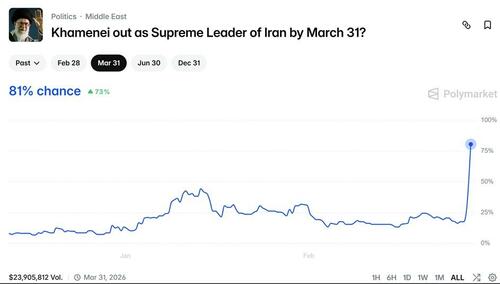
There have been rumors flying all day that Ayatollah Ali Khamenei has been killed, which Iranian officials have firmly denied. Many analysts believe that full regime change in Iran cannot happen unless there are US forces on the ground, and this prospect would be immensely unpopular among the American public.

Iran’s Foreign Minister Abbas Araghchi in Saturday remarks to NBC has said the Ayatollah is alive “as far as I know”. But he took it a step further in declaring that changing the Iranian government is “mission impossible”.

“You cannot do regime change while millions of people are supporting the so called regime,” he said.

The top diplomat underscored that millions of government supporters took to the streets upon the recent anniversary of the 1979 revolution. 

Like in Syria before under Assad, Western mainstream media almost never gives coverage to such ‘pro-regime’ demonstrations, as it would add too much complexity to the dominant Western narrative.

The Western MSM likes to manufacture a simplistic ‘goodies’ vs ‘baddies’ narrative when it comes to ‘rogue states’ – especially in the Middle East, and will never let careful, layered, historical analysis get in the way.

“Yes, there are also people who are complaining, but they are strong supporters of the regime,” Araghchi said. “And then we have a very well established political structure.”

As for whether the Ayatollah will survive a purely air war, the chances are good. Since the June war especially, the Iranians have had ample time for wartime contingency operations.

It’s likely none but Khamenei’s tightest circle knows where he is, as he commands the IRGC from a hidden underground bunker somewhere.

Iran is a nation of over 90 million people, and the size of half the European continent, or up to one-third of the continental United States land mass. The Ayatollah could be anywhere.

Two top commanders have been confirmed killed: Iran’s defense minister and the head of the IRCG forces. But like with prior instances, these positions will be quickly filled.

Tyler Durden
Sat, 02/28/2026 – 13:40

via ZeroHedge News https://ift.tt/M840xoH Tyler Durden

“Expect Moderate Disruptions”: Oil Tankers Avoid Strait Of Hormuz As Operation Fury Hits Iran

“Expect Moderate Disruptions”: Oil Tankers Avoid Strait Of Hormuz As Operation Fury Hits Iran

Automatic Identification System (AIS) vessel-tracking data indicate that multiple tankers abruptly reversed course near the entrance to the critical maritime chokepoint of the Strait of Hormuz early Saturday, following the U.S.-Israeli operation (Operation Epic Fury) targeting Islamic Revolutionary Guard Corps command-and-control infrastructure in multiple Iranian cities.

Bloomberg reporter Stephen Stapczynski pulled data from the Terminal that shows shipowners of crude oil, crude products, and LNG tankers are avoiding the strait, even though the waterway remains open and traffic has not stopped entirely.

A number of oil and LNG tankers are avoiding sailing through the Strait of Hormuz NYK has advised its ships to avoid the waterway,” Stapczynski wrote on X.

Stapczynski noted. 

Less than a day before Operation Epic Fury began, Bloomberg macro strategist Michael Ball warned, “US military action on Iran would result in sudden-yet-tradeable risk aversion. The negative markets impulse only sustains if there’s material disruption to regional oil production and shipping flows around the Strait of Hormuz.”

Map: Strait of Hormuz

Sources told CNN earlier this morning that Operation Epic Fury was the result of “months of joint planning” and will involve several days of attacks. The key question is whether the operation against Iran will spill over into next week. If it does, that would suggest potential disruptions at the critical maritime chokepoint, which handles one-fifth of global seaborne oil and LNG flows.

Rapidan Energy Group analyst Fernando Ferreira commented on the situation, indicating:

Iran understands that threatening traffic through Hormuz is its most credible asymmetric lever. Even limited interference can raise oil prices and impose immediate economic costs on the US and its partners, increasing pressure on Washington to de-escalate.

We expect at least moderate disruptions to Gulf oil flows in the coming days, with the risk tilted toward something more severe if tensions escalate further. 

And here it is:

  • FT: INSURERS TO CANCEL POLICIES FOR SHIPS IN GULF, HORMUZ STRAIT

Goldman analyst Adam Crook provided clients, shortly after the operation began, with an overview of how oil and gold were positioned heading into the weekend:

Tallulah Adams (Commods Sales): “We have seen significant engagement from the franchise in Oil and European Gas upside over previous weeks, being the most directly impacted Commodities in an escalation scenario (20% each of Global Oil and LNG flows transit through the Strait of Hormuz).

Oil remains the most direct and liquid expression as a geopolitical hedge – while a full closure of the Strait of Hormuz remains a tail scenario, even a disruption of flows through the Strait via other means (targeting of ships, insurance issues) poses an upside scenario closer to $100/bbl. Additionally, whilst not our base case, an attack on Iranian Oil infrastructure puts 2mb/d of Iran Crude exports at risk.

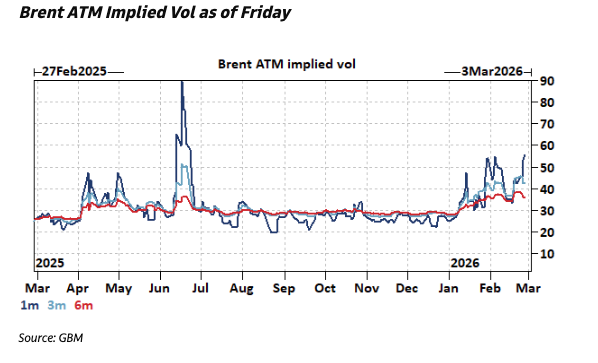
Despite a Middle East escalation remaining top of mind, positioning ironically feels cleaner (vs mid-Feb) with franchise flows skewed toward profit taking over the past week. This has kept a lid on call vols despite increasingly hawkish news flow + flat price moving higher in a high spot-vol correlation regime. Front month Brent implied volatility was at 60v on Friday, compared to a high of 90v in June last year. Meanwhile, 1 month 15 delta call skew was at 14 vols, compared to a 27 vol high last June. Net managed money (Brent + WTI combined) is sitting in the 59th percentile vs the previous 3 years. To play for a reprice in front vols and skew, we like owning front wingy outright calls.

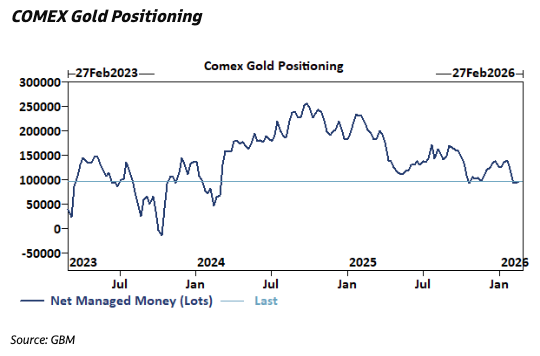
Additionally, we have seen a re-engagement in Gold upside as prices have consolidated above $5000/oz and 5 day realised vols have compressed to 27v vs a 100v high. Gold upside flow has migrated from VKO’s/Continuous KO’s to a mix of vanillas/EKO’s/Digis. While ETF holdings have continued to build, the market feels under positioned from the fast-money community – net managed money on Comex is sitting only in the 17th percentile vs the last 3 years and SHFE positioning is on multi-year lows.

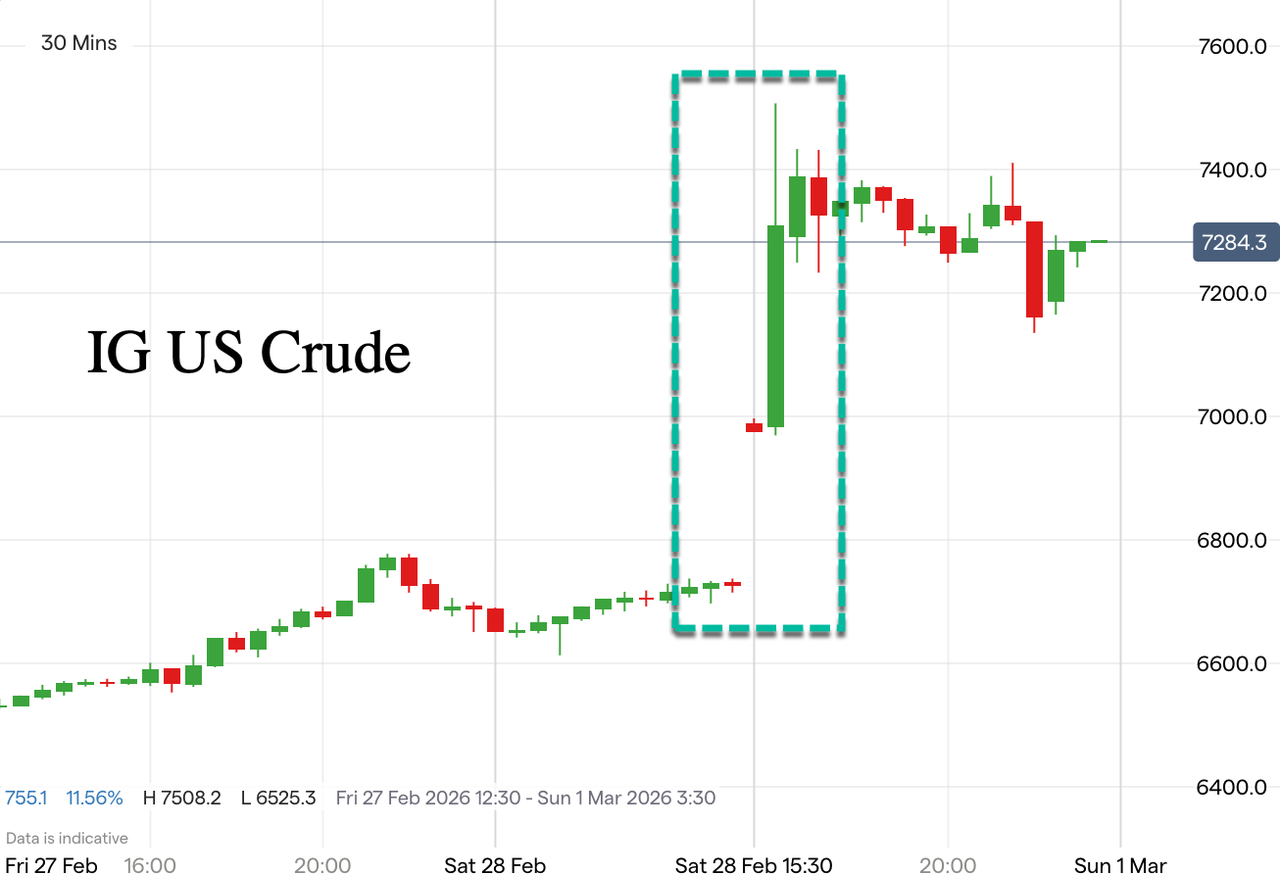
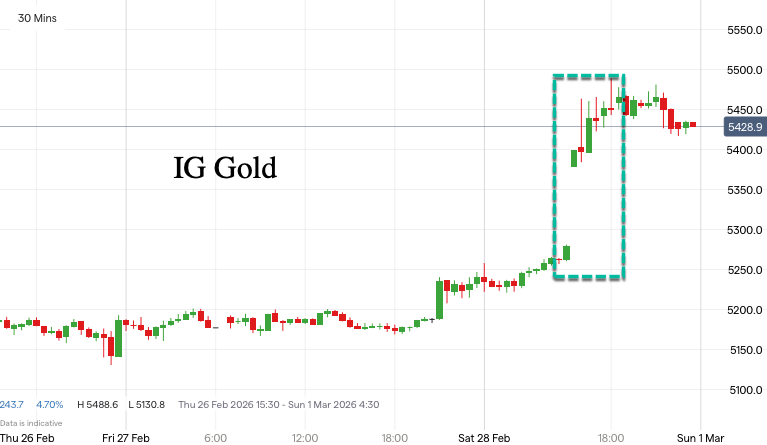
A synthetic weekend market via IG has crude oil prices up as much as 8%. 

IG has gold up nearly 3%. 

Related:

Operation Epic Fury coverage:

The key question is whether this operation remains confined to the weekend or spills into next week. If a spillover does occur, it would be unequivocally bullish for Brent crude and gold futures on Sunday evening.

Professional subscribers can read more Iran ​​​​​research on our new Marketdesk.ai portal.

Tyler Durden
Sat, 02/28/2026 – 12:15

via ZeroHedge News https://ift.tt/STH9hzp Tyler Durden

We Didn’t Just Get Expensive Electricity. We Built A System That Makes It Inevitable.

We Didn’t Just Get Expensive Electricity. We Built A System That Makes It Inevitable.

Authored by William Murray via RealClearEnergy,

Most Americans don’t think about electricity until the monthly bill arrives.

It comes once a month, often quietly, but lately it’s landed like a thud. Heating your home now costs hundreds more a month than it did just a few years ago. You use the same appliances. You flip the same switches. Nothing in your daily life has changed – except the price.

Why?

When one looks inside the electricity system, the experience is less like analyzing an immense machine than being fed into one, resembling the immortal scene in “Modern Times” where Charlie Chaplin’s factory worker is swallowed by the equipment he’s working on.

The American electricity market is not guided by an “invisible hand” of supply and demand, but an accumulation of misaligned rules laid down over decades. Layer upon layer of regulation, subsidy, mandate, and accounting rules to a point where the system became fixed in an upward, inflationary tilt, impervious to efforts to change.

There are at least a half-dozen federal environmental regulations that have more to do with rising electricity prices than tariffs or the data-center buildout, and a good example to start with is called Construction Work in Progress (CWIP).

As a new issue brief makes clear, it helped change who pays for America’s infrastructure.

Chief among these contrivances was the quiet transfer of financial risk from investors to the public. Before the 1970s, utilities had to finish building a power plant before they could charge customers for it. If a company wanted to build something, it had to take the risk. Investors would put up the money. If the project succeeded, they earned a return. If it failed, they paid the price.

But during the inflation crisis of the 1970s, power plants — especially nuclear plants —became vastly more expensive to build. Utilities argued they couldn’t afford to wait years to recover their costs. During a moment of civic weakness, state regulators started allowing utilities to charge customers while the plants were still under construction.

CWIP permanently shifted investment risk away from investors and onto ordinary people. Today, you can open your electric bill and pay for projects that don’t exist yet and may be cancelled in the future.

No banker in his right mind would accept such terms voluntarily. Yet millions of Americans are compelled to do so every month if they’re served by an investor-owned electric company.

This system could have operated below the waterline indefinitely, had it not collided with the renewable energy revolution of the last 15 years. Wind and solar generation increased fourfold between 2011 and 2020, reaching record output by 2024.

These sources have advantages. But they also have a basic limitation: they don’t produce power all the time.

So utilities must build backup systems. Extra transmission lines. Extra capacity.

None of this redundancy is free. Every mile of wire, every idle backup turbine, every overpriced and underutilized battery storage unit will eventually, without fail, appear on a customer’s bill.

And thanks to rules like CWIP, they can charge you while you wait.

Many of these policies came from a sincere place. Beginning in the 1970s and accelerating in the decades that followed, a network of public-interest law firms and environmental advocacy groups gained enormous influence over how infrastructure gets approved.

Their goal was to protect the public.

But over time, something else happened.

They built a system where stopping projects became easier than building them. Where delay became a strategy. Where lawsuits became routine.

Each delay added to costs. Each cost increase justifies charging customers sooner. Each increase made the next one easier to accept.

Even writers like the New York Times’ Ezra Klein — hardly a critic of environmental goals — have begun to acknowledge the problem. He has argued that well-intentioned rules have made it far too hard to build the infrastructure society needs.

People think this is an important admission by Klein and his ilk, but it is not.

These ‘well-intentioned rules’ were simply created by an earlier generation of Ezra Klein “Abundance” types who set up the public interest lawfare firms and NGO indulgences system in the first place.

Klein’s autopsy revealed only that the Left promotes things that make themselves feel better while making the world worse, yet their slobbering idealism protects them from feeling the shame of failed responsibility. There is a Kafkaesque process at work, filled with Orwellian word games that stymie everything. It’s a dirty, soiled, can’t-do spirit masquerading as something more noble and dignified.

Because the issue isn’t whether the goals were noble. Noble intentions don’t matter.

It’s that the results are what matter, and the results are failures.

There is, however, a remedy — not a technological breakthrough, but something far better (albeit rarer) in Washington: legislative clarity.

One promising approach is legislation such as Representative Troy Balderson’s “Affordable, Reliable, Clean Energy Security Act.” The bill seeks to establish clearer definitions of key terms like “affordable,” “reliable,” and “clean,” ensuring that investment risks are limited to cost-effective infrastructure projects only.

By recognizing the role of dispatchable resources such as natural gas and nuclear power, the legislation would also help ensure the grid maintains the reliability necessary to support modern life, all while meeting the standards of the Clean Air Act.

These reforms would not eliminate electricity price increases overnight. But they would begin to address one of the root causes: a system in which incentives increasingly misalign diverge from the interests of customers.

Electricity is not a luxury. It is a necessity that underpins economic growth, public safety, and household stability. Ensuring its affordability requires more than promises. It requires policies that encourage efficient investment, allocate risk appropriately, and maintain reliability.

Most of all, it comes from remembering a basic principle that once guided American growth:

You should pay for things when they work.

Not before.

Until that principle returns, electricity bills will continue their quiet climb upward, and Americans will continue to wonder why modern life feels harder to afford than it used to.

William Murray is a former speechwriter for the Environmental Protection Agency (EPA), the past editor of RealClearEnergy from 2015-2017, and currently the chief speechwriter for the Commodity Futures Trading Commission (CFTC).

Tyler Durden
Sat, 02/28/2026 – 11:40

via ZeroHedge News https://ift.tt/2sxEvgF Tyler Durden

An Unconstitutional War

Frame grab from an eight minute statement made by United States President Donald J Trump that was released via his X account concerning the United States attack on Iran, on Saturday, February 28, 2026.
Frame grab from an eight minute statement made by United States President Donald J Trump that was released via his X account concerning the United States attack on Iran, on Saturday, February 28, 2026. (@realDonaldTrump via CNP/Newscom)


Last night, the US and Israel initiated a large-scale military attack on Iran. This action is blatantly unconstitutional. Its wisdom and morality are are more debatable.

Article I of the Constitution gives Congress the exclusive power to declare war. One can debate the extent to which presidents can initiate relatively small-scale military actions, and such debates have raged for decades. But this attack is very obviously large enough to qualify as a war. Thus, it just as obviously requires congressional authorization. And Trump didn’t get any, and indeed did not even try to do so.

Don’t take my word for the proposition that it’s a war. Take Trump’s! He himself has called it a war, and proclaimed that the objective is regime change.

The closest historical analogue is Barack Obama’s 2011 air campaign against Libya, which was also attempt at regime change carried out with air strikes. For those keeping score, I condemned Obama’s action and repeatedly criticized him for violating the Constitution and the War Powers Act (see also here). But Iran is a larger and more powerful nation than Libya, and thus this is likely to be an even bigger conflict. And, as I have said before, Obama’s illegal actions don’t justify Trump’s (and vice versa).

The wisdom and morality of this action are a closer call. I am no reflexive opponent of military intervention, and I think regime change is sometimes justified. I have long differed on these issues with more dovish/isolationist libertarians.

The Iranian regime is a brutally oppressive dictatorship that recently slaughtered tens of thousands protesters, has a long history of promoting terrorism, and constantly seeks to develop nuclear weapons. For these and other reasons, I would welcome regime change there. Even if the new government is far from ideal, it is likely to less awful than regime of the ayatollahs. But I am skeptical that regime change can be achieved with air and missile strikes alone. And, at this point, it does not not seem like the US and Israel have either the will or the capability of launching a major ground invasion. If the latter is attempted, it might turn out to be too costly to be worth it.

Perhaps airpower could achieve regime changes if coupled with a strong opposition movement within Iran. But Trump waited until after the regime crushed the protests that arose a few weeks ago, in the process slaughtering tens of thousands. It may be difficult or impossible for a strong opposition movement to emerge again, without a ground attack.

War is inherently dynamic, and it would be foolish to make definitive predictions. I have been largely out of the field of security studies for many years now, and thus no longer have much relevant up-to-date expertise. Thus, at this point, I can only say I am skeptical this intervention will achieve the regime change Trump seeks, or any other beneficial result great enough to outweigh the damage done to our constitutional system.

That latter is not just a technical legal issue. The requirement of congressional authorization for the initiation of war is there to ensure that no one person can take the country to war on his own, and that any major military action have broad public support, which can be essential to ensuring that we have the will and commitment needed to achieve victory against difficult opponents.

I will note one clear beneficial consequence of this action that has largely been ignored by the media so far: Iran is a major supplier of weapons to Russia for its war of aggression against Ukraine. As long as Iran is fighting the US and Israel, it is unlikely to continue extensive weapons deliveries to Russia, since it will need those arms for its own use.

But, on balance, it would have been more effective to help Ukraine by simply giving them weapons directly, which Trump has largely stopped doing. And, unlike starting a war without congressional authorization, giving arms to Ukraine doesn’t violate the Constitution, and does not expose US forces to any significant risk.

In sum, this is a blatantly unconstitutional war. Time will tell whether it achieves any beneficial results that outweigh the costs – including the damage to our constitutional system of separation of powers.

The post An Unconstitutional War appeared first on Reason.com.

from Latest – Reason.com https://ift.tt/f1RyjEm
via IFTTT

Anthropic Labeled a Supply Chain Risk, Banned from Federal Government Contracts


Secretary of War Pete Hegseth delivers remarks to L3Harris employees as part of his Arsenal of Freedom Tour, Camden, Ark., Feb. 27, 2026. (POLARIS) | Polaris/Newscom

President Donald Trump banned all federal agencies from contracting with Anthropic after the company refused to remove its restrictions on domestic mass surveillance and fully autonomous weapons systems from its AI model, Claude. Later that same day, OpenAI CEO Sam Altman announced that the Defense Department had agreed to use ChatGPT supposedly subject to the very same restrictions. 

The acrimony between the federal government and Anthropic, which had been brewing for two months, reached a boiling point on Tuesday, when Defense Secretary Pete Hegseth and Anthropic CEO Dario Amodei met to discuss the terms of the Defense Department’s contract with Anthropic. Hegseth demanded that Anthropic equip the Pentagon with an AI model “free from usage policy constraints that may limit lawful military applications” or be labeled a supply chain risk and possibly nationalized. 

Amodei refused, publishing a public letter Thursday night explaining his constitutional, ethical, and technical concerns about unleashing AI capable of surveilling American citizens at home and executing people abroad according to its own judgment instead of a human being’s. 

On Friday evening, Hegseth made good on his promise. Following Trump’s declaration that “EVERY Federal Agency in the United States Government…IMMEDIATELY CEASE all use of Anthropic’s technology,” Hegseth directed the Defense Department to designate Anthropic a supply chain risk to national security. This means that “no contractor, supplier, or partner that does business with the United States military may conduct any commercial activity with Anthropic,” according to Hegeth’s statement

Mark Dalton, senior director of technology and innovation at the R Street Institute, says the Pentagon is guilty of a glaring contradiction: “consider[ing] Anthropic’s technology so vital to national defense that they thought that invoking the Defense Production Act was justified to retain access” earlier this week, and then “suddenly [designating the company] a supply chain risk.” 

Anthropic is such a national security that the president is permitting a six-month window during which federal agencies, including the Pentagon, will continue using Claude.

Dalton warns that “the next time the designation is applied to a company with actual ties to a foreign adversary, the credibility to make that case will be diminished.” Dean Ball, senior fellow at the Foundation for American Innovation, described the designation as “the most damaging policy move I have ever seen USG try to take.”

It’s unclear why Anthropic is just now being deemed a national security threat. The company’s usage policy has explicitly prohibited the use of its AI models for domestic surveillance purposes and to “produce, modify, design, market, or distribute weapons, explosives, dangerous materials or other systems designed to cause harm to or loss of human life” since June 2024, when it began supporting American warfighters. (These provisos are maintained in Anthropic’s current usage policy.)  The company received its $200 million Pentagon contract over a year later, in July 2025. 

Neither the president nor the secretary of defense were ignorant of these usage conditions. 

Trump implied that the Pentagon had stipulated to these terms of services in his Friday Truth Social post: “The Leftwing nut jobs at Anthropic have made a DISASTROUS MISTAKE trying to STRONG-ARM the Department of War, and force them to obey their Terms of Service instead of our Constitution” (emphasis added). Hegseth did likewise, stating that “the Terms of Service of Anthropic’s defective altruism will never outweigh the safety, the readiness, or the lives of American troops on the battlefield.” 

Neither Trump nor Hegseth have claimed that Amodei changed Anthropic’s terms of service to commandeer foreign policy and military decisions from the federal government. 

Friday night, OpenAI CEO Sam Altman announced that ChatGPT will replace Claude at the Pentagon after he “reached an agreement with the Department of War to deploy our models in their classified network.” Altman claimed that the Defense Department agrees with OpenAI’s “most important safety principles…prohibitions on domestic mass surveillance and human responsibility for the use of force…and we put them into our agreement.” 

Such an agreement would be identical to the one for which the Pentagon declared Anthropic a supply chain risk.

About an hour after Altman’s announcement, Under Secretary for Foreign Assistance Jeremy Lewin clarified that the terms of the OpenAI-Pentagon contract flow “from the touchstone of ‘all lawful use’ that DoW has rightfully insisted upon & xAI agreed to.” 

In a statement responding to Hegseth’s comments, Anthropic stated that “no amount of intimidation or punishment from the Department of War will change our position on mass domestic surveillance or fully autonomous weapons,” and that the company “will challenge any supply chain risk designation in court.”

The post Anthropic Labeled a Supply Chain Risk, Banned from Federal Government Contracts appeared first on Reason.com.

from Latest – Reason.com https://ift.tt/lOf6apD
via IFTTT

Anthropic Labeled a Supply Chain Risk, Banned from Federal Government Contracts


Secretary of War Pete Hegseth delivers remarks to L3Harris employees as part of his Arsenal of Freedom Tour, Camden, Ark., Feb. 27, 2026. (POLARIS) | Polaris/Newscom

President Donald Trump banned all federal agencies from contracting with Anthropic after the company refused to remove its restrictions on domestic mass surveillance and fully autonomous weapons systems from its AI model, Claude. Later that same day, OpenAI CEO Sam Altman announced that the Defense Department had agreed to use ChatGPT supposedly subject to the very same restrictions. 

The acrimony between the federal government and Anthropic, which had been brewing for two months, reached a boiling point on Tuesday, when Defense Secretary Pete Hegseth and Anthropic CEO Dario Amodei met to discuss the terms of the Defense Department’s contract with Anthropic. Hegseth demanded that Anthropic equip the Pentagon with an AI model “free from usage policy constraints that may limit lawful military applications” or be labeled a supply chain risk and possibly nationalized. 

Amodei refused, publishing a public letter Thursday night explaining his constitutional, ethical, and technical concerns about unleashing AI capable of surveilling American citizens at home and executing people abroad according to its own judgment instead of a human being’s. 

On Friday evening, Hegseth made good on his promise. Following Trump’s declaration that “EVERY Federal Agency in the United States Government…IMMEDIATELY CEASE all use of Anthropic’s technology,” Hegseth directed the Defense Department to designate Anthropic a supply chain risk to national security. This means that “no contractor, supplier, or partner that does business with the United States military may conduct any commercial activity with Anthropic,” according to Hegeth’s statement

Mark Dalton, senior director of technology and innovation at the R Street Institute, says the Pentagon is guilty of a glaring contradiction: “consider[ing] Anthropic’s technology so vital to national defense that they thought that invoking the Defense Production Act was justified to retain access” earlier this week, and then “suddenly [designating the company] a supply chain risk.” 

Anthropic is such a national security that the president is permitting a six-month window during which federal agencies, including the Pentagon, will continue using Claude.

Dalton warns that “the next time the designation is applied to a company with actual ties to a foreign adversary, the credibility to make that case will be diminished.” Dean Ball, senior fellow at the Foundation for American Innovation, described the designation as “the most damaging policy move I have ever seen USG try to take.”

It’s unclear why Anthropic is just now being deemed a national security threat. The company’s usage policy has explicitly prohibited the use of its AI models for domestic surveillance purposes and to “produce, modify, design, market, or distribute weapons, explosives, dangerous materials or other systems designed to cause harm to or loss of human life” since June 2024, when it began supporting American warfighters. (These provisos are maintained in Anthropic’s current usage policy.)  The company received its $200 million Pentagon contract over a year later, in July 2025. 

Neither the president nor the secretary of defense were ignorant of these usage conditions. 

Trump implied that the Pentagon had stipulated to these terms of services in his Friday Truth Social post: “The Leftwing nut jobs at Anthropic have made a DISASTROUS MISTAKE trying to STRONG-ARM the Department of War, and force them to obey their Terms of Service instead of our Constitution” (emphasis added). Hegseth did likewise, stating that “the Terms of Service of Anthropic’s defective altruism will never outweigh the safety, the readiness, or the lives of American troops on the battlefield.” 

Neither Trump nor Hegseth have claimed that Amodei changed Anthropic’s terms of service to commandeer foreign policy and military decisions from the federal government. 

Friday night, OpenAI CEO Sam Altman announced that ChatGPT will replace Claude at the Pentagon after he “reached an agreement with the Department of War to deploy our models in their classified network.” Altman claimed that the Defense Department agrees with OpenAI’s “most important safety principles…prohibitions on domestic mass surveillance and human responsibility for the use of force…and we put them into our agreement.” 

Such an agreement would be identical to the one for which the Pentagon declared Anthropic a supply chain risk.

About an hour after Altman’s announcement, Under Secretary for Foreign Assistance Jeremy Lewin clarified that the terms of the OpenAI-Pentagon contract flow “from the touchstone of ‘all lawful use’ that DoW has rightfully insisted upon & xAI agreed to.” 

In a statement responding to Hegseth’s comments, Anthropic stated that “no amount of intimidation or punishment from the Department of War will change our position on mass domestic surveillance or fully autonomous weapons,” and that the company “will challenge any supply chain risk designation in court.”

The post Anthropic Labeled a Supply Chain Risk, Banned from Federal Government Contracts appeared first on Reason.com.

from Latest – Reason.com https://ift.tt/lOf6apD
via IFTTT

Russia Condemns US Attack On Iran, Warns Of Possible ‘Radiological Catastrophe’

Russia Condemns US Attack On Iran, Warns Of Possible ‘Radiological Catastrophe’

As fully predictable, Moscow has blasted the major overnight and early morning US-Israeli strikes on Iran, calling the attack “a preplanned and unprovoked act of armed aggression against a sovereign and independent U.N. member state” and has demanded an immediate halt to the military campaign and a return to diplomacy.

The Foreign Ministry in a statement on Telegram accused Washington and Tel Aviv of “hiding behind” concerns about Iran’s nuclear program while actually pursuing regime change, as also cited in The Associated Press.

After all, even on Friday Iran was strongly signaling readiness to take enrichment down to zero, as our own headline and others indicated: Iran Reportedly Agrees To Give Up Nuclear Material In Breakthrough: ‘Peace Deal Within Reach’.

Moscow is further warning of Iraq-style catastrophe and a regional domino effect which could unleash terrorism and chaos for years to come. The attacks could trigger “humanitarian, economic and possibly radiological catastrophe” in the region, and charged the US and Israel of “plunging the Middle East into an abyss of uncontrolled escalation.”

Bombs fall on Tehran Saturday, via AP.

However, the Kremlin is unlikely to come to Iran’s rescue in any direct way, given it is carefully trying to balance and restore relations with Washington in the context of the Ukraine war.

As for that other raging conflict in Eastern Europe, now four years in, Ukraine has come out in support of the US attacks on Iran. This is understandable, given the Iranians have long supplied Moscow with suicide drones which have wreaked havoc on Ukrainian cities.

China too has condemned the attack on Iran alongside Moscow, but using words much more restrained that Russia’s. “China calls for an immediate stop of the military actions, no further escalation of the tense situation, resumption of dialogue and negotiation, and efforts to uphold peace and stability in the Middle East,” its foreign ministry ministry said on X.

Most or all of the BRICS countries are expected to come out against the US-Israeli aggression. Europe is expected to by and large stay on the sidelines, fearing that any broader Mideast war would have spillover effects, such as another potential refugee crisis.

The UK, Germany and France have said nothing specifically on the ‘legality’ of the unprovoked US attack on Tehran, but have instead condemned the Iranian response.

They released a joint statement telling Iran to stop its attacks on US-Israeli assets and bases in the region. “We condemn Iranian attacks on countries in the region in the strongest terms,” French President Emmanuel Macron, German Chancellor Friedrich Merz and British Prime Minister Keir Starmer said.

Iran is meanwhile alleging major war crimes:

However, they did urge a return to diplomacy (maybe trying telling Washington that): “We call for a resumption of negotiations and urge the Iranian leadership to seek a negotiated solution. Ultimately, the Iranian people must be allowed to determine their future,” the statement added. “We reiterate our commitment to regional stability and to the protection of civilian life,” the statement ended with.

Tyler Durden
Sat, 02/28/2026 – 11:05

via ZeroHedge News https://ift.tt/kKpdxAD Tyler Durden

Economic Sentiment Belies Strong Economic Estimates

Economic Sentiment Belies Strong Economic Estimates

Authored by Lance Roberts via RealInvestmentAdvice.com,

Economic growth metrics for the United States have recently shown surprising resilience; however, consumers’ economic sentiment has not.

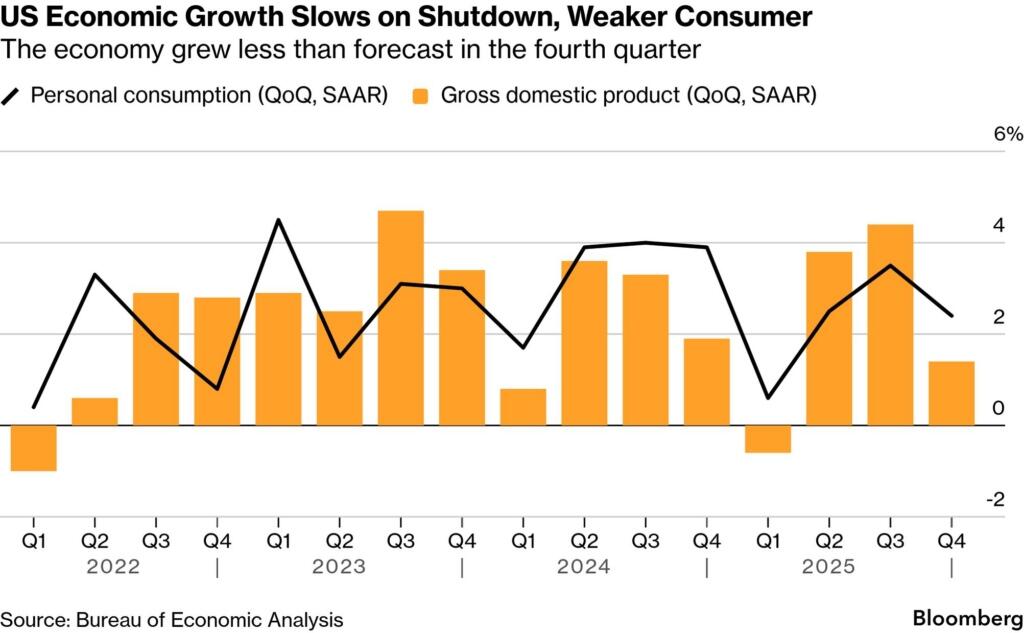
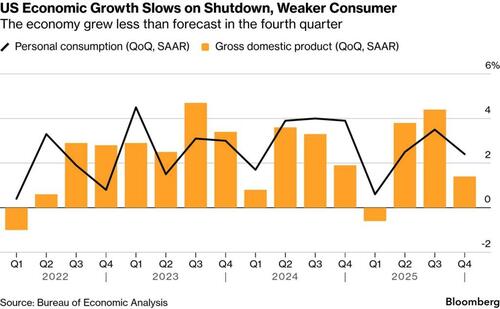
According to the Bureau of Economic Analysis’s advance estimate, real Gross Domestic Product expanded at an annualized rate of just 1.4%, well below expectations and a steep drop from the 4.4% pace in the third quarter. However, the record-long federal government shutdown, which ran from October 1 through November 12, subtracted roughly 1 full percentage point from growth, as federal outlays plunged 16.6%.

Stripping out that self-inflicted drag, underlying growth was closer to 2.4%, a pace more consistent with a healthy expansion. Consumer expenditures rose 2.4%, moderating from the third quarter’s 3.5% but still solid, while business investment climbed a healthy 3.8%, powered by the ongoing AI-driven capital spending boom. With the government now reopened, the shutdown’s drag is expected to reverse in early 2026, providing a tailwind to first-quarter growth.
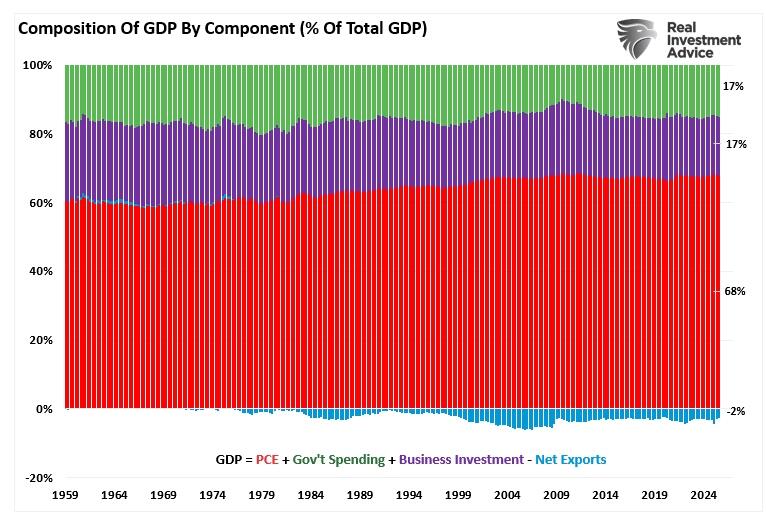
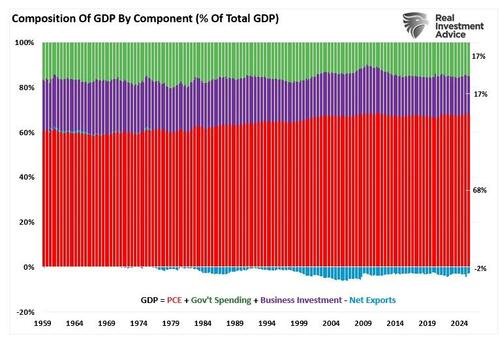
Notably, Gross Domestic Product (GDP) measures the total output of goods and services in the U.S. Of that total, personal consumption expenditures (PCE) comprise roughly 68%. In other words, so goes the consumer, so goes the economy.
When GDP climbs, it signals more economic activity (i.e., consumer demand), which then fuels broader expansion of production. Naturally, GDP growth rates are closely monitored by policymakers, investors, and corporate planners. There is much interpretation of GDP growth as evidence of potential for higher sales and profits going forward, but it does not tell the full story of individual households’ financial experiences.

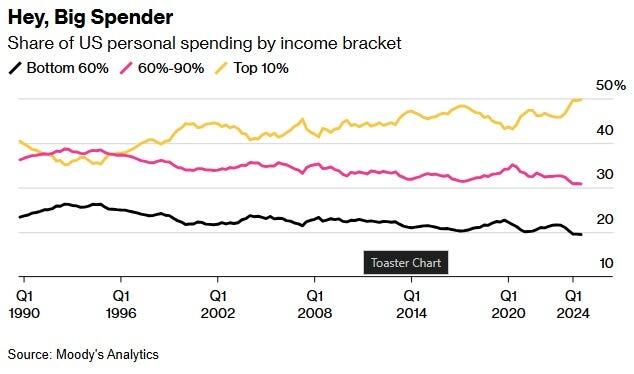
Crucially, economic growth numbers focus only on aggregate performance and do not capture income distribution, regional variations, or the lived experiences of millions of households. A good example of this is the share of U.S. spending by income bracket. Currently, roughly 50% of all consumer spending is driven by the top 10% of income earners, and is increasing, while it is falling for the bottom 90%.
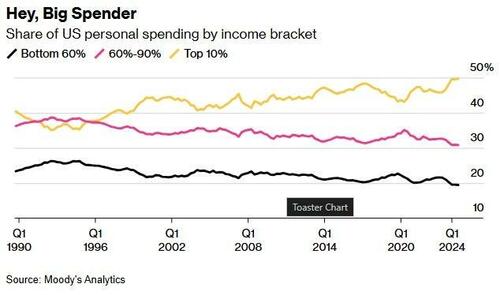
In other words, while we may see strong headline numbers, the numbers can mask pockets of stress in households and small businesses. Furthermore, growth driven by exports or government spending may fail to reach wide swaths of workers, further distorting the headline reading. A good example of that distortion was seen in 2025, when imports to get ahead of tariffs weighed heavily on the Q1 GDP reading, but then reversed sharply in Q2 as fears abated, leading to a sharp rebound. Those distortions had little impact on consumers as a whole.

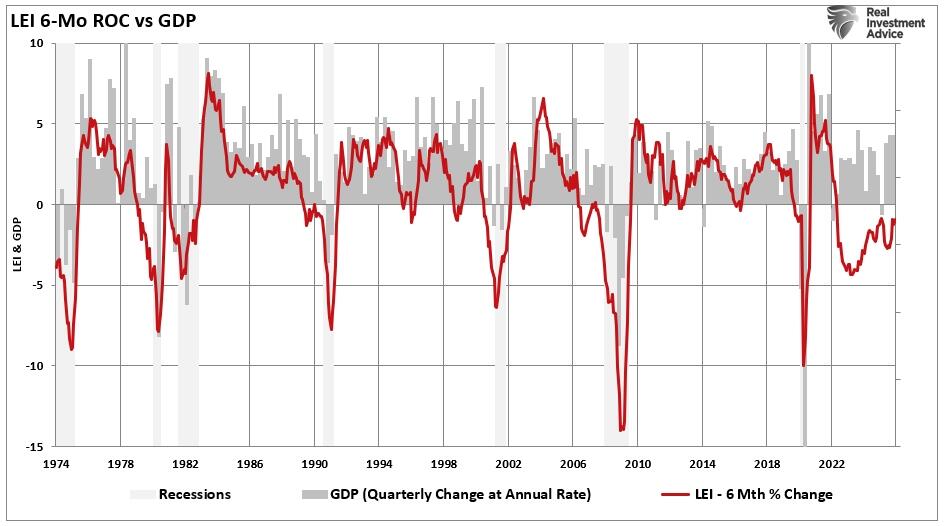
However, while economic growth statistics paint a picture of a robust backdrop, other coincident indicators, such as the Conference Board Leading Economic Index (LEI), paint a different picture. For example, the LEI, which tends to lead the US economy by about six months, has remained in contraction for a very long period. Such is why the 6-month rate of change of the LEI has historically been one of the most accurate indicators of contractions and recessions. However, despite a contraction in the LEI, the economy never registered a recession.
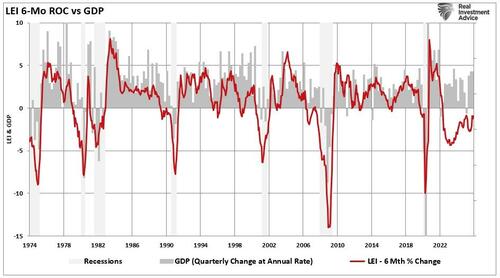
Yes, based on headline economic growth data, the economy looks solid for now. However, if we dig deeper, we find mixed signals beneath the surface, which may explain the difference between economic headlines and economic sentiment.

The Disconnect Between Stock Market Gains And Current Sentiment

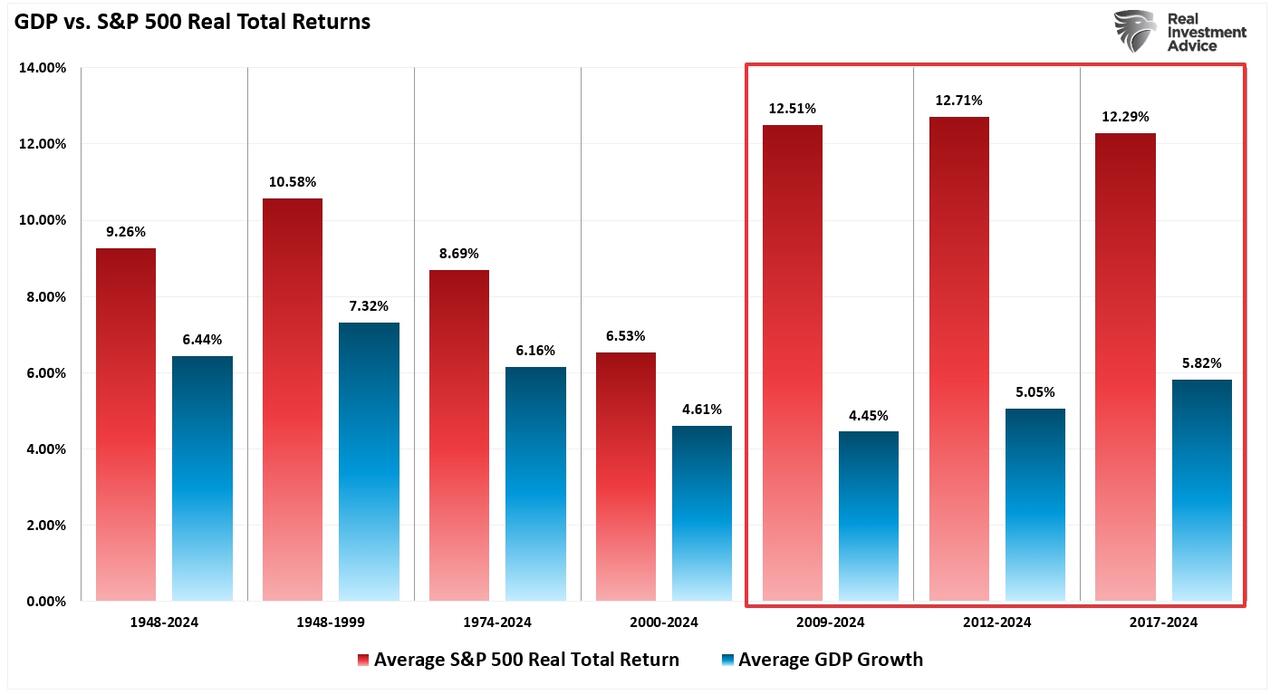
Historically, it is logical that stock markets and economic statistics should move together over the long run. As we discussed in “Return Expectations Are Too High,”

“The chart below shows the average annual inflation-adjusted total returns (dividends included) since 1948. I used total-return data from Aswath Damodaran at the NYU Stern School of Business. The chart shows that from 1948 to 2024, the market returned 9.26% after inflation. However, after the 2008 financial crisis, inflation-adjusted total returns jumped by nearly three percentage points for the last three observation periods.

Here is the issue. Total real (inflation-adjusted) stock market returns are easy to calculateThey are a function of economic growth (GDP) plus dividends less inflation. Such was the case from 1948 to 2000. However, since 2008, GDP growth has averaged roughly 5% with a dividend yield of 2%, yet returns have far surpassed what the economy can generate in earnings.”
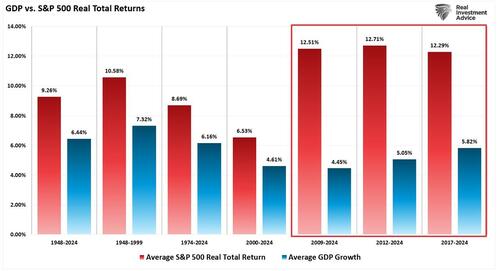
That divergence over the last 15 years is unsurprising as we noted in “Pavlov Rings The Bell” in investing?

“Over the past 15 years, the markets were repeatedly bailed out of more serious corrections by either fiscal or monetary policy. That neutral stimulus (the interventions) was repeatedly paired with a reward-stimulus of markets going higher. As such, investors were “conditioned” to expect rescue whenever issues arise, to buy stocks on every decline, and to believe that this cycle will indefinitely continue. This was the point we made recently regarding “moral hazard.”

“The Federal Reserve’s well-intentioned interventions have created one of modern finance’s most powerful behavioral distortions: the conviction that there is always a safety net. After the Global Financial Crisis, zero interest rates and repeated rounds of quantitative easing conditioned investors to expect that policy support would always return during volatility. Over time, that conditioning hardened into a reflex: buy every dip, because the Fed will not allow markets to fail. What exactly is the definition of ‘moral hazard?’ 

Noun – ECONOMICSThe lack of incentive to guard against risk where one is protected from its consequences, e.g., by insurance.

Those constant sustained supports in both the economy and the financial markets were the foundation behind the break between economic realities and financial returns.
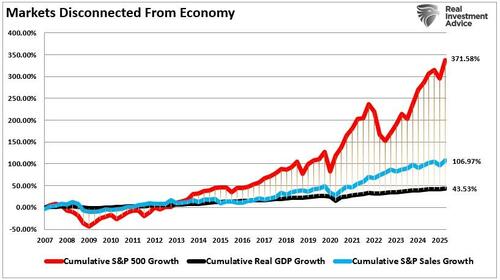
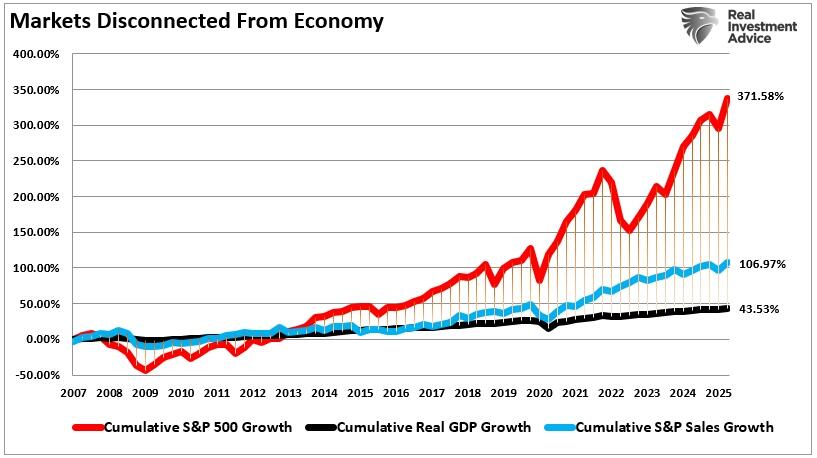
Currently, while GDP growth has surprised to the upside and some macro data show economic resilience, major equity indices such as the S&P 500 have also risen to new heights, driven by investor expectations for future earnings growth rather than the current consumer mood. The problem, as shown above, is that the markets are very detached from actual revenue growth.

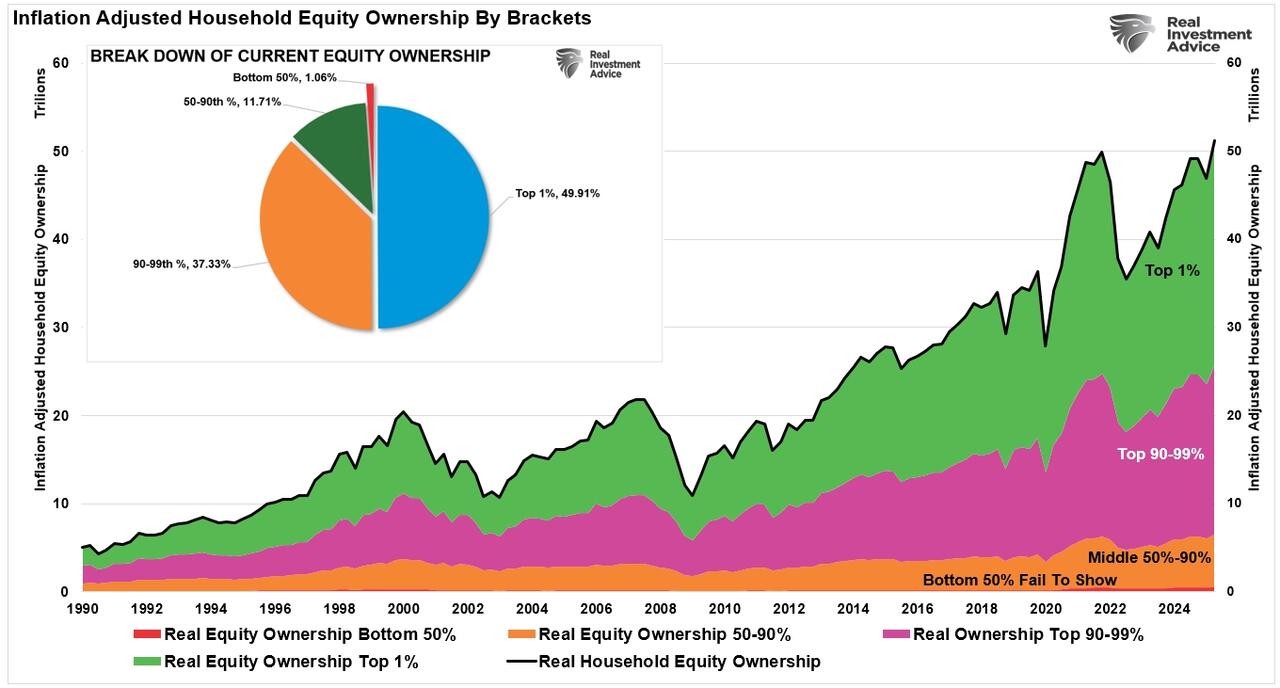
Another problem with the headline data is that while stock market performance has exceeded historical expectations, its impact on the overall economy has become more mutedWhile equity values have surged, creating a “wealth effect” that supports consumption, that effect remains primarily confined to the top 10% of the population that owns 87% of the equity market. As noted above, the top 40% of income earners currently account for roughly 80% of total consumption.
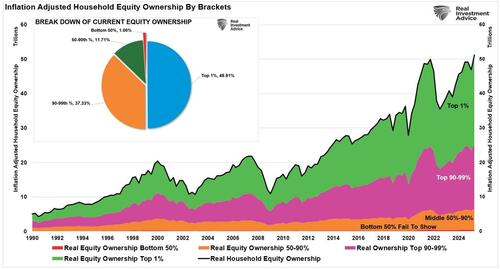
That divergence helps explain the gap between weak consumer sentiment and strong economic data.

Consumer Sentiment Surveys Weak Despite Strong Data

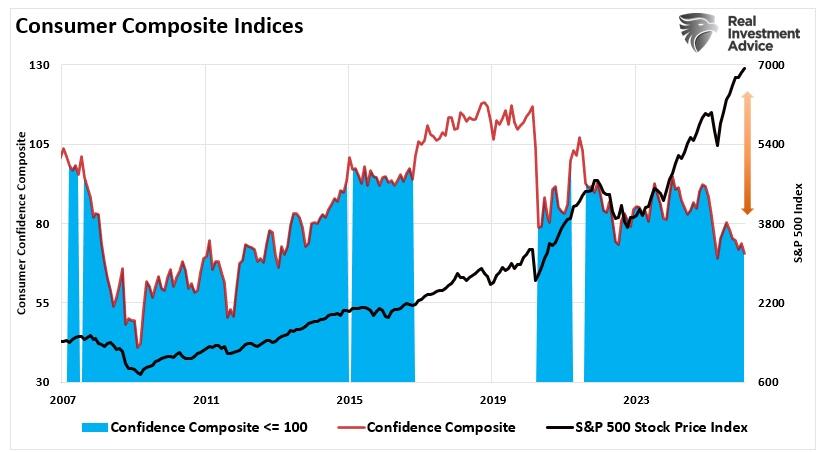
In stark contrast with macro indicators and stock market performance, consumer sentiment surveys have shown marked weakness. Both the Conference Board Consumer Confidence Index and the University of Michigan Surveys have dropped sharply over the last two years, while the stock market has risen sharply. As shown, when markets are rising, consumer sentiment tends to rise with them, which makes sense. The chart below is a composite indicator of both primary consumer sentiment measures.
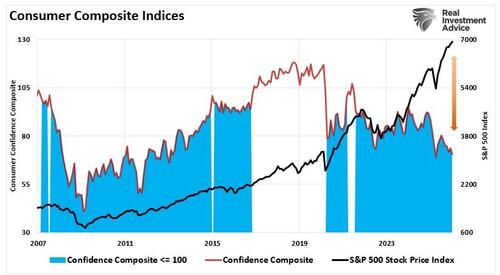
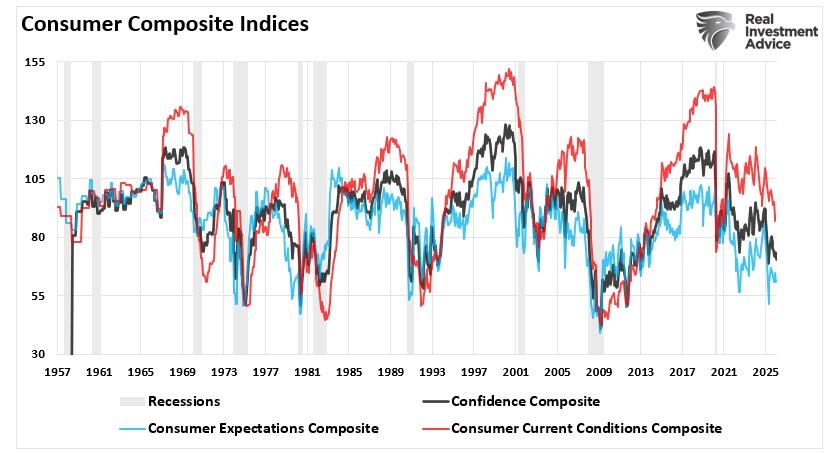
However, in both cases, the current situation assessments and future expectations remain very weak, with the expectations component falling below levels historically associated with recession signals.
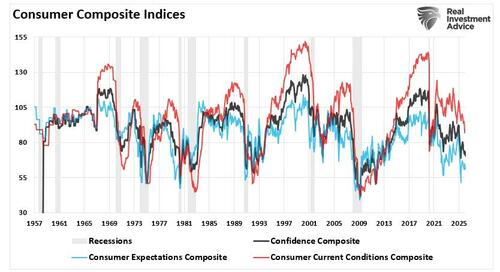
The decline reflects growing pessimism about job prospects, business conditions, and future income, and consumers cited concerns about inflation, high prices, food and energy costs, affordability of health insurance, and geopolitical or political uncertainty. While the surveys captured widespread unease, GDP continued to expand.

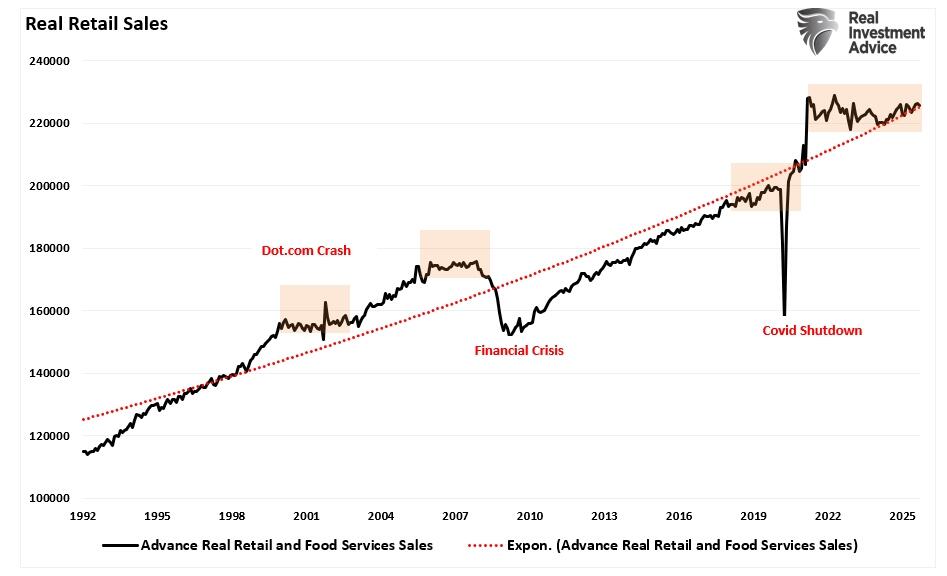
Notably, the divergence between sentiment and economic data is not unique to this moment. Analysts have long noted that consumer mood often lags hard data, and we hope to see sentiment turn higher if the economy continues to expand. It is worth stating that in the short term, surveys often reflect fear and uncertainty, which may depress sentiment even if actual spending behavior remains relatively strong. However, while nominal data suggests that consumer spending remains resilient, that resilience has not been a function of “buying more” products, but simply buying the same amount, or less, at higher prices, which certainly explains the decline in sentiment readings.
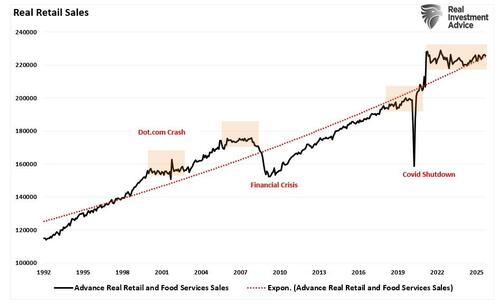
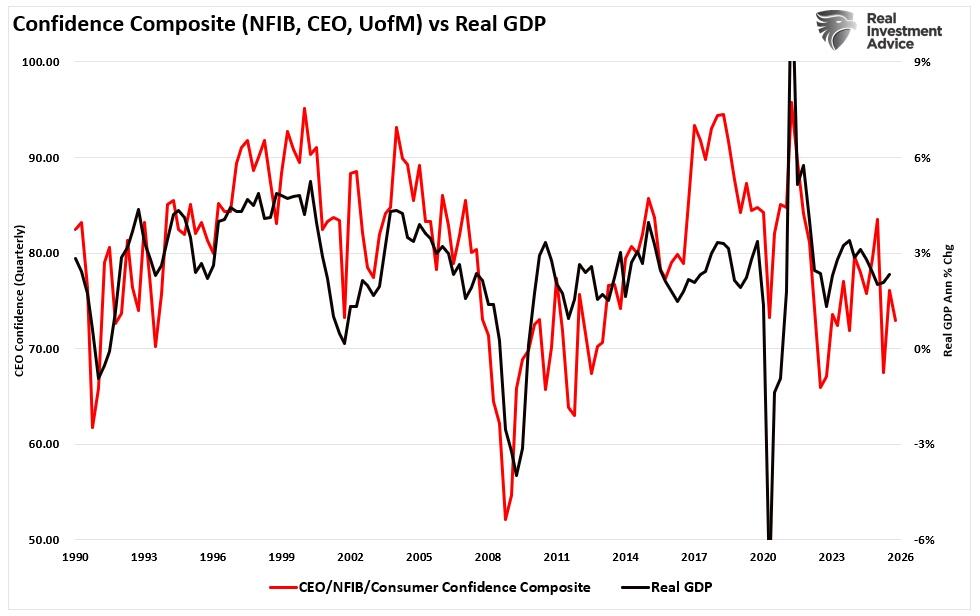
Crucially, understanding that if consumer sentiment drives consumption, and consumption makes up 68% of the economy, that consumption is the demand for small and large businesses. Therefore, if economic growth is robust, we should see demand reflected in increased sentiment across the spectrum. However, as the combined composite shows, those sentiment readings remain weak. Note the correlation between sentiment and the future direction of economic activity.
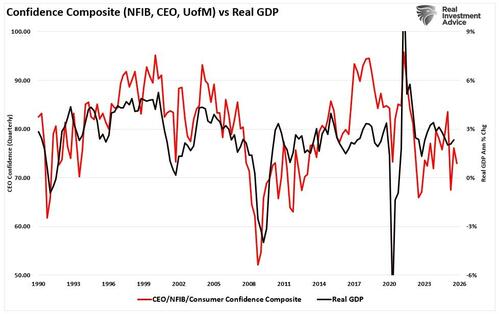
These weak sentiment readings do not automatically translate to immediate economic contraction. But they indicate a cautious mood among households and business owners. That caution may lead to reduced spending on both sides of the GDP equation. Such a slowdown seems logical if economic sentiment remains subdued.

Why the Divergence Matters and What It Signals for the Future

The split between improving economic statistics, rising markets, and weak consumer sentiment has important implications. First, it suggests an economy operating on multiple tracks. Macro data points to expansion, supporting the rise in stock prices and earnings expectations. However, the drivers of that expansion and earnings feel insecure and pessimistic.

That divergence raises several questions.

  • Is growth sustainable if sentiment remains weak?

  • Will strong corporate profits continue if consumers pull back?

  • Could widespread pessimism eventually feed into economic behavior, causing slower spending and slower growth?

History offers cautionary examples of negative sentiment preceding downturns. Such is not because the data was wrong, but because mood eventually influenced real behavior.

Secondly, the divergence also highlights distributional issues. As noted above, aggregate growth does not capture income and wealth disparities. While high-income households account for 50% of spending, lower-income households are less likely to fully benefit from macroeconomic expansion. That reality contributes to weak sentiment. This leaves the markets exposed to events that cause high-income earners to cut spending. Such is particularly the case when there is no buffer between the “haves” and “have-nots.”

From an investment standpoint, this mixed picture calls for increased risk management. While the market is rising on higher earnings expectations, those expectations are subject to rapid shifts as economic realities emerge. As such, investors should assess risk precisely, considering both macro signals and consumer behavior.

  • Evaluate valuations carefully. Rising indices do not rule out overvaluation. Focus on companies with strong balance sheets, stable cash flow, and pricing power.

  • Diversify across sectors. Performance may vary. Defensive sectors like utilities, consumer staples, and healthcare often outperform during sentiment-driven slowdowns.

  • Monitor leading indicators. Pay attention to leading economic indexes, employment data, and consumer credit trends. Weak sentiment may foreshadow slower growth.

  • Keep liquidity. Maintain cash reserves to deploy when conditions change. Divergence creates volatility.

  • Consider hedges. Bonds or volatility-linked strategies may reduce risk if sentiment shifts markets.

  • Focus on quality. Quality companies with competitive advantages are more likely to weather shifts.

This divergence between data, markets, and sentiment is a critical economic signal. How this all works out, no one knows for sure. While there are currently plenty of valid reasons markets can only go higher and that investors should “buy the dip,” it seems prudent to consider the other side of those arguments.

To steal a line from Bob Farrell:

Historically speaking, when “all experts agree,” it has paid dividends to stay disciplined and prepare for the possibility that “something else tends to happen.

Tyler Durden
Sat, 02/28/2026 – 10:30

via ZeroHedge News https://ift.tt/lGnOYb1 Tyler Durden

The Inflation Spark That Could Become A Deflation Shock

The Inflation Spark That Could Become A Deflation Shock

Authored by Robert Burrows via BondVigilantes.com,

Memory chips have quietly become the most important commodities in the global economy.

DRAM (Dynamic Random Access Memory) is considered the workhorse of the digital world. It functions as the operating memory when a device is turned on, and this memory is lost when a device is switched off.  These chips are used in almost all electronic devices. They play a critical role and sit at the heart of everything from AI servers, cars, smartphones, laptops and more.

The Nvidia type of chips – GPUs (Graphics Processing Units) – are used for computational purposes but are also heavily reliant on DRAM chips.

Many will be aware of the rise of semiconductors and the rapid ascent of Nvidia but few will be aware of the changes ripping through another part of the semiconductor industry: DRAM chips, which have a very direct effect on all of our everyday lives. When Covid disrupted supply chains, we saw all sorts of issues from price increases to availability of goods. Remember when the price of second hand cars were trading at levels close to new cars as the old cars had the necessary chips, while new ones had to go without.

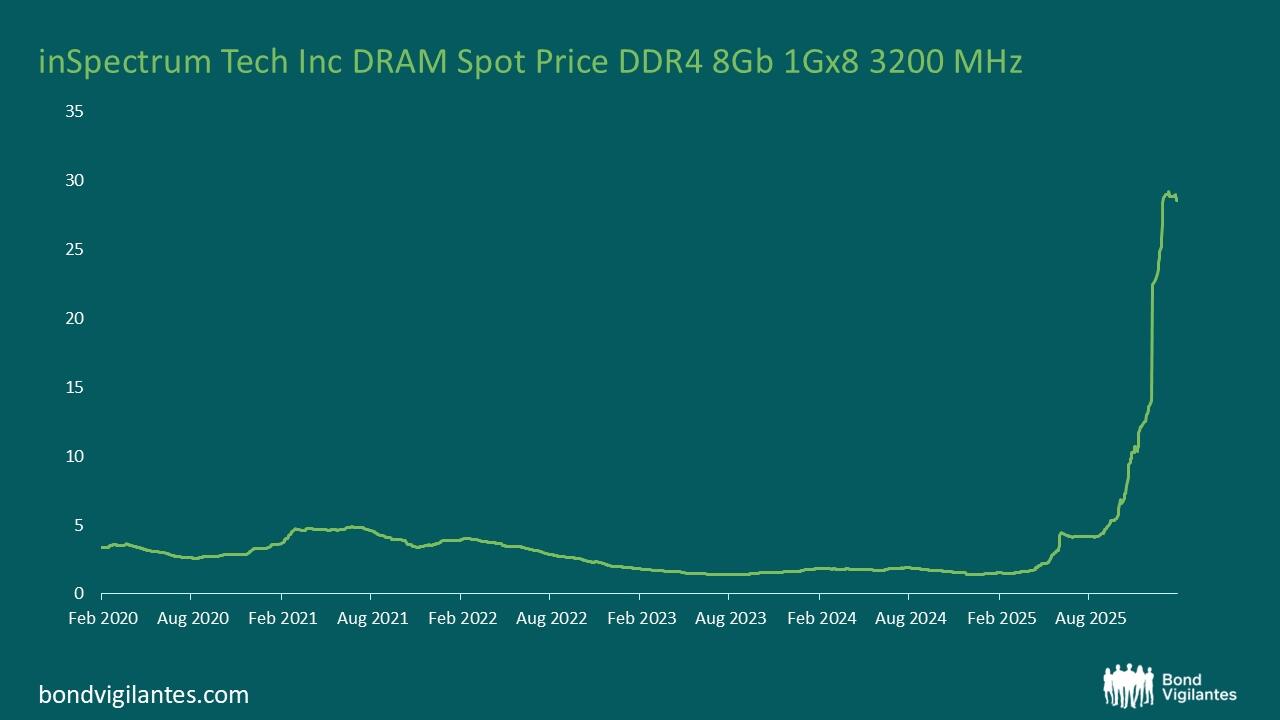
Source: Bloomberg Indices ( Ref.  ISPPDR37 index, inSpectrum Tech Inc DRAM Spot Price DDR4 8Gb 1Gx8 3200 MHz) accessed as of 25th February 2026 .

The price of these memory chips has exploded in recent months, helping explain why the Korean Stock Exchange has had such a good run with Samsung and SK Hynix making up circa 35% of the index.

Today’s tight memory market raises a fascinating macro question: Is this inflationary fuel for the global economy or are we at the early stages of a deflationary unwind?

The inflation case: scarcity breeds pricing power

When memory supply tightens, the first-order effect is straightforward: prices rise. The companies that benefit most are the manufacturers themselves, such as Samsung Electronics, SK Hynix and Micron Technology.

The memory market is one of the most cyclical industries in the world. When utilisation rates climb and inventories shrink, pricing power flips dramatically in favour of producers. Margins can expand quickly.

Higher memory prices feed directly into AI servers, cloud infrastructure, PCs, TVs and smartphones, networking equipment and vehicles. For AI in particular, memory is a major component. High Bandwidth Memory (HBM), a subset of DRAM, is essential to modern GPUs. Companies like Microsoft, Tesla, Meta, etc. depend on large volumes of high-performance memory to make their flagship accelerators function as designed.

If memory becomes more expensive, server build costs rise, cloud capex increases and hardware prices edge up. In that sense, the shock is inflationary, a classic cost-push dynamic. And because AI infrastructure investment is currently driven by deep-pocketed hyperscalers, demand is not especially price sensitive. Higher input costs don’t immediately suppress investment. They often get absorbed. That’s inflationary pressure in action. The issue of higher prices falls heavily onto all the other non-hyperscaler corporates.

The deflation counterargument: when scarcity and price choke growth

But what if availability becomes the issue, not just price?

Imagine a scenario where non-hyperscalers simply cannot secure memory chips to build products as a result of availability and price due to the hyperscalers apparent insatiable demand.

Production lines stall, revenue slows and inventory sits half-finished. For highly levered firms with large fixed costs, that becomes dangerous, very quickly.

Unlike the large technology companies with bucketloads of cash and the ability to tap credit markets, smaller firms lack a balance sheet buffer. This is where the recession transmission emerges through demand destruction. Insolvencies begin to rise, unemployment increases and credit spreads widen. With credit spreads trading at all time tight levels, we need to be cautious.

Time is currently the enemy. The longer chip prices remain elevated the more macro consequences we can expect. It certainly doesn’t feel like these deep pocketed technology firms are going to be backing away anytime soon. In fact, Google raised $32bn in multiple tranches at the drop of a hat the other day. The 100yr sterling tranche was massively oversubscribed. A £5.5bn issue attracted £30bn in bids.

Let’s keep a close eye on the industries that rely on these chips, with a particular focus on credit spreads and unemployment levels.

Unhelpfully, we are left wondering in which direction inflation will turn next? If you were a gambler, where would you put your chips?

Tyler Durden
Sat, 02/28/2026 – 09:20

via ZeroHedge News https://ift.tt/eYGObFZ Tyler Durden