Trump and Israel Start the Iran War


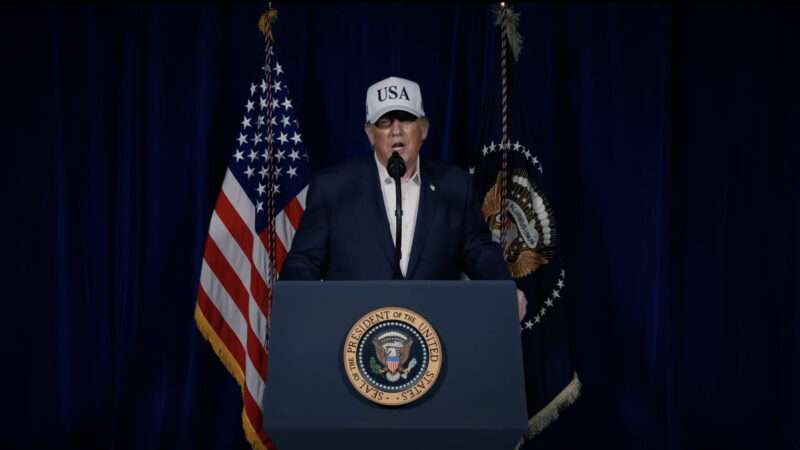
Frame grab from an eight minute statement made by United States President Donald J Trump that was released via his X account concerning the United States attack on Iran, on Saturday, February 28, 2026. | @realDonaldTrump via CNP/Newscom

President Donald Trump said on Friday afternoon that he was expecting to sit down with Iran for more negotiations next week. A few hours later, he announced the beginning of “major combat operations” in order to “raze their missile industry to the ground,” “annihilate their navy,” and help Iranians overthrow their government.

“The lives of courageous American heroes may be lost and we may have casualties. That often happens in war,” Trump added. Israeli Prime Minister Benjamin Netanyahu also announced that his country was taking part in “joint operations” in order to “create the conditions for the brave Iranian people to take their fate into their own hands.”

Iran has immediately begun firing back at Israeli territory and U.S. bases in Arab countries, hitting Bahrain, Kuwait, Qatar, the United Arab Emirates, Jordan, and Iraq with missiles and drones in the first few hours. The Iraqi militia Kataeb Hezbollah and the rebel Houthis in Yemen vowed to join the war on Iran’s side. There are about 40,000 U.S. troops stationed around the region.

Fires could be seen rising from the headquarters of the U.S. Navy Fifth Fleet in Bahrain. No U.S. casualties have been reported as of early Saturday morning. At least one bystander was killed in the United Arab Emirates.

Trump and Netanyahu preempted any kind of American public debate, launching their attack a few days before Congress was set to vote on a war powers resolution. An Israeli official told Reuters that the attack was planned months in advance and the date was decided weeks ago. Netanyahu visited Trump in December 2025—before recent Iranian protests began—to discuss attacking Iran, Axios reported at the time.

On Friday night, Omani Foreign Minister Badr Albusaidi, who was mediating U.S.-Iranian talks, told CBS News that a “peace deal is within our reach” and Iran had agreed to give up its stockpile of enriched uranium. Shortly after, Trump claimed that Iran was refusing to give up enriched uranium.

Secretary of State Marco Rubio reportedly informed Speaker of the House Mike Johnson (R–La.), Senate Majority Leader John Thune (R–S.D.), and Senate Intelligence Committee Vice Chairman Mark Warner (D–Va.) before the attack.

In his speech announcing the war, Trump cited a litany of decades-old grievances against Iran, including the takeover of the U.S. Embassy during the 1979 revolution and the bombing of the U.S. Marine barracks in Beirut during the Lebanese civil war in 1983.

Rep. Thomas Massie (R–Ky.), a sponsor of the war powers resolution, decried the strikes as “Acts of war unauthorized by Congress” immediately after the attack. “The American people are tired of regime change wars that cost us billions of dollars and risk our lives,” cosponsor Rep. Ro Khanna (D–Calif.) added in a video message.

“These strikes are a colossal mistake, and I pray they do not cost our sons and daughters in uniform and at embassies throughout the region their lives,” Sen. Tim Kaine (D–Va.), who is sponsoring a similar resolution in the Senate, said. “Every single Senator needs to go on the record about this dangerous, unnecessary, and idiotic action.”

On the other hand, hawkish Sen. Lindsey Graham (R–S.C.) gave a ringing endorsement: “This operation will be massive in scope and has as its goal the elimination of the regime as demanded by the people of Iran.”

The first wave of bombing hit government buildings across Tehran. Iranian state media reported on Saturday morning that President Masoud Pezeshkian, Speaker of Parliament Mohammad-Bagher Ghalibaf, and top military officials are all alive and well. But there was no word on Supreme Leader Ali Khamenei, whose house was bombed.

Axios reports that Israel is targeting Iranian leaders “past, present, and future.” Strangely, that list of targets may include opposition figures who are ready to step into a power vacuum. The opposition Green Movement reported that the airstrikes targeted the house where their leaders, Mirhossein Mousavi and Zahra Rahnavard, have been held under house arrest since 2009.

Whatever comes of the war, civilians are already starting to suffer. Iranian state TV played images of a bombed-out girls’ school in the south of the country, reporting that 57 people were killed. Another video widely circulated on social media shows men, women, and children running out of a bombed-out apartment building. A teenage girl shouts into her phone for her mother to come outside quickly, while another woman shouts, “Why did they hit a home?”

The post Trump and Israel Start the Iran War appeared first on Reason.com.

from Latest – Reason.com https://ift.tt/1Gsjmxh
via IFTTT
Trump and Israel Start the Iran War


Frame grab from an eight minute statement made by United States President Donald J Trump that was released via his X account concerning the United States attack on Iran, on Saturday, February 28, 2026. | @realDonaldTrump via CNP/Newscom

President Donald Trump said on Friday afternoon that he was expecting to sit down with Iran for more negotiations next week. A few hours later, he announced the beginning of “major combat operations” in order to “raze their missile industry to the ground,” “annihilate their navy,” and help Iranians overthrow their government.

“The lives of courageous American heroes may be lost and we may have casualties. That often happens in war,” Trump added. Israeli Prime Minister Benjamin Netanyahu also announced that his country was taking part in “joint operations” in order to “create the conditions for the brave Iranian people to take their fate into their own hands.”

Iran has immediately begun firing back at Israeli territory and U.S. bases in Arab countries, hitting Bahrain, Kuwait, Qatar, the United Arab Emirates, Jordan, and Iraq with missiles and drones in the first few hours. The Iraqi militia Kataeb Hezbollah and the rebel Houthis in Yemen vowed to join the war on Iran’s side. There are about 40,000 U.S. troops stationed around the region.

Fires could be seen rising from the headquarters of the U.S. Navy Fifth Fleet in Bahrain. No U.S. casualties have been reported as of early Saturday morning. At least one bystander was killed in the United Arab Emirates.

Trump and Netanyahu preempted any kind of American public debate, launching their attack a few days before Congress was set to vote on a war powers resolution. An Israeli official told Reuters that the attack was planned months in advance and the date was decided weeks ago. Netanyahu visited Trump in December 2025—before recent Iranian protests began—to discuss attacking Iran, Axios reported at the time.

On Friday night, Omani Foreign Minister Badr Albusaidi, who was mediating U.S.-Iranian talks, told CBS News that a “peace deal is within our reach” and Iran had agreed to give up its stockpile of enriched uranium. Shortly after, Trump claimed that Iran was refusing to give up enriched uranium.

Secretary of State Marco Rubio reportedly informed Speaker of the House Mike Johnson (R–La.), Senate Majority Leader John Thune (R–S.D.), and Senate Intelligence Committee Vice Chairman Mark Warner (D–Va.) before the attack.

In his speech announcing the war, Trump cited a litany of decades-old grievances against Iran, including the takeover of the U.S. Embassy during the 1979 revolution and the bombing of the U.S. Marine barracks in Beirut during the Lebanese civil war in 1983.

Rep. Thomas Massie (R–Ky.), a sponsor of the war powers resolution, decried the strikes as “Acts of war unauthorized by Congress” immediately after the attack. “The American people are tired of regime change wars that cost us billions of dollars and risk our lives,” cosponsor Rep. Ro Khanna (D–Calif.) added in a video message.

“These strikes are a colossal mistake, and I pray they do not cost our sons and daughters in uniform and at embassies throughout the region their lives,” Sen. Tim Kaine (D–Va.), who is sponsoring a similar resolution in the Senate, said. “Every single Senator needs to go on the record about this dangerous, unnecessary, and idiotic action.”

On the other hand, hawkish Sen. Lindsey Graham (R–S.C.) gave a ringing endorsement: “This operation will be massive in scope and has as its goal the elimination of the regime as demanded by the people of Iran.”

The first wave of bombing hit government buildings across Tehran. Iranian state media reported on Saturday morning that President Masoud Pezeshkian, Speaker of Parliament Mohammad-Bagher Ghalibaf, and top military officials are all alive and well. But there was no word on Supreme Leader Ali Khamenei, whose house was bombed.

Axios reports that Israel is targeting Iranian leaders “past, present, and future.” Strangely, that list of targets may include opposition figures who are ready to step into a power vacuum. The opposition Green Movement reported that the airstrikes targeted the house where their leaders, Mirhossein Mousavi and Zahra Rahnavard, have been held under house arrest since 2009.

Whatever comes of the war, civilians are already starting to suffer. Iranian state TV played images of a bombed-out girls’ school in the south of the country, reporting that 57 people were killed. Another video widely circulated on social media shows men, women, and children running out of a bombed-out apartment building. A teenage girl shouts into her phone for her mother to come outside quickly, while another woman shouts, “Why did they hit a home?”

The post Trump and Israel Start the Iran War appeared first on Reason.com.

from Latest – Reason.com https://ift.tt/1Gsjmxh
via IFTTT
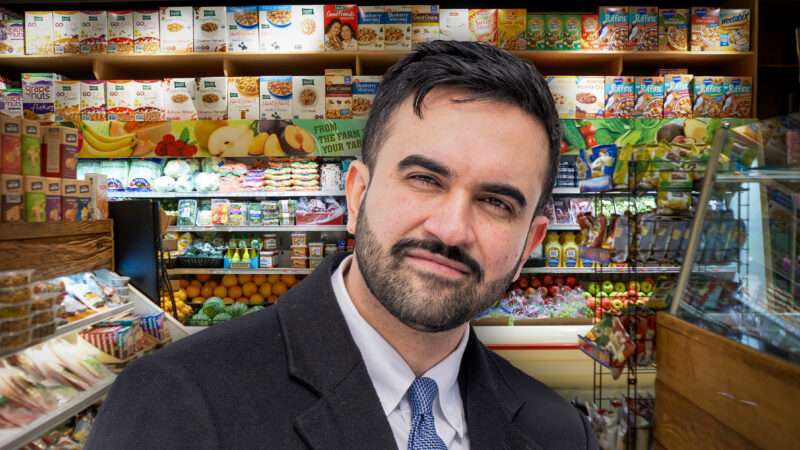
Mamdani Reportedly Pushes $70 Million Grocery Store Proposal Amid $5.4 Billion Budget Gap


Zohran Mamdani seen in front of grocery offerings | Illustration: Lev Radin/Sipa USA/Newscom/Tea/Dreamstime

New York Mayor Zohran Mamdani is facing a tough reality check. Just a few months into office, the new mayor’s dreams of free buses, free child care, and government-run grocery stores are running into the brick wall of New York City’s massive budget deficit. But when it comes to government food stores at least, the mayor is doubling down anyway.

The city currently faces a $5.4 billion budget gap, which Mamdani has largely blamed on former Mayor Eric Adams. In turn, Mamdani’s primary proposals for closing the gap are to either pressure New York Gov. Kathy Hochul and state legislators into raising taxes on the wealthiest New York City residents and corporations—the mayor’s preferred path—or enacting a 9.5 percent property tax in the Big Apple.

Gov. Hochul has poured cold water on the tax-the-rich route, while an across-the-board property tax increase has unsurprisingly received substantial backlash. The latter would also require the acquiescence of the New York City Council, but City Council Speaker Julie Menin has already dismissed the idea as a “nonstarter.”

Of course, other options beyond raising taxes exist for addressing NYC’s budget mess. Namely, the city could cut spending and exercise fiscal restraint. But if spending cuts seem like a pipe dream for a democratic socialist mayor, one might at least expect a temporary moratorium on expensive new spending items.

No such luck. Despite NYC’s fiscal situation, the New York Post reports that Mamdani plans to earmark $70 million for his central campaign proposal of government-run grocery stores. The funding would supposedly flow to the city’s Economic Development Corporation (EDC), which would be tasked with scouting sites for the five proposed stores across Gotham’s five boroughs, as well as spearheading the construction of the stores.

The $70 million price tag is an escalation from the mayor’s $60 million campaign trail projection, and it’s just the start. The Post confirmed with EDC that the reported $70 million doesn’t even include the cost of a feasibility study for the new grocery stores, the price tag of which remains unknown.

It also doesn’t cover the ongoing cost of running the stores, such as building maintenance or paying the salaries of government employees who may ultimately staff the stores (the mayor has left the operational details unclear so far).

As commentators across the ideological spectrum have pointed out, government-run grocery stores are a particularly bad policy idea. For one, past efforts have met with poor results and have cost cities money that can never be recouped.

There’s also little evidence that they accomplish their intended purpose of helping city residents.

According to NYC’s Deputy Mayor for Economic Justice, Julie Su (who served as President Biden’s former Acting Secretary of Labor), the priority is to target so-called “food deserts” in NYC in order to provide better access to healthy food options. But research has failed to turn up much evidence that government-run stores lead to healthier eating habits among local residents.

Government-run stores would also inevitably inject more politics into the food supply. Food—like everything else—has become increasingly politicized in recent years, and putting the government in charge of stocking store shelves would simply accelerate this trend.

As I wrote about previously in these pages, what constitutes “healthy” eating has been controversial for decades. The federal government, in the form of its dietary guidelines, has vacillated back-and-forth about which food groups are good or bad, embracing recommendations that have arguably contributed to rising American obesity rates over the years.

It’s similarly foolhardy to expect NYC’s government to demonstrate nutritional clairvoyance in what it puts on government-owned shelves. A final lesson can be learned from the experience of state-run liquor stores—still present in 13 states—which have demonstrated that these government-run retailers are engines for corruption and political favoritism.

Mamdani’s government-run grocery stores make neither political nor financial sense. But despite a massive budget shortfall, the mayor remains undeterred in his efforts to run up the grocery bill.

The post Zohran Mamdani's $70 Million Grocery Gamble appeared first on Reason.com.

from Latest – Reason.com https://ift.tt/EDt3wXm
via IFTTT

France’s Le Pen Says She Will Not Run In 2027 Election If Under House Arrest, Names Successor

France’s Le Pen Says She Will Not Run In 2027 Election If Under House Arrest, Names Successor

Via Remix News,

In March 2025,  Le Pen was convicted on charges dating back years ago, in a move that was widely contested and seen as a highly political attempt to keep her from running in next year’s presidential election.

Now, she says she has no intention of running if her ban from running is lifted, if it means she must wear an electronic tag, i.e., ankle monitor.

She is also ready to place full trust in Jordan Bardella, current leader of the National Rally (RN).

Le Pen’s comments came during an interview with French television station BFMTV, her first since French prosecutors asked a court to uphold her five-year ban. A ruling on her case is expected on July 7.

“You cannot campaign under these conditions. Can you campaign without going out in the evenings to meet your constituents at rallies?” she asked, referring to the idea of having to campaign while wearing a monitor and under house arrest.

Prosecutors had asked for Le Pen to be sentenced to four years in prison (three of which were suspended) and a fine of €100,000.

In France, shorter prison sentences are often commuted, meaning that if the court follows the prosecutor’s request, Le Pen could spend anywhere from a few months to a year under house arrest, wearing an anklet.

However, Le Pen has said she would not campaign under such circumstances.

Le Pen says she will be present in court on July 7 to hear the Court of Appeal’s decision.

“Of course I will go, as I went every day to the trial in the first instance and on appeal because I respect justice,” she told BFMTV.

Regarding the 2027 election, Le Pen said regarding RN leader Jordan Bardella:

“The best-case scenario is that I am elected president of the Republic and he is my prime minister.”

However, if she cannot run, then “Jordan will find himself a prime minister,” and she will take whatever “role he wants me to have.”

Emphasizing that Bardella will be free to make his own choices, Le Pen told listeners, “If I cannot be a candidate, he will determine at what level he needs my presence, my advice and my experience.”

Read more here…

Tyler Durden
Sat, 02/28/2026 – 08:10

via ZeroHedge News https://ift.tt/2JpNxBw Tyler Durden

92% Of Illegal Arrivals At Spain’s Canary Islands Are Men, And Half Of ‘Unaccompanied Minors’ Are Adults

92% Of Illegal Arrivals At Spain’s Canary Islands Are Men, And Half Of ‘Unaccompanied Minors’ Are Adults

Authored by Thomas Brooke via Remix News,

A European Parliament fact-finding mission to the Canary Islands has revealed that around half of migrants who claimed to be unaccompanied minors upon arrival were ultimately determined to be adults.

The Committee on Petitions conducted the visit in September 2025 to assess the impact of illegal immigration on the Spanish archipelago. According to a draft report from earlier this month, prosecutors informed MEPs that “among approximately 1,500 unaccompanied minors whose age was not clear and who were subjected to age-assessment procedures at their arrival to the adult reception centers, around half of them were ultimately determined to be adults.”

The report also acknowledged systemic weaknesses in the initial screening process, stating that “initial assessments by police are often inaccurate, leading to some being misplaced in the wrong center before their age is confirmed.”

The scale of arrivals remains significant.

By Aug. 31, 2025, 201 boats had reached the Canary Islands in that year carrying 12,249 migrants, including 9,955 men, 782 women, 192 minors traveling with parents, and 1,320 unaccompanied minors.

Authorities recorded 629 individuals whose age was in doubt, and officials noted that 92 percent of arrivals were male.

This aligns with the findings from across Europe.

In 2023, Frontex data indicated that exactly 92 percent of illegal migrants were males, with that number being remarkably stable over the years.

Crime and public safety were repeatedly raised during the mission. MEP Sebastian Kruis questioned why migrants appear statistically overrepresented in prison figures, asking “the reasons why, in proportionate terms, an immigrant has a 1.5 times higher chance of being in prison,” as in the Canary Islands, migrants represent 31 percent of inmates but they only account for 22 percent of the total population.

“There has been an increase in criminality following the arrival of unaccompanied minors, with offenses committed mainly against them,” the report states.

However, it continues to explain that these offenses are predominantly “fights, insults, and sexual assaults, occurring mainly within reception centers,” meaning that while offenses may be committed against migrants, they are also being committed by them.

Neighborhood representatives in La Isleta, near the Canarias 50 reception center in Las Palmas, told MEPs they had experienced a growing “feeling of insecurity.”

The report also detailed the difficulty of prosecuting smuggling networks. In 2024, 282 preliminary investigations were opened in relation to boat arrivals, yet 97 percent were provisionally suspended due to a lack of identified perpetrators.

On returns, authorities said expulsions to Morocco are limited because many arrivals lack documentation, and Morocco does not process papers for undocumented nationals. It was noted that 92 percent of repatriation requests by Spain are rejected by Rabat.

Maritime Rescue representatives stated they “did not carry out interceptions of vessels” and were limited to search-and-rescue operations within Spain’s area of responsibility, which often results in migrants being brought ashore in Spain even when their point of departure is known.

In the report, Dutch MEP Sebastian Kruis of the Patriots for Europe (PfE) group argued that he had experienced a “big difference between the presentations given by official representatives and NGOs and what the people from the districts close to the reception centers and the news are saying about incidents concerning migrants.”

Read more here…

Tyler Durden
Sat, 02/28/2026 – 07:00

via ZeroHedge News https://ift.tt/HyBrfJ7 Tyler Durden

Mamdani Reportedly Pushes $70 Million Grocery Store Proposal Amid $5.4 Billion Budget Gap


Zohran Mamdani seen in front of grocery offerings | Illustration: Lev Radin/Sipa USA/Newscom/Tea/Dreamstime

New York Mayor Zohran Mamdani is facing a tough reality check. Just a few months into office, the new mayor’s dreams of free buses, free child care, and government-run grocery stores are running into the brick wall of New York City’s massive budget deficit. But when it comes to government food stores at least, the mayor is doubling down anyway.

The city currently faces a $5.4 billion budget gap, which Mamdani has largely blamed on former Mayor Eric Adams. In turn, Mamdani’s primary proposals for closing the gap are to either pressure New York Gov. Kathy Hochul and state legislators into raising taxes on the wealthiest New York City residents and corporations—the mayor’s preferred path—or enacting a 9.5 percent property tax in the Big Apple.

Gov. Hochul has poured cold water on the tax-the-rich route, while an across-the-board property tax increase has unsurprisingly received substantial backlash. The latter would also require the acquiescence of the New York City Council, but City Council Speaker Julie Menin has already dismissed the idea as a “nonstarter.”

Of course, other options beyond raising taxes exist for addressing NYC’s budget mess. Namely, the city could cut spending and exercise fiscal restraint. But if spending cuts seem like a pipe dream for a democratic socialist mayor, one might at least expect a temporary moratorium on expensive new spending items.

No such luck. Despite NYC’s fiscal situation, the New York Post reports that Mamdani plans to earmark $70 million for his central campaign proposal of government-run grocery stores. The funding would supposedly flow to the city’s Economic Development Corporation (EDC), which would be tasked with scouting sites for the five proposed stores across Gotham’s five boroughs, as well as spearheading the construction of the stores.

The $70 million price tag is an escalation from the mayor’s $60 million campaign trail projection, and it’s just the start. The Post confirmed with EDC that the reported $70 million doesn’t even include the cost of a feasibility study for the new grocery stores, the price tag of which remains unknown.

It also doesn’t cover the ongoing cost of running the stores, such as building maintenance or paying the salaries of government employees who may ultimately staff the stores (the mayor has left the operational details unclear so far).

As commentators across the ideological spectrum have pointed out, government-run grocery stores are a particularly bad policy idea. For one, past efforts have met with poor results and have cost cities money that can never be recouped.

There’s also little evidence that they accomplish their intended purpose of helping city residents.

According to NYC’s Deputy Mayor for Economic Justice, Julie Su (who served as President Biden’s former Acting Secretary of Labor), the priority is to target so-called “food deserts” in NYC in order to provide better access to healthy food options. But research has failed to turn up much evidence that government-run stores lead to healthier eating habits among local residents.

Government-run stores would also inevitably inject more politics into the food supply. Food—like everything else—has become increasingly politicized in recent years, and putting the government in charge of stocking store shelves would simply accelerate this trend.

As I wrote about previously in these pages, what constitutes “healthy” eating has been controversial for decades. The federal government, in the form of its dietary guidelines, has vacillated back-and-forth about which food groups are good or bad, embracing recommendations that have arguably contributed to rising American obesity rates over the years.

It’s similarly foolhardy to expect NYC’s government to demonstrate nutritional clairvoyance in what it puts on government-owned shelves. A final lesson can be learned from the experience of state-run liquor stores—still present in 13 states—which have demonstrated that these government-run retailers are engines for corruption and political favoritism.

Mamdani’s government-run grocery stores make neither political nor financial sense. But despite a massive budget shortfall, the mayor remains undeterred in his efforts to run up the grocery bill.

The post Zohran Mamdani's $70 Million Grocery Gamble appeared first on Reason.com.

from Latest – Reason.com https://ift.tt/EDt3wXm
via IFTTT

It’s the Spending, Stupid!


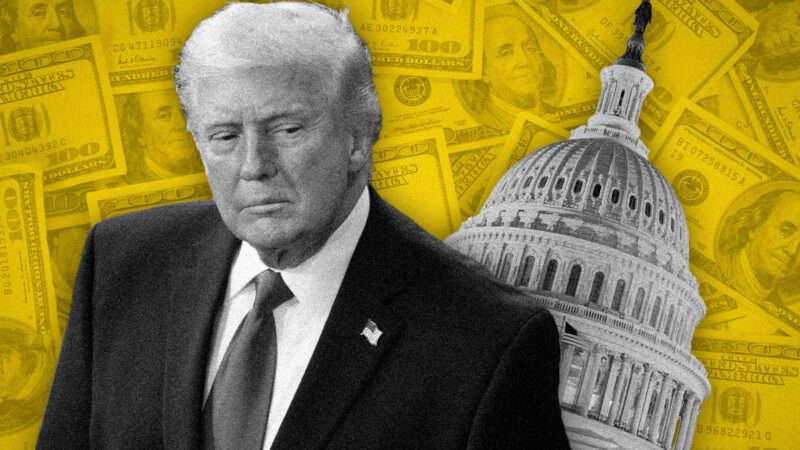
An illustration of Donald Trump and the U.S. Capitol before a background of currency | om Williams/CQ Roll Call/Newscom/Lunamarina/Patrick Bryk/Dreamstime

With a few days’ perspective on the State of the Union address, which grows ever closer in spirit and content to outtakes from the prophetic 2006 comedy Idiocracy, it’s worth revisiting one of Milton Friedman’s most enduring insights. “Keep your eye on one thing and one thing only: how much government is spending,” the libertarian Nobel laureate counseled. “That’s the true tax.” Don’t be distracted, he added, by talk about balancing budgets or cutting marginal tax rates. Focus on how much money the federal government spends each year, because that’s the ultimate indicator of how much it costs.

Friedman was talking in the late 1970s, when top marginal income-tax rates were 70 percent and debates were focused on lowering the tax burden and, by implication, government spending. Back then, deficit spending was something that mostly happened during wartime or recessions, rather than being taken for granted the way it has been since Jimmy Carter occupied the White House. If you cut the amount of money the government brought in, went the general argument, you also cut the amount of money it could spend. Friedman was emphasizing that whether spending is paid for in the moment, it is the best proxy for government involvement in everyday life. It has to be paid for eventually, either by raising taxes, reducing services, or by inflating the currency—all actions that make us subordinate to politics and politicians.

In Tuesday’s speech, President Donald Trump reduced fiscal responsibility to a few lines about taming deficits by announcing a “war on fraud,” to be prosecuted by Vice President J.D. Vance. “He’ll get it done,” promised Trump. “And we’re able to find enough of that fraud, we will actually have a balanced budget overnight.” Thus ends nearly half a century of the Republican Party being, at least rhetorically, the party of less spending and smaller government.

Trump’s promise to balance the budget by clamping down on fraud is, to invoke the chief executive Trump replaced, utter malarkey. The barely cold corpse of the Department of Government Efficiency (DOGE) testifies to how surprisingly hard it is, even for wunderkind spreadsheet hotshots with battle names like Big Balls, to realize cost savings in a federal budget that tops $7 trillion. The absolute best-case scenario, wrote Reason‘s Eric Boehm, is that DOGE saved $170 billion rather than the $2 trillion that Elon Musk promised at its outset. (At least, that’s what DOGE finally claimed, but given the agency’s reputation for fudging its numbers, we should take it with a grain of salt or two.) Whatever numbers Vance comes up with should be met with similar skepticism. After all, this is the man who, when called out for circulating unsubstantiated stories of Haitian immigrants grilling pet cats in Springfield, Ohio, told CNN, “If I have to create stories so that the American media actually pays attention to the suffering of the American people, then that’s what I’m going to do.”

When it came to talking about spending in the State of the Union, Trump wasn’t at all tempered. He bragged about the $1 trillion defense budget he signed, the $1,776 “warrior dividends” sent to service members, and his Trump Accounts for babies born between 2025 and 2028, a program estimated to cost taxpayers over $15 billion through 2034.

To the extent he talked about the revenue side, he congratulated himself for instituting “tariffs, paid for by foreign countries,” that brought in “billions of dollars.” As many analyses show, Americans paid upwards of 90 percent of the cost of the tariffs, which were ruled illegal by the Supreme Court and will eventually be refunded. While refusing to acknowledge that tariffs are taxes paid by his countrymen, Trump did boast of last year’s tax cuts:

I urged this Congress to begin the mission by passing the largest tax cuts in American history….And with the great Big Beautiful Bill, we gave you no tax on tips, no tax on overtime, and no tax on Social Security for our great seniors. And we also made interest on auto loans tax-deductible. The first time, but only if the car is made in America.

But, following Friedman, let’s keep our eye on spending, not revenue. The results are as disheartening as they are bipartisan. Here are recent annual outlays, as tallied by the Treasury Department’s FiscalData site. The data are inflation-adjusted in 2025 dollars:

  • 2015: $5.02 trillion
  • 2016: $5.17 trillion
  • 2017: $5.23 trillion
  • 2018: $5.27 trillion
  • 2019: $5.61 trillion
  • 2020: $8.16 trillion
  • 2021: $8.05 trillion
  • 2022: $6.85 trillion
  • 2023: $6.48 trillion
  • 2024: $6.93 trillion
  • 2025: $7.01 trillion

The current estimate from the Congressional Budget Office (CBO) for FY 2026 is $7.4 trillion. That’s for a country that is post-pandemic and not at war (at least not as of when I’m writing this). If we cannot reduce spending now through political means, it will ultimately be reduced through a recession, inflation, or an abrupt cut in government services. Given that the debt held by the public equals the size of our economy, it will be extremely difficult for the government to handle such a crisis.

Decades after Friedman’s initial warning at the start of chronic deficit spending, it’s still the spending, and it keeps getting worse with every passing year.

The post It's the Spending, Stupid! appeared first on Reason.com.

from Latest – Reason.com https://ift.tt/8maGq7l
via IFTTT

It’s the Spending, Stupid!


An illustration of Donald Trump and the U.S. Capitol before a background of currency | om Williams/CQ Roll Call/Newscom/Lunamarina/Patrick Bryk/Dreamstime

With a few days’ perspective on the State of the Union address, which grows ever closer in spirit and content to outtakes from the prophetic 2006 comedy Idiocracy, it’s worth revisiting one of Milton Friedman’s most enduring insights. “Keep your eye on one thing and one thing only: how much government is spending,” the libertarian Nobel laureate counseled. “That’s the true tax.” Don’t be distracted, he added, by talk about balancing budgets or cutting marginal tax rates. Focus on how much money the federal government spends each year, because that’s the ultimate indicator of how much it costs.

Friedman was talking in the late 1970s, when top marginal income-tax rates were 70 percent and debates were focused on lowering the tax burden and, by implication, government spending. Back then, deficit spending was something that mostly happened during wartime or recessions, rather than being taken for granted the way it has been since Jimmy Carter occupied the White House. If you cut the amount of money the government brought in, went the general argument, you also cut the amount of money it could spend. Friedman was emphasizing that whether spending is paid for in the moment, it is the best proxy for government involvement in everyday life. It has to be paid for eventually, either by raising taxes, reducing services, or by inflating the currency—all actions that make us subordinate to politics and politicians.

In Tuesday’s speech, President Donald Trump reduced fiscal responsibility to a few lines about taming deficits by announcing a “war on fraud,” to be prosecuted by Vice President J.D. Vance. “He’ll get it done,” promised Trump. “And we’re able to find enough of that fraud, we will actually have a balanced budget overnight.” Thus ends nearly half a century of the Republican Party being, at least rhetorically, the party of less spending and smaller government.

Trump’s promise to balance the budget by clamping down on fraud is, to invoke the chief executive Trump replaced, utter malarkey. The barely cold corpse of the Department of Government Efficiency (DOGE) testifies to how surprisingly hard it is, even for wunderkind spreadsheet hotshots with battle names like Big Balls, to realize cost savings in a federal budget that tops $7 trillion. The absolute best-case scenario, wrote Reason‘s Eric Boehm, is that DOGE saved $170 billion rather than the $2 trillion that Elon Musk promised at its outset. (At least, that’s what DOGE finally claimed, but given the agency’s reputation for fudging its numbers, we should take it with a grain of salt or two.) Whatever numbers Vance comes up with should be met with similar skepticism. After all, this is the man who, when called out for circulating unsubstantiated stories of Haitian immigrants grilling pet cats in Springfield, Ohio, told CNN, “If I have to create stories so that the American media actually pays attention to the suffering of the American people, then that’s what I’m going to do.”

When it came to talking about spending in the State of the Union, Trump wasn’t at all tempered. He bragged about the $1 trillion defense budget he signed, the $1,776 “warrior dividends” sent to service members, and his Trump Accounts for babies born between 2025 and 2028, a program estimated to cost taxpayers over $15 billion through 2034.

To the extent he talked about the revenue side, he congratulated himself for instituting “tariffs, paid for by foreign countries,” that brought in “billions of dollars.” As many analyses show, Americans paid upwards of 90 percent of the cost of the tariffs, which were ruled illegal by the Supreme Court and will eventually be refunded. While refusing to acknowledge that tariffs are taxes paid by his countrymen, Trump did boast of last year’s tax cuts:

I urged this Congress to begin the mission by passing the largest tax cuts in American history….And with the great Big Beautiful Bill, we gave you no tax on tips, no tax on overtime, and no tax on Social Security for our great seniors. And we also made interest on auto loans tax-deductible. The first time, but only if the car is made in America.

But, following Friedman, let’s keep our eye on spending, not revenue. The results are as disheartening as they are bipartisan. Here are recent annual outlays, as tallied by the Treasury Department’s FiscalData site. The data are inflation-adjusted in 2025 dollars:

  • 2015: $5.02 trillion
  • 2016: $5.17 trillion
  • 2017: $5.23 trillion
  • 2018: $5.27 trillion
  • 2019: $5.61 trillion
  • 2020: $8.16 trillion
  • 2021: $8.05 trillion
  • 2022: $6.85 trillion
  • 2023: $6.48 trillion
  • 2024: $6.93 trillion
  • 2025: $7.01 trillion

The current estimate from the Congressional Budget Office (CBO) for FY 2026 is $7.4 trillion. That’s for a country that is post-pandemic and not at war (at least not as of when I’m writing this). If we cannot reduce spending now through political means, it will ultimately be reduced through a recession, inflation, or an abrupt cut in government services. Given that the debt held by the public equals the size of our economy, it will be extremely difficult for the government to handle such a crisis.

Decades after Friedman’s initial warning at the start of chronic deficit spending, it’s still the spending, and it keeps getting worse with every passing year.

The post It's the Spending, Stupid! appeared first on Reason.com.

from Latest – Reason.com https://ift.tt/8maGq7l
via IFTTT