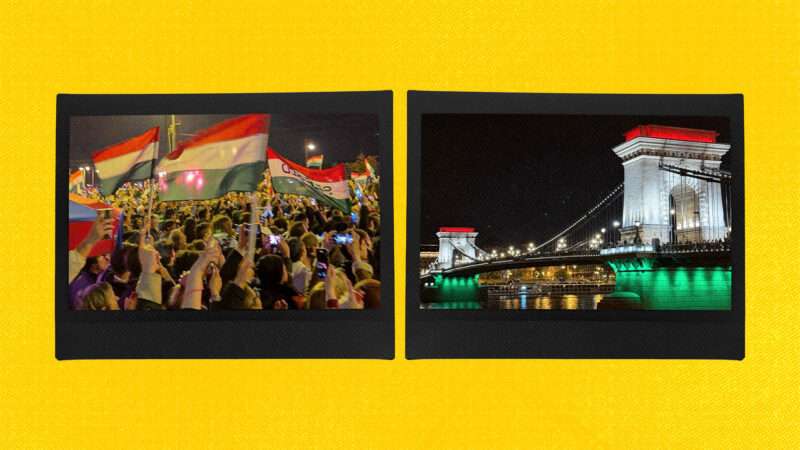
Sunday night in Budapest was glorious. The overwhelming majority of Hungarians in the country’s biggest-ever election chucked out a corrupt and oppressive regime that had transformed a once-thriving post-communist country into a listening post for Moscow and Beijing.
I flew in Sunday morning hoping to witness the second great Hungarian liberation of my lifetime. Back in the late 1980s, I had been active in Hungary and other Central/Eastern European countries, working with the classical liberal Carl Menger Institute out of nearby Vienna to identify and assist people looking to escape what turned out to be the final days of Soviet-bloc tyranny.
Through that work I got to know many founders of Fidesz, then known as the Fiatal Demokraták Szövetsége, or the Federation of Democratic Youth (the acronym Fidesz is Latin for trust). We organized projects with the college where Fidesz was born, the Rajk László Szakkollégium, from intensive seminars on translations of F. A. Hayek’s works to summer schools.
But what had started out as an exciting youth movement for freedom was converted into a nationalist and illiberal political party, eventually degenerating into a corrupt and statist tool for the personal enrichment of its leaders, particularly Viktor Orbán.
Orbán, who exploded on the scene in June 1989 with a speech in Budapest’s Heroes’ Square demanding the withdrawal of Soviet troops, became Fidesz president in 1993, intentionally shucking off the party’s cosmopolitan past in favor of a more populist nationalism. He forged an alliance with the conservative Hungarian Democratic Forum (MDF) and the Independent Smallholders’ Party (FKGP), but then, after becoming prime minister for the first time in 1998, aggressively poached the voting bases of his two coalition partners, annihilating them as political forces. No alternating center-left/center-right coalitions for Orbán; he wanted Fidesz to have it all.
Orbán lost to the Socialists in 2002, but four years later, Socialist Prime Minister Ferenc Gyurcsány doomed his party by letting slip at a leaked closed-door party event that, “We have obviously been lying throughout the last one and a half to two years.” The leak eventually led not only to a victory for Fidesz in 2010, but—disastrously—a two-thirds majority in Parliament. This “constitutional majority” allowed Orbán to rewrite laws, overhaul the management and ownership of institutions, and write a new constitution.
Over the ensuing 16 years, Hungary was transformed into an illiberal crony state, falling further and further behind other post-communist entrants into the European Union. Upon accession into the European Union in 2004, Poland was much poorer than its southern neighbor, as the Hungarian Communists had tolerated a much greater degree of private enterprise during the “goulash communism” of the 1980s. Poland has since pulled well ahead of Hungary, while Romania, which had been far, far poorer than Hungary, has caught up.
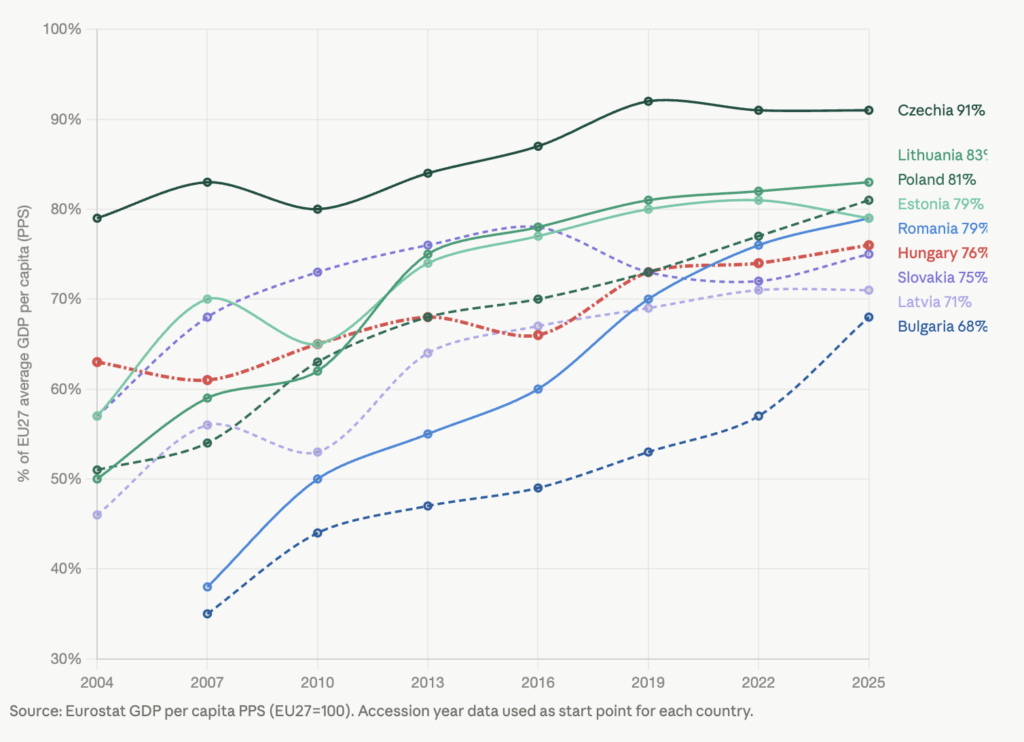
The chart represents gross domestic product (GDP) per capita expressed in Purchasing Power Standards, with the E.U. average set at 100 percent. The percentages represent what the average citizen of a country could buy with his or her income as a percentage of the average for the European Union as a whole.
Major drivers in Hungary’s dismal performance have been a collapse in private investment, due to cronyism replacing rule of law, as well as the departure of hundreds of thousands of prime-aged Hungarians who prefer setting up businesses, finding work, and managing their affairs without worrying about where they stand with the ruling party.
Orbán made life worse for his constituents by building what he advertised as “an illiberal state,” in which “no policy-specific debates are needed now.” Since 2015 he has ruled by decree under “permanent emergency” powers. He has for years actively courted the political and economic support of Russia and China. Chinese Communist Party activists patrol the streets of Budapest and in 2024 even forcibly stopped Hungarian opposition party member Márton Tompos as he was hoisting a European Union flag in advance of a Xi Jinping visit.
Orbán actually defended Chinese police for violently preventing Hungarians from holding free-Tibet signs on the streets of Budapest, saying, “Those who come here as our guests are entitled to be treated as such. So these two rights need to be aligned, so we do not permit activities and events that would diminish our guests’ visit who come to Hungary and are received with respect.” Xi Jinping praised Orbán’s government for its “unequivocal and firm support for China on issues related to Taiwan, Hong Kong, and human rights.” For that, Orbán was richly rewarded with contracts, state investments, and other gifts.
The relationship with Russian dictator Vladimir Putin has been particularly blatant. Orbán declared in February of this year that Ukraine, which Putin continues to mercilessly attack, is an enemy of Hungary. The Orbán regime reportedly even went so far as to prepare false flag operations to blame Ukrainians for election-related violence, including, just days prior, the alleged “discovery” of explosive-laden backpacks near a pipeline in neighboring Serbia.
Moreover, Orbán and his foreign minister Péter Szijjártó have repeatedly displayed slavish subservience to Putin and his foreign minister Sergey Lavrov, with the former saying to Putin on October 17, 2025, that “In any matter where I can be of assistance, I am at your service,” comparing himself to a mouse offering services to a lion.” Szijjártó, meanwhile, was caught serially calling Lavrov immediately after stepping out of E.U. meetings, and agreeing to provide secret E.U. documents: “I immediately do it. I send it to my embassy in Moscow, and my ambassador will forward it to your chief of staff, and then it’s at your disposal.”
The broadcast and print media are almost completely in the hands of the government or Orbán cronies, thanks to abuse of tax and regulatory powers, denial of licenses, state loans, and the awarding of government advertising contracts on the basis of party allegiance. The voting system had been thoroughly gerrymandered and rigged to favor Fidesz. Subsidies flowed to Fidesz voters, with clear statements from Orbán that they owed him for the support. For the opposition and its supporters, life was made much harder.
So how did Orbán lose?
First, despite the rigged system, the intimidation, the gifts, and all of his other tricks, Orbán was widely despised by Hungarians, especially among young people who have known only his corrupt rule and nothing else. The dismal economic performance meant that Hungarians could see that they were falling behind and knew who was responsible for it.
Second, the opposition leader Péter Magyar, a former member of Fidesz, was a tireless campaigner who walked through the whole of Hungary, visiting villages and speaking directly with ordinary Hungarians. His campaign was expertly run at every level.
Third, the public was prepared for any dirty tricks that Orbán might prepare. Former MP and opposition figure Zoltán Kész sounded the alarm in The Telegraph on March 1: “Hungarians want to kick Viktor Orban out of power. Is he planning a coup to stop them?” Thus ensued a series of revelations about Orbán’s dirty deals and inept attempts at false flag operations.
Fourth, revelations about Orbán’s craven subservience to Xi and Putin undermined his campaign claim that he was protecting Hungarian sovereignty from the European Union (of which Hungary is a member). The dissonance reached absurd levels when U.S. Vice President J.D. Vance beclowned himself by going on a U.S.-taxpayer-funded trip to Hungary to campaign explicitly for Orbán. There Vance stated, with no evidence of understanding the irony, “What has happened in this country, what has happened in the midst of this election campaign is one of the worst examples of foreign election interference that I’ve ever seen or ever even read about.”
Trump added his surreal two cents, writing in his uniquely eloquent style, “Hungary: GET OUT AND VOTE FOR VIKTOR ORBÁN. He is a true friend, fighter, and WINNER, and has my Complete and Total Endorsement for Re-Election as Prime Minister of Hungary — VIKTOR ORBÁN WILL NEVER LET THE GREAT PEOPLE OF HUNGARY DOWN. I AM WITH HIM ALL THE WAY!,” followed the next day by “My Administration stands ready to use the full Economic Might of the United States to strengthen Hungary’s Economy, as we have done for our Great Allies in the past, if Prime Minister Viktor Orbán and the Hungarian People ever need it. We are excited to invest in the future Prosperity that will be generated by Orbán’s continued Leadership!”
In the end, Hungarians stood up and said Szabad Magyarország!, “Free Hungary!” I’m happy beyond the power of words that I was there to witness it. Now begins the process of fulfilling the slogan. Fortunately, many Hungarians are up for the challenge. Freedom advocates in the rest of Europe and the world should stand ready to assist them.
The post Hungary Breaks Free: How Voters Ended 16 Years of Orbán's Iron Rule appeared first on Reason.com.
from Latest – Reason.com https://ift.tt/fjr8OHD
via IFTTT