“Set Your AC To 78F”: NYC Socialist Pleads With Residents As Fragile Grid Faces Blackout Risk

“Set Your AC To 78F”: NYC Socialist Pleads With Residents As Fragile Grid Faces Blackout Risk

Set your AC to 78 degrees, turn off lights/electronics you’re not using, and unplug what you can,” New York City Socialist Mayor Zohran Mamdani wrote on X late Wednesday.

New Yorkers are now getting a real-world lesson in what Mamdani’s recent “warmth of collectivism” comments actually mean: shared sacrifice, including being told to dial back air conditioning during blistering heat as the risk of power blackouts rises.

The deeper issue here is that years of left-wing climate policies and poor grid management have left the metro area and the broader region increasingly vulnerable during peak-demand hours.

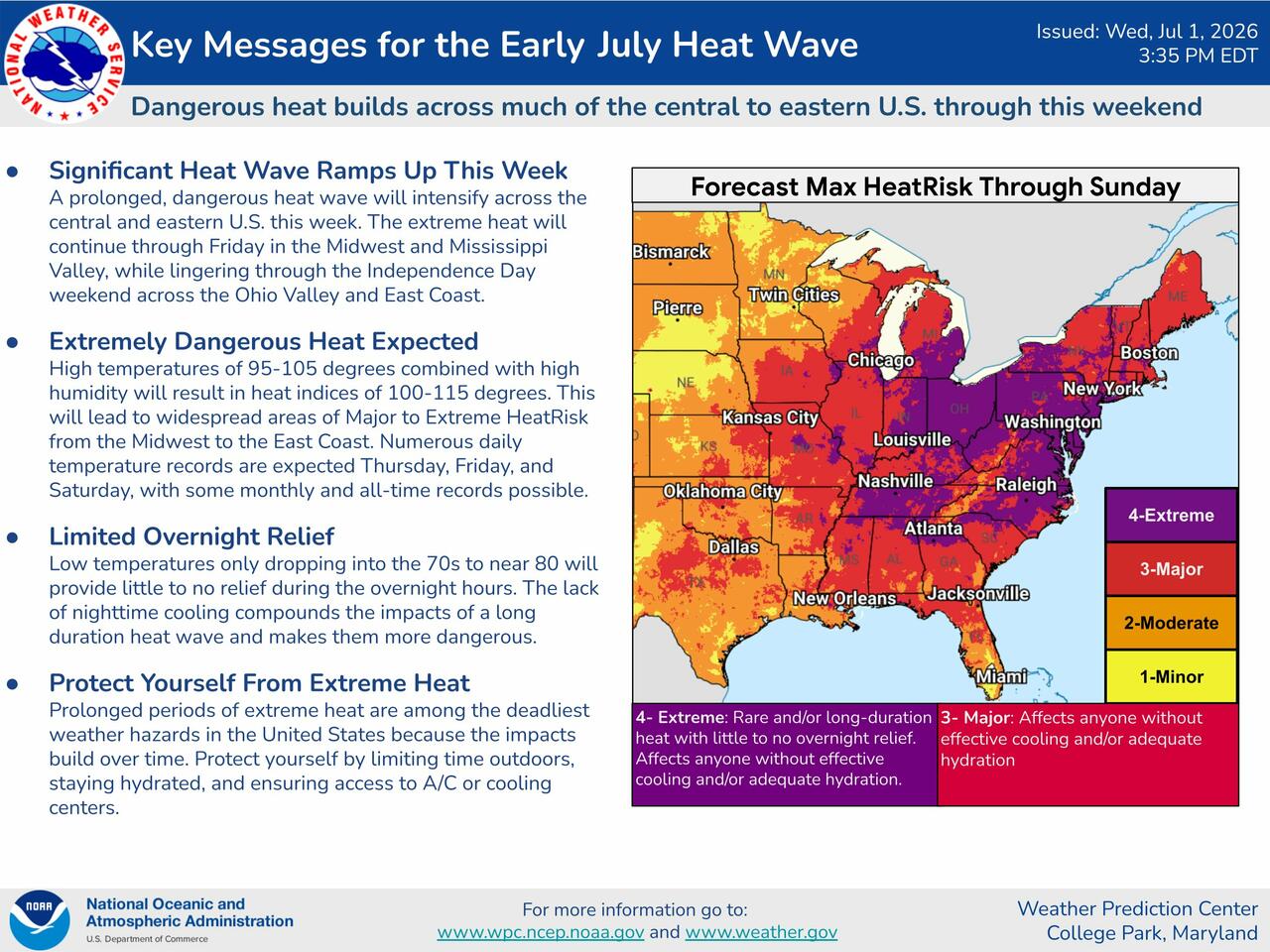
Temperatures are forecast to top 100F across NYC and large parts of the Mid-Atlantic and East Coast beginning today. The extreme weather is set to sharply drive up cooling demand, just as power grids are already under pressure from failed climate-change policies colliding with the era of data centers.

On Tuesday, the Energy Department issued emergency orders allowing PJM Interconnection power plants to bypass certain environmental limits to keep electricity flowing. Backup generators have been placed on standby on the grid serving 67 million people across 13 states.

New York City power prices climbed above $1,100 per megawatt-hour by late Wednesday afternoon. PJM expects to break its all-time peak load record of 165.5 gigawatts later today.

Tyler Durden
Thu, 07/02/2026 – 08:00

via ZeroHedge News https://ift.tt/BagF9Il Tyler Durden

Sam Altman’s OpenAI Discusses Handing Trump Admin A 5% Stake

Sam Altman’s OpenAI Discusses Handing Trump Admin A 5% Stake

The U.S. government’s equity portfolio could be expanding again, this time with a potential 5% stake in Sam Altman’s OpenAI at an $852 billion valuation, according to a new report. The proposed stake would mark another step toward taking direct financial positions in tech giants. For OpenAI, buy-in from the Trump administration could ease mounting political pressure ahead of an IPO.

The Financial Times reports that Altman has floated giving the U.S. government a 5% stake in OpenAI, modeled after the Alaska Permanent Fund, a state-owned sovereign wealth fund created to invest a portion of Alaska’s oil revenue for the long-term benefit of Alaskans.

The FT noted that the proposal would spur other tech giants, including Anthropic, Google, and Meta, to follow suit by handing over stakes to the federal government.

The discussions remain early and “conceptual,” and any arrangement could require congressional approval, the report said, adding that the idea stems from mounting pressure in the Trump administration over AI’s impact on jobs and the localized blowback against data center buildouts nationwide.

Earlier this week, Elon Musk’s xAI Memphis rolled out a ‘data center dividend‘ for the surrounding community, offering free Starlink kits and half-price service to quell any dissent against AI. This move suggests that data center operators nationwide may offer other forms of dividends in the future to appease surrounding communities.

Back to the FT report, Altman has reportedly discussed public ownership with Trump, Commerce Secretary Howard Lutnick, Treasury Secretary Scott Bessent, and Sen. Bernie Sanders.

Sanders, a crazed socialist, has argued for the public stake in AI companies to exceed 50%. The socialist and far-left lawmakers who make up the Democratic Socialists of America have even signaled a questionable data center moratorium – a move that would only cede compute power to China.

In recent months, Altman’s chatbot company proposed a “public wealth fund” that “provides every citizen — including those not invested in financial markets — with a stake in AI-driven economic growth.”

“The goal is not only to support people through economic change after decisions have already been made, but to give them a stake and a voice in shaping how that change unfolds,” OpenAI said in a blog post.

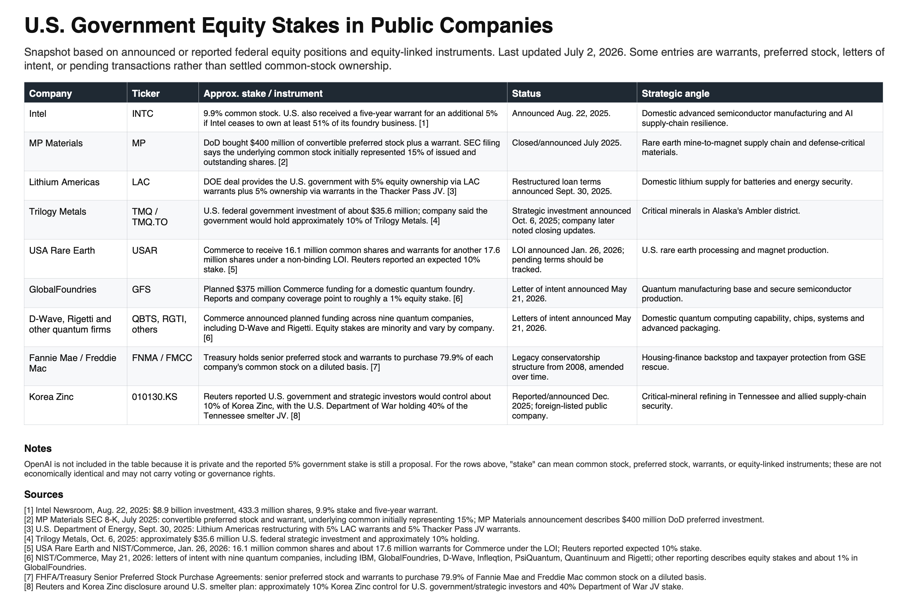
The talks come after the Trump administration took a 10% stake in Intel, 15% in MP Materials, and …

For OpenAI, a government stake could ease tensions with the Trump administration ahead of an IPO (delayed until 2027), while offering a political answer to concerns that AI is financially wrecking low-income folks.

Meanwhile, The Information’s earlier report that Nvidia has been renting back its own compute capacity from neocloud providers raises one obvious question…

… is there really enough end-user compute demand to absorb the AI buildout? 

Tyler Durden
Thu, 07/02/2026 – 07:30

via ZeroHedge News https://ift.tt/dHlhW9Y Tyler Durden

“Kids, if Your Parents Are MAGA, They Love Child Rapists” Sign Protected by First Amendment

From the Complaint.

From Judge Randolph Moss (D.D.C.) Monday in Accountability Now USA v. Griess, decided Monday (correctly, I think):

Plaintiff Accountability Now is an unincorporated association that holds a permit from the NPS [National Park Service] to conduct “a demonstration near the George Meade Statue on Constitution Avenue in Washington, D.C.” “Volunteers maintain the demonstration twenty-four hours a day, seven days a week” at which they “engage in face-to-face conversations with members of the public[] to call attention to the rise of fascism in the United States and [to] demand the impeachment of President Trump.” Plaintiff’s “current permit was issued on April 13, 2026, and is valid through August 12, 2026[,]” and Plaintiff “intends to obtain another permit when the current permit expires, at the same or another location on NPS-managed land in the District of Columbia.”

On February 24, 2026, in response to reporting “that the Justice Department was withholding more than 50 pages of FBI interviews with a woman who had accused Donald Trump of sexually abusing her when she was a minor[,]” Plaintiff began to display two new signs at the demonstration. One sign reads: “TRUMP RAPED LITTLE GIRLS.” The other reads: “KIDS, IF YOUR PARENTS ARE MAGA, THEY LOVE CHILD RAPISTS.” According to Plaintiff, “[t]he display of those signs has engendered numerous conversations between volunteers and passersby regarding President Trump’s behavior, morality, and fitness to continue in office.” … [Plaintiffs allege that] NPS agents requested that the two child rape signs be taken down, although it is not clear whether the NPS officials provided a reason for the request during the conversation…

Under the well-known standard articulated in Miller v. California (1973), speech is obscene if (1) “the average person, applying contemporary community standards would find that the work, taken as a whole, appeals to the prurient interest,” (2) “the work depicts or describes, in a patently offensive way, sexual conduct specifically defined by the applicable state [or federal] law,” and “the work, taken as a whole, lacks serious literary, artistic, political, or scientific value…. Understandably, Defendants have now conceded that the two signs at issue are not obscene as to adults. Indeed, to argue otherwise would be to suggest that virtually every news outlet in the country violates the obscenity laws every time it refers to allegations of rape or rape of a minor.

Nor can one plausibly maintain that the First Amendment affords no protection to those who accuse high ranking government officials of having committed sex crimes, including the rape of a child. Allegations of rape, standing alone, do not appeal to any prurient or unwholesome interest in nudity, sex, or excretion; they do not describe sexual conduct in a patently offensive way, and, indeed, do not describe a particular sex act at all; and they do not lack all serious political value. To the contrary, “‘[o]bscene antigovernment’ speech, … is a contradiction in terms: If expression is antigovernment, it does not lac[k] serious … political … value’ and cannot be obscene.”

Recognizing the futility of arguing otherwise, Defendants do not argue that the two rape signs are obscene in general, but, rather, only obscene as to minors. Because “States have a specific interest in protecting children from sexually explicit speech,” the government “may prevent children from accessing speech that is obscene to children,” in a manner subject only to rational basis review “even though [that speech may] encompass speech that is ‘not obscene for adults.'” Free Speech Coal., Inc v. Paxton (2025). [“]A State may prevent minors from accessing works that (a) taken as a whole, and under contemporary community standards, appeal to the prurient interest of minors; (b) depict or describe specifically defined sexual conduct in a way that is patently offensive for minors; and (c) taken as a whole, lack serious literary, artistic, political, or scientific value for minors.” Id. (emphases in original). And although the restriction on children’s access to such material is subject only to rational basis review, “[t]o the extent that [the restriction] burdens adults’ rights to access such speech” incidentally, the restriction is “subject to intermediate scrutiny.”

Here, it is far from clear that either of the signs at issue is properly evaluated under the obscene-as-to-minors standard. Defendants hang their entire argument on the fact that one of the two signs opens with the salutation, “KIDS,” before stating “IF YOUR PARENTS ARE MAGA, THEY LOVE CHILD RAPISTS[,]” The other sign at issue omits any such salutation and merely asserts: “TRUMP RAPED LITTLE GIRLS.” As to that sign, counsel for the government conceded at oral argument that “viewed in isolation, … the second sign would be neither obscene nor obscene as to minors” but urged the Court to “view these signs as … one integrated message,” the second of which merely “elaborate[d] on the other.” Although Defendants acknowledge that “incidental viewers from a particularly vulnerable class—like children—do not wield a veto over speech that is suitable for the public at large,” they maintain that this case is different because “Accountability Now’s speech, on its own terms, was not directed to the public at large—it was directed at and tailored to ‘KIDS.'”

That characterization of the speech is a stretch. As Carey explains in her uncontroverted declaration, the message is far broader than Defendants contend. It is clearly “directed at all the people who visit [the] demonstration,” and it invites parents to “think about what lessons their children are learning if they see their parents” supporting the President. Notably, the sign was displayed as part of a demonstration calling for President Trump’s impeachment and removal from office, and the demonstration is located on a busy street in front of a federal courthouse. The demonstration is not at or near a school or playground, where children are often unaccompanied by their parents. Nor were the signs included in children’s television programing or online or at a place that young children can often access without their parents’ knowledge. Although children “sometimes visit [the] demonstration site,” the government offers no evidence that it considered whether or how often children might see the sign before acting—or, indeed, that it was aware that a single child had seen the signs.

Defendants’ regulation of these publicly visible signs, moreover, is a far cry from the sorts of regulations targeting the direct distribution of sexual content to minors …. The Court is, therefore, unpersuaded that Defendants’ actions are reasonably characterized as the direct regulation of “sexual material harmful to minors” that has “only an incidental effect on” “adults’ rights to access such speech.” …

But even putting that threshold difficulty aside, Defendants’ contention that the two signs are obscene as to minors fails for multiple reasons:

First, the signs, “taken as a whole, and under contemporary community standards,” do not “appeal to the prurient interest of minors.” “[P]rurient interest[s]” are “shameful or morbid interest[s] in nudity, sex, or excretion.” … Defendants maintain that this factor is satisfied because Plaintiff’s signs “predominantly invoke[ ] in minors a ‘shameful or morbid interest’ in violent and unlawful sex,” and “piques minors’ ‘shameful and morbid interest’ in a particularly repugnant and criminal category of sex.”

Their argument borders on the absurd. Accusations of rape—and, in particular, rape of a child—are undoubtedly disturbing. But they do not pique a shameful or morbid interest in that repugnant and criminal act. Here, moreover, Plaintiff’s signs unequivocally condemn “child rapists” or those who “raped little girls.” They do not, by any stretch of the imagination, “deal[ ] with sex in a manner appealing” to minors’ shameful interest in child rape or pedophilia. To be sure, rape involves sexual contact of some form. But that is the extent of it, and “[s]ex and obscenity, … as the Supreme Court has held, are not synonymous.”

Second, Plaintiff’s signs do not “depict or describe specifically defined sexual conduct in a way that is patently offensive for minors.” Patently offensive materials “go[ ] substantially beyond customary limits of candor and affront[ ] contemporary community standards of decency.” As with prurient appeal, patent offensiveness may be measured by the standard that prevails in the state or forum community. Defendants’ claims with regard to this factor are even further afield. They contend that the signs “accost[ ] children with a graphic description of violent sexual crimes” and “explicitly refer to a sexual act and use the term ‘RAPE’ in its ordinary criminal sexual sense.” Neither sign, however, includes any description of the alleged sexual crimes, much less a “graphic” one. Indeed, neither sign “depicts or describes” any sexual contact at all, beyond conveying that it was non-consensual (perhaps due to force, or perhaps due to the age of the alleged victims) and that the victims were minors. By Defendants’ logic, To Kill a Mockingbird, The Color Purple, A Tree Grows in Brooklyn, Tess of the d’Urbervilles, Leda and the Swan, The Rape of the Sabine Women, and the biblical story of Dinah and Shechem (Genesis 34) would all fail this prong of the obscene-as-to-minors test. That, of course, is not the law.

Finally, Defendants do not—and cannot—show that the two signs lack any “serious … political … value” for minors. The signs constitute a direct response to current events: news reporting that “the Justice Department was withholding more than 50 pages of FBI interviews with a woman who had accused Donald Trump of sexually abusing her when she was a minor.” The signs “ha[ve] engendered numerous conversations between volunteers and passersby regarding President Trump’s [alleged] behavior, morality, and fitness to continue in office,” id., topics that are plainly a “matter[ ] of political concern.” Although Defendants maintain that the signs “frustrate [healthy political discussion] by explicitly accusing many parents of loving child rapists,” it is neither the government’s nor the Court’s role to distinguish healthy from unhealthy debate and discussion of topics of national importance. The same is true of Defendants’ contention that because the signs fail to “explain that they are mere rhetoric or innuendo,” minors will not “understand their veiled meaning, related conspiracy theories, or the broader political context to which the signs vaguely allude.” In pressing this argument, Defendants concede that the signs constitute political discourse, and they appear to acknowledge that the signs were not, in fact, targeted at children—a contention at odds with their vehement assertion that children are “the target audience” of these signs. But most problematically, Defendants incorrectly suggest that the NPS may exercise its permitting authority to police the content of speech and to ensure that it is not misleading—at least as to minors. Emphatically, that is not the role of the government or the Court.

Along similar lines, Defendants characterize the signs as raising sexual misconduct allegations that are “frivolous[ ]” and that propagate “conspiracy theories.” But if anything, those assertions undermine the government’s defense; the government lacks authority to regulate the content of political speech, particularly political speech that is critical of the government or senior government officials, based on the belief that the speaker has it wrong….

{Defendants do not contend that the speech at issue is libelous under the actual malice standard applicable to public figures, see New York Times Co. v. Sullivan (1964), nor would the NPS have authority to take an enforcement action based on such a theory.}

For all of these reasons, the Court concludes that Plaintiff’s signs are protected speech, not obscene as to minors…..

The Court, accordingly, concludes that Defendants’ conduct violates Plaintiff’s First Amendment rights with respect to the two signs at issue and will grant summary judgment in Plaintiff’s favor with respect to its First Amendment claim challenging the NPS’s direction that it remove the two signs under threat of revocation of its permit.

The court also held that an “86-47” flag displayed by the protesters was constitutionally protected, for reasons similar to those the court gave a month ago when issuing a temporary restraining order (see this post). Arthur Spitzer, Aditi Shah, and Laura Follansbee (ACLU D.C.) represent plaintiff.

The post "Kids, if Your Parents Are MAGA, They Love Child Rapists" Sign Protected by First Amendment appeared first on Reason.com.

from Latest – Reason.com https://ift.tt/1yz6Onu
via IFTTT

Thomas Paine: The Founding Father Worth Celebrating


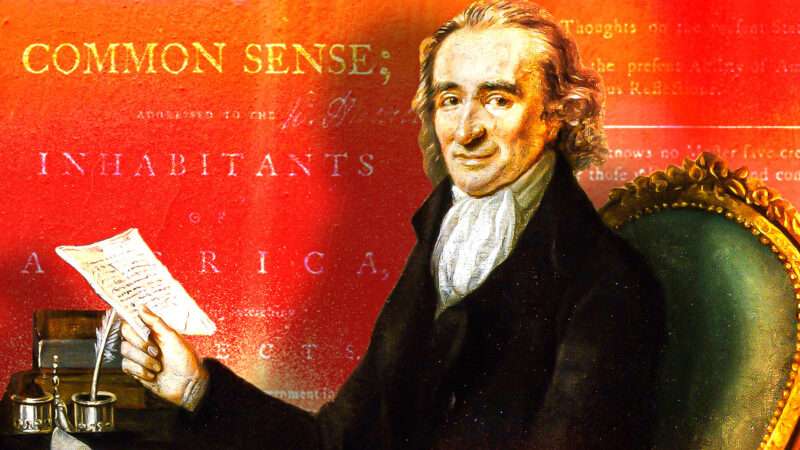
Thomas Paine against a red background with gold text from Common Sense | Illustration: Adani Samat/Laurent Dabos

On June 8, 1809, 72-year-old Thomas Paine took his last breath inside a small house in Greenwich Village. The next day the best-selling author and revolutionary’s body was loaded onto a cart and taken to his farm in New Rochelle, about 22 miles north of New York City, for burial. There was no procession, no national moment of silence, no celebration of a life fully lived. 

A small group attended his funeral, including his caretaker, Marguerite Bonneville, a friend from his many years in Revolutionary France, and her son, Benjamin. As the dirt hit the mahogany coffin, Bonneville exclaimed, “Oh! Mr. Paine! My son stands here as testimony of the gratitude of America, and I, for France!”

By the time of his death, there was little gratitude for Paine’s contributions to the United States outside of workingmen’s associations because of his blistering attacks on revealed religion, particularly Christianity. But as America barrels toward its semiquincentennial, Thomas Paine emerges as the Founding Father Americans can celebrate without regret. Unlike his contemporaries, Paine’s radical liberalism feels strikingly modern—pro-democracy, pro-market, anti-poverty, and antislavery—and worth defending as the forces of reaction mount here at home and abroad. Without the pen of Paine, in fact, there might not be a United States to celebrate today. 

In January 1776, Paine’s Common Sense hit the streets of Philadelphia like a cannonball. The 47-page pamphlet was an immediate sensation. Not only did Paine reject reconciliation with Great Britain and call for independence, he attacked hereditary monarchy and aristocracy as millstones around humanity’s neck. What made the text dangerous was that Paine didn’t write it for polite society. With wit and verve, he wrote it for the masses in language any farmer or artisan could understand. But Paine went further. He had the temerity to tell common people that they weren’t mules to be driven into the mud by their so-called betters. Instead, they had the right and ability to rule themselves with dignity, the divine right of kings be damned.

Paine’s democratic beliefs terrified the more elitist and conservative Founding Fathers, most notably his decades-long nemesis, John Adams. While Adams conceded that without Paine “the sword of Washington would have been wielded in vain,” he feared Paine’s egalitarian ethos would unleash anarchy into the nascent republic. Paine’s forceful argument for universal male suffrage without a property qualification petrified Adams. (Though he had a friendship with the founding feminist Mary Wollstonecraft during his time in England and revolutionary France, Paine doesn’t seem to have commented on women’s voting rights.) 

A few short months after the Declaration of Independence in September 1776, Pennsylvania made good on Paine’s democratic promise. The state’s constitutional convention—presided over by Benjamin Franklin, Paine’s friend and benefactor—codified popular democracy into the state constitution while protecting civil liberties such as free speech and the right to bear arms for self-defense. In response, the embattled nation’s working people celebrated him while the colonial elite cursed him for unleashing the unforgivable conceit: equality by birth.

Paine, however, couldn’t be typecast as a typical progressive today. As the Democratic Party flirts with socialism and Donald Trump’s MAGA movement champions tariffs, Paine’s bourgeois radicalism stands firm: Markets and private property are the best ways to combat poverty. He anticipated that great wealth could be “capable of good” and rebelled against the simplistic notion that entrepreneurs and business owners were evil. “I care not how affluent some may be,” he wrote in Agrarian Justice, “provided that none be miserable in consequence of it.” In The American Crisis, Paine insisted that trade “flourishes best when it is free, and it is weak policy to attempt to fetter it,” understanding that prosperity flowed from the free trade in goods and services between individuals and nations. 

Paine, however, wasn’t an apologist for the rich or inequality. Instead, he earned the admiration of working people. Not only because he was one of them, but because he fought for them wholeheartedly. Enraged by the privilege and feudalism of the Old World and any scheme to plant such poison in American soil, Paine laid out an early proposal for social insurance to provide public education for poor children, maternity benefits for new mothers, and pensions for the infirm and elderly. But Paine didn’t see his proposal as welfare. He saw it as every individual’s natural inheritance from common land being cultivated and taken out of common use. “It is not a charity but a right,” he wrote, “that I am pleading for.” Paine thought his plan would undercut the rampant inequality and dependency that corrupted the Old World.

Unlike many in the Founding generation, Paine detested slavery. When he arrived in Philadelphia in 1774, his quarters sat next to a slave market. What he called “the infernal trafic (sic)” horrified him. Later in life he would write a sentence that connected his hatred of subjugation to his celebration of democracy and individual rights: “Man has no property in man, neither has one generation a property in the generations that are to follow.” 

About seven months before his death, Paine even hurled his abolitionist views in the face of former president Thomas Jefferson, according to textual analysis by the historians behind Thomas Paine: Collected Writings, published this week by Princeton University Press. In what was considered a letter of unknown authorship to Jefferson from November 1808, Paine chastised the former president and slaveholder, reminding Jefferson of the Declaration’s language he penned. “We hold these truths self-evident; that all men, (not all white men) are created equal,” he wrote. Then he came in for the kill, telling Jefferson that if slavery was so entrenched in America then that meant it was “high time for America to give up all pretentions [sic] to liberty & freedom.” Paine’s antislavery credentials shouldn’t need defending today, but they take on new salience when the U.S. government rewrites American history to sand down slavery’s wickedness.

This year, more than ever, there is an impulse to engage in hagiography when discussing the Founding generation. Paine was far from perfect, but when it comes to the questions that matter most today, he’s the Founding Father to cast our lot with. He reminds us of America’s true covenant: the right of every person to live without a master.

The post Thomas Paine: The Founding Father Worth Celebrating appeared first on Reason.com.

from Latest – Reason.com https://ift.tt/pfA7LQI
via IFTTT

No One Can Control the Future


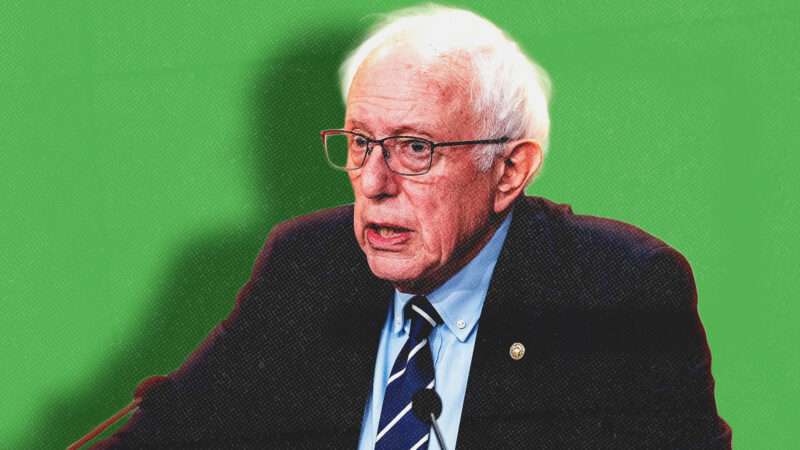
Bernie Sanders | Illustration: Andrew Thomas-CNP/CNP/Polaris/Newscom

In a recent New York Times op-ed, the senior socialist senator from Vermont argued that artificial intelligence was “built on our collective intelligence”—our “books, songs, artwork, journalism, computer code, scientific research, videos, conversations, images and ideas spanning generations.” The most important question, he said, is not whether AI will change the world but “who will own and control that future.”

He proposed a one-time 50 percent tax on the largest AI companies, to be paid in shares held by a government-run sovereign wealth fund. The federal government would get voting shares, board representation, and the power to “block decisions” it decides are bad for citizens.

This is the worst idea Bernie Sanders has ever had, in a long and illustrious career of terrible ideas.

***

In 2012, President Barack Obama delivered a line that would haunt his reelection campaign and my nightmares: “If you’ve got a business—you didn’t build that.” Obama was talking about roads, bridges, schools, and the internet. His defenders insisted he was being caricatured after the line became a GOP meme. But the broader claim was clear enough: Private accomplishment is downstream of public investment, giving the state some moral claim on the fruits of success.

He was wrong about that. Simply existing in a geographical area where the state monopolizes violence and infrastructure does not give the president of the United States the right to your production or profits.

Sanders takes that already tenuous argument to its maximalist conclusion. He no longer even pretends to make a distinction between the goods or services customarily provided by the state and what OpenAI’s Sam Altman has called “the learnings of humanity.” New technology always dresses in hand-me-downs, and AI’s use of intellectual property has been rapid and public in ways that invite scrutiny. But influence does not create ownership. Use does not equal debt. And most importantly, the fact that human beings operate in a world filled with past inventions does not give Sanders, of all people, the right to a veto on Anthropic’s conduct.

President Donald Trump’s economic nationalism has made federal ownership, veto rights, and backdoor nationalization feel terribly normal. His administration converted federal grants into a roughly 10 percent stake in Intel, using already-promised CHIPS Act and Secure Enclave money to make Washington one of the company’s largest shareholders. The Trump administration also secured what Trump called a “golden share” in U.S. Steel as part of the Nippon Steel deal, giving Washington unusual power over the company’s operations.

The right calls it national security. The left calls it democracy. The results are the same: Washington wants shares, seats, vetoes, and a cut of the upside.

***

An earlier version of this battle went down during the great Facebook panic of the 2010s. For a while, very serious people were convinced Facebook had become something more than a company. It was a public square. A public resource. A public utility. It was too large to ignore and too central to civic life to remain merely private.

Sen. Elizabeth Warren (D–Mass.) proposed treating Big Tech companies (including Amazon, Google, and Facebook) as “platform utilities” and forcing separations between the platforms and businesses that used them. Her 2019 plan declared that “today’s big tech companies have too much power—too much power over our economy, our society, and our democracy.” The Federal Trade Commission (FTC) later sued Facebook, alleging it had illegally maintained a “personal social networking monopoly” through its acquisitions of Instagram and WhatsApp.

The premise was that Facebook’s dominance would last unless Washington intervened—and that if it didn’t intervene, our foreign policy and domestic politics would be destroyed. Then teenagers did what teenagers do: rolled their eyes and left the room where the adults were yelling.

Pew Research found that teen Facebook use fell from 71 percent in 2014–15 to 32 percent in 2022. In November 2025, a federal court concluded that the FTC had failed to prove Meta held monopoly power in the personal social networking market. Our foreign policy and domestic politics are a shambles, but that’s not Facebook’s fault.

Had Washington succeeded in freezing Facebook into a regulated utility, it might have done the one thing Mark Zuckerberg could not do on his own: make Facebook’s dominance permanent.

The case for nationalizing half of the largest AI companies depends on a fantasy of certainty: that we know which firms matter, what they will become, whether government control would discipline them or entrench them, and whether politicians can seize upside without smothering experimentation.

A company can be huge and still be vulnerable. A product can be essential today and obsolete tomorrow. A technology can reshape the world and then vanish. None of this requires government shareholders. A company does not become a “public utility” when it reaches a certain market cap, influences an election cycle, or terrifies enough op-ed writers.

***

All of that is worth remembering as SpaceX prepares what could be the largest IPO in history, targeting a $1.77 trillion valuation and a $74 billion raise. The company is selling investors not only rockets and Starlink, but also AI computing resources and speculative plans such as space-based data centers. The same week the SpaceX IPO started making headlines, one of Blue Origin’s New Glenn rockets exploded during a hot-fire test, damaging its launch pad and threatening delays.

You can already hear the next version of the argument forming. Launch is too important. Satellites are too important. Orbital compute is too important. No private company should control access to space. “You didn’t build that.” Surely the public deserves a stake. Surely Washington deserves a golden share.

The next big thing will always look too big, too dangerous, too socially consequential, too dependent on shared inheritance, and too lucrative to leave alone.

Leave it alone anyway. No one can, or should, control the future.

The post No One Can Control the Future appeared first on Reason.com.

from Latest – Reason.com https://ift.tt/uCUcdGo
via IFTTT

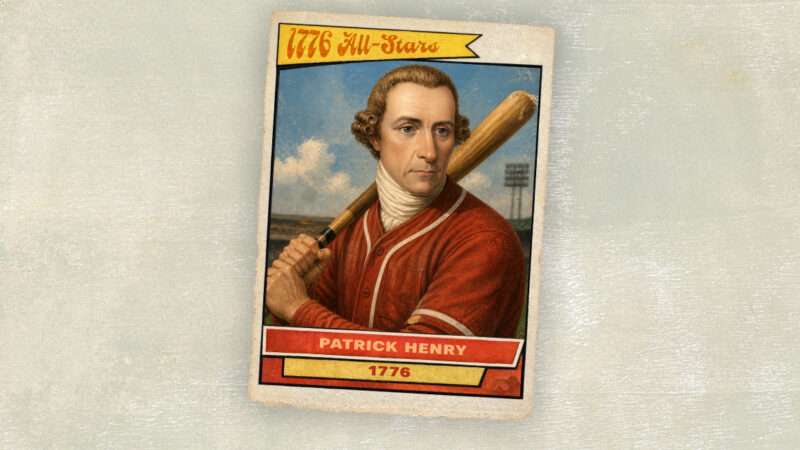
1776 All-Stars: Patrick Henry Knew To Fear American Kings


henry | Illustration: Joanna Andreasson, ChatGPT-5.4; Source images: Wikimedia

This is part of 1776 All-Stars, a series about Reason’s favorite American Founders. Read more here.

Joanna Andreasson

The proposed U.S. Constitution “squints toward monarchy,” Patrick Henry complained at the Virginia Ratifying Convention in 1788. “Does not this raise indignation in the breast of every true American? Your president may easily become king.”

Henry’s warning about presidential powers, which looks especially prescient today, was part of his broader case against James Madison’s replacement for the Articles of Confederation. Although Henry lost that battle, his heroic reputation as an early and eloquent advocate of independence earned him a respectful hearing, and his critique helped shape the Bill of Rights.

Madison’s plan, Henry warned, repudiated the principles that drove the Revolution. “Here is a revolution as radical as that which separated us from Great Britain,” he said. “It is as radical, if in this transition, our rights and privileges are endangered, and the sovereignty of the states be relinquished: and cannot we plainly see, that this is actually the case? The rights of conscience, trial by jury, liberty of the press, all your immunities and franchises, all pretensions to human rights and privileges, are rendered insecure, if not lost, by this change.”

The Virginia convention nevertheless approved the Constitution. But it also proposed a raft of 40 amendments that reflected Henry’s concerns. They included explicit protections for freedom of speech, religious liberty, trial by jury, and the right to arms, along with an amendment affirming the “sovereignty of the states” that Henry feared would be lost, similar to the language that was later ratified as the 10th Amendment.

The man who would play a central role in the Revolution and the debate over the Constitution began his adult life as a failed retailer whose business setbacks drove him to a job serving drinks at his father-in-law’s tavern. Determined to support a growing family that would eventually include 17 children, Henry lived in constant dread of debt as a struggling planter, ever-hopeful land speculator, and self-taught lawyer whose formal education ended when he was 10. But he made a name for himself as a fiery advocate of the American cause.

In 1763, when Henry was 27, he defended a 1758 Virginia law that reduced the colony’s compensation for Anglican clergy against a lawsuit by James Maury, an aggrieved minister. King George II’s Privy Council had overturned that law in 1759, and Henry, who represented the parish vestrymen who would have to pony up the back pay that Maury claimed he was due, viewed that veto as an outrageous example of interference with local rule.

“A king, by annulling or disallowing laws of this salutary nature, from being the father of his people, degenerates into a tyrant, and forfeits all rights to his subjects’ obedience,” Henry declared. These were shocking words at the time, but they evidently swayed the jury, which awarded Maury just a penny in damages.

Henry made a similar splash as a freshman Virginia legislator in 1765, when he denounced the Stamp Act, which imposed the first direct tax on American colonists. Henry reportedly noted that “Tarquin and Julius had their Brutus,” while “Charles had his Cromwell,” adding that “he did not doubt but some good American would stand up, in favour of his country.” When House of Burgesses Speaker John Robinson condemned the implied endorsement of assassination as treason, Henry withdrew his comment, attributing it to his passionate concern for “his country’s dying liberty.” But according to a tradition that Henry biographer Thomas S. Kidd describes as “almost certainly apocryphal,” Henry was more defiant, saying, “If this be treason, make the most of it!”

Henry delivered his most famous speech as a delegate to the Second Virginia Convention, which was convened after the colony’s royal governor suspended the House of Burgesses in 1775. Speaking a month before the Battles of Lexington and Concord, Henry said it was folly to call for peace, although his exact words are uncertain. “Is life so dear, or peace so sweet, as to be purchased at the price of chains and slavery?” he reportedly asked. “Forbid it, Almighty God! I know not what course others may take; but as for me, give me liberty or give me death!”

Henry later served several terms as Virginia’s governor and as a member of its House of Delegates. But his participation in politics was intermittent and reluctant, and he turned down various offers of presidential appointments, admirably preferring family life to the temptations of power.

Less admirable: Like many other prominent Virginians, Henry recognized the immorality of slavery but nevertheless owned and sold its victims. In a 1773 letter to a Quaker abolitionist, Henry described slavery as a “lamentable evil” and “abominable practice” that was “repugnant to humanity,” flagrantly inconsistent with Christianity, and “destructive to liberty.” Although “I am drawn along by the general inconvenience of living without” slaves, he wrote, “I will not, cannot justify it.”

Publicly, Henry opposed the African slave trade, and he seems to have supported a bill that allowed Virginia slaveholders to free the people they held in bondage. But he never liberated any of his own slaves, even in his will. And as Kidd notes, Henry’s objections to the new federal government’s taxing authority stemmed partly from his fear that Congress would impose a prohibitive tax on slaves.

While Henry’s slaveholding contradicted his rhetoric of liberty, his concerns about oppressive taxes and unbridled executive power still ring true. In fact, contemporary controversies combine those two threats in a way that even Henry never would have imagined.

1776 All-Stars, a series about Reason‘s favorite American Founders:

The post 1776 All-Stars: Patrick Henry Knew To Fear American Kings appeared first on Reason.com.

from Latest – Reason.com https://ift.tt/TMLfyxW
via IFTTT

Japan Takes Next Step In $2.3 Trillion Plan With Domestic AI Model And 10M Robots

Japan Takes Next Step In $2.3 Trillion Plan With Domestic AI Model And 10M Robots

The Japanese government has unveiled plans to create a domestically developed artificial intelligence model and put roughly 10 million AI-equipped robots into operation across 18 sectors by 2040 – building on a 14-year growth strategy announced last month, which targets ¥370 trillion ($2.3 trillion) in combined public and private investment across 17 priority areas, including physical AI, semiconductors, quantum technology, and nuclear fusion.

Kawasaki Kaleido

The initiative will receive up to 1 trillion yen (approximately $6.1 billion) in government funding over the next five years. Crucially, the funding is tied to annual milestone reviews – making the trillion-yen figure a ceiling rather than a guarantee, with Tokyo retaining the ability to pull back if early targets are missed.

The AI model will be developed by Noetra, a consortium formally commissioned by Japan’s Ministry of Economy, Trade and Industry (METI) and its innovation agency NEDO. Noetra is majority-owned by SoftBank, NEC, Sony Group, and Honda, with Fujitsu and Rakuten reportedly weighing whether to join. The consortium is also working alongside AIST, Japan’s national research laboratory. Noetra’s investor base is expected to grow to 44 participating companies spanning automotive, electronics, manufacturing, finance, and logistics. The technical goal is a multimodal foundation model capable of processing language, images, video, and sensor data simultaneously – giving robots the ability to interpret a physical environment and act within it, rather than simply executing pre-programmed instructions.

The effort reflects a broader global push by countries to build “sovereign AI” capabilities and reduce reliance on dominant U.S. and Chinese technologies.

A key focus of the strategy is physical AI – the application of artificial intelligence in real-world environments rather than just on screens. This includes self-driving vehicles, factory automation, and humanoid robots designed for practical tasks.

On Tuesday, the government released an updated national AI robotics strategy. Industry Minister Ryosei Akazawa said the plan aims to “vigorously promote social implementation across a total of 18 fields,” including newly added sectors such as restaurants, food manufacturing, and medicine.

We will build and grow data infrastructure for physical AI and robots that capitalize on Japan’s strengths,” Akazawa told reporters.

Those strengths are considerable. Japan is home to some of the world’s leading industrial robotics manufacturers – including FANUC, Yaskawa Electric, and Kawasaki Heavy Industries – and produces roughly half of all industrial robots globally by volume, according to the International Federation of Robotics. The country already deploys more robots per manufacturing worker than any other nation, making it the natural proving ground for physical AI at industrial scale.

The push comes as Japan grapples with a rapidly aging and shrinking population. More than 29% of the Japanese population is now aged 65 or older – the highest proportion of any country in the world – and the working-age population has been in decline since 1995. Policymakers see advanced robotics as a critical tool to fill widening labor gaps across industries rather than a supplement to an adequate workforce.

Can they make it happen?

FANUC factory floor

Tyler Durden
Thu, 07/02/2026 – 07:00

via ZeroHedge News https://ift.tt/7lSFwJp Tyler Durden

Why Bernie Sanders’ AI Bill Is Fascistic And Dangerous

Why Bernie Sanders’ AI Bill Is Fascistic And Dangerous

Authored by Amirhossein Eshtiaghi via The Mises Institute,

Bernie Sanders is a socialist populist. His unfamiliarity with the fundamentals of economics explains why he considers Denmark to be socialist. A former Danish Prime Minister once implicitly addressed such claims, noting that Denmark’s economy is not socialist, but rather a market economy. But the truth does not matter to American leftists.

He has now made headlines again with a bill that would expand state participation in the AI sector—a plan that, contrary to the claims of his supporters, could have disastrous consequences. In the following, these consequences are briefly examined.

This Is a Fascist Policy

Fascist Italy and Nazi Germany, after the Soviet Union, were among the countries with the highest levels of state ownership and state control over the economy. In both Germany and Italy, the state controlled many companies, while private firms operated under strict state supervision and intervention. The Nazis nationalized nearly half of the economy and then used extensive regulations to bring the private sector under state control. Mussolini followed a similar approach. The state determined what goods would be produced, how they would be produced, and in what form they would be supplied.

Sanders says that artificial intelligence does not belong to billionaires but to the people. Fascists and Nazis used the same argument—that the private sector should be organized in line with the public interest—to justify extensive intervention in the market. In fact, Hitler and Mussolini were able to control the means of production in much the same way without removing corporate managers.

Comparing Sanders to fascism may seem unusual, but it should not be forgotten that the main leaders of Italian fascism, including Mussolini, were initially socialists before they became fascists. In fact, as Thomas DiLorenzo argues in his book The Problem with Socialism, fascism had socialist origins.

Regarding state ownership and state influence over AI, Sanders and Trump take similar approaches. Trump himself has admitted that the economic views of his voters and Sanders’s voters “aren’t that far apart”—and that may be one of the few honest statements Trump has made in his life. In fact, both are populists and seek to expand state power and weaken the free market economy.

Therefore, Sanders’s proposal, or similar proposals, could allow the state to gain control over the AI industry while preserving the appearance of private ownership. In that sense, such proposals can reasonably be described as fascistic, since they enable state control over production without formally abolishing the private sector.

A Threat to Civil Liberties

States have always used intelligence agencies and affiliated institutions to restrict social freedoms, silence opponents, and monitor users online. They also pressure various platforms to hand over user data so it can be used to suppress dissent. If the state becomes the owner of artificial intelligence companies, it will be able to collect users’ information freely and without any obstacles.

Sanders’s supporters might privately believe that this would be a useful tool for monitoring opponents, allowing the state to identify and silence those who oppose their leftist ideology. However, it must be remembered that this power is being granted to the state, not to a specific political party. If figures like Trump—or any other authoritarian personality—come to power, this authority will fall into their hands, allowing them to suppress those very same leftists. It empowers states to monitor anyone they deem an “undesirable element.” Ultimately, this could pose a serious threat to liberty.

Politicians already possess considerable power; control over artificial intelligence would multiply that power many times over—and more power brings more corruption.

Weakening Innovation

This policy threatens innovation. State favoritism can make it difficult for new and creative players to enter the market and can slow the process of “creative destruction.” It should also be noted that the managers of AI companies might even welcome such a situation, since it could allow them to eliminate new competitors in the industry and reach a monopolistic position.

After all, once the state enters the field, companies could rely on the support of politicians so they no longer have to compete with non-American companies. They might even use the argument that the state is a shareholder in AI companies to justify banning the use of AI systems from other countries in the United States.

The support of some AI companies’ executives for proposals that would lead to state involvement in this industry is highly suspicious. We will have to wait and see what happens, but it is possible that Sanders’s bill could actually help those same billionaires eliminate their competitors.

Technology Should Not Be Held Back

Obstructing technological growth is both foolish and harmful. The claim that artificial intelligence destroys jobs is a deceptive and misleading argument. Opposing AI in order to preserve certain jobs is just as irrational as trying to stop the spread of the internet because the use of email caused some postal workers to lose their jobs.

By the same logic, we should have banned the light bulb because it led to job losses in the candle-making industry. Likewise, we should have abandoned modern textile machinery because it allowed the same amount of clothing to be produced with fewer workers.

If we follow this line of reasoning to its logical conclusion, we would have to return to the Stone Age. Innovation should not be stopped. Technological advancement and innovation are the primary engines of productivity growth and rising living standards. Just as old jobs disappear, new employment opportunities emerge. For example, many workers from traditional industries can find work in newer and more productive sectors of the economy. We should not hinder the growth of industries that can improve the lives of billions of people merely to preserve the jobs of a limited number of individuals.

A Populist Claim

Artificial intelligence, like any other industry, is built by entrepreneurs and producers, and its products are exchanged in the marketplace. The assertion that, “AI does not belong to billionaires; it belongs to the people” is akin to claiming that potatoes do not belong to their farmers but to “the people,” and that therefore, 50 percent of all farmland must be seized by the state.

Sanders is a master of slogans like “Billionaires shouldn’t exist,” and he is strategic in this choice. Were he to replace “billionaires” with “millionaires,” the slogan would inevitably implicate him and leftist celebrities. It benefits him to funnel jealousy toward billionaires, thereby shielding himself from public outrage.

If wealth is inherently evil, then being a millionaire is equally so. In that case, the left would be forced to chant slogans such as “Millionaires should not exist”—or perhaps even say, “Damn Sean Penn, Oprah, and Sanders.” After all, they are all millionaires.

The benefits of AI do not accrue solely to billionaires; billions of people worldwide utilize these tools—in medicine, education, and thousands of other fields. If private companies, absent rent-seeking or government handouts, earn profits through innovation and creativity, there is nothing inherently wrong with that. No one is forced to use AI; those who choose to do so effectively vote with their dollars to reward the companies that provide these services. One can only hope that Sanders has not used these tools or maintained an AI account himself—because if he has, he has been lining the pockets of the very capitalists he claims to despise.

The Abuse of a Public Wealth Fund

Politicians can abuse national wealth funds. In Russia, Vladimir Putin has leveraged the National Wealth Fund to bankroll the war in Ukraine. The US state could just as easily exploit such a fund to finance war or violate human rights. In this scenario, revenues generated from AI would be diverted away from vital investments in innovation and instead channeled into the production of bombs to be dropped on innocent people.

Conclusion

Regrettably, politicians from both major American parties seem determined to undermine the free market and the values of classical liberalism. From Trump’s foolish tariffs to Sanders’s socialist and demagogic policies, both are actively eroding the foundations of economic freedom.

Americans should not feel compelled to choose between economic nationalism and socialism, just as they were never truly forced to choose between fascism and socialism in the twentieth century. There is only one path worth pursuing: the defense of libertarian values.

The real solution to improving living standards lies in the state’s complete withdrawal from all economic and social spheres. Unless the American public shifts its focus toward the ideals of classical liberalism or libertarianism, we will continue to witness a cycle of populism from both parties, as well as state obstruction of growth and innovation.
Tyler Durden
Thu, 07/02/2026 – 06:30

via ZeroHedge News https://ift.tt/49WZrDB Tyler Durden

Thomas Paine: The Founding Father Worth Celebrating


Thomas Paine against a red background with gold text from Common Sense | Illustration: Adani Samat/Laurent Dabos

On June 8, 1809, 72-year-old Thomas Paine took his last breath inside a small house in Greenwich Village. The next day the best-selling author and revolutionary’s body was loaded onto a cart and taken to his farm in New Rochelle, about 22 miles north of New York City, for burial. There was no procession, no national moment of silence, no celebration of a life fully lived. 

A small group attended his funeral, including his caretaker, Marguerite Bonneville, a friend from his many years in Revolutionary France, and her son, Benjamin. As the dirt hit the mahogany coffin, Bonneville exclaimed, “Oh! Mr. Paine! My son stands here as testimony of the gratitude of America, and I, for France!”

By the time of his death, there was little gratitude for Paine’s contributions to the United States outside of workingmen’s associations because of his blistering attacks on revealed religion, particularly Christianity. But as America barrels toward its semiquincentennial, Thomas Paine emerges as the Founding Father Americans can celebrate without regret. Unlike his contemporaries, Paine’s radical liberalism feels strikingly modern—pro-democracy, pro-market, anti-poverty, and antislavery—and worth defending as the forces of reaction mount here at home and abroad. Without the pen of Paine, in fact, there might not be a United States to celebrate today. 

In January 1776, Paine’s Common Sense hit the streets of Philadelphia like a cannonball. The 47-page pamphlet was an immediate sensation. Not only did Paine reject reconciliation with Great Britain and call for independence, he attacked hereditary monarchy and aristocracy as millstones around humanity’s neck. What made the text dangerous was that Paine didn’t write it for polite society. With wit and verve, he wrote it for the masses in language any farmer or artisan could understand. But Paine went further. He had the temerity to tell common people that they weren’t mules to be driven into the mud by their so-called betters. Instead, they had the right and ability to rule themselves with dignity, the divine right of kings be damned.

Paine’s democratic beliefs terrified the more elitist and conservative Founding Fathers, most notably his decades-long nemesis, John Adams. While Adams conceded that without Paine “the sword of Washington would have been wielded in vain,” he feared Paine’s egalitarian ethos would unleash anarchy into the nascent republic. Paine’s forceful argument for universal male suffrage without a property qualification petrified Adams. (Though he had a friendship with the founding feminist Mary Wollstonecraft during his time in England and revolutionary France, Paine doesn’t seem to have commented on women’s voting rights.) 

A few short months after the Declaration of Independence in September 1776, Pennsylvania made good on Paine’s democratic promise. The state’s constitutional convention—presided over by Benjamin Franklin, Paine’s friend and benefactor—codified popular democracy into the state constitution while protecting civil liberties such as free speech and the right to bear arms for self-defense. In response, the embattled nation’s working people celebrated him while the colonial elite cursed him for unleashing the unforgivable conceit: equality by birth.

Paine, however, couldn’t be typecast as a typical progressive today. As the Democratic Party flirts with socialism and Donald Trump’s MAGA movement champions tariffs, Paine’s bourgeois radicalism stands firm: Markets and private property are the best ways to combat poverty. He anticipated that great wealth could be “capable of good” and rebelled against the simplistic notion that entrepreneurs and business owners were evil. “I care not how affluent some may be,” he wrote in Agrarian Justice, “provided that none be miserable in consequence of it.” In The American Crisis, Paine insisted that trade “flourishes best when it is free, and it is weak policy to attempt to fetter it,” understanding that prosperity flowed from the free trade in goods and services between individuals and nations. 

Paine, however, wasn’t an apologist for the rich or inequality. Instead, he earned the admiration of working people. Not only because he was one of them, but because he fought for them wholeheartedly. Enraged by the privilege and feudalism of the Old World and any scheme to plant such poison in American soil, Paine laid out an early proposal for social insurance to provide public education for poor children, maternity benefits for new mothers, and pensions for the infirm and elderly. But Paine didn’t see his proposal as welfare. He saw it as every individual’s natural inheritance from common land being cultivated and taken out of common use. “It is not a charity but a right,” he wrote, “that I am pleading for.” Paine thought his plan would undercut the rampant inequality and dependency that corrupted the Old World.

Unlike many in the Founding generation, Paine detested slavery. When he arrived in Philadelphia in 1774, his quarters sat next to a slave market. What he called “the infernal trafic (sic)” horrified him. Later in life he would write a sentence that connected his hatred of subjugation to his celebration of democracy and individual rights: “Man has no property in man, neither has one generation a property in the generations that are to follow.” 

About seven months before his death, Paine even hurled his abolitionist views in the face of former president Thomas Jefferson, according to textual analysis by the historians behind Thomas Paine: Collected Writings, published this week by Princeton University Press. In what was considered a letter of unknown authorship to Jefferson from November 1808, Paine chastised the former president and slaveholder, reminding Jefferson of the Declaration’s language he penned. “We hold these truths self-evident; that all men, (not all white men) are created equal,” he wrote. Then he came in for the kill, telling Jefferson that if slavery was so entrenched in America then that meant it was “high time for America to give up all pretentions [sic] to liberty & freedom.” Paine’s antislavery credentials shouldn’t need defending today, but they take on new salience when the U.S. government rewrites American history to sand down slavery’s wickedness.

This year, more than ever, there is an impulse to engage in hagiography when discussing the Founding generation. Paine was far from perfect, but when it comes to the questions that matter most today, he’s the Founding Father to cast our lot with. He reminds us of America’s true covenant: the right of every person to live without a master.

The post Thomas Paine: The Founding Father Worth Celebrating appeared first on Reason.com.

from Latest – Reason.com https://ift.tt/pfA7LQI
via IFTTT