The Civitas Collection 250

I am happy to pass along this impressive volume from my friends at the Civitas Institute:

The contributors have strived to evaluate the Declaration in its entirety, a document whose excellence serves as the foundation of American political life. We also recognize that the legacy and principles of the Declaration are being questioned in this, the two-hundred-and-fiftieth anniversary year. What the reader should understand is that the authors featured in this volume are not in doubt about the principles of the Declaration and their meaning for American citizens and politics. With essays on the Declaration’s teachings on natural rights, freedom, anthropology, natural theology, legal standing, revolutionary principles, civic virtue, executive power, biblical religion, foreign policy, and notably its influence on our culture and memory, we hope that you, the reader, will deepen your understanding of the Declaration and develop greater devotion to this remarkable country we have been called to uphold and cherish.

In this light, the Civitas Institute at the University of Texas at Austin presents this volume to the reader, featuring essays by 25 scholars examining all aspects of the Declaration of Independence. A large majority of contributors teach in the newly established centers and schools of civic thought and education that now inhabit major universities across the country, deepening public instruction for students, ensuring that a richer set of ideas circulates on campus, and inevitably improving higher education in America. This volume will contribute to those efforts. The Civitas Institute is grateful to all who have skillfully shaped this collection of essays.


The post The Civitas Collection 250 appeared first on Reason.com.

from Latest – Reason.com https://ift.tt/HWIkgA3
via IFTTT

Trump Scapegoats Gas Companies for Price Hikes Caused by His Iran War


President Trump and dollars being stuffed into a gas pump | Illustration: Andreblais/Dreamstime/Aaron Schwartz-Pool via CNP/CNP/Polaris/Newscom

On Monday, President Donald Trump renewed his threats to the oil and gas industry, telling gasoline retailers they “must get their Prices down, IMMEDIATELY!” to around $2.50 per gallon. The president first threatened the “big Oil Companies” last Wednesday, when he ordered the Justice Department to investigate whether they were engaged in price gouging. 

It’s unclear how the president arrived at his asking price. When he first railed against higher prices last week, he estimated that gas prices should be “$2.25 right now at the pump,” an unrealistic expectation based on the market data. (The average price for regular unleaded gasoline is $3.85 per gallon, according to AAA, and the last time the average price of gas hovered around $2.25 per gallon was May 2020.) Still, if the president is looking for someone to blame for higher gas prices, he should direct his ire at himself.

When Trump reentered office, the average price of gasoline stood at $3.48 per gallon, while the average per-barrel price of crude oil was $74.66. [75.44 right? on 1/20] Through the first year of the president’s second term, the average price of gas nationwide remained relatively stable between $3.20 and $3.60 per gallon, falling to a low of $3.19 per gallon in January, according to data from the U.S. Energy Information Administration. 

Then, toward the end of February and leading into March, gas prices increased by 0.55 cents, a 16 percent jump sparked by the president’s illegal war in Iran. With the Strait of Hormuz—which transports 20 percent of the world’s petroleum supply—closed, crude oil prices continued to rise. After the average price of gas in the U.S. reached $4 per gallon in late March, crude prices peaked at an average of $112 per barrel in April, according to Business Insider.  

Those prices eventually dropped following the announcement of a ceasefire that same month. Crude oil is currently hovering around $69 per barrel, close to the $67.02 per barrel average a day before the war began. All told, the war has cost Americans an extra $447 in higher energy costs per household, according to Moody’s. 

Considering gasoline retailers—the subjects of the president’s discontent—are price takers, not makers, the president’s demand that the price at the pump decrease “commensurate with” the price of crude oil seems unreasonable. Most gas stations, even those with nationally recognized brands, are independently owned, mom-and-pop operations. If they aren’t obligated to buy fuel from their brand supplier, they buy from the global fuel market. And even when petroleum prices spike, gas stations make most of their money from snacks and food, not fuel sales, meaning they don’t profit from the supposed price gouging Trump is accusing them of.  

It’s not the first time a president has accused the oil and gas industry of price gouging. As far back as Bill Clinton, presidents have used their expansive regulatory powers to investigate oil companies whenever prices were politically inconvenient. George W. Bush did it in 2006, Barack Obama in 2011, and Joe Biden in 2021.

In each case, federal regulators were unable to find any evidence of industry-wide price fixing. Regardless, lawmakers insist corrupt business practices are afoot. Last June, Rep. Janice Schakowsky (D–Ill.) introduced the Price Gouging Prevention Act of 2025, which would grant the federal government authority to regulate and criminalize price gouging. The bill has so far stalled in committee.

In an emailed response to a question about the status of a potential Justice Department investigation, a department spokesperson told Reason that gas prices are a “national security issue” affecting “every American,” and that the department is committed to “ensuring affordability in this nation.”

It’s easy to cast the oil and gas industry as greedy capitalists profiting from scarcity during a war. Yet, they’re simply reacting to foreign policy decisions by the Trump administration that have negatively affected the global supply chain.

The post Trump Scapegoats Gas Companies for Price Hikes Caused by His Iran War appeared first on Reason.com.

from Latest – Reason.com https://ift.tt/lLr48DX
via IFTTT

Trans Athletes Lose (in Court)


Supreme Court and protesters outside | Photo: Sue Dorfman/ZUMAPRESS/Newscom

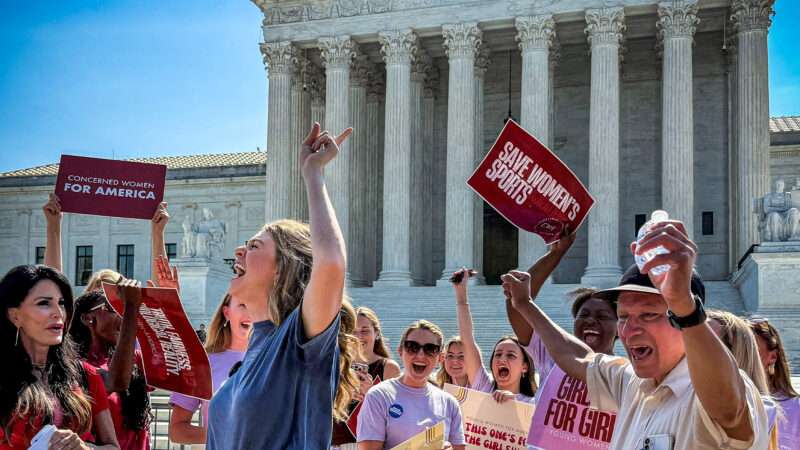
Big SCOTUS rulings: The Supreme Court ruled 6–3 yesterday, upholding West Virginia’s and Idaho’s laws that bar transgender athletes who identify as women from competing in girls’ sports. This decision has implications for 25 other states with similar laws.

“To provide equal opportunity for female athletes, schools do not merely maintain, for example, one soccer team, one basketball team, one ice hockey team, and one lacrosse team that are equally open to female and male athletes,” wrote Justice Brett Kavanaugh for the majority. “That approach would deny equal opportunity to female athletes because, as all agree, females and males have inherent physical differences relevant to athletic performance. Those ‘physical differences between men and women’ are ‘enduring.’ United States v. Virginia, 518 U. S. 515, 533 (1996). The differences include, among other things, height, weight, strength, speed, endurance, and jumping ability. Therefore, in contact sports, forcing female athletes to compete against males can create significant safety risks. And in virtually all competitive sports, forcing female athletes to compete against males can undermine competitive fairness.”

He continued: “The question before the Court is: Under Title IX and the Equal Protection Clause of the Fourteenth Amendment, may schools maintain women’s and girls’ sports for biological females? In other words, may schools determine eligibility for women’s and girls’ sports based on biological sex? The answer is yes.”

“Allowing a biological male athlete to compete on a girls’ team necessarily displaces or disadvantages a female athlete—replacing her on the roster, knocking her out of the starting lineup, reducing her playing time, depriving her of a medal and the like,” continues Kavanaugh. “That hard reality of sports cannot be ignored or swept under the rug.”

The Court’s liberal-leaning justices interestingly concurred with the majority’s decision to reject under Title IX, but dissented in part:

“Applying a form of heightened scrutiny divorced from this Court’s cases, the majority holds that transgender girls like B. P. J. who wish to play girls’ sports are not protected by the Constitution, even if B. P. J. is correct that neither of the State’s interests is furthered by their exclusion,” writes Justice Sonia Sotomayor. “Yet the Equal Protection Clause demands much more when a State deploys a sex classification to achieve legislative aims. Perhaps West Virginia could meet those demands. Perhaps not. In either event, because unresolved factual questions prevent the Court from assessing the merits of B. P. J.’s equal protection claim at this time, the Court should allow the District Court to address those factual questions in the first instance. Yet in an opinion unencumbered by fact or law, the majority today cuts off that process prematurely, deciding instead that B. P. J.’s case must end now.”

President Donald Trump, naturally, had a slightly less nuanced reading: “Wow! That takes that ridiculous situation off the table!!!” he wrote on Truth Social.

My preferred take: “I felt like I was on the other side [of] the looking glass,” wrote The Volokh Conspiracy‘s Josh Blackman, commenting on his debate on NPR with Jennifer C. Pizer, who works for Lambda Legal and was counsel on the case, much of which hinged on the meaning of biological male.

This strikes me, more broadly, as a win for fairness. Other libertarians’ mileage may vary.


New AOC on the scene? Melat Kiros, a 29-year-old DSA candidate, just unseated a 15-term incumbent, Rep. Diana DeGette, in yesterday’s primary in Denver. Given the blueness of that area of Colorado, it is very likely that Kiros is going to win in November and join the crew of democratic socialists flooding Congress. (DeGette has historically attracted kind of crazy challengers, like Saira Rao, the woman who infamously invited people to dinner so she could berate them about their internalized racism and spun this into a whole company.)

“In her campaign biography, Ms. Kiros highlighted the fact that the Manhattan law firm where she once worked had fired her in 2023 after she refused to take down a letter that raised questions about Israel’s historical legitimacy, defended pro-Palestinian campus protesters and challenged the firm’s response to activist law students,” reports The New York Times. “By chilling future lawyers’ employment prospects for criticism of the Israeli government’s actions and its legitimacy, you are complicit in Israel’s weaponization of anti-Semitism against legitimate concerns for the right of self-determination and the livelihood of the Palestinian people,” wrote Kiros in the letter.

In addition to her intense views on Israel, Kiros is in favor of the Green New Deal and “a moratorium on new AI data centers until federal regulations are in place to protect labor, the environment, and our privacy”; increasing childcare subsidies; and all manner of socialist policies that would cripple private industry. Her campaign website calls for “federally subsidizing 30% of all new housing developments to ensure affordable, dignified housing is truly accessible” and making “public college and trade school tuition-free.” “I support robust federal investment in public transit: expanding light rail and bus rapid transit, making fares affordable, and modernizing our transit systems as part of our broader climate infrastructure,” says her website. “Transit is not a luxury. It is the circulatory system of an affordable city.”

“The greatest threat to your job isn’t an immigrant—it’s a billionaire,” notes Kiros, who seems to truly have no idea how economics works.


Scenes from New York: On Tuesday, the City Council approved even more handouts for poor and middle-income residents: An expansion of the Fair Fares program, which gives half-price bus and subway fares to people with low enough incomes.

Now, some 1.3 million New Yorkers will qualify, up from 960,000 before. Formerly, you had to make 150 percent of the federal poverty level or lower (about $49,000 for a family of four). Now, you just have to make 200 percent of the federal poverty level (so about $66,000 for a family of four). The program will now cost $175 million, instead of $100 million. Add it to our tab, I guess.


QUICK HITS

  • “A divided US Supreme Court upheld the constitutional right of birthright citizenship, rejecting President Donald Trump’s planned restrictions and invalidating a central plank of his immigration agenda,” reports Bloomberg. “The court said an executive order Trump issued hours after his inauguration last year couldn’t be squared with the Constitution’s 14th Amendment, which has long been understood as guaranteeing citizenship to virtually everyone born on US soil.” If Trump’s order had been allowed to stand, it would have affected roughly 250,000 children annually. Two of the (three total) dissenters—Justices Clarence Thomas and Samuel A. Alito—said the ruling opened the door to “birth tourists” (Thomas) and that established residents have a “strong moral claim” to staying here, but that Congress must sort out their legal status (Alito). (Thomas seemed more concerned than Alito about foreigners’ allegiances and whether people having children in the United States are “subject to any foreign power.”) Trump immediately started talking about ending birthright citizenship through the legislature.

  • You know who’s not having any anchor or non-anchor babies at all? San Franciscans, apparently:

For all that freaky stuff they do out there, you’d think more children would result! I guess not. (Also, crazy that you need to register your dog with the government.)


The post Trans Athletes Lose (in Court) appeared first on Reason.com.

from Latest – Reason.com https://ift.tt/2AtuiOG
via IFTTT

Meanwhile In The UK, You Simply Will Not Believe This…

Meanwhile In The UK, You Simply Will Not Believe This…

Authored by Steve Watson via Modernity News,

A convicted predator who helped destroy the lives of vulnerable girls as young as 13 is days away from freedom in Britain, while Pakistan refuses to take him and archaic rules shield him from removal.

Shabir Ahmed’s case lays bare how legal technicalities, political cowardice, and a refusal to enforce borders have turned the country into a revolving door for the most dangerous offenders.

Ahmed, now 73, arrived in the UK long before 1973 as a Commonwealth citizen. He was convicted in 2012 at Liverpool Crown Court on multiple counts of rape, aiding and abetting rape, sexual assault, and trafficking for sexual exploitation. He treated at least one victim as property, abusing her on an almost weekly basis. Part of a gang of nine men operating out of takeaways in the Heywood area of Rochdale, Ahmed and his associates targeted working-class girls from broken backgrounds.

He received lengthy sentences that later expanded. His British citizenship was stripped. Yet, ludicrously, he cannot be deported. The barrier is a provision in the Immigration Act 1971 that exempts Commonwealth citizens who arrived before 1973 and have long residence from removal.

On release, expected imminently, Ahmed faces lifelong sex offender registration, exclusion zones around Rochdale, bans on contacting any child, strict curfews, and electronic tagging. Breaches mean immediate return to prison. Taxpayers will foot the bill for round-the-clock monitoring and staffed accommodation.

Criminal Lawyer Marcus Johnstone, who has handled grooming gang cases for nearly two decades, pointed out that outdated laws combined with excessive human rights legislation have made Britain the destination of choice for international sex criminals. The gangs are sophisticated. The system that should remove them is not.

Home Office statements emphasise thoughts with victims and the “darkest moments” of the grooming gangs scandal, insisting the full force of the law will apply through these conditions.

Labour MP Paul Waugh, whose Rochdale constituency was ground zero for the abuse, called Ahmed a “depraved paedophile” who should have been removed years ago. He said the people of Rochdale want him gone and urged ministers to amend the Citizenship Act if necessary.

This case fits a wider, years-long scandal of institutional failure and political cowardice.

Separate recent investigations laid bare mini-mart operations where vulnerable children were plied with alcohol and cigarettes in exchange for sexual abuse.

Illegal shops were caught handing out free vapes to kids in return for sexual favours.

And the weary response from parts of the establishment often boiled down to telling victims and the public to simply “get over it.”

The common thread is the same: authorities slow-walked or buried evidence, prioritised community relations over child safety, and treated any mention of ethnic or cultural patterns as radioactive.

Official files had ethnicity redacted. In two-thirds of cases, perpetrator background went unrecorded. Police in some areas told victims the Asian men who abused them were “probably not going to catch them.”

A 2020 Home Office report, relying on hopelessly incomplete data, pushed the false narrative that most grooming perpetrators were white – a claim parroted in Parliament and by broadcasters even after it was exposed as statistical sleight-of-hand.

The motivation was always the same: fear of “racism” accusations, dread of community tension, and the overriding imperative to protect the narrative that mass immigration and multiculturalism have been an unalloyed success. Working-class girls, often from broken homes or care systems, paid the price while officials and media looked the other way or actively smeared whistleblowers.

While Ahmed prepares for supervised release, London Mayor Sadiq Khan faces renewed scrutiny over his past claims. In January 2025 he told the London Assembly there were “no reported cases and also no indication of the grooming gangs” in the capital.

A Metropolitan Police review of roughly 12,000 potential child sexual exploitation reports since 2010 has since flagged more than 4,000 cases that may require reopening. Many had been closed without further action. These have been referred to the National Crime Agency under Operation Beaconport.

London’s current review notes a broader mix of offender backgrounds than the classic Pakistani-heritage networks documented in Rotherham, Rochdale, Telford and elsewhere. That distinction does not erase the scale of what was ignored or the political class that spent years insisting the problem did not exist in the capital.

This London revelation drops just days after the release of Rupert Lowe’s Rape Gang Inquiry Report, which documented a coordinated national campaign of rape, torture and abuse against up to 250,000 British girls by predominantly Muslim grooming gangs operating across 149 local authority districts.

Lowe’s findings laid bare the same pattern of police warnings to rapists, political interference and deliberate suppression of evidence that protected predators for decades while treating working-class girls as disposable.

Britain does not lack the power to change this. Parliament can amend citizenship and immigration rules to close loopholes for serious offenders. It can assert sovereignty over international obligations that shield threats.

Other countries manage deportation of convicted criminals without descending into chaos. The question is whether the political class has the will to put the safety of British girls ahead of globalist pieties and domestic sensitivities.

Ahmed walking free under licence is not justice. It is the predictable result of a system that has spent years protecting itself from hard truths rather than protecting its children. British girls deserve a country that removes foreign criminals who rape its children and never looks back.

Your support is crucial in helping us defeat mass censorship. Please consider donating via Locals or check out our unique merch. Follow us on X @ModernityNews.

Tyler Durden
Wed, 07/01/2026 – 09:05

via ZeroHedge News https://ift.tt/b6TRq0t Tyler Durden

Preview And Watch Live: Kevin Warsh Speaks At Sintra ECB Forum

Preview And Watch Live: Kevin Warsh Speaks At Sintra ECB Forum

Watch live here:

Today’s main event takes place in Sintra, Portugal and the ECB’s annual symposium, where Warsh joins President Christine Lagarde and Bank of England Governor Andrew Bailey at 9 a.m. New York time.  Bloomberg Economics expects Warsh to strike a carefully balanced tone after signaling different messages to hawks and doves at the June FOMC meeting

Courtesy of Newsquawk, here is a prime of what to expect at the Sintra panel featuring Fed’s Warsh, ECB’s Lagarde, BoE’s Bailey & BoC’s Macklem, at 14:00BST/09:00EDT.

The panel is a ‘policy panel”, lasting for one hour from 14:00BST/09:00EDT, with CNBC’s Eisen as moderator. Text releases are not expected.

Fed

Warsh has already become notorious in not wanting to provide forward guidance, so while traders will be looking to his appearance for clues on future policy, some analysts suggest that traders may be left disappointed. At his first policy meeting as Fed Chair, the FOMC held the FFR target range unchanged at 3.50-3.75%, via a unanimous vote. Warsh described the labour market as keeping pace with workforce growth, with unemployment little changed, while inflation remains elevated due to energy-related supply shocks tied to the Iran conflict. On the 2% target, Warsh reaffirmed the Fed’s “capability and commitment” to deliver price stability, calling the commitment “strong, unanimous, and unambiguous”. Notably, he declined to submit his own SEP projections (though nine of the other eighteen officials projected the FFR target will end 2026 above the current range, pointing to hike risk). On the balance sheet, the Committee reaffirmed its policy of maintaining ample reserves in the banking system, with a dedicated task force reviewing the balance sheet tool’s transmission. Warsh also abandoned forward guidance, shortening the policy statement significantly, and launched task forces covering data, communications, and the inflation framework.

ECB

Lagarde has spoken extensively recently, and will have an opportunity to speak again during the closing Sintra remarks once the panel ends. Lagarde’s remarks on the 22nd of June, alongside the post-MoU energy pullback, have driven much of the moderation in pricing seen in recent weeks, removing a back-to-back hike from the playbook ahead and instead placing focus almost entirely on September for the next potential move. To recap, Lagarde said they “see no evidence yet of de-anchoring of inflation expectations or second-round effects that would warrant a more forceful policy response at this stage” and, as it stood, the ‘current shock appears to be smaller in magnitude…” vs the last period of high inflation, i.e. when Russia’s war in Ukraine commenced. However, at the start of Sintra Lagarde was a touch more hawkish talking around inflation being “away” from target. Though, her commentary didn’t spark any real return towards a move in July. Since, the Flash EZ HICP for June came in cooler than expected, though Services remains above the April figure. While the PMIs are net-constructive, however, much uncertainty remains amid the Middle East situation.

BoE

Following the June meeting and despite the two hawkish dissenters, the narrative has shifted significantly to the BoE being on hold for the foreseeable future. Although Governor Bailey has expressed frustration that inflation is not back to target, he has continued to stick to the narrative that the BoE has time to judge the pass-through of higher energy prices onto the UK economy. There has not been anything to suggest that Bailey will deviate from this.

BoC

After the BoC’s June meeting, Governor Macklem said any decision on possible rate hikes would depend on conditions, not a specific timeline. He noted that core inflation has ticked down, while inflation expectations will remain a key consideration. Economic weakness tends to put downward pressure on prices, adding that higher oil prices have not yet spread significantly into other goods and services, though food inflation remains a concern. He also said little had changed since the previous meeting, with no major data surprises, and that Canada’s economy is not clearly in recession. On communications, Macklem warned that too much forward guidance can imply false precision and become confusing. Separately, speaking last week, he said widening global imbalances and rising non-bank lending increase the risk of economic disruption. He warned that large capital inflows into the US could be misallocated or reverse suddenly, spreading stress beyond US borders, and urged global officials to support higher US savings, Chinese consumption and European investment.

Tyler Durden
Wed, 07/01/2026 – 08:54

via ZeroHedge News https://ift.tt/Fy4zxfs Tyler Durden

Did META Just Expose The First Crack In the AI CapEx Boom?

Did META Just Expose The First Crack In the AI CapEx Boom?

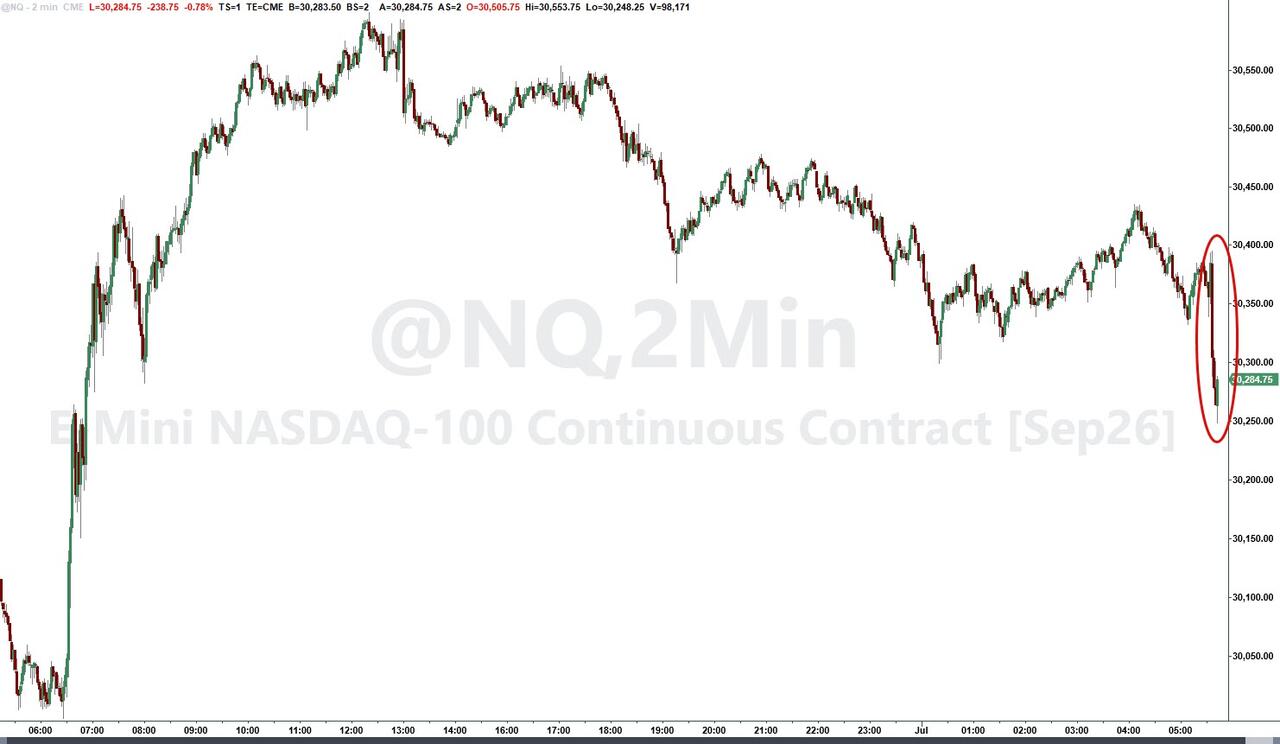
If you’re wondering why the Nasdaq is suddenly tumbling this morning, wonder no more…

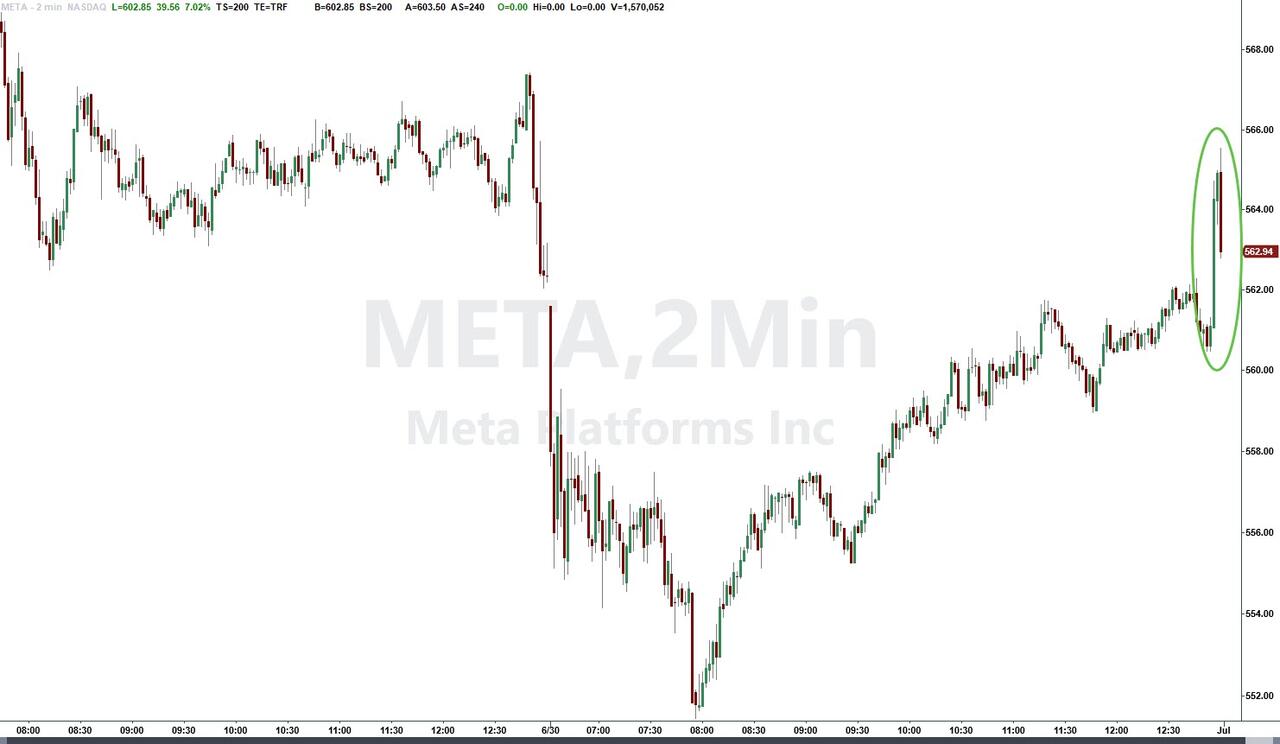
Nasdaq moves lower after Meta announces it is to build a cloud business to sell its excess AI compute, weighing on cloud peers like AMZN, ORCL, MSFT and chip and memory names like NVDA, MU, INTO. As Bloomberg reports:

Meta, which has been rushing to secure expensive data centers and other infrastructure to fuel its own artificial intelligence ambitions, is forming a business to generate revenue from excess computing power sold to outside customers, according to people familiar with the matter, who asked not to be named as the details aren’t public.

One potential plan includes selling access to various AI models that are hosted on Meta’s existing AI infrastructure, an approach similar to AWS’s Bedrock offering, the people said.

Meta would run the data centers and chips that power the models, including its own Muse Spark models, and charge developers to access them.

Despite the complexities, Meta Chief Executive Officer Mark Zuckerberg has signaled to investors that he’s open to selling excess computing infrastructure, or even a so-called API service where customers would pay for AI usage — a business that’s usually measured in “tokens,” or the amount of data used and generated for a customer query.

“It’s definitely on the table,” Zuckerberg said during a call with shareholders in May.

“Almost every week there are different companies that come to us from the outside asking us to both stand up an API service or asking if we have compute that they could buy from us at some premium to what we’ve bought it at.”

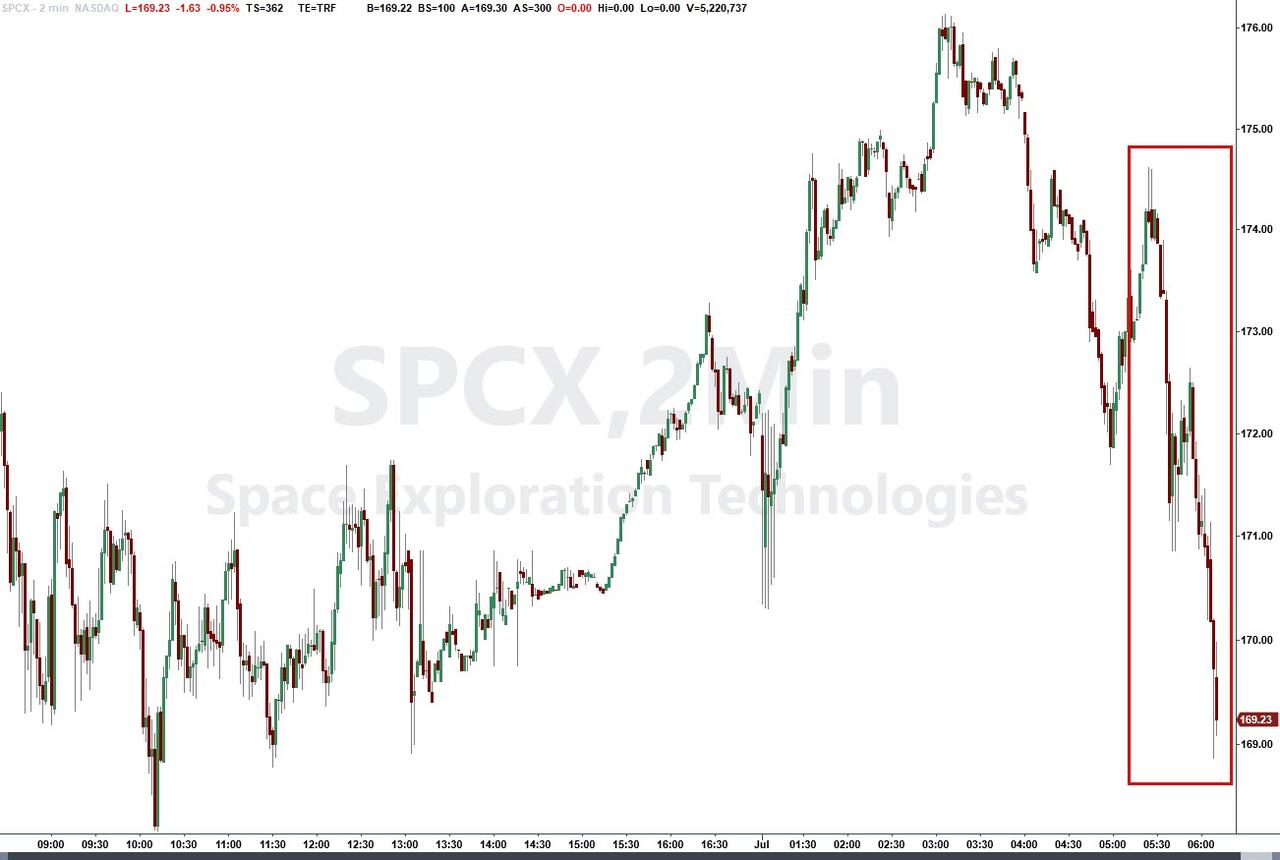
This move comes after SpaceX started leasing its ‘excess compute’ (which is struggling now that it has competition in selling ‘compute’):

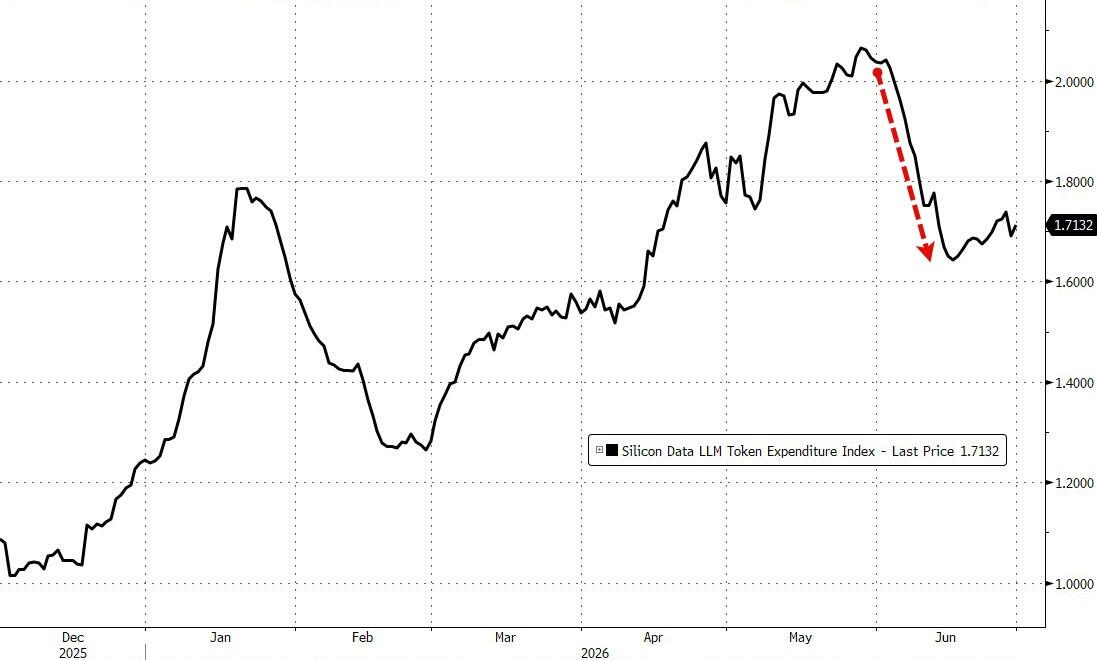
…raising questions about the potential for cutting CapEx which has perhaps overshot token demand

…did META just shatter the market’s central premise has been that compute is scarce

As Goldman Sachs 1-Delta desk-head, Rich Privorotsky, has been warning:

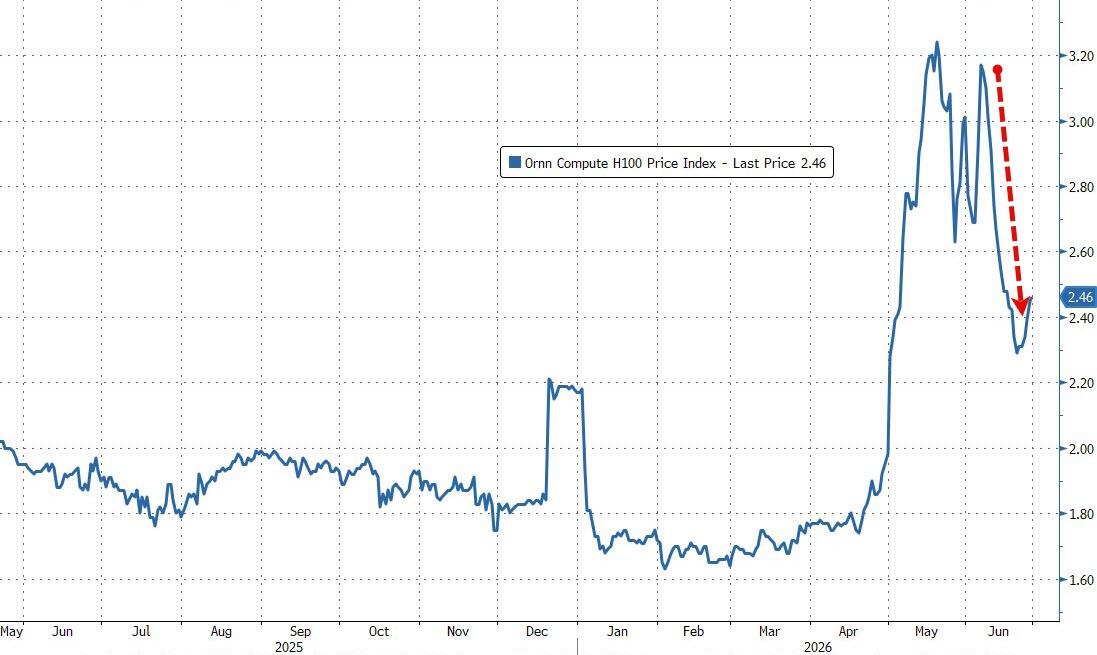
The market’s central premise has been that compute is scarce. If scarcity persists, prices should remain firm and justify continued capex. If supply rises and rental prices continue to drift lower, that is a direct challenge to the shortage narrative. The first place that pain shows up is hardware. 

ORNN H100 index rolling over last couple days worth watching.

The beneficiaries are the companies selling the complete platform and monetizing usage rather than simply selling picks and shovels. My working conclusion remains that hyperscalers are the structural winners through this phase. The first moment they demonstrate they can deliver equivalent output with lower spend, the market will reward them.

The bigger risk sits further upstream in the hardware and infrastructure stack where expectations remain built around persistent scarcity.”

Simply put, confessions of ‘excess capacity’ will crush the hyperbolic dreams of the CapEx cycle that underpins so much of the market’s recent incredible performance.

And the pivot to rewarding CapEx cutters begins…

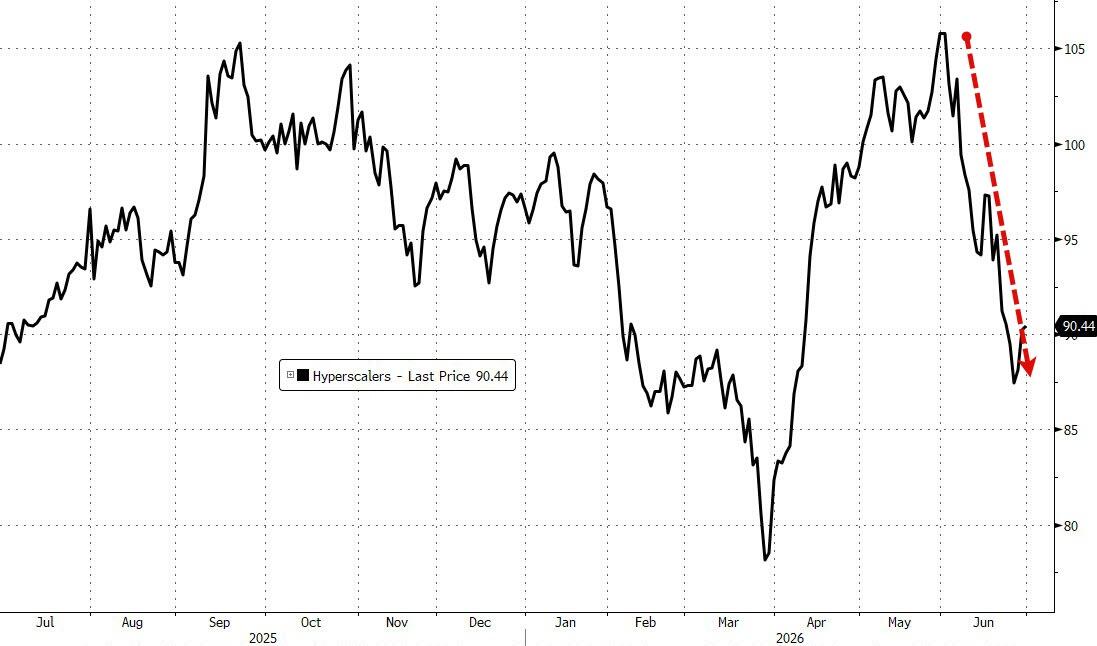
“Lots of underperformance in hyperscalers. Everyone still appears convinced they must keep spending simply to remain competitive, while token cost compression/advent of neoclouds puts pricing pressure on core business. If token prices continue to compress alongside falling compute costs, the benefits may accrue to users faster than providers. Ironically, the first hyperscaler to signal that it can slow the pace of spending will likely see its share price rewarded.

If that happens, others will take notice.

That is the reflexivity that ultimately stalls the capex cycle… not a lack of demand, but investors deciding that incremental returns on the next dollar of spend are no longer attractive.

Watch hyperscalers share price as leading indicator.”

Don’t say you weren’t warned.

META shares are notably higher on the news…

Chipmakers are hurting…

Buckle Up!

Tyler Durden
Wed, 07/01/2026 – 08:52

via ZeroHedge News https://ift.tt/QymPhjD Tyler Durden

Futures Fall To Start Now Quarter With Warsh Sintra Comments On Deck

Futures Fall To Start Now Quarter With Warsh Sintra Comments On Deck

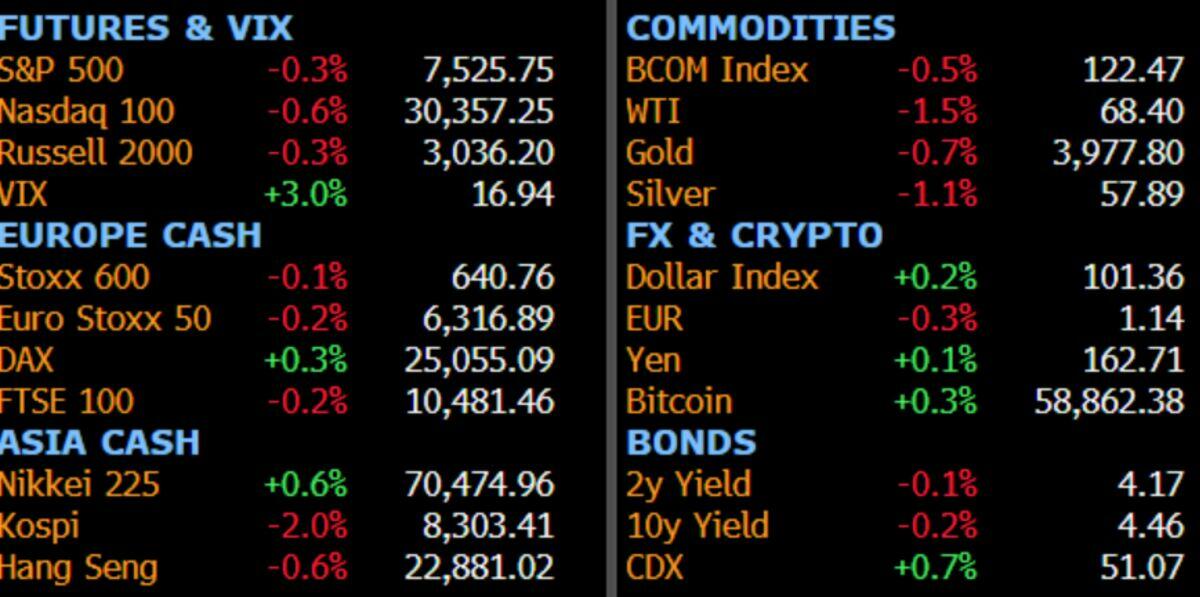
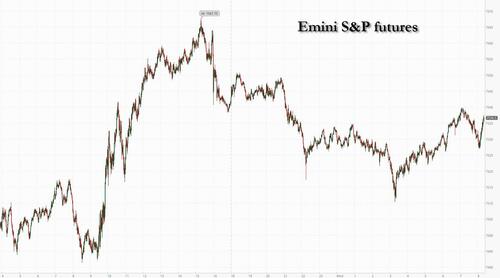
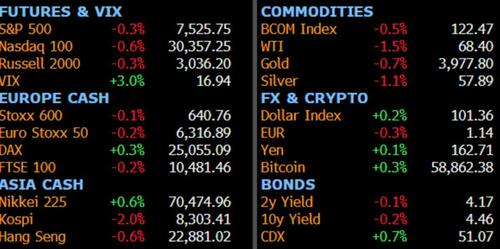
US equity futures point to a softer start to the third quarter as investors await a fresh batch of economic data and the first major overseas appearance by Fed Chair Kevin Warsh. As of 8:20am ET, S&P futures are down 0.2%, off session lows, while Nasdaq futures are down 0.6: techs lags following NDX’s 3.9% gain over the last 2 days; in premarket trading, chipmakers, which did much of the heavy lifting as investors piled into AI beneficiaries, were weaker with Mag7s mostly lower. Nike dropped 2% following a cautious outlook. Software names including Microsoft gained. Cyclicals are under pressure with HC and Staples leading a Defensives bid. Overnight the US removed Anthropic’s foreign access restrictions. Bond yields are flat to down 1bp, and USD is bid as positive progress is reported in US / Iran talk. In commodities, crude prices are lower as distillates rise; WTI futures are down about 0.8% following the biggest quarterly drop since the pandemic.Metals are under pressure, with Ags bid as the group has been the recent outperformer. US economic data calendar includes June ADP employment change (8:15am), June final S&P Global manufacturing PMI (9:45am) and June ISM manufacturing (10am). 
In premarket trading, Microsoft outperforms Magnificent 7 peers in premarket trading. Business Insider reports that the company is planning to announce job cuts, impacting thousands of roles, citing people it didn’t identify. Shares are up 1.7%. Other Mag 7 stocks are mixed early Wednesday (Alphabet -0.4%, Nvidia -0.6%, Apple -0.09%, Tesla -0.4%, Amazon +0.9%, Meta Platforms +0.3%). Here are some of the biggest US movers today:

  • Abbott Lab (ABT) shares are up 0.03% in premarket trading after Baird initiated coverage of the stock with an outperform rating, saying a clearer path to upside for the medical device maker is “beginning to emerge.”
  • Alcoa Corp. (AA) is down 5.0% after the mining company agreed to buy South32 Ltd.’s bauxite, alumina and aluminum assets in a deal worth as much as $5.6 billion. Morgan Stanley expects a negative reaction on the transaction multiple and limited visibility on synergies.
  • Bloom Energy (BE) shares rise 8.3% in premarket trading on Wednesday after the company expanded its partnership with Brookfield from $5 billion to $25 billion to help grow the fuel cell partnership globally.
  • Dow Inc. shares are down 0.7% in premarket trading, after RBC Capital Markets downgraded the chemical company to sector perform from outperform. Mizuho cut its price target to $35 from $43.
  • FMC shares rise 7.0% after the company said Tessenderlo Group will make a strategic minority equity investment of about $400 million at $13.30 per share. Shares in Tessenderlo gain 3.4% in Brussels.
  • General Mills shares are up 4.89% after the packaged food company’s adjusted earnings per share for the fourth quarter beat the average analyst estimate.
  • Grindr shares gain 6.9% ahead of the bell after Morgan Stanley upgrades the LGBTQ community dating company to overweight from equal-weight, highlighting monetizing opportunities. The upgrade leaves the stock with only buy-equivalent ratings.
  • NASA selected Astrobotic, Firefly Aerospace and Intuitive Machines for four moon missions in late 2028 as part of the Moon Base Program. Intuitive and Firefly shares are up 7.2% and 2.7%, respectively.
  • Nike shares fall 1.6% in premarket trading on Wednesday after the sneaker company said on its conference call revenue expectations for the next two quarters are now seen down low-to-mid single digits from down low single digits earlier.
  • Klarna shares rise 6.9% after a Swedish Patent and Market court ordered Google to pay SEK14.3b ($1.47b) to Klarna’s subsidiary PriceRunner International following antitrust damages proceedings.
  • Microsoft outperforms Magnificent 7 peers in premarket trading. Business Insider reports that the company is planning to announce job cuts, impacting thousands of roles, citing people it didn’t identify. Shares are up 1.7%.
  • Shares in ServiceNow, Salesforce and Check Point Software rise in premarket trading as Guggenheim upgraded all three to buy from neutral, saying that the fatal AI bear case on software is a “hallucination.” ServiceNow +5.0%, Salesforce +3.3% and Check Point Software +3.1%.

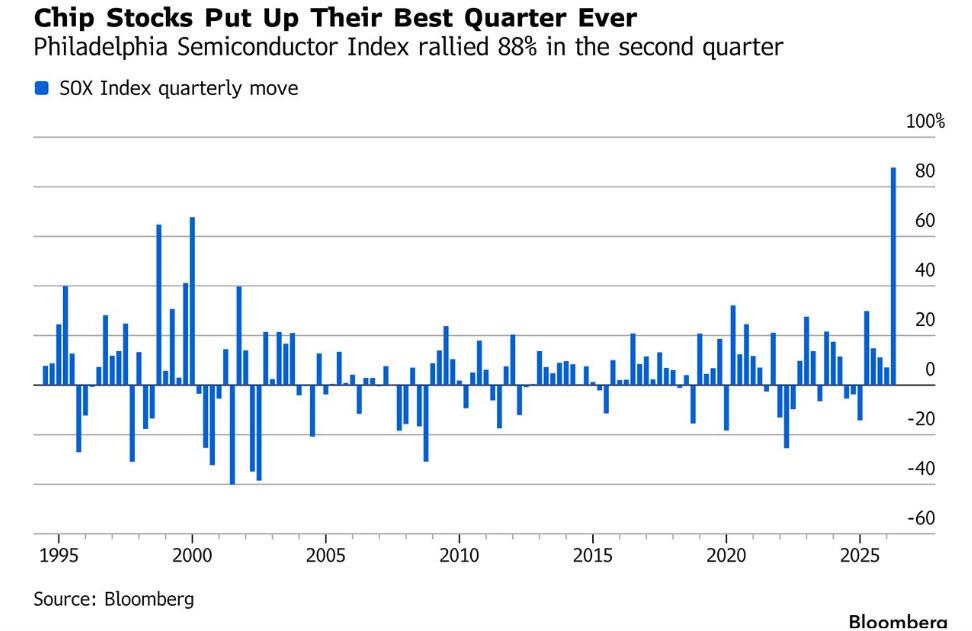
US stocks just posted their best quarter in six years with fresh signs of economic resilience bolstering confidence in corporate earnings. The rally added more than $8 trillion to the S&P 500’s market value over the past three months. The SOX semiconductor index posted its strongest quarter on record.
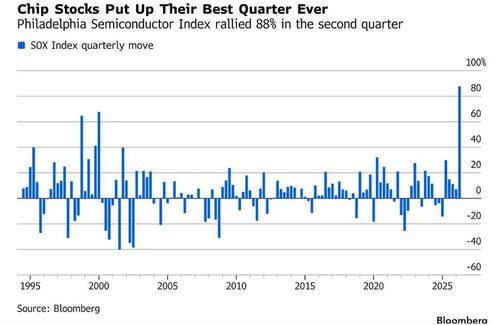
“As long as earnings continue to be good and broaden out, I think we will get continued gains through the second half — probably lower than what we saw in the first half — but I think it will quite broadly based,” said Goldman’s Chief Global Equity Strategist Peter Oppenheimer. Technology remains the main driver of earnings growth even as hyperscalers have “derated” on concerns about longer-term returns, Oppenheimer said. Their heavy spending should continue to underpin growth and “trickle out” into parts of the economy supporting the AI infrastructure buildout, he told Bloomberg TV. 

Meanwhile, concentrated market leadership, passive investing, retail flows, leverage and a new volatility regime are increasingly dictating price action, Citadel Securities’ Scott Rubner wrote in a Tuesday note. 

In other assets, the global oil market is set to swing back into oversupply even after strategic reserves are replenished, according to Goldman Sachs. Japan’s currency chief suggested intervention was an effective strategy. 

Today’s main event takes place in Sintra, Portugal and the ECB’s annual symposium, where Warsh joins President Christine Lagarde and Bank of England Governor Andrew Bailey at 9 a.m. New York time. Bloomberg Economics expects Warsh to strike a carefully balanced tone after signaling different messages to hawks and doves at the June FOMC meeting. After his pledge last month to deliver price stability sent the dollar and shorter-dated Treasury yields higher, traders will be looking for further clues on the rate path for the year ahead.

“Given the absence of forward guidance from the Fed now, there is going to be intense focus on any comments” from Warsh, wrote Chris Turner, a foreign-exchange strategist at ING Bank NV. “A focus on price stability can keep the dollar bid.”

Investors are increasingly shifting focus to growing price pressures in an economy that’s firing strongly, with expectations building for a solid payrolls report on Thursday. 

European stocks also slipped in early Wednesday trading, with indexes dragged down by mining companies on the back of weaker commodity prices. The Stoxx 600 falls 0.2% to 640.52 with 229 members up, 361 down, and 10 unchanged. Among individual stocks, Switzerland’s Galderma fell the most in over a year after the US FDA turned down the firm’s Botox rival Relfydess. CMC Markets jumped to a fresh record high after raising its guidance.  Here are the biggest movers Wednesday:

  • CMC Markets shares soar as much as 25% to a fresh record after the UK financial derivatives dealer raised its guidance for 2027 net operating income citing strong momentum
  • Renault shares rise as much as 4.5% after the French carmaker hosted a pre-close call with analysts ahead of its first-half results scheduled for the end of the month
  • Tecan shares rise as much as 10% after UBS raised its recommendation in the Swiss laboratory technology group to buy from hold, saying top-line growth has bottomed out and expected margin improvements are not yet priced in
  • Aker ASA gains as much as 11%, the most since January, after it agreed to sell its shares in Cognite Holding to Schneider Electric, which meanwhile dropped as much as 3%
  • ASOS shares gain as much as 12% after announcing it will sell its Atlanta fulfilment center and associated automation assets for net proceeds of ~£48 million
  • RS Group rises as much as 5.1%, the most since May 20, as Deutsche Bank upgrades the distributor of electrical and industrial products to buy from hold on a strengthening recovery case
  • Galderma shares slump as much as 6.6%, the most in more than a year, after the US Food and Drug Administration turned down the Swiss dermatology firm’s rival Botox treatment Relfydess
  • AB Foods shares fall as much as 3.6%, the most in over two months, after the conglomerate delivered an underwhelming third-quarter update and downgraded the outlook for its sugar business in the 2026 and 2027 fiscal years
  • Bucher shares fall as much as 3.6%, the most since April 28, after Kepler Cheuvreux cut its price target on the Swiss agricultural machinery company, citing capex sentiment indicators in Europe that are nearing recession territory
  • Medacta drops as much as 4.1%, the most in a month, as Stifel cuts its full-year organic revenue growth estimates for the Swiss medical-implant firm to the midpoint of guidance

Earlier, Asian stocks fluctuated on Wednesday after capping their best quarter in 17 years, as investors paused to assess the outlook for the AI rally that has been a major driver of the gains. The MSCI Asia Pacific Index swung between gains and losses for most of the day. Declines in South Korean chipmakers Samsung Electronics and SK Hynix were a major drag, offsetting gains in Japan and Taiwan — which together account for about half of the benchmark. Hong Kong markets were closed for a public holiday. The Kospi declined as the National Pension Service was set to resume rebalancing its domestic stock holdings after a temporary suspension.

The Asian benchmark climbed 21% last quarter while a subgauge of tech shares soared a record 74%. However, the sector’s rally slowed in June as rising concerns over the payoff from hefty AI investments, coupled with elevated valuations and crowded positioning, sparked intermittent pullbacks, particularly in Korean shares. The AI trade within Asia has been “quite narrow,” Hebe Chen, senior market analyst at Vantage Global Prime, said in a Bloomberg Television interview. “That overcrowding is often exposed to a higher and sharper fall if the tide changes, because this rally has attracted so much liquidity,” she added.

In FX, The Bloomberg Dollar Spot index rises 0.2% to its highest level this week before Fed Chairman Kevin Warsh appears on a policy panel alongside peers from Europe and the UK.

Treasuries are narrowly mixed with yields less than a basis point away from their closing levels on Tuesday, when they climbed 7bp-9bp amid a flurry of month-end selling in futures. WTI crude oil futures are down, underpinning Treasuries, as traders monitor peace talks between the US and Iran. US 10-year yields are down 1bp to around 4.46%, Treasuries are little changed on the day while curve spreads are marginally steeper. European bonds lag Treasuries, following the late weakness in futures into the US month-end index rebalancing, which also saw the day’s steepening move accelerate. Focal points of US session include key manufacturing data and unscripted comments by Fed Chairman Kevin Warsh. 

In commodities, Brent extended declines, falling 1% to $72.20 a barrel. US negotiators held positive discussions in Qatar and progress is being made on technical talks with Iran, according to a senior administration official, as the countries seek to turn an interim peace deal into a permanent end to the war. That’s been of little support to European government bonds, however. UK and German 10-year borrowing costs rise 2 basis points each. Precious metals decline, with spot silver down over 1%. 

US economic data calendar includes June ADP employment change (8:15am), June final S&P Global manufacturing PMI (9:45am) and June ISM manufacturing (10am). Fed speaker slate includes only Warsh, participating in an ECB panel in Sintra, Portugal at 9am New York time

Market Snapshot
Top Overnight News

  • Iran and U.S.-allied Oman are moving forward with plans to collect payment for ships transiting the Strait of Hormuz, despite public American objections. NYT
  • US negotiators Steve Witkoff and Jared Kushner held positive discussions in Qatar and progress is being made on technical talks with Iran, according to a senior administration official, as the countries seek to turn an interim peace deal into a permanent end to the war. BBG
  • The US removed foreign access restrictions on Anthropic’s Fable 5 AI model. The company said it will restore global access across its platforms starting today. BBG
  • Xi Jinping signaled China’s ambition to play a more high-profile role, a strategy that involves rallying developing nations as a counterweight to what he views as fading US influence. BBG
  • The yen pared some losses after Japan’s top FX official said past intervention efforts were successful, adding that Washington remains in close communication with Tokyo over FX policy. South Korea’s won slid toward its weakest level since the global financial crisis. BBG
  • Euro-area inflation eased more than anticipated in June. Consumer prices rose 2.8% from a year ago, down from 3.2% a month earlier. BBG
  • President Trump has weighed a return to all-out war with Iran, holding multiple conversations in recent days with Defense Secretary Pete Hegseth and Chairman of the Joint Chiefs of Staff Gen. Dan Caine on more strikes, but has decided to stick with diplomatic talks for now, according to U.S. officials familiar with the discussion. WSJ
  • Microsoft plans thousands of job cuts, impacting less than 2.5% of workforce. Business Insider
  • Republicans’ cash advantage just got a lot more powerful thanks to the Supreme Court — and the Democratic National Committee’s fundraising struggles just got a lot more concerning for their party. Democrats argue that the court’s Tuesday decision, which allows political parties to freely coordinate with candidates, will give the GOP the ability to offset Democratic candidates’ fundraising lead in battlegrounds. Politico
  • The value of global M&A rose around 30% year-on-year to $2.6 trillion in the first half, on course to potentially pass 2021’s record haul. Companies struck 38 deals valued at $10 billion or more, the most ever in a six-month period. BBG
  • US Challenger Job Cuts (Jun) 45.849K (Prev. 97.006K); cuts remain concentrated in tech, with AI continuing to reshape how companies think about headcount.

A more detailed look at global markets courtesy of Newqsuawk

APAC stocks were mixed, in which bourses partially sustained the positive momentum from the tech-led gains on Wall St, where the S&P 500 and Nasdaq posted their best quarter in six years. The region also digested a slew of data, including the stronger-than-expected BoJ Tankan survey and numerous PMIs. ASX 200 was dragged lower by weakness in the consumer, financial, tech and telecom sectors, while sentiment was also not helped by a surprise contraction in Building Approvals data. Nikkei 225 rallied following the stronger-than-expected Tankan survey, which showed Large Manufacturing Sentiment was at the highest in 8 years, although the index gradually wiped out the majority of its gains amid intervention risks and as the data supported the case for the BoJ to continue normalising policy.
KOSPI pared opening gains and lingered in the red as SK Hynix and Samsung Electronics retreated. Shanghai Comp was underpinned on the 105th anniversary of the founding of the Communist Party of China, and as participants digested the latest RatingDog Manufacturing PMI, which remained in expansion territory, while Hong Kong markets were closed for a holiday.

Top Asian News

  • Japanese top FX diplomat Mimura said they are in touch with US counterparts more than most imagine and that a US official made supportive remarks about FX action, while he also commented that recent intervention had meaning.
  • BoJ official noted regarding the recent Tankan survey that most firms replied before the US-Iran peace deal on June 15th, so the impact of the deal is likely not reflected much in the Tankan outcome.

European bourses (STOXX 600 -0.1%) start Q3 on a softer footing, with Germany’s DAX 40 (+0.4%) the only index printing modest gains; perhaps welcoming recent pension reform progress and the possible involvement of the Bundesbank. Final manufacturing PMI figures were broadly positive, with the majority of PMIs being revised higher. Commentary was relatively upbeat, with S&P stating that the sustained growth was accompanied by a welcome cooling of cost pressures. European sectors tilt to the negative side. Industrial Goods & Services (+0.5%), Technology (+0.5%) and Optimised Personal Care (+0.5%) are the top 3 sectors. To the downside lies Media (-1.7%), Consumer Products & Services (-1.5%) and Travel & Leisure (-0.1%).

Top European News

  • French Presidential vote to be held on April 18th and May 2nd next year, with the official announcement expected on Wednesday, according to AFP citing sources.
  • UK Labour MPs reportedly want Burnham to appoint McFadden as Chancellor, in order to block Miliband, Huffington Post reported citing sources.

FX

  • Snapshot: G10s are mostly lower against the USD this morning, with clear underperformance in the Aussie, whilst the Kiwi fares a little better vs peers. USD/JPY continues to hold at elevated levels beyond the 162.50 mark, with further jawboning attempts seen overnight.
  • DXY is firmer this morning and trades at the upper end of a 101.21-101.39 range (WTD peak at 101.43). The strength which comes amidst the markets’ continued hawkish shift at the Fed, seen following the last FOMC meeting. Markets also appear to be positioning for a hawkish commentary from Chair Warsh today, and then the NFP report on Thursday. On that note, Treasury Sec Bessent said he expects a strong jobs number, though clarified that he had not seen the report. Key releases today include: US ADP Employment, Challenge Job Cuts and ISM Manufacturing PMI.
  • EUR and GBP have both been weighed on by the USD strength. The single currency has had a number of ECB members to digest, who are currently hosting the Sintra conference. Broadly speaking the remarks have been balanced, and with policymakers stressing data dependency heading into the July/September meetings. On the inflation front, today’s HICP release from the EZ saw the headline Y/Y cool from the prior (2.8% vs exp. 3%, prev. 3.2%). The Services figure also edged lower to 3.2% (prev. 3.5%). Some very mild pressure was seen in the EUR, and plays in favour of a hold in July. On the activity side of things, today’s Manufacturing PMI finals were subject to mild upward revisions, and the accompanying commentary was upbeat.
  • JPY continues to remain in focus, with another jawboning attempt proving impotent. The latest attempt was by Top FX Diplomat who stated that Japan is in touch with US counterparts more than most imagine and that a US official made supportive remarks about FX action. This spurred some very mild pressure in the pair (05:30 BST / 00:30 EDT), falling from 162.79 to 162.56, before retracing about half of that move. A breach beyond the 163.00 mark could be difficult, given expectations that Japan may use the low-volume / holiday-thinned conditions on Friday (US Independence Day) to deliver effective intervention. Nonetheless, a hawkish Warsh and a strong NFP report on Thursday pose risk to the 163.00 level, which some have touted as the new “line in the sand”.

Fixed Income

  • Global fixed income benchmarks are softer across the board, given Tuesday’s post-settlement selloff. However, price action across the board has been range-bound, as markets look ahead to Fed Chair Warsh’s first public appearance and updates from the US-Iran indirect Doha talks.
  • Bunds (-18 ticks) have found support at the 127.00 handle, finding some stability after Tuesday’s weakness, which was primarily driven by USTs. EZ inflation printed cooler than expected, with the headline figure at 2.8% Y/Y from 3.2% (exp. 3.0%) and ex-E, F, A & T dipping to 2.4% Y/Y from 2.6% (exp. 2.6%). Bunds did see some fleeting upside following the data, notching a new session high of 127.23 before falling back into the prior established daily range. ECB policymakers should find some comfort from the report, with some GC members starting to sound a bit more cautious on further rate hikes. On the supply front, a 2032 Bund auction was weak, with a poor b/c, though the average yield was less than the prior outing.
  • USTs (-8+ ticks) oscillate in a narrow 109-18 to 109-23 band ahead of comments by Fed Chair Warsh at Sintra and the US jobs report on Thursday. Since his first remarks at the FOMC press conference, core PCE printed at 3.4% Y/Y, consumer confidence has surprised to the upside, and May payrolls printed strong (June payrolls due on Thursday). Given the backdrop, it would be hard for Warsh to soften his hawkish tone.
  • OATs (-21 ticks) follow their European peers, but will come into greater focus as we near the Presidential elections in 2027. A date for the first round of elections has reportedly been set for April 18th, 2027, with a run-off set for May 2nd. The current President, Macron, cannot run in this election.
  • Germany sells EUR 2.673bln vs exp. EUR 3.5bln 2.50% 2032 Bund: b/c 1.15x (prev. 2.4x), avg. yield 2.68% (prev. 2.8%), retention 23.6% (prev. 23.94%).
  • UK sells GBP 1.25bln 0.125% 2031 I/L Treasury Gilt: b/c 4.26x (prev. 3.75x), real yield 0.933% (prev. 0.651%).
  • Australia sells AUD 800mln 4.25% December 2035 bonds b/c 4.34, avg yield 4.748%

Commodities

  • A contained start for the energy complex, but with modest pressure emerging across the European morning. As the benchmarks pullback from the highs in yesterday’s session and the brief, but within existing ranges, uptick seen in the US late-afternoon as tensions flared somewhat. Currently, the waiting game continues amid the Doha gathering, but there is a positive skew to current expectations as the US and Iran are expected to hold in-direct talks and after President Trump’s openness to extending deadlines over taking military action.
  • As the morning progressed the downside extended with participants looking to the Doha indirect meeting, and indeed sources since suggest that has commenced, no move on that latest report. Kushner and Witkoff are reportedly not involved in the technical exchange.
  • Action that pushed Brent to a USD 71.62/bbl base, printing a fresh WTD low and falling below the USD 71.93/bbl trough. The next leg higher/lower will potentially be determined by the readout and/or sources around the talks, before we look to possible comments from President Trump or others on the state of relations.
  • Spot gold saw pressure overnight, moving below the USD 4k/oz handle once again. The yellow metal is currently trading at the bottom-end of a USD 3,960-4,018/oz range, with the trough approaching the WTD low at USD 3,942/oz range. The recent pressure has been attributed to the markets’ continued hawkish shift at the Fed, stronger USD and rising US yields. Price action for the remainder of the day will be dictated by key US data (ADP/ISM Manufacturing) and Fed Chair Warsh.
  • Base metals are entirely in the red, following the subdued risk sentiment seen in Asia, which has filtered through into the London session. 3M LME Copper (-1.67%) has traded lower throughout the day, and currently holds at the bottom end of a USD 13,134.08-13,384/t range.
  • US Private Inventory Data (bbls): Crude -6.1mln (exp. -4.1mln), Distillates +2.9mln (exp. -0.9mln), Gasoline -2.1mln (exp. -0.9mln), Cushing +0.5mln.
  • Petrobras executive said they will cut diesel prices beginning July 1st.

Central Banks

  • ECB’s Nagel pushed back on a “insurance hike” narrative in an interview with Bloomberg TV. He added that inflation will stay high in 2026 and remain above target in 2027, while stressing data dependency and a meeting-by-meeting approach. On the future rate path, he kept options open for July and September. He finished by stating that the first round effects continue, which increases the chance of second round effects and that he is currently seeing pass-through of first round effects on wages.
  • ECB’s Wunsch told Econostream that the case for further tightening is receding and any surprise in EZ inflation before the July meeting is more likely to be on the downside. He added he would need stronger second-round effects to justify further tightening and that one hike could suffice if shock fades before significant second-round effects. More than one hike to depend on more persistence and stronger second-round effects.
  • ECB’s Demarco said the ECB should not rush into a further rate hike after the decline in oil prices, while he added the central bank can wait until next projections to decide if further hikes are needed, and that there are no signs of second-round effects, excessive wage pressures, or unanchored expectations.

Geopolitics

  • Indirect US-Iran technical talks are reportedly underway in Doha, with Qatar and Pakistan acting as mediators. The sessions are to involve chief negotiators and specialist teams, sources suggest, however US envoy Witkoff and Kushner will not be attending the talks themselves.
  • Iran is reportedly insisting on retaining control over the Strait of Hormuz, according to sources citing a senior Iranian official. Could see a recommence charging ships to transit from mid-August and are not going to discuss other points until Hormuz is agreed.
  • US President Trump was briefed on all-out war options on Iran, but opted to stick with talks, while he told aides he’s okay if talks go past the August 18th deadline, according to WSJ.
  • US VP Vance said President Trump is ready to drop bombs again, while he added that they have two options, which are either to pursue a long-term agreement with Iran on the condition that it changes its behaviour, or consolidate the gains that they made. Furthermore, he said Trump asked them to use the memorandum of understanding to resupply the global economy with oil, then they will see how things develop, and they want permanent, verifiable commitments from Iran regarding its nuclear disarmament.
  • US admin official said the US has not released any of the USD 6bln in Iranian frozen funds, and won’t until Tehran “performs”, according to NY Post’s Doornbos.
  • US official said ships are transiting the Strait of Hormuz at higher levels.
  • Iran State Media said that a foreign container ship ran aground in the Strait of Hormuz after using a route which was undesignated by Iran.
  • Oman presented a proposal regarding the future administration of the Strait of Hormuz to the US and other allies, while the proposal outlines a system for shipping companies to pay “service fees” for using the waterway, though sources differ on whether Oman is actively pushing for a fee-based structure, according to CNN citing sources.
  • Qatar’s PM and Foreign Minister met with US envoys Witkoff and Kushner, while they discussed the latest developments in the ongoing talks between the US and Iran, according to Qatar’s Foreign Ministry.
  • Israeli Broadcasting Authority cited a source that stated the start of the pilot phase in Lebanon has been postponed until a monitoring mechanism is reached between the Lebanese and Israeli armies.
  • Israeli Defence Minister Katz said the IDF will remain in the security zones in Lebanon, Syria and Gaza.
  • UKMTO said it received a report of an incident 76NM south of Yemen; the vessel being approached by multiple small craft but the crew reported safe.
  • North Korean leader Kim pledged to deepen ties with China on shared socialist values and dispatched a congratulatory message to Chinese President Xi, on the Chinese Communist Party’s founding anniversary, according to KCNA.
  • Pakistan’s air defence system shot down four rudimentary drones launched by Afghanistan’s Taliban regime, while Pakistan’s armed forces warned that continued provocation by the Taliban would be met with a befitting response that would cost them heavily.

US Event Calendar

  • 7:00 am: Jun 26 MBA Mortgage Applications, prior 1%
  • 8:15 am: Jun ADP Employment Change, est. 120k, prior 122k
  • 9:45 am: Jun F S&P Global US Manufacturing PMI, est. 55.7, prior 55.7
  • 10:00 am: Jun ISM Manufacturing, est. 53.85, prior 54
  • 10:00 am: Jun ISM Prices Paid, est. 77.5, prior 82.1
  • 10:00 am: May Construction Spending MoM, est. 0.1%, prior 0.4%

Central Banks

  • 9:00 am: ECB’s Lagarde, Fed’s Warsh, BOE’s Bailey, BOC’s Macklem
  • 9:00 am: Fed’s Warsh Appears on Panel at ECB Forum

DB’s Jim Reid concludes the overnight wrap

There must be a lot of illness going round our floor today — looking at the team diary, an awful lot of people seem to be seeing a doctor. In fact, at 5pm sharp, it looks like everyone’s booked in with Dr Congo… let’s hope we all get a positive result.   

As it’s the start of the new quarter, Henry will shortly release our regular performance review for Q2 and indeed H1. The main headline was the signing of the interim US-Iran deal, which meant Brent crude oil prices (-38.4%) saw their biggest quarterly decline since the start of the pandemic in Q1 2020. So that meant stagflation fears receded, supporting bonds and equities across the board. In fact, the S&P 500 saw its best quarter since the post-pandemic rebound in Q2 2020, with a +15.2% gain in total return terms. That included an exceptional performance for chip stocks, with the Philly semiconductor (+88.0%) posting its best quarter since the index started in the early 1990s. See the full report in your inboxes shortly.   

Risk assets largely finished Q2 on a strong footing yesterday, with the S&P 500 (+0.79%) gaining for a second consecutive day. The biggest factor was the recovery in tech stocks, with the Mag 7 (+1.30%) up for a third consecutive day, whilst the Philly semiconductor index (+3.92%) posted another large gain. The rally was somewhat narrow with a majority of S&P 500 constituents lower on the day and just 8 of the 25 industry groups gaining. This left the equal-weighted S&P 500 -0.12% lower, while the small cap Russell 2000 underperformed (+0.46%) its large cap peers.

US data was mixed yesterday as strong job opening numbers were matched with weak housing and sentiment data. The JOLTS report for May added to the picture of labour market resilience from other recent releases. Job openings surprised on the upside, with 7.594m openings in May (vs. 7.296m expected). So that meant that the ratio of job openings per unemployed individuals reached 1.039, which takes it to the highest reading since January 2025. Moreover, the quits rate of those voluntarily leaving their jobs (a good barometer for tightness in the labour market) held steady at 1.9%. And yet the Conference Board’s consumer confidence reading missed expectations, coming in at 91.2 (vs. 94.4 expected), with the present labour market sentiment the weakest since 2021. Moreover, the overall present situation indicator fell to 116.4 (vs. 123.0 expected), marking its lowest level since February 2021 when the economy was still coming out of the pandemic. Consumer sentiment/confidence numbers have long decoupled from economic growth so we can’t read too much into it, but the data is still striking. On housing, the FHFA House Price index showed a month-on-month decline in house prices (-0.1% vs +0.2% expected), with year-over-year home price appreciation now near its lowest levels since 2012.

However, the market keyed in on the strong job openings number and hawkish comments from Cleveland Fed President Hammack shortly after their release. She said in a CNBC interview that the US may “need higher interest rates to bring inflation back down to target”, and when asked about a July hike, said she was keeping an open mind at every meeting. So that raised speculation about a rate hike in just 4 weeks’ time, and market pricing for a July hike ticked up a bit to 34% by the close, up from 32% the previous day. Stand by for both Warsh and Lagarde speaking at Sintra today.  

Ahead of that, the hawkish newsflow led to a fresh selloff for US Treasuries, with the 2yr Treasury yield (+6.8bps) rising to 4.17%, whilst the 10yr yield (+9.1bps) hit 4.465%. There was a more muted reaction for European government bonds as yields on 10yr bunds (+0.3bps), OATs (+1.3bps) and BTPs (+4.8bps) all moved higher. This followed comparatively dovish European newsflow, with the flash CPI prints surprising on the downside in several member states. So the German print fell more than expected to +2.4% on the EU-harmonised measure (vs. +2.5% expected), whilst the French print also fell more than expected to +2.0% (vs. +2.3% expected).

So that raised hopes that today’s Euro Area-wide print might surprise on the softer side, and investors also dialled back expectations for ECB rate hikes this year, with just 23bps priced by the December meeting at the close, down from 27bps the previous day. Here in the UK however, 10yr gilt yields (+4.1bps) rose by more than elsewhere, which came as BoE Governor Bailey warned that inflation could still rise later this year. Otherwise in Europe, equities advanced across the board, with the STOXX 600 up +0.88% to a new all-time high. The move was clear across the continent, with gains for the DAX (+1.50%), the CAC 40 (+0.44%) and the FTSE MIB (+1.01%) as well.

Alongside the lower inflation prints, sentiment was also supported by oil prices holding steady, with Brent crude (-0.31%) down slightly on the day. This came as Bloomberg reported that US officials held positive discussions with GCC leaders in Qatar on Tuesday. There was further reporting from the Wall Street Journal overnight that President Trump had been briefed on potential war options but was opting to stay in talks and that he told aides that he was ok with talks continuing past the initial August 18th deadline. The dovish mood from the White House continues as the President seems reticent to restart the kinetic action and risk higher energy prices ahead of the November midterms.  

Asian equity markets have started H2 on a mixed footing this morning. The KOSPI (-0.70%) is leading regional declines, coming off one of its strongest quarterly runs in recent years. By contrast, improved manufacturing activity in Japan and China is supporting gains in Tokyo and mainland markets. The Nikkei (+0.63%) is moving higher, alongside both the CSI (+0.44%) and the Shanghai Composite (+1.08%), while Hong Kong markets are closed for a public holiday. S&P 500 (-0.23%) and Nasdaq (-0.24%) futures are both edging lower.

Early data suggested that China’s manufacturing activity moderated slightly in June relative to May, although robust export performance helped keep overall activity in expansionary territory. The RatingDog Manufacturing PMI edged down to 51.7 from 51.8, a three-month low, but still capped the strongest quarterly performance for the sector since Q4 2020.

In South Korea, exports surged by +70.9% year-on-year in June, accelerating from +53.4% in May and comfortably exceeding expectations. The increase was largely driven by strong semiconductor demand amid the global AI investment boom, reinforcing the Bank of Korea’s increasingly hawkish stance ahead of its July 16 decision. Separately, while factory activity expanded for a seventh consecutive month, the pace of growth eased slightly, reflecting softer export demand at the margin.

Elsewhere, the yen weakened to its lowest level against the dollar since 1986 overnight, currently at 162.72 (-0.10%) and fuelling speculation that Tokyo may be nearing direct intervention.

To the day ahead now, data releases include the US June ISM manufacturing index, ADP report, and May construction spending, along with the Euro Area flash CPI print for June. Central bank speakers include the Fed’s Warsh, the ECB’s Lagarde, Vujcic, Cipollone and Lane, the BoE’s Bailey, and the BoC’s Macklem.

Tyler Durden
Wed, 07/01/2026 – 08:35

via ZeroHedge News https://ift.tt/Tb0piIV Tyler Durden

Trump Briefed On All-Out War Plans, Still Eyes Diplomacy, As Iran Reminds US: ‘Muzzle Your Pets In Tel Aviv’

Trump Briefed On All-Out War Plans, Still Eyes Diplomacy, As Iran Reminds US: ‘Muzzle Your Pets In Tel Aviv’

President Trump started this week by claiming that Iran had “requested” direct talks in Qatar, but as of yet the ground reality in Doha is that Iranian officials have refused, leaving US representatives Steve Witkoff and Jared Kushner to just bide their time and deal with Qatari and Pakistani intermediaries.

In this context of Tehran putting direct contacts on hold, Trump has reportedly been briefed on options for a possible return to broader war with Iran, but has for now opted to continue diplomatic negotiations, according to a report by the Wall Street Journal citing admin officials.

Source: White House/Getty Images

The late Monday report described that discussions on “all-out war” planning involved War Secretary Pete Hegseth and Joint Chiefs Chairman Gen. Dan Caine, with the focus of the briefing described as assessing whether the United States should abandon talks with Tehran and resume full-scale military strikes. The Journal characterized, citing the officials, the latter option as

…a move some of them describe as “finishing the job.” While not making a final decision, Trump has told aides he believes another round of full-scale attacks could derail diplomacy and hurt Washington’s chances of ultimately dismantling Iran’s nuclear program.

While Trump is said to be leaning toward diplomacy, the report suggests he had not made a final decision yet, as new large-scale strikes would certainly destroy already fragile negotiations.

The WSJ further specified the president has told advisers he is ready to allow nuclear negotiations with Tehran to extend beyond an August 18 deadline, giving breathing room and flexibility for talks to produce real results.

It should be noted that the Pentagon and US intelligence community routinely present ‘options’ for the Commander-in-Chief:

Pentagon briefings on a president’s military options in a conflict aren’t unusual, with Trump routinely holding formal and impromptu meetings on Iran. But the latest discussions suggest he is looking for ways to break the deadlock with Tehran and hasn’t yet ruled out a return to fighting. Resuming the conflict, some officials acknowledge, would be a tacit admission that the much-touted Iran deal failed.

Central sticking points remain the initial release of $6 billion in Iranian frozen assets, and the question of tolls or fees for Hormuz Strait passage. The US side has yet to see enough good behavior from Iran to release the funds – but perhaps the administration is more worried about domestic criticism from the hawks. Neither side has found agreement for moving forward.

In the meantime so-called hardliners within Iran are putting pressure on their negotiators to make Washington ‘pay’ if it won’t honor its agreements outlined in the MoU. As geopolitical blog Moon of Alabama has laid out:

The U.S. is obviously not willing to fulfill the conditions set out in its Memorandum of Understanding with Iran. It will need more pressure from Iran to make the U.S. agree to its demands.

The current team of Iranian leaders who had negotiated and signed the MoU are President Masoud Pezeshkian -a good heart surgeon but unexperienced politician-, Speaker of the Parliament Mohammad Bagher Ghalibaf -a former IRGC leader and professional politician-, and Foreign Minister Abbas Araghchi -a longtime professional diplomat.

All three are now under critique for multiple breaches of the MoU by the U.S. and the perceived lack of Iranian responses to those.

Some 68 members of 88 men strong Assembly of Experts have published (in Farsi, in in English) a strong admonishing advice to the negotiators to stick to the ten points the Supreme Leader of Iran had defined.

The Assembly of Experts is the elected board of senior Islamic jurists which can elect and disposes of the Supreme Leader. It is residing in Qom. Its assembly building had been destroyed in one of the U.S. attacks on Iran.

The Assembly’s statement from just days stated in part, “In accordance with the commitment of the respected officials to the leadership and the people, it is expected that any breach of the agreement and violation of the clauses of the memorandum of understanding will be responded to immediately.”

The Iranian Foreign Minister’s own rhetoric has grown more pointed and heated at this point:

So far, the White House has tended to ignore such strong rhetoric coming from Araghchi – again, likely not willing to damage negotiations all based on some social media tit-for-tat exchanges.

But all of this without doubt demonstrates that Tehran won’t so easily bend, and the two sides could be headed toward more direct clashes as absolutist demands and interpretations keep being presented.

Tyler Durden
Wed, 07/01/2026 – 08:25

via ZeroHedge News https://ift.tt/QmYEM1G Tyler Durden

ADP Employment Report Shows 12th Straight Month Of Job Gains

ADP Employment Report Shows 12th Straight Month Of Job Gains

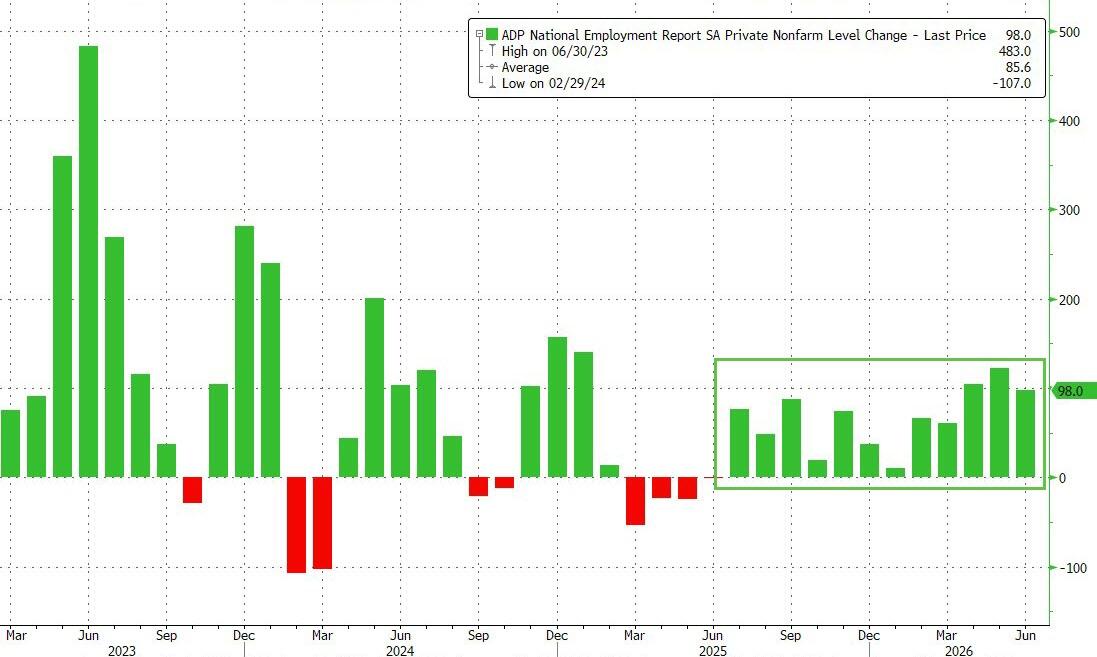
With jobless claims still hovering near multi-decade lows and Job Openings soaring, and despite near record low consumer sentiment (particularly about the labor market), ADP was expected to report another strong employment report this morning with the US economy adding 120k jobs.

The actual print was a disappointing +98k, but still represented the 12th straight month of employment gains…

Source: Bloomberg

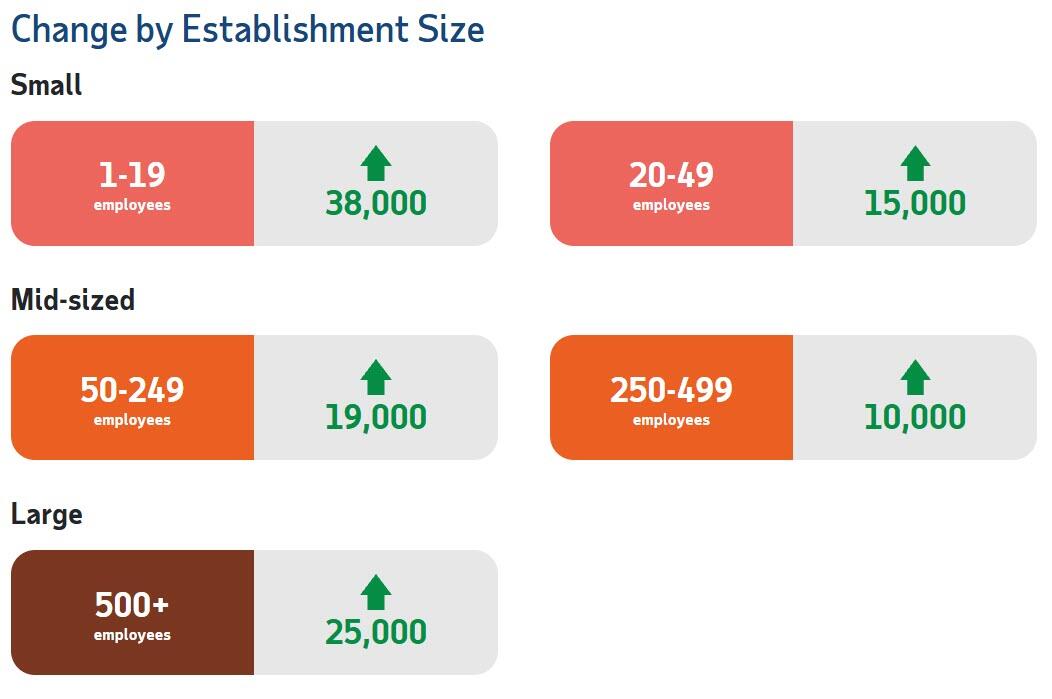
Once again Small Business led the charge with hiring, but the gains were seen across all firm sizes…

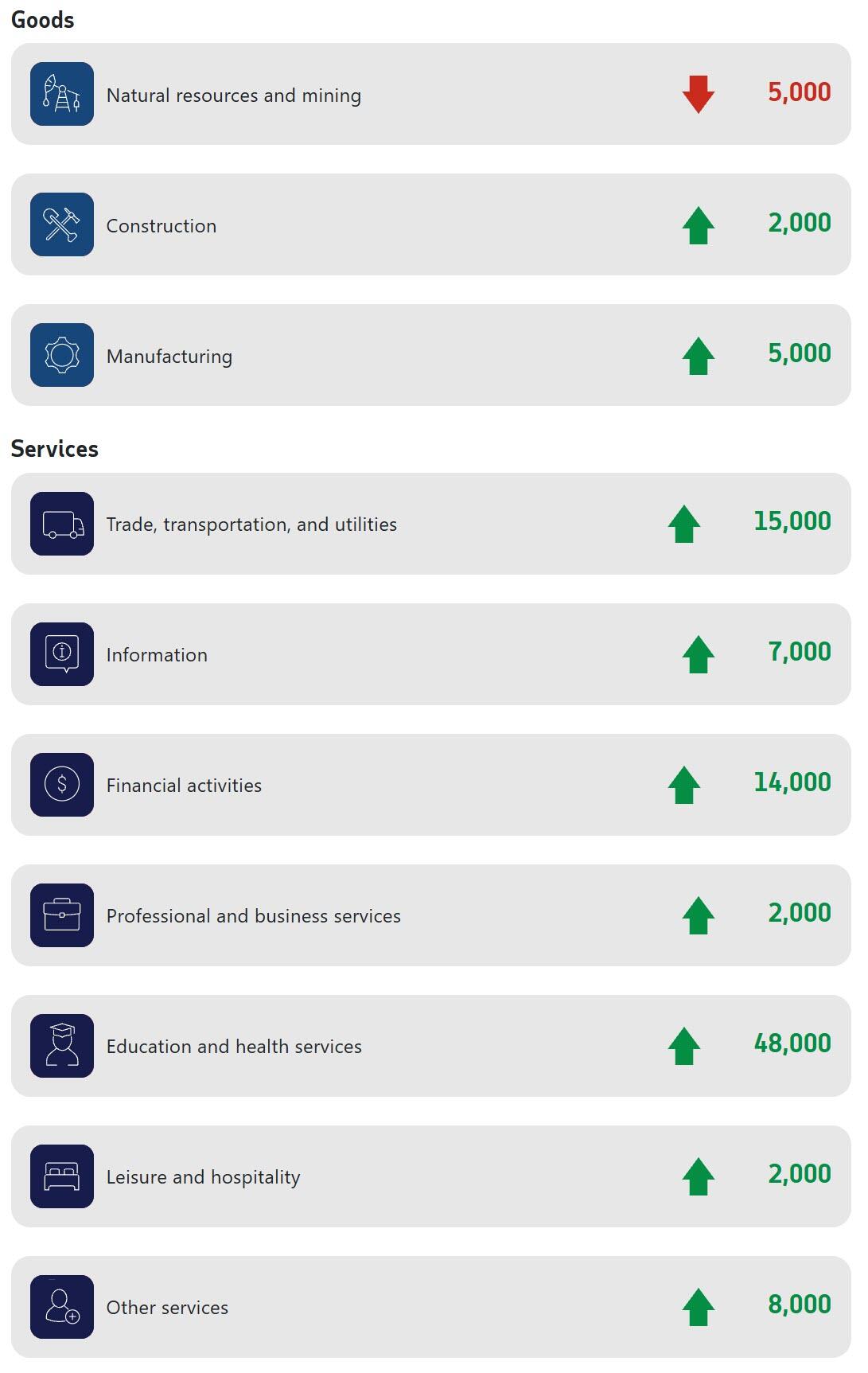
Interestingly, only the Natural Resources & Mining sector saw job losses…

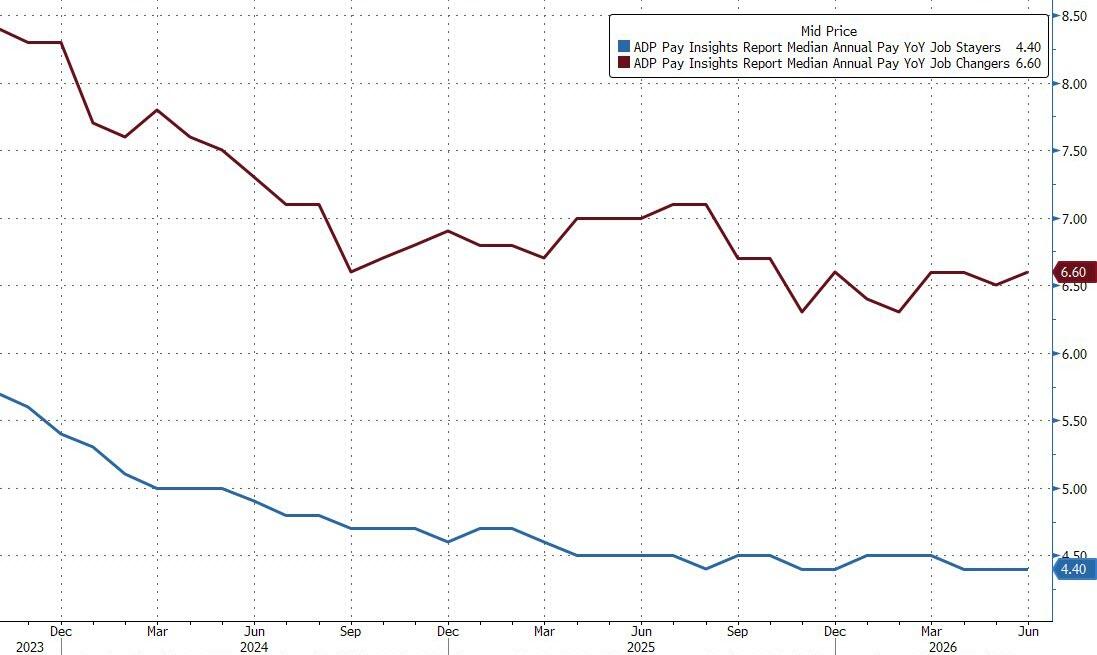
The median pay gain for job-stayers was little changed at 4.4 percent, while year-over-year pay growth for job-changers accelerated to 6.6 percent.

“The pace of hiring is telling a story of both supply and demand,” said Dr. Nela Richardson Chief Economist, ADP.

We know it’s taking people longer to find work, but there also are signs of labor supply constraints in certain industries. For now, the overall effect is a slowdown in job creation.

Still, this is hardly the collapse in labor market sentiment that surveys are suggesting…

Tyler Durden
Wed, 07/01/2026 – 08:22

via ZeroHedge News https://ift.tt/NiQ2PLs Tyler Durden

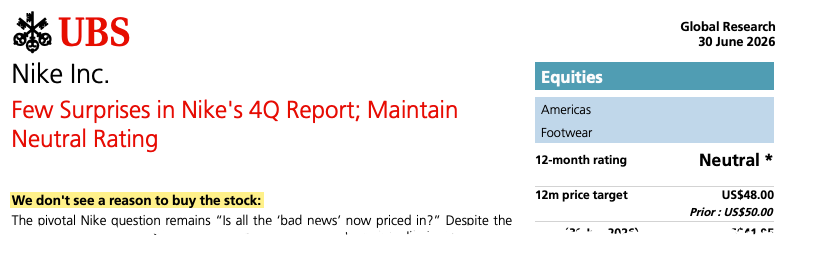
Nike Turnaround Falters As UBS Says There’s “No Reason To Buy” Stock

Nike Turnaround Falters As UBS Says There’s “No Reason To Buy” Stock

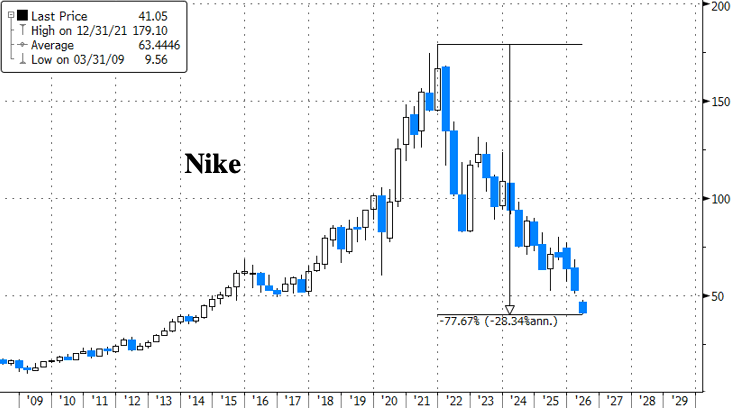
Nike shares fell 3% in premarket trading after the struggling athletic apparel giant warned on its earnings call that revenue declines over the next two quarters will be worse than previously expected, underscoring that there is still no immediate turnaround to halt a multi-year bear market that has driven the stock to decade lows.

“We are not expecting the environment to improve meaningfully over the next six months,” Nike’s outgoing CFO Matt Friend told investors on Tuesday evening.

Customers are “under pressure around the world, and we can particularly see it having a larger impact on sportswear,” Friend added.

Nike now sees sales falling in the low-to-mid single digits, down from an earlier view of a low-single-digit decline. The slowdown is expected over the next six months and is mostly due to slower wholesale shipments in North America, among other factors.

The downbeat commentary offset better-than-expected fourth-quarter sales and profits, which were largely in line with expectations. Management warned that the operating environment became “increasingly challenging” as the quarter progressed, with North America slowing by mid-April.

Our immediate takeaway is that Nike’s reset remains ongoing, and any turnaround plan will likely take much longer than initially anticipated, continuing to pressure the stock.

UBS equity analyst Jay Sole, focused on retail, department stores, specialty softlines, apparel, footwear, and consumer discretionary stocks, was blunt with clients: “We don’t see a reason to buy the stock.

Sole explained why clients should hold off for now from attempting to bottom-fish the stock, which is currently trading at 2014 levels:

The pivotal Nike question remains “Is all the ‘bad news’ now priced in?” Despite the pullback in Nike’s stock price, we still don’t see a good entry point. Nike’s stock price is still not cheap at ~27x our FY27 EPS estimate, in our view, and this suggests a solid rebound remains priced in. We continue to see a balanced upside/downside skew. The main upside risk is Nike returns to positive sales growth with expanding gross margin faster than expected. Yet the main downside risk is the rebound takes much longer than the market anticipates. Nike’s 4Q report did not cause us to change our thesis much.

Nike’s 4Q report underscores upside and downside sales and margin risks:

1. Nike lowered its CY26 sales guidance, but there were bright spots within the outlook. Nike lowered its CY26 sales growth forecast to -L to -MSD% from -LSD %. We believe the main negative factor is Nike’s fashion business continues to struggle. The issue is Nike’s fashion business remains 50% of its sales mix. Nike may need to take this percentage much lower over time in order to reestablish itself at the world’s best sports brand. If so, it could serve as a major, multiyear drag on Nike’s top line. This is the main downside sales risk. At the same time, Nike’s performance business grew 5% in Q4. Plus, the company sounded like it is in the process of replicating the operational improvements made in categories like running to other sports categories such as basketball, training, outdoor, and tennis. If so, this could lead to upside sales growth surprises over the NTM. This is the main upside risk, in our view.

2. Nike offset its lowered sales expectation with raised margin guidance. Nike boosted its GM% outlook slightly and trimmed its SG&A outlook in order to maintain its CY26 guidance. This was a mild positive surprise to us and Nike is citing its ability to continue to tightly manage costs as one means of restoring its EBIT margin back to 10% over time. However, Nike’s average annual SG&A growth rate over the past 4 years (FY27e included) is just 0%. Our concern is Nike is underinvesting in future growth in order to limit near-term downward EPS revisions. Thus, a main downside margin risk is that Nike will have to ramp up SG&A more than expected to return to sustainable top-line growth.

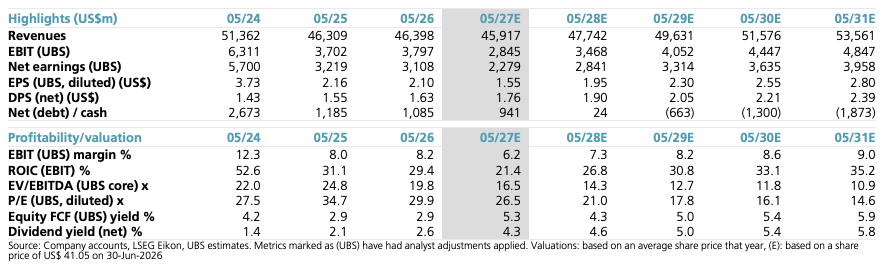
We maintain our FY27, FY28, and FY29 EPS estimates:

We lower our FY27 sales growth forecast given Nike’s plan to reduce its inventory buys. Plus, we see greater revenue pressure post Q1 as Nike moves past major sporting events like the world cup and laps elevated promotions on its digital channel. At the same time, we raise our operating margin forecast related to annualizing new efficiencies in Nike’s supply chain and technology divisions. Plus we see slightly lower risk Nike’s promotions

Separate analyst commentary (courtsey of Bloomberg):

Bloomberg Intelligence analyst Poonam Goyal

  • “Nike’s sales recovery is likely to take longer as management tightens buys and sell-in to clear sportswear, Jordan, streetwear and China inventory, even as margin can expand sooner”

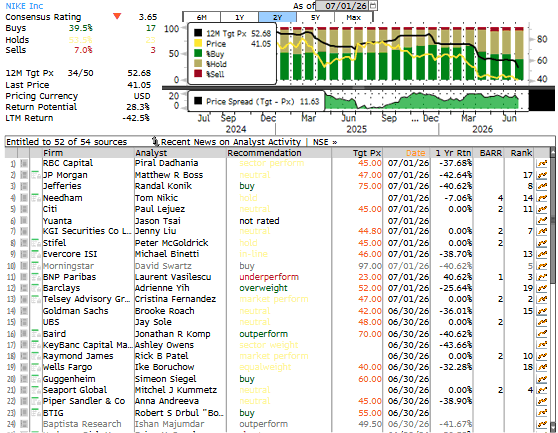
Citi analyst (neutral, PT to $45 from $47)

  • Nike’s sales are looking a little weaker, while margins are a little better.
  • “After sales slowed in mid-April within 4Q26, June (1QTD) has improved, helped by excitement around global football”

Guggenheim analyst Simeon Siegel (buy, PT $60 from $74)

  • The bottom line is that “we assume investors will still question whether Nike has ‘ripped the band-aid’ on earnings revisions”
  • Trim price target on “recognizing ongoing noise and a general reduction in retail multiples”

Jefferies analyst Randal Konik (buy, PT to $75 from $90)

  • The fourth-quarter report “came in ahead with kernels of progress solidifying in the base business”
  • “Sportswear/Jordan Streetwear still the overhang, but not getting worse”

RBC Capital analyst Piral Dadhania (sector perform, PT $50)

  • Revenues remain reliant on wholesale, whilst direct-to- consumer trends remain soft, which is “not likely sustainable mid-term”
  • “Nike has delivered a mixed 4Q26 quarter (ex US tariff refund) with anticipated lack of underlying revenue momentum offset by more favourable FX translation benefit which flatters absolute gross profit”

According to Bloomberg data, there are 17 “Buy” ratings on the stock, with 23 “Neutral” ratings and 3 “Sell” ratings.

Read The Market Ear note on Nike’s epic demise titled “Go Woke Go Broke: Nike Stopped Obsessing Over Athletes And Started Obsessing Over Activism.”

Tyler Durden
Wed, 07/01/2026 – 08:05

via ZeroHedge News https://ift.tt/hBQfMme Tyler Durden