El Chapo’s ‘Narco Beauty Queen’ Wife Pleads Guilty To Helping Run Drug Empire
Drug kingpin Joaquin “El Chapo” Guzman’s wife has pleaded guilty for her role in helping her husband run his multi-billion dollar empire in a Washington federal court on Thursday.
32-year-old Emma Coronel Aispuro married El Chapo in 2007 and since then is believed to have “aided and abetted” the Sinaloa cartel in importing over 500,000 kilograms of drugs into the United States – mostly cocaine, but also heroin, methamphetamine, and marijuana. For example the Mexico-based drug operation is believed responsible for up to80% of all cocaine and heroin sold in Chicago in recent years. She further pled guilty to money laundering and charges related to El Chapo’s famous 2015 tunnel escape from a top security Mexican prison.
Coronel Aispuro, who holds dual US-Mexico citizenship “worked closely with the command-and-control structure” according to prosecutors. She was arrested at Dulles International Airport in February after being allowed to travel freely for years. She was even reported to have shown up to the courtroom daily during her husband’s three-month-long trial.
After previously escaping Mexican prisons two times (which authorities believe his wife helped orchestrate) Guzman was arrested after a shootout and extradited from Mexico to the United States, after which he was sentenced to life in prison by a US court, and is now at the federal supermax prison in Florence, Colorado.
Coronel and Guzman met when she was 18 and he was nearly 50 while she was competing in beauty pageants. She’s since been dubbed ‘Narco Princess’ and is believed to have an estimated worth of five billion dollars.
According to CNN, “In Guzman’s trial, a cooperating witness testified that Coronel and others worked together to coordinate details of Guzman’s last escape from prison in Mexico and that Coronel would often relay messages from Guzman in prison to others.”
With her guilty plea she could potentially face life in prison, but it’s expected that she’ll come out of it with a significantly lighter sentence, especially if the plea deal is centered on her providing key information that might help US and Mexico authorities disrupt the Sinoloa cartel’s multi-billion dollar international criminal enterprise.
The wife of Mexican drug kingpin Joaquin #ElChapo Guzman pleaded guilty to federal charges.
Emma Coronel Aispuro appeared in federal court in Washington on charges of knowingly and willfully conspiring to distribute drugs. https://t.co/tm6SUGiNmO
The U.S. government is thinking about creating an electronic currency backed directly by the dollar, an idea dubbed the “digital dollar” or “Fedcoin.” Such a step could severely damage trust in the dollar and risk Americans’ privacy.
Blockchain technology has allowed countries across the world—most notably China—to create central bank digital currencies (CBDCs), which allow people to exchange money electronically without going through a bank or a secondary service such as PayPal or Venmo.
In a recent video, U.S. Federal Reserve Chair Jerome Powell announced that the Fed intends to issue a discussion paper about the “benefits and risks associated with CBDC in the U.S. context.” While Powell’s statement was generally neutral, stressing the importance of taking time to assess “the broader risks and opportunities,” other oficials have more pointedly favored the idea. Fed Governor Lael Brainard endorsed a digital dollar at a recent conference sponsored by CoinDesk, and Sen. Sherrod Brown (D-Ohio) wrote in March that a CBDC could help create a more “fair and equitable financial system” by allowing unbanked Americans to pay electronically without a bank account, credit card, or internet connection.
CBDC boosters also argue that the currencies are more efficient, since transactions that use them would not have to travel through as many intermediaries. This, they say, could reduce the friction of international payments and make global transactions easier.
It’s not clear how big these benefits really are. The Federal Deposit Insurance Corporation reported in 2019 that only 5.4 percent of Americans lacked a bank account—a total that has been dropping rapidly. And we already have intermediaries, such as PayPal and Venmo, that can make international payments virtually instantaneous. Are these reasons enough to put Americans’ privacy at risk?
Paul Jossey, an adjunct fellow at the Competitive Enterprise Institute, says the potential impact of a CBDC on Americans’ financial privacy is “at best very scary.” At worst, he adds, it’s “nightmareville.”
China’s digital yuan shows how CBDCs could be a tool of government surveillance and control. “Unlike many anonymous and decentralized cryptocurrencies, [it] is monitored and backed by the [People’s Bank of China], affording China’s leadership supreme control over all transactions,” reportsAsia Times. This “allows the Chinese government to integrate data collected on other platforms like the social credit system to generate a more detailed picture of individual users’ buying patterns.” In a video released by CGTN, a state-controlled media outlet, a fist with a symbol of the digital yuan punches the ground as a symbol of how the currency will be used to find and crush those who disobey the law.
The European Union has floated plans for a CBDC with “privacy anonymity vouchers,” which consumers could exchange to protect the privacy of their transactions. “But if you run out of vouchers, then that’s it,” says Jossey.
Meanwhile, tech writer Naomi Brockwell is worried that CBDCs could allow the government to “automatically deduct taxes,” “freeze funds more easily,” and “program money that sits in a bank account to become worthless if it sits too long in order to encourage spending.”
And while Powell and Brainard have been careful to say that CBDCs would not replace cash and other payment systems, some supporters of CBDCs have other ideas. Deutsche Banke, the largest banking institution in Germany, stated in a November 2020 report that “in the long term, central bank digital currencies will replace cash.” As Reason has pointed out on many different occasions, cash remains the only truly private form of transaction; a cashless society is a “pay-as-the-powers-at-be-will-let-you” society.
Competitive private sector organizations have at least some incentive to prioritize privacy, as we’ve seen in the cryptocurrency market. The federal government has little such incentive.
Much of the push for government-run digital money is driven by fears of those private cryptocurrencies. Sen. Brown, for example, pointed out that bitcoin “can be used for illegal activity.” (In fact, cash is still the preferred method of choice for illegal transactions. According to a report by Chainalysis, illicit behavior accounts for less than 1 percent of all crypto activity.) Meanwhile, Brainard is worried about the widespread adoption of stablecoins—digital assets pegged to a national currency, usually the U.S. dollar. If these are widely adopted, she argues, they could recreate a system like the one the U.S. had before the creation of a national bank, where there was no one dominant currency; and that, she fears, could lead to instability.
Dante Alighieri Disparte, who serves on the World Economic Forum’s Digital Currency Governance Consortium, believes such concerns are unfounded. “That the majority of asset-referenced stablecoins in circulation today are pegged to the U.S. dollar speaks to how the fundamental trust in the U.S. dollar as the global reserve currency of choice is being preserved by digital currencies, not circumvented by them,” he writes in Coindesk.
Another fear that comes up in these arguments is a fear of “falling behind” China, causing the dollar to lose its global preeminence. But “by today’s hyper-competitive digital currency and blockchain standards, the U.S. may not be a laggard at all, but rather is already winning the race for the future of money and payments,” Disparate argues. China’s control over the flow of the digital yuan makes it an unappealing way to store assets and do business.
“Americans, and people around the world, trust the dollar not just because the government behind it is powerful but also because it is constrained by a robust body of law, among whose pillars is the Fourth Amendment protection against unreasonable searches and seizures,” writesWashington Post columnist Charles Lane. “We should be very sure of the benefits of CBDC before granting the central bank powers that could be bent to Orwellian purposes, either by this government or, in the event of hacking, a foreign one.”
The best future of money is not in a centralized public digital currency. It’s in a free marketplace marked by privacy, innovation, and choice.
from Latest – Reason.com https://ift.tt/3wdfLYp
via IFTTT
Senator Rand Paul blasted Dr Fauci Wednesday, labelling him “an elitist” who believes Americans are not smart enough to make their own decisions about their health.
Appearing on Newsmax, Paul noted “I think it’s this — it’s one-size-fits-all and his idea that the regular people aren’t smart enough to make these regular decisions. So he just wants to treat everybody the same.”
“The one-size-fits-all strategy that everybody must get vaccinated ignores the science,” the Senator continued, adding “It’s mostly that he’s not telling the truth once again because he is an elitist, and he thinks we can’t handle the truth.”
“In private, he said in emails last spring that most of the masks you can get over the counter don’t work because the virus particles are too small and go right through them. That’s still true. They don’t work. There’s no value. Yet, we’re mandating them by law because — and this is where I really have a disagreement with Fauci, one he’s not telling the truth, and promulgating bad science, pseudoscience,” Paul urged.
“So your eighth grade running the mile or half-mile wearing the mask outside is probably not going to be good for their health, it’s not comfortable, and there’s no science to say you’re preventing disease,” Paul continued.
“It’s really just a disservice to the public,” The Senator asserted, explaining “The main thing about the mask when he said they didn’t work at all was he didn’t want people buying the N95 masks and the people in the hospital, the doctors not having enough. So he just admits that he lied, but it was a lie for our own good, supposedly.”
In the age of mass Silicon Valley censorship It is crucial that we stay in touch. We need you to sign up for our free newsletter here. Support our sponsor – Turbo Force – a supercharged boost of clean energy without the comedown. Also, we urgently need your financial support here.
June is typically the month the wildfire season in California begins. The state is already battling an extreme drought, and the first heat wave of the season hit last week. The risks of another heat wave are increasing for next week.
The hottest and most fire-prone months are nearing as a second heat wave of the season could arrive as early as next week.
How the season turns out may depend on the immediate climate in the state. Extreme heat and drought are several factors that may produce dry fuels and eventually spark fires.
Forecast temperature anomalies daily are expected to jump for the southern part of the state by Tuesday/Wednesday and then the whole state by Friday. In many parts of the state, temperature anomalies, the difference from an average, or baseline, temperature, could be +14 degrees. Forecasts suggest Bakersfield and Fresno could reach triple digits.
Prospects of the next heat wave come as the Drought Monitor (dated June 3) shows much of California, nevertheless, the West Coast, is experiencing some level of drought.
California could be headed for a dangerous wildfire season with conditions already parched.
Further, we want to monitor power prices in the state as grid demand could overwhelm supply, and power companies could issue rolling blackouts to conserve power or prevent wildfires.
Ground service providers drowning in shipments delivered by airlines are responding to massive gridlock at Chicago O’Hare by permanently relocating some warehouse operations outside the property to increase capacity in what could increasingly become a model at major U.S. airports that haven’t prioritized investment in cargo facilities.
Alliance Ground International (AGI), with stations around the country, and local ground handling agent Maestro International Cargo this month are both opening large, off-airport transfer facilities to enable faster pickup of import cargo, which currently can take up to six days to retrieve after an aircraft’s arrival.
Alliance officials told American Shipper they are putting the final touches on a 253,000-square-foot building located about 10 minutes west of O’Hare and close to many of the freight forwarders responsible for picking up and delivering customers’ cargo. Alliance, the largest cargo processor at O’Hare, manages 640,000 square feet of space in four airport terminals. The Elk Grove Village facility will take the company’s total footprint to 900,000 square feet and has more space than any tenant controls in a single warehouse at the airport.
Maestro is leasing a 164,000-square-foot facility about five minutes from the airport for five years, CEO Edip Pektas said. At O’Hare it has about 115,000 square feet of warehouse space.
Adding auxiliary facilities further from the airport runs counter to the traditional industry model of processing loads close to the aircraft to enable fast handoffs, but now is viewed as increasingly necessary to prevent cargo bottlenecks. Under the hybrid strategy, cargo handlers will move as much inbound cargo as possible away from the airport, depending on whether their service agreements with airlines allow it, and keep export processing in place because logistics providers want to drop outbound shipments as close to flight time as possible in order to make flights.
“I think it will significantly improve their service because right now it’s not great. This will give them the upper hand,” said Neel Jones Shah, executive vice president and global head of airfreight at Flexport, a major freight management company based in San Francisco. “It’s going to be a trend in the industry as a lot of these airport facilities are way underinvested in. So you’re going to have to go off-airport, split your operation and get creative as hell.”
Chicago O’Hare International Airport is one of the biggest U.S. airfreight gateway for cargo, prized for its central location and size, access to extensive ground transportation and logistics infrastructure, and proximity to manufacturing centers. The pandemic significantly increased cargo activity as pure freighters and cargo-only passenger aircraft carrying critical COVID supplies, as well as increased orders for e-commerce and other goods, swarmed the airport. Last year cargo volume grew 15% to more than 2 million metric tons, with the number of freighter flights escalating 25% to 30,400.
Notably, international imports carried on widebody jets jumped 22%, more than any other major gateway in the U.S., according to an analysis by consultant Logistics Capital & Strategy.
Cargo bottlenecks are common at O’Hare during peak shipping periods because of limited warehouse space and truck zones, and paper-based processes, but have become a constant source of aggravation for shippers since the pandemic. The spike in freighter activity swamped facilities used to a steadier shipment flow from a mix of freighters and passenger aircraft pumping in small, frequent loads. At some facilities, it is common for four or five widebody freighters to disgorge huge loads in a single day.
At the same time, third-party ground handlers released many workers when airlines scaled back passenger flights and lost others to illness. Social distancing also makes warehouse operations less efficient, and cargo-only passenger flights require larger crews to hand-carry boxes in the cabin.
Pektas said the record influx of imports is like “getting hit by cargo tornadoes every day. We were just blown away. We couldn’t keep up.”
Many cargo handlers responded by establishing temporary facilities outside the airport campus, according to logistics managers in the area, but the new AGI and Maestro facilities are of a much greater scale and future-proof the companies for long-term growth.
Pop-up facilities designed to handle overflow “don’t tend to work as well because there’s no set process and it’s like a fire drill,” Jones Shah said.
Maestro initially leased a small off-airport facility on a month-to-month basis, but after six months moved to a 72,000-square-foot facility before expanding again. The company, which handles cargo for airlines such as Air China Cargo and Emirates, plans to keep the smaller facility to help process export cargo, Pektas said.
Swissport also opened last month a 65,000-square foot import processing center near the airport, a spokesperson confirmed. It is the company’s third warehouse besides two with airside access.
“The idea for us was to open up a facility that was big enough to provide relief to our on-airport buildings and really improve [the situation] for the air cargo community at O’Hare,” said AGI Chief Operating Officer Jared Azcuy.
Airline customers will transition in stages to the new import center, which has 57 dock doors and 34 trailer parking positions, but pharmaceutical shipments will stay at the airport to preserve the cold chain, he explained.
Shipments will be immediately offloaded from aircraft directly into trucks and taken to the customs-bonded freight station. Freight shuttled over from passenger terminals by tugs will also go straight into trucks on the ramp.
The size of the new facility will accommodate longer storage times for forwarders willing to pay, although most users try hard to pick up shipments before the 24-hour free time expires because storage fees are expensive. At 18 cents per kilo, or $180 for 1,000 kilos per day, it doesn’t make financial sense for freight intermediaries to use airport facilities as warehouses for large consignments, said one source, who referred to an AGI rate sheet.
But Azcuy said some forwarders are leaving cargo longer because they, or their trucking partners, have no room in their warehouses. Smaller forwarders often don’t have storage facilities of their own and may be forced to make a tough choice if the warehouse they rent is full, or they can’t make an immediate delivery to the customer, according to other logistics managers.
Ground handlers say that when forwarders delay pickups it clogs their facilities, making it more difficult to break down and locate shipments for arriving truckers.
“We are not a warehouse facility to store cargo. We are a transit warehouse,” said Warren Jones, AGI’s vice president of business development. “We want to get cargo off a truck and onto an airplane. We have limited space to store cargo. And some of these forwarders are paying us high storage fees. We don’t want that. We want cargo in and out.
“We just want to make sure that we have enough space to accommodate extended stays. We can’t put ourselves in a logjam position.”
Forwarders need to change their business practices too, he added, and make weekend pickups more routine. Large forwarders with their own truck fleets do make weekend pickups, but smaller outfits have to rely on contract carriers with driver-shortage issues of their own, industry experts say.
Alliance Ground is installing a payment and appointment system from CargoSprint in the new building, as it has at other O’Hare facilities. Azcuy said it has so many dock doors that appointments likely won’t be necessary, except for pickups outside regular hours. The SprintPay system allows forwarders to submit payments online so truck drivers can simply retrieve the cargo without waiting at the counter to resolve charges or stopping by on the way to the airport to pick up a paper check.
Off-airport real estate is cheaper, but some savings will be offset by the cost of truck shuttles, said a Chicagoland terminal manager who is not authorized to speak to the press. It takes nine to 10 truckloads to carry all the cargo in a full Boeing 777 or 747 freighter.
Split operations can sometimes cause a problem if receivers aren’t sure which facility has their cargo, but logistics specialists say it shouldn’t be a problem if everyone is informed and there are enough trucks to keep the freight flowing quickly to the import location.
“They just need to communicate which airlines are going to which building and then stick to it,” said Scott Case, president of the International Air Cargo Association of Chicago.
Over 170 Houston Hospital Employees Suspended Without Pay For Refusing COVID-19 Vaccine
Houston Methodist Hospital in Texas has suspended over 170 employees for two weeks without pay, after they refused to take the COVID-19 vaccine. The suspensions come after a new May policy requiring all 26,000 workers to get full courses of either the Pfizer-BioNTech, Moderna, or Johnson & Johnson vaccines by June 7 or face termination.
The hospital says 99% of its employees – 24,947 – are fully vaccinated, however a group of 178 workers who have refused and have now been punished.
What happens after the two weeks is unknown, according to the Daily Mail.
Meanwhile, 117 employees are suing the hospital, claiming that they’ve been pressured into becoming ‘human guinea pigs’.
Earlier this month, 117 employees sued Houston Methodist, claiming the hospital ‘is forcing its employees to be human ‘guinea pigs’ as a condition for continued employment,’ reported KHOU 11 last month.
They also claim coronavirus vaccines are ‘experimental,’ because they have only received emergency use authorization and not full U.S. Food and Drug Administration (FDA) approval.
The federal government’s Equal Employment Opportunity Commission ruled in December 2020 that employers could legally set vaccine requirements for their workforce. -Daily Mail
“It is unfortunate that today’s milestone of Houston Methodist becoming the safest hospital system in the country is being overshadowed by a few disgruntled employees,” said CEO Marc Bloom, who added that 27 of the suspended workers have since received at least one dose of the vaccine.
“I know that today may be difficult for some who are sad about losing a colleague who’s decided to not get vaccinated,” Bloom continued. “We only wish them well and thank them for their past service to our community, and we must respect the decision they made.”
Hospital staff were first given until mid-April before the deadline was extended to early June, with $500 bonus payments offered to employees who got vaccinated early. At the time, two employees chose to leave the hospital instead of getting vaccinated. Those with religious or health exemptions had until May 3 to apply for a waiver. According to the Washington Post, 285 employees were given medical exemptions, while 332 received medical deferrals.
“No one should be forced to put something into their body if they’re not comfortable with it,” nurse Jennifer Bridges told The Texan. Bridges has worked at Houston Methodist for over six years, and is leading the lawsuit.
“People trying to force you to put something into your body that you’re not comfortable with, in order to keep your job, is just insane,” she told KHOU11 last month, adding “I’m not an anti-vax person. If you want to get it, by all means, get it. I don’t take that away from anybody Just let everybody have a choice and the right to make their own decision.”
Bridges and the group of employees are being represented by Jared Woodfill from the Houston-based Woodfill Law Firm.
Woodfill told KHOU that his firm filed a declaration action, asking the court to declare the hospital’s orders illegal.
He argues that the vaccine is an experimental product, and that it should not be legal to force employees to receive it.
‘[The vaccine] that’s been on the market for less than a year. And yes, it’s being used under EUA, but at the same time, that is experimental by definition,‘ he said.
‘You can’t fire someone for refusing to do something illegal, and if you look at federal law, it makes it very clear that it’s illegal to force someone to participate in a vaccine trial.’ -Daily Mail
Bloom addressed the anti-vax employees two weeks ago, saying a statement: “It is unfortunate that the few remaining employees who refuse to get vaccinated and put our patients first are responding in this way,” adding “It is legal for health care institutions to mandate vaccines, as we have done with the flu vaccine since 2009. The COVID-19 vaccines have proven through rigorous trials to be very safe and very effective and are not experimental.”
Bridges, meanwhile, says she’s waiting for the vaccine to receive full approval from the FDA before she takes it.
Mediocre, Tailing 30Y Auction Redeemed By Jump In Foreign Demand
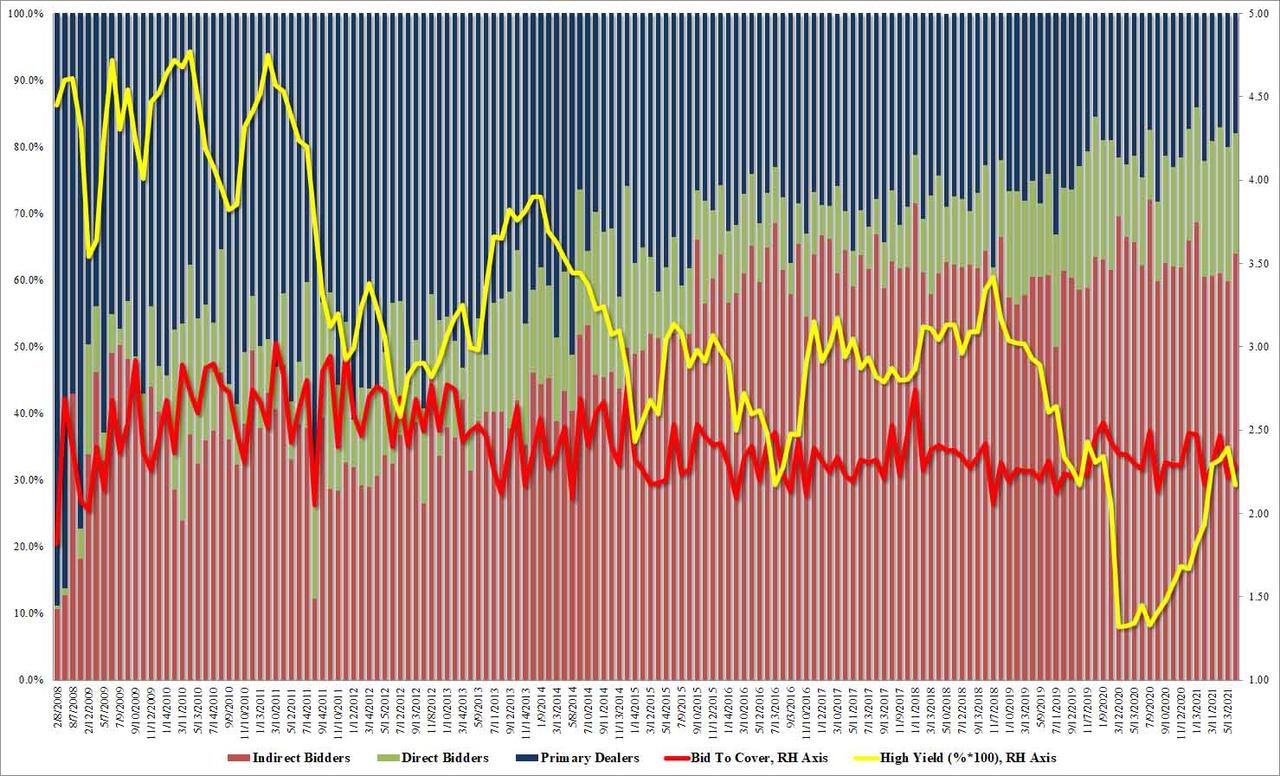
After two stellar auctions earlier this week, when buyers just couldn’t get enough of US paper, moments ago in the week’s final auction, the Treasury sold $24 billion in 30Y paper (in the form of a 29-Y 11-month reopening of Cusip SX7), to mixed demand.
The high yield of 2.172% was a big drop from last month’s 2.395% and the lowest since February’s 1.933%; it was also a 1.1bps tail to the 2.161 When Issued, which however is likely a result of today’s sharp move lower in yields across the curve and the lack of concessions.
The Bid to Cover of 2.289 was also an improvement to last month’s 2.219 if below the 6-auction average of 2.219.
Yet while these two metrics were mediocre at best, it was the surge in Indirects that surprised to the upside, with 64.0% of the auction going to foreign buyers, i.e. Indirects, a big jump from last month’s 59.9% and the highest since January (the six auction average is 62.7%). The rest was split almost equally between Directs and Dealers (18.0% and 17.9% respectively).
Overall, a mediocre auction yet one which could have been far uglier (recall the Feb 7Y auction?) considering today’s red hot CPI print, one which the market continues to dismiss as merely transitory until proven otherwise.
I have a confession to make. I have never seen Hamilton. Indeed, not only have I never seen Hamilton, I do not particularly care for most musicals (with a few notable exceptions), or dancing, or stage-style bare-your-soul, explain-your-thoughts singing. Nothing that matters in life or in movies should ever be resolved by singing or dancing. Fictional characters should work out their internal issues and external conflicts in normal and relatable ways, with terse monologues, glowering stares, and elaborately choreographed action scenes.
So when it comes to the musical art form and all its trappings, I admit to being what you might call a curmudgeon, which a long way of saying that I am very much not the target for In the Heights, the new movie musical from Hamilton scribe Lin Manuel Miranda and Step Up 2: The Streets director Jon M. Chu. This movie isn’t for me. Or at least it shouldn’t be.
And yet, somehow, I found it rather charming, even heartwarming. I don’t know if it’s a great movie, but it’s a gentle and genuinely appealing production, buoyed by a message of DIY community building and entrepreneurial advancement.
Some of that charm is a product of Chu’s deft direction, which takes the choreographed song spectacles of the stage musical, which debuted in 2005, and transforms them into a series of decidedly cinematic sequences. A few of these songs produce big numbers with ambitious designs and dozens of extras. But some of the film’s best bits are smaller, more intimate, as Chu recasts the rhythms of everyday life—walking down the street, stamping prices on food cans at a small corner market—into cleverly edited bits of musical cinema.
Much of the film’s success owes to its genuinely appealing cast, in particular, Anthony Ramos as Usnavi de la Vega and Melissa Barrera as his (maybe) love interest, Vanessa. Both deliver wholehearted performances that manage to be deeply earnest without ever quite coming across as cheeseball.
That earnestness, in turn, is what fuels the story’s big themes and values, which revolve around entrepreneurship, immigration, and self-made communities. In the Heights is set in the heavily Dominican New York City neighborhood of Washington Heights, and it is, at heart, the story of an immigrant community coming together to determine its own future.
Sometimes that future is forged by fighting with a labyrinthine immigration bureaucracy and racist attitudes, and there’s an admittedly too-on-the-nose subplot about DREAMers that wasn’t present in the stage version. But politics are only part of the story. By and large, In the Heights casts immigration as an entrepreneurial act, an individual decision to build a better life in concert with one’s new neighbors.
So it is fitting that, as often as not, the community’s future is forged through commerce. The plot runs through Usnavi’s neighborhood bodega, but there’s also a salon and gathering place run by two neighborhood women, a taxi dispatch, run by another local, Kevin Rosario (played with delightful ease and gravitas by Jimmy Smits), a local lawyer who handles tough immigration cases, and even a piragua (Puerto Rican shaved ice) cart run by a character played by Lin-Manuel Miranda.
These businesses are consistently portrayed both as sources of hard-earned personal wealth and valuable social connection, especially when the neighborhood faces a crisis, in the form of a citywide power outage, late in the second act. Charging people money in exchange for useful services—and keeping those services going when times are tough—is how they make their own lives better, and also how they help their neighbors. Their lives are improved, and their local universe is a better place, when their businesses grow.
The movie doesn’t quite bang you over the head with this message, but it’s not exactly subtle, either: The final, post-credits scene shows Miranda’s street-cart piraguas becoming a hot commodity with the block’s residents. In response to rising demand, he raises prices, and in the process, he outcompetes the Mister Softee truck that had been his biggest rival. (Mister Softee responds not with anger but with grudging respect.) It’s an entrepreneurial immigrant success story, and a fitting grace note for a movie that earnestly, ebulliently celebrates such values—albeit through people who spontaneously break out in song and dance to share their feelings. Huh. Maybe I do like musicals after all.
from Latest – Reason.com https://ift.tt/3cuGWGo
via IFTTT
I have a confession to make. I have never seen Hamilton. Indeed, not only have I never seen Hamilton, I do not particularly care for most musicals (with a few notable exceptions), or dancing, or stage-style bare-your-soul, explain-your-thoughts singing. Nothing that matters in life or in movies should ever be resolved by singing or dancing. Fictional characters should work out their internal issues and external conflicts in normal and relatable ways, with terse monologues, glowering stares, and elaborately choreographed action scenes.
So when it comes to the musical art form and all its trappings, I admit to being what you might call a curmudgeon, which a long way of saying that I am very much not the target for In the Heights, the new movie musical from Hamilton scribe Lin Manuel Miranda and Step Up 2: The Streets director Jon M. Chu. This movie isn’t for me. Or at least it shouldn’t be.
And yet, somehow, I found it rather charming, even heartwarming. I don’t know if it’s a great movie, but it’s a gentle and genuinely appealing production, buoyed by a message of DIY community building and entrepreneurial advancement.
Some of that charm is a product of Chu’s deft direction, which takes the choreographed song spectacles of the stage musical, which debuted in 2005, and transforms them into a series of decidedly cinematic sequences. A few of these songs produce big numbers with ambitious designs and dozens of extras. But some of the film’s best bits are smaller, more intimate, as Chu recasts the rhythms of everyday life—walking down the street, stamping prices on food cans at a small corner market—into cleverly edited bits of musical cinema.
Much of the film’s success owes to its genuinely appealing cast, in particular, Anthony Ramos as Usnavi de la Vega and Melissa Barrera as his (maybe) love interest, Vanessa. Both deliver wholehearted performances that manage to be deeply earnest without ever quite coming across as cheeseball.
That earnestness, in turn, is what fuels the story’s big themes and values, which revolve around entrepreneurship, immigration, and self-made communities. In the Heights is set in the heavily Dominican New York City neighborhood of Washington Heights, and it is, at heart, the story of an immigrant community coming together to determine its own future.
Sometimes that future is forged by fighting with a labyrinthine immigration bureaucracy and racist attitudes, and there’s an admittedly too-on-the-nose subplot about DREAMers that wasn’t present in the stage version. But politics are only part of the story. By and large, In the Heights casts immigration as an entrepreneurial act, an individual decision to build a better life in concert with one’s new neighbors.
So it is fitting that, as often as not, the community’s future is forged through commerce. The plot runs through Usnavi’s neighborhood bodega, but there’s also a salon and gathering place run by two neighborhood women, a taxi dispatch, run by another local, Kevin Rosario (played with delightful ease and gravitas by Jimmy Smits), a local lawyer who handles tough immigration cases, and even a piragua (Puerto Rican shaved ice) cart run by a character played by Lin-Manuel Miranda.
These businesses are consistently portrayed both as sources of hard-earned personal wealth and valuable social connection, especially when the neighborhood faces a crisis, in the form of a citywide power outage, late in the second act. Charging people money in exchange for useful services—and keeping those services going when times are tough—is how they make their own lives better, and also how they help their neighbors. Their lives are improved, and their local universe is a better place, when their businesses grow.
The movie doesn’t quite bang you over the head with this message, but it’s not exactly subtle, either: The final, post-credits scene shows Miranda’s street-cart piraguas becoming a hot commodity with the block’s residents. In response to rising demand, he raises prices, and in the process, he outcompetes the Mister Softee truck that had been his biggest rival. (Mister Softee responds not with anger but with grudging respect.) It’s an entrepreneurial immigrant success story, and a fitting grace note for a movie that earnestly, ebulliently celebrates such values—albeit through people who spontaneously break out in song and dance to share their feelings. Huh. Maybe I do like musicals after all.
from Latest – Reason.com https://ift.tt/3cuGWGo
via IFTTT
France’s Macron Urges G-7 To Sell Gold Reserves To Fund Bailout For Africa
Having been slapped in the face by an unemployed fan of medieval swordsmanship who said he is a right-wing sympathiser yesterday, French President Macron was back at work today, making headlines in his latest press conference.
Building on comments from earlier in May, when Macron hosted African leaders and the heads of multilateral lenders to find ways of financing African economies hurt by the COVID-19 pandemic and discuss handling the continent’s billions of dollars debt; the French President had an interesting suggestion for how to fund the bailout.
“The peculiarity of Africa is that it does not have the financial means today to protect and revive its economy like all the other continents have done,” French Finance Minister Bruno Le Maire told RFI radio in May.
World finance chiefs agreed in April to boost reserves (SDR)at the International Monetary Fund by $650 billion and extend a debt-servicing freeze to help developing countries deal with the pandemic, although only $34 billion will be allocated to Africa.
“France wants this to go much further by reallocating SDRs that are (scheduled) for developed countries,” an official from the French presidency briefed reporters ahead of the summit.
Macron has said he believes Africa needs a “New Deal” to give the continent a breath of fresh air.
And today, he called on G7 nations to find an agreement as part of efforts to reallocate $100 billion in International Monetary Fund (IMF) special drawing rights to African states.
So how do we pay for the bailout?
Macron told a news conference he would like the sale of gold reserves to help finance this planned aid for Africa.
So is Macron about to join the hall of fame of infamous leaders selling gold at just the wrong time?