Brickbat: Run It Off


squatexercise_1161x653

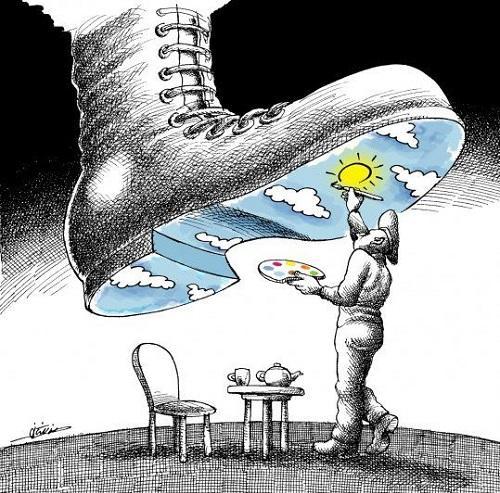
A man in the Philippines died after police forced him to do 300 squats for breaching a COVID-19 curfew. Darren Manaog Peñaredondo left his home to buy water. But he was caught by police and forced to perform exercises in punishment. Human Rights Watch says people violating COVID-19 restrictions in the Philippines are being abused, saying that officials locked five young people in a dog cage and have forced people to sit in the midday sun for breaking the rules.

from Latest – Reason.com https://ift.tt/3shU2vC
via IFTTT

The Complex Global Supply Chain Of Semiconductors Explained In One Chart

The Complex Global Supply Chain Of Semiconductors Explained In One Chart

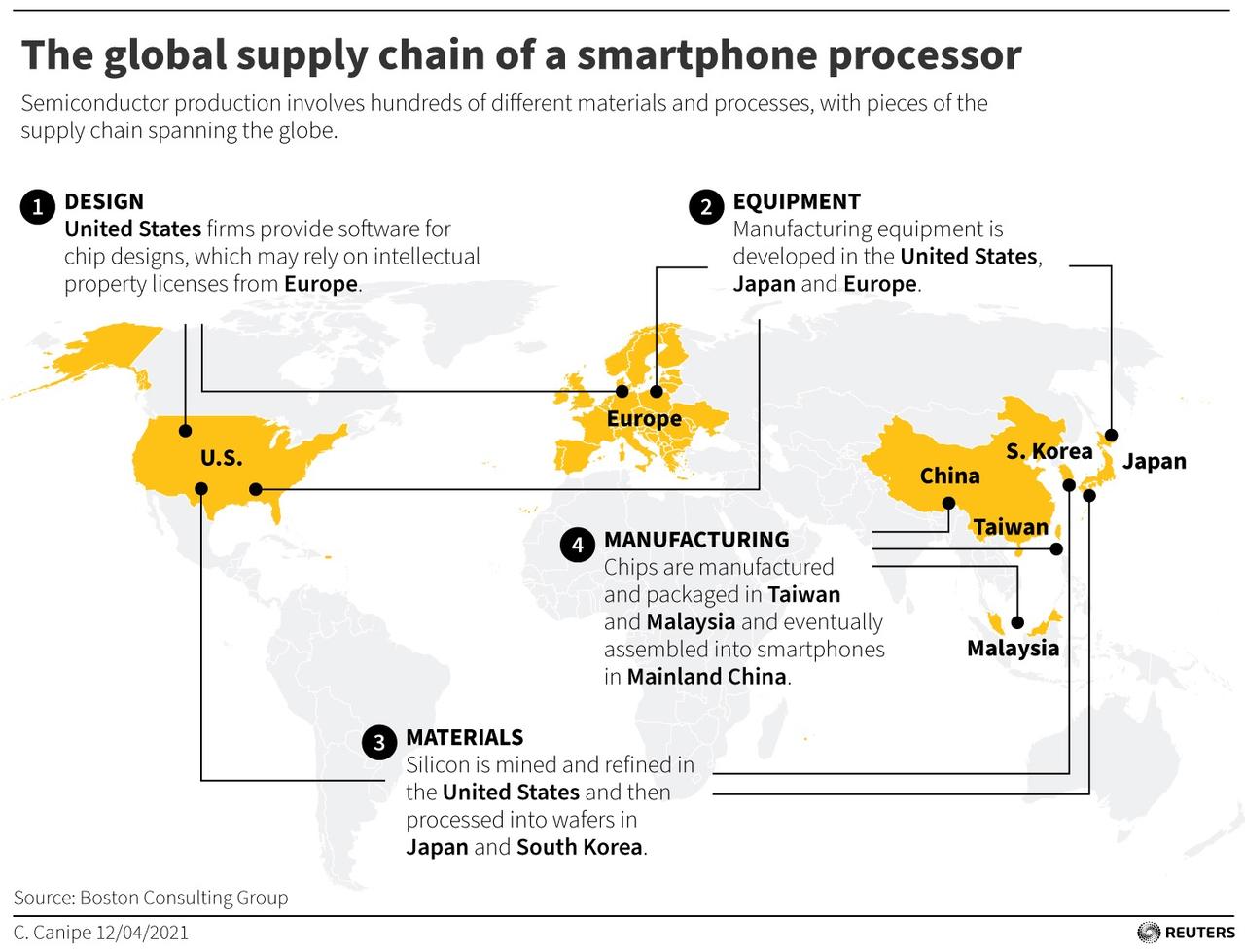
The global supply chain of a semiconductor chip is complex and spans the globe. 

For example, a camera image sensor produced by On Semiconductor is first created with wafers in Taiwan for packaging and testing, then to Singapore for storage, then on to China for assembly into a camera unit. The camera unit is sent to a Hyundai component supplier in Korea before being mounted on Hyundai vehicles in auto factories around the world, according to Reuters

A shortage of that image sensor has resulted in Hyundai Motor’s plant’s idling in South Korea. Other automakers such a Ford Motors Co, General Motors Co, and Volkswagen are experiencing issues. 

The example of On Semiconductor’s image sensor winding journey around the world shows just how difficult it is for the chip industry to increase capacity to address the current shortage

Meanwhile, President Biden is attempting to address the shortage and has called for a massive effort to bolster the domestic chip industry. He’s proposed $50 billion to build out the chip industry as part of his $2 trillion infrastructure proposal. In doing so, the chip supply chain would be far less complex and able to adjust to market fluctuations much quicker. 

Currently, the US only produces 12% of worldwide semiconductor manufacturing capacity, down a whopping 37% since 1990. Asia, on the other hand, commands more than 80% of the chip manufacturing market. 

The complexity of the semiconductor global supply chain is outlined below: 

Source: Reuters

The need to condense production for semiconductor chips appears to be necessary as it seems the current shortage is hard to solve with supply chains spanning the world. 

Tyler Durden
Fri, 04/16/2021 – 04:15

via ZeroHedge News https://ift.tt/3dkGD1s Tyler Durden

Brickbat: Run It Off


squatexercise_1161x653

A man in the Philippines died after police forced him to do 300 squats for breaching a COVID-19 curfew. Darren Manaog Peñaredondo left his home to buy water. But he was caught by police and forced to perform exercises in punishment. Human Rights Watch says people violating COVID-19 restrictions in the Philippines are being abused, saying that officials locked five young people in a dog cage and have forced people to sit in the midday sun for breaking the rules.

from Latest – Reason.com https://ift.tt/3shU2vC
via IFTTT

The EU’s Stunning Green Hypocrisy (At Least Trump Was Honest About Targets)

The EU’s Stunning Green Hypocrisy (At Least Trump Was Honest About Targets)

Authored by Mike Shedlock via MishTalk,

Let’s check in on EU’s green energy policy and how countries meet green investment targets.

Green Smokescreen

The EU mandates that that 30% of all EU expenditures be allocated to green projects. Eurointelligence discusses the Green Smokescreen and some amusing math as to how those targets are met.

If you took this target seriously, you would have to reform the Common Agricultural Policy. But the EU failed to do precisely that when they had an opportunity last year. Instead, the EU resorts to cheating.

The European Commission classifies investment in terms of 0%, 40% and 100% green content, and rounds up the numbers to the next higher target. So 1% becomes 40%. 41% becomes 100%.

You can always rely on EU leaders to put appearances ahead of content.

Reform of fiscal rules, a capital markets union, and changes in tax rules would produce more environmental investments and employment than a senseless competition for numerical climate change targets.

I also don’t believe this charade will work politically. When the mendacity of the EU’s climate policy becomes apparent, the centre will not only have lost the victims of the economic crisis, but an entire generation of young voters.

This is the thing with smoke and mirrors: when the smoke lifts, you see clearly.

Greenwashed Out

The above article was published on March 13, 2021. 

Eurointelligence reports today in “Greenwashed Out” that lobbyists consider the above demands as too strict. 

The Commission has been working to update its green finance taxonomy because the most recent set of guidelines, published in 2019, were deemed too strict by some member states and industry lobbyists.

In layman’s terms, projects that are not green will still be labelled green, which defeats the purpose of the entire endeavor.

Nine members of the 57-strong group have threatened to quit over the latest proposal because it would allow companies that are not currently considered green to claim investments, such as highly efficient steel production, and classify them as taxonomy-aligned.

This means that the proposal will maintain a longstanding practice of mislabeling green investments. Under a previous set of guidelines, a system called the Rio markers was used to round up the green content of investments and projects. A project with even a tiny amount of green content would qualify as 40% green, and anything with more than 40% green content was rounded up to 100% green. 

Too Strict!?

Clearly there is a need to round 1% up to 49% and 50% up to 120% or whatever.

In addition, let’s label steel production as green-aligned.

You may love or hate Trump’s approach to green projects but at least he was honest about what he was doing.

Global Net Zero Climate Change Targets are ‘Pie in the Sky’

By 2050 the world population is forecast to grow 9.8 billion, up from 7.9 billion in 2021.

That’s a huge increase in carbon demand even if we reduce per capita demand. 

Cherry Picking

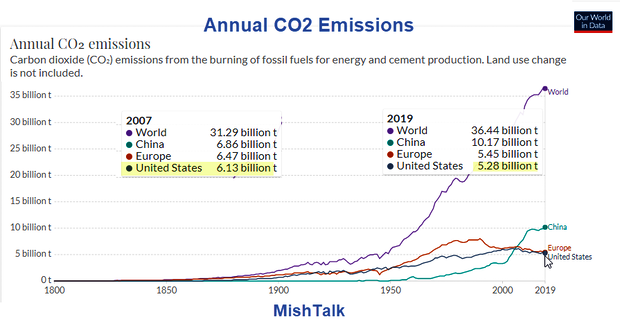
Even if the US footprint fell to zero (it won’t) it’s possible the net effect would be meaningless.

For discussion, please consider Global Net Zero Climate Change Targets are ‘Pie in the Sky’

Tyler Durden
Fri, 04/16/2021 – 03:30

via ZeroHedge News https://ift.tt/3adOiwC Tyler Durden

Beijing Displaces New York To Become The World’s Billionaire Capital

Beijing Displaces New York To Become The World’s Billionaire Capital

For the first time in seven years, New York City has lost its title as the world’s billionaire capital.

Statista’s Niall McCarthy reports that in 2020, the Big Apple was displaced by Beijing which recorded a net gain of 33 billionaires. Beijing is now in top spot with 100 individuals worth a billion dollars or more, narrowly ahead of New York’s 99.

Infographic: Beijing Displaces New York To Become The Billionaire Capital | Statista

You will find more infographics at Statista

The findings come from the 2021 Forbes World’s Billionaires list which shows that a quarter of its 2,755 members live in just 10 cities with more than 10 percent resident in just four Chinese metropolises. Along with Beijing, Shanghai, Shenzhen and Hangzhou also make the list of the world’s top-10 billionaire capitals. Hong Kong, a special administrative region of China, is also present on the list and it comes third with 80 billionaires.

Even though New York is in second place, the collective worth of its billionaire population amounts to $560.5 billion, beating Beijing’s collective $484.3 billion. Zhang Yiming is the richest resident in the Chinese capital with a net worth of $35.6 billion while Michael Bloomberg is New York’s wealthiest inhabitant with a $59 billion fortune.

Tyler Durden
Fri, 04/16/2021 – 02:45

via ZeroHedge News https://ift.tt/3dnEnqd Tyler Durden

UK Councils Bring Back “COVID Marshal” To Report People For Not Social-Distancing

UK Councils Bring Back “COVID Marshal” To Report People For Not Social-Distancing

Authored by Paul Joseph Watson via Summit News,

UK council authorities are putting more ‘COVID marshals’ onto the streets to report people to the police for not properly social distancing.

After the government lifted some lockdown restrictions on Monday, bars and restaurants were allowed to open outside.

This prompted the media to once again hysterically point to footage of people daring to enjoy themselves in order to whip up another contrived panic over a ‘4th wave’ of the virus returning despite Britain having one of the lowest case rates in the world amongst major countries.

Local government immediately responded by vowing to put more state spies on the streets.

“Councils across England have boosted the number of Covid-19 marshals patrolling city centres after scenes of overcrowding since outdoor drinking and dining resumed on Monday,” reports the Times.

The marshals have no enforcement power, so their role almost entirely depends on lecturing people about their behavior and then snitching on them to police if they fail to comply.

As we previously highlighted, when the second lockdown was implemented in the UK last autumn, COVID marshals were dispatched to ensure pubs and clubs were closed.

Photographs from the patrols showed marshals peering into windows and letterboxes to ensure gatherings or private parties were not taking place.

Images from London on Monday also showed masked security guards with attack dogs waiting to deal with any trouble caused by overcrowding as shops re-opened.

This is all apparently part of the process of regaining our freedom!

*  *  *

Brand new merch now available! Get it at https://www.pjwshop.com/

*  *  *

In the age of mass Silicon Valley censorship It is crucial that we stay in touch. I need you to sign up for my free newsletter here. Support my sponsor – Turbo Force – a supercharged boost of clean energy without the comedown. Also, I urgently need your financial support here.

Tyler Durden
Fri, 04/16/2021 – 02:00

via ZeroHedge News https://ift.tt/3aizlJE Tyler Durden

Mass Casualty Incident At FedEx Facility In Indianapolis

Mass Casualty Incident At FedEx Facility In Indianapolis

Indianapolis News WISH-TV reports Indianapolis Metropolitan Police Department (IMPD) received reports of an active shooter around 11:10 pm local time Thursday at a FedEx facility in Indianapolis. 

The incident was reported at the FedEx facility in the 8900 block of Mirabel Road in Indianapolis, near Indianapolis International Airport.

Dispatchers declared a “mass casualty, Level 1,” which means the incident involved less than ten surviving victims. 

IMPD has yet to release information on how many people were shot or their conditions. There’s also no information if the shooter is in custody. 

Here’s the IMPD scanner audio of shots fired at the FedEx facility. The dispatcher said at least ten shots were fired from the entrance or inside the facility. Another caller (from inside the facility’s control room) told dispatchers she had no visual on the suspect but heard the shots. 

A massive police presence is seen outside the FedEx facility. 

Local news Fox 59’s Courtney Crown spoke with a family member of one of the victims who the gunman shot. 

“She called as I was asleep at home. She said there was a shooting in the FedEx. So we just drove from Brownsburg,” said Parminder Singh, the uncle of one of the victims.

A shooting witness said there may have been multiple shooters.  

Crown interviewed the husband of a FedEx employee who was in the facility during the time of the incident.

*This story is developing… 

Tyler Durden
Fri, 04/16/2021 – 00:53

via ZeroHedge News https://ift.tt/3afdq65 Tyler Durden

China’s Economy Grows By A Record 18.3% In Q1; It’s Not Enough

China’s Economy Grows By A Record 18.3% In Q1; It’s Not Enough

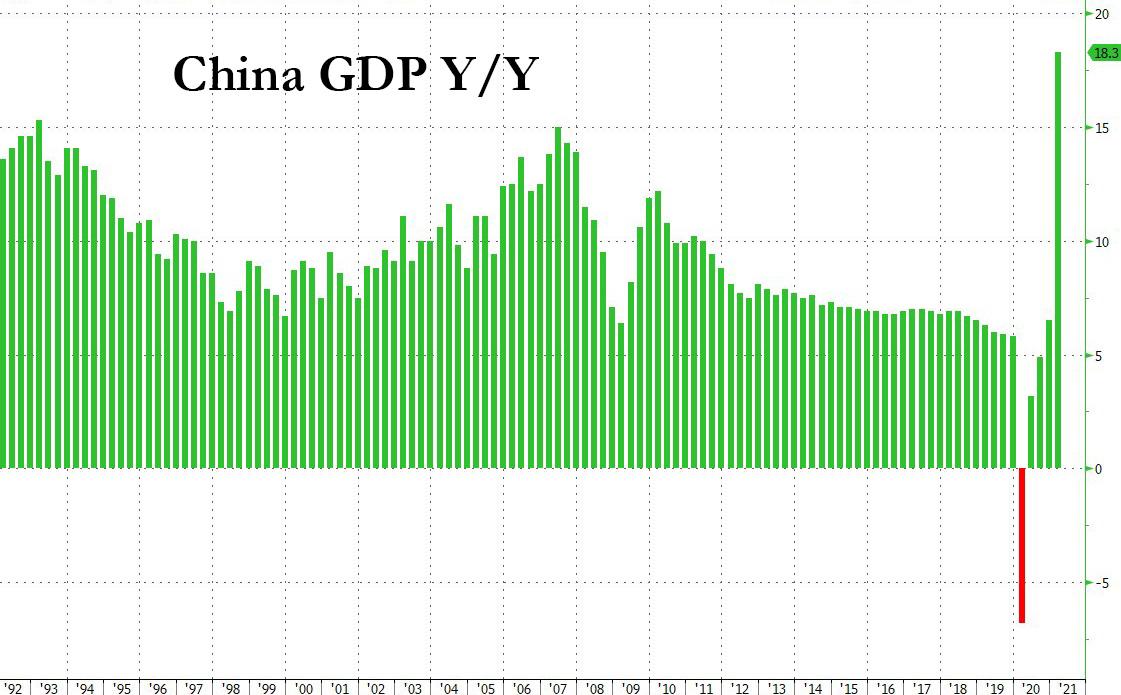
China’s economy grew by a record 18.3% in the first three months of 2021, its fastest annual growth rate in history reflecting the weak comparison to the lockdown period in early 2020. However, in keeping with the recent theme of China’s slowing credit impulse, the GDP print wasn’t nearly enough and disappointed markets which were expecting an 18.5% number.

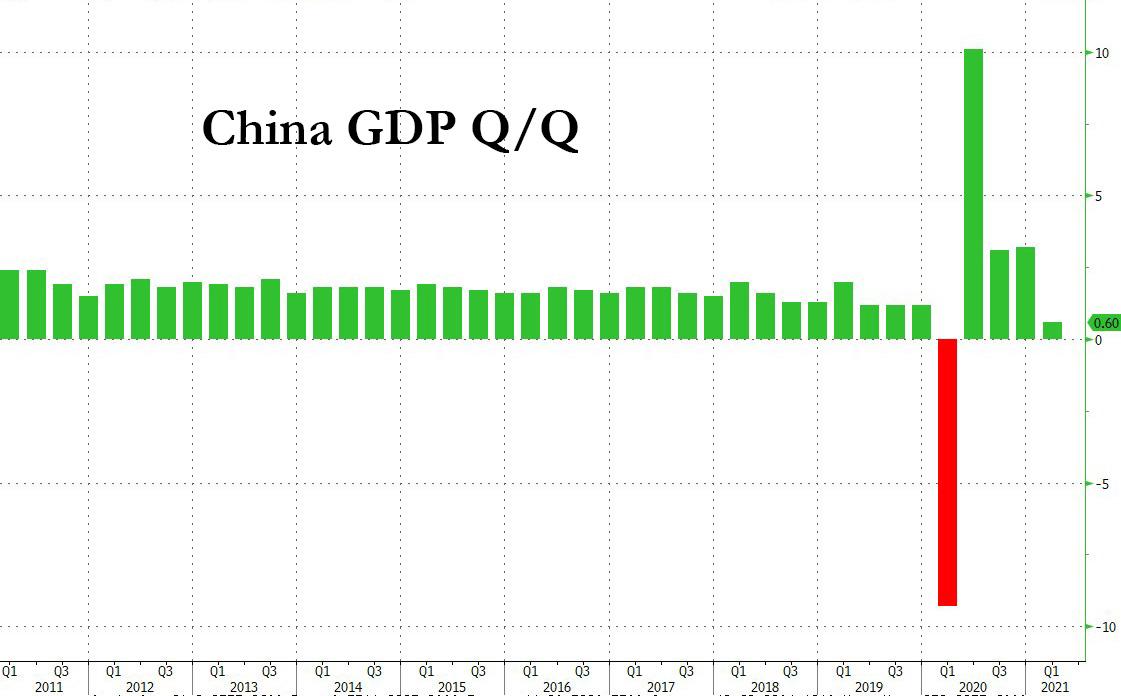
The Chinese slowdown was even more visible in the quarter-on-quarter growth which slowed to just 0.6% from 2.6% in the previous three months – the second lowest quarterly growth rate since the financial crisis with the sole exception of the covid crash quarter a year ago, while the picture in the monthly data dump was mixed at best.

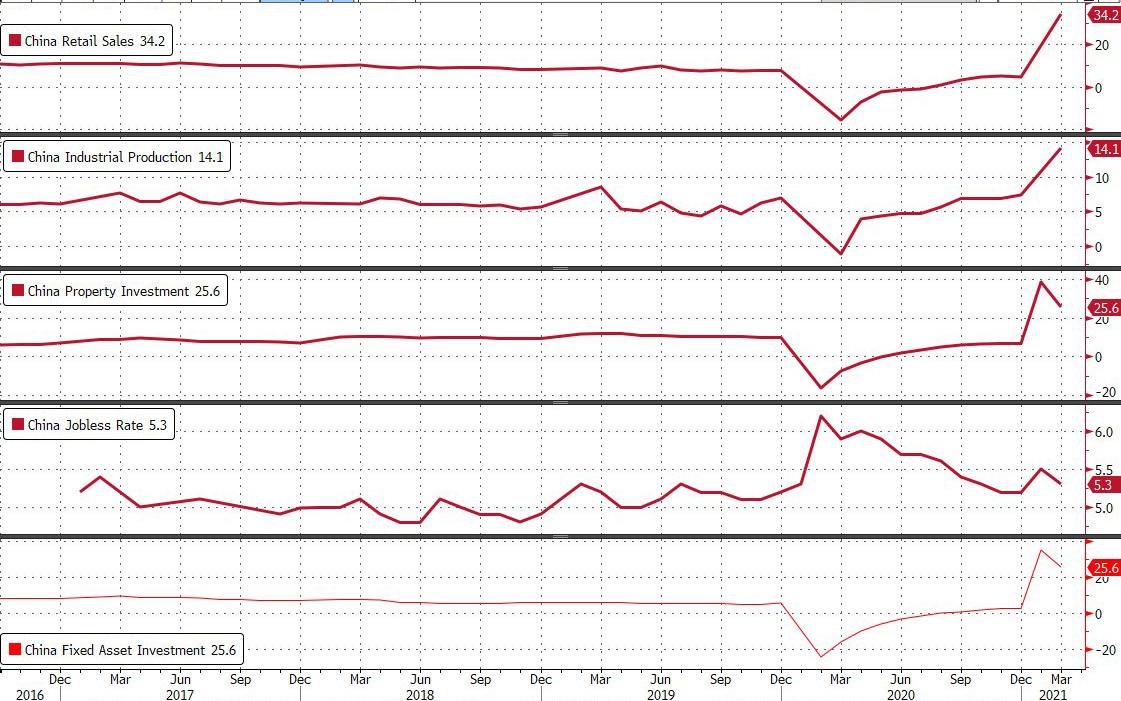
China’s expansion was supported by household consumption, which had previously lagged behind the wider recovery but is expected to play a greater role in driving growth this year. Retail sales beat expectations to add 34.2% in March, rebounding from a period of lockdowns a year earlier. Industrial production also boosted growth, with the metric adding 24.5% in the first quarter and alongside booming exports has helped prop up growth over the past year, it did, however, miss expectations in March and only rose 14.1% year-on-year.

Other data was also mostly disappointing with both industrial production and fixed asset investment missing, while only retail sales beat:

  • March industrial production came in at +14.1% yoy, well below the 18.0% consensus forecast. Based on IP by major product data, cement production decelerated to 33.1% yoy in March from 61.1% yoy growth in January-February; steel product production grew 20.9% yoy in March vs. 23.6% yoy in January-February; electricity production decelerated to 17.4% yoy, from 19.5% in January-February.
  • Fixed investment growth also also slowed in March. FAI growth was +25.6%Y/Y in Q1 2021, below market expectations of 26.0% On single month basis FAI growth was +19.4% yoy in March (vs. +35.0% yoy in January-February).
  • Retail sales were the only bright spot and beat expectations.  March retail sales growth was 34.2% Y/Y vs. +33.8% in January-February and above the 28.0% consensus. Still, automobile sales growth slowed to +48.7% yoy (vs. +77.6% yoy in January-February).
  • The nationwide unemployment rate dropped to 5.3% in March, vs. 5.4% in January-February; and was at 5.3% for the 31 major cities in March, vs. 5.5% in January-February.
  • China Jan.-March Property Development investment rose 25.6% Y/y
    • Jan.-March property sales value rises 88.5% y/y to 3.84t yuan
    • Jan.-March home sales value rises 95.5% y/y to 3.51t yuan
    • Jan.-March property sales area rises 63.8% y/y to 360m sqm
    • Jan.-March home sales area rises 68.1% y/y to 323m sqm

The Chinese recovery from the pandemic also helped it dominate global trade, with exports rising every month since June last year. In March, exports added 30% in dollar terms compared with the same month a year earlier.

In light of China’s recent aggressive deleveraging which has pushed China’s CSI300 just shy of dipping below the 200DMA, focus has shifted to the prospect of rate rises, with signs of overheating across parts of the economy despite persistently low consumer price inflation. The government is trying to curb leverage across its property sector, as well as rein in record rates of steel production following a construction boom.

Several high-ranking officials have warned about the risks of high asset prices in recent months. Guo Shuqing, China’s top banking regulator, said in March that the country was exposed to “bubbles” in international markets and its own real estate sector.

And sure enough, with China’s CSI300 down 15% since hitting a record high in February, the overall economic direction points to an ongoing, broadening slowdown in China’s economy whose peak hit some time ago. That probably explains, why National Bureau of Statistics spokeswoman Liu Aihua talked up the recovery, especially among consumers, though she also flagged sectors such as services industries, smaller business and young workers who all need ongoing support.

“Generally speaking, the national economy in the first quarter presented continued momentum of stable recovery,” China’s National Bureau of Statistics said in a statement.  “However, we must be aware that the Covid-19 epidemic is still spreading globally and the international landscape is complicated with high uncertainties and instabilities.”

Markets were choppy on the data release with the CSI 300 Index falling as much as 0.6%, and briefly sliding below the 200DMA key support level, while the Shanghai Composite reversed its early losses to gain 0.2%. The benchmark 10-year sovereign bond yield fell 1 basis point to 3.166%; the onshore yuan lost 0.17% against the dollar.

Asian stocks traded slightly lower as China’s record economic growth failed to inspire new investment in the region’s equity markets. Across the Pacific, US 10Y yields were unchanged as were US equity futures.

Tyler Durden
Fri, 04/16/2021 – 00:11

via ZeroHedge News https://ift.tt/3dlaqXS Tyler Durden

Rule By Fiat: When The Government Does Whatever It Wants

Rule By Fiat: When The Government Does Whatever It Wants

Authored by John W. Whitehead & Nisha Whitehead via The Rutherford Institute,

“We are fast approaching the stage of the ultimate inversion: the stage where the government is free to do anything it pleases, while the citizens may act only by permission; which is the stage of the darkest periods of human history, the stage of rule by brute force.”

– Ayn Rand

Rule by brute force.

That’s about as good a description as you’ll find for the sorry state of our nation.

SWAT teams crashing through doors. Militarized police shooting unarmed citizens. Traffic cops tasering old men and pregnant women for not complying fast enough with an order. Resource officers shackling children for acting like children. Homeowners finding their homes under siege by police out to confiscate lawfully-owned guns. Drivers having their cash seized under the pretext that they might have done something wrong.

The list of abuses being perpetrated against the American people by their government is growing rapidly.

We are approaching critical mass.

The groundwork has been laid for a new kind of government where it won’t matter if you’re innocent or guilty, whether you’re a threat to the nation, or even if you’re a citizen. What will matter is what the government—or whoever happens to be calling the shots at the time—thinks. And if the powers-that-be think you’re a threat to the nation and should be locked up, then you’ll be locked up with no access to the protections our Constitution provides.

In effect, you will disappear.

Our freedoms are already being made to disappear.

We have seen this come to pass under past presidents with their use of executive orders, decrees, memorandums, proclamations, national security directives and legislative signing statements.

President Biden’s long list of executive orders, executive actions, proclamations and directives is just more of the same: rule by fiat.

Now the Biden Administration is setting its sights on gun control.

Mark my words: gun control legislation, especially in the form of red flag gun laws, which allow the police to remove guns from people “suspected” of being threats, will become yet another means by which to subvert the Constitution and sabotage the rights of the people.

These laws, growing in popularity as a legislative means by which to seize guns from individuals viewed as a danger to themselves or others, are yet another Trojan Horse, a stealth maneuver by the police state to gain greater power over an unsuspecting and largely gullible populace.

Nineteen states and Washington DC have red flag laws on their books.

That number is growing.

As The Washington Post reports, these laws “allow a family member, roommate, beau, law enforcement officer or any type of medical professional to file a petition [with a court] asking that a person’s home be temporarily cleared of firearms. It doesn’t require a mental-health diagnosis or an arrest.

In the midst of what feels like an epidemic of mass shootings (the statistics suggest otherwise), these gun confiscation laws—extreme risk protection order (ERPO) laws—may appease the fears of those who believe that fewer guns in the hands of the general populace will make our society safer.

Of course, it doesn’t always work that way.

Anything—knives, vehicles, planes, pressure cookers—can become a weapon when wielded with deadly intentions.

With these red flag gun laws, the stated intention is to disarm individuals who are potential threats… to “stop dangerous people before they act.”

While in theory it appears perfectly reasonable to want to disarm individuals who are clearly suicidal and/or pose an “immediate danger” to themselves or others, where the problem arises is when you put the power to determine who is a potential danger in the hands of government agencies, the courts and the police.

We’ve been down this road before.

Remember, this is the same government that uses the words “anti-government,” “extremist” and “terrorist” interchangeably.

This is the same government whose agents are spinning a sticky spider-web of threat assessments, behavioral sensing warnings, flagged “words,” and “suspicious” activity reports using automated eyes and ears, social media, behavior sensing software, and citizen spies to identify potential threats.

This is the same government that keeps re-upping the National Defense Authorization Act (NDAA), which allows the military to detain American citizens with no access to friends, family or the courts if the government believes them to be a threat.

This is the same government that has a growing list—shared with fusion centers and law enforcement agencies—of ideologies, behaviors, affiliations and other characteristics that could flag someone as suspicious and result in their being labeled potential enemies of the state.

For instance, if you believe in and exercise your rights under the Constitution (namely, your right to speak freely, worship freely, associate with like-minded individuals who share your political views, criticize the government, own a weapon, demand a warrant before being questioned or searched, or any other activity viewed as potentially anti-government, racist, bigoted, anarchic or sovereign), you could be at the top of the government’s terrorism watch list.

Moreover, as a New York Times editorial warns, you may be an anti-government extremist (a.k.a. domestic terrorist) in the eyes of the police if you are afraid that the government is plotting to confiscate your firearms, if you believe the economy is about to collapse and the government will soon declare martial law, or if you display an unusual number of political and/or ideological bumper stickers on your car.

Let that sink in a moment.

Now consider the ramifications of giving police that kind of authority: to preemptively raid homes in order to neutralize a potential threat.

It’s a powder keg waiting for a lit match.

Under these red flag laws, what happened to Duncan Lemp—who was gunned down in his bedroom during an early morning, no-knock SWAT team raid on his family’s home—could very well happen to more people.

At 4:30 a.m. on March 12, 2020, in the midst of a COVID-19 pandemic that had most of the country under a partial lockdown and sheltering at home, a masked SWAT team—deployed to execute a “high risk” search warrant for unauthorized firearms—stormed the suburban house where 21-year-old Duncan, a software engineer and Second Amendment advocate, lived with his parents and 19-year-old brother.

The entire household, including Lemp and his girlfriend, was reportedly asleep when the SWAT team directed flash bang grenades and gunfire through Lemp’s bedroom window.

Lemp was killed and his girlfriend injured.

No one in the house that morning, including Lemp, had a criminal record.

No one in the house that morning, including Lemp, was considered an “imminent threat” to law enforcement or the public, at least not according to the search warrant.

So what was so urgent that militarized police felt compelled to employ battlefield tactics in the pre-dawn hours of a day when most people are asleep in bed, not to mention stuck at home as part of a nationwide lockdown?

According to police, they were tipped off that Lemp was in possession of “firearms.”

Thus, rather than approaching the house by the front door at a reasonable hour in order to investigate this complaint—which is what the Fourth Amendment requires—police instead strapped on their guns, loaded up their flash bang grenades and acted like battle-crazed warriors.

This is the blowback from all that military weaponry flowing to domestic police departments.

This is what happens when you use SWAT teams to carry out routine search warrants.

This is what happens when you adopt red flag gun laws, which Maryland did in 2018, painting anyone who might be in possession of a gun—legal or otherwise—as a threat that must be neutralized.

Therein lies the danger of these red flag laws, specifically, and pre-crime laws such as these generally where the burden of proof is reversed and you are guilty before you are given any chance to prove you are innocent.

Red flag gun laws merely push us that much closer towards a suspect society where everyone is potentially guilty of some crime or another and must be preemptively rendered harmless.

Where many Americans go wrong is in naively assuming that you have to be doing something illegal or harmful in order to be flagged and targeted for some form of intervention or detention.

In fact, U.S. police agencies have been working to identify and manage potential extremist “threats,” violent or otherwise, before they can become actual threats for some time now.

All you need to do these days to end up on a government watch list or be subjected to heightened scrutiny is use certain trigger words (like cloud, pork and pirates), surf the internet, communicate using a cell phone, limp or stutterdrive a car, stay at a hotel, attend a political rally, express yourself on social mediaappear mentally ill, serve in the militarydisagree with a law enforcement officialcall in sick to work, purchase materials at a hardware store, take flying or boating lessons, appear suspicious, appear confused or nervous, fidget or whistle or smell bad, be seen in public waving a toy gun or anything remotely resembling a gun (such as a water nozzle or a remote control or a walking cane), stare at a police officer, question government authority, appear to be pro-gun or pro-freedom, or generally live in the United States.

Be warned: once you get on such a government watch list—whether it’s a terrorist watch list, a mental health watch list, a dissident watch list, or a red flag gun watch list—there’s no clear-cut way to get off, whether or not you should actually be on there.

You will be tracked wherever you go.

You will be flagged as a potential threat and dealt with accordingly.

This is pre-crime on an ideological scale and it’s been a long time coming.

The government has been building its pre-crime, surveillance network in concert with fusion centers (of which there are 78 nationwide, with partners in the private sector and globally), data collection agencies, behavioral scientists, corporations, social media, and community organizers and by relying on cutting-edge technology for surveillance, facial recognition, predictive policing, biometrics, and behavioral epigenetics (in which life experiences alter one’s genetic makeup).

To that noxious mix, add in a proposal introduced under the Trump Administration and being considered by Biden for a new government agency HARPA (a healthcare counterpart to the Pentagon’s research and development arm DARPA) that will take the lead in identifying and targeting “signs” of mental illness or violent inclinations among the populace by using artificial intelligence to collect data from Apple Watches, Fitbits, Amazon Echo and Google Home.

It’s the American police state’s take on the dystopian terrors foreshadowed by George Orwell, Aldous Huxley and Phillip K. Dick all rolled up into one oppressive pre-crime and pre-thought crime package.

If you’re not scared yet, you should be.

Connect the dots.

Start with the powers amassed by the government under the USA Patriot Act, note the government’s ever-broadening definition of what it considers to be an “extremist,” then add in the government’s detention powers under NDAA, the National Security Agency’s far-reaching surveillance networks, and fusion centers that collect and share surveillance data between local, state and federal police agencies.

To that, add tens of thousands of armed, surveillance drones that will soon blanket American skies, facial recognition technology that will identify and track you wherever you go and whatever you do. And then to complete the picture, toss in the real-time crime centers being deployed in cities across the country, which will be attempting to “predict” crimes and identify criminals before they happen based on widespread surveillance, complex mathematical algorithms and prognostication programs.

Hopefully you’re starting to understand how easy we’ve made it for the government to identify, label, target, defuse and detain anyone it views as a potential threat for a variety of reasons that run the gamut from mental illness to having a military background to challenging its authority to just being on the government’s list of persona non grata. Finally, add in the local police agencies and SWAT teams that are being “gifted” military-grade weaponry and equipment designed for the battlefield and trained in the tactics of war.

It all adds up to a terrifying package of brute force coupled with invasive technology and totalitarian tactics.

This brings me back to those red flag gun laws.

In the short term, these gun confiscation laws may serve to temporarily delay or discourage those wishing to inflict violence on others, but it will not resolve whatever madness or hate or instability therein that causes someone to pull a trigger or launch a bomb or unleash violence on another.

Indeed, those same individuals sick enough to walk into an elementary school or a movie theater and open fire using a gun can and do wreak just as much havoc with homemade bombs made out of pressure cookers and a handful of knives.

Nor will these laws save us from government-instigated and directed violence at the hands of the militarized police state or the blowback from the war-drenched, violence-imbued, profit-driven military industrial complex, both of which remain largely overlooked and underestimated pieces of the discussion on gun violence in America.

As I make clear in my book Battlefield America: The War on the American People, in the long term, all these gun confiscation laws will do is ensure that when the police state finally cracks down, “we the people” are defenseless in the face of the government’s arsenal of weapons.

No matter how well-meaning the politicians make these encroachments on our rights appear, in the right (or wrong) hands, benevolent plans can easily be put to malevolent purposes. In this way, even the most well-intentioned government law or program can be—and has been—perverted, corrupted and used to advance illegitimate purposes once profit and power are added to the equation.

The war on terror, the war on drugs, the war on illegal immigration, asset forfeiture schemes, road safety schemes, school safety schemes, eminent domain: all of these programs started out as legitimate responses to pressing concerns and have since become weapons of compliance and control in the police state’s hands.

Red flag laws and gun control legislation are no less a threat to our freedoms.

Tyler Durden
Thu, 04/15/2021 – 23:50

via ZeroHedge News https://ift.tt/2ORXrUa Tyler Durden

Visualizing America’s Longest Foreign Wars

Visualizing America’s Longest Foreign Wars

President Biden has announced that 2,500 U.S. troops and another 7,000 from NATO will start returning home from Afghanistan in May, with the full withdrawal set to be completed in time for the 20th anniversary of 9/11. In a White House speech, he said:

“I am now the fourth American president to preside over an American troop presence in Afghanistan. Two Republicans. Two Democrats. I will not pass this responsibility on to a fifth.”

Statista’s Niall McCarthy details that over the course of nearly two decades, America’s longest war has consumed $2 trillion dollars, cost 110,000 Afghan lives and also resulted in the deaths of 3,500 coalition service members including around 2,400 Americans.

Biden’s announcement will prove pivotal for Afghanistan and it could accelerate the drive towards peace or plunge the country into further uncertainty and violence. When asked by a reporter about whether the decision was a difficult one, the president said it was not and that “to me, it was absolutely clear”. He continued by stating that “we went for two reasons: to get rid of bin Laden and to end the safe haven. I never thought we were there to somehow unify Afghanistan. It’s never been done.”

So how does the length of U.S. involvement in Afghanistan compare to other major foreign wars?

Infographic: America’s Longest Foreign Wars | Statista

You will find more infographics at Statista

Defining what exactly constitutes a military conflict is not as straightforward as it sounds and down through the years, U.S. participation in major wars, interventions, occupations and suppressions of insurgencies have tended to overlap. The Washington Post took those factors into account when it put an overview of U.S. foreign wars together in 2014.

It shows that Afghanistan is the longest war in American history by far, running for nearly twice as long as the previous longest conflict, Vietnam. It has also outlasted the Spanish-American War, World War I, World War II and the Korean War combined. The reality of the length of the war in Afghanistan becomes clear by the fact that many U.S. troops serving in the country were not even born when the conflict started back in October 2001.

Tyler Durden
Thu, 04/15/2021 – 23:30

via ZeroHedge News https://ift.tt/3ah7Q3f Tyler Durden