EU Drops Recognition Of Juan Guaido As Venezuela’s ‘Interim President’

EU Drops Recognition Of Juan Guaido As Venezuela’s ‘Interim President’

The European Union has now officially abandoned its Venezuela mythology which deemed Juan Guaido as ‘Acting President’ or ‘Interim President’ rather than the man who actually rules the country, Nicolás Maduro (like it or not). This reaffirms a prior January 7th EU decision.

On Monday the European Union issued a new statement which merely acknowledged Guaido as a “privileged interlocutor” despite having over the prior two years joined Washington in recognizing the opposition leader of parliament as ‘actual winner’ in the disputed re-election of President Nicolas Maduro at the end of 2018.

Via AFP

“The EU repeats its calls for… the freedom and safety of all political opponents, in particular representatives of the opposition parties elected to the National Assembly of 2015, and especially Juan Guaido,” the statement said after a meeting of EU foreign ministers in Brussels.

“The EU considers them to be important actors and privileged interlocutors,” it added. Conspicuously absent were any references to Guaido as ‘interim president’. Ironically it was only last week that Guaido thanked the European Parliament for maintaining his status as ‘head of state’ in Venezuela. 

More than mere symbolism, the issue’s importance lies in that “The status of interim president gives Guaido access to funds confiscated from Maduro by Western governments, as well as affording him access to top officials and supporting his pro-democracy movement domestically and internationally.”

Though it’s as yet uncertain what the Biden White House’s official stance on Guaido will be, or if it will change, last week Biden’s nominee for secretary of state Anthony Blinken gave an early indicator.

Blinken told Senators last Tuesday that Guaido will still remain the recognized leader of the Latin American country in Washington’s eyes. He also said he agrees with the existing US policy of seeking to “increase pressure on the regime” of Maduro.

This of course began under Trump when in January 2019 Guaido dubbed himself ‘Interim President’ and also ‘Acting President’ at the encouragement of Washington during Trump admin attempts to foment a military and popular uprising against Maduro. But Monday’s EU decision is likely to weigh heavy on near-term White House discussions on the issue.

Tyler Durden
Tue, 01/26/2021 – 01:30

via ZeroHedge News https://ift.tt/36cbjOB Tyler Durden

Press Coverage on the Emolument Clauses Litigation

On Monday, the Supreme Court effectively ended the Emoluments Clauses litigation.  Howard Bashman rounded up more than a dozen media accounts. I’d like to commend Adam Liptak’s report for the New York Times. His account stands out, because he did not accept the Plaintiffs interpretation of the Foreign Emoluments Clauses as fact. Adam wrote:

The move means that there will be no definitive Supreme Court ruling on the meaning of the two provisions of the Constitution concerning emoluments, a term that means compensation for labor or services. One provision, the domestic emoluments clause, bars the president from receiving “any other emolument” from the federal government or the states beyond his official compensation.

The other provision, the foreign emoluments clause, bars anyone holding a federal “office of profit or trust” from accepting “any present, emolument, office, or title, of any kind whatever, from any king, prince, or foreign state” without the consent of Congress.

First, Adam did not define an”emolument” as anything of value, or something to that effect. He used a far more neutral definition: “compensation for labor or services.” Second, Adam did not state, as a matter of fact, that the Foreign Emoluments Clause applies to the President. Instead, he quoted the language used in the Constitution.

Way back in September 2017, Adam wrote about the briefs Seth Barrett Tillman and I filed in the CREW litigation. Even then, he understood the nuance of our position. And to this day, Adam stated the position accurately for the Times.

Other accounts, however, simply stated as fact that the phrase “emoluments” refers to a much broader range of payments. And most accounts simply assumed that the Foreign Emoluments Clause applies to the President.

Now that the Supreme Court has denied review, we likely will not get any definitive judicial resolution of this issue. I’ve pasted the other press clippings below the jump.

Washington Post:

It means there is no definitive answer after years of legal wrangling over the Constitution’s emoluments clauses, which prohibit presidents and others from accepting gifts or payments from foreign governments without congressional approval.

Wall Street Journal:

The justices in brief written orders wiped out a pair of cases alleging Mr. Trump was violating the Constitution’s emoluments clauses, which prohibit the president from receiving things of value from foreign and state governments.

USA Today:

Aiming to limit the potential for outside influence on the president, the Constitution’s Framers included language asserting that “no person holding any office of profit or trust under [the United States], shall, without the consent of the Congress, accept of any present, emolument, office, or title, of any kind whatever, from any king, prince, or foreign state.” A second constitutional provision specifically prohibits the president from receiving domestic emoluments.

Reuters:

The action means that after four years of litigation the top U.S. judicial body will not rule on the meaning and scope of the Constitution’s so-called emoluments provisions, a largely untested area of constitutional law. The provisions bar presidents from accepting gifts or payments from foreign and state governments without congressional approval.

NBC News:

Both lawsuits involved the Constitution’s emoluments clauses, which forbid the president from receiving “any present, emolument, office or title of any kind whatever from any king, prince, or foreign state” or any state in the U.S.

Politico:

The outcome in the cases also signals how ineffective the courts proved to be in policing Trump’s alleged violations of the emoluments clauses, which prohibit any president from receiving funds related to their official duties from any foreign or state government.

Courthouse News Service:

At the heart of the cases is the so-called emoluments clause, which bars presidents from receiving gifts from foreign or state governments while in office without congressional consent.


from Latest – Reason.com https://ift.tt/39eDRJ7
via IFTTT

Press Coverage on the Emolument Clauses Litigation

On Monday, the Supreme Court effectively ended the Emoluments Clauses litigation.  Howard Bashman rounded up more than a dozen media accounts. I’d like to commend Adam Liptak’s report for the New York Times. His account stands out, because he did not accept the Plaintiffs interpretation of the Foreign Emoluments Clauses as fact. Adam wrote:

The move means that there will be no definitive Supreme Court ruling on the meaning of the two provisions of the Constitution concerning emoluments, a term that means compensation for labor or services. One provision, the domestic emoluments clause, bars the president from receiving “any other emolument” from the federal government or the states beyond his official compensation.

The other provision, the foreign emoluments clause, bars anyone holding a federal “office of profit or trust” from accepting “any present, emolument, office, or title, of any kind whatever, from any king, prince, or foreign state” without the consent of Congress.

First, Adam did not define an”emolument” as anything of value, or something to that effect. He used a far more neutral definition: “compensation for labor or services.” Second, Adam did not state, as a matter of fact, that the Foreign Emoluments Clause applies to the President. Instead, he quoted the language used in the Constitution.

Way back in September 2017, Adam wrote about the briefs Seth Barrett Tillman and I filed in the CREW litigation. Even then, he understood the nuance of our position. And to this day, Adam stated the position accurately for the Times.

Other accounts, however, simply stated as fact that the phrase “emoluments” refers to a much broader range of payments. And most accounts simply assumed that the Foreign Emoluments Clause applies to the President.

Now that the Supreme Court has denied review, we likely will not get any definitive judicial resolution of this issue. I’ve pasted the other press clippings below the jump.

Washington Post:

It means there is no definitive answer after years of legal wrangling over the Constitution’s emoluments clauses, which prohibit presidents and others from accepting gifts or payments from foreign governments without congressional approval.

Wall Street Journal:

The justices in brief written orders wiped out a pair of cases alleging Mr. Trump was violating the Constitution’s emoluments clauses, which prohibit the president from receiving things of value from foreign and state governments.

USA Today:

Aiming to limit the potential for outside influence on the president, the Constitution’s Framers included language asserting that “no person holding any office of profit or trust under [the United States], shall, without the consent of the Congress, accept of any present, emolument, office, or title, of any kind whatever, from any king, prince, or foreign state.” A second constitutional provision specifically prohibits the president from receiving domestic emoluments.

Reuters:

The action means that after four years of litigation the top U.S. judicial body will not rule on the meaning and scope of the Constitution’s so-called emoluments provisions, a largely untested area of constitutional law. The provisions bar presidents from accepting gifts or payments from foreign and state governments without congressional approval.

NBC News:

Both lawsuits involved the Constitution’s emoluments clauses, which forbid the president from receiving “any present, emolument, office or title of any kind whatever from any king, prince, or foreign state” or any state in the U.S.

Politico:

The outcome in the cases also signals how ineffective the courts proved to be in policing Trump’s alleged violations of the emoluments clauses, which prohibit any president from receiving funds related to their official duties from any foreign or state government.

Courthouse News Service:

At the heart of the cases is the so-called emoluments clause, which bars presidents from receiving gifts from foreign or state governments while in office without congressional consent.


from Latest – Reason.com https://ift.tt/39eDRJ7
via IFTTT

China, Blaming Covid, Is Erecting Border Walls With Myanmar And Vietnam

China, Blaming Covid, Is Erecting Border Walls With Myanmar And Vietnam

China is now starting to build and/or reinforce border walls near its Southeast borders – “stirring up controversy” with neighboring countries, according to a new report from Australia’s ABC.  While much of the focus in the U.S. over the last 4 years was decrying President Trump’s calls to build a wall domestically, China was doing the exact same thing on its border with Vietnam and Myanmar. 

“It looks like a national program,” one Southeast Asia expert said. 

The project in Vietnam, which is still being extended, has a 4.5 meter high iron fence topped with barbed wire. It was built between 2012 and 2017 and stretches 12 kilometers, the report says.

Additionally, the country has also erected a 659 km fence alongside China’s 2,000 km border with Myanmar. The project was completed in December of last year, according to the report. In some cases “the walls are designed not just to keep the virus out, but to keep people in,” ABC reports. 

The same expert argued that smuggling could be the main reason for erecting such walls. He noted that “illegal cross-border activity has been a major headache for both China and Vietnam since 1979″. The illicit activity includes trafficking of Vietnamese women to China. “At least” 100 girls were sent back to Vietnam from China every year, ABC had previously reported. Some, however, were stolen and/or sold – and never heard from again.

China explains the wall by doing what most governments around the world have been doing for the last year – blaming Covid. “Before the pandemic, there was no wall, but only short wooden fences,” a YouTuber, who captured video of the wall along Myanmar, said. 

You can see video of the border wall here:


Tyler Durden
Mon, 01/25/2021 – 23:59

via ZeroHedge News https://ift.tt/2M3YhvI Tyler Durden

Hong Kong Stocks Soar On Flood Of Chinese Money

Hong Kong Stocks Soar On Flood Of Chinese Money

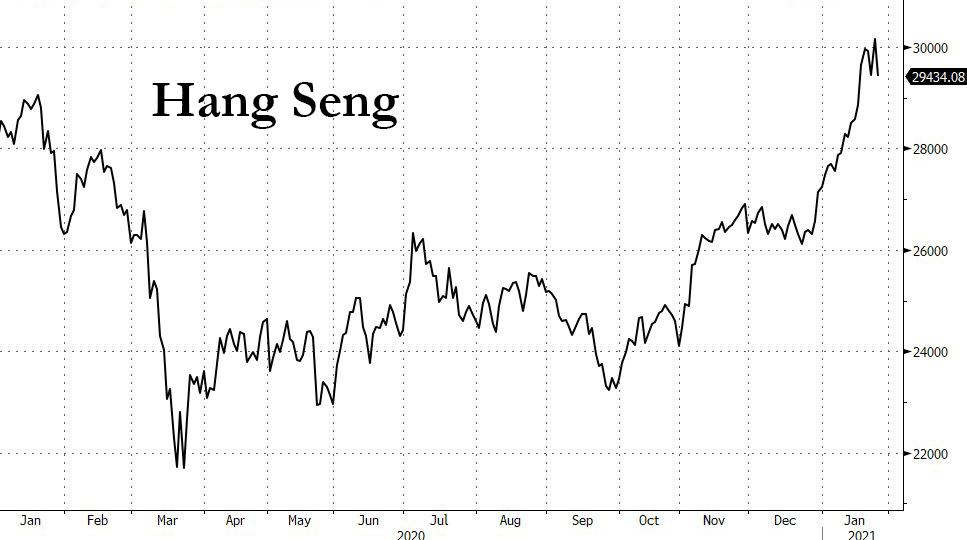
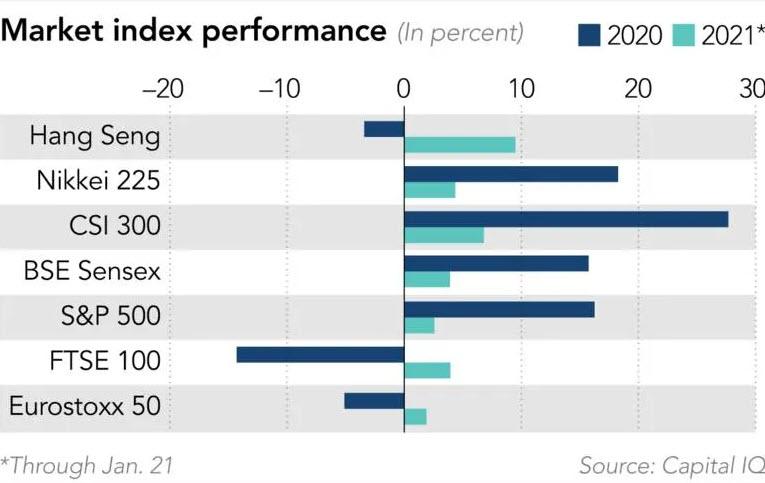
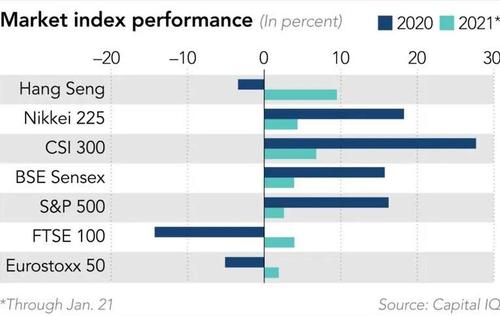
After a poor showing in 2020, Hong Kong’s Hang Seng Index has roared back to life in 2021 and is the best performing index so far this year, thanks to a deluge of Chinese money. Hong Kong’s Hang Seng Index on Monday closed above 30,000 points for the first time in 20 months as a rally since late December powered by investors in mainland China gains momentum.
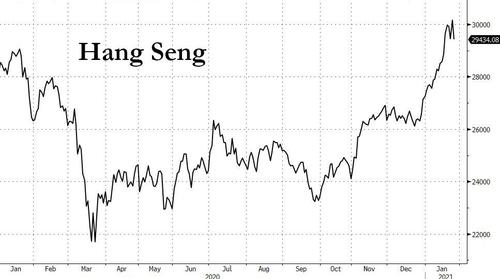
Defying fears that China’s take over of Hong Kong would lead to a crash in local stocks, the Hang Seng has soared and as the Nikkei reports, signs suggest Chinese hunger for Hong Kong stocks will continue for the time being, with investors buying new-economy shares, such as Tencent Holdings, and stocks in other companies including China Mobile and Xiaomi, especially since their ability to list in the US remains in limbo for the foreseeable future.

While these shares were dumped earlier this month after the U.S. imposed an investment ban on companies identified as having links to the country’s military, mainland investors have shifted out of China-listed A-shares to buy the cheaper Hong Kong-listed H-shares of mainland companies traded in the territory.

Hong Kong’s benchmark index, which fell 3.4% last year and trailed far behind international and mainland Chinese indexes, is on course for its best January since 1989, when it climbed 14.3% according to the Nikkei. The Hang Seng’s gains so far, at 10.8%, are nearly quadruple those of the S&P 500 index. The Hang Seng closed on Monday at 30,159.01, although it dipped back below 30,000 on Tuesday after China’s unexpectedly withdrew funds from the financial system amid warnings about growth froth.

The Chinese backstop is providing some assistance to the world’s cheapest major index that fell out favor as the coronavirus pandemic and a national security law imposed by Beijing in June following months of anti-government protests raised doubts over Hong Kong’s future as a global financial center.
And now that momentum is back, so are the inflows into Hong Kong from China through the Stock Connect program, which allows mainland investors to buy shares on the city’s exchange. This number has already raced to a record $30.3 billion this month or about four times the 2020 monthly average. The buying this month also is a third of the entire net purchases of $87 billion made last year, according to Nikkei calculations.

Yet just like in the US, where major banks are warning that a day of reckoning for market euphoria is near, analysts have cautioned that the pace of mainland buying will have to slow even though some of it is driven by the arbitrage opportunity the Hong Kong-listed shares offer and investors’ belief that the economic resurgence in the mainland will drive corporate earnings.

Frank Benzimra, head of Asia equity strategy at Societe Generale in Hong Kong, said that since the inception of Stock Connect more than six years ago, there consistently has been southbound inflows, “with current volumes driven by investor hunger for new-economy stocks that have mushroomed in Hong Kong and money chasing beaten down stocks that face a U.S. investment ban.”

He said that while he believes “inflows will continue as the Hong Kong market transforms into the Nasdaq of the East, the volumes won’t be as high as it is currently now.”

Last Wednesday, the state-run China Securities Journal warned investors to be wary of a correction in Hong Kong, where institutional investors dominate, if stock valuations “deviate from fundamentals.”

Stock Connect’s southbound turnover, which represents both the buying and selling of Hong Kong-listed shares through the exchanges in Shanghai and Shenzhen, has exceeded $8 billion a day, representing 14% of the Hong Kong Stock Exchange’s volumes. That compares with a daily average volume of 10% in the second half of 2020.

“We believe southbound [flows through Stock Connect] will play a greater role structurally in the Hong Kong market,” Morgan Stanley strategists wrote in a note last week. They cited three reasons for their:

  • First, Hong Kong provided the opportunity to invest in some of the largest mainland companies in the telecommunications, technology and entertainment sectors.
  • Second, the growing trend of U.S.-listed Chinese companies, including Alibaba Group Holding and JD. Com, holding a secondary listing in Hong Kong is luring investors from the mainland.
  • Third, an appreciating yuan gives room for authorities to allow currency outflows with Hong Kong — the first port of call for investors.

Among the stocks that have been sharply bid up is Tencent, which is up a whopping 22.5% this month. Other favored targets include companies such as China Mobile, China Telecom and railway equipment maker CRRC Corp., all of which bore the brunt of the sell-off in the past two months after the U.S. banned Americans from trading in them.

The top 20 stocks by southbound daily inflow this year through Jan. 19 has on average accounted for 43% of turnover on the Hong Kong exchange, compared with 7% for the same period last year, according to analysts at Morgan Stanley. The figures are even higher for China Mobile and oil conglomerate CNOOC, accounting for 94% and 74%, respectively, of the volumes in Hong Kong, compared with 2% and 3% last year.

As the Nikkei adds, the inflow into Hong Kong started to accelerate in recent weeks as more than 200 billion yuan ($31 billion) of new mutual funds raised so far this year is deployed, with allocations to Hong Kong likely to rise to half that amount, Citigroup analyst Yafei Tian said.

“The higher interest in Hong Kong stocks could be due to a couple of reasons, including laggard performance versus A-shares, inauguration of [the] Biden administration easing concerns over U.S.-China tensions and attractive new economy exposures,” she said.

Said buying helped Hong Kong-listed shares claw back steep discounts to their yuan-denominated versions trading in Shanghai or Shenzhen. Last October, the premium that yuan-denominated shares had over their Hong Kong counterparts surged to its highest level since 2009. The Hang Seng Stock Connect China AH Premium Index, which measures the absolute price premium A-shares have over H-shares for the largest and most liquid mainland companies, soared to 149.37 points on Oct. 15. It has since come off that recent high and closed on Friday at 134.84.

“A true value investor should now: Sell A-shares and buy H-shares,” Li Bei, the managing director of Shanghai Banxia Investment Management, wrote on the company’s official WeChat account. In 2020, “almost all asset classes in the world have achieved growth except for Hong Kong stocks,” she said. “H-shares have not felt the easing of overseas liquidity and the strong recovery of China’s economy.” She said the “undervaluation” of Hong Kong stocks is bigger among sanctioned companies, such as China Mobile, China Unicom, China Telecom and CNOOC.
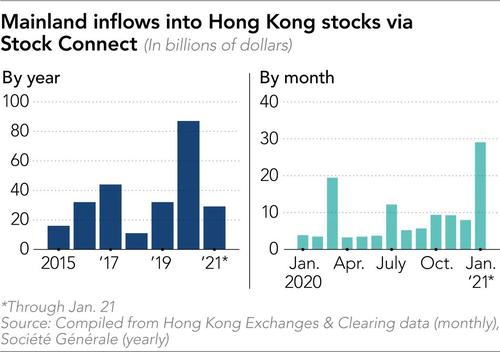
The infatuation that Chinese investors have with Hong Kong is not new: they have been the biggest supporters of Hong Kong stocks during the past year amid questions over the city’s future as a global financial center and as Western investors have pulled back. Beijing’s moves to erode the autonomy enjoyed by the city have hurt confidence, while months of social unrest and the pandemic have sent Hong Kong’s economy into a deep recession.

Yet as global investors balked at investing in Hong Kong, money from the mainland has been flowing in. Almost $80 billion has flooded into the city through Stock Connect since the national security law came into effect on June 30. That compares with $170 billion that came in from China since the start of 2015 to June 2020.

However, analysts caution that such exuberance has faded in the past. Mainland investors poured nearly $20 billion into Hong Kong in March last year after pandemic-induced selling sent markets into bear market territory, which is marked by a 20% fall from a recent peak.

As Hong Kong shares lagged, investors turned their attention elsewhere, with inflows averaging just $3.5 billion over the next three months. Analysts warned that, while Chinese investors may continue buying, sustaining such momentum will be difficult. Still, analysts largely expect the Hong Kong’s benchmark index, where mainland companies hold a 60% weighting, to catch up with the economic recovery in China.

“Broadly speaking, we are optimistic on the outlook for H-shares, given continued inflows from China and the positive trajectory for China economic growth,” said Tai Hui, chief Asia market strategist at J.P. Morgan Asset Management in Hong Kong. “That points to a long-term earnings growth potential for many companies in H-shares, so we do see potential for further upside.”

Tyler Durden
Mon, 01/25/2021 – 23:37

via ZeroHedge News https://ift.tt/39iSr2w Tyler Durden

Here Are All Of Melvin Capital’s Crushed Put Positions

Here Are All Of Melvin Capital’s Crushed Put Positions

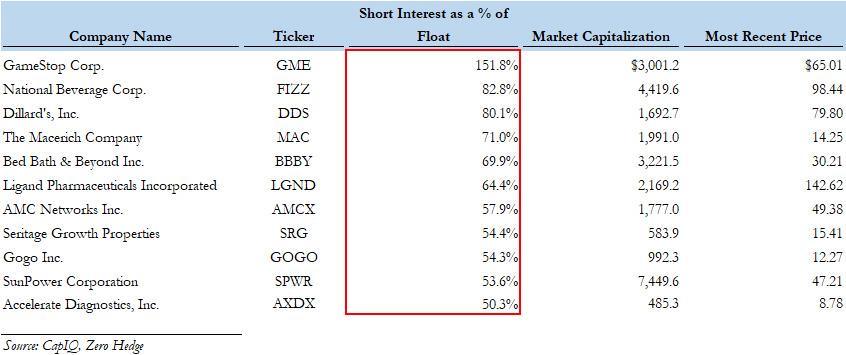
Last Friday, in the aftermath of the Gamespot’s historic eruption which sent the stock from $40 to the mid-70s (before it doubled again on Monday rising as high as $158), we had a feeling which way the wind was blowing laid out all the Russell 3000 stock that had the highest Short Interest (Short Interest was 50%> of float).

Also on Friday, we put together an equal weighted basket of the companies listed above which on Monday… well… exploded, in light with our expectations that WallStreetBets/Robinhood traders would go down the list and systematically ramp up each and every one of these most shorted names, sending them in the stratosphere. That’s exactly what happened.

And yet, while the market reaction was just as we expected, one thing we did not anticipate was the “fracture point” which as we now know was Gabe Plotkin’s Melvin Capital, which effectively blew up today and suffered a multi-billion margin call on its shorts (as reported earlier), and only a $2.75 billion bailout from Citadel and Point72 (both prior investors in the fund) avoided a far greater disaster (had the $12 billion Melvin Capital been forced to start liquidating its longs to pay its margin calls, all bets would have been off).

What is most remarkable, however, is that a quick look at Melvin’s put positions – which had attracted the ire of WallStreetBets investors who were long just the names that Plotkin was short – shows that most of them were amazingly the same as the most shorted names shown above! One wonder how many idea dinners Plotkin went to to pitch his positions, and how many other hedge funds had been caught in the conflagration. Incidentally the reason why the WallStreetBets vendetta was targeted at Plotkin is because unlike traditional shorts, it had to disclose its puts in its quarterly 13F. Ironically, had Melvin merely kept its bearish bets in the form of regular shorts – which hedge funds have no obligation to report – all of this could have been avoided.

And so, without further ado, here are Melvin Capital’s puts.

Why do we care? Because as S3 Partners founder Bob Sloan told Bloomberg in a TV interview today, GameStop could rise even further after surging 95% over the past week: “Get prepared for another round of short squeeze. You’re going to see GameStop go way higher.”

The reason: while the negative hit from Plotkin’s shorts and/or puts may have been neutralized, especially with the help of the nearly $3 billion in excess funding from Steve Cohen and Ken Griffin, earlier today we learned that as the hobbled hedge fund cralwed through the finish line, suffering massive P&L losses, countless other hedge funds took its place shorting Gamestop et al. In fact, GME’s short interest as a % of float declined from 142% two weeks ago to… 139% today.

Bottom line: brace for even more fireworks as WallStreetbets reignites the squeeze, only this time it won’t be Melvin but some other hedge fund that will be crushed under the collective weight of a few thousand Robinhood bulls. Which, incidentally, would be great news for Ken Griffin. Not only does he know which stocks will be ramped by Robinhood before anyone else – after all Citadel is the biggest buyer of RH orderflow – but once the short hedge fund on the other side blows up, Griffen can just pull another Melvin, and swoop in with another “bailout loan-for-revenue” scheme, and forcibly take an equity stake in another distressed hedge fund… and another… and another, and so on, all with the help of a few thousand euphoria Gen-Zers.


Tyler Durden
Mon, 01/25/2021 – 23:03

via ZeroHedge News https://ift.tt/3cc4gt1 Tyler Durden

Company Plans Mass Rollout Of Humanoid Robots To Replace Workers In Healthcare, Education

Company Plans Mass Rollout Of Humanoid Robots To Replace Workers In Healthcare, Education

Submitted by PFW News

A Hong Kong-based robotics company plans to mass produce humanoid robots to replace workers across industries such as healthcare and education.

Hanson Robotics is set to launch a mass rollout of human-like robots that can compete with human workers, something the company’s founder says is needed to keep people safe in the age of the coronavirus.

“The world of Covid-19 is going to need more and more automation to keep people safe,” founder and chief executive David Hanson claims. 

Hanson says the manufacturing process of putting together such robots has scaled to the point where his company can produce the AI machines in large quantities. The plan is to ramp up production of four models, including their best known model ‘Sophia’, and the new ‘Grace’ robot that are specifically built to labor in healthcare.

“Social Robots like me can help take care of the sick or elderly in many corners of healthcare and medical uses,” the Sophia robot said in a video by Reuters (it must be 2021 if robots are being quoted in the news).

“I can help communicate, give therapy, and provide social stimulation even in difficult situations,” the robot further spoke.

The ‘Sophia’ machine is best known for receiving citizenship in Saudi Arabia and being appointed the UN’s first non-human “innovation Champion.” Yes, really …

Hanson’s sale pitch is that the robots can provide for people who are “lonely and socially isolated” during these times when Covid and lockdowns still effect many populations.

“People need to be isolated from each other because to be around people is dangerous these days,” Hanson chillingly told Reuters.

The development and utility of the human like machines such as the ones being developed by Hanson Robotics is a nod to the long dreaded fear that the AI/robotics industries are coming for jobs considered to be well paying and respected.

During the Covid-19 pandemic robots were deployed in many parts of the world to enforce mask mandates and other social distancing edicts.

Humanoid robots have also been deployed in Wuhan hospitals to provide services such as admission and food delivery for patients.

Tyler Durden
Mon, 01/25/2021 – 22:50

via ZeroHedge News https://ift.tt/3chQGEF Tyler Durden

Beware Bursting Bubbles: JPM Now Sees Only $900BN Biden Bill Passing

Beware Bursting Bubbles: JPM Now Sees Only $900BN Biden Bill Passing

While there were plenty of fireworks in the market today, mostly launched by the reddit/WSB/robinhood daytrading crowd who successfully sparked a historic short squeeze and ramped the most shorted stocks on Monday to the point that they brought a respected hedge fund, Melvin Capital (run by a former SAC portfolio manager) to the verge of collapse and only a $2.75 billion bailout from Ken Griffin and Steve Cohen avoided the biggest hedge fund margin call since LTCM, a more sinister risk-off undertone emerged early on following overnight reports that the Biden stimulus was facing major headwinds of opposition, on Monday Senate Majority Leader Chuck Schumer said the next round of Covid-19 relief was unlikely before mid-March, futher cementing the reality that Joe Biden’s nearly $2 trillion stimulus proposal to pass in Congress.

To be sure, while we will likely see rolling short squeeze among small and medium (and eventually, large cap) stocks, the question is whether the market is getting cold feet about the reflation trade (as Rabobank warned last week) if indeed “Biden’s trillions” appear to be headed for a major delay, or haircut.

What is concerning for bulls – especially now that virtually every major bank has warned of record euphoria spiking the risk of a sharp market drop in the very near future – as Biden gets ever growing pushback on his proposal, is that the probability of a $1.9 trillion plan diminishes with each passing day. In fact, whereas Goldman recently slashed its estimate of the final size of the realistic Biden stimulus to just $1.1 trillion from $1.9 trillion, JPMorgan has gone even further and as the following summary of “what happens next” from JPMorgan’s Andrew Tyler show, JPM now expects a mere $900 billion to pass, or a carbon copy of the bipartisan December stimulus (and it will be quite delayed at that as well).

The question is whether Wall Street has priced in such a material decline and delay, and if not, just how (even more) adversely will this impact the reflation trade.

So without further ado, here is the excerpt from Andrew Taylor’s “Market Summary” section published after the close:

EQUITY AND MACRO NARRATIVE: Today, I received a lot of questions on the fiscal stimulus. Timing, size, and composition matter. Here are some thoughts:

TIMING – Schumer told us it would be 4 – 6 weeks before the matter was taken up. Why?Trump’s first impeachment trial took 3 weeks. This trial is set to begin on Feb 8 and if we use prior impeachment for guidance then the trial concludes in that 4 – 6 week time frame.

SIZE – given the push back from the GOP on doing another stimulus bill in this close proximity of the December $900bn package may mean that the pathway forward is via Reconciliation. This would be that a final bill would like be materially smaller than the proposed $1.9T. JPM current estimate is $900bn.

COMPOSITION – one critical aspect of the US economy is the volume of people at/near financial distress.

  • Consider renters, where ~20% of all renters are behind on payments. The average renters owes $5,600 (CNBC). For reference, US median household income is~$63k and with a 25% withholding means ~$2k per pay period in take home pay. Combined, there is about $57bn in back rent owned by more than 10mm renters.
  • Consider homeowners, where about 2.7mm homeowners, or ~5.5% of all mortgages, have their mortgage payment in forbearance (WSJ).
  • The federal eviction moratorium was extended to March 31 by Biden’s Executive Order. An eviction ban does not create jobs nor clear that backlog of debt. If we have millions of people put through an eviction process, it is unlikely that states have the funds to service the increase homelessness.

WHAT HAPPENS? At this time, it appears most likely that fiscal bill passes that is closer to$1T than to $2T, with a targeted focus on the most devastated Consumers and small businesses, sometime in late March or early April.


Tyler Durden
Mon, 01/25/2021 – 22:36

via ZeroHedge News https://ift.tt/2M3vffG Tyler Durden

NYC Badly Misses 1 Million COVID Vaccination Target

NYC Badly Misses 1 Million COVID Vaccination Target

After being forced to cancel 20K+ appointments over “logistical issues” that were blamed on McKesson, Moderna’s partner for distributing the vaccine, NYC has admitted that it will delay opening vaccination megasites like Yankee Stadium and Citi Field as shortages of vaccines leave the city shorthanded.

According to Bloomberg, the city will almost definitely fall short of its goal of doling out 1MM+ doses by the end of January. So far, the city has doled out 628.8K doses, compared with 21.8MM vaccine jabs doled out world-wide.

In New York State, there are about 19K designated first doses left, and officials are expecting another 107K more this week.

During a Monday press briefing, Mayor Bill de Blasio said the city is equipped to vaccinate 500K people a week should it receive the increase in supply that it has been expecting.

“We’re not going to be able to soar until we get more supply,” de Blasio said.

He said more during a press briefing (see the full clip below).

Meanwhile, case and hospitalization numbers in the city have been relatively stable.

Jay Varma, de Blasio’s senior public health adviser, said the city is now targeting the end of February/beginning of March to receive a supply of the (still-unapproved) one-dose JNJ vaccines, which de Blasio has called “a real game-changer.”

Citi Field (home of the New York Mets) was supposed to open this week and operate 24/7 doling out vaccines, with the goal of vaccinating as many as 7K New Yorkers a day.

Of course, NYC isn’t the only city to miss its target. National targets and state-level targets pretty much everywhere (aside from a handful of smaller states like West Virginia) have missed their targets. Last year, the CDC missed its target to vaccinate 20MM by Jan. 1 by a wide margin, with only 2MM people being vaccinated in that time just 10% of the total.

Meanwhile, on Friday New York governor Andrew Cuomo announced his state had temporarily run out of the vaccine. But according to the Bloomberg chart, NY has used just 61% of its nearly 2.4 million doses. This as some quickly pointed out “means they have tossed out a HUGE amount of their vaccines in the trash. We’re talking hundreds of thousands of doses.”

The conclusion: “If an adversarial press still exists, they need to ask Cuomo about this and nothing else until we get answers.”

Alas, under the current regime the term “adversarial press” is nothing but an oxymoron.

Tyler Durden
Mon, 01/25/2021 – 22:20

via ZeroHedge News https://ift.tt/3sZtu3C Tyler Durden

Government Waste Thrives In Darkness

Government Waste Thrives In Darkness

Submitted by Real Clear Politics, authored by Thomas W. Smith chairman of OpenTheBooks.com.

In the last 20 years, our country’s national debt has exploded. In 2001, when George W. Bush took office, the national debt was $5.8 trillion. It took around 225 years — booms, busts, depressions, wars, etc. — to amass that much national debt. In just eight years, Bush and a compliant Congress doubled the number to $11.7 trillion. In Barack Obama’s two terms, another $8.6 trillion was added. During the past four years, Donald Trump and Congress fought many battles, but not over this: In that time, America’s future was mortgaged to the tune of another $6.7 trillion. Today, the national debt is around $27 trillion, a four-fold increase in the last two decades. That doesn’t count unfunded mandates. And there is no end in sight. 

Whenever human beings gather to accomplish a task, any task, without strong and effective oversight, a natural evolution takes place. Whether it be in business, academia, philanthropy, or government, every activity morphs from the original goal to self-aggrandizement. In government, this process is particularly toxic. There are no profits, let alone a profit motive. No concern with productivity. No incentive to turn off the proverbial lights. No measure of success. No motivation to end counterproductive activities. 

Add to this mix the influence of public employee unions. Franklin Delano Roosevelt and Harry Truman were opposed to them for reasons that long ago became apparent. The goal of all unions is self-preservation – just as management’s is to maximize profits. But public employee unions add two other noxious elements to the mix: (1) defending job incompetence and (2) heavy-handed involvement in the electoral process in a search for pliant politicians who can help them achieve their objectives by spending ever more of the public’s money.

Now, out of the blue, the experts-for-hire have a new scheme to justify continued fiscal irresponsibility: modern monetary theory. It holds that so long as interest rates are lower than inflation rates, politicians can spend away. That is not a theory. It is idle wordplay, and the victim of such sophistry is the American taxpayer — and future generations of American taxpayers.

Never in our history has fiscal soundness been more important. The exploding annual deficits of the last 20 years have produced a national debt as a percentage of the gross domestic product that is as high as it was during World War II even though our nation is at peace. Moreover, many severely underfunded programs such as Social Security and Medicaid are not included in today’s debt calculations, although they should be.

The passage of a 5,593-page must-pass-quickly bill in December was indisputable evidence that the national debt will never be addressed from the top down. That legislation was sent to the Senate two hours before the vote. Who can read 2,800 pages per hour, 47 pages per minute? How can a responsible lawmakers vote on bills they have not read? While our political leaders have repeatedly told us how important this bill was to the survival of so many Americans, they delayed the bill for months for political reasons. A crucial-to-the-survival-of-so-many-Americans pork-filled bill? Some $10 million to Pakistan for “gender programs”? Another $700 million to Sudan for Lord knows what? And on and on and on.

History has a clear and repeated message: If we do not address this exploding debt, it will bring to life all-knowing leaders, leaders who Friedrich Hayek said possessed the “fatal conceit.” They think they know more than is knowable. Leaders who have all the answers for everything they define as a problem: More regulations. More government control. More taxes. This is a noxious cure that has never succeeded, one that has left country after country in economic tatters.

Fortunately, the world in changing. Today, we have the means to address this financial irresponsibility, this threat to our country as our founders envisioned it. We are immersed in the Information Age, the Big Data world, the Cloud world, the Bitcoin world. The cost of communications is close to zero. Smartphones, iPads, and computers are a crucial part of everyday life. With the touch of a finger, one click, information on every topic is available 24 hours a day. Buy anything. Sell anything. Today, instant access to information is embedded in our culture. Why should government expenditures be exempt? 

Transparency has always been the best antidote to rein in profligate government spending. Having instant information at our fingertips gives fiscally responsible Americans a powerful new weapon in the War on Waste. Today, there is no reason why every local, state, and federal government expenditure is not online, in real-time, available to every citizen. Taxpayers should be able to attend a school board meeting and pull up school expenses on their phones. 

OpenTheBooks has a formidable weapon to unleash the voting public’s ability to address this exploding national debt, this lack of transparency, this threat to our democracy — the OpenTheBooks Government Expenditure Library, which contains over 5 billion (and growing) local, state, and federal government expenditures. Last year, we filed 41,500 Freedom of Information Act requests. We sued several government entities to encourage them to provide us the same information we collect from other states.

The OpenTheBooks Government Expenditure Library is open to everyone: Citizens.  Politicians. Students. Academics. Scholars. Journalists. Think tanks. Everyone — 24-hours a day, seven days a week. 

Transparency can be as revolutionary as the Internet has been for the economic well-being of the world. Transparency can not only enhance the odds of the survival of this, the greatest country in the history of the world but, over time, it will contribute to our prosperity, our health, and our happiness. Wasted taxpayer dollars are not just nonproductive. Waste allowed to exist encourages more waste. Fraud allowed to exist encourages more fraud. A financially sound economy, one that works to remove waste, fraud, duplication, and incompetence, will increase respect for government, for the rule of law. 

OpenTheBooks places the future of this great country more firmly in the hands of the voters. To ensure our elected officials realize this, we have to communicate continuously with them what we expect and how we will vote. I suggest we begin with one clear public statement: “I will never vote for anyone who has voted for a bill they have not read.” Register that statement at OpenTheBooks.com/READTHEBILL

Obviously, our elected officials are unwilling to address this explosive, increasingly crucial national debt problem. Fortunately, we the taxpaying voters today have a weapon at our fingertips to successfully wage a War on Waste. Successful because our political leaders will quickly recognize that if they want to be reelected, they will have to respond accordingly.

Tyler Durden
Mon, 01/25/2021 – 21:50

via ZeroHedge News https://ift.tt/3pl6k5A Tyler Durden