“You’re No Better Than Socialist Dems” – Rand Paul Slams COVID-Bill-Backing Republicans

“You’re No Better Than Socialist Dems” – Rand Paul Slams COVID-Bill-Backing Republicans

Authored by Steve Watson via Summit News,

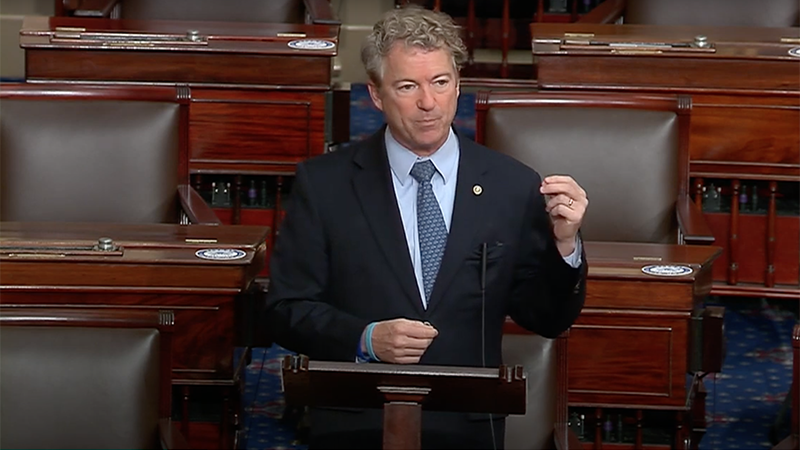
Senator Rand Paul slammed Republicans Monday for voting in favour of a huge $900 billion coronavirus relief bill, saying that they are no better than the Democrats they routinely label as ‘socialists’.

“To so-called conservatives who are quick to identify the socialism of Democrats: If you vote for this spending monstrosity, you are no better,” Paul urged in a speech on the Senate floor:

The Democrat controlled House, as well as the Senate passed the legislation, also tacking on a $1.4 trillion spending bill, prompting Paul to criticise the move as the government giving away “free money”.

“When you vote to pass out free money, you lose your soul and you abandon forever any semblance of moral or fiscal integrity,” Paul urged.

“If free money was the answer… if money really did grow on trees, why not give more free money?” Paul said.

“Why not give it out all the time? Why stop at $600 a person? Why not $1,000? Why not $2,000? Maybe these new Free-Money Republicans should join the Everybody-Gets-A-Guaranteed-Income Caucus? Why not $20,000 a year for everybody, why not $30,000? If we can print out money with impunity, why not do it?” the Senator proclaimed.

In addition to Paul, only five other Republicans voted against the legislation:

Senator Ted Cruz tweeted that there was no time to even read the bill, ironically agreeing with extreme leftist Democrat Alexandria Ocasio-Cortez:

Paul also noted that it would have been impossible for anyone to have read the bill:

Paul vowed to continue to ‘sound the alarm’ over excessive spending:

Tyler Durden
Tue, 12/22/2020 – 08:10

via ZeroHedge News https://ift.tt/2WAbQET Tyler Durden

Furtures Rebound As Stimulus Optimism Trumps Mutant Virus Gloom

Furtures Rebound As Stimulus Optimism Trumps Mutant Virus Gloom

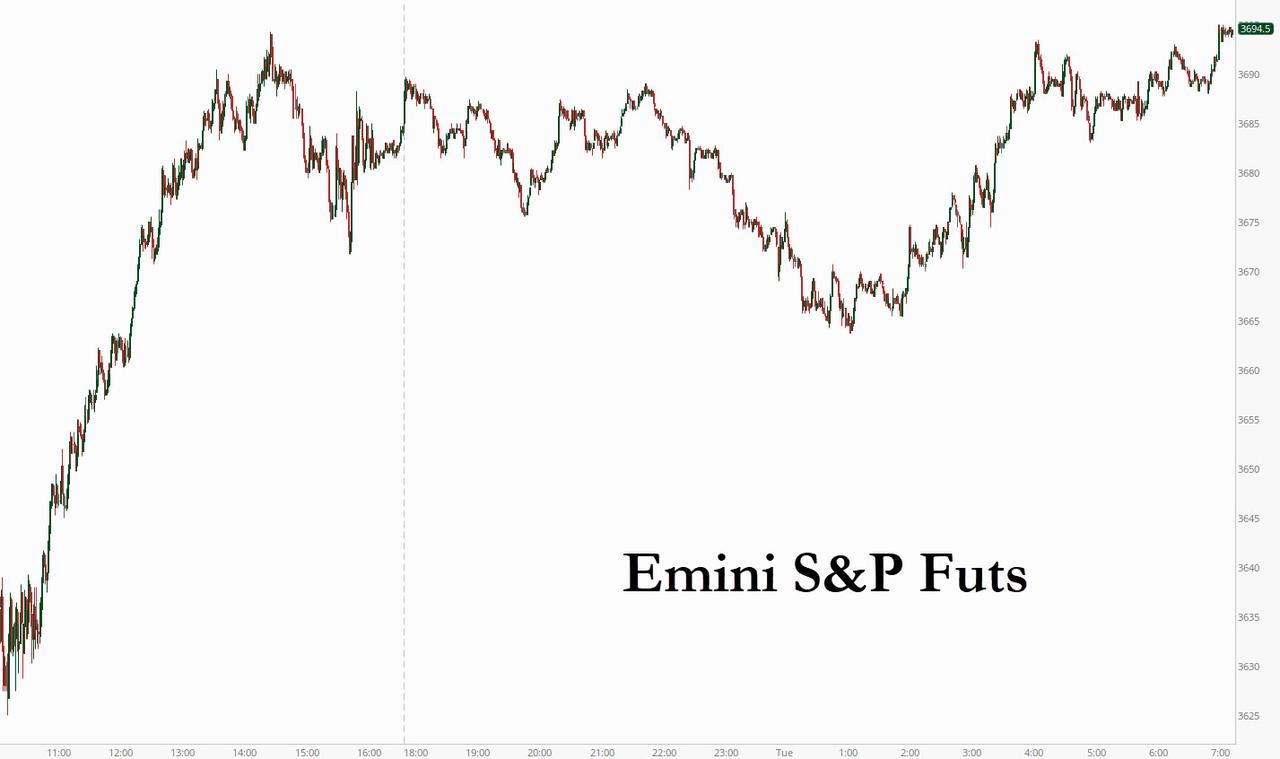
S&P futures erases their drop to trade 0.3% higher as of 730 a.m. ET, tracking gains for shares across European markets, which reversed an earlier Asian loss. Emini futures fell as much as 0.6% earlier despite the successful passage of the covid relief bill late on Monday in both the House and the Senate. The S&P dropped 0.4% on Monday as optimism over the $900BN Covid-19 relief bill was offset by the emergence of a mutant variant of the virus and a frenzy of lockdowns and travel curbs to contain it.

Nasdaq 100 futures outperformed the S&P 500 after U.S. lawmakers cleared a $2.3 trillion year-end spending bill and stimulus package yesterday, which now passes to President Donald Trump to sign. Treasuries and the dollar pared an earlier advance. The stimulus package, the first congressionally approved aid since April, comes as the pandemic accelerated in the United States, slowing the economic recovery.

Tuesday’s rebound follows a scare on Monday as countries across the world shut their borders to the UK because of fears over the new variant of the disease, snarling one of Europe’s most important trade routes just days before Britain is set to leave the European Union. A full lockdown came into force in London and southeast England. Europe and regions from Canada to Hong Kong have suspended travel links to the island nation, piling pressure onto the government as it tries to salvage a free-trade agreement with the European Union.

The discovery of the new strain, just months before vaccines are expected to be widely available, renewed fears about the economic impact of new lockdowns to curb the virus that has killed about 1.7 million people worldwide. In response, European shares slumped to their biggest one-day loss in nearly two months on Monday but the sentiment reversed on Tuesday after traders said Tuesday they assumed vaccines would still be effective against the new strain.

The new strain “is a bump in the road, but that road is still leading to a much stronger recovery in the second half of next year,” said Hugh Gimber of J.P. Morgan Asset Management. “Markets are a lot calmer today because of confidence that there is a big build up of pent-up demand and a return to much stronger levels of activity in the second half of next year.”

Not everyone is as cheerful, and as Bloomberg notes the global rally is looking increasingly fragile after equities touched a record high last week, as lockdowns and rising virus cases threaten to overshadow U.S. pandemic relief and the initial rollout of vaccines.

“The agreed fiscal relief package will undoubtedly help mitigate some of the negatives but unfortunately, it won’t be able to fully offset the effects of people staying at home as many businesses face tighter restrictions or are even forced to close,” according to James Knightley, chief international economist at ING Groep.

In Europe, stocks rebounded from their steepest slump in almost two months Monday, with all but one industry group in the green.  The broad Euro STOXX 600 gained 0.8%, on course for its biggest one-day jump in over five weeks. German and French indexes both added 1.3%. London’s blue chips turned positive, too, recovering early losses even as Britain adjusts to strict lockdowns imposed to curb the spread of the new strain of coronavirus. They were last up 0.3% British Airways owner IAG SA surged as much as 5.5% as travel shares bounced back. Crude oil edged lower for a second day.

Earlier, MSCI’s index of Asia Pacific shares ex Japan fell 0.8%, dragged down by Hong Kong’s Hang Seng Index and China’s benchmark CSI300 Index Asian stocks were headed for their first three-day slide since October. All industry groups were in the red, with materials and energy leading declines. Indonesia’s benchmark slumped 2.3%. President Joko Widodo announced a revamped cabinet as the government fights Southeast Asia’s worst coronavirus outbreak. Main indexes in China, South Korea and Japan also fell by more than 1.5%. Taiwan’s benchmark slid after a report of the island’s first locally-transmitted infection since April. India’s major gauges swung to gains after slumping about 3% on Monday. Thailand’s SET Index also rebounded from a 5.4% plunge the previous day, its worst since March. New Zealand’s key stock gauge was the strongest performer in the region, rising 1.9%, driven by a rebound in a2 Milk.

In FX, the stimulus news helped prop up the dollar index, which was on course for a third consecutive quarterly loss and had dropped some 12.5% from a March peak. The dollar advanced as thin liquidity and haven demand continued to dominate moves in FX and fixed-income markets against a backdrop of Brexit uncertainty.  The Bloomberg Dollar Spot Index rose a third day as the greenback advanced versus most Group-of-10 peers, though trading ranges were tighter than yesterday; the euro slipped, nearing $1.22

Sterling was down 0.2%, after tumbling as much as 2.5% versus the dollar on Monday to a 10-day low as currency traders weighed twin fears over COVID and Brexit. It slumped just around 5am ET when the EU rebuffed Prime Minister Boris Johnson’s latest concessions on fishing rights, keeping the pound lower. Analysts remain pessimistic on the pound’s prospects, even after it recovered on Monday some of its losses on media reports of progress in Brexit trade negotiations. MUFG said in a note to clients it expected London and Brussels would strike a last-minute deal, but added: “Even if a trade deal is reached, upside potential for the pound will now be dampened by recent negative COVID developments in the UK.”

In commodities, oil prices dropped on expectations of lower demand, with Brent 1.6% lower at $50.09; gold was roughly unchanged last trading at $1874.

Looking at today’s calendar, we get the second revision to Q3 GDP as well as the November existing home sales report. CarMax is reporting earnings

Market Snapshot

  • S&P 500 futures little changed at 3,688.25
  • MXAP down 1% to 193.71
  • MXAPJ down 0.8% to 640.28
  • Nikkei down 1% to 26,436.39
  • Topix down 1.6% to 1,761.12
  • Hang Seng Index down 0.7% to 26,119.25
  • Shanghai Composite down 1.9% to 3,356.78
  • Sensex up 0.9% to 45,946.95
  • Australia S&P/ASX 200 down 1.1% to 6,599.57
  • Kospi down 1.6% to 2,733.68
  • Stoxx Europe 600 up 1% to 390.48
  • German 10Y yield fell 0.9 bps to -0.589%
  • Euro down 0.2% to $1.2215
  • Italian 10Y yield rose 0.3 bps to 0.458%
  • Spanish 10Y yield fell 0.7 bps to 0.049%
  • Brent futures down 1.1% to $50.37/bbl
  • Gold spot down 0.3% to $1,871.26
  • U.S. Dollar Index up 0.2% to 90.26

Top Overnight News from Bloomberg

  • The European Union rejected Britain’s latest concessions on fishing, dealing a setback to efforts for a post-Brexit trade deal. On Monday, the U.K. made an offer that would see value of the fish the EU catches in British waters shrink by 30%, according to people familiar with the discussions. Last week, Britain insisted the EU accept a 60% cut, but the bloc has refused to accept a reduction of more than 25%
  • British Prime Minister Boris Johnson’s government is desperately trying to re- open trade routes to France after a day of cross-Channel political bartering failed to end the chaos at the U.K.’s busiest port
  • U.K. government borrowing climbed to a record 240.9 billion pounds ($323 billion) in the first eight months of the fiscal year, reflecting the damage inflicted on an economy now at risk of falling back into recession
  • Systems at the U.S. Treasury Department used by senior officials were accessed by hackers in a widespread cyberattack on federal agencies, according to Senator Ron Wyden
  • Pfizer Inc. partner BioNTech SE is pursuing all its options to make more Covid-19 vaccine doses than the 1.3 billion the companies have promised to produce next year, according to the German company’s chief executive officer

Quick look at global markets courtesy of Newsquawk

Asian equities saw a subdued session following a somewhat mixed Wall Street handover, after the S&P 500 and Nasdaq ended the session well off lows and the Dow eked mild gains. Meanwhile, Tesla shed 6.5% on its S&P debut, with some of the losses emanating from source reports that Apple is looking at electric vehicle production as early as 2024 which could also have its own novel “monocell” battery tech. US equity futures meanwhile drifted lower as markets awaited the State-side COVID relief and government funding package to make its way through Congress. Back to APAC, the overall sentiment was lacklustre, with losses in the ASX 200 (-1.1%) led by the basic resources and energy sectors, whilst upside for the Nikkei 225 (-0.6%) was hampered by recent JPY-dynamics. South Korea’s KOSPI (-0.5%) held onto losses as the rising COVID case count in the country surfaced reports of tourist location closures in a bid to stem the spread. Elsewhere, Hang Seng (-0.3%) and Shanghai Comp. (-0.2%) conformed to the losses across the region and as tensions with Washington brew in the background, with the Trump admin poised to publish a list of 103 Chinese and Russian companies with alleged military ties, whilst Secretary of State Pompeo announced additional restrictions on visas for officials of the Chinese Communist Party linked to human rights violations. Finally, 10yr JGB futures are flat as it tracks similar price action in UST futures.

Top Asian News

  • Israel Government Collapse Looms After Budget Delay Rejected
  • Japan Stocks Fall as Coronavirus Worries Grow at Home and Abroad
  • World’s Longest Virus-Free Streak Ends With New Taiwan Case
  • Hang Seng Proposes Sweeping Overhaul to Hong Kong Stock Index

European equities (Eurostoxx 50 +1.0%) have extended on opening gains in a retracement of some of yesterday’s heavy losses. From a European perspective, markets await updates from the EU negotiator on Brexit discussions after talks of a compromise on fisheries last night were rebuffed by the EU side and further sources on the matter this morning seemingly keeping the prospect of an agreement alive. Across the pond in the US, futures are relatively unchanged, with a slight positive bias, as the widely-expected news that Congress has approved the spending bill and COVID relief package has been unable to bolster sentiment. All major sectors in Europe trade higher with outperformance seen in banks, retail and tech names, whilst telecoms and basic resources post more modest gains. The underperformance of the latter has acted as a headwind for the FTSE 100 (+0.1%) which lags peers after yesterday’s relatively outperformance. Additionally, index-heavyweight AstraZeneca (-1.3%) are softer on the session after its 48-week Phase III trial of Tezepelumab did not meet its primary endpoint. Airline names such as Air France (+4.3%), easyJet (+3.7%) and IAG (+4.1%) have been granted some reprieve, albeit concerns continue to linger around the sector after Germany announced today that it has extended its ban for travellers from Britain until January 6th in an attempt to stop the spread of the new COVID-19 strain. Asides from the above, corporate updates in Europe have been on the light side as markets wind down for Christmas. Stateside, the WSJ reports that Facebook and Google have agreed to team up against potential antitrust action.

Top European News

  • U.K. Firms Told to Protect Data Flows Amid Brexit Worry
  • Europe’s Embattled Banks Look to Mergers as Way Out of Malaise
  • JPM Banker Who Foresaw Nordic M&A Surge Says More to Come
  • JPMorgan Expects Further Downside in Small and Mid-Cap Stocks

In FX, not much retail therapy for the Aussie, even though the lifting of restrictions and lockdown in the state of Victoria boosted consumption last month, as Aud/Usd topped out ahead of 0.7600 and is now hovering around 0.7550. However, favourable crosswinds are keeping Aud/Nzd underpinned around 1.0700 as the Kiwi fades from just above 0.7100 vs its US counterpart towards 0.7050.

  • USD – Antipodean peers aside, the Buck is flat to firmer across the G10 board after unwinding the bulk of its safe-haven gains over the course of Monday’s whipsaw session and the DXY finding underlying bids into 90.000, but trading conditions are getting increasingly thin and rangy beyond the few major exceptions like Sterling on Brexit and new virus strain dynamics. Nevertheless, the index is holding within a narrow 90.366-079 band for now and awaiting several US data points including final Q3 GDP, existing home sales and the more forward-looking Richmond Fed survey.
  • EUR/CAD/GBP/CHF/JPY – The Euro is attempting to consolidate on the 1.2200 handle vs the Greenback after yesterday’s swoon below the round number and through technical support, with decent option expiry interest adding more layers of support given 2.3 bn at the strike and a further 1.1 bn at 1.2150. Meanwhile, the Loonie is still keeping an eye on crude prices before more Canadian data, albeit rather stale today and tomorrow compared to Xmas Eve (October average earnings, monthly GDP and November building permits respectively). Elsewhere, the Pound has regained a bit more composure following its extremely volatile start to the week, with Cable back above 1.3400 and Eur/Gbp pivoting 0.9100 after UK PM Johnson’s fishing concession and talks between himself and French President Macron aimed at unblocking the cargo route between Britain and France. However, reports that the latest offer on fisheries will be rejected by the EU did spark another bout of selling in Sterling – albeit, this was somewhat short-lived given further sources from the EU on an acceptable quota reduction; in contrast to the Franc that is sitting tight just under 0.8850 and 1.0800 vs the Euro, in similar vein to the Yen keeping its head above 103.50, but likely to meet resistance at 103.00 in the form of 1.2 bn expiries.
  • SCANDI/EM – The Sek is still testing 10.1000 against the Eur irrespective of mixed Swedish retail sales data and sentiment surveys, while the Nok lags near 10.6000 alongside softer oil after an in line Norwegian LFS jobless rate, but the Rub continues to underperform on geopolitical factors as Russia retaliates to EU sanctions and warns that those imposed by the US will harm already strained relations between the 2 nations.

In commodities, WTI and Brent are hampered this morning with concern remaining on the demand-side implications of enhanced lockdown restrictions and the halting of flights to/from the UK and South Africa. Currently, the benchmarks are exhibiting losses in excess of 1.0% but are around USD 1.00/bbl from their session lows seen around the entrance of European participants this morning. Fundamentally, news explicitly for the complex has been very sparse and nothing has occurred which significantly changes the narrative thus far. In the session ahead the weekly private inventories will be published as normal, unaffected by the holiday period, and for reference last week the report showed a build of 1.97M in comparison to the week’s EIA equivalent which printed a draw of 3.135M. Moving to metals, spot gold and silver are currently in proximity to the U/C mark, in contrast to the sessions fairly broad range of USD 20/oz for gold, but still retains a slight negative bias given the USD’s continued modest strength.

US Event Calendar

  • 8:30am: GDP Annualized QoQ, est. 33.1%, prior 33.1%
    • 8:30am: Personal Consumption, est. 40.6%, prior 40.6%
    • 8:30am: GDP Price Index, est. 3.6%, prior 3.6%
    • 8:30am: Core PCE QoQ, est. 3.5%, prior 3.5%
  • 10am: Conf. Board Consumer Confidence, est. 97, prior 96.1; Expectations, prior 89.5; Present Situation, prior 105.9
  • 10am: Existing Home Sales, est. 6.7m, prior 6.85m; MoM, est. -2.19%, prior 4.3%
  • 10am: Richmond Fed Manufact. Index, est. 10, prior 15

Tyler Durden
Tue, 12/22/2020 – 07:51

via ZeroHedge News https://ift.tt/3re9mKi Tyler Durden

Scientists, MPs Ask “Where Is Evidence Of 70% More Contagious Mutant COVID?”

Scientists, MPs Ask “Where Is Evidence Of 70% More Contagious Mutant COVID?”

Given the “plunge” in stocks (Nasdaq is down less than 1%) and headlines blaring of COVID “mutations”, @KizzyPhd decided to ‘clarify’ some science before all hell breaks loose (which judging by the London exodus, it already did) for no good reason. She begins…

@KizzyPhD offers some context:

You are going to read and hear about a million and one variant viruses, because viruses mutate by nature. It’s scary, I know. But, a couple of amino acids is not the same a whole whole new virus strain in the way that we’ve been taught to think about flu. 

What is happening, often times, is selective pressure. As the virus transmits it learns how to be better at transmitting. This is why you hear “circulating faster than last variant”… 

But, don’t get in a panic over it. There will take a large amount of genetic diversity to completely make the current vaccines useless… And, here is why: 

Unlike monoclonal antibody therapies, vaccines (especially those using the whole spike protein) make polyclonal antibody responses. This means that the antibodies your vaccinated body will make will be able to bind the coronavirus spike in multiple places… not just one. 

Remember in April when media had y’all scared over a mutation…

Then here came the D614G mutation that had reviewers on our neck… and then boom… in the mouse paper we added results showing “mRNA-1273 induces potent neutralizing antibody responses to both wild-type (D614) and D614G mutant SARS-CoV-2” nature.com/articles/s4158…

In all, please don’t be alarmed any more than you have been through this pandemic. The precautionary measures (ie. no travel) in the UK are in line with sensible measures following a regional virus spike. 

In fact, the virus is always mutating

All of which is background to what we are seeing on the ground in Europe. As Summit News’ Steve Watson details, as London and the entire South East of the UK was plunged into a fresh lockdown over the weekend, scores of countries have banned all travel to and from the UK, but scientists there are demanding to see any evidence that there is a 70% more contagious mutant strain of COVID, having not been shown anything by the government.

The Daily Mail reports that Carl Heneghan, Professor of Evidence Based Medicine at Oxford University’s Nuffield Department of Primary Care, has expressed scepticism over the 70 per cent figure. 

“I’ve been doing this job for 25 years and I can tell you can’t establish a quantifiable number in such a short time frame,” Heneghan said.

“Every expert is saying it’s too early to draw such an inference,” the professor added.

“I would want to have very clear evidence rather than ‘we think it’s more transmissible’ so we can see if it is or not,” Heneghan continued.

“It has massive implications, it’s causing fear and panic, but we should not be in this situation when the Government is putting out data that is unquantifiable,” the professor further urged.

“They are fitting the data to the evidence. They see cases rising and they are looking for evidence to explain it,” Heneghan declared.

The ‘mutant strain’ has been circulating since September, according to the government, with Prime Minister Boris Johnson using it to justify literally cancelling Christmas.

However, Professor Heneghan emphasised that if this strain really is that much more contagious “we should be locking down the whole country”.

The data the government has on the ‘new strain’ off COVID comes from analysis by advisory body The New and Emerging Respiratory Virus Threats Advisory Group (Nervtag).

No one has seen the data, with the Prime Minster noting it is “early data, “subject to review” but “It’s the best we have at the moment.”

Announcing the previously non-existent ‘Tier four’ restriction level, Johnson added it was happening because of a “change in the science”:

Some conservative MPs, who were already rebelling against the tier 3 lockdown, have called for all the scientific evidence the government has to be made public.

The government was accused of being ‘bounced by the science’, with former Tory leader Iain Duncan Smith noting that Chief Medical Officer Professor Chris Whitty and Chief Scientific Adviser Sir Patrick Vallance are ‘stepping back into the shadows when it suits them’.

“‘Why did they not alert ministers to the dangers earlier? Especially when, as we now know, scientists learnt about this mutation back in September,” Duncan-Smith asked.

Former minister Sir Desmond Swayne said “it does have all the characteristics of the Government being bounced by the science, as it was right at the beginning of the arrangements when we first went into lockdown last March.”

“The arrangements for Christmas were explicitly voted on by Parliament. If they’re to be changed then in my view, Parliament should vote again,” Swayne added.

“Parliament voted explicitly for a certain set of arrangements, it seems to be perfectly proper therefore that Parliament should be consulted when those are changed, irrespective of the Government acting in an emergency, nevertheless it’s perfectly proper to recall Parliament at the beginning of this week to at least ratify those changes,” the MP continued.

Swayne noted that MPs haven’t even been given any evidence to justify the heightened restrictions, and that a third of the country was effectively imprisoned via a press conference.

“Explain to us – we are after all a democracy, explain to the elected representatives the evidence that they have and why they’ve reached this decision,” Swayned emphasised.

The MP charged that the government purposefully waited until parliament had started its break for Christmas before making the announcement, in order to avoid a rebellion.

“They’ve been looking at it since September and how convenient when Parliament went into recess on Thursday suddenly they were then able to produce this revelation,” Swayne noted.

“Let’s see the evidence then, let’s have Parliament back and show us and convince us, come clean,” he urged, adding “I want Parliament to be recalled so we can scrutinise properly in a democracy decisions that are being made which affect our economy radically and our liberty.”

…Dark_Winter.exe?

Tyler Durden
Tue, 12/22/2020 – 04:10

via ZeroHedge News https://ift.tt/3h5d2cN Tyler Durden

US May Require British Passengers To Prove They Don’t Have COVID Before Boarding Flights

US May Require British Passengers To Prove They Don’t Have COVID Before Boarding Flights

By nighttime on the East Coast of the US, more than 30 countries and territories had barred Britons from traveling – by air, land or sea – through their borders. The NYT yesterday described the British Isles as being “virtually cut off” from surrounding Europe – and that phrasing isn’t an exaggeration or an accident.

Whether or not this mutation is even real – as Moncef Slaoui pointed out yesterday, there’s no “hard evidence” tying this whole theory together – is of secondary importance to the Europeans, who, with talks over a comprehensive UK-EU trade deal coming down to the wire, have just been handed a tremendous political opportunity: They’re giving the Brits a dry run of what departing the customs union and single market might look like.

In other words, if London and Brussels can’t strike a deal on the fish within the next few days, we get to do this all over again next month – empty supermarket shelves, trucks piled up at the border, the works. There’s no question: if the UK leaves the transition without a deal (it formally left the EU on Jan. 1, 2020) Brussels will seek to exact political retribution on Boris Johnson. Whether that dissuaded him from holding the line is another issue.

As the maneuvering continues, the US has been caught in the middle, and the Trump Administration is being forced to choose between backing a political ally, or imposing new travel restrictions on Brits. According to Reuters, which cited officials from the US (presumably the State Department) as well as top airline officials, the US is weighing a temporary requirement that all travelers from Britain possess a COVID test dated within 72 hours of departure.

The US government is considering requiring that all passengers traveling from the United Kingdom receive a negative COVID-19 test within 72 hours of departure as a condition of entry, airline and US officials briefed on the matter said Monday.

A White House coronavirus task force discussed requiring pre-flight tests after a meeting on Monday regarding the emergence of a highly infectious new coronavirus strain in Britain that prompted dozens of countries to close their borders to Britain. Airline and U.S. officials said requiring testing for UK arrivals won backing among task force members. The White House has yet to make a final decision on the matter, they said.

Already, several airlines operating flights from London to JFK have promised NY Gov Andrew Cuomo that they would independently require travelers from London to present evidence of a negative test.

Earlier, airlines operating flights from London to John F. Kennedy International Airport voluntarily agreed to a request from New York Governor Andrew Cuomo that they only allow passengers who test negative to fly.

The three airlines – British Airways, Delta Air Lines and Virgin Atlantic – said they would begin screening passengers on those routes this week.

Which makes us wonder whether this leak is merely the administration trying to cover all its bases to prevent Cuomo from one-upping the president in the press? Then again, there’s always a chance that these restrictions might backfire on Europe.

Tyler Durden
Tue, 12/22/2020 – 07:02

via ZeroHedge News https://ift.tt/2KKgzRN Tyler Durden

Humanity and Wild Nature Will Likely Both Be Flourishing in 2100

topicsscience

“Human activity has wiped out two-thirds of the world’s wildlife since 1970,” CNN reported on September 10. Later that month, The Guardian reported that “40 percent of [the] world’s plant species [are] at risk of extinction.”

In an even more worrisome article, published by Proceedings of the National Academy of Sciences in July, Stanford biologist Paul Ehrlich and his colleagues asserted that “the ongoing sixth mass extinction may be the most serious environmental threat to the persistence of civilization.” Around the same time, The Daily Mail warned that “human civilization stands a 90 percent chance of collapse within decades due to deforestation.”

These dire calculations and projections come from authoritative-sounding reports issued by international agencies, conservation groups, and peer-reviewed scientific journals. But is the future of wild nature and human civilization really so bleak?

Not according to the demographic and ecological trends that Marian Tupy and I describe in our book Ten Global Trends Every Smart Person Should Know (Cato Institute). Data from uncontroversial mainstream sources strongly indicate that both humanity and the natural world are likely to be flourishing rather than collapsing at the end of this century.

World population, today about 7.7 billion, likely will peak at 8.9 billion by 2060 and decline to 7.8 billion by the end of this century. This projection is based on the fact that women around the world are choosing to have fewer children, causing the global average fertility rate (the number of children per woman of childbearing age) to plummet from 5 in 1960 to 2.4 now.

According to a July analysis in The Lancet, that rate will fall to 1.5 by the end of this century. Other global trends—such as steeply falling child mortality rates, increased urbanization, rising incomes, expanding education of women, and the spread of political and economic freedom—all strongly correlate with the choice to have fewer children.

Human ingenuity, enlarged through free markets, is also enabling us to get ever more goods and services from fewer and fewer resources. Arnulf Grubler, an energy researcher with the International Institute for Applied Systems Analysis, documents how modern smartphones “dematerialized” computers, calculators, cameras, televisions, radios, recorders, and many more gadgets, replacing equipment weighing a combined 57 pounds and using 72 watts of stand-by energy with a device that weighs 2 ounces and uses 2.5 watts. In recent research, Grubler outlines a scenario in which a larger and richer world population using disruptive social and technological innovations reduces the amount of food, fuel, metals, and minerals that humanity annually consumes from about 100 gigatons now to 83 gigatons by 2050.

Humanity is becoming an urban species, and that’s good for the environment, since city dwellers generally use less electricity, emit less globe-warming carbon dioxide, and have smaller land footprints than people living in the countryside. Today, about 55 percent of the world’s 7.7 billion people live in cities. That means about 3.5 billion still live on the landscape, many as subsistence farmers. By 2100, demographers project that 85 percent of people will be city dwellers, which would leave only 1.2 billion still living in the countryside.

The amount of farmland needed to sustain humanity peaked at the beginning of this century, according to data from the Organisation for Economic Co-operation and Development. Considering that agriculture is the most expansive and intensive way in which people transform natural landscapes, that is really good news for other species. The trend will reinforce ongoing depopulation of rural areas, freeing up ever greater swaths of land. In a reasonably optimistic scenario, increases in crop productivity will allow nearly 1 billion acres of farmland to revert to nature by 2060. That’s an area almost twice the size of the United States east of the Mississippi River.

Aquaculture is already supplying about half of the fish that humanity consumes. Much as rising crop productivity is freeing up land for nature, fish farming could help relieve pressure on overfished wild stocks in our oceans, lakes, and rivers. At the same time, awarding secure property rights to fishers would incentivize them to safeguard stocks, making the fisheries sustainable. As a result of such privatization in Iceland and New Zealand, their fish stocks, which had been declining, are now on the rise.

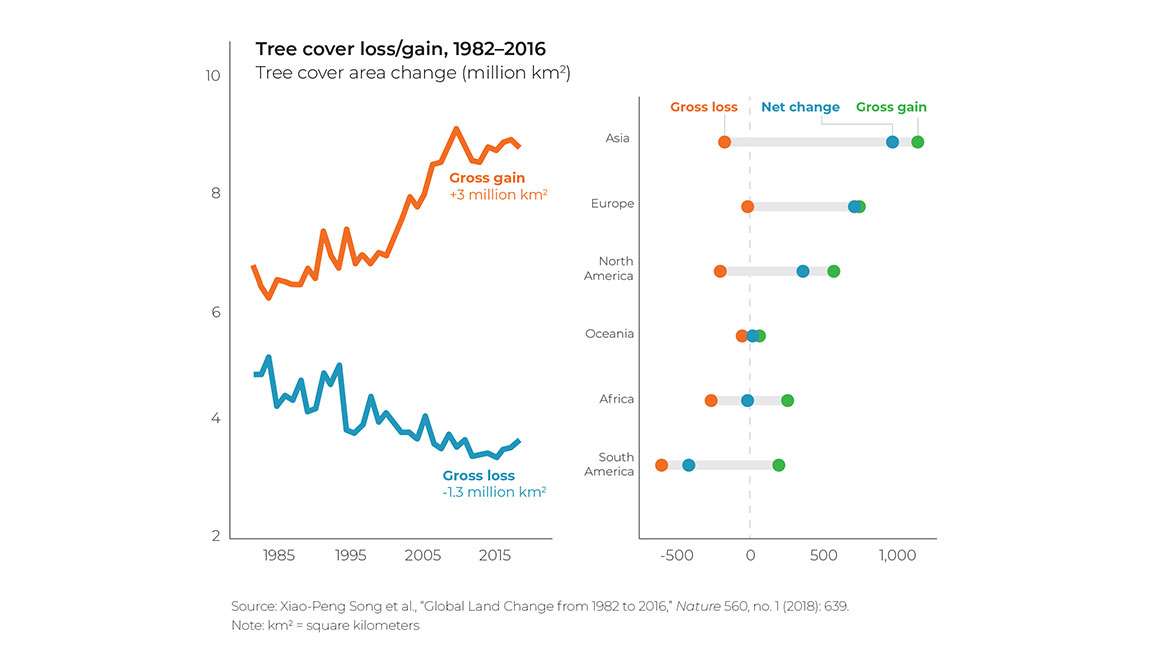
Developed land is already reverting to nature. In 2018, researchers at the University of Maryland reported that the global tree canopy increased by 865,000 square miles between 1982 and 2016. That’s a land area larger than Alaska and Montana combined. Using satellite data to track the changes in various land covers, the researchers found that gains in forest area in the temperate, subtropical, and boreal climatic zones are offsetting declines in the tropics.

Forest area is expanding even as areas of bare ground and short vegetation are shrinking. Furthermore, forests in mountainous regions are expanding as climate warming enables trees to grow at higher altitudes. A 2011 study found that global forest growth and regrowth act as a carbon sink, annually taking from the atmosphere between one-fourth and one-third of the total carbon dioxide emitted by the burning of fossil fuels.
The tree canopy in Europe, including European Russia, has increased by 35 percent since 1982—the greatest gain among all continents. The Maryland researchers attribute much of that increase to “natural afforestation on abandoned agricultural land,” which has been “a common process in Eastern Europe after the collapse of the Soviet Union.” The tree canopy in the United States and China has increased by 15 percent and 34 percent, respectively, since 1982.

Increasing global wealth, agricultural efficiency, and urbanization are also providing countries ever greater scope for taking active measures to protect and preserve natural land and seascapes.

Governments began formally setting aside protected parks and nature preserves in the late 19th century. The Yosemite Valley was dedicated in 1864 as a California state park, while Yellowstone National Park was established as the world’s first national park in 1872. As of 2018, according to a global database, protected areas covered about 15 percent of the earth’s land surface: about 7.7 million square miles. That area is nearly double the size of the entire United States. Marine protected areas now include more than 10 million square miles, nearly 7 percent of the global ocean and more than double the size of South America.

Humanity does face big environmental challenges in the coming century. But the bulk of scientific and economic evidence shows that most of the trends are positive or can be turned in a positive direction by human ingenuity. Rather than an age of extinction, the 21st century promises to be an era of environmental renewal.

from Latest – Reason.com https://ift.tt/3hdTPFJ
via IFTTT
Humanity and Wild Nature Will Likely Both Be Flourishing in 2100

topicsscience

“Human activity has wiped out two-thirds of the world’s wildlife since 1970,” CNN reported on September 10. Later that month, The Guardian reported that “40 percent of [the] world’s plant species [are] at risk of extinction.”

In an even more worrisome article, published by Proceedings of the National Academy of Sciences in July, Stanford biologist Paul Ehrlich and his colleagues asserted that “the ongoing sixth mass extinction may be the most serious environmental threat to the persistence of civilization.” Around the same time, The Daily Mail warned that “human civilization stands a 90 percent chance of collapse within decades due to deforestation.”

These dire calculations and projections come from authoritative-sounding reports issued by international agencies, conservation groups, and peer-reviewed scientific journals. But is the future of wild nature and human civilization really so bleak?

Not according to the demographic and ecological trends that Marian Tupy and I describe in our book Ten Global Trends Every Smart Person Should Know (Cato Institute). Data from uncontroversial mainstream sources strongly indicate that both humanity and the natural world are likely to be flourishing rather than collapsing at the end of this century.

World population, today about 7.7 billion, likely will peak at 8.9 billion by 2060 and decline to 7.8 billion by the end of this century. This projection is based on the fact that women around the world are choosing to have fewer children, causing the global average fertility rate (the number of children per woman of childbearing age) to plummet from 5 in 1960 to 2.4 now.

According to a July analysis in The Lancet, that rate will fall to 1.5 by the end of this century. Other global trends—such as steeply falling child mortality rates, increased urbanization, rising incomes, expanding education of women, and the spread of political and economic freedom—all strongly correlate with the choice to have fewer children.

Human ingenuity, enlarged through free markets, is also enabling us to get ever more goods and services from fewer and fewer resources. Arnulf Grubler, an energy researcher with the International Institute for Applied Systems Analysis, documents how modern smartphones “dematerialized” computers, calculators, cameras, televisions, radios, recorders, and many more gadgets, replacing equipment weighing a combined 57 pounds and using 72 watts of stand-by energy with a device that weighs 2 ounces and uses 2.5 watts. In recent research, Grubler outlines a scenario in which a larger and richer world population using disruptive social and technological innovations reduces the amount of food, fuel, metals, and minerals that humanity annually consumes from about 100 gigatons now to 83 gigatons by 2050.

Humanity is becoming an urban species, and that’s good for the environment, since city dwellers generally use less electricity, emit less globe-warming carbon dioxide, and have smaller land footprints than people living in the countryside. Today, about 55 percent of the world’s 7.7 billion people live in cities. That means about 3.5 billion still live on the landscape, many as subsistence farmers. By 2100, demographers project that 85 percent of people will be city dwellers, which would leave only 1.2 billion still living in the countryside.

The amount of farmland needed to sustain humanity peaked at the beginning of this century, according to data from the Organisation for Economic Co-operation and Development. Considering that agriculture is the most expansive and intensive way in which people transform natural landscapes, that is really good news for other species. The trend will reinforce ongoing depopulation of rural areas, freeing up ever greater swaths of land. In a reasonably optimistic scenario, increases in crop productivity will allow nearly 1 billion acres of farmland to revert to nature by 2060. That’s an area almost twice the size of the United States east of the Mississippi River.

Aquaculture is already supplying about half of the fish that humanity consumes. Much as rising crop productivity is freeing up land for nature, fish farming could help relieve pressure on overfished wild stocks in our oceans, lakes, and rivers. At the same time, awarding secure property rights to fishers would incentivize them to safeguard stocks, making the fisheries sustainable. As a result of such privatization in Iceland and New Zealand, their fish stocks, which had been declining, are now on the rise.

Developed land is already reverting to nature. In 2018, researchers at the University of Maryland reported that the global tree canopy increased by 865,000 square miles between 1982 and 2016. That’s a land area larger than Alaska and Montana combined. Using satellite data to track the changes in various land covers, the researchers found that gains in forest area in the temperate, subtropical, and boreal climatic zones are offsetting declines in the tropics.

Forest area is expanding even as areas of bare ground and short vegetation are shrinking. Furthermore, forests in mountainous regions are expanding as climate warming enables trees to grow at higher altitudes. A 2011 study found that global forest growth and regrowth act as a carbon sink, annually taking from the atmosphere between one-fourth and one-third of the total carbon dioxide emitted by the burning of fossil fuels.

The tree canopy in Europe, including European Russia, has increased by 35 percent since 1982—the greatest gain among all continents. The Maryland researchers attribute much of that increase to “natural afforestation on abandoned agricultural land,” which has been “a common process in Eastern Europe after the collapse of the Soviet Union.” The tree canopy in the United States and China has increased by 15 percent and 34 percent, respectively, since 1982.

Increasing global wealth, agricultural efficiency, and urbanization are also providing countries ever greater scope for taking active measures to protect and preserve natural land and seascapes.

Governments began formally setting aside protected parks and nature preserves in the late 19th century. The Yosemite Valley was dedicated in 1864 as a California state park, while Yellowstone National Park was established as the world’s first national park in 1872. As of 2018, according to a global database, protected areas covered about 15 percent of the earth’s land surface: about 7.7 million square miles. That area is nearly double the size of the entire United States. Marine protected areas now include more than 10 million square miles, nearly 7 percent of the global ocean and more than double the size of South America.

Humanity does face big environmental challenges in the coming century. But the bulk of scientific and economic evidence shows that most of the trends are positive or can be turned in a positive direction by human ingenuity. Rather than an age of extinction, the 21st century promises to be an era of environmental renewal.

from Latest – Reason.com https://ift.tt/3hdTPFJ
via IFTTT
UK Retailers Urge Government To Ensure Food Supplies As French Border Shut

UK Retailers Urge Government To Ensure Food Supplies As French Border Shut

Authored by Alexander Zhang via The Epoch Times,

British retailers have urged the government to make an urgent effort to prevent prolonged suspension of cross-Channel transport, which they say would disrupt supplies of fresh produce to UK consumers.

To prevent the spread of a new, more transmissible variant of the CCP (Chinese Communist Party) virus from the UK, the French government suspended all travel from the UK for 48 hours from 11 p.m. on Sunday night (midnight Paris time), including travel linked to goods transport by road, air, sea, or rail.

Sainsbury’s, one of the UK’s biggest supermarkets, urged the UK and French governments to work together to ensure food supplies to the UK market over the Christmas holidays.

It said it had plenty of food items in stock for Christmas, and was also sourcing products in the UK and looking into alternative transport for products sourced from Europe.

However, “if nothing changes, we will start to see gaps over the coming days on lettuce, some salad leaves, cauliflowers, broccoli and citrus fruit—all of which are imported from the Continent at this time of year,” it said in a statement emailed to The Epoch Times.

“We hope the UK and French governments can come to a mutually agreeable solution that prioritises the immediate passage of produce and any other food at the ports.”

UK business groups have also raised concerns to the government.

The British Retail Consortium (BRC) said the border closure “poses difficulties for UK capacity to import and export key goods during the busy Christmas period.”

“While goods can enter from France, few haulage firms will be willing to send trucks and drivers across to the UK without a guarantee they can return to the EU in a timely manner,” Andrew Opie, director of food and sustainability at the BRC, said in a statement.

“This is a key supply route for fresh produce at this time of year: the channel crossings see 10,000 trucks passing daily during peak periods such as in the run-up to Christmas,” he said. “We urge the UK government and the EU to find a pragmatic solution to this as soon as possible, to prevent disruption for consumers.”

The Food and Drink Federation (FDF), the UK’s representative body for the food and beverage manufacturing sector, said that the suspension of traffic could cause serious disruption to UK Christmas fresh food supplies as truckers from continental Europe “will not want to travel here if they have a real fear of getting marooned.”

In a thread on Twitter, Ian Wright, the chief executive of the FDF, urged the UK government to “urgently persuade the French government to exempt accompanied freight from its ban.”

Talking to the BBC on Monday morning, UK Transport Secretary Grant Shapps said he was working with his French counterpart to resolve the blockade.

“The shops are well stocked. So in the short term, the next 48 hours or so, this is not an issue in terms of supply, but we’re very, very keen to get it resolved,” he told BBC Radio 4’s “Today” programme.

Tyler Durden
Tue, 12/22/2020 – 05:00

via ZeroHedge News https://ift.tt/37DzF4L Tyler Durden

Brickbat: Unexcused Absence

emptydesk_1161x653

The New Mexico Department of Public Education has apologized for sending a truancy letter to the parents of Landon Fuller, asking them to report why their son was not enrolled this school year. Landon, 11, killed himself last April. Making the letter even worse, the parents had alerted Hobbs Municipal Schools and officially withdrawn Landon from school the day after his death. After his death, his parents found an entry in his journal complaining that classes were not in session and staying at home all the time and being unable to see his friends was driving him mad.

from Latest – Reason.com https://ift.tt/37DkecQ
via IFTTT